WO2024237142A1 - 鉄含有fer型ゼオライト及びその製造方法 - Google Patents
鉄含有fer型ゼオライト及びその製造方法 Download PDFInfo
- Publication number
- WO2024237142A1 WO2024237142A1 PCT/JP2024/017079 JP2024017079W WO2024237142A1 WO 2024237142 A1 WO2024237142 A1 WO 2024237142A1 JP 2024017079 W JP2024017079 W JP 2024017079W WO 2024237142 A1 WO2024237142 A1 WO 2024237142A1
- Authority
- WO
- WIPO (PCT)
- Prior art keywords
- less
- iron
- type zeolite
- fer
- mass
- Prior art date
- Legal status (The legal status is an assumption and is not a legal conclusion. Google has not performed a legal analysis and makes no representation as to the accuracy of the status listed.)
- Ceased
Links
Images


Classifications
-
- C—CHEMISTRY; METALLURGY
- C01—INORGANIC CHEMISTRY
- C01B—NON-METALLIC ELEMENTS; COMPOUNDS THEREOF; METALLOIDS OR COMPOUNDS THEREOF NOT COVERED BY SUBCLASS C01C
- C01B39/00—Compounds having molecular sieve and base-exchange properties, e.g. crystalline zeolites; Their preparation; After-treatment, e.g. ion-exchange or dealumination
- C01B39/02—Crystalline aluminosilicate zeolites; Isomorphous compounds thereof; Direct preparation thereof; Preparation thereof starting from a reaction mixture containing a crystalline zeolite of another type, or from preformed reactants; After-treatment thereof
- C01B39/44—Ferrierite type, e.g. types ZSM-21, ZSM-35 or ZSM-38
-
- B—PERFORMING OPERATIONS; TRANSPORTING
- B01—PHYSICAL OR CHEMICAL PROCESSES OR APPARATUS IN GENERAL
- B01D—SEPARATION
- B01D53/00—Separation of gases or vapours; Recovering vapours of volatile solvents from gases; Chemical or biological purification of waste gases, e.g. engine exhaust gases, smoke, fumes, flue gases, aerosols
- B01D53/34—Chemical or biological purification of waste gases
- B01D53/92—Chemical or biological purification of waste gases of engine exhaust gases
- B01D53/94—Chemical or biological purification of waste gases of engine exhaust gases by catalytic processes
-
- B—PERFORMING OPERATIONS; TRANSPORTING
- B01—PHYSICAL OR CHEMICAL PROCESSES OR APPARATUS IN GENERAL
- B01J—CHEMICAL OR PHYSICAL PROCESSES, e.g. CATALYSIS OR COLLOID CHEMISTRY; THEIR RELEVANT APPARATUS
- B01J29/00—Catalysts comprising molecular sieves
- B01J29/88—Ferrosilicates; Ferroaluminosilicates
-
- C—CHEMISTRY; METALLURGY
- C01—INORGANIC CHEMISTRY
- C01B—NON-METALLIC ELEMENTS; COMPOUNDS THEREOF; METALLOIDS OR COMPOUNDS THEREOF NOT COVERED BY SUBCLASS C01C
- C01B39/00—Compounds having molecular sieve and base-exchange properties, e.g. crystalline zeolites; Their preparation; After-treatment, e.g. ion-exchange or dealumination
- C01B39/02—Crystalline aluminosilicate zeolites; Isomorphous compounds thereof; Direct preparation thereof; Preparation thereof starting from a reaction mixture containing a crystalline zeolite of another type, or from preformed reactants; After-treatment thereof
- C01B39/44—Ferrierite type, e.g. types ZSM-21, ZSM-35 or ZSM-38
- C01B39/445—Ferrierite type, e.g. types ZSM-21, ZSM-35 or ZSM-38 using at least one organic template directing agent
-
- B—PERFORMING OPERATIONS; TRANSPORTING
- B01—PHYSICAL OR CHEMICAL PROCESSES OR APPARATUS IN GENERAL
- B01J—CHEMICAL OR PHYSICAL PROCESSES, e.g. CATALYSIS OR COLLOID CHEMISTRY; THEIR RELEVANT APPARATUS
- B01J37/00—Processes, in general, for preparing catalysts; Processes, in general, for activation of catalysts
- B01J37/08—Heat treatment
- B01J37/10—Heat treatment in the presence of water, e.g. steam
-
- C—CHEMISTRY; METALLURGY
- C01—INORGANIC CHEMISTRY
- C01P—INDEXING SCHEME RELATING TO STRUCTURAL AND PHYSICAL ASPECTS OF SOLID INORGANIC COMPOUNDS
- C01P2002/00—Crystal-structural characteristics
- C01P2002/80—Crystal-structural characteristics defined by measured data other than those specified in group C01P2002/70
- C01P2002/84—Crystal-structural characteristics defined by measured data other than those specified in group C01P2002/70 by UV- or VIS- data
-
- C—CHEMISTRY; METALLURGY
- C01—INORGANIC CHEMISTRY
- C01P—INDEXING SCHEME RELATING TO STRUCTURAL AND PHYSICAL ASPECTS OF SOLID INORGANIC COMPOUNDS
- C01P2006/00—Physical properties of inorganic compounds
- C01P2006/80—Compositional purity
Definitions
- This disclosure relates to iron-containing FER-type zeolite and a method for producing the same.
- FER-type zeolites containing iron as a transition metal element have been investigated as transition metal-containing zeolites that can be used as nitrogen oxide reduction catalysts in which the by-production of N 2 O is suppressed (for example, Patent Documents 1 to 4).
- Patent Documents 1 to 3 report that by mixing FER-type zeolite with an aqueous solution containing an iron salt such as iron nitrate, iron can be incorporated into the FER-type zeolite through post-treatment.
- Patent Document 4 also reports that iron-containing FER-type zeolite can be directly obtained by crystallizing a raw material containing iron.
- the FER-type zeolite containing directly crystallized iron disclosed in Patent Document 4 has high nitrogen oxide reduction properties.
- the crystallization in Patent Document 4 requires expensive hexamethylimine as an essential raw material, so the resulting FER-type zeolite is also expensive, making it difficult to apply industrially.
- the present disclosure aims to provide at least one of a FER-type zeolite that produces less N 2 O in nitrogen oxide reduction compared to conventional iron-containing FER-type zeolites and is industrially applicable, a method for producing the same, and a nitrogen oxide reduction catalyst containing the same.
- iron-containing FER-type zeolite improves the nitrogen oxide reduction characteristics of iron-containing FER-type zeolite.
- iron-containing FER-type zeolite can be directly crystallized without requiring an expensive organic structure-directing agent such as hexamethylimine by controlling the raw materials and conditions for crystallization.
- such iron-containing FER-type zeolite has a different iron presence state and a high iron dispersion state compared to conventional iron-containing FER-type zeolites, and furthermore, it is possible to further suppress the generation of N 2 O in nitrogen oxide reduction at low temperatures compared to conventional iron-containing FER-type zeolites.
- a FER-type zeolite containing iron in which the area ratio of a peak in a spectrum having a wavelength of 300 nm or more and 600 nm or less to a peak in a wavelength of 190 nm or more and 600 nm or less in a UV-VIS spectrum is 20% or less.
- [3] The FER type zeolite according to the above [1] or [2], in which the area ratio of the peak in the spectrum having a wavelength of 190 nm or more and less than 300 nm to the peak in the wavelength of 190 nm or more and 600 nm or less in the UV-VIS spectrum is 80% or more.
- [5] The FER type zeolite according to any one of the above [1] to [4], wherein the molar ratio of silica to alumina is 5 or more and 50 or less.
- the alkali source includes at least a sodium source or a potassium source.
- a FER-type zeolite that produces less N 2 O in nitrogen oxide reduction compared to conventional iron-containing FER-type zeolites and is industrially applicable, a method for producing the same, and a nitrogen oxide reduction catalyst containing the same.
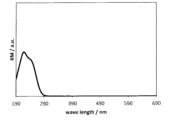
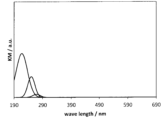
- UV-VIS spectrum of iron-containing FER type zeolite of Example 1 UV-VIS spectrum of iron-containing FER type zeolite of Example 1 (after waveform separation)
- UV-VIS spectrum of iron-containing FER type zeolite of Example 3 UV-VIS spectrum of iron-containing FER type zeolite of Example 3 (after waveform separation)
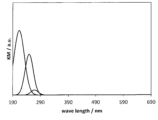
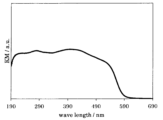
- UV-VIS spectrum of iron-containing FER type zeolite of Comparative Example 1 UV-VIS spectrum of iron-containing FER-type zeolite of Comparative Example 1 (after waveform separation)
- Zeolite is a compound in which the skeleton atoms (hereinafter also referred to as "T atoms”) have a regular structure with oxygen (O) interposed therebetween, and the T atoms are at least one of metal atoms and/or metalloid atoms.
- the metal atoms include one or more selected from the group consisting of aluminum (Al), titanium (Ti), iron (Fe), zinc (Zn), gallium (Ga) and tin (Sn), with at least one of aluminum and iron being preferred, and aluminum being more preferred.
- the metalloid atoms include one or more selected from the group consisting of boron (B), silicon (Si), germanium (Ge), arsenic (As), antimony (Sb) and tellurium (Te), with silicon being preferred.
- Zerolite-like substances are compounds in which the T atoms have a regular structure with oxygen interposed therebetween, and the T atoms contain at least an atom other than a metal or a metalloid (hereinafter also referred to as a "nonmetal atom").
- An example of a nonmetal atom is phosphorus (P).
- Examples of zeolite-like substances include complex phosphorus compounds containing phosphorus (P) as the T atom, such as aluminophosphate (AlPO) and silicoaluminophosphate (SAPO). For clarity, in this embodiment, zeolite does not include zeolite-like substances.
- the "regular structure” in zeolites and zeolite-like substances is a skeletal structure specified by a structure code (hereinafter also referred to simply as “structure code”) defined by the Structure Commission of the International Zeolite Association.
- structure code a structure code defined by the Structure Commission of the International Zeolite Association.
- the FER structure is a skeletal structure specified by the structure code "FER”.
- Zeolite structures can be identified by comparing with the XRD pattern (hereinafter also referred to as "reference pattern”) described in the CHA of Zeolite Framework Types on the IZA Structure Commission's website http://www.iza-structure.org/databases/.
- the terms zeolite structure, skeletal structure, crystal structure, and crystal phase are used interchangeably.
- -type zeolite such as "FER-type zeolite” refers to a zeolite having a zeolite structure with the corresponding structure code.
- Al aluminum
- Si silicon
- oxygen oxygen
- crystalline aluminosilicates those that have a crystalline XRD peak in their powder X-ray diffraction (hereinafter also referred to as "XRD") pattern are called “crystalline aluminosilicates”, and those that do not have a crystalline XRD peak are called “amorphous aluminosilicates”.
- the XRD pattern can be measured using a general powder X-ray diffractometer (e.g., UltimaIV Protectus, manufactured by Rigaku Corporation).
- the present embodiment is a FER type zeolite that contains iron and has a peak area ratio of a spectrum having a wavelength of 300 nm or more and 600 nm or less to a peak having a wavelength of 190 nm or more and 600 nm or less in a UV-VIS spectrum of 20% or less.
- This embodiment relates to a FER-type zeolite containing iron (hereinafter also referred to as "iron-containing FER-type zeolite”), which is a zeolite having a crystal structure consisting only of a FER structure, and further, a FER-type crystalline aluminosilicate.
- iron-containing FER-type zeolite a zeolite having a crystal structure consisting only of a FER structure, and further, a FER-type crystalline aluminosilicate.
- the area ratio of the spectral peak having a wavelength of 300 nm or more and 600 nm or less to the peak having a wavelength of 190 nm or more and 600 nm or less in the UV-VIS spectrum (hereinafter also referred to as the "300 nm-600 nm spectral intensity ratio") is 20% or less.
- the presence of iron can be confirmed by the presence of a peak having a wavelength of 190 nm or more and 600 nm or less, and the more highly dispersed the iron is, the lower the wavelength of the peak can be confirmed.
- iron is contained as one or more iron species selected from the group consisting of isolated iron (Fe 3+ ), iron clusters (Fe x O y ), and iron oxide (Fe 2 O 3 ) particles.
- the peaks with wavelengths of 190 nm or more and less than 300 nm can be regarded as peaks corresponding to isolated iron (Fe 3+ ), the peaks with wavelengths of 300 nm or more and 400 nm or less can be regarded as peaks corresponding to iron clusters (Fe x O y ), and the peaks with wavelengths of more than 400 nm and 600 nm or less can be regarded as peaks corresponding to iron oxide (Fe 2 O 3 ) particles.
- the area ratio of the peak having a wavelength of 190 nm or more and less than 300 nm to the peak having a wavelength of 190 nm or more and less than 600 nm in the UV-VIS spectrum (hereinafter also referred to as the "190 nm-300 nm spectral intensity ratio”) is 70% or more, 80% or more, or 90% or more, and is preferably 100% or less, less than 100%, or 99% or less, and examples of such ratios include 70% or more and 100% or less, 80% or more and less than 100%, or 90% or more and 99% or less.
- the area ratio of the peak having a wavelength of 300 nm or more and 400 nm or less to the peak having a wavelength of 190 nm or more and 600 nm or less in the UV-VIS spectrum (hereinafter also referred to as the "300 nm-400 nm spectral intensity ratio”) is 20% or less, 5.0% or less, 3.0% or less, or 1.0% or less, and preferably 0% or more, more than 0%, or 0.1% or more, and examples of such ratio include 0% or more and 20% or less, 0% or more and 5.0% or less, 0% or more and 3.0% or less, more than 0% and 3.0% or less, or 0.1% or more and 1.0% or less.
- the area ratio of the peak having a wavelength of more than 400 nm and less than 600 nm to the peak having a wavelength of 190 nm or more and less than 600 nm in the UV-VIS spectrum (hereinafter also referred to as the "400 nm-600 nm spectral intensity ratio") is 20% or less, 5.0% or less, 3.0% or less, or 1.0% or less, and preferably 0% or more, more than 0%, or 0.1% or more, and examples of such ratio include 0% or more and less than 20%, 0% or more and less than 5.0%, 0% or more and less than 3.0%, more than 0% and less than 3.0%, or 0.1% or more and less than 1.0%.
- spectral intensity ratios [%] correspond to the abundance ratios [%] of iron species in the iron-containing FER-type zeolite, with the 190 nm-300 nm spectral intensity ratio corresponding to the abundance ratio [%] of isolated iron (Fe 3+ ), the 300 nm-400 nm spectral intensity ratio corresponding to the abundance ratio [%] of iron clusters (Fe x O y ), and the 400 nm-600 nm spectral intensity ratio corresponding to the abundance ratio [%] of iron oxide particles (Fe 2 O 3 ).
- the iron-containing FER type zeolite of this embodiment can also be regarded as a FER type zeolite that contains iron and has an abundance ratio of iron clusters and iron oxide particles of 20% or less, or the iron-containing FER type zeolite of this embodiment can also be regarded as a FER type zeolite that contains iron and has an abundance ratio of isolated iron of 80% or more.
- the total presence ratio of isolated iron, iron clusters, and iron oxide particles is 100%
- the abundance ratio of isolated iron is 70% or more, 80% or more, or 90% or more, and is preferably 100% or less, less than 100%, or 99% or less, and more preferably 70% or more and 100% or less, 80% or more and less than 100%, or 90% or more and 99% or less
- the proportion of iron clusters is 20% or less, 5.0% or less, 3.0% or less, or 1.0% or less, and is preferably 0% or more, more than 0%, or 0.1% or more, and is preferably 0% or more and 20% or less, 0% or more and 5.0% or less, 0% or more and 3.0% or less, more than 0% and 3.0% or less, or 0.1% or more and 1.0% or less
- the proportion of iron oxide particles is 20% or less, 5.0% or less, 3.0% or less, or 1.0% or less, and is preferably 0% or more, more than 0%, or 0.1%
- the UV-VIS spectrum in this embodiment may be measured using a general ultraviolet-visible spectrophotometer (e.g., UV-visible spectrophotometer V-770, manufactured by JASCO Corporation) under the following conditions.
- Integrating sphere unit ISN-923 (JASCO Corporation) Measurement mode: Diffuse reflection method Wavelength: 190-700 nm Temperature: Room Slit width: 5 nm Background: Barium sulfate
- the obtained UV-VIS spectrum is corrected so that the reflectance of the iron-containing FER-type zeolite of this embodiment relative to the reflectance of barium sulfate at a wavelength of 700 nm (hereinafter also referred to as " ⁇ " or “relative reflectance”) is 1, and then the corrected UV-VIS spectrum is subjected to KM (Kubelka-Munk) conversion using the KM function (f( ⁇ )) of the following equation.
- f( ⁇ ) (1 ⁇ ) 2 /2 ⁇
- the UV-VIS spectrum after KM conversion is fitted and separated using general analysis software (e.g., Fityk 0.9.8) with a Gaussian fitting function, and then the peak areas are calculated for wavelengths of 190 nm or more and less than 300 nm, 300 nm or more and less than 400 nm, and 400 nm or more and less than 600 nm, and the sum of these is taken as the peak area for wavelengths of 190 nm or more and less than 600 nm.
- the area ratio can be calculated from the ratio of the peak area for each wavelength range to the obtained peak area for wavelengths of 190 nm or more and less than 600 nm.
- the iron content is 0.1 mass% or more, 0.5 mass% or more, or 1.0 mass% or more, and 5.0 mass% or less, or 3.5 mass% or less, and preferably 0.1 mass% or more and 5.0 mass% or less, or 1.0 mass% or more and 5.0 mass% or less, or 1.0 mass% or more and 3.5 mass% or less.
- the "iron content” is the mass ratio [mass%] of iron (Fe) relative to the mass of the iron-containing FER type zeolite.
- the mass of the iron-containing FER type zeolite is the total mass of aluminum in terms of Al2O3 , silicon in terms of SiO2 , and iron (Fe) contained in the iron-containing FER type zeolite.
- the mass of the iron-containing FER type zeolite may be determined by mass measurement after treatment in an air atmosphere at 100°C for 2 hours.
- the iron-containing FER-type zeolite of this embodiment preferably contains a large amount of isolated iron, and the content of isolated iron in the iron content (hereinafter also referred to as "isolated Fe 3+ content”) is preferably 1.0 mass% or more, 1.2 mass% or more, or 1.5 mass% or more. It is preferable that the isolated Fe 3+ content is high, and in that case, the isolated Fe 3+ content is the same as the upper limit value of the iron content, for example, 5.0 mass% or less or 3.5 mass% or less. Preferred isolated Fe 3+ contents are 1.0 mass% or more and 5.0 mass% or less, 1.2 mass% or more and 3.5 mass% or less, or 1.5 mass% or more and 3.5 mass% or less.
- iron needs to be contained in a state that functions as an active metal, and needs to be present on the surface, in the pores, and at the ion exchange sites of the FER-type zeolite, and preferably present at least in the pores. Note that the iron-containing FER-type zeolite of this embodiment does not need to have iron substituted into the framework structure.
- the iron-containing FER-type zeolite of this embodiment may contain iron as an active metal, but may also contain active metals other than iron, such as one or more elements selected from the group consisting of copper (Cu), manganese (Mn), zirconium (Zr), yttrium (Y), cerium (Ce), lanthanum (La) and calcium (Ca), and further at least one of copper and manganese, or even copper.
- active metals other than iron such as one or more elements selected from the group consisting of copper (Cu), manganese (Mn), zirconium (Zr), yttrium (Y), cerium (Ce), lanthanum (La) and calcium (Ca), and further at least one of copper and manganese, or even copper.
- the molar ratio of silica to alumina in the iron-containing FER-type zeolite of this embodiment may be any value that makes it difficult for crystal collapse to occur when exposed to a high-temperature, high-humidity atmosphere, and may be 5 or more, 10 or more, or 15 or more, and may be 50 or less, 30 or less, or 20 or less, and is preferably 5 or more and 50 or less, 10 or more and 30 or less, or 15 or more and 20 or less.
- the iron-containing FER type zeolite of this embodiment preferably does not substantially contain fluorine (F), and further preferably has a fluorine content of 0 ppm by mass.
- the fluorine content of the iron-containing FER type zeolite of this embodiment may be below the measurement limit, and is preferably, for example, from 0 ppm by mass to 100 ppm by mass, further preferably from 0 ppm by mass to 50 ppm by mass, and further preferably from 0 ppm by mass to 5 ppm by mass.
- the shape of the iron-containing FER-type zeolite of this embodiment may be any shape appropriate for the application, and may be, for example, at least one of a powder and a molded body.
- the powder may be applied or wash-coated to a substrate such as a honeycomb to form a catalyst member.
- the initial shape may be any shape appropriate for the application, and may be one or more selected from the group consisting of spherical, approximately spherical, elliptical, disk-like, cylindrical, polyhedral, irregular, and petal-like.
- the iron-containing FER-type zeolite of this embodiment can be used in known applications of zeolites, for example, as one or more selected from the group consisting of catalysts, adsorbents, and carriers thereof, and can also be used as at least one of a catalyst and a catalyst carrier.
- the iron-containing FER-type zeolite of this embodiment is suitable for use as at least one of a nitrogen oxide reduction catalyst and its support, and further as a nitrogen oxide reduction catalyst, and further as a nitrogen oxide reduction catalyst by selective catalytic reduction.
- the iron-containing FER type zeolite of this embodiment when used as a nitrogen oxide reduction catalyst, it may be used as a method for reducing nitrogen oxides that includes a step of contacting the iron-containing FER type zeolite of this embodiment with a nitrogen oxide-containing gas (hereinafter also referred to as the "contact step").
- the nitrogen oxide-containing gas may be any gas containing nitrogen oxide (NOx), and is preferably a gas containing at least dinitrogen monoxide (N 2 O), and more preferably a gas containing one or more selected from the group consisting of nitric oxide, nitrogen dioxide, dinitrogen trioxide, dinitrogen tetroxide, and dinitrogen monoxide, and even more preferably a gas containing one or more selected from the group consisting of nitric oxide, nitrogen dioxide, and dinitrogen monoxide.
- the nitrogen oxide-containing gas may contain components other than nitrogen oxide, and may contain one or more selected from the group consisting of hydrocarbons, carbon monoxide, carbon dioxide, hydrogen, nitrogen, oxygen, sulfur oxides, and water. Specific examples of nitrogen oxide-containing gas include waste gas discharged from an internal combustion engine, and waste gas discharged from one or more selected from the group consisting of automobiles, ships, boilers, and gas turbines.
- any conditions may be used so long as the iron-containing FER-type zeolite of this embodiment comes into contact with the nitrogen oxide-containing gas, and examples of the contact conditions include the following conditions.
- Space velocity 500 to 500,000 h -1 , preferably 2,000 to 300,000 h -1
- Contact temperature 120°C or higher and 600°C or lower, preferably 150°C or higher and 550°C or lower
- the contact in the contact step is preferably carried out in the presence of a reducing agent, which may be one or more selected from the group consisting of ammonia, urea, organic amines, hydrocarbons, alcohols, ketones, carbon monoxide, and hydrogen, at least one or more of ammonia, hydrocarbons, urea, and organic amines, at least one of ammonia and hydrocarbons, or ammonia.
- a reducing agent which may be one or more selected from the group consisting of ammonia, urea, organic amines, hydrocarbons, alcohols, ketones, carbon monoxide, and hydrogen, at least one or more of ammonia, hydrocarbons, urea, and organic amines, at least one of ammonia and hydrocarbons, or ammonia.
- a preferred method for producing the iron-containing FER type zeolite of the present embodiment includes a method for producing a FER type zeolite, the method including a step of crystallizing a composition that contains a silica-alumina source, an iron source, an alkali source, and water, and in which the molar ratio of iron to silicon calculated as SiO2 is less than 0.1.
- the conventional method for producing iron-containing FER-type zeolite is FER-type zeolite.
- the manufacturing method of this embodiment includes a step of crystallizing a composition (hereinafter also referred to as a "raw material composition") that contains a silica-alumina source, an iron source, an alkali source, and water, and has a molar ratio of iron to silicon calculated as SiO2 of less than 0.1 (hereinafter also referred to as a “crystallization step").
- a composition hereinafter also referred to as a "raw material composition” that contains a silica-alumina source, an iron source, an alkali source, and water, and has a molar ratio of iron to silicon calculated as SiO2 of less than 0.1
- the silica-alumina source is a compound containing aluminum (Al) and silicon (Si), and is preferably an amorphous compound containing aluminum and silicon.
- a specific example of a silica-alumina source is amorphous aluminosilicate. In this embodiment, it is believed that crystallization proceeds in a state where the dispersion of iron is promoted, compared to when an aluminum source and a silicon source are separately contained.
- the iron source is a compound containing iron, and may be any iron compound that is uniformly dispersed in the raw material composition.
- Specific iron compounds include one or more selected from the group consisting of iron nitrate, iron sulfate, iron oxide, iron chloride, and iron oxyhydroxide, and further one or more selected from the group consisting of iron hydroxide, iron sulfate, and iron nitrate, and further at least one of iron sulfate and iron nitrate, and further still iron sulfate.
- the alkaline source is a compound containing an alkali metal element, and examples thereof include compounds containing one or more selected from the group consisting of sodium, potassium, rubidium, and cesium, compounds containing one or more selected from the group consisting of sodium, potassium, and cesium, compounds containing at least one of sodium and potassium, and compounds containing sodium.
- alkaline source examples include one or more selected from the group consisting of hydroxides, fluorides, bromides, iodides, sulfates, nitrates, and carbonates containing the above-mentioned alkali metal elements, one or more selected from the group consisting of hydroxides, bromides, and iodides, or hydroxides.
- the alkali source preferably contains at least a sodium source or a potassium source, more preferably contains at least a potassium source, even more preferably contains a sodium source and a potassium source, and even more preferably contains a sodium source and a potassium source.
- water contained in other starting materials such as structural water, hydration water, and solvents can also be considered as water in the raw material composition.
- the starting materials such as the iron source
- these starting materials may also be considered as alkali sources.
- the iron source contains aluminum, the iron source is also considered as an alumina source.
- the raw material composition does not contain an organic structure directing agent (hereinafter also referred to as "SDA") source, and it is particularly preferable that it does not contain hexamethyleneimine.
- the raw material composition may contain an SDA source.
- the organic structure directing agent source is at least one of SDA and its compounds that can direct FER-type zeolite, and may be an amine compound that can direct FER-type zeolite.
- the SDA source is an inexpensive amine compound, for example, an amine other than hexamethyleneimine, and further one or more selected from the group of pyridine, pyrrolidine, cyclohexylamine, and butylamine, and further one or more selected from the group of pyridine, pyrrolidine, and butylamine.
- the molar ratio of iron to aluminum in terms of Al2O3 and silicon in terms of SiO2 in the raw material composition (hereinafter also referred to as " SiO2 / Al2O3 " ) can be 5 or more, 10 or more, or 15 or more, and can be 50 or less, 30 or less, 25 or less, or 18 or less, and is preferably 5 or more and 50 or less, 10 or more and 30 or less, or 15 or more and 25 or less.
- the molar ratio of iron to silicon converted to SiO2 in the raw material composition (hereinafter also referred to as "Fe/SiO2”) is preferably less than 0.1, and 0.05 or less, or 0.03 or less. If Fe/ SiO2 exceeds 0.1, the iron will be incorporated into the FER zeolite in a low activity state, such as by agglomeration.
- the lower limit of Fe / SiO2 in the raw material composition may be greater than 0, 0.001 or more, or 0.01 or more, and examples thereof include greater than 0 and less than 0.1, greater than 0 and 0.5 or less, 0.001 or more and 0.5 or less, 0.01 or more and 0.05 or less, or 0.01 or more and 0.03 or less.
- M/ SiO2 The total molar ratio of alkali metal elements to silicon in terms of SiO2 in the raw material composition (hereinafter also referred to as "M/ SiO2 ”) is less than 0.40, 0.38 or less, or 0.30 or less, and preferably 0.05 or more, 0.20 or more, or 0.25 or more.
- Preferred M/ SiO2 include 0.05 or more and less than 0.40, 0.20 or more and 0.38 or less, or 0.25 or more and 0.30 or less.
- the total molar ratio of potassium to silicon, calculated as SiO2, in the raw material composition (hereinafter also referred to as "K/ SiO2 ") is less than 0.40, 0.30 or less, or 0.15 or less, and may be 0 or more, greater than 0, or 0.1 or more, and is preferably greater than 0 but less than 0.40, 0.1 or more and 0.30 or less, or 0.1 or more and 0.15 or less.
- the molar ratio of water (H 2 O) to silicon converted to SiO 2 in the raw material composition may be 50 or less, and preferably 40 or less or 25 or less.
- H 2 O/SiO 2 may be 5 or more, 10 or more, or 13 or more, and preferably 5 or more and 40 or less, 10 or more and 40 or less, or 13 or more and 25 or less.
- M is an alkali metal.
- the alkali metals are sodium and potassium, M can be regarded as (Na+K).
- the following molar compositions are particularly preferred for the raw material composition.
- the raw material composition does not contain fluorine (F) and phosphorus (P), and the fluorine content is preferably 100 ppm by mass or less, and even below the detection limit (10 ppm by mass or less). Similarly, it is preferable that the phosphorus content is 100 ppm by mass or less, and even below the detection limit (0.01 ppm by mass or less).
- the raw material composition may contain seed crystals to promote crystallization of the raw material composition.
- the seed crystals may be any zeolite that promotes crystallization of FER type zeolite, and are preferably one or more selected from the group consisting of CHA type zeolite, AEI type zeolite, MOR type zeolite, FER type zeolite, and AFX type zeolite, with FER type zeolite being more preferred.
- the raw material composition is crystallized.
- iron-containing FER type zeolite can be obtained as a crystallized product.
- the crystallization may be performed by hydrothermal treatment under conditions that allow the iron-containing FER type zeolite to crystallize. The following conditions may be mentioned as preferable crystallization conditions.
- Pressure Autogenous pressure Crystallization temperature: 100°C or more, 160°C or more, or 175°C or more, and 200°C or less or 190°C or less
- the crystallization time may be any time that allows the iron-containing FER-type zeolite to crystallize sufficiently, and may be set appropriately depending on the amount of the raw material composition to be subjected to crystallization and the crystallization method.
- Examples of the crystallization time include 4 hours or more, 8 hours or more, 24 hours or more, or 48 hours or more, and 150 hours or less, 100 hours or less, or 80 hours or less.
- the crystallization time is preferably 4 hours or more and 150 hours or less, 8 hours or more and 100 hours or less, or 24 hours or more and 48 hours or less.
- the raw material composition may be stirred directly, or the container containing the raw material composition may be stirred.
- the crystallized product (iron-containing FER-type zeolite) may be recovered by any method, for example by solid-liquid separation, washing, drying, and then recovering the product.
- the solid-liquid separation may be any method capable of separating the raw material composition after crystallization into a solid phase (crystallized material) and a liquid phase, and may be, for example, one or more methods selected from the group consisting of filtration, decantation, and centrifugation.
- the washing may be performed by any method capable of removing impurities contained in the recovered crystallized material, for example, washing with pure water.
- the drying may be performed by any method capable of removing moisture physically adsorbed on the crystallized material, for example at least one of static drying and spray drying, in the air at 100°C or higher and 120°C or lower.
- the manufacturing method of this embodiment may include a step of removing an organic structure-directing agent from the crystallized product (hereinafter, also referred to as an "SDA removal step").
- SDA removal step any SDA removal method may be used, and examples thereof include one or more selected from the group consisting of liquid phase treatment with an acidic aqueous solution, exchange treatment with a resin, pyrolysis treatment, and calcination treatment.
- the SDA removal step is preferably at least one of pyrolysis treatment and calcination treatment, and calcination treatment is more preferable. Examples of preferable calcination conditions include the following conditions. Firing atmosphere: air atmosphere Firing temperature: 400°C or higher or 560°C or higher, and 700°C or less or 650°C or less
- the firing time can be set appropriately depending on the crystallized material to be fired and the firing method, and can be, for example, from 1 hour to 10 hours, from 2 hours to 8 hours, or from 3 hours to 5 hours.
- the manufacturing method of this embodiment may include a step of ion-exchanging the iron-containing FER-type zeolite (hereinafter also referred to as the "ion-exchange step") in order to reduce the alkali metal content of the iron-containing FER-type zeolite.
- the ion-exchange may be any method that reduces the alkali metal content, and an example of the method is mixing the iron-containing FER-type zeolite with an ammonium chloride aqueous solution and then performing ion-exchange.
- the iron-containing FER-type zeolite after ion exchange may be calcined.
- the manufacturing method of this embodiment may include a step of mixing the iron-containing FER-type zeolite with a metal compound (hereinafter also referred to as a "metal loading step") in addition to or instead of the ion exchange step.
- a metal compound hereinafter also referred to as a "metal loading step”
- the mixing method may be any method that can support the metal compound on the iron-containing FER-type zeolite, and may be one or more methods selected from the group consisting of ion exchange method, impregnation method, evaporation to dryness method, precipitation method, and physical mixing method.
- a sample solution was prepared by dissolving the sample in a mixed aqueous solution of hydrofluoric acid and nitric acid.
- the sample solution was measured by inductively coupled plasma atomic emission spectrometry (ICP-AES) using an ICP device (device name: OPTIMA 5300DV, manufactured by PerkinElmer).
- ICP-AES inductively coupled plasma atomic emission spectrometry
- OPTIMA 5300DV manufactured by PerkinElmer
- the UV-Vis spectrum of the sample was measured using an ultraviolet-visible spectrophotometer (apparatus name: ultraviolet-visible spectrophotometer V-770, manufactured by JASCO Corporation).
- the obtained crystallized product was subjected to solid-liquid separation and washed with pure water. Thereafter, the crystallized product was collected by drying in the air at 110° C.
- the crystallized product was a zeolite consisting of a single phase of FER type zeolite, and had a SiO 2 /Al 2 O 3 ratio of 18.0.
- the obtained crystallized material was calcined in air at 600°C for 2 hours, and then ion-exchanged with a 20% by mass aqueous solution of ammonium chloride at 60°C. After ion-exchange, the crystallized material was washed with a sufficient amount of pure water and dried in air at 110°C to obtain the iron-containing FER-type zeolite of this example.
- the iron-containing FER type zeolite of this example was a zeolite consisting of a single phase of FER type zeolite, with SiO 2 /Al 2 O 3 of 18.0, an alkali metal content of less than 0.1 mass%, and an Fe content of 1.4 mass%.
- the 190 nm-300 nm spectrum intensity ratio (abundance ratio of isolated iron) was 99.8%
- the 300 nm-400 nm spectrum intensity ratio (abundance ratio of cluster iron) was 0.2%
- the 400 nm-600 nm spectrum intensity ratio (abundance ratio of iron oxide particles) was 0%
- the 300 nm-600 nm spectrum intensity ratio was 0.2%
- the isolated Fe 3+ content was 1.4 mass%.
- the 2 ⁇ of the peak top of the XRD peak of the (200) plane was 9.3.
- Example 2 The iron-containing FER-type zeolite of this example was obtained in the same manner as in Example 1, except that the raw material composition had the following molar composition.
- SiO 2 /Al 2 O 3 17.9
- the iron-containing FER type zeolite of this example was a zeolite consisting of a single phase of FER type zeolite, and had a SiO2 / Al2O3 of 18.2, an alkali metal content of less than 0.1 mass%, and an Fe content of 2.0 mass%.
- the 2 ⁇ of the peak top of the XRD peak of the (200) plane was 9.3.
- Example 3 The iron-containing FER-type zeolite of this example was obtained in the same manner as in Example 1, except that the raw material composition had the following molar composition.
- the iron-containing FER type zeolite of this example was a zeolite consisting of a single phase of FER type zeolite, with SiO 2 /Al 2 O 3 of 18.4, an alkali metal content of less than 0.1 mass%, and an Fe content of 3.0 mass%.
- the 190 nm-300 nm spectrum intensity ratio (abundance ratio of isolated iron) was 99.7%
- the 300 nm-400 nm spectrum intensity ratio (abundance ratio of cluster iron) was 0.3%
- the 400 nm-600 nm spectrum intensity ratio (abundance ratio of iron oxide particles) was 0%
- the 300 nm-600 nm spectrum intensity ratio was 0.3%
- the isolated Fe 3+ content was 3.0 mass%.
- the 2 ⁇ of the peak top of the XRD peak of the (200) plane was 9.3.
- the obtained crystallized product was a zeolite consisting of a single phase of FER type zeolite, and had a SiO 2 /Al 2 O 3 ratio of 18.7.
- the obtained crystallized material was calcined at 600°C for 2 hours in air.
- the alkali metal content in the dried sample was less than 0.1% by mass.
- 7.0 g of the dried sample, 1.6 g of iron (III) nitrate nonahydrate, and 2.4 g of pure water were mixed in a mortar.
- the homogeneously mixed sample was dried at 110°C for 5 hours in air, and then calcined at 500°C for 2 hours to obtain the iron-containing FER-type zeolite of this comparative example.
- the iron-containing FER type zeolite of this comparative example was a zeolite consisting of a single phase of FER type zeolite, with a SiO 2 /Al 2 O 3 of 18.7, an alkali metal content of less than 0.1 mass%, and an Fe content of 3.0 mass%.
- the 190 nm-300 nm spectrum intensity ratio (abundance ratio of isolated iron) was 29.6%
- the 300 nm-400 nm spectrum intensity ratio (abundance ratio of cluster iron) was 23.2%
- the 400 nm-600 nm spectrum intensity ratio (abundance ratio of iron oxide particles) was 47.2%
- the 300 nm-600 nm spectrum intensity ratio was 70.4%
- the isolated Fe 3+ content was 0.9 mass%.
- the iron-containing FER type zeolite of this comparative example has the same iron content as the iron-containing FER type zeolite of Example 3, but has a lower proportion of isolated iron, and has a lower isolated Fe3 + content than the iron-containing FER type zeolite of Example 1.
- This example confirmed that it is possible to obtain iron-containing FER-type zeolite that contains dispersed iron, i.e., iron-containing FER-type zeolite with a low 300 nm-600 nm spectral intensity ratio, without requiring expensive SDA.
- Measurement example ⁇ Hydrothermal durability treatment> The iron-containing FRR-type zeolite obtained in each of the examples and comparative examples was molded and pulverized to obtain agglomerated particles having an agglomeration diameter of 12 to 20 mesh. 3 mL of the obtained agglomerated particles was packed into an atmospheric pressure fixed-bed flow-type reactor, and then air containing 20% by volume of moisture was passed through the reactor under the following conditions to perform hydrothermal durability treatment. Air flow rate: 300 mL/min Treatment temperature: 700°C Processing time: 20 hours
- composition of nitrogen oxide-containing gas NO 200 ppm by volume NH3 200 ppm by volume O2 10% by volume H2O 3% by volume N2 balance
- Flow rate of nitrogen oxide-containing gas 1.5 L/min
- Space velocity 60,000hr -1 Measurement temperature: 150°C, 200°C, 300°C, 500°C, 5 50°C or 600°C
- the nitrogen oxide reduction rate was calculated from the obtained nitrogen oxide concentration according to the following formula.
- Nitrogen oxide reduction rate (%) ⁇ ([NOx]in-[NOx]out)/[NOx]in ⁇ 100
- [NOx]in is the nitrogen oxide concentration of the nitrogen oxide-containing gas at the inlet of the atmospheric pressure fixed-bed flow-type reactor tube
- [NOx]out is the nitrogen oxide concentration of the nitrogen oxide-containing gas at the outlet of the atmospheric pressure fixed-bed flow-type reactor tube.
- the amount of N 2 O contained in the nitrogen oxide-containing gas at the outlet of the atmospheric pressure fixed bed flow type reactor tube was measured and regarded as the amount of N 2 O produced.
- the iron-containing FER type zeolite of the Examples suppressed the generation of N 2 O in nitrogen oxide reduction treatment in the low temperature range of 150° C. to 200° C. and the medium temperature range of 300° C.
- the iron-containing FER type zeolite of Example 3 and the iron-containing FER type zeolite of Comparative Example 1 both have an iron content of 3 mass%.
- the iron-containing FER type zeolite of Example 3 significantly suppressed the generation of N 2 O in nitrogen oxide reduction treatment in the low temperature range of 150° C. to 200° C. and the medium temperature range of 300° C., compared with the iron-containing FER type zeolite of Comparative Example 1 obtained by the post-supporting method.
- the iron-containing FER-type zeolite of the Example suppressed the generation of N 2 O in the nitrogen oxide reduction treatment at a low temperature range of 150°C to 300°C, even after the hydrothermal durability treatment.
- the iron-containing FER-type zeolite of Example 1 produced virtually no N2O , despite the fact that it contained not only iron, which is the active component, but also a small amount of iron clusters, which are considered to be active species at high temperatures.
- the iron-containing FER-type zeolite of Example 3 suppressed the generation of N 2 O in the nitrogen oxide reduction treatment at high temperatures of 500° C. or higher, even after the hydrothermal durability treatment.
- the iron-containing FER-type zeolite of the Example was confirmed to exhibit stable nitrogen oxide reduction properties over a wide range of temperatures for nitrogen oxide reduction treatment, from low to high.
- the nitrogen oxide reduction rate after hydrothermal durability treatment in a nitrogen oxide reduction treatment at 550° C. was 75% for the iron-containing FER-type zeolite of Comparative Example 1, whereas it was 77%, 73% and 81%, respectively, for Examples 1 to 3. From this, it was confirmed that, although the iron-containing FER-type zeolite of this example does not substantially contain iron clusters, which are considered to be active species in a high temperature range, it exhibits a nitrogen oxide reduction rate after hydrothermal durability treatment in a nitrogen oxide reduction treatment in a high temperature range that is equal to or greater than that of conventional iron-containing FER-type zeolites that contain iron clusters.
- the entire contents of the specification, claims and abstract of Japanese Patent Application No. 2023-79261, filed on May 12, 2023, are hereby incorporated by reference as the disclosure of the specification of the present disclosure.
Landscapes
- Chemical & Material Sciences (AREA)
- Engineering & Computer Science (AREA)
- Organic Chemistry (AREA)
- Chemical Kinetics & Catalysis (AREA)
- Geology (AREA)
- General Life Sciences & Earth Sciences (AREA)
- Life Sciences & Earth Sciences (AREA)
- Materials Engineering (AREA)
- Inorganic Chemistry (AREA)
- Biomedical Technology (AREA)
- Oil, Petroleum & Natural Gas (AREA)
- General Chemical & Material Sciences (AREA)
- Analytical Chemistry (AREA)
- Environmental & Geological Engineering (AREA)
- Health & Medical Sciences (AREA)
- Combustion & Propulsion (AREA)
- Catalysts (AREA)
- Silicates, Zeolites, And Molecular Sieves (AREA)
- Exhaust Gas Treatment By Means Of Catalyst (AREA)
Abstract
Description
[1] 鉄を含有し、なおかつ、UV-VISスペクトルにおける波長190nm以上600nm以下のピークに対する、波長300nm以上600nm以下のスペクトルのピークの面積割合が20%以下である、FER型ゼオライト。
[2] UV-VISスペクトルにおける波長190nm以上600nm以下のピークに対する、波長400nm超600nm以下のスペクトルのピークの面積割合が20%以下である、上記[1]に記載のFER型ゼオライト。
[3] UV-VISスペクトルにおける波長190nm以上600nm以下のピークに対する、波長190nm以上300nm未満のスペクトルのピークの面積割合が80%以上である、上記[1]又は[2]に記載のFER型ゼオライト。
[4] 鉄含有量が5質量%以下である、上記[1]乃至[3]のいずれかひとつに記載のFER型ゼオライト。
[5] アルミナに対するシリカのモル比が5以上50以下である、上記[1]乃至[4]のいずれかひとつに記載のFER型ゼオライト。
[6] 銅(Cu)、マンガン(Mn)、ジルコニウム(Zr)、イットリウム(Y)、セリウム(Ce)、ランタン(La)及びカルシウム(Ca)の群から選ばれる1以上の元素を含む、上記[1]乃至[5]のいずれかひとつに記載のFER型ゼオライト。
[7] シリカアルミナ源、鉄源、アルカリ源及び水、並びに、種晶を含有し、なおかつ、SiO2換算したケイ素に対する鉄のモル割合が0.1未満である組成物を結晶化する工程、を有する上記[1]乃至[6]のいずれかひとつに記載のFER型ゼオライトの製造方法。
[8] アルカリ源が、少なくともナトリウム源又はカリウム源を含む、上記[7]に記載の製造方法。
SiO2/Al2O3 =5以上50以下
Fe/SiO2 =0超0.1未満
M/SiO2 =0.05以上0.40未満
K/M =0以上0.9以下
H2O/SiO2 =5以上50以下
[10] 前記種晶がCHA型ゼオライト、AEI型ゼオライト、MOR型ゼオライト、FER型ゼオライト及びAFX型ゼオライトの群から選ばれる1つ以上である、上記[7]乃至[9]のいずれかひとつに記載の製造方法。
[11] 前記原料組成物における種晶の含有量が0質量%を超え、10質量%以下である上記[7]乃至[10]のいずれかひとつに記載の製造方法。
[12] 有機構造指向剤源を含まない、上記[7]乃至[11]の少なくともいずれかひとつに記載の製造方法。
[13] ピリジン、ピロリジン、シクロヘキシルアミン及びブチルアミンの群から選ばれる1以上の有機構造指向剤源を含む、上記[7]乃至[11]の少なくともいずれかひとつに記載の製造方法。
[14] 上記[1]乃至[6]のいずれかひとつに記載のFER型ゼオライトを含む窒素酸化物還元触媒。
[15] 上記[1]乃至[6]のいずれかひとつに記載のFER型ゼオライトを含む窒素酸化物還元触媒と、窒素酸化物含有ガスを接触させる工程を有する、窒素酸化物の還元方法。
加速電流・電圧: 40mA・40kV
線源 : CuKα線(λ=1.5405Å)
測定モード : ステップスキャン
スキャン条件 : 40°/分
計測時間 : 3秒
測定範囲 : 2θ=3°から43°
発散縦制限スリット: 10mm
発散/入射スリット: 1°
受光スリット : open
受光ソーラースリット : 5°
検出器 : 半導体検出器(D/teX Ultra)
フィルター : Niフィルター
[鉄を含有するFER型ゼオライト]
本実施形態は、鉄を含有し、なおかつ、UV-VISスペクトルにおける波長190nm以上600nm以下のピークに対する、波長300nm以上600nm以下のスペクトルのピークの面積割合が20%以下である、FER型ゼオライトである。
本実施形態の鉄含有FER型ゼオライトは、UV-VISスペクトルにおける波長190nm以上600nm以下のピークに対する、波長190nm以上300nm未満のピークの面積割合(以下、「190nm-300nmスペクトル強度比」ともいう。)が、70%以上、80%以上又は90%以上であり、また、100%以下、100%未満又は99%以下であることが好ましく、70%以上100%以下、80%以上100%未満、又は、90%以上99%以下であることが挙げられる。
本実施形態の鉄含有FER型ゼオライトは、UV-VISスペクトルにおける波長190nm以上600nm以下のピークに対する、波長300nm以上400nm以下のピークの面積割合(以下、「300nm-400nmスペクトル強度比」ともいう。)が、20%以下、5.0%以下、3.0%以下又は1.0%以下であり、また、0%以上、0%超又は0.1%以上がであることが好ましく、0%以上20%以下、0%以上5.0%以下、0%以上3.0%以下、0%超3.0%以下、又は、0.1%以上1.0%以下が挙げられる。
本実施形態の鉄含有FER型ゼオライトは、UV-VISスペクトルにおける波長190nm以上600nm以下のピークに対する、波長400nm超600nm以下のピークの面積割合(以下、「400nm-600nmスペクトル強度比」ともいう。)が20%以下、5.0%以下、3.0%以下又は1.0%以下であり、また、0%以上、0%超又は0.1%以上であることが好ましく、0%以上20%以下、0%以上5.0%以下、0%以上3.0%以下、0%超3.0%以下、又は、0.1%以上1.0%以下が挙げられる。
これらのスペクトル強度比[%]は、鉄含有FER型ゼオライトの鉄種の存在割合[%]に相当し、それぞれ、190nm-300nmスペクトル強度比は孤立鉄(Fe3+)、300nm-400nmスペクトル強度比は鉄クラスター(FexOy)、及び、400nm-600nmスペクトル強度比は酸化鉄粒子(Fe2O3)の存在割合[%]に相当する。
そのため、本実施形態の鉄含有FER型ゼオライトは、鉄を含有し、なおかつ、鉄クラスター及び酸化鉄粒子の存在割合が20%以下である、FER型ゼオライト、又は、本実施形態の鉄含有FER型ゼオライトは、鉄を含有し、なおかつ、孤立鉄の存在割合が80%以上である、FER型ゼオライト、とみなすこともできる。
また更に、本実施形態の鉄含有FER型ゼオライトは、孤立鉄、鉄クラスター及び酸化鉄粒子の合計存在割合が100%であり、
孤立鉄の存在割合が、70%以上、80%以上又は90%以上であり、また、100%以下、100%未満又は99%以下であることが好ましく、70%以上100%以下、80%以上100%未満、又は、90%以上99%以下であり、
鉄クラスターの存在割合が、20%以下、5.0%以下、3.0%以下又は1.0%以下であり、また、0%以上、0%超又は0.1%以上であることが好ましく、0%以上20%以下、0%以上5.0%以下、0%以上3.0%以下、0%超3.0%以下、又は、0.1%以上1.0%以下であり、なおかつ、
酸化鉄粒子の存在割合が20%以下、5.0%以下、3.0%以下又は1.0%以下であり、また、0%以上、0%超又は0.1%以上であることが好ましく、0%以上20%以下、0%以上5.0%以下、0%以上3.0%以下、0%超3.0%以下、又は、0.1%以上1.0%以下である、
鉄を含有するFER型ゼオライト、とみなすこともできる。
積分球ユニット : ISN―923(日本分光社製)
測定モード : 拡散反射法
波長 : 190~700nm
温度 : 室
スリット幅 : 5nm
バックグラウンド : 硫酸バリウム
f(γ∞) = (1-γ∞)2/2γ∞
孤立Fe3+含有量は、以下の式により求めることができる。
孤立Fe3+含有量[質量%]
=鉄含有量[質量%]×孤立鉄の存在割合[%]
=鉄含有量[質量%]×190nm-300nmスペクトル強度比[%]
同様に、鉄含有量に占める鉄クラスターの含有量(以下、「クラスター含有量」ともいう。)及び、鉄含有量に占める酸化鉄粒子の含有量(以下、「酸化鉄含有量」ともいう。)は、それぞれ、以下の式により求めることができる。
クラスター含有量[質量%]
=鉄含有量[質量%]×孤立鉄の存在割合[%]
=鉄含有量[質量%]×300nm-400nmスペクトル強度比[%]
酸化鉄含有量[質量%]
=鉄含有量[質量%]×孤立鉄の存在割合[%]
=鉄含有量[質量%]×400nm-600nmスペクトル強度比[%]
空間速度 :500~50万時間-1、好ましくは2000~30万時間-1
接触温度 :120℃以上600℃以下、好ましくは150℃以上550℃以下
[鉄含有FER型ゼオライトの製造方法]
本実施形態の鉄含有FER型ゼオライトの好ましい製造方法として、シリカアルミナ源、鉄源、アルカリ源及び水を含有し、なおかつ、SiO2換算したケイ素に対する鉄のモル割合が0.1未満である組成物を結晶化する工程、を有するFER型ゼオライトの製造方法、が挙げられる。
50以下、30以下、25以下又は18以下、
Fe/SiO2 =0超、0.001以上、0.01以上又は0.02以
上、
0.1未満、0.05以下又は0.03以下
M/SiO2 =0.05以上、0.20以上又は0.25以上、
0.40未満、0.38以下又は0.30以下、
K/M =0以上、0超、0.10以上又は0.30以上、
0.9以下、0.7以下又は0.5以下、
H2O/SiO2 =5以上、10以上又は13以上、
50以下、40以下又は25以下
SiO2/Al2O3 =5以上50以下
Fe/SiO2 =0超0.1未満
M/SiO2 =0.05以上0.40未満
K/M =0以上0.9以下
H2O/SiO2 =5以上50以下
原料組成物の特に好ましい組成として、以下のモル組成が挙げられる。
SiO2/Al2O3 =10以上、30以下
Fe/SiO2 =0.01以上0.05以下
M/SiO2 =0.20以上0.38以下
K/M =0.10以上0.7以下
H2O/SiO2 =5以上25以下
圧力 :自生圧
結晶化温度 :100℃以上、160℃以上又は175℃以上、かつ、
200℃以下又は190℃以下
焼成雰囲気 : 大気雰囲気
焼成温度 : 400℃以上又は560℃以上、かつ、
700℃以下又は650℃以下
(結晶の同定)
粉末X線回折装置(装置名:UltimaIV、リガク社製)を使用し、試料のXRD測定をした。測定条件は以下の通りである。
線源 : CuKα線(λ=1.5405Å)
測定モード : ステップスキャン
スキャン条件 : 40°/分
計測時間 : 3秒
測定範囲 : 2θ=5°から43°
フッ酸と硝酸の混合水溶液に試料を溶解して試料溶液を調製した。ICP装置(装置名:OPTIMA5300DV、PerkinElmer社製)を使用して、当該試料溶液を誘導結合プラズマ発光分光分析(ICP-AES)で測定した。
(鉄分散性の測定)
紫外可視分光測定装置(装置名:紫外可視分光光度計V-770、日本分光社製)を使用し、試料のUV-Visスペクトルを測定した。測定条件は以下の通りである。
積分球ユニット : ISN―923(日本分光社製)
測定モード : 拡散反射法
波長 : 190~700nm
温度 : 室温
スリット幅 : 5nm
バックグラウンド : 硫酸バリウム
得られたUV-Visスペクトルから、一般的な解析ソフトウェア(ソフト名:Fityk 0.9.8)、及び、フィッティング関数にGaussianを使用してフィッティング及び波形分離した後、波長190nm以上300nm未満、波長300nm以上400nm以下、及び、波長400nm超600nm以下、それぞれのピーク面積を求めた後、300nm-600nmスペクトル強度比[%]、190nm-300nmスペクトル強度比(孤立鉄(Fe3+)の存在割合)[%]、300nm-400nmスペクトル強度比(クラスター鉄(FexOy)の存在割合)[%]、及び、400nm-600nmスペクトル強度比(酸化鉄粒子(Fe2O3)の存在割合)[%]を求めた。
また、孤立鉄の存在割合と、上記組成分析により求めた鉄含有量から、各鉄種の含有量を以下の式により求めた。
孤立Fe3+含有量[質量%]
= 鉄含有量[質量%]×孤立鉄(Fe3+)の存在割合[%]
= 鉄含有量[質量%]×190nm-300nmスペクトル強度比[%]
クラスター含有量[質量%]
=鉄含有量[質量%]×孤立鉄の存在割合[%]
=鉄含有量[質量%]×300nm-400nmスペクトル強度比[%]
酸化鉄含有量[質量%]
=鉄含有量[質量%]×孤立鉄の存在割合[%]
=鉄含有量[質量%]×400nm-600nmスペクトル強度比[%]
48質量%水酸化ナトリウム水溶液、48質量%水酸化カリウム水溶液、硝酸鉄(III)九水和物、純水及び非晶質アルミノシリケート(SiO2/Al2O3=17.9)を混合し、以下のモル組成を有する原料組成物を得た。
Fe/SiO2 =0.016
(Na+K)/SiO2 =0.280
(Na/SiO2=0.163,K/SiO2=0.117)
K/(Na+K) =0.418
H2O/SiO2 =16
得られた原料組成物に、種晶含有量が2.0質量%となるようにFER型ゼオライト(SiO2/Al2O3=18.0)を混合した。混合後の原料組成物を容積80mLの密閉容器内に充填し、これを55rpmで回転しながら、180℃、40時間で水熱処理して、結晶化物を得た。得られた結晶化物を固液分離し、純水で洗浄した後、大気中、110℃で乾燥して回収した。当該結晶化物はFER型ゼオライトの単一相からなるゼオライトであり、SiO2/Al2O3は18.0であった。
原料組成物を以下のモル組成としたこと以外は実施例1と同様な方法で本実施例の鉄含有FER型ゼオライトを得た。
SiO2/Al2O3 =17.9
Fe/SiO2 =0.024
(Na+K)/SiO2=0.305
Na/SiO2=0.177,K/SiO2=0.128)
K/(Na+K) =0.420
H2O/SiO2 =16
原料組成物を以下のモル組成としたこと以外は実施例1と同様な方法で本実施例の鉄含有FER型ゼオライトを得た。
SiO2/Al2O3 =17.9
Fe/SiO2 =0.037
(Na+K)/SiO2 =0.350
(Na/SiO2=0.203,K/SiO2=0.147)
K/(Na+K) =0.420
H2O/SiO2 =16
原料組成物を以下の組成としたこと以外は実施例1と同様な方法で結晶化、固液分離、洗浄及び乾燥し、結晶化物を得た。
SiO2/Al2O3 =19.0
(Fe/SiO2 =0)
(Na+K)/SiO2 =0.19
(Na/SiO2=0.114,K/SiO2=0.076)
K/(Na+K) =0.400
H2O/SiO2 =16

<水熱耐久処理>
実施例及び比較例で得られた鉄含有FRR型ゼオライトを、それぞれ、成形及び粉砕し、凝集径12~20メッシュの凝集粒子とした。得られた凝集粒子3mLを常圧固定床流通式反応管に充填した後、以下の条件で水分を20体積%含有する空気を流通させることで水熱耐久処理とした。
空気の流通速度 : 300mL/min
処理温度 : 700℃
処理時間 : 20時間
凝集粒子状の試料1.5mLを常圧固定床流通式反応管に充填し、以下の測定温度で保持して窒素酸化物含有ガスを流通させ、常圧固定床流通式反応管の入口及び出口の窒素酸化物濃度を測定した。窒素酸化物含有ガスの流通条件は以下のとおりである。
NH3 200体積ppm
O2 10体積%
H2O 3体積%
N2 残部
窒素酸化物含有ガスの流量 : 1.5L/min
空間速度 : 60,000hr-1
測定温度 : 150℃、200℃、300℃、500℃、5
50℃又は600℃
窒素酸化物還元率(%)
={([NOx]in-[NOx]out)/[NOx]in}×100
[NOx]inは常圧固定床流通式反応管の入口の窒素酸化物含有ガスの窒素酸化物濃度であり、[NOx]outは常圧固定床流通式反応管の出口の窒素酸化物含有ガスの窒素酸化物濃度である。





令和5年5月12日に出願された日本国特許出願2023-79261号の明細書、特許請求の範囲及び要約書の全内容をここに引用し、本開示の明細書の開示として、取り入れる。
Claims (15)
- 鉄を含有し、なおかつ、UV-VISスペクトルにおける波長190nm以上600nm以下のピークに対する、波長300nm以上600nm以下のスペクトルのピークの面積割合が20%以下である、FER型ゼオライト。
- UV-VISスペクトルにおける波長190nm以上600nm以下のピークに対する、波長400nm超600nm以下のスペクトルのピークの面積割合が20%以下である、請求項1に記載のFER型ゼオライト。
- UV-VISスペクトルにおける波長190nm以上600nm以下のピークに対する、波長190nm以上300nm未満のスペクトルのピークの面積割合が80%以上である、請求項1又は2に記載のFER型ゼオライト。
- 鉄含有量が5質量%以下である、請求項1乃至3のいずれかひとつに記載のFER型ゼオライト。
- アルミナに対するシリカのモル比が5以上50以下である、請求項1乃至4のいずれかひとつに記載のFER型ゼオライト。
- 銅(Cu)、マンガン(Mn)、ジルコニウム(Zr)、イットリウム(Y)、セリウム(Ce)、ランタン(La)及びカルシウム(Ca)の群から選ばれる1以上の元素を含む、請求項1乃至5のいずれかひとつに記載のFER型ゼオライト。
- シリカアルミナ源、鉄源、アルカリ源及び水、並びに、種晶を含有し、なおかつ、SiO2換算したケイ素に対する鉄のモル割合が0.1未満である組成物を結晶化する工程、を有する請求項1乃至6のいずれかひとつに記載のFER型ゼオライトの製造方法。
- アルカリ源が、少なくともナトリウム源又はカリウム源を含む、請求項7に記載の製造方法。
- 前記組成物が以下のモル組成を有する、請求項7又は8に記載のFER型ゼオライトの製造方法。なお、以下のモル組成において、Mはアルカリ金属である。
SiO2/Al2O3 =5以上50以下
Fe/SiO2 =0超0.1未満
M/SiO2 =0.05以上0.40未満
K/M =0以上0.9以下
H2O/SiO2 =5以上50以下 - 前記種晶がCHA型ゼオライト、AEI型ゼオライト、MOR型ゼオライト、FER型ゼオライト及びAFX型ゼオライトの群から選ばれる1つ以上である、請求項7乃至9のいずれかひとつに記載の製造方法。
- 前記原料組成物における種晶の含有量が0質量%を超え、10質量%以下である請求項7乃至10のいずれかひとつに記載の製造方法。
- 有機構造指向剤源を含まない、請求項7乃至11のいずれかひとつに記載の製造方法。
- ピリジン、ピロリジン、シクロヘキシルアミン及びブチルアミンの群から選ばれる1以上の有機構造指向剤源を含む、請求項7乃至12のいずれかひとつに記載の製造方法。
- 請求項1乃至6のいずれかひとつに記載のFER型ゼオライトを含む窒素酸化物還元触媒。
- 請求項1乃至6のいずれかひとつに記載のFER型ゼオライトを含む窒素酸化物還元触媒と、窒素酸化物含有ガスを接触させる工程を有する、窒素酸化物の還元方法。
Priority Applications (2)
| Application Number | Priority Date | Filing Date | Title |
|---|---|---|---|
| CN202480026684.4A CN121001962A (zh) | 2023-05-12 | 2024-05-08 | 含铁fer型沸石及其制造方法 |
| EP24807095.5A EP4711335A1 (en) | 2023-05-12 | 2024-05-08 | Iron-containing fer-type zeolite and method for producing same |
Applications Claiming Priority (2)
| Application Number | Priority Date | Filing Date | Title |
|---|---|---|---|
| JP2023-079261 | 2023-05-12 | ||
| JP2023079261 | 2023-05-12 |
Publications (1)
| Publication Number | Publication Date |
|---|---|
| WO2024237142A1 true WO2024237142A1 (ja) | 2024-11-21 |
Family
ID=93519080
Family Applications (1)
| Application Number | Title | Priority Date | Filing Date |
|---|---|---|---|
| PCT/JP2024/017079 Ceased WO2024237142A1 (ja) | 2023-05-12 | 2024-05-08 | 鉄含有fer型ゼオライト及びその製造方法 |
Country Status (4)
| Country | Link |
|---|---|
| EP (1) | EP4711335A1 (ja) |
| JP (2) | JP7677496B2 (ja) |
| CN (1) | CN121001962A (ja) |
| WO (1) | WO2024237142A1 (ja) |
Citations (7)
| Publication number | Priority date | Publication date | Assignee | Title |
|---|---|---|---|---|
| JP2007537858A (ja) | 2004-05-17 | 2007-12-27 | スティヒティング エネルギーオンダーゾーク セントラム ネーデルランド | N2oの分解方法、そのための触媒及びこの触媒の製法 |
| WO2011024847A1 (ja) * | 2009-08-27 | 2011-03-03 | 東ソー株式会社 | 高耐熱水性scr触媒及びその製造方法 |
| JP2017510437A (ja) | 2014-02-28 | 2017-04-13 | ジョンソン、マッセイ、パブリック、リミテッド、カンパニーJohnson Matthey Public Limited Company | 低温性能が改善されたscr触媒及びその作製ならびに使用方法 |
| JP2017512630A (ja) | 2014-02-28 | 2017-05-25 | ジョンソン、マッセイ、パブリック、リミテッド、カンパニーJohnson Matthey Public Limited Company | 低温性能が改善されたscr触媒及びその製造ならびに使用方法 |
| CN114345402A (zh) | 2021-08-30 | 2022-04-15 | 武汉科技大学 | 一种铁基分子筛催化剂的制备方法 |
| JP2023079261A (ja) | 2021-11-29 | 2023-06-08 | 矢崎総業株式会社 | プロテクタ、ワイヤハーネス、及び、ロック機構 |
| JP2023103968A (ja) * | 2022-01-14 | 2023-07-27 | 国立大学法人広島大学 | シート状結晶性アルミノシリケート凝集体及びその製造方法 |
-
2024
- 2024-05-08 CN CN202480026684.4A patent/CN121001962A/zh active Pending
- 2024-05-08 WO PCT/JP2024/017079 patent/WO2024237142A1/ja not_active Ceased
- 2024-05-08 EP EP24807095.5A patent/EP4711335A1/en active Pending
- 2024-05-08 JP JP2024075644A patent/JP7677496B2/ja active Active
-
2025
- 2025-04-11 JP JP2025065513A patent/JP2025096526A/ja active Pending
Patent Citations (7)
| Publication number | Priority date | Publication date | Assignee | Title |
|---|---|---|---|---|
| JP2007537858A (ja) | 2004-05-17 | 2007-12-27 | スティヒティング エネルギーオンダーゾーク セントラム ネーデルランド | N2oの分解方法、そのための触媒及びこの触媒の製法 |
| WO2011024847A1 (ja) * | 2009-08-27 | 2011-03-03 | 東ソー株式会社 | 高耐熱水性scr触媒及びその製造方法 |
| JP2017510437A (ja) | 2014-02-28 | 2017-04-13 | ジョンソン、マッセイ、パブリック、リミテッド、カンパニーJohnson Matthey Public Limited Company | 低温性能が改善されたscr触媒及びその作製ならびに使用方法 |
| JP2017512630A (ja) | 2014-02-28 | 2017-05-25 | ジョンソン、マッセイ、パブリック、リミテッド、カンパニーJohnson Matthey Public Limited Company | 低温性能が改善されたscr触媒及びその製造ならびに使用方法 |
| CN114345402A (zh) | 2021-08-30 | 2022-04-15 | 武汉科技大学 | 一种铁基分子筛催化剂的制备方法 |
| JP2023079261A (ja) | 2021-11-29 | 2023-06-08 | 矢崎総業株式会社 | プロテクタ、ワイヤハーネス、及び、ロック機構 |
| JP2023103968A (ja) * | 2022-01-14 | 2023-07-27 | 国立大学法人広島大学 | シート状結晶性アルミノシリケート凝集体及びその製造方法 |
Non-Patent Citations (3)
| Title |
|---|
| CATALYSIS COMMUNICATIONS, vol. 89, 2017, pages 133 - 147 |
| JOURNAL OF CATALYSIS, vol. 261, 2009, pages 27 - 34 |
| See also references of EP4711335A1 |
Also Published As
| Publication number | Publication date |
|---|---|
| CN121001962A (zh) | 2025-11-21 |
| JP7677496B2 (ja) | 2025-05-15 |
| JP2025096526A (ja) | 2025-06-26 |
| EP4711335A1 (en) | 2026-03-18 |
| JP2024163863A (ja) | 2024-11-22 |
Similar Documents
| Publication | Publication Date | Title |
|---|---|---|
| JP5833560B2 (ja) | Cha構造を有するゼオライトの製造方法 | |
| KR101766930B1 (ko) | 신규 메탈로실리케이트, 그 제조 방법, 질소 산화물 정화 촉매, 그 제조 방법, 및 그것을 사용한 질소 산화물 정화 방법 | |
| JP7557663B2 (ja) | 脱硝触媒および該触媒を用いた脱硝方法 | |
| EP3009400B1 (en) | Nu-3 lev-type zeolite and production method therefor | |
| WO2017038851A1 (ja) | リンを含有するcha型ゼオライトおよびその製造方法 | |
| WO2023025069A1 (zh) | 一种直接制备h型cha结构分子筛的合成方法及应用 | |
| JP5594121B2 (ja) | 新規メタロシリケート及び窒素酸化物浄化触媒 | |
| JP6817022B2 (ja) | 高耐水熱性チャバザイト型ゼオライトおよびその製造方法 | |
| JP7677496B2 (ja) | 鉄含有fer型ゼオライト及びその製造方法 | |
| WO2020222105A2 (en) | Methods of preparation of metal exchanged zeolites | |
| JP2019104677A (ja) | β型ゼオライト及びその製造方法 | |
| JP6848329B2 (ja) | ゼオライトzts−5及びその製造方法 | |
| JP7739715B2 (ja) | 炭化水素吸着剤及び炭化水素の吸着方法 | |
| JP7691037B1 (ja) | 鉄含有小細孔ゼオライト | |
| JP7753795B2 (ja) | Cha型ゼオライト及びその製造方法 | |
| JP7758250B1 (ja) | ゼオライト及びその製造方法 | |
| JP7803056B2 (ja) | Cha型ゼオライト及びその製造方法 | |
| JP7525033B2 (ja) | ゼオライト製造用アルミノシリケート | |
| JP2025148133A (ja) | Cha型ゼオライトの製造方法 | |
| JP2011148677A (ja) | 新規メタロシリケート | |
| JP2022098472A (ja) | Cha型ゼオライト及びその製造方法 | |
| JP2025148131A (ja) | Cha型ゼオライトの製造方法 | |
| CN117861718A (zh) | 一种用于NH3-SCR反应的Cu-SSZ-13分子筛催化剂及其制备方法 |
Legal Events
| Date | Code | Title | Description |
|---|---|---|---|
| 121 | Ep: the epo has been informed by wipo that ep was designated in this application |
Ref document number: 24807095 Country of ref document: EP Kind code of ref document: A1 |
|
| WWE | Wipo information: entry into national phase |
Ref document number: 202517109005 Country of ref document: IN |
|
| WWP | Wipo information: published in national office |
Ref document number: 202517109005 Country of ref document: IN |
|
| WWE | Wipo information: entry into national phase |
Ref document number: 2024807095 Country of ref document: EP |
|
| NENP | Non-entry into the national phase |
Ref country code: DE |
|
| ENP | Entry into the national phase |
Ref document number: 2024807095 Country of ref document: EP Effective date: 20251212 |
|
| ENP | Entry into the national phase |
Ref document number: 2024807095 Country of ref document: EP Effective date: 20251212 |
|
| ENP | Entry into the national phase |
Ref document number: 2024807095 Country of ref document: EP Effective date: 20251212 |
|
| ENP | Entry into the national phase |
Ref document number: 2024807095 Country of ref document: EP Effective date: 20251212 |
|
| ENP | Entry into the national phase |
Ref document number: 2024807095 Country of ref document: EP Effective date: 20251212 |
|
| ENP | Entry into the national phase |
Ref document number: 2024807095 Country of ref document: EP Effective date: 20251212 |
|
| ENP | Entry into the national phase |
Ref document number: 2024807095 Country of ref document: EP Effective date: 20251212 |
|
| ENP | Entry into the national phase |
Ref document number: 2024807095 Country of ref document: EP Effective date: 20251212 |
|
| ENP | Entry into the national phase |
Ref document number: 2024807095 Country of ref document: EP Effective date: 20251212 |
|
| WWP | Wipo information: published in national office |
Ref document number: 2024807095 Country of ref document: EP |