WO2024236951A1 - 電源端子及び電動機 - Google Patents
電源端子及び電動機 Download PDFInfo
- Publication number
- WO2024236951A1 WO2024236951A1 PCT/JP2024/014474 JP2024014474W WO2024236951A1 WO 2024236951 A1 WO2024236951 A1 WO 2024236951A1 JP 2024014474 W JP2024014474 W JP 2024014474W WO 2024236951 A1 WO2024236951 A1 WO 2024236951A1
- Authority
- WO
- WIPO (PCT)
- Prior art keywords
- power supply
- supply terminal
- terminal
- electric motor
- power
- Prior art date
- Legal status (The legal status is an assumption and is not a legal conclusion. Google has not performed a legal analysis and makes no representation as to the accuracy of the status listed.)
- Ceased
Links
Images








Classifications
-
- H—ELECTRICITY
- H01—ELECTRIC ELEMENTS
- H01R—ELECTRICALLY-CONDUCTIVE CONNECTIONS; STRUCTURAL ASSOCIATIONS OF A PLURALITY OF MUTUALLY-INSULATED ELECTRICAL CONNECTING ELEMENTS; COUPLING DEVICES; CURRENT COLLECTORS
- H01R39/00—Rotary current collectors, distributors or interrupters
-
- H—ELECTRICITY
- H02—GENERATION; CONVERSION OR DISTRIBUTION OF ELECTRIC POWER
- H02K—DYNAMO-ELECTRIC MACHINES
- H02K5/00—Casings; Enclosures; Supports
- H02K5/04—Casings or enclosures characterised by the shape, form or construction thereof
- H02K5/22—Auxiliary parts of casings not covered by groups H02K5/06-H02K5/20, e.g. shaped to form connection boxes or terminal boxes
Definitions
- This disclosure relates to a power supply terminal used in an electric motor and an electric motor equipped with the power supply terminal.
- Electric motors are widely used in the fields of household electrical appliances such as vacuum cleaners, as well as in the electrical equipment fields of automobiles and the like.
- electric motors are used in the electric blowers installed in vacuum cleaners to rotate the rotary fans.
- electric motors are used to drive cooling fans such as radiators.
- Known electric motors include brushed motors (commutator motors) that use brushes, and brushless motors that do not use brushes.
- brushed motors include a stator, a rotor that rotates due to the magnetic force of the stator, a commutator attached to the rotating shaft of the rotor, brushes that make sliding contact with the commutator, and power supply terminals for receiving power from an external power source to supply power to the brushes (see Patent Document 1).
- the power supply terminals receive DC power (e.g., DC 12V) from an external power source such as a battery.
- FIG. 12 is a diagram showing an example of an electric motor 1X having a power supply line 2X connected to a conventional power supply terminal 80X.
- Patent Document 1 proposes a structure in which, like the electric motor 1X shown in FIG. 12, one end of a power supply line 2X having a connector 6X at the other end is connected to the power supply terminal 80X of the electric motor 1X by soldering or crimping.
- the present disclosure has been made to solve these problems.
- the purpose of the present disclosure is to provide a thin electric motor that allows easy connection between a power supply terminal and a power supply line, and a power supply terminal for use with this electric motor.
- one aspect of the power supply terminal disclosed herein is a power supply terminal that is used in an electric motor and electrically connected to a brush of the electric motor, and has an engaging portion that engages with an engaging portion of a power supply terminal of a power supply line for supplying power to the electric motor.
- One embodiment of the electric motor disclosed herein comprises the above-mentioned power supply terminal, a rotor having a rotating shaft, a commutator attached to the rotating shaft, and a brush in contact with the commutator, and the power supply terminal and the brush are electrically connected.
- the power supply terminal and the power supply line can be easily connected, and the electric motor can be made flat.
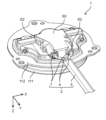
- FIG. 1 is a perspective view of an electric motor according to an embodiment of the present invention as viewed from above.
- FIG. 2 is a perspective view of the electric motor according to the embodiment as viewed from below.
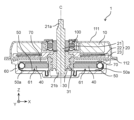
- FIG. 3 is a cross-sectional view of the electric motor according to the embodiment taken along a plane passing through the axis of the rotating shaft and the brushes.
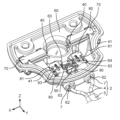
- FIG. 4 is a perspective view showing the configuration of a brush holder and various parts arranged on the brush holder in the electric motor according to the embodiment.
- FIG. 5 is an exploded perspective view of the brush holder and various parts shown in FIG.
- FIG. 6 is an enlarged cross-sectional view showing the structure of a connection portion between a power supply terminal and a power supply line in the electric motor according to the embodiment.
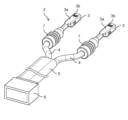
- FIG. 7 is a diagram showing a configuration of a power supply line connected to the electric motor according to the embodiment.
- FIG. 8A is a perspective view showing a configuration of a power supply terminal of a power supply line connected to the electric motor according to the embodiment.
- FIG. 8B is a perspective view showing the configuration of a power supply terminal of a power supply line connected to the electric motor according to the embodiment.
- FIG. 8C is a cross-sectional perspective view illustrating a configuration of a power supply terminal of a power supply line connected to the electric motor according to the embodiment.
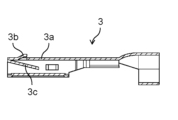
- FIG. 8D is a cross-sectional view showing the configuration of a power supply terminal of a power supply line connected to the electric motor according to the embodiment.
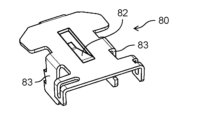
- FIG. 9A is a perspective view showing a configuration of a power supply terminal in the electric motor according to the embodiment.
- FIG. 9B is a perspective view showing the configuration of a power supply terminal in the electric motor according to the embodiment.
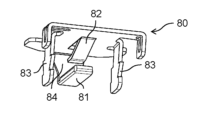
- FIG. 9C is a perspective view showing the configuration of a power supply terminal in the electric motor according to the embodiment.
- FIG. 9D is a cross-sectional view showing the configuration of a power supply terminal in the electric motor according to the embodiment.
- FIG. 10 is a perspective view showing a state in which power feeders are connected to the power supply terminals of the electric motor according to the embodiment.
- FIG. 11 is a cross-sectional view showing a state in which a power supply terminal of a power supply line is connected to a power supply terminal of an electric motor according to an embodiment.
- FIG. 12 is a diagram showing an example of a conventional electric motor having a power supply line connected to a power supply terminal.
- the X-axis, Y-axis, and Z-axis represent the three axes of a three-dimensional Cartesian coordinate system.
- the X-axis and Y-axis are mutually orthogonal, and are also orthogonal to the Z-axis.
- the Z-axis direction is the direction in which the axis C of the rotation shaft 21 extends.
- FIG. 1 Each figure is a schematic diagram and is not necessarily a precise illustration.
- the same reference numerals are used for configurations that are substantially the same as in other figures, and duplicate explanations are omitted or simplified.
- the terms “upper” and “lower” do not necessarily refer to the upper direction (vertically upward) and the lower direction (vertically downward) in an absolute spatial sense.
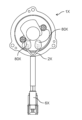
- FIG. 1 is a perspective view of the electric motor 1 according to an embodiment as viewed from above.
- Fig. 2 is a perspective view of the electric motor 1 according to an embodiment as viewed from below.
- Fig. 3 is a cross-sectional view of the electric motor 1 according to an embodiment cut along a plane passing through the axis C of the rotating shaft 21 and the brush 40.
- Fig. 4 is a perspective view showing the configuration of a brush holder 60 and various components arranged in the brush holder 60 in the electric motor 1 according to an embodiment.
- Fig. 5 is an exploded perspective view of the brush holder 60 and various components shown in Fig. 4.
- the electric motor 1 includes a stator 10 and a rotor 20 that rotates due to the magnetic force of the stator 10.
- the electric motor 1 is a brushed electric motor.
- the electric motor 1 includes a commutator 30 attached to a rotating shaft 21 of the rotor 20, at least one brush 40 in contact with the commutator 30, a brush spring 50 for pressing the brush 40 against the commutator 30, a brush holder 60 for holding the brush 40, and a cover plate 70 for covering the brush 40.
- the electric motor 1 further includes a power terminal 80 electrically connected to the brush 40, and a capacitor 90 connected to the power terminal 80.
- the electric motor 1 further includes a bearing 100, a first bracket 111, and a second bracket 112.
- a power supply line 2 for supplying power to the electric motor 1 is connected to the electric motor 1.
- the power supply line 2 is an output line drawn from the electric motor 1.
- the power supply line 2 may be a component that constitutes part of the electric motor 1, or may be a separate component from the electric motor 1 that is retrofitted to the electric motor 1.
- the electric motor 1 is a type of direct current motor (DC motor) driven by direct current.
- a magnet is used as the stator 10.
- An armature having a coil 22 is used as the rotor 20.
- the electric motor 1 is a flat type (flat type) brushed coreless motor (flat motor) mounted on a vehicle such as a two-wheeled or four-wheeled vehicle. Therefore, the stator 10 and the rotor 20 do not have a core (iron core).
- the electric motor 1 is thin and lightweight overall. Specifically, the electric motor 1 is a small motor used in a cooling fan of a radiator in a vehicle.
- the outer diameter (diameter) ⁇ of the electric motor 1 is 120 mm or less.
- the outer diameter ⁇ of the electric motor 1 is ⁇ 60 mm, ⁇ 70 mm, ⁇ 90 mm, or the like.
- the electric motor 1 is driven by power supplied from an external power source such as a battery.
- the electric motor 1 is driven by an input voltage of DC 12 V supplied through a power supply line 2 connected to the external power source.
- the stator 10 is disposed with a small air gap between it and the rotor 20.
- the stator 10 generates a magnetic force acting on the rotor 20.
- the stator 10 is configured to generate magnetic flux on the air gap surface that faces the rotor 20 through the air gap.
- the stator 10 forms a magnetic circuit together with the stator 10, which is an armature.
- the stator 10 is generally doughnut-shaped.
- the stator 10 is configured so that N poles and S poles are alternately and evenly present on the air gap surface that faces the rotor 20 through the air gap along the circumferential direction of the rotating shaft 21.
- the stator 10 is a field magnet that creates magnetic flux to generate torque.
- the stator 10 is composed of multiple magnets.
- the magnets that compose the stator 10 are, for example, permanent magnets.
- the direction of the main magnetic flux generated by the stator 10 (magnet) is along the direction in which the rotating shaft 21 extends.
- the stator 10 is fixed to the
- the rotor 20 has a rotating shaft 21 and a coil 22.
- the rotor 20 is a coreless rotor that does not have a core.
- the rotor 20 rotates about the axis C direction (also simply called the "axis direction") along which the rotating shaft 21 extends.
- the rotor 20 generates a magnetic force that acts on the stator 10.
- the direction of the main magnetic flux generated by the rotor 20 is along the axis C direction along which the rotating shaft 21 extends.
- the rotor 20 is disposed opposite the stator 10.
- the rotor 20 faces the stator 10 in the direction of the axis C along which the rotating shaft 21 extends.
- the coil 22 of the rotor 20 and the stator 10 face each other in the direction of the axis C along which the rotating shaft 21 extends. In other words, the coil 22 and the stator 10 are aligned in the direction of the axis C of the rotating shaft 21.
- the rotating shaft 21 is a shaft having an axis C.
- the rotating shaft 21 is a long rod-shaped member.
- the rotating shaft 21 is a metal rod made of a metal material such as SUS (Stainless Used Steel).
- the axis C contained in the rotating shaft 21 becomes the center of rotation when the rotor 20 rotates.
- the longitudinal direction of the rotating shaft 21, i.e., the direction in which the rotating shaft 21 extends (extension direction), is the direction of the axis C.
- the rotating shaft 21 is supported by the bearing 100.
- the bearing 100 supports the rotating shaft 21 so that it can rotate freely.
- the rotating shaft 21 is press-fitted into the bearing 100.
- the bearing 100 is held by the first bracket 111.
- the bearing 100 is press-fitted and fixed into a recess provided in the first bracket 111.
- the bearing 100 is a ball bearing.
- the bearing 100 is a deep groove ball bearing.
- the first end 21a of the rotating shaft 21 is the end on the output side (output shaft).
- the first end 21a of the rotating shaft 21 protrudes from the first bracket 111 and the bearing 100.
- the first end 21a of the rotating shaft 21 is the end of the rotating shaft 21 that is on the bearing 100 side between the bearing 100 and the commutator 30.
- a load such as a rotating fan is attached to the first end 21a.
- the electric motor 1 with a rotating fan attached to the rotating shaft 21 can be used as, for example, a cooling fan and an electric blower.
- the second end 21b of the rotating shaft 21 is the end on the non-output side (non-output shaft). The second end 21b does not protrude from the second bracket 112.
- the first bracket 111 and the second bracket 112 are made of, for example, a metal material.
- the first bracket 111 and the second bracket 112 are made of an iron-based material such as cold-rolled steel plate (SPC (Steel Plate Cold) material) or a metal such as aluminum.
- SPC Cold-rolled steel plate
- the first bracket 111 and the second bracket 112 form a housing.
- the stator 10 and the rotor 20 are arranged inside this housing.
- the first bracket 111 is an outer shell member of the electric motor 1.
- the first bracket 111 is formed in a bottomed cylindrical shape having a bottom and a cylindrical side wall.
- the magnets constituting the stator 10 are fixed to the bottom of the first bracket 111.
- the coil 22 of the rotor 20 is surrounded by the side wall of the first bracket 111.
- the material of the first bracket 111 and the second bracket 112 is not limited to a metal material, and may be a resin material. From the viewpoint of suppressing noise generated from the electric motor 1, it is preferable that the material of the first bracket 111 and the second bracket 112 is a metal material.
- the coils 22 of the rotor 20 shown in FIG. 3 are wound coils.
- the rotor 20 has a plurality of coils 22.
- Each of the plurality of coils 22 is an armature winding made of electric wire.
- Each of the plurality of coils 22 is wound so as to generate a magnetic force acting on the stator 10 when a current flows through it.
- the direction of the main magnetic flux generated by each coil 22 is along the axis C along which the rotating shaft 21 extends.
- each of the plurality of coils 22 is wound in a flat shape.
- the coil surface of each of the plurality of coils 22 is arranged in a position facing in a direction along the axis C along which the rotating shaft 21 extends.
- the multiple coils 22 are composed of an insulated wire having a core wire made of a metal such as copper or aluminum and an insulating film coating the core wire.
- Each of the multiple coils 22 is a thin wound coil having a coil layer in which the insulated wire is wound in a planar shape.
- each of the multiple coils 22 is composed of, for example, one layer or multiple coil layers in which the insulated wire is wound in a roughly fan-like shape in a planar view.
- the multiple coils 22 thus configured are arranged to surround the rotating shaft 21 when viewed from the direction of the axis C along which the rotating shaft 21 extends.
- Each of the multiple coils 22 is electrically connected to the commutator 30. Specifically, each of the multiple coils 22 is electrically connected to one of the multiple commutator segments 31 that the commutator 30 has. Therefore, a current flows through each of the multiple coils 22 via the commutator segment 31 that the brush 40 contacts.
- the multiple coils 22 are covered with molded resin 23.
- the multiple coils 22 are resin molded. Therefore, the multiple coils 22 are molded integrally with the molded resin 23 by being covered with the molded resin 23.
- the planar external shape of the molded resin 23 after the multiple coils 22 are molded is circular.
- the molded resin 23 can be made of an insulating resin material such as phenolic resin or unsaturated polyester resin (BMC (Bulk Molding Compound)).
- BMC Secondulk Molding Compound
- the molded resin 23 can be either a thermosetting resin or a thermoplastic resin.
- the electric motor 1 is a coreless motor in which the rotor 20 does not have a core.
- the multiple coils 22 of the rotor 20 of the electric motor 1 are thin and molded from resin. This makes it possible to realize a flat, thin electric motor 1 with low inductance.
- the commutator 30 is a molded commutator.
- the commutator 30 is configured such that multiple commutator segments 31 are molded with molded resin 23. In this case, the multiple commutator segments 31 are embedded in the molded resin 23 so that their surfaces are exposed.
- the molded resin 23 is the commutator body.
- the molded resin 23 is a substantially cylindrical member having a through hole into which the rotating shaft 21 is inserted.
- the molded resin 23 is a resin molded body made of an insulating resin material such as a thermosetting resin.
- the brush spring 50 presses the brush 40 against the commutator 30 with the spiral portion 50a.
- the spiral portion 50a of the brush spring 50 contacts the rear end of the brush 40, and the spring restoring force of the spiral portion 50a applies a load to the brush 40.
- the load with which the brush 40 presses against the commutator 30 by the brush spring 50 should be at least one time the radial load generated while the rotor 20 is rotating.
- the brush holder 60 is made of an insulating resin material.
- the brush holder 60 is a resin molded product formed integrally from an insulating resin material.
- the resin material that makes up the brush holder 60 is phenolic resin. However, this is not limited to this.
- the brush holder 60 has a brush storage section 61, which is a spatial area in which the brushes 40 are stored.
- the brush storage section 61 is a recessed portion formed in a concave shape.
- the brush storage sections 61 are formed according to the number of brushes 40.
- the brush holder 60 has two brush storage sections 61 formed. Each of the two brush storage sections 61 is elongated in a direction perpendicular to the axis C of the rotating shaft 21 (i.e., in the radial direction of the rotation of the rotating shaft 21), and is formed in a concave shape with a rectangular cross-sectional shape.
- the brush storage section 61 stores the brush spring 50 together with the brush 40. Therefore, the longitudinal length of the brush storage section 61 is longer than the length of the brush 40.
- the brush spring 50 is arranged in the brush storage section 61 so that the spiral portion 50a is located behind the rear end of the brush 40, in other words, on the opposite side of the brush 40 from the side on which the commutator 30 is located within the brush storage section 61. In this case, the outer end of the brush spring 50 is pulled out toward the commutator 30, passing under the brush 40, and is fixed to a recess formed in the front bottom of the brush storage section 61 in the brush holder 60.
- the brush 40 stored in the brush storage section 61 slides in the brush storage section 61 by being pressed by the brush spring 50.
- the brush 40 pressed against the brush spring 50 moves within the brush storage section 61 toward the commutator 30 as the front end of the brush 40 wears down due to friction with the commutator segments 31.
- the rear end face of the brush 40 moves in the direction (radial direction) toward the axis C of the rotating shaft 21.
- a cover plate 70 is provided to cover the brush 40 stored in the brush storage section 61.
- the cover plate 70 covers not only the brush 40 but also the brush spring 50.
- the cover plate 70 is fixed to the brush holder 60 by pressing a portion of the cover plate 70 into the brush holder 60.
- the cover plate 70 is made of a metal material such as brass or stainless steel (SUS).
- the cover plate 70 is made of a plate-shaped metal plate.
- the cover plate 70 is formed by performing sheet metal processing such as bending or pressing on a single metal plate punched into a predetermined shape.
- the brush holder 60 has an insertion hole 62 through which the power supply line 2 is inserted. As shown in Figure 2, the insertion hole 62 is provided on the back side of the brush holder 60.
- Figure 6 is an enlarged cross-sectional view showing the structure of the connection point between the power supply terminal 80 and the power supply line 2 in the electric motor 1 according to the embodiment. As shown in Figure 6, the power supply terminal 3 of the power supply line 2 is inserted into the insertion hole 62.
- two insertion holes 62 are formed in the brush holder 60.
- Each of the two insertion holes 62 extends in a direction parallel to a direction perpendicular to the direction in which the rotation shaft 21 extends.
- the two insertion holes 62 extend in parallel. In other words, the openings of the two insertion holes 62 are aligned in the horizontal direction.
- each insertion hole 62 is formed in a tunnel shape to connect the outside and inside of the brush holder 60.
- Each insertion hole 62 extends to the position of the power supply terminal 80.
- the power supply line 2 is inserted into the insertion hole 62, thereby connecting the power supply line 2 and the power supply terminal 80.
- the power supply line 2 and the power supply terminal 80 are electrically and mechanically connected.
- the power supply terminal 80 receives power from an external power source via the power supply line 2.
- the power supply terminal 80 receives power from an external power supply to be supplied to the brush 40. Therefore, the power supply terminal 80 is electrically connected to the brush 40. The power supply power supplied to the brush 40 is supplied to the coil 22 of the rotor 20. In this embodiment, since the external power supply is a DC power supply, the power supply terminal 80 receives a DC voltage as an input voltage via the power supply line 2.
- the power supply terminal 80 and the brush 40 are electrically connected by a pigtail wire 41.
- the pigtail wire 41 is fixed to the brush 40. Specifically, one end of the pigtail wire 41 is fixed to the brush 40. The other end of the pigtail wire 41 is connected to the power supply terminal 80.
- the pigtail wire 41 is fixed to the brush 40, for example, so that it is pulled out from the side of the brush 40.
- the pigtail wire 41 and the power supply terminal 80 are joined, for example, by solder or the like.
- the power terminal 80 is fixed to the brush holder 60.
- the power terminal 80 is fixed to the brush holder 60 by pressing a portion of the power terminal 80 into the brush holder 60.
- the power terminal 80 is fixed to the brush holder 60 by pressing a leg portion 83 of the power terminal 80 into an insertion hole 63 provided in the brush holder 60.
- the electric motor 1 is provided with two power supply terminals 80.
- the two power supply terminals 80 receive DC power from an external power supply.
- one of the two power supply terminals 80 (first power supply terminal) is a positive power supply terminal (high voltage side terminal) that is connected to the positive side of the DC power supply.
- the other of the two power supply terminals 80 (second power supply terminal) is a negative power supply terminal (low voltage side terminal) that is connected to the negative side of the DC power supply.
- a capacitor 90 housed in the brush holder 60 is connected to the two power supply terminals 80.
- the two power supply terminals 80 are connected to the leads of the capacitor 90 by soldering or the like.
- the capacitor 90 is connected to the two power supply terminals 80 so that it is connected in parallel with the two power supply terminals 80. This makes it possible to suppress noise generated by the electric motor 1.
- the capacitor 90 is a capacitor for reducing noise.
- the capacitor 90 is a lead-type capacitor (capacitor with leads).
- the capacitor 90 has a main body and a pair of lead terminals (lead pins) drawn out from the main body.
- One of the pair of lead terminals of the capacitor 90 is connected to one of the pair of power supply terminals 80.
- the other of the pair of lead terminals of the capacitor 90 is connected to the other of the pair of power supply terminals 80.
- two capacitors 90 are arranged on the brush holder 60.
- Two capacitors 90 connected in series are connected in parallel to the pair of power supply terminals 80.
- the two capacitors 90 are stored in a capacitor storage section 64 formed in the brush holder 60.
- the capacitor storage section 64 is a recessed section provided on the inner surface of the brush holder 60.
- the capacitor storage section 64 is provided between the pair of power supply terminals 80.
- FIG. 7 is a diagram showing the configuration of the power supply line 2 connected to the electric motor 1 according to the embodiment.
- the power supply line 2 is a power supply line for supplying power to the electric motor 1. Specifically, the power supply line 2 supplies power to the power supply terminal 80 for energizing the coil 22.
- the power supply line 2 has a power supply terminal 3, a wire body 4, a tube 5, a connector 6, and a waterproof plug 7.
- the electric wire body 4 is an electric wire (power line) through which the supplied electric power passes.
- the electric wire body 4 is an insulated wire such as a vinyl wire.
- the electric wire body 4 has a core wire 4a made of a conductor such as copper and an insulating coating 4b that covers the core wire.
- the power feeder 2 is connected to each of the two power supply terminals 80. Therefore, as shown in FIG. 1 and FIG. 7, the power feeder 2 has two electric wire bodies 4.
- the electric wire body 4 connected to the power supply terminal 80 which is the high-voltage terminal, is a high-voltage side power feeder (positive side wiring).
- the electric wire body 4 connected to the power supply terminal 80 which is the low-voltage side terminal, is a low-voltage side power feeder (negative side wiring).
- the two electric wire bodies 4 are covered with a tube 5.
- the tube 5 is a cylindrical cover that covers the electric wire body 4.
- the tube 5 is, for example, an insulating rubber tube. Both ends of the two electric wire bodies 4 are exposed from the tube 5.
- a power supply terminal 3 is attached to one end of each of the two electric wire bodies 4.
- the power supply terminal 3 is a component that is connected to a power supply terminal 80 disposed on the electric motor 1.
- the power supply terminal 3 is electrically and mechanically connected to the core wire 4a exposed from the insulating coating 4b at the tip of the electric wire body 4.
- the power supply terminal 3 is not covered with a housing or a resin holder, which is an insulating resin member.
- the power supply terminal 3 is attached to the electric wire body 4 in an exposed state.
- a connector 6 is attached to the other end of the two electric wire bodies 4.
- the connector 6 has, for example, a resin housing and multiple connector pins covered by this housing.
- the multiple connector pins are electrically connected to the two electric wire bodies 4.
- the power supply line 2 is electrically connected to the external power source. In other words, the electric motor 1 and the external power source are connected.
- the waterproof plug 7 is a cylindrical packing having insulating properties.
- the waterproof plug 7 is a rubber packing having rubber elasticity.
- the waterproof plug 7 is made of, for example, an elastomer. As shown in FIG. 7, the waterproof plug 7 is attached to each end of the two electric wire bodies 4.
- the waterproof plug 7 is attached to the end of the power supply terminal 3 on the electric wire body 4 side (the base of the power supply terminal 3). Specifically, a part of the waterproof plug 7 is sandwiched between the power supply terminal 3 and the electric wire body 4.
- the waterproof plug 7 is attached to the electric wire body 4 by inserting it into the electric wire body 4 and crimping the power supply terminal 3.
- the waterproof plug 7 is pushed into the insertion hole 62 and fitted. Specifically, the waterproof plug 7 is press-fitted into the insertion hole 62 and fitted into the insertion hole 62.
- the power supply terminal 3 of the power supply line 2 is inserted into the insertion hole 62 of the brush holder 60, and the waterproof plug 7 is fitted into the insertion hole 62.
- the power supply terminal 3 of the power supply line 2 is connected to the power terminal 80 in the electric motor 1, and at the same time, the waterproof plug 7 is fitted into the insertion hole 62.
- the waterproof plug 7 pressed into the insertion hole 62 is compressed and deformed, and the waterproof plug 7 and the insertion hole 62 are in close contact with each other. In this way, by fitting the waterproof plug 7 into the insertion hole 62 of the brush holder 60, water can be prevented from entering the inside of the electric motor 1 through the insertion hole 62.
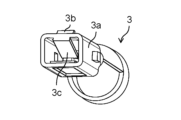
- Fig. 8A is a perspective view showing the configuration of the power supply terminal 3 of the power supply line 2 connected to the electric motor 1 according to the embodiment.
- Fig. 8B is a perspective view showing the configuration of the power supply terminal 3 of the power supply line 2 connected to the electric motor 1 according to the embodiment.
- Fig. 8C is a cross-sectional perspective view showing the configuration of the power supply terminal 3 of the power supply line 2 connected to the electric motor 1 according to the embodiment.
- Fig. 9A is a perspective view showing the configuration of the power supply terminal 80 in the electric motor 1 according to the embodiment.
- Fig. 9B is a perspective view showing the configuration of the power supply terminal 80 in the electric motor 1 according to the embodiment.
- Fig. 9C is a perspective view showing the configuration of the power supply terminal 80 in the electric motor 1 according to the embodiment.
- Fig. 9D is a cross-sectional view showing the configuration of the power supply terminal 80 in the electric motor 1 according to the embodiment.
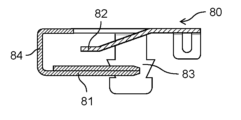
- the power supply terminal 3 of the power supply line 2 has a connecting portion 3a (first connecting portion) that is connected to a portion of the power supply terminal 80, and a locking portion 3b (first locking portion) that is locked to a portion of the power supply terminal 80.
- the connecting portion 3a of the power supply terminal 3 is connected to the connected portion 81 of the power supply terminal 80.
- the locking portion 3b of the power supply terminal 3 is locked to the locked portion 82 of the power supply terminal 80.
- the power supply terminal 3 further has a pressing portion 3c that presses a part of the power supply terminal 80.
- the pressing portion 3c presses the connected portion 81 of the power supply terminal 80 when the power supply terminal 3 and the power supply terminal 80 are connected.
- the engaged portion 82 which is a cut-out piece, is a leaf spring.
- the engaged portion 82 which is a cut-out piece, is formed to have spring elasticity.
Landscapes
- Engineering & Computer Science (AREA)
- Power Engineering (AREA)
- Motor Or Generator Frames (AREA)
Priority Applications (2)
| Application Number | Priority Date | Filing Date | Title |
|---|---|---|---|
| CN202480028863.1A CN121039937A (zh) | 2023-05-12 | 2024-04-10 | 电源端子及电动机 |
| JP2025520444A JPWO2024236951A1 (https=) | 2023-05-12 | 2024-04-10 |
Applications Claiming Priority (2)
| Application Number | Priority Date | Filing Date | Title |
|---|---|---|---|
| JP2023-079028 | 2023-05-12 | ||
| JP2023079028 | 2023-05-12 |
Publications (1)
| Publication Number | Publication Date |
|---|---|
| WO2024236951A1 true WO2024236951A1 (ja) | 2024-11-21 |
Family
ID=93519390
Family Applications (1)
| Application Number | Title | Priority Date | Filing Date |
|---|---|---|---|
| PCT/JP2024/014474 Ceased WO2024236951A1 (ja) | 2023-05-12 | 2024-04-10 | 電源端子及び電動機 |
Country Status (3)
| Country | Link |
|---|---|
| JP (1) | JPWO2024236951A1 (https=) |
| CN (1) | CN121039937A (https=) |
| WO (1) | WO2024236951A1 (https=) |
Citations (3)
| Publication number | Priority date | Publication date | Assignee | Title |
|---|---|---|---|---|
| JPH0217955U (https=) * | 1988-07-15 | 1990-02-06 | ||
| JP2001251089A (ja) * | 2000-03-07 | 2001-09-14 | Auto Network Gijutsu Kenkyusho:Kk | シールド電線の端末接続装置 |
| WO2014109404A1 (ja) * | 2013-01-11 | 2014-07-17 | 矢崎総業株式会社 | 端子接続構造 |
-
2024
- 2024-04-10 JP JP2025520444A patent/JPWO2024236951A1/ja active Pending
- 2024-04-10 WO PCT/JP2024/014474 patent/WO2024236951A1/ja not_active Ceased
- 2024-04-10 CN CN202480028863.1A patent/CN121039937A/zh active Pending
Patent Citations (3)
| Publication number | Priority date | Publication date | Assignee | Title |
|---|---|---|---|---|
| JPH0217955U (https=) * | 1988-07-15 | 1990-02-06 | ||
| JP2001251089A (ja) * | 2000-03-07 | 2001-09-14 | Auto Network Gijutsu Kenkyusho:Kk | シールド電線の端末接続装置 |
| WO2014109404A1 (ja) * | 2013-01-11 | 2014-07-17 | 矢崎総業株式会社 | 端子接続構造 |
Also Published As
| Publication number | Publication date |
|---|---|
| CN121039937A (zh) | 2025-11-28 |
| JPWO2024236951A1 (https=) | 2024-11-21 |
Similar Documents
| Publication | Publication Date | Title |
|---|---|---|
| CN101981789A (zh) | 直流电动机 | |
| JP7774225B2 (ja) | 電動機及び電動送風機 | |
| JP2012070512A (ja) | Dcモータ | |
| WO2023119924A1 (ja) | 電動機及び電動送風機 | |
| JPWO2023119924A5 (https=) | ||
| JPWO2023119839A5 (https=) | ||
| WO2024236951A1 (ja) | 電源端子及び電動機 | |
| WO2023119839A1 (ja) | 電動機及び部品収納箱 | |
| WO2022202274A1 (ja) | 電動機及び電動送風機 | |
| WO2022215369A1 (ja) | 電動機及び電動送風機 | |
| JPWO2022215369A5 (https=) | ||
| WO2017017746A1 (ja) | モータ | |
| JPWO2022202274A5 (https=) | ||
| WO2023188590A1 (ja) | 電動機及び電動機の製造方法 | |
| WO2024236952A1 (ja) | 電動機 | |
| JPWO2022137890A5 (https=) | ||
| JP7542172B2 (ja) | 電動機 | |
| US20250379498A1 (en) | Electric motor | |
| WO2026009547A1 (ja) | 電動機 | |
| CN121336346A (zh) | 电动机 | |
| WO2023119801A1 (ja) | 電動機及び端子 | |
| WO2022202272A1 (ja) | 電動機及び電動送風機 | |
| WO2025173389A1 (ja) | 電動機 | |
| US20250300517A1 (en) | Electric motor | |
| WO2024084849A1 (ja) | 電動機 |
Legal Events
| Date | Code | Title | Description |
|---|---|---|---|
| 121 | Ep: the epo has been informed by wipo that ep was designated in this application |
Ref document number: 24806905 Country of ref document: EP Kind code of ref document: A1 |
|
| ENP | Entry into the national phase |
Ref document number: 2025520444 Country of ref document: JP Kind code of ref document: A |
|
| WWE | Wipo information: entry into national phase |
Ref document number: 2025520444 Country of ref document: JP |
|
| NENP | Non-entry into the national phase |
Ref country code: DE |