WO2024232001A1 - コントロールセンタのシャッタ機構 - Google Patents
コントロールセンタのシャッタ機構 Download PDFInfo
- Publication number
- WO2024232001A1 WO2024232001A1 PCT/JP2023/017372 JP2023017372W WO2024232001A1 WO 2024232001 A1 WO2024232001 A1 WO 2024232001A1 JP 2023017372 W JP2023017372 W JP 2023017372W WO 2024232001 A1 WO2024232001 A1 WO 2024232001A1
- Authority
- WO
- WIPO (PCT)
- Prior art keywords
- functional unit
- control center
- shutter
- shutter cover
- spacer
- Prior art date
- Legal status (The legal status is an assumption and is not a legal conclusion. Google has not performed a legal analysis and makes no representation as to the accuracy of the status listed.)
- Ceased
Links
Images



Classifications
-
- H—ELECTRICITY
- H02—GENERATION; CONVERSION OR DISTRIBUTION OF ELECTRIC POWER
- H02B—BOARDS, SUBSTATIONS OR SWITCHING ARRANGEMENTS FOR THE SUPPLY OR DISTRIBUTION OF ELECTRIC POWER
- H02B11/00—Switchgear having carriage withdrawable for isolation
- H02B11/12—Switchgear having carriage withdrawable for isolation with isolation by horizontal withdrawal
- H02B11/173—Switchgear having carriage withdrawable for isolation with isolation by horizontal withdrawal drawer type
-
- H—ELECTRICITY
- H02—GENERATION; CONVERSION OR DISTRIBUTION OF ELECTRIC POWER
- H02B—BOARDS, SUBSTATIONS OR SWITCHING ARRANGEMENTS FOR THE SUPPLY OR DISTRIBUTION OF ELECTRIC POWER
- H02B1/00—Frameworks, boards, panels, desks, casings; Details of substations or switching arrangements
- H02B1/26—Casings; Parts thereof or accessories therefor
- H02B1/30—Cabinet-type casings; Parts thereof or accessories therefor
- H02B1/32—Mounting of devices therein
- H02B1/34—Racks
- H02B1/36—Racks with withdrawable units
-
- H—ELECTRICITY
- H02—GENERATION; CONVERSION OR DISTRIBUTION OF ELECTRIC POWER
- H02B—BOARDS, SUBSTATIONS OR SWITCHING ARRANGEMENTS FOR THE SUPPLY OR DISTRIBUTION OF ELECTRIC POWER
- H02B11/00—Switchgear having carriage withdrawable for isolation
- H02B11/24—Shutters or guards
Definitions
- This application relates to a shutter mechanism for a control center.
- Distribution boards are intended to open and close, control, protect, and monitor electrical circuits to load equipment connected to the distribution circuit, and each compartment contains multiple functional units with these functions.
- Each functional unit is supplied with power from a busbar inside the distribution board housing, and each unit has a junction for power supply, which is connected to the busbar inside the housing when the functional unit is inserted into the housing. For this reason, a shutter mechanism is provided between the functional unit room and the busbar room to prevent accidental contact with the busbar.
- a switchboard shutter device has been disclosed that has a rotating cam and shutter retaining rod in the functional unit chamber, and a shutter mechanism that opens and closes in conjunction with the insertion position of the functional unit, eliminating the risk of touching the live busbar before and after inserting the functional unit.
- This application discloses technology to solve the problems described above, and aims to provide a shutter mechanism for a control center that opens and closes in conjunction with the insertion and withdrawal of a functional unit.
- the control center shutter mechanism disclosed in this application is a control center shutter mechanism equipped with a shutter cover attached to a partition plate that separates a busbar room in which the busbars of the control center are arranged and a functional unit room in which functional units implemented in the control center are arranged, the shutter cover has a front protrusion that protrudes forward from the bottom, the functional unit has a spacer on the bottom, and when the functional unit is inserted into the functional unit room, the spacer on the functional unit presses against the front protrusion of the shutter cover, so that the shutter cover moves in conjunction with the insertion of the functional unit and opens, enabling connection between the busbar and the junction of the functional unit.
- control center shutter mechanism disclosed in this application provides a control center shutter mechanism that opens and closes in conjunction with the insertion and removal of a functional unit.
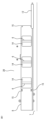
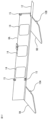
- FIGS. 2A and 2B are a perspective view of a control center housing in the first embodiment and an enlarged view of a partition plate and a shutter cover.
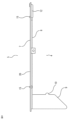
- 1 is a front view illustrating the relationship between the partition plate separating the busbar room and the unit room of the control center and the shutter mechanism in the first embodiment.
- FIG. 1 is a front view illustrating the relationship between the partition plate separating the busbar room and the unit room of the control center and the shutter mechanism in the first embodiment.
- FIG. 1 is a top view illustrating the relationship between the partition plate separating the busbar room and the unit room of the control center and the shutter mechanism in the first embodiment.
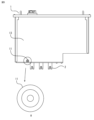
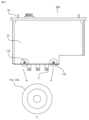
- FIG. FIG. 2 is a bottom view of the functional unit of the control center in the first embodiment.
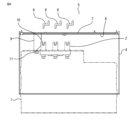
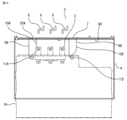
- FIG. 1 is a cross-sectional top view showing a state in which a functional unit is inserted into a control center housing according to the first embodiment.
- FIG. 1 is a cross-sectional top view of a control center housing according to a first embodiment, showing a functional unit inserted to a test position.
- 1 is a cross-sectional top view of a control center housing according to a first embodiment, in which a functional unit is inserted up to a connection position.
- FIG. 4A and 4B are a perspective view of a control center housing in a comparative example of the first embodiment and an enlarged view of a partition plate and a shutter cover.
- FIG. 13 is a perspective view of a functional unit of a control center in a comparative example to the first embodiment.
- FIG. 13 is a cross-sectional top view showing a state in which a functional unit is inserted into a control center housing in a comparative example of the first embodiment.
- FIG. FIG. 11 is a perspective view of a shutter mechanism of a functional unit of a control center in a second embodiment.
- FIG. 11 is a bottom view of the functional unit of the control center in the second embodiment.
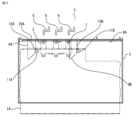
- 13 is a cross-sectional top view showing a state in which a functional unit is inserted into a control center housing in the second embodiment.
- FIG. 13 is a cross-sectional top view of a control center housing according to a second embodiment, showing a functional unit inserted to a test position.
- FIG. 13 is a cross-sectional top view of a control center housing according to a second embodiment, in which a functional unit is inserted up to a connection position.
- Embodiment 1 is a shutter mechanism for a control center equipped with a shutter cover attached to a partition plate separating a busbar room in which the busbars of the control center are arranged and a functional unit room in which functional units to be implemented in the control center are arranged, the shutter cover having a front protrusion protruding toward the front from its bottom, and the functional unit having a spacer on its bottom, and when the functional unit is inserted into the functional unit room, the spacer on the functional unit presses against the front protrusion of the shutter cover, so that at the same time as the functional unit is inserted, the shutter cover moves in conjunction with the functional unit and automatically opens, enabling connection of the junction between the busbar and the functional unit.
- FIG. 1 is an oblique view of the control center housing and an enlarged view of the partition and shutter cover
- Figures 2 and 3 which are front views explaining the relationship between the partition separating the bus bar room and unit room of the control center and the shutter mechanism
- Figure 4 which is a top view explaining the relationship between the partition separating the bus bar room and unit room of the control center and the shutter mechanism
- Figure 5 which is a bottom view of the functional unit of the control center
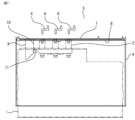
- Figure 6 which is a sectional top view when the functional unit is inserted into the control center housing
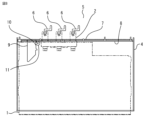
- Figure 7 which is a sectional top view when the functional unit is inserted into the control center housing to the test position
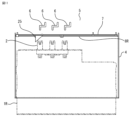
- Figure 8 which is a sectional top view when the functional unit is inserted to the connection position
- Figure 9 which is an oblique view of the control center housing in a comparative example and an enlarged view of the partition and shutter cover
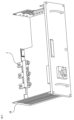
- Figure 10 which is an oblique view of the functional unit of the control center in the comparative example
- control center 100 the structure of the control center 100 and the structure and function of the functional unit 1, which is the main device, will be explained with reference to Figures 1 to 8, focusing on the configuration of the shutter mechanism 20 of the control center in embodiment 1.
- the control center 100 has a plurality of functional units 1 housed in each compartment of a functional unit room 4 of the control center 100 for the purposes of opening and closing electrical circuits, controlling, protecting, monitoring, etc., to load equipment connected to a low-voltage distribution circuit.
- Each functional unit 1 is supplied with power from a busbar 6 inside a control center housing 3, and is provided with a power supply junction 2.
- each functional unit 1 When each functional unit 1 is inserted into each compartment of the functional unit room 4 of the control center 100, it is structured to connect with the busbar 6 in the busbar room 5 inside the housing 3.
- the control center housing 3 will be referred to as housing 3, and the control center shutter mechanism 20 will be referred to as shutter mechanism 20, where appropriate.
- the shutter mechanism 20 is composed of a partition plate 7 , a shutter cover 8 , a spring 12 , and a spacer 11 .
- a partition plate 7 a partition plate 7
- a shutter cover 8 a spring 12
- a spacer 11 a spacer 11 .
- FIGS. Fig. 1 shows an example of a control center 100 that houses nine functional units 1.
- an enlarged view of a partition plate 7 is shown in part A
- an enlarged view of a shutter cover 8 is shown in part B.
- the horizontal direction of the board of the control center 100 is designated as the X direction, the depth direction as the Y direction, and the vertical direction as the Z direction.
- the partition plate 7 serves to separate the busbar room 5 in which the busbars 6 of the control center 100 are arranged from the functional unit room 4 in which the functional units 1 are inserted.
- the shutter cover 8 is attached to this partition plate 7. Since the shutter cover 8 needs to move laterally when the functional unit 1 is inserted, it is not fixed to the partition plate 7 with screws or the like, but is attached by clamping the upper and lower parts of the partition plate 7 with stoppers 15 provided on the top and bottom of the shutter cover 8. Furthermore, a spring 12 is attached between the partition plate 7 and the shutter cover 8 so that the shutter cover 8 returns to its original position (the position hiding the bus bar 6) by elastic force when the functional unit 1 is pulled out of the functional unit chamber 4.
- the shutter cover 8 has a front protrusion 9 at one end, either left or right (X direction).
- X direction a case will be described in which the front protrusion 9 is provided at the left end of the shutter cover 8 when the functional unit 1 is viewed from the front panel.
- This front protrusion 9 is structured to protrude in the front direction (i.e., in the Y direction toward the front panel of the functional unit 1) from the bottom side of the shutter cover 8, and is positioned so that it can be slipped under the bottom plate 13 of the functional unit 1 when it is inserted into the functional unit chamber 4.
- the front protrusion 9 is provided with a test position protrusion 10 so that the functional unit 1 feels a catch when it is inserted or pulled out to the test position. That is, the test position protrusion 10 is provided in a direction that suppresses the movement of the functional unit in the insertion direction and the pull-out direction.
- FIGS. Fig. 2 is a front view of the state in which the shutter cover 8 is attached to the partition plate 7 and before the functional unit 1 is inserted
- Fig. 4 is a top view of this state.
- the shutter cover 8 Before the functional unit 1 is inserted into the functional unit chamber 4, the shutter cover 8 has not yet moved sideways, so the busbar 6 in the busbar chamber 5 is not exposed as shown in Fig. 2.
- Fig. 3 shows the state after the functional unit 1 has been fully inserted and the shutter cover 8 has moved sideways. In this state, the positions of the busbar openings 14 provided on the shutter cover 8 and the partition plate 7 are aligned, so the busbar 6 in the busbar chamber 5 is exposed and the junction 2 attached to the functional unit 1 can be connected to the busbar 6.
- Fig. 5 is a bottom view of the functional unit 1.
- Part A in Fig. 5 is an enlarged view of the spacer 11. 5
- a spacer 11 is provided on the underside of the bottom plate 13 of the functional unit 1.
- the spacer 11 in order to avoid the risk of the spacer 11 becoming stuck due to friction when it comes into contact with the front protrusion 9, it is preferable that the spacer 11 be flat and circular in shape and parallel to the front protrusion 9. It is also preferable that the spacer 11 be made of metal rather than resin so that it is not damaged when it comes into contact with the front protrusion 9.
- the spacer 11 rotatable about its circular central axis, no friction occurs between the spacer 11 and the front protruding portion 9, so that the functional unit 1 can be inserted and pulled out more smoothly.
- the shutter cover 8 prevents the live part of the busbar 6 in the busbar chamber 5 from being exposed, and when the functional unit 1 is inserted into the functional unit chamber 4, the spacer 11 attached to the bottom plate 13 of the functional unit 1 comes into contact with the front protrusion 9 of the shutter cover 8. At the same time that the functional unit 1 is inserted into the functional unit chamber 4, the spacer 11 presses against the front protrusion 9 of the shutter cover 8, and in conjunction with this, the shutter cover 8 moves sideways.
- Figures 6 to 8 each show a cross-sectional view of the functional unit 1 as seen from above.
- Figure 6 shows the functional unit 1 in a position where the spacer 11 comes into contact with the front protrusion 9 of the shutter cover 8 when it is inserted into the functional unit chamber 4.
- Figure 7 shows the functional unit 1 inserted up to the test position.
- Figure 8 shows the functional unit 1 inserted further, with the junction 2 of the functional unit 1 connected to the busbar 6.
- the elastic force of the spring 12 attached to one end of the shutter cover 8 causes the shutter cover 8 to move laterally as the functional unit 1 is pulled out from the functional unit chamber 4, thereby preventing the busbar 6 from being exposed.
- a shutter mechanism of a control center of a comparative example will be described with reference to Figures 9 to 11.
- a control center 100R in order to distinguish it from the control center 100 of the first embodiment, it is referred to as a control center 100R, a functional unit 1R, and a shutter cover 8R.
- a diagonal protrusion 25 is provided on the shutter cover 8R that hides the busbar 6 in the busbar room 5, and when the functional unit 1R is inserted into the functional unit room of the control center 100R, the outer wall of the junction 2 on the back side of the functional unit 1R presses against the diagonal protrusion 25 of the shutter cover 8R, causing the shutter cover 8R to move.
- a spring 12 is provided on one end of the shutter cover 8R so that the shutter cover 8R returns to its original position when the functional unit 1R is pulled out.
- the shutter cover 8 is pressed against the spacer 11 attached to the bottom plate 13 of the functional unit 1, so there is no risk of the outer wall of the junction 2 being damaged and the internal live parts being exposed, and the risk of earth faults and short circuit accidents can be eliminated.
- the shutter cover 8 moves in response to the insertion and withdrawal of the functional unit 1 without direct contact with human hands, enabling operation without the risk of people touching the live parts of the busbar 6.
- a control center shutter mechanism is obtained in which the shutter opens and closes in conjunction with the insertion and withdrawal of a functional unit.
- Embodiment 2 In the second embodiment, two front projections and two spacers are provided.
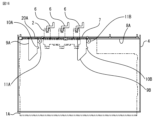
- embodiment 2 includes a control center 200, a functional unit 1A, a control center shutter mechanism 20A, a shutter cover 8A, front protrusions 9A, 9B, test position protrusions 10A, 10B, and spacers 11A, 11B.
- Part C in Figure 13 is an enlarged view of the spacers 11A and 11B.
- the shutter cover 8A is provided with front protrusions 9A, 9B on both ends, and two spacers 11A, 11B are attached to the bottom plate 13 of the functional unit 1A as shown in Figure 13 in order to press the two front protrusions 9A, 9B of the shutter cover 8A against each other when the functional unit 1A is inserted into the functional unit chamber 4.
- Figures 14 to 16 shows a cross-sectional view of the functional unit 1A as seen from above.
- Figure 14 shows the functional unit 1A in a position where the spacers 11A and 11B come into contact with the front protrusions 9A and 9B of the shutter cover 8A when the functional unit 1A is inserted into the functional unit chamber 4.
- Figure 15 shows the functional unit 1A inserted up to the test position.
- Figure 16 shows the functional unit 1A inserted further, with the junction 2 of the functional unit 1A connected to the busbar 6.
- the front protrusion 9 of the shutter cover 8 that fits under the bottom of the functional unit 1 is provided only on one end, either the left or right. Therefore, when the shutter cover 8 operates, there is a possibility that the end where the front protrusion 9 is not provided may become loose.
- the front protrusions 9A and 9B of the shutter cover 8A that fits under the bottom of the functional unit 1A are provided on both the left and right ends. Therefore, there is no possibility that one end of the shutter cover 8A may become loose when the shutter cover 8A operates, and although the structure is a little more complicated than in the first embodiment, the shutter cover 8A can be opened and closed more smoothly.
- the shutter cover 8A is pressed against it by the spacers 11A, 11B attached to the bottom plate 13 of the functional unit 1A, there is no risk of the outer wall of the junction 2 being damaged and the internal live parts being exposed, eliminating the risk of earth faults and short circuit accidents.
- the front protrusions 9A, 9B of the shutter cover 8A are provided with the test position protrusions 10A, 10B, a catch can be felt when inserting or pulling out the functional unit 1A into the functional unit chamber 4, and therefore the functional unit 1A can be easily kept in the test position.
- a control center shutter mechanism is obtained in which the shutter opens and closes in conjunction with the insertion and withdrawal of the functional unit. Furthermore, the shutter cover can be opened and closed more smoothly.
- 1, 1A, 1R functional unit, 2 junction, 3 control center housing 4 functional unit room, 5 busbar room, 6 busbar, 7 partition plate, 8, 8A, 8R shutter cover, 9, 9A, 9B front protrusion, 10, 10A, 10B test position protrusion, 11, 11A, 11B spacer, 12 spring, 13 bottom plate, 14 busbar opening, 15 stopper, 20, 20A control center shutter mechanism, 25 diagonal protrusion, 100, 100R, 200 control center.
Landscapes
- Engineering & Computer Science (AREA)
- Power Engineering (AREA)
- Trip Switchboards (AREA)
- Connection Or Junction Boxes (AREA)
- Patch Boards (AREA)
Priority Applications (3)
| Application Number | Priority Date | Filing Date | Title |
|---|---|---|---|
| JP2023557380A JP7481590B1 (ja) | 2023-05-09 | 2023-05-09 | コントロールセンタのシャッタ機構 |
| PCT/JP2023/017372 WO2024232001A1 (ja) | 2023-05-09 | 2023-05-09 | コントロールセンタのシャッタ機構 |
| DE112023006290.0T DE112023006290T5 (de) | 2023-05-09 | 2023-05-09 | Verschlussmechanismus für steuerzentrale |
Applications Claiming Priority (1)
| Application Number | Priority Date | Filing Date | Title |
|---|---|---|---|
| PCT/JP2023/017372 WO2024232001A1 (ja) | 2023-05-09 | 2023-05-09 | コントロールセンタのシャッタ機構 |
Publications (1)
| Publication Number | Publication Date |
|---|---|
| WO2024232001A1 true WO2024232001A1 (ja) | 2024-11-14 |
Family
ID=90926001
Family Applications (1)
| Application Number | Title | Priority Date | Filing Date |
|---|---|---|---|
| PCT/JP2023/017372 Ceased WO2024232001A1 (ja) | 2023-05-09 | 2023-05-09 | コントロールセンタのシャッタ機構 |
Country Status (3)
| Country | Link |
|---|---|
| JP (1) | JP7481590B1 (https=) |
| DE (1) | DE112023006290T5 (https=) |
| WO (1) | WO2024232001A1 (https=) |
Citations (3)
| Publication number | Priority date | Publication date | Assignee | Title |
|---|---|---|---|---|
| JPS5774611U (https=) * | 1980-10-27 | 1982-05-08 | ||
| JPS58127806U (ja) * | 1982-02-18 | 1983-08-30 | 株式会社明電舎 | コントロ−ルセンタ−用シヤツタ−装置 |
| JPS58186305A (ja) * | 1982-04-20 | 1983-10-31 | 三菱電機株式会社 | コントロ−ルセンタ制御ユニツトのシヤツタ装置 |
Family Cites Families (1)
| Publication number | Priority date | Publication date | Assignee | Title |
|---|---|---|---|---|
| JP5618806B2 (ja) * | 2010-12-14 | 2014-11-05 | 三菱電機株式会社 | 配電盤のシャッタ装置 |
-
2023
- 2023-05-09 DE DE112023006290.0T patent/DE112023006290T5/de active Pending
- 2023-05-09 JP JP2023557380A patent/JP7481590B1/ja active Active
- 2023-05-09 WO PCT/JP2023/017372 patent/WO2024232001A1/ja not_active Ceased
Patent Citations (3)
| Publication number | Priority date | Publication date | Assignee | Title |
|---|---|---|---|---|
| JPS5774611U (https=) * | 1980-10-27 | 1982-05-08 | ||
| JPS58127806U (ja) * | 1982-02-18 | 1983-08-30 | 株式会社明電舎 | コントロ−ルセンタ−用シヤツタ−装置 |
| JPS58186305A (ja) * | 1982-04-20 | 1983-10-31 | 三菱電機株式会社 | コントロ−ルセンタ制御ユニツトのシヤツタ装置 |
Also Published As
| Publication number | Publication date |
|---|---|
| JP7481590B1 (ja) | 2024-05-10 |
| DE112023006290T5 (de) | 2026-03-05 |
| JPWO2024232001A1 (https=) | 2024-11-14 |
Similar Documents
| Publication | Publication Date | Title |
|---|---|---|
| JP7659555B2 (ja) | プラグイン型遮断器 | |
| JP7481590B1 (ja) | コントロールセンタのシャッタ機構 | |
| JPH0329935Y2 (https=) | ||
| CN217589862U (zh) | 一种开关柜柜门联锁装置 | |
| CN212011899U (zh) | 一种实现开关柜关门操作的新型联锁 | |
| CN213365279U (zh) | 一种冗余舞台机械控制台 | |
| CN1678179B (zh) | 带有自动强制断路功能的用于可更换组件的锁止机构 | |
| JP2001269472A (ja) | 遊技機 | |
| CN112186541B (zh) | 一种安全性能高的电力控制柜 | |
| CN106024444A (zh) | 用于电力设备的二次压板及其操作方法 | |
| JPH0613532Y2 (ja) | 閉鎖配電盤 | |
| JP2005312994A (ja) | 遊技機の基板ボックス | |
| JP7845309B2 (ja) | 筐体 | |
| CN223927249U (zh) | 一种充气式高压开关柜的机械联锁装置 | |
| RU2829485C2 (ru) | Выдвижной блок | |
| CN218976162U (zh) | 用于开关柜的连锁机构及开关柜 | |
| JPH0321130Y2 (https=) | ||
| CN210898254U (zh) | 一种合分闸与摇柄的联锁结构 | |
| JPH0127367Y2 (https=) | ||
| JPS6233453Y2 (https=) | ||
| JPS60147910U (ja) | 高圧閉鎖配電盤における主回路器具の引出機構 | |
| JP4358396B2 (ja) | 電気機器収納用箱 | |
| JP2848079B2 (ja) | 閉鎖配電盤 | |
| CN207250982U (zh) | 一种带导向功能的门板结构 | |
| JPS60147914U (ja) | 高圧閉鎖配電盤における主回路器具の引出機構 |
Legal Events
| Date | Code | Title | Description |
|---|---|---|---|
| WWE | Wipo information: entry into national phase |
Ref document number: 2023557380 Country of ref document: JP |
|
| 121 | Ep: the epo has been informed by wipo that ep was designated in this application |
Ref document number: 23936555 Country of ref document: EP Kind code of ref document: A1 |
|
| WWE | Wipo information: entry into national phase |
Ref document number: 112023006290 Country of ref document: DE |
|
| WWP | Wipo information: published in national office |
Ref document number: 112023006290 Country of ref document: DE |