WO2024225195A1 - 継電器 - Google Patents
継電器 Download PDFInfo
- Publication number
- WO2024225195A1 WO2024225195A1 PCT/JP2024/015618 JP2024015618W WO2024225195A1 WO 2024225195 A1 WO2024225195 A1 WO 2024225195A1 JP 2024015618 W JP2024015618 W JP 2024015618W WO 2024225195 A1 WO2024225195 A1 WO 2024225195A1
- Authority
- WO
- WIPO (PCT)
- Prior art keywords
- cap
- fixed terminal
- relay
- hole
- recess
- Prior art date
- Legal status (The legal status is an assumption and is not a legal conclusion. Google has not performed a legal analysis and makes no representation as to the accuracy of the status listed.)
- Ceased
Links
Images



Classifications
-
- H—ELECTRICITY
- H01—ELECTRIC ELEMENTS
- H01H—ELECTRIC SWITCHES; RELAYS; SELECTORS; EMERGENCY PROTECTIVE DEVICES
- H01H50/00—Details of electromagnetic relays
- H01H50/54—Contact arrangements
Definitions
- the present disclosure relates to a relay having a fixed terminal and a movable contact.
- the present disclosure relates to an electromagnetic relay having a coil that moves the movable contact toward the fixed terminal or away from the fixed terminal.
- the electromagnetic relay (electrical relay) described in Patent Document 1 is exemplified.
- the electromagnetic relay described in Patent Document 1 includes a fixed terminal and a movable contact.
- the fixed terminal has a recess that opens upward.
- the movable contact is disposed below the fixed terminal, moves upward to contact the fixed terminal, and moves downward to separate from the fixed terminal.
- the objective of this disclosure is to provide a relay that can easily suppress heat generation from the fixed terminal.
- a relay includes a cap, a fixed terminal, and a movable contact.
- the cap has a through hole and is formed of a conductive material.
- the fixed terminal has a recess that opens upward and is disposed below the cap such that the through hole of the cap and the opening of the recess overlap.
- the movable contact is disposed below the fixed terminal, moves upward to contact the fixed terminal, and moves downward to separate from the fixed terminal.
- FIG. 1 is a perspective view of a relay according to a first embodiment.
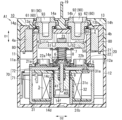
- FIG. 2 is a cross-sectional view of the relay.
- FIG. 3 is a cross-sectional view of the cap of the relay.
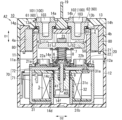
- FIG. 4 is a cross-sectional view of a relay according to the second embodiment.
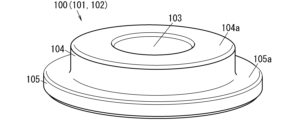
- FIG. 5 is a perspective view of the cap of the relay.
- FIG. 6 is a cross-sectional view of the cap of the relay.
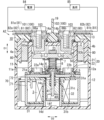
- FIG. 7 is a cross-sectional view showing one embodiment of the use of the relay.
- first direction D1, second direction D2, and third direction D3 indicated by arrows in the drawings are defined as the up-down, left-right, and front-to-back directions of relays A1-A2.
- the up-down, left-right, and front-to-back directions are used for convenience to aid in understanding the explanation of each embodiment, and do not define the directions when relays A1-A2 are actually used.
- the arrows indicating "D1", “D2", and “D3" in the drawings are merely indicated for the purpose of explanation, and none of them have any substance.
- the relay A1 has a cap 90, a fixed terminal 60, and a movable contact 50.
- the cap 90 has a through hole 93 and is made of a conductive material.
- the fixed terminal 60 has a recess 65 that opens upward, and is disposed below the cap 90 so that the through hole 93 of the cap 90 and the opening of the recess 65 overlap.
- the movable contact 50 is disposed below the fixed terminal 60, and moves upward to contact the fixed terminal 60 and downward to separate from the fixed terminal 60.
- relay A1 With relay A1, the heat generation of the fixed terminal 60 can be easily suppressed by providing a cap 90 made of a conductive material on the fixed terminal 60.
- Figure 2 shows a cross-sectional view taken along line XX in Figure 1.
- the relay A1 includes an outer case 10, an inner case 20, a coil 32, a movable core 40, a yoke 70, a shaft 41, a plurality of caps 90 (two in the example of FIG. 2), a plurality of fixed terminals 60 (two in the example of FIG. 2), and a movable contactor 50.
- the two caps 90 include a first cap 91 and a second cap 92.
- the two fixed terminals 60 include a first fixed terminal 61 and a second fixed terminal 62.
- the relay A1 includes a filler 80, a pair of permanent magnets 4a, 4b, a connecting portion 5, a spring receiving portion 6, a holder 7, a contact pressure spring 8, and a return spring 9.
- the inner case 20 the movable contactor 50, and the two fixed terminals 60 are included in the contact device 2.
- At least the coil 32, the movable core 40, and the yoke 70 are included in the electromagnet device 3.
- the outer case 10 is a hollow box (e.g., a rectangular box). As shown in FIG. 1, the outer case 10 includes an upper case 11 and a lower case 12.
- the upper case 11 is box-shaped (e.g., rectangular box-shaped) with an open bottom.
- the upper case 11 is arranged to cover the inner case 20.
- the ceiling portion 13 of the upper case 11 has a first storage portion 13a and a second storage portion 13b.
- the first storage portion 13a stores the first cap 91.
- the second storage portion 13b stores the second cap 92.
- the ceiling portion 13 of the upper case 11 also has a first through hole 14a and a second through hole 14b.
- the first through hole 14a communicates with the first storage portion 13a and exposes a part of the first cap 91 (first portion 94 described below).
- the second through hole 14b communicates with the second storage portion 13b and exposes a part of the second cap 92 (first portion 94).
- the upper case 11 also has a wall portion 19 as shown in FIG. 1.
- the wall portion 19 is plate-shaped (e.g., rectangular plate-shaped).
- the wall portion 19 is disposed between the pair of caps 90 on the upper surface of the upper case 11.
- the wall portion 19 ensures an insulation distance (surface distance) between the first cap 91 and the second cap 92.
- the lower case 12 is box-shaped (e.g., rectangular box-shaped) with an open top.
- the lower case 12 is disposed below the upper case 11.
- the lower end 11a of the upper case 11 is fitted into the upper end 12a of the lower case 12.
- the lower case 12 has a pair of mounting portions 18a, 18b.
- Each mounting portion 18a, 18b is configured so that the relay A1 can be mounted at the installation location.
- Each mounting portion 18a, 18b has a hole 18c. A screw (not shown) is inserted into each hole 18c.
- an inner case 20 Inside the outer case 10, there are arranged an inner case 20, a coil 32, a movable core 40, a yoke 70, a shaft 41, a movable contact 50, two fixed terminals 60, a filler material 80, a pair of permanent magnets 4a, 4b, a connecting portion 5, a spring bearing portion 6, a holder 7, a contact pressure spring 8, and a return spring 9.
- the coil 32 and the movable core 40 are housed in the lower case 12 (the lower part of the outer case 10).
- the coil 32 brings the movable contactor 50 into contact with the first fixed terminal 61 and the second fixed terminal 62, and separates the movable contactor 50 from the first fixed terminal 61 and the second fixed terminal 62.
- the coil 32 is wound around the coil bobbin 31.
- the coil bobbin 31 has an upper flange portion 31a, a lower flange portion 31b, and a tube portion 31c.
- the material of the coil bobbin 31 is an electrically insulating material (e.g., resin, etc.).
- the upper flange portion 31a is plate-shaped (e.g., disk-shaped).
- a third through hole 14c is provided in the center of the upper flange portion 31a.
- the lower flange portion 31b is plate-shaped (e.g., disk-shaped).
- a fourth through hole 14d is provided in the center of the lower flange portion 31b.
- the tube portion 31c is hollow tube-shaped (e.g., hollow cylindrical).
- the outer diameter of the upper flange portion 31a is smaller than the outer diameter of the lower flange portion 31b.
- the outer diameter of the tube portion 31c is smaller than the outer diameters of the upper flange portion 31a and the lower flange portion 31b.
- the outer diameter of the upper part of the tube portion 31c is smaller than the outer diameter of the central and lower parts of the tube portion 31c.
- the inner diameter of the third through hole 14c of the upper flange portion 31a is the same as the inner diameter of the upper part of the tube portion 31c.
- the inner diameter of the fourth through hole 14d of the lower flange portion 31b is the same as the inner diameter of the lower part of the tube portion 31c.
- the coil 32 is wound around the outer circumference of the cylindrical portion 31c of the coil bobbin 31.
- the first end of the coil 32 is electrically connected to a first coil terminal (not shown).
- the second end of the coil 32 is electrically connected to a second coil terminal (not shown).
- the material of the first coil terminal and the second coil terminal is conductive (e.g., copper, etc.).
- the first coil terminal and the second coil terminal are disposed inside the connection portion 17 (see FIG. 1) in the lower case 12 of the outer case 10.
- the movable core 40 is disposed inside the cylindrical portion 31c of the coil bobbin 31.
- the coil 32 and the movable core 40 are disposed inside the yoke 70.
- the yoke 70 includes a lower yoke 71 and an upper yoke 72.
- the material of the yoke 70 is a magnetic material (e.g., light iron, etc.).
- the lower yoke 71 is box-shaped (e.g., rectangular box-shaped) with an open top.
- the coil 32 and the movable core 40 are arranged inside the lower yoke 71.
- the upper yoke 72 is plate-shaped (e.g., rectangular plate-shaped).
- the upper yoke 72 has a fifth through hole 14e.
- the shaft 41 is inserted into the fifth through hole 14e.
- the central axis of the fifth through hole 14e coincides with the central axis of the cylindrical portion 31c of the coil bobbin 31.
- the upper yoke 72 covers the opening of the lower yoke 71 and is attached to the lower yoke 71.
- the yoke 70 is disposed within the outer case 10 so that the lower surface of the lower yoke 71 faces the inner bottom surface of the lower case 12 in the outer case 10.
- the yoke 70 functions as a magnetic circuit together with the movable core 40.
- the coil 32, the movable core 40, and the yoke 70 function as the electromagnet device 3 or a part of the electromagnet device 3.
- the coil 32 has the function of generating a magnetic field when current is applied.
- the coil 32 moves the movable core 40 upward or downward along the axial direction (first direction D1) of the tube portion 31c of the coil bobbin 31 depending on the presence or absence of a magnetic field and the direction in which it is generated.
- the movable core 40 moves upward when the coil 32 is energized.
- the movable core 40 moves downward when the coil 32 is not energized.
- the movable core 40 is hollow tubular (e.g., hollow cylindrical).
- the movable core 40 is made of a magnetic material (e.g., light iron).
- the movable core 40 is disposed inside the coil 32. More specifically, the movable core 40 is disposed inside the tube portion 31c of the coil bobbin 31.
- the movable core 40 has a sixth through hole 14f.
- the shaft 41 is inserted into the sixth through hole 14f.
- the central axis of the sixth through hole 14f coincides with the central axis of the tube portion 31c of the coil bobbin 31.
- the inner case 20 includes a first case 21 and a second case 22.
- the material of the inner case 20 is a heat-resistant material (e.g., ceramic, etc.).
- the first case 21 is box-shaped (e.g., rectangular box-shaped) that opens downward.
- the second case 22 is plate-shaped (e.g., rectangular plate-shaped).
- the ceiling portion 23 of the first case 21 has a seventh through hole 14g and an eighth through hole 14h.
- the first fixed terminal 61 is inserted into the seventh through hole 14g.
- the second fixed terminal 62 is inserted into the eighth through hole 14h.
- the second case 22 has a first protrusion 22a and a second protrusion 22b.
- the first protrusion 22a is provided on the upper surface of the second case 22 on the left side of the inner case 20 in the left-right direction (second direction D2).
- the second protrusion 22b is provided on the upper surface of the second case 22 on the right side of the inner case 20 in the left-right direction.
- the second case 22 is arranged to cover the opening of the first case 21.
- the second case 22 is placed on the upper surface of the upper yoke 72 of the yoke 70.
- the inner case 20 is housed in the upper case 11 of the outer case 10.
- the lower end 21a of the first case 21 of the inner case 20 is connected to the upper surface of the upper yoke 72 of the yoke 70 via the connecting part 5, as shown in FIG. 2.
- the connecting part 5 is mechanically connected to the lower end 21a of the first case 21, for example, by brazing.
- the connecting part 5 is also mechanically connected to the upper surface of the upper yoke 72, for example, by brazing.
- the upper yoke 72 of the yoke 70 is positioned below the second case 22 of the inner case 20, and is positioned so as to cover the opening of the first case 21 of the inner case 20.
- a shaft 41 is attached to the movable core 40.
- the shaft 41 is rod-shaped.
- the shaft 41 is inserted into the sixth through hole 14f of the movable core 40 and fixed to the movable core 40.
- the shaft 41 also moves vertically through the fifth through hole 14e of the upper yoke 72.
- the upper end of the shaft 41 is located above the upper surface of the upper yoke 72.
- a spring receiving portion 6 is attached to the upper end of the shaft 41.
- a contact pressure spring 8 is fixed to the spring receiving portion 6.
- the contact pressure spring 8 is, for example, a coil spring.
- the contact pressure spring 8 is a spring for ensuring contact pressure between the movable contact 50 and a pair of fixed terminals 60 (first fixed terminal 61 and second fixed terminal 62).
- the contact pressure spring 8 is fixed to the spring receiving portion 6 so that the expansion and contraction direction of the contact pressure spring 8 coincides with the vertical direction (first direction D1) of the shaft 41. That is, the lower end of the pressure spring 8 is fixed to the spring receiving portion 6.
- the movable contact 50 is attached to the upper end of the pressure spring 8 via the holder 7. In other words, the pressure spring 8 is disposed between the holder 7 and the spring receiving portion 6.
- the holder 7 holds the movable contact 50.
- a return spring 9 is disposed between the upper yoke 72 and the movable core 40.
- the return spring 9 is, for example, a wound spring. When the coil 32 is not energized, the return spring 9 pushes the movable core 40 downward to return the movable core 40 to its original position.
- the spring constant of the return spring 9 is greater than the spring constant of the contact pressure spring 8.
- the return spring 9 is disposed around the shaft 41. In other words, the shaft 41 is inserted through the return spring 9.
- the movable contactor 50 is housed in the inner case 20. As shown in FIG. 2, the movable contactor 50 is plate-shaped (e.g., rectangular plate-shaped). The material of the movable contactor 50 is a conductive material (e.g., copper, etc.).
- the movable contactor 50 has a first movable contact 51 and a second movable contact 52.
- the first movable contact 51 is provided on the upper surface of the movable contactor 50 on the left side in the left-right direction of the movable contactor 50 (second direction D2).
- the second movable contact 52 is provided on the upper surface of the movable contactor 50 on the right side in the left-right direction of the movable contactor 50.
- the first fixed terminal 61 is a bottomed tubular shape (e.g., a bottomed cylindrical shape).
- the material of the first fixed terminal 61 is a conductive material (e.g., copper, etc.).
- the first fixed terminal 61 is inserted into the seventh through hole 14g in the ceiling portion 23 of the first case 21 of the inner case 20, and is attached to the first case 21 so as to face the first movable contact 51 of the movable contactor 50.
- the first fixed terminal 61 has a first fixed contact 63.
- the first fixed contact 63 is provided in a portion of the first fixed terminal 61 that faces the first movable contact 51 of the movable contactor 50.
- the second fixed terminal 62 is a bottomed tubular shape (e.g., a bottomed cylindrical shape).
- the material of the second fixed terminal 62 is a conductive material (e.g., copper, etc.).
- the second fixed terminal 62 is inserted into the eighth through hole 14h in the ceiling portion 23 of the first case 21 of the inner case 20, and is attached to the first case 21 so as to face the second movable contact 52 of the movable contactor 50.
- the second fixed terminal 62 has a second fixed contact 64.
- the second fixed contact 64 is provided in a portion of the second fixed terminal 62 that faces the second movable contact 52 of the movable contactor 50.
- first fixed terminal 61 and the second fixed terminal 62 are attached to the ceiling portion 23 of the first case 21 of the inner case 20, side by side in the left-right direction of the first case 21 (second direction D2).
- the upper end of the first fixed terminal 61 is located above the upper surface of the first case 21 of the inner case 20.
- the upper end of the second fixed terminal 62 is located above the upper surface of the first case 21 of the inner case 20.
- the lower end (bottom) of the first fixed terminal 61 is located inside the inner case 20 and faces the first movable contact 51 of the movable contactor 50.
- the lower end (bottom) of the second fixed terminal 62 is located inside the inner case 20 and faces the second movable contact 52 of the movable contactor 50.
- the movable contact 50 is disposed below the first fixed terminal 61 and the second fixed terminal 62, and when it moves upward it comes into contact with the first fixed terminal 61 and the second fixed terminal 62, and when it moves downward it moves away from the first fixed terminal 61 and the second fixed terminal 62.
- the first cap 91 has a through hole 93 and is made of a conductive material. As shown in FIG. 3, the first cap 91 has a first portion 94 and a second portion 95. The second portion 95 is located below the first portion 94. The second portion 95 of the first cap 91 is in contact with the first fixed terminal 61 (see FIG. 2).
- the material of the first cap 91 is preferably the same as that of the first fixed terminal 61.
- the second cap 92 has a through hole 93 and is made of a conductive material. As shown in FIG. 3, the second cap 92 has a first portion 94 and a second portion 95. The second portion 95 is located below the first portion 94. The second portion 95 of the second cap 92 is in contact with the second fixed terminal 62 (see FIG. 2). The material of the second cap 92 is preferably the same as that of the second fixed terminal 62.
- each first portion 94 is columnar (e.g., cylindrical).
- Each second portion 95 is columnar (e.g., cylindrical).
- the width of the first portion 94 is narrower than the width of the second portion 95.
- the first portion 94 and the second portion 95 are, for example, configured as a continuous, integrated unit. Note that the first portion 94 and the second portion 95 are configured as a continuous, integrated unit, but they may also be, for example, configured separately and then combined to form an integrated unit.
- Each first portion 94 has a first upper surface 94a.
- Each second portion 95 has a second upper surface 95a.
- the second upper surface 95a is located lower than the first upper surface 94a.
- the second upper surface 95a is located outside the first upper surface 94a.
- each cap 90 has a stepped step. This allows the surface area of each cap 90 in relay A1 to be increased. Therefore, the heat dissipation effect of each cap 90 in relay A1 can be improved.
- the through hole 93 formed in the first cap 91 penetrates the first portion 94 and the second portion 95 of the first cap 91.
- the through hole 93 formed in the first cap 91 is composed of a through hole 93a formed in the first portion 94 and a through hole 93b formed in the second portion 95, as shown in FIG. 3.
- the through hole 93 formed in the second cap 92 penetrates the first portion 94 and the second portion 95 of the second cap 92.
- the through hole 93 formed in the second cap 92 is composed of a through hole 93a formed in the first portion 94 and a through hole 93b formed in the second portion 95.
- the width W1 of the through hole 93a in the first portion 94 of the cap 90 is narrower than the width W2 of the through hole 93b in the second portion 95 of the cap 90 (see FIG. 3). This allows the fixed terminal 60 to be easily inserted into the through hole 93b in the second portion 95 of the cap 90 in the relay A1.
- the upper end of the first fixed terminal 61 is disposed within the through hole 93b in the second portion 95 of the first cap 91, and the first cap 91 is positioned relative to the first fixed terminal 61.
- the first cap 91 contacts the first fixed terminal 61 at the inner wall of the through hole 93b in the second portion 95, and the first fixed terminal 61 contacts the inner wall of the through hole 93b in the second portion 95, and the first fixed terminal 61 and the first cap 91 are electrically and thermally connected. Therefore, in the relay A1, for example, heat generated in the first fixed terminal 61 can be dissipated into the air via the first cap 91, so that heat generation in the first fixed terminal 61 can be easily suppressed.
- the upper end of the second fixed terminal 62 is disposed within the through hole 93b in the second portion 95 of the second cap 92, and the second cap 92 is positioned relative to the second fixed terminal 62.
- the second cap 92 contacts the second fixed terminal 62 at the inner wall of the through hole 93b in the second portion 95, and the second fixed terminal 62 contacts the inner wall of the through hole 93b in the second portion 95, and the second fixed terminal 62 and the second cap 92 are electrically and thermally connected. Therefore, in the relay A1, for example, heat generated in the second fixed terminal 62 can be dissipated into the air via the second cap 92, and heat generation in the second fixed terminal 62 can be easily suppressed.
- the first fixed terminal 61 is formed with a recess 65 that opens upward.
- the first fixed terminal 61 is disposed below the first cap 91 so that the through hole 93 of the first cap 91 and the opening of the recess 65 of the first fixed terminal 61 overlap.
- a screw groove (not shown) is formed in the recess 65 of the first fixed terminal 61.
- the second fixed terminal 62 is formed with a recess 65 that opens upward.
- the second fixed terminal 62 is disposed below the second cap 92 so that the through hole 93 of the second cap 92 and the opening of the recess 65 of the second fixed terminal 62 overlap.
- a screw groove (not shown) is formed in the recess 65 of the second fixed terminal 62.
- the relay A1 when the relay A1 is electrically connected to a conductor (e.g., a bus bar), for example, a fixing member (e.g., a screw, a metal member, etc.) can be inserted into each recess 65 to screw or crimp the relay A1 to the conductor. Therefore, it is preferable that the width W1 (see FIG. 3) of the through hole 93a in the first portion 94 of the cap 90 is the same as the width of the recess 65 of the fixed terminal 60, or is greater than the width of the recess 65 of the fixed terminal 60 as shown in FIG. 2.
- a fixing member e.g., a screw, a metal member, etc.
- the relay A1 reduces the difficulty of fixing the relay A1 to the conductor caused by the cap 90.
- the relay A1 has a cap 90 on the fixed terminal 60. For example, if the dimension (length) of the fixed member fastened to the fixed terminal 60 in the first direction D1 is long, the cap 90 can be used as a spacer, and it can be used appropriately for fixed members of different lengths. Note that if the relay A1 is fixed to the conductor by crimping, the thread groove of the recess 65 is not essential.
- the upper end of the first fixed terminal 61 is disposed within the through hole 93b in the second portion 95 of the first cap 91.
- the first fixed terminal 61 contacts the inner wall of the through hole 93b in the second portion 95 of the first cap 91.
- the upper end of the second fixed terminal 62 is disposed within the through hole 93b in the second portion 95 of the second cap 92.
- the second fixed terminal 62 contacts the inner wall of the through hole 93b in the second portion 95 of the second cap 92. This allows the relay A1 to easily achieve electrical connection between the fixed terminal 60 and the cap 90.
- the outer case 10 houses the first fixed terminal 61, the second fixed terminal 62, and the movable contact 50.
- the outer case 10 houses the second portion 95 (the lower end portion of the first cap 91) of the first cap 91 in the first housing portion 13a of the upper case 11 so that the first portion 94 (the upper end portion of the first cap 91) of the first cap 91 is exposed from the ceiling portion 13 of the upper case 11.
- the outer case 10 also houses the second portion 95 (the lower end portion of the second cap 92) of the second cap 92 in the second housing portion 13b of the upper case 11 so that the first portion 94 (the upper end portion of the second cap 92) of the second cap 92 is exposed from the ceiling portion 13 of the upper case 11.
- the inner surface of the first housing portion 13a is in contact with the second upper surface 95a of the second portion 95 of the first cap 91.
- the inner surface of the second storage section 13b is in contact with the second upper surface 95a of the second part 95 of the second cap 92.
- the upper case 11 of the outer case 10 presses the cap 90 downward, pressing the cap 90 against the fixed terminal 60.
- the outer case 10 positions the cap 90 relative to the fixed terminal 60.
- the cap 90 is positioned relative to the fixed terminal 60 by the outer case 10. This makes it easy to position the cap 90 relative to the fixed terminal 60 in the relay A1.
- the pair of permanent magnets 4a, 4b are fixed to the outer peripheral surface of the first case 21 of the inner case 20. More specifically, the permanent magnet 4a of the pair of permanent magnets 4a, 4b is fixed to the outer peripheral surface on the left side in the left-right direction (second direction D2) of the first case 21. The permanent magnet 4b of the pair of permanent magnets 4a, 4b is fixed to the outer peripheral surface on the right side in the left-right direction of the first case 21. In short, the pair of permanent magnets 4a, 4b are disposed between the outer peripheral surface of the first case 21 of the inner case 20 and the inner peripheral surface of the upper case 11 of the outer case 10.
- the permanent magnet 4a is plate-shaped (e.g., rectangular plate-shaped).
- the permanent magnet 4b is plate-shaped (e.g., rectangular plate-shaped).
- the pair of permanent magnets 4a, 4b are arranged outside the first fixed terminal 61 and the second fixed terminal 62 in the direction in which the first fixed terminal 61 and the second fixed terminal 62 are lined up (the left-right direction of the first case 21).
- the pair of permanent magnets 4a, 4b are also arranged outside the movable contact 50 in the direction in which the first fixed terminal 61 and the second fixed terminal 62 are lined up.
- the pair of permanent magnets 4a, 4b are arranged in the left-right direction of the first case 21 so as to sandwich the first fixed terminal 61, the second fixed terminal 62, and the movable contact 50 therebetween.
- the pair of permanent magnets 4a, 4b are arranged with opposite polarities.
- the right side surface of the permanent magnet 4a in the left-right direction of the outer case 10 is the S pole
- the left side surface of the permanent magnet 4b in the left-right direction of the outer case 10 is the N pole
- the right side surface of the permanent magnet 4b in the left-right direction of the outer case 10 is the S pole
- the left side surface of the permanent magnet 4b in the left-right direction of the outer case 10 is the N pole. That is, the permanent magnet 4a faces its S pole toward the permanent magnet 4b.
- the permanent magnet 4b faces its N pole toward the permanent magnet 4a.
- the pair of permanent magnets 4a, 4b generate a magnetic field between the pair of fixed contacts 63, 64 and the pair of movable contacts 51, 52.
- the relay A1 when the movable contactor 50 is separated from the pair of fixed terminals 60, the arc discharge generated between the pair of fixed contacts 63, 64 and the pair of movable contacts 51, 52 can be removed by the Lorentz force generated in response to the magnetic field generated by the pair of permanent magnets 4a, 4b.
- the number of pairs of permanent magnets 4a, 4b is not limited to two, and may be four or more. In other words, the number of pairs of permanent magnets 4a, 4b may be an even number.
- the gap formed between the outer surface (top surface and outer circumferential surface) of the first case 21 of the inner case 20 and the inner surface (top surface and inner circumferential surface) of the upper case 11 of the outer case 10 is filled with a filler material 80.
- the filler material 80 is filled between the outer case 10 and the inner case 20.
- the material of the filler 80 is, for example, a resin (e.g., urethane resin, epoxy resin, silicone resin, etc.).
- the filler 80 is thermally connected to the upper case 11 of the outer case 10.
- the filler 80 is also thermally connected to the first case 21 of the inner case 20. It is preferable that the filler 80 has lower thermal conductivity (thermal conductivity rate) than the inner case 20 and higher thermal conductivity (thermal conductivity rate) than the outer case 10. This allows the relay A1 to release heat outside the inner case 20 more efficiently than when an air layer is formed between the inner case 20 and the outer case 10.
- the shaft 41 and the movable contact 50 also move in the vertical direction in the same manner as the movable core 40. That is, the movable core 40 moves upward, moving the movable contact 50 upward. Also, the movable core 40 moves downward, moving the movable contact 50 downward. And in the relay A1, when the movable contact 50 moves upward, the upper surface of the movable contact 50 comes into contact with the pair of fixed terminals 60, and the pair of fixed terminals 60 are electrically connected (turned on).
- the relay A1 when the movable contact 50 moves downward, the upper surface of the movable contact 50 moves away from the pair of fixed terminals 60, and the pair of fixed terminals 60 are electrically disconnected (turned off).
- the movable contact 50 moves either upward or downward due to the magnetic force generated by the coil 32. Therefore, the relay A1 is generally called an electromagnetic relay.
- the inner surface of the second portion 95 of the first cap 91 may be formed with a protrusion or a recess that engages with the first fixed terminal 61.
- the first fixed terminal 61 is formed with a recess or a protrusion that engages with the inner surface of the second portion 95 of the first cap 91.
- the inner surface of the second portion 95 of the second cap 92 may have a protrusion or recess formed thereon to engage with the second fixed terminal 62.
- the second fixed terminal 62 has a recess or protrusion formed thereon to engage with the inner surface of the second portion 95 of the second cap 92.
- the relay A2 according to the second embodiment differs from the relay A1 according to the first embodiment in that the shape of the cap 100 is different. Note that, in the relay A2 according to the second embodiment, the same components as those in the relay A1 according to the first embodiment ( Figures 1 to 3) are denoted by the same reference numerals and will not be described.
- Cap The relay A2 includes a plurality of caps 100 (two in the example of FIG. 4 ) instead of the plurality of caps 90 (two in the example of FIG. 2 ) in the relay A1 of the embodiment 1.
- the two caps 100 include a first cap 101 and a second cap 102.
- the first cap 101 has a through hole 103 and is made of a conductive material. As shown in FIG. 5, the first cap 101 has a first portion 104 and a second portion 105. The second portion 105 is located below the first portion 104. The second portion 105 of the first cap 101 is in contact with the first fixed terminal 61 (see FIG. 4). More specifically, the lower surface of the second portion 105 of the first cap 101 is in contact with the upper surface of the first fixed terminal 61. This makes it easy to electrically connect the first fixed terminal 61 and the first cap 101 in the relay A2. It is preferable that the material of the first cap 101 is the same as that of the first fixed terminal 61.
- the second cap 102 has a through hole 103 and is made of a conductive material. As shown in FIG. 5, the second cap 102 has a first portion 104 and a second portion 105. The second portion 105 is located below the first portion 104. The second portion 105 of the second cap 102 is in contact with the second fixed terminal 62 (see FIG. 4). More specifically, the lower surface of the second portion 105 of the second cap 102 is in contact with the upper surface of the second fixed terminal 62. This makes it easy to electrically connect the second fixed terminal 62 and the second cap 102 in the relay A2. It is preferable that the material of the second cap 102 is the same as that of the second fixed terminal 62.
- each first portion 104 is columnar (e.g., cylindrical).
- Each second portion 105 is also columnar (e.g., cylindrical).
- the width of the first portion 104 is narrower than the width of the second portion 105.
- the first portion 104 and the second portion 105 are, for example, configured as a continuous, integrated unit. Note that the first portion 104 and the second portion 105 are configured as a continuous, integrated unit, but they may also be, for example, configured separately and then combined to form an integrated unit.
- each first portion 104 has a first upper surface 104a.
- Each second portion 105 has a second upper surface 105a.
- the second upper surface 105a is located lower than the first upper surface 104a.
- the second upper surface 105a is located outside the first upper surface 104a. In other words, each cap 100 has a stair-like step.
- the through hole 103 formed in the first cap 101 penetrates the first portion 104 and the second portion 105 of the first cap 101.
- the through hole 103 formed in the first cap 101 is composed of a through hole 103a formed in the first portion 104 and a through hole 103b formed in the second portion 105, as shown in FIG. 6.
- the through hole 103 formed in the second cap 102 penetrates the first portion 104 and the second portion 105 of the second cap 102.
- the through hole 103 formed in the second cap 102 is composed of a through hole 103a formed in the first portion 104 and a through hole 103b formed in the second portion 105, as shown in FIG. 6.
- the width W3 of the through hole 103a in the first portion 104 of the cap 100 is the same as the width W4 of the through hole 103b in the second portion 105 of the cap 100 (see FIG. 6).
- the bottom surface of the second portion 105 of the cap 100 contacts the top surface of the fixed terminal 60, as shown in FIG. 4.
- the fixed terminal 60 and the cap 100 are electrically and thermally connected. Therefore, in the relay A2 as well, for example, heat generated in the fixed terminal 60 can be dissipated into the air via the cap 100, so heat generation in the fixed terminal 60 can be easily suppressed.
- the width of the second portion 105 of the cap 100 is greater than the width of the upper end of the fixed terminal 60, as shown in FIG. 4.
- the width of the second portion 105 of the cap 100 may be the same as the width of the upper end of the fixed terminal 60.
- the above-mentioned relay A2 can also be used as shown in Fig. 7.
- the relay A2 further includes a plurality of (two in the example of Fig. 7) first conductors 81 and a plurality of (two in the example of Fig. 7) second conductors 82.
- the two first conductors 81 include a first conductor 81a and a first conductor 81b.
- the two second conductors 82 include a second conductor 82a and a second conductor 82b.
- the first conductor 81a and the first conductor 81b are, for example, bus bars.
- the first conductor 81a has a hole 86a through which the fixing member 83a is inserted.
- the first conductor 81a is fixed to the first portion 104 of the first cap 101 (see FIG. 5) by, for example, the fixing member 83a.
- the first conductor 81b has a hole 86b through which the fixing member 83b is inserted.
- the first conductor 81b is fixed to the first portion 104 of the second cap 102 by, for example, the fixing member 83b.
- the second conductor 82a and the second conductor 82b are, for example, heat pipes.
- the second conductor 82a has a hole 87a through which the first portion 104 of the first cap 101 is inserted.
- the second conductor 82a is joined to the second portion 105 of the first cap 101 (see FIG. 5) by, for example, soldering or welding.
- the second conductor 82b has a hole 87b through which the first portion 104 of the second cap 102 is inserted.
- the second conductor 82b is joined to the second portion 105 of the second cap 102 by, for example, soldering or welding. That is, the first conductor 81a and the second conductor 82a are electrically connected to the first fixed terminal 61.
- first conductor 81b and the second conductor 82b are electrically connected to the second fixed terminal 62. Therefore, in the relay A2, for example, two different conductors 81 and 82 can be easily electrically connected to each fixed terminal 60.
- the first conductor 81a and the second conductor 82a may be press-fitted into the first cap 101, for example.
- the first conductor 81b and the second conductor 82b may be press-fitted into the second cap 102, for example.
- the first conductor 81a is electrically connected to a load 85 via a power source 84.
- the first conductor 81b is electrically connected to a power source 84 via a load 85.
- the load 85 is, for example, a motor of an automobile.
- the power source 84 is, for example, a battery.
- the second conductor 82a and the second conductor 82b are, for example, heat pipes routed to the outside of the outer case 10. This allows the relay A2 to more effectively dissipate heat generated by the fixed terminal 60.
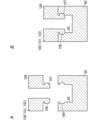
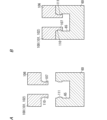
- the cap 100 may be inserted into the recess 65 of the fixed terminal 60, as shown in Figures 8A and 8B.
- the cap 100 has a first portion 106 and a second portion 107.
- the first portion 106 is exposed from the recess 65 of the fixed terminal 60 when the cap 100 is inserted into the recess 65 of the fixed terminal 60.
- the second portion 107 is located below the first portion 106 and is disposed within the recess 65 of the fixed terminal 60.
- the cap 100 may be configured to be positioned on the fixed terminal 60 when the second portion 107 is disposed in the recess 65 of the fixed terminal 60.
- the cap 100 may be configured to be fixed to the fixed terminal 60 by disposing the second portion 107 in the recess 65 of the fixed terminal 60.
- the second portion 107 of the cap 100 may have a protrusion 108
- the recess 65 of the fixed terminal 60 may have a recess 109 with which the protrusion 108 engages.
- the protrusion 108 may be formed on the second portion 107 of the cap 100, and the recess 65 of the fixed terminal 60 may have a recess 109 with which the protrusion 108 engages.
- the cap 100 can be easily positioned with respect to the fixed terminal 60.
- the second portion 107 of the cap 100 may have a recess 110
- the fixed terminal 60 may have a protrusion 111 that engages with the recess 110.
- the recess 110 may be formed in the second portion 107 of the cap 100
- the protrusion 111 that engages with the recess 110 may be formed in the recess 65 of the fixed terminal 60. This also makes it possible to easily position the cap 100 relative to the fixed terminal 60 in the relay A2 according to the modified example of embodiment 2.
- the relay A2 of the second embodiment also has the same effect as the relay A2 of the second embodiment.
- the relay A2 may position the cap 100 and the fixed terminal 60 by embedding the second portion 105 of the cap 100 in the outer case 10, as shown in FIG. 4, for example.
- the relay A2 may also position the cap 100 and the fixed terminal 60 by providing a protrusion (not shown) on the outer case 10, providing a hole (not shown) in the cap 100 into which the protrusion of the outer case 10 is inserted, and heat-crimping the protrusion of the outer case 10.
- the second conductor 82a and the second conductor 82b are not limited to heat pipes, and may be used in a configuration that takes advantage of the fact that they are conductors to supply power. In this case, since the relay A2 has two conductors (the first conductor 81 and the second conductor 82), for example, the current path can be branched into two.
- the two conductors may be embedded in the outer case 10
- holes (not shown) may be provided in the conductors into which protrusions (not shown) of the outer case 10 may be inserted, and the protrusions of the outer case 10 may be heat-crimped to position the cap 100 on the fixed terminal 60.
- relay A2 includes a first conductor 81 and a second conductor 82
- the first conductor 81 and the second conductor 82 are not essential.
- the first conductor 81 and the second conductor 82 may be prepared by the user of relay A2.
- the relay (A1; A2) of the first aspect of the embodiment includes a cap (90; 100), a fixed terminal (60), and a movable contact (50).
- the cap (90; 100) has a through hole (93; 103) and is made of a conductive material.
- the fixed terminal (60) has a recess (65) that opens upward, and is disposed below the cap (90; 100) so that the through hole (93; 103) of the cap (90; 100) and the opening of the recess (65) overlap.
- the movable contact (50) is disposed below the fixed terminal (60), moves upward to contact the fixed terminal (60), and moves downward to separate from the fixed terminal (60).
- the relays (A1; A2) described above can easily suppress heat generation from the fixed terminals (60) by providing caps (90; 100) made of conductive material on the fixed terminals (60).
- the cap (90; 100) has a first upper surface (94a; 104a) and a second upper surface (95a; 105a) located below the first upper surface (94a; 104a), and it is preferable that the second upper surface (95a; 105a) is located outside the first upper surface (94a; 104a) when viewed from above.
- the above-mentioned relay (A1; A2) can increase the surface area of the cap (90; 100) and improve the heat dissipation effect of the cap (90; 100).
- the cap (90) in the first or second aspect, has a first portion (94) having a first upper surface (94a) and a second portion (95) located below the first portion (94) and having a second upper surface (95a). It is preferable that the width (W1) of the through hole (93a) of the cap (90) in the first portion (94) is narrower than the width (W2) of the through hole (93b) in the second portion (95).
- the relay (A1) described above allows the fixed terminal (60) to be easily inserted into the through hole (93b) of the second portion (95).
- the width of the through hole (93a; 103a) of the cap (90; 100) in the first portion (94; 104) is the same as or larger than the width of the recess (65) of the fixed terminal (60).
- the cap (90; 100) is less likely to interfere with the fixing of the bus bar and the relay (A1; A2), for example.
- the upper end of the fixed terminal (60) is disposed within the through hole (93b) in the second portion (95), and the fixed terminal (60) contacts the inner wall of the through hole (93b).
- the above-mentioned relay (A1) can easily achieve electrical connection between the fixed terminal (60) and the cap (90).
- the cap (100) has a first portion (104) having a first upper surface (104a) and a second portion (105) located below the first portion (104) and having a second upper surface (105a). It is preferable that the lower surface of the second portion (105) contacts the upper surface of the fixed terminal (60).
- the above-mentioned relay (A2) can easily achieve electrical connection between the fixed terminal (60) and the cap (100).
- the width of the second portion (105) of the cap (100) is the same as or greater than the width of the upper end of the fixed terminal (60).
- the relay (A2) of the eighth aspect of the embodiment is preferably any one of the first to seventh aspects, further comprising a first conductor (81) electrically connected to the fixed terminal (60) and a second conductor (82) electrically connected to the fixed terminal (60).
- the cap (100) has a first portion (104) that contacts the first conductor (81) and a second portion (105) that is located below the first portion (104) and joins with the second conductor (82).
- the above-mentioned relay (A2) can easily electrically connect two different conductors (81, 82) to a fixed terminal (60).
- the cap (100) has a first portion (106) exposed from the recess (65) of the fixed terminal (60) and a second portion (107) located below the first portion (106) and disposed within the recess (65) of the fixed terminal (60).
- the cap (100) is fixed to the fixed terminal (60) by disposing the second portion (107) within the recess (65) of the fixed terminal (60).
- the above-mentioned relay (A2) can easily achieve electrical connection between the fixed terminal (60) and the cap (100).
- a protrusion (108) is formed on the second portion (107) of the cap (100) and a recess (109) into which the protrusion (108) engages is formed in the recess (65) of the fixed terminal (60), or that a recess (110) is formed on the second portion (107) of the cap (100) and a protrusion (111) into which the recess (110) engages is formed in the recess (65) of the fixed terminal (60).
- the above-mentioned relay (A2) allows easy positioning of the cap (100) relative to the fixed terminal (60).
- the relay (A1; A2) of the eleventh aspect of the embodiment is preferably any one of the first to tenth aspects, further comprising a case (10) that houses the fixed terminal (60) and the movable contact (50) and exposes the upper end of the cap (90; 100).
- the cap (90; 100) is positioned with respect to the fixed terminal (60) by the case (10).
- the above-mentioned relays (A1; A2) allow easy positioning of the caps (90; 100) relative to the fixed terminals (60).
Landscapes
- Physics & Mathematics (AREA)
- Electromagnetism (AREA)
- Thermally Actuated Switches (AREA)
- Switch Cases, Indication, And Locking (AREA)
Priority Applications (2)
| Application Number | Priority Date | Filing Date | Title |
|---|---|---|---|
| JP2025516780A JPWO2024225195A1 (https=) | 2023-04-27 | 2024-04-19 | |
| CN202480027702.0A CN121079750A (zh) | 2023-04-27 | 2024-04-19 | 继电器 |
Applications Claiming Priority (2)
| Application Number | Priority Date | Filing Date | Title |
|---|---|---|---|
| US202363498541P | 2023-04-27 | 2023-04-27 | |
| US63/498,541 | 2023-04-27 |
Publications (1)
| Publication Number | Publication Date |
|---|---|
| WO2024225195A1 true WO2024225195A1 (ja) | 2024-10-31 |
Family
ID=93256290
Family Applications (1)
| Application Number | Title | Priority Date | Filing Date |
|---|---|---|---|
| PCT/JP2024/015618 Ceased WO2024225195A1 (ja) | 2023-04-27 | 2024-04-19 | 継電器 |
Country Status (3)
| Country | Link |
|---|---|
| JP (1) | JPWO2024225195A1 (https=) |
| CN (1) | CN121079750A (https=) |
| WO (1) | WO2024225195A1 (https=) |
Citations (2)
| Publication number | Priority date | Publication date | Assignee | Title |
|---|---|---|---|---|
| JPH05128927A (ja) * | 1991-11-07 | 1993-05-25 | Matsushita Electric Works Ltd | 接点装置 |
| JP2021144957A (ja) * | 2020-02-05 | 2021-09-24 | パナソニックIpマネジメント株式会社 | 電磁継電器 |
-
2024
- 2024-04-19 JP JP2025516780A patent/JPWO2024225195A1/ja active Pending
- 2024-04-19 WO PCT/JP2024/015618 patent/WO2024225195A1/ja not_active Ceased
- 2024-04-19 CN CN202480027702.0A patent/CN121079750A/zh active Pending
Patent Citations (2)
| Publication number | Priority date | Publication date | Assignee | Title |
|---|---|---|---|---|
| JPH05128927A (ja) * | 1991-11-07 | 1993-05-25 | Matsushita Electric Works Ltd | 接点装置 |
| JP2021144957A (ja) * | 2020-02-05 | 2021-09-24 | パナソニックIpマネジメント株式会社 | 電磁継電器 |
Also Published As
| Publication number | Publication date |
|---|---|
| JPWO2024225195A1 (https=) | 2024-10-31 |
| CN121079750A (zh) | 2025-12-05 |
Similar Documents
| Publication | Publication Date | Title |
|---|---|---|
| JP7117567B2 (ja) | 接点装置、電磁継電器、電気機器 | |
| JP7672093B2 (ja) | 接点装置及び電磁継電器 | |
| JP7142220B2 (ja) | 接点装置及び電磁継電器 | |
| JP6300153B2 (ja) | 電磁継電器 | |
| JP7519644B2 (ja) | 接点装置 | |
| CN112805802B (zh) | 电磁继电器 | |
| WO2019103061A1 (ja) | 接点装置、及び電磁継電器 | |
| JP2009188364A (ja) | 点火コイル | |
| JP4858508B2 (ja) | 電磁開閉装置 | |
| EP4333016B1 (en) | Contact device and electromagnetic relay | |
| US11562870B2 (en) | Electromagnetic relay | |
| WO2024225195A1 (ja) | 継電器 | |
| JP2020173939A (ja) | 電磁継電器 | |
| WO2020090264A1 (ja) | 電磁継電器 | |
| JP6011267B2 (ja) | 電磁継電器 | |
| JP5547011B2 (ja) | 電磁継電器 | |
| JP2021082402A (ja) | 電磁継電器モジュール及び電気接続装置 | |
| JP2016181386A (ja) | 接点装置および当該接点装置を有する電磁リレー、電線取付方法 | |
| WO2024157952A1 (ja) | 電磁継電器 | |
| JP5351735B2 (ja) | 電磁継電器 | |
| US12620540B2 (en) | Contact device and electromagnetic relay | |
| WO2025182827A1 (ja) | 継電器 | |
| JP2021083160A (ja) | 電気接続装置 | |
| JP2013246869A (ja) | 接点装置 |
Legal Events
| Date | Code | Title | Description |
|---|---|---|---|
| 121 | Ep: the epo has been informed by wipo that ep was designated in this application |
Ref document number: 24796942 Country of ref document: EP Kind code of ref document: A1 |
|
| ENP | Entry into the national phase |
Ref document number: 2025516780 Country of ref document: JP Kind code of ref document: A |
|
| WWE | Wipo information: entry into national phase |
Ref document number: 2025516780 Country of ref document: JP |
|
| NENP | Non-entry into the national phase |
Ref country code: DE |