WO2024224440A1 - 構造体の成形方法及び接合構造体 - Google Patents
構造体の成形方法及び接合構造体 Download PDFInfo
- Publication number
- WO2024224440A1 WO2024224440A1 PCT/JP2023/016062 JP2023016062W WO2024224440A1 WO 2024224440 A1 WO2024224440 A1 WO 2024224440A1 JP 2023016062 W JP2023016062 W JP 2023016062W WO 2024224440 A1 WO2024224440 A1 WO 2024224440A1
- Authority
- WO
- WIPO (PCT)
- Prior art keywords
- prepreg
- thermoplastic resin
- mold
- needle
- cavity
- Prior art date
- Legal status (The legal status is an assumption and is not a legal conclusion. Google has not performed a legal analysis and makes no representation as to the accuracy of the status listed.)
- Ceased
Links
Images









Classifications
-
- B—PERFORMING OPERATIONS; TRANSPORTING
- B29—WORKING OF PLASTICS; WORKING OF SUBSTANCES IN A PLASTIC STATE IN GENERAL
- B29C—SHAPING OR JOINING OF PLASTICS; SHAPING OF MATERIAL IN A PLASTIC STATE, NOT OTHERWISE PROVIDED FOR; AFTER-TREATMENT OF THE SHAPED PRODUCTS, e.g. REPAIRING
- B29C43/00—Compression moulding, i.e. applying external pressure to flow the moulding material; Apparatus therefor
- B29C43/32—Component parts, details or accessories; Auxiliary operations
- B29C43/36—Moulds for making articles of definite length, i.e. discrete articles
-
- B—PERFORMING OPERATIONS; TRANSPORTING
- B29—WORKING OF PLASTICS; WORKING OF SUBSTANCES IN A PLASTIC STATE IN GENERAL
- B29C—SHAPING OR JOINING OF PLASTICS; SHAPING OF MATERIAL IN A PLASTIC STATE, NOT OTHERWISE PROVIDED FOR; AFTER-TREATMENT OF THE SHAPED PRODUCTS, e.g. REPAIRING
- B29C43/00—Compression moulding, i.e. applying external pressure to flow the moulding material; Apparatus therefor
- B29C43/32—Component parts, details or accessories; Auxiliary operations
- B29C43/36—Moulds for making articles of definite length, i.e. discrete articles
- B29C43/361—Moulds for making articles of definite length, i.e. discrete articles with pressing members independently movable of the parts for opening or closing the mould, e.g. movable pistons
-
- B—PERFORMING OPERATIONS; TRANSPORTING
- B29—WORKING OF PLASTICS; WORKING OF SUBSTANCES IN A PLASTIC STATE IN GENERAL
- B29C—SHAPING OR JOINING OF PLASTICS; SHAPING OF MATERIAL IN A PLASTIC STATE, NOT OTHERWISE PROVIDED FOR; AFTER-TREATMENT OF THE SHAPED PRODUCTS, e.g. REPAIRING
- B29C45/00—Injection moulding, i.e. forcing the required volume of moulding material through a nozzle into a closed mould; Apparatus therefor
- B29C45/14—Injection moulding, i.e. forcing the required volume of moulding material through a nozzle into a closed mould; Apparatus therefor incorporating preformed parts or layers, e.g. injection moulding around inserts or for coating articles
- B29C45/14065—Positioning or centering articles in the mould
-
- B—PERFORMING OPERATIONS; TRANSPORTING
- B29—WORKING OF PLASTICS; WORKING OF SUBSTANCES IN A PLASTIC STATE IN GENERAL
- B29C—SHAPING OR JOINING OF PLASTICS; SHAPING OF MATERIAL IN A PLASTIC STATE, NOT OTHERWISE PROVIDED FOR; AFTER-TREATMENT OF THE SHAPED PRODUCTS, e.g. REPAIRING
- B29C70/00—Shaping composites, i.e. plastics material comprising reinforcements, fillers or preformed parts, e.g. inserts
- B29C70/04—Shaping composites, i.e. plastics material comprising reinforcements, fillers or preformed parts, e.g. inserts comprising reinforcements only, e.g. self-reinforcing plastics
- B29C70/06—Fibrous reinforcements only
- B29C70/10—Fibrous reinforcements only characterised by the structure of fibrous reinforcements, e.g. hollow fibres
- B29C70/16—Fibrous reinforcements only characterised by the structure of fibrous reinforcements, e.g. hollow fibres using fibres of substantial or continuous length
- B29C70/20—Fibrous reinforcements only characterised by the structure of fibrous reinforcements, e.g. hollow fibres using fibres of substantial or continuous length oriented in a single direction, e.g. roofing or other parallel fibres
-
- B—PERFORMING OPERATIONS; TRANSPORTING
- B29—WORKING OF PLASTICS; WORKING OF SUBSTANCES IN A PLASTIC STATE IN GENERAL
- B29C—SHAPING OR JOINING OF PLASTICS; SHAPING OF MATERIAL IN A PLASTIC STATE, NOT OTHERWISE PROVIDED FOR; AFTER-TREATMENT OF THE SHAPED PRODUCTS, e.g. REPAIRING
- B29C70/00—Shaping composites, i.e. plastics material comprising reinforcements, fillers or preformed parts, e.g. inserts
- B29C70/04—Shaping composites, i.e. plastics material comprising reinforcements, fillers or preformed parts, e.g. inserts comprising reinforcements only, e.g. self-reinforcing plastics
- B29C70/06—Fibrous reinforcements only
- B29C70/10—Fibrous reinforcements only characterised by the structure of fibrous reinforcements, e.g. hollow fibres
- B29C70/16—Fibrous reinforcements only characterised by the structure of fibrous reinforcements, e.g. hollow fibres using fibres of substantial or continuous length
- B29C70/24—Fibrous reinforcements only characterised by the structure of fibrous reinforcements, e.g. hollow fibres using fibres of substantial or continuous length oriented in at least three directions forming a three-dimensional [3D] structure
-
- B—PERFORMING OPERATIONS; TRANSPORTING
- B29—WORKING OF PLASTICS; WORKING OF SUBSTANCES IN A PLASTIC STATE IN GENERAL
- B29C—SHAPING OR JOINING OF PLASTICS; SHAPING OF MATERIAL IN A PLASTIC STATE, NOT OTHERWISE PROVIDED FOR; AFTER-TREATMENT OF THE SHAPED PRODUCTS, e.g. REPAIRING
- B29C70/00—Shaping composites, i.e. plastics material comprising reinforcements, fillers or preformed parts, e.g. inserts
- B29C70/04—Shaping composites, i.e. plastics material comprising reinforcements, fillers or preformed parts, e.g. inserts comprising reinforcements only, e.g. self-reinforcing plastics
- B29C70/28—Shaping operations therefor
- B29C70/30—Shaping by lay-up, i.e. applying fibres, tape or broadsheet on a mould, former or core; Shaping by spray-up, i.e. spraying of fibres on a mould, former or core
- B29C70/34—Shaping by lay-up, i.e. applying fibres, tape or broadsheet on a mould, former or core; Shaping by spray-up, i.e. spraying of fibres on a mould, former or core and shaping or impregnating by compression, i.e. combined with compressing after the lay-up operation
-
- B—PERFORMING OPERATIONS; TRANSPORTING
- B29—WORKING OF PLASTICS; WORKING OF SUBSTANCES IN A PLASTIC STATE IN GENERAL
- B29C—SHAPING OR JOINING OF PLASTICS; SHAPING OF MATERIAL IN A PLASTIC STATE, NOT OTHERWISE PROVIDED FOR; AFTER-TREATMENT OF THE SHAPED PRODUCTS, e.g. REPAIRING
- B29C70/00—Shaping composites, i.e. plastics material comprising reinforcements, fillers or preformed parts, e.g. inserts
- B29C70/04—Shaping composites, i.e. plastics material comprising reinforcements, fillers or preformed parts, e.g. inserts comprising reinforcements only, e.g. self-reinforcing plastics
- B29C70/28—Shaping operations therefor
- B29C70/40—Shaping or impregnating by compression not applied
- B29C70/42—Shaping or impregnating by compression not applied for producing articles of definite length, i.e. discrete articles
- B29C70/46—Shaping or impregnating by compression not applied for producing articles of definite length, i.e. discrete articles using matched moulds, e.g. for deforming sheet moulding compounds [SMC] or prepregs
-
- B—PERFORMING OPERATIONS; TRANSPORTING
- B29—WORKING OF PLASTICS; WORKING OF SUBSTANCES IN A PLASTIC STATE IN GENERAL
- B29C—SHAPING OR JOINING OF PLASTICS; SHAPING OF MATERIAL IN A PLASTIC STATE, NOT OTHERWISE PROVIDED FOR; AFTER-TREATMENT OF THE SHAPED PRODUCTS, e.g. REPAIRING
- B29C70/00—Shaping composites, i.e. plastics material comprising reinforcements, fillers or preformed parts, e.g. inserts
- B29C70/04—Shaping composites, i.e. plastics material comprising reinforcements, fillers or preformed parts, e.g. inserts comprising reinforcements only, e.g. self-reinforcing plastics
- B29C70/28—Shaping operations therefor
- B29C70/54—Component parts, details or accessories; Auxiliary operations, e.g. feeding or storage of prepregs or SMC after impregnation or during ageing
-
- B—PERFORMING OPERATIONS; TRANSPORTING
- B29—WORKING OF PLASTICS; WORKING OF SUBSTANCES IN A PLASTIC STATE IN GENERAL
- B29C—SHAPING OR JOINING OF PLASTICS; SHAPING OF MATERIAL IN A PLASTIC STATE, NOT OTHERWISE PROVIDED FOR; AFTER-TREATMENT OF THE SHAPED PRODUCTS, e.g. REPAIRING
- B29C70/00—Shaping composites, i.e. plastics material comprising reinforcements, fillers or preformed parts, e.g. inserts
- B29C70/68—Shaping composites, i.e. plastics material comprising reinforcements, fillers or preformed parts, e.g. inserts by incorporating or moulding on preformed parts, e.g. inserts or layers, e.g. foam blocks
- B29C70/74—Moulding material on a relatively small portion of the preformed part, e.g. outsert moulding
-
- B—PERFORMING OPERATIONS; TRANSPORTING
- B29—WORKING OF PLASTICS; WORKING OF SUBSTANCES IN A PLASTIC STATE IN GENERAL
- B29C—SHAPING OR JOINING OF PLASTICS; SHAPING OF MATERIAL IN A PLASTIC STATE, NOT OTHERWISE PROVIDED FOR; AFTER-TREATMENT OF THE SHAPED PRODUCTS, e.g. REPAIRING
- B29C43/00—Compression moulding, i.e. applying external pressure to flow the moulding material; Apparatus therefor
- B29C43/02—Compression moulding, i.e. applying external pressure to flow the moulding material; Apparatus therefor of articles of definite length, i.e. discrete articles
- B29C43/18—Compression moulding, i.e. applying external pressure to flow the moulding material; Apparatus therefor of articles of definite length, i.e. discrete articles incorporating preformed parts or layers, e.g. compression moulding around inserts or for coating articles
- B29C2043/189—Compression moulding, i.e. applying external pressure to flow the moulding material; Apparatus therefor of articles of definite length, i.e. discrete articles incorporating preformed parts or layers, e.g. compression moulding around inserts or for coating articles the parts being joined
-
- B—PERFORMING OPERATIONS; TRANSPORTING
- B29—WORKING OF PLASTICS; WORKING OF SUBSTANCES IN A PLASTIC STATE IN GENERAL
- B29C—SHAPING OR JOINING OF PLASTICS; SHAPING OF MATERIAL IN A PLASTIC STATE, NOT OTHERWISE PROVIDED FOR; AFTER-TREATMENT OF THE SHAPED PRODUCTS, e.g. REPAIRING
- B29C43/00—Compression moulding, i.e. applying external pressure to flow the moulding material; Apparatus therefor
- B29C43/32—Component parts, details or accessories; Auxiliary operations
- B29C43/36—Moulds for making articles of definite length, i.e. discrete articles
- B29C2043/3602—Moulds for making articles of definite length, i.e. discrete articles with means for positioning, fastening or clamping the material to be formed or preforms inside the mould
-
- B—PERFORMING OPERATIONS; TRANSPORTING
- B29—WORKING OF PLASTICS; WORKING OF SUBSTANCES IN A PLASTIC STATE IN GENERAL
- B29C—SHAPING OR JOINING OF PLASTICS; SHAPING OF MATERIAL IN A PLASTIC STATE, NOT OTHERWISE PROVIDED FOR; AFTER-TREATMENT OF THE SHAPED PRODUCTS, e.g. REPAIRING
- B29C43/00—Compression moulding, i.e. applying external pressure to flow the moulding material; Apparatus therefor
- B29C43/32—Component parts, details or accessories; Auxiliary operations
- B29C43/36—Moulds for making articles of definite length, i.e. discrete articles
- B29C43/361—Moulds for making articles of definite length, i.e. discrete articles with pressing members independently movable of the parts for opening or closing the mould, e.g. movable pistons
- B29C2043/3613—Moulds for making articles of definite length, i.e. discrete articles with pressing members independently movable of the parts for opening or closing the mould, e.g. movable pistons applying pressure locally
-
- B—PERFORMING OPERATIONS; TRANSPORTING
- B29—WORKING OF PLASTICS; WORKING OF SUBSTANCES IN A PLASTIC STATE IN GENERAL
- B29C—SHAPING OR JOINING OF PLASTICS; SHAPING OF MATERIAL IN A PLASTIC STATE, NOT OTHERWISE PROVIDED FOR; AFTER-TREATMENT OF THE SHAPED PRODUCTS, e.g. REPAIRING
- B29C43/00—Compression moulding, i.e. applying external pressure to flow the moulding material; Apparatus therefor
- B29C43/003—Compression moulding, i.e. applying external pressure to flow the moulding material; Apparatus therefor characterised by the choice of material
-
- B—PERFORMING OPERATIONS; TRANSPORTING
- B29—WORKING OF PLASTICS; WORKING OF SUBSTANCES IN A PLASTIC STATE IN GENERAL
- B29C—SHAPING OR JOINING OF PLASTICS; SHAPING OF MATERIAL IN A PLASTIC STATE, NOT OTHERWISE PROVIDED FOR; AFTER-TREATMENT OF THE SHAPED PRODUCTS, e.g. REPAIRING
- B29C43/00—Compression moulding, i.e. applying external pressure to flow the moulding material; Apparatus therefor
- B29C43/02—Compression moulding, i.e. applying external pressure to flow the moulding material; Apparatus therefor of articles of definite length, i.e. discrete articles
-
- B—PERFORMING OPERATIONS; TRANSPORTING
- B29—WORKING OF PLASTICS; WORKING OF SUBSTANCES IN A PLASTIC STATE IN GENERAL
- B29C—SHAPING OR JOINING OF PLASTICS; SHAPING OF MATERIAL IN A PLASTIC STATE, NOT OTHERWISE PROVIDED FOR; AFTER-TREATMENT OF THE SHAPED PRODUCTS, e.g. REPAIRING
- B29C45/00—Injection moulding, i.e. forcing the required volume of moulding material through a nozzle into a closed mould; Apparatus therefor
- B29C45/14—Injection moulding, i.e. forcing the required volume of moulding material through a nozzle into a closed mould; Apparatus therefor incorporating preformed parts or layers, e.g. injection moulding around inserts or for coating articles
-
- B—PERFORMING OPERATIONS; TRANSPORTING
- B29—WORKING OF PLASTICS; WORKING OF SUBSTANCES IN A PLASTIC STATE IN GENERAL
- B29K—INDEXING SCHEME ASSOCIATED WITH SUBCLASSES B29B, B29C OR B29D, RELATING TO MOULDING MATERIALS OR TO MATERIALS FOR MOULDS, REINFORCEMENTS, FILLERS OR PREFORMED PARTS, e.g. INSERTS
- B29K2101/00—Use of unspecified macromolecular compounds as moulding material
- B29K2101/12—Thermoplastic materials
-
- B—PERFORMING OPERATIONS; TRANSPORTING
- B29—WORKING OF PLASTICS; WORKING OF SUBSTANCES IN A PLASTIC STATE IN GENERAL
- B29K—INDEXING SCHEME ASSOCIATED WITH SUBCLASSES B29B, B29C OR B29D, RELATING TO MOULDING MATERIALS OR TO MATERIALS FOR MOULDS, REINFORCEMENTS, FILLERS OR PREFORMED PARTS, e.g. INSERTS
- B29K2105/00—Condition, form or state of moulded material or of the material to be shaped
- B29K2105/06—Condition, form or state of moulded material or of the material to be shaped containing reinforcements, fillers or inserts
- B29K2105/08—Condition, form or state of moulded material or of the material to be shaped containing reinforcements, fillers or inserts of continuous length, e.g. cords, rovings, mats, fabrics, strands or yarns
- B29K2105/0872—Prepregs
-
- B—PERFORMING OPERATIONS; TRANSPORTING
- B29—WORKING OF PLASTICS; WORKING OF SUBSTANCES IN A PLASTIC STATE IN GENERAL
- B29K—INDEXING SCHEME ASSOCIATED WITH SUBCLASSES B29B, B29C OR B29D, RELATING TO MOULDING MATERIALS OR TO MATERIALS FOR MOULDS, REINFORCEMENTS, FILLERS OR PREFORMED PARTS, e.g. INSERTS
- B29K2105/00—Condition, form or state of moulded material or of the material to be shaped
- B29K2105/06—Condition, form or state of moulded material or of the material to be shaped containing reinforcements, fillers or inserts
- B29K2105/08—Condition, form or state of moulded material or of the material to be shaped containing reinforcements, fillers or inserts of continuous length, e.g. cords, rovings, mats, fabrics, strands or yarns
- B29K2105/10—Cords, strands or rovings, e.g. oriented cords, strands or rovings
-
- B—PERFORMING OPERATIONS; TRANSPORTING
- B29—WORKING OF PLASTICS; WORKING OF SUBSTANCES IN A PLASTIC STATE IN GENERAL
- B29K—INDEXING SCHEME ASSOCIATED WITH SUBCLASSES B29B, B29C OR B29D, RELATING TO MOULDING MATERIALS OR TO MATERIALS FOR MOULDS, REINFORCEMENTS, FILLERS OR PREFORMED PARTS, e.g. INSERTS
- B29K2105/00—Condition, form or state of moulded material or of the material to be shaped
- B29K2105/06—Condition, form or state of moulded material or of the material to be shaped containing reinforcements, fillers or inserts
- B29K2105/08—Condition, form or state of moulded material or of the material to be shaped containing reinforcements, fillers or inserts of continuous length, e.g. cords, rovings, mats, fabrics, strands or yarns
- B29K2105/10—Cords, strands or rovings, e.g. oriented cords, strands or rovings
- B29K2105/101—Oriented
-
- B—PERFORMING OPERATIONS; TRANSPORTING
- B29—WORKING OF PLASTICS; WORKING OF SUBSTANCES IN A PLASTIC STATE IN GENERAL
- B29K—INDEXING SCHEME ASSOCIATED WITH SUBCLASSES B29B, B29C OR B29D, RELATING TO MOULDING MATERIALS OR TO MATERIALS FOR MOULDS, REINFORCEMENTS, FILLERS OR PREFORMED PARTS, e.g. INSERTS
- B29K2307/00—Use of elements other than metals as reinforcement
- B29K2307/04—Carbon
-
- B—PERFORMING OPERATIONS; TRANSPORTING
- B29—WORKING OF PLASTICS; WORKING OF SUBSTANCES IN A PLASTIC STATE IN GENERAL
- B29L—INDEXING SCHEME ASSOCIATED WITH SUBCLASS B29C, RELATING TO PARTICULAR ARTICLES
- B29L2031/00—Other particular articles
- B29L2031/30—Vehicles, e.g. ships or aircraft, or body parts thereof
-
- B—PERFORMING OPERATIONS; TRANSPORTING
- B29—WORKING OF PLASTICS; WORKING OF SUBSTANCES IN A PLASTIC STATE IN GENERAL
- B29L—INDEXING SCHEME ASSOCIATED WITH SUBCLASS B29C, RELATING TO PARTICULAR ARTICLES
- B29L2031/00—Other particular articles
- B29L2031/30—Vehicles, e.g. ships or aircraft, or body parts thereof
- B29L2031/3005—Body finishings
-
- B—PERFORMING OPERATIONS; TRANSPORTING
- B29—WORKING OF PLASTICS; WORKING OF SUBSTANCES IN A PLASTIC STATE IN GENERAL
- B29L—INDEXING SCHEME ASSOCIATED WITH SUBCLASS B29C, RELATING TO PARTICULAR ARTICLES
- B29L2031/00—Other particular articles
- B29L2031/30—Vehicles, e.g. ships or aircraft, or body parts thereof
- B29L2031/3076—Aircrafts
-
- F—MECHANICAL ENGINEERING; LIGHTING; HEATING; WEAPONS; BLASTING
- F16—ENGINEERING ELEMENTS AND UNITS; GENERAL MEASURES FOR PRODUCING AND MAINTAINING EFFECTIVE FUNCTIONING OF MACHINES OR INSTALLATIONS; THERMAL INSULATION IN GENERAL
- F16B—DEVICES FOR FASTENING OR SECURING CONSTRUCTIONAL ELEMENTS OR MACHINE PARTS TOGETHER, e.g. NAILS, BOLTS, CIRCLIPS, CLAMPS, CLIPS OR WEDGES; JOINTS OR JOINTING
- F16B5/00—Joining sheets or plates, e.g. panels, to one another or to strips or bars parallel to them
- F16B5/04—Joining sheets or plates, e.g. panels, to one another or to strips or bars parallel to them by means of riveting
Definitions
- the present invention relates to a method for forming a structure and a joined structure.
- Patent Document 1 discloses a conventional joint structure. This joint structure is made of two CFRP (Carbon Fiber Reinforced Plastics) structures that have carbon fibers in a matrix made of thermoplastic resin or thermosetting resin and are joined by rivets.
- CFRP Carbon Fiber Reinforced Plastics
- CFRP structures are lightweight yet strong, and have excellent fatigue and corrosion properties.
- joined structures in which multiple CFRP structures are joined with rivets do not require the use of adhesives, and therefore offer the advantages of reduced joining time, low cost, and high durability. For this reason, joined structures are expected to be widely used in parts and other applications in fields such as automobiles.
- the conventional joint structure is obtained by punching two structures together with a rivet, the carbon fibers in each structure are easily cut by the rivet, and the tensile strength in the direction along the joint surface of the structures is compromised.
- the carbon fibers in the first structure extend in a first direction and the carbon fibers in the second structure extend in a second direction that intersects the first direction, such as perpendicular to the first direction, and these first and second structures are joined as described above
- the carbon fibers in the first structure are easily cut in the first direction by the joining holes through which the rivets pass
- the carbon fibers in the second structure are also easily cut in the second direction by the same joining holes.
- the tensile strength of the joined structure decreases in both the first and second directions.
- the present invention was made in consideration of the above-mentioned conventional situation, and aims to provide a method for molding a structure that can improve the tensile strength of the joined structure. Another aim of the present invention is to provide a joined structure that can improve its strength.
- the molding method of the first teaching structure includes a preparation step of preparing a first prepreg having a plurality of first carbon fibers extending in one direction in a first base material made of a first thermoplastic resin, a second prepreg having a plurality of second carbon fibers extending in one direction in a second base material made of a second thermoplastic resin, a first mold, a second mold that forms a cavity together with the first mold, and a needle having a pointed tip; a setting process of providing the first prepreg in the cavity and providing the second prepreg in the cavity such that a first direction in which the first carbon fibers extend and a second direction in which the second carbon fibers extend intersect and overlap within a specific range in a third direction perpendicular to the first direction and the second direction; a mold clamping step of clamping the first mold and the second mold after the setting step; a pressurizing step of pressurizing the first prepreg and the second prepreg so as to integrate them in the cavity during or after the mold clamping step;
- the first direction in which the first carbon fiber extends and the second direction in which the second carbon fiber extends are crossed in the setting process, and the first prepreg and the second prepreg are integrated in the mold clamping process, making it possible to mold structures such as trusses.
- the needle is inserted in the third direction from its sharp tip into the specific area where the first prepreg and the second prepreg overlap, so that the first carbon fiber in the first prepreg is gradually pushed radially outward by the tip of the needle within the first base material, and the second carbon fiber in the second prepreg is also gradually pushed radially outward by the tip of the needle within the second base material.
- both the carbon fibers of the first prepreg and the carbon fibers of the second prepreg are difficult to cut. In this way, a connection hole is formed in the resulting structure in which cutting of the surrounding carbon fibers is suppressed.
- the first and second prepregs are restrained in the cavity while the hole-drilling process is carried out, which is an insert PCM (Pre-Preg Compression Molding) method, and the structure is less prone to deformation and has high dimensional accuracy.
- PCM Pre-Preg Compression Molding
- the molding method of the second teaching of the structure includes a preparation step of preparing a first prepreg having a plurality of first carbon fibers extending in one direction in a first base material made of a first thermoplastic resin, a first mold, a second mold forming a cavity together with the first mold, a needle having a pointed tip, and an injection material including a third thermoplastic resin and to be injected into the cavity; a setting step of providing the first prepreg in the cavity; a mold clamping step of clamping the first mold and the second mold after the setting step; a hole making step of inserting the needle from the tip portion into a specific area of the first prepreg in a third direction perpendicular to the first direction to form a connection hole with the needle; and an injection step of injecting the injection material into the cavity before, during or after the hole drilling step.
- the needle in the hole punching process, is inserted from its sharp tip in the third direction into a specific area of the first prepreg, so that the first carbon fiber in the first prepreg is gradually pushed radially outward by the tip of the needle within the first base material. This makes it difficult for the carbon fiber in the first prepreg to be cut.
- the injection process is performed before, during, or after the hole punching process, this is an insert injection molding method, and the structure is molded integrally with the first prepreg and the injection material, making it more practical.
- the injection material since the injection material is injected into the cavity, the injection material also molds the connection holes, and the connection holes can be shaped to a desired shape.
- the first thermoplastic resin of the first prepreg can be heated so as to be softened by the temperature of the injection material, reducing or eliminating the need to soften a specific range of the first thermoplastic resin during the hole punching process.
- the molding cycle time of the structure can be shortened, and manufacturing costs can be reduced.
- the resulting structure is designed to prevent cutting of the surrounding carbon fiber and to form connection holes of a desired shape.
- CFRTP Carbon Fiber Reinforced Thermo Plastics
- thermoplastic CFRP Carbon Fiber Reinforced Plastics
- the joint structure of the third teaching comprises a structure obtained by the above molding method, and a mating member laminated with the structure and having an insertion hole aligned with the joint hole;
- the connection hole and the insertion hole are characterized in that they have a plurality of fifth carbon fibers extending in one direction within a fifth base material made of a fifth thermoplastic resin, and a rivet is provided to join the structure and the mating material.
- the joint structure of the third teaching is made by joining the structure obtained in the first and second teachings to the mating material with rivets, so the tensile strength in the direction along the joint surface of the structure is unlikely to be compromised.
- this joint structure does not require the use of adhesive, it exhibits advantages such as shortened joining time, low cost, and high durability.
- the method for molding a structure of the present invention makes it possible to obtain a structure that can improve the tensile strength of the joined structure. Furthermore, the joined structure of the present invention can improve its strength.
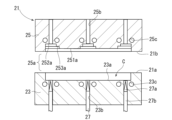
- FIG. FIG. 4 is a schematic cross-sectional view showing a first mold, a second mold, and a needle during a preparation process according to the first embodiment.
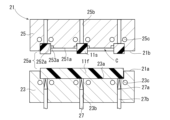
- FIG. 2 is a schematic cross-sectional view showing a first mold, a second mold, a needle, a first prepreg, and a second prepreg during a setting process according to the first embodiment.
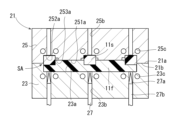
- 4 is a schematic cross-sectional view showing a first mold, a second mold, a needle, a first prepreg, and a second prepreg during a mold clamping step and a pressure application step according to the first embodiment.
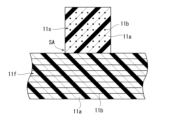
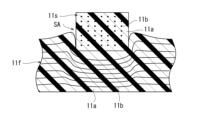
- FIG. 4 is a schematic enlarged cross-sectional view of the first prepreg and the second prepreg at an early stage of the mold clamping step and the pressurizing step in the first embodiment.
- FIG. 4 is a schematic enlarged cross-sectional view of the first prepreg and the second prepreg at the end of the mold clamping step and the pressurizing step in the first embodiment.
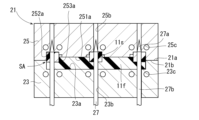
- FIG. 2 is a schematic cross-sectional view illustrating a first mold, a second mold, a needle, a first prepreg, and a second prepreg during a hole punching process according to the first embodiment.
- FIG. 4 is a schematic enlarged cross-sectional view of the first prepreg, the second prepreg, and the needle during a hole punching step according to the first embodiment.
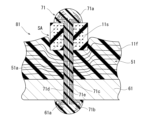
- FIG. 2 is an enlarged cross-sectional view of a main portion of the structure obtained by the molding method of Example 1.
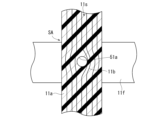
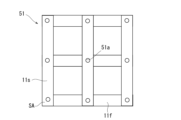
- FIG. 2 is an enlarged, partially sectional plan view showing the structure obtained by the molding method of Example 1.
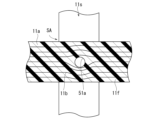
- FIG. 2 is an enlarged, partially sectional, back view of the structure obtained by the molding method of Example 1.
- FIG. 2 is a plan view of a structure obtained by the molding method of Example 1.
- 1 is a cross-sectional view of a structure obtained by the molding method of Example 1 and a counterpart material.
- FIG. FIG. 2 is a cross-sectional view of a main portion of the joined structure of the first embodiment.
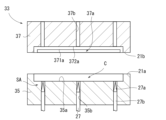
- FIG. 11 is a schematic cross-sectional view showing a first mold, a second mold, and a needle during a preparation process according to a second embodiment.
- FIG. 11 is a schematic cross-sectional view showing the first mold, the second mold, the needle, and the first prepreg during the setting process and the mold clamping process according to the second embodiment.
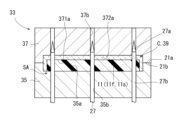
- FIG. 11 is a schematic cross-sectional view illustrating a first mold, a second mold, a needle, a first prepreg, and an injected material during an injection process and a hole punching process according to a second embodiment.
- FIG. 11 is a cross-sectional view of two structures obtained by the molding method of Example 2 and a counterpart material.
- FIG. 6 is a cross-sectional view of a main portion of a joined structure according to a second embodiment.
- FIG. 13 is a schematic cross-sectional view showing a first mold, a second mold, and a needle during a preparation step according to a third embodiment.
- FIG. 11 is a schematic cross-sectional view illustrating a first mold, a second mold, a needle, a first prepreg, and a second prepreg during a setting process according to Example 3.
- FIG. 11 is a schematic cross-sectional view showing a first mold, a second mold, a needle, a first prepreg, and a second prepreg during a mold clamping step and a pressure application step according to a third embodiment.
- FIG. 11 is a schematic cross-sectional view showing a first mold, a second mold, a needle, a first prepreg, and a second prepreg during a mold clamping step and a pressure application step according to a third embodiment.
- FIG. 11 is a schematic cross-sectional view illustrating a first mold, a second mold, a needle, a first prepreg, a second prepreg, and an injected material during an injection process and a hole punching process according to a third embodiment.
- FIG. 11 is a cross-sectional view of a structure obtained by the molding method of Example 3 and a counterpart material.
- FIG. 11 is a cross-sectional view of a main portion of a joint structure according to a third embodiment.
- the first thermoplastic resin constituting the first base material of the first prepreg, the second thermoplastic resin constituting the second base material of the second prepreg, the third thermoplastic resin constituting the injection material, the fourth thermoplastic resin that may constitute the needle, and the fifth thermoplastic resin constituting the fifth base material of the rivet may be polyethylene (PE), polypropylene (PP), polyvinyl chloride (PVC), polystyrene (PS), polyvinyl acetate (PVAC), polyurethane (PUR), polytetrafluoroethylene (PTFE), acrylonitrile butadiene styrene (ABS) resin, acrylonitrile styrene copolymer (AS resin), acrylic (PMMA), etc.
- PE polyethylene
- PP polypropylene
- PVC polyvinyl chloride
- PS polystyrene
- PVAC polyurethane
- PUR polytetrafluoroethylene
- ABS acrylonitrile butadiene sty
- MA resin polyamide (PA), polyacetal (POM), polycarbonate (PC), modified polyphenylene ether (modified PPE), polyethylene terephthalate (PET), polybutylene terephthalate (PBT), cyclic polyolefin (COP), polyphenylene sulfide (PPS), polysulfone (PSF), polyethersulfone (PES), amorphous polyarylate (PAR), polyaryletherketone (PAEK), polyetherketoneketone (PEKK), polyetheretherketone (PEEK), thermoplastic polyimide (PI), polyamideimide (PAI), etc.
- the first to fifth thermoplastic resins may be the same type or different types.
- the first, second, fourth, and fifth carbon fibers are filaments.
- the first, second, fourth, and fifth carbon fibers may be PAN (Polyacrylonitrile) based or pitch based.
- the first, second, fourth, and fifth carbon fibers may have the same diameter or different diameters.
- the number and density of the first carbon fibers in the first prepreg, the number and density of the second carbon fibers in the second prepreg, the number and density of the fourth carbon fibers that may be in the needle, and the number and density of the fifth carbon fibers in the rivet may be the same or different.
- the first and second prepregs may be carbon fibers completely impregnated with thermoplastic resin, or may be so-called semi-pregs in which the carbon fibers are incompletely impregnated.
- the first and second prepregs may be rods, such as rectangular or cylindrical, or may be sheets. It is also possible to use third and fourth prepregs, etc., similar to the first and second prepregs.
- the shape of the structure is not limited in the molding direction of the first and second teachings.
- the pressurizing process may be performed during or after the mold clamping process. If the pressurizing process is performed during the mold clamping process, the molding cycle time of the structure can be shortened, and manufacturing costs can be reduced. If the pressurizing process is performed after the mold clamping process, the pressure can be easily adjusted.
- the hole-making process may be performed during or after the pressurizing process. If the hole-making process is performed during the pressurizing process, the molding cycle time of the structure can be shortened, and manufacturing costs can be reduced.
- the preparation step may prepare an injection material containing a third thermoplastic resin to be injected into the cavity.
- the molding method preferably includes an injection step of injecting the injection material into the cavity before, during, or after the hole punching step.
- the insert injection molding method is used, and the structure is not only integrated with the first prepreg and the second prepreg, but is also molded by the injection material, which increases the practicality.
- the injection material since the injection material is injected into the cavity, the injection material also molds the connection hole, and the connection hole can be shaped into a preferred shape.
- the first thermoplastic resin of the first prepreg and the second thermoplastic resin of the second prepreg can be heated so as to be softened by the temperature of the injection material, and the need to soften the first thermoplastic resin and the second thermoplastic resin in a specific range during the hole punching step can be reduced or eliminated.
- the injection step is performed during the hole punching step, the molding cycle time of the structure can be shortened, and the manufacturing cost can be reduced.
- the third thermoplastic resin has a higher melting point than the first thermoplastic resin and the second thermoplastic resin.
- the first thermoplastic resin and the second thermoplastic resin are reliably softened or melted by the temperature of the injected material, increasing the integrity of the structure and improving the dimensional accuracy of the structure including the connection holes.
- the pressurizing step it is preferable to heat the first thermoplastic resin and the second thermoplastic resin in a specific range so that they soften.
- the first base material of the first prepreg and the second base material of the second prepreg are more likely to become integrated.
- the heating temperature is preferably equal to or higher than the thermal deformation temperature of at least one of the first thermoplastic resin and the second thermoplastic resin. It may be equal to or lower than the melting point of at least one of the first thermoplastic resin and the second thermoplastic resin.
- the first and second thermoplastic resins in the hole-making process, it is preferable to heat the first and second thermoplastic resins in a specific range so that they soften. If the injection process is not performed before or during the hole-making process, the first and second carbon fibers are more likely to move within the first and second base materials by the tip of the needle, making them less likely to be cut.
- the heating temperature is preferably equal to or higher than the thermal deformation temperature of at least one of the first and second thermoplastic resins. It may also be equal to or lower than the melting point of at least one of the first and second thermoplastic resins.
- the third thermoplastic resin has a higher melting point than the first thermoplastic resin.
- the first thermoplastic resin softens or melts depending on the temperature of the injected material, increasing the integrity of the structure and improving the dimensional accuracy of the structure including the connection holes.
- a second prepreg having a plurality of second carbon fibers extending in one direction within a second base material made of a second thermoplastic resin can be prepared.
- the setting step it is preferable to provide the second prepreg within the cavity so that in a specific range, the first direction in which the first carbon fibers extend and the second direction in which the second carbon fibers extend intersect and overlap in a third direction.
- the hole drilling step it is preferable to insert a needle from its tip into the specific range in the third direction and form a connection hole with the needle.
- a connection hole can be formed in a structure that integrally includes the first prepreg and the second prepreg.
- the third thermoplastic resin has a higher melting point than the first and second thermoplastic resins.
- the first and second thermoplastic resins soften or melt depending on the temperature of the injected material, increasing the integrity of the structure and improving the dimensional accuracy of the structure including the connection holes.
- the second teaching it is preferable to apply pressure to the first and second prepregs in the cavity during the mold clamping process so as to integrate them. In this case, the integrity of the structure is increased and the dimensional accuracy of the structure, including the connection holes, is improved.
- the needle has a plurality of fourth carbon fibers extending in one direction within the fourth base material made of the fourth thermoplastic resin.
- the needle can be used as a CFRTP rivet as is.
- first and second teachings it is preferable to make the first direction and the second direction perpendicular to each other in the setting process. In this case, a high-strength structure can be obtained without the need to weave the carbon fibers.
- the first and second prepregs are rod-shaped, and the specific range can be the portion where the first and second prepregs intersect.
- the joining holes will also be formed in the intersecting portions, making the joined structure widely applicable to automobiles, aircraft, spacecraft, ships, trains, buildings, etc.
- the joining structure of the third teaching has high peel strength in the third direction because the rivets are also made of CFRTP.
- the shaft or intermediate body disclosed in Patent No. 6840410 or Patent No. 6901063 can be used as the CFRTP rivet, and the fastening method and fastening device disclosed in these documents can be used.
- the mating material may be metal, CFRTP, or thermosetting CFRP, as long as it has an insertion hole that matches the joining hole.
- Example 1 embodied the first teaching, which does not include the injection process, and the third teaching.
- a plurality of prepregs 11 shown in FIG. 1(A) were prepared. These prepregs 11 were in the form of a rod having a rectangular prism shape, and had a plurality of carbon fibers 11b extending only in the length direction within the base material 11a.
- the base material 11a was a thermoplastic resin.
- These prepregs 11 corresponded to the first and second prepregs 11f and 11s, the base material 11a corresponded to the first and second base materials 11a made of the first and second thermoplastic resins, and the carbon fibers 11b corresponded to the first and second carbon fibers 11b.
- a molding device 21 was prepared.
- the molding device 21 is equipped with a first die 23, a second die 25, and a plurality of needles 27.
- the first die 23 and the second die 25 are capable of moving relative to each other to clamp the die.
- the first mold 23 has a first molding surface 23a recessed from the parting surface 21a. As shown in Figures 12 and 13, the first molding surface 23a is adapted to engage with the three first prepregs 11f, which extend in the left-right direction of the paper. In Example 1, the left-right direction of the paper in Figures 12 and 13 is the first direction.
- the second mold 25 has a second molding surface 25a recessed from the mold parting surface 21b.
- the first molding surface 23a of the first mold 23 and the second molding surface 25a of the second mold 25 form a cavity C.
- the second molding surface 25a consists of three first portions 251a, three second portions 252a, and an infinite number of third portions 253a.
- the first portion 251a faces the first molding surface 23a, and as shown in Figures 12 and 13, the three first prepregs 11f are fitted in the left-right direction of the paper.
- the sum of the depth of the first molding surface 23a from the parting surface 21a and the depth of the first portion 251a from the parting surface 21b is equal to the thickness of the first prepreg 11f.
- the second portion 252a is recessed to be continuous with the first portion 251a.
- the second portion 252a is adapted to engage with the three second prepregs 11s, which extend in the vertical direction of the paper in FIG. 12 and in the thickness direction of the paper in FIG. 13.
- the vertical direction of the paper in FIG. 12 and the thickness direction of the paper in FIGS. 2 and 13 are the second directions. Therefore, the first prepregs 11f and the second prepregs 11s are perpendicular to each other and overlap in nine specific ranges SA.
- the length from the bottom surface of the first molding surface 23a to the bottom surface of the second portion 252a is smaller than the sum of the thicknesses of the first prepreg 11f and the second prepreg 11s. Therefore, when the parting surface 21a and the parting surface 21b are brought together and the first mold 23 and the second mold 25 are clamped together, the first prepreg 11f and the second prepreg 11s are pressurized and integrated in the specific range SA, but the first prepreg 11f and the second prepreg 11s have excess material in each specific range SA. Therefore, the third portion 253a is formed between the first portion 251a and the second portion 252a, and the material is molded in each third portion 253a.
- the first die 23 is provided with a needle hole 23b extending vertically toward each specific range SA.
- the second die 25 is also provided with a needle hole 25b extending vertically toward each specific range SA to coincide with the needle hole 23b.
- a metal needle 27 is movably provided in each needle hole 23b, 25b.
- the needle 27 is composed of a conically pointed tip 27a and a cylindrical portion 27b extending cylindrically coaxially with the tip 27a.
- the needle 27 in the needle hole 23b protrudes from the tip 27a into the cavity C, and can protrude until the cylindrical portion 27b is positioned within the cavity C.
- the first die 23 has heating holes 23c formed around each needle hole 23b.
- the second die 25 also has heating holes 25c formed around each needle hole 25b.
- the heating holes 23c around each needle hole 23b and the heating holes 25c around each needle hole 25b are connected, allowing a heat medium such as oil at a predetermined temperature to circulate.
- a first prepreg 11f is provided in the cavity C, and a second prepreg 11s is provided. Specifically, the first prepreg 11f is fitted into the first molding surface 23a of the first mold 23, and the second prepreg 11s is fitted into the second part 252a of the second mold 23.
- the first prepreg 11f and the second prepreg 11s overlap in a third direction perpendicular to the first and second directions in each specific range SA.
- the third direction is the up-down direction on the paper in FIG. 3.
- the first mold 23 and the second mold 25 are clamped together as shown in FIG. 4, and pressure is applied to integrate the first prepreg 11f and the second prepreg 11s within the cavity C.
- the first prepreg 11f and the second prepreg 11s first come into contact with each other in the specific range SA.
- the clamping of the first mold 23 and the second mold 25 is completed, as shown in FIG. 6, the first prepreg 11f and the second prepreg 11s are pressurized in the specific range SA, leaving excess material. The excess material is molded in each third portion 253a of the second mold 25.
- the first and second thermoplastic resins of the first and second prepregs 11f, 11s in the specific range SA are softened by the temperature of the heat medium.
- the heating temperature is set appropriately depending on the thermoplastic resins of the first and second prepregs 11f, 11s.
- the first and second carbon fibers 11b deform relatively flexibly and are not damaged.
- the insert PCM method effectively integrates the first base material 11a of the first prepreg 11f and the second base material 11a of the second prepreg 11s while suppressing damage to the first and second carbon fibers 11b.
- the needle 27 is inserted into the specific range SA from the tip 27a in the third direction as shown in Figures 7 and 8.
- the first carbon fiber 11b in the first prepreg 11f is gradually pushed radially outward by the tip 27a of the needle 27 within the first base material 11a.
- the second carbon fiber 11b in the second prepreg 11s is gradually pushed radially outward by the tip 27a of the needle 27 within the second base material 11a.
- the first and second thermoplastic resins of the first and second prepregs 11f, 11s in the specific range SA are softened by the temperature of the heat medium. This makes it easier for the first and second carbon fibers 11b to move within the first and second base materials 11a by the tip 27a of the needle 27, making them less likely to be cut. In this way, the resulting structure 51 has a connection hole 51a formed that prevents the surrounding first and second carbon fibers 11b from being cut.
- connection hole 51a While leaving needles 27 in each connection hole 51a, the circulation of the high-temperature heat medium to the heating holes 23c, 25c is stopped and a low-temperature heat medium is circulated to the heating holes 23c, 25c, or the circulation of the high-temperature heat medium to the heating holes 23c, 25c is stopped and time is allowed to pass, allowing the first and second thermoplastic resins in the specific range SA to reach room temperature. Then, the first mold 23 and the second mold 25 are opened, and a structure 51 is obtained.
- This structure 51 has the connection holes 51a shown in Figures 9 to 11 formed in it.
- the first prepreg 11f and the second prepreg 11s are restrained and integrated within the cavity C during the hole drilling process, so the structure 51 is less likely to deform and has high dimensional accuracy.
- the pressure application process is performed during the mold clamping process, the molding cycle time of the structure 51 can be shortened, and manufacturing costs can be reduced.
- this structure 51 is made of CFRTP, it is lighter and stronger than a metal structure, and has excellent fatigue and corrosion resistance.
- this structure 51 has a first prepreg 11f having a plurality of first carbon fibers 11b extending in a first direction in the first matrix 11a made of a first thermoplastic resin, and a second prepreg 11s having a plurality of second carbon fibers 11b extending in a second direction in the second matrix 11a made of a first thermoplastic resin, so that it can exhibit high tensile strength in the first and second directions.
- the first and second directions of this structure 51 are perpendicular to each other, there is no need to weave the 1.2 carbon fibers 11b, and the structure 51 has high strength.
- the first prepreg 11f and the second prepreg 11s use the same type of thermoplastic resin, it is easy to soften the matrix 11a in the mold clamping process and the hole punching process, and it is easy to realize the integrity of the structure 51.
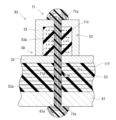
- the rivet 71 consists of a first head 71a, a second head 71b, and a shaft 71c that is integral with the first head 71a and the second head 71b.
- the first head 71a, the second head 71b, and the shaft 71c consist of a fifth base material 71d made of a fifth thermoplastic resin and a fifth carbon fiber 71e extending in a third direction.
- a metal plate is used as the mating material 61, but it may be CFRTP or thermosetting CFRP.
- the joint structure 81 thus obtained has a high peel strength in the third direction, since the rivet 71 is also made of CFRTP, and in particular the first head 71a, the second head 71b, and the fifth carbon fiber 71e in the shaft 71c are not cut.
- the needle 27 is not made of metal but is made of CFRTP and left in the structure 51, and the needle 27 can be transformed into a rivet 71 to join the structure 51 and the mating material 61, thereby forming a joined structure 81.
- the first and second thermoplastic resins were heated and softened in the pressurizing and hole-making processes, but depending on the types of the first and second thermoplastic resins, it is also possible to carry out the pressurizing and hole-making processes at room temperature.
- the hole-making process was performed after the pressurizing process, but the hole-making process may be performed simultaneously with the pressurizing process. In this case, the molding cycle time of the structure 51 can be shortened, and the manufacturing cost can be reduced.
- the molding device 21 may be provided with a heater wire in the heating hole 23c or the heating hole 25c.
- the first die 23 and the second die 25 may not be provided with the heating hole 23c or the heating hole 25c, and only the needle 27 may be heated and inserted into the needle hole 23b, 25b.
- Example 2 embodies the second teaching in which the second prepreg is not prepared and the third teaching. First, in the preparation step, similarly to Example 1, a plurality of prepregs 11 shown in FIG.
- a molding device 33 was prepared.
- the molding device 33 is equipped with a first die 35, a second die 37, and a plurality of needles 27.
- the first die 35 and the second die 37 are capable of moving relative to each other to clamp the die.
- the first mold 35 has a first molding surface 35a recessed from the parting surface 21a. As in Example 1, the first molding surface 35a is designed to fit the three first prepregs 11f by extending them in the left-right direction of the paper.
- the second mold 37 has a second molding surface 37a recessed from the mold parting surface 21b.
- the first molding surface 35a of the first mold 35 and the second molding surface 37a of the second mold 37 form a cavity C.
- the second molding surface 37a consists of three first portions 371a and a second portion 372a.
- the first portion 371a faces the first molding surface 35a and is adapted to fit into the three prepregs 11 in the left-right direction of the paper surface.
- the sum of the depth of the first molding surface 35a from the parting surface 21a and the depth of the first portion 371a from the parting surface 21b is equal to the thickness of the prepregs 11.
- the second portion 372a is spaced apart from the top, right, left, front and rear surfaces of each prepreg 11 when the bottom surface of each prepreg 11 is in contact with the bottom surface of the first molding surface 35a.
- Needle holes 35b, 37b are formed in the first and second dies 35, 37.
- the configuration of the needle holes 35b, 37b is similar to that of the needle holes 23b, 25b in Example 1.
- the first and second dies 35, 37 do not have heating holes 23c, 25c like the first and second dies 23, 25 in Example 1.
- the other configuration of the molding device 33 is similar to that of the molding device 21 in Example 1.
- injection material 39 was prepared.
- Injection material 39 contains a third thermoplastic resin and is in a molten state, and is designed to be injected into cavity C from a gate (not shown).
- the third thermoplastic resin of injection material 39 has a higher melting point than the thermoplastic resin of prepreg 11.
- the prepreg 11 is provided in the cavity C.
- the first mold 35 and the second mold 37 are clamped together.
- the injection material 39 is injected into the cavity C.
- the needle 27 is advanced into the specific range SA from the tip 27a in the third direction so that the cylindrical portion 27b of the needle 27 penetrates the injected material 39 in the cavity C and reaches the needle hole 37b.
- the carbon fibers 11b in the prepreg 11 are gradually pushed radially outward from the needle 27 by the tip 27a of the needle 27 within the base material 11a.
- the carbon fibers 11b of the prepreg 11 are less likely to be cut.
- the thermoplastic resin in the specific range SA softens due to the temperature of the injection material 39, and the carbon fibers 11b are more likely to move within the base material 11a by the tip 27a of the needle 27, making them less likely to be cut.
- the injection material 39 is injected in the injection process while leaving the needle 27 in the connection hole 53a, so that the insert injection molding method is performed and the connection hole 53a can be shaped into a desirable shape by the injection material 39.
- the molding cycle time of the structure 53 can be shortened, and manufacturing costs can be reduced.
- the first mold 35 and the second mold 37 are opened with the thermoplastic resin and the injection material 39 at room temperature to obtain a structure 53.
- the obtained structure 53 is composed of a prepreg 11 and the injection material 39 provided on five surfaces of the prepreg 11 except for the bottom surface.
- Each structure 53 is formed with a connection hole 53a of a preferred shape while preventing cutting of the surrounding carbon fiber 11b.
- each structure 53 and the mating member 61 were joined with a rivet 71 made of CFRTP. In this way, a joined structure 83 was obtained.
- the structure 53 of Example 2 can achieve the same effect as that of Example 1.
- the joint structure 83 of Example 2 can achieve the same effect as that of Example 1.
- the needle 27 in Example 2 is also not made of metal, but is made of CFRTP and can be left in the structure 53.
- the needle 27 can be transformed into a rivet 71 to join the structure 53 and the mating material 61, thereby forming a joined structure 83.
- Example 2 the injection process is performed during the hole punching process, but it may be performed before or after the hole punching process. If the injection process is performed after the hole punching process, the needle 27 remains in the cavity C, and a connection hole is also formed in the injected material 39.
- Example 3 is a concrete example of the first teaching of the injection process and the third teaching.
- Example 3 is a concrete example of the second teaching of preparing a second prepreg and the third teaching.
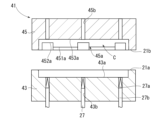
- a molding device 41 was prepared.
- the molding device 41 is equipped with a first die 43, a second die 45, and a plurality of needles 27.
- the first die 43 and the second die 45 are capable of moving relative to each other to clamp the die.
- the first mold 43 has a first molding surface 43a recessed from the parting surface 21a. As in Example 1, the first molding surface 43a is designed to fit the three first prepregs 11f by extending them in the left-right direction of the paper.
- the second mold 45 has a second molding surface 45a recessed from the mold parting surface 21b.
- the first molding surface 43a of the first mold 43 and the second molding surface 45a of the second mold 45 form a cavity C.
- the second molding surface 45a consists of three first portions 451a, three second portions 452a, and a third portion 453a.
- the first portion 451a faces the first molding surface 43a, and the three first prepregs 11f are fitted in the left-right direction of the paper.
- the sum of the depth of the first molding surface 43a from the parting surface 21a and the depth of the first portion 451a from the parting surface 21b is equal to the thickness of the first prepregs 11f.
- the second portion 452a is recessed to continue from the first portion 451a.
- the second portion 452a is adapted to engage with the three second prepregs 11s by extending them in the thickness direction of the paper surface of FIG. 20. Therefore, the first prepregs 11f and the second prepregs 11s are perpendicular to each other and overlap in nine specific ranges SA.
- the third portion 453a abuts the bottom surface of the first prepreg 11f against the bottom surface of the first molding surface 43a, and when the second prepreg 11s is fitted to the second portion 452a, it is spaced apart from the top, right, left, front and rear surfaces of the first prepreg 11f and the second prepreg 11s.
- the length from the bottom surface of the first molding surface 43a to the bottom surface of the second portion 452a is smaller than the sum of the thicknesses of the first prepreg 11f and the second prepreg 11s. Therefore, when the parting surface 21a and the parting surface 21b are brought together and the first mold 43 and the second mold 45 are clamped together, the first prepreg 11f and the second prepreg 11s are pressurized in the specific range SA and become one, but the first prepreg 11f and the second prepreg 11s have excess material in each specific range SA. Therefore, that material bulges out into the third portion 453a.
- Needle holes 43b, 45b are formed in the first and second dies 43, 45.
- the configuration of the needle holes 43b, 45b is similar to that of the needle holes 23b, 25b, 35b, 37b in Examples 1 and 2.
- the first and second dies 43, 45 do not have heating holes 23c, 25c like the first and second dies 23, 25 in Example 1.
- the other configuration of the molding device 41 is similar to that of the molding device 21 in Example 1.
- injection material 39 was prepared.
- Injection material 39 contains a third thermoplastic resin and is in a molten state, and is designed to be injected into cavity C from a gate (not shown).
- the third thermoplastic resin of injection material 39 has a higher melting point than the first and second thermoplastic resins of first and second prepregs 11f and 11s.
- the first and second prepregs 11f and 11s are provided in the cavity C, as in Example 1.
- the mold clamping process and pressurizing process as shown in FIG. 22, the first mold 43 and the second mold 45 are clamped together, and pressure is applied to integrate the first prepreg 11f and the second prepreg 11s in the cavity C.
- the injection material 39 is injected into the cavity C.
- the needle 27 is advanced into the specific range SA from the tip 27a in the third direction so that the cylindrical portion 27b of the needle 27 penetrates the injected material 39 in the cavity C and reaches the needle hole 37b.
- the first and second carbon fibers 11b in the first and second prepregs 11f, 11s are gradually pushed radially outward of the needle 27 by the tip 27a of the needle 27 within the first and second base materials 11a.
- the first and second carbon fibers 11b of the first and second prepregs 11f, 11s are less likely to be cut.
- the first and second thermoplastic resins in the specific range SA are softened by the temperature of the injection material 39, and the first and second carbon fibers 11b are easily moved by the tip 27a of the needle 27 in the first and second base material 11a, making them less likely to be cut.
- connection holes 55a formed by the needles 27 in the first and second prepregs 11f and 11s become undesirable shapes, the injection material 39 is injected in the injection process while leaving the needles 27 in the connection holes 55a, so that the insert injection molding method is performed and the connection holes 55a can be shaped into a desirable shape by the injection material 39. Also, if the injection process is performed during the hole punching process, the molding cycle time of the structure 53 can be shortened, and the manufacturing cost can be reduced.
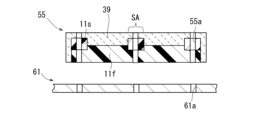
- the first and second thermoplastic resins and the injected material 39 are brought to room temperature, and the first and second dies 43 and 45 are opened to obtain structures 55.
- the obtained structures 55 are made of the first and second prepregs 11f and 11s, and the injected material 39 provided on five surfaces of the first and second prepregs 11f and 11s, excluding the bottom surfaces.
- Each structure 55 is formed with a connection hole 55a of a preferred shape, while preventing cutting of the surrounding first and second carbon fibers 11b.
- FIG. 24 three structures 55 were arranged in the thickness direction of the paper, and a mating member 61 was prepared in the same manner as in Examples 1 and 2. Then, as shown in FIG. 25, the structures 55 and the mating member 61 were joined with a rivet 71 made of CFRTP in the same manner as in Examples 1 and 2. In this manner, a joined structure 85 was obtained.
- the structure 55 of Example 3 can achieve the same effects as those of Examples 1 and 2.
- the joint structure 85 of Example 3 can achieve the same effects as those of Examples 1 and 2.
- the needle 27 in Example 3 is also not made of metal, but is made of CFRTP and can remain in the structure 55.
- the needle 27 can be transformed into a rivet 71 to join the structure 55 and the mating material 61, thereby forming a joined structure 85.
- the injection process was performed during the hole drilling process, but the injection process may be performed before or after the hole drilling process. If the injection process is performed before or after the hole drilling process, the needle 27 remains in the cavity C, and a connection hole is also formed in the injected material 39.
- the inventors molded multiple structures 53 of Example 2 using PP (polypropylene) as the thermoplastic resin and injection material of the prepreg 11, and manufactured a lattice-shaped joint structure 83 using each structure 53.
- This joint structure 83 is lightweight yet strong, and has excellent fatigue properties and corrosion resistance, making it suitable for use as a cover member for a battery case.
- a rod-shaped prepreg 11 in the shape of a rectangular prism shown in FIG. 1(A) was used, but a rod-shaped prepreg 13 in the shape of a cylinder shown in FIG. 1(B) may also be used.
- This prepreg 13 also has multiple carbon fibers 13b that extend only in the length direction within the base material 13a.
- a sheet-shaped prepreg 15 shown in FIG. 1(C) may also be used.
- This prepreg 15 also has multiple carbon fibers 15b that extend only in the length direction within the base material 15a.
- the injected material 39 is provided on five surfaces of the prepreg 11 or the first and second prepregs 11f and 11s, excluding the bottom surface, but the injected material may be provided on the entire surface of the prepreg 11 or the first and second prepregs 11f and 11s, or may be provided only on specific parts.
- the first and second prepregs 11, 13, and 15 have carbon fibers 11b, 13b, and 15b that extend only in the length direction, but may also have carbon fibers that extend in the length direction while twisting.
- the present invention can be used for parts in the fields of automobiles, aircraft, spacecraft, ships, trains, buildings, etc.
Landscapes
- Engineering & Computer Science (AREA)
- Mechanical Engineering (AREA)
- Chemical & Material Sciences (AREA)
- Composite Materials (AREA)
- Textile Engineering (AREA)
- Manufacturing & Machinery (AREA)
- Moulding By Coating Moulds (AREA)
- Injection Moulding Of Plastics Or The Like (AREA)
- Lining Or Joining Of Plastics Or The Like (AREA)
- Moulds For Moulding Plastics Or The Like (AREA)
- Casting Or Compression Moulding Of Plastics Or The Like (AREA)
Priority Applications (5)
| Application Number | Priority Date | Filing Date | Title |
|---|---|---|---|
| JP2023555507A JP7487861B1 (ja) | 2023-04-24 | 2023-04-24 | 構造体の成形方法 |
| PCT/JP2023/016062 WO2024224440A1 (ja) | 2023-04-24 | 2023-04-24 | 構造体の成形方法及び接合構造体 |
| CN202380043051.XA CN119343225A (zh) | 2023-04-24 | 2023-04-24 | 结构体的成形方法以及接合结构体 |
| EP23935223.0A EP4703129A1 (en) | 2023-04-24 | 2023-04-24 | Structure molding method and joining structure |
| JP2024068938A JP2024156624A (ja) | 2023-04-24 | 2024-04-22 | 接合構造体の製造方法 |
Applications Claiming Priority (1)
| Application Number | Priority Date | Filing Date | Title |
|---|---|---|---|
| PCT/JP2023/016062 WO2024224440A1 (ja) | 2023-04-24 | 2023-04-24 | 構造体の成形方法及び接合構造体 |
Publications (1)
| Publication Number | Publication Date |
|---|---|
| WO2024224440A1 true WO2024224440A1 (ja) | 2024-10-31 |
Family
ID=91082678
Family Applications (1)
| Application Number | Title | Priority Date | Filing Date |
|---|---|---|---|
| PCT/JP2023/016062 Ceased WO2024224440A1 (ja) | 2023-04-24 | 2023-04-24 | 構造体の成形方法及び接合構造体 |
Country Status (4)
| Country | Link |
|---|---|
| EP (1) | EP4703129A1 (https=) |
| JP (2) | JP7487861B1 (https=) |
| CN (1) | CN119343225A (https=) |
| WO (1) | WO2024224440A1 (https=) |
Citations (11)
| Publication number | Priority date | Publication date | Assignee | Title |
|---|---|---|---|---|
| JPS54102385A (en) * | 1978-01-31 | 1979-08-11 | Nhk Spring Co Ltd | Fiber reinforced synthetic resin board and its preparation |
| JPS5891380U (ja) * | 1981-12-16 | 1983-06-21 | 中村 一弥 | 縫糸つき縫針 |
| JPH07186100A (ja) * | 1993-12-24 | 1995-07-25 | Yamaha Motor Co Ltd | 繊維強化樹脂材の孔開け加工方法および繊維強化樹脂材 |
| JP2008260142A (ja) * | 2007-04-10 | 2008-10-30 | Toyota Motor Corp | 繊維強化樹脂シートに貫通孔を形成する方法 |
| WO2012117737A1 (ja) | 2011-03-02 | 2012-09-07 | 学校法人日本大学 | リベットによる板材の接合方法,接合構造 |
| JP2016150547A (ja) * | 2015-02-18 | 2016-08-22 | 大成プラス株式会社 | Cfrtp複合体の製造方法とそのcfrtp複合体 |
| JP2017124530A (ja) * | 2016-01-13 | 2017-07-20 | レノボ・シンガポール・プライベート・リミテッド | 繊維強化樹脂材の加工方法および繊維強化樹脂材 |
| JP2018134858A (ja) * | 2017-02-23 | 2018-08-30 | 国立大学法人筑波技術大学 | 熱可塑性樹脂複合材料の加工方法、結合方法及び加工装置並びに熱可塑性樹脂複合材料 |
| JP2018138355A (ja) * | 2017-02-24 | 2018-09-06 | 住友重機械工業株式会社 | 繊維強化プラスチック成形品およびその成形方法 |
| WO2019012717A1 (ja) * | 2017-07-10 | 2019-01-17 | 第一電通株式会社 | 締結方法及び締結装置 |
| JP6901063B2 (ja) | 2017-07-10 | 2021-07-14 | 第一電通株式会社 | 締結装置及び締結具の良否判定方法 |
Family Cites Families (2)
| Publication number | Priority date | Publication date | Assignee | Title |
|---|---|---|---|---|
| DE102014102024B4 (de) * | 2014-02-18 | 2025-05-28 | Dr. Ing. H.C. F. Porsche Aktiengesellschaft | Verfahren zur Herstellung einer Öffnung in einem Faserverbundbauteil |
| JP6731787B2 (ja) * | 2016-06-02 | 2020-07-29 | 株式会社Subaru | 繊維強化複合材料の製造方法及び穿孔・接合装置 |
-
2023
- 2023-04-24 EP EP23935223.0A patent/EP4703129A1/en active Pending
- 2023-04-24 CN CN202380043051.XA patent/CN119343225A/zh active Pending
- 2023-04-24 WO PCT/JP2023/016062 patent/WO2024224440A1/ja not_active Ceased
- 2023-04-24 JP JP2023555507A patent/JP7487861B1/ja active Active
-
2024
- 2024-04-22 JP JP2024068938A patent/JP2024156624A/ja active Pending
Patent Citations (12)
| Publication number | Priority date | Publication date | Assignee | Title |
|---|---|---|---|---|
| JPS54102385A (en) * | 1978-01-31 | 1979-08-11 | Nhk Spring Co Ltd | Fiber reinforced synthetic resin board and its preparation |
| JPS5891380U (ja) * | 1981-12-16 | 1983-06-21 | 中村 一弥 | 縫糸つき縫針 |
| JPH07186100A (ja) * | 1993-12-24 | 1995-07-25 | Yamaha Motor Co Ltd | 繊維強化樹脂材の孔開け加工方法および繊維強化樹脂材 |
| JP2008260142A (ja) * | 2007-04-10 | 2008-10-30 | Toyota Motor Corp | 繊維強化樹脂シートに貫通孔を形成する方法 |
| WO2012117737A1 (ja) | 2011-03-02 | 2012-09-07 | 学校法人日本大学 | リベットによる板材の接合方法,接合構造 |
| JP2016150547A (ja) * | 2015-02-18 | 2016-08-22 | 大成プラス株式会社 | Cfrtp複合体の製造方法とそのcfrtp複合体 |
| JP2017124530A (ja) * | 2016-01-13 | 2017-07-20 | レノボ・シンガポール・プライベート・リミテッド | 繊維強化樹脂材の加工方法および繊維強化樹脂材 |
| JP2018134858A (ja) * | 2017-02-23 | 2018-08-30 | 国立大学法人筑波技術大学 | 熱可塑性樹脂複合材料の加工方法、結合方法及び加工装置並びに熱可塑性樹脂複合材料 |
| JP2018138355A (ja) * | 2017-02-24 | 2018-09-06 | 住友重機械工業株式会社 | 繊維強化プラスチック成形品およびその成形方法 |
| WO2019012717A1 (ja) * | 2017-07-10 | 2019-01-17 | 第一電通株式会社 | 締結方法及び締結装置 |
| JP6840410B2 (ja) | 2017-07-10 | 2021-03-10 | 第一電通株式会社 | 締結方法及び締結装置 |
| JP6901063B2 (ja) | 2017-07-10 | 2021-07-14 | 第一電通株式会社 | 締結装置及び締結具の良否判定方法 |
Also Published As
| Publication number | Publication date |
|---|---|
| JP2024156624A (ja) | 2024-11-06 |
| JPWO2024224440A1 (https=) | 2024-10-31 |
| EP4703129A1 (en) | 2026-03-04 |
| CN119343225A (zh) | 2025-01-21 |
| JP7487861B1 (ja) | 2024-05-21 |
Similar Documents
| Publication | Publication Date | Title |
|---|---|---|
| AU2007294461B2 (en) | Joining of concentric section polymer composite components | |
| CN105829048B (zh) | 具有局部纤维插入件的载体和方法 | |
| DE102010007824B4 (de) | Verfahren zum Fügen und zur Herstellung von Kohlenstofffaserverbundbauteilen | |
| US20180272618A1 (en) | Ultrasonic welding of dissimilar sheet materials | |
| US10105898B2 (en) | Resin joined body, manufacturing method of resin joined body, and vehicle structure | |
| WO2015162998A1 (ja) | 繊維強化樹脂接合体、中間体及び締結棒 | |
| WO2011095399A1 (de) | Verfahren zum herstellen eines mit aussparung bauteils aus einem organoblech | |
| DE102015120717B4 (de) | Verfahren und system zum fügen von werkstücken | |
| US20200047455A1 (en) | Fiber preform and method of making the same | |
| JPH07178730A (ja) | 繊維強化熱可塑性シート | |
| JP6341156B2 (ja) | 樹脂接合体、樹脂接合体の製造方法及び車両用構造体 | |
| EP3037239B1 (de) | Verfahren zur Herstellung von Fahrzeugbauteilen/Strukturbauteilen aus einem Kunststoffmaterial sowie derart hergestelltes Fahrzeug- oder Strukturbauteil | |
| JP6229881B2 (ja) | 繊維強化複合成形品の製造方法 | |
| JP2007313778A (ja) | 繊維強化熱可塑性樹脂複合材の接合方法 | |
| JP7447512B2 (ja) | 接合構造体 | |
| JP7487861B1 (ja) | 構造体の成形方法 | |
| US20170217118A1 (en) | Resin tube, and method of manufacture thereof | |
| CN106687271B (zh) | 制备具有集成增强结构的多壳复合材料构件的方法以及由其制得的多壳复合材料构件 | |
| EP3263321B1 (de) | Verfahren zur herstellung eines sandwich-paneels mit einem verstärkten schaumstoffkern | |
| JP6828343B2 (ja) | 異材接合体 | |
| JP2016198888A (ja) | 繊維強化複合材料成形品の製造方法 | |
| JP6876516B2 (ja) | 繊維強化樹脂部材及び該繊維強化樹脂部材の製造方法 | |
| EP3444105A1 (en) | Hybrid non-woven composite part | |
| JPWO2024224440A5 (https=) | ||
| JP6596873B2 (ja) | 成形体の製造方法 |
Legal Events
| Date | Code | Title | Description |
|---|---|---|---|
| WWE | Wipo information: entry into national phase |
Ref document number: 2023555507 Country of ref document: JP |
|
| WWE | Wipo information: entry into national phase |
Ref document number: 202380043051.X Country of ref document: CN |
|
| 121 | Ep: the epo has been informed by wipo that ep was designated in this application |
Ref document number: 23935223 Country of ref document: EP Kind code of ref document: A1 |
|
| WWP | Wipo information: published in national office |
Ref document number: 202380043051.X Country of ref document: CN |
|
| WWE | Wipo information: entry into national phase |
Ref document number: 2023935223 Country of ref document: EP |
|
| NENP | Non-entry into the national phase |
Ref country code: DE |
|
| ENP | Entry into the national phase |
Ref document number: 2023935223 Country of ref document: EP Effective date: 20251124 |
|
| ENP | Entry into the national phase |
Ref document number: 2023935223 Country of ref document: EP Effective date: 20251124 |
|
| ENP | Entry into the national phase |
Ref document number: 2023935223 Country of ref document: EP Effective date: 20251124 |
|
| ENP | Entry into the national phase |
Ref document number: 2023935223 Country of ref document: EP Effective date: 20251124 |
|
| ENP | Entry into the national phase |
Ref document number: 2023935223 Country of ref document: EP Effective date: 20251124 |
|
| ENP | Entry into the national phase |
Ref document number: 2023935223 Country of ref document: EP Effective date: 20251124 |
|
| ENP | Entry into the national phase |
Ref document number: 2023935223 Country of ref document: EP Effective date: 20251124 |
|
| ENP | Entry into the national phase |
Ref document number: 2023935223 Country of ref document: EP Effective date: 20251124 |
|
| ENP | Entry into the national phase |
Ref document number: 2023935223 Country of ref document: EP Effective date: 20251124 |
|
| WWP | Wipo information: published in national office |
Ref document number: 2023935223 Country of ref document: EP |