WO2024218898A1 - 電子制御装置 - Google Patents
電子制御装置 Download PDFInfo
- Publication number
- WO2024218898A1 WO2024218898A1 PCT/JP2023/015612 JP2023015612W WO2024218898A1 WO 2024218898 A1 WO2024218898 A1 WO 2024218898A1 JP 2023015612 W JP2023015612 W JP 2023015612W WO 2024218898 A1 WO2024218898 A1 WO 2024218898A1
- Authority
- WO
- WIPO (PCT)
- Prior art keywords
- layer
- substrate
- layers
- earth
- ground
- Prior art date
- Legal status (The legal status is an assumption and is not a legal conclusion. Google has not performed a legal analysis and makes no representation as to the accuracy of the status listed.)
- Ceased
Links
Images





Classifications
-
- H—ELECTRICITY
- H05—ELECTRIC TECHNIQUES NOT OTHERWISE PROVIDED FOR
- H05K—PRINTED CIRCUITS; CASINGS OR CONSTRUCTIONAL DETAILS OF ELECTRIC APPARATUS; MANUFACTURE OF ASSEMBLAGES OF ELECTRICAL COMPONENTS
- H05K1/00—Printed circuits
- H05K1/02—Details
- H05K1/0201—Thermal arrangements, e.g. for cooling, heating or preventing overheating
- H05K1/0203—Cooling of mounted components
- H05K1/0204—Cooling of mounted components using means for thermal conduction connection in the thickness direction of the substrate
- H05K1/0206—Cooling of mounted components using means for thermal conduction connection in the thickness direction of the substrate by printed thermal vias
-
- H—ELECTRICITY
- H02—GENERATION; CONVERSION OR DISTRIBUTION OF ELECTRIC POWER
- H02K—DYNAMO-ELECTRIC MACHINES
- H02K11/00—Structural association of dynamo-electric machines with electric components or with devices for shielding, monitoring or protection
- H02K11/30—Structural association with control circuits or drive circuits
- H02K11/33—Drive circuits, e.g. power electronics
-
- H—ELECTRICITY
- H02—GENERATION; CONVERSION OR DISTRIBUTION OF ELECTRIC POWER
- H02K—DYNAMO-ELECTRIC MACHINES
- H02K5/00—Casings; Enclosures; Supports
-
- H—ELECTRICITY
- H05—ELECTRIC TECHNIQUES NOT OTHERWISE PROVIDED FOR
- H05K—PRINTED CIRCUITS; CASINGS OR CONSTRUCTIONAL DETAILS OF ELECTRIC APPARATUS; MANUFACTURE OF ASSEMBLAGES OF ELECTRICAL COMPONENTS
- H05K1/00—Printed circuits
- H05K1/02—Details
-
- H—ELECTRICITY
- H05—ELECTRIC TECHNIQUES NOT OTHERWISE PROVIDED FOR
- H05K—PRINTED CIRCUITS; CASINGS OR CONSTRUCTIONAL DETAILS OF ELECTRIC APPARATUS; MANUFACTURE OF ASSEMBLAGES OF ELECTRICAL COMPONENTS
- H05K1/00—Printed circuits
- H05K1/02—Details
- H05K1/0201—Thermal arrangements, e.g. for cooling, heating or preventing overheating
- H05K1/0203—Cooling of mounted components
- H05K1/0207—Cooling of mounted components using internal conductor planes parallel to the surface for thermal conduction, e.g. power planes
-
- H—ELECTRICITY
- H05—ELECTRIC TECHNIQUES NOT OTHERWISE PROVIDED FOR
- H05K—PRINTED CIRCUITS; CASINGS OR CONSTRUCTIONAL DETAILS OF ELECTRIC APPARATUS; MANUFACTURE OF ASSEMBLAGES OF ELECTRICAL COMPONENTS
- H05K1/00—Printed circuits
- H05K1/02—Details
- H05K1/0213—Electrical arrangements not otherwise provided for
- H05K1/0215—Grounding of printed circuits by connection to external grounding means
-
- H—ELECTRICITY
- H05—ELECTRIC TECHNIQUES NOT OTHERWISE PROVIDED FOR
- H05K—PRINTED CIRCUITS; CASINGS OR CONSTRUCTIONAL DETAILS OF ELECTRIC APPARATUS; MANUFACTURE OF ASSEMBLAGES OF ELECTRICAL COMPONENTS
- H05K3/00—Apparatus or processes for manufacturing printed circuits
- H05K3/46—Manufacturing multilayer circuits
-
- H—ELECTRICITY
- H05—ELECTRIC TECHNIQUES NOT OTHERWISE PROVIDED FOR
- H05K—PRINTED CIRCUITS; CASINGS OR CONSTRUCTIONAL DETAILS OF ELECTRIC APPARATUS; MANUFACTURE OF ASSEMBLAGES OF ELECTRICAL COMPONENTS
- H05K1/00—Printed circuits
- H05K1/02—Details
- H05K1/0296—Conductive pattern lay-out details not covered by sub groups H05K1/02 - H05K1/0295
- H05K1/0298—Multilayer circuits
-
- H—ELECTRICITY
- H05—ELECTRIC TECHNIQUES NOT OTHERWISE PROVIDED FOR
- H05K—PRINTED CIRCUITS; CASINGS OR CONSTRUCTIONAL DETAILS OF ELECTRIC APPARATUS; MANUFACTURE OF ASSEMBLAGES OF ELECTRICAL COMPONENTS
- H05K1/00—Printed circuits
- H05K1/18—Printed circuits structurally associated with non-printed electric components
- H05K1/181—Printed circuits structurally associated with non-printed electric components associated with surface mounted components
-
- H—ELECTRICITY
- H05—ELECTRIC TECHNIQUES NOT OTHERWISE PROVIDED FOR
- H05K—PRINTED CIRCUITS; CASINGS OR CONSTRUCTIONAL DETAILS OF ELECTRIC APPARATUS; MANUFACTURE OF ASSEMBLAGES OF ELECTRICAL COMPONENTS
- H05K2201/00—Indexing scheme relating to printed circuits covered by H05K1/00
- H05K2201/09—Shape and layout
- H05K2201/09209—Shape and layout details of conductors
- H05K2201/095—Conductive through-holes or vias
- H05K2201/09554—Via connected to metal substrate
-
- H—ELECTRICITY
- H05—ELECTRIC TECHNIQUES NOT OTHERWISE PROVIDED FOR
- H05K—PRINTED CIRCUITS; CASINGS OR CONSTRUCTIONAL DETAILS OF ELECTRIC APPARATUS; MANUFACTURE OF ASSEMBLAGES OF ELECTRICAL COMPONENTS
- H05K2201/00—Indexing scheme relating to printed circuits covered by H05K1/00
- H05K2201/09—Shape and layout
- H05K2201/09818—Shape or layout details not covered by a single group of H05K2201/09009 - H05K2201/09809
- H05K2201/0999—Circuit printed on or in housing, e.g. housing as PCB; Circuit printed on the case of a component; PCB affixed to housing
-
- H—ELECTRICITY
- H05—ELECTRIC TECHNIQUES NOT OTHERWISE PROVIDED FOR
- H05K—PRINTED CIRCUITS; CASINGS OR CONSTRUCTIONAL DETAILS OF ELECTRIC APPARATUS; MANUFACTURE OF ASSEMBLAGES OF ELECTRICAL COMPONENTS
- H05K2201/00—Indexing scheme relating to printed circuits covered by H05K1/00
- H05K2201/10—Details of components or other objects attached to or integrated in a printed circuit board
- H05K2201/10007—Types of components
- H05K2201/10166—Transistor
-
- H—ELECTRICITY
- H05—ELECTRIC TECHNIQUES NOT OTHERWISE PROVIDED FOR
- H05K—PRINTED CIRCUITS; CASINGS OR CONSTRUCTIONAL DETAILS OF ELECTRIC APPARATUS; MANUFACTURE OF ASSEMBLAGES OF ELECTRICAL COMPONENTS
- H05K2201/00—Indexing scheme relating to printed circuits covered by H05K1/00
- H05K2201/10—Details of components or other objects attached to or integrated in a printed circuit board
- H05K2201/10227—Other objects, e.g. metallic pieces
- H05K2201/10409—Screws
Definitions
- This disclosure relates to an electronic control device.
- the controller in Patent Document 1 has a board on which electronic components are mounted.
- the board is attached to a frame that functions as a heat sink and is provided at the axial end of the motor.
- the electronic components include heat-generating components such as FETs, and are attached to the front surface of the board.
- the back surface of the board is in contact with the frame.
- the board has thermal vias.
- the thermal vias penetrate the board in the thickness direction directly below the heat-generating components. Heat generated by the heat-generating components is transferred from the front to the back of the board via the thermal vias. The heat transferred to the back of the board is dissipated to the outside via the frame.
- An electronic control device includes a substrate configured to be attached to a metal housing by a metal fixing member, the substrate having a plurality of conductor layers stacked via an insulating layer, and a heat generating element configured to generate heat when electricity is passed through the substrate.
- the plurality of conductor layers include a first specific conductor layer having an earth layer configured to be electrically connected to the housing, and a second specific conductor layer having a ground layer configured to be electrically connected to the heat generating element.
- the earth layer and the ground layer are at least partially opposed to each other in the thickness direction of the substrate via the insulating layer.
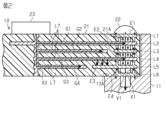
- FIG. 1 is a cross-sectional view showing a state in which an electronic control device according to an embodiment is attached to a controlled object; 2 is a cross-sectional view of the electronic control device of FIG. 1 and its surroundings.
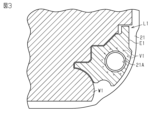
- 3 is a cross-sectional plan view of a first conductor layer in the electronic control device of FIG. 2.
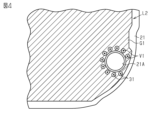
- 3 is a cross-sectional plan view of a second conductor layer in the electronic control device of FIG. 2.
- 3 is a cross-sectional plan view of a third conductor layer in the electronic control device of FIG. 2.
- 3 is a cross-sectional plan view of a fourth conductor layer in the electronic control device of FIG. 2.
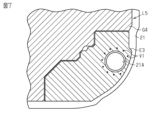
- FIG. 3 is a cross-sectional plan view of a fifth conductor layer in the electronic control device of FIG. 2 .
- FIG. 3 is a cross-sectional plan view of a sixth conductor layer in the electronic control device of FIG. 2 .
- 4 is a plan view of the first conductor layer of FIG. 3 showing the boundary between the first ground layer and the first wiring layer;
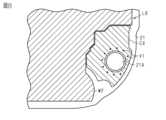
- FIG. 5 is a cross-sectional plan view of the second conductor layer of FIG. 4, showing the first earth layer projected onto the first ground layer.
- the electronic control device 10 is provided in a housing 11 of an object to be controlled.
- the object to be controlled is, for example, a motor.
- the housing 11 is a case for the motor, and is, for example, a cylindrical body having a circular cross-sectional shape.
- An end of the housing 11 is open in the axial direction. The open end is the end of the housing 11 on which the electronic control device 10 is mounted.
- the opening of the housing 11 is blocked by fitting a lid 12.
- the housing 11 and the lid 12 are each made of metal.
- the metal is, for example, iron or an aluminum alloy.
- the end of the housing 11 has a substrate accommodating section 13.
- the substrate accommodating section 13 is located axially outward from the cover 12.
- the substrate accommodating section 13 is a section at the end of the housing 11 with an enlarged inner diameter.
- the substrate accommodating section 13 has an attachment section 13A.
- the attachment section 13A has a flat surface that extends in the radial direction of the housing 11. The flat surface is an attachment surface for the substrate 21.
- the electronic control device 10 has a board 21.
- the board 21 is accommodated inside the board accommodation section 13.
- the board 21 is in contact with the mounting section 13A.
- the board 21 is flat.
- One or more through holes 21A are provided on the periphery of the board 21.
- the through holes 21A penetrate the board 21 in the thickness direction.
- the board 21 is fixed to the mounting section 13A by screws 22.
- the screws 22 are fixing members for fixing the board 21 to the housing 11.
- the screws 22 have a shaft and a head.
- the shaft penetrates the through holes 21A and is fastened to the mounting section 13A.
- the head is in contact with a first surface of the board 21.
- the substrate 21 has a first surface and a second surface located opposite each other.
- the first surface is the surface of the substrate 21 located opposite the lid 12.
- the second surface is the surface of the substrate 21 facing the lid 12.
- the electronic components include a heat generating element 23 that generates heat when electricity is passed through it.
- the heat generating element is, for example, a semiconductor element such as a field effect transistor (FET).
- FET field effect transistor
- a heat dissipation material 24 is interposed between the portion of the second surface that corresponds to the heat generating element 23 and the cover 12.
- the heat dissipation material 24 is, for example, thermal grease.
- the peripheral portion of the second surface is in contact with the mounting portion 13A.
- the heat generated from the heat generating element 23 is released, for example, via a first heat dissipation path A1 and a second heat dissipation path A2.
- the first heat dissipation path A1 and the second heat dissipation path A2 are heat transfer paths between the heat generating element 23 and the housing 11.
- the first heat dissipation path A1 includes the substrate 21, the screw 22, and the housing 11.
- the second heat dissipation path A2 includes the substrate 21, the heat dissipation material 24, the cover 12, and the housing 11. The heat transferred to the housing 11 via the first heat dissipation path A1 and the second heat dissipation path A2 is dissipated to the outside.
- the substrate 21 is a multilayer substrate.
- a multilayer substrate is a substrate having three or more conductor layers.
- the substrate 21 is, for example, a six-layer substrate, and has first to sixth thin-film conductor layers L1 to L6.
- the first to sixth conductor layers L1 to L6 are stacked via an insulating layer L7.
- the conductor constituting the conductor layer is, for example, copper. Copper has superior electrical conductivity and thermal conductivity compared to, for example, resin.
- the insulating layer L7 is formed of a core material or a prepreg.
- the core material and the prepreg are each a layer of glass fiber impregnated with resin.
- the first to sixth conductor layers L1 to L6 are arranged in this order from the first surface to the second surface of the substrate 21.
- the first conductor layer L1 has a first earth layer E1.
- the first earth layer E1 is provided around the through hole 21A.
- the portion of the substrate 21 around the through hole 21A corresponds to the portion of the substrate 21 that contacts the housing 11.
- the portion of the substrate 21 that contacts the housing 11 corresponds to the mounting portion 13A of the substrate 21. That is, the substrate 21 has a contact portion that contacts the housing 11, and the contact portion is a portion that overlaps with the mounting portion 13A when viewed from the thickness direction of the substrate 21.
- the first earth layer E1 is exposed on the first surface of the substrate 21 and is in contact with the head of the screw 22.
- the first earth layer E1 is electrically connected to the housing 11 via the screw 22.
- the first conductor layer L1 also has, for example, a first wiring layer W1.
- the first wiring layer W1 is provided with a pattern wiring. A small gap is formed at the boundary between the first earth layer E1 and the first wiring layer W1.
- the first wiring layer W1 is omitted in FIG.
- the second conductor layer L2 has a first ground layer G1.
- the first ground layer G1 extends from a portion of the substrate 21 corresponding to the heating element 23 to the through hole 21A.
- a portion of the first ground layer G1 faces the first earth layer E1 in the thickness direction of the substrate 21 via the insulating layer L7.
- the portion of the first ground layer G1 facing the first earth layer E1 is the portion of the first ground layer G1 surrounding the through hole 21.
- the first ground layer G1 has a plurality of first holes 31.
- the first holes 31 are arranged to surround the through hole 21A.
- the first holes 31 are through holes that penetrate the first ground layer G1 in the film thickness direction.
- the third conductor layer L3 has a second earth layer E2 and a second ground layer G2.
- the second earth layer E2 is provided around the through hole 21A.
- the second earth layer E2 faces a part of the first ground layer G1 in the thickness direction of the substrate 21 via the insulating layer L7.
- the part of the first ground layer G1 facing the second earth layer E2 is the part of the first ground layer G1 around the through hole 21.
- the second ground layer G2 extends from the part of the substrate 21 corresponding to the heating element 23 to the vicinity of the second earth layer E2. As shown in FIG. 5, a small gap is formed at the boundary between the second earth layer E2 and the second ground layer G2.
- the fourth conductor layer L4 has a third ground layer G3.
- the third ground layer G3 extends from a portion of the substrate 21 corresponding to the heating element 23 to the through hole 21A.
- a portion of the third ground layer G3 faces the second earth layer E2 in the thickness direction of the substrate 21 via the insulating layer L7.
- the portion of the third ground layer G3 facing the second earth layer E2 is the portion of the third ground layer G3 surrounding the through hole 21.
- the third ground layer G3 has a plurality of second holes 32.
- the second holes 32 are the same in number as the first holes 31, and are arranged to surround the through hole 21A.
- the second holes 32 are through holes that penetrate the third ground layer G3 in the film thickness direction.
- the second holes 32 are arranged coaxially with the first holes 31.
- the fifth conductor layer L5 has a third earth layer E3 and a fourth ground layer G4.
- the third earth layer E3 is provided around the through hole 21A.
- the third earth layer E3 extends from the peripheral portion of the through hole 21A radially outward from the through hole 21A.
- the third earth layer E3 extends to a position outside the portion of the substrate 21 that contacts the housing 11.
- the third earth layer E3 faces a portion of the third ground layer G3 in the thickness direction of the substrate 21 via the insulating layer L7.
- the portion of the third ground layer G3 facing the third earth layer E3 includes the portion of the third ground layer G3 surrounding the through hole 21.
- the fourth ground layer G2 extends from the portion of the substrate 21 corresponding to the heating element 23 to the vicinity of the third earth layer E3. As shown in FIG. 7, a small gap is formed at the boundary between the third earth layer E3 and the fourth ground layer G4.
- the sixth conductor layer L6 has a fourth earth layer E4.
- the fourth earth layer E4 is provided around the through hole 21A.
- the fourth earth layer E4 is exposed on the second surface of the substrate 21 and is in contact with the mounting portion 13A. That is, the fourth earth layer E4 is electrically connected to the housing 11.
- the sixth conductor layer L6 also has, for example, a second wiring layer W2. Pattern wiring is provided on the second wiring layer W2. A small gap is formed at the boundary between the fourth earth layer E4 and the second wiring layer W2.
- the second wiring layer W2 is omitted in FIG. 2.
- the substrate 21 has a plurality of first thermal vias V1.
- the number of the first thermal vias V1 is the same as the number of the first holes 31 and the second holes 32.
- the first thermal vias V1 are formed, for example, by driving a metal body such as copper, which has excellent thermal conductivity, into the substrate 21.
- the first thermal vias V1 have, for example, a circular cross-sectional shape.
- the first thermal vias V1 are arranged on the periphery of the through hole 21A.
- the first thermal vias V1 extend in the thickness direction of the substrate 21 and connect the first to fourth earth layers E1 to E4 to each other.
- the first thermal vias V1 are electrically connected to the first to fourth earth layers E1 to E4, while being electrically insulated from the first to fourth ground layers G1 to G4.
- the first thermal via V1 penetrates the substrate 21 in the thickness direction while in contact with the first to fourth earth layers E1 to E4.
- the outer peripheral surface of the first thermal via V1 contacts each of the first to fourth earth layers E1 to E4, thereby ensuring electrical connection between the first thermal via V1 and the first to fourth earth layers E1 to E4.
- the first thermal via V1 penetrates the substrate 21 in the thickness direction without contacting the first ground layer G1, which has a portion surrounding the through hole 21A.
- the first hole 31 is larger in outer diameter than the first thermal via V1.
- a gap is formed between the inner surface of the first hole 31 and the outer surface of the first thermal via V1. The gap ensures electrical insulation between the first thermal via V1 and the first ground layer G1.
- the first thermal via V1 penetrates the substrate 21 in the thickness direction without contacting the third ground layer G3, which has a portion surrounding the through hole 21A.
- the second hole 32 is larger in outer diameter than the first thermal via V1.
- a gap is formed between the inner surface of the second hole 32 and the outer surface of the first thermal via V1. The gap ensures electrical insulation between the first thermal via V1 and the third ground layer G3.
- the second ground layer G2 and the fourth ground layer G4 do not have a portion surrounding the through hole 21A. That is, when viewed from the thickness direction of the substrate 21, the second ground layer G2 and the fourth ground layer G4 do not overlap with the first thermal via V1. Because the second ground layer G2 is not in contact with the first thermal via V1, electrical insulation between the first thermal via V1 and the second ground layer G2 is ensured. Also, because the fourth ground layer G4 is not in contact with the first thermal via V1, electrical insulation between the first thermal via V1 and the fourth ground layer G4 is ensured.
- the substrate 21 has a second thermal via V2.
- the second thermal via V2 is formed, for example, by driving a metal body such as copper, which has excellent thermal conductivity, into the substrate 21.
- the second thermal via V2 has, for example, a circular cross-sectional shape.
- the second thermal via V2 is disposed in a portion of the substrate 21 corresponding to the heating element 23.
- the second thermal via V2 extends in the thickness direction of the substrate 21 and connects the first to fourth ground layers G1 to G4 to each other.
- a first end of the second thermal via V2 is exposed on the first surface of the substrate 21 and is in contact with the heating element 23. That is, the first to fourth ground layers G1 to G4 are electrically connected to the heating element 23 through the second thermal via V2.
- a second end of the second thermal via V2 is exposed on the second surface of the substrate 21. The second end is the end of the second thermal via V2 opposite to the first end.
- heat generated from the heating element 23 is transferred to the housing 11 via the second thermal via V2, the first to fourth ground layers G1 to G4, the first to fourth earth layers E1 to E4, the first thermal via V1, and the screw 22.
- a portion of the heat is exchanged between the ground layers (G1 to G4) and the earth layers (E1 to E4) that face each other in the thickness direction of the board 21 via the insulating layer L7.
- a portion of the heat is transferred to the housing 11 via the first earth layer E1 and the screw 22.
- a portion of the heat is transferred to the housing 11 via the fourth earth layer E4.
- a portion of the heat is transferred to the housing 11 via the second thermal via V2, the heat dissipation material 24, and the cover 12.
- the heat dissipation material 24 and the cover 12 are not shown in FIG. 2.
- the heat transferred to the housing 11 is dissipated to the outside.
- Thermal resistance in thermal conduction is proportional to the length of an object and inversely proportional to the cross-sectional area of the object. In other words, the shorter the length of an object and the larger the cross-sectional area of the object, the smaller the thermal resistance in thermal conduction.
- Thermal resistance in thermal radiation is inversely proportional to the surface area of an object. In other words, the larger the surface area of an object, the smaller the thermal resistance in thermal radiation.
- the first earth layer E1 has a first opposing surface E11.
- the first opposing surface E11 is part of the periphery of the first earth layer E1.
- the first wiring layer W1 has a second opposing surface W11.
- the second opposing surface W11 is part of the periphery of the first wiring layer W1 and has a contour shape corresponding to the first opposing surface E11.
- the first opposing surface E11 and the second opposing surface W11 face each other with a constant small gap between them.
- the gap between the first opposing surface E11 and the second opposing surface W11 is narrower than the gap in the thickness direction between the first to sixth conductor layers L1 to L6.
- the opposing area between the first opposing surface E11 and the second opposing surface W11 is very narrow compared to the opposing area between the first earth layer E1, shown by many dots in FIG. 10, and the first ground layer G1 in the second conductor layer L2. This is because the thickness of the first conductor layer L1, which includes the first earth layer E1 and the first wiring layer W1, is extremely thin. Therefore, overall, the thermal resistance between the first opposing surface E11 and the second opposing surface W11 is greater than the thermal resistance between the first earth layer E1 and the first ground layer G1. The same is true for each of the first to sixth conductor layers L1 to L6.
- the thermal resistance between two layers facing each other in the thickness direction of the substrate 21 with the insulating layer L7 interposed therebetween is smaller than the thermal resistance between two adjacent layers located in the same plane.
- the thermal resistance between two layers facing each other with the insulating layer L7 interposed therebetween is smaller the wider the opposing area of the two layers, and also smaller the thinner the insulating layer L7 is.
- the substrate 21 has a plurality of conductor layers (L1 to L6) stacked with an insulating layer L7 interposed therebetween.
- the plurality of conductor layers include a first specific conductor layer having an earth layer configured to be electrically connected to the housing 11, and a second specific conductor layer having a ground layer configured to be electrically connected to the heating element 23.
- the first specific conductor layer is the first conductor layer L1, the third conductor layer L3, or the fifth conductor layer L5.
- the first conductor layer L1 has a first earth layer E1
- the third conductor layer L3 has a second earth layer E2
- the fifth conductor layer L5 has a third earth layer E3.
- the first to third earth layers E1 to E3 are each configured to be electrically connected to the housing 11.
- the second specific conductor layer is the second conductor layer L2 or the fourth conductor layer L4.
- the second conductor layer L2 has a first ground layer G1
- the fourth conductor layer L4 has a third ground layer G3.
- the first ground layer G1 and the third ground layer G3 are each configured to be electrically connected to the heating element 23.
- the second specific conductor layer is the second conductor layer L2.
- the first earth layer E1 and the first ground layer G1 are at least partially opposed to each other in the thickness direction of the substrate 21 via the insulating layer L7.
- the second specific conductor layer is the second conductor layer L2 or the fourth conductor layer L4.
- the third conductor layer L3 and the first ground layer G1, or the third conductor layer L3 and the third ground layer G3, are at least partially opposed to each other in the thickness direction of the substrate 21 via the insulating layer L7.
- the first specific conductor layer is the fifth conductor layer L5
- the second specific conductor layer is the fourth conductor layer L4.
- the third earth layer E3 and the third ground layer G3 are at least partially opposed to each other in the thickness direction of the substrate 21 via the insulating layer L7.
- heat generated by the heating element 23 is transferred to the housing 11 via the ground layers (G1-G4), earth layers (E1-E4), and the screw 22.
- the heat transferred to the housing 11 is dissipated to the outside.
- Heat is transferred via the insulating layer L7 between the parts where the earth layers (E1-E3) and the ground layers (G1, G3) face each other in the thickness direction of the board 21.
- the heat dissipation properties of the board 21 are improved compared to when the earth layers (E1-E3) and the ground layers (G1, G3) do not face each other in the thickness direction of the board 21 via the insulating layer L7.
- the earth layers (E1 to E3) and the ground layers (G1, G3) overlap at least partially in the thickness direction of the substrate 21 in the area where the substrate 21 contacts the housing 11.
- the portion of the substrate 21 that contacts the housing 11 is the portion of the substrate 21 that corresponds to the mounting portion 13A. With this configuration, the distance from the ground layers (G1, G3) to the housing 11 is shorter. Since the thermal resistance between the ground layers (G1, G3) and the housing 11 is smaller, the heat dissipation properties of the substrate 21 are improved.
- the multiple pairs include, for example, a first pair consisting of the first conductor layer L1 and the second conductor layer L2, and a second pair consisting of the third conductor layer L3 and the fourth conductor layer L4.
- the first earth layer E1, the first ground layer G1, the second earth layer E2, and the third ground layer G3 are arranged in this order in the thickness direction of the board 21. That is, the earth layers (E1, E2) and the ground layers (G1, G3) are arranged alternately in the thickness direction of the board 21.
- the substrate 21 has a plurality of first thermal vias V1 that connect the plurality of earth layers (E1 to E4) to each other.
- the first thermal vias V1 are interlayer conductors that connect the earth layers of different conductor layers. With this configuration, heat is transferred between the plurality of earth layers (E1 to E4) through the first thermal vias V1. This improves the heat dissipation properties of the substrate 21.
- the first ground layer G1 and the third ground layer G3 each have a hole 31.
- the first thermal via V1 extends through the hole 31 without contacting each of the ground layers G1, G3.
- the earth layers (E1 to E3) and the ground layers (G1, G3) can be electrically insulated from each other while ensuring an area where the earth layers (E1 to E3) and the ground layers (G1, G3) face each other in the thickness direction of the board 21 via the insulating layer L7.
- the substrate 21 has a contact portion that contacts the housing 11. At least one (E3) of the multiple earth layers (E1-E4) faces a part of the ground layer (G3) in the thickness direction of the substrate 21 via the insulating layer L7 at a position corresponding to the contact portion of the substrate 21 and at a position away from the contact portion. With this configuration, the area where the earth layer (E3) and the ground layer (G3) face each other in the thickness direction of the substrate 21 via the insulating layer L7 is increased. This improves the heat dissipation properties of the substrate 21.
- This embodiment may be modified as follows. If the required heat dissipation properties of the substrate 21 can be ensured, the heat dissipation material 24 between the substrate 21 and the lid 12 may be omitted.
- the substrate 21 is not limited to a six-layer substrate having the first to sixth conductor layers L1 to L6.
- the substrate 21 may be, for example, a three-layer substrate or a four-layer substrate.
- the earth layers (E1 to E3) and the ground layers (G1, G3) do not have to be arranged alternately in the thickness direction of the substrate 21.
- the first earth layer E1, the first ground layer G1, the third ground layer G3, and the second earth layer E2 may be arranged in this order in the thickness direction of the substrate 21.
- the electronic control unit 10 is not limited to use in vehicles.
- the electronic control unit 10 can be used to control various mechanical devices.
- the phrase "at least one" as used herein means “one or more” of the desired options.
- the phrase “at least one” as used herein means “only one option” or “both of two options” if the number of options is two.
- the phrase “at least one” as used herein means “only one option” or “any combination of two or more options” if the number of options is three or more.
Landscapes
- Engineering & Computer Science (AREA)
- Microelectronics & Electronic Packaging (AREA)
- Power Engineering (AREA)
- Manufacturing & Machinery (AREA)
- Structure Of Printed Boards (AREA)
- Cooling Or The Like Of Electrical Apparatus (AREA)
Priority Applications (4)
| Application Number | Priority Date | Filing Date | Title |
|---|---|---|---|
| PCT/JP2023/015612 WO2024218898A1 (ja) | 2023-04-19 | 2023-04-19 | 電子制御装置 |
| EP23933276.0A EP4701051A1 (en) | 2023-04-19 | 2023-04-19 | Electronic control device |
| CN202380097062.6A CN121079875A (zh) | 2023-04-19 | 2023-04-19 | 电子控制装置 |
| JP2025514957A JPWO2024218898A1 (https=) | 2023-04-19 | 2023-04-19 |
Applications Claiming Priority (1)
| Application Number | Priority Date | Filing Date | Title |
|---|---|---|---|
| PCT/JP2023/015612 WO2024218898A1 (ja) | 2023-04-19 | 2023-04-19 | 電子制御装置 |
Publications (1)
| Publication Number | Publication Date |
|---|---|
| WO2024218898A1 true WO2024218898A1 (ja) | 2024-10-24 |
Family
ID=93152158
Family Applications (1)
| Application Number | Title | Priority Date | Filing Date |
|---|---|---|---|
| PCT/JP2023/015612 Ceased WO2024218898A1 (ja) | 2023-04-19 | 2023-04-19 | 電子制御装置 |
Country Status (4)
| Country | Link |
|---|---|
| EP (1) | EP4701051A1 (https=) |
| JP (1) | JPWO2024218898A1 (https=) |
| CN (1) | CN121079875A (https=) |
| WO (1) | WO2024218898A1 (https=) |
Citations (3)
| Publication number | Priority date | Publication date | Assignee | Title |
|---|---|---|---|---|
| JP2016039672A (ja) * | 2014-08-06 | 2016-03-22 | 株式会社ジェイテクト | 電動オイルポンプ装置 |
| JP2017163809A (ja) * | 2016-03-11 | 2017-09-14 | オムロンオートモーティブエレクトロニクス株式会社 | 電動モータ制御装置 |
| JP2019080471A (ja) | 2017-10-27 | 2019-05-23 | オムロンオートモーティブエレクトロニクス株式会社 | 負荷駆動装置 |
-
2023
- 2023-04-19 EP EP23933276.0A patent/EP4701051A1/en active Pending
- 2023-04-19 JP JP2025514957A patent/JPWO2024218898A1/ja active Pending
- 2023-04-19 CN CN202380097062.6A patent/CN121079875A/zh active Pending
- 2023-04-19 WO PCT/JP2023/015612 patent/WO2024218898A1/ja not_active Ceased
Patent Citations (3)
| Publication number | Priority date | Publication date | Assignee | Title |
|---|---|---|---|---|
| JP2016039672A (ja) * | 2014-08-06 | 2016-03-22 | 株式会社ジェイテクト | 電動オイルポンプ装置 |
| JP2017163809A (ja) * | 2016-03-11 | 2017-09-14 | オムロンオートモーティブエレクトロニクス株式会社 | 電動モータ制御装置 |
| JP2019080471A (ja) | 2017-10-27 | 2019-05-23 | オムロンオートモーティブエレクトロニクス株式会社 | 負荷駆動装置 |
Non-Patent Citations (1)
| Title |
|---|
| See also references of EP4701051A1 |
Also Published As
| Publication number | Publication date |
|---|---|
| EP4701051A1 (en) | 2026-02-25 |
| CN121079875A (zh) | 2025-12-05 |
| JPWO2024218898A1 (https=) | 2024-10-24 |
Similar Documents
| Publication | Publication Date | Title |
|---|---|---|
| US10604173B2 (en) | Load drive device | |
| JP4361486B2 (ja) | 電気モータの電力用電子部品及び制御用電子部品を搭載する装置構造 | |
| JP4054137B2 (ja) | パワー半導体素子の給電及び放熱装置 | |
| JP4404726B2 (ja) | 車載用電力変換装置 | |
| JP5444619B2 (ja) | 多層回路基板およびモータ駆動回路基板 | |
| JP6183314B2 (ja) | 電子装置及びそれを備えた駆動装置 | |
| JP2004172459A (ja) | 電子制御装置における電子部品の放熱構造 | |
| WO2017154075A1 (ja) | 電子制御装置 | |
| JP2017163810A (ja) | 電動モータ制御装置 | |
| CN112653297A (zh) | 马达装置 | |
| JP5236178B2 (ja) | 電子回路装置 | |
| JP2019033586A (ja) | 電子装置 | |
| JP2016213375A (ja) | 放熱基板及びこれを収納する放熱ケース。 | |
| JPH04113695A (ja) | 電子機器の放熱構造 | |
| WO2020148800A1 (ja) | 制御装置 | |
| WO2024218898A1 (ja) | 電子制御装置 | |
| US9178402B2 (en) | Control unit for electric motor and vehicle steering system including the same | |
| JP5533787B2 (ja) | 放熱装置 | |
| JP6504666B2 (ja) | 電動モータ制御装置 | |
| JP2005191378A (ja) | プリント基板における放熱構造 | |
| JP2017027994A (ja) | 放熱基板及びこれを収納する放熱ケース。 | |
| JP6794757B2 (ja) | 電子回路装置 | |
| JP2016157715A (ja) | 放熱基板及びこれを収納する放熱ケース。 | |
| JP7724105B2 (ja) | 回路基板および電子機器 | |
| JP6652844B2 (ja) | エアポンプ用の多層基板及びエアポンプ用の電子回路基板 |
Legal Events
| Date | Code | Title | Description |
|---|---|---|---|
| 121 | Ep: the epo has been informed by wipo that ep was designated in this application |
Ref document number: 23933276 Country of ref document: EP Kind code of ref document: A1 |
|
| ENP | Entry into the national phase |
Ref document number: 2025514957 Country of ref document: JP Kind code of ref document: A |
|
| WWE | Wipo information: entry into national phase |
Ref document number: 2025514957 Country of ref document: JP |
|
| WWE | Wipo information: entry into national phase |
Ref document number: CN2023800970626 Country of ref document: CN |
|
| WWE | Wipo information: entry into national phase |
Ref document number: 2023933276 Country of ref document: EP |
|
| NENP | Non-entry into the national phase |
Ref country code: DE |
|
| ENP | Entry into the national phase |
Ref document number: 2023933276 Country of ref document: EP Effective date: 20251119 |
|
| ENP | Entry into the national phase |
Ref document number: 2023933276 Country of ref document: EP Effective date: 20251119 |
|
| ENP | Entry into the national phase |
Ref document number: 2023933276 Country of ref document: EP Effective date: 20251119 |
|
| ENP | Entry into the national phase |
Ref document number: 2023933276 Country of ref document: EP Effective date: 20251119 |
|
| ENP | Entry into the national phase |
Ref document number: 2023933276 Country of ref document: EP Effective date: 20251119 |
|
| ENP | Entry into the national phase |
Ref document number: 2023933276 Country of ref document: EP Effective date: 20251119 |
|
| ENP | Entry into the national phase |
Ref document number: 2023933276 Country of ref document: EP Effective date: 20251119 |
|
| ENP | Entry into the national phase |
Ref document number: 2023933276 Country of ref document: EP Effective date: 20251119 |
|
| ENP | Entry into the national phase |
Ref document number: 2023933276 Country of ref document: EP Effective date: 20251119 |
|
| WWP | Wipo information: published in national office |
Ref document number: 2023933276 Country of ref document: EP |