WO2024204860A1 - 脱気装置、インクジェット記録装置および脱気方法 - Google Patents
脱気装置、インクジェット記録装置および脱気方法 Download PDFInfo
- Publication number
- WO2024204860A1 WO2024204860A1 PCT/JP2024/018072 JP2024018072W WO2024204860A1 WO 2024204860 A1 WO2024204860 A1 WO 2024204860A1 JP 2024018072 W JP2024018072 W JP 2024018072W WO 2024204860 A1 WO2024204860 A1 WO 2024204860A1
- Authority
- WO
- WIPO (PCT)
- Prior art keywords
- flow path
- liquid
- degassing
- ink
- head
- Prior art date
- Legal status (The legal status is an assumption and is not a legal conclusion. Google has not performed a legal analysis and makes no representation as to the accuracy of the status listed.)
- Ceased
Links
Images



Classifications
-
- B—PERFORMING OPERATIONS; TRANSPORTING
- B01—PHYSICAL OR CHEMICAL PROCESSES OR APPARATUS IN GENERAL
- B01D—SEPARATION
- B01D19/00—Degasification of liquids
-
- B—PERFORMING OPERATIONS; TRANSPORTING
- B41—PRINTING; LINING MACHINES; TYPEWRITERS; STAMPS
- B41J—TYPEWRITERS; SELECTIVE PRINTING MECHANISMS, i.e. MECHANISMS PRINTING OTHERWISE THAN FROM A FORME; CORRECTION OF TYPOGRAPHICAL ERRORS
- B41J2/00—Typewriters or selective printing mechanisms characterised by the printing or marking process for which they are designed
- B41J2/005—Typewriters or selective printing mechanisms characterised by the printing or marking process for which they are designed characterised by bringing liquid or particles selectively into contact with a printing material
- B41J2/01—Ink jet
-
- B—PERFORMING OPERATIONS; TRANSPORTING
- B41—PRINTING; LINING MACHINES; TYPEWRITERS; STAMPS
- B41J—TYPEWRITERS; SELECTIVE PRINTING MECHANISMS, i.e. MECHANISMS PRINTING OTHERWISE THAN FROM A FORME; CORRECTION OF TYPOGRAPHICAL ERRORS
- B41J2/00—Typewriters or selective printing mechanisms characterised by the printing or marking process for which they are designed
- B41J2/005—Typewriters or selective printing mechanisms characterised by the printing or marking process for which they are designed characterised by bringing liquid or particles selectively into contact with a printing material
- B41J2/01—Ink jet
- B41J2/17—Ink jet characterised by ink handling
- B41J2/175—Ink supply systems ; Circuit parts therefor
-
- B—PERFORMING OPERATIONS; TRANSPORTING
- B41—PRINTING; LINING MACHINES; TYPEWRITERS; STAMPS
- B41J—TYPEWRITERS; SELECTIVE PRINTING MECHANISMS, i.e. MECHANISMS PRINTING OTHERWISE THAN FROM A FORME; CORRECTION OF TYPOGRAPHICAL ERRORS
- B41J2/00—Typewriters or selective printing mechanisms characterised by the printing or marking process for which they are designed
- B41J2/005—Typewriters or selective printing mechanisms characterised by the printing or marking process for which they are designed characterised by bringing liquid or particles selectively into contact with a printing material
- B41J2/01—Ink jet
- B41J2/17—Ink jet characterised by ink handling
- B41J2/18—Ink recirculation systems
-
- B—PERFORMING OPERATIONS; TRANSPORTING
- B41—PRINTING; LINING MACHINES; TYPEWRITERS; STAMPS
- B41J—TYPEWRITERS; SELECTIVE PRINTING MECHANISMS, i.e. MECHANISMS PRINTING OTHERWISE THAN FROM A FORME; CORRECTION OF TYPOGRAPHICAL ERRORS
- B41J2/00—Typewriters or selective printing mechanisms characterised by the printing or marking process for which they are designed
- B41J2/005—Typewriters or selective printing mechanisms characterised by the printing or marking process for which they are designed characterised by bringing liquid or particles selectively into contact with a printing material
- B41J2/01—Ink jet
- B41J2/17—Ink jet characterised by ink handling
- B41J2/19—Ink jet characterised by ink handling for removing air bubbles
Definitions
- the present invention relates to a degassing device, an inkjet recording device, and a degassing method.
- ink droplets are ejected from the nozzles of the recording head, but if air bubbles are present in the ink, there is a risk that the ink droplets will not be ejected.
- degassing devices that remove the air dissolved in the ink are being considered.
- a degassing device that stirs the ink while the pressure inside the ink tank is reduced (see, for example, Patent Documents 1 and 2).
- a magnetic force is applied from the outside to a stirrer inside the ink tank, which rotates the stirrer and stirs the ink in the ink tank.
- the present invention takes the above circumstances into consideration and provides a degassing device, inkjet recording device, and degassing method that can suppress non-ejection caused by air bubbles generated in the ink inside a recording head, etc.
- the present invention is a degassing device that removes air dissolved in a liquid under a reduced pressure atmosphere, and includes a liquid container that supplies the liquid, a liquid tank that stores the liquid supplied from the liquid container, a supply flow path that connects the liquid container and the liquid tank, a degassing circulation flow path that connects different positions in the liquid tank, a head circulation flow path that connects different positions in the liquid tank via a recording head that ejects the liquid, and a single liquid delivery device that delivers the liquid through one of the supply flow path, the degassing circulation flow path, and the head circulation flow path that is selectively opened.
- the present invention is a degassing device that removes air dissolved in a liquid under a reduced pressure atmosphere, and includes a liquid container that supplies the liquid, a liquid tank that stores the liquid supplied from the liquid container, a supply flow path that connects the liquid container and the liquid tank, a degassing circulation flow path that connects different positions of the liquid tank, a head circulation flow path that connects different positions of the liquid tank via a recording head that ejects the liquid, a first liquid delivery device that delivers the liquid through one of the supply flow path, the degassing circulation flow path, and the head circulation flow path, and a second liquid delivery device that delivers the liquid through one of the supply flow path, the degassing circulation flow path, and the head circulation flow path that is selectively opened, excluding the one flow path.
- the inkjet recording device includes the degassing device described above and a recording head that ejects degassed ink as the liquid onto a sheet.
- the degassing method according to the present invention is a degassing method using the degassing device described above, and includes a head circulation process for circulating the liquid through the head circulation flow path when the non-ejection time during which the recording head is not ejecting the liquid is equal to or longer than a predetermined time, and a degassing circulation process for circulating the liquid through the degassing circulation flow path after the head circulation process.
- the present invention makes it possible to prevent non-ejection caused by air bubbles that occur in the ink inside the recording head, etc.
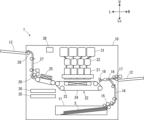
- FIG. 1 is a schematic diagram illustrating an ink jet recording apparatus according to an embodiment of the present invention.
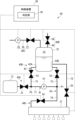
- 1 is a schematic diagram showing a degassing device according to a first embodiment of the present invention
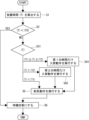
- 1 is a flowchart showing a degassing method according to a first embodiment of the present invention.
- 4 is a flowchart showing a degassing method according to a modified example of the first embodiment of the present invention.
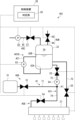
- FIG. 4 is a schematic diagram showing a degassing device according to a second embodiment of the present invention.
- FIG. 11 is a schematic diagram showing a degassing device according to a first modified example of the second embodiment of the present invention.
- FIG. 13 is a schematic diagram showing a degassing device according to a second modified example of the second embodiment of the present invention.
- FIG. 1 is a schematic diagram showing an outline of the inkjet recording device 1.
- the front of the paper in FIG. 1 is the front (forward) of the inkjet recording device 1, and the left and right directions are set based on a view from the front.
- Arrows L, R, U, and Lo which are appropriately added to each figure, respectively indicate the left, right, top, and bottom of the inkjet recording device 1.
- Terms indicating directions and positions are used in this specification, but these terms are used for convenience of explanation and do not limit the technical scope of the present invention.
- the inkjet recording device 1 is configured to be capable of printing by ejecting ink (an example of liquid) from each inkjet recording head 21 toward a sheet S as a recording medium.
- the inkjet recording device 1 has a box-shaped housing 10 that houses various devices.
- the lower part of the housing 10 contains a paper feed cassette 11 in which the sheets S are set, and a manual feed tray 12 is provided on the right side of the housing 10 into which the sheets S are manually set.
- a paper output tray 13 is provided on the upper left side of the housing 10, on which the sheets S that have been recorded on are stacked.
- a first transport path 14 is formed on the right side of the housing 10 to transport sheets S from the paper feed cassette 11 toward the recording head 21 in the center of the housing 10.
- a first paper feed unit 15 is provided upstream of the first transport path 14 to pick up sheets S from the stack of sheets in the paper feed cassette 11, and a pair of registration rollers 18 are provided downstream of the first transport path 14 to adjust the timing of sending out sheets S.
- a paper feed path 16 for the manual feed tray 12 is connected downstream of the first transport path 14, and a second paper feed unit 17 is provided on the paper feed path 16 to pick up sheets S from the stack of sheets in the manual feed tray 12.
- a transport device 22 and recording heads 21 for each color are installed downstream of the pair of registration rollers 18.
- the pair of registration rollers 18 correct the skew of the sheet S and send the sheet S to the transport device 22 in accordance with the ink ejection operation of each recording head 21.
- An ink container 31 and an ink tank 32 are provided for each recording head 21 in the housing 10. Ink from each ink container 31 is temporarily stored in the ink tank 32, and degassed ink is supplied from the ink tank 32 to the recording head 21 as necessary.
- the transport device 22 is configured by stretching a transport belt 24 across multiple tension rollers 23 installed below each recording head 21. Downstream of the transport device 22, a drying device 25 is provided for drying the ink on the sheet S. Downstream of the drying device 25, a decurling device 26 is provided for straightening curls that occur in the sheet S due to drying of the ink. Downstream of the decurling device 26, a second transport path 27 is formed for transporting the sheet S toward the paper discharge tray 13. Downstream of the second transport path 27, a paper discharge section 28 is provided for discharging the recorded sheet S to the paper discharge tray 13.
- the drying device 25 below the drying device 25 are a maintenance unit 35 that cleans the recording head 21, and a cap unit 36 that caps the recording head 21.
- the maintenance unit 35 is provided with a squeegee-like wiping blade that scrapes off any ink remaining on the nozzle surface of the recording head 21.
- the cap unit 36 is provided with a head cap that is placed over the nozzle surface of the recording head 21. The head cap prevents the ink in the nozzles from drying out. Drying of the ink in the nozzles can be further prevented by storing a liquid such as a cleaning liquid in the head cap.
- the inkjet recording device 1 is also provided with a control device 38 that performs overall control of the entire device.
- the control device 38 may be configured with a processor, or may be configured with a logic circuit (hardware) formed in an integrated circuit or the like.
- the processor reads out and executes programs stored in memory to perform various processes.
- a CPU Central Processing Unit
- the memory is configured with one or more storage devices such as a ROM (Read Only Memory) or a RAM (Random Access Memory) depending on the application.
- the first and second paper feed units 15, 17 take out a sheet S from the paper feed cassette 11 or manual feed tray 12 and send it to a pair of registration rollers 18.
- the sheet S is sent from the pair of registration rollers 18 to the conveyor belt 24, and each recording head 21 ejects degassed ink to form a color image on the sheet S.
- the ink on the sheet S is dried by the drying device 25, and the curl of the sheet S is corrected by the decurling device 26.
- the recorded (printed) sheet S is conveyed to the paper discharge unit 28 via the second conveyor path 27, and is discharged to the paper discharge tray 13 by the paper discharge unit 28.
- the ink surface comes into contact with air in the ink tank, causing air to dissolve, and air bubbles in the ink may prevent ink from being ejected from the nozzles of the recording head. For this reason, it is desirable to appropriately suppress the amount of dissolved air in the ink stored in the ink tank. Also, for example, if the power of the inkjet recording device 1 is turned off (OFF) and the recording head is not ejecting ink for a long period of time (non-ejection time), air bubbles may form in the ink remaining in the recording head or in the flow path from the ink tank to the recording head.
- the ink Even if it is possible to remove the air dissolved in the ink in the ink tank, if air bubbles form in the ink inside the recording head, etc., the ink may not be ejected from the nozzles of the recording head due to these air bubbles.
- the inkjet recording device 1 is therefore equipped with a degassing device 40 that removes the air dissolved in the ink in the ink tank 32 and prevents non-ejection caused by air bubbles that form in the ink inside the recording head 21, etc.
- Fig. 2 is a schematic diagram showing the degassing device 40. Note that, although the inkjet recording apparatus 1 is provided with a degassing device 40 for each color, one degassing device 40 will be described here.
- the degassing device 40 includes a supply section 40A, an atmospheric opening section 40B, a pressure reduction section 40C, a circulation section 40D, and a head circulation section 40E.
- the degassing device 40 is a device that degasses the ink in the ink tank 32, but it also serves as an ink supply structure for supplying (replacing) ink to the recording head 21.
- the refill unit 40A has an ink container 31, an ink tank 32, a refill passage 41, a first valve 51, and a second valve 52.
- the ink container 31 which is an example of a liquid container, is a source of ink to the ink tank 32 and is connected to the ink tank 32 via a refill flow path 41.
- the ink tank 32 which is an example of a liquid tank, stores the ink supplied from the ink container 31.
- the refill flow path 41 has a first flow path 71 and a second flow path 72, and connects the ink container 31 and the ink tank 32.
- the first flow path 71 extends from the ink container 31 and constitutes the upstream side of the refill flow path 41.
- the second flow path 72 extends from the end of the first flow path 71 (branch point P1) to the ink tank 32 and constitutes the downstream side of the refill flow path 41.
- the ink container 31 and the ink tank 32 are components of the inkjet recording device 1, but are also components of the refill unit 40A (deaeration device 40).
- the first valve 51 is disposed in the first flow path 71, and the second valve 52 is disposed in the second flow path 72.
- the first valve 51 and the second valve 52 adjust the flow rate of ink passing through the supply flow path 41.
- a common pump 61 which is an example of a liquid delivery device, is located downstream of the first valve 51 in the first flow path 71.
- the common pump 61 distributes (supplies) ink from the ink container 31 to the ink tank 32 through the supply flow path 41 (first flow path 71, second flow path 72).
- the atmosphere release section 40B has an atmosphere release flow path 44 and an atmosphere release valve 56.
- the atmosphere release flow path 44 is provided to communicate the upper space 34 of the ink tank 32 with the outside.
- the atmosphere release valve 56 is interposed in the atmosphere release flow path 44 and adjusts the flow rate of air passing through the atmosphere release flow path 44. By opening the atmosphere release valve 56, the inside of the ink tank 32 (upper space 34) is opened to the atmosphere.
- the pressure reducing unit 40C has a pressure reducing flow path 45, a pressure reducing valve 57, and a pressure reducing pump 62.
- the pressure reducing flow path 45 is provided to communicate the upper space 34 of the ink tank 32 with the outside.
- the pressure reducing valve 57 is disposed in the pressure reducing flow path 45 and adjusts the flow rate of air passing through the pressure reducing flow path 45.
- the pressure reducing pump 62 which is an example of a pressure reducing device, is disposed in the pressure reducing flow path 45 and distributes air from the upper space 34 of the ink tank 32 to the outside through the pressure reducing flow path 45.
- the pressure reducing pump 62 reduces the pressure inside the ink tank 32 (upper space 34) (to below atmospheric pressure) prior to the circulation of ink through the degassing circulation flow path 42, as will be described in detail later.
- the circulation section 40D has a degassing circulation flow path 42, a second valve 52, and a third valve 53.
- the degassing circulation flow path 42 has a part of the first flow path 71, a second flow path 72, and a third flow path 73.
- a part of the first flow path 71 and the second flow path 72 are components of the supply flow path 41, but are also components of the degassing circulation flow path 42, and are shared by the supply flow path 41 and the degassing circulation flow path 42.
- the third flow path 73 connects the ink tank 32 to the first flow path 71.
- the third flow path 73 joins the first flow path 71 at a joining point P2 that is downstream of the first valve 51 and upstream of the common pump 61.
- the degassing circulation flow path 42 is provided to connect different positions of the ink tank 32.
- the second flow path 72 and the third flow path 73 are connected to positions facing each other at approximately the same height near the bottom surface of the ink tank 32.
- the connection of the third flow path 73 to the ink tank 32 is the outlet 42A
- the connection of the second flow path 72 to the ink tank 32 is the inlet 42B.
- the outlet 42A and the inlet 42B are provided at approximately the same height, but are not limited to this and may be provided at different heights. In this case, it is preferable that the inlet 42B is provided at a higher position than the outlet 42A so that the ink near the bottom of the ink tank 32, where the amount of dissolved air in the ink is large, can be moved to near the liquid surface.
- the second valve 52 disposed in the second flow path 72 is a component of the resupply unit 40A, but is also a component of the circulation unit 40D, and is shared by the resupply unit 40A and the circulation unit 40D.
- the third valve 53 disposed in the third flow path 73 adjusts the flow rate of ink passing through the third flow path 73.
- the common pump 61 circulates (circulates) the ink in the ink tank 32 from the outlet 42A to the inlet 42B of the degassing circulation flow path 42.
- the head circulation unit 40E includes a head circulation flow path 43, a supply valve 54, and a recovery valve 55.
- the head circulation flow path 43 has a third flow path 73, a part of the first flow path 71, a supply flow path 74, and a recovery flow path 75.
- the third flow path 73 is a component of the degassing circulation flow path 42, but is also a component of the head circulation flow path 43, and is shared by the degassing circulation flow path 42 and the head circulation flow path 43.
- a part of the first flow path 71 is a component of the supply flow path 41 or the degassing circulation flow path 42, but is also a component of the head circulation flow path 43, and is shared by the supply flow path 41, the degassing circulation flow path 42, and the head circulation flow path 43.
- the supply flow path 74 extends from the end of the first flow path 71 (branch point P1) to the recording head 21.
- the recovery flow path 75 connects the recording head 21 and the ink tank 32.
- the head circulation flow path 43 connects different positions of the ink tank 32 via the recording head 21.
- the supply valve 54 is disposed in the supply flow path 74 and adjusts the flow rate of ink passing through the supply flow path 74.
- the recovery valve 55 is disposed in the recovery flow path 75 and adjusts the flow rate of ink passing through the recovery flow path 75.
- the common pump 61 distributes ink from the ink tank 32 to the recording head 21 through the third flow path 73, a part of the first flow path 71, and the supply flow path 74, and distributes (circulates) ink from the recording head 21 to the ink tank 32 through the recovery flow path 75.
- the degassing circulation flow path 42 which performs degassing while circulating, may be configured to include the recording head 21 in the middle of the degassing circulation flow path 42, but in this embodiment, the recording head 21 is not included in the middle of the degassing circulation flow path 42.
- the degassing circulation flow path 42 is provided separately from the head circulation flow path 43, which supplies ink to the recording head 21.
- the control device 38 controls the opening and closing of the various valves 51-57, and also controls the operation of the various pumps 61, 62.
- the control device 38 is provided with a determination unit 39 that determines whether or not a degassing operation is required depending on the amount of dissolved air in the ink.
- the determination unit 39 is a function that is realized, for example, by a processor executing a program.
- the control device 38 is a component of the inkjet recording device 1, but is also a component of the degassing device 40.
- a pump that pumps ink using a rotating body as at least the common pump 61 of the pumps 61 and 62 described above.
- the common pump 61 for example, a non-positive displacement pump such as a centrifugal pump, mixed flow pump, or axial flow pump may be used, or a positive displacement rotary pump such as a vane pump, gear pump, or screw pump may be used.
- ink is supplied from the ink tank 32 to the recording head 21 through the upstream side of the head circulation flow path 43 (the third flow path 73, a part of the first flow path 71, the supply flow path 74) and the downstream side of the head circulation flow path 43 (the recovery flow path 75).
- a refill operation may be performed during the printing operation.
- the second valve 52 is closed and the third valve 53 is open, but instead, the second valve 52 may be opened and the third valve 53 may be closed.
- the recording head 21 is disposed above the ink tank 32. Negative pressure is applied to the ink in the recording head 21 due to the head difference with the ink in the ink tank 32, and this negative pressure forms a meniscus in the nozzle of the recording head 21. After ink is ejected from the recording head 21, the surface tension of the ink acts to reduce the surface area of the meniscus, and the resulting negative pressure draws the reduced amount of ink from the ink tank 32 into the recording head 21. Note that the recovery valve 55 may be closed, and ink may be supplied to the recording head 21 only from the upstream side of the head circulation flow path 43.
- the ink tank 32 is depressurized to a degree that would essentially cause degassing while the recording head 21 and ink tank 32 are connected, the meniscus in the nozzle may be destroyed. Even if the meniscus is not destroyed, the shape of the meniscus in the nozzle may change from when the ink tank 32 is open to the atmosphere, and the ink ejection characteristics may change. In this embodiment, the ink tank 32 is not depressurized during printing operations to a degree that would essentially cause degassing, so the meniscus in the nozzle of the recording head 21 is not destroyed, and its shape does not change, resulting in changes in the ejection characteristics.
- the degassing operation performed by the degassing device 40 includes a reduction in pressure operation and a circulation operation.
- the decompression operation is performed prior to the circulation operation. During the decompression operation, only the decompression valve 57 is opened, and the other valves 51-56 are closed.
- the decompression pump 62 is driven, air is removed from the upper space 34 in the ink tank 32.
- a target pressure for example, -50 [kPa]
- the decompression pump 62 is stopped and the decompression valve 57 is closed.
- the ink surface is exposed to a decompressed atmosphere, and the air dissolved in the ink near the liquid surface begins to be removed.
- the head circulation flow path 43 is opened, and the supply flow path 41 and the degassing circulation flow path 42 are closed.
- ink is supplied from the ink tank 32 to the recording head 21 through the third flow path 73, a part of the first flow path 71, and the supply flow path 74, and is recovered from the recording head 21 to the ink tank 32 through the recovery flow path 75.
- ink is circulated between the recording head 21 and the ink tank 32, so that ink that has thickened inside the recording head 21, etc. is replaced and air bubbles that have formed inside the recording head 21, etc. are removed (collected in the ink tank 32).
- the various valves 51-55 selectively open one of the refill flow path 41, the degassing circulation flow path 42, and the head circulation flow path 43, and the single common pump 61 sends ink through one of the selectively opened flow paths of the refill flow path 41, the degassing circulation flow path 42, and the head circulation flow path 43.
- the single common pump 61 can be used for the refill operation, the degassing operation, and the replacement operation. This allows the degassing device 40 to be made smaller and manufacturing costs to be reduced compared to a case in which three pumps are provided to send ink to the three flow paths 41-43.
- the control device 38 calculates the standing time (T) from the measurement results of the standard timer function (step S1).
- the standing time of ink include the time from when the inkjet recording device 1 goes into sleep mode to when it returns from sleep, and the time from when the inkjet recording device 1 is turned off to when it is turned on.
- the determination unit 39 determines whether the left-standing time (T) is equal to or longer than a predetermined time (T1) (step S3).
- the predetermined time (T1) is, for example, the time during which air bubbles are predicted to be generated in the ink remaining inside the head circulation flow path 43 or the recording head 21 (hereinafter referred to as "inside the recording head 21"), and is determined experimentally and stored in advance in memory.
- step S3 if the standing time (T) is less than the predetermined time (T1) (T ⁇ T1) (NO in step S3), it is predicted that there is a low possibility that air bubbles have occurred in the ink in the recording head 21, so the control device 38 does not perform the replacement operation (head circulation process S4) but instead performs a degassing operation (degassing circulation process S5) for a preset time.
- the control device 38 stops the degassing operation (the degassing circulation step S5) and puts the inkjet recording apparatus 1 into a standby state (step S8).
- the degassing device 40 (degassing method) according to the first embodiment, when the ink is left unattended (non-ejection time) for a predetermined time (T1) or more and it is predicted that air bubbles are generated in the ink in the recording head 21, the ink is circulated through the head circulation flow path 43 and then through the degassing circulation flow path 42 (the degassing circulation step S5 is executed after the head circulation step S4).
- the degassing circulation step S5 is executed after the head circulation step S4.
- the head circulation step S4 and the degassing circulation step S5 are modified according to the time that the ink is left standing (non-ejection time).
- the judgment unit 39 compares the left-standing time (T) with both the predetermined time (T1) and the second predetermined time (T2) (step S31).
- the second predetermined time (T2) is set as a time longer than the predetermined time (T1) and is stored in advance in memory.
- the control device 38 executes the replacement operation for only a first time (step S41).
- the control device 38 executes the replacement operation for only a second time longer than the first time (step S42).
- the control device 38 stops (ends) the replacement operation and executes a degassing operation (degassing circulation process S5).
- the first time and the second time are experimentally determined and stored in advance in memory.
- the control device 38 performs a degassing operation (degassing circulation process S5) without performing a replacement operation.
- the degassing device 40 (degassing method) according to the modified example of the first embodiment described above makes it possible to effectively remove air bubbles that have occurred in the ink inside the recording head 21.
- the ink standing time (T) is compared to two different predetermined times (T1) and (T2), but this is not limiting and it may be compared to three or more different predetermined times.
- the time for circulating the ink through the head circulation flow path 43 is increased in proportion to the length of the ink left unattended, but the present invention is not limited to this.
- the time for circulating the ink through the degassing circulation flow path 42 (the execution time of the circulation operation during the degassing operation) may be increased (lengthened) in proportion to the length of the ink left unattended (non-ejection time).
- the flow rate of the ink flowing through the degassing circulation flow path 42 or the flow rate of the ink flowing through the head circulation flow path 43 may be increased (fastened) in proportion to the length of the ink left unattended (non-ejection time).
- the decompression width (difference from atmospheric pressure) in the ink tank 32 may be increased (fastened) in proportion to the length of the ink left unattended (non-ejection time).
- the execution time of the decompression operation during the degassing operation may be lengthened (or the amount of exhaust per unit time may be increased) to lower the pressure in the ink tank 32 as the ink left unattended (non-ejection time) becomes longer.
- two or more (or all) of the time for circulating ink through the head circulation flow path 43, the time for circulating ink through the degassing circulation flow path 42, the flow rate of ink flowing through the degassing circulation flow path 42, the flow rate of ink flowing through the head circulation flow path 43, and the reduced pressure in the ink tank 32 may be increased in proportion to the length of time the ink is left standing.
- the ink in the head circulation step S4, the ink may be intermittently circulated through the head circulation flow path 43.
- the control device 38 may control the common pump 61 to be alternately driven and stopped, or may control at least one of the third valve 53, the supply valve 54, and the recovery valve 55 to be alternately opened and closed.
- the ink flow is alternately started and stopped in the head circulation flow path 43, so that air bubbles trapped in bent parts of the head circulation flow path 43, for example, can be pushed toward the ink tank 32. This makes it possible to more effectively remove air bubbles generated in the ink inside the recording head 21.
- a degassing device 401 according to a second embodiment will be described with reference to Fig. 5.
- Fig. 5 is a schematic diagram showing the degassing device 401.
- the same reference numerals are used for the same or corresponding components as those of the degassing device 40 and the degassing method according to the first embodiment (including various modified examples; the same applies below), and the description thereof will be omitted.
- a single common pump 61 is used to circulate ink through the three flow paths 41-43, thereby making the degassing device 40 smaller and less expensive.
- using a single common pump for the three flow paths 41-43 can easily complicate the layout of the various flow paths 41-43, and can easily make the various flow paths 41-43 longer.
- the ink can easily absorb air, so it is not desirable to make the various flow paths 41-43 longer.
- the circulation section 401D has a first pump 63 (first liquid delivery device), and the refill section 40A and the head circulation section 40E share a second pump 64 (second liquid delivery device).
- first pump 63 first liquid delivery device
- second pump 64 second liquid delivery device
- the circulation section 401D has a degassing circulation flow path 421 and a first pump 63.
- the degassing circulation flow path 421 is provided to communicate the vicinity of the ink liquid surface and the vicinity of the bottom surface of the ink tank 32.
- the outlet 42A opens to the bottom surface of the ink tank 32, and the inlet 42B opens to the side surface of the ink tank 32 near the liquid surface. In other words, the inlet 42B is provided at a higher position than the outlet 42A.
- the first pump 63 is interposed in the degassing circulation flow path 421 and circulates the ink through the degassing circulation flow path 421.
- the head circulation flow path 431 of the head circulation unit 40E has a second flow path 72, a supply flow path 74, and a recovery flow path 75.
- the second flow path 72 is shared by the refill flow path 41 and the head circulation flow path 431.
- the second pump 64 is interposed in the second flow path 72 and causes ink to flow through a selected one of the refill flow path 41 and the head circulation flow path 431.
- the first valve 51 and the pressure reducing valve 57 are closed, and the second valve 52, the supply valve 54, the recovery valve 55, and the atmospheric relief valve 56 are open.
- the supply valve 54, the recovery valve 55, and the pressure reducing valve 57 are closed, and the first valve 51, the second valve 52, and the atmospheric relief valve 56 are open.
- the second pump 64 is driven, ink is refilled from the ink container 31 to the ink tank 32 through the refill flow path 41 (first flow path 71, second flow path 72).
- the first valve 51 and the pressure reducing valve 57 are closed, and the second valve 52, the supply valve 54, the recovery valve 55, and the atmospheric relief valve 56 are open. Every time ink is ejected from the recording head 21, ink is supplied from the ink tank 32 to the recording head 21 through the upstream side (second flow path 72, supply flow path 74) of the head circulation flow path 431.
- the degassing device 401 according to the second embodiment described above includes a first pump 63 that sends ink through the degassing circulation flow path 421, and a second pump 64 that sends ink through the supply flow path 41 or the head circulation flow path 431.
- This configuration simplifies the handling of the three flow paths 41, 421, 431 compared to a case where a single pump is used for the three flow paths 41, 421, 431, and shortens the length of each of the flow paths 41, 421, 431. This reduces the risk that the ink will absorb air that has passed through the various flow paths 41, 421, 431.
- the degassing device 401 according to the second embodiment can achieve the same effects as the degassing device 40 according to the first embodiment, such as suppressing ink non-ejection due to air bubbles generated in the ink in the recording head 21.
- the first pump 63 sends ink through the degassing circulation flow path 421, and the second pump 64 sends ink through the supply flow path 41 or the head circulation flow path 431, but the present invention is not limited to this.
- the first pump 63 only needs to be able to send ink through any one of the supply flow path 41, the degassing circulation flow path 42 (421), and the head circulation flow path 43 (431), and the second pump 64 only needs to be able to send ink through one of the supply flow path 41, the degassing circulation flow path 42 (421), and the head circulation flow path 43 (431), excluding the one flow path.
- FIG. 6 is a schematic diagram showing the degassing device 401 according to the first modified example.
- the supply section 401A has a first pump 63, and the circulation section 40D and the head circulation section 40E share the second pump 64.
- the resupply flow path 41 of the resupply unit 401A is composed of only the first flow path 71, and the first valve 51 is interposed in the first flow path 71.
- the first pump 63 is interposed in the first flow path 71 upstream of the first valve 51, and sends ink through the resupply flow path 41 (first flow path 71).
- the degassing circulation flow path 422 of the circulation unit 40D has a second flow path 72 and a third flow path 73.
- the head circulation flow path 431 has a third flow path 73, a supply flow path 74, and a recovery flow path 75.
- the third flow path 73 is shared by the degassing circulation flow path 422 and the head circulation flow path 431.
- the second pump 64 is interposed in the third flow path 73, and sends ink through a selected one of the degassing circulation flow path 422 and the head circulation flow path 431.
- the operation of the degassing device 401 (ink supply structure) according to the first modified example will be briefly described.
- the first valve 51, the second valve 52, and the pressure reducing valve 57 are closed, and the third valve 53, the supply valve 54, the recovery valve 55, and the atmospheric release valve 56 are open.
- the second valve 52, the third valve 53, the supply valve 54, the recovery valve 55, and the pressure reducing valve 57 are closed, and the first valve 51 and the atmospheric release valve 56 are open.
- the first pump 63 is driven, ink is refilled from the ink container 31 to the ink tank 32 through the refill flow path 41 (first flow path 71).
- the first valve 51, the second valve 52, and the pressure reducing valve 57 are closed, and the third valve 53, the supply valve 54, the recovery valve 55, and the atmospheric release valve 56 are open.
- ink is supplied from the ink tank 32 to the recording head 21 through the upstream side (third flow path 73, supply flow path 74) of the head circulation flow path 431.
- the second valve 52 is closed and the third valve 53 is open, but instead, the second valve 52 may be opened and the third valve 53 may be closed.
- the second valve 52 and the third valve 53 are opened, the other valves 51, 54-57 are closed, and the second pump 64 is driven, thereby circulating the ink in the ink tank 32 through the degassing circulation flow path 422.
- the first valve 51, the second valve 52, and the pressure reducing valve 57 are closed, and the third valve 53, the supply valve 54, the recovery valve 55, and the atmospheric release valve 56 are open.
- ink is supplied from the ink tank 32 to the recording head 21 through the third flow path 73 and the supply flow path 74, and is recovered from the recording head 21 to the ink tank 32 through the recovery flow path 75 (ink circulates through the head circulation flow path 431).
- FIG. 7 is a schematic diagram showing a degassing device 401 according to the second modified example.
- the head circulation section 401E has a first pump 63, and the supply section 40A and the circulation section 40D share the second pump 64.
- the head circulation flow path 433 of the head circulation unit 401E has a supply flow path 74, a recovery flow path 75, and a bypass flow path 76.
- the first pump 63 is disposed in the supply flow path 74 downstream of the supply valve 54, and sends ink through the supply flow path 74.
- the bypass flow path 76 is disposed in parallel with the supply flow path 74 so as to bypass the first pump 63.
- the bypass flow path 76 is provided with a bypass valve 58 that adjusts the flow rate of ink passing through the bypass flow path 46.
- the second pump 64 is disposed in the first flow path 71, and sends ink through a selected one of the supply flow path 41 and the degassing circulation flow path 42.
- the operation of the degassing device 401 (ink supply structure) according to the second modified example will be briefly described.
- the first valve 51, the second valve 52, the third valve 53, the supply valve 54, and the pressure reducing valve 57 are closed, and the recovery valve 55, the atmospheric release valve 56, and the bypass valve 58 are open.
- the third valve 53, the supply valve 54, the recovery valve 55, the pressure reducing valve 57, and the bypass valve 58 are closed, and the first valve 51, the second valve 52, and the atmospheric release valve 56 are open.
- the second pump 64 is driven, ink is refilled from the ink container 31 to the ink tank 32 through the refill passage 41.
- the first valve 51, the second valve 52, the third valve 53, the supply valve 54, and the pressure reducing valve 57 are closed, and the recovery valve 55, the atmospheric release valve 56, and the bypass valve 58 are open.
- ink is supplied from the ink tank 32 to the recording head 21 through the upstream side of the head circulation flow path 433 (part of the supply flow path 74, the bypass flow path 76).
- the second valve 52 and the third valve 53 are opened, the other valves 51, 54-58 are closed, and the second pump 64 is driven, thereby circulating the ink in the ink tank 32 through the degassing circulation flow path 42.
- the first valve 51, the second valve 52, the third valve 53, the pressure reducing valve 57, and the bypass valve 58 are closed, and the supply valve 54, the recovery valve 55, and the atmospheric release valve 56 are open.
- the second pump 64 is driven, ink is supplied from the ink tank 32 to the recording head 21 through the supply flow path 74, and is recovered from the recording head 21 to the ink tank 32 through the recovery flow path 75 (ink circulates through the head circulation flow path 433).
- the degassing device 401 in the degassing device 401 according to the second embodiment (including various modified examples), it is preferable to use a non-positive displacement pump or a positive displacement rotary pump at least as the pump for performing the circulation operation during the degassing operation.
- the degassing circulation step S5 is performed after the head circulation step S4 is performed, but the present invention is not limited to this.
- the first degassing circulation step S5 may be performed, the head circulation step S4 may be performed, and then the second degassing circulation step S5 may be performed.
- the degassing device 40, 401 is provided in the inkjet recording device 1, but it is not limited to this and can also be applied to devices used in other fields such as the semiconductor manufacturing field and the display manufacturing field.
- the degassing device 40 can also be applied to degassing liquids such as chemical solutions, electrolytes, liquid resins, adhesives, solvents, lubricants, liquid foods, and beauty serums.
- the decompression pump 62 is exemplified as the decompression device, but the decompression device may be any device capable of reducing the pressure inside the ink tank 32, and may be, for example, an ejector (not shown).
- the liquid delivery device, the first liquid delivery device, and the second liquid delivery device may be any device capable of delivering ink, and may be, for example, an ejector (not shown).
- the inkjet recording device 1 is a color printer, but it is not limited to this and may be a monochrome printer, a copy machine, a facsimile, etc.
- the sheet S used for printing may be any sheet-like material, such as plain paper, coated paper, tracing paper, or an OHP (Over Head Projector) sheet.
Landscapes
- Chemical & Material Sciences (AREA)
- Chemical Kinetics & Catalysis (AREA)
- Ink Jet (AREA)
Priority Applications (1)
| Application Number | Priority Date | Filing Date | Title |
|---|---|---|---|
| JP2025511746A JPWO2024204860A1 (https=) | 2023-03-29 | 2024-05-16 |
Applications Claiming Priority (2)
| Application Number | Priority Date | Filing Date | Title |
|---|---|---|---|
| JP2023053973 | 2023-03-29 | ||
| JP2023-053973 | 2023-03-29 |
Publications (1)
| Publication Number | Publication Date |
|---|---|
| WO2024204860A1 true WO2024204860A1 (ja) | 2024-10-03 |
Family
ID=92906217
Family Applications (1)
| Application Number | Title | Priority Date | Filing Date |
|---|---|---|---|
| PCT/JP2024/018072 Ceased WO2024204860A1 (ja) | 2023-03-29 | 2024-05-16 | 脱気装置、インクジェット記録装置および脱気方法 |
Country Status (2)
| Country | Link |
|---|---|
| JP (1) | JPWO2024204860A1 (https=) |
| WO (1) | WO2024204860A1 (https=) |
Citations (7)
| Publication number | Priority date | Publication date | Assignee | Title |
|---|---|---|---|---|
| WO2006047053A1 (en) * | 2004-10-22 | 2006-05-04 | Hewlett-Packard Development Company, L.P. | Fluid-gas separator |
| JP2011207023A (ja) * | 2010-03-30 | 2011-10-20 | Dainippon Screen Mfg Co Ltd | 印刷装置 |
| JP2011212872A (ja) * | 2010-03-31 | 2011-10-27 | Seiko Epson Corp | 液体噴射装置の制御装置、液体噴射装置及び液体噴射装置のクリーニング方法 |
| JP2016032900A (ja) * | 2014-07-31 | 2016-03-10 | 理想科学工業株式会社 | インクジェット印刷装置 |
| JP2016141063A (ja) * | 2015-02-03 | 2016-08-08 | セイコーエプソン株式会社 | 液体噴射装置 |
| JP2018047683A (ja) * | 2016-09-14 | 2018-03-29 | 株式会社リコー | 液体吐出ヘッド、液体吐出ユニット、液体を吐出する装置 |
| JP2019142189A (ja) * | 2018-02-23 | 2019-08-29 | キヤノン株式会社 | インクジェット記録装置 |
-
2024
- 2024-05-16 JP JP2025511746A patent/JPWO2024204860A1/ja active Pending
- 2024-05-16 WO PCT/JP2024/018072 patent/WO2024204860A1/ja not_active Ceased
Patent Citations (7)
| Publication number | Priority date | Publication date | Assignee | Title |
|---|---|---|---|---|
| WO2006047053A1 (en) * | 2004-10-22 | 2006-05-04 | Hewlett-Packard Development Company, L.P. | Fluid-gas separator |
| JP2011207023A (ja) * | 2010-03-30 | 2011-10-20 | Dainippon Screen Mfg Co Ltd | 印刷装置 |
| JP2011212872A (ja) * | 2010-03-31 | 2011-10-27 | Seiko Epson Corp | 液体噴射装置の制御装置、液体噴射装置及び液体噴射装置のクリーニング方法 |
| JP2016032900A (ja) * | 2014-07-31 | 2016-03-10 | 理想科学工業株式会社 | インクジェット印刷装置 |
| JP2016141063A (ja) * | 2015-02-03 | 2016-08-08 | セイコーエプソン株式会社 | 液体噴射装置 |
| JP2018047683A (ja) * | 2016-09-14 | 2018-03-29 | 株式会社リコー | 液体吐出ヘッド、液体吐出ユニット、液体を吐出する装置 |
| JP2019142189A (ja) * | 2018-02-23 | 2019-08-29 | キヤノン株式会社 | インクジェット記録装置 |
Also Published As
| Publication number | Publication date |
|---|---|
| JPWO2024204860A1 (https=) | 2024-10-03 |
Similar Documents
| Publication | Publication Date | Title |
|---|---|---|
| JP5209431B2 (ja) | インクジェット記録装置 | |
| CN110936715B (zh) | 印刷装置、印刷系统、印刷方法 | |
| JP6004967B2 (ja) | 液体移送装置及び画像形成装置 | |
| US11738563B2 (en) | Printer, printing system, and printing method | |
| JP2021094735A (ja) | 液体吐出装置 | |
| US11724515B2 (en) | Inkjet printer and non-transitory computer-readable storage medium storing computer-readable instructions | |
| JP7682067B2 (ja) | 印刷装置および印刷装置の立ち下げ方法 | |
| US11040538B2 (en) | Inkjet printer and maintenance method | |
| WO2024204860A1 (ja) | 脱気装置、インクジェット記録装置および脱気方法 | |
| JP2015205418A (ja) | インクジェット記録装置 | |
| US20260054496A1 (en) | Degassing device and inkjet recording apparatus | |
| US20240351347A1 (en) | Inkjet recording apparatus | |
| US20240351344A1 (en) | Inkjet recording apparatus | |
| EP4620685A1 (en) | Deaeration device, inkjet recording device, and deaeration method | |
| US20240351343A1 (en) | Degassing device and inkjet recording apparatus | |
| US20180086093A1 (en) | Liquid ejection apparatus and liquid supply unit | |
| WO2024204854A1 (ja) | 脱気装置、インクジェット記録装置 | |
| JP2024142019A (ja) | 脱気装置及びインクジェット記録装置 | |
| WO2024204862A1 (ja) | 脱気装置、インクジェット記録装置 | |
| US20240351345A1 (en) | Degassing device and inkjet recording apparatus | |
| JP2024168642A (ja) | 脱気装置及びインクジェット記録装置 | |
| US20240351346A1 (en) | Degassing device and inkjet recording apparatus | |
| EP4624177A1 (en) | Inkjet recording device | |
| EP4628307A1 (en) | Inkjet recording device | |
| JP7645173B2 (ja) | 印刷装置、印刷システムおよび印刷方法 |
Legal Events
| Date | Code | Title | Description |
|---|---|---|---|
| 121 | Ep: the epo has been informed by wipo that ep was designated in this application |
Ref document number: 24780952 Country of ref document: EP Kind code of ref document: A1 |
|
| WWE | Wipo information: entry into national phase |
Ref document number: 2025511746 Country of ref document: JP |
|
| NENP | Non-entry into the national phase |
Ref country code: DE |
|
| 122 | Ep: pct application non-entry in european phase |
Ref document number: 24780952 Country of ref document: EP Kind code of ref document: A1 |