WO2024204532A1 - キシリレンジアミンの製造方法、及び、マグネットストレーナの清掃方法 - Google Patents
キシリレンジアミンの製造方法、及び、マグネットストレーナの清掃方法 Download PDFInfo
- Publication number
- WO2024204532A1 WO2024204532A1 PCT/JP2024/012623 JP2024012623W WO2024204532A1 WO 2024204532 A1 WO2024204532 A1 WO 2024204532A1 JP 2024012623 W JP2024012623 W JP 2024012623W WO 2024204532 A1 WO2024204532 A1 WO 2024204532A1
- Authority
- WO
- WIPO (PCT)
- Prior art keywords
- magnetic
- catalyst
- strainer
- main body
- cleaning
- Prior art date
- Legal status (The legal status is an assumption and is not a legal conclusion. Google has not performed a legal analysis and makes no representation as to the accuracy of the status listed.)
- Ceased
Links
Images



Classifications
-
- C—CHEMISTRY; METALLURGY
- C07—ORGANIC CHEMISTRY
- C07C—ACYCLIC OR CARBOCYCLIC COMPOUNDS
- C07C209/00—Preparation of compounds containing amino groups bound to a carbon skeleton
- C07C209/44—Preparation of compounds containing amino groups bound to a carbon skeleton by reduction of carboxylic acids or esters thereof in presence of ammonia or amines, or by reduction of nitriles, carboxylic acid amides, imines or imino-ethers
- C07C209/48—Preparation of compounds containing amino groups bound to a carbon skeleton by reduction of carboxylic acids or esters thereof in presence of ammonia or amines, or by reduction of nitriles, carboxylic acid amides, imines or imino-ethers by reduction of nitriles
-
- B—PERFORMING OPERATIONS; TRANSPORTING
- B01—PHYSICAL OR CHEMICAL PROCESSES OR APPARATUS IN GENERAL
- B01D—SEPARATION
- B01D35/00—Filtering devices having features not specifically covered by groups B01D24/00 - B01D33/00, or for applications not specifically covered by groups B01D24/00 - B01D33/00; Auxiliary devices for filtration; Filter housing constructions
- B01D35/06—Filters making use of electricity or magnetism
-
- B—PERFORMING OPERATIONS; TRANSPORTING
- B01—PHYSICAL OR CHEMICAL PROCESSES OR APPARATUS IN GENERAL
- B01D—SEPARATION
- B01D35/00—Filtering devices having features not specifically covered by groups B01D24/00 - B01D33/00, or for applications not specifically covered by groups B01D24/00 - B01D33/00; Auxiliary devices for filtration; Filter housing constructions
- B01D35/16—Cleaning-out devices, e.g. for removing the cake from the filter casing or for evacuating the last remnants of liquid
-
- B—PERFORMING OPERATIONS; TRANSPORTING
- B01—PHYSICAL OR CHEMICAL PROCESSES OR APPARATUS IN GENERAL
- B01D—SEPARATION
- B01D35/00—Filtering devices having features not specifically covered by groups B01D24/00 - B01D33/00, or for applications not specifically covered by groups B01D24/00 - B01D33/00; Auxiliary devices for filtration; Filter housing constructions
- B01D35/28—Strainers not provided for elsewhere
-
- C—CHEMISTRY; METALLURGY
- C07—ORGANIC CHEMISTRY
- C07B—GENERAL METHODS OF ORGANIC CHEMISTRY; APPARATUS THEREFOR
- C07B61/00—Other general methods
-
- C—CHEMISTRY; METALLURGY
- C07—ORGANIC CHEMISTRY
- C07C—ACYCLIC OR CARBOCYCLIC COMPOUNDS
- C07C209/00—Preparation of compounds containing amino groups bound to a carbon skeleton
- C07C209/82—Purification; Separation; Stabilisation; Use of additives
- C07C209/84—Purification
-
- C—CHEMISTRY; METALLURGY
- C07—ORGANIC CHEMISTRY
- C07C—ACYCLIC OR CARBOCYCLIC COMPOUNDS
- C07C211/00—Compounds containing amino groups bound to a carbon skeleton
- C07C211/01—Compounds containing amino groups bound to a carbon skeleton having amino groups bound to acyclic carbon atoms
- C07C211/26—Compounds containing amino groups bound to a carbon skeleton having amino groups bound to acyclic carbon atoms of an unsaturated carbon skeleton containing at least one six-membered aromatic ring
- C07C211/27—Compounds containing amino groups bound to a carbon skeleton having amino groups bound to acyclic carbon atoms of an unsaturated carbon skeleton containing at least one six-membered aromatic ring having amino groups linked to the six-membered aromatic ring by saturated carbon chains
Definitions
- the present invention relates to a new method for producing xylylenediamine and a method for cleaning a magnetic strainer.
- Xylylenediamine is a useful compound as a raw material for polyamide resins, hardeners, etc., and as an intermediate raw material for isocyanate resins, etc.
- Various methods for producing xylylenediamine for example, methods utilizing hydrogenation of dicyanobenzene, have been investigated.
- One example of a method for synthesizing xylylenediamine by hydrogenating dicyanobenzene is a method in which a two-stage hydrogenation reaction is carried out using dicyanobenzene as a raw material, and this method can efficiently produce high-purity xylylenediamine.
- one of the purposes of the solid-liquid separation process is to separate the catalyst powder derived from the catalyst generated in the fixed-bed reactor during the production of xylylenediamine into solid and liquid.
- Such catalysts are present in the reaction solution obtained by hydrogenation, and as a solid-liquid separation means, for example, a magnetic strainer using a magnet is used.
- a magnetic strainer using a magnet is used.
- the present invention aims to solve the above problems by providing a method for producing xylylenediamine that allows for quick and easy cleaning of magnetic strainers, and a method for cleaning magnetic strainers.
- the inventor discovered that by using a magnetic strainer with a structure that separates the lid material and the magnetic attraction means, cleaning can be performed quickly, easily, and safely by simply removing the magnetic attraction means when cleaning, and thus arrived at the present invention.
- a process for producing xylylenediamine by hydrogenating dicyanobenzene comprising the steps of: hydrogenating the dicyanobenzene in the presence of a catalyst to obtain a mixture containing at least a reaction product and at least a portion of the catalyst; passing the mixture through a magnetic strainer to separate the catalyst by magnetic attraction;
- the magnetic strainer comprises a main body having an opening, a lid material placed on the opening of the main body, and a magnetic adsorption means provided inside the main body and separated from the lid material.
- ⁇ 2> The method for producing xylylenediamine according to ⁇ 1>, wherein the magnetic strainer is provided, inside the main body, with a guide for supporting the magnetic adsorption means and a bucket for removing solid matter in the mixed liquid.
- the magnetic attraction means includes a magnet and a holding member for holding the magnet.
- the magnetic strainer includes, inside the main body, a guide for supporting the magnetic attraction means and a bucket for removing solid matter from the mixed liquid;
- the magnetic attraction means includes a magnet and a holding member that holds the magnet,
- a method for cleaning a magnetic strainer for removing a catalyst from a mixture containing a reaction product obtained by hydrogenating dicyanobenzene in the presence of a catalyst and the catalyst by magnetic adsorption comprising the steps of:
- the magnetic strainer includes a main body having an opening, a lid placed on the opening of the main body, and a magnetic attraction means provided inside the main body and separated from the lid,
- a method for cleaning a magnetic strainer comprising removing the magnetic attraction means separated from the lid member from within the main body of the magnetic strainer, and cleaning the magnetic attraction means.
- the present invention provides a method for producing xylylenediamine that allows for quick and easy cleaning of magnetic strainers, and a method for cleaning magnetic strainers.
- FIG. 2 is a schematic diagram showing the configuration of a magnetic strainer in the present embodiment.
- FIG. 1 is a schematic diagram showing a state in which a lid is closed in a magnetic strainer.
- FIG. 11 is a schematic diagram for explaining a cleaning process in the present embodiment.
- 1 is a flowchart showing a basic flow of the present embodiment.
- the method for producing xylylenediamine of this embodiment is a method for producing xylylenediamine by hydrogenating dicyanobenzene, and includes a step of hydrogenating dicyanobenzene in the presence of a catalyst to obtain a mixed liquid containing at least a reaction product and at least a part of the catalyst (hereinafter, sometimes referred to as the “first hydrogenation step”), and a step of passing the mixed liquid through a magnetic strainer to separate the catalyst by magnetic adsorption (hereinafter, sometimes referred to as the "solid-liquid separation step").
- the magnetic strainer includes a main body having an opening, a lid material installed at the opening of the main body, and a magnetic adsorption means provided inside the main body and separated from the lid material.
- the production method of this embodiment includes at least the first hydrogenation step and the solid-liquid separation step, and may further include a cleaning step, a liquid ammonium removal step, a second hydrogenation step, etc., as necessary.
- the cleaning method for the magnetic strainer of this embodiment is a cleaning method for the magnetic strainer that removes the catalyst from a mixed liquid containing the catalyst and a reaction product obtained by hydrogenating dicyanobenzene in the presence of the catalyst by magnetic adsorption, in which the magnetic strainer comprises a main body having an opening, a lid material installed at the opening of the main body, and a magnetic adsorption means provided inside the main body and separated from the lid material, and the cleaning method involves removing the magnetic adsorption means separated from the lid material from inside the main body of the magnetic strainer and cleaning the magnetic adsorption means.
- the cleaning method of this embodiment corresponds to the cleaning step of the manufacturing method of this embodiment described below.
- the catalyst in the mixed liquid containing the reaction product obtained by hydrogenating dicyanobenzene in the presence of a catalyst and at least a part of the catalyst can be removed by magnetic adsorption using a magnetic strainer equipped with a lid material and a magnetic adsorption means separated from the lid material.
- a cleaning process is periodically performed to remove the catalyst attached to the magnet of the magnetic adsorption means in order to prevent subsequent blockages due to the catalyst.
- the magnetic adsorption means in this embodiment is a separate member separated from the lid material, so that the weight of the lid material itself can be reduced, and the lid material can be easily opened and closed when cleaning the magnetic strainer. Furthermore, when cleaning the magnetic strainer, it is not necessary to lift the magnetic adsorption means together with the heavy lid with a chain block, and only the magnetic adsorption means can be removed from inside the magnetic strainer. This significantly reduces the workload when cleaning the magnetic strainer. Furthermore, there is no need to prepare for work using a chain block, so the magnetic strainer can be cleaned quickly and easily, and the physical burden on the cleaner can be reduced.
- the magnetic adsorption means can be easily removed, so the task of spraying water on the catalyst powder can be performed quickly, and cleaning work can be performed more safely.
- the manufacturing method and cleaning method of this embodiment allow for quick and easy cleaning of the magnetic strainer, making it possible to efficiently manufacture xylylenediamine.
- the magnetic strainer in this embodiment includes a main body having an opening, a lid placed on the opening of the main body, and a magnetic attraction means provided inside the main body and separated from the lid.
- magnetic attraction means separated from the lid means that the lid and the magnetic attraction means are not connected directly or via another member, and each can be attached to the magnetic strainer separately and independently.
- Figure 1 is a schematic diagram showing an example of the configuration of the magnetic strainer in this embodiment.
- Figure 2 is a schematic diagram showing the magnetic strainer 100 with the lid closed.
- the magnetic strainer 100 comprises a main body 10 having an opening 12, a lid 20 installed at the opening 12 of the main body 10, and a magnetic adsorption means 30 provided inside the main body 10 and separated from the lid 20.
- the magnetic strainer 100 comprises a guide 40 for supporting the magnetic adsorption means 30 and a bucket 50 for removing solids in the mixed liquid inside the main body 10.
- the magnetic adsorption means 30 comprises a magnet 34 and a holding member 32 for holding the magnet 34, and the holding member 32 of the magnetic adsorption means 30 is supported by the guide 40.
- Fig. 1 shows the state in which the lid 20 has been moved and the opening 12 of the main body 10 has been opened, and is a cross-sectional view in which part of the wall of the main body 10 has been omitted to show the inside.
- Figs. 1 and 2 are schematic diagrams, and the configuration of the magnetic strainer in this embodiment is not limited to that shown in Fig. 1, and the size and shape of each member and the ratio between members are not limited to this.
- the magnetic strainer 100 is a device installed in the solid-liquid separation process in this embodiment, and at least the catalyst is separated from the mixed liquid obtained in the first hydrogenation process by magnetic adsorption by passing the mixed liquid obtained in the first hydrogenation process through the main body 10.
- the magnetic adsorption means 30, the guide 40, and the bucket 50 are each installed so that they can be removed from inside the main body 10 through the opening 12 during the cleaning process.
- the main body 10 has an opening 12 and has a space inside in which a magnetic adsorption means 30 and the like can be installed. As shown in FIG. 2, in the solid-liquid separation process, the lid 20 is closed and the opening 12 of the main body 10 is blocked. As shown in FIGS. 1 and 2, the main body 10 has a supply port 14 and a discharge port 16, and in the solid-liquid separation process, the mixed liquid obtained in the first hydrogenation process is supplied to the inside of the main body 10 from the supply port 14. The mixed liquid supplied to the inside of the main body 10 then comes into contact with the magnetic adsorption means 30 and passes through a filter provided in the bucket 50, thereby removing solids in the mixed liquid. The mixed liquid that comes into contact with the magnetic adsorption means 30 and passes through the bucket 50 is discharged outside the main body 10 from the discharge port 16.
- the opening 12 is provided on the upper side of the main body 10 in the weight direction (the upper side of the paper in FIG. 1), and its inner diameter is set so that it is opened during the cleaning process and the magnetic adsorption means 30 installed inside can be removed from the opening 12.
- the lid material 20 is attached to the edge of the opening 12 on the top surface of the main body 10 so that it can rotate horizontally, and the opening 12 is opened and closed by rotating the lid material 20 during the cleaning process.
- the opening and closing mechanism of the lid material 20 is not limited to horizontal rotation, and other mechanisms may be used, such as sliding horizontally or opening vertically using a hinge, as long as it can be opened and closed easily.
- the lid material 20 may be fixed to the main body 10 by bolts or the like.
- the magnetic adsorption means 30 includes a magnet 34 and a holding member 32 that holds the magnet 34.
- the magnet 34 comes into contact with the mixed liquid supplied to the main body 10, thereby adsorbing and removing the catalyst in the mixed liquid.
- a plurality of magnet members 36 are attached below the holding member 32 in the direction of gravity (below the paper surface in FIG. 1), and each magnet member 36 is equipped with a plurality of magnets 34.
- FIG. 1 shows the magnetic attraction means 30 removed from the main body 10, but in the solid-liquid separation process, the magnetic attraction means 30 is stored inside the main body 10, and specifically, the holding member 32 of the magnetic attraction means 30 is supported by a guide 40 so that at least a part of the portion of the magnetic member 36 having the magnet 34 is housed in the bucket 50.
- the magnetic attraction means 30 in FIG. 1 is shown as being configured such that the magnet 34 is provided on the holding member 32 via the rod-shaped magnet member 36
- the configuration of the magnetic attraction means in this embodiment is not limited to this form, and may be other configurations, such as a form in which a rod-shaped magnet is directly or indirectly attached to the holding member.
- the magnetic strainer 100 may include, as necessary, a guide 40 for supporting the magnetic adsorption means 30 and a bucket 50 for removing solids from the mixed liquid inside the main body 10.
- the guide 40 has the role of supporting the holding member 32 of the magnetic adsorption means 30 inside the main body 10. This allows the weight of the magnetic adsorption means 30 to be distributed to the outer periphery when the bucket 50 is installed, compared to when the magnetic adsorption means 30 is directly supported by the bucket 50, and the load on the bucket 50 can be reduced.
- the guide 40 may be configured by combining multiple ring-shaped members, but the configuration is not limited as long as it can support the holding member 32 of the magnetic adsorption means 30 inside the main body 10.
- the shape of the guide 40 is such that the lower part is cut diagonally in cross section in accordance with the shape of the upper part of the bucket 50, but the shape of the guide 40 is not limited to this.
- the bucket 50 is a member equipped with a filter, and can remove solid matter in the mixed liquid passing through the bucket 50 by the filter.
- the bucket 50 has a shape in which a cylindrical member is cut diagonally in cross section.
- the shape of the bucket 50 is configured such that the height of the wall surface on the supply port 14 side is lower than the supply port 14, and the height of the wall surface on the discharge port 16 side is higher than the discharge port 16.
- the bucket 50 is not limited to this shape, and the shape is not particularly limited as long as it is a shape that can remove solid matter in the mixed liquid by the filter.
- a ring-shaped protrusion 18 is provided along the inner wall of the main body 10, and the protrusion 18 supports the bucket 50 so that it is fixed in the hollow inside the main body 10.
- the weight of the magnetic adsorption means 30 can be distributed to the inner circumference of the main body 10 by the protrusion 18, and the load on the bucket 50 can be reduced.
- a liquid flow occurs from the bottom surface of the bucket 50, allowing the entire amount of mixed liquid to pass through the bucket 50.
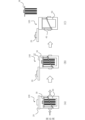
- FIG. 3 is a schematic diagram for explaining the cleaning step in this embodiment.
- A) shows the state of the magnetic strainer 100 in the solid-liquid separation process.
- the cleaning process is a process in which the magnetic attraction means separated from the lid material is removed from inside the magnetic strainer body, and the magnetic attraction means is cleaned.
- the catalyst adhering to the magnet of the magnetic adsorption means is periodically removed. It is preferred to carry out a cleaning step.
- the mixed liquid obtained in the first hydrogenation process is supplied into the magnetic strainer 100, as shown by the arrow in FIG. 3(A).
- the catalyst in the mixed liquid is removed.
- other solid matter in the mixed liquid is removed by the filter of the bucket 50 as it passes through the bucket 50.
- the mixed liquid from which solid matter such as the catalyst has been removed is discharged outside the magnetic strainer 100, as shown by the arrow in FIG. 3(A).
- FIG. 3 shows the state of the magnetic strainer 100 during the cleaning process.
- the opening 12 of the magnetic strainer 100 is opened by rotating the cover material 20 horizontally as shown in FIG. 3(B).
- FIG. 3(C) the magnetic adsorption means 30 is removed from inside the magnetic strainer 100, and the catalyst and the like on the powder attracted to the magnet are removed.
- the cleaning process it is preferable to remove the guide 40 and the bucket 50 together with the magnetic attraction means 30 from within the magnetic strainer 100 and remove the solid matter captured in the bucket 50.
- the magnetic attraction means 30 and the like are returned to their designated positions within the magnetic strainer 100, the lid 20 is closed, and the solid-liquid separation process is carried out again.
- only one magnetic strainer may be used, or multiple magnetic strainers may be used.
- the multiple magnetic strainers may be arranged in series or in parallel with respect to the flow of the mixed liquid supplied from the first hydrogenation process, or a combination of series and parallel.
- the flow of the mixed liquid can be switched by closing the valves installed at the supply inlet and discharge outlet of the magnetic strainer to be cleaned, so that the mixed liquid from the first hydrogenation process is supplied only to the magnetic strainer that is not to be cleaned. This makes it possible to continue the xylylenediamine manufacturing process without having to stop it when the cleaning process is performed.
- the production method of the present embodiment includes the first hydrogenation step and the solid-liquid separation step, and preferably further includes a cleaning step of cleaning the inside of the magnetic strainer used in the solid-liquid separation step (cleaning the magnetic adsorption means); however, in addition, an ammonia separation step and a purification step can be provided as necessary.
- the production method of this embodiment can also employ, for example, a two-stage hydrogenation reaction.
- cyanobenzylamine which is a by-product of the first hydrogenation step, can be efficiently converted to xylylenediamine by hydrogenating it in the second hydrogenation step.
- high-purity xylylenediamine can be stably produced for a long period of time without changing the conditions of the second hydrogenation reaction.
- a preferred example of the manufacturing method of this embodiment includes the following steps (1) to (5).
- the solid-liquid separation step is carried out after the ammonia separation step, the amount of liquid circulated in the solid-liquid separation step is reduced, so that the equipment can be made small and the pressure can be made low, which is industrially advantageous.
- the order of the above-mentioned (2) ammonia separation step and (3) solid-liquid separation step may be reversed, and the ammonia separation step may be carried out after the solid-liquid separation step.
- the first hydrogenation step is a step of hydrogenating dicyanobenzene in the presence of a catalyst to obtain a mixture containing at least a reaction product and at least a part of the catalyst.
- a solution containing dicyanobenzene and a solvent containing liquid ammonia is hydrogenated in a fixed bed reactor to obtain a reaction product.
- the dicyanobenzene used in this step is not particularly limited and may be one obtained by any method, but it is industrially preferred to use one obtained by, for example, the ammoxidation reaction of xylene.
- the ammoxidation reaction for obtaining dicyanobenzene can be carried out by a known method. Specifically, the reaction can be carried out by reacting a mixture of a catalyst, xylene, oxygen, and ammonia as reaction raw materials. The ammoxidation reaction can be carried out in either a fluidized bed or a fixed bed.
- a known catalyst can be used as the catalyst for ammoxidation, but it is preferable that the catalyst contains vanadium or chromium, and it is more preferable that the catalyst contains vanadium and chromium.
- the amount of ammonia is preferably 2 to 20 moles per mole of xylene, more preferably 6 to 15 moles. If the amount of ammonia is within the above range, the yield of dicyanobenzene is good and the space-time yield is also high. Oxygen can also be used as an oxygen-containing gas by diluting it with nitrogen, carbon dioxide, etc.
- the oxygen-containing gas air is preferably used.
- the amount of oxygen is preferably 3 moles or more, more preferably 4 to 100 moles, per mole of xylene. When the amount of oxygen is within the above-mentioned range, the yield of dicyanobenzene is good and the space-time yield is also high.
- the reaction temperature is preferably 300 to 500°C, more preferably 330 to 470°C. When the temperature is within the above-mentioned range, the conversion rate of xylene is good, by-products are suppressed, and dicyanobenzene can be produced in a good yield.
- the dicyanobenzene obtained in the reaction can be collected and used as a raw material in the first hydrogenation step.
- the dicyanobenzene can be collected by cooling the gaseous ammoxidation reaction product to a temperature at which dicyanobenzene precipitates, or by using water or a suitable organic solvent.
- the organic solvent used for collection is preferably one or more organic solvents that have a high solubility for dicyanobenzene and are inactive to dicyanobenzene, and among these, tolunitrile is more preferable.
- the dicyanobenzene collection liquid can be used as is in the first hydrogenation step, but it is preferable to separate a part or all of the components (low boiling point components) that contain the organic solvent and have a boiling point lower than that of dicyanobenzene by distillation before using it in the first hydrogenation step.
- a part or all of the components (high boiling point components) that have a boiling point higher than that of dicyanobenzene can also be separated by distillation or extraction.
- dicyanobenzene for example, three isomers of phthalonitrile (1,2-dicyanobenzene), isophthalonitrile (1,3-dicyanobenzene) or terephthalonitrile (1,4-dicyanobenzene) can be used.
- the desired dicyanobenzene can be produced by appropriately selecting the corresponding xylene, ortho-xylene, meta-xylene or para-xylene.
- the dicyanobenzene in the first hydrogenation step is isophthalonitrile and the obtained xylylenediamine is meta-xylylenediamine.
- solvent containing liquid ammonia dicyanobenzene can be dissolved in a solvent containing liquid ammonia and then hydrogenated in the liquid phase in the presence of a catalyst.
- the solvent containing liquid ammonia include (i) liquid ammonia, (ii) a mixed solvent of liquid ammonia and aromatic hydrocarbon, (iii) a mixed solvent of liquid ammonia and xylylenediamine, (iv) a mixed solvent of liquid ammonia, aromatic hydrocarbon, and xylylenediamine, etc.
- the aromatic hydrocarbon may be used alone or in combination of two or more.
- the liquid ammonia concentration in the solvent is high, more preferably 60% by mass or more, and even more preferably 100% by mass.
- the amount of the solvent containing liquid ammonia in this step is not particularly limited, but is preferably 1 to 99 parts by mass, more preferably 3 to 66 parts by mass, and even more preferably 5 to 49 parts by mass per part by mass of dicyanobenzene. If the amount of the solvent is within the above range, the energy required to recover the solvent is small, which is economically advantageous, and the selectivity of xylylenediamine in the hydrogenation reaction is also good.
- the pressure in the dissolution tank is preferably 0.5 to 15 MPa, more preferably 0.7 to 10 MPa, and even more preferably 1 to 8 MPa.
- the solution temperature in the dissolution tank is preferably 3 to 140°C, more preferably 5 to 120°C, and even more preferably 10 to 100°C.
- the hydrogenation reaction in this step can be carried out using a fixed bed reactor.
- the fixed bed reaction may be either a batch type or a continuous type, but in order to fully exert the effects of the present invention, a continuous type is preferred.
- a circulation system in which a part of the hydrogenation reaction liquid obtained from the outlet of the hydrogenation reactor is continuously returned to the hydrogenation reactor may be used, or a combination of the circulation system and the one-pass system may be used as described in JP-A-2008-31155.
- the liquid hourly space velocity (LHSV) of the reaction raw material is preferably 0.1 to 10 h -1 .
- the reaction time is preferably 0.5 to 8 hours.
- the catalyst used in this step may be a known supported metal catalyst, unsupported metal catalyst, Raney catalyst, sponge catalyst, noble metal catalyst, etc.
- a catalyst containing nickel and/or cobalt which are ferromagnetic materials.
- the amount of catalyst used may be the amount used in the known liquid phase hydrogenation of dicyanobenzene.
- the hydrogen used in this step may contain impurities that are not involved in the reaction, such as methane, nitrogen, etc.
- impurities such as methane, nitrogen, etc.
- the hydrogen concentration in the hydrogen-containing gas is preferably 50 mol % or more, more preferably 80 mol % or more.
- the amount of cyanobenzylamine relative to xylylenediamine in the reaction product obtained after the hydrogenation reaction is preferably kept at 5.0 mass% or less, more preferably at 1.0 mass% or less, and even more preferably at 0.2 mass% or less.
- the conversion rate of dicyanobenzene is preferably 99.50% or more, more preferably at 99.90% or more, and even more preferably at 99.95% or more.
- the pressure and temperature of the hydrogenation reaction are preferably adjusted so that the solution remains in the liquid phase.
- the temperature of the hydrogenation reaction is preferably 20 to 200°C, more preferably 30 to 150°C, and even more preferably 40 to 120°C.
- the hydrogen pressure is preferably 1 to 30 MPa, more preferably 2 to 25 MPa, and even more preferably 3 to 20 MPa.
- the ammonia separation step is a step of separating and removing liquid ammonia contained in the mixed liquid.
- the ammonia separation step may be performed between the first hydrogenation step and the solid-liquid separation step, or may be performed between the solid-liquid separation step and the second hydrogenation step.
- liquid ammonia in the liquid ammonia-containing solvent used in the previous process is separated and removed.
- the liquid ammonia-containing solvent contains a solvent other than liquid ammonia, such as an aromatic hydrocarbon
- only the liquid ammonia may be separated and removed, or the liquid ammonia and the solvent other than liquid ammonia may be separated and removed simultaneously. From an industrial point of view, it is preferable to separate and remove the liquid ammonia and the solvent other than liquid ammonia simultaneously.
- the method for separating and removing liquid ammonia is not particularly limited, but for example, a method for separating and removing liquid ammonia by distillation is preferred.
- the distillation is preferably carried out under pressurized conditions, and the pressure at that time is preferably 0.2 to 3 MPa.
- the temperature during distillation is preferably 50 to 200°C, and more preferably 70 to 180°C.
- known distillation apparatus such as a packed tower, a plate tower, and a flash drum can be used, and the distillation can be carried out in a batch or continuous manner.
- the amount of ammonia in the mixed solution obtained after the distillation in this process is 1.0 mass% or less. If the amount of ammonia is 1.0 mass% or less, it is possible to prevent an increase in the partial pressure of the solution after distillation, and a high-pressure reactor is not required in the subsequent process, which is economically advantageous.
- the solid-liquid separation step is a step of passing the mixed liquid through a magnetic strainer to separate the catalyst by magnetic adsorption, and is a step of removing solid matter such as the catalyst from the mixed liquid.
- the solid components in this process are primarily insoluble components produced in the first hydrogenation process, but the main component is catalyst powder derived from the catalyst used in the first hydrogenation process, and specifically, it is believed that the main component is catalyst fine powder with a particle size of 1 to 500 ⁇ m.
- this process solid-liquid separation is performed by magnetic adsorption using the magnetic strainer of this embodiment as described above.
- the manufacturing method of this embodiment makes it possible to efficiently remove catalyst fines originating from catalysts that use ferromagnetic components such as nickel and cobalt, and to obtain a solution in which almost no catalyst fines remain.
- this process may also use a combination of magnetic adsorption and known adsorption (such as adsorption due to intermolecular forces), filtration, or sedimentation separation means, such as filtration using a filter.
- the filter used for filtration is not particularly limited, but for example, a sintered metal filter can be used.
- the filtration diameter of the sintered metal filter is preferably 100 ⁇ m or less, more preferably 50 ⁇ m or less, and even more preferably 10 ⁇ m or less.
- the catalyst fine powder flowing out from the first hydrogenation step can be efficiently removed.
- the sedimentation separation may be performed by static separation, centrifugation, or the like.
- Second hydrogenation step This step is a step in which the reaction product in the mixed liquid from which the catalyst and the like have been removed by the solid-liquid separation step is further hydrogenated in a fixed bed reactor, etc.
- xylylenediamine can be obtained by hydrogenating the cyanobenzylamine by-produced in the first hydrogenation step and contained in the reaction product, and the purity of xylylenediamine in the reaction product can be increased.
- the hydrogenation in this step is preferably carried out in a continuous fixed bed reaction.
- the catalyst used in this step may be a known supported metal catalyst, non-supported metal catalyst, Raney catalyst, sponge catalyst, noble metal catalyst, etc.
- a catalyst containing nickel and/or cobalt is preferably used.
- a solvent other than liquid ammonia such as an aromatic hydrocarbon
- the solvent other than liquid ammonia may be used as it is in this step without being separated and removed in the ammonia separation step.
- the temperature of the hydrogenation reaction in this step is preferably 30 to 150°C, more preferably 40 to 120°C, and even more preferably 50 to 100°C. If it is 30°C or higher, a decrease in the conversion rate of cyanobenzylamine can be effectively prevented, and if it is 150°C or lower, the progress of nuclear hydrogenation and deamination of xylylenediamine can be prevented, and thermal deterioration of xylylenediamine itself can also be effectively prevented.
- the hydrogen pressure of the hydrogenation reaction in this step is preferably 0.1 to 10 MPa, more preferably 0.5 to 8 MPa, and even more preferably 1 to 4 MPa.
- the hourly space velocity (LHSV) of the reaction raw material is preferably 0.1 to 10 h ⁇ 1 , more preferably 0.1 to 3.0 h ⁇ 1 . If it is 0.1 h ⁇ 1 or more, the amount that can be treated per hour increases, which is industrially advantageous. Also, if it is 10 h ⁇ 1 or less, the conversion rate of cyanobenzylamine can be increased.
- the hydrogenation reaction time is preferably 0.5 to 8 hours.
- the amount of cyanobenzylamine relative to xylylenediamine in the solution obtained after the hydrogenation reaction is preferably kept at 0.02% by mass or less, more preferably at 0.01% by mass or less, even more preferably at 0.005% by mass or less, and even more preferably at 0.001% by mass or less.
- the reaction conditions such as temperature, hydrogen pressure, reaction time, or LHSV so as to keep the amount of cyanobenzylamine within the above-mentioned range, high-purity xylylenediamine can be obtained.
- the production method of the present embodiment may include a step of purifying the xylylenediamine after the second hydrogenation step.
- the purification step the reaction product obtained in the second hydrogenation step can be purified to obtain xylylenediamine with higher purity.
- the purification method in this step is preferably, for example, a method by distillation, and the distillation is preferably performed using a distillation column having 2 or more theoretical plates, more preferably a distillation column having 5 or more theoretical plates.
- the distillation is preferably performed under reduced pressure, and the pressure is preferably 1 to 10 kPa.
- Fig. 4 is a flow chart showing the basic flow of this embodiment.
- the production method of this embodiment can include a second hydrogenation step and a cleaning step in addition to the first hydrogenation step and the solid-liquid separation step. Note that Fig. 4 will be described taking an example in which one magnetic strainer is used.
- step S1 dicyanobenzene is hydrogenated in the presence of a catalyst to obtain a mixed liquid containing at least a reaction product and at least a portion of the catalyst.
- the first hydrogenation step can be carried out, for example, in a hydrogenation reactor.
- the mixed liquid obtained in the first hydrogenation step is sent to a solid-liquid separation step and proceeds to step S2.
- step S2 the mixed liquid obtained in the first hydrogenation process is sent to a solid-liquid separation process.
- the mixed liquid is supplied into a magnetic strainer, and the catalyst in the mixed liquid is separated by a magnetic adsorption means.
- the mixed liquid from which solids such as the catalyst have been separated in the solid-liquid separation process is sent to the second hydrogenation process and proceeds to step S3.
- an ammonia separation process can be carried out before the solid-liquid separation process (between steps S1 and S2) or after the solid-liquid separation process (between steps S2 and S3) to remove liquid ammonia in the mixed liquid.
- step S3 the mixed liquid from which solids such as catalyst have been removed in the solid-liquid separation process is sent to the second hydrogenation process.
- the reaction product in the mixed liquid is further hydrogenated in a fixed bed reactor or the like.
- the purity of xylylenediamine in the reaction product can be increased by hydrogenating the cyanobenzylamine by-produced in the first hydrogenation process and contained in the reaction product.
- the xylylenediamine produced in step S3 is shipped as a product after undergoing a purification process or the like as necessary.
- steps S1 to S3 are continuously repeated, and after a predetermined period of time has passed, the process proceeds to step S4 (cleaning process).
- step S4 cleaning process
- the cleaning method (cleaning process) of this embodiment is carried out in order to remove catalysts and the like attached to the surface of the magnetic adsorption means in the magnet strainer.
- the cycle for carrying out the cleaning process is not particularly limited, and is appropriately determined according to the scale of the device and the production amount of xylylenediamine.
- the process proceeds to step S1 again, and the xylylenediamine manufacturing process is started.
- the manufacturing method of this embodiment uses multiple magnet strainers, and by closing the valves of the supply port and discharge port of the magnet strainer to be cleaned and leaving the other magnet strainers in operation, the magnet strainers can be cleaned without stopping the xylylenediamine manufacturing process.
- steps S1 to S3 and step S4 are carried out in parallel.
- Example 1 The first hydrogenation step and the solid-liquid separation step were carried out using a magnetic strainer having the structure shown in Fig. 1, and meta-xylylenediamine was synthesized using a mixed liquid of isophthalonitrile and liquid ammonia as a raw material. After passing a total of 610 kg of the reaction liquid through the strainer, the valves before and after the strainer were closed to stop the flow of the mixed liquid, and the waste valve at the bottom of the strainer was opened to drain the remaining liquid. After that, the bolts on the upper lid were removed, the lid was shifted, and the part with the magnetic rod (magnetic attraction means) was taken out. After that, the fine powder attached to the magnetic rod was washed off with water and wiped off with a rag to clean the magnetic attraction means. The total work time required to clean the magnetic strainer was 30 minutes, and two workers were required.
- 100 magnetic strainer, 10: main body, 12: opening, 20: lid, 30: magnetic adsorption means, 32: holding member, 34: magnet, 36: magnetic member, 40: guide, 50: bucket
Landscapes
- Chemical & Material Sciences (AREA)
- Organic Chemistry (AREA)
- Chemical Kinetics & Catalysis (AREA)
- Engineering & Computer Science (AREA)
- Water Supply & Treatment (AREA)
- Organic Low-Molecular-Weight Compounds And Preparation Thereof (AREA)
- Low-Molecular Organic Synthesis Reactions Using Catalysts (AREA)
Priority Applications (4)
| Application Number | Priority Date | Filing Date | Title |
|---|---|---|---|
| JP2025511141A JPWO2024204532A1 (https=) | 2023-03-31 | 2024-03-28 | |
| CN202480019018.8A CN120813560A (zh) | 2023-03-31 | 2024-03-28 | 苯二甲胺的制造方法及磁性过滤器的清扫方法 |
| KR1020257027238A KR20250169151A (ko) | 2023-03-31 | 2024-03-28 | 자일릴렌디아민의 제조방법, 및, 마그넷 스트레이너의 청소방법 |
| EP24780632.6A EP4692044A1 (en) | 2023-03-31 | 2024-03-28 | Method for producing xylylenediamine and method for cleaning magnet strainer |
Applications Claiming Priority (2)
| Application Number | Priority Date | Filing Date | Title |
|---|---|---|---|
| JP2023-058898 | 2023-03-31 | ||
| JP2023058898 | 2023-03-31 |
Publications (1)
| Publication Number | Publication Date |
|---|---|
| WO2024204532A1 true WO2024204532A1 (ja) | 2024-10-03 |
Family
ID=92906737
Family Applications (1)
| Application Number | Title | Priority Date | Filing Date |
|---|---|---|---|
| PCT/JP2024/012623 Ceased WO2024204532A1 (ja) | 2023-03-31 | 2024-03-28 | キシリレンジアミンの製造方法、及び、マグネットストレーナの清掃方法 |
Country Status (6)
| Country | Link |
|---|---|
| EP (1) | EP4692044A1 (https=) |
| JP (1) | JPWO2024204532A1 (https=) |
| KR (1) | KR20250169151A (https=) |
| CN (1) | CN120813560A (https=) |
| TW (1) | TW202444687A (https=) |
| WO (1) | WO2024204532A1 (https=) |
Citations (11)
| Publication number | Priority date | Publication date | Assignee | Title |
|---|---|---|---|---|
| JP3118569U (ja) * | 2005-10-27 | 2006-02-02 | 株式会社ディスペンパックジャパン | 流体移送用配管 |
| JP2006335812A (ja) * | 2005-05-31 | 2006-12-14 | Sagami Chemical Metal Co Ltd | 液体石油精製留分の鉄分除去方法及びその装置 |
| JP2007533614A (ja) * | 2003-09-10 | 2007-11-22 | ビーエーエスエフ アクチェンゲゼルシャフト | キシリレンジアミン(xda)の製造法 |
| JP2008031155A (ja) | 2006-06-29 | 2008-02-14 | Mitsubishi Gas Chem Co Inc | キシリレンジアミンの製造方法 |
| JP2010065031A (ja) * | 2008-08-25 | 2010-03-25 | Air Products & Chemicals Inc | 低温硬化用硬化剤 |
| JP2010168374A (ja) * | 2008-12-26 | 2010-08-05 | Mitsubishi Gas Chemical Co Inc | キシリレンジアミンの製造方法 |
| WO2012105498A1 (ja) * | 2011-01-31 | 2012-08-09 | 三菱瓦斯化学株式会社 | キシリレンジアミンの製造方法 |
| JP2013508501A (ja) * | 2009-10-19 | 2013-03-07 | シーピーシー コーポレイション タイワン | 汚染スルホラン溶剤のライン中での再生方法および装置 |
| WO2020189227A1 (ja) * | 2019-03-20 | 2020-09-24 | 三菱瓦斯化学株式会社 | キシリレンジアミンの製造方法 |
| JP2021116234A (ja) * | 2020-01-22 | 2021-08-10 | 三井化学株式会社 | m−キシリレンジアミンの製造方法 |
| JP2023058898A (ja) | 2021-10-14 | 2023-04-26 | 株式会社三共 | 遊技機 |
-
2024
- 2024-03-28 JP JP2025511141A patent/JPWO2024204532A1/ja active Pending
- 2024-03-28 WO PCT/JP2024/012623 patent/WO2024204532A1/ja not_active Ceased
- 2024-03-28 CN CN202480019018.8A patent/CN120813560A/zh active Pending
- 2024-03-28 KR KR1020257027238A patent/KR20250169151A/ko active Pending
- 2024-03-28 EP EP24780632.6A patent/EP4692044A1/en active Pending
- 2024-03-29 TW TW113111906A patent/TW202444687A/zh unknown
Patent Citations (12)
| Publication number | Priority date | Publication date | Assignee | Title |
|---|---|---|---|---|
| JP2007533614A (ja) * | 2003-09-10 | 2007-11-22 | ビーエーエスエフ アクチェンゲゼルシャフト | キシリレンジアミン(xda)の製造法 |
| JP2006335812A (ja) * | 2005-05-31 | 2006-12-14 | Sagami Chemical Metal Co Ltd | 液体石油精製留分の鉄分除去方法及びその装置 |
| JP3118569U (ja) * | 2005-10-27 | 2006-02-02 | 株式会社ディスペンパックジャパン | 流体移送用配管 |
| JP2008031155A (ja) | 2006-06-29 | 2008-02-14 | Mitsubishi Gas Chem Co Inc | キシリレンジアミンの製造方法 |
| JP2010065031A (ja) * | 2008-08-25 | 2010-03-25 | Air Products & Chemicals Inc | 低温硬化用硬化剤 |
| JP2010168374A (ja) * | 2008-12-26 | 2010-08-05 | Mitsubishi Gas Chemical Co Inc | キシリレンジアミンの製造方法 |
| JP2013508501A (ja) * | 2009-10-19 | 2013-03-07 | シーピーシー コーポレイション タイワン | 汚染スルホラン溶剤のライン中での再生方法および装置 |
| WO2012105498A1 (ja) * | 2011-01-31 | 2012-08-09 | 三菱瓦斯化学株式会社 | キシリレンジアミンの製造方法 |
| WO2020189227A1 (ja) * | 2019-03-20 | 2020-09-24 | 三菱瓦斯化学株式会社 | キシリレンジアミンの製造方法 |
| JP6806290B1 (ja) | 2019-03-20 | 2021-01-06 | 三菱瓦斯化学株式会社 | キシリレンジアミンの製造方法 |
| JP2021116234A (ja) * | 2020-01-22 | 2021-08-10 | 三井化学株式会社 | m−キシリレンジアミンの製造方法 |
| JP2023058898A (ja) | 2021-10-14 | 2023-04-26 | 株式会社三共 | 遊技機 |
Non-Patent Citations (1)
| Title |
|---|
| See also references of EP4692044A1 |
Also Published As
| Publication number | Publication date |
|---|---|
| KR20250169151A (ko) | 2025-12-02 |
| CN120813560A (zh) | 2025-10-17 |
| TW202444687A (zh) | 2024-11-16 |
| EP4692044A1 (en) | 2026-02-11 |
| JPWO2024204532A1 (https=) | 2024-10-03 |
Similar Documents
| Publication | Publication Date | Title |
|---|---|---|
| EP2671864B1 (en) | Method for producing xylylenediamine | |
| US6476269B2 (en) | Method for producing xylylenediamine | |
| CN101429139B (zh) | 二环己基甲烷二异氰酸酯及其中间体的制备方法 | |
| JP2010168374A (ja) | キシリレンジアミンの製造方法 | |
| JP4303124B2 (ja) | ニトリル又はニトロ化合物をアミンに水素化させるための連続方法 | |
| EP1873137B1 (en) | Production of Xylenediamines | |
| TWI382970B (zh) | 伸茬基二胺之製法 | |
| JP7373557B2 (ja) | ビス(アミノメチル)シクロヘキサンの製造方法 | |
| JP5017755B2 (ja) | 高純度キシリレンジアミンの製造方法 | |
| JP6806290B1 (ja) | キシリレンジアミンの製造方法 | |
| WO2024204532A1 (ja) | キシリレンジアミンの製造方法、及び、マグネットストレーナの清掃方法 | |
| JP4556466B2 (ja) | 1,3−ビス(アミノメチル)シクロヘキサンの蒸留方法 | |
| EP1378504B1 (en) | Process for production of m-xylylenediamine | |
| KR100754755B1 (ko) | 방향족 아민의 제조방법 | |
| JP6695278B2 (ja) | トルエンジアミンの製造方法 | |
| KR100528246B1 (ko) | 2,6-나프탈렌디카르복실산의 수소화 정제를 위한 여과 및세정 장치 | |
| KR20090015046A (ko) | 아다만탄류의 제조 방법 |
Legal Events
| Date | Code | Title | Description |
|---|---|---|---|
| 121 | Ep: the epo has been informed by wipo that ep was designated in this application |
Ref document number: 24780632 Country of ref document: EP Kind code of ref document: A1 |
|
| ENP | Entry into the national phase |
Ref document number: 1020257027238 Country of ref document: KR Free format text: ST27 STATUS EVENT CODE: A-0-1-A10-A15-NAP-PA0105 (AS PROVIDED BY THE NATIONAL OFFICE) |
|
| ENP | Entry into the national phase |
Ref document number: 2025511141 Country of ref document: JP Kind code of ref document: A |
|
| WWE | Wipo information: entry into national phase |
Ref document number: 2025511141 Country of ref document: JP |
|
| WWE | Wipo information: entry into national phase |
Ref document number: 202480019018.8 Country of ref document: CN |
|
| WWE | Wipo information: entry into national phase |
Ref document number: P2025-03063 Country of ref document: AE |
|
| WWP | Wipo information: published in national office |
Ref document number: 202480019018.8 Country of ref document: CN |
|
| WWE | Wipo information: entry into national phase |
Ref document number: 202517103550 Country of ref document: IN |
|
| WWE | Wipo information: entry into national phase |
Ref document number: 2024780632 Country of ref document: EP |
|
| NENP | Non-entry into the national phase |
Ref country code: DE |
|
| ENP | Entry into the national phase |
Ref document number: 2024780632 Country of ref document: EP Effective date: 20251031 |
|
| ENP | Entry into the national phase |
Ref document number: 2024780632 Country of ref document: EP Effective date: 20251031 |
|
| WWP | Wipo information: published in national office |
Ref document number: 202517103550 Country of ref document: IN |
|
| ENP | Entry into the national phase |
Ref document number: 2024780632 Country of ref document: EP Effective date: 20251031 |
|
| ENP | Entry into the national phase |
Ref document number: 2024780632 Country of ref document: EP Effective date: 20251031 |
|
| ENP | Entry into the national phase |
Ref document number: 2024780632 Country of ref document: EP Effective date: 20251031 |
|
| ENP | Entry into the national phase |
Ref document number: 2024780632 Country of ref document: EP Effective date: 20251031 |
|
| ENP | Entry into the national phase |
Ref document number: 2024780632 Country of ref document: EP Effective date: 20251031 |
|
| ENP | Entry into the national phase |
Ref document number: 2024780632 Country of ref document: EP Effective date: 20251031 |
|
| WWP | Wipo information: published in national office |
Ref document number: 2024780632 Country of ref document: EP |