WO2024204251A1 - 積層体及び包装袋 - Google Patents
積層体及び包装袋 Download PDFInfo
- Publication number
- WO2024204251A1 WO2024204251A1 PCT/JP2024/012049 JP2024012049W WO2024204251A1 WO 2024204251 A1 WO2024204251 A1 WO 2024204251A1 JP 2024012049 W JP2024012049 W JP 2024012049W WO 2024204251 A1 WO2024204251 A1 WO 2024204251A1
- Authority
- WO
- WIPO (PCT)
- Prior art keywords
- gas barrier
- resin layer
- barrier resin
- layer
- laminate
- Prior art date
- Legal status (The legal status is an assumption and is not a legal conclusion. Google has not performed a legal analysis and makes no representation as to the accuracy of the status listed.)
- Ceased
Links
Images

Classifications
-
- B—PERFORMING OPERATIONS; TRANSPORTING
- B65—CONVEYING; PACKING; STORING; HANDLING THIN OR FILAMENTARY MATERIAL
- B65D—CONTAINERS FOR STORAGE OR TRANSPORT OF ARTICLES OR MATERIALS, e.g. BAGS, BARRELS, BOTTLES, BOXES, CANS, CARTONS, CRATES, DRUMS, JARS, TANKS, HOPPERS, FORWARDING CONTAINERS; ACCESSORIES, CLOSURES, OR FITTINGS THEREFOR; PACKAGING ELEMENTS; PACKAGES
- B65D65/00—Wrappers or flexible covers; Packaging materials of special type or form
- B65D65/38—Packaging materials of special type or form
- B65D65/42—Applications of coated or impregnated materials
-
- B—PERFORMING OPERATIONS; TRANSPORTING
- B32—LAYERED PRODUCTS
- B32B—LAYERED PRODUCTS, i.e. PRODUCTS BUILT-UP OF STRATA OF FLAT OR NON-FLAT, e.g. CELLULAR OR HONEYCOMB, FORM
- B32B27/00—Layered products comprising a layer of synthetic resin
- B32B27/06—Layered products comprising a layer of synthetic resin as the main or only constituent of a layer, which is next to another layer of the same or of a different material
- B32B27/10—Layered products comprising a layer of synthetic resin as the main or only constituent of a layer, which is next to another layer of the same or of a different material of paper or cardboard
-
- B—PERFORMING OPERATIONS; TRANSPORTING
- B32—LAYERED PRODUCTS
- B32B—LAYERED PRODUCTS, i.e. PRODUCTS BUILT-UP OF STRATA OF FLAT OR NON-FLAT, e.g. CELLULAR OR HONEYCOMB, FORM
- B32B27/00—Layered products comprising a layer of synthetic resin
- B32B27/18—Layered products comprising a layer of synthetic resin characterised by the use of special additives
- B32B27/20—Layered products comprising a layer of synthetic resin characterised by the use of special additives using fillers, pigments, thixotroping agents
-
- B—PERFORMING OPERATIONS; TRANSPORTING
- B65—CONVEYING; PACKING; STORING; HANDLING THIN OR FILAMENTARY MATERIAL
- B65D—CONTAINERS FOR STORAGE OR TRANSPORT OF ARTICLES OR MATERIALS, e.g. BAGS, BARRELS, BOTTLES, BOXES, CANS, CARTONS, CRATES, DRUMS, JARS, TANKS, HOPPERS, FORWARDING CONTAINERS; ACCESSORIES, CLOSURES, OR FITTINGS THEREFOR; PACKAGING ELEMENTS; PACKAGES
- B65D31/00—Bags or like containers made of paper and having structural provision for thickness of contents
- B65D31/02—Bags or like containers made of paper and having structural provision for thickness of contents with laminated walls
-
- D—TEXTILES; PAPER
- D21—PAPER-MAKING; PRODUCTION OF CELLULOSE
- D21H—PULP COMPOSITIONS; PREPARATION THEREOF NOT COVERED BY SUBCLASSES D21C OR D21D; IMPREGNATING OR COATING OF PAPER; TREATMENT OF FINISHED PAPER NOT COVERED BY CLASS B31 OR SUBCLASS D21G; PAPER NOT OTHERWISE PROVIDED FOR
- D21H19/00—Coated paper; Coating material
- D21H19/02—Metal coatings
- D21H19/08—Metal coatings applied as vapour, e.g. in vacuum
-
- D—TEXTILES; PAPER
- D21—PAPER-MAKING; PRODUCTION OF CELLULOSE
- D21H—PULP COMPOSITIONS; PREPARATION THEREOF NOT COVERED BY SUBCLASSES D21C OR D21D; IMPREGNATING OR COATING OF PAPER; TREATMENT OF FINISHED PAPER NOT COVERED BY CLASS B31 OR SUBCLASS D21G; PAPER NOT OTHERWISE PROVIDED FOR
- D21H19/00—Coated paper; Coating material
- D21H19/36—Coatings with pigments
- D21H19/38—Coatings with pigments characterised by the pigments
-
- D—TEXTILES; PAPER
- D21—PAPER-MAKING; PRODUCTION OF CELLULOSE
- D21H—PULP COMPOSITIONS; PREPARATION THEREOF NOT COVERED BY SUBCLASSES D21C OR D21D; IMPREGNATING OR COATING OF PAPER; TREATMENT OF FINISHED PAPER NOT COVERED BY CLASS B31 OR SUBCLASS D21G; PAPER NOT OTHERWISE PROVIDED FOR
- D21H19/00—Coated paper; Coating material
- D21H19/36—Coatings with pigments
- D21H19/44—Coatings with pigments characterised by the other ingredients, e.g. the binder or dispersing agent
- D21H19/56—Macromolecular organic compounds or oligomers thereof obtained by reactions only involving carbon-to-carbon unsaturated bonds
-
- D—TEXTILES; PAPER
- D21—PAPER-MAKING; PRODUCTION OF CELLULOSE
- D21H—PULP COMPOSITIONS; PREPARATION THEREOF NOT COVERED BY SUBCLASSES D21C OR D21D; IMPREGNATING OR COATING OF PAPER; TREATMENT OF FINISHED PAPER NOT COVERED BY CLASS B31 OR SUBCLASS D21G; PAPER NOT OTHERWISE PROVIDED FOR
- D21H19/00—Coated paper; Coating material
- D21H19/80—Paper comprising more than one coating
- D21H19/82—Paper comprising more than one coating superposed
-
- D—TEXTILES; PAPER
- D21—PAPER-MAKING; PRODUCTION OF CELLULOSE
- D21H—PULP COMPOSITIONS; PREPARATION THEREOF NOT COVERED BY SUBCLASSES D21C OR D21D; IMPREGNATING OR COATING OF PAPER; TREATMENT OF FINISHED PAPER NOT COVERED BY CLASS B31 OR SUBCLASS D21G; PAPER NOT OTHERWISE PROVIDED FOR
- D21H19/00—Coated paper; Coating material
- D21H19/80—Paper comprising more than one coating
- D21H19/82—Paper comprising more than one coating superposed
- D21H19/826—Paper comprising more than one coating superposed two superposed coatings, the first applied being pigmented and the second applied being non-pigmented
-
- D—TEXTILES; PAPER
- D21—PAPER-MAKING; PRODUCTION OF CELLULOSE
- D21H—PULP COMPOSITIONS; PREPARATION THEREOF NOT COVERED BY SUBCLASSES D21C OR D21D; IMPREGNATING OR COATING OF PAPER; TREATMENT OF FINISHED PAPER NOT COVERED BY CLASS B31 OR SUBCLASS D21G; PAPER NOT OTHERWISE PROVIDED FOR
- D21H27/00—Special paper not otherwise provided for, e.g. made by multi-step processes
- D21H27/10—Packing paper
Definitions
- This disclosure relates to a laminate and a packaging bag.
- packaging materials are used according to the contents.
- Packaging materials are required to have gas barrier properties that prevent the permeation of water vapor and other substances that can cause deterioration of the contents.
- Patent Document 1 discloses a laminate in which a clay coat layer, a resin layer, and a vapor deposition layer are laminated onto paper to impart barrier properties.
- the clay coat layer is provided to seal and smooth the paper.
- Paper has the characteristic of being easy to process because it has crease retention (also called dead-hold properties).
- crease retention also called dead-hold properties.
- the present disclosure therefore aims to provide a laminate using paper that has sufficient water vapor barrier properties not only initially but also after being folded, and a packaging bag that includes the laminate.
- a laminate comprising a base paper and a gas barrier resin layer disposed on the base paper so as to be in direct contact with the base paper, wherein a binder resin constituting the gas barrier resin layer comprises at least one selected from the group consisting of polyolefin resins and polyvinyl alcohol-based resins, the gas barrier resin layer comprises an inorganic pigment within a first region extending from the surface on the base paper side to a thickness that is 50% of the total thickness of the gas barrier resin layer, and 80 volume % or more of the inorganic pigment contained in the gas barrier resin layer is present within the first region.
- the laminate uses paper, it has the crease retention characteristic of paper and contributes to reducing the amount of plastic material used.
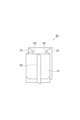
- FIG. 1 is a schematic cross-sectional view showing a laminate according to an embodiment of the present disclosure.
- FIG. 1 is a perspective view showing a packaging bag according to an embodiment of the present disclosure.
- the laminate according to the present embodiment is a laminate comprising a base paper and a gas barrier resin layer disposed on the base paper so as to be in direct contact with the base paper, wherein the binder resin constituting the gas barrier resin layer comprises at least one selected from the group consisting of polyolefin resins and polyvinyl alcohol-based resins, the gas barrier resin layer comprises an inorganic pigment in a first region extending from the surface on the base paper side to a thickness of 50% of the total thickness of the gas barrier resin layer, and 80% by volume or more of the total amount of the inorganic pigment contained in the gas barrier resin layer is present in the first region.
- the laminate according to the present embodiment may comprise an inorganic vapor deposition layer on the surface of the gas barrier resin layer opposite the base paper, and may further comprise an overcoat layer on the surface of the inorganic vapor deposition layer opposite the gas barrier resin layer.
- the laminate has a gas barrier resin layer directly on the base paper without a clay coat layer, and the binder resin constituting the gas barrier resin layer contains the specific resin, which provides high flexibility and prevents cracks from occurring in the gas barrier resin layer when folded, and provides sufficient water vapor barrier properties not only initially but also after folding.
- the binder resin constituting the gas barrier resin layer contains the specific resin, which provides high flexibility and prevents cracks from occurring in the gas barrier resin layer when folded, and provides sufficient water vapor barrier properties not only initially but also after folding.
- the inorganic pigment unevenly in the first region on the base paper side of the gas barrier resin layer, it is possible to prevent the binder resin from penetrating the base paper excessively, and the inorganic pigment can act as a sealer that fills in the unevenness of the paper, making it possible to form a smooth gas barrier resin layer with few defects and unevenness. This provides stable water vapor barrier properties.
- a uniform inorganic vapor deposition layer can be formed, making it possible to further improve water vapor barrier properties.
- FIG. 1 is a schematic cross-sectional view showing a laminate according to one embodiment.
- the laminate 10 according to one embodiment comprises, in this order, a base paper 1, a gas barrier resin layer 2, an inorganic vapor deposition layer 3, and an overcoat layer 4. Each layer will be described below.
- the base paper is a paper without a coating layer such as a clay coating layer.
- the base paper may be a paper whose main component is plant-derived pulp. Specific examples of the base paper include wood-free paper, special wood-free paper, imitation paper, kraft paper, and glassine paper.
- the basis weight of the base paper may be 20 to 500 g/m 2 , or 30 to 100 g/m 2.
- the thickness of the base paper may be 20 to 100 ⁇ m, 30 to 80 ⁇ m, or 40 to 60 ⁇ m.
- the laminate can obtain better water vapor barrier properties not only initially but also after being folded.
- the mass of the base paper is preferably 50% by mass or more, more preferably 70% by mass or more, and even more preferably 80% by mass or more, based on the mass of the entire laminate. If the mass of the base paper is 50% by mass or more, the amount of plastic material used can be sufficiently reduced, the entire laminate can be said to be made of paper, and it has excellent recyclability.
- the gas barrier resin layer is provided on the surface of the base paper so as to be in direct contact with the base paper.
- the gas barrier resin layer is provided to improve the gas barrier properties of the laminate.
- the gas barrier resin layer also plays a role in improving the adhesion between the base paper and the inorganic vapor deposition layer described below.
- the binder resin constituting the gas barrier resin layer contains at least one selected from the group consisting of polyolefin resins and polyvinyl alcohol-based resins.
- the gas barrier resin layer can obtain good water vapor barrier properties, and also obtain high flexibility, suppressing the occurrence of cracks in the gas barrier resin layer when folded, and can have sufficient water vapor barrier properties not only initially but also after folding.
- a polyvinyl alcohol-based resin is used as the binder resin, good oxygen barrier properties can also be obtained both initially and after folding.
- polyolefin resins examples include low density polyethylene, medium density polyethylene, high density polyethylene, ethylene-alpha olefin copolymer, homopolypropylene, block polypropylene, random polypropylene, and propylene-alpha olefin copolymer.
- the polyolefin resin may be a polyolefin resin having a polar group.
- a polyolefin resin having a polar group is used, the presence of the polar group can further improve the adhesion between the gas barrier resin layer and the inorganic vapor deposition layer.
- the polyolefin having a polar group may have at least one selected from a carboxyl group, a salt of a carboxyl group, a carboxylic anhydride group, and a carboxylic acid ester.
- Polyolefins having polar groups may be copolymerized with ethylene or propylene and unsaturated carboxylic acids (unsaturated compounds having carboxyl groups such as acrylic acid, methacrylic acid, and maleic anhydride), unsaturated carboxylic acid esters, and salts of carboxylic acids neutralized with basic compounds.
- unsaturated carboxylic acids unsaturated compounds having carboxyl groups such as acrylic acid, methacrylic acid, and maleic anhydride
- unsaturated carboxylic acid esters unsaturated carboxylic acid esters
- salts of carboxylic acids neutralized with basic compounds may also be used.
- copolymers with vinyl acetate, epoxy compounds, chlorine compounds, urethane compounds, polyamide compounds, etc. may also be used.
- polyolefins having polar groups include copolymers of acrylic esters and maleic anhydride, ethylene-vinyl acetate copolymers, and ethylene-glycidyl methacrylate copolymers.
- Polyvinyl alcohol resins are resins that contain vinyl alcohol as a constituent unit. Any polyvinyl alcohol resin may be used as long as it has vinyl alcohol units formed by saponifying vinyl ester units, and examples of such resins include polyvinyl alcohol resin (PVA) and ethylene-vinyl alcohol copolymer (EVOH).
- PVA polyvinyl alcohol resin
- EVOH ethylene-vinyl alcohol copolymer
- the polyvinyl alcohol-based resin When the gas barrier resin layer contains a polyvinyl alcohol-based resin, the polyvinyl alcohol-based resin has a polar group (hydroxyl group), which easily bonds with the inorganic vapor deposition layer, improving the adhesion between the gas barrier resin layer and the inorganic vapor deposition layer.
- a gas barrier resin layer containing a polyvinyl alcohol-based resin has excellent flexibility, can suppress the occurrence of cracks in the gas barrier resin layer when folded, and can have sufficient water vapor barrier properties not only initially but also after folding.
- the oxygen barrier properties of the laminate can be improved.
- PVA examples include resins obtained by polymerizing vinyl esters such as vinyl acetate, vinyl formate, vinyl propionate, vinyl valerate, vinyl caprate, vinyl laurate, vinyl stearate, vinyl pivalate, and vinyl versatate alone and then saponifying them.
- the PVA may be a modified PVA that has been copolymerized or post-modified. Modified PVA can be obtained, for example, by copolymerizing a vinyl ester with an unsaturated monomer that is copolymerizable with the vinyl ester and then saponifying the resulting polymer.
- unsaturated monomers copolymerizable with vinyl esters include olefins such as ethylene, propylene, isobutylene, ⁇ -octene, ⁇ -dodecene, and ⁇ -octadecene; hydroxyl group-containing ⁇ -olefins such as 3-buten-1-ol, 4-pentyn-1-ol, and 5-hexen-1-ol; unsaturated acids such as acrylic acid, methacrylic acid, crotonic acid, maleic acid, maleic anhydride, itaconic acid, and undecylenic acid; nitriles such as acrylonitrile and methacrylonitrile; diacetone acrylamide, acrylic Amides such as amide and methacrylamide; olefin sulfonic acids such as ethylene sulfonic acid, allyl sulfonic acid, and methallyl sulfonic acid; vinyl compounds such as alkyl vinyl ether, di
- the degree of polymerization of PVA may be 300 to 3000. If the degree of polymerization is 300 or more, the barrier properties are likely to be improved, and if it is 3000 or less, it is easy to suppress the decrease in coating suitability due to an increase in viscosity. From the viewpoint of barrier properties, the saponification degree of PVA may be 50 mol% or more, 80 mol% or more, 90 mol% or more, 95 mol% or more, or 99 mol% or more. In addition, the saponification degree of PVA may be 100 mol% or less, or 99.9 mol% or less. The polymerization degree and saponification degree of PVA can be measured in accordance with the method described in JIS K 6726 (1994).
- EVOH is generally obtained by saponifying copolymers of ethylene and vinyl acid esters such as vinyl acetate, vinyl formate, vinyl propionate, vinyl valerate, vinyl caprate, vinyl laurate, vinyl stearate, vinyl pivalate, and vinyl versatate.
- the degree of polymerization of EVOH is preferably 300 to 3000. If the degree of polymerization is less than 300, the barrier property is likely to decrease, and if it exceeds 3000, the viscosity is too high and the coating suitability is likely to decrease.
- the saponification degree of the vinyl ester component of EVOH may be 50 mol% or more, 80 mol% or more, 90 mol% or more, 95 mol% or more, or 99 mol% or more.
- the saponification degree of EVOH may be 100 mol% or less.
- the saponification degree of EVOH is determined by performing nuclear magnetic resonance ( 1 H-NMR) measurement and measuring the peak area of hydrogen atoms contained in the vinyl ester structure and the peak area of hydrogen atoms contained in the vinyl alcohol structure.
- the ethylene unit content of EVOH may be 10 mol% or more, 15 mol% or more, 20 mol% or more, or 25 mol% or more.
- the ethylene unit content of EVOH may be 65 mol% or less, 55 mol% or less, or 50 mol% or less.
- the gas barrier properties or dimensional stability can be maintained well under high humidity.
- the gas barrier properties can be improved.
- the ethylene unit content of EVOH can be determined by the NMR method.
- the binder resin constituting the gas barrier resin layer may contain other resins in addition to polyolefin resins and polyvinyl alcohol resins.
- other resins include polyacrylic resins, polyester resins, polyurethane resins, polycarbonate resins, polyurea resins, polyamide resins, polyimide resins, melamine resins, and phenolic resins.
- the resin composition constituting the binder resin may be the same throughout the entire gas barrier resin layer. This provides high flexibility throughout the entire gas barrier resin layer, and also prevents cracks from occurring within the gas barrier resin layer due to differences in resin composition, making it possible to more fully suppress the deterioration of water vapor barrier properties after bending.
- the total content of the polyolefin resin and the polyvinyl alcohol-based resin based on the total amount of the binder resin may be 50% by mass or more, 70% by mass or more, 90% by mass or more, or 100% by mass.
- the gas barrier resin layer can have high water vapor barrier properties and high flexibility, and can have excellent water vapor barrier properties both initially and after bending.
- the gas barrier resin layer contains an inorganic pigment.
- the inorganic pigment 5 is contained in a first region A1 that extends from the surface of the gas barrier resin layer 2 on the base paper 1 side to a thickness (D/2) that is 50% of the total thickness D of the gas barrier resin layer. Moreover, 80% by volume or more of the total amount of the inorganic pigment 5 in the gas barrier resin layer 2 is present in the first region A1.
- an inorganic pigment in the gas barrier resin layer so as to satisfy the above conditions, it is possible to prevent the binder resin from penetrating excessively into the base paper, and the inorganic pigment can act as a sealant that fills in the unevenness of the paper, making it possible to form a smooth gas barrier resin layer with few defects and unevenness. This results in stable water vapor barrier properties. Furthermore, when an inorganic vapor deposition layer is formed on a smooth gas barrier resin layer, a uniform inorganic vapor deposition layer can be formed, making it possible to further improve water vapor barrier properties.
- Inorganic pigments include clay, kaolin, calcium carbonate, talc, mica, etc. These may be used alone or in combination of two or more types.
- the average particle size of the inorganic pigment may be 0.1 to 10 ⁇ m, or 0.1 to 5 ⁇ m, from the viewpoints of suitability for coating, of more adequately suppressing the occurrence of cracks in the gas barrier resin layer originating from the inorganic pigment when folded, and of more smoothly forming the surface of the gas barrier resin layer.
- the average particle size is the volume-based median size (d50) measured by laser diffraction/scattering particle size distribution measurement.
- the aspect ratio of the inorganic pigment may be 1 to 200, or 5 to 200, from the viewpoints of suitability for coating, of more adequately suppressing the occurrence of cracks in the gas barrier resin layer originating from the inorganic pigment when folded, and of more smoothly forming the surface of the gas barrier resin layer.
- the aspect ratio can be measured by observation with an electron microscope, X-ray diffraction measurement, or the like.
- the content of the inorganic pigment in the gas barrier resin layer may be 50 parts by volume or less, 1 to 45 parts by volume, 3 to 40 parts by volume, or 5 to 35 parts by volume, relative to 100 parts by volume of the binder resin. If the content is 50 parts by volume or less, there is a tendency to more adequately prevent cracks from occurring in the gas barrier resin layer when folded, and if the content is 1 part by volume or more, there is a tendency to more adequately prevent the binder resin from penetrating excessively into the base paper, and the inorganic pigment can more adequately fulfill its role of filling in the unevenness of the paper, resulting in the formation of a smooth gas barrier resin layer with fewer defects and unevenness.
- the content of the inorganic pigment in the first region of the gas barrier resin layer may be 2 to 200 parts by volume, 5 to 150 parts by volume, or 10 to 125 parts by volume, relative to 100 parts by volume of the binder resin in the first region. If the content is 200 parts by volume or less, there is a tendency to more adequately prevent cracks from occurring in the gas barrier resin layer when folded, and if the content is 2 parts by volume or more, there is a tendency to more adequately prevent the binder resin from penetrating excessively into the base paper, and the inorganic pigment can more adequately fulfill its role of filling in the unevenness of the paper, resulting in the formation of a smooth gas barrier resin layer with fewer defects and unevenness.
- the gas barrier resin layer 80 volume % or more of the total amount of inorganic pigment is present in the first region, but 90 volume % or more of the total amount of inorganic pigment may be present in the first region, 95 volume % or more may be present in the first region, 99 volume % or more may be present in the first region, or 100 volume % may be present in the first region.
- the region other than the first region i.e., the region on the inorganic deposition layer side of the gas barrier resin layer
- whether or not 80% by volume or more of the total amount of inorganic pigment in the gas barrier resin layer is present in the first region can be determined, for example, by observing the cross section of the gas barrier resin layer with an electron microscope, or from the method for forming the gas barrier resin layer and the composition of the coating liquid used.
- the thickness of the region where the inorganic pigment is present may be 0.1 to 50%, 1 to 40%, or 10 to 40% of the total thickness of the gas barrier resin layer. If the thickness ratio is equal to or greater than the lower limit, the sealing effect tends to be enhanced.
- the thickness of the gas barrier resin layer may be, for example, 1 to 20 ⁇ m, 2 to 10 ⁇ m, 3 to 8 ⁇ m, 3 to 5 ⁇ m, or 3 to 4 ⁇ m. If the thickness of the gas barrier resin layer is 1 ⁇ m or more, the unevenness of the base paper surface can be filled more efficiently, allowing the inorganic vapor deposition layer described below to be laminated more smoothly and uniformly, resulting in better barrier properties. Furthermore, if the thickness of the gas barrier resin layer is 20 ⁇ m or less, it is suitable for coating and the resin ratio can be reduced, making it suitable from the perspective of recycling.
- the gas barrier resin layer may contain components other than the binder resin and inorganic pigment described above. Examples of other components include silane coupling agents and organic titanates.
- a method for providing a gas barrier resin layer includes coating a coating liquid containing a binder resin and an inorganic pigment on a base paper, and then coating a coating liquid containing a binder resin but not an inorganic pigment.
- a coating liquid containing a binder resin and an inorganic pigment By coating two types of coating liquids, one with an inorganic pigment and the other with an inorganic pigment, it is possible to form a state in which the base paper side of the gas barrier resin layer contains an inorganic pigment, and the inorganic vapor deposition layer side does not contain an inorganic pigment.
- the gas barrier resin layer may have a two-layer structure consisting of a layer containing an inorganic pigment and a layer not containing an inorganic pigment.
- Solvents used in the coating liquid include, for example, water, methyl alcohol, ethyl alcohol, isopropyl alcohol, n-propyl alcohol, n-butyl alcohol, n-pentyl alcohol, dimethyl sulfoxide, dimethylformamide, dimethylacetamide, toluene, hexane, heptane, cyclohexane, acetone, methyl ethyl ketone, diethyl ether, dioxane, tetrahydrofuran, ethyl acetate, and butyl acetate. These solvents may be used alone or in combination of two or more.
- methyl alcohol, ethyl alcohol, isopropyl alcohol, toluene, ethyl acetate, methyl ethyl ketone, and water are preferred.
- methyl alcohol, ethyl alcohol, isopropyl alcohol, and water are preferred.
- the coating method is not particularly limited, but examples include direct gravure coating, reverse coating, air knife coating, blade coating, etc.
- a smoothing treatment such as calendaring may be performed to smooth the surface of the gas barrier resin layer.
- the surface roughness Ra of the gas barrier resin layer on the side opposite the base paper (the inorganic vapor deposition layer side) may be 1.0 ⁇ m or less. By having a surface roughness Ra of 1.0 ⁇ m or less, the inorganic vapor deposition layer can be formed more uniformly on the gas barrier resin layer, and better water vapor barrier properties can be obtained both initially and after bending.
- the surface roughness Ra of the gas barrier resin layer can be measured with a surface roughness measuring device.
- Inorganic vapor deposition layer 3 Examples of materials constituting the inorganic vapor deposition layer include metals such as aluminum, and inorganic oxides such as aluminum oxide, silicon oxide, magnesium oxide, and tin oxide. From the viewpoint of transparency and barrier properties, the inorganic oxide may be selected from the group consisting of aluminum oxide, silicon oxide, and magnesium oxide. Furthermore, from the viewpoint of excellent tensile stretchability during processing, the inorganic vapor deposition layer may be a layer using aluminum or silicon oxide. By using an inorganic vapor deposition layer, high barrier properties can be obtained with a very thin layer that does not affect the recyclability of the laminate.
- the thickness of the inorganic vapor deposition layer may be set appropriately depending on the intended use, but is preferably 10 to 300 nm, more preferably 20 to 100 nm, and even more preferably 30 to 100 nm.
- the thickness of the inorganic vapor deposition layer is preferably 10 to 300 nm, more preferably 20 to 100 nm, and even more preferably 30 to 100 nm.
- the inorganic vapor deposition layer is preferably formed by vacuum deposition from the viewpoint of water vapor barrier properties and film uniformity.
- vacuum deposition There are known deposition methods such as vacuum deposition, sputtering, and chemical vapor deposition (CVD), but vacuum deposition is preferred due to its fast deposition speed and high productivity.
- vacuum deposition methods deposition by electron beam heating is particularly effective because the deposition speed can be easily controlled by the irradiation area and electron beam current, and the deposition material can be heated and cooled in a short time.
- the overcoat layer is provided on the surface of the inorganic vapor deposition layer so as to be in contact with the inorganic vapor deposition layer.
- the overcoat layer may include a polyolefin having a polar group.
- the polyolefin having a polar group may have at least one selected from a carboxyl group, a salt of a carboxyl group, a carboxylic anhydride group, and a carboxylic acid ester.
- Polyolefins having polar groups may be copolymerized with ethylene or propylene and unsaturated carboxylic acids (unsaturated compounds having carboxyl groups such as acrylic acid and methacrylic acid), unsaturated carboxylic acid esters, or salts of carboxylic acids neutralized with basic compounds.
- unsaturated carboxylic acids unsaturated compounds having carboxyl groups such as acrylic acid and methacrylic acid
- unsaturated carboxylic acid esters unsaturated carboxylic acid esters
- salts of carboxylic acids neutralized with basic compounds may also be used.
- copolymers with vinyl acetate, epoxy compounds, chlorine compounds, urethane compounds, polyamide compounds, etc. may also be used.
- polyolefins having polar groups include copolymers of acrylic esters and maleic anhydride, ethylene-vinyl acetate copolymers, and ethylene-glycidyl methacrylate copolymers.
- the overcoat layer has excellent flexibility, can suppress cracking of the inorganic vapor deposition layer after bending (folding), and has excellent adhesion to the inorganic vapor deposition layer. Furthermore, by including a polyolefin having the above-mentioned polar group, a dense film can be formed due to the crystallinity of the polyolefin, and water vapor barrier properties are exhibited. Furthermore, by including a polar group, the overcoat layer can also function as a heat seal layer, so there is no need to provide a separate heat seal layer.
- the overcoat layer may contain other components in addition to the polyolefin having the polar group.
- examples of other components include silane coupling agents, organic titanates, polyacrylics, polyesters, polyurethanes, polycarbonates, polyureas, polyamides, polyolefin emulsions, polyimides, melamines, and phenols.
- the content of the polyolefin having a polar group in the overcoat layer may be, for example, 50% by mass or more, 70% by mass or more, 90% by mass or more, or 100% by mass.
- the thickness of the overcoat layer may be, for example, 0.05 ⁇ m or more, 0.5 ⁇ m or more, 1 ⁇ m or more, 2 ⁇ m or more, 20 ⁇ m or less, 10 ⁇ m or less, or 5 ⁇ m or less. If the thickness of the overcoat layer is 0.05 ⁇ m or more, it can fully fulfill the role of the heat seal layer described above. Furthermore, if the thickness of the overcoat layer is 20 ⁇ m or less, it can fully exert adhesion and barrier properties with the inorganic vapor deposition layer while suppressing costs. Furthermore, by setting the thickness of the overcoat layer to 2 ⁇ m or more and 10 ⁇ m or less, the inorganic vapor deposition layer becomes less likely to crack, and sufficient water vapor barrier properties can be obtained even after bending.
- the thickness of the overcoat layer is 2 ⁇ m or more and 10 ⁇ m or less, and the thickness of the inorganic vapor deposition layer is 20 nm or more and 100 nm or less, the inorganic vapor deposition layer is less likely to crack, and the effect of being able to obtain sufficient water vapor barrier properties even after bending is particularly remarkable.
- Solvents contained in the coating liquid for the overcoat layer include, for example, water, methyl alcohol, ethyl alcohol, isopropyl alcohol, n-propyl alcohol, n-butyl alcohol, n-pentyl alcohol, dimethyl sulfoxide, dimethylformamide, dimethylacetamide, toluene, hexane, heptane, cyclohexane, acetone, methyl ethyl ketone, diethyl ether, dioxane, tetrahydrofuran, ethyl acetate, and butyl acetate. These solvents may be used alone or in combination of two or more.
- methyl alcohol, ethyl alcohol, isopropyl alcohol, toluene, ethyl acetate, methyl ethyl ketone, and water are preferred.
- methyl alcohol, ethyl alcohol, isopropyl alcohol, and water are preferred.
- the overcoat layer can be formed by applying a coating liquid containing the above-mentioned polyolefin having a polar group and a solvent on the inorganic vapor deposition layer and drying it.
- the melting point of the polyolefin having a polar group in the coating liquid is preferably 70 to 160°C, more preferably 80 to 120°C. If the melting point of the polyolefin having a polar group is low, there is an advantage in that the start-up temperature during heat sealing can be lowered. If the melting point of the polyolefin having a polar group is high, there is an increased risk of blocking in a high-temperature environment. From the viewpoint of preventing blocking, it is preferable that the particle size is large so that the contact area is small. Although not particularly limited, the particle size may be specifically 1 nm or more, 0.1 ⁇ m or more, 1 ⁇ m or less, 0.7 ⁇ m or less, or 0.5 ⁇ m or less.
- the thickness of the laminate including the above layers may be 20 to 150 ⁇ m, 30 to 100 ⁇ m, or 40 to 90 ⁇ m. If the thickness of the laminate is within the above range, the laminate can have better water vapor barrier properties not only initially but also after being folded.
- ⁇ Packaging bag> 2 is a perspective view showing a gusset bag 20 made of the laminate 10.
- a packaging bag is manufactured by sealing the opening at the top of the gusset bag 20.
- the gusset bag 20 has portions where the laminate 10 is folded (folded portions B1, B2).
- the folded portion B1 is a portion where the laminate 10 is folded in a valley direction as viewed from the innermost layer side
- the folded portion B2 is a portion where the laminate 10 is folded in a mountain direction as viewed from the innermost layer side.
- the packaging bag may be made by folding one laminate in half so that the overcoat layers face each other, then folding appropriately into the desired shape and heat sealing it to form a bag shape, or it may be made by stacking two laminates together so that the overcoat layers face each other, and then heat sealing it to form a bag shape.
- the heat seal strength may be 2N or more, or 4N or more.
- the upper limit of the heat seal strength is not particularly limited, but may be, for example, 10N or less.
- the packaging bag can contain food, medicine, and other contents. It is particularly suitable for containing food such as sweets.
- the packaging bag according to this embodiment can maintain high gas barrier properties even when it has a shape with folded sections.
- a gusset bag is given as an example of a packaging bag, but the laminate according to this embodiment may be used to produce, for example, a pillow bag, a three-sided sealed bag, or a standing pouch.
- a first coating liquid was prepared by adding and mixing 50 parts by volume of kaolin to 100 parts by volume (volume of solids) of a fully saponified polyvinyl alcohol resin having a degree of polymerization of 500 (solids concentration: 10% by mass, solvent: water).
- the first coating liquid was applied to a base paper of kraft paper having a basis weight of 50 g/ m2 by a bar coater so that the thickness after the calendaring process described below would be 1 ⁇ m, and then dried in an oven to form a first layer.
- the second coating liquid was applied to the first layer by a bar coater so that the thickness after the calendaring process described below would be 3 ⁇ m, and then dried in an oven to form a second layer. Thereafter, the first layer and the second layer were pressed and the surface of the second layer was smoothed by calendaring to obtain a gas barrier resin layer having a total thickness of 4 ⁇ m consisting of the first layer and the second layer.
- the content of the inorganic pigment in the entire gas barrier resin layer was 9.1 parts by volume relative to 100 parts by volume of the resin.
- the proportion of the inorganic pigment present in the first region out of the total amount of inorganic pigment in the gas barrier resin layer was 100% by volume.
- a first coating liquid was prepared by adding and mixing 200 parts by volume of kaolin to 100 parts by volume (volume of solids) of a fully saponified polyvinyl alcohol resin having a degree of polymerization of 500 (solids concentration: 10% by mass, solvent: water).
- the first coating liquid was applied to a base paper of kraft paper having a basis weight of 50 g/ m2 by a bar coater so that the thickness after the calendaring process described below would be 1.5 ⁇ m, and then dried in an oven to form a first layer.
- the second coating liquid was applied to the first layer by a bar coater so that the thickness after the calendaring process described below would be 2.5 ⁇ m, and then dried in an oven to form a second layer. Thereafter, the first layer and the second layer were pressed and the surface of the second layer was smoothed by calendaring to obtain a gas barrier resin layer having a total thickness of 4 ⁇ m consisting of the first layer and the second layer.
- the content of the inorganic pigment in the entire gas barrier resin layer was 33.3 parts by volume relative to 100 parts by volume of the resin.
- the proportion of the inorganic pigment present in the first region out of the total amount of the inorganic pigment in the gas barrier resin layer was 100% by volume.
- a laminate was produced in the same manner as in Example 1, except that the above-mentioned first coating liquid and second coating liquid were used.
- a first coating liquid was prepared by adding and mixing 50 parts by volume of kaolin to 100 parts by volume (volume of solid content) of a polyvinyl alcohol resin (solid content concentration: 10 mass %, solvent: water) having a degree of polymerization of 500 and a degree of saponification of 85 mol %.
- a laminate was produced in the same manner as in Example 1, except that the above-mentioned first coating liquid and second coating liquid were used.
- a laminate was produced in the same manner as in Example 1, except that the above-mentioned first coating liquid and second coating liquid were used.
- a first coating liquid was prepared by adding and mixing 50 parts by volume of talc to 100 parts by volume (volume of solids) of a fully saponified polyvinyl alcohol resin having a degree of polymerization of 500 (solids concentration: 10% by mass, solvent: water).
- a laminate was produced in the same manner as in Example 1, except that the above-mentioned first coating liquid and second coating liquid were used.
- a first coating liquid was prepared by adding and mixing 200 parts by volume of kaolin to 100 parts by volume (volume of solids) of a fully saponified polyvinyl alcohol resin having a degree of polymerization of 500 (solids concentration: 10% by mass, solvent: water).
- the first coating liquid was applied to a base paper of kraft paper having a basis weight of 50 g/ m2 by a bar coater so that the thickness after the calendaring process described below would be 3 ⁇ m, and then dried in an oven to form a first layer.
- the second coating liquid was applied to the first layer by a bar coater so that the thickness after the calendaring process described below would be 1 ⁇ m, and then dried in an oven to form a second layer. Thereafter, the first layer and the second layer were pressed and the surface of the second layer was smoothed by calendaring to obtain a gas barrier resin layer having a total thickness of 4 ⁇ m consisting of the first layer and the second layer.
- the content of the inorganic pigment in the entire gas barrier resin layer was 100 parts by volume relative to 100 parts by volume of the resin. Moreover, the ratio of the inorganic pigment present in the first region to the total amount of the inorganic pigment in the gas barrier resin layer was 67% by volume.
- an aluminum deposition layer and an overcoat layer were formed on the gas barrier resin layer in the same manner as in Example 1 to obtain a laminate.
- a first coating liquid was prepared by adding and mixing 50 parts by volume of kaolin to 100 parts by volume (volume of solids) of a fully saponified polyvinyl alcohol resin having a degree of polymerization of 500 (solids concentration: 10% by mass, solvent: water).
- the first coating liquid was applied to a base paper of 50 g/ m2 basis weight kraft paper with a bar coater so that the thickness after drying was 4 ⁇ m, and then dried in an oven to form a gas barrier resin layer.
- the content of the inorganic pigment in the entire gas barrier resin layer was 50 parts by volume relative to 100 parts by volume of the resin.
- the proportion of the inorganic pigment present in the first region out of the total amount of inorganic pigment in the gas barrier resin layer was 50% by volume.
- an aluminum deposition layer and an overcoat layer were formed on the gas barrier resin layer in the same manner as in Example 1 to obtain a laminate.
- a laminate was produced in the same manner as in Example 1, except that the above-mentioned first coating liquid and second coating liquid were used.
- Oxygen Transmission Rate (OTR) Measurement The oxygen permeability (unit: cc/ m2 ⁇ day ⁇ atm) of the laminates obtained in the examples and comparative examples was measured by the Mocon method under the conditions of 30°C and 70% RH. The measurement was performed three times, and the average value was calculated. The results are shown in Tables 1 and 2.
- Reference Signs List 1 base paper, 2: gas barrier resin layer, 3: inorganic vapor deposition layer, 4: overcoat layer, 5: inorganic pigment, 10: laminate, 20: gusset bag, B1, B2: folded portion.
Landscapes
- Engineering & Computer Science (AREA)
- Mechanical Engineering (AREA)
- Chemical & Material Sciences (AREA)
- Chemical Kinetics & Catalysis (AREA)
- Laminated Bodies (AREA)
Priority Applications (3)
| Application Number | Priority Date | Filing Date | Title |
|---|---|---|---|
| JP2025510963A JPWO2024204251A1 (https=) | 2023-03-30 | 2024-03-26 | |
| EP24780359.6A EP4656380A4 (en) | 2023-03-30 | 2024-03-26 | LAMINATE AND PACKAGING BAG |
| US19/342,095 US20260021948A1 (en) | 2023-03-30 | 2025-09-26 | Laminate and packaging bag |
Applications Claiming Priority (2)
| Application Number | Priority Date | Filing Date | Title |
|---|---|---|---|
| JP2023055182 | 2023-03-30 | ||
| JP2023-055182 | 2023-03-30 |
Related Child Applications (1)
| Application Number | Title | Priority Date | Filing Date |
|---|---|---|---|
| US19/342,095 Continuation US20260021948A1 (en) | 2023-03-30 | 2025-09-26 | Laminate and packaging bag |
Publications (1)
| Publication Number | Publication Date |
|---|---|
| WO2024204251A1 true WO2024204251A1 (ja) | 2024-10-03 |
Family
ID=92905454
Family Applications (1)
| Application Number | Title | Priority Date | Filing Date |
|---|---|---|---|
| PCT/JP2024/012049 Ceased WO2024204251A1 (ja) | 2023-03-30 | 2024-03-26 | 積層体及び包装袋 |
Country Status (4)
| Country | Link |
|---|---|
| US (1) | US20260021948A1 (https=) |
| EP (1) | EP4656380A4 (https=) |
| JP (1) | JPWO2024204251A1 (https=) |
| WO (1) | WO2024204251A1 (https=) |
Citations (6)
| Publication number | Priority date | Publication date | Assignee | Title |
|---|---|---|---|---|
| JP2001253035A (ja) * | 2000-03-08 | 2001-09-18 | Kuraray Co Ltd | バリアー性を有する紙容器 |
| US20140251856A1 (en) * | 2011-10-31 | 2014-09-11 | Billerudkorsnas Skog & Industri Aktiebolage | Coating composition, a method for coating a substrate, a coated substrate, a packaging material and a liquid package |
| WO2018062466A1 (ja) * | 2016-09-30 | 2018-04-05 | 日本製紙株式会社 | 紙製バリア材料 |
| WO2022071399A1 (ja) * | 2020-09-30 | 2022-04-07 | 凸版印刷株式会社 | ガスバリア積層体及び包装袋 |
| JP2022128849A (ja) * | 2021-02-24 | 2022-09-05 | 凸版印刷株式会社 | ガスバリア性積層体およびそれを用いた包装体 |
| JP2022143096A (ja) * | 2021-03-17 | 2022-10-03 | 三菱製紙株式会社 | 紙製包装材料 |
Family Cites Families (2)
| Publication number | Priority date | Publication date | Assignee | Title |
|---|---|---|---|---|
| DE102020127373A1 (de) * | 2020-10-16 | 2022-04-21 | Koehler Innovation & Technology Gmbh | Beschichtetes Papier |
| JP6958755B1 (ja) | 2020-12-28 | 2021-11-02 | 王子ホールディングス株式会社 | 蒸着紙用原紙および蒸着紙 |
-
2024
- 2024-03-26 JP JP2025510963A patent/JPWO2024204251A1/ja active Pending
- 2024-03-26 EP EP24780359.6A patent/EP4656380A4/en active Pending
- 2024-03-26 WO PCT/JP2024/012049 patent/WO2024204251A1/ja not_active Ceased
-
2025
- 2025-09-26 US US19/342,095 patent/US20260021948A1/en active Pending
Patent Citations (6)
| Publication number | Priority date | Publication date | Assignee | Title |
|---|---|---|---|---|
| JP2001253035A (ja) * | 2000-03-08 | 2001-09-18 | Kuraray Co Ltd | バリアー性を有する紙容器 |
| US20140251856A1 (en) * | 2011-10-31 | 2014-09-11 | Billerudkorsnas Skog & Industri Aktiebolage | Coating composition, a method for coating a substrate, a coated substrate, a packaging material and a liquid package |
| WO2018062466A1 (ja) * | 2016-09-30 | 2018-04-05 | 日本製紙株式会社 | 紙製バリア材料 |
| WO2022071399A1 (ja) * | 2020-09-30 | 2022-04-07 | 凸版印刷株式会社 | ガスバリア積層体及び包装袋 |
| JP2022128849A (ja) * | 2021-02-24 | 2022-09-05 | 凸版印刷株式会社 | ガスバリア性積層体およびそれを用いた包装体 |
| JP2022143096A (ja) * | 2021-03-17 | 2022-10-03 | 三菱製紙株式会社 | 紙製包装材料 |
Non-Patent Citations (1)
| Title |
|---|
| See also references of EP4656380A1 * |
Also Published As
| Publication number | Publication date |
|---|---|
| EP4656380A1 (en) | 2025-12-03 |
| EP4656380A4 (en) | 2026-04-08 |
| JPWO2024204251A1 (https=) | 2024-10-03 |
| US20260021948A1 (en) | 2026-01-22 |
Similar Documents
| Publication | Publication Date | Title |
|---|---|---|
| JP7800426B2 (ja) | ガスバリア積層体及び包装袋 | |
| JP7800428B2 (ja) | ガスバリア積層体及び包装袋 | |
| SE532388C2 (sv) | Förpackningslaminat och -behållare med två separata gasbarriärskikt samt metod för deras framställning | |
| JP6944022B1 (ja) | ガスバリア積層体及び包装袋 | |
| JP2026020286A (ja) | ガスバリア積層体及び包装袋 | |
| WO2024022494A1 (zh) | 包装用阻隔层、包装用片状复合层及其包装容器 | |
| JP2023158017A (ja) | ガスバリア積層体及び包装袋 | |
| WO2023176432A1 (ja) | 水系内容物用包装材及び水系内容物用包装袋 | |
| WO2024204251A1 (ja) | 積層体及び包装袋 | |
| JP7563646B2 (ja) | 易開封性包装材及び包装袋 | |
| JP5845575B2 (ja) | 直線引き裂き性透明積層フィルム並びにこれを用いた積層体及び包装袋 | |
| JP7294555B2 (ja) | 易開封性包装材及び包装袋 | |
| JP2024096386A (ja) | チューブ容器 | |
| JP2023041634A (ja) | ガスバリア積層体及び包装袋 | |
| JP7631721B2 (ja) | ガスバリア積層体及び包装袋 | |
| JP2018183889A (ja) | 包装袋用包装材料 | |
| JP2022047775A (ja) | ラミネートチューブ容器 | |
| CN100591522C (zh) | 条状带(strip tape)的制造方法以及用于容器的条状带 | |
| JP7704320B2 (ja) | ガスバリア積層体、並びにこれを用いた包装材及び真空断熱材 | |
| JP7342934B2 (ja) | ガスバリア積層体及び包装袋 | |
| JP2004299173A (ja) | ガスバリア性積層フィルム | |
| JP2024031120A (ja) | ガスバリア積層体及び包装袋 | |
| JP7567333B2 (ja) | ガスバリア積層体及び包装袋 | |
| JP2024066802A (ja) | ヒートシール紙及び包装袋 | |
| JP2024027967A (ja) | ガスバリア積層体、包装袋及び包装製品 |
Legal Events
| Date | Code | Title | Description |
|---|---|---|---|
| 121 | Ep: the epo has been informed by wipo that ep was designated in this application |
Ref document number: 24780359 Country of ref document: EP Kind code of ref document: A1 |
|
| WWE | Wipo information: entry into national phase |
Ref document number: 2025510963 Country of ref document: JP |
|
| NENP | Non-entry into the national phase |
Ref country code: DE |
|
| WWP | Wipo information: published in national office |
Ref document number: 2024780359 Country of ref document: EP |