WO2024203512A1 - バインダー梱包物 - Google Patents
バインダー梱包物 Download PDFInfo
- Publication number
- WO2024203512A1 WO2024203512A1 PCT/JP2024/010451 JP2024010451W WO2024203512A1 WO 2024203512 A1 WO2024203512 A1 WO 2024203512A1 JP 2024010451 W JP2024010451 W JP 2024010451W WO 2024203512 A1 WO2024203512 A1 WO 2024203512A1
- Authority
- WO
- WIPO (PCT)
- Prior art keywords
- binder composition
- binder
- mass
- container
- particulate polymer
- Prior art date
- Legal status (The legal status is an assumption and is not a legal conclusion. Google has not performed a legal analysis and makes no representation as to the accuracy of the status listed.)
- Ceased
Links
Images

Classifications
-
- H—ELECTRICITY
- H01—ELECTRIC ELEMENTS
- H01M—PROCESSES OR MEANS, e.g. BATTERIES, FOR THE DIRECT CONVERSION OF CHEMICAL ENERGY INTO ELECTRICAL ENERGY
- H01M4/00—Electrodes
- H01M4/02—Electrodes composed of, or comprising, active material
- H01M4/62—Selection of inactive substances as ingredients for active masses, e.g. binders, fillers
- H01M4/621—Binders
- H01M4/622—Binders being polymers
-
- B—PERFORMING OPERATIONS; TRANSPORTING
- B65—CONVEYING; PACKING; STORING; HANDLING THIN OR FILAMENTARY MATERIAL
- B65D—CONTAINERS FOR STORAGE OR TRANSPORT OF ARTICLES OR MATERIALS, e.g. BAGS, BARRELS, BOTTLES, BOXES, CANS, CARTONS, CRATES, DRUMS, JARS, TANKS, HOPPERS, FORWARDING CONTAINERS; ACCESSORIES, CLOSURES, OR FITTINGS THEREFOR; PACKAGING ELEMENTS; PACKAGES
- B65D47/00—Closures with filling and discharging, or with discharging, devices
- B65D47/04—Closures with discharging devices other than pumps
- B65D47/06—Closures with discharging devices other than pumps with pouring spouts or tubes; with discharge nozzles or passages
-
- B—PERFORMING OPERATIONS; TRANSPORTING
- B65—CONVEYING; PACKING; STORING; HANDLING THIN OR FILAMENTARY MATERIAL
- B65D—CONTAINERS FOR STORAGE OR TRANSPORT OF ARTICLES OR MATERIALS, e.g. BAGS, BARRELS, BOTTLES, BOXES, CANS, CARTONS, CRATES, DRUMS, JARS, TANKS, HOPPERS, FORWARDING CONTAINERS; ACCESSORIES, CLOSURES, OR FITTINGS THEREFOR; PACKAGING ELEMENTS; PACKAGES
- B65D51/00—Closures not otherwise provided for
- B65D51/16—Closures not otherwise provided for with means for venting air or gas
- B65D51/1605—Closures not otherwise provided for with means for venting air or gas whereby the interior of the container is maintained in permanent gaseous communication with the exterior
-
- C—CHEMISTRY; METALLURGY
- C08—ORGANIC MACROMOLECULAR COMPOUNDS; THEIR PREPARATION OR CHEMICAL WORKING-UP; COMPOSITIONS BASED THEREON
- C08L—COMPOSITIONS OF MACROMOLECULAR COMPOUNDS
- C08L101/00—Compositions of unspecified macromolecular compounds
-
- H—ELECTRICITY
- H01—ELECTRIC ELEMENTS
- H01M—PROCESSES OR MEANS, e.g. BATTERIES, FOR THE DIRECT CONVERSION OF CHEMICAL ENERGY INTO ELECTRICAL ENERGY
- H01M4/00—Electrodes
- H01M4/02—Electrodes composed of, or comprising, active material
- H01M4/13—Electrodes for accumulators with non-aqueous electrolyte, e.g. for lithium-accumulators; Processes of manufacture thereof
- H01M4/139—Processes of manufacture
-
- H—ELECTRICITY
- H01—ELECTRIC ELEMENTS
- H01M—PROCESSES OR MEANS, e.g. BATTERIES, FOR THE DIRECT CONVERSION OF CHEMICAL ENERGY INTO ELECTRICAL ENERGY
- H01M4/00—Electrodes
- H01M4/02—Electrodes composed of, or comprising, active material
- H01M4/62—Selection of inactive substances as ingredients for active masses, e.g. binders, fillers
-
- H—ELECTRICITY
- H01—ELECTRIC ELEMENTS
- H01M—PROCESSES OR MEANS, e.g. BATTERIES, FOR THE DIRECT CONVERSION OF CHEMICAL ENERGY INTO ELECTRICAL ENERGY
- H01M50/00—Constructional details or processes of manufacture of the non-active parts of electrochemical cells other than fuel cells, e.g. hybrid cells
- H01M50/40—Separators; Membranes; Diaphragms; Spacing elements inside cells
- H01M50/403—Manufacturing processes of separators, membranes or diaphragms
-
- Y—GENERAL TAGGING OF NEW TECHNOLOGICAL DEVELOPMENTS; GENERAL TAGGING OF CROSS-SECTIONAL TECHNOLOGIES SPANNING OVER SEVERAL SECTIONS OF THE IPC; TECHNICAL SUBJECTS COVERED BY FORMER USPC CROSS-REFERENCE ART COLLECTIONS [XRACs] AND DIGESTS
- Y02—TECHNOLOGIES OR APPLICATIONS FOR MITIGATION OR ADAPTATION AGAINST CLIMATE CHANGE
- Y02E—REDUCTION OF GREENHOUSE GAS [GHG] EMISSIONS, RELATED TO ENERGY GENERATION, TRANSMISSION OR DISTRIBUTION
- Y02E60/00—Enabling technologies; Technologies with a potential or indirect contribution to GHG emissions mitigation
- Y02E60/10—Energy storage using batteries
Definitions
- the present invention relates to a package for a binder for secondary batteries, and more specifically, to a package in which a binder for secondary batteries is packaged in a state suitable for storage and use.
- Binders are used as materials for manufacturing batteries such as lithium-ion secondary batteries. Binders can be used in the electrodes (positive or negative electrodes) of batteries as materials for bonding active material particles that make up the electrodes, and as materials for bonding layered structures such as electrodes and separators together.
- the binder is often prepared as a binder composition in a liquid state such as a slurry, which contains a fine particulate polymer that functions as a binder and a dispersing medium.
- the prepared binder composition may be used immediately after preparation, but in many cases it is packaged in a container and stored until it is to be used.
- JP 2011-098736 A International Publication No. 2022/071523 (Corresponding Publication: U.S. Patent Application Publication No. 2023/331976) International Publication No. 2015/029835
- preparing and storing a binder composition for secondary batteries before using it to manufacture a battery can cause problems such as poor coating of the binder composition and reduced battery performance.
- the occurrence of such problems is thought to be due to deterioration of the quality of the binder composition during storage, but the packaging of the binder composition in conventional technology was not able to sufficiently suppress such deterioration of quality.
- the object of the present invention is therefore to provide a package for a binder composition that can prevent deterioration of the quality of the binder composition due to storage, that allows the binder composition to be easily removed when in use, and that can effectively prevent the occurrence of defects in the resulting battery.
- the present inventors have conducted various studies to solve the above problems.
- the present inventors have found that the deterioration of the quality of the binder composition is largely related to the inclusion of coarse particles from the environment when the binder composition is transferred from a container to a coating device, and the generation of aggregates due to evaporation of the dispersion medium and contact of the binder composition with the inner wall of the container while the binder composition is stored in the container.
- the present inventors further found that the generation of granular components such as coarse particles and aggregates due to these causes can be effectively suppressed by adopting a specific package for the binder composition, and have completed the present invention. That is, according to the present invention, the following is provided.
- a binder package comprising a container and a binder composition for a secondary battery contained in an internal space of the container,
- the container includes a storage portion, a liquid supply adapter, a liquid supply tube, and a stopper.
- the container has an opening at its top,
- the liquid supply adapter is provided in engagement with the opening of the storage portion,
- the liquid supply tube has a bottom end adjacent to the bottom of the internal space of the container and a top end engaged with the liquid supply adapter; the liquid supply adapter and the liquid supply tube form a liquid guide path that connects an opening at the bottom end of the liquid supply tube to a top side of the container;
- the plug is provided to detachably engage with the liquid supply adapter to seal the liquid guide path,
- the binder package wherein a contact angle ⁇ B between the binder composition and an inner wall surface of the container is 30° or more.
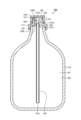
- FIG. 1 is a longitudinal sectional view that shows a schematic example of a binder package of the present invention and a container that is a component thereof.
- FIG. 2 is a partial vertical cross-sectional view that shows, in outline, an example of a state in which a liquid supply adaptor and a connector are connected in order to deliver the binder composition from the binder package of the present invention.
- the liquid delivery adapter 120 is provided by engaging with the opening 111 of the storage section 110.
- the liquid delivery adapter 120 and the storage section 110 are engaged with each other at a screw-in section 191 where a male screw near the opening 111 of the storage section 110 and a female screw in a corresponding portion of the liquid delivery adapter 120 engage with each other.
- the engagement of the members constituting the container may be a sealed engagement that can block the inflow and outflow of fluid at the engagement portion.
- the engagement between the storage portion 110 and the liquid delivery adapter 120, the engagement between the liquid delivery adapter 120 and the liquid delivery tube 130, the detachable engagement between the liquid delivery adapter 120 and the stopper body 140, and the engagement between the liquid delivery adapter 120 and the connector may be a sealed engagement that can block the inflow and outflow of fluid at the engagement portion.
- Engagements that are not limited to detachable engagements may be detachable engagements or non-detachable engagements.
- the engagement of multiple members may be a mechanical engagement such as screwing, or multiple members may be integrated by bonding, etc.
- the liquid delivery adapter 120 further has an air supply hole 129 in addition to the through hole 121.
- the air supply hole 129 is a hole that connects between the bottom opening 129L and the top opening 129H.
- the liquid delivery adapter 120 further has a connector engagement portion 123 including a recess 122 near the top side.
- the connector engagement portion 123 functions when engaging the liquid delivery adapter 120 with a connector (described below).
- the plug 140 is provided so as to be removably engaged with the liquid delivery adapter 120.
- the plug 140 and the liquid delivery adapter 120 are removably engaged by screwing together at a threaded portion 192 where a male thread near the top of the liquid delivery adapter 120 and a female thread at a corresponding portion of the plug 140 engage.
- the plug 140 seals the liquid guide path at its opening on the top side (top opening 121H of the liquid delivery adapter 120 in this example).
- the plug 140 also seals top opening 129H of the air supply hole 129.
- the container 100 in the example of FIG. 1 has such a structure, and thus the internal space 101 can be made an airtight space. Therefore, a liquid binder composition for secondary batteries can be stored inside the container 100, and the binder package of the present invention can be constituted.
- FIG. 2 is a partial vertical cross-sectional view showing an example of a state in which a liquid delivery adapter and a connector are connected to deliver the binder composition from the binder package of the present invention.
- FIG. 2 the state in which the connector 150 is connected to the liquid delivery adapter 120 after removing the plug 140 from the liquid delivery adapter 120 of the container 100 of the binder package is shown.
- the connector 150 has a shape in which its connection part 153 fits into the recess 122 of the connector engagement part 123 of the liquid delivery adapter 120, and therefore, by plugging the connector 150 to the liquid delivery adapter 120, the two can be easily connected.
- the container is provided with a liquid supply adapter that engages with the opening of the container, and further includes a liquid supply tube that engages with the liquid supply adapter, the bottom end of which is close to the bottom of the internal space of the container and the top end of which engages with the liquid supply adapter.
- a liquid supply adapter that engages with the liquid supply adapter, the bottom end of which is close to the bottom of the internal space of the container and the top end of which engages with the liquid supply adapter.
- the connector 150 has an opening 159L that is opened at a position corresponding to the top opening 129H of the air supply hole 129. This makes it possible to introduce gas into the container 100 from the opening 159L of the connector 150.
- the gas introduced into the container 100 from the opening 159L may be a gas with a low concentration of coarse particles derived from the environment.
- a gas obtained by filtering outside air with a filter, or a gas with a low concentration of coarse particles stored in a tank in advance may be used.
- Such a gas with a reduced concentration of coarse particles may be a gas that does not contain any coarse particles at all, or a gas in which the amount of coarse particles captured by a mesh filter with an opening of 5 ⁇ m is 3000 particles/m3 or less.
- the contact angle ⁇ B between the binder composition and the inner wall surface of the container is a large value equal to or greater than a specific value.
- a contact angle ⁇ B is 30° or more, and preferably 60° or more.
- the upper limit of the contact angle ⁇ B is not particularly limited, and may be less than 180°.
- the contact angle ⁇ B When the contact angle ⁇ B is small, the binder composition that has adhered to the inner wall surface of the container remains adhered for a long time, the dispersion medium is partially volatilized, and the concentration of the dispersion (such as fine particulate polymer) in the binder composition may be partially increased. In that case, aggregation of the dispersion in the binder composition easily occurs, resulting in the generation of aggregate particles.
- the binder composition interacts with the inner wall surface of the container at a position lower than the liquid level of the stored binder composition, which may destabilize the dispersion and cause aggregation of the dispersion.
- the contact angle ⁇ B has a specific high value, it is considered that such destabilization is suppressed and the generation of coarse molecules due to aggregation is suppressed.
- the binder composition is stored in contact with the inner wall surface 102 of the storage section 100, so the contact angle between the inner wall surface 102 of the storage section 100 and the binder composition is set to a large value equal to or greater than a specific value.
- a contact angle can be obtained by appropriately selecting a material for the storage section 100 that provides such a contact angle in relation to the binder composition.
- materials constituting the storage section 100 include materials such as high density polyethylene (HDPE), polyethylene, polypropylene, polyethylene terephthalate, polyamide, polyester, and polyvinyl alcohol.
- the contact angle ⁇ B can also be changed by appropriately adjusting the components and the ratios of the components in the binder composition.
- the contact angle ⁇ B can be adjusted by appropriately adjusting the ratios of components such as a dispersant contained in the binder composition.
- the contact angle ⁇ W between water and the inner wall surface of the container is preferably a large value equal to or greater than a specific value.
- a contact angle ⁇ W is preferably 80° or more, more preferably 100° or more.
- the upper limit of the contact angle ⁇ W is not particularly limited, and may be less than 180°.
- various so-called aqueous binder compositions i.e., binder compositions containing water as a dispersion medium
- the binder compositions packaged as components of the binder packages of the present invention are described below.
- the binder composition is used as a material for manufacturing a secondary battery such as a lithium ion secondary battery.
- the binder composition may contain a particulate polymer and a dispersion medium.
- a dispersion medium a medium containing water is preferable from the viewpoint of ease of handling and reduction of environmental load.
- the binder composition preferably contains a drying inhibitor.
- the binder composition may contain a particulate polymer, an anti-drying agent, and water, and may have a contact angle ⁇ W of 80° or more relative to the container.
- the binder composition can be a coating liquid for coating by the inkjet method.
- a coating liquid for inkjet printing problems such as nozzle clogging due to granular components such as coarse particles and aggregate particles contained in the coating liquid can be problematic.
- the binder composition stored in the binder package of the present invention is particularly preferred as it is possible to reduce such problems.
- the granular components in the binder composition may be defined as granular components having a sphere volume equivalent diameter of 5 ⁇ m or more.
- the concentration of such granular components in the binder composition may be measured by filtering the binder composition through a nylon mesh filter with a mesh size of 5 ⁇ m and weighing the collected matter on the filter.
- Such granular components include particles resulting from aggregation of the dispersion in the binder composition, and foreign matter mixed in from the external environment during handling of the binder composition.
- granular components having a sphere volume equivalent diameter of 5 ⁇ m or more may be simply referred to as “granular components”, and particulate polymers and the like contained as components of the binder composition are not included in the category of "granular components”.
- the particulate polymer can function in the electrode (positive electrode or negative electrode) of a battery as a material for bonding active material particles constituting the electrode and as a material for bonding layered structures such as the electrode, the separator, etc.
- the binder composition may contain only one type of particulate polymer, or may contain two or more types of particulate polymers.
- the content of the particulate polymer in the binder composition is preferably 1% by mass or more, more preferably 3% by mass or more, and is preferably 15% by mass or less, based on the total amount of the binder composition. If the content of the particulate polymer is equal to or higher than the lower limit, the adhesion between electrode members of a secondary battery can be improved, whereas if the content of the particulate polymer is equal to or lower than the upper limit, the inkjet ejection characteristics can be improved.
- the particulate polymer preferably contains a polymer having a glass transition temperature of 40° C. or higher. If the particulate polymer contains a polymer having a glass transition temperature of 40° C. or higher, the ink jet ejection characteristics can be improved. Furthermore, if the glass transition temperature of the particulate polymer is higher than a certain level, the generation of aggregates inside the container can be suppressed, and as a result, the above-mentioned effect obtained when the contact angle ⁇ B is within a specific range can be further enhanced. It is preferable that at least a part of the surface of the particulate polymer is composed of the above-mentioned polymer.
- the glass transition temperature of the polymer is preferably 50° C.
- the glass transition temperature of the polymer is equal to or higher, more preferably 80° C. or higher, and is preferably 200° C. or lower, more preferably 120° C. or lower.
- the glass transition temperature of the polymer is equal to or higher than the lower limit, the ink jet ejection characteristics can be further improved.
- the glass transition temperature of the polymer is equal to or lower than the upper limit, the particulate polymer becomes appropriately soft, so that an adhesive layer that more firmly bonds battery components together can be formed even when pressurized at room temperature.
- the glass transition temperature of the polymer can be adjusted, for example, by changing the types and ratios of monomers used in preparing the polymer.
- the volume average particle diameter of the particulate polymer is preferably 100 nm or more, more preferably 200 nm or more, even more preferably 400 nm or more, and even more preferably 500 nm or more, and is preferably 1500 nm or less, more preferably 900 nm or less, even more preferably 800 nm or less, and even more preferably 700 nm or less.
- the volume average particle diameter of the particulate polymer being within the above range, the aggregation of the particulate polymer can be effectively suppressed, and the performance of the secondary battery obtained by using the binder composition can be improved.
- the volume average particle diameter of the particulate polymer is equal to or greater than the above lower limit, the deterioration of the battery characteristics due to the increase in resistance of the secondary battery caused by the obstruction of the path of the electrode or separator can be suppressed.
- the volume average particle diameter of the particulate polymer is equal to or less than the above upper limit, clogging of the nozzle when the binder composition is applied by the inkjet method can be further suppressed, and the inkjet discharge characteristics can be improved.
- volume average particle size refers to a particle size at which the cumulative volume calculated from the small diameter side is 50% in a volume-based particle size distribution measured by a laser diffraction method, and can be measured using the measurement method described in the examples of the present specification.
- the particulate polymer may be a particle made of a single polymer, or may be a particle made of a composite of a plurality of polymers (a particle formed by physical or chemical bonding of two or more polymers).
- the particulate polymer is preferably a particle made of a composite of a plurality of polymers, and is more preferably a particle having a core-shell structure having a core part and a shell part covering at least a part of the outer surface of the core part; a particle having a side-by-side structure in which two or more polymers are arranged side by side; a particle having a structure in which a part of the central polymer is exposed to the outer shell part; a particle having a structure in which another type of polymer particle is embedded and integrated into the surface of a spherical polymer particle, and further preferably a particle having a core-shell structure.
- a particulate polymer having a core-shell structure By adopting a particulate polymer having a core-shell structure, it is possible to achieve both high adhesion performance and dispersion stability, which is particularly preferable.
- a particulate polymer having a core-shell structure will be described as an example.
- the particulate polymer having a core-shell structure has a core part and a shell part covering the outer surface of the core part.
- the shell portion may cover the entire outer surface of the core portion, or may cover only a portion of the outer surface of the core portion. Even if the outer surface of the core portion appears to be completely covered by the shell portion from the outside, if a hole that communicates between the inside and outside of the shell portion is formed, the shell portion is a shell portion that partially covers the outer surface of the core portion.
- the particulate polymer may have any component other than the core and shell portions described above, so long as the intended effect is not significantly impaired.
- the particulate polymer may have a portion inside the core portion that is formed of a polymer other than the core portion.
- the seed particles used when producing the particulate polymer by the seed polymerization method may remain inside the core portion.
- the particulate polymer has only the core portion and the shell portion.
- the glass transition temperature of the polymer of the core portion of the particulate polymer is preferably ⁇ 50° C. or higher, more preferably ⁇ 45° C. or higher, and is preferably 60° C. or lower, more preferably 35° C. or lower, even more preferably 0° C. or lower, and even more preferably ⁇ 15° C. or lower. If the glass transition temperature of the polymer of the core portion is equal to or higher than the lower limit, the ink jet ejection characteristics can be improved.
- the glass transition temperature of the polymer of the core portion is equal to or lower than the upper limit, the polymer of the core portion can exhibit good adhesiveness, and an adhesive layer that more firmly bonds the battery components together can be formed even when pressurized at room temperature. Also, if the glass transition temperature of the polymer of the core portion is equal to or lower than the upper limit, the falling off of the components contained in the adhesive layer (so-called powder falling) can be sufficiently suppressed.
- the glass transition temperature of the core polymer can be adjusted, for example, by changing the types and ratio of monomers used in preparing the core polymer.
- Examples of monomers used to prepare the core polymer include vinyl chloride monomers such as vinyl chloride and vinylidene chloride; vinyl acetate monomers such as vinyl acetate; aromatic vinyl monomers such as styrene, ⁇ -methylstyrene, styrenesulfonic acid, butoxystyrene, and vinylnaphthalene; vinylamine monomers such as vinylamine; vinylamide monomers such as N-vinylformamide and N-vinylacetamide; methyl acrylate, ethyl acrylate, butyl acrylate, 2-ethylhexyl acrylate, and methyl methacrylate.
- vinyl chloride monomers such as vinyl chloride and vinylidene chloride
- vinyl acetate monomers such as vinyl acetate
- aromatic vinyl monomers such as styrene, ⁇ -methylstyrene, styrenesulfonic acid, butoxystyrene, and vinylnaphthalene
- Examples of such monomers include fluorine-free (meth)acrylic acid ester monomers such as ethyl methacrylate, butyl methacrylate, and cyclohexyl methacrylate; (meth)acrylamide monomers such as acrylamide and methacrylamide; (meth)acrylonitrile monomers such as acrylonitrile and methacrylonitrile; fluorine-containing (meth)acrylic acid ester monomers such as 2-(perfluorohexyl)ethyl methacrylate and 2-(perfluorobutyl)ethyl acrylate; maleimide; and maleimide derivatives such as phenylmaleimide.
- fluorine-free (meth)acrylic acid ester monomers such as ethyl methacrylate, butyl methacrylate, and cyclohexyl methacrylate
- (meth)acrylamide monomers such as acrylamide and methacrylamide
- (meth)acrylic means acrylic and/or methacrylic
- (meth)acrylonitrile means acrylonitrile and/or methacrylonitrile.
- a (meth)acrylic acid ester monomer as the monomer used for preparing the core polymer, and it is more preferable to use a combination of a (meth)acrylic acid ester monomer and an aromatic vinyl monomer, or a combination of a (meth)acrylic acid ester monomer and a (meth)acrylonitrile monomer.
- the core polymer contains at least a (meth)acrylic acid ester monomer unit, and it is more preferable that the core polymer contains a (meth)acrylic acid ester monomer unit and an aromatic vinyl monomer unit or a (meth)acrylonitrile monomer unit.
- containing a monomer unit means that "a polymer obtained by using that monomer contains a repeating unit derived from the monomer”.
- (meth)acrylic acid ester monomer” refers to a monofunctional (meth)acrylic acid ester monomer having only one polymerization reactive group.
- the proportion of (meth)acrylic acid ester monomer units in the core polymer is preferably 5% by mass or more, more preferably 10% by mass or more, and particularly preferably 20% by mass or more, with the total repeating units (total monomer units) in the particulate polymer being 100% by mass, and is preferably 98% by mass or less, and more preferably 96% by mass or less.
- the ratio of (meth)acrylic acid ester monomer units in the core polymer is preferably 5% by mass or more, more preferably 10% by mass or more, particularly preferably 20% by mass or more, preferably 80% by mass or less, more preferably 75% by mass or less, and even more preferably 70% by mass or less, based on 100% by mass of all repeating units (total monomer units) in the particulate polymer
- the ratio of aromatic vinyl monomer units in the core polymer is preferably 15% by mass or more, more preferably 20% by mass or more, particularly preferably 25% by mass or more, preferably 90% by mass or less, more preferably 80% by mass or less, and even more preferably 70% by mass or less, based on 100% by mass of all repeating units (total monomer units) in the particulate polymer.
- the ratio of (meth)acrylic acid ester monomer units in the core polymer is preferably 70% by mass or more, more preferably 80% by mass or more, particularly preferably 85% by mass or more, preferably 98% by mass or less, and more preferably 96% by mass or less, with the total repeating units (total monomer units) in the particulate polymer being 100% by mass, and the ratio of (meth)acrylonitrile monomer units in the core polymer is preferably 1% by mass or more, more preferably 1.5% by mass or more, preferably 10% by mass or less, and more preferably 5% by mass or less, with the total repeating units (total monomer units) in the particulate polymer being 100% by mass.
- the core polymer may contain an acid group-containing monomer unit.
- the acid group-containing monomer include monomers having an acid group, such as monomers having a carboxylic acid group, monomers having a sulfonic acid group, and monomers having a phosphoric acid group.
- Examples of the monomer having a carboxylic acid group include monocarboxylic acid and dicarboxylic acid.
- Examples of the monocarboxylic acid include acrylic acid, methacrylic acid, crotonic acid, etc.
- Examples of the dicarboxylic acid include maleic acid, fumaric acid, itaconic acid, etc.
- Examples of monomers having a sulfonic acid group include vinyl sulfonic acid, methyl vinyl sulfonic acid, (meth)allyl sulfonic acid, (meth)acrylic acid-2-ethyl sulfonate, 2-acrylamido-2-methylpropanesulfonic acid, and 3-allyloxy-2-hydroxypropanesulfonic acid.
- examples of monomers having a phosphate group include 2-(meth)acryloyloxyethyl phosphate, methyl-2-(meth)acryloyloxyethyl phosphate, and ethyl-(meth)acryloyloxyethyl phosphate.
- (meth)allyl means allyl and/or methallyl
- (meth)acryloyl means acryloyl and/or methacryloyl.
- the acid group-containing monomer a monomer having a carboxylic acid group is preferred, among which a monocarboxylic acid is preferred, and (meth)acrylic acid is more preferred.
- the acid group-containing monomer may be used alone or in combination of two or more kinds in any ratio.
- the proportion of acid group-containing units in the core polymer is preferably 0.1% by mass or more, more preferably 1% by mass or more, and preferably 15% by mass or less, and more preferably 10% by mass or less, with the total repeating units (total monomer units) in the particulate polymer being 100% by mass.
- the core polymer preferably contains a crosslinkable monomer unit in addition to the above monomer units.
- a crosslinkable monomer is a monomer that can form a crosslinked structure during or after polymerization by heating or irradiation with energy rays.
- crosslinkable monomers include polyfunctional monomers having two or more polymerization reactive groups in the monomer.
- polyfunctional monomers include divinyl monomers such as divinylbenzene, 1,3-butadiene, isoprene, and allyl methacrylate; di(meth)acrylic acid ester monomers such as ethylene dimethacrylate, diethylene glycol dimethacrylate, ethylene glycol dimethacrylate, diethylene glycol diacrylate, and 1,3-butylene glycol diacrylate; tri(meth)acrylic acid ester monomers such as trimethylolpropane trimethacrylate and trimethylolpropane triacrylate; ethylenically unsaturated monomers containing epoxy groups such as allyl glycidyl ether and glycidyl methacrylate; ⁇ -methacryloxypropyltrimethoxysilane, N-methylol acrylamide, and the like.
- the proportion of crosslinkable monomer units in the core polymer is preferably 0.05% by mass or more, more preferably 0.1% by mass or more, preferably 10% by mass or less, more preferably 5% by mass or less, and particularly preferably 3% by mass or less, with the total repeating units (total monomer units) in the particulate polymer being 100% by mass.
- the glass transition temperature of the polymer of the shell portion of the particulate polymer is preferably 40° C. or higher, more preferably 50° C. or higher, and even more preferably 80° C. or higher, and is preferably 200° C. or lower, and more preferably 120° C. or lower.
- the glass transition temperature of the shell polymer is equal to or higher than the lower limit, the generation of aggregates can be suppressed and the ink jet discharge characteristics can be further improved.
- the glass transition temperature of the shell polymer is equal to or lower than the upper limit, the particulate polymer becomes appropriately soft, so that an adhesive layer that more firmly bonds battery components together can be formed even when pressurized at room temperature.
- the glass transition temperature of the shell polymer can be adjusted, for example, by changing the types and ratio of monomers used in preparing the shell polymer.
- the glass transition temperature of the polymer in the shell portion is preferably at least 25°C higher than the glass transition temperature of the polymer in the core portion described above, from the viewpoint of maintaining the shape of the particulate polymer after bonding the battery components together and suppressing an increase in resistance.
- Monomers used to prepare the shell polymer include, for example, the same monomers as those exemplified as monomers that can be used to produce the core polymer. Furthermore, such monomers may be used alone or in combination of two or more types in any ratio.
- the shell polymer contains at least one of a (meth)acrylic acid ester monomer unit, an aromatic vinyl monomer unit, a (meth)acrylonitrile monomer unit, and an acid group-containing monomer unit.
- the proportion of (meth)acrylic acid ester monomer units in the shell polymer is preferably 1% by mass or more, more preferably 1.5% by mass or more, and more preferably 10% by mass or less, and more preferably 6% by mass or less, with the total repeating units (total monomer units) in the particulate polymer being 100% by mass, from the viewpoint of bonding the battery components together more firmly via the adhesive layer.
- the proportion of aromatic vinyl monomer units in the polymer of the shell portion is preferably 2% by mass or more, more preferably 3% by mass or more, and preferably 10% by mass or less, and more preferably 5% by mass or less, with the total repeating units (total monomer units) in the particulate polymer being 100% by mass.
- the proportion of (meth)acrylonitrile monomer units in the shell polymer is preferably 0.1% by mass or more, more preferably 0.2% by mass or more, preferably 2% by mass or less, more preferably 1% by mass or less, and even more preferably 0.5% by mass or less, with the total repeating units (total monomer units) in the particulate polymer being 100% by mass.
- the proportion of the acid group-containing monomer in the shell polymer is preferably 0.01% by mass or more, more preferably 0.03% by mass or more, and preferably 1% by mass or less, more preferably 0.5% by mass or less, and even more preferably 0.2% by mass or less, with the total repeating units (total monomer units) in the particulate polymer being 100% by mass.
- the particulate polymer preferably has a shell portion having a mass ratio of 2 mass% or more to the total mass of the core portion and the shell portion, and more preferably has a mass ratio of 20 mass% or less, more preferably has a mass ratio of 15 mass% or less, further preferably has a mass ratio of 10 mass% or less, and particularly preferably has a mass ratio of 5 mass% or less.
- mass ratio of the shell portion is equal to or greater than the lower limit, the inkjet ejection characteristics can be further improved.
- the mass ratio of the shell portion is equal to or less than the upper limit, an adhesive layer that more firmly bonds battery components together can be formed even when pressurized at room temperature.
- the mass proportion of the shell portion in the total of the core portion and the shell portion is calculated from the ratio of the thickness of the core portion to the thickness of the shell portion and the specific gravity of the particulate polymer, which will be described later.
- the particulate polymer can be prepared, for example, by using the monomer of the core polymer and the monomer of the shell polymer, and polymerizing them stepwise while changing the ratio of the monomers over time.
- the particulate polymer can be prepared by a continuous multi-stage emulsion polymerization method and a multi-stage suspension polymerization method in which the polymer of the previous stage is successively coated with the polymer of the later stage.
- the binder composition of the present invention may contain other particulate polymers in addition to or instead of the particulate polymer having the core-shell structure described above.
- the binder composition of the present invention may contain other particulate polymers in addition to or instead of the particulate polymer having the core-shell structure described above.
- auxiliary particulate polymer such a non-core-shell particulate polymer used auxiliary in addition to the particulate polymer having the core-shell structure is referred to as "auxiliary particulate polymer" for convenience of distinction.
- the auxiliary particulate polymer may be a particle obtained by granulating only one type of polymer, or a particle obtained by granulating a mixture of multiple types of polymers.
- the glass transition temperature of the auxiliary particulate polymer is preferably 25° C. or lower, more preferably 10° C. or lower, and even more preferably 0° C. or lower. If the glass transition temperature of the polymer is 25° C. or lower, the components contained in the adhesive layer can be sufficiently prevented from falling off, and the adhesiveness between the battery components of the secondary battery can be improved.
- the example of the monomer used to prepare auxiliary particulate polymer can include the same monomer as the monomer exemplified as the monomer that can be used to manufacture the polymer of the core part of the above-mentioned particulate polymer.
- the monomer used to prepare the polymer as auxiliary particulate polymer can be (meth)acrylic acid ester monomer, (meth)acrylonitrile monomer, aromatic vinyl monomer unit, acid group-containing monomer, (meth)acrylamide monomer, and crosslinking monomer, etc.
- a (meth)acrylic acid ester monomer having a polar group such as 2-hydroxyethyl (meth)acrylate, 2-hydroxypropyl (meth)acrylate, etc.
- the above monomers may be used alone or in combination of two or more kinds in any ratio.
- the monomers used to prepare the polymer as the auxiliary particulate polymer may be a combination of (meth)acrylic acid ester monomers, (meth)acrylonitrile monomers, acid group-containing monomers, (meth)acrylamide monomers, and crosslinkable monomers, or may be a combination of aromatic vinyl monomers, acid group-containing monomers, (meth)acrylic acid ester monomers having a polar group, and crosslinkable monomers.
- the polymer as the auxiliary particulate polymer may contain (meth)acrylic acid ester monomer units, (meth)acrylonitrile monomer units, acid group-containing monomer units, (meth)acrylamide monomer units, and crosslinkable monomer units, or may contain aromatic vinyl monomer units, acid group-containing monomer units, (meth)acrylic acid ester monomer units having a polar group, and crosslinkable monomer units.
- the proportion of (meth)acrylic acid ester monomer units in the polymer as the auxiliary particulate polymer is not particularly limited, but may be, for example, 40% by mass or more, 50% by mass or more, or 60% by mass or more, for example, 90% by mass or less, or 85% by mass or less, assuming that the total repeating units (total monomer units) contained in the polymer is 100% by mass.
- the proportion of (meth)acrylonitrile monomer units in the polymer as the auxiliary particulate polymer is not particularly limited, but may be, for example, 1% by mass or more, or 5% by mass or more, or 10% by mass or more, for example, 20% by mass or less, or 15% by mass or less, assuming that all repeating units (total monomer units) contained in the polymer are 100% by mass.
- the proportion of the acid group-containing monomer units in the polymer as the auxiliary particulate polymer is not particularly limited, but may be, for example, 0.5% by mass or more, 1% by mass or more, or 2% by mass or more, for example, 10% by mass or less, 7% by mass or less, or 5% by mass or less, assuming that the total repeating units (total monomer units) contained in the polymer is 100% by mass.
- the proportion of (meth)acrylamide monomer units in the polymer as the auxiliary particulate polymer is not particularly limited, but may be, for example, 0.1% by mass or more, or 0.5% by mass or more, or 1% by mass or more, for example, 5% by mass or less, or 4% by mass or less, or 2% by mass or less, with the total repeating units (total monomer units) contained in the polymer being 100% by mass.
- the proportion of aromatic vinyl monomer units in the polymer as the auxiliary particulate polymer is not particularly limited, but may be, for example, 20% by mass or more, 40% by mass or more, or 55% by mass or more, for example, 80% by mass or less, 70% by mass or less, or 65% by mass or less, assuming that the total repeating units (total monomer units) contained in the polymer is 100% by mass.
- the (meth)acrylic acid ester monomer units having a polar group in the polymer as the auxiliary particulate polymer are not particularly limited, but may be, for example, 0.1% by mass or more and 0.5% by mass or less, for example, 3% by mass or less and 1.5% by mass or less, where the total repeating units (total monomer units) contained in the polymer is taken as 100% by mass.
- the proportion of crosslinkable monomer units in the polymer as the auxiliary particulate polymer is not particularly limited, but may be, for example, 1% by mass or more, or 2% by mass or more, or 3% by mass or more, for example, 50% by mass or less, or 40% by mass or less, or 35% by mass or less, assuming that the total repeating units (total monomer units) contained in the polymer is 100% by mass.
- the proportion of the crosslinkable monomer unit in the polymer is not particularly limited, but may be, for example, 1 mass% or more, or may be 2 mass% or more, or may be 3 mass% or more, for example, 6 mass% or less, or may be 5 mass% or less, or may be 4 mass% or less, assuming that all repeating units (total monomer units) contained in the polymer are 100 mass%.
- the proportion of the crosslinkable monomer unit in the polymer is not particularly limited, but may be, for example, 10% by mass or more, or may be 20% by mass or more, or may be 30% by mass or more, for example, 50% by mass or less, or may be 40% by mass or less, or may be 35% by mass or less, assuming that all repeating units (total monomer units) contained in the polymer are 100% by mass.
- the volume average particle diameter of the auxiliary particulate polymer is preferably 50 nm or more, more preferably 100 nm or more, even more preferably 200 nm or more, and preferably 600 nm or less, more preferably 500 nm or less, and even more preferably 400 nm or less. If the volume average particle diameter of the auxiliary particulate polymer is within the above specified range, the battery components can be bonded together more firmly via the adhesive material.
- the amount of the auxiliary particulate polymer is not particularly limited, and is preferably 1 part by mass or more, more preferably 5 parts by mass or more, and preferably 20 parts by mass or less, and more preferably 15 parts by mass or less, per 100 parts by mass of the particulate polymer having a core-shell structure. If the amount of the auxiliary particulate polymer is within the above range, the components contained in the adhesive layer can be sufficiently prevented from falling off, while the cycle characteristics of the secondary battery can be improved.
- the amount of the auxiliary particulate polymer in the binder composition is not particularly limited, but from the viewpoint of suppressing the occurrence of aggregation, it is preferable that the amount is relatively small. Specifically, the amount of the auxiliary particulate polymer in 100% by mass of the binder composition is preferably 5% by mass or less. When the binder composition contains the auxiliary particulate polymer, the lower limit of the amount of the auxiliary particulate polymer may be, for example, 0.2% by mass or more.
- the binder composition may not contain an auxiliary particulate polymer. If the binder composition does not contain an auxiliary particulate polymer, the generation of aggregates is effectively suppressed. In addition, the increase in internal resistance of the obtained secondary battery is suppressed, and the cycle characteristics can be further improved.
- the polymer as the auxiliary particulate polymer is not particularly limited, and can be prepared, for example, by polymerizing a monomer composition containing the above-mentioned monomers in an aqueous solvent such as water.
- the ratio of each monomer in the monomer composition is usually the same as the ratio of each monomer unit in the polymer.
- the polymerization method and polymerization reaction are not particularly limited, and known polymerization methods and polymerization reactions can be used.
- the binder composition preferably contains water as a dispersion medium, and may further contain a dispersion medium other than water.
- the dispersion medium other than water include organic solvents such as cyclic aliphatic hydrocarbons such as cyclopentane and cyclohexane, aromatic hydrocarbons such as toluene and xylene, ketones such as ethyl methyl ketone and cyclohexanone, esters such as ethyl acetate, butyl acetate, ⁇ -butyrolactone and ⁇ -caprolactone, nitriles such as acetonitrile and propionitrile, ethers such as tetrahydrofuran, and alcohols such as methanol, ethanol and isopropanol.
- organic solvents such as cyclic aliphatic hydrocarbons such as cyclopentane and cyclohexane, aromatic hydrocarbons such as toluene and xylene, keto
- Anti-drying agent By including a drying inhibitor in the binder composition, drying of the binder composition during storage of the binder composition in the binder package can be suppressed, and the generation of aggregate particles can be further suppressed.
- a low molecular weight polyhydric alcohol compound can be used as the drying inhibitor.
- a low molecular weight polyhydric alcohol compound is a compound that has a molecular weight of less than 150 and has two or more hydroxyl groups (-OH) in one molecule.
- a low molecular weight polyhydric alcohol compound in addition to the effect of suppressing drying of the binder composition during storage, the ejection characteristics can be improved when the binder composition is ejected from an inkjet head.
- examples of low molecular weight polyhydric alcohol compounds include propylene glycol, ethylene glycol, glycerin, 1,3-propanediol, 1,4-butanediol, etc.
- glycerin is preferred. These may be used alone or in combination of two or more types in any ratio.
- the content of the low molecular weight polyhydric alcohol compound per 100 parts by mass of the particulate polymer is preferably 20 parts by mass or more, more preferably 40 parts by mass or more, even more preferably 50 parts by mass or more, even more preferably 55 parts by mass or more, and is preferably 400 parts by mass or less, more preferably 300 parts by mass or less, even more preferably 250 parts by mass or less, and even more preferably 200 parts by mass or less.
- the content of the low molecular weight polyhydric alcohol compound is equal to or more than the lower limit, the generation of aggregate particles can be reduced and the ink jet discharge characteristics can be further improved.
- the content of the low molecular weight polyhydric alcohol compound is equal to or less than the upper limit, an excessive increase in viscosity of the binder composition can be suppressed, and as a result, the ink jet discharge characteristics can be further improved.
- the content of the low molecular weight polyhydric alcohol compound per 100 parts by mass of water as a dispersion medium is preferably 1 part by mass or more, more preferably 2 parts by mass or more, and even more preferably 3 parts by mass or more, and is preferably 80 parts by mass or less, more preferably 50 parts by mass or less, and even more preferably 29 parts by mass or less.
- the content of the low molecular weight polyhydric alcohol compound is equal to or more than the lower limit, the generation of aggregate particles can be reduced and the ink jet discharge characteristics can be further improved.
- the content of the low molecular weight polyhydric alcohol compound is equal to or less than the upper limit, an excessive increase in viscosity of the binder composition can be suppressed, and as a result, the ink jet discharge characteristics can be further improved.
- the binder composition may contain any other components in addition to the components described above.
- the binder composition may contain a dispersant (water-soluble polymer) and a dispersion stabilizer to suppress aggregation.
- dispersants include ammonium acrylate polymers (e.g., Aron (registered trademark) A-6114, manufactured by Toagosei Co., Ltd.).
- the binder composition is preferably one in which, before being filled into a container to prepare the binder package of the present invention, granular components such as coarse particles and aggregate particles are filtered out to reduce their concentration.
- concentration of the granular components is preferably 1000 ppm or less, more preferably 800 ppm or less, and even more preferably 500 ppm or less.
- the binder package of the present invention can maintain the concentration of granular components in the binder composition at a low value even after long-term storage.
- the concentration of granular components in the binder composition contained in the binder package stored for 6 months in an environment of 5°C or higher and 40°C or lower can be preferably 1000 ppm or less, more preferably 800 ppm or less, and even more preferably 500 ppm or less.
- the surface tension of the binder composition is preferably 20 to 60 mN/m from the standpoint of ease of handling, etc.
- the binder package of the present invention is not limited to the above-mentioned examples, and may be modified from the above-mentioned examples.
- FIG. 1 illustrates the container 100 having the roughly circular container portion 110
- the shape of the container portion is not limited to this and may be rectangular.
- the binder composition was drawn from the upstream of the connector 150 by a pump, while gas was introduced from the opening 159L of the connector to the top opening 129H of the liquid supply adapter 120 to draw out the binder composition, but the drawing out operation is not limited to this, and for example, the container 100 may have a hole communicating with the container external environment via a filter instead of the air supply hole 129 communicating with the opening of the connector 150, and outside air may be introduced from there.
- the binder composition may be drawn out by pressurizing and deforming the storage section 110 from the outside to make the container internal space 101 positive pressure and pressure-feeding the binder composition.
- the through hole 121 in the liquid supply adapter 120 was a hole with a simple shape, but the shape of the through hole is not limited to this, and may be, for example, equipped with a pressure reducing valve for convenience of drawing by the pump.
- volume average particle size The volume average particle diameter of the particulate polymer was measured by a laser diffraction method. Specifically, water was added to the prepared aqueous dispersion solution containing the particulate polymer to adjust the solid content concentration to 0.1 mass % to prepare a sample, and the particle size distribution (volume basis) was obtained using a laser diffraction particle size distribution measuring device (manufactured by Beckman Coulter, Inc., product name "LS-13 320"). In the particle size distribution, the particle diameter at which the cumulative volume calculated from the small diameter side is 50% was obtained, and this was taken as the volume average particle diameter D50 (nm).
- Contact angle The same storage section 110 as used in each of the Examples and Comparative Examples was prepared and cut open to make a flat sample. The surface corresponding to the inner wall surface 102 was placed on top, and water and the binder composition used in each of the Examples and Comparative Examples were dropped onto the surface to provide a droplet. Using a contact angle meter (manufactured by Kyowa Interface Science Co., Ltd., product name "DMs-400"), an image of the droplet taken from the horizontal direction was analyzed based on the tangent method to determine the contact angle.
- DMs-400 product name
- the washed nylon mesh filter having an opening of 5 ⁇ m was weighed. 1 kg of the binder composition to be measured was filtered through the mesh filter, and the collected matter was washed with ion-exchanged water and then dried at 80° C. for 3 hours. After drying, the mesh filter with the collected matter placed thereon was weighed. The difference between the weighed value after correction and the weighed value before correction was calculated, and this value was regarded as the amount of the particulate component, and the concentration in the measurement object was calculated. The calculated concentration was evaluated according to the following criteria.
- the binder composition was sucked up from a container and transferred to a coater, and was supplied to the nozzle head of a discharge experiment kit and continuously discharged.
- a discharge experiment kit (IJK-200S, manufactured by Microjet Co., Ltd.) equipped with a high-performance glass nozzle head (IJHD-100, manufactured by Microjet Co., Ltd.) was used.
- the discharge conditions were a droplet volume of 100 pL and a discharge frequency of 500 kHz.
- the discharge characteristics were evaluated according to the following criteria.
- E Continuous ejection became impossible within a period of less than 3 hours after the start of continuous ejection.
- the cellophane tape used was specified in JIS Z1522.
- One end of the separator in the longitudinal direction was pulled vertically upward at a pulling speed of 50 mm/min to peel it off, and the stress during peeling was measured. This measurement was carried out six times in total, and the average stress was calculated and used as the peel strength.
- the peel strength was evaluated according to the following criteria. A higher peel strength indicates a higher dry adhesion between the electrode and the separator due to the dried product of the coating liquid.
- the lithium ion secondary batteries produced in each of the examples and comparative examples were charged at a constant current and constant voltage (CC CV) up to 4.3 V in an atmosphere at a temperature of 25° C.
- the charged batteries were discharged to 3.0 V by a constant current method of 0.2 C and 1 C in an atmosphere at a temperature of ⁇ 10° C., and the electric capacity was determined.
- the lithium ion secondary battery was clamped with a pressure tool to a surface pressure of 1 MPa, and then a cycle test was performed at 45°C.
- the cycle test conditions were 1C CC+CV charge (4.3V, 1/50C cut) and 1C CC discharge (3.0V cut), and the charge/discharge cycle was repeated 500 times. Thereafter, the temperature was lowered to 25°C while the pressure tool was still clamped, and the output characteristics were measured in the same manner as above.
- the monomer composition for the core portion a composition consisting of 91.1 parts of n-butyl acrylate as a (meth)acrylic acid ester monomer, 1.9 parts of methacrylic acid as an acid group-containing monomer, 0.1 parts of ethylene glycol dimethacrylate as a crosslinkable monomer, and 1.9 parts of acrylonitrile as a (meth)acrylonitrile monomer was used.
- the mixture for forming the core part was continuously added to the reactor over a period of 3 hours, and a polymerization reaction was carried out at a temperature of 80° C.
- the polymerization was continued until the polymerization conversion rate reached 95%, thereby obtaining an aqueous dispersion containing a particulate polymer constituting the core part.
- the monomer composition for the shell part was continuously supplied to the aqueous dispersion over a period of 60 minutes, and the polymerization was continued.
- the monomer composition for the shell portion a composition consisting of 4.75 parts of styrene as an aromatic vinyl monomer and 0.25 parts of methacrylic acid as an acid group-containing monomer was used.
- the reaction was stopped by cooling to prepare an aqueous dispersion containing particulate polymer 1.
- the volume average particle size and glass transition temperature of the obtained particulate polymer 1 were measured. By observing the cross-sectional structure of the particulate polymer 1 using a transmission electron microscope (TEM), it was confirmed that the particulate polymer 1 has a core-shell structure in which the shell part partially covers the outer surface of the core part.
- TEM transmission electron microscope
- a particulate polymer 2 was obtained by the same procedure as in Production Example 1, except for the following changes, and the volume average particle size and glass transition temperature were measured.
- the monomer composition for the core portion a composition consisting of 3 parts of methacrylic acid, 48 parts of 2-ethylhexyl acrylate, 43.9 parts of styrene, and 0.1 part of ethylene glycol dimethacrylate was used.
- the monomer composition for the shell portion was a composition consisting of 4.7 parts of styrene, 0.05 parts of methacrylic acid, and 0.25 parts of acrylonitrile.
- TEM transmission electron microscope
- the reaction was carried out at 80°C. After the addition was completed, the mixture was stirred for another 3 hours at 80°C to terminate the reaction, and an aqueous dispersion containing a particulate polymer 3 not having a core-shell structure was prepared. The volume average particle size and glass transition temperature of the obtained Particulate Polymer 3 were measured.
- Example 1 (1-1. Binder Composition) 10 parts in terms of solid content of the aqueous dispersion of particulate polymer 1 obtained in Production Example 1, 1 part in terms of solid content of the aqueous dispersion of particulate polymer 3 obtained in Production Example 3, 10 parts of propylene glycol as a drying inhibitor, and 0.1 parts in terms of solid content of an ammonium acrylate-based polymer (Aron (registered trademark) A-6114, manufactured by Toagosei Co., Ltd.) as a dispersant (water-soluble polymer), were mixed, and ion-exchanged water was further added to adjust the concentration to 11.1% by mass to obtain a mixture. The mixture was filtered through a mesh filter having an opening of 5 ⁇ m to obtain a binder composition.
- an ammonium acrylate-based polymer Aron (registered trademark) A-6114, manufactured by Toagosei Co., Ltd.
- water-soluble polymer water-soluble polymer
- the concentration of the granular components in the resulting binder composition was measured and evaluated.
- FIG. 1 An inkjet coating machine (KM1024 (shear mode type) manufactured by Konica) equipped with a container having a structure shown in FIG. 1 and a connector 150 having a structure shown in FIG. 2 was prepared.
- the container 100 was equipped with a storage section 110 made of HDPE (high density polyethylene) with an internal volume of 10 liters, a liquid supply adapter 120 made of HDPE, a liquid supply tube 130 made of HDPE, and a plug 140.
- the liquid supply adapter 120 was structured to be screwed and engaged with the opening 111 of the storage section 110, and the liquid supply tube 130 was structured to be engaged with the hand side opening 121L of the liquid supply adapter 120.
- the plug 140 was structured to be detachably screwed and engaged near the top of the liquid supply adapter 120.
- An airtight internal space 101 was formed in the container 100 by these components.
- the contact angle ⁇ W of the inner wall surface 102 of the container 100 with water and the contact angle ⁇ B with the binder composition obtained in (1-1) were measured.
- the plug 140 was removed from the container 100 obtained in (1-2), and the container 100 was washed to make the inside clean. 9 liters of the binder composition immediately after filtration obtained in (1-1) was filled into the internal space 101 of the container 100, and the plug 140 was screwed back on to seal the container 100, thereby obtaining a binder package.
- the resulting binder packages were stored indoors for six months, during which the room temperature ranged from 5 to 40°C. After the storage period had ended, the plug 140 was removed from the container 100, a portion of the binder composition was extracted, and the concentration of the granular component was measured and evaluated.
- the connector 150 of the coater was connected to the liquid supply adapter 120 of the container 100, and the binder composition was sucked up from the container 100 by the liquid supply pump of the coater and sent to the coater. During the sucking, clean air with a coarse particle content of about 2000 particles/ m3 was also sent into the container from the opening 159L of the connector 150. The binder composition that reached the inside of the coater was extracted, and the concentration of the granular component was measured and evaluated.
- a 5% aqueous sodium hydroxide solution was added to the mixture containing the binder for the negative electrode mixture layer, and the pH was adjusted to 8, and then unreacted monomers were removed by heating and reduced pressure distillation. Then, the mixture was cooled to a temperature of 30 ° C. or less to obtain an aqueous dispersion containing the desired binder for the negative electrode mixture layer.
- the obtained mixture was added with 1.5 parts of the aqueous dispersion containing the above-mentioned binder for the negative electrode composite layer in terms of solid content, and ion-exchanged water, and the final solid content concentration was adjusted to 52%, and further mixed for 10 minutes. This was defoamed under reduced pressure to obtain a non-aqueous secondary battery negative electrode slurry composition with good fluidity.
- the obtained slurry composition for non-aqueous secondary battery negative electrode was applied to both sides of a long copper foil having a thickness of 20 ⁇ m as a current collector with a comma coater so that the film thickness after drying was about 150 ⁇ m, and then dried.
- This drying was performed by conveying the copper foil at a speed of 0.5 m/min in an oven at a temperature of 60 ° C. for 2 minutes. Then, the copper foil was heated at a temperature of 120 ° C. for 2 minutes to obtain a negative electrode raw sheet before pressing.
- the negative electrode raw sheet before pressing was rolled with a roll press to obtain a negative electrode raw sheet after pressing with a negative electrode composite layer thickness of 80 ⁇ m.
- the obtained slurry composition for non-aqueous secondary battery positive electrode was applied to both sides of a long aluminum foil having a thickness of 20 ⁇ m as a current collector using a comma coater so that the film thickness after drying was about 150 ⁇ m, and then dried. This drying was performed by conveying the aluminum foil at a speed of 0.5 m/min in an oven at a temperature of 60° C. for 2 minutes. Then, the aluminum foil was heated at a temperature of 120° C. for 2 minutes to obtain a positive electrode blank. The positive electrode blank obtained was then rolled using a roll press to obtain a pressed positive electrode blank having a positive electrode mixture layer. The pressed positive electrode blank was then cut into a rectangular shape.
- a long separator raw film made of polyethylene (PE) (product name "ND412” manufactured by Asahi Kasei) was prepared.
- Laminate for non-aqueous secondary battery While conveying the pressed negative electrode raw sheet obtained in (1-4) at a speed of 10 m/min, the binder composition was supplied onto one surface of the negative electrode raw sheet, and the separator raw sheet of (1-6) was further superimposed thereon as a first separator raw sheet and bonded together with a pressure roller. The binder composition was supplied by ejecting the binder composition sucked up from the container to the coater in (1-3) from the inkjet head of the coater.
- the binder composition was supplied onto the other surface of the negative electrode original sheet in the same manner as described above from another coater, and another separator original sheet (1-6) was further stacked on top of it as a second separator original sheet and bonded together with a pressure roller, thereby obtaining a laminate (a) having a layer structure of (first separator original sheet)/(layer of binder composition)/(negative electrode original sheet)/(layer of binder composition)/(second separator original sheet).
- the binder composition was supplied to the surface of the laminate (a) facing the first separator original sheet in the same manner as described above from another coater, and a rectangular positive electrode original sheet was further placed on top of it and bonded together with a pressure roller, thereby obtaining a laminate (b) having a layer structure of (rectangular positive electrode)/(layer of binder composition)/(first separator original sheet)/(layer of binder composition)/(negative electrode original sheet)/(layer of binder composition)/(second separator original sheet).
- the binder composition was applied to the surface of the positive electrode side of the laminate (b) from another coater in the same manner as above, and the laminate (b) was cut to obtain a rectangular laminate (c) having a layer structure of (layer of binder composition)/(rectangular positive electrode)/(layer of binder composition)/(first separator)/(layer of binder composition)/(negative electrode)/(layer of binder composition)/(second separator).
- a portion on which the electrode mixture layer (positive electrode mixture layer or negative electrode mixture layer) was not formed was provided at the end of each current collector of the positive electrode and negative electrode of the laminate (c), and a tab of a desired size was formed.
- the positive electrode and negative electrode tabs were arranged to extend from the same side of the rectangular laminate (c).
- the lamination using the pressure rollers described above was performed at a temperature of 25° C. and a pressure of 2 MPa.
- a heat roller was used as a transport roller for transporting the laminate, and the layer of the binder composition was dried at a drying temperature of 70° C. for a drying time of 1 second.
- Each binder composition was applied so as to form a uniform dot pattern.
- the dot size was 100 ⁇ m in diameter, and the spacing between dots was 400 ⁇ m.
- the weight of the binder composition (dry weight per unit area) was 0.2 g/ m2 .
- Example 2 In the preparation of the binder composition (1-1), the particulate polymer 2 obtained in the preparation example 2 is used instead of the particulate polymer 1, the same operation as in the embodiment 1 is carried out, and the binder package is obtained and evaluated.
- Example 3 In the preparation of the binder composition (1-1), the ratio of the particulate polymer 3 was changed from 10 parts to 5 parts, the ratio of the dispersant (water-soluble polymer) was changed from 0.1 parts to 0.05 parts, and the total concentration of the particulate polymers 1 and 3 was adjusted to 10.5%, and the same operation as in Example 1 was performed to obtain and evaluate the binder package.
- Example 4 The same operations as in Example 1 were carried out to obtain and evaluate a binder package, except that a polyethylene terephthalate container of the same shape was used as the storage section 110 of the container 100 instead of the HDPE container used in Example 1.
- Example 5 In the preparation of the binder composition (1-1), filtration was not performed, and the mixture obtained by mixing each component was used as the binder composition as it was, but the same operation as in Example 1 was performed to obtain a binder package and evaluate it.
- Example 6 In the preparation of the binder composition (1-1), do not add the aqueous dispersion of particulate polymer 3, and adjust the concentration so that the solid content concentration is 10.1 mass %. Except for this, carry out the same operation as in Example 1, obtain binder package and evaluate.
- Example 1 Comparative Example 1 Except for the following changes, the same procedure as in Example 1 was carried out to obtain and evaluate a binder package. In the preparation of the binder composition (1-1), the proportion of the dispersant (water-soluble polymer) was changed from 0.1 part to 0.5 part.
- the storage portion 110 of the container 100 was made of polyethylene terephthalate instead of the HDPE used in Example 1. The storage portion 110 had the same shape as the HDPE storage portion 110 used in Example 1.
- Example 2 Except for the following changes, the same procedure as in Example 1 was carried out to obtain and evaluate a binder package.
- the liquid supply adaptor 120 and the liquid supply tube 130 were not used, and a container having a structure in which the opening 111 of the storage section 110 is closed with a plug was used.
- the plug when the binder composition was delivered from the binder package, the plug was removed to open the opening, a tube was inserted through the opening, and the binder composition was sucked up by the delivery pump of the coating machine using the tube.
- Container 101 Container internal space 102: Inner wall surface 110: Storage section 111: Opening 120: Liquid supply adapter 121: Through hole 121H: Top opening 121L: Bottom opening 122: Depression 123: Connector engagement section 129: Air supply hole 129H: Top opening 129L: Bottom opening 130: Liquid supply tube 131H: Top end 131L: Bottom end 140: Plug 150: Connector 153: Connection section 151L: Opening 159L: Opening 191: Screw-on section 192: Screw-on section
Landscapes
- Chemical & Material Sciences (AREA)
- Chemical Kinetics & Catalysis (AREA)
- Engineering & Computer Science (AREA)
- Electrochemistry (AREA)
- General Chemical & Material Sciences (AREA)
- Mechanical Engineering (AREA)
- Manufacturing & Machinery (AREA)
- Medicinal Chemistry (AREA)
- Health & Medical Sciences (AREA)
- Polymers & Plastics (AREA)
- Organic Chemistry (AREA)
- Materials Engineering (AREA)
- Battery Electrode And Active Subsutance (AREA)
- Adhesives Or Adhesive Processes (AREA)
Priority Applications (4)
| Application Number | Priority Date | Filing Date | Title |
|---|---|---|---|
| CN202480018167.2A CN120883394A (zh) | 2023-03-31 | 2024-03-18 | 黏结剂包装物 |
| EP24779637.8A EP4693506A1 (en) | 2023-03-31 | 2024-03-18 | Binder package |
| JP2025510521A JPWO2024203512A1 (https=) | 2023-03-31 | 2024-03-18 | |
| KR1020257031104A KR20250167589A (ko) | 2023-03-31 | 2024-03-18 | 바인더 포장물 |
Applications Claiming Priority (2)
| Application Number | Priority Date | Filing Date | Title |
|---|---|---|---|
| JP2023058825 | 2023-03-31 | ||
| JP2023-058825 | 2023-03-31 |
Publications (1)
| Publication Number | Publication Date |
|---|---|
| WO2024203512A1 true WO2024203512A1 (ja) | 2024-10-03 |
Family
ID=92904766
Family Applications (1)
| Application Number | Title | Priority Date | Filing Date |
|---|---|---|---|
| PCT/JP2024/010451 Ceased WO2024203512A1 (ja) | 2023-03-31 | 2024-03-18 | バインダー梱包物 |
Country Status (5)
| Country | Link |
|---|---|
| EP (1) | EP4693506A1 (https=) |
| JP (1) | JPWO2024203512A1 (https=) |
| KR (1) | KR20250167589A (https=) |
| CN (1) | CN120883394A (https=) |
| WO (1) | WO2024203512A1 (https=) |
Citations (7)
| Publication number | Priority date | Publication date | Assignee | Title |
|---|---|---|---|---|
| JP2005538902A (ja) * | 2002-05-03 | 2005-12-22 | アドバンスド テクノロジー マテリアルズ,インコーポレイテッド | 超高純度液体中の粒子の生成を最小限にするための装置および方法 |
| JP2011098736A (ja) | 2009-11-04 | 2011-05-19 | Aicello Chemical Co Ltd | 液体容器、その液体容器を用いる送液装置、および送液方法 |
| WO2015029835A1 (ja) | 2013-08-29 | 2015-03-05 | 日本ゼオン株式会社 | リチウム二次電池用水系バインダー組成物の保存方法 |
| JP2016015254A (ja) * | 2014-07-02 | 2016-01-28 | Jsr株式会社 | 蓄電デバイス用バインダー組成物を容器へ充填する方法 |
| JP2016046186A (ja) * | 2014-08-26 | 2016-04-04 | Jsr株式会社 | 蓄電デバイス用バインダー組成物の品質管理システム |
| WO2022071523A1 (ja) | 2020-09-30 | 2022-04-07 | 日本ゼオン株式会社 | 二次電池用バインダー製品 |
| CN115646281A (zh) * | 2022-11-08 | 2023-01-31 | 胜华新材料科技(眉山)有限公司 | 一种高效的硅碳负极合浆装置 |
-
2024
- 2024-03-18 JP JP2025510521A patent/JPWO2024203512A1/ja active Pending
- 2024-03-18 CN CN202480018167.2A patent/CN120883394A/zh active Pending
- 2024-03-18 KR KR1020257031104A patent/KR20250167589A/ko active Pending
- 2024-03-18 WO PCT/JP2024/010451 patent/WO2024203512A1/ja not_active Ceased
- 2024-03-18 EP EP24779637.8A patent/EP4693506A1/en active Pending
Patent Citations (8)
| Publication number | Priority date | Publication date | Assignee | Title |
|---|---|---|---|---|
| JP2005538902A (ja) * | 2002-05-03 | 2005-12-22 | アドバンスド テクノロジー マテリアルズ,インコーポレイテッド | 超高純度液体中の粒子の生成を最小限にするための装置および方法 |
| JP2011098736A (ja) | 2009-11-04 | 2011-05-19 | Aicello Chemical Co Ltd | 液体容器、その液体容器を用いる送液装置、および送液方法 |
| WO2015029835A1 (ja) | 2013-08-29 | 2015-03-05 | 日本ゼオン株式会社 | リチウム二次電池用水系バインダー組成物の保存方法 |
| JP2016015254A (ja) * | 2014-07-02 | 2016-01-28 | Jsr株式会社 | 蓄電デバイス用バインダー組成物を容器へ充填する方法 |
| JP2016046186A (ja) * | 2014-08-26 | 2016-04-04 | Jsr株式会社 | 蓄電デバイス用バインダー組成物の品質管理システム |
| WO2022071523A1 (ja) | 2020-09-30 | 2022-04-07 | 日本ゼオン株式会社 | 二次電池用バインダー製品 |
| US20230331976A1 (en) | 2020-09-30 | 2023-10-19 | Zeon Corporation | Binder product for secondary battery |
| CN115646281A (zh) * | 2022-11-08 | 2023-01-31 | 胜华新材料科技(眉山)有限公司 | 一种高效的硅碳负极合浆装置 |
Non-Patent Citations (1)
| Title |
|---|
| See also references of EP4693506A1 |
Also Published As
| Publication number | Publication date |
|---|---|
| JPWO2024203512A1 (https=) | 2024-10-03 |
| KR20250167589A (ko) | 2025-12-01 |
| CN120883394A (zh) | 2025-10-31 |
| EP4693506A1 (en) | 2026-02-11 |
Similar Documents
| Publication | Publication Date | Title |
|---|---|---|
| JP7363777B2 (ja) | 非水系二次電池用スラリー、非水系二次電池用セパレータ、非水系二次電池用電極、非水系二次電池用積層体および非水系二次電池 | |
| JP7306272B2 (ja) | 非水系二次電池機能層用組成物、非水系二次電池用電池部材、非水系二次電池用積層体の製造方法、および非水系二次電池 | |
| JP7512894B2 (ja) | 非水系二次電池機能層用組成物、非水系二次電池用機能層、非水系二次電池用セパレータ、および非水系二次電池 | |
| JP7552578B2 (ja) | 非水系二次電池機能層用スラリー組成物、非水系二次電池用セパレータおよび非水系二次電池 | |
| JP7380581B2 (ja) | 二次電池およびその製造方法 | |
| JP6988808B2 (ja) | 非水系二次電池機能層用組成物、非水系二次電池用機能層及び非水系二次電池 | |
| US20240322374A1 (en) | Laminate for non-aqueous secondary battery, composition for adhesion, and non-aqueous secondary battery | |
| JP7268675B2 (ja) | 非水系二次電池用積層体の製造方法および非水系二次電池の製造方法 | |
| JPWO2016031163A1 (ja) | 非水系二次電池用積層体および非水系二次電池部材の製造方法 | |
| JP7652083B2 (ja) | 二次電池およびその製造方法 | |
| JP7823656B2 (ja) | 非水系二次電池接着層用組成物、非水系二次電池用接着層およびその製造方法、非水系二次電池用積層体およびその製造方法、ならびに、非水系二次電池 | |
| JP7732357B2 (ja) | 二次電池およびその製造方法 | |
| JP7306271B2 (ja) | 非水系二次電池機能層用組成物、非水系二次電池用電池部材、非水系二次電池用積層体の製造方法、および、非水系二次電池 | |
| JP6891392B2 (ja) | 非水系二次電池用積層体 | |
| WO2022209997A1 (ja) | 非水系二次電池接着層用組成物、非水系二次電池用接着層およびその製造方法、非水系二次電池用積層体およびその製造方法、ならびに、非水系二次電池 | |
| WO2024203512A1 (ja) | バインダー梱包物 | |
| WO2023032718A1 (ja) | 非水系二次電池接着層用組成物、非水系二次電池用接着層及びその製造方法、非水系二次電池用積層体及びその製造方法、並びに、非水系二次電池 | |
| CN118476110A (zh) | 非水系二次电池黏合层用组合物、非水系二次电池用黏合层、非水系二次电池用电池构件及其制造方法、非水系二次电池用层叠体及其制造方法、以及非水系二次电池 | |
| WO2023008165A1 (ja) | 非水系二次電池用積層体、非水系二次電池用積層体の製造方法及び非水系二次電池 | |
| WO2024116518A1 (ja) | 非水系二次電池機能層用組成物、非水系二次電池用部材及びその製造方法、並びに非水系二次電池 | |
| WO2026009651A1 (ja) | 電気化学素子機能層用組成物、電気化学素子用機能層、電気化学素子用積層体、電気化学素子用積層体の製造方法、および電気化学素子 | |
| WO2024172131A1 (ja) | 非水系二次電池機能層用スラリー組成物、非水系二次電池用セパレータ、および非水系二次電池 | |
| WO2024202962A1 (ja) | 塗液、及び二次電池用の接着層の製造方法 |
Legal Events
| Date | Code | Title | Description |
|---|---|---|---|
| 121 | Ep: the epo has been informed by wipo that ep was designated in this application |
Ref document number: 24779637 Country of ref document: EP Kind code of ref document: A1 |
|
| WWE | Wipo information: entry into national phase |
Ref document number: 2025510521 Country of ref document: JP |
|
| WWE | Wipo information: entry into national phase |
Ref document number: 202480018167.2 Country of ref document: CN |
|
| ENP | Entry into the national phase |
Ref document number: 1020257031104 Country of ref document: KR Free format text: ST27 STATUS EVENT CODE: A-0-1-A10-A15-NAP-PA0105 (AS PROVIDED BY THE NATIONAL OFFICE) |
|
| WWE | Wipo information: entry into national phase |
Ref document number: 2024779637 Country of ref document: EP |
|
| WWP | Wipo information: published in national office |
Ref document number: 202480018167.2 Country of ref document: CN |
|
| NENP | Non-entry into the national phase |
Ref country code: DE |
|
| ENP | Entry into the national phase |
Ref document number: 2024779637 Country of ref document: EP Effective date: 20251031 |
|
| ENP | Entry into the national phase |
Ref document number: 2024779637 Country of ref document: EP Effective date: 20251031 |
|
| ENP | Entry into the national phase |
Ref document number: 2024779637 Country of ref document: EP Effective date: 20251031 |
|
| ENP | Entry into the national phase |
Ref document number: 2024779637 Country of ref document: EP Effective date: 20251031 |
|
| ENP | Entry into the national phase |
Ref document number: 2024779637 Country of ref document: EP Effective date: 20251031 |
|
| ENP | Entry into the national phase |
Ref document number: 2024779637 Country of ref document: EP Effective date: 20251031 |
|
| ENP | Entry into the national phase |
Ref document number: 2024779637 Country of ref document: EP Effective date: 20251031 |
|
| ENP | Entry into the national phase |
Ref document number: 2024779637 Country of ref document: EP Effective date: 20251031 |
|
| WWP | Wipo information: published in national office |
Ref document number: 2024779637 Country of ref document: EP |