WO2024202646A1 - 複合容器及び複合容器の製造方法 - Google Patents
複合容器及び複合容器の製造方法 Download PDFInfo
- Publication number
- WO2024202646A1 WO2024202646A1 PCT/JP2024/005198 JP2024005198W WO2024202646A1 WO 2024202646 A1 WO2024202646 A1 WO 2024202646A1 JP 2024005198 W JP2024005198 W JP 2024005198W WO 2024202646 A1 WO2024202646 A1 WO 2024202646A1
- Authority
- WO
- WIPO (PCT)
- Prior art keywords
- film
- paper container
- container
- paper
- adhesive
- Prior art date
- Legal status (The legal status is an assumption and is not a legal conclusion. Google has not performed a legal analysis and makes no representation as to the accuracy of the status listed.)
- Ceased
Links
Images






Classifications
-
- B—PERFORMING OPERATIONS; TRANSPORTING
- B65—CONVEYING; PACKING; STORING; HANDLING THIN OR FILAMENTARY MATERIAL
- B65D—CONTAINERS FOR STORAGE OR TRANSPORT OF ARTICLES OR MATERIALS, e.g. BAGS, BARRELS, BOTTLES, BOXES, CANS, CARTONS, CRATES, DRUMS, JARS, TANKS, HOPPERS, FORWARDING CONTAINERS; ACCESSORIES, CLOSURES, OR FITTINGS THEREFOR; PACKAGING ELEMENTS; PACKAGES
- B65D3/00—Rigid or semi-rigid containers having bodies or peripheral walls of curved or partially-curved cross-section made by winding or bending paper without folding along defined lines
- B65D3/02—Rigid or semi-rigid containers having bodies or peripheral walls of curved or partially-curved cross-section made by winding or bending paper without folding along defined lines characterised by shape
- B65D3/06—Rigid or semi-rigid containers having bodies or peripheral walls of curved or partially-curved cross-section made by winding or bending paper without folding along defined lines characterised by shape essentially conical or frusto-conical
-
- B—PERFORMING OPERATIONS; TRANSPORTING
- B31—MAKING ARTICLES OF PAPER, CARDBOARD OR MATERIAL WORKED IN A MANNER ANALOGOUS TO PAPER; WORKING PAPER, CARDBOARD OR MATERIAL WORKED IN A MANNER ANALOGOUS TO PAPER
- B31B—MAKING CONTAINERS OF PAPER, CARDBOARD OR MATERIAL WORKED IN A MANNER ANALOGOUS TO PAPER
- B31B50/00—Making rigid or semi-rigid containers, e.g. boxes or cartons
- B31B50/14—Cutting, e.g. perforating, punching, slitting or trimming
- B31B50/16—Cutting webs
-
- B—PERFORMING OPERATIONS; TRANSPORTING
- B31—MAKING ARTICLES OF PAPER, CARDBOARD OR MATERIAL WORKED IN A MANNER ANALOGOUS TO PAPER; WORKING PAPER, CARDBOARD OR MATERIAL WORKED IN A MANNER ANALOGOUS TO PAPER
- B31B—MAKING CONTAINERS OF PAPER, CARDBOARD OR MATERIAL WORKED IN A MANNER ANALOGOUS TO PAPER
- B31B50/00—Making rigid or semi-rigid containers, e.g. boxes or cartons
- B31B50/26—Folding sheets, blanks or webs
-
- B—PERFORMING OPERATIONS; TRANSPORTING
- B31—MAKING ARTICLES OF PAPER, CARDBOARD OR MATERIAL WORKED IN A MANNER ANALOGOUS TO PAPER; WORKING PAPER, CARDBOARD OR MATERIAL WORKED IN A MANNER ANALOGOUS TO PAPER
- B31B—MAKING CONTAINERS OF PAPER, CARDBOARD OR MATERIAL WORKED IN A MANNER ANALOGOUS TO PAPER
- B31B50/00—Making rigid or semi-rigid containers, e.g. boxes or cartons
- B31B50/60—Uniting opposed surfaces or edges; Taping
- B31B50/62—Uniting opposed surfaces or edges; Taping by adhesives
- B31B50/624—Applying glue on blanks
-
- B—PERFORMING OPERATIONS; TRANSPORTING
- B31—MAKING ARTICLES OF PAPER, CARDBOARD OR MATERIAL WORKED IN A MANNER ANALOGOUS TO PAPER; WORKING PAPER, CARDBOARD OR MATERIAL WORKED IN A MANNER ANALOGOUS TO PAPER
- B31B—MAKING CONTAINERS OF PAPER, CARDBOARD OR MATERIAL WORKED IN A MANNER ANALOGOUS TO PAPER
- B31B50/00—Making rigid or semi-rigid containers, e.g. boxes or cartons
- B31B50/74—Auxiliary operations
- B31B50/741—Moistening; Drying; Cooling; Heating; Sterilizing
-
- B—PERFORMING OPERATIONS; TRANSPORTING
- B31—MAKING ARTICLES OF PAPER, CARDBOARD OR MATERIAL WORKED IN A MANNER ANALOGOUS TO PAPER; WORKING PAPER, CARDBOARD OR MATERIAL WORKED IN A MANNER ANALOGOUS TO PAPER
- B31B—MAKING CONTAINERS OF PAPER, CARDBOARD OR MATERIAL WORKED IN A MANNER ANALOGOUS TO PAPER
- B31B50/00—Making rigid or semi-rigid containers, e.g. boxes or cartons
- B31B50/74—Auxiliary operations
- B31B50/742—Coating; Impregnating; Waterproofing; Decoating
- B31B50/745—Coating or impregnating formed boxes
-
- B—PERFORMING OPERATIONS; TRANSPORTING
- B31—MAKING ARTICLES OF PAPER, CARDBOARD OR MATERIAL WORKED IN A MANNER ANALOGOUS TO PAPER; WORKING PAPER, CARDBOARD OR MATERIAL WORKED IN A MANNER ANALOGOUS TO PAPER
- B31B—MAKING CONTAINERS OF PAPER, CARDBOARD OR MATERIAL WORKED IN A MANNER ANALOGOUS TO PAPER
- B31B50/00—Making rigid or semi-rigid containers, e.g. boxes or cartons
- B31B50/74—Auxiliary operations
- B31B50/88—Printing; Embossing
-
- B—PERFORMING OPERATIONS; TRANSPORTING
- B32—LAYERED PRODUCTS
- B32B—LAYERED PRODUCTS, i.e. PRODUCTS BUILT-UP OF STRATA OF FLAT OR NON-FLAT, e.g. CELLULAR OR HONEYCOMB, FORM
- B32B29/00—Layered products comprising a layer of paper or cardboard
-
- B—PERFORMING OPERATIONS; TRANSPORTING
- B65—CONVEYING; PACKING; STORING; HANDLING THIN OR FILAMENTARY MATERIAL
- B65D—CONTAINERS FOR STORAGE OR TRANSPORT OF ARTICLES OR MATERIALS, e.g. BAGS, BARRELS, BOTTLES, BOXES, CANS, CARTONS, CRATES, DRUMS, JARS, TANKS, HOPPERS, FORWARDING CONTAINERS; ACCESSORIES, CLOSURES, OR FITTINGS THEREFOR; PACKAGING ELEMENTS; PACKAGES
- B65D25/00—Details of other kinds or types of rigid or semi-rigid containers
- B65D25/14—Linings or internal coatings
-
- B—PERFORMING OPERATIONS; TRANSPORTING
- B65—CONVEYING; PACKING; STORING; HANDLING THIN OR FILAMENTARY MATERIAL
- B65D—CONTAINERS FOR STORAGE OR TRANSPORT OF ARTICLES OR MATERIALS, e.g. BAGS, BARRELS, BOTTLES, BOXES, CANS, CARTONS, CRATES, DRUMS, JARS, TANKS, HOPPERS, FORWARDING CONTAINERS; ACCESSORIES, CLOSURES, OR FITTINGS THEREFOR; PACKAGING ELEMENTS; PACKAGES
- B65D3/00—Rigid or semi-rigid containers having bodies or peripheral walls of curved or partially-curved cross-section made by winding or bending paper without folding along defined lines
- B65D3/10—Rigid or semi-rigid containers having bodies or peripheral walls of curved or partially-curved cross-section made by winding or bending paper without folding along defined lines characterised by form of integral or permanently secured end closure
- B65D3/12—Flanged discs permanently secured, e.g. by adhesives or by heat-sealing
- B65D3/14—Discs fitting within container end and secured by bending, rolling, or folding operations
-
- B—PERFORMING OPERATIONS; TRANSPORTING
- B31—MAKING ARTICLES OF PAPER, CARDBOARD OR MATERIAL WORKED IN A MANNER ANALOGOUS TO PAPER; WORKING PAPER, CARDBOARD OR MATERIAL WORKED IN A MANNER ANALOGOUS TO PAPER
- B31B—MAKING CONTAINERS OF PAPER, CARDBOARD OR MATERIAL WORKED IN A MANNER ANALOGOUS TO PAPER
- B31B2105/00—Rigid or semi-rigid containers made by assembling separate sheets, blanks or webs
- B31B2105/002—Making boxes characterised by the shape of the blanks from which they are formed
- B31B2105/0022—Making boxes from tubular webs or blanks, e.g. with separate bottoms, including tube or bottom forming operations
-
- B—PERFORMING OPERATIONS; TRANSPORTING
- B31—MAKING ARTICLES OF PAPER, CARDBOARD OR MATERIAL WORKED IN A MANNER ANALOGOUS TO PAPER; WORKING PAPER, CARDBOARD OR MATERIAL WORKED IN A MANNER ANALOGOUS TO PAPER
- B31B—MAKING CONTAINERS OF PAPER, CARDBOARD OR MATERIAL WORKED IN A MANNER ANALOGOUS TO PAPER
- B31B2110/00—Shape of rigid or semi-rigid containers
- B31B2110/10—Shape of rigid or semi-rigid containers having a cross section of varying size or shape, e.g. conical or pyramidal
-
- B—PERFORMING OPERATIONS; TRANSPORTING
- B31—MAKING ARTICLES OF PAPER, CARDBOARD OR MATERIAL WORKED IN A MANNER ANALOGOUS TO PAPER; WORKING PAPER, CARDBOARD OR MATERIAL WORKED IN A MANNER ANALOGOUS TO PAPER
- B31B—MAKING CONTAINERS OF PAPER, CARDBOARD OR MATERIAL WORKED IN A MANNER ANALOGOUS TO PAPER
- B31B2110/00—Shape of rigid or semi-rigid containers
- B31B2110/20—Shape of rigid or semi-rigid containers having a curved cross section, e.g. circular
-
- B—PERFORMING OPERATIONS; TRANSPORTING
- B31—MAKING ARTICLES OF PAPER, CARDBOARD OR MATERIAL WORKED IN A MANNER ANALOGOUS TO PAPER; WORKING PAPER, CARDBOARD OR MATERIAL WORKED IN A MANNER ANALOGOUS TO PAPER
- B31B—MAKING CONTAINERS OF PAPER, CARDBOARD OR MATERIAL WORKED IN A MANNER ANALOGOUS TO PAPER
- B31B2120/00—Construction of rigid or semi-rigid containers
- B31B2120/002—Construction of rigid or semi-rigid containers having contracted or rolled necks, having shoulders
-
- B—PERFORMING OPERATIONS; TRANSPORTING
- B31—MAKING ARTICLES OF PAPER, CARDBOARD OR MATERIAL WORKED IN A MANNER ANALOGOUS TO PAPER; WORKING PAPER, CARDBOARD OR MATERIAL WORKED IN A MANNER ANALOGOUS TO PAPER
- B31B—MAKING CONTAINERS OF PAPER, CARDBOARD OR MATERIAL WORKED IN A MANNER ANALOGOUS TO PAPER
- B31B2120/00—Construction of rigid or semi-rigid containers
- B31B2120/40—Construction of rigid or semi-rigid containers lined or internally reinforced
- B31B2120/402—Construction of rigid or semi-rigid containers lined or internally reinforced by applying a liner to already made boxes, e.g. opening or distending of the liner or the box
- B31B2120/404—Construction of rigid or semi-rigid containers lined or internally reinforced by applying a liner to already made boxes, e.g. opening or distending of the liner or the box using vacuum or pressure means to force the liner against the wall
Definitions
- the present invention relates to a composite container in which a film is attached to the inner surface of a paper container, and a method for manufacturing the composite container.
- Some composite containers have an inner surface coated with resin to prevent the contents from leaking from the joints of the containers (see, for example, Patent Document 1).
- the container in Patent Document 1 has a preformed resin inner container fitted into a paper outer container, and the opening edges of the inner container and the outer container are rolled outward together to form a curled section. In other words, the inner container and the outer container are joined by forming a double curled section.
- the container in Patent Document 1 has problems such as an increased amount of resin compared to a paper container alone, and a space being created between the outer container and the inner container, reducing the internal volume of the container.
- Patent Document 2 there is a method for manufacturing a composite container in which a preform having a shape corresponding to the opening of the container is injection molded in advance, and the preform is stretched by pressure forming or vacuum forming to be combined with the inside of the container (see, for example, Patent Document 2).
- a heated resin preform is pressure molded or the like to combine the resin material with the inner surface of the container, but there is no mention of the adhesiveness between the resin and paper.
- a lining film is attached to the inside of a paper outer cup by vacuum suction, and the inner surface of the outer cup is covered with an inner cup (see, for example, Patent Document 3).
- the bottom plate member of the container is intermittently joined to the lower part of the container body member, and the lining film is attached to the entire inner surface of the container by performing vacuum suction through the non-jointed parts between the bottom plate member and the container body member.
- a plug is lowered while in contact with the lining film to assist in the vacuum suction, stretching the lining film, but adjustments must be made to the descent speed of the plug and the degree of contact between the plug and the lining film, etc.
- the present invention was made in consideration of the above-mentioned background technology, and aims to provide a composite container in which a resin film is stably attached to the inner surface, and a method for manufacturing the composite container.
- the composite container comprises a paper container having a body member and a bottom plate member joined together, and a resin film attached to the inner surface of the paper container, the base paper of the paper container is exposed at the adhesive surface between the paper container and the film, the side joints joining the sides of the body member and the bottom joints joining the body member and the bottom plate member of the paper container are each joined together via an adhesive, and the film has an adhesive layer that adheres to the base paper of the paper container.
- the method for manufacturing a composite container includes a paper container having a body member and a bottom plate member joined together, and a resin film attached to the inner surface of the paper container, in which the base paper of the paper container is exposed at the adhesive surface between the paper container and the film, and the film has an adhesive layer that adheres to the base paper of the paper container, and includes an adhesive application process for applying an adhesive to portions of the inner surface of the paper container that correspond to the side joints that join the sides of the body member and the bottom joint that joins the body member and the bottom plate member, a joining process for joining the side joints and the bottom joint, and a film attachment process for attaching the film to the adhesive surface of the paper container by an air pressure difference.
- FIG. 1A is a conceptual cross-sectional view illustrating a composite container
- FIG. 1B is a development view illustrating a body member of the composite container
- FIG. 1C is a partially enlarged cross-sectional view of the composite container
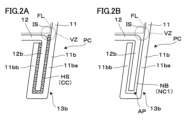
- 2A and 2B are enlarged cross-sectional views of the periphery of the bottom joint of the composite container.
- FIG. 3 is a conceptual diagram for explaining the feeding of a blank for a body member.
- FIG. 4A is a diagram for explaining the thickness of a film attached to a paper container
- FIG. 4B is a table for explaining examples of the film thickness.
- FIG. 5 is a conceptual cross-sectional view illustrating a film bonding device used in the film bonding step.
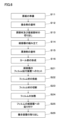
- FIG. 6 is a flowchart illustrating a method for manufacturing a paper container.
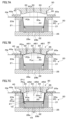
- 7A to 7C are conceptual diagrams illustrating a method for manufacturing a paper container.
- 8A and 8B are tables illustrating an embodiment of a composite container.
- 9A to 9D are development views for explaining locations on the body member where the adhesive is applied in relation to an embodiment of the composite container.
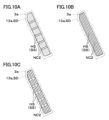
- 10A to 10C are diagrams illustrating modified examples of the side application portion of the bonding agent in the side bonding portion.
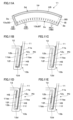
- 11A to 11E are diagrams illustrating modified examples of the bottom application portion of the bonding agent in the bottom bonding portion.
- 12A and 12B are diagrams illustrating modified examples of the application portion of the bonding agent in the bottom bonding portion.
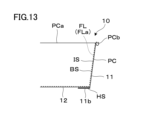
- FIG. 13 is a conceptual diagram illustrating a modified example of a composite container.
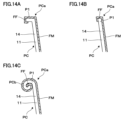
- 14A to 14C are enlarged cross-sectional views illustrating the mouth of a composite container according to a modified example.
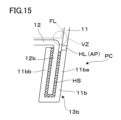
- FIG. 15 is an enlarged cross-sectional view of the periphery of a bottom joint of a composite container according to a modified example.
- FIG. 1A is a cross-sectional view showing an example of a composite container 10.
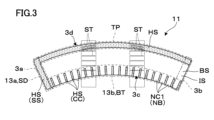
- FIG. 1B is an exploded view of a body member 11, described later, of the composite container 10 shown in FIG. 1A.
- the portion to which the bonding agent HS, described later, is applied is shown with a matte-finished filled pattern.
- FIG. 1C is an enlarged view of the portion of the composite container 10 shown in FIG. 1A surrounded by a dotted line MA.
- the composite container 10 is a cup-shaped container with a resin film FL attached to the entire inner surface IS of a paper container PC.
- the composite container 10 has a mouth portion PCa that is a circular opening at the top, and the side of the composite container 10 has a vertically tapered shape.
- the composite container 10 has a curled portion PCb that is formed by rolling the peripheral edge of the opening outward.
- the paper container PC is formed by joining a body member 11 and a bottom plate member 12.
- the bottom P3 of the paper container PC is closed by the bottom plate member 12.
- the outer periphery 12c of the bottom plate member 12 has a peripheral wall portion 12b that is bent downward.
- the peripheral wall portion 12b is joined to the bottom portion 11b of the body member 11.
- the bottom portion 11b of the body member 11 is bent inward at its lower end, and the peripheral wall portion 12b is sandwiched between the outer wall portion 11ba and the inner wall portion 11bb of the body member 11.
- the side joint 13a and bottom joint 13b shown in FIG. 1B are joined together via an adhesive HS.
- the side joint 13a is the part that joins the side of the body member 11 (hereinafter also referred to as the side SD).
- the part that joins the side of the body member 11 refers to the ends 3a and 3b of the side of the body member 11, and the body member 11 is formed into a cylindrical shape by bonding the ends 3a and 3b on both sides together so that they overlap each other.
- the side SD corresponds to the inner surface IS of one of the ends 3a and 3b of the side of the body member 11.
- the adhesive HS is applied to the entire surface as the side application section SS.
- the bottom joint 13b is a portion that joins the body member 11 and the bottom plate member 12 (hereinafter, also referred to as bottom BT).
- the portion that joins the body member 11 and the bottom plate member 12 is the area of the inner surface IS of the lower end portion 3c of the body member 11 excluding the end portion 3a (side SD) of the side surface.
- the adhesive HS is applied to a portion of the bottom BT as a bottom application portion CC.
- the bottom application portions CC are arranged in multiple locations at a regular cycle or interval.
- Each bottom application portion CC has, for example, a rectangular shape and has a uniform width or the same area.
- the area of the bottom BT other than the bottom application portion CC is a bottom non-application portion NC1, which corresponds to the non-adhesive portion NB described later.
- the bottom application portion CC has multiple elongated areas. Each area is arranged approximately parallel to the vertical direction of the paper container PC. When viewed in the developed view of FIG. 1B, the bottom application section CC is arranged in a slightly radial pattern along the bottom end 3c.
- the bottom coat area of the bottom BT, where the bonding agent HS is applied, is in the range of 26% to 80% of the total area of the bottom BT.
- the bottom coat area is the area of the bottom BT excluding the bottom non-coated portion NC1, and is the total area of the multiple bottom coated portions CC.
- the number of bottom coated portions CC is, for example, 20.
- the bottom joint 13b has a portion having the adhesive HS and a portion not having the adhesive HS (non-adhesive portion NB).
- a portion of the bottom joint 13b has a ventilation portion AP that allows ventilation to the outside of the paper container PC due to the non-adhesive portion NB shown in Figure 2B.
- the ventilation portion AP is formed by the bottom non-coated portion NC1 where the adhesive HS is not applied.
- the non-adhesive portion NB forms a small gap between the bottom 11b of the body member 11 and the peripheral wall portion 12b of the bottom plate member 12, and this gap becomes the ventilation portion AP.
- the ventilation portion AP allows ventilation to the outside of the paper container PC by vacuuming performed when attaching the film FL to the inner surface IS of the paper container PC. This improves ventilation when vacuuming, and improves the moldability of the film FL.
- the adhesive HS is also applied to the band-shaped portion (hereinafter also referred to as the top TP) that corresponds to the curled portion PCb of the paper container PC.
- the top TP corresponds to the inner surface IS of the upper portion 3d of the body member 11.
- the adhesive HS is applied to the entire surface of the top TP.
- the curled portion PCb curls around the adhesive HS applied to the inner surface IS of the paper container PC.
- the adhesive HS is applied to the side SD, bottom BT, and top TP of the blank of the body member 11 so as to maintain the paper container PC in a cup shape.
- the adhesive HS can also be applied to the top TP at the same time. This reduces the number of processes. Also, by partially applying the adhesive HS to the inner surface IS of the paper container PC, the amount of resin used to bond the components of the paper container PC to each other can be reduced, which is environmentally friendly.
- the surface of the inner surface IS of the paper container PC that comes into direct contact with the film FL that is, the adhesive surface BS, can be made of the base paper 14. The surface of only the base paper 14 has better adhesion to the adhesive layer 16 of the film FL, which will be described later, than the surface of the base paper 14 that has been generally laminated, so the adhesion between the paper container PC and the film FL is stable.
- the adhesive HS applied to the top TP prevents the lubricant used in processing the curled portion PCb from penetrating into the base paper 14 of the paper container PC. This prevents the curled portion PCb from curling up. If the lubricant penetrates into the base paper 14, the base paper 14 loses its rigidity and becomes difficult to curl, resulting in a container in which the curled portion PCb cannot be completely wound or is buckled. In addition, when the curled portion PCb is pressed with a hot plate (not shown), the adhesive HS applied to the top TP, which is the part corresponding to the curled portion PCb, prevents the curled portion PCb from unwinding.
- the blanks of the body member 11 can be sent out one by one when the paper container PC is molded. As shown in FIG. 3, the blanks are sent out to the molding device using a holding device (not shown) having a slit portion ST. At this time, the blanks can be sent out one by one by vacuum suction from the slit portion ST. If the paper where it overlaps with the slit ST is air permeable, it may result in two blanks being sucked in. By applying adhesive HS to the top TP, the applied area becomes less air permeable, preventing two blanks from being sucked in. However, if the top TP is made of a material that is less air permeable, it is not necessary to apply adhesive HS.
- the bonding agent HS is applied to the blank of the body member 11 before the paper container PC is molded.
- the bonding agent HS is applied, for example, by printing.
- the amount of the bonding agent HS applied is, for example, 5 g/m 2 to 20 g/m 2 .
- Examples of the bonding agent HS include heat seal agents and adhesives that are bonded by pressure. Note that the types of bonding agent HS applied to the sides SD, bottom BT, and top TP may be different.
- the heat sealant is, for example, a thermoplastic resin.
- thermoplastic resins include polyethylene and modified resins thereof, ionomer resin, ethylene-methacrylic acid copolymer resin, ethylene-acrylic acid copolymer resin, ethylene-vinyl acetate copolymer resin, styrene-acrylic acid copolymer resin, cellulose acetate resin, polyester resin, polylactic acid resin, polyhydroxyalkanoic acid resin, polybutylene succinate resin, polybutylene succinate adipate resin, hydroxybutyrate-hydroxyhexanoate copolymer resin, polyvinyl alcohol resin, ethylene-vinyl alcohol copolymer resin, polypropylene and modified resins thereof, polyhydroxybutyric acid resin, acrylic acid resin, methacrylic acid resin, polyethylene terephthalate resin, polyamide resin, etc.
- the heat sealant uses a material in which a thermoplastic resin is dispersed, dissolved, or emulsified in water or
- Adhesives that are bonded by pressure include, for example, modified vinyl acetate resin, vinyl acetate resin, acrylic-modified vinyl acetate copolymer resin, vinyl copolymer resin, ethylene-vinyl acetate copolymer resin, urea resin, melamine resin, phenolic resin, resorcinol resin, chloroprene rubber, epoxy resin, urethane resin, silicone resin, modified silicone resin, styrene-butadiene rubber copolymer resin, isobutene-maleic anhydride copolymer resin, polyvinyl chloride resin, starch, nitrile rubber, rosin, acrylic acid resin, methacrylic acid resin, acrylic acid ester resin, methacrylic acid ester resin, etc.
- the paper container PC has a base paper 14.
- the base paper 14 used for the body member 11 has a basis weight of, for example, 150 to 400 g/ m2 .
- the base paper 14 used for the bottom plate member 12 has a basis weight of, for example, 150 to 400 g/ m2 . If the basis weight is less than 150 g/ m2 , the rigidity is insufficient and the container cannot stand on its own. If the basis weight is more than 400 g/ m2 , the rigidity is too strong and the top curl cannot be formed.
- the base paper 14 of the paper container PC is exposed at the adhesive surface BS between the paper container PC and the film FL.
- a printed layer 15 that decorates the composite container 10 is formed on the outer surface OS of the base paper 14.
- the printed layer 15 displays information such as pictures and letters, as well as marks described below, by printing on the outer surface OS of the composite container 10.
- OP varnish overprint varnish
- heat seal agent heat seal agent
- lamination etc.
- the printed layer 15 may be a combination of ink and OP varnish, ink and heat seal agent, or ink and lamination.
- the printed layer 15 includes a mark on the outer surface OS of the base paper 14 for applying the adhesive HS to a specified location on the inner surface IS of the base paper 14.
- the adhesive HS is applied using this mark as a reference.
- the mark on the printed layer 15 is also used as a reference when cutting out a blank for the body member 11 so that it matches the position of the adhesive HS on the inner surface IS of the base paper 14. Note that if the function of the mark is replaced by another method, the printed layer 15 may be omitted.
- the film FL is attached to the adhesive surface BS, which is the inner surface IS of the base paper 14 of the paper container PC.
- the film FL needs to be in contact with the exposed part of the base paper 14.
- the thickness of the film FL varies depending on the attachment position with the paper container PC, and the film FL attached to the bottom P3 (see FIG. 1A) of the paper container PC is thicker than the film FL attached to the inner wall P2 (see FIG. 1A) of the body.
- the thick film FL at the bottom P3 prevents pinholes from being formed in the film FL when the composite container 10 is filled with sharp contents or when the composite container 10 is dropped.
- the thick film FL at the bottom P3 makes it difficult for the film to shrink due to heat generated by the contents during microwave heating, and prevents peeling between the paper container PC and the film FL.
- the thick film FL at the bottom P3 brings the center of gravity of the composite container 10 closer to the bottom P3, making it difficult for the composite container 10 to tip over.
- the thickness of the film FL will change depending on the bonding position if the inner diameter of the mouth portion PCa of the paper container PC and the height of the paper container PC change.
- FIG. 4A is a diagram for explaining the thickness of the film FL attached to the paper container PC.
- FIG. 4B is a table for explaining a specific example of the thickness of the film FL.
- the thickness of the film FL before attachment is 100 ⁇ m.
- the thickness was measured by a method using a micrometer or a method using a thickness gauge.
- the measurement points were four points on the circumference of the body center E1 of the film FL, four points on the circumference of the V zone E2, and one point at the bottom center E3. There were five samples, and the measured values shown in FIG. 4 were average values.
- the V zone E2 corresponds to the V zone VZ shown in FIGS. 2A and 2B.
- the V zone VZ is the part where the body member 11 and the bottom plate member 12 are connected.
- the film FL has a three-layer structure. Specifically, the film FL has, in order from the adhesive surface BS side of the base paper 14, an adhesive layer 16, an intermediate layer 17, and a substrate layer 18 that supports the adhesive layer 16 and the intermediate layer 17.
- the base material layer 18 is provided on the innermost side of the composite container 10 and is the layer that comes into contact with the contents of the composite container 10.
- the base material layer 18 has water resistance, chemical resistance, etc.
- PP polypropylene
- PE polyethylene
- the intermediate layer 17 is a layer that mainly suppresses the formation of pinholes.
- a laminate of Ny (nylon) and EVOH (ethylene vinyl alcohol resin), or a laminate of ionomer and EVOH can be used as the intermediate layer 17.
- Ny and ionomer have elasticity and flexibility, and function to prevent pinholes in the film FL.
- EVOH has gas barrier properties and oil resistance, and functions as a barrier material.
- the adhesive layer 16 is a layer that adheres to the base paper 14 of the paper container PC. As shown in FIG. 1A, the adhesive layer 16 adheres to all surfaces of the mouth PCa or flange P1, the body inner wall P2, and the bottom P3 of the paper container PC. However, the adhesive layer 16 does not adhere to the V-zone VZ.
- the adhesive strength of the adhesive layer 16 is such that when the film FL is peeled off from the base paper 14, the paper fibers adhere to the film FL. Specifically, the adhesive strength of the adhesive layer 16 is from 0.5 N/mm to the point where the paper layers peel off. The measurement width for the adhesive strength is 15 mm.
- the adhesive layer 16 may be, for example, a polyolefin such as polypropylene or polyethylene, or a modified resin thereof, a polyester resin such as polyvinyl chloride or polyethylene terephthalate, or a thermoplastic resin such as ethylene-vinyl acetate copolymer resin (EVA), ethylene-vinyl alcohol copolymer resin, polyamide resin, polyvinylidene chloride resin, polystyrene resin, polycarbonate resin, polybutene resin, or polyvinyl alcohol resin. It is preferable to use an adhesive layer 16 that has high adhesiveness so as to adhere uniformly to the base paper 14 of the paper container PC.
- a polyolefin such as polypropylene or polyethylene, or a modified resin thereof
- a polyester resin such as polyvinyl chloride or polyethylene terephthalate
- a thermoplastic resin such as ethylene-vinyl acetate copolymer resin (EVA), ethylene-vinyl alcohol copolymer resin,
- the left side of the example structure is the base paper 14, and the right side is the inner surface IS side of the composite container 10.
- molten thermoplastic resin is made into a film, and is not dispersed, dissolved, or emulsified in water or a solvent like an adhesive.
- the combination of materials constituting the film FL can be changed as appropriate as long as it has the functions of the adhesive layer 16, intermediate layer 17, and base layer 18.
- the film FL is deformable along the inner surface IS of the paper container PC during pressure forming, and has a thickness that does not cause pinholes.
- the total thickness of the film FL before attachment is, for example, 90 ⁇ m to 250 ⁇ m, preferably 100 ⁇ m.
- the total thickness of the base layer 18 and the intermediate layer 17 is, for example, 60 ⁇ m to 80 ⁇ m, and the thickness of the adhesive layer 16 is, for example, 20 ⁇ m to 40 ⁇ m.
- the performance of the film FL is largely influenced by the thickness and less influenced by the ratio.
- the overall thickness of the film FL affects the tearing of the film FL when it is attached.
- the film FL contains Ny, EVOH, or ionomer, the film FL is less likely to tear.
- the adhesion between the film FL and the base paper 14 is affected by the thickness of the adhesive layer 16.
- the effect of the thickness of the adhesive layer 16 also varies depending on the type of resin used in the adhesive layer 16.
- the oxygen barrier property is affected by the thickness of the EVOH, which has oxygen barrier function.
- the film application device 100 shown in FIG. 5 comprises a lower mold member 20, a compressed air device 30, a support member 40, an air adjustment unit 50, an air suction unit 60, and a control device 80.
- the film application device 100 applies the film FL or film material FM to the inner surface IS or adhesive surface BS of the paper container PC by using an air pressure difference.
- the air pressure difference is generated by either introducing compressed air from above the film FL or drawing a vacuum from below the paper container PC, as will be described in detail later.
- the lower mold member 20 comprises a cylindrical cavity 21, a disk-shaped pedestal 22, and an annular film holding member 23, a disk-shaped base 25 that aligns and fixes the cavity 21 and the pedestal 22 to each other, and a support 26 that fixes the film holding member 23 upward relative to the outer periphery of the base 25.
- the precursor paper container PC is stably supported in the lower mold member 20 by the cavity 21 and the pedestal 22.
- a gap GA is formed between the lower inner surface of the cavity 21 and the periphery of the pedestal 22, and ventilation paths 28a, 28b are formed in the lower part of the pedestal 22. Air around the paper container PC can be discharged to the air suction section 60 via the gap GA and the ventilation paths 28a, 28b.
- the compressed air device 30 is a disk-shaped member that incorporates a heater 31 and has a number of ventilation holes 33.
- An annular cutter 35 is fixed to the outer periphery of the compressed air device 30, and cuts out the processed portion FLa to be attached to the inner surface IS of the paper container PC from the sheet-like film material FM that has moved above the lower mold member 20.
- the processed portion FLa corresponds to the film FL of the composite container 10 shown in FIG. 1A, etc.
- the compressed air device 30 is driven by the lifting drive device 71 and can be raised and lowered in a vertical direction parallel to the axis AX.
- the compressed air device 30 When the compressed air device 30 is raised, the paper container PC can be placed in the lower mold member 20, and when the compressed air device 30 is lowered, the film material FM can be pressed against the mouth portion PCa formed at the top of the paper container PC, and the cutter 35 can cut out the processed portion FLa from the film material FM.
- the heater 31 can be driven by the heater driving device 72 to adjust the temperature, and can soften the processed portion FLa of the film material FM.
- the compressed air device 30 can reduce the pressure of the space facing the lower surface 30a of the compressed air device 30 through the vent 33 by the air adjustment unit 50, and can bring the processed portion FLa of the film material FM into close contact with the lower surface 30a. This allows the film material FM to be held while being softened to a desired state.
- the lower surface 30a of the compressed air device 30 has a curved shape. This allows the processed portion FLa to be attached to the lower surface 30a while heating it from the edge and smoothing out any wrinkles.
- the lower surface 30a is not limited to a curved shape, and may be a flat shape.
- the support member 40 temporarily fixes the film material FM to the paper container PC by sandwiching the film material FM between the film holding member 23 of the lower mold member 20.
- the support member 40 is driven by the lifting drive device 73 and can be raised and lowered in the vertical direction parallel to the axis AX.
- the film material FM can be moved horizontally above the paper container PC, and when the support member 40 is lowered, the film material FM is sandwiched and fixed between the upper surface 23a of the film holding member 23 and the lower surface 40a of the support member 40.
- the air adjustment unit 50 is an air suction device and also functions as a compressed air blowing device.
- the air adjustment unit 50 is connected to the ventilation port 33 of the compressed air device 30.
- the air adjustment unit 50 operates as an air suction device at a predetermined timing, and adsorbs the processed portion FLa of the film material FM to the lower surface 30a of the compressed air device 30 to soften it.
- the air adjustment unit 50 operates as a compressed air blowing device at a predetermined timing, and stretches the softened processed portion FLa with compressed air introduced from above, and deforms it so as to press it against the inner surface IS of the paper container PC.
- the compressed air supplied by the air adjustment unit 50 from the ventilation port 33 may be temperature-adjusted so as to maintain the softening degree of the processed portion FLa of the film material FM.
- the air suction unit 60 can reduce the pressure inside the cavity 21 of the lower mold member 20 by drawing a vacuum through the gap GA and the air passages 28a, 28b, and can reduce the pressure around the paper container PC placed on the lower mold member 20. This makes it easier to bring the stretched processed portion FLa of the film material FM into close contact with the inner surface IS of the paper container PC when blowing the processed portion FLa of the film material FM with compressed air.
- the control device 80 controls the overall operation of the film attachment device 100.
- the control device 80 controls the temperature of the compressed air device 30 by controlling the driving state of the heater driving device 72, and adjusts the lifting position of the compressed air device 30 by controlling the driving state of the lifting drive device 71.
- the control device 80 adjusts the lifting position of the support member 40 by controlling the driving state of the lifting drive device 73.
- the control device 80 can make the processed portion FLa of the film material FM adhere to the lower surface 30a of the compressed air device 30 at the desired timing by controlling the driving state of the air adjustment unit 50, and can deform the softened processed portion FLa so as to press it against the inner surface IS of the paper container PC.
- control device 80 controls the driving state of the air suction unit 60 in synchronization with the air adjustment unit 50, reduces the pressure around the paper container PC, and assists in the operation of making the stretched processed portion FLa of the film material FM adhere to the inner surface IS of the paper container PC.
- a base paper 14 for a paper container PC is prepared, and a printed layer 15 is formed, if necessary, on the surface that will become the outer surface OS of the paper container PC (step S11).
- the printed outer surface OS may be laminated.
- adhesive HS is applied to predetermined locations on the surface of the body member 11 that will become the inner surface IS of the paper container PC (adhesive application process, step S12).
- the locations to which the adhesive HS is applied are the portions corresponding to the side joints 13a (sides SD), the portions corresponding to the bottom joints 13b (bottom BT), and the portions corresponding to the curled portions PCb at the top of the bottom plate member 12 (top TP).
- the adhesive HS is applied to the body member 11 by printing or the like.
- the marks on the printed layer 15 are used as a reference for alignment when applying the adhesive HS.
- the outer surface OS of the base paper 14 may be laminated.
- the base paper 14 is cut out into the body member 11 and the bottom plate member 12, which are the components (blanks) of the paper container PC (step S13).
- the marks on the printing layer 15 are used as a reference.
- the body member 11 and the bottom plate member 12 are joined together to assemble the paper container PC into a cup shape (joining process, step S14).
- the paper container PC is molded using a molding device (not shown).
- the body member 11 and the bottom plate member 12 are joined together by heating the bonding agent HS.
- the heating temperature is equal to or higher than the melting point of the bonding agent HS, and is preferably between 200°C and 500°C.
- a lubricant is applied to the upper part (top TP) of the inner surface IS of the body member 11 (lubricant application process, step S15). Because the bonding agent HS has already been applied to the upper part of the body member 11 in step S12, the lubricant does not easily penetrate into the base paper 14, making it easier to form the curled portion PCb in the next process.
- step S16 After the lubricant is applied, the upper part of the paper container PC is rolled outward to form the curled portion PCb (curled portion forming process, step S16).
- the paper container PC formed in steps S11 to S16 is set in the film application device 100 (step S21). Specifically, the paper container PC is stored in the lower mold member 20 of the film application device 100. At this time, the control device 80 operates the compressed air device 30 and the support member 40 to separate the compressed air device 30 and the support member 40 from the lower mold member 20.
- step S22 the film material FM to be attached to the inner surface IS of the paper container PC is supplied to the film attachment device 100 (step S22). Specifically, the control device 80 moves the film material FM horizontally above the paper container PC while raising the support member 40 (see FIG. 7A).
- the processed portion FLa is cut from the film material FM to match the shape of the mouth portion PCa of the paper container PC (step S23).
- the control device 80 lowers the support member 40 and clamps and fixes the film material FM between the upper surface 23a of the film holding member 23 and the lower surface 40a of the support member 40.
- the control device 80 also lowers the compressed air device 30 to press the film material FM against the mouth portion PCa of the paper container PC, and cuts out the processed portion FLa from the film material FM with the cutter 35.
- the processed portion FLa of the cut film material FM is attached to the compressed air device 30 of the film attachment device 100, and the processed portion FLa is heated (film heating step, step S24).
- the control device 80 operates the air adjustment unit 50 to suck in air AR1 through the air vent 33, and adsorbs the processed portion FLa to the underside 30a of the compressed air device 30 (see FIG. 7B).
- the control device 80 also operates the heater 31 to soften the processed portion FLa adsorbed to the compressed air device 30.
- the heating temperature of the heater 31 is equal to or higher than the melting point of the resin that constitutes the adhesive layer 16, and is preferably 160°C to 190°C.
- the processed portion FLa of the film material FM is compressed and attached to the inner surface IS of the paper container PC (film attachment process, step S25).
- the processed portion FLa is attached to the flange P1, the inner wall P2 of the body, the bottom P3, and the V zone VZ of the paper container PC in that order. This allows the film FL to be attached to the inner surface IS of the paper container PC without leaving any air between the paper container PC and the film FL while maintaining the thickness of the film FL.
- the film FL is not attached to the V zone VZ. However, in the V zone VZ, the film FL is not directly attached to the inner surface IS of the paper container PC, but is close to the inner surface IS and does not float.
- control device 80 operates the compressed air device 30 to introduce compressed air AR2 from above the processed portion FLa through the air vent 33, stretching the softened processed portion FLa and deforming it so that it is pressed against the inner surface IS of the paper container PC (see FIG. 7C).
- the control device 80 also operates the air suction unit 60 to perform vacuum drawing and exhaust air VA through the gap GA (see FIG. 5) and air passages 28a, 28b to reduce the pressure around the paper container PC, and in cooperation with the compressed air blow by the compressed air device 30, attaches the processed portion FLa as a film FL to the inner surface IS of the paper container PC (see FIG. 7C).
- the heated film FL is molded by the air pressure difference, which improves the moldability and adhesion of the film FL to the paper container PC.
- step S26 the composite container 10 with the film FL attached to the paper container PC is removed from the film attachment device 100 (step S26).
- the control device 80 operates the compressed air device 30 and the support member 40 to raise the compressed air device 30 and the support member 40, and removes the composite container 10 from the lower mold member 20.
- the film FL is attached using the air pressure difference caused by both the introduction of compressed air (compressed air molding) and vacuum drawing, but the film FL may also be attached using the air pressure difference caused by either compressed air molding or vacuum drawing.
- the moldability of the paper container and the adhesiveness of the film to the paper container will be described as an example.
- the base paper 14 of the body member 11 and the bottom plate member 12 is HC(E)COC (manufactured by O&C Ivory Board Co., Ltd.) with a basis weight of 300 g/ m2 .
- the outer surface OS of the body member 11 is printed with OP varnish (overprint varnish).
- the air permeability (Oken air permeability) of the base paper 14 with the outer surface OS applied with OP varnish is 624 sec.
- the bonding agent HS is, for example, Chemipearl S500 (registered trademark, manufactured by Mitsui Chemicals, Inc.) as an ionomer.
- the coating amount of the bonding agent HS is 9.4 g/ m2 .
- FIGS 8A and 8B show the relationship between the bottom coat area of the adhesive HS in the paper container PC and the formability of the paper container PC.
- the bottom coat area is the application area of the adhesive HS in the bottom BT shown in Figures 9A to 9D.
- Figure 9A shows the case where the bottom coat area is 0%
- Figure 9B shows the case where the bottom coat area is 26%
- Figure 9C shows the case where the bottom coat area is 90%
- Figure 9D shows the case where the bottom coat area is 100%.
- the bottom coat area is the total area of one or more bottom coated parts CC of the bottom BT excluding the bottom non-coated part NC1.
- the number of bottom coated parts CC was set to 20, and the bottom coat area was increased or decreased by changing the area of one bottom coated part CC.
- the bottom coated parts CC had a uniform width or the same area and were provided at regular intervals.
- the bottom coat area is 0%, the bottom coating part CC is not provided, and the bonding agent HS is not applied to the bottom BT (see FIG. 9A).
- the bottom coat area is 100%, the entire bottom BT is the bottom coating part CC, and the bonding agent HS is applied to the entire bottom BT (see FIG. 9D).
- the number of bottom coating parts CC when the bottom coat area is 100% is 20, assuming that there are no gaps between the bottom coating parts CC.
- the bonded parts between the body member 11 and the bottom plate member 12 are provided at regular intervals with uniform width or area. This allows air to escape uniformly from the ventilation parts AP, which are the non-bonded parts NB, and no stress is placed on any one of the multiple ventilation parts AP, making it difficult for the film FL to tear.
- the bottom coat gap BG (see FIG. 1B) shown in FIG. 8A corresponds to the widest width of each non-bonded part NB shown in FIG. 1B, and is the inlet through which air VA (see FIG. 7C) passes. As shown in FIG. 8A, the width of the bottom coat gap BG must be 4 mm or more. This allows air to escape uniformly from the multiple ventilation parts AP (see FIG. 2B) to prevent the film FL from floating in the V zone VZ.
- the adhesive strength of the bottom plate member 12 required for continuous molding of the paper container PC was measured.
- the adhesive strength of the bottom plate member 12 was measured by compressing the bottom plate member 12 from the underside or thread bottom side of the bottom plate member 12 of the paper container PC using a strength testing machine (specifically, a Strograph), and measuring the strength at which the bottom plate member 12 began to peel off.
- the diameter of the compression jig of the strength testing machine was 106 mm in diameter corresponding to the shape and size of the paper container PC, and the compression speed was 100 mm/min.
- Figure 8B shows the adhesive strength of the bottom plate member 12. As shown in Figure 8B, it was found that an adhesive strength of 52 N or more is necessary to continuously mold the paper container PC. When the adhesive strength is 52 N or more, delamination of the paper occurs in the paper container PC after the bottom plate member 12 is peeled off, indicating that the body member 11 and the bottom plate member 12 are sufficiently bonded. Note that when the bottom coat area is 20% or less, the adhesive strength of the bottom plate member 12 is weak and the bottom plate member 12 is prone to coming loose.
- FIG. 8A shows the relationship between the shapeability of the film FL to the paper container PC and the tearing of the film FL.
- the heating conditions when attaching the film FL or the processed part FLa to the paper container PC were a heating temperature of 177°C and a heating time of 1 second.
- the film FL was attached to the inner surface IS of the paper container PC by pressure molding at a pressure of 0.05 MPa to 0.15 MPa and a pressure time of 1.2 seconds while evacuating at a vacuum pressure of -56 kPa.
- the shapeability if the film FL could be molded, the evaluation was marked with the symbol " ⁇ ".
- the adhesion of the film FL was good when the bottom coat area was 26% to 80%.
- the film FL partially lifted in the V zone VZ, and when the bottom coat area was 100%, the film FL lifted almost all around the V zone VZ.
- the tearing of the film FL can be dealt with by changing the compressed air pressure, the type of film FL, the thickness of the film FL, etc.
- the base paper 14 is exposed at the adhesive surface BS between the paper container PC and the film FL, and the film FL has an adhesive layer 16, so that the adhesion between the paper container PC and the film FL can be stabilized.
- the adhesive HS is used at the side joint 13a and the bottom joint 13b, i.e., the joint parts necessary for molding the paper container PC, the amount of resin applied to the paper container PC can be reduced while maintaining the film adhesion of the entire inner surface IS of the paper container PC.
- the film FL may be a single layer consisting of only the adhesive layer 16.
- the film FL may omit the base material layer 18 and intermediate layer 17.
- the constituent material is not limited to one type, and may be a mixture of two or more types of resin, such as a combination of PP and PE.
- the film FL may also be formed of only the adhesive layer 16 and the base material layer 18, omitting the intermediate layer 17.
- the adhesive HS does not have to be applied to the entire surface of the side SD.
- the side application portion SS of the adhesive HS does not have to be the entire surface of the side SD.
- the adhesive HS may have a side non-application portion NC2 on the side SD.
- the width of the side non-application portion NC2 is narrower than the width of the bottom non-application portion NC1 shown in Figure 1B.
- the application position of the adhesive HS at the bottom joint 13b can be changed as appropriate.
- the bottom application portion CC may be an area up to the middle part rather than the area up to the lowest end of the bottom BT.
- FIGS. 11B and 11C are enlarged cross-sectional views of the area around the bottom joint 13b of the molded paper container PC. The state of bonding between the bottom 11b of the body member 11 and the bottom plate member 12 changes depending on the application position of the bottom application portion CC.
- Figure 11B shows an example of bonding between the adhesive HS applied to the body member 11 and the peripheral wall portion 12b and edge portion 12d of the bottom plate member 12.
- Figure 11C shows an example of bonding between the adhesive HS applied to the body member 11 and the peripheral wall portion 12b of the bottom plate member 12.
- the back surface 12f of the bottom plate member 12 and the inner surface 11f of the body member 11 are not bonded. Therefore, at the bottom joint 13b, the inner wall portion 11bb of the body member 11 is easily separated from the peripheral wall portion 12b of the bottom plate member 12. In this case, the ventilation area of the inner wall portion 11bb is increased in the ventilation portion AP, so that vacuuming can be performed in a short time.
- the application position of the adhesive HS in the vertical direction may be separated in the bottom joint portion 13b.
- the bottom application portion CC may be divided into an area from the upper end to the middle part of the bottom BT and an area on the lower end side.
- the outer wall portion 11ba of the body member 11 and the peripheral wall portion 12b of the bottom plate member 12 are joined, and a part of the inner wall portion 11bb of the body member 11 is joined to a part of the peripheral wall portion 12b of the bottom plate member 12 (the upper end part or the middle part of the back surface 12f of the peripheral wall portion 12b in a cross-sectional view).
- the adhesive HS applied to the body member 11 is joined to both sides of the peripheral wall portion 12b of the bottom plate member 12, and the inner wall portion 11bb is less likely to separate from the peripheral wall portion 12b than when it is joined to one side of the peripheral wall portion 12b.
- the adhesive HS may be applied to the outer periphery 12c of the bottom plate member 12 without applying the adhesive HS to the body member 11.
- FIG. 12A on the outer periphery 12c of the bottom plate member 12, multiple bottom application portions CC are radially arranged in the area corresponding to the bottom BT.
- FIG. 12B is an enlarged cross-sectional view of the area around the bottom joint 13b of the molded paper container PC. At the bottom joint 13b shown in FIG. 12B, the back surface 12f of the bottom plate member 12 and the inner surface 11f of the body member 11 are not joined.
- the composite container 10 is not limited to having a circular shape in a plan view, but may have various polygonal or elliptical shapes.
- the embodiment is not limited to the embodiment in which the processed portion FLa is heated after the film material FM is cut as shown in FIG. 7B.
- the film material FM may be heated while sandwiched between separate heating plates (not shown) on both sides and sent to the film attachment device 100.
- the film material FM or the processed portion FLa may be heated by radiant heat from a heater such as a ceramic heater. In this case, the heater 31 of the compressed air device 30 may be omitted as long as the softening of the film FL can be maintained.
- the film FL is heated and molded, but the film FL may also be molded while the paper container PC is also heated.
- the bottom plate member 12 is folded and attached to the bottom portion 11b of the body member 11, but as shown in FIG. 13, the body member 11 may be folded and the bottom portion 11b of the body member 11 may be attached to the bottom plate member 12 without folding the bottom plate member 12.
- the opening portion PCa or the flange P1 of the composite container 10 does not need to have a curled portion PCb.
- the flange end surface FF of the composite container 10 is formed sideways.
- the flange end surface FF of the composite container 10 is formed facing upward.
- the method of attaching the film FL may be changed as appropriate to the shape of the mold, or to a method in which the film material FM is heated in advance with radiant heat, and then vacuum-pressure molded onto the paper container PC, which serves as the lower mold, while ensuring the film area to be wrapped around the flange end surface FF.
- the curled portion PCb may be formed after the film FL is attached.
- the paper container PC is molded without first forming the curled portion PCb.
- the flange end surface FF of the composite container 10 is formed facing upward.
- the film FL or film material FM is heated in advance with radiant heat, and then attached to the paper container PC in the lower mold by vacuum and pressure molding while ensuring the film area to be wrapped around the flange end surface FF.
- the base paper 14 of the paper container PC is not cut.
- FIG. 14C after the film is attached, the film FL and base paper 14 are curled together to form the curled portion PCb.
- the ventilation area AP provided in the bottom joint 13b is formed by the non-adhesive portion NB of the bottom non-applied portion NC1 of the adhesive HS of the body member 11, but it may be formed by other methods.
- the ventilation area AP may be formed by making holes HL or perforations slightly below the portion of the body member 11 corresponding to the V zone VZ.
- the bottom joint 13b is joined by applying adhesive HS to the entire surface of the bottom BT of the body member 11, as shown in FIG. 9D. The application position of the adhesive HS is adjusted so that the holes HL, etc. are exposed to allow ventilation through the ventilation area AP.
Landscapes
- Engineering & Computer Science (AREA)
- Mechanical Engineering (AREA)
- Laminated Bodies (AREA)
- Details Of Rigid Or Semi-Rigid Containers (AREA)
- Making Paper Articles (AREA)
Priority Applications (3)
| Application Number | Priority Date | Filing Date | Title |
|---|---|---|---|
| CN202480009805.4A CN120677108A (zh) | 2023-03-31 | 2024-02-15 | 复合容器和用于制造复合容器的方法 |
| EP24778791.4A EP4691936A1 (en) | 2023-03-31 | 2024-02-15 | Composite container and method for manufacturing composite container |
| JP2025509891A JPWO2024202646A1 (https=) | 2023-03-31 | 2024-02-15 |
Applications Claiming Priority (2)
| Application Number | Priority Date | Filing Date | Title |
|---|---|---|---|
| JP2023057757 | 2023-03-31 | ||
| JP2023-057757 | 2023-03-31 |
Publications (1)
| Publication Number | Publication Date |
|---|---|
| WO2024202646A1 true WO2024202646A1 (ja) | 2024-10-03 |
Family
ID=92904213
Family Applications (1)
| Application Number | Title | Priority Date | Filing Date |
|---|---|---|---|
| PCT/JP2024/005198 Ceased WO2024202646A1 (ja) | 2023-03-31 | 2024-02-15 | 複合容器及び複合容器の製造方法 |
Country Status (4)
| Country | Link |
|---|---|
| EP (1) | EP4691936A1 (https=) |
| JP (1) | JPWO2024202646A1 (https=) |
| CN (1) | CN120677108A (https=) |
| WO (1) | WO2024202646A1 (https=) |
Citations (6)
| Publication number | Priority date | Publication date | Assignee | Title |
|---|---|---|---|---|
| JPH03176128A (ja) | 1989-12-05 | 1991-07-31 | Tokan Kogyo Co Ltd | 複合式簡易容器の製造方法 |
| JP2001180641A (ja) | 1999-12-27 | 2001-07-03 | Tokan Kogyo Co Ltd | 複合式簡易容器とその製造方法 |
| JP2001293801A (ja) * | 2000-04-13 | 2001-10-23 | Shibaura Mechatronics Corp | 紙カップの製造装置及び製造方法 |
| JP2004224422A (ja) | 2003-01-27 | 2004-08-12 | Nippon Dekishii:Kk | 紙製シームレスカップ及びその製造方法 |
| JP2017077912A (ja) * | 2015-10-21 | 2017-04-27 | 凸版印刷株式会社 | 紙カップ |
| JP2023057757A (ja) | 2021-10-12 | 2023-04-24 | 株式会社三共 | 遊技機 |
-
2024
- 2024-02-15 WO PCT/JP2024/005198 patent/WO2024202646A1/ja not_active Ceased
- 2024-02-15 CN CN202480009805.4A patent/CN120677108A/zh active Pending
- 2024-02-15 JP JP2025509891A patent/JPWO2024202646A1/ja active Pending
- 2024-02-15 EP EP24778791.4A patent/EP4691936A1/en active Pending
Patent Citations (6)
| Publication number | Priority date | Publication date | Assignee | Title |
|---|---|---|---|---|
| JPH03176128A (ja) | 1989-12-05 | 1991-07-31 | Tokan Kogyo Co Ltd | 複合式簡易容器の製造方法 |
| JP2001180641A (ja) | 1999-12-27 | 2001-07-03 | Tokan Kogyo Co Ltd | 複合式簡易容器とその製造方法 |
| JP2001293801A (ja) * | 2000-04-13 | 2001-10-23 | Shibaura Mechatronics Corp | 紙カップの製造装置及び製造方法 |
| JP2004224422A (ja) | 2003-01-27 | 2004-08-12 | Nippon Dekishii:Kk | 紙製シームレスカップ及びその製造方法 |
| JP2017077912A (ja) * | 2015-10-21 | 2017-04-27 | 凸版印刷株式会社 | 紙カップ |
| JP2023057757A (ja) | 2021-10-12 | 2023-04-24 | 株式会社三共 | 遊技機 |
Also Published As
| Publication number | Publication date |
|---|---|
| JPWO2024202646A1 (https=) | 2024-10-03 |
| EP4691936A1 (en) | 2026-02-11 |
| CN120677108A (zh) | 2025-09-19 |
Similar Documents
| Publication | Publication Date | Title |
|---|---|---|
| US6190485B1 (en) | Methods of manufacturing tubular containers having polymeric liner plies | |
| EP3786082B1 (en) | Tabbed seal | |
| EP0857568A2 (en) | Tubular container and methods and apparatus for manufacturing same | |
| US10232580B2 (en) | Methods for securing a shrinkable film to a paperboard substrate and methods for making paperboard containers therefrom | |
| US20170225423A1 (en) | Methods for securing a shrinkable film to a paperboard substrate and methods for making paperboard containers therefrom | |
| WO2026065971A1 (zh) | 纸制食物容器的制作方法、纸制食物容器的制作模具 | |
| EP1607336B1 (en) | Composite container liner with self-supporting sealant web | |
| WO2024202646A1 (ja) | 複合容器及び複合容器の製造方法 | |
| JP2007210638A (ja) | 紙カップ | |
| JP6018960B2 (ja) | 積層シートおよびこれを用いた積層成形品の製造方法 | |
| JP2006256643A (ja) | 紙カップ | |
| JP2004090928A (ja) | 断熱性紙製容器 | |
| JP2013151314A (ja) | スキンパック包装体 | |
| JP3546940B2 (ja) | 密封包装体 | |
| CN121018971B (zh) | 一种纸塑封口膜及其制备方法和应用 | |
| JP2001233323A (ja) | 紙製容器 | |
| CN212244641U (zh) | 一种方便面包装盖及方便面包装 | |
| WO2025022687A1 (ja) | 紙容器、トップシール紙容器及び紙容器の製造方法 | |
| JP2025023315A (ja) | 紙製容器、蓋材付き紙製容器およびブランク材 | |
| JP2023035470A (ja) | 紙製トレー | |
| JP6669426B2 (ja) | フィルム包装体およびフィルム包装体の製造方法 | |
| JP2000095233A (ja) | 紙容器 | |
| JP2003040241A (ja) | 断熱性紙カップ | |
| JP2003251717A (ja) | 紙カップ成形用マンドレル | |
| JP2000326963A (ja) | 紙製容器およびその製造方法 |
Legal Events
| Date | Code | Title | Description |
|---|---|---|---|
| 121 | Ep: the epo has been informed by wipo that ep was designated in this application |
Ref document number: 24778791 Country of ref document: EP Kind code of ref document: A1 |
|
| ENP | Entry into the national phase |
Ref document number: 2025509891 Country of ref document: JP Kind code of ref document: A |
|
| WWE | Wipo information: entry into national phase |
Ref document number: 2025509891 Country of ref document: JP |
|
| WWE | Wipo information: entry into national phase |
Ref document number: 202480009805.4 Country of ref document: CN |
|
| WWP | Wipo information: published in national office |
Ref document number: 202480009805.4 Country of ref document: CN |
|
| WWE | Wipo information: entry into national phase |
Ref document number: 2024778791 Country of ref document: EP |
|
| NENP | Non-entry into the national phase |
Ref country code: DE |
|
| ENP | Entry into the national phase |
Ref document number: 2024778791 Country of ref document: EP Effective date: 20251031 |
|
| ENP | Entry into the national phase |
Ref document number: 2024778791 Country of ref document: EP Effective date: 20251031 |
|
| ENP | Entry into the national phase |
Ref document number: 2024778791 Country of ref document: EP Effective date: 20251031 |
|
| ENP | Entry into the national phase |
Ref document number: 2024778791 Country of ref document: EP Effective date: 20251031 |
|
| ENP | Entry into the national phase |
Ref document number: 2024778791 Country of ref document: EP Effective date: 20251031 |
|
| ENP | Entry into the national phase |
Ref document number: 2024778791 Country of ref document: EP Effective date: 20251031 |
|
| ENP | Entry into the national phase |
Ref document number: 2024778791 Country of ref document: EP Effective date: 20251031 |
|
| ENP | Entry into the national phase |
Ref document number: 2024778791 Country of ref document: EP Effective date: 20251031 |
|
| WWP | Wipo information: published in national office |
Ref document number: 2024778791 Country of ref document: EP |