WO2024202045A1 - 腸管へのウイルス特異的な抗体誘導が可能なノロウイルスワクチン - Google Patents
腸管へのウイルス特異的な抗体誘導が可能なノロウイルスワクチン Download PDFInfo
- Publication number
- WO2024202045A1 WO2024202045A1 PCT/JP2023/013640 JP2023013640W WO2024202045A1 WO 2024202045 A1 WO2024202045 A1 WO 2024202045A1 JP 2023013640 W JP2023013640 W JP 2023013640W WO 2024202045 A1 WO2024202045 A1 WO 2024202045A1
- Authority
- WO
- WIPO (PCT)
- Prior art keywords
- norovirus
- vaccine
- virus
- strain
- administered
- Prior art date
- Legal status (The legal status is an assumption and is not a legal conclusion. Google has not performed a legal analysis and makes no representation as to the accuracy of the status listed.)
- Ceased
Links
Classifications
-
- A—HUMAN NECESSITIES
- A61—MEDICAL OR VETERINARY SCIENCE; HYGIENE
- A61K—PREPARATIONS FOR MEDICAL, DENTAL OR TOILETRY PURPOSES
- A61K39/00—Medicinal preparations containing antigens or antibodies
- A61K39/12—Viral antigens
- A61K39/125—Picornaviridae, e.g. calicivirus
-
- A—HUMAN NECESSITIES
- A61—MEDICAL OR VETERINARY SCIENCE; HYGIENE
- A61K—PREPARATIONS FOR MEDICAL, DENTAL OR TOILETRY PURPOSES
- A61K47/00—Medicinal preparations characterised by the non-active ingredients used, e.g. carriers or inert additives; Targeting or modifying agents chemically bound to the active ingredient
- A61K47/06—Organic compounds, e.g. natural or synthetic hydrocarbons, polyolefins, mineral oil, petrolatum or ozokerite
-
- A—HUMAN NECESSITIES
- A61—MEDICAL OR VETERINARY SCIENCE; HYGIENE
- A61K—PREPARATIONS FOR MEDICAL, DENTAL OR TOILETRY PURPOSES
- A61K9/00—Medicinal preparations characterised by special physical form
- A61K9/10—Dispersions; Emulsions
- A61K9/107—Emulsions ; Emulsion preconcentrates; Micelles
-
- A—HUMAN NECESSITIES
- A61—MEDICAL OR VETERINARY SCIENCE; HYGIENE
- A61P—SPECIFIC THERAPEUTIC ACTIVITY OF CHEMICAL COMPOUNDS OR MEDICINAL PREPARATIONS
- A61P31/00—Antiinfectives, i.e. antibiotics, antiseptics, chemotherapeutics
- A61P31/12—Antivirals
- A61P31/14—Antivirals for RNA viruses
-
- A—HUMAN NECESSITIES
- A61—MEDICAL OR VETERINARY SCIENCE; HYGIENE
- A61P—SPECIFIC THERAPEUTIC ACTIVITY OF CHEMICAL COMPOUNDS OR MEDICINAL PREPARATIONS
- A61P37/00—Drugs for immunological or allergic disorders
- A61P37/02—Immunomodulators
- A61P37/04—Immunostimulants
Definitions
- the present invention relates to a norovirus vaccine that can induce a virus-specific antibody response in the intestinal mucosa.
- Norovirus is one of the viruses that causes acute gastroenteritis and epidemic diarrhea, and is known to be transmitted mainly through human hands or food, causing symptoms such as vomiting, diarrhea, and abdominal pain. Norovirus infection is prevalent mainly in the winter, affecting more than 680 million people worldwide annually, with 200,000 deaths, mainly in developing countries. Vaccines are an effective method of preventing infection, but there is no vaccine against norovirus, and treatment is limited to symptomatic treatment.
- Noroviruses are classified into 10 genogroups, of which the noroviruses detected in humans that infect them belong to Genogroup I (GI), Genogroup II (GII), and Genogroup IV (GIV), with the majority of human infections occurring being GI and GII.
- GI and GII genogroups there are 9 genotypes for GI and 27 genotypes for GII, and it is believed that different genotypes fundamentally have different antigenicities.
- there are many genotypes of norovirus and as genes mutate during epidemics, if the epidemic strain shifts to a new mutant strain or a different genotype, it could cause a large-scale infection.
- Norovirus is a positive-sense, single-stranded RNA virus belonging to the Norovirus genus of the Caliciviridae family.
- the genomic RNA of norovirus contains regions that code for three proteins: nonstructural protein ORF1, structural protein 1 (VP1): ORF2, and structural protein 2 (VP2): ORF3, with VP1 and VP2 constituting the viral capsid.
- VP1 nonstructural protein
- VP1 structural protein 1
- VP2 structural protein 2
- VLP antigens that uses VLPs as vaccine antigens, but one of the issues is that intramuscular injection of VLP antigens is capable of inducing systemic virus-specific IgG antibodies, but is reported to be unable to induce mucosal immunity in the intestinal mucosa, the site of norovirus infection. It has also been reported that IgA antibodies that protect against viral infection are not induced even when monophosphoryl lipid (MPL), a Th1-inducing adjuvant used in approved vaccines, or aluminum salts, a Th2-inducing adjuvant, are added (Non-Patent Document 1).
- MPL monophosphoryl lipid
- Th1-inducing adjuvant used in approved vaccines
- aluminum salts a Th2-inducing adjuvant
- Non-Patent Document 2 a randomized, double-blind, placebo-controlled study in healthy adults aged 18 to 50 years reported that after two intramuscular injections of a bivalent VLP vaccine containing adjuvants (MPL and Alum), symptoms were milder than in controls, but norovirus infection was confirmed in 54% of vaccinated individuals (Non-Patent Document 2). Therefore, norovirus vaccines that use VLPs as vaccine antigens are still in the development stage, and the development of more effective vaccines is desired.
- MPL and Alum bivalent VLP vaccine containing adjuvants
- the present invention relates to providing a norovirus vaccine that uses VLPs as vaccine antigens and induces virus-specific IgG and IgA antibodies in the intestinal mucosa.
- the inventors of the present application have found that the addition of a specific adjuvant to a VLP antigen that is a candidate for a norovirus vaccine increases the ability to induce virus-specific IgG and IgA antibodies in the blood and intestinal mucosa, and that the addition of the adjuvant increases the receptor binding inhibitory activity (PGM binding inhibitory activity) of the antibodies induced in the blood.
- PGM binding inhibitory activity receptor binding inhibitory activity
- the present invention relates to the following 1) to 5).
- a norovirus vaccine composition that induces virus-specific antibodies in the intestinal mucosa, the composition comprising a norovirus virus-like particle and a squalene-containing emulsion.
- the present invention can provide a norovirus vaccine that uses VLPs as vaccine antigens, which are highly effective in inducing virus-specific antibodies in the intestinal mucosa, which is the gateway to viral infection, and provide excellent protection against infection, making a significant contribution to the pharmaceutical industry.
- Serum IgG titers against GI.4-Chiba strains IgG titers against GI.4-Chiba strains in intestinal washings IgA titers against GI.4-Chiba strains in intestinal washings Serum IgG titers against GI.4-Chiba strain 3 weeks after single administration of vaccine Serum IgG titers against GII.4-Aomori strain 3 weeks after a single dose of vaccine Serum IgG titers against GI.4-Chiba strain 3 weeks after two doses of vaccine Serum IgG titers against GII.4-Aomori strain 3 weeks after two doses of vaccine IgG titers against GI.4-Chiba strains in intestinal washings 3 weeks after two doses of vaccine IgG titers against GII.4-Aomori strain in intestinal washings 3 weeks after two doses of vaccine IgA titers against GI.
- a "norovirus vaccine” is a vaccine against human norovirus, and uses norovirus virus-like particles (VLPs) as a vaccine antigen.
- VLPs are recombinant proteins produced by expressing a viral capsid in cells, and are virus-like hollow particles that are morphologically similar to norovirus and do not contain internal genes.
- the norovirus used to prepare the VLP includes all currently known genogroup I (GI) and genogroup II (GII) genotypes and genotypes to be isolated and identified in the future, and can be appropriately selected and used.
- the norovirus vaccine of the present invention may be a monovalent vaccine containing only one of the GI or GII genotypes, or a multivalent vaccine containing multiple genotypes.
- a multivalent vaccine containing multiple GI and GII genotypes is preferable, and a multivalent vaccine containing one or more GI genotypes and one or more GII genotypes is more preferable.
- the recombinant protein that forms the VLP refers to the norovirus structural protein VP1 or VP1 and VP2, and this VLP is produced using a baculovirus expression system, a mammalian cell expression system, or a plant expression system.
- the insect cells used in the "baculovirus expression system” are not particularly limited as long as they are cell lines established from Lepidoptera insects, and examples thereof include silkworm cells (BmN cells, BmN4 cells, BoMo cells, etc.), Antheraea persica cells (Anpe cells), Spodoptera frugiperda cells (Sf9 cells and Sf21 cells, etc.), Antheraea mulberry webworm cells (SpIm cells), and Antheraea gracilis cells (Tn-5 cells, HIGH FIVE cells, MG1 cells, etc.). Improved insect cell lines derived by modifying these cells are also included.
- the norovirus vaccine antigen prepared using the above-mentioned insect cells is, for example, infected with a recombinant baculovirus, cultured at 26 to 28° C. for about 5 to 10 days, and after completion of the culture, the culture supernatant of the infected cells is collected and centrifuged and filtered for clarification. Then, ultrafiltration for concentration and purification can be performed using means such as density gradient centrifugation and chromatography.
- the norovirus vaccine composition of the present invention contains the above-mentioned VLP, which is a vaccine antigen, and a squalene-containing emulsion.
- the squalene-containing emulsion is known as an adjuvant that activates both Th1 and Th2.
- the squalene-containing emulsion is an oil-in-water emulsion containing 3 to 15 mg, preferably 5 to 10 mg, of squalene per dose, and may contain, in addition to squalene, a surfactant (e.g., polyoxyethylene sorbitan monooleate, sorbitan trioleate, etc.), an antioxidant such as tocopherol, an immunostimulant, etc.
- a surfactant e.g., polyoxyethylene sorbitan monooleate, sorbitan trioleate, etc.
- an antioxidant such as tocopherol, an immunostimulant, etc.
- the squalene-containing emulsion may be a nanoemulsion formulated to have particles of less than 1 micron.
- examples of commercially available products include Addavax (trademark) (InvivoGen, Inc.; hereinafter, referred to as "Addavax”), Ribi (Sigma), and MF59 (trademark).
- the norovirus vaccine composition of the present invention preferably uses a cell membrane-permeable peptide nucleic acid (CPP-PNA) in addition to the VLP and the squalene-containing emulsion from the viewpoint of improving the IgG antibody titer and the IgA antibody titer on the intestinal mucosa.
- the cell membrane-permeable peptide nucleic acid means a molecule in which a peptide nucleic acid (PNA) is bound to the N- or C-terminus of a cell membrane-permeable peptide (CPP).
- CPP-PNA examples include a substance represented by the following formula (1) in which a peptide (SEQ ID NO: 1) consisting of 13 amino acids derived from HIV TAT is covalently bound to C10PNA at its C-terminus.
- CPP-PNA can be produced by covalently bonding the N-terminus of CPP and the N-terminus of PNA via a crosslinker having N-hydroxysuccinimide ester at both ends at the N- or C-terminus of CPP using a chemical method.
- PNA can be synthesized using, for example, an Fmoc-type PNA monomer unit or the like by utilizing a solid-phase peptide synthesis method known in the art.
- the norovirus vaccine composition of the present invention may further contain a medicamentously acceptable carrier.
- a medicamentously acceptable carrier include carriers that are commonly used in the manufacture of vaccines, specifically, buffers, emulsifiers, preservatives (e.g., thimerosal), isotonicity agents, pH adjusters, inactivating agents (e.g., formalin), adjuvants other than squalene-containing emulsions, immunostimulants, etc.
- the amount of antigen contained in the norovirus vaccine composition of the present invention is not particularly limited as long as it is an amount sufficient to induce a specific antibody response, for example, 15 ⁇ g VP1/strain or more, preferably 50 ⁇ g VP1/strain or more, and can be appropriately set taking into consideration the ratio with the squalene-containing emulsion used in combination. That is, the amount of antigen contained in the norovirus vaccine of the present invention can be prepared so that the dose per administration is, for example, 15 to 150 ⁇ g VP1 (in VP1 equivalent), preferably 50 to 100 ⁇ g VP1 (in VP1 equivalent).
- the norovirus vaccine composition of the present invention may be administered once or twice or more, preferably multiple times, with intervals of 1 to 4 weeks between administrations.
- the volume of the norovirus vaccine composition of the present invention administered at one time is determined by the administration site and administration device, but is usually about 0.05 to 1.0 mL, and preferably 0.2 to 0.5 mL.
- the norovirus vaccine composition of the present invention is administered parenterally, preferably by injection.
- injection include subcutaneous, intramuscular, intradermal, and intravenous administration.
- Subjects to which the norovirus vaccine composition of the present invention is administered include humans and non-human mammals, with humans being preferred.
- non-human mammals include pigs, orangutans, chimpanzees, etc.
- a virus removal filter (0.1 ⁇ m). After this virus removal, a fraction containing VP1 was collected by cesium density gradient centrifugation, and again concentrated by ultrafiltration and replaced with 15 w / w% sucrose-containing phosphate buffered saline (pH 7.2). The purified VLPs were ultracentrifuged at 26,000 ⁇ g for 30 minutes, and the supernatant was filtered through a virus removal filter (0.1 ⁇ m) to prepare a vaccine antigen.
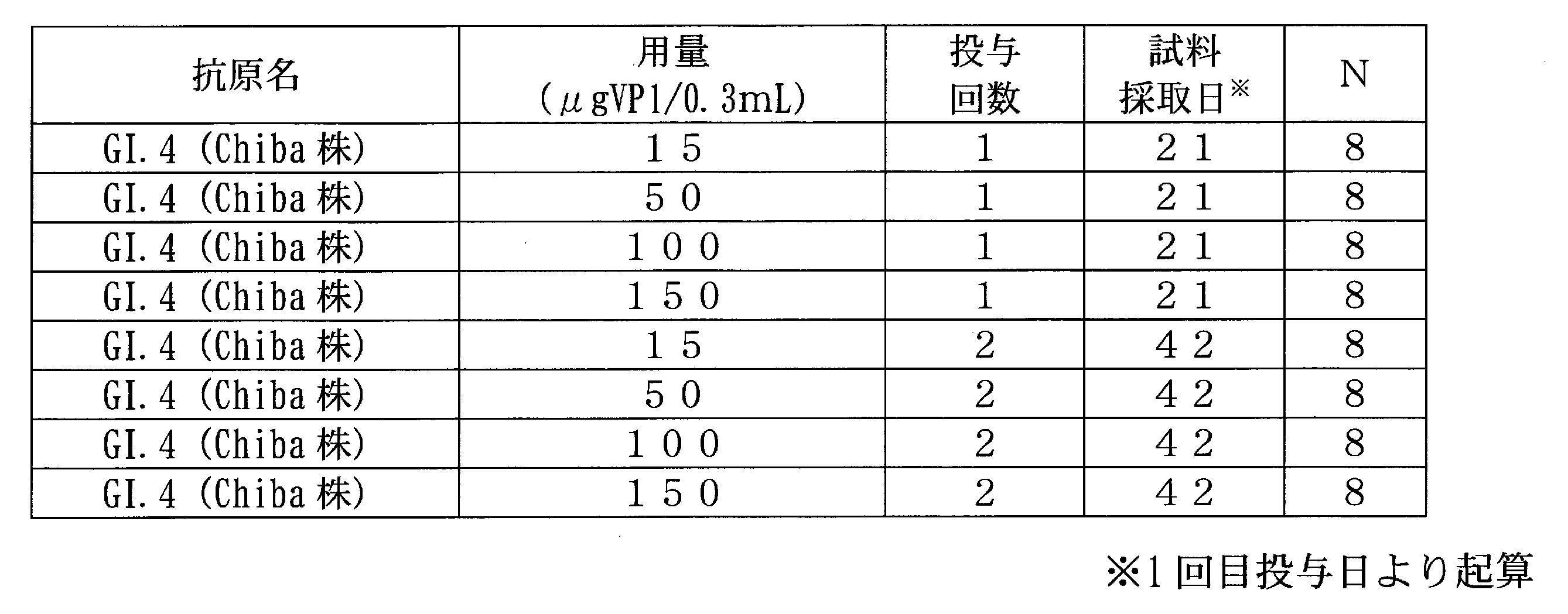
- the administration solution (Table 1) was administered subcutaneously to BALB/c mice at 0.3 mL per mouse once or twice at 3-week intervals. 21 and 42 days after the first administration, whole blood was collected (from 8 mice per time point) and intestinal lavage fluid was collected. Serum was prepared from the collected blood by centrifugation. In addition, intestinal lavage fluid was prepared by removing approximately 10 cm of the small intestine, inserting a pipette into the lumen of the removed small intestine, and pouring in 1 mL of D-PBS containing 0.175% BSA and protease inhibitor (Thermo Fisher Scientific), and the collected solution was used as intestinal lavage fluid. The serum was used to measure the IgG titer binding to GI.4 (Chiba strain), and the intestinal lavage fluid was used to measure the IgG and IgA titers binding to GI.4 (Chiba strain).
- the virus-specific IgG titer of the serum is shown in FIG. 1, and it was confirmed that the IgG antibody titer was increased dose-dependently at 15 ⁇ g to 150 ⁇ g in a comparison of the single-administration group. On the other hand, the IgG titer was similar at 15 ⁇ g to 150 ⁇ g in a double-administration.
- the virus-specific IgG titer in the intestinal mucosa, which is the site of infection with norovirus, is shown in FIG. 2A, and the IgA titer is shown in FIG. 2B.
- the IgG antibody titer of the intestinal lavage solution was confirmed to be increased dose-dependently at 15 ⁇ g to 150 ⁇ g in a comparison of the single-administration group.
- no clear antibody induction was confirmed for the IgA antibody titer at any dose or number of administrations.
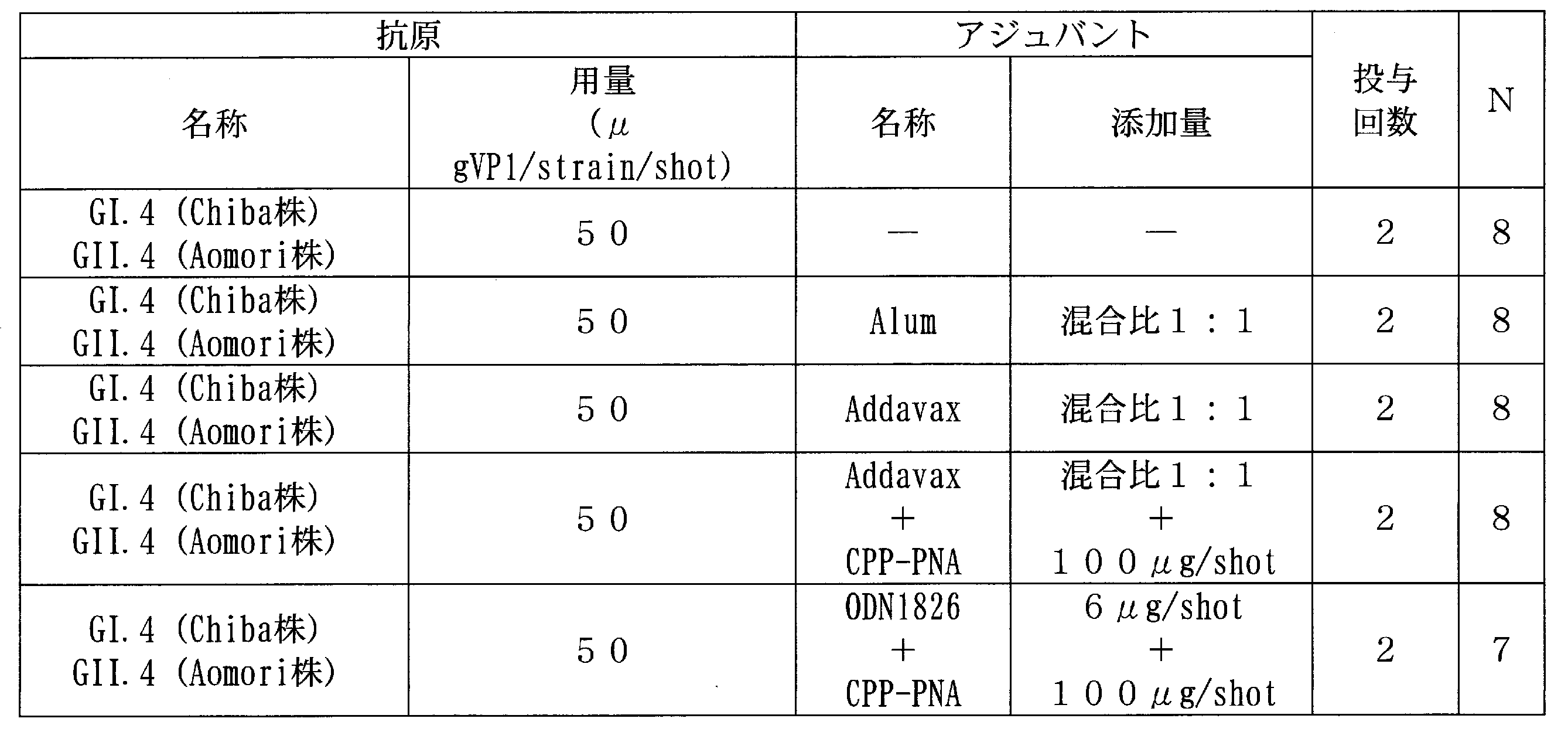
- Example 1 Adjuvant Evaluation Test VLPs of GI.4 (Chiba strain) and GII.4 (Aomori strain) were mixed with an adjuvant so that VP1 protein was 50 ⁇ g VP1 per 0.4 mL.
- the adjuvants used here were Alum, which has a proven track record as an adjuvant for norovirus vaccines, Addavax, a squalene-containing emulsion, ODN1826, a TLR9 agonist, and CPP-PNA of the formula (1) in which C10PNA is covalently bonded to a peptide consisting of 13 amino acids derived from HIV TAT.
- a control solution containing only the antigen without the addition of an adjuvant was also prepared.
- the dosing solution (Table 2) prepared as described above was administered subcutaneously to BALB/c mice at 0.4 mL per mouse once or twice at 3-week intervals. 21 days after the first administration, 120 ⁇ L of blood was collected from the jugular vein, and 42 days after the first administration (21 days after the second administration), whole blood was collected (from 8 mice per time point) and intestinal lavage fluid was collected. The collected blood was centrifuged to prepare serum, and the IgG titer binding to GI.4 (Chiba strain) or GII.4 (Aomori strain) and the PGM binding inhibitory activity of the serum were measured. In addition, the IgG titer and IgA titer binding to GI.4 (Chiba strain) or GII.4 (Aomori strain) were measured for the intestinal lavage fluid.
- the serum IgG titers after a single administration are shown in Figures 3A and 3B.
- GI. 4 Choba strain
- GII. 4 Aomori strain
- antibody induction was confirmed to be significantly improved in all adjuvant-administered groups compared to the non-adjuvant-administered group.
- Alum which has a proven track record as an adjuvant for norovirus vaccines
- antibody induction was confirmed to be significantly improved in the Addavax-administered group for GI.
- the IgG titers of serum after two doses are shown in Figures 4A and 4B.
- As with one dose it was confirmed that antibody induction was significantly improved in all adjuvant-administered groups after two doses compared to the non-adjuvant-administered groups for both GI. 4 (Chiba strain) and GII. 4 (Aomori strain).
- As compared with the Alum-administered groups it was confirmed that antibody induction was significantly improved in the Addavax-administered group for GI. 4 (Chiba strain), and in the Addavax-administered group and the Adavax and CPP-PNA co-administered group for GII. 4 (Aomori strain).
- the ODN1826 and CPP-PNA co-administered group showed antibody induction at the same level as Alum.
- the IgG titers in the intestinal lavage fluid after two doses are shown in Figures 5A and 5B.
- the IgA titers of the intestinal lavage fluid administered twice are shown in Figures 6A and 6B.
- GI.4 Choba strain
- GII.4 Himori strain
- the non-adjuvant-administered groups did not induce IgA antibodies in the intestinal tract, or induced them at a very low level.
- the induction of IgA antibodies was significantly improved in all adjuvant-administered groups compared to the non-adjuvant-administered groups, and among them, it was found that the antibody induction was significantly improved in the Addavax-administered group and the Addavax and CPP-PNA co-administered group.
- the ODN1826 and CPP-PNA co-administered group showed a higher antibody titer than the non-adjuvant-administered group and Alum, but the antibody titers were inferior to those of Addavax and the Addavax and CPP-PNA co-administered group.
- the PGM binding inhibitory activity of the serum administered twice is shown in Figures 7A and 7B. It was confirmed that the PGM binding inhibitory activity of both GI.4 (Chiba strain) and GII.4 (Aomori strain) was significantly improved in all adjuvant-administered groups compared to the non-adjuvant-administered group. In addition, in comparison with Alum, it was confirmed that antibody induction was significantly improved in the Addavax-administered group and the Addavax and CPP-PNA co-administered group in GII.4 (Aomori strain). However, the ODN1826 and CPP-PNA co-administered group had the same level of antibody induction as Alum.
- the norovirus vaccine in which the squalene-containing emulsion Addavax or a mixed adjuvant of Addavax and cell membrane-permeable peptide nucleic acid (CPP-PNA) was added to the antigen not only improved the serum IgG antibody titer and PGM binding inhibitory activity, but also improved the IgG antibody titer and IgA antibody titer on the intestinal mucosa, which is the site of norovirus infection. Therefore, it was suggested that the norovirus vaccine of the present invention may be an excellent vaccine for preventing norovirus infection in the intestinal tract.
Landscapes
- Health & Medical Sciences (AREA)
- Life Sciences & Earth Sciences (AREA)
- Chemical & Material Sciences (AREA)
- Pharmacology & Pharmacy (AREA)
- General Health & Medical Sciences (AREA)
- Veterinary Medicine (AREA)
- Public Health (AREA)
- Animal Behavior & Ethology (AREA)
- Medicinal Chemistry (AREA)
- Virology (AREA)
- Immunology (AREA)
- Chemical Kinetics & Catalysis (AREA)
- Epidemiology (AREA)
- General Chemical & Material Sciences (AREA)
- Engineering & Computer Science (AREA)
- Organic Chemistry (AREA)
- Nuclear Medicine, Radiotherapy & Molecular Imaging (AREA)
- Oncology (AREA)
- Microbiology (AREA)
- Mycology (AREA)
- Communicable Diseases (AREA)
- Molecular Biology (AREA)
- Bioinformatics & Cheminformatics (AREA)
- Oil, Petroleum & Natural Gas (AREA)
- Dispersion Chemistry (AREA)
- Medicines Containing Antibodies Or Antigens For Use As Internal Diagnostic Agents (AREA)
Abstract
Description
したがって、VLPをワクチン抗原とするノロウイルスワクチンは未だ開発段階であり、より有効性の高いワクチンの開発が望まれている。
1)腸管粘膜にウイルス特異的抗体を誘導するノロウイルスワクチン組成物であって、ノロウイルスウイルス様粒子及びスクワレン含有エマルジョンを含む組成物。
2)ノロウイルスウイルス様粒子がGenogroupI又はGenogroupIIのいずれか又は両方のノロウイルスから作製されたものである、1)の組成物。
3)さらに、細胞膜透過ペプチド核酸を含有する、1)又は2)の組成物。
4)ノロウイルスウイルス様粒子をVP1タンパク質含量として1株あたり15μg以上含有する、1)~3)のいずれかの組成物。
5)非経口投与によって投与される、1)~4)のいずれかの組成物。
VLPは、ウイルスのカプシドを細胞中で発現させた組換えタンパク質であり、ノロウイルスに形態的に類似し、内部に遺伝子を持たないウイルス様中空粒子である。
VLPの作製に用いられるノロウイルスとしては、現在知られているすべてのGenogroupI(GI)及びGenogroupII(GII)の遺伝子型及び将来単離、同定される遺伝子型を包含し、適宜選択して使用することができる。すなわち、本発明のノロウイルスワクチンは、GI又はGIIの一方のみの遺伝子型を含む単価ワクチンでもよく、複数の遺伝子型を含む多価ワクチンであっても良い。好ましくはGI及びGIIの複数の遺伝子型を含む多価ワクチンであり、より好ましくはGIから1種類以上の遺伝子型及びGIIから1種類以上の遺伝子型を含む多価ワクチンである。
上記昆虫細胞を使用して調製されるノロウイルスワクチン抗原は、例えば、組換えバキュロウイルス感染後、26~28℃で5~10日間程度の培養が行われ、培養終了後、感染細胞の培養上清が回収され、清澄化のため遠心分離及び濾過が行われる。次いで、濃縮のための限外濾過、並びに精製は密度勾配遠心分離やクロマトグラフィー等の手段を用いて行うことができる。
スクワレン含有エマルジョンは、スクワレンを投与当りに3~15mg、好ましくは5~10mg含有する水中油型乳濁液であり、スクワレンの他に界面活性剤(例えば、ポリオキシエチレンソルビタンモノオレエート、ソルビタントリオレエート等)、トコフェロール等の抗酸化剤、免疫賦活剤等を含有することもできる。スクワレン含有エマルジョンは1ミクロン未満の粒子になるように処方されたナノ乳剤であり得る。
市販品としては、例えばAddavax(商標)(InvivoGen社;以下、「Addavax」と称する)、Ribi(Sigma社)、MF59(商標)等が挙げられる。
CPP-PNAは、CPPのN若しくはC末端に、化学的手法、例えば、N-ヒドロキシスクシンイミドエステルを両末端に有する架橋剤を介してCPPとPNAのN末端間を共有結合させることにより製造することができる。なお、PNAは、例えばFmoc型PNAモノマーユニット等を用い、当技術分野で公知の固相ペプチド合成法を利用して合成することができる。

また、本発明のノロウイルスワクチン組成物の投与回数は、1回又は2回以上の投与が挙げられ、好ましくは複数回の投与である。この場合、1~4週間の間隔をあけて投与することが好ましい。
GI.4(Chiba株)のVLPを抗原とし、0.3mL当りにVP1タンパク質が15μg、50μg、100μg、又は150μgとなるように15w/w%しょ糖含有リン酸緩衝生理食塩液(pH7.2)で調製し、これをノロウイルスワクチンとした。
High Five細胞にウイルスシードをMOI=1で感染させ、回収の前日にベンゾナーゼを添加し、27℃で合計6日間撹拌培養した。培養終了後、回収した感染細胞の培養上清は遠心分離及びフィルター濾過にて清澄化させ、限外濾過により濃縮及び2w/w%しょ糖含有リン酸緩衝生理食塩液(pH7.2)へ置換した。バキュロウイルスの感染性を不活化するため、終濃度0.05%となるように不活化剤であるベータプロピオラクトンを添加して、4℃、12時間で反応させ、さらにウイルス除去フィルター(0.1μm)でバキュロウイルス粒子を除去した。このウイルス除去後に、セシウム密度勾配遠心でVP1を含む画分を回収し、再度、限外濾過により濃縮及び15w/w%しょ糖含有リン酸緩衝生理食塩液(pH7.2)へ置換した。この精製VLPを26,000×gで30分間の超遠心後、さらに、上清をウイルス除去フィルター(0.1μm)で濾過して、これをワクチン抗原とした。
この結果より、VP1タンパク質1株あたり15μg以上においては、複数回の投与を行うことでIgG抗体誘導に大きな差はなく、いずれも高いIgG抗体誘導能を示したが、ノロウイルス抗原(VLP)のみでは腸管粘膜に特異的なIgA抗体を誘導することが難しいと考えられた。
GI.4(Chiba株)及びGII.4(Aomori株)のVLPを、それぞれ0.4mL当りにVP1タンパク質が50μgVP1となるようアジュバントを混合した。ここで用いたアジュバントは、ノロウイルスワクチンのアジュバントとして実績のあるAlum、スクワレン含有エマルジョンであるAddavax、TLR9アゴニストであるODN1826、HIVのTAT由来の13アミノ酸からなるペプチドにC10PNAを共有結合した前記式(1)のCPP-PNAである。また、対照としてアジュバントを添加しない抗原のみの投与液も併せて調製した。
上記の結果より、抗原にスクワレン含有エマルジョンであるAddavax又はAddavaxと細胞膜透過ペプチド核酸(CPP-PNA)の混合アジュバントを添加したノロウイルスワクチンは、血清のIgG抗体価やPGM結合阻害活性が向上するだけでなく、ノロウイルスの感染局所である腸管粘膜上のIgG抗体価及びIgA抗体価も向上させることを確認した。したがって、本発明のノロウイルスワクチンは腸管におけるノロウイルスの感染防御に優れたワクチンとなる可能性が示唆された。
Claims (5)
- 腸管粘膜にウイルス特異的抗体を誘導するノロウイルスワクチン組成物であって、ノロウイルスウイルス様粒子及びスクワレン含有エマルジョンを含む組成物。
- ノロウイルスウイルス様粒子がGenogroupI又はGenogroupIIのいずれか又は両方のノロウイルスから作製されたものである、請求項1記載の組成物。
- さらに、細胞膜透過ペプチド核酸を含有する、請求項1又は2記載の組成物。
- ノロウイルスウイルス様粒子をVP1タンパク質含量として1株あたり15μg以上含有する、請求項1~3のいずれか1項記載の組成物。
- 非経口投与によって投与される、請求項1~4のいずれか1項記載の組成物。
Priority Applications (2)
| Application Number | Priority Date | Filing Date | Title |
|---|---|---|---|
| JP2025509627A JPWO2024202045A1 (ja) | 2023-03-31 | 2023-03-31 | |
| PCT/JP2023/013640 WO2024202045A1 (ja) | 2023-03-31 | 2023-03-31 | 腸管へのウイルス特異的な抗体誘導が可能なノロウイルスワクチン |
Applications Claiming Priority (1)
| Application Number | Priority Date | Filing Date | Title |
|---|---|---|---|
| PCT/JP2023/013640 WO2024202045A1 (ja) | 2023-03-31 | 2023-03-31 | 腸管へのウイルス特異的な抗体誘導が可能なノロウイルスワクチン |
Publications (1)
| Publication Number | Publication Date |
|---|---|
| WO2024202045A1 true WO2024202045A1 (ja) | 2024-10-03 |
Family
ID=92904610
Family Applications (1)
| Application Number | Title | Priority Date | Filing Date |
|---|---|---|---|
| PCT/JP2023/013640 Ceased WO2024202045A1 (ja) | 2023-03-31 | 2023-03-31 | 腸管へのウイルス特異的な抗体誘導が可能なノロウイルスワクチン |
Country Status (2)
| Country | Link |
|---|---|
| JP (1) | JPWO2024202045A1 (ja) |
| WO (1) | WO2024202045A1 (ja) |
Citations (5)
| Publication number | Priority date | Publication date | Assignee | Title |
|---|---|---|---|---|
| CN113679831A (zh) * | 2021-08-17 | 2021-11-23 | 四川大学 | 一种注射用水包油型乳剂黏膜疫苗及其制备方法和应用 |
| CN113713093A (zh) * | 2021-08-31 | 2021-11-30 | 中国人民解放军陆军军医大学 | 一种新型高效增强体液免疫应答和粘膜免疫应答的维甲酸纳米乳佐剂及其制备方法和应用 |
| JP2022514759A (ja) * | 2018-12-20 | 2022-02-15 | タケダ ワクチン,インコーポレイテッド | ノロウイルスワクチン製剤及び方法 |
| WO2022180534A1 (en) * | 2021-02-23 | 2022-09-01 | Universita' Degli Studi Di Milano | Vaccine composition comprising a leishmania host cell expressing at least one protein of the family coronaviridae |
| WO2022215737A1 (ja) * | 2021-04-07 | 2022-10-13 | デンカ株式会社 | アジュバント活性増強剤及びアジュバント組成物 |
-
2023
- 2023-03-31 JP JP2025509627A patent/JPWO2024202045A1/ja active Pending
- 2023-03-31 WO PCT/JP2023/013640 patent/WO2024202045A1/ja not_active Ceased
Patent Citations (5)
| Publication number | Priority date | Publication date | Assignee | Title |
|---|---|---|---|---|
| JP2022514759A (ja) * | 2018-12-20 | 2022-02-15 | タケダ ワクチン,インコーポレイテッド | ノロウイルスワクチン製剤及び方法 |
| WO2022180534A1 (en) * | 2021-02-23 | 2022-09-01 | Universita' Degli Studi Di Milano | Vaccine composition comprising a leishmania host cell expressing at least one protein of the family coronaviridae |
| WO2022215737A1 (ja) * | 2021-04-07 | 2022-10-13 | デンカ株式会社 | アジュバント活性増強剤及びアジュバント組成物 |
| CN113679831A (zh) * | 2021-08-17 | 2021-11-23 | 四川大学 | 一种注射用水包油型乳剂黏膜疫苗及其制备方法和应用 |
| CN113713093A (zh) * | 2021-08-31 | 2021-11-30 | 中国人民解放军陆军军医大学 | 一种新型高效增强体液免疫应答和粘膜免疫应答的维甲酸纳米乳佐剂及其制备方法和应用 |
Non-Patent Citations (5)
| Title |
|---|
| HERNANDEZ-DAVIES JENNY E., DOLLINGER EMMANUEL P., PONE EGEST J., FELGNER JIIN, LIANG LI, STROHMEIER SHIRIN, JAN SHARON, ALBIN TYLE: "Magnitude and breadth of antibody cross-reactivity induced by recombinant influenza hemagglutinin trimer vaccine is enhanced by combination adjuvants", SCIENTIFIC REPORTS, vol. 12, no. 1, 1 January 2022 (2022-01-01), US , pages 1 - 20, XP093218138, ISSN: 2045-2322, DOI: 10.1038/s41598-022-12727-y * |
| LIN XUAN, SHENG YANAN, ZHANG XUAN, LI ZHENGJUN, YANG YANLI, WU JIE, SU ZHIGUO, MA GUANGHUI, ZHANG SONGPING: "Oil-in-ionic liquid nanoemulsion-based intranasal delivery system for influenza split-virus vaccine", JOURNAL OF CONTROLLED RELEASE, vol. 346, 1 June 2022 (2022-06-01), AMSTERDAM, NL , pages 380 - 391, XP093218142, ISSN: 0168-3659, DOI: 10.1016/j.jconrel.2022.04.036 * |
| NAGISA NAKATA, TAKENORI OIKAWA, TOMOHIRO NARAHARA, RYOTAROU MITSUMATA: "O5-2 Suitable adjuvants far Recombinant Norovirus Vaccine", BPB REPORTS, vol. 5, no. Suppl., 1 August 2022 (2022-08-01), JP, pages 164, XP009560203, ISSN: 2434-432X * |
| NAKATA, NAGISA ET AL: "2-3-9: Immunological properties of norovirus adjuvant vaccine", PROGRAM AND ABSTRACTS OF THE ANNUAL MEETING OF THE JAPANESE SOCIETY FOR VACCINOLOGY, vol. 26, 1 January 2022 (2022-01-01), JP, pages 134, XP009559864 * |
| ONODERA, TAISHI ET AL.: "Viral infection and vaccines, Humoral immune response to norovirus infection and vaccine research", CLINICAL IMMUNOLOGY AND ALLERGY, vol. 76, no. 1, 1 January 2021 (2021-01-01), JP , pages 8 - 14, XP009559863, ISSN: 1881-1930 * |
Also Published As
| Publication number | Publication date |
|---|---|
| JPWO2024202045A1 (ja) | 2024-10-03 |
Similar Documents
| Publication | Publication Date | Title |
|---|---|---|
| JP6896700B2 (ja) | ワクチン組成物 | |
| JP6774149B2 (ja) | エンテロウイルス感染に対する免疫原としてのウイルス粒子およびその生産 | |
| US9844588B2 (en) | Inactivated chikungunya viruses (CHIKV) comprising an E1-K211E mutation | |
| KR101847472B1 (ko) | 혼합 백신으로 사용하기 위한 노로바이러스 캡시드 및 로타바이러스 vp6 단백질 | |
| Wen et al. | Inclusion of a universal tetanus toxoid CD4+ T cell epitope P2 significantly enhanced the immunogenicity of recombinant rotavirus ΔVP8* subunit parenteral vaccines | |
| WO2006031795A2 (en) | Hemorrhagic feline calicivirus, calicivirus vaccine and method for preventing calicivirus infection or disease | |
| US11576960B2 (en) | Respiratory syncytial virus (RSV) vaccines | |
| US20040047882A1 (en) | Adjuvant for vaccines | |
| Huhti et al. | Characterization and immunogenicity of norovirus capsid-derived virus-like particles purified by anion exchange chromatography | |
| JP6985384B2 (ja) | 弱毒変異型ジカウイルスを含むワクチン組成物 | |
| JP2022514759A (ja) | ノロウイルスワクチン製剤及び方法 | |
| CN113329767B (zh) | 肠道病毒对vero细胞的适应及其疫苗制剂 | |
| Allam et al. | Perspective vaccines for emerging viral diseases in farm animals | |
| JP2023128573A (ja) | 腸管へのウイルス特異的な抗体誘導が可能なノロウイルスワクチン | |
| JP7515611B2 (ja) | 口蹄疫ウイルス様粒子抗原、及びそのワクチン組成物、調製方法と使用 | |
| JP4873632B2 (ja) | 改良された不活化fcvワクチン | |
| EP2632487A2 (en) | Viral vaccine and process for preparing the same | |
| JP2025516762A (ja) | Moritella viscosaに対するワクチン | |
| KR100934687B1 (ko) | 고양이 칼리시바이러스 질병에 대한 불활성화 백신 | |
| US20240269270A1 (en) | Covid-19 vaccines with tocopherol-containing squalene emulsion adjuvants | |
| JP2024510065A (ja) | 防御免疫の送達における、sars-cov-2受容体結合ドメインに基づくワクチン組成物の使用 | |
| KR20210065952A (ko) | 불활화 전입자 인플루엔자 백신 및 그 조제법 | |
| WO2024195868A1 (ja) | ノロウイルスワクチン組成物 | |
| CN116457011A (zh) | 用于治疗冠状病毒的疫苗组合物 | |
| MXPA05003413A (es) | Uso del peptido gk-1 para potencial la respuesta inmunologica generada por la vacuna de influenza. |
Legal Events
| Date | Code | Title | Description |
|---|---|---|---|
| 121 | Ep: the epo has been informed by wipo that ep was designated in this application |
Ref document number: 23930679 Country of ref document: EP Kind code of ref document: A1 |
|
| ENP | Entry into the national phase |
Ref document number: 2025509627 Country of ref document: JP Kind code of ref document: A |
|
| WWE | Wipo information: entry into national phase |
Ref document number: 2025509627 Country of ref document: JP |
|
| NENP | Non-entry into the national phase |
Ref country code: DE |
|
| 122 | Ep: pct application non-entry in european phase |
Ref document number: 23930679 Country of ref document: EP Kind code of ref document: A1 |