WO2024201809A1 - ハニカムフィルタ - Google Patents
ハニカムフィルタ Download PDFInfo
- Publication number
- WO2024201809A1 WO2024201809A1 PCT/JP2023/012886 JP2023012886W WO2024201809A1 WO 2024201809 A1 WO2024201809 A1 WO 2024201809A1 JP 2023012886 W JP2023012886 W JP 2023012886W WO 2024201809 A1 WO2024201809 A1 WO 2024201809A1
- Authority
- WO
- WIPO (PCT)
- Prior art keywords
- cells
- cell
- inflow
- outflow
- honeycomb filter
- Prior art date
- Legal status (The legal status is an assumption and is not a legal conclusion. Google has not performed a legal analysis and makes no representation as to the accuracy of the status listed.)
- Ceased
Links
Images

Classifications
-
- B—PERFORMING OPERATIONS; TRANSPORTING
- B01—PHYSICAL OR CHEMICAL PROCESSES OR APPARATUS IN GENERAL
- B01D—SEPARATION
- B01D39/00—Filtering material for liquid or gaseous fluids
- B01D39/14—Other self-supporting filtering material ; Other filtering material
- B01D39/20—Other self-supporting filtering material ; Other filtering material of inorganic material, e.g. asbestos paper, metallic filtering material of non-woven wires
-
- B—PERFORMING OPERATIONS; TRANSPORTING
- B01—PHYSICAL OR CHEMICAL PROCESSES OR APPARATUS IN GENERAL
- B01D—SEPARATION
- B01D46/00—Filters or filtering processes specially modified for separating dispersed particles from gases or vapours
-
- B—PERFORMING OPERATIONS; TRANSPORTING
- B01—PHYSICAL OR CHEMICAL PROCESSES OR APPARATUS IN GENERAL
- B01D—SEPARATION
- B01D46/00—Filters or filtering processes specially modified for separating dispersed particles from gases or vapours
- B01D46/24—Particle separators, e.g. dust precipitators, using rigid hollow filter bodies
- B01D46/2403—Particle separators, e.g. dust precipitators, using rigid hollow filter bodies characterised by the physical shape or structure of the filtering element
- B01D46/2418—Honeycomb filters
- B01D46/2425—Honeycomb filters characterized by parameters related to the physical properties of the honeycomb structure material
- B01D46/2429—Honeycomb filters characterized by parameters related to the physical properties of the honeycomb structure material of the honeycomb walls or cells
-
- B—PERFORMING OPERATIONS; TRANSPORTING
- B01—PHYSICAL OR CHEMICAL PROCESSES OR APPARATUS IN GENERAL
- B01D—SEPARATION
- B01D46/00—Filters or filtering processes specially modified for separating dispersed particles from gases or vapours
- B01D46/24—Particle separators, e.g. dust precipitators, using rigid hollow filter bodies
- B01D46/2403—Particle separators, e.g. dust precipitators, using rigid hollow filter bodies characterised by the physical shape or structure of the filtering element
- B01D46/2418—Honeycomb filters
- B01D46/2425—Honeycomb filters characterized by parameters related to the physical properties of the honeycomb structure material
- B01D46/24491—Porosity
-
- B—PERFORMING OPERATIONS; TRANSPORTING
- B01—PHYSICAL OR CHEMICAL PROCESSES OR APPARATUS IN GENERAL
- B01D—SEPARATION
- B01D46/00—Filters or filtering processes specially modified for separating dispersed particles from gases or vapours
- B01D46/24—Particle separators, e.g. dust precipitators, using rigid hollow filter bodies
- B01D46/2403—Particle separators, e.g. dust precipitators, using rigid hollow filter bodies characterised by the physical shape or structure of the filtering element
- B01D46/2418—Honeycomb filters
- B01D46/2451—Honeycomb filters characterized by the geometrical structure, shape, pattern or configuration or parameters related to the geometry of the structure
- B01D46/2459—Honeycomb filters characterized by the geometrical structure, shape, pattern or configuration or parameters related to the geometry of the structure of the plugs
-
- B—PERFORMING OPERATIONS; TRANSPORTING
- B01—PHYSICAL OR CHEMICAL PROCESSES OR APPARATUS IN GENERAL
- B01D—SEPARATION
- B01D46/00—Filters or filtering processes specially modified for separating dispersed particles from gases or vapours
- B01D46/24—Particle separators, e.g. dust precipitators, using rigid hollow filter bodies
- B01D46/2403—Particle separators, e.g. dust precipitators, using rigid hollow filter bodies characterised by the physical shape or structure of the filtering element
- B01D46/2418—Honeycomb filters
- B01D46/2451—Honeycomb filters characterized by the geometrical structure, shape, pattern or configuration or parameters related to the geometry of the structure
- B01D46/247—Honeycomb filters characterized by the geometrical structure, shape, pattern or configuration or parameters related to the geometry of the structure of the cells
-
- B—PERFORMING OPERATIONS; TRANSPORTING
- B01—PHYSICAL OR CHEMICAL PROCESSES OR APPARATUS IN GENERAL
- B01D—SEPARATION
- B01D46/00—Filters or filtering processes specially modified for separating dispersed particles from gases or vapours
- B01D46/24—Particle separators, e.g. dust precipitators, using rigid hollow filter bodies
- B01D46/2403—Particle separators, e.g. dust precipitators, using rigid hollow filter bodies characterised by the physical shape or structure of the filtering element
- B01D46/2418—Honeycomb filters
- B01D46/2451—Honeycomb filters characterized by the geometrical structure, shape, pattern or configuration or parameters related to the geometry of the structure
- B01D46/2474—Honeycomb filters characterized by the geometrical structure, shape, pattern or configuration or parameters related to the geometry of the structure of the walls along the length of the honeycomb
-
- B—PERFORMING OPERATIONS; TRANSPORTING
- B01—PHYSICAL OR CHEMICAL PROCESSES OR APPARATUS IN GENERAL
- B01D—SEPARATION
- B01D46/00—Filters or filtering processes specially modified for separating dispersed particles from gases or vapours
- B01D46/24—Particle separators, e.g. dust precipitators, using rigid hollow filter bodies
- B01D46/2403—Particle separators, e.g. dust precipitators, using rigid hollow filter bodies characterised by the physical shape or structure of the filtering element
- B01D46/2418—Honeycomb filters
- B01D46/2451—Honeycomb filters characterized by the geometrical structure, shape, pattern or configuration or parameters related to the geometry of the structure
- B01D46/2476—Monolithic structures
-
- B—PERFORMING OPERATIONS; TRANSPORTING
- B01—PHYSICAL OR CHEMICAL PROCESSES OR APPARATUS IN GENERAL
- B01D—SEPARATION
- B01D46/00—Filters or filtering processes specially modified for separating dispersed particles from gases or vapours
- B01D46/24—Particle separators, e.g. dust precipitators, using rigid hollow filter bodies
- B01D46/2403—Particle separators, e.g. dust precipitators, using rigid hollow filter bodies characterised by the physical shape or structure of the filtering element
- B01D46/2418—Honeycomb filters
- B01D46/2451—Honeycomb filters characterized by the geometrical structure, shape, pattern or configuration or parameters related to the geometry of the structure
- B01D46/2482—Thickness, height, width, length or diameter
-
- B—PERFORMING OPERATIONS; TRANSPORTING
- B01—PHYSICAL OR CHEMICAL PROCESSES OR APPARATUS IN GENERAL
- B01D—SEPARATION
- B01D46/00—Filters or filtering processes specially modified for separating dispersed particles from gases or vapours
- B01D46/24—Particle separators, e.g. dust precipitators, using rigid hollow filter bodies
- B01D46/2403—Particle separators, e.g. dust precipitators, using rigid hollow filter bodies characterised by the physical shape or structure of the filtering element
- B01D46/2418—Honeycomb filters
- B01D46/2451—Honeycomb filters characterized by the geometrical structure, shape, pattern or configuration or parameters related to the geometry of the structure
- B01D46/2484—Cell density, area or aspect ratio
-
- B—PERFORMING OPERATIONS; TRANSPORTING
- B01—PHYSICAL OR CHEMICAL PROCESSES OR APPARATUS IN GENERAL
- B01D—SEPARATION
- B01D46/00—Filters or filtering processes specially modified for separating dispersed particles from gases or vapours
- B01D46/24—Particle separators, e.g. dust precipitators, using rigid hollow filter bodies
- B01D46/2403—Particle separators, e.g. dust precipitators, using rigid hollow filter bodies characterised by the physical shape or structure of the filtering element
- B01D46/2418—Honeycomb filters
- B01D46/2451—Honeycomb filters characterized by the geometrical structure, shape, pattern or configuration or parameters related to the geometry of the structure
- B01D46/2486—Honeycomb filters characterized by the geometrical structure, shape, pattern or configuration or parameters related to the geometry of the structure characterised by the shapes or configurations
- B01D46/249—Quadrangular e.g. square or diamond
-
- B—PERFORMING OPERATIONS; TRANSPORTING
- B01—PHYSICAL OR CHEMICAL PROCESSES OR APPARATUS IN GENERAL
- B01D—SEPARATION
- B01D46/00—Filters or filtering processes specially modified for separating dispersed particles from gases or vapours
- B01D46/24—Particle separators, e.g. dust precipitators, using rigid hollow filter bodies
- B01D46/2403—Particle separators, e.g. dust precipitators, using rigid hollow filter bodies characterised by the physical shape or structure of the filtering element
- B01D46/2418—Honeycomb filters
- B01D46/2451—Honeycomb filters characterized by the geometrical structure, shape, pattern or configuration or parameters related to the geometry of the structure
- B01D46/2486—Honeycomb filters characterized by the geometrical structure, shape, pattern or configuration or parameters related to the geometry of the structure characterised by the shapes or configurations
- B01D46/2494—Octagonal
-
- B—PERFORMING OPERATIONS; TRANSPORTING
- B01—PHYSICAL OR CHEMICAL PROCESSES OR APPARATUS IN GENERAL
- B01D—SEPARATION
- B01D46/00—Filters or filtering processes specially modified for separating dispersed particles from gases or vapours
- B01D46/24—Particle separators, e.g. dust precipitators, using rigid hollow filter bodies
- B01D46/2403—Particle separators, e.g. dust precipitators, using rigid hollow filter bodies characterised by the physical shape or structure of the filtering element
- B01D46/2418—Honeycomb filters
- B01D46/2498—The honeycomb filter being defined by mathematical relationships
-
- F—MECHANICAL ENGINEERING; LIGHTING; HEATING; WEAPONS; BLASTING
- F01—MACHINES OR ENGINES IN GENERAL; ENGINE PLANTS IN GENERAL; STEAM ENGINES
- F01N—GAS-FLOW SILENCERS OR EXHAUST APPARATUS FOR MACHINES OR ENGINES IN GENERAL; GAS-FLOW SILENCERS OR EXHAUST APPARATUS FOR INTERNAL-COMBUSTION ENGINES
- F01N3/00—Exhaust or silencing apparatus having means for purifying, rendering innocuous, or otherwise treating exhaust
- F01N3/02—Exhaust or silencing apparatus having means for purifying, rendering innocuous, or otherwise treating exhaust for cooling, or for removing solid constituents of, exhaust
- F01N3/021—Exhaust or silencing apparatus having means for purifying, rendering innocuous, or otherwise treating exhaust for cooling, or for removing solid constituents of, exhaust by means of filters
- F01N3/022—Exhaust or silencing apparatus having means for purifying, rendering innocuous, or otherwise treating exhaust for cooling, or for removing solid constituents of, exhaust by means of filters characterised by specially adapted filtering structure, e.g. honeycomb, mesh or fibrous
-
- B—PERFORMING OPERATIONS; TRANSPORTING
- B01—PHYSICAL OR CHEMICAL PROCESSES OR APPARATUS IN GENERAL
- B01D—SEPARATION
- B01D2279/00—Filters adapted for separating dispersed particles from gases or vapours specially modified for specific uses
- B01D2279/30—Filters adapted for separating dispersed particles from gases or vapours specially modified for specific uses for treatment of exhaust gases from IC Engines
Definitions
- the present invention relates to a honeycomb filter. More specifically, the present invention relates to a honeycomb filter that has excellent regeneration efficiency during continuous regeneration in which particulate matter trapped on partition walls is burned and removed, and that can suppress an increase in pressure loss due to the accumulation of ash.
- diesel particulate filters filters for removing PM emitted from diesel engines are sometimes called diesel particulate filters.
- diesel particulate filters may be referred to as "DPFs.”
- DPFs diesel particulate filters
- honeycomb filters using a honeycomb structure are known (see, for example, Patent Documents 1 and 2).
- Exhaust gas purification using a honeycomb filter is carried out as follows. First, the honeycomb filter is positioned so that its inlet end face is located upstream of the exhaust system where the exhaust gas is discharged. The exhaust gas flows into the inlet cells from the inlet end face side of the honeycomb filter. The exhaust gas that flows into the inlet cells then passes through the porous partition walls, flows into the outlet cells, and is discharged from the outlet end face of the honeycomb filter.
- soot and other PM will accumulate in the DPF, reducing purification efficiency and increasing pressure loss in the DPF. Therefore, for example, in purification devices that use DPFs, a "regeneration process" is carried out to burn the soot and other PM that has accumulated in the DPF. If soot is burned when there is a large amount of soot accumulated in the DPF, the temperature inside the DPF will rise, which can lead to damage to the DPF. For this reason, it is important to efficiently burn the soot (in other words, the regeneration process).
- DPF regeneration processes include, for example, “forced regeneration” and “continuous regeneration” as described below.
- Forced regeneration is a process in which fuel is intentionally injected into the DPF to increase the gas temperature in the DPF and forcibly burn the soot accumulated in the DPF.
- continuous regeneration is a process in which NO in the exhaust gas is converted to NO2 by an oxidation catalyst, and the soot accumulated in the DPF is continuously burned using this as an oxidizing agent.
- continuous regeneration the DPF is supported with an oxidation catalyst for purifying exhaust gas, and regeneration can be performed continuously by the action of the catalyst.
- forced regeneration uses fuel to burn the soot, which may lead to a deterioration in fuel efficiency.
- Continuous regeneration requires the application of a relatively expensive precious metal as a catalyst.
- the present invention was made in consideration of the problems associated with the conventional technology.
- the present invention provides a honeycomb filter that has excellent regeneration efficiency during continuous regeneration and is capable of suppressing an increase in pressure loss due to the accumulation of ash.
- the present invention provides the following honeycomb filter.
- a columnar honeycomb structure having porous partition walls arranged to surround a plurality of cells that serve as a fluid flow path extending from an inflow end face to an outflow end face, and a plugging portion arranged to plug either one of the inflow end face side or the outflow end face side of the cells,
- the plugging portion is disposed at an end portion on the outflow end surface side, and the cell having an opening on the inflow end surface side is defined as an inflow cell
- the plugging portion is disposed at an end portion on the inflow end face side, and the cell having an open outflow end face side is defined as an outflow cell
- the cross-sectional shape of the inflow cells is octagonal or quadrangular, except for the cells arranged on the outermost periphery of the honeycomb structure, and the cross-sectional shape of the outflow cells is quadrangular
- the honeycomb structure has a cell density of 49 to 70 cells/ cm2 ;
- the thickness 49 to 70 cells/ cm2 ;
- the honeycomb filter of the present invention has excellent regeneration efficiency during continuous regeneration in which PM such as soot is burned and removed, and can effectively suppress the increase in pressure loss caused by the accumulation of ash.
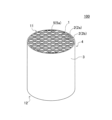
- FIG. 1 is a perspective view seen from the inflow end face side, which diagrammatically shows one embodiment of a honeycomb filter of the present invention.
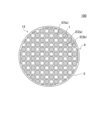
- FIG. FIG. 2 is a plan view of the honeycomb filter shown in FIG. 1 as viewed from an inlet end face side.
- FIG. 2 is a plan view of the honeycomb filter shown in FIG. 1 as viewed from the outflow end face side.
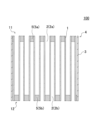
- 3 is a cross-sectional view showing a schematic cross section taken along the line A-A' in FIG. 2.
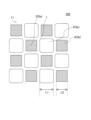
- 3 is an enlarged plan view showing a part of an inflow end face of the honeycomb filter shown in FIG. 2 .
- Honeycomb filter One embodiment of the honeycomb filter of the present invention is a honeycomb filter 100 as shown in Figures 1 to 5.
- Figure 1 is a perspective view seen from the inflow end face side, which typically shows one embodiment of the honeycomb filter of the present invention.
- Figure 2 is a plan view seen from the inflow end face side of the honeycomb filter shown in Figure 1
- Figure 3 is a plan view seen from the outflow end face side of the honeycomb filter shown in Figure 1.
- Figure 4 is a cross-sectional view typically showing the A-A' cross section of Figure 2.
- Figure 5 is an enlarged plan view of a portion of the inflow end face of the honeycomb filter shown in Figure 2.
- the honeycomb filter 100 comprises a honeycomb structure 4 and plugging portions 5.
- the honeycomb structure 4 has porous partition walls 1 arranged to surround a plurality of cells 2 that serve as fluid flow paths extending from the inflow end face 11 to the outflow end face 12.
- the honeycomb structure 4 is a columnar structure having the inflow end face 11 and the outflow end face 12 as both end faces.
- the cell 2 means the space surrounded by the partition walls 1.
- the honeycomb structure 4 constituting the honeycomb filter 100 further has an outer peripheral wall 3 arranged on its outer peripheral side so as to surround the partition walls 1.
- the plugging portion 5 is disposed at either the end of the cell 2 on the inflow end face 11 side or the end of the cell 2 on the outflow end face 12 side, and plugs the opening of the cell 2.
- the plugging portion 5 is porous (i.e., a porous body) made of a porous material.
- a predetermined cell 2 having a plugging portion 5 (inflow end face side plugging portion 5a) disposed at the end on the inflow end face 11 side and the remaining cells 2 having a plugging portion 5 (outflow end face side plugging portion 5b) disposed at the end on the outflow end face 12 side are alternately arranged with the partition wall 1 in between.
- the cell 2 having the plugging portion 5 disposed at the end on the inflow end face 11 side may be referred to as the "outflow cell 2b".
- the cell 2 having the plugging portion 5 disposed at the end on the outflow end face 12 side may be referred to as the "inflow cell 2a”.
- the cross-sectional shape of the inflow cells 2a is octagonal or rectangular
- the cross-sectional shape of the outflow cells 2b is rectangular, except for the cells 2 arranged on the outermost periphery of the honeycomb structure 4.
- a cell 2 whose periphery is surrounded only by partition walls 1 may be referred to as a "complete cell”.
- the cell 2 arranged on the outermost periphery of the honeycomb structure 4 (hereinafter simply referred to as the "outermost cell 2") is a cell 2 surrounded by partition walls 1 and the outer peripheral wall 3.
- the outermost cell 2 a part of the periphery of the cell 2 is partitioned by the outer peripheral wall 3, and it is an incomplete cell 2 in which a part of the complete cell is missing.
- Such cells 2 whose periphery is surrounded by the partition wall 1 and the outer peripheral wall 3 are sometimes called “incomplete cells,” and such incomplete cells are not included in the cells 2 that make up the inflow cells 2a and outflow cells 2b described above. Therefore, unless otherwise specified, when we simply refer to “inflow cells 2a” and “outflow cells 2b,” we are referring to the “inflow cells 2a” and "outflow cells 2b,” which are complete cells.
- the honeycomb filter 100 of this embodiment has particularly important characteristics in the cell density of the honeycomb structure 4, the thickness of the partition walls 1, and the configuration of the inflow cells 2a and the outflow cells 2b. That is, first, in the honeycomb structure 4, the cell density of the cells 2 defined by the partition walls 1 is 49 to 70 cells/ cm2 . Then, the thickness of the partition walls 1 constituting the honeycomb structure 4 is 0.152 mm or more. The upper limit of the thickness of the partition walls 1 is determined by the cell density of the honeycomb structure 4 and the opening diameter L1 of the inflow cells 2a and the opening diameter L2 of the outflow cells 2b described below.
- the opening diameter L1 of the inflow cells 2a is 1.16 to 1.40 mm
- the opening diameter L2 of the outflow cells 2b is 0.82 to 1.08 mm
- the ratio (L1/L2) of the opening diameter L1 of the inflow cells 2a to the opening diameter L2 of the outflow cells 2b is 1.30 to 1.53.
- the "ratio (L1/L2) of the opening diameter L1 of the inflow cells 2a to the opening diameter L2 of the outflow cells 2b" may be referred to as the "opening diameter ratio (L1/L2)" of the outflow cells 2b and the inflow cells 2a.
- the honeycomb filter 100 configured as above has excellent regeneration efficiency during continuous regeneration in which PM such as soot is burned and removed, and can effectively suppress the increase in pressure loss due to the accumulation of ash.
- the honeycomb filter 100 can effectively suppress the increase in pressure loss during ash accumulation while improving the regeneration efficiency during continuous regeneration by setting the opening diameter ratio (L1/L2) of the outflow cell 2b and the inflow cell 2a within the above numerical range.
- soot is burned by reacting soot with NO 2 on the oxidation catalyst (hereinafter also simply referred to as "catalyst") supported on the partition wall 1.
- the opening diameter L1 and the opening diameter L2 are adjusted to achieve the above-mentioned opening diameter ratio (L1/L2), so that the geometric surface area of the inflow cell 2a becomes relatively large.
- the oxidation catalyst supported on the DPF can oxidize NOx (e.g., NO) emitted from the engine to NO2 , and the oxidation function of the oxidation catalyst can be increased by increasing the geometric surface area of the inlet cell 2a. This promotes the production of NO2, which functions as an oxidizing agent during soot combustion, and contributes to improving regeneration efficiency.
- NOx e.g., NO
- the increase in pressure loss during ash accumulation is caused by ash accumulating on the inner wall surface and the end on the outflow end face 12 side of the inflow cells 2a, narrowing the flow path through which the exhaust gas that has flowed into the inflow cells 2a can pass. Therefore, by setting the cell density of the honeycomb structure 4 and the geometric surface area of the inflow cells 2a to appropriate values, the amount of ash accumulated per inflow cell 2a and the thickness of the ash accumulation can be reduced, and the increase in pressure loss caused by ash accumulation can be effectively suppressed.
- each component of the honeycomb filter 100 of this embodiment will be described in more detail.
- the cell density of the honeycomb structure 4 is 49 to 70 cells/cm 2. If the cell density is less than 49 cells/cm 2 , the opening diameter L1 of the inflow cell and the opening diameter L2 of the outflow cell are both large, making it difficult to sufficiently improve the regeneration efficiency during continuous regeneration. On the other hand, if the cell density exceeds 70 cells/cm 2 , for example, when the opening diameter L1 of the inflow cell is forcibly increased, the cell structure of the honeycomb structure 4 becomes distorted, and the isostatic strength of the honeycomb filter 100 decreases.
- the cell density is preferably 50 to 70 cells/cm 2 , more preferably 50 to 69 cells/cm 2 , and particularly preferably 52 to 68 cells/cm 2 .
- the thickness of the partition wall 1 is 0.152 mm or more. If the thickness of the partition wall 1 is less than 0.152 mm, the isostatic strength of the honeycomb filter 100 will decrease. As described above, the upper limit of the thickness of the partition wall 1 is determined by the cell density of the honeycomb structure 4 and the opening diameter L1 of the inlet cell 2a and the opening diameter L2 of the outlet cell 2b. For example, the thickness of the partition wall 1 is preferably 0.152 to 0.198 mm, more preferably 0.173 to 0.196 mm, and particularly preferably 0.178 to 0.193 mm. The thickness of the partition wall 1 can be measured, for example, using a scanning electron microscope or a microscope.
- the opening diameter L1 of the inflow cell 2a is 1.16 to 1.40 mm, and the opening diameter L2 of the outflow cell 2b is 0.82 to 1.08 mm.
- the opening diameter ratio (L1/L2) of the outflow cell 2b and the inflow cell 2a is 1.30 to 1.53. If the opening diameter L1 of the inflow cell 2a is less than 1.16 mm, the opening diameter L1 of the inflow cell 2a is too small, and the increase in pressure loss during ash deposition increases. On the other hand, if the opening diameter L1 of the inflow cell 2a exceeds 1.40 mm, when a cell structure that satisfies the above opening diameter ratio (L1/L2) is made, the cell structure becomes distorted and the isostatic strength decreases.
- the above-mentioned problems may occur when a cell structure that satisfies the numerical range of the opening diameter L1 and the opening diameter ratio (L1/L2) of the inflow cell 2a is made.
- the opening diameter L1 of the inflow cell 2a may be 1.16 to 1.40 mm, but is preferably 1.17 to 1.39 mm.
- the opening diameter L2 of the outflow cell 2b may be 0.82 to 1.08 mm, but is preferably 0.83 to 1.08 mm.
- the opening diameter ratio (L1/L2) of the outflow cell 2b to the inflow cell 2a may be 1.30 to 1.53, but is preferably 1.32 to 1.49.
- the cross-sectional shape of the inflow cells 2a is octagonal or quadrangular
- the cross-sectional shape of the outflow cells 2b is quadrangular, except for the cells 2 arranged at the outermost periphery of the honeycomb structure 4.
- the "cross-sectional shape of the cells 2" in the cross section perpendicular to the extension direction of the cells 2 of the honeycomb structure 4 may be referred to as the "cross-sectional shape of the cells 2" or simply the "shape of the cells 2".
- octagonal includes an octagon, a shape in which at least one corner of the octagon is curved, and a shape in which at least one corner of the octagon is chamfered linearly.
- quadrangle includes a quadrangle, a shape in which at least one corner of the quadrangle is curved, and a shape in which at least one corner of the quadrangle is chamfered linearly.
- the honeycomb structure 4 preferably has a repeating unit in which the inflow cells 2a, whose cross-sectional shape is octagonal or rectangular, and the outflow cells 2b, whose cross-sectional shape is rectangular, are alternately arranged in a lattice shape with the partition wall 1 between them.
- the cross-sectional shape of the outflow cells 2b is preferably a square.
- the cross-sectional shape of the inflow cells 2a is preferably an octagon with the four corners of a square, or a square. For example, as shown in FIG. 5, when a cell structure in which a plurality of cells 2 are arranged along the left-right direction and the up-down direction of the paper surface of FIG.
- the inflow cells 2a and the outflow cells 2b are alternately arranged with the partition wall 1 between them in the cell arrangement in each direction.
- the inflow cells 2a preferably have one type of cross-sectional shape in which the opening diameter L1 is 1.16 to 1.40 mm
- the outflow cells 2b preferably have one type of cross-sectional shape in which the opening diameter L2 is 0.82 to 1.08 mm.
- the opening diameter L1 of the inflow cell 2a is a value measured by the following method.
- the distance between two opposing sides of the four sides adjacent to the outflow cell 2b across the partition wall 1 is defined as the "opening diameter L1 of the inflow cell 2a.”
- the distance between two opposing sides of the four sides of the rectangle is defined as the "opening diameter L2 of the outflow cell 2b.”
- the opening diameters L1 and L2 can be measured, for example, using a scanning electron microscope or a microscope.
- the geometric surface area of the inflow cells 2a is preferably 1.23 to 1.50 mm 2 /mm 3 , more preferably 1.25 to 1.49 mm 2 /mm 3 , and particularly preferably 1.27 to 1.48 mm 2 /mm 3.
- the geometric surface area of the inflow cells 2a refers to the geometric surface area of the partition walls 1 arranged so as to surround the inflow cells 2a.
- the "geometric surface area" of the inflow cells 2a can be calculated as the value (S/V: mm 2 /mm 3 ) obtained by dividing the total internal surface area (S: mm 2 ) of the inflow cells 2a by the total volume (V: mm 3 ) of the honeycomb structure 4.
- the total internal surface area (S) of the inflow cells 2a is the sum of the surface areas of the partition walls 1 arranged so as to surround the inflow cells 2a (however, the surface area of the range where the outlet end face side plugging portion 5b is arranged is excluded).
- the geometric surface area is sometimes referred to as, for example, "GSA” or “geometric surface area GSA".
- GSA is an abbreviation for "Geometric Surface Area”. If the geometric surface area of the inflow cells 2a is less than 1.23 mm 2 /mm 3 , sufficient improvement in regeneration efficiency during continuous regeneration may not be expected. On the other hand, if the geometric surface area of the inflow cells 2a exceeds 1.50 mm 2 /mm 3 , the isostatic strength of the honeycomb filter 100 may decrease if the cell structure of the honeycomb structure 4 becomes distorted.
- the porosity of the partition wall 1 is preferably 35 to 65%, and more preferably 40 to 60%.
- the porosity of the partition wall 1 is a value measured by mercury intrusion porosimetry.
- the porosity of the partition wall 1 can be measured, for example, using an Autopore 9500 (product name) manufactured by Micromeritics.
- the porosity can be measured using a test piece obtained by cutting a part of the partition wall 1 from the honeycomb structure 4.
- the honeycomb filter 100 can be particularly suitably used as a filter for purifying exhaust gas, in particular, as a diesel particulate filter (DPF).
- DPF diesel particulate filter
- the material of the partition wall 1 may be at least one material selected from the group consisting of silicon carbide, cordierite, silicon-silicon carbide composite material, cordierite-silicon carbide composite material, silicon nitride, mullite, alumina, and aluminum titanate.
- the silicon-silicon carbide composite material is a composite material formed with silicon carbide as an aggregate and silicon as a binder.
- the cordierite-silicon carbide composite material is a composite material formed with silicon carbide as an aggregate and cordierite as a binder.
- the outer peripheral wall 3 of the honeycomb structure 4 may be integral with the partition wall 1, or may be an outer peripheral coating layer formed by applying an outer peripheral coating material to the outer peripheral side of the partition wall 1.
- the outer peripheral coating layer can be provided on the outer peripheral side of the partition wall after the partition wall and the outer peripheral wall are integrally formed during manufacturing, and the formed outer peripheral wall is then removed by a known method such as grinding.
- honeycomb structure 4 There are no particular limitations on the shape of the honeycomb structure 4. Examples of the shape of the honeycomb structure 4 include a cylindrical shape such as a circle, an ellipse, or a polygon, with the inlet end face 11 and the outlet end face 12.
- the size of the honeycomb structure 4 for example, the length from the inlet end face 11 to the outlet end face 12, or the size of the cross section perpendicular to the extension direction of the cells 2 of the honeycomb structure 4.
- each size can be appropriately selected so as to obtain optimal purification performance.
- a catalyst for purifying exhaust gas is supported on the partition walls 1 that define the multiple cells 2.
- Supporting a catalyst on the partition walls 1 means that the catalyst is coated on the surfaces of the partition walls 1 and on the inner walls of the pores formed in the partition walls 1.
- a catalyst supported on the partition wall 1 There are no particular limitations on the catalyst supported on the partition wall 1.
- a catalyst containing a platinum group element and an oxide of at least one of the elements aluminum, zirconium, and cerium can be used.
- the method for producing the honeycomb filter of the present invention is not particularly limited, and may be, for example, the following method.
- a plastic clay for producing a honeycomb filter is prepared.
- the clay for producing a honeycomb filter can be prepared by adding additives such as a binder, a pore former, and water to a material selected from the above-mentioned suitable materials for the partition walls as a raw material powder.
- the clay obtained in this manner is extruded to produce a columnar honeycomb molded body having partition walls that define a plurality of cells and an outer peripheral wall arranged to surround the partition walls.
- a die having slits on the extrusion surface of the clay that will be the inverted shape of the honeycomb molded body to be molded can be used as the extrusion die.
- a die having slits for forming inlet cells and outlet cells of a predetermined opening diameter in the honeycomb molded body to be extruded is dried, for example, with microwaves and hot air.
- plugging portions are placed in the openings of the cells of the dried honeycomb formed body. Specifically, for example, first, a plugging material containing the raw materials for forming the plugging portions is prepared. Next, a mask is applied to the inlet end face of the honeycomb formed body so that the inlet cells are covered. Next, the previously prepared plugging material is filled into the openings of the outlet cells that are not covered with a mask on the inlet end face side of the honeycomb formed body. Thereafter, the plugging material is filled into the openings of the inlet cells on the outlet end face of the honeycomb formed body in the same manner as above.
- the honeycomb formed body with the plugging portion disposed at one of the openings of the cells is fired to produce a honeycomb filter.
- the firing temperature and firing atmosphere vary depending on the raw materials, and a person skilled in the art can select the firing temperature and firing atmosphere that are optimal for the selected materials.
- Example 1 2 parts by mass of a pore former, 1 part by mass of a dispersion medium, and 6 parts by mass of an organic binder were added to 100 parts by mass of the cordierite raw material, and mixed and kneaded to prepare a clay.
- Methylcellulose was used as the organic binder.
- Potassium laurate was used as the dispersant.
- a water-absorbent polymer with an average particle size of 20 ⁇ m was used as the pore former.
- honeycomb molded bodies were then extruded using a die for producing honeycomb molded bodies to obtain a honeycomb molded body with an overall cylindrical shape.
- the cells of the honeycomb molded body were octagonal and rectangular in shape, and these octagonal and rectangular cells were arranged alternately with partition walls in between.
- honeycomb body was then dried in a microwave dryer and then completely dried in a hot air dryer, after which both end faces of the honeycomb body were cut and trimmed to the specified dimensions.
- a plugging material was prepared to form the plugging portions. Specifically, water, binders, etc. were added to the ceramic raw material to prepare a slurry plugging material. After that, the plugging material was used to form plugging portions in the openings of specified cells on the inflow end face side of the dried honeycomb formed body and in the openings of the remaining cells on the outflow end face side. The plugging portions were formed so that cells with an octagonal shape became inflow cells and cells with a square shape became outflow cells.
- honeycomb formed body with each plugging portion formed was degreased and fired to produce the honeycomb filter of Example 1.
- the honeycomb filter of Example 1 had an end face diameter of 228.6 mm and a length in the cell extension direction of 184.2 mm.
- the honeycomb filter of Example 1 had a partition wall thickness of 0.185 mm and a cell density of 52 cells/ cm2 .
- the partition wall thickness and cell density results are shown in Table 1.
- the partition wall porosity of the honeycomb filter of Example 1 was 58%.
- the partition wall porosity was measured using an Autopore 9500 (product name) manufactured by Micromeritics.
- the opening diameter L1 of the inflow cells and the opening diameter L2 of the outflow cells were measured for the honeycomb filter of Example 1. The results are shown in Table 1. In addition, in Table 1, the ratio of the opening diameter L1 of the inflow cells to the opening diameter L2 of the outflow cells is shown in the column "Opening diameter ratio (L1/L2)". In addition, the honeycomb filter of Example 1 had a geometric surface area of the inflow cells of 1.27 mm2 / mm3 .
- the exhaust gas was discharged from a 6.7 L diesel engine.
- the regeneration conditions were a gas temperature at the inlet end face of 350°C and a gas ventilating time of 60 minutes.
- the honeycomb filter was removed from the device that performed the continuous regeneration, and the amount of soot remaining in the honeycomb filter was measured.
- the percentage (%) of the ratio of the mass of soot reduced by continuous regeneration divided by the mass of soot initially deposited was determined as the regeneration efficiency (%) during continuous regeneration.
- the regeneration efficiency (%) during continuous regeneration thus determined exceeded the regeneration efficiency (50.8%) of the honeycomb filter of Comparative Example 1 described later, it was determined to be acceptable, and when it was less than this, it was determined to be unacceptable.
- the pressure loss of the honeycomb filter was measured, and the measured pressure loss was defined as "initial pressure loss (kPa)".
- the pressure loss was measured in a state in which a predetermined amount of soot and ash (ash) was deposited on the partition walls of the honeycomb filter, and the measured pressure loss was defined as "pressure loss during ash deposition (kPa)".
- the amount of soot deposition was 3 g/L, and the amount of ash deposition was 60 g/L.
- the amount of soot and ash deposition refers to the amount of soot and ash deposition (g) per unit volume (1 L) of the honeycomb filter.
- the value obtained by subtracting the "initial pressure loss (kPa)” from the “pressure loss during ash deposition (kPa)” was defined as the "pressure loss increase ⁇ P (kPa)" of the honeycomb filter to be evaluated.
- the pressure loss increase ⁇ P of the honeycomb filter of Comparative Example 1 described later was used as a base, and the pressure loss increase rate (%) of the pressure loss evaluation during ash deposition was calculated using the following formula (1).
- the pressure loss increase ⁇ P (kPa) of the honeycomb filter of Comparative Example 1, which serves as the reference, is designated as “reference pressure loss increase ⁇ P0 ”
- the pressure loss increase ⁇ P (kPa) of the honeycomb filter to be evaluated is designated as “target pressure loss increase ⁇ P1 .”
- Pressure loss increase rate (%) (target pressure loss increase ⁇ P 1 ⁇ reference pressure loss increase ⁇ P 0 ) ⁇ reference pressure loss increase ⁇ P 0 ⁇ 100% (1)
- isostatic strength (MPa) The measurement of isostatic strength was performed based on the isostatic fracture strength test stipulated in M505-87 of the automobile standard (JASO standard) issued by the Society of Automotive Engineers of Japan.
- the isostatic fracture strength test is a test in which a honeycomb filter is placed in a rubber cylindrical container, covered with an aluminum plate, and isotropically compressed in water.
- the isostatic strength measured by the isostatic fracture strength test is indicated by the compression pressure value (MPa) at which the honeycomb filter breaks. An isostatic strength of 1.0 MPa or more was considered to be pass, and an isostatic strength of less than 1.0 MPa was considered to be fail.
- Example 2 to 14 and Comparative Examples 1 to 4 A honeycomb filter was produced in the same manner as in Example 1, except that the configuration of the honeycomb filter was changed as shown in Table 1.
- honeycomb filters of Examples 1 to 14 showed good measurement results in both the regeneration efficiency (%) during continuous regeneration and the isostatic strength (MPa). Furthermore, in the evaluation of pressure loss during ash deposition, the honeycomb filters of Examples 1 to 14 showed a smaller pressure loss increase ⁇ P than the honeycomb filter of Comparative Example 1, which was used as the reference, and showed a negative pressure loss increase rate (%).
- the honeycomb filter of Comparative Example 2 was able to improve the regeneration efficiency (%) during continuous regeneration and reduce pressure loss during ash accumulation by reducing the thickness of the partition walls.
- the thickness of the partition walls was made too thin, the isostatic strength was significantly reduced.
- the honeycomb filter of Comparative Example 3 had a small inlet cell opening diameter L1 and also a small opening diameter ratio (L1/L2) of 1.26.
- L1/L2 small opening diameter ratio
- the honeycomb filter of Comparative Example 3 had the inlet cells blocked at the middle section rather than the rear section along its entire length due to the ash accumulated within the honeycomb filter, reducing the effective volume of the honeycomb filter, resulting in a larger pressure loss increase ⁇ P than the honeycomb filter of Comparative Example 1.
- the cell density of the honeycomb structure was increased to 71 cells/ cm2 .
- the opening diameter L2 of the outflow cells had to be reduced, which resulted in a distorted cell structure of the honeycomb structure and a deterioration in isostatic strength.
- honeycomb filter of the present invention can be used as a filter to remove PM emitted from diesel engines.
Landscapes
- Physics & Mathematics (AREA)
- Geometry (AREA)
- Chemical & Material Sciences (AREA)
- Chemical Kinetics & Catalysis (AREA)
- Engineering & Computer Science (AREA)
- Life Sciences & Earth Sciences (AREA)
- Geology (AREA)
- Combustion & Propulsion (AREA)
- Mechanical Engineering (AREA)
- General Engineering & Computer Science (AREA)
- Filtering Materials (AREA)
Priority Applications (5)
| Application Number | Priority Date | Filing Date | Title |
|---|---|---|---|
| PCT/JP2023/012886 WO2024201809A1 (ja) | 2023-03-29 | 2023-03-29 | ハニカムフィルタ |
| CN202380095630.9A CN120897787A (zh) | 2023-03-29 | 2023-03-29 | 蜂窝过滤器 |
| DE112023006081.9T DE112023006081T5 (de) | 2023-03-29 | 2023-03-29 | Wabenfilter |
| JP2025509423A JPWO2024201809A1 (https=) | 2023-03-29 | 2023-03-29 | |
| US19/322,958 US20260001022A1 (en) | 2023-03-29 | 2025-09-09 | Honeycomb filter |
Applications Claiming Priority (1)
| Application Number | Priority Date | Filing Date | Title |
|---|---|---|---|
| PCT/JP2023/012886 WO2024201809A1 (ja) | 2023-03-29 | 2023-03-29 | ハニカムフィルタ |
Related Child Applications (1)
| Application Number | Title | Priority Date | Filing Date |
|---|---|---|---|
| US19/322,958 Continuation US20260001022A1 (en) | 2023-03-29 | 2025-09-09 | Honeycomb filter |
Publications (1)
| Publication Number | Publication Date |
|---|---|
| WO2024201809A1 true WO2024201809A1 (ja) | 2024-10-03 |
Family
ID=92903642
Family Applications (1)
| Application Number | Title | Priority Date | Filing Date |
|---|---|---|---|
| PCT/JP2023/012886 Ceased WO2024201809A1 (ja) | 2023-03-29 | 2023-03-29 | ハニカムフィルタ |
Country Status (5)
| Country | Link |
|---|---|
| US (1) | US20260001022A1 (https=) |
| JP (1) | JPWO2024201809A1 (https=) |
| CN (1) | CN120897787A (https=) |
| DE (1) | DE112023006081T5 (https=) |
| WO (1) | WO2024201809A1 (https=) |
Citations (2)
| Publication number | Priority date | Publication date | Assignee | Title |
|---|---|---|---|---|
| JP2011098338A (ja) * | 2009-10-09 | 2011-05-19 | Ibiden Co Ltd | ハニカムフィルタ |
| WO2011125769A1 (ja) * | 2010-03-31 | 2011-10-13 | 日本碍子株式会社 | ハニカムフィルタ |
-
2023
- 2023-03-29 JP JP2025509423A patent/JPWO2024201809A1/ja active Pending
- 2023-03-29 CN CN202380095630.9A patent/CN120897787A/zh active Pending
- 2023-03-29 WO PCT/JP2023/012886 patent/WO2024201809A1/ja not_active Ceased
- 2023-03-29 DE DE112023006081.9T patent/DE112023006081T5/de active Pending
-
2025
- 2025-09-09 US US19/322,958 patent/US20260001022A1/en active Pending
Patent Citations (2)
| Publication number | Priority date | Publication date | Assignee | Title |
|---|---|---|---|---|
| JP2011098338A (ja) * | 2009-10-09 | 2011-05-19 | Ibiden Co Ltd | ハニカムフィルタ |
| WO2011125769A1 (ja) * | 2010-03-31 | 2011-10-13 | 日本碍子株式会社 | ハニカムフィルタ |
Also Published As
| Publication number | Publication date |
|---|---|
| CN120897787A (zh) | 2025-11-04 |
| JPWO2024201809A1 (https=) | 2024-10-03 |
| US20260001022A1 (en) | 2026-01-01 |
| DE112023006081T5 (de) | 2026-02-26 |
Similar Documents
| Publication | Publication Date | Title |
|---|---|---|
| US9080484B2 (en) | Wall flow type exhaust gas purification filter | |
| US7138003B2 (en) | Honeycomb structure | |
| US7138002B2 (en) | Honeycomb structure and process for production thereof | |
| JP6200212B2 (ja) | ハニカム触媒体 | |
| JP7123597B2 (ja) | ハニカムフィルタ | |
| US9890673B2 (en) | Honeycomb filter | |
| JP6246683B2 (ja) | ハニカムフィルタ | |
| JP6530680B2 (ja) | 目封止ハニカム構造体、及び目封止ハニカムセグメント | |
| JP7799542B2 (ja) | ハニカムフィルタ | |
| US11027269B2 (en) | Plugged honeycomb structure | |
| US10765986B2 (en) | Plugged honeycomb structure | |
| JP2018167200A (ja) | ハニカムフィルタ | |
| JP4426381B2 (ja) | ハニカム構造体及びその製造方法 | |
| US10105696B2 (en) | Honeycomb structure | |
| JP7799541B2 (ja) | ハニカムフィルタ | |
| JP7408462B2 (ja) | ハニカムフィルタ | |
| US12226727B2 (en) | Honeycomb filter | |
| WO2024201809A1 (ja) | ハニカムフィルタ | |
| US20260124570A1 (en) | Honeycomb filter | |
| JP7504826B2 (ja) | ハニカムフィルタ | |
| CN219209527U (zh) | 蜂窝过滤器 | |
| JP7668339B2 (ja) | ハニカム構造体 | |
| JP7643881B2 (ja) | 目封止ハニカム構造体 | |
| CN113426491B (zh) | 蜂窝结构体 |
Legal Events
| Date | Code | Title | Description |
|---|---|---|---|
| 121 | Ep: the epo has been informed by wipo that ep was designated in this application |
Ref document number: 23930447 Country of ref document: EP Kind code of ref document: A1 |
|
| WWE | Wipo information: entry into national phase |
Ref document number: 2025509423 Country of ref document: JP |
|
| WWE | Wipo information: entry into national phase |
Ref document number: 202380095630.9 Country of ref document: CN |
|
| WWE | Wipo information: entry into national phase |
Ref document number: 202517086490 Country of ref document: IN |
|
| WWE | Wipo information: entry into national phase |
Ref document number: 112023006081 Country of ref document: DE |
|
| WWP | Wipo information: published in national office |
Ref document number: 202380095630.9 Country of ref document: CN |
|
| WWP | Wipo information: published in national office |
Ref document number: 202517086490 Country of ref document: IN |
|
| WWP | Wipo information: published in national office |
Ref document number: 112023006081 Country of ref document: DE |
|
| 122 | Ep: pct application non-entry in european phase |
Ref document number: 23930447 Country of ref document: EP Kind code of ref document: A1 |