WO2024199855A1 - Farbschutzshampoo - Google Patents
Farbschutzshampoo Download PDFInfo
- Publication number
- WO2024199855A1 WO2024199855A1 PCT/EP2024/054866 EP2024054866W WO2024199855A1 WO 2024199855 A1 WO2024199855 A1 WO 2024199855A1 EP 2024054866 W EP2024054866 W EP 2024054866W WO 2024199855 A1 WO2024199855 A1 WO 2024199855A1
- Authority
- WO
- WIPO (PCT)
- Prior art keywords
- hair
- cleaning agent
- hair cleaning
- group
- amino
- Prior art date
- Legal status (The legal status is an assumption and is not a legal conclusion. Google has not performed a legal analysis and makes no representation as to the accuracy of the status listed.)
- Ceased
Links
Classifications
-
- A—HUMAN NECESSITIES
- A61—MEDICAL OR VETERINARY SCIENCE; HYGIENE
- A61Q—SPECIFIC USE OF COSMETICS OR SIMILAR TOILETRY PREPARATIONS
- A61Q5/00—Preparations for care of the hair
- A61Q5/004—Preparations used to protect coloured hair
-
- A—HUMAN NECESSITIES
- A61—MEDICAL OR VETERINARY SCIENCE; HYGIENE
- A61K—PREPARATIONS FOR MEDICAL, DENTAL OR TOILETRY PURPOSES
- A61K8/00—Cosmetics or similar toiletry preparations
- A61K8/18—Cosmetics or similar toiletry preparations characterised by the composition
- A61K8/30—Cosmetics or similar toiletry preparations characterised by the composition containing organic compounds
- A61K8/33—Cosmetics or similar toiletry preparations characterised by the composition containing organic compounds containing oxygen
- A61K8/34—Alcohols
- A61K8/342—Alcohols having more than seven atoms in an unbroken chain
-
- A—HUMAN NECESSITIES
- A61—MEDICAL OR VETERINARY SCIENCE; HYGIENE
- A61K—PREPARATIONS FOR MEDICAL, DENTAL OR TOILETRY PURPOSES
- A61K8/00—Cosmetics or similar toiletry preparations
- A61K8/18—Cosmetics or similar toiletry preparations characterised by the composition
- A61K8/30—Cosmetics or similar toiletry preparations characterised by the composition containing organic compounds
- A61K8/40—Cosmetics or similar toiletry preparations characterised by the composition containing organic compounds containing nitrogen
- A61K8/41—Amines
- A61K8/416—Quaternary ammonium compounds
-
- A—HUMAN NECESSITIES
- A61—MEDICAL OR VETERINARY SCIENCE; HYGIENE
- A61K—PREPARATIONS FOR MEDICAL, DENTAL OR TOILETRY PURPOSES
- A61K8/00—Cosmetics or similar toiletry preparations
- A61K8/18—Cosmetics or similar toiletry preparations characterised by the composition
- A61K8/30—Cosmetics or similar toiletry preparations characterised by the composition containing organic compounds
- A61K8/46—Cosmetics or similar toiletry preparations characterised by the composition containing organic compounds containing sulfur
- A61K8/463—Cosmetics or similar toiletry preparations characterised by the composition containing organic compounds containing sulfur containing sulfuric acid derivatives, e.g. sodium lauryl sulfate
-
- A—HUMAN NECESSITIES
- A61—MEDICAL OR VETERINARY SCIENCE; HYGIENE
- A61K—PREPARATIONS FOR MEDICAL, DENTAL OR TOILETRY PURPOSES
- A61K8/00—Cosmetics or similar toiletry preparations
- A61K8/18—Cosmetics or similar toiletry preparations characterised by the composition
- A61K8/72—Cosmetics or similar toiletry preparations characterised by the composition containing organic macromolecular compounds
- A61K8/81—Cosmetics or similar toiletry preparations characterised by the composition containing organic macromolecular compounds obtained by reactions involving only carbon-to-carbon unsaturated bonds
- A61K8/8141—Compositions of homopolymers or copolymers of compounds having one or more unsaturated aliphatic radicals, each having only one carbon-to-carbon double bond, and at least one being terminated by only one carboxyl radical, or of salts, anhydrides, esters, amides, imides or nitriles thereof; Compositions of derivatives of such polymers
- A61K8/8152—Homopolymers or copolymers of esters, e.g. (meth)acrylic acid esters; Compositions of derivatives of such polymers
-
- A—HUMAN NECESSITIES
- A61—MEDICAL OR VETERINARY SCIENCE; HYGIENE
- A61K—PREPARATIONS FOR MEDICAL, DENTAL OR TOILETRY PURPOSES
- A61K8/00—Cosmetics or similar toiletry preparations
- A61K8/18—Cosmetics or similar toiletry preparations characterised by the composition
- A61K8/72—Cosmetics or similar toiletry preparations characterised by the composition containing organic macromolecular compounds
- A61K8/84—Cosmetics or similar toiletry preparations characterised by the composition containing organic macromolecular compounds obtained by reactions otherwise than those involving only carbon-carbon unsaturated bonds
- A61K8/86—Polyethers
-
- A—HUMAN NECESSITIES
- A61—MEDICAL OR VETERINARY SCIENCE; HYGIENE
- A61K—PREPARATIONS FOR MEDICAL, DENTAL OR TOILETRY PURPOSES
- A61K8/00—Cosmetics or similar toiletry preparations
- A61K8/18—Cosmetics or similar toiletry preparations characterised by the composition
- A61K8/72—Cosmetics or similar toiletry preparations characterised by the composition containing organic macromolecular compounds
- A61K8/84—Cosmetics or similar toiletry preparations characterised by the composition containing organic macromolecular compounds obtained by reactions otherwise than those involving only carbon-carbon unsaturated bonds
- A61K8/89—Polysiloxanes
- A61K8/891—Polysiloxanes saturated, e.g. dimethicone, phenyl trimethicone, C24-C28 methicone or stearyl dimethicone
-
- A—HUMAN NECESSITIES
- A61—MEDICAL OR VETERINARY SCIENCE; HYGIENE
- A61K—PREPARATIONS FOR MEDICAL, DENTAL OR TOILETRY PURPOSES
- A61K2800/00—Properties of cosmetic compositions or active ingredients thereof or formulation aids used therein and process related aspects
- A61K2800/40—Chemical, physico-chemical or functional or structural properties of particular ingredients
- A61K2800/59—Mixtures
- A61K2800/596—Mixtures of surface active compounds
Definitions
- the application relates to a hair cleaning agent which contains at least one cleaning surfactant and an anionic acrylate copolymer and which has a pH value > 6.5.
- the application also relates to the use of the hair cleaning agent for cleaning and care as well as for improving color retention on colored human hair. Changing the shape and color of keratin fibers, especially hair, is an important area of modern cosmetics. To change hair color, the expert knows various coloring systems depending on the coloring requirements. Oxidation colorants are usually used for permanent, intensive coloring with good fastness properties and good gray coverage.
- Such colorants usually contain oxidation dye precursors, so-called developer components and coupler components, which form the actual dyes under the influence of oxidizing agents, such as hydrogen peroxide.
- Oxidation colorants are characterized by very long-lasting coloring results.
- direct dyes When direct dyes are used, the dyes that have already been formed diffuse from the dye into the hair fiber. In comparison to oxidative hair coloring, the colors obtained with direct dyes are less durable and wash out more quickly. Colorings with direct dyes usually remain on the hair for a period of between 5 and 20 washes.
- the use of color pigments is known for short-term color changes on the hair and/or skin. Color pigments are generally understood to be insoluble, color-giving substances.
- Coloring with pigments offers various significant advantages. Since the pigments only attach themselves to the keratin materials, particularly the hair fibers, from the outside, the damage associated with the coloring process is very minimal. Furthermore, unwanted coloring can be removed quickly and easily without leaving any residue, giving the user the opportunity to return to their original hair color immediately and without great effort. This coloring process is therefore particularly attractive for those consumers who do not want to re-color their hair regularly. In recent work, the problem of the short durability of this coloring system has been addressed. In this context, it was found that the washfastness of the color results obtained with pigments could be greatly improved by combining the pigments with certain amino-functionalized silicone polymers.
- hair cleaning products are still being sought to protect the color of colored hair, in particular to improve the wash fastness or color retention of colored hair that has been colored with a pigment-based coloring system.
- the products must be easy to preserve.
- the object of the present invention was therefore to provide a hair cleaning product with which the authenticity properties of colored hair - in particular colored hair that has been colored with at least one pigment-containing hair dye - are preserved as best as possible.
- the hair cleaning product should be stable, have a viscosity and texture that is pleasant for use and retain these during storage.
- a further object was to provide hair cleaning products that, in addition to preserving the authenticity properties of colored hair, ensure thorough cleaning and simultaneous care.
- human hair preferably colored human hair and in particular hair that has been colored with at least one pigment-containing hair dye, is washed with a hair cleaning agent that contains at least one anionic, amphoteric, zwitterionic and/or nonionic surfactant and at least one anionic acrylate copolymer, and that has a pH value > 6.5.
- a first subject of the invention is a hair cleaning agent containing - based on its total weight - - 5-40% by weight of at least surfactant selected from anionic, amphoteric, zwitterionic and/or nonionic surfactants, and - 0.1-3% by weight of at least one anionic acrylate copolymer, wherein the hair cleaning agent has a pH value > 6.5.
- a characteristic of the hair cleaning agent according to the invention is a pH value > 6.5. In the series of tests leading to this invention, it was shown that the improvement of the fastness properties (wash fastness or color retention) can be better controlled by choosing the optimal pH value. Very good color protection could already be observed at a pH value of 6.5.
- the color protection could be improved even further by further increasing the pH value.
- the color protection effect achieved relates in particular to colored hair that has been colored with at least one hair dye containing pigment.
- the hair cleaning agent has a pH value of > 7.0, more preferably > 7.2, particularly preferably > 7.5 and in particular of about 8.
- a hair cleaning agent according to the invention is characterized in that it has a pH value of > 7.5.
- the hair cleaning agent according to the invention comprises - based on its total weight - 5-40% by weight of at least surfactant selected from anionic, amphoteric, zwitterionic and/or nonionic surfactants.
- a hair cleaning agent according to the invention contains - based on its total weight - ai) 5-30% by weight of at least one anionic surfactant and aii) 1-20% by weight of at least one amphoteric surfactant and/or aiii) 0.5-10% by weight of at least one non-ionic surfactant.
- Agents according to the invention based on the surfactants ai), aii), aiii) have good foaming properties and a mild, creamy foam that spreads well on the hair and after can be rinsed out again after use. Hair cleaned and colored with hair cleaning products according to the invention is more supple, easier to comb and feels soft.
- the suitable anionic surfactants ai) that can be used in the hair cleaning agents according to the invention include in principle: A) linear and branched fatty acids with 8 to 30 C atoms (soaps), B) ether carboxylic acids or their physiologically acceptable salts according to the formula RO-(CH 2 -CH 2 O) x -CH 2 -COOX, in which R is a linear or branched, saturated or unsaturated alkyl group with 8 to 30 C atoms, x is 0 or an integer from 1 to 16, X is hydrogen or a metal such as an alkali metal, in particular sodium, potassium, lithium, an alkaline earth metal, in particular 1 ⁇ 2 magnesium, 1 ⁇ 2 calcium, 1 ⁇ 2 zinc or ammonium (NH4 + ), C) acyl sarcosides with 8 to 24 C atoms in the acyl group, D) acyl taurides with 8 to 24 C atoms in the acyl group, E) acyl isethionates
- R 2 stands for hydrogen, a radical (CH 2 CH 2 O) n R 1 or X, n stands for numbers from 0 to 10 and X stands for hydrogen, an alkali or alkaline earth metal or NR 3 R 4 R 5 R 6 , with R 3 to R 6 independently of one another standing for a C1 to C4 hydrocarbon radical.
- R in anionic surfactants ai) which are selected from the aforementioned group J) preferably stands for a linear, saturated or unsaturated C10-C24-alkyl group.
- the radical R very particularly preferably stands for a linear, saturated or unsaturated C10-C20-alkyl group.
- the radical R particularly preferably represents a linear, saturated or unsaturated C 12 -C 18 alkyl group.
- saturated, linear C8-C30 alkyl groups are the lauryl group, the myristyl group, the cetyl group, the stearyl group and the behenyl group.
- R is particularly preferably a lauryl group.
- the index number x indicates the number of ethylene oxide groups contained in the anionic surfactant.
- x represents a number from 1 to 10, particularly preferably x represents a number from 1 to 4.
- the radical X preferably represents an ammonium (NH4) + or an equivalent of a monovalent or polyvalent cation, whereby the anionic alkyl ether sulfate surfactant J) is present in the form of a salt.
- NH4 ammonium
- X represents a sodium, magnesium or ammonium cation.
- a hair cleaning agent according to the invention is characterized in that it contains at least one anionic surfactant known under the INCI name Sodium Laureth Sulfate as anionic surfactant ai).
- the anionic surfactant(s) ai) are preferably used in the agents according to the invention in certain quantity ranges. Particularly good results in terms of gentle cleaning and good color protection could be achieved if the hair cleaning agent - based on its total weight - contains one or more anionic surfactants ai) in a total amount of 5.5 to 25.0 wt.%, more preferably 6.0 to 20.0 wt.%, further preferably 6.5 to 18.0 wt.% and very particularly preferably 7.0 to 15.0 wt.%. Within this embodiment, it is particularly preferred if the hair cleaning agent according to the invention contains at least one alkyl ether sulfate salt in the aforementioned amounts.
- Suitable amphoteric or zwitterionic surfactants aii) are preferably so-called betaines such as, for example, alkyl betaines, N-alkyl-N,N-dimethylammonium glycinates, such as cocoalkyldimethylammonium glycinate, N-acyl-aminopropyl-N,N-dimethylammonium glycinate, cocoamidopropyl-dimethylammonium glycinate, 2-alkyl-3-carboxymethyl-3-hydroxyethylimidazolines each having 8 to 18 C atoms in the alkyl or acyl group, and cocoaminoethylhydroxyethylcarboxymethylglycinate.
- betaines such as, for example, alkyl betaines, N-alkyl-N,N-dimethylammonium glycinates, such as cocoalkyldimethylammonium glycinate, N-
- amphoteric or zwitterionic surfactants aii) which can be selected from the following groups: A) Alkylamidoalkylbetaines of the formula R 1 -C(O)-N(H)-(CH 2 ) n -N + (CH 3 ) 2 -CH 2 -COO-, in which R 1 -C(O) is an acyl radical having 6 to 30, preferably 8 to 22 C atoms and N is an integer from 1 to 10, preferably from 2 to 5 and in particular 3 B) Alkylbetaines of the formula R 2 -N + (CH 3 ) 2 -CH 2 -COO-, in which R 2 is a saturated or unsaturated, optionally hydroxy-substituted alkyl radical having 6 to 24 carbon atoms.
- a particularly preferred amphoteric or zwitterionic surfactant aii) from the above-mentioned group A) is the fatty acid amide derivative known under the INCI name Cocamidopropyl Betaine.
- a particularly preferred amphoteric or zwitterionic surfactant aii) from the above-mentioned group B) is dimethylcocoylbetaine (INCI name Coco Betaine).
- ampholytic surfactants are N-alkylglycines, N-alkylpropionic acids, N-alkylaminobutyric acids, N-alkyliminodipropionic acids, N-hydroxyethyl-N-alkylamidopropylglycines, N-alkyltaurines, N-alkylsarcosines, 2-alkylaminopropionic acids and alkylaminoacetic acids, each with about 8 to 24 C atoms in the alkyl group.
- ampholytic surfactants such as N-cocoalkylaminopropionate, cocoacylaminoethylaminopropionate and C12 - C18 -acylsarcosine.
- ampholytic surfactants such as N-cocoalkylaminopropionate, cocoacylaminoethylaminopropionate and C12 - C18 -acylsarcosine.
- a hair cleaning agent according to the invention is characterized in that it contains at least one surfactant aii) from the above-mentioned group A) - in particular surfactants aii) known under the INCI name Cocamidopropyl Betaine - as an amphoteric or zwitterionic surfactant aii).
- the amphoteric or zwitterionic surfactant(s) aii) are preferably used in the agents according to the invention in certain quantity ranges.
- the hair cleaning agent - based on its total weight - contains one or more amphoteric or zwitterionic aii) in a total amount of 1.0 to 15.0 wt.%, more preferably 1.5 to 12.0 wt.%, further preferably 1.5 to 10.0 wt.% and very particularly preferably 2.0 to 7.5 wt.%.
- the hair cleaning agent according to the invention contains at least one surfactant aii) from the above-mentioned group A) - in particular surfactants aii) known under the INCI name Cocamidopropyl Betaine - in the amounts mentioned above.
- Suitable nonionic surfactants aiii) within the meaning of the present invention contain, for example, a polyol group, a polyalkylene glycol ether group or a combination of polyol and polyglycol ether groups as a hydrophilic group.
- Such compounds are, for example, A) addition products of 2 to 50 mol of ethylene oxide and/or 0 to 5 mol of propylene oxide with linear and branched fatty alcohols having 6 to 30 C atoms, the fatty alcohol polyglycol ethers or the fatty alcohol polypropylene glycol ethers or mixed fatty alcohol polyethers, B) addition products of 2 to 50 mol of ethylene oxide and/or 0 to 5 mol of propylene oxide with linear and branched fatty acids having 6 to 30 C atoms, the fatty acid polyglycol ethers or the fatty acid polypropylene glycol ethers or mixed fatty acid polyethers, C) addition products of 2 to 50 mol of ethylene oxide and/or 0 to 5 mol of propylene oxide with linear and branched alkylphenols having 8 to 15 C atoms in the alkyl group, the alkylphenol polyglycol ethers or the Alkyl polypropylene glycol ethers or mixed alkylphenol
- the alkyl and/or alkenyl oligoglycosides can be derived from aldoses or ketoses with 5 or 6 carbon atoms, preferably from glucose. Preferred alkyl and/or alkenyl oligoglycosides are thus alkyl and/or alkenyl oligoglucosides.
- the index number p in the general formula indicates the degree of oligomerization (DP), ie the distribution of mono- and oligoglycosides, and is a number between 1 and 10.
- alkyl oligoglycoside is an analytically determined calculated value that is usually a fractional number.
- Alkyl and/or alkenyl oligoglycosides with an average degree of oligomerization p of 1.1 to 3.0 are preferably used. From an application point of view, alkyl and/or alkenyl oligoglycosides whose degree of oligomerization is less than 1.7 and in particular between 1.2 and 1.4 are preferred.
- the alkyl or alkenyl radical R 1 can preferably be derived from primary alcohols with 4 to 20, preferably 8 to 18 carbon atoms.
- Alkyl oligoglucosides with the INCI names Caprylyl/Capryl Glucoside, Decyl Glucoside, Lauryl Glucoside, Coco Glucoside and any mixtures thereof are particularly preferred. Particularly good results in terms of mild cleaning and good color protection were achieved when the hair cleaning agents contained nonionic surfactants aiii) from the above-mentioned group M) - the alkyl polyglycosides (APG).
- a hair cleaning agent according to the invention is characterized in that it contains at least one alkyl polyglycoside (APG) as nonionic surfactant aiii).
- the nonionic surfactant(s) aiii) are preferably used in the agents according to the invention in certain quantity ranges. Particularly good results in terms of mild cleaning and good color protection were achieved when the hair cleaning agent - based on its Total weight - one or more nonionic surfactants aiii) in a total amount of 0.5 to 9.0 wt. %, more preferably 0.6 to 8.0 wt. %, further preferably 0.75 to 7.5 wt. %, and most preferably 0.75 to 6.0 wt. %. Within this embodiment, it is particularly preferred if the hair cleaning agent according to the invention contains at least one alkyl polyglycoside (APG) in the aforementioned amounts.
- APG alkyl polyglycoside
- the hair cleaning agent according to the invention comprises - based on its total weight - 0.1-3 wt. % of at least one anionic acrylate copolymer b). It has been found that the aforementioned anionic acrylate copolymers b) in particular are suitable for providing hair cleaning agents according to the invention with the desired viscosity at a high pH of > 6.5. Furthermore, anionic acrylate copolymers b) give the agents according to the invention transport stability and increased product stability - even at fluctuating temperatures.
- suitable anionic acrylate copolymers b) are understood to mean crosslinked or uncrosslinked copolymers which comprise at least one anionic monomer and at least one nonionic monomer.
- Preferred anionic monomers can be selected from acrylic acid, methacrylic acid, crotonic acid, itaconic acid, maleic anhydride and 2-acrylamido-2-methylpropanesulfonic acid.
- Preferred nonionic monomers can be selected from acrylamide, methacrylamide, acrylic acid esters, methacrylic acid esters, itaconic acid mono- and diesters, vinylpyrrolidinone, vinyl ethers and vinyl esters.
- Particularly preferred anionic acrylate copolymers b) are copolymers of acrylic acid and/or methacrylic acid and one or more C1-C6 alkyl esters of acrylic acid or methacrylic acid, as are sold, for example, under the INCI declaration Acrylates Copolymer.
- Suitable C 1 -C 6 alkyl esters of acrylic acid or methacrylic acid are understood to mean methyl acrylate, ethyl acrylate, propyl acrylate, butyl acrylate, pentyl acrylate, hexyl acrylate, methyl methacrylate, ethyl methacrylate, propyl methacrylate, butyl methacrylate, pentyl methacrylate or hexyl methacrylate.
- Anionic copolymers b) formed from the monomers (meth)acrylic acid, ethyl acrylate and butyl acrylate are particularly preferred for use in the hair cleaning agents according to the invention, because they lead to viscosity-stable hair cleaning agents with very good care and foaming properties, even at pH values > 6.5.
- Corresponding commercial products are, for example, Aculyn ® 33 from Rohm & Haas and/or Rheocare ® TTA (copolymer of 2-methyl-2-propanoic acid, butyl-2-propenoate and ethyl-2-propenoate; CAS No. 31069-81-5) from BASF.
- a hair cleaning agent according to the invention is characterized in that it contains at least one copolymer of (meth)acrylic acid and one or more C1-C6 alkyl esters of (meth)acrylic acid as anionic acrylate copolymer b).
- the anionic acrylate copolymer(s) b) are preferably used in the agents according to the invention in certain quantity ranges.
- the hair cleaning agents according to the invention very particularly preferably contain copolymers of 2-methyl-2-propanoic acid (methacrylic acid), butyl-2-propenoate (butyl acrylate) and ethyl-2-propenoate (ethyl acrylate) in the amounts mentioned above.
- hair cleaning agents according to the invention In addition to adjusting the viscosity at pH values > 6.5, appropriate preservation of the hair cleaning agents according to the invention is also necessary. Preserving hair cleaning agents according to the invention in the alkaline range was not easily possible using conventional preservatives suitable for the alkaline range and approved for cosmetic use. Different preservatives suitable for the alkaline range were tested - both in individual use and in different combinations and also with different use concentrations (even high use concentrations). It was found that hair cleaning agents according to the invention can be preserved particularly well and satisfactorily if they contain at least three different preservatives c), each based on a substituted benzene.
- a hair cleaning agent according to the invention is characterized in that it contains - based on its total weight - 0.5-5% by weight of at least three different preservatives c), each based on a substituted benzene.
- Suitable preservatives c) based on a substituted benzene are preferably understood to mean compounds from the following groups: ci) benzoic acid or its salts or esters, preferably sodium benzoate, cii) salicylic acid or its salts or esters, preferably sodium salicylate, ciii) 4-hydroxybenzoic acid (paraben) or its salts or esters, for example 4-hydroxybenzoic acid methyl ester (methylparaben), 4-hydroxybenzoic acid ethyl ester (ethylparaben), 4-hydroxybenzoic acid propyl ester (propylparaben), 4-hydroxybenzoic acid butyl ester (butylparaben), 4-hydroxybenzoic acid pentyl ester (pentylparaben), 4-hydroxybenzoic acid phenyl ester (phenylparaben), civ) benzyl alcohol, cv) phenoxyethanol, cvi) triclosan, cvii)
- the preservation of hair cleaning agents according to the invention can be achieved particularly well and satisfactorily with a preservative mixture which in each case comprises at least one component from groups ciii), civ) and cv).
- a preservative mixture which in each case comprises at least one component from groups ciii), civ) and cv).
- the combination of methylparaben, benzyl alcohol and phenoxyethanol is particularly preferred.
- the preservative mixture c), each based on a substituted benzene can be used in the agents according to the invention - based on their total weight - preferably in a total amount of 0.5 to 5.0 wt.%, more preferably 0.6 to 4.5 wt.%, further preferably 0.75 to 4.0 wt.% and in particular 1.0 to 3.5 wt.%.
- the hair cleaning agents according to the invention very particularly preferably contain - based on their total weight - ciii) 0.1 to 0.75 wt.% methylparaben civ) 0.25 to 1.0 wt.% benzyl alcohol and cv) 0.25 to 1.0 wt.% phenoxyethanol.
- the cleaning agents according to the invention also have a hair-care effect, so that, ideally, additional or subsequent treatment with a hair conditioner can be dispensed with.
- hair that has been colored with a hair dye containing at least one pigment often has haptic disadvantages after coloring. It has been found that these disadvantages can be significantly reduced if specific care ingredients are added to the hair cleaning agents according to the invention.
- hair care parameters such as hair feel, suppleness, softness, shine and combability could be improved as a result.
- Specific care ingredients in the sense of the present invention are preferably understood to mean d) cationic polymers and e) amino-functionalized silicone polymers.
- a hair cleaning agent according to the invention is characterized in that it contains - based on its total weight - d) 0.01-10% by weight of at least one cationic polymer and e) 0.01-20% by weight of at least one amino-functionalized silicone polymer.
- Suitable cationic polymers for use in the hair cleaning agents according to the invention are, for example: - quaternized cellulose derivatives, as are commercially available under the names Celquat ® and Polymer JR ® , - hydrophobically modified cellulose derivatives, for example the cationic polymers sold under the trade name SoftCat ® , - cationic starch derivatives, as are commercially available under the name Mirustyle ® , - cationic alkyl polyglycosides, - cationized honey, for example the commercial product Honeyquat ® 50, - cationic guar derivatives, such as in particular the products sold under the trade names Cosmedia ® Guar, N-Hance ® and Jaguar ® , - cationic cassia and/or inulin polymers, such as the cationic polymers known under the INCI names Cassia Hydroxypropyltrimonium Chloride and Hydroxypropyltrimonium Inulin, - polymeric dimethyldial
- the products commercially available under the names Merquat ® 100 (poly(dimethyldiallylammonium chloride)) and Merquat ® 550 (dimethyldiallylammonium chloride-acrylamide copolymer) are examples of such cationic polymers, - copolymers of vinylpyrrolidone with quaternized derivatives of dialkylaminoalkyl acrylate and methacrylate, such as vinylpyrrolidone-dimethylaminoethyl methacrylate copolymers quaternized with diethyl sulfate.
- Such compounds are commercially available under the names Gafquat ® 734 and Gafquat ® 755, - vinylpyrrolidone-vinylimidazolium methochloride copolymers, as sold under the names Luviquat ® FC 370, FC 550, FC 905 and HM 552, - quaternized polyvinyl alcohol, - as well as the polymers known under the names - Polyquaternium-2, Polyquaternium-17, Polyquaternium-18, Polyquaternium-24, Polyquaternium-27, Polyquaternium-32, Polyquaternium-37, Polyquaternium-74 and Polyquaternium-89.
- cationic polymers of natural origin such as the cationic polymers known under the INCI names Guar Hydroxypropyltrimonium Chloride, Hydroxypropyl Guar Hydroxypropyltrimonium Chloride, Polyquaternium-10, Polyquaternium-67, Hydroxypropyltrimonium Inulin, Cassia Hydroxypropyltrimonium Chloride, Hydroxypropyltrimonium Hydrolyzed Corn Starch, and any mixtures thereof.
- cationic guar polymers such as the compounds known under the INCI names Guar Hydroxypropyltrimonium Chloride and/or Hydroxypropyl Guar Hydroxypropyltrimonium Chloride.
- a hair cleaning agent according to the invention is characterized in that it contains at least one cationic guar polymer.
- the cationic polymer(s) d) can be used in the agents according to the invention - based on their total weight - preferably in a total amount of 0.025 to 7.5 wt.%, more preferably 0.05 to 5.0 wt.% and in particular 0.075 to 2.5 wt.%.
- Suitable, preferred and particularly preferred amino-functionalized silicone polymers e) are generally understood to mean macromolecules with a molecular weight of at least 500 g/mol, preferably at least 1000 g/mol, more preferably of at least 2500 g/mol, particularly preferably of at least 5000 g/mol, which comprise repeating organic units.
- the maximum molecular weight of the silicone polymer e) depends on the degree of polymerization (number of polymerized monomers) and the batch size and is also determined by the polymerization method. For the purposes of the present invention, it is preferred if the maximum molecular weight of the silicone polymer e) is not more than 10 7 g/mol, preferably not more than 10 6 g/mol and particularly preferably not more than 10 5 g/mol.
- the silicone polymers e) comprise many Si-O repeat units, where the Si atoms can carry organic radicals such as alkyl groups or substituted alkyl groups. Alternatively, a silicone polymer is therefore also referred to as polydimethylsiloxane.
- an amino-functionalized silicone polymer e) is understood to mean a functionalized silicone which carries at least one structural unit with an amino group.
- the amino-functionalized silicone polymer preferably carries several structural units, each with at least one amino group.
- An amino group is understood to mean a primary amino group, a secondary amino group and a tertiary amino group. All of these amino groups can be protonated in an acidic medium and are then present in their cationic form.
- Amino-functionalized silicone polymer e) with at least one secondary amino group is preferred.
- the secondary amino group(s) can be located at different positions on the amino-functionalized silicone polymer e).
- the amino-functionalized silicone polymer e) comprises at least one, preferably several structural units of the formula (Si-Amino) Amino)
- the abbreviations ALK1 and ALK2 independently stand for a linear or branched, divalent C1-C20 alkylene group.
- the amino-functionalized silicone polymer e) comprises at least one of the aforementioned structural units of the formula (Si-Amino).
- the positions marked with an asterisk (*) indicate the bond to other structural units of the silicone polymer.
- the silicon atom adjacent to the star can be bonded to another oxygen atom, and the oxygen atom adjacent to the star can be bonded to another silicon atom or to a C1-C6 alkyl group.
- a divalent C1-C20 alkylene group can alternatively be referred to as a divalent or divalent C1-C20 alkylene group, which means that each ALK1 or AK2 group can form two bonds.
- ALK1 a bond is formed from the silicon atom to the ALK1 group, and the second bond is between ALK1 and the secondary amino group.
- a bond is formed from the secondary amino group to the ALK2 group, and the second bond is between ALK2 and the primary amino group.
- a linear divalent C1-C20 alkylene group are the methylene group (-CH2-), the ethylene group (-CH2-CH2-), the propylene group (-CH2-CH2-CH2-) and the butylene group (-CH 2 -CH 2 -CH 2 -CH 2 -).
- the propylene group (-CH 2 -CH 2 -CH 2 -) is particularly preferred. From a chain length of 3 C atoms, divalent alkylene groups can also be branched.
- Examples of branched, divalent C3-C20 alkylene groups are (-CH2-CH(CH3)-) and (-CH2-CH(CH3)-CH2-).
- the structural units of the formula (Si-amino) represent repeat units in the amino-functionalized silicone polymer e), so that the silicone polymer comprises several structural units of the formula (Si-amino).
- amino-functionalized silicone polymers e) with at least one secondary amino group are listed below: a) amino-functionalized silicone polymer e) which comprises structural units of the formula (Si-I) and the formula (Si-II)
- a corresponding amino-functionalized silicone polymer with the structural units (Si-I) and (Si-II) is, for example, the commercial product DC 2-8566 or Dowsil 2-8566 Amino Fluid, which is sold commercially by the Dow Chemical Company and which has the name "Siloxanes and Silicones, 3-[(2-Aminoethyl)amino]-2-methylpropyl Me, Di-Me-Siloxane" and the CAS number 106842-44-8.
- Another particularly preferred commercial product is Dowsil AP-8568 Amino Fluid, which is also sold commercially by the Dow Chemical Company.
- the silicones of the formulas (Si-III) and (Si-IV) differ in the grouping on the Si atom which carries the nitrogen-containing group: in formula (Si-III), R2 is a hydroxy group or a C1-4 alkoxy group, while the remainder in formula (Si-IV) is a methyl group.
- Non-limiting examples of the radicals represented by R include alkyl radicals such as methyl, ethyl, propyl, isopropyl, isopropyl, butyl, isobutyl, amyl, isoamyl, hexyl, isohexyl and the like; alkenyl radicals such as vinyl, halovinyl, alkylvinyl, allyl, haloallyl, alkylallyl; cycloalkyl radicals such as cyclobutyl, cyclopentyl, cyclohexyl and the like; phenyl radicals, benzyl radicals, halohydrocarbon radicals such as 3-chloropropyl, 4-bromobutyl, 3,3,3-trifluoropropyl, chlorocyclohexyl, bromophenyl, chlorophenyl and the like; and sulfur-containing radicals such as mercaptoethyl, mercaptopropy
- R 1 examples include methylene, ethylene, propylene, hexamethylene, decamethylene, -CH2CH(CH3)CH2-, phenylene, naphthylene, -CH2CH2SCH2CH 2-, -CH2CH2OCH2-, -OCH2CH2-, -OCH2 CH2CH2- , -CH 2 CH(CH 3 )C(O)OCH 2 -, -(CH 2 ) 3 CC(O)OCH 2 CH 2 -, -C 6 H 4 C 6 H 4 -, -C 6 H 4 CH 2 C 6 H 4 -; and -(CH 2 ) 3 C(O)SCH 2 CH 2 -.
- Z is an organic amino-functional radical containing at least one amino functional group.
- One possible formula for Z is NH(CH2 )zNH2, where z is 1 or more.
- Another possible formula for Z is -NH(CH 2 ) z (CH 2 ) zz NH, where both z and zz are independently 1 or more, which structure includes diamino ring structures such as piperazinyl.
- Z is most preferably a -NHCH2CH 2NH2 radical.
- Another possible Formula for Z is -N(CH 2 ) z (CH 2 ) zz NX 2 or -NX 2 , wherein each X of X 2 is independently selected from the group consisting of hydrogen and alkyl groups having 1 to 12 carbon atoms, and zz is 0.
- Q is most preferably a polar, amine functional radical of the formula -CH 2 CH 2 CH 2 NHCH 2 CH 2 NH 2 .
- "a” takes on values in the range of about 0 to about 2
- "b” takes on values in the range of about 2 to about 3
- "a” + "b” is less than or equal to 3
- "c” is a number in the range of about 1 to about 3.
- the molar ratio of the R a Q b SiO (4-ab)/2 units to the R c SiO (4-c)/2 units is in the range of about 1:2 to 1:65, preferably from about 1:5 to about 1:65, and most preferably from about 1:15 to about 1:20.
- These silicones are referred to as trimethylsilylamodimethicones according to the INCI declaration.
- amino-functionalized silicone polymers are referred to as amodimethicones according to the INCI declaration.
- hair cleaning agents according to the invention which contain an amino-functional silicone polymer e) whose amine number is above 0.25 meq/g, preferably above 0.3 meq/g and in particular above 0.4 meq/g.
- the amine number stands for the milliequivalents of amine per gram of the amino-functional silicone. It can be determined by titration and also given in the unit mg KOH/g. i) 4-morpholinomethyl-substituted silicone polymers.
- This amino-functionalized silicone polymer e) comprises structural units of the formulas (SI-VIII) and the formula (Si-IX)
- Corresponding 4-morpholinomethyl-substituted silicone polymers are known, for example, under the INCI name Amodimethicone/Morpholinomethyl Silsesquioxane Copolymer and are commercially available in the form of the raw material Belsil ADM 8301 E from Wacker.
- a suitable 4-morpholinomethyl-substituted silicone can also be a silicone that has structural units of the formulas (Si-VIII), (Si-IX) and (Si-X).
- R1 is -CH3, -OH, -OCH3, -O-CH2CH3, -O-CH2CH2CH3, or -O-CH(CH3)2;
- R2 is -CH3, -OH, or -OCH3.
- Particularly preferred is a 4-morpholinomethyl-substituted silicone of the formula (Si-XI) (Si-XI) in the R1 stands for –CH 3 , -OH, -OCH 3 , -O-CH 2 CH 3 , -O-CH 2 CH 2 CH 3 , or -O-CH(CH 3 ) 2 ;
- R2 stands for –CH3, -OH, or -OCH3.
- B stands for a group –OH, –O-Si(CH3)3,–O-Si(CH3)2OH,–O-Si(CH3)2OCH3
- D stands for a group –H, –Si(CH 3 ) 3 ,–Si(CH 3 ) 2 OH, –Si(CH 3 ) 2 OCH 3
- Structural formula (Si-XI) is intended to illustrate that the siloxane groups n and m do not necessarily have to be directly bonded to an end group B or D. Rather, in preferred formulas (Si-VI) a > 0 or b > 0 and in particularly preferred formulas (Si-VI) a > 0 and c > 0, i.e. the terminal grouping B or D is preferably bound to a dimethylsiloxy grouping. In formula (Si-VI) too, the siloxane units a, b, c, m and n are preferably distributed randomly.
- Amino-functional silicone polymers e) from the aforementioned groups a), g), h) and i) have proven to be particularly suitable for use in the hair cleaning agents according to the invention.
- the aforementioned care benefits could be achieved particularly in combination with cationic polymers - in particular with cationic guar polymers (especially on colored hair that was colored with at least one pigment-containing hair dye).
- Particularly good results in terms of hair grip and softness could be achieved when amino-functional silicone polymers e) known under the INCI name Amodimethicone were used in the hair cleaning agents according to the invention.
- the amino-functional silicone polymer(s) e) can be used in the hair cleaning agents according to the invention in the form of prefabricated emulsions.
- Corresponding commercial products are commercially available from various suppliers, for example from Dow under the trade names Dowsil ® and/or Xiameter ® , such as Dowsil ® 8500, Dowsil ® 979, Xiameter ® MEM-8194, Dowsil ® 1689, from Wacker under the trade names Belsil ® , such as Belsil ® ADM 6057 E, Belsil ® ADM 8105 E, from Shin-Etsu under the trade names X-52-2265.
- Dowsil ® and/or Xiameter ® such as Dowsil ® 8500, Dowsil ® 979, Xiameter ® MEM-8194, Dowsil ® 1689
- Belsil ® such as Belsil ® ADM 6057 E, Belsil ® ADM 8105 E, from Shin-Etsu under the trade names X-52-2265.
- the amino-functional silicone polymer(s) e) can be used in the hair cleaning agents according to the invention - based on their total weight - preferably in a total amount from 0.05 to 15.0 wt.%, more preferably 0.05 to 10.0 wt.% and in particular 0.1 to 7.5 wt.%.
- amino-functional silicone polymers e) from the aforementioned groups a), g), h) and i) and in particular an amino-functional silicone polymer e) known under the INCI name Amodimethicone are used in the aforementioned amounts.
- the hair cleaning agents according to the invention can contain further active ingredients which give them additional advantageous properties, for example ⁇ polyols, preferably glycerin, ⁇ hair-care, natural, mineral or synthetic oils, waxes, butters or mixtures thereof, preferably oils, waxes, butters or mixtures thereof obtainable from natural sources, such as vegetable oils (triglycerides), cocoa butter, shea butter, beeswax, carnauba wax, fruit waxes, hydrogenated castor oil, mineral oils, paraffin and isoparaffin oils, dialkyl ethers, fatty acids, fatty alcohols, ester oils, silicones ⁇ UV filters ⁇ cationic surfactants, for example trialkylammonium salts or esterquats ⁇ dyes for coloring the agent ⁇ vitamins, vitamin derivatives and/or vitamin precursors such as panthenol, niacinamide, biotin ⁇ protein hydrolysates ⁇ ceramides (N-acyl
- the hair cleansing agents according to the invention preferably have an initial viscosity in the range from 4,000 to 20,000 mPas, more preferably from 5,000 to 18,000 mPas and in particular from 6,000 to 14,000 mPas (measured with an IQ Haake Viscotester rheometer with coaxial cylinder at 20°C. Hair cleaning agents of this viscosity can be applied conveniently and easily from a container to the hand or the application surface without running through the fingers or dripping. At the same time, the viscosity of the composition is low enough to ensure satisfactory distribution on the application surface with the help of the hands.
- the hair cleaning agents according to the invention are storage and temperature stable, they have excellent rheology, viscosity and foam properties and are particularly suitable for cleaning and color protection of colored hair.
- Hair treated with hair cleaning agents according to the invention has a clean and well-groomed appearance, whereby both the fastness properties (wash fastness or color retention) and essential hair care parameters such as hair grip and hair feel could be improved - especially on previously colored hair that was colored with at least one hair dye containing pigment.
- a second subject matter of the invention relates to the use of the hair cleaning agent according to the invention for cleaning and care as well as for improving color retention on keratin fibers, in particular on human hair that has been colored by using a colorant.
- the use is particularly preferably applied to colored hair that has been colored with a colorant containing at least one pigment.
- Suitable colorants containing at least one pigment are understood to mean in particular those colorants as described in patent application EP 4065073, to whose description express reference is made.
- what has been said about the hair cleaning agent according to the invention applies mutatis mutantis. Examples 1.
- Formulations The following formulations were prepared (all data in % by weight unless otherwise stated) and their viscosity was determined: Hair cleanser (% by weight) 1 2 3 4 anionic surfactant 5-30 5-30 (10.8) S odium Laureth Sulfate (AS) 5-30 ( 3.5-21) amphoteric or zwitterionic surfactant 1-20 1-20 (2.6) C ocomidopropyl betaine (AS) 1-20 ( 0.3-7.5) non-ionic surfactant 0.5-10 0.5-10 (1) C oco-Glucoside (AS) 0.5-10 ( 0.2-5) anionic acrylate copolymer 0.1-2.5 0.1-2.5 2 Rheocare ®1 TTA 0.1-2.5 Preservatives 0.5-5 0.5-5 Methylparaben and/or benzyl alcohol and/or phenoxyethanol 0.5-5 Cationic polymer 0.01-10 0.2 Jaguar ®2 C 162 0.01-3 Amino-functionalized silicone 0.01-20 0.5 Dowsil ®
- Pigment CI 15850 1.0 1,2-Propanediol 10.0 Phenoxyethanol 0.8 Dow Corning 2-8566 (Siloxanes and Silicones, 3-[(2- 1,0 Aminoethyl)amino]-2-methylpropyl Me, Di-Me-Siloxane) Sodium salicylate 0.4 Water ad 100 Half of the dyed hair strands were then washed 5 times with the hair cleaning agent 4 according to the invention, then rinsed with water and dried. The other half was washed just as often and in the same way with a commercially available color protection shampoo with an acidic pH value and then dried. All hair strands were then visually and haptically assessed by trained specialists.
- Test bacteria cfu/ml: 4.0x10 8 (inoculated in 1%)
- Test fungi cfu/ml: 5.0x10 7 (inoculated in 1%)
- the results in the table below are given as days required to reduce the microbial viability of the bacteria (B) and fungi (F) to the required level.
Landscapes
- Health & Medical Sciences (AREA)
- Life Sciences & Earth Sciences (AREA)
- Animal Behavior & Ethology (AREA)
- General Health & Medical Sciences (AREA)
- Public Health (AREA)
- Veterinary Medicine (AREA)
- Birds (AREA)
- Epidemiology (AREA)
- Emergency Medicine (AREA)
- Cosmetics (AREA)
Abstract
Gegenstand der vorliegenden Erfindung ist ein Haarreinigungsmittel, das – bezogen auf sein Gesamtgewicht – a) 5-40 Gew.-% mindestens Tensids, ausgewählt aus anionischen, amphoteren, zwitterionischen und/oder nichtionischen Tensiden, sowie b) 0,1-3 Gew.-% mindestens eines anionischen Acrylat-Copolymeren enthält, und das einen pH-Wert > 6,5 aufweist.
Description
Henkel AG & Co. KGaA Dr. Ludwig „Farbschutzshampoo“ Die Anmeldung betrifft ein Haarreinigungsmittel, das neben mindestens einem Reinigungstensid ein anionisches Acrylat-Copolymer enthält, und das einen pH-Wert > 6,5 aufweist. Die Anmeldung betrifft weiterhin die Verwendung des Haarreinigungsmittels zur Reinigung und Pflege sowie zur Verbesserung des Farberhalts auf gefärbten menschlichen Haaren. Die Veränderung von Form und Farbe keratinischer Fasern, insbesondere von Haaren, stellt einen wichtigen Bereich der modernen Kosmetik dar. Zur Veränderung der Haarfarbe kennt der Fachmann je nach Anforderung an die Färbung diverse Färbesysteme. Für permanente, intensive Färbungen mit guten Echtheitseigenschaften und guter Grauabdeckung werden üblicherweise Oxidations- färbemittel verwendet. Solche Färbemittel enthalten üblicherweise Oxidationsfarbstoffvorprodukte, sogenannte Entwicklerkomponenten und Kupplerkomponenten, die unter dem Einfluss von Oxidationsmitteln, wie beispielsweise Wasserstoffperoxid, untereinander die eigentlichen Farbstoffe ausbilden. Oxidationsfärbemittel zeichnen sich durch sehr langanhaltende Färbe-ergebnisse aus. Bei dem Einsatz von direktziehenden Farbstoffen diffundieren bereits fertig ausgebildete Farbstoffe aus dem Färbemittel in die Haarfaser hinein. Im Vergleich zur oxidativen Haarfärbung weisen die mit direktziehenden Farbstoffen erhaltenen Färbungen eine geringere Haltbarkeit und schnellere Aus- waschbarkeit auf. Färbungen mit direktziehenden Farbstoffen verbleiben üblicherweise für einen Zeitraum zwischen 5 und 20 Haarwäschen auf dem Haar. Für kurzzeitige Farbveränderungen auf dem Haar und/oder der Haut ist der Einsatz von Farb- pigmenten bekannt. Unter Farbpigmenten werden im Allgemeinen unlösliche, farbgebende Substanzen verstanden. Diese liegen ungelöst in Form kleiner Partikel in der Färbeformulierung vor und lagern sich lediglich von außen auf den Haarfasern und/oder der Hautoberfläche ab. Daher lassen sie sich in der Regel durch einige Wäschen mit tensidhaltigen Reinigungsmitteln wieder rückstandslos entfernen. Unter dem Namen Haar-Mascara sind verschiedene Produkte dieses Typs auf dem Markt erhältlich. Wünscht sich der Anwender besonders langanhaltende Färbungen, so ist die Verwendung von oxidativen Färbemitteln bislang seine einzige Option. Doch trotz vielfacher Optimierungsversuche lässt sich bei der oxidativen Haarfärbung ein unangenehmer Ammoniak- bzw. Amingeruch nicht vollständig vermeiden. Auch die mit dem Einsatz der oxidativen Färbemittel nach wie vor verbundene Haarschädigung wirkt sich auf das Haar des Anwenders nachteilig aus. Eine nach wie vor bestehende Herausforderung ist daher die Suche nach alternativen, leistungsstarken Färbe- systemen. Ein mögliches, alternatives Färbesystem, das in letzter Zeit zunehmend in den Fokus rückt, beruht auf dem Einsatz von farbigen Pigmenten.
Die Färbung mit Pigmenten bietet verschiedene wesentliche Vorteile. Da die Pigmente sich lediglich von außen an die Keratinmaterialen, insbesondere an die Haarfasern, anlagern, ist die mit dem Färbeprozess verbundene Schädigung ganz besonders gering. Weiterhin lassen sich nicht mehr erwünschte Färbungen schnell und einfach rückstandslos entfernen und bieten dem Anwender auf diese Weise die Möglichkeit, unmittelbar und ohne großen Aufwand wieder zu seiner Ursprungshaarfarbe zurückzukehren. Insbesondere für diejenigen Konsumenten, die ihre Haare nicht regelmäßig nachfärben möchten, ist dieser Färbeprozess daher besonders attraktiv. In aktuellen Arbeiten wurde das Problem der geringen Haltbarkeit dieses Färbesystems adressiert. In diesem Zusammenhang konnte gefunden werden, dass die Waschechtheit der mit Pigmenten erhaltenen Farbresultate durch Kombination der Pigmente mit bestimmten aminofunktionalisierten Silikonpolymeren stark verbessert werden konnte. Trotz der so gefundenen Möglichkeiten, die Waschechtheit bzw. den Farberhalt zu verbessern, besteht in diesem Zusammenhang immer noch Optimierungsbedarf. Aus diesem Grund wird nach wie vor nach Haarreinigungsmitteln für den Farbschutz gefärbter Haare gesucht, insbesondere für die Verbesserung der Waschechtheit bzw. des Farberhalts gefärbter Haare, die mit einem auf Pigmenten basierenden Färbesystem gefärbt wurden. Neben der Waschechtheit bzw. dem Farberhalt ist es essenziell, dass die Haareinigungsmittel lagerstabil sind. Darunter wird verstanden, dass die Mittel zum einen eine für die Anwendung optimale Viskosität aufweisen müssen, welche sich bei der Lagerung nicht oder nur marginal verändert. Zum anderen müssen sich die Mittel gut konservieren lassen. Aufgabe der vorliegenden Erfindung war daher die Bereitstellung eines Haarreinigungsmittels, mit dem die Echtheitseigenschaften gefärbter Haare – insbesondere gefärbter Haare, welche mit mindestens einem Pigment enthaltenden Haarfärbemittel gefärbt wurden – bestmöglich erhalten bleiben. Das Haarreinigungsmittel sollte stabil sein, eine für die Anwendung angenehme Viskosität und Textur aufweisen und diese bei der Lagerung beibehalten. Eine weitere Aufgabe bestand darin, Haarreinigungsmittel bereitzustellen, welche neben dem Erhalt der Echtheitseigenschaften gefärbter Haare eine gründliche Reinigung und gleichzeitige Pflege gewährleisten. Überraschenderweise hat sich nun herausgestellt, dass diese Aufgaben in vollumfänglicher Weise gelöst werden können, wenn menschliche Haare, bevorzugt gefärbte menschliche Haare und insbesondere Haare, die mit mindestens einem Pigment enthaltenden Haarfärbemittel gefärbt wurden, mit einem Haarreinigungsmittel gewaschen werden, welches mindestens ein anionisches, amphoteres, zwitterionisches und/oder nichtionisches Tensid sowie mindestens ein anionisches Acrylat-Copolymer enthält, und welches einen pH-Wert > 6,5 besitzt.
Ein erster Gegenstand der Erfindung ist ein Haarreinigungsmittel, enthaltend – bezogen auf sein Gesamtgewicht – - 5-40 Gew.-% mindestens Tensids, ausgewählt aus anionischen, amphoteren, zwitterionischen und/oder nichtionischen Tensiden, sowie - 0,1-3 Gew.-% mindestens eines anionischen Acrylat-Copolymeren, wobei das Haarreinigungsmittel einen pH-Wert > 6,5 aufweist. Kennzeichnend für das erfindungsgemäße Haarreinigungsmittel ist ein pH-Wert > 6,5. In der zu dieser Erfindung führenden Reihenversuchen hat sich gezeigt, dass durch die Wahl des optimalen pH-Wertes die Verbesserung der Echtheitseigenschaften (Waschechtheit bzw. Farberhalt) besser gesteuert werden kann. Ein sehr guter Farbschutz konnte bereits bei einem pH- Wert von 6,5 beobachtet werden. Durch weiteres Erhöhen des pH-Wertes konnte der Farbschutz jedoch noch weiter verbessert werden. Der erzielte Farbschutzeffekt bezieht sich insbesondere auf gefärbte Haare, welche mit mindestens einem Pigment enthaltenden Haarfärbemittel gefärbt wurden. In diesem Zusammenhang hat es sich als weiter bevorzugt herausgestellt, wenn das Haarreinigungsmittel einen pH-Wert > 7,0, mehr bevorzugt von > 7,2, besonders bevorzugt > 7,5 und insbesondere von etwa 8 besitzt. Im Rahmen einer besonders bevorzugten Ausführungsform ist ein erfindungsgemäßes Haarreinigungsmittel dadurch gekennzeichnet, dass es einen pH-Wert > 7,5 besitzt. Als ersten wesentlichen Inhaltsstoff umfasst das erfindungsgemäße Haarreinigungsmittel – bezogen auf sein Gesamtgewicht – 5-40 Gew.-% mindestens Tensids, ausgewählt aus anionischen, amphoteren, zwitterionischen und/oder nichtionischen Tensiden. Es wurde gefunden, dass eine optimale Balance zwischen milder Haarreinigung und Farbschutz erreicht werden kann, wenn die erfindungsgemäßen Haarreinigungsmittel anionische, amphotere bzw. zwitterionische und nichtionische Tenside in bestimmten Mengen enthalten. Im Rahmen einer weiteren besonders bevorzugten Ausführungsform ist ein erfindungsgemäßes Haarreinigungsmittel dadurch gekennzeichnet, dass es – bezogen auf sein Gesamtgewicht – ai) 5-30 Gew.-% mindestens eines anionischen Tensids sowie aii) 1-20 Gew.-% mindestens eines amphoteren Tensids und/oder aiii) 0,5-10 Gew.-% mindestens eines nichtionischen Tensids enthält. Erfindungsgemäße Mittel auf Basis der Tenside ai), aii), aiii) weisen gute Schaumeigenschaften sowie einen milden, cremigen Schaum auf, der sich gut auf den Haaren verteilen und nach der
Anwendung wieder ausspülen lässt. Mit erfindungsgemäßen Haarreinigungsmitteln gereinigte und gefärbte Haare weisen mehr Geschmeidigkeit, eine gute Kämmbarkeit sowie ein weiches Haargefühl auf. Zu den geeigneten anionischen Tensiden ai), die in den erfindungsgemäßen Haarreinigungsmitteln eingesetzt werden können, zählen prinzipiell: A) lineare und verzweigte Fettsäuren mit 8 bis 30 C-Atomen (Seifen), B) Ethercarbonsäuren oder deren physiologisch verträgliche Salze gemäß der Formel R-O-(CH2-CH2O)x-CH2-COOX, in der R für eine lineare oder verzweigte, gesättigte oder ungesättigte Alkylgruppe mit 8 bis 30 C- Atomen, x für 0 oder eine ganze Zahl von 1 bis 16, X für Wasserstoff oder ein Metall wie ein Alkalimetall, insbesondere Natrium, Kalium, Lithium, ein Erdalkalimetall, insbesondere ½ Magnesium, ½ Calcium, ½ Zink oder Ammonium (NH4+) steht, C) Acylsarcoside mit 8 bis 24 C-Atomen in der Acylgruppe, D) Acyltauride mit 8 bis 24 C-Atomen in der Acylgruppe, E) Acylisethionate mit 8 bis 24 C-Atomen in der Acylgruppe, F) Acylglutamate mit 8 bis 24 C-Atomen in der Acylgruppe, G) Acylaspartate 8 bis 24 C-Atomen in der Acylgruppe, H) Sulfobernsteinsäuremono- und/oder -dialkylester mit 8 bis 24 C-Atomen in der Alkylgruppe und Sulfobernsteinsäuremono-alkylpolyoxyethylester mit 8 bis 24 C-Atomen in der Alkyl- gruppe und 1 bis 6 Oxyethylgruppen, I) Alpha-Olefinsulfonate mit 8 bis 24 C-Atomen, J) Alkylsulfat- und/oder Alkylpolyglykolethersulfatsalze der Formel R-(OCH2-CH2)x-OSO3- X+, in der R eine bevorzugt lineare oder verzweigte, gesättigte oder ungesättigte Alkylgruppe mit 8 bis 30 C-Atomen, x = 0 oder 1 bis 12 und X Ammonium oder ein Äquivalent eines ein oder mehrwertigen Kations ist, K) Sulfonate ungesättigter Fettsäuren mit 8 bis 24 C-Atomen und 1 bis 6 Doppelbindungen, L) Ester der Weinsäure und Zitronensäure mit Alkoholen, die Anlagerungsprodukte von etwa 2-15 Molekülen Ethylenoxid und/oder Propylenoxid an Fettalkohole mit 8 bis 22 C-Atomen darstellen, M) Alkyl- und/oder Alkenyletherphosphate der Formel O R1-(OCH CH ) O 2 2 2 n P OR OX in der R1 bevorzugt für einen aliphatischen Kohlenwasserstoffrest mit 8 bis 30 Kohlenstoff-
atomen, R2 für Wasserstoff, einen Rest (CH2CH2O)nR1 oder X, n für Zahlen von 0 bis 10 und X für Wasserstoff, ein Alkali- oder Erdalkalimetall oder NR3R4R5R6, mit R3 bis R6 unabhängig voneinander stehend für einen C1 bis C4 -Kohlenwasserstoffrest, steht. Besonders gute Ergebnisse hinsichtlich milder Reinigung und gutem Farbschutz konnten erzielt werden, wenn in den erfindungsgemäßen Mitteln anionische Tenside aus der zuvor genannten Gruppe J) eingesetzt wurden. Bevorzugt steht der Rest R in anionischen Tensiden ai), die aus der vorgenannten Gruppe J) ausgewählt werden, für eine lineare, gesättigte oder ungesättigte C10-C24-Alkylgruppe. Ganz besonders bevorzugt steht der Rest R für eine lineare, gesättigte oder ungesättigte C10-C20- Alkylgruppe. Insbesondere bevorzugt steht der Rest R für eine lineare, gesättigte oder ungesättigte C12-C18-Alkylgruppe. Beispiele für gesättigte, lineare C8-C30-Alkylgruppen sind die Laurylgruppe, die Myristylgruppe, die Cetylgruppe, die Stearylgruppe und die Behenylgruppe. Besonders bevorzugt ist R eine Laurylgruppe. Die Indexzahl x gibt die Anzahl der im anionischen Tensid enthaltenen Ethylenoxid-Gruppen an. Bevorzugt steht x für eine Zahl von 1 bis 10, besonders bevorzugt steht x für eine Zahl von 1 bis 4. Der Rest X steht vorzugsweise für ein für Ammonium (NH4)+ oder für ein Äquivalent eines ein oder mehrwertigen Kations, womit das anionische Alkylethersulfattensid J) in Form eines Salzes vorliegt. Das Vorhandensein der entsprechenden Äquivalente eines ein- oder mehrwertigen Kations gewährleistet hierbei die Elektroneutralität des Anion-Tensids. Bevorzugt steht X für ein Natrium-, Magnesium- oder ein Ammonium-Kation. Im Rahmen einer besonders bevorzugten Ausführungsform ist ein erfindungsgemäßes Haarreinigungsmittel dadurch gekennzeichnet, dass es als anionisches Tensid ai) mindestens ein unter der INCI-Bezeichnung Sodium Laureth Sulfate bekanntes anionisches Tensid enthält. Das bzw. die anionischen Tenside ai) werden in den erfindungsgemäßen Mitteln bevorzugt in bestimmten Mengenbereichen eingesetzt. Besonders gute Ergebnisse hinsichtlich milder Reinigung und gutem Farbschutz konnten erzielt werden, wenn das Haarreinigungsmittel – bezogen auf sein Gesamtgewicht – ein oder mehrere anionischeTenside ai) in einer Gesamtmenge von 5,5 bis 25,0 Gew.-%, mehr bevorzugt 6,0 bis 20,0 Gew.-%, weiter bevorzugt 6,5 bis 18,0 Gew.-% und ganz besonders bevorzugt 7,0 bis 15,0 Gew.-% enthält. Innerhalb dieser Ausführungsform ist es besonders bevorzugt, wenn das erfindungsgemäße Haarreinigungsmittel mindestens ein Alkylethersulfatsalz in den zuvor genannten Mengen enthält.
Unter geeigneten amphoteren bzw. zwitterionischen Tensiden aii) sind vorzugsweise sogenannte Betaine wie beispielsweise Alkylbetaine, N-Alkyl-N,N-dimethylammoniumglycinate, wie Kokosalkyldimethylammoniumglycinat, N-Acyl-aminopropyl-N,N-dimethylammoniumglycinat, Kokosamidopropyl-dimethylammoniumglycinat, 2-Alkyl-3-carboxymethyl-3-hydroxyethylimidazoline mit jeweils 8 bis 18 C-Atomen in der Alkyl- oder Acylgruppe sowie Kokosaminoethylhydroxyethyl- carboxymethylglycinat zu verstehen. Mehr bevorzugt aufgrund ihrer ausgezeichneten Milde, Schaumwirkung und guter Kombinierbarkeit mit anionischen und nichtionischen Tensiden sind amphotere bzw. zwitterionische Tenside aii), welche aus den folgenden Gruppen ausgewählt sein können: A) Alkylamidoalkylbetainen der Formel R1-C(O)-N(H)-(CH2)n-N+(CH3)2-CH2-COO-, worin R1-C(O) für einen Acylrest mit 6 bis 30, bevorzugt 8 bis 22 C-Atomen und N für eine ganze Zahl von 1 bis 10, bevorzugt von 2 bis 5 und insbesondere für 3 steht B) Alkylbetainen der Formel R2-N+(CH3)2-CH2-COO-, worin R2 für einen gesättigten oder ungesättigten, gegebenenfalls Hydroxy-substituierten Alkylrest mit 6 bis 24 Kohlenstoffatomen steht. Ein besonders bevorzugtes amphoteres bzw. zwitterionisches Tensid aii) aus der o.g. Gruppe A) ist das unter der INCI-Bezeichnung Cocamidopropyl Betaine bekannte Fettsäureamid-Derivat. Ein besonders bevorzugtes amphoteres bzw. zwitterionisches Tensid aii) aus der o.g. Gruppe B) ist Dimethylcocoylbetain (INCI-Bezeichnung Coco Betaine). Beispiele für weitere geeignete ampholytische Tenside sind N-Alkylglycine, N-Alkylpropionsäuren, N-Alkylaminobuttersäuren, N-Alkyliminodipropionsäuren, N-Hydroxyethyl-N-alkylamidopropyl- glycine, N-Alkyltaurine, N-Alkylsarcosine, 2-Alkylaminopropionsäuren und Alkylaminoessigsäuren mit jeweils etwa 8 bis 24 C-Atomen in der Alkylgruppe. Bevorzugt innerhalb dieser Gruppe sind ampholytische Tenside sind N-Kokosalkylaminopropionat, Kokosacylaminoethylaminopropionat und C12-C18-Acylsarcosin. Besonders gute Ergebnisse hinsichtlich milder Reinigung und gutem Farbschutz wurden erzielt, wenn die Haarreinigungsmittel amphotere bzw. zwitterionische Tensid(e) aii) aus der o.g. Gruppe A) – insbesondere unter der INCI-Bezeichnung Cocamidopropyl Betaine bekannte Tenside aii) – enthielten. Im Rahmen einer besonders bevorzugten Ausführungsform ist ein erfindungsgemäßes Haarreinigungsmittel dadurch gekennzeichnet, dass es als amphoteres bzw. zwitterionisches Tensid aii) mindestens ein Tensid aii) aus der o.g. Gruppe A) – insbesondere unter der INCI-Bezeichnung Cocamidopropyl Betaine bekannte Tenside aii) enthält.
Das oder die amphoteren bzw. zwitterionischen Tenside aii) werden in den erfindungsgemäßen Mitteln bevorzugt in bestimmten Mengenbereichen eingesetzt. Besonders gute Ergebnisse hinsichtlich milder Reinigung und gutem Farbschutz konnten erhalten werden, wenn das Haarreinigungsmittel – bezogen auf sein Gesamtgewicht – ein oder mehrere amphotere bzw. zwitterionische aii) in einer Gesamtmenge von 1,0 bis 15,0 Gew.-%, mehr bevorzugt 1,5 bis 12,0 Gew.-%, weiter bevorzugt 1,5 bis 10,0 Gew.-% und ganz besonders bevorzugt 2,0 bis 7,5 Gew.-% enthält. Innerhalb dieser Ausführungsform ist es besonders bevorzugt, wenn das erfindungsgemäße Haarreinigungsmittel mindestens ein Tensid aii) aus der o.g. Gruppe A) – insbesondere unter der INCI-Bezeichnung Cocamidopropyl Betaine bekannte Tenside aii) – in den zuvor genannten Mengen enthält. Geeignete nichtionische Tenside aiii) im Sinne der vorliegenden Erfindung enthalten als hydrophile Gruppe z.B. eine Polyolgruppe, eine Polyalkylenglykolethergruppe oder eine Kombination aus Polyol- und Polyglykolethergruppe. Solche Verbindungen sind beispielsweise A) Anlagerungsprodukte von 2 bis 50 Mol Ethylenoxid und/oder 0 bis 5 Mol Propylenoxid an lineare und verzweigte Fettalkohole mit 6 bis 30 C-Atomen, die Fettalkoholpolyglykolether bzw. die Fettalkoholpolypropylenglykolether bzw. gemischte Fettalkoholpolyether, B) Anlagerungsprodukte von 2 bis 50 Mol Ethylenoxid und/oder 0 bis 5 Mol Propylenoxid an lineare und verzweigte Fettsäuren mit 6 bis 30 C-Atomen, die Fettsäurepolyglykolether bzw. die Fettsäurepolypropylenglykolether bzw. gemischte Fettsäurepolyether, C) Anlagerungsprodukte von 2 bis 50 Mol Ethylenoxid und/oder 0 bis 5 Mol Propylenoxid an lineare und verzweigte Alkylphenole mit 8 bis 15 C-Atomen in der Alkylgruppe, die Alkylphenolpolyglykolether bzw. die Alkylpolypropylenglykolether, bzw. gemischte Alyklphenolpolyether, D) mit einem Methyl- oder C2 - C6 - Alkylrest endgruppenverschlossene Anlagerungsprodukte von 2 bis 50 Mol Ethylenoxid und/oder 0 bis 5 Mol Propylenoxid an lineare und verzweigte Fettalkohole mit 8 bis 30 C-Atomen, an Fettsäuren mit 8 bis 30 C-Atomen und an Alkylphenole mit 8 bis 15 C-Atomen in der Alkylgruppe, wie beispielsweise die unter den Verkaufsbezeichnungen Dehydol® LS, Dehydol® LT (Cognis) erhältlichen Typen, E) C12-C30-Fettsäuremono- und -diester von Anlagerungsprodukten von 1 bis 30 Mol Ethylenoxid an Glycerin, F) Anlagerungsprodukte von 5 bis 60 Mol Ethylenoxid an Rizinusöl und gehärtetes Rizinusöl, G) alkoxylierte Triglyceride, H) Aminoxide, I) Hydroxymischether,
J) Sorbitanfettsäureester und Anlagerungeprodukte von Ethylenoxid an Sorbitanfettsäureester wie beispielsweise die Polysorbate, K) Zuckerfettsäureester und Anlagerungsprodukte von Ethylenoxid an Zuckerfettsäureester, L) Anlagerungsprodukte von Ethylenoxid an Fettsäurealkanolamide und Fettamine oder M) Zuckertenside vom Typ der Alkyl- und Alkenyloligoglykoside, die sich durch die Formel R1-O-[G]p beschreiben lassen, worin R1 für einen Alkyl- oder Alkenylrest mit 4 bis 24 Kohlenstoffatomen; G für einen Zuckerrest mit 5 oder 6 Kohlenstoffatomen und p für Zahlen von 1 bis 10 steht. Sie können nach den einschlägigen Verfahren der präparativen organischen Chemie erhalten werden. Die Alkyl- und/oder Alkenyloligoglykoside können sich von Aldosen bzw. Ketosen mit 5 oder 6 Kohlenstoffatomen, vorzugsweise von Glucose ableiten. Bevorzugte Alkyl- und/oder Alkenyloligoglykoside sind somit Alkyl- und/oder Alkenyloligoglucoside. Die Indexzahl p in der allgemeinen Formel gibt den Oligomerisierungsgrad (DP), d.h. die Verteilung von Mono- und Oligoglykosiden an und steht für eine Zahl zwischen 1 und 10. Während p in einer gegebenen Verbindung stets ganzzahlig sein muss und vor allem Werte 1 bis 6 annehmen kann, ist der Wert p für ein bestimmtes Alkyloligoglycosid eine analytisch ermittelte rechnerische Größe, die meistens eine gebrochene Zahl darstellt. Vorzugsweise werden Alkyl- und/oder Alkenyloligoglykoside mit einem mittleren Oligomerisierungsgrad p von 1,1 bis 3,0 eingesetzt. Aus anwendungstechnischer Sicht sind solche Alkyl- und/oder Alkenyloligoglykoside bevorzugt, deren Oligomerisierungsgrad kleiner als 1,7 ist und insbesondere zwischen 1,2 und 1,4 liegt. Der Alkyl- bzw. Alkenylrest R1 kann sich vorzugsweise von primären Alkoholen mit 4 bis 20, vorzugsweise 8 bis 18 Kohlenstoffatomen ableiten. Besonders bevorzugt sind Alkyloligoglucoside mit den INCI-Bezeichnungen Caprylyl/ Capryl Glucoside, Decyl Glucoside, Lauryl Glucoside, Coco Glucoside sowie beliebige Mischungen davon. Besonders gute Ergebnisse hinsichtlich milder Reinigung und gutem Farbschutz wurden erzielt, wenn die Haarreinigungsmittel nichtionische Tenside aiii) aus der o.g. Gruppe M) – der Alkylpolyglycoside (APG) – enthielten. Im Rahmen einer besonders bevorzugten Ausführungsform ist ein erfindungsgemäßes Haarreinigungsmittel dadurch gekennzeichnet, dass es als nichtionisches Tensid aiii) mindestens ein Alkylpolyglycosid (APG) enthält. Das oder die nichtionische Tensid(e) aiii) werden in den erfindungsgemäßen Mitteln bevorzugt in bestimmten Mengenbereichen eingesetzt. Besonders gute Ergebnisse hinsichtlich milder Reinigung und gutem Farbschutz konnten erhalten werden, wenn das Haarreinigungsmittel – bezogen auf sein
Gesamtgewicht – ein oder mehrere nichtionische Tenside aiii) in einer Gesamtmenge von 0,5 bis 9,0 Gew.-%, mehr bevorzugt 0,6 bis 8,0 Gew.-%, weiter bevorzugt 0,75 bis 7,5 Gew.-% und ganz besonders bevorzugt 0,75 bis 6,0 Gew.-% enthält. Innerhalb dieser Ausführungsform ist es besonders bevorzugt, wenn das erfindungsgemäße Haarreinigungsmittel mindestens ein Alkylpolyglycosid (APG) in den zuvor genannten Mengen enthält. Als zweiten wesentlichen Inhaltsstoff umfasst das erfindungsgemäße Haarreinigungsmittel – bezogen auf sein Gesamtgewicht – 0,1-3 Gew.-% mindestens eines anionischen Acrylat- Copolymeren b). Es wurde gefunden, dass insbesondere die vorgenannten anionischen Acrylat-Copolymere b) geeignet sind, um erfindungsgemäße Haarreinigungsmittel mit der gewünschten Viskosität bei einem hohen pH-Wert von > 6,5 bereitzustellen. Des Weiteren verleihen anionische Acrylat- Copolymere b) den erfindungsgemäßen Mitteln Transportstabilität sowie eine erhöhte Produktstabilität – selbst bei schwankenden Temperaturen. Unter geeigneten anionischen Acrylat-Copolymeren b) werden im Sinne der vorliegenden Erfindung vernetzte oder unvernetzte Copolymere verstanden, die mindestens ein anionisches Monomer und mindestens ein nichtionisches Monomer umfassen. Bevorzugte anionische Monomere können aus gewählt sein aus Acrylsäure, Methacrylsäure, Crotonsäure, Itaconsäure, Maleinsäureanhydrid und 2-Acrylamido-2-methylpropansulfonsäure. Bevorzugte nichtionische Monomere können ausgewählt sein aus Acrylamid, Methacrylamid, Acrylsäureestern, Methacrylsäureestern, Itaconsäuremono- und -diestern, Vinylpyrrolidinon, Vinylethern und Vinylestern. Besonders bevorzugte anionische Acrylat-Copolymere b) sind Copolymere aus Acrylsäure und/oder Methacrylsäure sowie einem oder mehreren C1-C6-Alkylestern von Acrylsäure oder Methacrylsäure, wie sie beispielsweise unter der INCI-Deklaration Acrylates Copolymer vertrieben werden. Unter geeigneten C1-C6-Alkylestern von Acrylsäure oder Methacrylsäure sind Methylacrylat, Ethylacrylat, Propylacrylat, Butylacrylat, Pentylacrylat, Hexylacrylat, Methylmethacrylat, Ethylmethacrylat, Propylmethacrylat, Butylmethacrylat, Pentylmethacrylat oder Hexylmethacrylat zu verstehen. Ganz besonders bevorzugt für die Verwendung in den erfindungsgemäßen Haarreinigungsmitteln sind anionische Copolymere b), die aus den Monomeren (Meth)acrylsäure, Ethylacrylat und Butylacrylat gebildet werden, denn sie führen zu viskositätsstabilen Haarreinigungsmitteln mit sehr guten Pflege- und Schaumeigenschaftenganz, auch bei pH-Werten > 6,5.
Entsprechende Handelsprodukte sind beispielsweise Aculyn® 33 der Firma Rohm & Haas und/oder Rheocare® TTA (Copolymer von 2-Methyl-2-Propansäure, Butyl-2-propenoat und Ethyl-2-propenoat; CAS-No.31069-81-5) der Firma BASF. Im Rahmen einer besonders bevorzugten Ausführungsform ist ein erfindungsgemäßes Haarreinigungsmittel dadurch gekennzeichnet, dass es als anionisches Acrylat-Copolymer b) mindestens ein Copolymer von (Meth)acrylsäure und einem oder mehreren C1-C6-Alkylster von (Meth)acrylsäure enthält. Das oder die anionischen Acrylat-Copolymer b) werden in den erfindungsgemäßen Mitteln bevorzugt in bestimmten Mengenbereichen eingesetzt. Besonders gute Viskositäts- und Stabilitätswerte bei einem pH-Wert > 6,5 konnten erhalten werden, wenn das Haarreinigungsmittel – bezogen auf sein Gesamtgewicht – ein oder mehrere anionische Acrylat-Copolymere b) in einer Gesamtmenge von 0,1 bis 2,5 Gew.-%, mehr bevorzugt 0,2 bis 2,5 Gew.-%, weiter bevorzugt 0,25 bis 2,5 Gew.-% und insbesondere 0,25 bis 2,0 Gew.-% enthielt. Ganz besonders bevorzugt enthalten die erfindungsgemäßen Haarreinigungsmittel Copolymere von 2-Methyl-2-Propansäure (Methacrylsäure), Butyl-2-propenoat (Butylacrylat) und Ethyl-2-propenoat (Ethylacrylat) in den zuvor genannten Mengen. Neben der Viskositätseinstellung bei pH-Werten > 6,5 ist auch eine entsprechende Konservierung der erfindungsgemäßen Haarreinigungsmittel erforderlich. Die Konservierung erfindungsgemäßer Haarreinigungsmittel im alkalischen Bereich war mithilfe üblicher, für den alkalischen Bereich geeigneter und für kosmetische Verwendungen zugelassener Konservierungsmittel nicht einfach möglich. Es wurden unterschiedliche, für den alkalischen Bereich geeignete Konservierungsmittel – sowohl in der Einzelanwendung und auch in verschiedenen Kombinationen und auch mit verschiedenen Einsatzkonzentrationen (selbst hohen Einsatzkonzentrationen) – getestet. Dabei wurde gefunden, dass sich erfindungsgemäße Haarreinigungsmittel besonders gut und zufriedenstellend konservieren lassen, wenn sie mindestens drei unterschiedliche, jeweils auf einem substituierten Benzol basierenden, Konservierungsmittel c) enthalten. Im Rahmen einer besonders bevorzugten Ausführungsform ist ein erfindungsgemäßes Haarreinigungsmittel dadurch gekennzeichnet, dass es – bezogen auf sein Gesamtgewicht – 0,5-5 Gew.-% mindestens dreier unterschiedlicher, jeweils auf einem substituierten Benzol basierenden, Konservierungsmittel c) enthält. Unter geeigneten, auf einem substituierten Benzol basierenden Konservierungsmitteln c) werden vorzugsweise Verbindungen aus den folgenden Gruppen verstanden:
ci) Benzoesäure oder deren Salze oder Ester, vorzugsweise Natriumbenzoat, cii) Salicylsäure oder deren Salze oder Ester, vorzugsweise Natriumsalicylat, ciii) 4-Hydroxybenzoesäure (Paraben) oder deren Salze oder Ester, beispielsweise 4- Hydroxybenzoesäuremethylester (Methylparaben), 4-Hydroxybenzoesäureethylester (Ethylparaben), 4-Hydroxybenzoesäurepropylester (Propylparaben), 4- Hydroxybenzoesäurebutylester (Butylparaben), 4-Hydroxybenzoesäurepentylester (Pentylparaben), 4-Hydroxybenzoesäurephenylester (Phenylparaben), civ) Benzylalkohol, cv) Phenoxyethanol, cvi) Triclosan, cvii) Chlorkresol cviii) Chlorxylenol und/oder cix) Chlorhexidin. Die Konservierung erfindungsgemäßer Haarreinigungsmittel lässt sich besonders gut und zufriedenstellend mit einer Konservierungsmittelmischung erzielen, die jeweils mindestens einen Bestandteil aus den Gruppen ciii), civ) und cv) umfasst. Insbesondere bevorzugt ist die Kombination aus Methylparaben, Benzylalkohol und Phenoxyethanol. Die jeweils auf einem substituierten Benzol basierenden Konservierungsmittelmischung c) kann in den erfindungsgemäßen Mitteln – bezogen auf deren Gesamtgewicht – vorzugsweise in einer Gesamtmenge von 0,5 bis 5,0 Gew.-%, mehr bevorzugt 0,6 bis 4,5 Gew.-%, weiter bevorzugt 0,75 bis 4,0 Gew.-% und insbesondere 1,0 bis 3,5 Gew.-% eingesetzt werden. Ganz besonders bevorzugt enthalten die erfindungsgemäßen Haarreinigungsmittel – bezogen auf ihr Gesamtgewicht – ciii) 0,1 bis 0,75 Gew.-% Methylparaben civ) 0,25 bis 1,0 Gew.-% Benzylalkohol und cv) 0,25 bis 1,0 Gew.-% Phenoxyethanol. Neben Reinigung und Farbschutz ist es weiterhin erstrebenswert, dass die erfindungsgemäßen Reinigungsmittel zudem einen haarpflegenden Effekt aufweisen, so dass optimalerweise auf die zusätzliche oder nachfolgende Behandlung mit einem Haarkonditioniermittel verzichtet werden kann. Insbesondere Haare, welche mit einem mindestens ein Pigment enthaltenden Haarfärbemittel gefärbt wurden, weisen nach der Färbung oftmals haptische Nachteile auf. Es wurde gefunden, dass diese Nachteile signifikant reduziert werden können, wenn den erfindungsgemäßen Haarreinigungsmitteln spezifische Pflegewirkstoffe hinzugefügt werden.
Insbesondere Haarpflegeparameter wie Haargriff, Geschmeidigkeit, Weichheit, Schimmer und Kämmbarkeit konnten dadurch verbessert werden. Unter spezifischen Pflegewirkstoffen werden im Sinne der vorliegenden Erfindung vorzugsweise d) kationische Polymere und e) aminofunktionalisierte Silikonpolymere verstanden. Im Rahmen einer besonders bevorzugten Ausführungsform ist ein erfindungsgemäßes Haarreinigungsmittel dadurch gekennzeichnet, dass es – bezogen auf sein Gesamtgewicht – d) 0,01-10 Gew.-% mindestens eines kationischen Polymeren und e) 0,01-20 Gew.-% mindestens eines aminofunktionalisierten Silikonpolymeren enthält. Unter geeigneten kationischen Polymeren für die Verwendung in den erfindungsgemäßen Haarreinigungsmitteln sind beispielsweise zu verstehen: - quaternisierte Cellulose-Derivate, wie sie unter den Bezeichnungen Celquat® und Polymer JR® im Handel erhältlich sind, - hydrophob modifizierte Cellulosederivate, beispielsweise die unter dem Handelsnamen SoftCat® vertriebenen kationischen Polymere, - kationische Stärke-Derivate, wie sie beispielsweise unter der Bezeichnung Mirustyle® im Handel erhältlich sind, - kationische Alkylpolyglycoside, - kationiserter Honig, beispielsweise das Handelsprodukt Honeyquat® 50, - kationische Guar-Derivate, wie insbesondere die unter den Handelsnamen Cosmedia® Guar, N-Hance® und Jaguar® vertriebenen Produkte, - kationische Cassia- und/oder Inulinpolymere wie beispielsweise die unter den INCI- Bezeichnungen Cassia Hydroxypropyltrimonium Chloride und Hydroxypropyltrimonium Inulin bekannten kationischen Polymere, - polymere Dimethyldiallylammoniumsalze und deren Copolymere mit Estern und Amiden von Acrylsäure und Methacrylsäure. Die unter den Bezeichnungen Merquat® 100 (Poly(dimethyldiallylammoniumchlorid)) und Merquat® 550 (Dimethyldiallylammoniumchlorid- Acrylamid-Copolymer) im Handel erhältlichen Produkte sind Beispiele für solche kationischen Polymere, - Copolymere des Vinylpyrrolidons mit quaternierten Derivaten des Dialkylaminoalkylacrylats und -methacrylats, wie beispielsweise mit Diethylsulfat quaternierte Vinylpyrrolidon- Dimethylaminoethylmethacrylat-Copolymere. Solche Verbindungen sind unter den Be zeichnungen Gafquat® 734 und Gafquat® 755 im Handel erhältlich,
- Vinylpyrrolidon-Vinylimidazoliummethochlorid-Copolymere, wie sie unter den Bezeichnungen Luviquat® FC 370, FC 550, FC 905 und HM 552 angeboten werden, – quaternierter Polyvinylalkohol, - sowie die unter den Bezeichnungen - Polyquaternium-2, Polyquaternium-17, Polyquaternium-18, Polyquaternium-24, Polyquaternium-27, Polyquaternium-32, Polyquaternium-37, Polyquaternium-74 und Polyquaternium-89 bekannten Polymere. Bevorzugt für die Verwendung in den erfindungsgemäßen Haarreinigungsmitteln sind kationische Polymere natürlichen Ursprungs wie die unter den INCI-Bezeichnungen Guar Hydroxypropyltrimonium Chloride, Hydroxypropyl Guar Hydroxypropyltrimonium Chloride, Polyquaternium-10, Polyquaternium-67, Hydroxypropyltrimonium Inulin, Cassia Hydroxypropyltrimonium Chloride, Hydroxypropyltrimonium Hydrolyzed Corn Starch bekannten kationischen Polymere sowie beliebige Mischungen davon. Besonders bevorzugt – insbesondere in Kombination mit aminofunktionalisierten Silikonpolymeren e) – sind kationische Guar-Polymere, wie beispielsweise die unter den INCI-Bezeichnungen Guar Hydroxypropyltrimonium Chloride und/oder Hydroxypropyl Guar Hydroxypropyltrimonium Chloride bekannten Verbindungen. Im Rahmen einer besonders bevorzugten Ausführungsform ist ein erfindungsgemäßes Haarreinigungsmittel dadurch gekennzeichnet, dass es mindestens ein kationisches Guar-Polymer enthält. Das oder die kationischen Polymere d) können in den erfindungsgemäßen Mitteln – bezogen auf deren Gesamtgewicht – vorzugsweise in einer Gesamtmenge von 0,025 bis 7,5 Gew.-%, mehr bevorzugt 0,05 bis 5,0 Gew.-% und insbesondere 0,075 bis 2,5 Gew.-% eingesetzt werden. Besonders bevorzugt werden kationische Guar-Polymere und insbesondere unter den INCI- Bezeichnungen Guar Hydroxypropyltrimonium Chloride und/oder Hydroxypropyl Guar Hydroxypropyltrimonium Chloride bekannte Verbindungen in den zuvor genannten Mengen eingesetzt. Unter geeigneten, bevorzugten und besonders bevorzugten aminofunktionalisierten Silikonpolymeren e) sind im Allgemeinen Makromoleküle mit einem Molekulargewicht von mindestens 500 g/mol, bevorzugt mindestens 1000 g/mol, weiter bevorzugt von mindestens 2500 g/mol, besonders bevorzugt von mindestens 5000 g/mol zu verstehen, welche sich wiederholende organische Einheiten umfassen.
Das maximale Molekulargewicht des Silikonpolymers e) hängt von dem Polymerisationsgrad (Anzahl der polymerisierten Monomere) und der Ansatzgröße ab und wird auch durch die Polymerisations- methode mitbestimmt. Im Sinne der vorliegenden Erfindung ist es bevorzugt, wenn das maximale Molekulargewicht des Silikonpolymers e) nicht mehr als 107 g/mol, bevorzugt nicht mehr als 106 g/mol und besonders bevorzugt nicht mehr als 105 g/mol beträgt. Die Silikonpolymere e) umfassen viele Si-O-Wiederholungseinheiten, wobei die Si-Atome organische Reste wie beispielsweise Alkylgruppen oder substituierte Alkylgruppen tragen können. Alternativ wird ein Silikonpolymer daher auch als Polydimethylsiloxan bezeichnet. In Entsprechung des hohen Molekulargewichts der Silikonpolymere basieren diese auf mehr als 10 Si-O Wiederholungseinheiten, bevorzugt mehr als 50 Si-O-Wiederholungseinheiten und besonders bevorzugt mehr als 100 Si-O-Wiederholungseinheiten, ganz besonders bevorzugt mehr als 500 Si- O-Wiederholungseinheiten. Unter einem aminofunktionalisierten Silikonpolymer e) wird ein funktionalisiertes Silikon verstanden, welches mindestens eine Struktureinheit mit einer Aminogruppe trägt. Bevorzugt trägt das aminofunktionalisierte Silikonpolymer mehrere Struktureinheiten mit jeweils mindestens einer Aminogruppe. Unter einer Aminogruppe wird eine primäre Aminogruppe, eine sekundäre Aminogruppe und eine tertiäre Aminogruppe verstanden. Alle diese Aminogruppen können im sauren Milieu protoniert werden und liegen dann in ihrer kationischen Form vor. Bevorzugt sind aminofunktionalisierte Silikonpolymer e) mit mindestens einer sekundären Aminogruppe. Die sekundäre(n) Aminogruppe(n) kann bzw. können sich an verschiedenen Positionen des amino- funktionalisierten Silikonpolymers e) befinden. Vorzugsweise umfasst das aminofunktionalisierte Silikonpolymer e) mindestens eine, bevorzugt mehrere Struktureinheiten der Formel (Si-Amino)
 Amino)
In den Struktureinheiten der Formel (Si-Amino) stehen die Kürzel ALK1 und ALK2 unabhängig voneinander für eine lineare oder verzweigte, zweiwertige C1-C20-Alkylengruppe. In einer bevorzugten Ausführungsform umfasst das aminofunktionalisierte Silikonpolymer e) mindestens eine vorgenannte Struktureinheit der Formel (Si-Amino). Die mit einem Stern (*) gekennzeichneten Positionen geben hierbei jeweils die Bindung zu weiteren Struktureinheiten des Silikonpolymers an. Beispielsweise kann das dem Stern benachbarte Silicium- Atom an ein weiteres Sauerstoffatom gebunden sein, und das dem Stern benachbarte Sauerstoffatom kann an ein weiteres Siliciumatom oder auch an eine C1-C6-Alkylgruppe gebunden sein. Eine zweiwertige C1-C20-Alkylengruppe kann alternativ auch als eine divalente oder zweibindige C1- C20-Alkylengruppe bezeichnet werden, womit gemeint ist, dass jede Gruppierung ALK1 bzw. AK2 zwei Bindungen eingehen kann. Im Fall von ALK1 erfolgt eine Bindung vom Silicium-Atom zur Gruppierung ALK1, und die zweite Bindung besteht zwischen ALK1 und der sekundären Aminogruppe. Im Fall von ALK2 erfolgt eine Bindung von der sekundären Aminogruppe zur Gruppierung ALK2, und die zweite Bindung besteht zwischen ALK2 und der primären Aminogruppe. Beispiele für eine lineare zweiwertige C1-C20-Alkylengruppe sind beispielsweise die Methylen-gruppe (-CH2-), die Ethylengruppe (-CH2-CH2-), die Propylengruppe (-CH2-CH2-CH2-) und die Butylengruppe (-CH2-CH2-CH2-CH2-). Die Propylengruppe (-CH2-CH2-CH2-) ist besonders bevorzugt. Ab einer Kettenlänge von 3 C-Atomen können zweiwertige Alkylengruppen auch verzweigt sein. Beispiele für verzweigte, zweiwertige C3-C20-Alkylengruppen sind (-CH2-CH(CH3)-) und (-CH2-CH(CH3)-CH2-). In einer weiteren besonders bevorzugten Ausführungsform stellen die Struktureinheiten der Formel (Si-Amino) Wiederholungseinheiten im aminofunktionalisierten Silikonpolymer e) dar, so dass das Silikonpolymer mehrere Struktureinheiten der Formel (Si-Amino) umfasst. Im Folgenden werden besonders gut geeignete aminofunktionalisierte Silikonpolymere e) mit mindestens einer sekundären Aminogruppe aufgelistet: a) aminofunktionalisiertes Silikonpolymer e), das Struktureinheiten der Formel (Si-I) und der Formel (Si-II) umfasst
Amino)
In den Struktureinheiten der Formel (Si-Amino) stehen die Kürzel ALK1 und ALK2 unabhängig voneinander für eine lineare oder verzweigte, zweiwertige C1-C20-Alkylengruppe. In einer bevorzugten Ausführungsform umfasst das aminofunktionalisierte Silikonpolymer e) mindestens eine vorgenannte Struktureinheit der Formel (Si-Amino). Die mit einem Stern (*) gekennzeichneten Positionen geben hierbei jeweils die Bindung zu weiteren Struktureinheiten des Silikonpolymers an. Beispielsweise kann das dem Stern benachbarte Silicium- Atom an ein weiteres Sauerstoffatom gebunden sein, und das dem Stern benachbarte Sauerstoffatom kann an ein weiteres Siliciumatom oder auch an eine C1-C6-Alkylgruppe gebunden sein. Eine zweiwertige C1-C20-Alkylengruppe kann alternativ auch als eine divalente oder zweibindige C1- C20-Alkylengruppe bezeichnet werden, womit gemeint ist, dass jede Gruppierung ALK1 bzw. AK2 zwei Bindungen eingehen kann. Im Fall von ALK1 erfolgt eine Bindung vom Silicium-Atom zur Gruppierung ALK1, und die zweite Bindung besteht zwischen ALK1 und der sekundären Aminogruppe. Im Fall von ALK2 erfolgt eine Bindung von der sekundären Aminogruppe zur Gruppierung ALK2, und die zweite Bindung besteht zwischen ALK2 und der primären Aminogruppe. Beispiele für eine lineare zweiwertige C1-C20-Alkylengruppe sind beispielsweise die Methylen-gruppe (-CH2-), die Ethylengruppe (-CH2-CH2-), die Propylengruppe (-CH2-CH2-CH2-) und die Butylengruppe (-CH2-CH2-CH2-CH2-). Die Propylengruppe (-CH2-CH2-CH2-) ist besonders bevorzugt. Ab einer Kettenlänge von 3 C-Atomen können zweiwertige Alkylengruppen auch verzweigt sein. Beispiele für verzweigte, zweiwertige C3-C20-Alkylengruppen sind (-CH2-CH(CH3)-) und (-CH2-CH(CH3)-CH2-). In einer weiteren besonders bevorzugten Ausführungsform stellen die Struktureinheiten der Formel (Si-Amino) Wiederholungseinheiten im aminofunktionalisierten Silikonpolymer e) dar, so dass das Silikonpolymer mehrere Struktureinheiten der Formel (Si-Amino) umfasst. Im Folgenden werden besonders gut geeignete aminofunktionalisierte Silikonpolymere e) mit mindestens einer sekundären Aminogruppe aufgelistet: a) aminofunktionalisiertes Silikonpolymer e), das Struktureinheiten der Formel (Si-I) und der Formel (Si-II) umfasst
 Ein entsprechendes aminofunkionalisiertes Silikonpolymer mit den Struktureinheiten (Si-I) und (Si-II) ist beispielweise das Handelsprodukt DC 2-8566 bzw. Dowsil 2-8566 Amino Fluid, das von der Firma Dow Chemical Company komerziell vertrieben wird und welches die Benennung „Siloxanes and Silicones, 3-[(2-Aminoethyl)amino]-2-methylpropyl Me, Di-Me- Siloxane“ sowie die CAS-Nummer 106842-44-8 trägt. Ein weiteres besonders bevorzugtes Handelsprodukt ist Dowsil AP-8568 Amino Fluid, das ebenfalls von der Firma Dow Chemical Company kommerziell vertrieben wird. b) aminofunktionelles Silikonpolymer e) der Formel (Si-III)
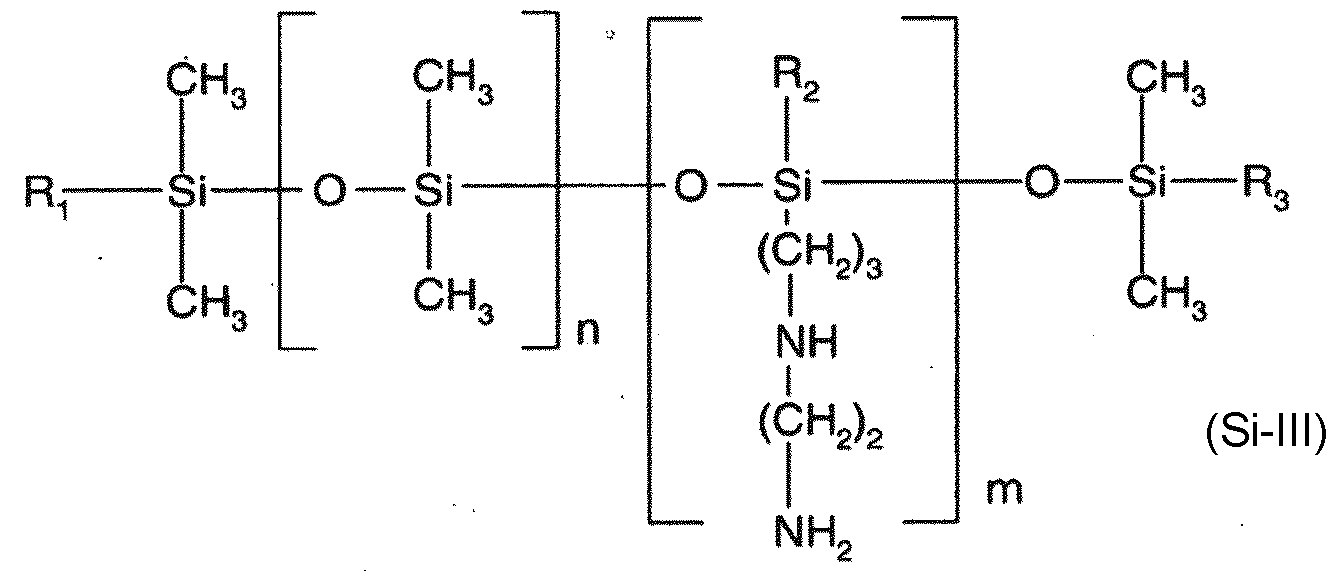 worin - m und n Zahlen bedeuten, die so gewählt sind, dass die Summe (n + m) im Bereich von 1 bis 1000 liegt, - n eine Zahl im Bereich von 0 bis 999 und m ist eine Zahl im Bereich von 1 bis 1000 ist, - R1, R2 und R3, die gleich oder verschieden sind, eine Hydroxygruppe oder eine C1-4- Alkoxygruppe bedeuten, - wobei mindestens eine der Gruppen R1 bis R3 eine Hydroxygruppe bedeutet; c) aminofunktionelles Silikonpolymer e) der Formel (Si-IV)
 in der - p und q Zahlen bedeuten, die so gewählt sind, dass die Summe (p + q) im Bereich von 1 bis 1000 liegt, - p eine Zahl im Bereich von 0 bis 999 und q ist eine Zahl im Bereich von 1 bis 1000 ist, - R1 und R2, die verschieden sind, eine Hydroxygruppe oder eine C1-4-Alkoxygruppe bedeuten, wobei mindestens eine der Gruppen R1 bis R2 eine Hydroxygruppe bedeutet. Die Silikone der Formeln (Si-III) und (Si-IV) unterscheiden sich durch die Gruppierung am Si-Atom, das die stickstoffhaltige Gruppe trägt: In Formel (Si-III) bedeutet R2 eine Hydroxygruppe oder eine C1-4-Alkoxygruppe, während der Rest in Formel (Si-IV) eine Methylgruppe ist. Die einzelnen Si-Gruppierungen, die mit den Indices m und n bzw. p und q gekennzeichnet sind, müssen nicht als Blöcke vorliegen, vielmehr können die einzelnen Einheiten auch statistisch verteilt vorliegen, d.h. in den Formeln (Si-III) und (Si-IV) ist nicht zwingend jedes R1-Si(CH3)2-Gruppe an eine –[O-Si(CH3)2]-Gruppierung gebunden. d) aminofunktionelles Silikonpolymer e) der Formel der Formel (Si-V) enthält
 in der A für eine Gruppe –OH, –O-Si(CH3)3,–O-Si(CH3)2OH ,–O-Si(CH3)2OCH3 steht, D für eine Gruppe –H, –Si(CH3)3,–Si(CH3)2OH, –Si(CH3)2OCH3 steht, b, n und c für ganze Zahlen zwischen 0 und 1000 stehen, mit den Maßgaben - n > 0 und b + c > 0 - mindestens eine der Bedingungen A = -OH bzw. D = -H ist erfüllt.
In der vorstehend genannten Formel (Si-V) sind die einzelnen Siloxaneinheiten mit den Indices b, c und n statistisch verteilt, d.h. es muss sich nicht zwingend um Blockcopolymere handeln. e) aminofunktionalisierte Silikonpolymere e), die durch die Formel (Si-VI) M(RaQbSiO(4-a-b)/2)x(RcSiO(4-c)/2)yM (Si-VI) beschrieben werden, wobei in der obigen Formel R ein Kohlenwasserstoff oder ein Kohlenwasserstoffrest mit 1 bis etwa 6 Kohlenstoffatomen ist, Q ein polarer Rest der allgemeinen Formel -R1HZ ist, worin R1 eine zweiwertige, verbindende Gruppe ist, die an Wasserstoff und den Rest Z gebunden ist, zusammengesetzt aus Kohlenstoff- und Wasserstoffatomen, Kohlenstoff-, Wasserstoff- und Sauerstoffatomen oder Kohlenstoff-, Wasserstoff- und Stickstoffatomen, und Z ein organischer, aminofunktioneller Rest ist, der mindestens eine aminofunktionelle Gruppe enthält; "a" Werte im Bereich von etwa 0 bis etwa 2 annimmt, "b" Werte im Bereich von etwa 1 bis etwa 3 annimmt, "a" + "b" kleiner als oder gleich 3 ist, und "c" eine Zahl im Bereich von etwa 1 bis etwa 3 ist, und x eine Zahl im Bereich von 1 bis etwa 2.000, vorzugsweise von etwa 3 bis etwa 50 und am bevorzugtesten von etwa 3 bis etwa 25 ist, und y eine Zahl im Bereich von etwa 20 bis etwa 10.000, vorzugsweise von etwa 125 bis etwa 10.000 und am bevorzugtesten von etwa 150 bis etwa 1.000 ist, und M eine geeignete Silicon-Endgruppe ist, wie sie im Stand der Technik bekannt ist, vorzugsweise Trimethylsiloxy. Nicht einschränkende Beispiele der durch R repräsentierten Reste schließen Alkylreste, wie Methyl, Ethyl, Propyl, Isopropyl, Isopropyl, Butyl, Isobutyl, Amyl, Isoamyl, Hexyl, Isohexyl und ähnliche; Alkenylreste, wie Vinyl, Halogenvinyl, Alkylvinyl, Allyl, Halogenallyl, Alkylallyl; Cycloalkylreste, wie Cyclobutyl, Cyclopentyl, Cyclohexyl und ähnliche; Phenylreste, Benzylreste, Halogenkohlenwasserstoffreste, wie 3- Chlorpropyl, 4-Brombutyl, 3,3,3-Trifluorpropyl, Chlorcyclohexyl, Bromphenyl, Chlorphenyl und ähnliche sowie schwefelhaltige Reste, wie Mercaptoethyl, Mercaptopropyl, Mercaptohexyl, Mercaptophenyl und ähnliche ein; vorzugsweise ist R ein Alkylrest, der 1 bis etwa 6 Kohlenstoffatomen enthält, und am bevorzugtesten ist R Methyl. Beispiele von R1 schließen Methylen, Ethylen, Propylen, Hexamethylen, Decamethylen, -CH2CH(CH3)CH2-, Phenylen, Naphthylen, -CH2CH2SCH2CH 2-, -CH2CH2OCH2-, -OCH2CH2-, -OCH2 CH2CH2- , -CH2CH(CH3)C(O)OCH2-, -(CH2)3 CC(O)OCH2CH2-, -C6H 4C6H4-, -C6H 4CH2C6H4-; und -(CH 2)3C(O)SCH2CH2- ein. Z ist ein organischer, aminofunktioneller Rest, enthaltend mindestens eine funktionelle Aminogruppe. Eine mögliche Formel für Z ist NH(CH2 )zNH2, worin z 1 oder mehr ist. Eine andere mögliche Formel für Z ist -NH(CH2)z(CH 2)zzNH, worin sowohl z als auch zz unabhängig 1 oder mehr sind, wobei diese Struktur Diamino-Ringstrukturen umfaßt, wie Piperazinyl. Z ist am bevorzugtesten ein -NHCH2CH 2NH2-Rest. Eine andere mögliche
Formel für Z ist - N(CH2)z(CH2)zzNX2 oder -NX2, worin jedes X von X2 unabhängig ausgewählt ist aus der Gruppe bestehend aus Wasserstoff und Alkylgruppen mit 1 bis 12 Kohlenstoffatomen, und zz 0 ist. Q ist am bevorzugtesten ein polarer, aminfunktioneller Rest der Formel - CH2CH2CH2NHCH2CH2NH 2. In den Formeln nimmt "a" Werte im Bereich von etwa 0 bis etwa 2 an, "b" nimmt Werte im Bereich von etwa 2 bis etwa 3 an, "a" + "b" ist kleiner als oder gleich 3, und "c" ist eine Zahl im Bereich von etwa 1 bis etwa 3. Das molare Verhältnis der RaQb SiO(4-a-b)/2-Einheiten zu den RcSiO (4-c)/2-Einheiten liegt im Bereich von etwa 1 : 2 bis 1 : 65, vorzugsweise von etwa 1 : 5 bis etwa 1 : 65 und am bevorzugtesten von etwa 1 : 15 bis etwa 1 : 20. Werden ein oder mehrere Silicone der obigen Formel eingesetzt, dann können die verschiedenen variablen Substituenten in der obigen Formel bei den verschiedenen Siliconkomponenten, die in der Siliconmischung vorhanden sind, verschieden sein. f) aminofunktionelles Silikonpolymer e) der Formel (Si-VII) R'aG3-a-Si(OSiG 2)n-(OSiG bR'2- b)m-O-SiG3-a-R'a (Si-VII), worin - G –H, eine Phenylgruppe, -OH, -O-CH3, -CH3, -O-CH2CH3, -CH2CH3, -O-CH2CH2CH3,- CH2CH2CH3, -O-CH(CH3)2, -CH(CH3)2, -O-CH2CH2CH2CH3, -CH2CH2CH2CH3, -O- CH2CH(CH3)2, -CH2CH(CH3)2, -O-CH(CH3)CH2CH3, -CH(CH3)CH2CH3, -O-C(CH3)3, - C(CH3)3 bedeutet; - a für eine Zahl zwischen 0 und 3, insbesondere 0, steht; - b für eine Zahl zwischen 0 und 1, insbesondere 1, steht, - m und n Zahlen sind, deren Summe (m + n) zwischen 1 und 2000, vorzugsweise zwischen 50 und 150 beträgt, wobei n vorzugsweise Werte von 0 bis 1999 und insbesondere von 49 bis 149 und m vorzugsweise Werte von 1 bis 2000, insbesondere von 1 bis 10 annimmt, - R´ ein monovalenter Rest ist, ausgewählt aus o -Q-N(R")-CH2-CH2-N(R")2 o -Q-N(R")2 o -Q–N+(R")3A- o -Q–N+H(R")2 A- o -Q-N+H2(R")A- o -Q-N(R")-CH2-CH2-N+R"H2A- , wobei jedes Q für eine chemische Bindung, -CH2-, -CH2-CH2-, -CH2CH2CH2-, -C(CH3)2-, - CH2CH2CH2CH2-, -CH2C(CH3)2-, -CH(CH3)CH2CH2- steht, R" für gleiche oder verschiedene Reste aus der Gruppe –H, -Phenyl, -Benzyl, -CH2- CH(CH3)Ph, der C1-20-Alkylreste, vorzugsweise -CH3, -CH2CH3, -CH2CH2CH3, -
CH(CH3)2, -CH2CH2CH2H3, -CH2CH(CH3)2, -CH(CH3)CH2CH3, -C(CH3)3, steht und A ein Anion repräsentiert, welches vorzugsweise ausgewählt ist aus Chlorid, Bromid, Iodid oder Methosulfat. g) aminofunktionelles Silikonpolymer e) der Formel (Si-VIIa), (CH3)3Si-[O-Si(CH3)2]n[OSi(CH3)]m-OSi(CH3)3 (Si-VIIa), │ CH2CH(CH3)CH2NH(CH2)2NH2 worin m und n Zahlen sind, deren Summe (m + n) zwischen 1 und 2000, vorzugsweise zwischen 50 und 150 beträgt, wobei n vorzugsweise Werte von 0 bis 1999 und insbesondere von 49 bis 149 und m vorzugsweise Werte von 1 bis 2000, insbesondere von 1 bis 10 annimmt. Diese Silicone werden nach der INCI-Deklaration als Trimethylsilylamodimethicone bezeichnet. h) aminofunktionelles Silikonpolymer e) der Formel (Si-VIIb) R-[Si(CH3)2-O]n1[Si(R)-O]m-[Si(CH3)2]n2-R (Si-VIIb), │ (CH2)3NH(CH2)2NH2 worin R für –OH, -O-CH3 oder eine –CH3-Gruppe steht und m, n1 und n2 Zahlen sind, deren Summe (m + n1 + n2) zwischen 1 und 2000, vorzugsweise zwischen 50 und 150 beträgt, wobei die Summe (n1 + n2) vorzugsweise Werte von 0 bis 1999 und insbesondere von 49 bis 149 und m vorzugsweise Werte von 1 bis 2000, insbesondere von 1 bis 10 annimmt. Diese aminofunktionalisierten Siliconpolymere werden nach der INCI-Deklaration als Amo- dimethicone bezeichnet. Unabhängig davon, welche der vorgenannten aminofunktionellen Silicone eingesetzt werden, sind erfindungsgemäße Haarreinigungsmittel bevorzugt, die ein aminofunktionelles Silikonpolymer e) enthalten, dessen Aminzahl oberhalb von 0,25 meq/g, vorzugsweise oberhalb von 0,3 meq/g und insbesondere oberhalb von 0,4 meq/g liegt. Die Aminzahl steht dabei für die Milli-Äquivalente Amin pro Gramm des aminofunktionellen Silicons. Sie kann durch Titration ermittelt und auch in der Einheit mg KOH/g angegeben werden. i) 4-Morpholinomethyl-substituierte Silikonpolyme. Dieses aminofunktionalisierte Silikonpolymer e) umfasst Struktureinheiten der Formeln (SI-VIII) und der Formel (Si-IX)
in der A für eine Gruppe –OH, –O-Si(CH3)3,–O-Si(CH3)2OH ,–O-Si(CH3)2OCH3 steht, D für eine Gruppe –H, –Si(CH3)3,–Si(CH3)2OH, –Si(CH3)2OCH3 steht, b, n und c für ganze Zahlen zwischen 0 und 1000 stehen, mit den Maßgaben - n > 0 und b + c > 0 - mindestens eine der Bedingungen A = -OH bzw. D = -H ist erfüllt.
In der vorstehend genannten Formel (Si-V) sind die einzelnen Siloxaneinheiten mit den Indices b, c und n statistisch verteilt, d.h. es muss sich nicht zwingend um Blockcopolymere handeln. e) aminofunktionalisierte Silikonpolymere e), die durch die Formel (Si-VI) M(RaQbSiO(4-a-b)/2)x(RcSiO(4-c)/2)yM (Si-VI) beschrieben werden, wobei in der obigen Formel R ein Kohlenwasserstoff oder ein Kohlenwasserstoffrest mit 1 bis etwa 6 Kohlenstoffatomen ist, Q ein polarer Rest der allgemeinen Formel -R1HZ ist, worin R1 eine zweiwertige, verbindende Gruppe ist, die an Wasserstoff und den Rest Z gebunden ist, zusammengesetzt aus Kohlenstoff- und Wasserstoffatomen, Kohlenstoff-, Wasserstoff- und Sauerstoffatomen oder Kohlenstoff-, Wasserstoff- und Stickstoffatomen, und Z ein organischer, aminofunktioneller Rest ist, der mindestens eine aminofunktionelle Gruppe enthält; "a" Werte im Bereich von etwa 0 bis etwa 2 annimmt, "b" Werte im Bereich von etwa 1 bis etwa 3 annimmt, "a" + "b" kleiner als oder gleich 3 ist, und "c" eine Zahl im Bereich von etwa 1 bis etwa 3 ist, und x eine Zahl im Bereich von 1 bis etwa 2.000, vorzugsweise von etwa 3 bis etwa 50 und am bevorzugtesten von etwa 3 bis etwa 25 ist, und y eine Zahl im Bereich von etwa 20 bis etwa 10.000, vorzugsweise von etwa 125 bis etwa 10.000 und am bevorzugtesten von etwa 150 bis etwa 1.000 ist, und M eine geeignete Silicon-Endgruppe ist, wie sie im Stand der Technik bekannt ist, vorzugsweise Trimethylsiloxy. Nicht einschränkende Beispiele der durch R repräsentierten Reste schließen Alkylreste, wie Methyl, Ethyl, Propyl, Isopropyl, Isopropyl, Butyl, Isobutyl, Amyl, Isoamyl, Hexyl, Isohexyl und ähnliche; Alkenylreste, wie Vinyl, Halogenvinyl, Alkylvinyl, Allyl, Halogenallyl, Alkylallyl; Cycloalkylreste, wie Cyclobutyl, Cyclopentyl, Cyclohexyl und ähnliche; Phenylreste, Benzylreste, Halogenkohlenwasserstoffreste, wie 3- Chlorpropyl, 4-Brombutyl, 3,3,3-Trifluorpropyl, Chlorcyclohexyl, Bromphenyl, Chlorphenyl und ähnliche sowie schwefelhaltige Reste, wie Mercaptoethyl, Mercaptopropyl, Mercaptohexyl, Mercaptophenyl und ähnliche ein; vorzugsweise ist R ein Alkylrest, der 1 bis etwa 6 Kohlenstoffatomen enthält, und am bevorzugtesten ist R Methyl. Beispiele von R1 schließen Methylen, Ethylen, Propylen, Hexamethylen, Decamethylen, -CH2CH(CH3)CH2-, Phenylen, Naphthylen, -CH2CH2SCH2CH 2-, -CH2CH2OCH2-, -OCH2CH2-, -OCH2 CH2CH2- , -CH2CH(CH3)C(O)OCH2-, -(CH2)3 CC(O)OCH2CH2-, -C6H 4C6H4-, -C6H 4CH2C6H4-; und -(CH 2)3C(O)SCH2CH2- ein. Z ist ein organischer, aminofunktioneller Rest, enthaltend mindestens eine funktionelle Aminogruppe. Eine mögliche Formel für Z ist NH(CH2 )zNH2, worin z 1 oder mehr ist. Eine andere mögliche Formel für Z ist -NH(CH2)z(CH 2)zzNH, worin sowohl z als auch zz unabhängig 1 oder mehr sind, wobei diese Struktur Diamino-Ringstrukturen umfaßt, wie Piperazinyl. Z ist am bevorzugtesten ein -NHCH2CH 2NH2-Rest. Eine andere mögliche
Formel für Z ist - N(CH2)z(CH2)zzNX2 oder -NX2, worin jedes X von X2 unabhängig ausgewählt ist aus der Gruppe bestehend aus Wasserstoff und Alkylgruppen mit 1 bis 12 Kohlenstoffatomen, und zz 0 ist. Q ist am bevorzugtesten ein polarer, aminfunktioneller Rest der Formel - CH2CH2CH2NHCH2CH2NH 2. In den Formeln nimmt "a" Werte im Bereich von etwa 0 bis etwa 2 an, "b" nimmt Werte im Bereich von etwa 2 bis etwa 3 an, "a" + "b" ist kleiner als oder gleich 3, und "c" ist eine Zahl im Bereich von etwa 1 bis etwa 3. Das molare Verhältnis der RaQb SiO(4-a-b)/2-Einheiten zu den RcSiO (4-c)/2-Einheiten liegt im Bereich von etwa 1 : 2 bis 1 : 65, vorzugsweise von etwa 1 : 5 bis etwa 1 : 65 und am bevorzugtesten von etwa 1 : 15 bis etwa 1 : 20. Werden ein oder mehrere Silicone der obigen Formel eingesetzt, dann können die verschiedenen variablen Substituenten in der obigen Formel bei den verschiedenen Siliconkomponenten, die in der Siliconmischung vorhanden sind, verschieden sein. f) aminofunktionelles Silikonpolymer e) der Formel (Si-VII) R'aG3-a-Si(OSiG 2)n-(OSiG bR'2- b)m-O-SiG3-a-R'a (Si-VII), worin - G –H, eine Phenylgruppe, -OH, -O-CH3, -CH3, -O-CH2CH3, -CH2CH3, -O-CH2CH2CH3,- CH2CH2CH3, -O-CH(CH3)2, -CH(CH3)2, -O-CH2CH2CH2CH3, -CH2CH2CH2CH3, -O- CH2CH(CH3)2, -CH2CH(CH3)2, -O-CH(CH3)CH2CH3, -CH(CH3)CH2CH3, -O-C(CH3)3, - C(CH3)3 bedeutet; - a für eine Zahl zwischen 0 und 3, insbesondere 0, steht; - b für eine Zahl zwischen 0 und 1, insbesondere 1, steht, - m und n Zahlen sind, deren Summe (m + n) zwischen 1 und 2000, vorzugsweise zwischen 50 und 150 beträgt, wobei n vorzugsweise Werte von 0 bis 1999 und insbesondere von 49 bis 149 und m vorzugsweise Werte von 1 bis 2000, insbesondere von 1 bis 10 annimmt, - R´ ein monovalenter Rest ist, ausgewählt aus o -Q-N(R")-CH2-CH2-N(R")2 o -Q-N(R")2 o -Q–N+(R")3A- o -Q–N+H(R")2 A- o -Q-N+H2(R")A- o -Q-N(R")-CH2-CH2-N+R"H2A- , wobei jedes Q für eine chemische Bindung, -CH2-, -CH2-CH2-, -CH2CH2CH2-, -C(CH3)2-, - CH2CH2CH2CH2-, -CH2C(CH3)2-, -CH(CH3)CH2CH2- steht, R" für gleiche oder verschiedene Reste aus der Gruppe –H, -Phenyl, -Benzyl, -CH2- CH(CH3)Ph, der C1-20-Alkylreste, vorzugsweise -CH3, -CH2CH3, -CH2CH2CH3, -
CH(CH3)2, -CH2CH2CH2H3, -CH2CH(CH3)2, -CH(CH3)CH2CH3, -C(CH3)3, steht und A ein Anion repräsentiert, welches vorzugsweise ausgewählt ist aus Chlorid, Bromid, Iodid oder Methosulfat. g) aminofunktionelles Silikonpolymer e) der Formel (Si-VIIa), (CH3)3Si-[O-Si(CH3)2]n[OSi(CH3)]m-OSi(CH3)3 (Si-VIIa), │ CH2CH(CH3)CH2NH(CH2)2NH2 worin m und n Zahlen sind, deren Summe (m + n) zwischen 1 und 2000, vorzugsweise zwischen 50 und 150 beträgt, wobei n vorzugsweise Werte von 0 bis 1999 und insbesondere von 49 bis 149 und m vorzugsweise Werte von 1 bis 2000, insbesondere von 1 bis 10 annimmt. Diese Silicone werden nach der INCI-Deklaration als Trimethylsilylamodimethicone bezeichnet. h) aminofunktionelles Silikonpolymer e) der Formel (Si-VIIb) R-[Si(CH3)2-O]n1[Si(R)-O]m-[Si(CH3)2]n2-R (Si-VIIb), │ (CH2)3NH(CH2)2NH2 worin R für –OH, -O-CH3 oder eine –CH3-Gruppe steht und m, n1 und n2 Zahlen sind, deren Summe (m + n1 + n2) zwischen 1 und 2000, vorzugsweise zwischen 50 und 150 beträgt, wobei die Summe (n1 + n2) vorzugsweise Werte von 0 bis 1999 und insbesondere von 49 bis 149 und m vorzugsweise Werte von 1 bis 2000, insbesondere von 1 bis 10 annimmt. Diese aminofunktionalisierten Siliconpolymere werden nach der INCI-Deklaration als Amo- dimethicone bezeichnet. Unabhängig davon, welche der vorgenannten aminofunktionellen Silicone eingesetzt werden, sind erfindungsgemäße Haarreinigungsmittel bevorzugt, die ein aminofunktionelles Silikonpolymer e) enthalten, dessen Aminzahl oberhalb von 0,25 meq/g, vorzugsweise oberhalb von 0,3 meq/g und insbesondere oberhalb von 0,4 meq/g liegt. Die Aminzahl steht dabei für die Milli-Äquivalente Amin pro Gramm des aminofunktionellen Silicons. Sie kann durch Titration ermittelt und auch in der Einheit mg KOH/g angegeben werden. i) 4-Morpholinomethyl-substituierte Silikonpolyme. Dieses aminofunktionalisierte Silikonpolymer e) umfasst Struktureinheiten der Formeln (SI-VIII) und der Formel (Si-IX)
 Entsprechende 4-Morpholinomethyl-substituiertes Silikonpolymere sind beispielsweise unter der INCI-Bezeichnung Amodimethicone/Morpholinomethyl Silsesquioxane Copolymer bekannt und in Form des Rohstoffes Belsil ADM 8301 E von Wacker kommerziell erhältlich. Als geeignetes 4-morpholinomethyl-substituiertes Silikon kann beispielsweise auch ein Silikon eingesetzt werden, welches Struktureinheiten der Formeln (Si-VIII), (Si-IX) und (Si- X) aufweist
 in denen R1 für –CH3, -OH, -OCH3, -O-CH2CH3, -O-CH2CH2CH3, oder -O-CH(CH3)2 steht; R2 für –CH3, -OH, oder -OCH3 steht. Besonders bevorzugt ist ein 4-morpholinomethyl-substituiertes Silikon der Formel (Si-XI)
 (Si-XI) in der
R1 für –CH3, -OH, -OCH3, -O-CH2CH3, -O-CH2CH2CH3, oder -O-CH(CH3)2 steht; R2 für –CH3, -OH, oder -OCH3 steht. B für eine Gruppe –OH, –O-Si(CH3)3,–O-Si(CH3)2OH ,–O-Si(CH3)2OCH3 steht, D für eine Gruppe –H, –Si(CH3)3,–Si(CH3)2OH, –Si(CH3)2OCH3 steht, a, b und c unabhängig voneinander für ganze Zahlen zwischen 0 und 1000 stehen, mit der Maßgabe a + b + c > 0 m und n unabhängig voneinander für ganze, Zahlen zwischen 1 und 1000 stehen mit den Maßgabe, dass - mindestens eine der Bedingungen B = -OH bzw. D = -H erfüllt ist, - die Einheiten a, b, c, m und n statistisch oder blockweise im Molekül verteilt vorliegen. Strukturformel (Si-XI) soll verdeutlichen, dass die Siloxangruppen n und m nicht zwingend direkt an eine Endgruppierung B bzw. D gebunden sein müssen. Vielmehr gilt in bevorzugten Formeln (Si-VI) a > 0 oder b > 0 und in besonders bevorzugten Formeln (Si-VI) a > 0 und c > 0, d.h. die terminale Gruppierung B bzw. D ist vorzugsweise an eine Dimethylsiloxy- Gruppierung gebunden. Auch in Formel (Si-VI) sind die Siloxaneinheiten a, b, c, m und n vorzugsweise statistisch verteilt. Für den Einsatz in den erfindungsgemäßen Haarreinigungsmitteln haben sich insbesondere aminofunktionelle Silikonpolymere e) aus den zuvor genannten Gruppen a), g), h) und i) als besonders geeignet erwiesen. Besonders in Kombination mit kationischen Polymeren – insbesondere mit kationischen Guar- Polymeren – konnten die zuvor genannten Pflegevorteile erzielt werden (insbesondere auf gefärbten Haaren, die mit mindestens einem Pigment enthaltenden Haarfärbemittel gefärbt wurden). Ganz besonders gute Ergebnisse hinsichtlich Haargriff und Weichheit konnten erzielt werden, wenn unter der INCI-Bezeichnung Amodimethicone bekannte aminofunktionelle Silikonpolymere e) in den erfindungsgemäßen Haarreinigungsmitteln eingesetzt wurden. Das oder die aminofunktionellen Silikonpolymere e) kann oder können in den erfindungsgemäßen Haarreinigungsmitteln in Form vorgefertigter Emulsionen eingesetzt werden. Entsprechende Handelsprodukte sind von verschiedenen Anbietern im Handel erhältlich, beispielsweise von der Firma Dow unter den Handelsbezeichnungen Dowsil® und/oder Xiameter®, wie Dowsil® 8500, Dowsil® 979, Xiameter® MEM-8194, Dowsil® 1689, von der Firma Wacker unter den Handelsbezeichnungen Belsil®, wie Belsil® ADM 6057 E, Belsil® ADM 8105 E, von der Firma Shin- Etsu unter der Handelsbezeichnungen X-52-2265. Das oder die aminofunktionellen Silikonpolymere e) kann oder können in den erfindungsgemäßen Haarreinigungsmitteln – bezogen auf deren Gesamtgewicht – vorzugsweise in einer Gesamtmenge
von 0,05 bis 15,0 Gew.-%, mehr bevorzugt 0,05 bis 10,0 Gew.-% und insbesondere 0,1 bis 7,5 Gew.- % eingesetzt werden. Besonders bevorzugt werden aminofunktionelle Silikonpolymere e) aus den zuvor genannten Gruppen a), g), h) und i) und insbesondere ein unter der INCI-Bezeichnungen Amodimethicone bekanntes aminofunktionelles Silikonpolymer e) in den zuvor genannten Mengen eingesetzt. Neben den zuvor genannten wesentlichen und bevorzugten Komponenten können die erfindungsgemäßen Haarreinigungsmittel weitere Wirkstoffe enthalten, die ihnen zusätzliche vorteilhafte Eigenschaften verleihen, beispielsweise ^ Polyole, vorzugsweise Glycerin, ^ Haarpflegende, natürliche, mineralische oder synthetische Öle, Wachse, Buttern oder deren Mischungen, vorzugsweise aus natürlichen Quellen erhältliche Öle, Wachse, Buttern oder deren Mischungen, wie beispielsweise pflanzliche Öle (Triglyceride), Kakaobutter, Sheabutter, Bienenwachs, Carnaubawachs, Fruchtwachse, Hydrogenated Castor Oil, Mineralöle, Paraffin- und Isoparaffinöle, Dialkylether, Fettsäuren, Fettalkohole, Esteröle, Silikone ^ UV-Filter ^ kationische Tenside, beispielsweise Trialkylammoniumsalze oder Esterquats ^ Farbstoffe zum Anfärben des Mittels ^ Vitamine, Vitaminderivate und/oder Vitaminvorstufen wie Panthenol, Niacinamid, Biotin ^ Proteinhydrolysate ^ Ceramide (N-Acylsphingosin = Fettsäureamide des Sphingosins) oder synthetische Analoga solcher Lipide (sogenannte Pseudo-Ceramide) ^ Wirkstoffe wie Allantoin und/oder Bisabolol ^ Komplexbildner wie EDTA, NTA, MGDA, β-Alanindiessigsäure und Phosphonsäuren ^ Treibmittel wie Propan-Butan-Gemische, N2O, Dimethylether, CO2 und Luft ^ Antioxidantien ^ Pflanzenextrakte ^ Perlglanzmittel wie EGDS oder PEG-3 Distearate ^ Trübungsmittel wie die unter der INCI-Bezeichnung Styrene/Acrylates-Copolymer bekannten Verbindungen ^ pH-Stellmittel wie Zitronensäure und/oder Milchsäure und/oder Natriumhydroxid ^ Parfum. Die erfindungsgemäßen Haarreinigungsmittel weisen vorzugsweise eine Anfangsviskosität im Bereich von 4,000 bis 20,000 mPas, mehr bevorzugt von 5,000 bis 18,000 mPas und insbesondere von 6,000 bis 14,000 mPas auf (gemessen mit einem IQ Haake Viscotester Rheometer mit koaxialem Zylinder bei 20°C.
Haarreinigungsmittel dieser Viskosität lassen sich bequem und einfach aus einem Behälter auf die Hand oder die Anwendungsoberfläche applizieren, ohne zwischen den Fingern hindurchzulaufen oder zu tropfen. Gleichzeitig ist die Viskosität der Zusammensetzung niedrig genug, damit eine zufriedenstellende Verteilung auf der Anwendungsoberfläche unter Zuhilfenahme der Hände gewährleistet ist. Die erfindungsgemäßen Haarreinigungsmittel sind lager- und temperaturstabil, sie weisen hervorragende Rheologie-, Viskositäts- und Schaumeigenschaften auf und eignen sich insbesondere für die Reinigung und den Farbschutz gefärbter Haare. Mit erfindungsgemäßen Haarreinigungsmitteln behandelte Haare weisen ein sauberes und gepflegtes Erscheinungsbild auf, wobei sowohl die Echtheitseigenschaften (Waschechtheit bzw. Farberhalt) als auch wesentliche Haarpflegeparameter wie Haargriff und das Haargefühl verbessert werden konnten – insbesondere auch auf vorher gefärbten Haaren, die mit mindestens einem Pigment enthaltenden Haarfärbemittel gefärbt wurden. Ein zweiter Gegenstand der Erfindung betrifft die Verwendung des erfindungsgemäßen Haarreinigungsmittels zur Reinigung und Pflege sowie zur Verbesserung des Farberhalts auf keratinischen Fasern, insbesondere auf menschlichen Haaren, welche durch Anwendung eines Färbemittels gefärbt wurden. Besonders bevorzugt ist die Verwendung auf gefärbten Haaren angewendet, die mit einem mindestens ein Pigment enthaltenden Färbemittel gefärbt wurden. Unter geeigneten, mindestens ein Pigment enthaltenden Färbemitteln werden insbesondere solche Färbemittel verstanden, wie sie in der Patentanmeldung EP 4065073 beschrieben werden, und auf deren Beschreibung ausdrücklich Bezug genommen wird. Betreffend die weiteren bevorzugten Ausführungsformen der erfindungsgemäßen Verwendung gilt mutatis mutantis das zum erfindungsgemäßen Haarreinigungsmittel Gesagte.
Beispiele 1. Formulierungen Es wurden die folgenden Formulierungen hergestellt (alle Angaben, sofern nichts anderes angegeben ist, in Gew.-%) und deren Viskosität bestimmt: Haarreinigungsmittel (Gew.-%) 1 2 3 4 anionisches Tensid 5-30 5-30 (10,8) Sodium Laureth Sulfate (AS) 5-30 (3,5-21) amphoteres bzw. zwitterionisches Tensid 1-20 1-20 (2,6) Cocamidopropylbetain (AS) 1-20 (0,3-7,5) nichtionisches Tensid 0,5-10 0,5-10 (1) Coco-Glucoside (AS) 0,5-10 (0,2-5) anionisches Acrylat-Copolymer 0,1-2,5 0,1-2,5 2 Rheocare®1 TTA 0,1-2,5 Konservierungsmittel 0,5-5 0,5-5 Methylparaben und/oder Benzylalkohol und/oder Phenoxyethanol 0,5-5 kationisches Polymer 0,01-10 0,2 Jaguar®2 C 162 0,01-3 aminofunktionalisiertes Silikon 0,01-20 0,5 Dowsil®3979 Emulsion 0,01-5 ad 100 Wasser und ggfs. weitere Wirk- und Hilfsstoffe ad 100 ad 100 ad 100 >6,5 pH >6,5 >6,5 >6,5
1 INCI-Bezeichnung: Acrylates Copolymer (BASF) 2 INCI-Bezeichnung: Hydroxypropyl guar hydroxypropyltrimonium chloride (Rhodia) 3 INCI-Bezeichnung: Amodimethicone, C11-15 Alketh-12, C11-15-Alketh-7 (Dow); Silikongehalt etwa 50% 2. Beurteilung der erfindungsgemäßen Formulierungen a) Beurteilung des Farbschutzes Haarsträhnen der Fa. Kerling (Euronaturhaar, weiß) wurden mit dem folgenden Färbemittel in üblicher Art gefärbt: Färbemittel (Gew.-%) Cetylalkohol 3,0 Stearylalkohol 3,0 Ceteareth-30 1,5 Kaliumhydrogenphosphat 0,35 Dinatriumhydrogenphosphat 0,72 Unipure Red LC 3071 (org. Pigment CI 15850) 1,0 1,2-Propandiol 10,0 Phenoxyethanol 0,8 Dow Corning 2-8566 (Siloxanes and Silicones, 3-[(2- 1,0 Aminoethyl)amino]-2-methylpropyl Me, Di-Me-Siloxane) Natriumsalicylat 0,4 Wasser ad 100 Die Hälfte der gefärbten Haarsträhnen wurde anschließend 5 Mal mit dem erfindungsgemäßen Haarreinigungsmittel 4 gewaschen, anschließend mit Wasser gespült und getrocknet. Die andere Hälfte wurde mit einem handelsüblichen Farbschutzshampoo mit acidem pH-Wert ebenso häufig und in derselben Art gewaschen und anschließend getrocknet. Alle Haarsträhnen wurden im Anschluss optisch und haptisch von geschultem Fachpersonal beurteilt. Es wurden die folgenden Ergebnisse erzielt: ^ Die Färbung sowie deren Intensität auf Haarsträhnen, welche mit dem erfindungsgemäßen Haarreinigungsmittel gefärbt wurden, war nach den wiederholten Reinigungsvorgängen nahezu unverändert, während die mit dem handelsüblichen Farbschutzshampoo gewaschenen Haarsträhnen nicht mehr einheitlich gefärbt und sichtlich verblasst waren. ^ Die mit dem erfindungsgemäßen Haarreinigungsmittel gefärbten Haarsträhnen fühlten sich nach der Trocknung geschmeidig und weich an. Darüber hinaus ließen sie sich leicht
kämmen. Die mit dem handelsüblichen Farbschutzshampoo gewaschenen Haarsträhnen fühlten sich stumpf an. b) Beurteilung der Konservierungswirkung Die Konservierung des erfindungsgemäßen Haarreinigungsmittels 4 wurde getestet. Der Test wurde gemäß AA HSA A.1.1-050 durchgeführt. Testbakterien (cfu/ml): 4,0x10⁸ (beimpft in 1%) Testpilze (cfu/ml): 5,0x10⁷ (beimpft in 1%) Die Ergebnisse in der nachfolgenden Tabelle werden als Tage angegeben, die erforderlich sind, um die mikrobielle Lebensfähigkeit der Bakterien (B) und Pilze (F) auf das erforderliche Niveau zu reduzieren. Testnummer Konservierungsmittel (Gew.-%) pH-Wert Konservierungstest B F Ergebnis 1 - 8,07 fehlgeschlagen 2 Euxyl®1 K 320 (1,4) 8,03 fehlgeschlagen 3 Euxyl®1 K 320 (1,4) 8,15 fehlgeschlagen Neutrol®2 MGDA (1,4) 4 Benzylalkohol (0,4) 7,95 14 >35 bestanden Methylparaben (0,7) Phenoxyethanol (0,6) 5 Benzylalkohol (0,4) 8,40 14 35 bestanden Methylparaben (0,7) Phenoxyethanol (0,6) Neutrol®2 MGDA (1,4) 1 INCI-Bezeichnung: Phenoxyethanol, Methylparaben, Ethylparaben (Ashland Inc) 2 INCI-Bezeichnung: Trisodium Dicarboxymethyl Alaninate (BASF)
(Si-XI) in der
R1 für –CH3, -OH, -OCH3, -O-CH2CH3, -O-CH2CH2CH3, oder -O-CH(CH3)2 steht; R2 für –CH3, -OH, oder -OCH3 steht. B für eine Gruppe –OH, –O-Si(CH3)3,–O-Si(CH3)2OH ,–O-Si(CH3)2OCH3 steht, D für eine Gruppe –H, –Si(CH3)3,–Si(CH3)2OH, –Si(CH3)2OCH3 steht, a, b und c unabhängig voneinander für ganze Zahlen zwischen 0 und 1000 stehen, mit der Maßgabe a + b + c > 0 m und n unabhängig voneinander für ganze, Zahlen zwischen 1 und 1000 stehen mit den Maßgabe, dass - mindestens eine der Bedingungen B = -OH bzw. D = -H erfüllt ist, - die Einheiten a, b, c, m und n statistisch oder blockweise im Molekül verteilt vorliegen. Strukturformel (Si-XI) soll verdeutlichen, dass die Siloxangruppen n und m nicht zwingend direkt an eine Endgruppierung B bzw. D gebunden sein müssen. Vielmehr gilt in bevorzugten Formeln (Si-VI) a > 0 oder b > 0 und in besonders bevorzugten Formeln (Si-VI) a > 0 und c > 0, d.h. die terminale Gruppierung B bzw. D ist vorzugsweise an eine Dimethylsiloxy- Gruppierung gebunden. Auch in Formel (Si-VI) sind die Siloxaneinheiten a, b, c, m und n vorzugsweise statistisch verteilt. Für den Einsatz in den erfindungsgemäßen Haarreinigungsmitteln haben sich insbesondere aminofunktionelle Silikonpolymere e) aus den zuvor genannten Gruppen a), g), h) und i) als besonders geeignet erwiesen. Besonders in Kombination mit kationischen Polymeren – insbesondere mit kationischen Guar- Polymeren – konnten die zuvor genannten Pflegevorteile erzielt werden (insbesondere auf gefärbten Haaren, die mit mindestens einem Pigment enthaltenden Haarfärbemittel gefärbt wurden). Ganz besonders gute Ergebnisse hinsichtlich Haargriff und Weichheit konnten erzielt werden, wenn unter der INCI-Bezeichnung Amodimethicone bekannte aminofunktionelle Silikonpolymere e) in den erfindungsgemäßen Haarreinigungsmitteln eingesetzt wurden. Das oder die aminofunktionellen Silikonpolymere e) kann oder können in den erfindungsgemäßen Haarreinigungsmitteln in Form vorgefertigter Emulsionen eingesetzt werden. Entsprechende Handelsprodukte sind von verschiedenen Anbietern im Handel erhältlich, beispielsweise von der Firma Dow unter den Handelsbezeichnungen Dowsil® und/oder Xiameter®, wie Dowsil® 8500, Dowsil® 979, Xiameter® MEM-8194, Dowsil® 1689, von der Firma Wacker unter den Handelsbezeichnungen Belsil®, wie Belsil® ADM 6057 E, Belsil® ADM 8105 E, von der Firma Shin- Etsu unter der Handelsbezeichnungen X-52-2265. Das oder die aminofunktionellen Silikonpolymere e) kann oder können in den erfindungsgemäßen Haarreinigungsmitteln – bezogen auf deren Gesamtgewicht – vorzugsweise in einer Gesamtmenge
von 0,05 bis 15,0 Gew.-%, mehr bevorzugt 0,05 bis 10,0 Gew.-% und insbesondere 0,1 bis 7,5 Gew.- % eingesetzt werden. Besonders bevorzugt werden aminofunktionelle Silikonpolymere e) aus den zuvor genannten Gruppen a), g), h) und i) und insbesondere ein unter der INCI-Bezeichnungen Amodimethicone bekanntes aminofunktionelles Silikonpolymer e) in den zuvor genannten Mengen eingesetzt. Neben den zuvor genannten wesentlichen und bevorzugten Komponenten können die erfindungsgemäßen Haarreinigungsmittel weitere Wirkstoffe enthalten, die ihnen zusätzliche vorteilhafte Eigenschaften verleihen, beispielsweise ^ Polyole, vorzugsweise Glycerin, ^ Haarpflegende, natürliche, mineralische oder synthetische Öle, Wachse, Buttern oder deren Mischungen, vorzugsweise aus natürlichen Quellen erhältliche Öle, Wachse, Buttern oder deren Mischungen, wie beispielsweise pflanzliche Öle (Triglyceride), Kakaobutter, Sheabutter, Bienenwachs, Carnaubawachs, Fruchtwachse, Hydrogenated Castor Oil, Mineralöle, Paraffin- und Isoparaffinöle, Dialkylether, Fettsäuren, Fettalkohole, Esteröle, Silikone ^ UV-Filter ^ kationische Tenside, beispielsweise Trialkylammoniumsalze oder Esterquats ^ Farbstoffe zum Anfärben des Mittels ^ Vitamine, Vitaminderivate und/oder Vitaminvorstufen wie Panthenol, Niacinamid, Biotin ^ Proteinhydrolysate ^ Ceramide (N-Acylsphingosin = Fettsäureamide des Sphingosins) oder synthetische Analoga solcher Lipide (sogenannte Pseudo-Ceramide) ^ Wirkstoffe wie Allantoin und/oder Bisabolol ^ Komplexbildner wie EDTA, NTA, MGDA, β-Alanindiessigsäure und Phosphonsäuren ^ Treibmittel wie Propan-Butan-Gemische, N2O, Dimethylether, CO2 und Luft ^ Antioxidantien ^ Pflanzenextrakte ^ Perlglanzmittel wie EGDS oder PEG-3 Distearate ^ Trübungsmittel wie die unter der INCI-Bezeichnung Styrene/Acrylates-Copolymer bekannten Verbindungen ^ pH-Stellmittel wie Zitronensäure und/oder Milchsäure und/oder Natriumhydroxid ^ Parfum. Die erfindungsgemäßen Haarreinigungsmittel weisen vorzugsweise eine Anfangsviskosität im Bereich von 4,000 bis 20,000 mPas, mehr bevorzugt von 5,000 bis 18,000 mPas und insbesondere von 6,000 bis 14,000 mPas auf (gemessen mit einem IQ Haake Viscotester Rheometer mit koaxialem Zylinder bei 20°C.
Haarreinigungsmittel dieser Viskosität lassen sich bequem und einfach aus einem Behälter auf die Hand oder die Anwendungsoberfläche applizieren, ohne zwischen den Fingern hindurchzulaufen oder zu tropfen. Gleichzeitig ist die Viskosität der Zusammensetzung niedrig genug, damit eine zufriedenstellende Verteilung auf der Anwendungsoberfläche unter Zuhilfenahme der Hände gewährleistet ist. Die erfindungsgemäßen Haarreinigungsmittel sind lager- und temperaturstabil, sie weisen hervorragende Rheologie-, Viskositäts- und Schaumeigenschaften auf und eignen sich insbesondere für die Reinigung und den Farbschutz gefärbter Haare. Mit erfindungsgemäßen Haarreinigungsmitteln behandelte Haare weisen ein sauberes und gepflegtes Erscheinungsbild auf, wobei sowohl die Echtheitseigenschaften (Waschechtheit bzw. Farberhalt) als auch wesentliche Haarpflegeparameter wie Haargriff und das Haargefühl verbessert werden konnten – insbesondere auch auf vorher gefärbten Haaren, die mit mindestens einem Pigment enthaltenden Haarfärbemittel gefärbt wurden. Ein zweiter Gegenstand der Erfindung betrifft die Verwendung des erfindungsgemäßen Haarreinigungsmittels zur Reinigung und Pflege sowie zur Verbesserung des Farberhalts auf keratinischen Fasern, insbesondere auf menschlichen Haaren, welche durch Anwendung eines Färbemittels gefärbt wurden. Besonders bevorzugt ist die Verwendung auf gefärbten Haaren angewendet, die mit einem mindestens ein Pigment enthaltenden Färbemittel gefärbt wurden. Unter geeigneten, mindestens ein Pigment enthaltenden Färbemitteln werden insbesondere solche Färbemittel verstanden, wie sie in der Patentanmeldung EP 4065073 beschrieben werden, und auf deren Beschreibung ausdrücklich Bezug genommen wird. Betreffend die weiteren bevorzugten Ausführungsformen der erfindungsgemäßen Verwendung gilt mutatis mutantis das zum erfindungsgemäßen Haarreinigungsmittel Gesagte.
Beispiele 1. Formulierungen Es wurden die folgenden Formulierungen hergestellt (alle Angaben, sofern nichts anderes angegeben ist, in Gew.-%) und deren Viskosität bestimmt: Haarreinigungsmittel (Gew.-%) 1 2 3 4 anionisches Tensid 5-30 5-30 (10,8) Sodium Laureth Sulfate (AS) 5-30 (3,5-21) amphoteres bzw. zwitterionisches Tensid 1-20 1-20 (2,6) Cocamidopropylbetain (AS) 1-20 (0,3-7,5) nichtionisches Tensid 0,5-10 0,5-10 (1) Coco-Glucoside (AS) 0,5-10 (0,2-5) anionisches Acrylat-Copolymer 0,1-2,5 0,1-2,5 2 Rheocare®1 TTA 0,1-2,5 Konservierungsmittel 0,5-5 0,5-5 Methylparaben und/oder Benzylalkohol und/oder Phenoxyethanol 0,5-5 kationisches Polymer 0,01-10 0,2 Jaguar®2 C 162 0,01-3 aminofunktionalisiertes Silikon 0,01-20 0,5 Dowsil®3979 Emulsion 0,01-5 ad 100 Wasser und ggfs. weitere Wirk- und Hilfsstoffe ad 100 ad 100 ad 100 >6,5 pH >6,5 >6,5 >6,5
1 INCI-Bezeichnung: Acrylates Copolymer (BASF) 2 INCI-Bezeichnung: Hydroxypropyl guar hydroxypropyltrimonium chloride (Rhodia) 3 INCI-Bezeichnung: Amodimethicone, C11-15 Alketh-12, C11-15-Alketh-7 (Dow); Silikongehalt etwa 50% 2. Beurteilung der erfindungsgemäßen Formulierungen a) Beurteilung des Farbschutzes Haarsträhnen der Fa. Kerling (Euronaturhaar, weiß) wurden mit dem folgenden Färbemittel in üblicher Art gefärbt: Färbemittel (Gew.-%) Cetylalkohol 3,0 Stearylalkohol 3,0 Ceteareth-30 1,5 Kaliumhydrogenphosphat 0,35 Dinatriumhydrogenphosphat 0,72 Unipure Red LC 3071 (org. Pigment CI 15850) 1,0 1,2-Propandiol 10,0 Phenoxyethanol 0,8 Dow Corning 2-8566 (Siloxanes and Silicones, 3-[(2- 1,0 Aminoethyl)amino]-2-methylpropyl Me, Di-Me-Siloxane) Natriumsalicylat 0,4 Wasser ad 100 Die Hälfte der gefärbten Haarsträhnen wurde anschließend 5 Mal mit dem erfindungsgemäßen Haarreinigungsmittel 4 gewaschen, anschließend mit Wasser gespült und getrocknet. Die andere Hälfte wurde mit einem handelsüblichen Farbschutzshampoo mit acidem pH-Wert ebenso häufig und in derselben Art gewaschen und anschließend getrocknet. Alle Haarsträhnen wurden im Anschluss optisch und haptisch von geschultem Fachpersonal beurteilt. Es wurden die folgenden Ergebnisse erzielt: ^ Die Färbung sowie deren Intensität auf Haarsträhnen, welche mit dem erfindungsgemäßen Haarreinigungsmittel gefärbt wurden, war nach den wiederholten Reinigungsvorgängen nahezu unverändert, während die mit dem handelsüblichen Farbschutzshampoo gewaschenen Haarsträhnen nicht mehr einheitlich gefärbt und sichtlich verblasst waren. ^ Die mit dem erfindungsgemäßen Haarreinigungsmittel gefärbten Haarsträhnen fühlten sich nach der Trocknung geschmeidig und weich an. Darüber hinaus ließen sie sich leicht
kämmen. Die mit dem handelsüblichen Farbschutzshampoo gewaschenen Haarsträhnen fühlten sich stumpf an. b) Beurteilung der Konservierungswirkung Die Konservierung des erfindungsgemäßen Haarreinigungsmittels 4 wurde getestet. Der Test wurde gemäß AA HSA A.1.1-050 durchgeführt. Testbakterien (cfu/ml): 4,0x10⁸ (beimpft in 1%) Testpilze (cfu/ml): 5,0x10⁷ (beimpft in 1%) Die Ergebnisse in der nachfolgenden Tabelle werden als Tage angegeben, die erforderlich sind, um die mikrobielle Lebensfähigkeit der Bakterien (B) und Pilze (F) auf das erforderliche Niveau zu reduzieren. Testnummer Konservierungsmittel (Gew.-%) pH-Wert Konservierungstest B F Ergebnis 1 - 8,07 fehlgeschlagen 2 Euxyl®1 K 320 (1,4) 8,03 fehlgeschlagen 3 Euxyl®1 K 320 (1,4) 8,15 fehlgeschlagen Neutrol®2 MGDA (1,4) 4 Benzylalkohol (0,4) 7,95 14 >35 bestanden Methylparaben (0,7) Phenoxyethanol (0,6) 5 Benzylalkohol (0,4) 8,40 14 35 bestanden Methylparaben (0,7) Phenoxyethanol (0,6) Neutrol®2 MGDA (1,4) 1 INCI-Bezeichnung: Phenoxyethanol, Methylparaben, Ethylparaben (Ashland Inc) 2 INCI-Bezeichnung: Trisodium Dicarboxymethyl Alaninate (BASF)
Claims
Patentansprüche: 1. Haarreinigungsmittel, enthaltend – bezogen auf sein Gesamtgewicht – a) 5-40 Gew.-% mindestens Tensids, ausgewählt aus anionischen, amphoteren, zwitterionischen und/oder nichtionischen Tensiden, sowie b) 0,1-3 Gew.-% mindestens eines anionischen Acrylat-Copolymeren, dadurch gekennzeichnet, dass das Haarreinigungsmittel einen pH-Wert > 6,5 aufweist. 2. Haarreinigungsmittel nach Anspruch 1, dadurch gekennzeichnet, dass es einen pH-Wert >7,5 aufweist. 3. Haarreinigungsmittel nach einem der Ansprüche 1 oder 2, enthaltend – bezogen auf sein Gesamtgewicht – ai) 5-30 Gew.-% mindestens eines anionischen Tensids sowie aii) 1-20 Gew.-% mindestens eines amphoteren Tensids und/oder aiii) 0,5-10 Gew.-% mindestens eines nichtionischen Tensids. 4. Haarreinigungsmittel nach einem der Ansprüche 1 bis 3, dadurch gekennzeichnet, dass das anionische Acrylat-Copolymer b) ausgewählt ist aus Copolymeren von (Meth)acrylsäure sowie einem oder mehreren C1-C6-Alkylstern von (Meth)acrylsäure. 5. Haarreinigungsmittel nach einem der Ansprüche 1 bis 4, enthaltend – bezogen auf sein Gesamtgewicht – 0,5-5 Gew.-% mindestens dreier unterschiedlicher, jeweils auf einem substituierten Benzol basierenden, Konservierungsmittel c). 6. Haarreinigungsmittel nach einem der Ansprüche 1 bis 5, enthaltend – bezogen auf sein Gesamtgewicht – d) 0,01-10 Gew.-% mindestens eines kationischen Polymeren und e) 0,01-20 Gew.-% mindestens eines aminofunktionalisierten Silikonpolymeren. 7. Haarreinigungsmittel nach einem der Ansprüche 1 bis 6, enthaltend mindestens ein kationisches Guar-Polymer. 8. Haarreinigungsmittel nach einem der Ansprüche 1 bis 7, enthaltend mindestens ein unter der INCI-Bezeichnung Amodimethicone bekanntes aminofunktionalisiertes Silikon e).
9. Verwendung eines Haarreinigungsmittels nach einem der Ansprüche 1 bis 8 zur Reinigung und Pflege sowie zur Verbesserung des Farberhalts auf keratinischen Fasern, insbesondere auf menschlichen Haaren, welche durch Anwendung eines Färbemittels gefärbt wurden. 10. Verwendung nach Anspruch 9, dadurch gekennzeichnet, dass die keratinischen Fasern, insbesondere menschliche Haare, mit einem mindestens ein Pigment enthaltenden Färbemittel gefärbt wurde.
Applications Claiming Priority (2)
| Application Number | Priority Date | Filing Date | Title |
|---|---|---|---|
| DE102023202861.1 | 2023-03-29 | ||
| DE102023202861.1A DE102023202861A1 (de) | 2023-03-29 | 2023-03-29 | Farbschutzshampoo |
Publications (1)
| Publication Number | Publication Date |
|---|---|
| WO2024199855A1 true WO2024199855A1 (de) | 2024-10-03 |
Family
ID=90097575
Family Applications (1)
| Application Number | Title | Priority Date | Filing Date |
|---|---|---|---|
| PCT/EP2024/054866 Ceased WO2024199855A1 (de) | 2023-03-29 | 2024-02-27 | Farbschutzshampoo |
Country Status (2)
| Country | Link |
|---|---|
| DE (1) | DE102023202861A1 (de) |
| WO (1) | WO2024199855A1 (de) |
Citations (2)
| Publication number | Priority date | Publication date | Assignee | Title |
|---|---|---|---|---|
| WO2016062619A1 (de) * | 2014-10-23 | 2016-04-28 | Clariant International Ltd | Verwendung von speziellen n-alkyl-n-acylglucaminen zum farbschutz in haarwaschmitteln |
| EP4065073A1 (de) | 2019-11-26 | 2022-10-05 | Henkel AG & Co. KGaA | Verfahren zur entfärbung von keratinischem material, das durch anwendung eines pigments gefärbt wurde |
-
2023
- 2023-03-29 DE DE102023202861.1A patent/DE102023202861A1/de active Pending
-
2024
- 2024-02-27 WO PCT/EP2024/054866 patent/WO2024199855A1/de not_active Ceased
Patent Citations (2)
| Publication number | Priority date | Publication date | Assignee | Title |
|---|---|---|---|---|
| WO2016062619A1 (de) * | 2014-10-23 | 2016-04-28 | Clariant International Ltd | Verwendung von speziellen n-alkyl-n-acylglucaminen zum farbschutz in haarwaschmitteln |
| EP4065073A1 (de) | 2019-11-26 | 2022-10-05 | Henkel AG & Co. KGaA | Verfahren zur entfärbung von keratinischem material, das durch anwendung eines pigments gefärbt wurde |
Non-Patent Citations (1)
| Title |
|---|
| DATABASE GNPD [online] MINTEL; 20 December 2022 (2022-12-20), ANONYMOUS: "Shampoo for Color Protection", XP093155790, retrieved from https://www.gnpd.com/sinatra/recordpage/10439176/ Database accession no. 10439176 * |
Also Published As
| Publication number | Publication date |
|---|---|
| DE102023202861A1 (de) | 2024-10-02 |
Similar Documents
| Publication | Publication Date | Title |
|---|---|---|
| EP1714678B1 (de) | Körperreinigungszusammensetzung mit vermindertem Wassergehalt | |
| EP3185847B1 (de) | Verfahren zur erhöhung der waschbeständigkeit künstlich gefärbter haare | |
| EP3897862A1 (de) | Verfahren zum färben von keratinischem material mit färbemittel und saurem nachbehandlungsmittel | |
| WO2009074465A2 (de) | Haarkonditionierende mittel mit kationischen behenylverbindungen und ausgewählten siliconen und/oder kosmetischen ölen | |
| WO2009074463A2 (de) | Haarkonditionierende mittel mit imidazolinen und ausgewählten siliconen und/oder kosmetischen ölen | |
| EP2328544A2 (de) | Tensidhaltige zusammensetzung mit spezieller emulgatormischung | |
| WO2021058240A1 (de) | Mittel zum färben von keratinischem material mit aminosilikon, farbgebender verbindung und esteröl | |
| EP4065073A1 (de) | Verfahren zur entfärbung von keratinischem material, das durch anwendung eines pigments gefärbt wurde | |
| WO2012110386A2 (de) | Kosmetisches reinigungsmittel zur erhöhung des haarvolumens | |
| EP4065070A1 (de) | Verfahren zur verbesserung des griffgefühls von gefärbtem keratinischem material, insbesondere menschlichen haaren | |
| EP4034260A1 (de) | Verfahren zum färben von keratinischem material mit premix aus aminosilikon und farbgebender verbindung | |
| WO2021058157A1 (de) | Kit und verfahren zum färben von keratinischem material mit aminosilikon und farbgebender verbindung | |
| DE102016218984A1 (de) | "verbessert konditionierende Haarbehandlungsmittel mit Auswaschschutz" | |
| WO2020254012A1 (de) | Verfahren zum färben von keratinischem material mit premix aus aminosilikon und farbgebender verbindung | |
| WO2020254009A1 (de) | Verfahren zum färben von keratinischem material | |
| DE102019220139A1 (de) | Wasserfreies mittel zur behandlung von keratinfasern | |
| DE102023202861A1 (de) | Farbschutzshampoo | |
| DE102016218987A1 (de) | verbessert konditionierende Haarbehandlungsmittel mit Auswaschschutz | |
| DE102016218989A1 (de) | verbessert konditionierende Haarbehandlungsmittel mit Auswaschschutz | |
| WO2021058206A1 (de) | Kit und verfahren zum färben von keratinischem material mit aminosilikon und farbgebender verbindung | |
| EP3986373A1 (de) | Mittel zum färben von keratinischem material mit aminosilikonen und pigmenten in speziellen gewichtsverhältnissen | |
| EP2440173A2 (de) | Kosmetisches reinigungsmittel mit deo-effekt | |
| DE102005018666A1 (de) | Körperreinigungszusammensetzung in für die Kosmetik neuer Anwendungsform | |
| DE102016218994A1 (de) | Verbessert konditionierende Haarbehandlungsmittel mit Auswaschschutz | |
| DE102005052100A1 (de) | Haarbehandlungsmittel mit verbesserter Pflegeleistung sowie Verfahren zur Applikation des Mittels |
Legal Events
| Date | Code | Title | Description |
|---|---|---|---|
| 121 | Ep: the epo has been informed by wipo that ep was designated in this application |
Ref document number: 24708155 Country of ref document: EP Kind code of ref document: A1 |
|
| NENP | Non-entry into the national phase |
Ref country code: DE |
|
| 122 | Ep: pct application non-entry in european phase |
Ref document number: 24708155 Country of ref document: EP Kind code of ref document: A1 |