WO2024195802A1 - 電子部品包装用カバーテープおよび包装体 - Google Patents
電子部品包装用カバーテープおよび包装体 Download PDFInfo
- Publication number
- WO2024195802A1 WO2024195802A1 PCT/JP2024/010832 JP2024010832W WO2024195802A1 WO 2024195802 A1 WO2024195802 A1 WO 2024195802A1 JP 2024010832 W JP2024010832 W JP 2024010832W WO 2024195802 A1 WO2024195802 A1 WO 2024195802A1
- Authority
- WO
- WIPO (PCT)
- Prior art keywords
- tape
- cover tape
- electronic components
- layer
- antistatic
- Prior art date
- Legal status (The legal status is an assumption and is not a legal conclusion. Google has not performed a legal analysis and makes no representation as to the accuracy of the status listed.)
- Ceased
Links
Images

Classifications
-
- B—PERFORMING OPERATIONS; TRANSPORTING
- B32—LAYERED PRODUCTS
- B32B—LAYERED PRODUCTS, i.e. PRODUCTS BUILT-UP OF STRATA OF FLAT OR NON-FLAT, e.g. CELLULAR OR HONEYCOMB, FORM
- B32B27/00—Layered products comprising a layer of synthetic resin
-
- B—PERFORMING OPERATIONS; TRANSPORTING
- B32—LAYERED PRODUCTS
- B32B—LAYERED PRODUCTS, i.e. PRODUCTS BUILT-UP OF STRATA OF FLAT OR NON-FLAT, e.g. CELLULAR OR HONEYCOMB, FORM
- B32B7/00—Layered products characterised by the relation between layers; Layered products characterised by the relative orientation of features between layers, or by the relative values of a measurable parameter between layers, i.e. products comprising layers having different physical, chemical or physicochemical properties; Layered products characterised by the interconnection of layers
- B32B7/02—Physical, chemical or physicochemical properties
- B32B7/025—Electric or magnetic properties
-
- C—CHEMISTRY; METALLURGY
- C09—DYES; PAINTS; POLISHES; NATURAL RESINS; ADHESIVES; COMPOSITIONS NOT OTHERWISE PROVIDED FOR; APPLICATIONS OF MATERIALS NOT OTHERWISE PROVIDED FOR
- C09J—ADHESIVES; NON-MECHANICAL ASPECTS OF ADHESIVE PROCESSES IN GENERAL; ADHESIVE PROCESSES NOT PROVIDED FOR ELSEWHERE; USE OF MATERIALS AS ADHESIVES
- C09J7/00—Adhesives in the form of films or foils
- C09J7/20—Adhesives in the form of films or foils characterised by their carriers
- C09J7/29—Laminated material
-
- C—CHEMISTRY; METALLURGY
- C09—DYES; PAINTS; POLISHES; NATURAL RESINS; ADHESIVES; COMPOSITIONS NOT OTHERWISE PROVIDED FOR; APPLICATIONS OF MATERIALS NOT OTHERWISE PROVIDED FOR
- C09J—ADHESIVES; NON-MECHANICAL ASPECTS OF ADHESIVE PROCESSES IN GENERAL; ADHESIVE PROCESSES NOT PROVIDED FOR ELSEWHERE; USE OF MATERIALS AS ADHESIVES
- C09J7/00—Adhesives in the form of films or foils
- C09J7/30—Adhesives in the form of films or foils characterised by the adhesive composition
- C09J7/35—Heat-activated
-
- H—ELECTRICITY
- H10—SEMICONDUCTOR DEVICES; ELECTRIC SOLID-STATE DEVICES NOT OTHERWISE PROVIDED FOR
- H10P—GENERIC PROCESSES OR APPARATUS FOR THE MANUFACTURE OR TREATMENT OF DEVICES COVERED BY CLASS H10
- H10P95/00—Generic processes or apparatus for manufacture or treatments not covered by the other groups of this subclass
Definitions
- This disclosure relates to a cover tape for packaging electronic components and a package using the same.
- taping packaging electronic components such as ICs, resistors, transistors, diodes, capacitors, and piezoelectric resistors are packaged in taping for surface mounting.
- electronic components are stored in a carrier tape that has multiple storage compartments for storing the electronic components, and then the carrier tape is heat sealed with a cover tape to obtain a package for storing and transporting the electronic components.
- cover tape is peeled off from the carrier tape, and the electronic components are automatically removed and surface mounted on the board.
- the cover tape is also called top tape.
- static electricity may be generated by friction or contact between the electronic components and the carrier tape or cover tape.
- Static electricity may also be generated by peeling the cover tape off the carrier tape when mounting the electronic components. Static electricity may cause the electronic components to adhere to the cover tape during mounting, making it impossible to properly remove the electronic components, or causing the electronic components to jump out of the carrier tape's storage section. This leads to a decrease in mounting efficiency.
- static electricity may cause deterioration and destruction of the electronic components. Therefore, various antistatic cover tapes have been proposed to suppress the generation of static electricity (see, for example, Patent Document 1).
- the package In taping packaging, the package is usually wound up with the carrier tape on the inside and the cover tape on the outside, and then stored and transported with a seal affixed to the end where the winding ends.
- the seal is a temporary fixing tape that is peeled off when the package is unwound.
- the seal is also called end tape.
- the antistatic layer is known to contain an antistatic agent and a binder resin.
- a highly polar resin is sometimes used as the binder resin to improve adhesion to the base layer.
- An antistatic layer containing a binder resin also has poor slipperiness, low surface roughness and good flatness. This tends to result in stronger adhesion between the end tape and the cover tape.
- This disclosure was made in consideration of the above circumstances, and aims to provide a cover tape for packaging electronic components that has high antistatic properties and allows the end tape to be easily peeled off.
- the inventors of the present disclosure conducted extensive research into the peeling performance of an end tape in a cover tape having a heat seal layer on one side of a base layer and an antistatic layer on the other side of the base layer.
- Surfactants such as quaternary ammonium salts are commonly used as antistatic agents. Such surfactants tend to bleed out easily. As a result, they can inadvertently achieve light peeling and improve the peeling performance of the end tape.
- cover tapes are usually stored in a rolled up state. As a result, during storage, some of the surfactant contained in the antistatic layer may migrate to the heat seal layer, causing a decrease in antistatic performance and heat seal performance. Therefore, when using a surfactant as an antistatic agent, it is difficult to satisfy all of the antistatic performance, heat seal performance, and end tape peeling performance.
- Conductive polymers are also known as antistatic agents. Conductive polymers are less likely to bleed out. This makes it possible to prevent deterioration of antistatic performance and heat sealing performance during storage. However, because conductive polymers do not bleed out, the peeling force of the end tape tends to be high. Therefore, even when using conductive polymers as antistatic agents, it is difficult to satisfy all of the antistatic performance, heat sealing performance, and end tape peeling performance requirements.
- One embodiment of the present disclosure provides a cover tape for packaging electronic components having an antistatic layer, a base material layer, an intermediate layer, and a heat seal layer in this order, the surface resistivity of the surface of the antistatic layer being less than 1 ⁇ 10 ⁇ / ⁇ , the peel strength against an end tape being 2.0 N or less, and in a state in which the end tape is attached to the antistatic layer surface of the cover tape for packaging electronic components, the peel strength against the end tape after storage for 100 hours in an environment of 40° C.
- RH is 2.0 N or less, and in a state in which the heat seal layer side surface of the cover tape for packaging electronic components and the antistatic layer side surface of the cover tape for packaging electronic components are overlapped, the peel strength of the heat seal layer side surface of the cover tape for packaging electronic components to a carrier tape after storage for 100 hours under a pressure of 125 kN/m 2 in an environment of 40° C. and 90% RH is greater than 0.15 N.
- Another embodiment of the present disclosure provides a package comprising a carrier tape having a plurality of storage sections for storing electronic components, the electronic components stored in the storage sections, and the above-mentioned cover tape for packaging electronic components arranged to cover the storage sections.
- the present disclosure has the effect of providing a cover tape for packaging electronic components that has high antistatic properties and allows the end tape to be easily peeled off.
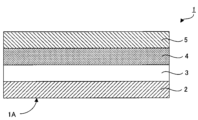
- 1 is a schematic cross-sectional view illustrating a cover tape for packaging electronic components according to the present disclosure.
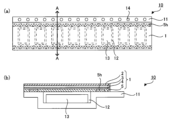
- 1A and 1B are schematic plan and cross-sectional views illustrating a packaging body according to the present disclosure.
- 1A and 1B are schematic perspective and cross-sectional views illustrating a packaging body according to the present disclosure.
- the term “above” or “below” includes both cases in which another component is placed directly above or below a certain component so as to be in contact with the component, and cases in which another component is placed above or below a certain component with another component in between, unless otherwise specified.
- the term “on the surface side” or “on the surface” includes both cases in which another component is placed directly above or below a certain component so as to be in contact with the component, and cases in which another component is placed above or below a certain component with another component in between, unless otherwise specified.
- cover tape for packaging electronic components and the package in this disclosure are described in detail below. Note that in this specification, the "cover tape for packaging electronic components” may be simply referred to as the “cover tape.”
- cover tape for packaging electronic components The cover tape in the present disclosure has an antistatic layer, a base layer, an intermediate layer, and a heat seal layer in this order, and the surface resistivity of the surface on the antistatic layer side is less than 1 ⁇ 10 10 ⁇ / ⁇ , and the peel strength against an end tape manufactured by NIPPO Corporation (as of March 15, 2024) is 2.0 N or less.
- NIPPO Corporation as of March 15, 2024
- the cover tape for packaging electronic components has a peel strength of more than 0.15 N from the carrier tape on the surface of the heat seal layer side of the cover tape for packaging electronic components after storage for 100 hours while applying a pressure of 1.2 thereto .
- FIG. 1 is a schematic cross-sectional view showing an example of the cover tape in this disclosure.
- the cover tape 1 has an antistatic layer 2, a base layer 3, an intermediate layer 4, and a heat seal layer 5, in this order.
- the surface resistivity of the surface 1A on the antistatic layer 2 side is less than a predetermined value.
- the package 10 comprises a carrier tape 11 having a plurality of storage sections 12 for storing electronic components 13, the electronic components 13 stored in the storage sections 12, and a cover tape 1 arranged to cover the storage sections 12.
- the cover tape 1 is heat-sealed to the carrier tape 11, and a heat-sealed section 5h is provided in a line shape with a predetermined width on both ends of the heat-sealed layer 5 of the cover tape 1.
- the carrier tape 11 can have a feed hole 14.
- the package 10 is usually stored after being wound up with the carrier tape 11 on the inside and the cover tape 1 on the outside, with the end tape 21 affixed to the end where the winding ends.
- the surface resistivity of the surface on the antistatic layer side is less than a predetermined value, so that the cover tape has high antistatic performance.
- the peel strength against the end tape is less than a predetermined value, so that the peel performance of the end tape is good.
- the peel strength of the end tape after storage for 100 hours in an environment of 40°C and 90% RH is also less than a predetermined value, so that the peel performance of the end tape can be maintained even when stored at a temperature and humidity higher than normal temperature and humidity. Therefore, when peeling the end tape in the package, it is possible to easily peel the end tape from the cover tape.
- the peel strength against the carrier tape is greater than or equal to a predetermined value, so that the heat seal performance is good.
- the peel strength against the carrier tape after storing for 100 hours under a pressure of 125 kN/ m2 in an environment of 40°C and 90% RH is equal to or greater than a predetermined value, so that the heat seal performance can be maintained even when stored under pressure at a temperature and humidity higher than normal temperature and humidity. That is, the deterioration of the heat seal performance due to blocking of the cover tape can be suppressed. Therefore, in the package, unintended peeling of the cover tape can be suppressed, and the falling off of electronic components can be suppressed.
- this disclosure provides a cover tape that satisfies all of the following requirements: antistatic performance, heat seal performance, and end tape peeling performance.
- the surface resistivity of the surface on the antistatic layer side is less than 1 ⁇ 10 10 ⁇ / ⁇ , preferably 1 ⁇ 10 9 ⁇ / ⁇ or less, and more preferably 1 ⁇ 10 8 ⁇ / ⁇ or less.
- the lower limit of the surface resistivity is not particularly limited, but is, for example, 1 ⁇ 10 5 ⁇ / ⁇ or more. If the surface resistivity is too low, a sudden voltage change occurs when electrostatic discharge (ESD; Electro Static Discharge) occurs, which may lead to damage to the contents.
- ESD Electro Static Discharge
- the surface resistivity was measured using a resistivity meter "Hiresta UP MCP-HT450" manufactured by Nitto Seiko Analytech Co., Ltd. under the following test conditions.
- ⁇ Test conditions> Probe: UA probe Applied voltage: 10 10 ⁇ / ⁇ or less 10V 10 10 ⁇ / ⁇ or more and less than 10 12 ⁇ / ⁇ 500V 10 13 ⁇ / ⁇ or more 1000V ⁇ Sample size: 5.5mm x 100mm ⁇ Measurement point: Center of sample ⁇ Measurement value: 5 points are measured so that the measurement points do not overlap, and the average value is used ⁇ Time for one measurement: The display after 10 seconds is used ⁇ Sample storage before measurement: Stored in an environment of 25°C and 40% RH for more than 24 hours ⁇ Measurement environment: 25 ⁇ 2°C, 40 ⁇ 5% RH environment
- methods for adjusting the surface resistivity of the surface on the antistatic layer side include, for example, a method for adjusting the type or content of the antistatic agent, a method for adjusting the type, physical properties, structure or content of a specific additive described below, and a method for adjusting the thickness of the antistatic layer.
- the peel strength against the end tape manufactured by NIPPO Corporation is 2.0 N or less, preferably 1.8 N or less, and more preferably 1.5 N or less.
- the above peel strength is the peel strength before the first environmental test described below, and is the initial peel strength.
- the peel strength is in the above range, it is possible to suppress the heat seal portion of the cover tape from peeling off from the carrier tape in the package when peeling the end tape from the package.
- the above peel strength is, for example, preferably 0.8 N or more, more preferably 1.3 N or more. When the peel strength is in the above range, it is possible to suppress the end tape from peeling off from the package.
- the peel strength of the end tape after storing for 100 hours in an environment of 40°C and 90% RH in a state where the end tape is attached to the surface of the antistatic layer of the cover tape is 2.0 N or less, preferably 1.8 N or less, and may be 1.5 N or less.
- a test in which the end tape is attached to the surface of the antistatic layer of the cover tape and stored for 100 hours in an environment of 40°C and 90% RH may be referred to as a first environmental test. Since the peel strength after the first environmental test is in the above range, blocking between the surface of the antistatic layer side of the cover tape and the end tape can be suppressed.
- the peel strength after the first environmental test is, for example, preferably 0.8 N or more, more preferably 1.3 N or more. By having the peel strength after the first environmental test be within the above range, peeling of the end tape from the packaging body can be prevented.
- the peel strength of the cover tape against the end tape is measured by the following method. First, prepare a cover tape with a width of 5.5 mm or more and an end tape manufactured by NIPPO Corporation with a width of 6 mm (as of March 15, 2024). Cut the cover tape to a length of 70 mm, and attach the heat seal layer side of the cover tape to a glass plate via double-sided tape.
- the glass substrate used is "S7213" (76 mm x 26 mm) manufactured by Matsunami Glass Industry Co., Ltd.
- the double-sided tape used is double-sided tape No. 777 manufactured by Teraoka Seisakusho Co., Ltd.
- the end tape is attached to the antistatic layer side of the cover tape by rolling the pressure roller back and forth twice to form a laminate.
- the laminate is then left to stand at 23 ⁇ 2 ° C and 50 ⁇ 10% RH for 60 minutes.
- the end tape is peeled off from the cover tape at a peel speed of 6000 mm / min and a peel angle of 180 °.
- the peel strength is then measured at four points, from 20 mm from the peel start point to 65 mm from the peel start point, and the average of the four measured values is taken as the peel strength. Note that care is taken to ensure that the end tape does not stick to the double-sided tape when preparing the sample and during measurements.
- the Tensilon universal testing machine used is the "RTF-1150-H" manufactured by A&D Co., Ltd.
- the end tape is attached to the surface of the antistatic layer of the cover tape and stored in an environment of 40°C and 90% RH for 100 hours.
- the peel strength after the first environmental test is the peel strength when peeling the end tape from the cover tape after storing the laminate in an environment of 40°C and 90% RH for 100 hours and then leaving it to stand for 60 minutes in an environment of 23 ⁇ 2°C and 50 ⁇ 10% RH.
- methods for adjusting the peel strength from the end tape include, for example, adjusting the type of binder resin, adjusting the type of antistatic agent, adjusting the type, physical properties, structure or content of a specific additive described below, adding a filler, and providing irregularities on the surface of the antistatic layer.
- the heat seal layer side of the cover tape and the antistatic layer side of the cover tape are overlapped with each other, and after storing for 100 hours under a pressure of 125 kN/ m2 under an environment of 40°C and 90% RH, the peel strength of the heat seal layer side of the cover tape against the carrier tape is greater than 0.15N, preferably 0.18N or more, and more preferably 0.20N or more.
- a test in which the heat seal layer side of the cover tape and the antistatic layer side of the cover tape are overlapped with each other and stored for 100 hours under an environment of 40°C and 90% RH while applying a pressure of 125 kN/ m2 is sometimes referred to as a second environmental test.
- the upper limit of the peel strength after the second environmental test is not particularly limited, but is preferably 0.7 N or less, and more preferably 0.6 N or less. If the peel strength after the second environmental test is within the above range, vibration of the carrier tape can be suppressed when peeling the cover tape from the carrier tape. As a result, it is possible to suppress the electronic components from jumping out of the storage pocket.
- the peel strength with respect to the carrier tape is, for example, preferably 0.15 N or more, preferably 0.18 N or more, and more preferably 0.20 N or more.
- the above peel strength is the peel strength before the second environmental test, and is the initial peel strength. If the peel strength is within the above range, for example, even when the cover tape is heat sealed to the carrier tape immediately after production, peeling of the heat sealed portion of the cover tape from the carrier tape can be suppressed. As a result, falling off of the electronic components can be suppressed.
- the upper limit of the peel strength is not particularly limited, but is, for example, preferably 0.7 N or less, and more preferably 0.6 N or less. If the peel strength is within the above range, vibration of the carrier tape can be suppressed when the cover tape is peeled off from the carrier tape. As a result, it is possible to suppress the electronic components from jumping out of the storage pocket.
- the peel strength of the cover tape against the carrier tape is the peel strength of the cover tape against the paper carrier tape.
- Carrier tapes are broadly divided into plastic carrier tapes made of plastic and paper carrier tapes made of paper, but paper carrier tapes are generally more prone to absorbing moisture than plastic carrier tapes. As a result, the peel strength is more likely to decrease. Therefore, in this disclosure, the peel strength of the cover tape against the paper carrier tape is used.
- the paper carrier tape used is "PCT31” manufactured by Hokuetsu Corporation. This paper carrier tape is 0.31 mm thick, 8 mm wide, and uses virgin paper.
- the peel strength of the initial cover tape from the carrier tape is measured using the following method. First, using a Nitto Kogyo taping machine "NST-35,” the carrier tape and cover tape are heat sealed under the following conditions while approximately 40 m is wound into a roll on a reel with a core diameter of 3 inches to prepare a reel sample. The reel sample is then stored in a tilted position in an environment of 25°C and 40% RH for 24 hours. Next, using an EPI embossed tape peel strength tester "PTS-5000,” the peel strength is measured when peeling the cover tape from the carrier tape under the following conditions.
- NST-35 Nitto Kogyo taping machine
- PTS-5000 EPI embossed tape peel strength tester
- the peel strength of the cover tape against the carrier tape after the second environmental test is measured by the following method. First, a cover tape with a width of 5.5 mm is prepared, and the cover tape is cut into two pieces with a length of 30 cm, and the second environmental test is performed. In the second environmental test, the cover tape is stored for 100 hours under a pressure of 125 kN/ m2 in an environment of 40 °C and 90% RH in a state where the heat seal layer side of the cover tape and the antistatic layer side of the cover tape are overlapped.
- the heat seal layer side of the cover tape and the antistatic layer side of the cover tape are overlapped, the heat seal layer side of the first cover tape and the antistatic layer side of the second cover tape are overlapped among the two cover tapes to form a laminate.
- a blocking tester with a pressure part size of 60 mm square is used, and a pressure of 125 kN/ m2 is applied to any area of the laminate.
- the laminate is stored for 24 hours under an environment of 25°C and 40% RH.
- the carrier tape and the cover tape are heat-sealed under the following conditions using a taping machine "NST-35" manufactured by Nitto Kogyo Co., Ltd.
- methods for adjusting the peel strength from the carrier tape include, for example, adjusting the type of antistatic agent, adjusting the type, physical properties, structure or content of a specific additive described below, and adjusting the thickness of the antistatic layer.
- the haze of the cover tape in the present disclosure is, for example, preferably 55% or less, more preferably 50% or less. If the cover tape has such optical properties, the cover tape will have good visibility.
- the haze is measured using a haze meter "NDH 7000" manufactured by Nippon Denshoku Industries Co., Ltd. in accordance with JIS K7136:2000.
- the total light transmittance of the cover tape in the present disclosure is, for example, preferably 80% or more, more preferably 85% or more. If the cover tape has such optical properties, it will have good visibility.
- the total light transmittance is measured using a haze meter "NDH 7000" manufactured by Nippon Denshoku Industries Co., Ltd. in accordance with JIS K7361-1:1997.
- the antistatic layer in the present disclosure is a layer for preventing the cover tape from being charged.
- the cover tape have an antistatic layer, damage to the chip caused by peeling charge when peeling the cover tape from the carrier tape and mounting failure due to static electricity can be suppressed.
- the generation of static electricity due to contact with other surfaces can be suppressed.
- the adhesion of dirt, dust, etc. to the cover tape surface due to static electricity can be suppressed.
- the antistatic layer preferably contains a binder resin and an antistatic agent, more preferably contains a conductive polymer or metal oxide as the antistatic agent, and even more preferably contains a conductive polymer as the antistatic agent. That is, the antistatic layer preferably contains a binder resin and a conductive polymer or metal oxide, and more preferably contains a binder resin and a conductive polymer.
- the antistatic layer contains a polyetheramine surfactant or a polymeric compound having a long-chain alkyl group on the side chain.
- the antistatic layer contains a polyetheramine surfactant, it is believed that the polyetheramine surfactant also migrates to the surface of the antistatic layer, thereby achieving releasability.
- the antistatic layer contains a polymeric compound having a long-chain alkyl group on the side chain
- the long-chain alkyl group of this polymeric compound is oriented on the surface of the antistatic layer or migrates to the surface of the antistatic layer, thereby achieving releasability. Therefore, when a surfactant is used as an antistatic agent, it is believed that the antistatic performance of the surfactant, which is the antistatic agent, and the releasability of the polyetheramine surfactant or the polymeric compound having a long-chain alkyl group on the side chain become competitive, making it difficult to achieve the antistatic effect.
- conductive polymers are less likely to bleed out, and the inclusion of conductive polymers reduces the resistance of the entire antistatic layer, thereby providing antistatic performance.
- metal oxides are less likely to bleed out, and the inclusion of metal oxides reduces the resistance of the entire antistatic layer, thereby providing antistatic performance. Therefore, even if the antistatic layer contains a polyetheramine surfactant or a polymer compound with a long-chain alkyl group on the side chain, the decrease in antistatic performance can be suppressed. This makes it possible to achieve both antistatic performance and end tape peeling performance.
- the antistatic layer preferably contains a binder resin.
- a binder resin a resin with high polarity may be used to improve adhesion to the substrate layer.
- an antistatic layer containing a binder resin has poor slipperiness, low surface roughness, and good flatness. Therefore, the adhesion between the end tape and the cover tape tends to be strong. Therefore, the effect of the present disclosure can be obtained significantly.
- by containing a binder resin in the antistatic layer not only adhesion to the substrate but also optical properties, mechanical properties, etc. are imparted.
- the binder resin is not particularly limited, but is preferably a resin with high polarity, i.e., a water-based resin. Specifically, acrylic resin, epoxy resin, polyester resin, or urethane resin is preferred.
- acrylic resins include acrylic resins obtained by polymerizing one or more of the following monomers: monomers containing hydroxyl groups, monomers containing amide groups, monomers containing carboxyl groups, and other monomers; and crosslinked acrylic resins obtained by crosslinking these resins with a crosslinking agent.
- monomers containing hydroxyl groups include 2-hydroxyethyl methacrylate, hydroxyethyl acrylate, hydroxypropyl acrylate, and hydroxybutyl acrylate.
- monomers containing amide groups include acrylamide and N-methylol acrylamide.
- monomers containing carboxyl groups include acrylic acid, methacrylic acid, itaconic acid, and maleic anhydride.
- Other monomers include methyl acrylate, ethyl acrylate, N-butyl acrylate, 2-ethylhexyl acrylate, methyl methacrylate, ethyl methacrylate, isobutyl methacrylate, and 2-ethylhexyl methacrylate.
- crosslinking agent examples include a melamine-based crosslinking agent, a urea-based crosslinking agent, an epoxy-based crosslinking agent, an isocyanate-based crosslinking agent, an aziridine-based crosslinking agent, an ethyleneimine-based crosslinking agent, a carbodiimide-based crosslinking agent, an oxazoline-based crosslinking agent, and a silane coupling agent.
- a melamine-based crosslinking agent examples include a melamine-based crosslinking agent, a urea-based crosslinking agent, an epoxy-based crosslinking agent, an isocyanate-based crosslinking agent, an aziridine-based crosslinking agent, an ethyleneimine-based crosslinking agent, a carbodiimide-based crosslinking agent, an oxazoline-based crosslinking agent, and a silane coupling agent.
- Epoxy resins include bixylenol type epoxy resins, bisphenol A type epoxy resins, bisphenol F type epoxy resins, bisphenol S type epoxy resins, bisphenol AF type epoxy resins, dicyclopentadiene type epoxy resins, trisphenol type epoxy resins, naphthol novolac type epoxy resins, phenol novolac type epoxy resins, tert-butyl-catechol type epoxy resins, naphthalene type epoxy resins, naphthol type epoxy resins, anthracene type epoxy resins, glycidylamine type epoxy resins, glycidyl ester type epoxy resins, cresol novolac type epoxy resins, biphenyl type epoxy resins, linear aliphatic epoxy resins, epoxy resins having a butadiene structure, alicyclic epoxy resins, heterocyclic epoxy resins, spiro ring-containing epoxy resins, cyclohexane dimethanol type epoxy resins, naphthylene ether type epoxy resins
- the polyester resin is composed of a polycarboxylic acid component and a polyol component.
- the polycarboxylic acid component includes at least one of an aromatic dicarboxylic acid and an aliphatic dicarboxylic acid.
- the aromatic dicarboxylic acid includes at least one component selected from the group consisting of, for example, terephthalic acid, isophthalic acid, phthalic acid, diphenic acid, naphthalic acid, 1,2-naphthalenedicarboxylic acid, 1,4-naphthalenedicarboxylic acid, 1,5-naphthalenedicarboxylic acid, and 2,6-naphthalenedicarboxylic acid.
- the aliphatic dicarboxylic acid may be linear, branched, or alicyclic.
- the aliphatic dicarboxylic acid includes at least one component selected from the group consisting of oxalic acid, malonic acid, succinic acid, maleic acid, itaconic acid, glutaric acid, adipic acid, pimelic acid, 2,2-dimethylglutaric acid, suberic acid, azelaic acid, sebacic acid, dodecanedioic acid, 1,3-cyclopentanedicarboxylic acid, 1,4-cyclohexanedicarboxylic acid, diglycolic acid, and thiodipropionic acid.
- the polyol component includes at least one component selected from the group consisting of ethylene glycol, polyethylene glycol, propylene glycol, polypropylene glycol, 1,3-propanediol, 1,3-butanediol, 1,4-butanediol, 1,5-pentanediol, 1,6-hexanediol, 2,2-dimethyl-1,3-propanediol, 2-ethyl-2-butyl-1,3-propanediol, 2-ethyl-2-isobutyl-1,3-propanediol, 2,2,4-trimethyl-1,6-hexanediol,
- the polyethylene glycol includes at least one component selected from the group consisting of 1,2-cyclohexanedimethanol, 1,3-cyclohexanedimethanol, 1,4-cyclohexanedimethanol, 2,2,4,4-tetramethyl-1,3-cyclobutaned
- the polyethylene glycol includes at least one component selected from the group consisting of, for example, diethylene glycol, triethylene glycol, tetraethylene glycol, pentaethylene glycol, hexaethylene glycol, heptaethylene glycol, and octaethylene glycol.
- the polypropylene glycol includes at least one component selected from the group consisting of, for example, dipropylene glycol, tripropylene glycol, and tetrapropylene glycol.
- the content of the binder resin in the antistatic layer is preferably 45% by mass or more, and more preferably 60% by mass or more.
- the content of the binder resin is preferably 98% by mass or less, and more preferably 95% by mass or less.
- the content of the binder resin is preferably 45% by mass or more and 98% by mass or less, and more preferably 60% by mass or more and 95% by mass or less. If the content of the binder resin is too low, the antistatic layer may be easily peeled off. On the other hand, if the content of the binder resin is too high, the content of the antistatic agent and the content of the specific additives described below will be relatively periodically reduced, and it may be difficult for the antistatic agent and the specific additives to exert their sufficient effects.
- the antistatic layer in the present disclosure preferably contains a conductive polymer or a metal oxide as an antistatic agent, and more preferably contains a conductive polymer.
- the antistatic layer may also contain a conductive polymer and a metal oxide as antistatic agents.
- Conductive Polymer refers to a polymer that itself exhibits electrical conductivity, such as polythiophene, which will be described later.
- Examples of conductive polymers include polythiophene, polyaniline, polypyrrole, polyacetylene, polyparaphenylene, polyphenylenevinylene, and polyvinylcarbazole.
- the conductive polymer is preferably one or more selected from the group consisting of polythiophene, polyaniline, and polypyrrole. This is because the polymer itself exhibits conductivity, and therefore sufficient antistatic properties and transparency can be obtained regardless of humidity.
- PEDOT/PSS ((poly(3,4-ethylenedioxythiophene))/polystyrene sulfonic acid) is preferably used as the polythiophene.
- sulfonated polyaniline is preferably used as the polyaniline. If the antistatic layer contains these conductive polymers, a low surface resistivity can be obtained even if the thickness is thin.
- the thin thickness of the antistatic layer can improve the light transmittance of the cover tape. In addition, the thin thickness of the antistatic layer can reduce the light absorption rate of the cover tape. Therefore, the visibility of the cover tape can be improved.
- the content of the conductive polymer in the antistatic layer may be an amount that satisfies the above surface resistivity.
- the content of the conductive polymer is preferably 5% by mass or more, and more preferably 7% by mass or more.
- the content of the conductive polymer is preferably 15% by mass or less, and more preferably 12% by mass or less.
- the content of the conductive polymer is preferably 5% by mass or more and 15% by mass or less, and more preferably 7% by mass or more and 12% by mass or less. If the content of the conductive polymer is too low, it may be difficult to achieve the antistatic effect. On the other hand, if the content of the conductive polymer is too high, dispersibility may be poor, and adhesion, optical properties, and mechanical properties may be inferior.
- metal oxides include antimony-doped tin oxide (ATO), fluorine-doped tin oxide, phosphorus-doped tin oxide (PTO), aluminum-doped tin oxide, niobium-doped tin oxide, tantalum-doped tin oxide, tungsten-doped tin oxide, indium-doped tin oxide, tin oxide, tin-doped indium oxide (ITO), fluorine-doped indium oxide, cadmium-doped indium oxide, indium-doped zinc oxide, fluorine-doped zinc oxide, aluminum-doped zinc oxide, gallium-doped zinc oxide, magnesium-doped zinc oxide, silicon-doped zinc oxide, tin-doped zinc oxide, boron-doped zinc oxide, zinc oxide, zinc antimonate (AZO), and niobium-doped titanium oxide.
- ATO antimony-doped t
- Metal oxides may be used alone or in combination of two or more. From the viewpoint of stabilizing the surface resistivity, antimony-doped tin oxide, tin-doped indium oxide, phosphorus-doped tin oxide, tin oxide, aluminum-doped zinc oxide, gallium-doped zinc oxide and zinc antimonate are preferred.
- the shape of the metal oxide may be spherical, acicular, or lamellar, but from the viewpoints of transparency, surface resistivity, and dispersibility, spherical and acicular shapes are preferred.
- the average particle size of the metal oxide is, for example, 0.01 ⁇ m or more and 1 ⁇ m or less, and from the viewpoint of transparency, 0.01 ⁇ m or more and 0.5 ⁇ m or less is preferred.
- the content of metal oxide in the antistatic layer may be any amount that provides a surface resistivity within a predetermined range, for example, 30% by mass or more and 70% by mass or less.
- the antistatic layer may contain an antistatic agent other than the conductive polymer and the metal oxide.
- examples of the other antistatic agent include surfactants.
- the surfactants may be cationic, anionic, or nonionic.
- the antistatic layer preferably contains a polyetheramine surfactant or a polymeric compound having a long-chain alkyl group on the side chain.
- the polyetheramine surfactant and the polymeric compound having a long-chain alkyl group on the side chain may be referred to as a specific additive.
- the antistatic agent contains a specific additive, which makes it easier to obtain the above-mentioned physical properties of the cover tape.
- the inclusion of a specific additive can improve the slipperiness of the antistatic layer. This can suppress blocking. Furthermore, it can suppress the antistatic layer from being scraped off due to friction with the taping device.
- polyetheramine type surfactants examples include polyoxyalkylene alkylamines. Examples of polyoxyalkylene alkylamines include polyoxyethylene alkylamines. Examples of polyoxyethylene alkylamines include polyoxyethylene laurylamine, polyoxyethylene alkyl (coconut)amine, polyoxyethylene tallow alkylamine, polyoxyethylene stearylamine, polyoxyethylene oleylamine, and polyoxyethylene alkyl propylene diamine.
- the polyetheramine type surfactants may be used alone or in combination of two or more.
- the number of carbon atoms in the alkyl group is, for example, 10 or more, and may be 12 or more.
- the number of carbon atoms in the alkyl group is, for example, 20 or less, and may be 18 or less. That is, the number of carbon atoms in the alkyl group is, for example, 10 or more and 20 or less, and may be 12 or more and 18 or less. If the number of carbon atoms in the alkyl group is within the above range, it is easy to adjust the HLB value and freezing point described below to be in the preferred range.
- examples of the oxyalkylene group include an oxyethylene group and an oxypropylene group.
- the oxyalkylene group is preferably an oxyethylene group, because this makes it easier to adjust the HLB value, which will be described later, to fall within a preferred range.
- the number of moles of alkylene oxide added is, for example, from 1 to 10, and may be from 1 to 5. This is because if the number of moles added is within the above range, it is easy to adjust the HLB value, which will be described later, to a preferred range.
- polyoxyalkylene alkylamines the number of carbon atoms in the alkyl group, the oxyalkylene group, and the number of moles of alkylene oxide added are analyzed by gas chromatography mass spectrometry (GC-MS).
- GC-MS gas chromatography mass spectrometry
- the HLB value (hydrophilic-lipophilic balance) of the polyetheramine surfactant is preferably, for example, 3 or more and 7 or less. In general, it is assumed that the higher the HLB value, the higher the hydrophilicity and the better the compatibility with the binder resin.
- the HLB value of the polyetheramine surfactant is a predetermined value or less, the compatibility with the binder resin is not too good, and the polyetheramine surfactant is likely to be localized on the surface of the antistatic layer. Therefore, the peel strength with respect to the end tape can be reduced, and the end tape can be easily peeled off.
- the HLB value of the polyetheramine surfactant when the HLB value of the polyetheramine surfactant is large and the compatibility with the binder resin is too good, the polyetheramine surfactant is well dissolved or dispersed in the binder resin in the antistatic layer, and it may be difficult to bleed onto the surface of the antistatic layer.
- the HLB value of the polyetheramine surfactant is a predetermined value or more, the compatibility with the binder resin is good, and the transparency can be increased.
- the HLB value is a value that represents the degree of affinity of a surfactant for water and oil, and takes a value from 0 to 20, with the closer to 0 the higher the lipophilicity and the closer to 20 the higher the hydrophilicity.
- the freezing point of the polyetheramine surfactant is preferably, for example, 5°C or higher and 40°C or lower. Having a freezing point below a specified value increases fluidity and improves dispersibility, making it possible to increase transparency. Also, having a freezing point above a specified value prevents fluidity from becoming too high, making it possible to prevent bias in antistatic performance and end tape peeling performance.
- the freezing point is the phase transition temperature from liquid to solid.
- the freezing point is measured by differential scanning calorimetry (DSC). Specifically, in differential scanning calorimetry (DSC), the measurement starting point is set to a temperature below the temperature at which the measurement sample freezes, and the freezing point is set to the temperature at which the measurement sample begins to melt as the temperature is increased and reaches an endothermic peak.
- DSC differential scanning calorimetry
- the content of the polyetheramine surfactant in the antistatic layer is, for example, preferably 5 parts by mass or more, more preferably 8 parts by mass or more, and even more preferably 10 parts by mass or more, relative to 100 parts by mass of the binder resin and the antistatic agent in total.
- the content of the polyetheramine surfactant is, for example, preferably 30 parts by mass or less, more preferably 25 parts by mass or less, and even more preferably 20 parts by mass or less, relative to 100 parts by mass of the binder resin and the antistatic agent in total.
- the content of the polyetheramine surfactant is, for example, preferably 5 parts by mass or more and 30 parts by mass or less, more preferably 8 parts by mass or more and 25 parts by mass or less, and even more preferably 10 parts by mass or more and 20 parts by mass or less, relative to 100 parts by mass of the binder resin and the antistatic agent in total. If the content of the polyetheramine surfactant is too low, the effect of improving the peeling performance of the end tape may not be sufficiently obtained. On the other hand, if the content of the polyetheramine surfactant is too high, the antistatic performance may be reduced.
- polymer compounds having a long-chain alkyl group on the side chain are used as release agents for improving the peeling performance of end tapes.
- polymer compounds having a long-chain alkyl group on the side chain may be referred to as long-chain alkyl group-containing polymer compounds.
- the long-chain alkyl group is a linear or branched alkyl group.
- the carbon number of the long-chain alkyl group is, for example, preferably 6 or more, more preferably 8 or more, even more preferably 12 or more, and particularly preferably 15 or more.
- the carbon number of the long-chain alkyl group is, for example, preferably 30 or less, more preferably 25 or less.
- Examples of long-chain alkyl groups include hexyl, octyl, decyl, lauryl, octadecyl, behenyl, myristyl, palmityl, stearyl, oleyl, elaidyl, erucyl, zomaryl, lylyl, lylnyl, eleostearyl, and lysylyl groups.
- the basic skeleton of the main chain is not particularly limited and is appropriately selected depending on the synthesis method.
- the basic skeleton of the main chain include polyester, polyamide, polyurethane, acrylic polymer, methacrylic polymer, acrylic acid ester copolymer, acrylamide copolymer, polyvinyl alcohol, polyethyleneimine, polyethyleneamine, etc.
- a polymer compound containing a long chain alkyl group can be obtained by reacting a polymer compound having a reactive group with a compound having an alkyl group capable of reacting with the reactive group.
- the reactive group include hydroxyl groups, amino groups, carboxy groups, and acid anhydrides.
- polymer compounds having a reactive group include polyvinyl alcohol, saponified vinyl acetate polymer, saponified vinyl acetate-ethylene copolymer, saponified vinyl acetate-acrylic acid copolymer, polyethyleneimine, polyethyleneamine, reactive group-containing polyester resin, and reactive group-containing poly(meth)acrylic resin.
- the saponification degree of the saponified vinyl acetate polymer is preferably 50% or more, and more preferably 60% or more.
- the saponification degree of the saponified vinyl acetate polymer is preferably 90% or less, and more preferably 80% or less. That is, the degree of saponification of the vinyl acetate polymer saponification product is preferably 50% or more and 90% or less, and more preferably 60% or more and 80% or less.
- Examples of compounds having an alkyl group capable of reacting with the reactive group include long-chain alkyl group-containing isocyanates, long-chain alkyl group-containing acid chlorides, long-chain alkyl group-containing amines, and long-chain alkyl group-containing alcohols.
- Examples of long-chain alkyl group-containing isocyanates include hexyl isocyanate, octyl isocyanate, decyl isocyanate, lauryl isocyanate, octadecyl isocyanate, and behenyl isocyanate.
- long-chain alkyl group-containing acid chlorides examples include hexyl chloride, octyl chloride, decyl chloride, lauryl chloride, octadecyl chloride, and behenyl chloride.
- long-chain alkyl group-containing isocyanates are preferred, with octadecyl isocyanate being particularly preferred.
- Long-chain alkyl group-containing polymeric compounds can also be obtained by polymerization of long-chain alkyl (meth)acrylates or copolymerization of long-chain alkyl (meth)acrylates with other vinyl group-containing monomers.
- long-chain alkyl (meth)acrylates include hexyl (meth)acrylate, octyl (meth)acrylate, decyl (meth)acrylate, lauryl (meth)acrylate, octadecyl (meth)acrylate, and behenyl (meth)acrylate.
- the long-chain alkyl group-containing polymer compound is a reaction product of a saponification product of a vinyl acetate polymer having a degree of saponification of 50% to 90%, particularly 60% to 80%, with a long-chain alkyl group-containing isocyanate, and it is preferable that the carbon number of the long-chain alkyl group is 20 to 25.
- the degree of polymerization of the main chain is, for example, 200 or more and 6000 or less.
- the number of carbon atoms in the long-chain alkyl group, the basic structure of the main chain, the degree of polymerization of the main chain, and the fact that the long-chain alkyl group-containing polymeric compound is a reaction product of saponified vinyl acetate polymer and isocyanate containing a long-chain alkyl group are analyzed using Fourier transform infrared spectroscopy (FT-IR).
- FT-IR Fourier transform infrared spectroscopy
- the content of the long-chain alkyl group-containing polymer compound in the antistatic layer is, for example, preferably 30 parts by mass or more, more preferably 40 parts by mass or more, and even more preferably 50 parts by mass or more, relative to 100 parts by mass of the binder resin and the antistatic agent in total.
- the content of the long-chain alkyl group-containing polymer compound is, for example, preferably 100 parts by mass or less, more preferably 90 parts by mass or less, and even more preferably 80 parts by mass or less, relative to 100 parts by mass of the binder resin and the antistatic agent in total.
- the content of the long-chain alkyl group-containing polymer compound is, for example, preferably 30 parts by mass or more and 100 parts by mass or less, more preferably 40 parts by mass or more and 90 parts by mass or less, and even more preferably 50 parts by mass or more and 80 parts by mass or less, relative to 100 parts by mass of the binder resin and the antistatic agent in total. If the content of the long-chain alkyl group-containing polymer compound is too small, the effect of improving the peeling performance of the end tape may not be sufficiently obtained. On the other hand, if the content of the long-chain alkyl group-containing polymer compound is too large, the peel strength to the carrier tape may decrease, or the transparency may decrease.
- the antistatic layer may contain additives, if necessary.
- the additives include a filler.
- the thickness of the antistatic layer is, for example, 0.02 ⁇ m or more and 3 ⁇ m or less. If the thickness of the antistatic layer is within the above range, the cover tape can be provided with antistatic properties.
- An example of a method for forming an antistatic layer is to use an antistatic layer composition in which a binder resin, an antistatic agent, and specific additives are dispersed or dissolved in a solvent, and then coat the antistatic layer composition on the surface of the substrate layer opposite the heat seal layer, followed by drying.
- methods for coating the antistatic layer composition include known coating methods such as air doctor, blade coating, knife coating, rod coating, bar coating, direct roll coating, reverse roll coating, gravure coating, and slide coating.
- the base material layer in the present disclosure is a layer that supports the antistatic layer, intermediate layer, and heat seal layer.
- various materials can be applied as long as they have mechanical strength to withstand external forces during storage and transportation, and heat resistance to withstand manufacturing and taping packaging.
- polyester, polyamide, polyolefin, etc. can be mentioned.
- polyester include polyethylene terephthalate, polybutylene terephthalate, polyethylene naphthalate, polyethylene terephthalate-isophthalate copolymer, terephthalic acid-cyclohexane dimethanol-ethylene glycol copolymer, etc.
- polyamide include nylon 6, nylon 66, nylon 610, etc.
- polyolefin examples include polyethylene, polypropylene, polymethylpentene, etc.
- polyester is preferable, and polyethylene terephthalate and polyethylene naphthalate are more preferable. This is because these materials are low cost and have good mechanical strength.
- the base layer may also contain additives as necessary.
- additives include fillers, plasticizers, colorants, and antistatic agents.
- the substrate layer may be a single layer or a laminate of multiple layers of the same or different types.
- the substrate layer may be a stretched film or an unstretched film.
- the substrate layer may be a film that has been stretched uniaxially or biaxially in order to improve its strength.
- the thickness of the substrate layer is, for example, 2.5 ⁇ m or more, may be 6 ⁇ m or more, or may be 12 ⁇ m or more.
- the thickness of the substrate layer is, for example, 300 ⁇ m or less, may be 100 ⁇ m or less, or may be 50 ⁇ m or less. That is, the thickness of the substrate layer is, for example, 2.5 ⁇ m or more and 300 ⁇ m or less, may be 6 ⁇ m or more and 100 ⁇ m or less, or may be 12 ⁇ m or more and 50 ⁇ m or less. If the substrate layer is too thick, the rigidity during taping packaging will be strong, which is disadvantageous in terms of handling and cost. If the substrate layer is too thin, the water vapor barrier property will decrease and the mechanical strength may be insufficient.
- the heat seal layer in the present disclosure is heat sealed to the carrier tape when a package is produced using the cover tape of the present disclosure, thereby bonding the cover tape and the carrier tape.
- the heat seal layer contains a thermoplastic resin.
- the thermoplastic resin is preferably an ethylene polymer, an acrylic resin, a polyester resin, a polyurethane resin, or a vinyl chloride-vinyl acetate copolymer, or a resin that contains any of these as its main components. Of these, it is preferable that the heat seal layer contains an ethylene polymer.
- An ethylene-based polymer is a polymer that contains structural units derived from ethylene.
- Examples of ethylene-based polymers include ethylene homopolymers and ethylene copolymers of ethylene and other monomers.
- ethylene homopolymers examples include low-density polyethylene (LDPE), linear low-density polyethylene (L-LDPE), medium-density polyethylene (MDPE), and high-density polyethylene (HDPE).
- LDPE low-density polyethylene
- L-LDPE linear low-density polyethylene
- MDPE medium-density polyethylene
- HDPE high-density polyethylene
- ethylene copolymer examples include olefin monomers, unsaturated carboxylic acids, unsaturated carboxylic acid esters, vinyl esters, styrene, etc.
- Olefin monomers include propylene, butene, pentene, hexene, octene, etc.
- Unsaturated carboxylic acids include acrylic acid, methacrylic acid, etc.
- Unsaturated carboxylic acid esters include methyl acrylate, ethyl acrylate, butyl acrylate, methyl methacrylate, ethyl methacrylate, butyl methacrylate, dimethyl maleate, diethyl maleate, etc.
- Vinyl esters include vinyl acetate, vinyl propionate, fumaric acid, maleic anhydride, maleic acid monoester, etc. These may be used alone or in combination of two or more.
- the ethylene copolymer is preferably an ethylene-vinyl acetate copolymer (EVA resin) or an acrylic-styrene copolymer.
- EVA resin ethylene-vinyl acetate copolymer
- acrylic-styrene copolymer acrylic-styrene copolymer.
- the heat seal layer contains EVA resin.
- the heat sealability to the carrier tape is improved. Therefore, unintended peeling of the cover tape during transportation or storage of the package can be suppressed.
- EVA resin is a copolymer that contains at least ethylene monomer units and vinyl acetate monomer units.
- An ethylene monomer unit is a structural unit derived from an ethylene monomer
- a vinyl acetate monomer unit is a structural unit derived from a vinyl acetate monomer.
- the EVA resin may contain a third monomer unit in addition to the ethylene monomer unit and the vinyl acetate monomer unit.
- the third monomer unit may have a functional group that has antistatic properties.
- the amount of EVA resin in the heat seal layer is not particularly limited.
- the amount of EVA resin is, for example, 50% by mass or more, and may be 60% by mass or more.
- the amount of EVA resin is, for example, 100% by mass or less, and may be 80% by mass or less. That is, the amount of EVA resin is, for example, 50% by mass or more and 100% by mass or less, and may be 60% by mass or more and 80% by mass or less.
- a high amount of EVA resin improves the heat sealability.
- the heat seal layer may further contain polyethylene resin.
- polyethylene resin By incorporating polyethylene resin, it is possible to suppress deterioration in a high-humidity and heat environment while maintaining good heat sealability.
- polyethylene resins examples include low-density polyethylene, linear low-density polyethylene, medium-density polyethylene, and high-density polyethylene. Among these, low-density polyethylene and linear low-density polyethylene are preferred from the viewpoint of dispersibility.
- classifications of various polyethylenes refer to those defined in the former JIS K6748:1995 and JIS K6899-1:2000.
- the content of the polyethylene resin in the heat seal layer is, for example, 50% by mass or less, and may be 40% by mass or less.
- the content of the polyethylene resin may be, for example, 0% by mass or more, and may be 20% by mass or more. That is, the content of the polyethylene resin may be, for example, 0% by mass or more and 50% by mass or less, and may be 20% by mass or more and 40% by mass or less. If the content of the polyethylene resin is high, the heat sealability may be reduced.
- the heat seal layer may contain additives such as tackifiers, antistatic agents, dispersants, fillers, plasticizers, colorants, and antiblocking agents, as necessary.
- the thickness of the heat seal layer is not particularly limited.
- the thickness of the heat seal layer is, for example, 1 ⁇ m or more, and may be 10 ⁇ m or more.
- the thickness of the heat seal layer is, for example, 30 ⁇ m or less, and may be 20 ⁇ m or less. That is, the thickness of the heat seal layer is, for example, 1 ⁇ m or more and 30 ⁇ m or less, and may be 10 ⁇ m or more and 20 ⁇ m or less. If the thickness of the heat seal layer is too thin, the heat sealability may be poor or a uniform film may not be obtained. On the other hand, if the thickness of the heat seal layer is too thick, the transparency of the cover tape may be reduced.
- the method for forming the heat seal layer is not particularly limited, and known methods can be used.
- a method extruded onto the base layer or intermediate layer using a T-die or the like, and then pressed onto the base layer or intermediate layer using a cooling roll.
- a method in which a pre-manufactured film is attached to the base layer or intermediate layer with an adhesive.
- adhesives that can be used include polyester-based adhesives, polyurethane-based adhesives, and acrylic-based adhesives.
- Another method for forming a heat seal layer is, for example, to use a composition for a heat seal layer in which a thermoplastic resin and additives are dispersed or dissolved in a solvent, to apply the composition for a heat seal layer onto a substrate layer, and to dry the composition.
- methods for applying the composition for a heat seal layer include known application methods such as roll coating, reverse roll coating, gravure coating, gravure reverse coating, comma coating, bar coating, wire bar coating, rod coating, kiss coating, knife coating, die coating, flow coating, dip coating, and spray coating.
- an intermediate layer is disposed between the base layer and the heat seal layer, thereby improving the adhesion between the base layer and the heat seal layer.
- the intermediate layer improves cushioning. Therefore, heat can be applied to the heat seal layer more uniformly.
- the resin material used for the intermediate layer can be appropriately selected depending on the materials of the base layer and the heat seal layer, and examples include polyolefin, polyurethane, and polyester.
- examples of polyolefin include polyethylene, polypropylene, and ethylene-methacrylate copolymer.
- the thickness of the intermediate layer is, for example, 5 ⁇ m or more and 50 ⁇ m or less.
- a film can be used as the intermediate layer.
- the lamination method of the base layer and the intermediate layer is not particularly limited, and a known method can be used.
- a method extrude lamination method
- the raw material of the heat-melted film is extruded onto the base layer using a T-die or the like, rapidly cooled and solidified with a cooling roll, and then pressed onto the base layer.
- an intermediate layer is formed on one side of the base layer.
- an anchor coat layer is formed in advance on the surface of the base layer on which the intermediate layer is to be placed.
- Another example is a method in which a pre-manufactured film is attached to the base layer with an adhesive.
- the cover tape of the present disclosure may have an adhesive layer between the base layer and the intermediate layer, or between the intermediate layer and the heat seal layer. By disposing the adhesive layer, it is possible to improve the adhesion between the base layer and the intermediate layer, or between the intermediate layer and the heat seal layer.
- the adhesive layer may be appropriately selected depending on the materials used for the base layer, intermediate layer, and heat seal layer, and is not particularly limited.
- an olefin-based adhesive an acrylic-based adhesive, an isocyanate-based adhesive, a urethane-based adhesive, or an ester-based adhesive may be used for the adhesive layer.
- the adhesive layer can be formed by applying an adhesive composition.
- the method for applying the adhesive composition is not particularly limited, and examples include gravure coating and roll coating.
- the thickness of the adhesive layer is not particularly limited as long as it can improve the adhesion between the base layer and the intermediate layer, or between the intermediate layer and the heat seal layer, and may be adjusted as appropriate.
- the package according to the present disclosure includes a carrier tape having a plurality of storage sections for storing electronic components, the electronic components stored in the storage sections, and the above-described cover tape arranged to cover the storage sections.
- FIGS. 2(a) and (b) are a schematic plan view and a cross-sectional view showing an example of a package according to the present disclosure. Note that since Figs. 2(a) and (b) were described above in the section "A. Cover tape for packaging electronic components," a description thereof will be omitted here.
- Cover Tape The cover tape in the present disclosure has been described above in the section "A. Cover Tape for Packaging Electronic Components," so description thereof will be omitted here.
- the heat seal layer of the cover tape and the carrier tape are bonded together at a heat seal portion.
- the heat seal portion can be disposed, for example, in a portion of the portion where the heat seal layer of the cover tape contacts the carrier tape.
- the heat seal layer may have a heat seal portion and a non-heat seal portion. This can improve the peeling performance of the cover tape relative to the carrier tape.
- the carrier tape in the present disclosure is a member having a plurality of storage sections for storing electronic components.
- the carrier tape may be any tape having multiple storage compartments, and may be, for example, an embossed carrier tape (also called embossed tape), a punched carrier tape (also called punched tape), or a pressed carrier tape (also called pressed tape).
- embossed carrier tape is preferably used from the standpoints of cost, formability, dimensional accuracy, etc.
- Materials for the carrier tape include, for example, plastics such as polyvinyl chloride, polystyrene, polyester, polypropylene, polycarbonate, polyacrylonitrile, and ABS resin, as well as paper.
- plastics such as polyvinyl chloride, polystyrene, polyester, polypropylene, polycarbonate, polyacrylonitrile, and ABS resin
- paper refers to a material whose main component is cellulose, and may also contain a resin component.
- the thickness of the carrier tape is selected appropriately depending on the material of the carrier tape, the thickness of the electronic components, etc.
- the thickness of the carrier tape is, for example, 30 ⁇ m or more and 1500 ⁇ m or less. If the carrier tape is too thick, the moldability may be poor. On the other hand, if the carrier tape is too thin, the strength may be insufficient.
- the carrier tape has multiple storage sections.
- the storage sections are usually arranged at predetermined intervals along the longitudinal direction of the carrier tape.
- the size, depth, pitch, etc. of the storage sections are appropriately adjusted according to the size, thickness, etc. of the electronic components.
- General carrier tape molding methods can be applied as a method for forming a carrier tape having a storage section, and are appropriately selected depending on the type and material of the carrier tape. Examples include press molding, vacuum molding, compressed air molding, punching, and compression processing.
- Electronic components used in the packaging body of the present disclosure are not particularly limited, and examples thereof include ICs, resistors, capacitors, inductors, transistors, diodes, LEDs (light-emitting diodes), liquid crystal, piezoelectric element resistors, filters, quartz oscillators, quartz vibrators, connectors, switches, volumes, relays, etc.
- the type of IC is also not particularly limited.
- the package in the present disclosure is used for storing and transporting electronic components.
- the electronic components are stored and transported in the package state and are used for mounting.
- the cover tape is peeled off, and the electronic components stored in the storage section of the carrier tape are removed and mounted on a substrate or the like.
- the package in this disclosure is usually wound with the cover tape on the outside and the carrier tape on the inside, and is stored with an end tape affixed to the end where the winding ends. Any common end tape can be used.
- an antistatic composition was prepared.
- 10 parts by mass of the polyetheramine surfactant 1 (Nimeen L-201 manufactured by NOF Corp., polyoxyethylene laurylamine) was added to the above solution per 100 parts by mass of the polyester resin and PEDOT/PSS in total to prepare an antistatic composition.
- the conductive coating agent (“U690” manufactured by Chukyo Yushi Co., Ltd.) is a solution with a solid content of 3.5% by mass, containing about 3.4% by mass of polyester resin and about 0.1% by mass of PEDOT/PSS.
- PET film a 25 ⁇ m-thick biaxially oriented polyethylene terephthalate film ("FE2002" manufactured by Futamura Chemical Co., Ltd.) (hereinafter referred to as PET film) was prepared, with both sides subjected to corona treatment.
- the above-mentioned antistatic composition was applied to one side of the above-mentioned PET film to form an antistatic layer with a thickness of 0.02 ⁇ m.
- polyurethane adhesives "Takenate A-3075” manufactured by Mitsui Chemicals and "Takelac A-3210" manufactured by Mitsui Chemicals were mixed in a mass ratio of 3:1 and diluted with ethyl acetate to a solid content of 5 mass% to prepare an adhesive composition.
- the adhesive composition was applied to the surface of the PET film opposite the antistatic layer to form an adhesive layer.
- polyethylene resin (Novatec LD LC600A manufactured by Japan Polyethylene Corporation, density 0.918 g/cm 3 ) was melted and extruded onto the surface of the adhesive layer, and an intermediate layer having a thickness of 15 ⁇ m was formed by extrusion lamination using a cooling roll.
- a heat seal composition (“Mersen MX74E” manufactured by Tosoh Corporation) was melted and extruded onto the surface of the intermediate layer, and a heat seal layer with a thickness of 15 ⁇ m was formed by extrusion lamination using a cooling roll.
- a cover tape was obtained that had an antistatic layer, a base layer, an adhesive layer, an intermediate layer, and a heat seal layer.
- Examples 2 to 9 and Comparative Examples 2 to 4 A cover tape was produced in the same manner as in Example 1, except that in the preparation of the antistatic composition, the specific additive used was changed and the amount of the specific additive added was changed.
- An antistatic composition was prepared by diluting a quaternary ammonium salt type acrylic polymer ("1sx-1090" manufactured by Taisei Fine Chemical Co., Ltd.) with methanol to a solid content of 3% by mass.
- the antistatic composition was applied to one side of a PET film to form an antistatic layer with a thickness of 1.0 ⁇ m.
- a cover tape was prepared in the same manner as in Example 1, except that in preparing the antistatic composition, a release agent (NOF Corporation's "Modiper F226", a block copolymer having a fluorine-based polymer component and an acrylic polymer component) was used as an additive, and the amount of additive added was changed.
- a release agent NOF Corporation's "Modiper F226", a block copolymer having a fluorine-based polymer component and an acrylic polymer component
- Example 7 A cover tape was prepared in the same manner as in Example 1, except that in preparing the antistatic composition, a release agent (NOF Corporation's "Modiper FS770", a block copolymer having a silicone polymer component and an acrylic polymer component) was used as an additive, and the amount of additive added was changed.
- a release agent NOF Corporation's "Modiper FS770", a block copolymer having a silicone polymer component and an acrylic polymer component
- An end tape manufactured by NIPPO Corporation (as of March 15, 2024) was attached to the end of the reel sample using a pressure roller. The reel sample was then left to stand at 23 ⁇ 2°C and 50 ⁇ 10% RH for 60 minutes. The end tape was then peeled off from the reel sample by hand at a peeling speed of 12 m/min and a peeling angle of 120° to 170°. The peeling of the end tape was evaluated according to the following criteria. A: The heat sealed portion was not peeled off from the carrier tape. B: A portion of the heat-sealed portion was peeled off from the calibrating tape by about 4 to 50 mm.
- an end tape manufactured by NIPPO Corporation (as of March 15, 2024) was attached to the antistatic layer side of the cover tape of the taping sample by rolling a pressure roller twice back and forth, and left to stand for 60 minutes at 23 ⁇ 2°C and 50 ⁇ 10% RH.
- the end tape was peeled off from the taping sample by hand at a peeling speed of 12 m/min and a peeling angle of 120° to 170°.
- the peeling of the end tape was evaluated according to the following criteria.
- B A portion of the heat-sealed portion was peeled off from the calibrating tape by about 4 to 50 mm.
- Comparative Examples 1, 3, 4, 6, and 7 the initial peel strength to the end tape and the peel strength to the end tape after the first environmental test were high, and the end tape was difficult to peel off.
- Comparative Example 5 a quaternary ammonium salt, a conventionally widely used antistatic agent, was used, and therefore the peel strength to the carrier tape after the second environmental test was high. This is thought to be because even quaternary ammonium salt-type polymers tend to bleed out, and blocking reduces the heat seal performance.
- Examples 1 to 6 and Comparative Examples 1, 3 and 4 show that it is preferable for the antistatic layer to contain a polyetheramine surfactant. Furthermore, Examples 7 to 9 and Comparative Examples 1, 6 and 7 show that it is also preferable for the antistatic layer to contain a polymer compound having a long-chain alkyl group on the side chain.
- a cover tape for packaging electronic components comprising an antistatic layer, a base layer, an intermediate layer, and a heat seal layer in this order, the surface resistivity of the antistatic layer side is less than 1 ⁇ 10 ⁇ / ⁇ ;
- the peel strength to the end tape is 2.0 N or less, With the end tape attached to the surface of the antistatic layer of the cover tape for packaging electronic components, the end tape has a peel strength of 2.0 N or less after storage for 100 hours under an environment of 40° C.
- the cover tape for packaging electronic components has a peel strength of more than 0.15 N from the surface of the heat seal layer of the cover tape for packaging electronic components to a carrier tape after storing the cover tape for packaging electronic components with the surface of the heat seal layer of the cover tape for packaging electronic components overlapped with the surface of the antistatic layer of the cover tape for packaging electronic components for 100 hours under a pressure of 125 kN/ m2 in an environment of 40°C and 90% RH.
- a packaging body comprising:
Landscapes
- Chemical & Material Sciences (AREA)
- Organic Chemistry (AREA)
- Packaging Frangible Articles (AREA)
- Laminated Bodies (AREA)
- Adhesive Tapes (AREA)
Abstract
本開示は、帯電防止層と、基材層と、中間層と、ヒートシール層とをこの順に有する電子部品包装用カバーテープであって、上記帯電防止層側の面の表面抵抗率が、1×10¹⁰Ω/□未満であり、エンドテープに対する剥離強度が2.0N以下であり、上記電子部品包装用カバーテープの上記帯電防止層の面に上記エンドテープを貼り付けた状態において、40℃、90%RHの環境下で100時間保管した後の上記エンドテープに対する剥離強度が2.0N以下であり、上記電子部品包装用カバーテープの上記ヒートシール層側の面と上記電子部品包装用カバーテープの上記帯電防止層側の面とを重ね合わせた状態において、40℃、90%RHの環境下で、125kN/m2の圧力をかけながら100時間保管した後の、上記電子部品包装用カバーテープの上記ヒートシール層側の面のキャリアテープに対する剥離強度が0.15Nより大きい、電子部品包装用カバーテープを提供する。
Description
本開示は、電子部品包装用カバーテープおよびそれを用いた包装体に関する。
近年、IC、抵抗、トランジスタ、ダイオード、コンデンサ、圧電素子レジスタ等の電子部品は、テーピング包装され、表面実装に供せられる。テーピング包装においては、電子部品を収納する収納部を複数有するキャリアテープに電子部品を収納した後に、キャリアテープをカバーテープでヒートシールし、電子部品を保管および搬送するための包装体を得る。電子部品の実装時には、カバーテープをキャリアテープから剥離し、電子部品を自動的に取り出して基板に表面実装する。なお、カバーテープはトップテープとも称される。
テーピング包装においては、電子部品がキャリアテープまたはカバーテープとの摩擦や接触によって、静電気が発生する場合がある。また、電子部品の実装時にカバーテープをキャリアテープから剥離することによって、静電気が発生する場合がある。静電気により、実装時に電子部品がカバーテープに付着し、電子部品を正常に取り出すことができない場合や、キャリアテープの収納部から電子部品が飛び出してしまう場合がある。これは、実装効率の低下を招くことになる。さらには、静電気により、電子部品の劣化および破壊が生ずるおそれもある。そこで、静電気の発生を抑制するために、帯電防止性を有するカバーテープが種々提案されている(例えば特許文献1参照)。
テーピング包装において、包装体は、通常、キャリアテープが内側、カバーテープが外側になるように巻き取った後、巻き終わりとなる端部に留めシールを貼り付けた状態で保管および搬送される。留めシールは、仮固定用テープであり、包装体を巻き出す際には剥がされる。なお、留めシールはエンドテープとも称される。
しかし、エンドテープとカバーテープとの密着力が強いと、包装体からエンドテープを剥がす際に、エンドテープがカバーテープから剥がれるのではなく、エンドテープおよびカバーテープがキャリアテープから剥がれてしまう場合があった。この場合、内容物である電子部品が脱落するという問題がある。
カバーテープが、例えば、基材層の一方の面側にヒートシール層を有し、基材層の他方の面側に帯電防止層を有する場合、帯電防止層としては、帯電防止剤およびバインダー樹脂を含有するものが知られている。バインダー樹脂としては、基材層に対する密着性を良くするために、極性の高い樹脂が用いられることがある。また、バインダー樹脂を含む帯電防止層は、滑り性が悪く、また表面粗さが低く平坦性が良い。そのため、エンドテープとカバーテープとの密着力が強くなる傾向がある。
本開示は、上記事情に鑑みてなされたものであり、高い帯電防止性能を有し、かつ、エンドテープを剥離しやすい電子部品包装用カバーテープを提供することを目的とする。
上記目的を達成するために、本開示の発明者らは、基材層の一方の面側にヒートシール層を有し、基材層の他方の面側に帯電防止層を有するカバーテープにおける、エンドテープの剥離性能について鋭意検討を行った。
帯電防止剤としては、4級アンモニウム塩等の界面活性剤が汎用されている。このような界面活性剤は、ブリードアウトしやすい。そのため、図らずも、軽剥離化を実現でき、エンドテープの剥離性能を良くすることができる。一方、カバーテープは、通常、巻かれた状態で保管される。そのため、保管中に、帯電防止層に含まれる界面活性剤の一部がヒートシール層に移行し、帯電防止性能やヒートシール性能が低下するおそれがある。よって、帯電防止剤として界面活性剤を用いる場合、帯電防止性能、ヒートシール性能、およびエンドテープの剥離性能の全てを満たすことは困難である。
また、帯電防止剤としては、導電性高分子も知られている。導電性高分子は、ブリードアウトしにくい。このため、保管中の帯電防止性能およびヒートシール性能の低下を抑制できる。しかし、導電性高分子がブリードアウトしないゆえに、エンドテープの剥離力が高くなりやすい。よって、帯電防止剤として導電性高分子を用いる場合も、帯電防止性能、ヒートシール性能、およびエンドテープの剥離性能の全てを満たすことは困難である。
本開示は、このような知見に基づくものである。
本開示の一実施形態は、帯電防止層と、基材層と、中間層と、ヒートシール層とをこの順に有する電子部品包装用カバーテープであって、上記帯電防止層側の面の表面抵抗率が、1×10¹⁰Ω/□未満であり、エンドテープに対する剥離強度が2.0N以下であり、上記電子部品包装用カバーテープの上記帯電防止層の面に上記エンドテープを貼り付けた状態において、40℃、90%RHの環境下で100時間保管した後の上記エンドテープに対する剥離強度が2.0N以下であり、上記電子部品包装用カバーテープの上記ヒートシール層側の面と上記電子部品包装用カバーテープの上記帯電防止層側の面とを重ね合わせた状態において、40℃、90%RHの環境下で、125kN/m2の圧力をかけ、100時間保管した後の、上記電子部品包装用カバーテープの上記ヒートシール層側の面のキャリアテープに対する剥離強度が0.15Nより大きい、電子部品包装用カバーテープを提供する。
本開示の他の実施形態は、電子部品を収納する複数の収納部を有するキャリアテープと、上記収納部に収納された電子部品と、上記収納部を覆うように配置された、上述の電子部品包装用カバーテープと、を備える、包装体を提供する。
本開示は、高い帯電防止性能を有し、かつ、エンドテープを剥離しやすい電子部品包装用カバーテープを提供することができるという効果を奏する。
下記に、図面等を参照しながら本開示の実施の形態を説明する。ただし、本開示は多くの異なる態様で実施することが可能であり、下記に例示する実施の形態の記載内容に限定して解釈されない。また、図面は説明をより明確にするため、実際の形態に比べ、各部の幅、厚さ、形状等について模式的に表わされる場合があるが、あくまで一例であって、本開示の解釈を限定しない。また、本明細書と各図において、既出の図に関して前述したものと同様の要素には、同一の符号を付して、詳細な説明を適宜省略することがある。
本明細書において、ある部材の上に他の部材を配置する態様を表現するにあたり、単に「上に」、あるいは「下に」と表記する場合、特に断りの無い限りは、ある部材に接するように、直上、あるいは直下に他の部材を配置する場合と、ある部材の上方、あるいは下方に、さらに別の部材を介して他の部材を配置する場合との両方を含む。また、本明細書において、ある部材の面に他の部材を配置する態様を表現するにあたり、単に「面側に」または「面に」と表記する場合、特に断りの無い限りは、ある部材に接するように、直上、あるいは直下に他の部材を配置する場合と、ある部材の上方、あるいは下方に、さらに別の部材を介して他の部材を配置する場合との両方を含む。
以下、本開示における電子部品包装用カバーテープおよび包装体について、詳細に説明する。なお、本明細書において、「電子部品包装用カバーテープ」を単に「カバーテープ」と称する場合がある。
A.電子部品包装用カバーテープ
本開示におけるカバーテープは、帯電防止層と、基材層と、中間層と、ヒートシール層とをこの順に有し、上記帯電防止層側の面の表面抵抗率が、1×10¹⁰Ω/□未満であり、NIPPO社製のエンドテープ(2024年3月15日現在)に対する剥離強度が2.0N以下であり、上記電子部品包装用カバーテープの上記帯電防止層の面に上記エンドテープを貼り付けた状態において、40℃、90%RHの環境下で100時間保管した後の上記エンドテープに対する剥離強度が2.0N以下であり、上記電子部品包装用カバーテープの上記ヒートシール層側の面と上記電子部品包装用カバーテープの上記帯電防止層側の面とを重ね合わせた状態において、40℃、90%RHの環境下で、125kN/m2の圧力をかけながら100時間保管した後の、記電子部品包装用カバーテープの上記ヒートシール層側の面のキャリアテープに対する剥離強度が0.15Nより大きい、電子部品包装用カバーテープを提供する。
本開示におけるカバーテープは、帯電防止層と、基材層と、中間層と、ヒートシール層とをこの順に有し、上記帯電防止層側の面の表面抵抗率が、1×10¹⁰Ω/□未満であり、NIPPO社製のエンドテープ(2024年3月15日現在)に対する剥離強度が2.0N以下であり、上記電子部品包装用カバーテープの上記帯電防止層の面に上記エンドテープを貼り付けた状態において、40℃、90%RHの環境下で100時間保管した後の上記エンドテープに対する剥離強度が2.0N以下であり、上記電子部品包装用カバーテープの上記ヒートシール層側の面と上記電子部品包装用カバーテープの上記帯電防止層側の面とを重ね合わせた状態において、40℃、90%RHの環境下で、125kN/m2の圧力をかけながら100時間保管した後の、記電子部品包装用カバーテープの上記ヒートシール層側の面のキャリアテープに対する剥離強度が0.15Nより大きい、電子部品包装用カバーテープを提供する。
本開示におけるカバーテープについて、図面を参照して説明する。図1は、本開示におけるカバーテープの一例を示す概略断面図である。図1に示すように、カバーテープ1は、帯電防止層2と、基材層3と、中間層4と、ヒートシール層5とをこの順に有する。カバーテープ1において、帯電防止層2側の面1Aの表面抵抗率は所定の値未満である。
図2(a)、(b)は、本開示におけるカバーテープを用いた包装体の一例を示す概略平面図および断面図であり、図2(b)は図2(a)のA-A線断面図である。図2(a)、(b)に示すように、包装体10は、電子部品13を収納する複数の収納部12を有するキャリアテープ11と、収納部12に収納された電子部品13と、収納部12を覆うように配置されたカバーテープ1と、を備える。キャリアテープ11にはカバーテープ1がヒートシールされており、カバーテープ1のヒートシール層5の両端に所定の幅でライン状にヒートシール部5hが設けられている。また、包装体10において、キャリアテープ11は、送り穴14を有することができる。
図3(a)、(b)に例示するように、包装体10は、通常、キャリアテープ11が内側、カバーテープ1が外側になるように巻き取った後、巻き終わりとなる端部にエンドテープ21を貼り付けた状態で保管される。
本開示のカバーテープにおいては、帯電防止層側の面の表面抵抗率が所定の値未満であるため、高い帯電防止性能を有する。また、本開示のカバーテープにおいては、エンドテープに対する剥離強度が所定の値以下であるため、エンドテープの剥離性能が良好である。さらに、40℃、90%RHの環境下で100時間保管した後のエンドテープの剥離強度も所定の値以下であるため、常温常湿よりも高い温度および湿度で保管された場合でも、エンドテープの剥離性能を維持できる。よって、包装体において、エンドテープを剥離する際に、カバーテープからエンドテープを剥離しやすくすることができる。これにより、エンドテープを剥離する際に、キャリアテープからカバーテープが剥がれるのを抑制し、電子部品の収納ポケットからの飛び出しを抑制できる。また、本開示のカバーテープにおいては、キャリアテープに対する剥離強度が所定の値以上であるため、ヒートシール性能が良好である。特に、カバーテープのヒートシール層側の面とカバーテープの帯電防止層側の面とを重ね合わせた状態において、40℃、90%RHの環境下で、125kN/m2の圧力をかけながら100時間保管した後のキャリアテープに対する剥離強度が所定の値以上であるため、常温常湿よりも高い温度および湿度で、圧力がかかった状態で保管された場合でも、ヒートシール性能を維持できる。すなわち、カバーテープのブロッキングによるヒートシール性能の低下を抑制できる。よって、包装体において、意図しないカバーテープの剥がれを抑制し、電子部品の脱落を抑制できる。
したがって、本開示においては、帯電防止性能、ヒートシール性能、およびエンドテープの剥離性能の全てを満たすカバーテープを提供できる。
以下、本開示におけるカバーテープの各構成について説明する。
1.カバーテープの物性
(1)表面抵抗率
本開示のカバーテープにおいて、帯電防止層側の面の表面抵抗率は、1×10¹⁰Ω/□未満であり、1×109Ω/□以下が好ましく、1×108Ω/□以下がより好ましい。上記表面抵抗率が上記範囲であることにより、十分な帯電防止性能が得られる。一方、上記表面抵抗率の下限は特に限定されないが、例えば、1×105Ω/□以上である。上記表面抵抗率が低すぎると、静電気放電(ESD;Electro Static Discharge)発生時に急激な電圧変化が生じ、内容物の破損につながる可能性がある。
(1)表面抵抗率
本開示のカバーテープにおいて、帯電防止層側の面の表面抵抗率は、1×10¹⁰Ω/□未満であり、1×109Ω/□以下が好ましく、1×108Ω/□以下がより好ましい。上記表面抵抗率が上記範囲であることにより、十分な帯電防止性能が得られる。一方、上記表面抵抗率の下限は特に限定されないが、例えば、1×105Ω/□以上である。上記表面抵抗率が低すぎると、静電気放電(ESD;Electro Static Discharge)発生時に急激な電圧変化が生じ、内容物の破損につながる可能性がある。
表面抵抗率は、日東精工アナリテック社製の抵抗率計「ハイレスタUP MCP-HT450」を用いて、以下の試験条件で行った値である。
<試験条件>
・プローブ:UAプローブ
・印加電圧:1010Ω/□未満 10V
1010Ω/□以上1012Ω/□未満 500V
1013Ω/□以上 1000V
・サンプルサイズ:5.5mm×100mm
・測定点:サンプル中央部
・測定値:測定点が重ならないように5点測定し、平均値を採用
・1回の測定時間:10秒後の表示を採用
・測定前サンプル保管:25℃40%RH環境下で24時間以上保管
・測定環境:25±2℃、40±5%RH環境
<試験条件>
・プローブ:UAプローブ
・印加電圧:1010Ω/□未満 10V
1010Ω/□以上1012Ω/□未満 500V
1013Ω/□以上 1000V
・サンプルサイズ:5.5mm×100mm
・測定点:サンプル中央部
・測定値:測定点が重ならないように5点測定し、平均値を採用
・1回の測定時間:10秒後の表示を採用
・測定前サンプル保管:25℃40%RH環境下で24時間以上保管
・測定環境:25±2℃、40±5%RH環境
本開示におけるカバーテープにおいて、帯電防止層側の面の表面抵抗率を調整する方法としては、例えば、帯電防止剤の種類または含有量を調整する方法、後述の特定添加剤の種類、物性、構造または含有量を調整する方法、帯電防止層の厚さを調整する方法が挙げられる。
(2)エンドテープに対する剥離強度
本開示のカバーテープにおいて、NIPPO社製のエンドテープ(2024年3月15日現在)に対する剥離強度は、2.0N以下であり、1.8N以下が好ましく、1.5N以下がより好ましい。上記剥離強度は、後述の第1の環境試験前の剥離強度であり、初期の剥離強度である。上記剥離強度が上記範囲であることにより、包装体からエンドテープを剥離する際に、包装体においてカバーテープのヒートシール部がキャリアテープから剥がれるのを抑制できる。その結果、電子部品が収納ポケットから飛び出すのを抑制できる。一方、上記剥離強度は、例えば、0.8N以上が好ましく、1.3N以上がより好ましい。上記剥離強度が上記範囲であることにより、包装体からエンドテープが剥離するのを抑制できる。
本開示のカバーテープにおいて、NIPPO社製のエンドテープ(2024年3月15日現在)に対する剥離強度は、2.0N以下であり、1.8N以下が好ましく、1.5N以下がより好ましい。上記剥離強度は、後述の第1の環境試験前の剥離強度であり、初期の剥離強度である。上記剥離強度が上記範囲であることにより、包装体からエンドテープを剥離する際に、包装体においてカバーテープのヒートシール部がキャリアテープから剥がれるのを抑制できる。その結果、電子部品が収納ポケットから飛び出すのを抑制できる。一方、上記剥離強度は、例えば、0.8N以上が好ましく、1.3N以上がより好ましい。上記剥離強度が上記範囲であることにより、包装体からエンドテープが剥離するのを抑制できる。
また、本開示のカバーテープにおいて、カバーテープの帯電防止層の面に上記エンドテープを貼り付けた状態において、40℃、90%RHの環境下で100時間保管した後の上記エンドテープに対する剥離強度は、2.0N以下であり、1.8N以下が好ましく、1.5N以下であってもよい。なお、本明細書において、カバーテープの帯電防止層の面に上記エンドテープを貼り付けた状態において、40℃、90%RHの環境下で100時間保管する試験を、第1の環境試験と称する場合がある。第1の環境試験後の上記剥離強度が上記範囲であることにより、カバーテープの帯電防止層側の面とエンドテープとの間のブロッキングを抑制できる。これにより、包装体からエンドテープを剥離する際に、包装体においてカバーテープのヒートシール部がキャリアテープから剥がれるのを抑制できる。その結果、電子部品が収納ポケットから飛び出すのを抑制できる。一方、第1の環境試験後の上記剥離強度は、例えば、0.8N以上が好ましく、1.3N以上がより好ましい。第1の環境試験後の上記剥離強度が上記範囲であることにより、包装体からエンドテープが剥離するのを抑制できる。
カバーテープのエンドテープに対する剥離強度は、下記方法により測定する。まず、5.5mm幅以上のカバーテープと、6mm幅のNIPPO社製のエンドテープ(2024年3月15日現在)とを準備する。カバーテープを70mm長さに切り出し、カバーテープのヒートシール層側の面を、両面テープを介してガラス板に貼り付ける。ガラス基板は、松浪硝子工業社製「S7213」(76mm×26mm)を用いる。両面テープは、寺岡製作所社製の両面テープ No.777を用いる。次に、カバーテープの帯電防止層側の面にエンドテープを、圧着ローラーを2往復転がして貼り付けて、積層体とする。その後、上記積層体を23±2℃、50±10%RHにて60分間静置する。次に、テンシロン万能試験機を用い、剥離速度6000mm/min、剥離角度180°にて、カバーテープからエンドテープを剥離する。そして、剥離開始点から20mmの点から、剥離開始点から65mmの点までの4点の剥離強度を測定し、4つの測定値の平均値を上記剥離強度とする。なお、サンプル作製時および測定時に、エンドテープが両面テープに貼り付かないように注意する。テンシロン万能試験機としては、エー・アンド・デイ社製「RTF-1150-H」を用いる。
第1の環境試験では、カバーテープの帯電防止層の面に上記エンドテープを貼り付けた状態において、40℃、90%RHの環境下で100時間保管する。第1の環境試験後の剥離強度は、上記積層体を、40℃、90%RHの環境下で100時間保管した後、さらに23±2℃、50±10%RHの環境下で60分間静置した後の、カバーテープからエンドテープを剥離する際の剥離強度である。
本開示におけるカバーテープにおいて、上記エンドテープに対する剥離強度を調整する方法としては、例えば、バインダー樹脂の種類を調整する方法、帯電防止剤の種類を調整する方法、後述の特定添加剤の種類、物性、構造または含有量を調整する方法、フィラーを添加する方法、帯電防止層の表面に凹凸をつける方法が挙げられる。
(3)キャリアテープに対する剥離強度
本開示のカバーテープにおいて、カバーテープのヒートシール層側の面とカバーテープの帯電防止層側の面とを重ね合わせた状態において、40℃、90%RHの環境下で、125kN/m2の圧力をかけながら100時間保管した後の、カバーテープのヒートシール層側の面のキャリアテープに対する剥離強度は、0.15Nより大きく、0.18N以上が好ましく、0.20N以上がより好ましい。なお、本明細書において、カバーテープのヒートシール層側の面とカバーテープの帯電防止層側の面とを重ね合わせた状態において、40℃、90%RHの環境下で、125kN/m2の圧力をかけながら100時間保管する試験を、第2の環境試験と称する場合がある。第2の環境試験後の上記剥離強度が上記範囲であることにより、カバーテープのブロッキングによる上記剥離強度の低下を抑制できる。よって、電子部品の実装時に剥離装置によってキャリアテープからカバーテープを剥離する前に、キャリアテープからカバーテープのヒートシール部が剥がれるのを抑制できる。その結果、電子部品が脱落するのを抑制できる。
本開示のカバーテープにおいて、カバーテープのヒートシール層側の面とカバーテープの帯電防止層側の面とを重ね合わせた状態において、40℃、90%RHの環境下で、125kN/m2の圧力をかけながら100時間保管した後の、カバーテープのヒートシール層側の面のキャリアテープに対する剥離強度は、0.15Nより大きく、0.18N以上が好ましく、0.20N以上がより好ましい。なお、本明細書において、カバーテープのヒートシール層側の面とカバーテープの帯電防止層側の面とを重ね合わせた状態において、40℃、90%RHの環境下で、125kN/m2の圧力をかけながら100時間保管する試験を、第2の環境試験と称する場合がある。第2の環境試験後の上記剥離強度が上記範囲であることにより、カバーテープのブロッキングによる上記剥離強度の低下を抑制できる。よって、電子部品の実装時に剥離装置によってキャリアテープからカバーテープを剥離する前に、キャリアテープからカバーテープのヒートシール部が剥がれるのを抑制できる。その結果、電子部品が脱落するのを抑制できる。
第2の環境試験後の上記剥離強度の上限は、特に限定されないが、例えば、0.7N以下が好ましく、0.6N以下がより好ましい。第2の環境試験後の上記剥離強度が上記範囲であれば、キャリアテープからカバーテープを剥離する際に、キャリアテープが振動するのを抑制できる。その結果、電子部品が収納ポケットから飛び出すのを抑制できる。
また、本開示のカバーテープにおいて、キャリアテープに対する剥離強度は、例えば、0.15N以上が好ましく、0.18N以上が好ましく、0.20N以上がより好ましい。上記剥離強度は、第2の環境試験前の剥離強度であり、初期の剥離強度である。上記剥離強度が上記範囲であれば、例えばカバーテープの製造直後にキャリアテープにヒートシールする場合においても、キャリアテープからカバーテープのヒートシール部が剥がれるのを抑制できる。その結果、電子部品が脱落するのを抑制できる。一方、上記剥離強度の上限は、特に限定されないが、例えば、0.7N以下が好ましく、0.6N以下がより好ましい。上記剥離強度が上記範囲であれば、キャリアテープからカバーテープを剥離する際に、キャリアテープが振動するのを抑制できる。その結果、電子部品が収納ポケットから飛び出すのを抑制できる。
カバーテープのキャリアテープに対する剥離強度は、カバーテープの紙キャリアテープに対する剥離強度である。キャリアテープは、プラスチック製のプラスチックキャリアテープと紙製の紙キャリアテープとに大別されるが、紙キャリアテープは、一般にプラスチックキャリアテープに比べて吸湿しやすい。そのため、剥離強度が低下しやすい。そこで、本開示においては、カバーテープの紙キャリアテープに対する剥離強度を採用している。
紙キャリアテープとしては、北越コーポレーション社製「PCT31」を使用する。この紙キャリテープは、厚さが0.31mm、幅が8mmであり、バージン紙を用いたものである。
初期のカバーテープのキャリアテープに対する剥離強度は、下記方法により測定する。まず、日東工業社製のテーピングマシーン「NST-35」を使用して、キャリアテープとカバーテープとを下記条件でヒートシールしつつ、約40mをコア径3インチのリールにロール状に巻き取り、リールサンプルを作製する。次いで、リールサンプルを倒した状態において、25℃、40%RHの環境下で24時間保管する。続いて、イー・ピー・アイ社製のエンボステープ剥離強度試験機「PTS-5000」を使用し、下記条件でキャリアテープからカバーテープを剥離する際の剥離強度を測定する。
<テーピング条件>
・キャリアテープ送り穴ピッチ:2mm
・テーピング温度:0.25Nから0.35Nに調整できる温度 例えば180℃
・テーピングスピード:3500タクト
・テーピングコテサイズ:0.6mm×2線
・テーピングコテ長さ(1タクトでのシール長):8±1mm
・キャリアテープ送り穴ピッチ:2mm
・テーピング温度:0.25Nから0.35Nに調整できる温度 例えば180℃
・テーピングスピード:3500タクト
・テーピングコテサイズ:0.6mm×2線
・テーピングコテ長さ(1タクトでのシール長):8±1mm
<剥離強度測定条件>
・カバーテープ幅:5.25±0.2mm
・測定長:150mm
・剥離速度:300mm/分
・剥離角度:165°以上175°以下
・測定環境:25±3℃、40±10%RH
・測定値:150mm測定したときの平均値
・カバーテープ幅:5.25±0.2mm
・測定長:150mm
・剥離速度:300mm/分
・剥離角度:165°以上175°以下
・測定環境:25±3℃、40±10%RH
・測定値:150mm測定したときの平均値
第2の環境試験後のカバーテープのキャリアテープに対する剥離強度は、下記方法により測定する。まず、5.5mm幅のカバーテープを準備し、カバーテープを30cm長さに2枚切り出し、第2の環境試験を行う。第2の環境試験では、カバーテープのヒートシール層側の面とカバーテープの帯電防止層側の面とを重ね合わせた状態において、40℃、90%RHの環境下で、125kN/m2の圧力をかけながら100時間保管する。カバーテープのヒートシール層側の面とカバーテープの帯電防止層側の面とを重ね合わせる際には、上記の2枚のカバーテープのうち、第1のカバーテープのヒートシール層側の面と第2のカバーテープの帯電防止層側の面とを重ね合わせて、積層体とする。また、圧力をかける際には、加圧部のサイズが60mm角であるブロッキングテスターを用い、上記積層体の任意の領域に125kN/m2の圧力をかける。次に、第2の環境試験後、上記積層体を25℃、40%RHの環境下で24時間保管する。次いで、日東工業社製のテーピングマシーン「NST-35」を使用して、キャリアテープとカバーテープとを下記条件でヒートシールして、長さ30cmのテーピングサンプルを作製する。この際、第1のカバーテープと第2のカバーテープとを剥離した後、第1のカバーテープのヒートシール層側の面をキャリアテープにテーピングする。続いて、イー・ピー・アイ社製のエンボステープ剥離強度試験機「PTS-5000」を使用し、第2の環境試験において加圧した部分について、下記条件でキャリアテープからカバーテープを剥離する際の剥離強度を測定する。
<テーピング条件>
・キャリアテープ送り穴ピッチ:2mm
・テーピング温度:0.25Nから0.35Nに調整できる温度 例えば180℃
・テーピングスピード:3500タクト
・テーピングコテサイズ:0.6mm×2線
・テーピングコテ長さ(1タクトでのシール長):8±1mm
・キャリアテープ送り穴ピッチ:2mm
・テーピング温度:0.25Nから0.35Nに調整できる温度 例えば180℃
・テーピングスピード:3500タクト
・テーピングコテサイズ:0.6mm×2線
・テーピングコテ長さ(1タクトでのシール長):8±1mm
<剥離強度測定条件>
・カバーテープ幅:5.5mm
・測定長:50mm
・剥離速度:300mm/分
・剥離角度:165°以上175°以下
・測定環境:25±3℃、40±10%RH
・測定値:50mm測定したときの平均値
・カバーテープ幅:5.5mm
・測定長:50mm
・剥離速度:300mm/分
・剥離角度:165°以上175°以下
・測定環境:25±3℃、40±10%RH
・測定値:50mm測定したときの平均値
本開示におけるカバーテープにおいて、キャリアテープに対する剥離強度を調整する方法としては、例えば、帯電防止剤の種類を調整する方法、後述の特定添加剤の種類、物性、構造または含有量を調整する方法、帯電防止層の厚さを調整する方法が挙げられる。
(4)ヘーズ
本開示におけるカバーテープのヘーズは、例えば、55%以下が好ましく、50%以下がより好ましい。このような光学特性を有するものであれば、視認性の良いカバーテープとなる。ヘーズは、JIS K7136:2000に準拠して、日本電色工業社製のヘーズメーター「NDH 7000」を用いて測定する。
本開示におけるカバーテープのヘーズは、例えば、55%以下が好ましく、50%以下がより好ましい。このような光学特性を有するものであれば、視認性の良いカバーテープとなる。ヘーズは、JIS K7136:2000に準拠して、日本電色工業社製のヘーズメーター「NDH 7000」を用いて測定する。
(5)全光線透過率
本開示におけるカバーテープの全光線透過率は、例えば、80%以上が好ましく、85%以上がより好ましい。このような光学特性を有するものであれば、視認性の良いカバーテープとなる。全光線透過率は、JIS K7361-1:1997に準拠して、日本電色工業社製のヘーズメーター「NDH 7000」を用いて測定する。
本開示におけるカバーテープの全光線透過率は、例えば、80%以上が好ましく、85%以上がより好ましい。このような光学特性を有するものであれば、視認性の良いカバーテープとなる。全光線透過率は、JIS K7361-1:1997に準拠して、日本電色工業社製のヘーズメーター「NDH 7000」を用いて測定する。
2.帯電防止層
本開示における帯電防止層は、カバーテープが帯電するのを防止するための層である。カバーテープが帯電防止層を有することにより、キャリアテープからカバーテープを剥離する際の剥離帯電によるチップの損傷や静電気による実装不良を抑制できる。また、他の面との接触による静電気の発生を抑制できる。さらに、静電気によるカバーテープ表面へのゴミやチリ等の付着を抑制できる。
本開示における帯電防止層は、カバーテープが帯電するのを防止するための層である。カバーテープが帯電防止層を有することにより、キャリアテープからカバーテープを剥離する際の剥離帯電によるチップの損傷や静電気による実装不良を抑制できる。また、他の面との接触による静電気の発生を抑制できる。さらに、静電気によるカバーテープ表面へのゴミやチリ等の付着を抑制できる。
(1)帯電防止層の材料
帯電防止層は、バインダー樹脂および帯電防止剤を含有することが好ましく、帯電防止剤として導電性高分子または金属酸化物を含有することがより好ましく、帯電防止剤として導電性高分子を含有することがさらに好ましい。すなわち、帯電防止層は、バインダー樹脂と導電性高分子または金属酸化物を含有することが好ましく、バインダー樹脂と導電性高分子とを含有することがより好ましい。
帯電防止層は、バインダー樹脂および帯電防止剤を含有することが好ましく、帯電防止剤として導電性高分子または金属酸化物を含有することがより好ましく、帯電防止剤として導電性高分子を含有することがさらに好ましい。すなわち、帯電防止層は、バインダー樹脂と導電性高分子または金属酸化物を含有することが好ましく、バインダー樹脂と導電性高分子とを含有することがより好ましい。
従来、帯電防止剤としては、4級アンモニウム塩等の界面活性剤が汎用されている。このような界面活性剤は、ブリードアウトしやすく、帯電防止層の表面に移行することで、帯電防止性能が発揮される。一方、後述するように、帯電防止層は、ポリエーテルアミン型界面活性剤または側鎖に長鎖アルキル基を有する高分子化合物を含有することが好ましい。帯電防止層にポリエーテルアミン型界面活性剤を含有させる場合、ポリエーテルアミン型界面活性剤も、帯電防止層の表面に移行することで、離型性が発揮されると考えられる。また、帯電防止層に側鎖に長鎖アルキル基を有する高分子化合物を含有させる場合、この高分子化合物の長鎖アルキル基が、帯電防止層の表面に配向する、または帯電防止層の表面に移行することにより、離型性が発揮されると考えられる。そのため、帯電防止剤として界面活性剤を用いると、帯電防止剤である界面活性剤による帯電防止性能の発現と、ポリエーテルアミン型界面活性剤または側鎖に長鎖アルキル基を有する高分子化合物による離型性の発現とが競争的になり、帯電防止効果が発現しにくくなると考えられる。
一方、導電性高分子は、ブリードアウトしにくく、導電性高分子を含有することによって帯電防止層全体の抵抗が下がることで、帯電防止性能が発揮される。同様に、金属酸化物は、ブリードアウトしにくく、金属酸化物を含有することによって帯電防止層全体の抵抗が下がることで、帯電防止性能が発揮される。そのため、帯電防止層にポリエーテルアミン型界面活性剤または側鎖に長鎖アルキル基を有する高分子化合物を含有させた場合でも、帯電防止性能が低下するのを抑制できる。よって、帯電防止性能およびエンドテープの剥離性能を両立することが可能である。
(a)バインダー樹脂
帯電防止層は、バインダー樹脂を含むことが好ましい。バインダー樹脂としては、基材層に対する密着性を良くするために、極性の高い樹脂が用いられることがある。また、バインダー樹脂を含む帯電防止層は、滑り性が悪く、また表面粗さが低く平坦性が良い。そのため、エンドテープとカバーテープとの密着力が強くなる傾向がある。よって、本開示による効果を顕著に得ることができる。また、帯電防止層がバインダー樹脂を含むことにより、基材に対する密着性だけでなく、光学特性、機械特性等が付与される。
帯電防止層は、バインダー樹脂を含むことが好ましい。バインダー樹脂としては、基材層に対する密着性を良くするために、極性の高い樹脂が用いられることがある。また、バインダー樹脂を含む帯電防止層は、滑り性が悪く、また表面粗さが低く平坦性が良い。そのため、エンドテープとカバーテープとの密着力が強くなる傾向がある。よって、本開示による効果を顕著に得ることができる。また、帯電防止層がバインダー樹脂を含むことにより、基材に対する密着性だけでなく、光学特性、機械特性等が付与される。
バインダー樹脂としては、特に限定されないが、極性の高い樹脂である、すなわち水系樹脂であることが好ましい。具体的には、アクリル系樹脂、エポキシ系樹脂、ポリエステル系樹脂またはウレタン系樹脂が好ましい。
アクリル系樹脂としては、ヒドロキシ基を含むモノマー、アミド基を含むモノマー、カルボキシ基を含むモノマー、他のモノマーのうち、一種類を重合させた、もしくは二種類以上を組み合せて共重合させたアクリル樹脂、および、それらの樹脂を架橋剤で架橋させた架橋アクリル樹脂が挙げられる。ヒドロキシ基を含むモノマーとしては、2-ヒドロキシエチルメタクリレート、ヒドロキシエチルアクリレート、ヒドロキシプロピルアクリレート、ヒドロキシブチルアクリレート等が挙げられる。アミド基を含むモノマーとしては、アクリルアミド、N-メチロールアクリルアミド等が挙げられる。カルボキシ基を含むモノマーとしては、アクリル酸、メタアクリル酸、イタコン酸、無水マレイン酸等が挙げられる。他のモノマーとしては、メチルアクリレート、エチルアクリレート、N-ブチルアクリレート、2-エチルヘキシルアクリレート、メチルメタクリレート、エチルメタクリレート、イソブチルメタクリレート、2-エチルヘキシルメタクリレート等が挙げられる。架橋剤としては、メラミン系架橋剤、尿素系架橋剤、エポキシ系架橋剤、イソシアネート系架橋剤、アジリジン系架橋剤、エチレンイミン系架橋剤、カルボジイミド系架橋剤、オキサゾリン系架橋剤、シランカップリング剤が挙げられる。特に、機械特性、耐水性、密着性の観点から、カルボキシル基を有するアクリル樹脂や、カルボキシル基を有するアクリル樹脂がアジリジン系架橋剤により架橋された架橋アクリル樹脂が好ましい。アクリル系樹脂は、1種単独で用いてもよく、2種以上を組み合わせて用いてもよい。
エポキシ系樹脂としては、ビキシレノール型エポキシ樹脂、ビスフェノールA型エポキシ樹脂、ビスフェノールF型エポキシ樹脂、ビスフェノールS型エポキシ樹脂、ビスフェノールAF型エポキシ樹脂、ジシクロペンタジエン型エポキシ樹脂、トリスフェノール型エポキシ樹脂、ナフトールノボラック型エポキシ樹脂、フェノールノボラック型エポキシ樹脂、tert-ブチル-カテコール型エポキシ樹脂、ナフタレン型エポキシ樹脂、ナフトール型エポキシ樹脂、アントラセン型エポキシ樹脂、グリシジルアミン型エポキシ樹脂、グリシジルエステル型エポキシ樹脂、クレゾールノボラック型エポキシ樹脂、ビフェニル型エポキシ樹脂、線状脂肪族エポキシ樹脂、ブタジエン構造を有するエポキシ樹脂、脂環式エポキシ樹脂、複素環式エポキシ樹脂、スピロ環含有エポキシ樹脂、シクロヘキサンジメタノール型エポキシ樹脂、ナフチレンエーテル型エポキシ樹脂、トリメチロール型エポキシ樹脂、テトラフェニルエタン型エポキシ樹脂等が挙げられる。エポキシ系樹脂は、1種単独で用いてもよく、2種以上を組み合わせて用いてもよい。
ポリエステル系樹脂は、多価カルボン酸成分とポリオール成分とから構成される。多価カルボン酸成分は、芳香族ジカルボン酸および脂肪族ジカルボン酸のうち少なくとも一方を含む。芳香族ジカルボン酸は、例えば、テレフタル酸、イソフタル酸、フタル酸、ジフェン酸、ナフタル酸、1,2-ナフタレンジカルボン酸、1,4-ナフタレンジカルボン酸、1,5-ナフタレンジカルボン酸、および2,6-ナフタレンジカルボン酸からなる群から選択される少なくとも一種の成分を含む。脂肪族ジカルボン酸は、直鎖状、分岐鎖状および脂環式のうちいずれでもよい。脂肪族ジカルボン酸は、例えば、シュウ酸、マロン酸、コハク酸、マレイン酸、イタコン酸、グルタール酸、アジピン酸、ピメリン酸、2,2-ジメチルグルタール酸、スベリン酸、アゼライン酸、セバシン酸、ドデカン二酸、1,3-シクロペンタンジカルボン酸、1,4-シクロヘキサンジカルボン酸、ジグリコール酸、およびチオジプロピオン酸からなる群から選択される少なくとも一種の成分を含む。ポリオール成分は、例えば、エチレングリコール、ポリエチレングリコール、プロピレングリコール、ポリプロピレングリコール、1,3-プロパンジオール、1,3-ブタンジオール、1,4-ブタンジオール、1,5-ペンタンジオール、1,6-ヘキサンジオール、2,2-ジメチル-1,3-プロパンジオール、2-エチル-2-ブチル-1,3-プロパンジオール、2-エチル-2-イソブチル-1,3-プロパンジオール、2,2,4-トリメチル-1,6-ヘキサンジオール、1,2-シクロヘキサンジメタノール、1,3-シクロヘキサンジメタノール、1,4-シクロヘキサンジメタノール、2,2,4,4-テトラメチル-1,3-シクロブタンジオール、4,4’-ジヒドロキシビフェノール、4,4’-メチレンジフェノール、1,5-ジヒドロキシナフタリン、2,5-ジヒドロキシナフタリン、2,2-ビス(4-ヒドロキシフェニル)プロパン(ビスフェノールA)、およびビスフェノールSからなる群から選択される少なくとも一種の成分を含む。ポリエチレングリコールは、例えば、ジエチレングリコール、トリエチレングリコール、テトラエチレングリコール、ペンタエチレングリコール、ヘキサエチレングリコール、ヘプタエチレングリコール、およびオクタエチレングリコールからなる群から選択される少なくとも一種の成分を含む。ポリプロピレングリコールは、例えば、ジプロピレングリコール、トリプロピレングリコール、およびテトラプロピレングリコールからなる群から選択される少なくとも一種の成分を含む。
帯電防止層中のバインダー樹脂の含有量は、45質量%以上が好ましく、60質量%以上がより好ましい。一方、上記バインダー樹脂の含有量は、98質量%以下が好ましく、95質量%以下がより好ましい。すなわち、上記バインダー樹脂の含有量は、45質量%以上98質量%以下が好ましく、60質量%以上95質量%以下がより好ましい。バインダー樹脂の含有量が少なすぎると、帯電防止層が剥落しやすくなる可能性がある。一方、バインダー樹脂の含有量が多すぎると、帯電防止剤の含有量や後述の特定添加剤の含有量が相対定期に少なくなるため、帯電防止剤や特定添加剤の十分な効果が発現しにくくなる可能性がある。
(b)帯電防止剤
本開示における帯電防止層は、上述したように、帯電防止剤として、導電性高分子または金属酸化物を含むことが好ましく、導電性高分子を含むことがより好ましい。また、帯電防止層は、帯電防止剤として、導電性高分子および金属酸化物を含んでいてもよい。
本開示における帯電防止層は、上述したように、帯電防止剤として、導電性高分子または金属酸化物を含むことが好ましく、導電性高分子を含むことがより好ましい。また、帯電防止層は、帯電防止剤として、導電性高分子および金属酸化物を含んでいてもよい。
(i)導電性高分子
本明細書において、「導電性高分子」とは、後述するポリチオフェン等のように、高分子自体が導電性を示すものをいう。
本明細書において、「導電性高分子」とは、後述するポリチオフェン等のように、高分子自体が導電性を示すものをいう。
導電性高分子としては、例えば、ポリチオフェン、ポリアニリン、ポリピロール、ポリアセチレン、ポリパラフェニレン、ポリフェニレンビニレン、ポリビニルカルバゾール等が挙げられる。
中でも、導電性高分子は、ポリチオフェン、ポリアニリンおよびポリピロールからなる群から選択される1種以上であることが好ましい。高分子自体が導電性を示すため、湿度に依存せず、十分な帯電防止性および透明性が得られるからである。ポリチオフェンとしては、例えば、PEDOT/PSS((ポリ(3,4-エチレンジオキシチオフェン))/ポリスチレンスルホン酸)が好ましく用いられる。ポリアニリンとしては、例えば、スルホン化ポリアニリンが好ましく用いられる。これらの導電性高分子を含む帯電防止層であれば、厚みが薄くとも、低い表面抵抗率を得ることができる。帯電防止層の厚みが薄いことにより、カバーテープの光の透過率を向上できる。また、帯電防止層の厚みが薄いことにより、カバーテープの光の吸収率を低くできる。そのため、カバーテープの視認性を向上できる。
帯電防止層中の導電性高分子の含有量は、上記の表面抵抗率を満たす量であればよい。上記導電性高分子の含有量は、5質量%以上が好ましく、7質量%以上がより好ましい。一方、上記導電性高分子の含有量は、15質量%以下が好ましく、12質量%以下がより好ましい。すなわち、上記導電性高分子の含有量は、5質量%以上15質量%以下が好ましく、7質量%以上12質量%以下がより好ましい。導電性高分子の含有量が少なすぎると、帯電防止効果が発現しにくくなる可能性がある。一方、導電性高分子の含有量が多すぎると、分散性が悪く、密着性、光学特性、機械特性が劣る可能性がある。
(ii)金属酸化物
金属酸化物としては、アンチモンドープ酸化スズ(ATO)、フッ素ドープ酸化スズ、リンドープ酸化スズ(PTO)、アルミニウムドープ酸化スズ、ニオブドープ酸化スズ、タンタルドープ酸化スズ、タングステンドープ酸化スズ、インジウムドープ酸化スズ、酸化スズ、スズドープ酸化インジウム(ITO)、フッ素ドープ酸化インジウム、カドミウムドープ酸化インジウム、インジウムドープ酸化亜鉛、フッ素ドープ酸化亜鉛、アルミニウムドープ酸化亜鉛、ガリウムドープ酸化亜鉛、マグネシウムドープ酸化亜鉛、シリコンドープ酸化亜鉛、スズドープ酸化亜鉛、ホウ素ドープ酸化亜鉛、酸化亜鉛、アンチモン酸亜鉛(AZO)、ニオブドープ酸化チタン等が挙げられる。金属酸化物は、1種単独で用いてもよく、2種以上を組み合わせて用いてもよい。表面抵抗率が安定する観点から、アンチモンドープ酸化スズ、スズドープ酸化インジウム、リンドープ酸化スズ、酸化スズ、アルミニウムドープ酸化亜鉛、ガリウムドープ酸化亜鉛およびアンチモン酸亜鉛が好ましい。
金属酸化物としては、アンチモンドープ酸化スズ(ATO)、フッ素ドープ酸化スズ、リンドープ酸化スズ(PTO)、アルミニウムドープ酸化スズ、ニオブドープ酸化スズ、タンタルドープ酸化スズ、タングステンドープ酸化スズ、インジウムドープ酸化スズ、酸化スズ、スズドープ酸化インジウム(ITO)、フッ素ドープ酸化インジウム、カドミウムドープ酸化インジウム、インジウムドープ酸化亜鉛、フッ素ドープ酸化亜鉛、アルミニウムドープ酸化亜鉛、ガリウムドープ酸化亜鉛、マグネシウムドープ酸化亜鉛、シリコンドープ酸化亜鉛、スズドープ酸化亜鉛、ホウ素ドープ酸化亜鉛、酸化亜鉛、アンチモン酸亜鉛(AZO)、ニオブドープ酸化チタン等が挙げられる。金属酸化物は、1種単独で用いてもよく、2種以上を組み合わせて用いてもよい。表面抵抗率が安定する観点から、アンチモンドープ酸化スズ、スズドープ酸化インジウム、リンドープ酸化スズ、酸化スズ、アルミニウムドープ酸化亜鉛、ガリウムドープ酸化亜鉛およびアンチモン酸亜鉛が好ましい。
金属酸化物の形状は、球状、針状、層状のいずれでもよいが、透明性、表面抵抗率、分散性の観点から、球状、針状が好ましい。金属酸化物の平均粒径は、例えば0.01μm以上1μm以下であり、透明性の観点から、0.01μm以上0.5μm以下が好ましい。
帯電防止層中の金属酸化物の含有量は、表面抵抗率が所定の範囲となる量であればよく、例えば、30質量%以上70質量%以下である。
(iii)他の帯電防止剤
帯電防止層は、導電性高分子および金属酸化物以外の帯電防止剤を含有していてもよい。他の帯電防止剤としては、界面活性剤等が挙げられる。界面活性剤としては、カチオン型、アニオン型、ノニオン型がある。
帯電防止層は、導電性高分子および金属酸化物以外の帯電防止剤を含有していてもよい。他の帯電防止剤としては、界面活性剤等が挙げられる。界面活性剤としては、カチオン型、アニオン型、ノニオン型がある。
(c)特定添加剤
帯電防止層は、ポリエーテルアミン型界面活性剤または側鎖に長鎖アルキル基を有する高分子化合物を含むことが好ましい。本明細書において、ポリエーテルアミン型界面活性剤および側鎖に長鎖アルキル基を有する高分子化合物を、特定添加剤と称する場合がある。帯電防止剤が特定添加剤を含有することにより、上記のカバーテープの物性が得られやすいからである。また、特定添加剤が含有されることにより、帯電防止層の滑り性を良くすることができる。これにより、ブロッキングを抑制できる。さらに、テーピング装置との摩擦により帯電防止層が削れるのを抑制できる。
帯電防止層は、ポリエーテルアミン型界面活性剤または側鎖に長鎖アルキル基を有する高分子化合物を含むことが好ましい。本明細書において、ポリエーテルアミン型界面活性剤および側鎖に長鎖アルキル基を有する高分子化合物を、特定添加剤と称する場合がある。帯電防止剤が特定添加剤を含有することにより、上記のカバーテープの物性が得られやすいからである。また、特定添加剤が含有されることにより、帯電防止層の滑り性を良くすることができる。これにより、ブロッキングを抑制できる。さらに、テーピング装置との摩擦により帯電防止層が削れるのを抑制できる。
(i)ポリエーテルアミン型界面活性剤
ポリエーテルアミン型界面活性剤としては、例えば、ポリオキシアルキレンアルキルアミンが挙げられる。ポリオキシアルキレンアルキルアミンとしては、例えば、ポリオキシエチレンアルキルアミンが挙げられる。ポリオキシエチレンアルキルアミンとしては、例えば、ポリオキシエチレンラウリルアミン、ポリオキシエチレンアルキル(ヤシ)アミン、ポリオキシエチレン牛脂アルキルアミン、ポリオキシエチレンステアリルアミン、ポリオキシエチレンオレイルアミン、ポリオキシエチレンアルキルプロピレンジアミンが挙げられる。ポリエーテルアミン型界面活性剤は、1種を単独で用いてもよく、2種以上を組み合わせて用いてもよい。
ポリエーテルアミン型界面活性剤としては、例えば、ポリオキシアルキレンアルキルアミンが挙げられる。ポリオキシアルキレンアルキルアミンとしては、例えば、ポリオキシエチレンアルキルアミンが挙げられる。ポリオキシエチレンアルキルアミンとしては、例えば、ポリオキシエチレンラウリルアミン、ポリオキシエチレンアルキル(ヤシ)アミン、ポリオキシエチレン牛脂アルキルアミン、ポリオキシエチレンステアリルアミン、ポリオキシエチレンオレイルアミン、ポリオキシエチレンアルキルプロピレンジアミンが挙げられる。ポリエーテルアミン型界面活性剤は、1種を単独で用いてもよく、2種以上を組み合わせて用いてもよい。
ポリオキシアルキレンアルキルアミンにおいて、アルキル基の炭素数は、例えば、10以上であり、12以上であってもよい。また、アルキル基の炭素数は、例えば、20以下であり、18以下であってもよい。すなわち、アルキル基の炭素数は、例えば、10以上20以下であり、12以上18以下であってもよい。アルキル基の炭素数が上記範囲内であれば、後述のHLB値および凝固点が好ましい範囲になるように調整しやすいからである。
また、ポリオキシアルキレンアルキルアミンにおいて、オキシアルキレン基としては、オキシエチレン基、オキシプロピレン基等が挙げられる。中でも、オキシアルキレン基は、オキシエチレン基であることが好ましい。後述のHLB値が好ましい範囲になるように調整しやすいからである。
また、ポリオキシアルキレンアルキルアミンにおいて、アルキレンオキシドの付加モル数は、例えば、1以上10以下であり、1以上5以下であってもよい。上記付加モル数が上記範囲内であれば、後述のHLB値が好ましい範囲になるように調整しやすいからである。
ポリオキシアルキレンアルキルアミンにおいて、アルキル基の炭素数、オキシアルキレン基、アルキレンオキシドの付加モル数は、ガスクロマトグラフ質量分析(GC-MS)により分析する。
ポリエーテルアミン型界面活性剤のHLB値(Hydrophilic-Lipophilic Balance)は、例えば、3以上7以下が好ましい。一般に、HLB値が大きいほど、親水性が高くなり、バインダー樹脂に対する相溶性が良好になると想定される。ポリエーテルアミン型界面活性剤のHLB値が所定の値以下であることにより、バインダー樹脂との相溶性が良くなり過ぎてしまうことがなく、ポリエーテルアミン型界面活性剤が帯電防止層の表面に局在化しやすくなる。よって、エンドテープに対する剥離強度を低くすることができ、エンドテープを剥がしやすくすることができる。なお、ポリエーテルアミン型界面活性剤のHLB値が大きく、バインダー樹脂に対する相溶性が良すぎる場合、ポリエーテルアミン型界面活性剤は、帯電防止層においてバインダー樹脂中に良好に溶解または分散してしまい、帯電防止層表面にブリードしにくくなる可能性がある。また、ポリエーテルアミン型界面活性剤のHLB値が所定の値以上であることにより、バインダー樹脂との相溶性が良くなり、透明性を高めることができる。
なお、本明細書において、HLB値とは、界面活性剤の水と油への親和性の程度を表す値であり、0から20までの値を取り、0に近いほど親油性が高く、20に近いほど親水性が高いことを意味する。HLB値は、グリフィン法により算出される値であり、下記式により求められる。
HLB値=20×親水部の式量の総和/分子量
HLB値=20×親水部の式量の総和/分子量
ポリエーテルアミン型界面活性剤の凝固点は、例えば、5℃以上40℃以下が好ましい。凝固点が所定の値以下であることにより、流動性が高くなり、分散性が良くなるため、透明性を高めることができる。また、凝固点が所定の値以上であることにより、流動性が高くなりすぎないため、帯電防止性能やエンドテープの剥離性能に偏りが生じるのを抑制できる。
凝固点とは、液体から固体への相転移温度をいう。凝固点は、示差走査熱量測定(DSC)により測定する。具体的には、示差走査熱量測定(DSC)において、測定サンプルが凝固する温度以下を測定開始点とし、昇温して測定サンプルが溶解し始める吸熱ピークを有する温度を凝固点とする。
帯電防止層中のポリエーテルアミン型界面活性剤の含有量は、例えば、バインダー樹脂および帯電防止剤の合計100質量部に対して、5質量部以上が好ましく、8質量部以上がより好ましく、10質量部以上がさらに好ましい。また、上記ポリエーテルアミン型界面活性剤の含有量は、例えば、バインダー樹脂および帯電防止剤の合計100質量部に対して、30質量部以下が好ましく、25質量部以下がより好ましく、20質量部以下がさらに好ましい。すなわち、上記ポリエーテルアミン型界面活性剤の含有量は、例えば、バインダー樹脂および帯電防止剤の合計100質量部に対して、5質量部以上30質量部以下が好ましく、8質量部以上25質量部以下がより好ましく、10質量部以上20質量部以下がさらに好ましい。ポリエーテルアミン型界面活性剤の含有量が少なすぎると、エンドテープの剥離性能向上の効果が十分に得られない可能性がある。一方、ポリエーテルアミン型界面活性剤の含有量が多すぎると、帯電防止性能が低下する可能性がある。
(ii)側鎖に長鎖アルキル基を有する高分子化合物
側鎖に長鎖アルキル基を有する高分子化合物は、エンドテープの剥離性能を向上させるための離型剤として用いられる。以下、側鎖に長鎖アルキル基を有する高分子化合物を、長鎖アルキル基含有高分子化合物と称する場合がある。
側鎖に長鎖アルキル基を有する高分子化合物は、エンドテープの剥離性能を向上させるための離型剤として用いられる。以下、側鎖に長鎖アルキル基を有する高分子化合物を、長鎖アルキル基含有高分子化合物と称する場合がある。
長鎖アルキル基含有高分子化合物において、長鎖アルキル基は、直鎖または分岐のアルキル基である。長鎖アルキル基の炭素数は、例えば6以上が好ましく、8以上がより好ましく、12以上がさらに好ましく、15以上が特に好ましい。また、長鎖アルキル基の炭素数は、例えば30以下が好ましく、25以下がより好ましい。上記炭素数が所定の値以上であることにより、長鎖アルキル基含有高分子化合物の長鎖アルキル基が、帯電防止層の表面に配向しやすく、またはブリードしやすくなり、エンドテープの剥離性能を良くすることができる。また、上記炭素数が所定の値以下であることにより、バインダー樹脂との相溶性が良くなり、透明性を高めることができる。また、帯電防止性能の低下を抑制できる。長鎖アルキル基としては、例えば、ヘキシル基、オクチル基、デシル基、ラウリル基、オクタデシル基、ベヘニル基、ミリスチル基、バルミチル基、ステアリル基、オレイル基、エライジル基、エルシル基、ゾーマリル基、リルイル基、リルニル基、エレオステアリル基、リシルイル基が挙げられる。
長鎖アルキル基含有高分子化合物において、主鎖の基本骨格としては、特に限定されず、合成方法に応じて適宜選択される。主鎖の基本骨格としては、ポリエステル、ポリアミド、ポリウレタン、アクリル重合体、メタクリル重合体、アクリル酸エステル共重合体、アクリルアミド共重合体、ポリビニルアルコール、ポリエチレンイミン、ポリエチレンアミン等が挙げられる。
長鎖アルキル基含有高分子化合物は、反応性基を有する高分子化合物と、上記反応性基と反応可能なアルキル基を有する化合物とを反応させて得ることができる。上記反応性基としては、例えば、水酸基、アミノ基、カルボキシ基、酸無水物が挙げられる。反応性基を有する高分子化合物としては、例えば、ポリビニルアルコール、酢酸ビニル重合体けん化物、酢酸ビニル-エチレン共重合体けん化物、酢酸ビニル-アクリル酸共重合体けん化物、ポリエチレンイミン、ポリエチレンアミン、反応性基含有ポリエステル樹脂、反応性基含有ポリ(メタ)アクリル樹脂が挙げられる。中でも、離型性や取り扱い易さを考慮すると、ポリビニルアルコール、酢酸ビニル重合体けん化物、酢酸ビニル-エチレン共重合体けん化物、酢酸ビニル-アクリル酸共重合体けん化物が好ましい。酢酸ビニル重合体けん化物のけん化度は、50%以上が好ましく、60%以上がより好ましい。また、酢酸ビニル重合体けん化物のけん化度は、90%以下が好ましく、80%以下がより好ましい。すなわち、酢酸ビニル重合体けん化物のけん化度は、50%以上90%以下が好ましく、60%以上80%以下がより好ましい。
上記反応性基と反応可能なアルキル基を有する化合物としては、例えば、長鎖アルキル基含有イソシアネート、長鎖アルキル基含有酸クロライド、長鎖アルキル基含有アミン、長鎖アルキル基含有アルコールが挙げられる。長鎖アルキル基含有イソシアネートとしては、ヘキシルイソシアネート、オクチルイソシアネート、デシルイソシアネート、ラウリルイソシアネート、オクタデシルイソシアネート、ベヘニルイソシアネート等が挙げられる。長鎖アルキル基含有酸クロライドとしては、ヘキシルクロライド、オクチルクロライド、デシルクロライド、ラウリルクロライド、オクタデシルクロライド、ベヘニルクロライド等が挙げられる。中でも、離型性や取り扱い易さを考慮すると、長鎖アルキル基含有イソシアネートが好ましく、オクタデシルイソシアネートが特に好ましい。
また、長鎖アルキル基含有高分子化合物は、長鎖アルキル(メタ)アクリレートの重合や長鎖アルキル(メタ)アクリレートと他のビニル基含有モノマーとの共重合によって得ることもできる。長鎖アルキル(メタ)アクリレートとしては、例えば、ヘキシル(メタ)アクリレート、オクチル(メタ)アクリレート、デシル(メタ)アクリレート、ラウリル(メタ)アクリレート、オクタデシル(メタ)アクリレート、ベヘニル(メタ)アクリレートが挙げられる。
特に、長鎖アルキル基含有高分子化合物は、けん化度が50%以上90%以下、中でも60%以上80%以下の酢酸ビニル重合体けん化物と、長鎖アルキル基含有イソシアネートとの反応物であり、長鎖アルキル基の炭素数が20以上25以下であることが好ましい。
長鎖アルキル基含有高分子化合物において、主鎖の重合度は、例えば、200以上6000以下である。
長鎖アルキル基の炭素数、主鎖の基本骨格、主鎖の重合度、および、長鎖アルキル基含有高分子化合物が酢酸ビニル重合体けん化物と長鎖アルキル基含有イソシアネートとの反応物であることは、フーリエ変換赤外分光法(FT-IR)により分析する。
帯電防止層中の長鎖アルキル基含有高分子化合物の含有量は、例えば、バインダー樹脂および帯電防止剤の合計100質量部に対して、30質量部以上が好ましく、40質量部以上がより好ましく、50質量部以上がさらに好ましい。また、上記長鎖アルキル基含有高分子化合物の含有量は、例えば、バインダー樹脂および帯電防止剤の合計100質量部に対して、100質量以下が好ましく、90質量部以下がより好ましく、80質量部以下がさらに好ましい。すなわち、上記長鎖アルキル基含有高分子化合物の含有量は、例えば、バインダー樹脂および帯電防止剤の合計100質量部に対して、30質量部以上100質量以下が好ましく、40質量部以上90質量部以下がより好ましく、50質量部以上80質量部以下がさらに好ましい。長鎖アルキル基含有高分子化合物の含有量が少なすぎると、エンドテープの剥離性能向上の効果が十分に得られない可能性がある。一方、長鎖アルキル基含有高分子化合物の含有量が多すぎると、キャリアテープに対する剥離強度が低下する可能性や、透明性が低下する可能性がある。
(d)添加剤
帯電防止層は、必要に応じて、添加剤を含んでいてもよい。添加剤としては、例えば、フィラーが挙げられる。
帯電防止層は、必要に応じて、添加剤を含んでいてもよい。添加剤としては、例えば、フィラーが挙げられる。
(3)帯電防止層の他の点
帯電防止層の厚さは、例えば、0.02μm以上3μm以下である。帯電防止層の厚さが上記範囲内であれば、カバーテープに帯電防止性能を付与できる。
帯電防止層の厚さは、例えば、0.02μm以上3μm以下である。帯電防止層の厚さが上記範囲内であれば、カバーテープに帯電防止性能を付与できる。
帯電防止層の形成方法としては、例えば、バインダー樹脂、帯電防止剤および特定添加剤等を溶媒に分散または溶解した帯電防止層用組成物を用い、基材層のヒートシール層とは反対の面側に上記帯電防止層用組成物を塗布し、乾燥させる方法が挙げられる。上記帯電防止層用組成物の塗布方法としては、エアドクター、ブレードコート、ナイフコート、ロッドコート、バーコート、ダイレクトロールコート、リバースロールコート、グラビアコート、スライドコート等の公知の塗布法が挙げられる。
3.基材層
本開示における基材層は、帯電防止層、中間層およびヒートシール層を支持する層である。基材層としては、保管時および搬送時の外力に耐える機械的強度や、製造およびテーピング包装に耐える耐熱性等を有していれば、種々の材料が適用できる。例えば、ポリエステル、ポリアミド、ポリオレフィン等が挙げられる。ポリエステルとしては、ポリエチレンテレフタレート、ポリブチレンテレフタレート、ポリエチレンナフタレート、ポリエチレンテレフタレート-イソフタレート共重合体、テレフタル酸-シクロヘキサンジメタノール-エチレングリコール共重合体等が挙げられる。ポリアミドとしては、ナイロン6、ナイロン66、ナイロン610等が挙げられる。ポリオレフィンとしては、ポリエチレン、ポリプロピレン、ポリメチルペンテン等が挙げられる。中でも、ポリエステルが好ましく、ポリエチレンテレフタレート、ポリエチレンナフタレートがより好ましい。これらの材料は、低コストであり、機械的強度が良いためである。
本開示における基材層は、帯電防止層、中間層およびヒートシール層を支持する層である。基材層としては、保管時および搬送時の外力に耐える機械的強度や、製造およびテーピング包装に耐える耐熱性等を有していれば、種々の材料が適用できる。例えば、ポリエステル、ポリアミド、ポリオレフィン等が挙げられる。ポリエステルとしては、ポリエチレンテレフタレート、ポリブチレンテレフタレート、ポリエチレンナフタレート、ポリエチレンテレフタレート-イソフタレート共重合体、テレフタル酸-シクロヘキサンジメタノール-エチレングリコール共重合体等が挙げられる。ポリアミドとしては、ナイロン6、ナイロン66、ナイロン610等が挙げられる。ポリオレフィンとしては、ポリエチレン、ポリプロピレン、ポリメチルペンテン等が挙げられる。中でも、ポリエステルが好ましく、ポリエチレンテレフタレート、ポリエチレンナフタレートがより好ましい。これらの材料は、低コストであり、機械的強度が良いためである。
また、基材層には、必要に応じて、添加剤が含まれていてもよい。添加剤としては、充填剤、可塑剤、着色剤、帯電防止剤等が挙げられる。
基材層は、単層であってもよく、同種または異種の複数層の積層体であってもよい。また、基材層は、延伸フィルムであってもよく、未延伸フィルムであってもよい。中でも、基材層は、強度を向上させる目的で、一軸方向または二軸方向に延伸したフィルムであってもよい。
基材層の厚さは、例えば、2.5μm以上であり、6μm以上であってもよく、12μm以上であってもよい。また、基材層の厚さは、例えば、300μm以下であり、100μm以下であってもよく、50μm以下であってもよい。すなわち、基材層の厚さは、例えば、2.5μm以上300μm以下であり、6μm以上100μm以下であってもよく、12μm以上50μm以下であってもよい。基材層の厚さが厚すぎると、テーピング包装時の剛性が強くなり、ハンドリング性およびコスト面で不利である。また、基材層の厚さが薄すぎると、水蒸気バリア性が低下し、機械的強度が不足する場合がある。
4.ヒートシール層
本開示におけるヒートシール層は、本開示のカバーテープを用いて包装体を製造する際に、キャリアテープに対してヒートシールすることにより、カバーテープとキャリアテープとが接着される。
本開示におけるヒートシール層は、本開示のカバーテープを用いて包装体を製造する際に、キャリアテープに対してヒートシールすることにより、カバーテープとキャリアテープとが接着される。
ヒートシール層は、熱可塑性樹脂を含有する。熱可塑性樹脂は、エチレン系重合体、アクリル系樹脂、ポリエステル系樹脂、ポリウレタン樹脂、塩化ビニル-酢酸ビニル共重合体のいずれか、あるいは、これらを主成分とする樹脂が好ましい。中でも、ヒートシール層はエチレン系重合体を含むことが好ましい。
エチレン系重合体とは、エチレンに由来する構成単位を含む重合体である。エチレン系重合体としては、例えば、エチレン単独重合体、エチレンと他の単量体とのエチレン共重合体が挙げられる。
エチレン単独重合体としては、例えば、低密度ポリエチレン(LDPE)、直鎖状低密度ポリエチレン(L-LDPE)、中密度ポリエチレン(MDPE)、高密度ポリエチレン(HDPE)が挙げられる。
エチレン共重合体を構成する他の単量体としては、オレフィン系単量体、不飽和カルボン酸、不飽和カルボン酸エステル、ビニルエステル、スチレン等が挙げられる。オレフィン系単量体としては、プロピレン、ブテン、ペンテン、ヘキセン、オクテン等が挙げられる。不飽和カルボン酸としては、アクリル酸、メタクリル酸等が挙げられる。不飽和カルボン酸エステルとしては、アクリル酸メチル、アクリル酸エチル、アクリル酸ブチル、メタクリル酸メチル、メタクリル酸エチル、メタクリル酸ブチル、マレイン酸ジメチル、マレイン酸ジエチル等が挙げられる。ビニルエステルとしては、酢酸ビニル、プロピオン酸ビニル、フマル酸、無水マレイン酸、マレイン酸モノエステル等が挙げられる。これらは、1種のみを用いてもよく、2種以上を併用してもよい。
エチレン共重合体は、エチレン-酢酸ビニル系共重合体(EVA樹脂)、アクリル-スチレン共重合体が好ましい。特に、ヒートシール層はEVA樹脂を含むことが好ましい。ヒートシール層がEVA樹脂を含むことにより、キャリアテープに対するヒートシール性が良好になる。そのため、包装体の搬送や保管中等において、意図しないカバーテープの剥がれを抑制できる。
EVA樹脂とは、少なくとも、エチレンモノマー単位と酢酸ビニルモノマー単位とを含む共重合体である。エチレンモノマー単位とは、エチレンモノマー由来の構成単位をいい、酢酸ビニルモノマー単位とは、酢酸ビニルモノマー由来の構成単位をいう。
EVA樹脂は、エチレンモノマー単位および酢酸ビニルモノマー単位の他に、第三のモノマー単位を含んでもよい。第三のモノマー単位は、帯電防止性能を有する官能基を有していてもよい。
ヒートシール層中のEVA樹脂の含有量は、特に限定されない。上記EVA樹脂の含有量は、例えば、50質量%以上であり、60質量%以上であってもよい。一方、上記EVA樹脂の含有量は、例えば、100質量%以下であり、80質量%以下であってもよい。すなわち、上記EVA樹脂の含有量は、例えば、50質量%以上100質量%以下であり、60質量%以上80質量%以下であってもよい。EVA樹脂の含有量が多いと、ヒートシール性が向上する。
ヒートシール層がEVA樹脂を含む場合、ヒートシール層はさらにポリエチレン樹脂を含んでいてもよい。ポリエチレン樹脂を配合することで、良好なヒートシール性を保ちつつ、高湿熱環境下での劣化を抑制できる。
ポリエチレン樹脂としては、低密度ポリエチレン、直鎖状低密度ポリエチレン、中密度ポリエチレン、高密度ポリエチレン等が挙げられる。中でも、分散性の観点から、低密度ポリエチレン、直鎖状低密度ポリエチレンが好ましい。
なお、本明細書において、各種ポリエチレンの分類は、旧JIS K6748:1995やJIS K6899-1:2000において定義されたものを指す。
ヒートシール層中のポリエチレン樹脂の含有量は、例えば、50質量%以下であり、40質量%以下であってもよい。一方、上記ポリエチレン樹脂の含有量は、例えば、0質量%以上であり、20質量%以上であってもよい。すなわち、上記ポリエチレン樹脂の含有量は、例えば、0質量%以上50質量%以下であり、20質量%以上40質量%以下であってもよい。ポリエチレン樹脂の含有量が多いと、ヒートシール性が低下する可能性がある。
ヒートシール層には、必要に応じて、例えば、粘着付与剤、帯電防止剤、分散剤、充填剤、可塑剤、着色剤、アンチブロッキング剤等の添加剤が含まれていてもよい。
ヒートシール層の厚さは、特に限定されない。ヒートシール層の厚さは、例えば、1μm以上であり、10μm以上であってもよい。一方、ヒートシール層の厚さは、例えば、30μm以下であり、20μm以下であってもよい。すなわち、ヒートシール層の厚さは、例えば、1μm以上30μm以下であり、10μm以上20μm以下であってもよい。ヒートシール層の厚さが薄すぎると、ヒートシール性に劣る場合や、均一な膜が得られない場合がある。一方、ヒートシール層の厚さが厚すぎると、カバーテープの透明性が低下するおそれがある。
ヒートシール層の形成方法としては、特に限定されず、公知の方法を用いることができる。例えば、熱溶融させたフィルムの原材料を基材層または中間層にTダイ等で押出して、冷却ロールで基材層または中間層と圧着する方法(押出ラミネート法)が挙げられる。また、予め製造したフィルムを接着剤で基材層または中間層に貼り合わせる方法も挙げられる。接着剤としては、例えば、ポリエステル系接着剤、ポリウレタン系接着剤、アクリル系接着剤等を用いることができる。
また、ヒートシール層の他の形成方法としては、例えば、熱可塑性樹脂および添加剤等を溶媒に分散または溶解したヒートシール層用組成物を用い、基材層上に上記ヒートシール層用組成物を塗布し、乾燥させる方法が挙げられる。上記ヒートシール層用組成物の塗布方法としては、例えば、ロールコート、リバースロールコート、グラビアコート、グラビアリバースコート、コンマコート、バーコート、ワイヤーバーコート、ロッドコ-ト、キスコート、ナイフコート、ダイコート、フローコート、ディップコート、スプレーコート等の公知の塗布法が挙げられる。
5.中間層
本開示においては、基材層とヒートシール層との間に中間層が配置されていることにより、基材層およびヒートシール層の密着性を向上できる。また、本開示におけるカバーテープをキャリアテープにヒートシールする際に、中間層により、クッション性を向上できる。よって、より均一にヒートシール層に熱を与えることができる。
本開示においては、基材層とヒートシール層との間に中間層が配置されていることにより、基材層およびヒートシール層の密着性を向上できる。また、本開示におけるカバーテープをキャリアテープにヒートシールする際に、中間層により、クッション性を向上できる。よって、より均一にヒートシール層に熱を与えることができる。
中間層に用いられる樹脂材料としては、基材層およびヒートシール層の材料等に応じて適宜選択することができ、例えば、ポリオレフィン、ポリウレタン、およびポリエステルが挙げられる。ポリオレフィンとしては、ポリエチレン、ポリプロピレン、エチレン-メタクリレート共重合体が挙げられる。
中間層の厚さは、例えば、5μm以上50μm以下である。中間層としては、フィルムを用いることができる。この場合、基材層および中間層の積層方法としては、特に限定されず、公知の方法を用いることができる。例えば、熱溶融させたフィルムの原材料を基材層にTダイ等で押出して、冷却ロールで急冷固化し、基材層と圧着する方法(押出ラミネート法)が挙げられる。これにより、基材層の一方の面側に中間層が形成される。なお、基材層の中間層が配置される側の面には、予め、アンカーコート層が形成されることが好ましい。また、予め製造したフィルムを接着剤で基材層に貼り合せる方法も挙げられる。
6.接着剤層
本開示におけるカバーテープは、基材層と中間層との間、または、中間層とヒートシール層との間に、接着剤層を有していてもよい。接着剤層が配置されていることによって、基材層と中間層との間の密着性、または、中間層とヒートシール層との間の密着性を向上できる。
本開示におけるカバーテープは、基材層と中間層との間、または、中間層とヒートシール層との間に、接着剤層を有していてもよい。接着剤層が配置されていることによって、基材層と中間層との間の密着性、または、中間層とヒートシール層との間の密着性を向上できる。
接着剤層としては、基材層、中間層、ヒートシール層に用いられる材料に応じて適宜選択すればよく、特に限定されない。接着剤層には、例えば、オレフィン系接着剤、アクリル系接着剤、イソシアネート系接着剤、ウレタン系接着剤、エステル系接着剤を用いることができる。
接着剤層の形成方法としては、接着剤組成物を塗布する方法が挙げられる。接着剤組成物の塗布方法としては、特に限定されず、グラビアコート、ロールコート等が挙げられる。
接着剤層の厚さは、基材層と中間層との間の密着性、または、中間層とヒートシール層との間の密着性を良くすることができれば特に限定されず、適宜調整される。
B.包装体
本開示における包装体は、電子部品を収納する複数の収納部を有するキャリアテープと、上記収納部に収納された電子部品と、上記収納部を覆うように配置された、上述のカバーテープと、を備える。
本開示における包装体は、電子部品を収納する複数の収納部を有するキャリアテープと、上記収納部に収納された電子部品と、上記収納部を覆うように配置された、上述のカバーテープと、を備える。
図2(a)、(b)は本開示における包装体の一例を示す概略平面図および断面図である。なお、図2(a)、(b)については、上記「A.電子部品包装用カバーテープ」の項に記載したので、ここでの説明は省略する。
以下、本開示の包装体の各構成について説明する。
1.カバーテープ
本開示におけるカバーテープについては、上記「A.電子部品包装用カバーテープ」の項に記載したので、ここでの説明は省略する。
本開示におけるカバーテープについては、上記「A.電子部品包装用カバーテープ」の項に記載したので、ここでの説明は省略する。
本開示の包装体においては、カバーテープのヒートシール層とキャリアテープとはヒートシール部で接着されている。ヒートシール部は、例えば、カバーテープのヒートシール層がキャリアテープと接する部分の一部に配置できる。すなわち、ヒートシール層は、ヒートシール部と非ヒートシール部とを有していてもよい。これにより、キャリアテープに対するカバーテープの剥離性能を良くすることができる。
2.キャリアテープ
本開示におけるキャリアテープは、電子部品を収納する複数の収納部を有する部材である。
本開示におけるキャリアテープは、電子部品を収納する複数の収納部を有する部材である。
キャリアテープとしては、複数の収納部を有するものであればよく、例えば、エンボスキャリアテープ(エンボステープとも称される。)、パンチキャリアテープ(パンチテープとも称される。)、プレスキャリアテープ(プレステープとも称される。)のいずれも用いることができる。中でも、コスト、成形性、寸法精度等の観点から、エンボスキャリアテープが好ましく用いられる。
キャリアテープの材質としては、例えば、ポリ塩化ビニル、ポリスチレン、ポリエステル、ポリプロピレン、ポリカーボネート、ポリアクリロニトリル、ABS樹脂等のプラスチックや、紙等が挙げられる。なお、本明細書において、紙とは、セルロースを主成分とするものをいい、さらに樹脂成分が含まれていてもよい。
キャリアテープの厚さは、キャリアテープの材質や、電子部品の厚さ等に応じて適宜選択される。キャリアテープの厚さは、例えば、30μm以上1500μm以下である。キャリアテープの厚さが厚すぎると、成形性が悪くなる場合がある。一方、キャリアテープの厚さが薄すぎると、強度が不足する場合がある。
キャリアテープは、複数の収納部を有する。収納部は、通常、キャリアテープの長手方向に所定の間隔をおいて配置される。収納部の大きさ、深さ、ピッチ等は、電子部品の大きさ、厚さ等に応じて適宜調整される。
収納部を有するキャリアテープの形成方法としては、一般的なキャリアテープの成形方法を適用でき、キャリアテープの種類や材質等に応じて適宜選択される。例えば、プレス成形、真空成形、圧空成形、打抜加工、圧縮加工が挙げられる。
3.電子部品
本開示における包装体に用いられる電子部品としては、特に限定されず、例えば、IC、抵抗、コンデンサ、インダクタ、トランジスタ、ダイオード、LED(発光ダイオード)、液晶、圧電素子レジスタ、フィルター、水晶発振子、水晶振動子、コネクタ、スイッチ、ボリュウム、リレー等が挙げられる。ICの形式についても、特に限定されない。
本開示における包装体に用いられる電子部品としては、特に限定されず、例えば、IC、抵抗、コンデンサ、インダクタ、トランジスタ、ダイオード、LED(発光ダイオード)、液晶、圧電素子レジスタ、フィルター、水晶発振子、水晶振動子、コネクタ、スイッチ、ボリュウム、リレー等が挙げられる。ICの形式についても、特に限定されない。
4.その他
本開示における包装体は、電子部品の保管および搬送のために用いられる。電子部品は、包装体の状態で保管および搬送され、実装に供される。実装時には、カバーテープを剥離し、キャリアテープの収納部に収納されている電子部品を取り出し、基板等へ実装される。
本開示における包装体は、電子部品の保管および搬送のために用いられる。電子部品は、包装体の状態で保管および搬送され、実装に供される。実装時には、カバーテープを剥離し、キャリアテープの収納部に収納されている電子部品を取り出し、基板等へ実装される。
本開示における包装体は、通常、カバーテープが外側、キャリアテープが内側になるように巻かれており、巻き終わりとなる端部にエンドテープを貼り付けた状態で保管される。エンドテープとしては、一般的なものを使用できる。
なお、本開示は、上記実施形態に限定されるものではない。上記実施形態は、例示であり、本開示の特許請求の範囲に記載された技術的思想と実質的に同一な構成を有し、同様な作用効果を奏するものは、いかなるものであっても本開示の技術的範囲に包含される。
以下に実施例および比較例を示し、本開示をさらに詳細に説明する。
[材料]
・ポリエーテルアミン型界面活性剤1
日油社製 ナイミーンL-201(ポリオキシエチレンラウリルアミン)
・ポリエーテルアミン型界面活性剤2
日油社製 ナイミーンT2-202(ポリオキシエチレン牛脂アルキルアミン)
・ポリエーテルアミン型界面活性剤3
日油社製 ナイミーンL-202(ポリオキシエチレンラウリルアミン)
・ポリエーテルアミン型界面活性剤4
日油社製 ナイミーンS-204(ポリオキシエチレンステアリルアミン)
・エステル型界面活性剤
日油社製 ノニオンOP-85R(ソルビタントリオレート)
・エーテル型界面活性剤1
日油社製 ノニオンS-202(リオキシエチレン-ステアリルエーテル)
・エーテル型界面活性剤2
日油社製 ディスパノールLS-100(ポリオキシアルキレンエーテル)
・長鎖アルキル基含有高分子化合物1
ライオン・スペシャリティ・ケミカルズ社製 ピーロイル406
・長鎖アルキル基含有高分子化合物2
中京油脂社製 レゼムP-677(側鎖に長鎖アルキル基を有するポリビニルアルコール)
ライオン・スペシャリティ・ケミカルズ社製 ピーロイル406
・長鎖アルキル基含有高分子化合物2
中京油脂社製 レゼムP-677(側鎖に長鎖アルキル基を有するポリビニルアルコール)
[実施例1]
まず、帯電防止組成物を調製した。ポリエステル系樹脂およびPEDOT/PSSを含む導電性コーテング剤(中京油脂社製「U690」)を、イソプロピルアルコールおよび水(イソプロピルアルコール/水=6/4)に溶解し、固形分0.6質量%の溶液を得た。上記溶液に、ポリエステル系樹脂およびPEDOT/PSSの合計100質量部に対し、上記ポリエーテルアミン型界面活性剤1(日油社製 ナイミーンL-201、ポリオキシエチレンラウリルアミン)10質量部を添加し、帯電防止組成物を調製した。上記導電性コーディング剤(中京油脂社製「U690」)は、固形分が3.5質量%であり、ポリエステル系樹脂を約3.4質量%、PEDOT/PSSを約0.1質量%含有する溶液である。
まず、帯電防止組成物を調製した。ポリエステル系樹脂およびPEDOT/PSSを含む導電性コーテング剤(中京油脂社製「U690」)を、イソプロピルアルコールおよび水(イソプロピルアルコール/水=6/4)に溶解し、固形分0.6質量%の溶液を得た。上記溶液に、ポリエステル系樹脂およびPEDOT/PSSの合計100質量部に対し、上記ポリエーテルアミン型界面活性剤1(日油社製 ナイミーンL-201、ポリオキシエチレンラウリルアミン)10質量部を添加し、帯電防止組成物を調製した。上記導電性コーディング剤(中京油脂社製「U690」)は、固形分が3.5質量%であり、ポリエステル系樹脂を約3.4質量%、PEDOT/PSSを約0.1質量%含有する溶液である。
基材層として、両面にコロナ処理を施した厚さ25μmの2軸延伸ポリエチレンテレフタレートフィルム(フタムラ化学社製「FE2002」)(以下、PETフィルムと称する。)を準備した。上記PETフィルムの一方の面に、上記帯電防止組成物を塗布して、厚さ0.02μmの帯電防止層を形成した。
次に、ポリウレタン系接着剤の三井化学社製「タケネートA-3075」と三井化学社製「タケラックA-3210」とを質量比3:1で混合し、酢酸エチルで固形分5質量%に希釈し、接着剤組成物を調製した。上記PETフィルムの帯電防止層とは反対の面に、上記接着剤組成物を塗布し、接着剤層を形成した。
次いで、ポリエチレン樹脂(日本ポリエチレン社製「ノバテックLD LC600A」、密度0.918g/cm3)を溶融させて、上記接着剤層の表面に押出し、冷却用ロールを用いた押出ラミネート法により、厚さ15μmの中間層を形成した。
次に、ヒートシール組成物(東ソー社製「メルセンMX74E」)を溶融させて、上記中間層の表面に押出し、冷却用ロールを用いた押出ラミネート法により、厚さ15μmのヒートシール層を形成した。
これにより、帯電防止層と基材層と接着剤層と中間層とヒートシール層とを有するカバーテープを得た。
[比較例1]
帯電防止組成物の調製において、特定添加剤を添加しなかったこと以外は、実施例1と同様にしてカバーテープを作製した。
帯電防止組成物の調製において、特定添加剤を添加しなかったこと以外は、実施例1と同様にしてカバーテープを作製した。
[実施例2~9および比較例2~4]
帯電防止組成物の調製において、使用する特定添加剤を変更したこと、および、特定添加剤の添加量を変更したこと以外は、実施例1と同様にしてカバーテープを作製した。
帯電防止組成物の調製において、使用する特定添加剤を変更したこと、および、特定添加剤の添加量を変更したこと以外は、実施例1と同様にしてカバーテープを作製した。
[比較例5]
下記のように帯電防止層を形成したこと以外は、実施例1と同様にしてカバーテープを作製した。
下記のように帯電防止層を形成したこと以外は、実施例1と同様にしてカバーテープを作製した。
4級アンモニウム塩型のアクリルポリマー(大成ファインケミカル社製「1sx―1090」)をメタノールで固形分3質量%に希釈し、帯電防止組成物を調製した。PETフィルムの一方の面に上記帯電防止組成物を塗布し、厚さ1.0μm帯電防止層を形成した。
[比較例6]
帯電防止組成物の調製において、添加剤として剥離性付与剤(日油社製「モディパーF226」、フッ素系重合体成分とアクリル系重合体成分とを有するブロック共重合体)を用いたこと、および、添加剤の添加量を変更したこと以外は、実施例1と同様にしてカバーテープを作製した。
帯電防止組成物の調製において、添加剤として剥離性付与剤(日油社製「モディパーF226」、フッ素系重合体成分とアクリル系重合体成分とを有するブロック共重合体)を用いたこと、および、添加剤の添加量を変更したこと以外は、実施例1と同様にしてカバーテープを作製した。
[比較例7]
帯電防止組成物の調製において、添加剤として剥離性付与剤(日油社製「モディパーFS770」、シリコーン系重合体成分とアクリル系重合体成分とを有するブロック共重合体)を用いたこと、および、添加剤の添加量を変更したこと以外は、実施例1と同様にしてカバーテープを作製した。
帯電防止組成物の調製において、添加剤として剥離性付与剤(日油社製「モディパーFS770」、シリコーン系重合体成分とアクリル系重合体成分とを有するブロック共重合体)を用いたこと、および、添加剤の添加量を変更したこと以外は、実施例1と同様にしてカバーテープを作製した。
[評価]
(1)表面抵抗率
カバーテープの帯電防止層側の面の表面抵抗率を、上記「A.電子部品包装用カバーテープ 1.カバーテープの物性」の項に記載した方法により測定した。
(1)表面抵抗率
カバーテープの帯電防止層側の面の表面抵抗率を、上記「A.電子部品包装用カバーテープ 1.カバーテープの物性」の項に記載した方法により測定した。
(2)エンドテープに対する剥離強度
エンドテープに対する剥離強度を、上記「A.電子部品包装用カバーテープ 1.カバーテープの物性」の項に記載した方法により測定した。
エンドテープに対する剥離強度を、上記「A.電子部品包装用カバーテープ 1.カバーテープの物性」の項に記載した方法により測定した。
(3)キャリアテープに対する剥離強度
キャリアテープに対する剥離強度を、上記「A.電子部品包装用カバーテープ 1.カバーテープの物性」の項に記載した方法により測定した。
キャリアテープに対する剥離強度を、上記「A.電子部品包装用カバーテープ 1.カバーテープの物性」の項に記載した方法により測定した。
(4)ヘーズ
実施例および比較例において、基材層の一方の面に帯電防止層を形成した積層体について、日本電色工業社製のヘーズメーター「NDH 7000」を用いて、JIS K7136:2000に準拠して測定した。
実施例および比較例において、基材層の一方の面に帯電防止層を形成した積層体について、日本電色工業社製のヘーズメーター「NDH 7000」を用いて、JIS K7136:2000に準拠して測定した。
(5)エンドテープの剥離の評価
(5-1)初期
カバーテープを使用してリールサンプルを作製した。日東工業社製のテーピングマシーン「NST-35」を使用して、紙キャリアテープとカバーテープとを下記条件でヒートシールしつつ、約40mをコア径3インチのリールに巻き取り、リールサンプルを得た。
(5-1)初期
カバーテープを使用してリールサンプルを作製した。日東工業社製のテーピングマシーン「NST-35」を使用して、紙キャリアテープとカバーテープとを下記条件でヒートシールしつつ、約40mをコア径3インチのリールに巻き取り、リールサンプルを得た。
<テーピング条件>
・紙キャリアテープ:北越コーポレーション社製 厚さ0.31mm、幅8mm、バージン紙
・キャリアテープ送り穴ピッチ:2mm
・テーピング温度:190℃
・テーピングスピード:3500タクト
・シール幅:0.6mm
・テーピングコテサイズ:0.6mm×2線
・テーピングコテ長さ(1タクトでのシール長):8±1mm
・紙キャリアテープ:北越コーポレーション社製 厚さ0.31mm、幅8mm、バージン紙
・キャリアテープ送り穴ピッチ:2mm
・テーピング温度:190℃
・テーピングスピード:3500タクト
・シール幅:0.6mm
・テーピングコテサイズ:0.6mm×2線
・テーピングコテ長さ(1タクトでのシール長):8±1mm
リールサンプルの巻き終わりに、NIPPO社製のエンドテープ(2024年3月15日現在)を、圧着ローラーを用いて貼り付けた。その後、リールサンプルを23±2℃、50±10%RHにて60分間静置した。次いで、リールサンプルからエンドテープを、剥離速度12m/min、剥離角度120°から170°にて手で剥離した。エンドテープの剥離については、下記基準にて評価した。
A:ヒートシール部がキャリアテープから剥がれなかった。
B:一部のヒートシール部が4mmから50mm程度、キャリテープから剥がれた。
A:ヒートシール部がキャリアテープから剥がれなかった。
B:一部のヒートシール部が4mmから50mm程度、キャリテープから剥がれた。
(5-2)第2の環境試験後
上記「A.電子部品包装用カバーテープ 1.カバーテープの物性」の項に記載したように、カバーテープに第2の環境試験を行った。第2の環境試験後、第1のカバーテープと第2のカバーテープとを剥離した後、第1のカバーテープを使用してテーピングサンプルを作製した。日東工業社製のテーピングマシーン「NST-35」を使用して、第1のカバーテープのヒートシール層側の面をキャリアテープに下記条件でヒートシールし、テーピングサンプルを得た。
上記「A.電子部品包装用カバーテープ 1.カバーテープの物性」の項に記載したように、カバーテープに第2の環境試験を行った。第2の環境試験後、第1のカバーテープと第2のカバーテープとを剥離した後、第1のカバーテープを使用してテーピングサンプルを作製した。日東工業社製のテーピングマシーン「NST-35」を使用して、第1のカバーテープのヒートシール層側の面をキャリアテープに下記条件でヒートシールし、テーピングサンプルを得た。
<テーピング条件>
・紙キャリアテープ:北越コーポレーション社製 厚さ0.31mm、幅8mm、バージン紙
・キャリアテープ送り穴ピッチ:2mm
・テーピング温度:190℃
・テーピングスピード:3500タクト
・シール幅:0.6mm
・テーピングコテサイズ:0.6mm×2線
・テーピングコテ長さ(1タクトでのシール長):8±1mm
・紙キャリアテープ:北越コーポレーション社製 厚さ0.31mm、幅8mm、バージン紙
・キャリアテープ送り穴ピッチ:2mm
・テーピング温度:190℃
・テーピングスピード:3500タクト
・シール幅:0.6mm
・テーピングコテサイズ:0.6mm×2線
・テーピングコテ長さ(1タクトでのシール長):8±1mm
次に、テーピングサンプルのカバーテープの帯電防止層側の面に、NIPPO社製のエンドテープ(2024年3月15日現在)を、圧着ローラーを2往復転がして貼り付け、23±2℃、50±10%RHにて60分間静置した。次いで、テーピングサンプルからエンドテープを、剥離速度12m/min、剥離角度120°から170°にて手で剥離した。エンドテープの剥離については、下記基準にて評価した。
A:ヒートシール部がキャリアテープから剥がれなかった。
B:一部のヒートシール部が4mmから50mm程度、キャリテープから剥がれた。
A:ヒートシール部がキャリアテープから剥がれなかった。
B:一部のヒートシール部が4mmから50mm程度、キャリテープから剥がれた。
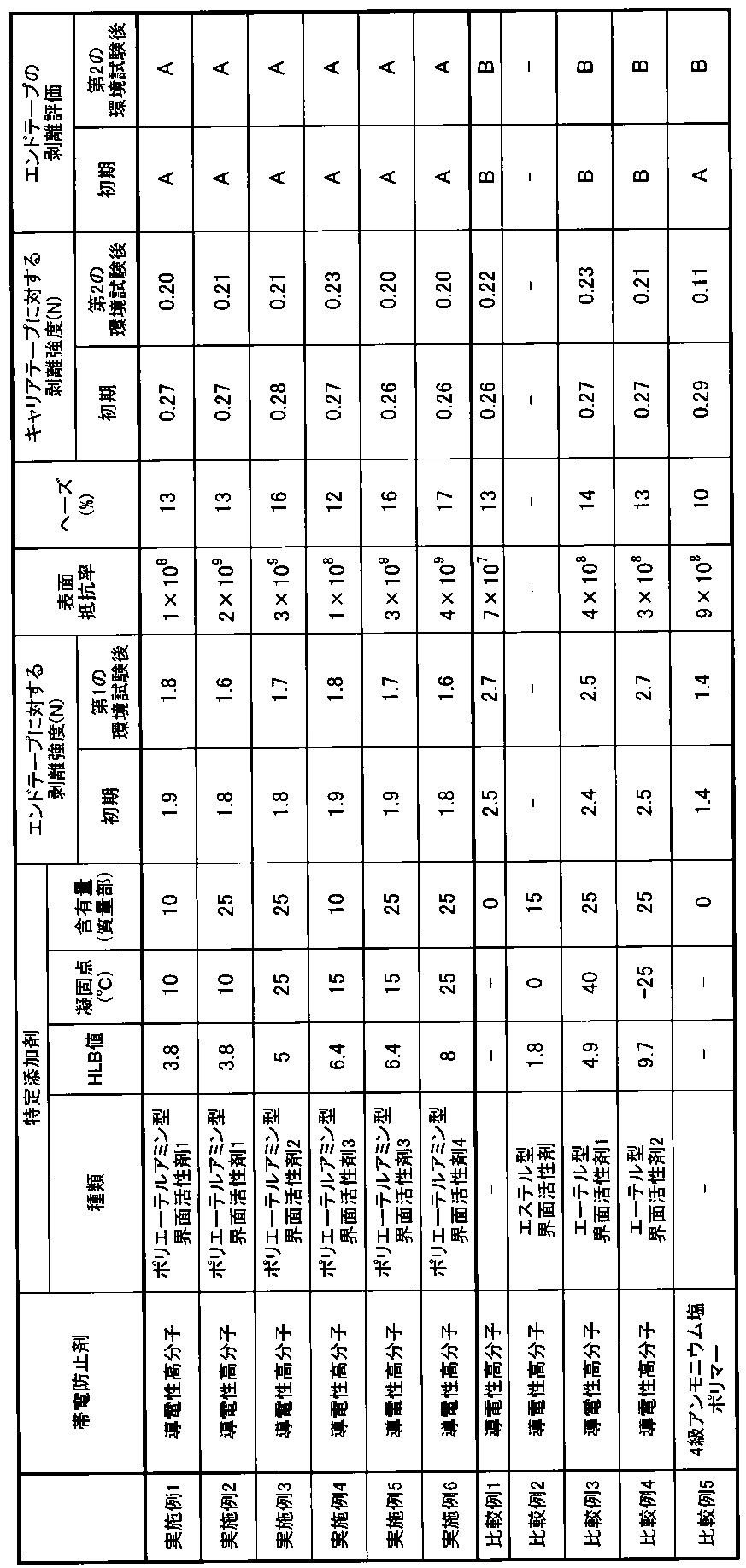
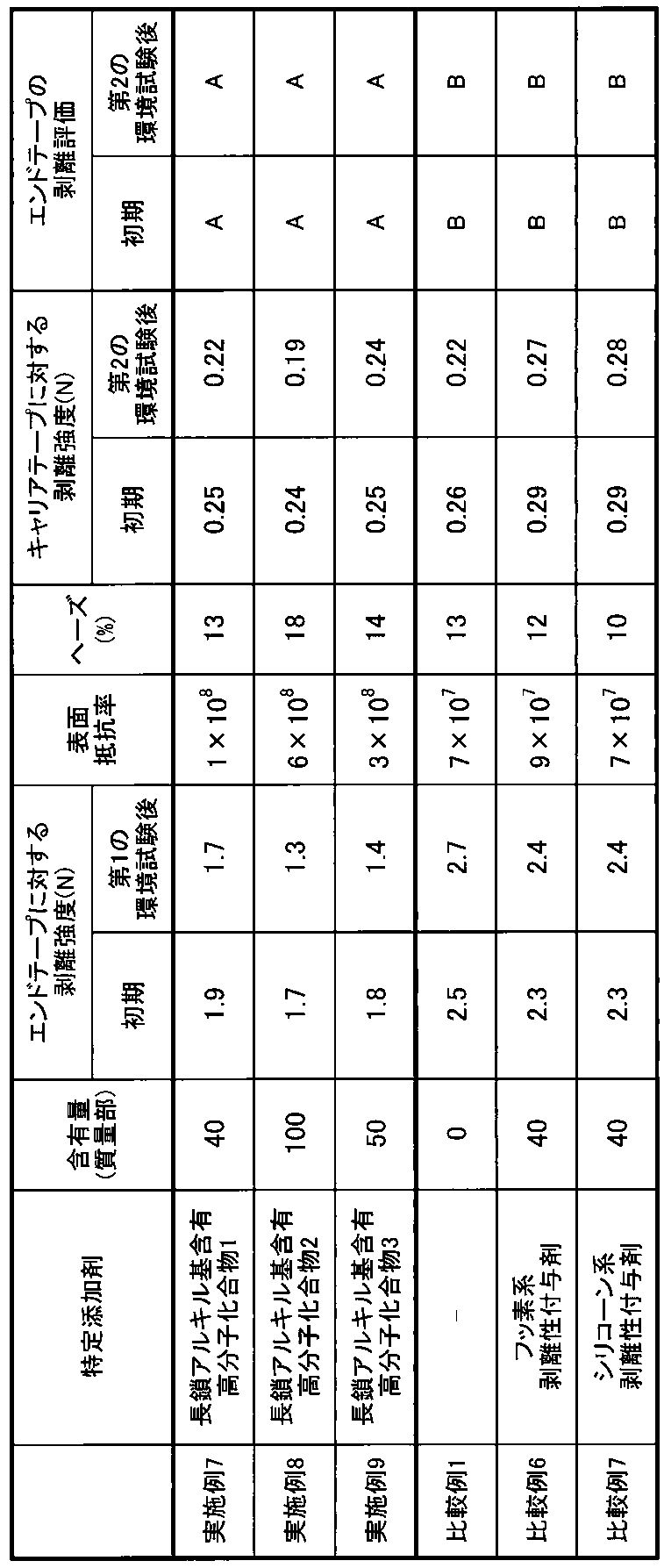
表1および表2より、実施例1~9では、カバーテープの帯電防止層側の面の表面抵抗率、初期のエンドテープに対する剥離強度、第1の環境試験後のエンドテープに対する剥離強度、および第2の環境試験後のキャリアテープに対する剥離強度がいずれも所定の範囲であるため、帯電防止性能が高く、エンドテープが剥離しやすかった。
一方、比較例1、3、4、6、7では、初期のエンドテープに対する剥離強度、および第1の環境試験後のエンドテープに対する剥離強度が高く、エンドテープが剥離しにくかった。比較例5では、従来汎用されている帯電防止剤の4級アンモニウム塩を用いたため、第2の環境試験後のキャリアテープに対する剥離強度が高くなった。これは、4級アンモニウム塩型ポリマーであっても、ブリードアウトしやすく、ブロッキングによりヒートシール性能が低下するためであると考えられる。
実施例1~6および比較例1、3~4から、帯電防止層は、ポリエーテルアミン型界面活性剤を含むことが好ましいことが示された。また、実施例7~9および比較例1、6、7から、帯電防止層は、側鎖に長鎖アルキル基を有する高分子化合物を含むことも好ましいことが示された。
なお、比較例2では、エステル型界面活性剤がバインダー樹脂およびPEDOT/PSSを含む溶液に混ざらなかったため、各物性を測定できなった。これは、エステル型界面活性剤のHLB値が低いためである。
本開示においては、例えば、以下の発明が提供される。
[1]
帯電防止層と、基材層と、中間層と、ヒートシール層とをこの順に有する電子部品包装用カバーテープであって、
上記帯電防止層側の面の表面抵抗率が、1×10¹⁰Ω/□未満であり、
エンドテープに対する剥離強度が2.0N以下であり、
上記電子部品包装用カバーテープの上記帯電防止層の面に上記エンドテープを貼り付けた状態において、40℃、90%RHの環境下で100時間保管した後の上記エンドテープに対する剥離強度が2.0N以下であり、
上記電子部品包装用カバーテープの上記ヒートシール層側の面と上記電子部品包装用カバーテープの上記帯電防止層側の面とを重ね合わせた状態において、40℃、90%RHの環境下で、125kN/m2の圧力をかけながら100時間保管した後の、上記電子部品包装用カバーテープの上記ヒートシール層側の面のキャリアテープに対する剥離強度が0.15Nより大きい、電子部品包装用カバーテープ。
[2]
上記帯電防止層が、バインダー樹脂および導電性高分子を含む、[1]に記載の電子部品包装用カバーテープ。
[3]
上記帯電防止層が、ポリエーテルアミン型界面活性剤を含む、[1]または[2]に記載の電子部品包装用カバーテープ。
[4]
上記帯電防止層が、側鎖に長鎖アルキル基を有する高分子化合物を含む、[1]または[2]に記載の電子部品包装用カバーテープ。
[5]
電子部品を収納する複数の収納部を有するキャリアテープと、
上記収納部に収納された電子部品と、
上記収納部を覆うように配置された、[1]から[4]までのいずれかに記載の電子部品包装用カバーテープと、
を備える、包装体。
1 … カバーテープ
2 … 帯電防止層
3 … 基材層
4 … 中間層
5 … ヒートシール層
10 … 包装体
11 … キャリアテープ
12 … 収納部
13 … 電子部品
21 … エンドテープ
2 … 帯電防止層
3 … 基材層
4 … 中間層
5 … ヒートシール層
10 … 包装体
11 … キャリアテープ
12 … 収納部
13 … 電子部品
21 … エンドテープ
Claims (5)
- 帯電防止層と、基材層と、中間層と、ヒートシール層とをこの順に有する電子部品包装用カバーテープであって、
前記帯電防止層側の面の表面抵抗率が、1×10¹⁰Ω/□未満であり、
エンドテープに対する剥離強度が2.0N以下であり、
前記電子部品包装用カバーテープの前記帯電防止層の面に前記エンドテープを貼り付けた状態において、40℃、90%RHの環境下で100時間保管した後の前記エンドテープに対する剥離強度が2.0N以下であり、
前記電子部品包装用カバーテープの前記ヒートシール層側の面と前記電子部品包装用カバーテープの前記帯電防止層側の面とを重ね合わせた状態において、40℃、90%RHの環境下で、125kN/m2の圧力をかけながら100時間保管した後の、前記電子部品包装用カバーテープの前記ヒートシール層側の面のキャリアテープに対する剥離強度が0.15Nより大きい、電子部品包装用カバーテープ。 - 前記帯電防止層が、バインダー樹脂および導電性高分子を含む、請求項1に記載の電子部品包装用カバーテープ。
- 前記帯電防止層が、ポリエーテルアミン型界面活性剤を含む、請求項1に記載の電子部品包装用カバーテープ。
- 前記帯電防止層が、側鎖に長鎖アルキル基を有する高分子化合物を含む、請求項1に記載の電子部品包装用カバーテープ。
- 電子部品を収納する複数の収納部を有するキャリアテープと、
前記収納部に収納された電子部品と、
前記収納部を覆うように配置された、請求項1から請求項4までのいずれかに記載の電子部品包装用カバーテープと、
を備える、包装体。
Applications Claiming Priority (2)
| Application Number | Priority Date | Filing Date | Title |
|---|---|---|---|
| JP2023044431A JP2024134232A (ja) | 2023-03-20 | 2023-03-20 | 電子部品包装用カバーテープおよび包装体 |
| JP2023-044431 | 2023-03-20 |
Publications (1)
| Publication Number | Publication Date |
|---|---|
| WO2024195802A1 true WO2024195802A1 (ja) | 2024-09-26 |
Family
ID=92842165
Family Applications (1)
| Application Number | Title | Priority Date | Filing Date |
|---|---|---|---|
| PCT/JP2024/010832 Ceased WO2024195802A1 (ja) | 2023-03-20 | 2024-03-19 | 電子部品包装用カバーテープおよび包装体 |
Country Status (3)
| Country | Link |
|---|---|
| JP (1) | JP2024134232A (ja) |
| TW (1) | TWI901047B (ja) |
| WO (1) | WO2024195802A1 (ja) |
Families Citing this family (1)
| Publication number | Priority date | Publication date | Assignee | Title |
|---|---|---|---|---|
| JP7899910B1 (ja) * | 2025-02-17 | 2026-08-04 | 住友ベークライト株式会社 | 電子部品包装用カバーテープおよび電子部品包装体 |
Citations (3)
| Publication number | Priority date | Publication date | Assignee | Title |
|---|---|---|---|---|
| JP6950774B1 (ja) * | 2020-03-17 | 2021-10-13 | 大日本印刷株式会社 | 電子部品包装用カバーテープおよび包装体 |
| JP2022130935A (ja) * | 2021-02-26 | 2022-09-07 | 東レ株式会社 | 積層ポリエステルフィルム |
| JP2023038475A (ja) * | 2021-09-07 | 2023-03-17 | 大日本印刷株式会社 | 電子部品包装用カバーテープおよび包装体 |
-
2023
- 2023-03-20 JP JP2023044431A patent/JP2024134232A/ja active Pending
-
2024
- 2024-03-19 TW TW113110076A patent/TWI901047B/zh active
- 2024-03-19 WO PCT/JP2024/010832 patent/WO2024195802A1/ja not_active Ceased
Patent Citations (3)
| Publication number | Priority date | Publication date | Assignee | Title |
|---|---|---|---|---|
| JP6950774B1 (ja) * | 2020-03-17 | 2021-10-13 | 大日本印刷株式会社 | 電子部品包装用カバーテープおよび包装体 |
| JP2022130935A (ja) * | 2021-02-26 | 2022-09-07 | 東レ株式会社 | 積層ポリエステルフィルム |
| JP2023038475A (ja) * | 2021-09-07 | 2023-03-17 | 大日本印刷株式会社 | 電子部品包装用カバーテープおよび包装体 |
Also Published As
| Publication number | Publication date |
|---|---|
| JP2024134232A (ja) | 2024-10-03 |
| TW202448762A (zh) | 2024-12-16 |
| TWI901047B (zh) | 2025-10-11 |
Similar Documents
| Publication | Publication Date | Title |
|---|---|---|
| JP2017222387A (ja) | 電子部品包装用カバーテープ | |
| CN105934396A (zh) | 电子部件包装用盖带 | |
| JP7197052B2 (ja) | 電子部品包装用カバーテープおよび包装体 | |
| JP2024134232A (ja) | 電子部品包装用カバーテープおよび包装体 | |
| JP7308807B2 (ja) | 電子部品包装用カバーテープ、電子部品包装体およびその製造方法 | |
| KR102657425B1 (ko) | 전자 부품 포장용 커버 테이프 및 포장체 | |
| JP6806753B2 (ja) | カバーテープおよび電子部品用包装体 | |
| TWI859344B (zh) | 電子零件包裝用覆蓋帶及包裝體 | |
| JP7152583B2 (ja) | 電子部品包装用カバーテープ、包装体、および包装体用セット | |
| WO2022255338A1 (ja) | 電子部品包装用カバーテープおよび包装体 | |
| JP7718190B2 (ja) | 電子部品包装用カバーテープおよび包装体 | |
| KR102646543B1 (ko) | 전자 부품 포장용 커버 테이프 및 포장체 | |
| JP7201125B2 (ja) | 電子部品包装用カバーテープおよび包装体 | |
| JP7859052B2 (ja) | 電子部品包装用カバーテープおよび包装体 | |
| JP2019199013A (ja) | カバーテープおよび電子部品包装体 | |
| JP2024049799A (ja) | 電子部品包装用カバーテープおよび包装体 | |
| TW202513326A (zh) | 電子零件包裝用覆蓋帶及包裝體 | |
| JP2023037999A (ja) | 電子部品包装用カバーテープおよび包装体 | |
| JP2024143146A (ja) | 電子部品包装用カバーテープおよび包装体 |
Legal Events
| Date | Code | Title | Description |
|---|---|---|---|
| 121 | Ep: the epo has been informed by wipo that ep was designated in this application |
Ref document number: 24774936 Country of ref document: EP Kind code of ref document: A1 |
|
| NENP | Non-entry into the national phase |
Ref country code: DE |
|
| 122 | Ep: pct application non-entry in european phase |
Ref document number: 24774936 Country of ref document: EP Kind code of ref document: A1 |