WO2024195626A1 - 電気刺激装置、制御システム、および制御方法 - Google Patents
電気刺激装置、制御システム、および制御方法 Download PDFInfo
- Publication number
- WO2024195626A1 WO2024195626A1 PCT/JP2024/009515 JP2024009515W WO2024195626A1 WO 2024195626 A1 WO2024195626 A1 WO 2024195626A1 JP 2024009515 W JP2024009515 W JP 2024009515W WO 2024195626 A1 WO2024195626 A1 WO 2024195626A1
- Authority
- WO
- WIPO (PCT)
- Prior art keywords
- electrical stimulation
- current
- user
- stimulation device
- electrodes
- Prior art date
- Legal status (The legal status is an assumption and is not a legal conclusion. Google has not performed a legal analysis and makes no representation as to the accuracy of the status listed.)
- Ceased
Links
Images

Classifications
-
- A—HUMAN NECESSITIES
- A63—SPORTS; GAMES; AMUSEMENTS
- A63F—CARD, BOARD, OR ROULETTE GAMES; INDOOR GAMES USING SMALL MOVING PLAYING BODIES; VIDEO GAMES; GAMES NOT OTHERWISE PROVIDED FOR
- A63F13/00—Video games, i.e. games using an electronically generated display having two or more dimensions
- A63F13/25—Output arrangements for video game devices
- A63F13/28—Output arrangements for video game devices responding to control signals received from the game device for affecting ambient conditions, e.g. for vibrating players' seats, activating scent dispensers or affecting temperature or light
-
- A—HUMAN NECESSITIES
- A61—MEDICAL OR VETERINARY SCIENCE; HYGIENE
- A61N—ELECTROTHERAPY; MAGNETOTHERAPY; RADIATION THERAPY; ULTRASOUND THERAPY
- A61N1/00—Electrotherapy; Circuits therefor
- A61N1/02—Details
- A61N1/04—Electrodes
- A61N1/0404—Electrodes for external use
- A61N1/0408—Use-related aspects
- A61N1/0456—Specially adapted for transcutaneous electrical nerve stimulation [TENS]
-
- A—HUMAN NECESSITIES
- A61—MEDICAL OR VETERINARY SCIENCE; HYGIENE
- A61N—ELECTROTHERAPY; MAGNETOTHERAPY; RADIATION THERAPY; ULTRASOUND THERAPY
- A61N1/00—Electrotherapy; Circuits therefor
- A61N1/02—Details
- A61N1/04—Electrodes
- A61N1/0404—Electrodes for external use
- A61N1/0472—Structure-related aspects
- A61N1/0484—Garment electrodes worn by the patient
-
- A—HUMAN NECESSITIES
- A61—MEDICAL OR VETERINARY SCIENCE; HYGIENE
- A61N—ELECTROTHERAPY; MAGNETOTHERAPY; RADIATION THERAPY; ULTRASOUND THERAPY
- A61N1/00—Electrotherapy; Circuits therefor
- A61N1/18—Applying electric currents by contact electrodes
- A61N1/32—Applying electric currents by contact electrodes alternating or intermittent currents
- A61N1/36—Applying electric currents by contact electrodes alternating or intermittent currents for stimulation
-
- A—HUMAN NECESSITIES
- A61—MEDICAL OR VETERINARY SCIENCE; HYGIENE
- A61N—ELECTROTHERAPY; MAGNETOTHERAPY; RADIATION THERAPY; ULTRASOUND THERAPY
- A61N1/00—Electrotherapy; Circuits therefor
- A61N1/18—Applying electric currents by contact electrodes
- A61N1/32—Applying electric currents by contact electrodes alternating or intermittent currents
- A61N1/36—Applying electric currents by contact electrodes alternating or intermittent currents for stimulation
- A61N1/36014—External stimulators, e.g. with patch electrodes
- A61N1/36025—External stimulators, e.g. with patch electrodes for treating a mental or cerebral condition
-
- A—HUMAN NECESSITIES
- A61—MEDICAL OR VETERINARY SCIENCE; HYGIENE
- A61N—ELECTROTHERAPY; MAGNETOTHERAPY; RADIATION THERAPY; ULTRASOUND THERAPY
- A61N1/00—Electrotherapy; Circuits therefor
- A61N1/18—Applying electric currents by contact electrodes
- A61N1/32—Applying electric currents by contact electrodes alternating or intermittent currents
- A61N1/36—Applying electric currents by contact electrodes alternating or intermittent currents for stimulation
- A61N1/36014—External stimulators, e.g. with patch electrodes
- A61N1/3603—Control systems
-
- A—HUMAN NECESSITIES
- A61—MEDICAL OR VETERINARY SCIENCE; HYGIENE
- A61N—ELECTROTHERAPY; MAGNETOTHERAPY; RADIATION THERAPY; ULTRASOUND THERAPY
- A61N1/00—Electrotherapy; Circuits therefor
- A61N1/18—Applying electric currents by contact electrodes
- A61N1/32—Applying electric currents by contact electrodes alternating or intermittent currents
- A61N1/36—Applying electric currents by contact electrodes alternating or intermittent currents for stimulation
- A61N1/36014—External stimulators, e.g. with patch electrodes
- A61N1/3603—Control systems
- A61N1/36034—Control systems specified by the stimulation parameters
-
- A—HUMAN NECESSITIES
- A63—SPORTS; GAMES; AMUSEMENTS
- A63F—CARD, BOARD, OR ROULETTE GAMES; INDOOR GAMES USING SMALL MOVING PLAYING BODIES; VIDEO GAMES; GAMES NOT OTHERWISE PROVIDED FOR
- A63F13/00—Video games, i.e. games using an electronically generated display having two or more dimensions
- A63F13/90—Constructional details or arrangements of video game devices not provided for in groups A63F13/20 or A63F13/25, e.g. housing, wiring, connections or cabinets
- A63F13/98—Accessories, i.e. detachable arrangements optional for the use of the video game device, e.g. grip supports of game controllers
-
- G—PHYSICS
- G06—COMPUTING OR CALCULATING; COUNTING
- G06F—ELECTRIC DIGITAL DATA PROCESSING
- G06F3/00—Input arrangements for transferring data to be processed into a form capable of being handled by the computer; Output arrangements for transferring data from processing unit to output unit, e.g. interface arrangements
- G06F3/01—Input arrangements or combined input and output arrangements for interaction between user and computer
-
- A—HUMAN NECESSITIES
- A63—SPORTS; GAMES; AMUSEMENTS
- A63F—CARD, BOARD, OR ROULETTE GAMES; INDOOR GAMES USING SMALL MOVING PLAYING BODIES; VIDEO GAMES; GAMES NOT OTHERWISE PROVIDED FOR
- A63F2250/00—Miscellaneous game characteristics
- A63F2250/49—Miscellaneous game characteristics with provisions for connecting to a part of the body
- A63F2250/497—Head
Definitions
- This disclosure relates to an electrical stimulation device, a control system, and a control method.
- JP 2019-017676 A Patent Document 1
- the target of electrical stimulation is the cerebral cortex, which integrates visual recognition and vestibular recognition of the sensation of motion, instead of the vestibular organ, which recognizes the sensation of motion, thereby suppressing motion sickness.
- Electrodes are attached to the skin of the head and a current is applied to provide electrical stimulation to the vestibular organs, cerebral cortex, etc. For this reason, if electrical stimulation is continued for a long period of time using an electrical stimulation device to the vestibular organs, cerebral cortex, etc., there is a risk of electric charges concentrating between the skin and the electrodes, causing inflammation of the skin.
- VR virtual reality
- transcranial direct current stimulation (tDCS) there may be situations in which the user uses an electrical stimulation device to provide electrical stimulation to the cerebral cortex, etc. for a long period of time.
- the objective of this disclosure is to provide an electrical stimulation device, control system, and control method that can reduce inflammation caused by applying an electric current to multiple electrodes attached to the skin.
- the electrical stimulation device is an electrical stimulation device that applies electrical stimulation to the human body.
- the electrical stimulation device includes a number of electrodes that are attached to the user's skin to apply electrical stimulation, an output circuit that applies current to the multiple electrodes, and a control circuit that controls the current that the output circuit applies to the multiple electrodes.
- the control circuit applies a current below the user's perception threshold to the multiple electrodes at a predetermined timing.
- a control system is a control system including the electrical stimulation device described above and an external device connected to the electrical stimulation device.
- the electrical stimulation device is a device that electrically stimulates the vestibular organ to excite a pseudo-acceleration sensation in the user.
- the external device includes an operation circuit that receives user operations, a display device that displays an image for the user, and a control device that causes the display device to display an image in which an object placed in a virtual space moves according to an operation input value received by the operation circuit.
- the control device outputs a control signal to the electrical stimulation device to apply a current to multiple electrodes to cause the user to feel a pseudo-acceleration sensation based on the movement of the object in the virtual space.
- the method of controlling an electrical stimulation device is a method of controlling an electrical stimulation device that applies electrical stimulation to the human body.
- the electrical stimulation device includes a plurality of electrodes that are attached to the user's skin to apply electrical stimulation, an output circuit that applies current to the plurality of electrodes, and a control circuit that controls the current applied by the output circuit to the plurality of electrodes.
- the method of controlling an electrical stimulation device includes the steps of setting a predetermined timing for applying a current below the user's perception threshold to the plurality of electrodes, and applying a current below the user's perception threshold to the plurality of electrodes at the set predetermined timing.
- FIG. 1 is a schematic diagram of a control system according to an embodiment.
- FIG. 2 is a diagram for explaining the operation of the control system according to the embodiment.
- 5A to 5C are diagrams showing current patterns applied to electrodes by a galvanic vestibular stimulation device according to an embodiment.
- 4 is a flowchart for explaining the operation of the galvanic vestibular stimulation device according to the embodiment.
- the electrical stimulation device described below is, for example, a Galvanic Vestibular Stimulation device (GVS) for artificially exciting an acceleration sensation, and can electrically stimulate the vestibular organ by attaching electrodes to the skin surface above the mastoid process of the human body and applying a current.
- the electrical stimulation device is not limited to the Galvanic Vestibular Stimulation device.
- the electrical stimulation device can also be applied to a transcranial direct current stimulation device (tDCS) that electrically stimulates the head by attaching electrodes to the skin of the head, a low-frequency therapy device that electrically stimulates the human body by attaching electrodes to the skin of the human body, and the like.
- tDCS transcranial direct current stimulation device
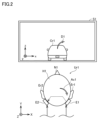
- FIG. 1 is a schematic diagram of a control system 1000 according to an embodiment.
- FIG. 2 is a diagram for explaining the operation of the control system 1000 according to an embodiment.
- the control system 1000 is a game system in which a galvanic vestibular stimulation device 100 and a game device 200 (external device) are combined to allow a user Ur1 playing a game on the game device 200 to feel a pseudo acceleration sensation through the galvanic vestibular stimulation device 100.
- the game device 200 described below is a VR game device that uses a head mounted display (HMD) to show a virtual space to the user Ur1 and allows the user Ur1 to operate an object (for example, Cr1) in the virtual space.
- HMD head mounted display
- the game device 200 can cause the user Ur1 to feel a simulated acceleration of the object in accordance with the object moving in the virtual space using the galvanic vestibular stimulation device 100.
- the game device 200 can further improve the user Ur1's sense of immersion in the game by allowing the user Ur1 to feel a simulated acceleration of the object.
- the game device 200 is not limited to a VR game device that uses a head-mounted display, and may be a game device that uses a two-dimensional display such as a liquid crystal display or an organic EL display.
- the vestibular galvanic stimulation device 100 includes electrodes E1, E2, a control circuit 110, an input interface 120, and an output interface 130.
- the electrodes E1, E2 are attached to the user Ur1, as shown in FIG. 1.
- FIG. 1 illustrates the user Ur1 as viewed from above, and illustrates the head H1, right ear Er1, left ear Er2, and nose N1 of the user Ur1.
- the electrodes E1, E2 are also referred to as electrode pads.
- the XYZ axes are shown, which represent the three axial directions of the real space in which the user Ur1 exists.
- the vertical direction of the floor on which the user Ur1 is standing is defined as the "Z-axis direction”
- the direction perpendicular to the Z-axis direction in which the user Ur1 faces is defined as the "Y-axis”
- the direction perpendicular to the Y-axis direction and the Z-axis direction is defined as the "X-axis direction”.
- the positive direction of the Z-axis is sometimes referred to as the upper side, the negative direction of the Z-axis as the lower side, the positive direction of the Y-axis as the front side, the negative direction of the Y-axis as the rear side, the positive direction of the X-axis as the right side, and the negative direction of the X-axis as the right side.
- the galvanic vestibular stimulation device 100 is a device that generates a pseudo acceleration sensation in the user Ur1 by providing electrical stimulation to the vestibular organ of the user Ur1.
- the vestibular organ is composed of hair cells in the utricle and saccule, which are located in the semicircular canals and the otolith organ.
- the semicircular canals receive three-axis rotational angular acceleration, and the utricle and saccule receive linear acceleration.
- a current is applied from the output interface 130 to electrodes E1 and E2 attached to the user Ur1, and an acceleration sensation corresponding to the current value can be given to the user Ur1.
- the control circuit 110 is, for example, a hardwired circuit such as an ASIC (Application Specific Integrated Circuit) or an FPGA (Field-Programmable Gate Array).
- the control circuit 110 may also be configured to include a CPU (Central Processing Unit) and memory such as a RAM (Random Access Memory).
- CPU Central Processing Unit
- RAM Random Access Memory
- the input interface 120 is connected to the game device 200. Therefore, a control signal including electrical stimulation data and the like is input from the game device 200 to the vestibular electrical stimulation device 100 via the input interface 120.
- the control circuit 110 calculates the current value to be applied to the electrodes E1, E2 based on the input control signal.
- the output interface 130 is connected to the electrodes E1, E2 via wiring, and applies the current value calculated by the control circuit 110 to the electrodes E1, E2.
- Electrode E1 is attached to the rear of the right ear Er1 of user Ur1, and electrode E2 is attached to the rear of the left ear Er2. More specifically, electrode E1 is attached to the mastoid process on the right ear Er1 side, and electrode E2 is attached to the mastoid process on the left ear Er2 side. Electrodes E1 and E2 can be attached to the mastoid process because they have a hydrogel, for example, on their surfaces. Of course, electrodes E1 and E2 may be held down with earmuffs or the like to prevent them from peeling off from the mastoid process. Note that it is preferable to attach electrodes E1 and E2 to positions that are not in hairy areas such as hair or beard.
- the vestibular galvanic stimulation device 100 can provide the user Ur1 with a pseudo acceleration sensation in the X-axis direction by placing electrodes E1, E2 on the left and right mastoid processes. Also, the vestibular galvanic stimulation device 100 can provide the user Ur1 with a pseudo acceleration sensation in the Y-axis direction, Z-axis direction, roll, pitch, and yaw by changing the arrangement and number of electrodes E1, E2.
- the game device 200 includes a display device S1, a game controller Ct1, a control device 210, a storage unit 220, an input interface 240, and an output interface 230.
- a display device S1 a game controller Ct1
- a control device 210 a storage unit 220
- an input interface 240 a storage unit 220
- an input interface 240 a storage unit 220
- an output interface 230 a racing game in which a car is driven
- the display device S1 which is a head-mounted display, displays VR video data so that the rear of the car Cr1 is in the center of the user Ur1's field of vision.
- the display device S1 may also display VR video data from the first-person perspective of the user Ur1 who is riding in the car Cr1.
- the x, y and z axes are also shown in the display device S1.
- the x, y and z axes displayed in the display device S1 represent three axial directions in the virtual space.
- the three axial directions in the virtual space correspond to the three axial directions in the real space, with the positive direction of the z axis referred to as the upper side, the negative direction of the z axis referred to as the lower side, the positive direction of the y axis referred to as the front side, the negative direction of the y axis referred to as the rear side, the positive direction of the x axis referred to as the right side, and the negative direction of the x axis referred to as the left side.
- the car Cr1 is moving straight in the positive direction of the y axis.
- the controller Ct1 includes at least a cross key Cs1 and buttons Ab1 and Ab2.
- the cross key Cs1 is a key for controlling the position of the car Cr1 (object) operated by the user Ur1, and may be a key or button of another type such as a stick-type input device, a gesture input device, or a steering wheel input device. By operating the controller Ct1, the user Ur1 can move the car Cr1 displayed in front of them forward or change its direction of travel.
- the user Ur1 moves the car Cr1 forward by pressing the button Ab1.
- the user Ur1 can also make the car Cr1 turn right by pressing the right button on the cross key Cs1, and can make the car Cr1 turn left by pressing the left button on the cross key Cs1.
- the left and right buttons on the cross key Cs1 correspond to the steering wheel of the car in the real space
- the button Ab1 corresponds to the accelerator of the car in the real space
- the button Ab2 corresponds to the brake of the car in the real space.
- Operations performed by the user Ur1 with the controller Ct1 are input as operation input values to the control device 210 via the input interface 240.
- the controller Ct1 and the input interface 240 correspond to the operation circuitry of the game device 200.
- the control device 210 includes, for example, a processor such as a CPU or MPU that executes a game program, and a memory such as a RAM. Note that the control device 210 may also be a hardwired circuit such as an ASIC or FPGA.
- the storage unit 220 is realized by a rewritable non-volatile memory such as a hard disk drive (HDD), a solid state drive (SSD), a flash memory, a magnetic disk, etc.
- the storage unit 220 stores a program for a racing game for the car Cr1 shown in FIG. 1.
- the control device 210 causes the display device S1 to display the object, the car Cr1.
- the control device 210 transmits video data for VR to the display device S1 via the output interface 230.
- FIG. 2 is a diagram for explaining the operation of the control system 1000 according to the embodiment.
- the game device 200 receives an operation by the user Ur1 to press the right button of the cross key Cs1, it turns the car Cr1 displayed on the display device S1 in the right direction D1 (the positive direction of the X-axis).
- the vestibular galvanic stimulation device 100 applies a current to the electrodes E1 and E2 so that the user Ur1 can feel an acceleration in the right direction in accordance with the display of the car Cr1 turning in the right direction D1.
- the vestibular electrical stimulation device 100 applies a current to electrode E2 as the cathode and electrode E1 as the anode in order to excite a pseudo acceleration sensation in the user Ur1 so that the user Ur1 feels a turn to the right.
- a current flows from electrode E1 to electrode E2
- the current passes through the inside of the user Ur1's ear canal and electrically stimulates the vestibular organ, causing the user Ur1 to feel a sensation of acceleration Ac1 in the roll direction.
- the current value flowing between electrode E1 and electrode E2 be 4.0 mA or less.
- the control system 1000 can thus make the user Ur1 feel a pseudo acceleration sensation turning to the right using the vestibular galvanic stimulation device 100 in accordance with an image of the car Cr1 turning to the right displayed in the game on the game device 200.
- the user Ur1 feels more immersed in the game when the vestibular galvanic stimulation device 100 gives him an image of the car turning to the right, giving him a pseudo acceleration sensation, compared to when the user Ur1 is simply shown an image of the car turning to the right in the game.
- control system 1000 applies a current (e.g., a noise current) below user UR1's perception threshold to electrodes E1, E2 at a predetermined timing.
- a current e.g., a noise current
- the vestibular galvanic stimulation device 100 when applying electrical stimulation with the vestibular galvanic stimulation device 100, electrodes E1 and E2 are attached to the head, so any inflammation of the skin is more noticeable than when they are attached to other parts of the body, and an improvement was desired. Therefore, in order to remove the charge that has built up between the skin and electrodes E1 and E2, the vestibular galvanic stimulation device 100 applies a noise current (nGVS: noisy galvanic vestibular stimulation) that is a current below the perception threshold of the user UR1 by applying a current back and forth between electrodes E1 and E2.
- nGVS noisy galvanic vestibular stimulation
- the current below the perception threshold of the user Ur1 is a noise current with a current density of less than 0.5 A/ m2 .
- the user Ur1 may perceive even a noise current with a current density of 0.4 A/ m2 , in which case a noise current with an even lower current density may be set.
- the noise current is preferably white noise.
- the noise current may not be white noise, but may be a signal that can apply a current back and forth between the electrodes E1 and E2.
- the current below the perception threshold of the user Ur1 may not be a noise current, but may be a current that can remove the charge accumulated between the electrodes E1 and E2.
- the noise current may be a current below the perception threshold (for example, a current with a current density of -0.3 A/ m2 ) that has the opposite polarity of the current (for example, +3 mA) for providing electrical stimulation to the vestibular organ.
- the noise current is not limited to a noise current with a central current value of 0 mA, and may be a noise current with a central current value of positive polarity or negative polarity.
- the noise current may be a negative current (-0.5 mA to +0.1 mA) with a central current value of -0.2 mA.
- the galvanic vestibular stimulation device 100 can remove the charge accumulated between the skin and the electrodes E1 and E2 by GVS, and can suppress inflammation of the skin. Furthermore, since the galvanic vestibular stimulation device 100 can suppress inflammation of the skin, it is possible to perform electrical stimulation of the vestibular organ by GVS for a long period of time.
- the galvanic vestibular stimulation device 100 preferably applies the noise current to the electrodes E1, E2 during the operation period of the galvanic vestibular stimulation device 100 (for example, the period from when the game device 200 is turned on to when it is turned off), other than the period during which a current for providing electrical stimulation to the vestibular organ is applied to the electrodes E1, E2.
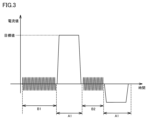
- Figure 3 is a diagram showing the current pattern applied to the electrodes E1, E2 by the galvanic vestibular stimulation device 100 according to the embodiment. In Figure 3, the horizontal axis represents time and the vertical axis represents current value.
- the galvanic vestibular stimulation device 100 does not need to provide electrical stimulation to the vestibular organ. Therefore, the galvanic vestibular stimulation device 100 applies a noise current to the electrodes E1, E2.
- the galvanic vestibular stimulation device 100 needs to provide electrical stimulation to the vestibular organ in accordance with the operation of the car Cr1. Therefore, the galvanic vestibular stimulation device 100 does not apply a noise current to the electrodes E1, E2 so as not to affect the electrical stimulation to the vestibular organ.
- the non-operation period B2 during which the user Ur1 cannot operate the car Cr1 on the game device 200, such as during game effects or menu display, is a period during which the galvanic vestibular stimulation device 100 does not need to provide electrical stimulation to the vestibular organ. Therefore, the galvanic vestibular stimulation device 100 applies a noise current to the electrodes E1, E2.
- the galvanic vestibular stimulation device 100 needs to provide electrical stimulation to the vestibular organ in accordance with the operation of the car Cr1. Therefore, the galvanic vestibular stimulation device 100 does not apply a noise current to the electrodes E1, E2 so as not to affect the electrical stimulation to the vestibular organ.
- the vestibular galvanic stimulation device 100 may apply a noise current to the electrodes E1, E2. Furthermore, if a game is being played continuously on the game device 200 for a predetermined period of time (for example, one hour), the game may be forcibly interrupted and the vestibular galvanic stimulation device 100 may apply a noise current to the electrodes E1, E2.
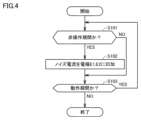
- FIG. 4 is a flowchart for explaining the operation of the galvanic vestibular stimulation device 100 according to the embodiment.
- the game device 200 is turned on, and the vestibular galvanic stimulation device 100 determines whether or not the game device 200 is in a non-operation period in which the user Ur1 cannot operate the car Cr1, based on a control signal received from the game device 200 (step S101).
- the control signal includes information that can distinguish between an operation period in which the user Ur1 can operate the car Cr1 and a non-operation period in which the user Ur1 cannot operate the car Cr1.
- the control signal includes information indicating an operation period
- the control signal includes electrical stimulation data such as the target value, polarity, and application period of the current to be applied to the electrodes E1 and E2 during that period.
- the vestibular galvanic stimulation device 100 may identify whether the period is an operation period or a non-operation period based on whether or not the control signal includes electrical stimulation data.
- vestibular galvanic stimulation device 100 sets the identified non-operation period as a predetermined timing and applies a noise current to electrodes E1, E2 (step S102).
- Vestibular galvanic stimulation device 100 may continue to apply the noise current to electrodes E1, E2 during the non-operation period, but may stop applying the noise current even during the non-operation period after a certain period of time (e.g., 60 seconds) has elapsed.
- a certain period of time e.g. 60 seconds
- vestibular galvanic stimulation device 100 may intermittently apply the noise current to electrodes E1, E2 during the non-operation period.
- the vestibular galvanic stimulation device 100 skips the process of step S102.
- the vestibular galvanic stimulation device 100 determines whether it is an operation period (step S103).
- the operation period of the vestibular galvanic stimulation device 100 is linked to the operation period of the game device 200, and is, for example, the period from when the game device 200 is turned on to when it is turned off.
- the operation period of the vestibular galvanic stimulation device 100 does not have to be linked to the operation period of the game device 200, and may be, for example, the period from when the vestibular galvanic stimulation device 100 is turned on to when it is turned off.
- step S103 If it is the operating period (YES in step S103), the vestibular galvanic stimulation device 100 returns the process to step S101. On the other hand, if it is not the operating period (NO in step S103), the vestibular galvanic stimulation device 100 ends the process of applying the noise current to electrodes E1 and E2.
- the control system 1000 has been described as a game system in which the galvanic vestibular stimulation device 100 and the game device 200 (external device) are combined to make the user Ur1 playing a game on the game device 200 feel a pseudo acceleration sensation through the galvanic vestibular stimulation device 100.
- the control system is not limited to a game system, and may be an amusement system in which the galvanic vestibular stimulation device 100 and a video device (external device) are combined to make the user Ur1 feel a pseudo acceleration sensation through the galvanic vestibular stimulation device 100 in accordance with the movement of an object displayed on the video device.
- a noise current may be applied to electrodes E1 and E2.
- the electrical stimulation device is not limited to the electrical vestibular stimulation device 100, and may be, for example, an electrical taste device.
- the electrical taste device is based on, for example, the ion electrophoresis hypothesis, and is an electrical stimulation device that allows the movement of taste ions in the oral cavity by electrical stimulation, thereby controlling and enhancing the taste felt by a person.
- the electrical taste device attaches an anode electrode to the back of the neck, inserts a cathode straw into the oral cavity, and applies electricity to control and enhance the taste of food ingested through the straw.
- This electrical taste device also has electrodes attached to the back of the neck, so that if used for a long period of time, electric charges may concentrate between the skin and the electrodes, causing inflammation of the skin. Therefore, in the electrical taste device, inflammation can also be reduced by applying a current below the perception threshold (for example, a noise current) when no current is applied to control or enhance the taste.
- a current below the perception threshold for example, a noise current
- An electrical stimulation device is an electrical stimulation device that applies electrical stimulation to a human body, A plurality of electrodes that are attached to the user's skin to provide electrical stimulation; an output circuit that applies a current to the plurality of electrodes; A control circuit that controls a current applied to the plurality of electrodes by the output circuit; The control circuitry applies a current below the user's perception threshold to the multiple electrodes at a predetermined timing.
- the specified timing is the operating period of the electrical stimulation device, other than the period during which a current for providing electrical stimulation is applied to the multiple electrodes.
- the current below the user's perception threshold is a current having a current density of less than 0.5 A/ m2 .
- the current below the user's threshold of perception is a current having a current density of opposite polarity to the current for providing electrical stimulation.
- the noise current is white noise.
- a control system includes the electrical stimulation device according to (7), and an external device connected to the electrical stimulation device.
- the electrical stimulation device is a device that electrically stimulates the vestibular organ to excite a pseudo-sense of acceleration in the user.
- the external device is An operation circuit that accepts a user operation; a display device for displaying an image to a user; a control device that displays, on a display device, an image in which an object arranged in a virtual space moves in response to an operation input value received by the operation circuit;
- the control device includes: Based on the movement of an object in a virtual space, a control signal is output to an electrical stimulation device to apply a current to a plurality of electrodes so as to give the user a pseudo sensation of acceleration.
- control device outputs a control signal to the electrical stimulation device to distinguish between an operation period during which the user can operate the object and a non-operation period during which the user cannot operate the object;
- the electrical stimulation device specifies a non-operation period based on the control signal received by the input circuit, and sets the specified timing to the specified non-operation period.
- a method for controlling an electrical stimulation device is a method for controlling an electrical stimulation device that applies electrical stimulation to a human body, comprising:
- the electrical stimulation device includes a plurality of electrodes that are attached to the skin of a user to provide electrical stimulation, an output circuit that applies a current to the plurality of electrodes, and a control circuit that controls the current that the output circuit applies to the plurality of electrodes; setting a predetermined timing for applying a current below a user's perception threshold to a plurality of electrodes;
- the method includes applying a current below the user's perception threshold to the multiple electrodes at a set predetermined timing.
- 100 Vestibular electrical stimulation device; 110: Control circuit; 120, 240: Input interface; 130, 230: Output interface; 200: Game device; 210: Control device; 220: Memory unit; 1000: Control system.
Landscapes
- Engineering & Computer Science (AREA)
- Health & Medical Sciences (AREA)
- Multimedia (AREA)
- Life Sciences & Earth Sciences (AREA)
- Veterinary Medicine (AREA)
- Biomedical Technology (AREA)
- Public Health (AREA)
- General Health & Medical Sciences (AREA)
- Animal Behavior & Ethology (AREA)
- Radiology & Medical Imaging (AREA)
- Nuclear Medicine, Radiotherapy & Molecular Imaging (AREA)
- Heart & Thoracic Surgery (AREA)
- Biophysics (AREA)
- Developmental Disabilities (AREA)
- Psychiatry (AREA)
- Neurology (AREA)
- Social Psychology (AREA)
- Psychology (AREA)
- Hospice & Palliative Care (AREA)
- Child & Adolescent Psychology (AREA)
- General Engineering & Computer Science (AREA)
- Theoretical Computer Science (AREA)
- Human Computer Interaction (AREA)
- Physics & Mathematics (AREA)
- General Physics & Mathematics (AREA)
- Electrotherapy Devices (AREA)
Priority Applications (2)
| Application Number | Priority Date | Filing Date | Title |
|---|---|---|---|
| JP2025508336A JPWO2024195626A1 (https=) | 2023-03-17 | 2024-03-12 | |
| US19/329,811 US20260014457A1 (en) | 2023-03-17 | 2025-09-16 | Electrical stimulation device, control system, and control method |
Applications Claiming Priority (2)
| Application Number | Priority Date | Filing Date | Title |
|---|---|---|---|
| JP2023-043359 | 2023-03-17 | ||
| JP2023043359 | 2023-03-17 |
Related Child Applications (1)
| Application Number | Title | Priority Date | Filing Date |
|---|---|---|---|
| US19/329,811 Continuation US20260014457A1 (en) | 2023-03-17 | 2025-09-16 | Electrical stimulation device, control system, and control method |
Publications (1)
| Publication Number | Publication Date |
|---|---|
| WO2024195626A1 true WO2024195626A1 (ja) | 2024-09-26 |
Family
ID=92842098
Family Applications (1)
| Application Number | Title | Priority Date | Filing Date |
|---|---|---|---|
| PCT/JP2024/009515 Ceased WO2024195626A1 (ja) | 2023-03-17 | 2024-03-12 | 電気刺激装置、制御システム、および制御方法 |
Country Status (3)
| Country | Link |
|---|---|
| US (1) | US20260014457A1 (https=) |
| JP (1) | JPWO2024195626A1 (https=) |
| WO (1) | WO2024195626A1 (https=) |
Citations (5)
| Publication number | Priority date | Publication date | Assignee | Title |
|---|---|---|---|---|
| JP2003339884A (ja) * | 2002-05-31 | 2003-12-02 | Fes:Kk | 顔面電気刺激装置 |
| JP2015062115A (ja) * | 2013-09-09 | 2015-04-02 | イマージョン コーポレーションImmersion Corporation | 電気刺激ハプティックフィードバックインターフェース |
| JP2017060581A (ja) * | 2015-09-25 | 2017-03-30 | 国立大学法人大阪大学 | 前庭電気刺激装置及び仮想現実体感装置 |
| JP2021510328A (ja) * | 2018-01-11 | 2021-04-22 | セラニカ バイオ−エレクトロニクス リミティド | 電極パッチ |
| JP2023013650A (ja) * | 2021-07-16 | 2023-01-26 | 国立大学法人 東京大学 | 情報処理方法、情報処理装置、およびプログラム |
-
2024
- 2024-03-12 JP JP2025508336A patent/JPWO2024195626A1/ja active Pending
- 2024-03-12 WO PCT/JP2024/009515 patent/WO2024195626A1/ja not_active Ceased
-
2025
- 2025-09-16 US US19/329,811 patent/US20260014457A1/en active Pending
Patent Citations (5)
| Publication number | Priority date | Publication date | Assignee | Title |
|---|---|---|---|---|
| JP2003339884A (ja) * | 2002-05-31 | 2003-12-02 | Fes:Kk | 顔面電気刺激装置 |
| JP2015062115A (ja) * | 2013-09-09 | 2015-04-02 | イマージョン コーポレーションImmersion Corporation | 電気刺激ハプティックフィードバックインターフェース |
| JP2017060581A (ja) * | 2015-09-25 | 2017-03-30 | 国立大学法人大阪大学 | 前庭電気刺激装置及び仮想現実体感装置 |
| JP2021510328A (ja) * | 2018-01-11 | 2021-04-22 | セラニカ バイオ−エレクトロニクス リミティド | 電極パッチ |
| JP2023013650A (ja) * | 2021-07-16 | 2023-01-26 | 国立大学法人 東京大学 | 情報処理方法、情報処理装置、およびプログラム |
Also Published As
| Publication number | Publication date |
|---|---|
| US20260014457A1 (en) | 2026-01-15 |
| JPWO2024195626A1 (https=) | 2024-09-26 |
Similar Documents
| Publication | Publication Date | Title |
|---|---|---|
| EP2403585B1 (en) | Galvanic vestibular stimulation system for simulation, directional cueing, and alleviating motion-related sickness | |
| Sra et al. | Adding proprioceptive feedback to virtual reality experiences using galvanic vestibular stimulation | |
| RU2686950C1 (ru) | Системы и способы предоставления неинвазивной нейрореабилитации пациента | |
| US12246172B2 (en) | Positioning of electrodes for transcranial brain stimulation | |
| KR102427212B1 (ko) | 정보 처리 장치, 정보 처리 방법 및 프로그램 | |
| Groth et al. | Omnidirectional galvanic vestibular stimulation in virtual reality | |
| KR101635266B1 (ko) | 3차원 가상현실 환경에서 사이버 멀미 경감을 위한 갈바닉 전정자극 시스템 및 그 방법 | |
| JP6653500B2 (ja) | 前庭電気刺激装置及び仮想現実体感装置 | |
| Hwang et al. | Electrical, vibrational, and cooling stimuli-based redirected walking: Comparison of various vestibular stimulation-based redirected walking systems | |
| JP6573268B1 (ja) | 複合波治療器 | |
| TW202308717A (zh) | 憂鬱症患者用復健輔助系統 | |
| EP3598962A1 (en) | System for training visual acuity | |
| WO2024195626A1 (ja) | 電気刺激装置、制御システム、および制御方法 | |
| JP4263921B2 (ja) | 身体誘導装置 | |
| JP2024127074A (ja) | 前庭電気刺激装置および該前庭電気刺激装置の制御方法 | |
| WO2024224938A1 (ja) | 前庭電気刺激装置、制御システム、および制御方法 | |
| JP4804784B2 (ja) | 電気刺激誘導装置 | |
| WO2024219195A1 (ja) | 電気刺激装置および該電気刺激装置の制御方法 | |
| JP2006296490A (ja) | 電気刺激装置 | |
| Aoyama | Novel display using percutaneous electrical stimulation for virtual reality | |
| US20200357298A1 (en) | Device for the Use of Vestibular Galvanic Stimulation for Pilot Training and the Correction of the Position and Sight Fixation in Microgravity | |
| JP2019017676A (ja) | 頭部刺激方法及び頭部刺激装置 | |
| WO2024175506A1 (en) | Electronic device and method | |
| JPWO2024195626A5 (https=) | ||
| JP2024127073A (ja) | 電極パッド、および電極パッドを備える電気刺激装置 |
Legal Events
| Date | Code | Title | Description |
|---|---|---|---|
| 121 | Ep: the epo has been informed by wipo that ep was designated in this application |
Ref document number: 24774765 Country of ref document: EP Kind code of ref document: A1 |
|
| ENP | Entry into the national phase |
Ref document number: 2025508336 Country of ref document: JP Kind code of ref document: A |
|
| WWE | Wipo information: entry into national phase |
Ref document number: 2025508336 Country of ref document: JP |
|
| NENP | Non-entry into the national phase |
Ref country code: DE |
|
| 122 | Ep: pct application non-entry in european phase |
Ref document number: 24774765 Country of ref document: EP Kind code of ref document: A1 |