WO2024194986A1 - 治具、工具回転装置、pvd処理装置および被覆工具の製造方法 - Google Patents
治具、工具回転装置、pvd処理装置および被覆工具の製造方法 Download PDFInfo
- Publication number
- WO2024194986A1 WO2024194986A1 PCT/JP2023/010894 JP2023010894W WO2024194986A1 WO 2024194986 A1 WO2024194986 A1 WO 2024194986A1 JP 2023010894 W JP2023010894 W JP 2023010894W WO 2024194986 A1 WO2024194986 A1 WO 2024194986A1
- Authority
- WO
- WIPO (PCT)
- Prior art keywords
- tool
- wall surface
- hole
- jig
- rotation
- Prior art date
- Legal status (The legal status is an assumption and is not a legal conclusion. Google has not performed a legal analysis and makes no representation as to the accuracy of the status listed.)
- Ceased
Links
Images



Classifications
-
- C—CHEMISTRY; METALLURGY
- C23—COATING METALLIC MATERIAL; COATING MATERIAL WITH METALLIC MATERIAL; CHEMICAL SURFACE TREATMENT; DIFFUSION TREATMENT OF METALLIC MATERIAL; COATING BY VACUUM EVAPORATION, BY SPUTTERING, BY ION IMPLANTATION OR BY CHEMICAL VAPOUR DEPOSITION, IN GENERAL; INHIBITING CORROSION OF METALLIC MATERIAL OR INCRUSTATION IN GENERAL
- C23C—COATING METALLIC MATERIAL; COATING MATERIAL WITH METALLIC MATERIAL; SURFACE TREATMENT OF METALLIC MATERIAL BY DIFFUSION INTO THE SURFACE, BY CHEMICAL CONVERSION OR SUBSTITUTION; COATING BY VACUUM EVAPORATION, BY SPUTTERING, BY ION IMPLANTATION OR BY CHEMICAL VAPOUR DEPOSITION, IN GENERAL
- C23C14/00—Coating by vacuum evaporation, by sputtering or by ion implantation of the coating forming material
- C23C14/22—Coating by vacuum evaporation, by sputtering or by ion implantation of the coating forming material characterised by the process of coating
- C23C14/50—Substrate holders
Definitions
- This disclosure relates to a jig, a tool rotation device, a PVD processing device, and a method for manufacturing a coated tool.
- a tool rotation device includes a revolution table that revolves a tool (substrate) and a rotation table that rotates the tool on the revolution table. Also known is a PVD processing device that uses the PVD (Physical Vapor Deposition) method to form a film on the surface of a substrate.
- PVD Physical Vapor Deposition
- Patent Document 1 describes a PVD processing apparatus that includes a vacuum chamber that houses multiple substrates, a revolution table that is provided within the vacuum chamber and supports the multiple substrates while revolving the substrates around an axis of revolution, multiple rotation tables that support each of the multiple substrates and rotate the substrates on the revolution table around an axis of rotation that is parallel to the axis of revolution, multiple targets formed from different types of film formation materials, and a table rotation mechanism that rotates each rotation table around its axis of rotation as the revolution table rotates.
- the non-limiting one-sided jig of the present disclosure is a jig for attaching a rod-shaped tool to a rotatable support, and includes a body having a through hole through which the support can be inserted and a recess in which a part of the tool can be accommodated.
- the recess has a first wall surface located along a first central axis of the through hole, a second wall surface located farther away from the through hole than the first wall surface and facing the first wall surface, and a bottom surface located between the first wall surface and the second wall surface.
- the body further has a first screw hole penetrating the body so as to open into the second wall surface, a first screw inserted into the first screw hole, a second screw hole penetrating the body so as to open into the through hole, and a second screw inserted into the second screw hole.
- the bottom surface is inclined with respect to the first central axis.
- FIG. 2 is a side view of a non-limiting one-sided fixture of the present disclosure.
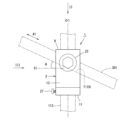
- FIG. 2 is a plan view of the jig shown in FIG. 1 as viewed from a direction II.
- FIG. 3 is a side view of the jig shown in FIG. 1 as viewed from direction III.
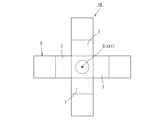
- FIG. 3 is a plan view of a non-limiting one-sided fixture of the present disclosure, corresponding to FIG. 2 .
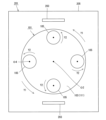
- FIG. 2 is a plan view showing a non-limiting one-sided tool rotation device (PVD processing device) of the present disclosure.
- FIG. 6 is a side view of the tool rotation device shown in FIG. 5 .
- the non-limiting one-sided jig 1 of the present disclosure will be described in detail with reference to the drawings.
- the jig 1 may include any component member not shown in each of the drawings referred to.
- the dimensions of the components in each drawing do not faithfully represent the dimensions of the actual components and the dimensional ratios of each component.
- the jig 1 may be a member for attaching a rod-shaped tool 301 to a rotatable support 113, as shown in a non-limiting example in Figures 1 to 3.
- the support 113 may be a component of a tool rotation device or a PVD processing device, which will be described later. Therefore, the jig 1 may be for use in a tool rotation device or a PVD processing device.
- the rod-shaped tool 301 may be a cutting tool.
- rod-shaped cutting tools include a solid bar, a drill, an end mill, and a reamer.
- the rod-shaped cutting tool may have a shank portion and a cutting portion.
- the shank portion may be a portion that is gripped by a rotating spindle of a machine tool.
- the shank portion may be designed according to the shape of the spindle in the machine tool.
- the cutting portion may be a portion that is capable of contacting the workpiece and plays a major role in cutting the workpiece.
- the cutting portion may be a portion that has a cutting edge.
- the rod-shaped tool 301 is not limited to a specific size.
- the diameter of the shank may be set to about 4 to 10 mm, and the overall length may be set to about 40 to 100 mm.
- the material of the tool 301 may be, for example, a cemented carbide or a cermet.
- the composition of the cemented carbide may be, for example, WC-Co, WC-TiC-Co, and WC-TiC-TaC-Co.
- WC, TiC, and TaC may be hard particles, and Co may be a binder phase.
- the cermet may be a sintered composite material in which a ceramic component is combined with a metal.
- An example of a cermet is a titanium compound mainly composed of TiC or TiN.
- the jig 1 may include a main body 3, as shown in the non-limiting example in Figures 1 to 3.
- Examples of materials for the main body 3 include stainless steel, steel, aluminum alloy, titanium alloy, etc.
- the main body 3 may have a through hole 5 and a recess 7.
- the through hole 5 is capable of inserting the support 113.
- the recess 7 is capable of accommodating a portion of the tool 301.
- the recess 7 is capable of accommodating a portion of the outer periphery of the tool 301. If the tool 301 is a cutting tool, the recess 7 is capable of accommodating a shank portion.
- the main body 3 may be block-shaped.
- the main body 3 may have an upper surface 9, a lower surface 11 located opposite the upper surface 9, and a side surface 13 located between the upper surface 9 and the lower surface 11.
- the through-hole 5 may open to the upper surface 9 and the lower surface 11.
- the recess 7 may open to opposing regions of the side surface 13 and to the upper surface 9.
- the recess 7 may have a first wall surface 15, a second wall surface 17, and a bottom surface 19, as shown in a non-limiting example in FIG. 3.
- the first wall surface 15 may be located along the first central axis O1 of the through hole 5.
- the first wall surface 15 may also be flat.
- the first wall surface 15 may be parallel to the first central axis O1. When a part of the tool 301 is housed in the recess 7, the first wall surface 15 may come into contact with the tool 301.
- the second wall surface 17 may be located farther from the through hole 5 than the first wall surface 15.
- the second wall surface 17 may face the first wall surface 15.
- the second wall surface 17 may be flat.
- the second wall surface 17 may be parallel to the first wall surface 15. When a part of the tool 301 is housed in the recess 7, the second wall surface 17 may not be in contact with the tool 301.
- the bottom surface 19 may be located between the first wall surface 15 and the second wall surface 17.
- the bottom surface 19 may also be connected to the first wall surface 15 and the second wall surface 17.
- the bottom surface 19 may be flat. When a part of the tool 301 is accommodated in the recess 7, the bottom surface 19 may come into contact with the tool 301.
- the main body 3 may further have a first screw hole 21, a first screw 23, a second screw hole 25, and a second screw 27, as shown in a non-limiting example in FIG. 2.
- the first screw hole 21 may penetrate the main body 3 so as to open into the second wall surface 17.
- the first screw hole 21 may also open into the second wall surface 17 and into an area of the side surface 13 of the main body 3 that faces the second wall surface 17.
- the first screw 23 may be inserted into the first screw hole 21.
- the tool 301 When a part of the tool 301 is housed in the recess 7, the tool 301 can be fixed to the recess 7 by tightening the first screw 23 inserted into the first screw hole 21.
- the second screw hole 25 may penetrate the main body 3 so as to open into the through hole 5.
- the second screw hole 25 may also open into the through hole 5 and into an area of the side surface 13 of the main body 3 facing the through hole 5.
- the second screw hole 25 may be connected to the through hole 5.
- the second screw 27 may be inserted into the second screw hole 25.
- the jig 1 can be fixed to the support 113. Furthermore, when the jig 1 is fixed to the support 113 in this manner, the jig 1 is less likely to spin freely when the support 113 rotates.
- the bottom surface 19 may be inclined with respect to the first central axis O1, as in the non-limiting example shown in FIG. 1.
- the bottom surface 19 may be an inclined surface inclined with respect to the first central axis O1.
- Such a jig 1 is suitable for attaching the tool 301 in a tool rotation device or PVD processing device described later.
- the inclination angle ⁇ of the bottom surface 19 with respect to the reference line S1 perpendicular to the first central axis O1 may be set to approximately 20 to 70°, or further may be set to approximately 40 to 50°.
- the second screw 27 (second screw hole 25) may be located below the recess 7, as in the non-limiting example shown in FIG. 3. In this case, the second screw 27 is less likely to impede the ease of fixing the tool 301 to the recess 7. This makes it easier to fix the tool 301 to the recess 7.
- jig 1A of this disclosure
- differences between jig 1A and jig 1 will be mainly described, and detailed descriptions of the same configuration as jig 1 may be omitted. Therefore, the description of jig 1 may be used to understand the configuration of jig 1A. Note that the first screw and other parts have been omitted from FIG. 4 to facilitate visual understanding.
- the main body 3 may have multiple recesses 7, as in the non-limiting example shown in FIG. 4.
- multiple tools 301 can be attached to the support 113 with one jig 1A.
- the number of recesses 7 may be, for example, about 2 to 6.
- the number of recesses 7 is four.
- the main body 3 may be rotationally symmetrical at 90° about the first central axis O1 when viewed in a plan view.
- a non-limiting one-sided tool rotation device 101 will be described with reference to Fig. 5 and Fig. 6, taking as an example a case where the above-mentioned jig 1 is provided. Note that, for ease of visual understanding, a rotation table that overlaps with the revolution axis when viewed from the side is omitted in Fig. 6.
- the tool rotation device 101 may be a device that rotates the tool 301 around a rotation axis O3 parallel to the revolution axis O2 while revolving the tool 301 around the revolution axis O2, as in a non-limiting example shown in Figures 5 and 6.
- the tool rotation device 101 may also be a device that rotates a plurality of tools 301.
- the tool rotation device 101 may be used, for example, in a PVD processing device that forms a film on the surface of the tool 301 using a PVD method.
- the tool rotation device 101 may include a jig 1, a revolution table 103, and a rotation table 105.
- the revolution table 103 may be a member that revolves the tool 301 around the revolution axis O2.
- the central axis of the revolution table 103 may coincide with the revolution axis O2.
- the revolution table 103 is rotatable around the revolution axis O2.
- the arrow Y1 in FIG. 5 etc. may indicate the rotation direction of the revolution table 103.
- the revolution table 103 may rotate in the opposite direction to the arrow Y1.
- a motor and gears may be used to rotate the revolution table 103.
- the driving force of the motor may be transmitted to the revolution table 103 via gears to rotate the revolution table 103.
- This is the same for other rotatable members such as the rotation table 105 described below.
- the revolution table 103 may be disk-shaped.
- the outer diameter of the revolution table 103 may be set to, for example, about 300 to 600 mm.
- the rotating table 105 may be a member that rotates the tool 301 on the revolution table 103 around a rotation axis O3 that is parallel to the revolution axis O2.
- the rotating table 105 is also rotatable around a second central axis O4 of the rotating table 105.
- the second central axis O4 of the rotating table 105 may be parallel to the revolution axis O2.
- the arrow Y2 in FIG. 5 etc. may indicate the rotation direction of the rotating table 105.
- the rotating table 105 may rotate in the opposite direction to the arrow Y2.
- the rotating table 105 may have a plate-shaped main body 107 and a top plate 109 that faces the main body 107 with a gap in the direction along the second central axis O4, as in the non-limiting example shown in FIG. 6.
- the main body 107 and the top plate 109 may be disk-shaped with an outer diameter smaller than that of the revolution table 103.
- the outer diameters of the main body 107 and the top plate 109 may be set to, for example, about 100 to 150 mm. Note that when the rotating table 105 has a main body 107, the main body 3 in the jig 1 may be referred to as the jig main body 3, and the main body 107 of the rotating table 105 may be referred to as the rotating table main body 107.
- the multiple rotation tables 105 may be located on the outer periphery side of the revolution axis O2 on the upper surface 111 of the revolution table 103, as in the non-limiting example shown in FIG. 5.
- the multiple rotation tables 105 may be located at equal intervals in the circumferential direction of the revolution axis O2.
- the number of rotation tables 105 may be, for example, about 2 to 10.
- the rotating table 105 may have a support 113, as shown in a non-limiting example in FIG. 6.
- the support 113 may be located between the main body 107 and the top plate 109.
- the support 113 may also be cylindrical.
- the diameter of the support 113 may be set to about 1 to 10 mm.
- the length of the support 113 may be set to about 200 to 700 mm.
- the multiple pillars 113 may be positioned at equal intervals in the circumferential direction of the second central axis O4.
- the number of pillars 113 on one rotating table 105 may be, for example, about 2 to 20.
- the rotation axis O3 may be located closer to the outer periphery of the rotation table 105 than the second central axis O4.
- the support pillar 113 may extend along the rotation axis O3.
- the support pillar 113 is rotatable around the rotation axis O3.
- the main body 107 and the top plate 109 may have a through hole through which the end of the support 113 can be inserted, or a recess into which the end of the support 113 can be inserted, and the end of the support 113 may be positioned in this through hole or recess to make the support 113 rotatable.
- the driving force from a motor may be transmitted to the support 113 via a gear to rotate the support 113.
- the driving force may be transmitted to the support 113 by a gear and a kicker to rotate the support 113.
- the arrow Y3 in FIG. 6 etc. may indicate the rotation direction of the support 113.
- the support 113 may rotate in the opposite direction to the arrow Y3.
- the tool rotation device 101 When the tool rotation device 101 is equipped with the jig 1, it is possible to attach the rod-shaped tool 301 in an inclined state to the rotatable support 113 of the tool rotation device 101.
- the first central axis O1 of the through hole 5 in the jig 1 may coincide with the rotation axis O3.
- the tool rotation device 101 may include multiple jigs 1.
- the rotating table 105 may also include multiple supports 113. Using the jig 1 makes it possible to attach a rod-shaped tool 301 to the support 113 in an inclined state. When a rod-shaped tool 301 is attached to the support 113 in an inclined state, the tools 301 attached to adjacent supports 113 are less likely to come into contact with each other. This makes it possible to attach many tools 301 to the support 113.
- the number of jigs 1 may be, for example, about 2 to 15.
- the number of jigs 1 illustrated may be the number per support 113.
- the number of jigs 1 may be the same as the number of tools 301.
- PVD processing apparatus 201 of the present disclosure a non-limiting aspect of the PVD processing apparatus 201 of the present disclosure will be described using an example in which the above-mentioned tool rotation device 101 is provided.
- the PVD processing apparatus 201 may include a tool rotation device 101, a target 203, and a vacuum chamber 205, as shown in a non-limiting example in FIG. 5.
- the tool rotation device 101 includes a jig 1, so that a rod-shaped tool 301 can be attached in an inclined state to a rotatable support 113 and a film can be formed.
- the tool rotation device 101 includes multiple jigs 1 and the rotating table 105 has multiple supports 113, many tools 301 can be attached to the supports 113, so that many tools 301 can be accommodated inside the vacuum chamber 205 and a film can be formed.
- the PVD processing device 201 may be a device that uses a PVD method to form a coating layer on the surface of the tool 301 housed inside the vacuum chamber 205.
- Examples of the PVD method include an ion plating method and a sputtering method.
- the target 203 may be located outside the revolution table 103.
- the target 203 may also be located radially outside the revolution table 103.
- the target 203 may be located on the inner wall surface of the vacuum chamber 205.
- the target 203 may be formed from a film-forming material that is the raw material for the coating layer.
- the target 203 may also be called an evaporation source or a deposition source.
- the target 203 may be in the form of a plate.
- the multiple targets 203 may be formed from different types of deposition materials, or may be formed from the same type of deposition material.
- the multiple targets 203 may be positioned at intervals in the direction along the revolution axis O2.
- the multiple targets 203 may be positioned at intervals along the circumferential direction of the revolution table 103.
- the two targets 203 may be positioned so as to face each other with the revolution table 103 in between.
- the number of targets 203 may be, for example, about 2 to 16.
- the vacuum chamber 205 may house the tool rotation device 101 and the target 203 inside.
- the vacuum chamber 205 is also capable of reducing the pressure inside.
- an exhaust pipe may be connected to the vacuum chamber 205, and a vacuum pump or the like may be connected to the exhaust pipe, so that the inside can be evacuated to a vacuum or extremely low pressure.
- a gas supply pipe may be connected to the vacuum chamber 205, and an inert gas or reactive gas or the like may be supplied to the inside of the vacuum chamber 205.
- the method for producing a coated tool may be a method in which a coating layer is formed on the surface of the tool 301 using a PVD processing device 201 to obtain a coated tool.
- the composition of the coating layer formed on the surface of the tool 301 may include, for example, titanium carbide (TiC), titanium nitride (TiN), titanium carbonitride (TiCN), and alumina (Al 2 O 3 ).
- the coating layer is not limited to a specific thickness.
- the average thickness of the coating layer may be set to about 0.1 to 10 ⁇ m.
- the thickness of the coating layer may be measured by cross-sectional observation using an electron microscope.
- the thickness may be measured at 10 or more measurement points at any position on the coating layer, and the average value may be calculated.
- electron microscopes include a scanning electron microscope (SEM) and a transmission electron microscope (TEM).
- the above provides examples of the non-limiting one-sided jig 1, 1A, tool rotation device 101, PVD processing device 201, and method for manufacturing a coated tool of the present disclosure, but it goes without saying that the present disclosure is not limited to the above embodiments and can be any as long as it does not deviate from the gist of the present disclosure.
- the above-mentioned tool rotation device 101 is provided with jig 1, but instead of jig 1, jig 1A may be provided.
Landscapes
- Chemical & Material Sciences (AREA)
- Chemical Kinetics & Catalysis (AREA)
- Engineering & Computer Science (AREA)
- Materials Engineering (AREA)
- Mechanical Engineering (AREA)
- Metallurgy (AREA)
- Organic Chemistry (AREA)
- Physical Vapour Deposition (AREA)
Priority Applications (2)
| Application Number | Priority Date | Filing Date | Title |
|---|---|---|---|
| JP2025507959A JPWO2024194986A1 (https=) | 2023-03-20 | 2023-03-20 | |
| PCT/JP2023/010894 WO2024194986A1 (ja) | 2023-03-20 | 2023-03-20 | 治具、工具回転装置、pvd処理装置および被覆工具の製造方法 |
Applications Claiming Priority (1)
| Application Number | Priority Date | Filing Date | Title |
|---|---|---|---|
| PCT/JP2023/010894 WO2024194986A1 (ja) | 2023-03-20 | 2023-03-20 | 治具、工具回転装置、pvd処理装置および被覆工具の製造方法 |
Publications (1)
| Publication Number | Publication Date |
|---|---|
| WO2024194986A1 true WO2024194986A1 (ja) | 2024-09-26 |
Family
ID=92841347
Family Applications (1)
| Application Number | Title | Priority Date | Filing Date |
|---|---|---|---|
| PCT/JP2023/010894 Ceased WO2024194986A1 (ja) | 2023-03-20 | 2023-03-20 | 治具、工具回転装置、pvd処理装置および被覆工具の製造方法 |
Country Status (2)
| Country | Link |
|---|---|
| JP (1) | JPWO2024194986A1 (https=) |
| WO (1) | WO2024194986A1 (https=) |
Citations (7)
| Publication number | Priority date | Publication date | Assignee | Title |
|---|---|---|---|---|
| JPS361018Y1 (https=) * | 1959-06-19 | 1961-01-21 | ||
| JPS5193122U (https=) * | 1975-01-24 | 1976-07-26 | ||
| JPS5431774U (https=) * | 1977-08-03 | 1979-03-02 | ||
| US20020062791A1 (en) * | 2000-10-11 | 2002-05-30 | Andrey Ginovker | Table |
| JP2009121614A (ja) * | 2007-11-15 | 2009-06-04 | Shigeki Nakamura | 自在継手 |
| JP2012067359A (ja) * | 2010-09-24 | 2012-04-05 | Nissin Electric Co Ltd | 膜形成対象物品支持装置及び膜形成装置 |
| KR20160022196A (ko) * | 2014-08-19 | 2016-02-29 | 재단법인 하이브리드 인터페이스기반 미래소재 연구단 | 구조물의 균일 증착을 위하여 비틀림각을 연출하는 지그시스템 |
-
2023
- 2023-03-20 JP JP2025507959A patent/JPWO2024194986A1/ja active Pending
- 2023-03-20 WO PCT/JP2023/010894 patent/WO2024194986A1/ja not_active Ceased
Patent Citations (7)
| Publication number | Priority date | Publication date | Assignee | Title |
|---|---|---|---|---|
| JPS361018Y1 (https=) * | 1959-06-19 | 1961-01-21 | ||
| JPS5193122U (https=) * | 1975-01-24 | 1976-07-26 | ||
| JPS5431774U (https=) * | 1977-08-03 | 1979-03-02 | ||
| US20020062791A1 (en) * | 2000-10-11 | 2002-05-30 | Andrey Ginovker | Table |
| JP2009121614A (ja) * | 2007-11-15 | 2009-06-04 | Shigeki Nakamura | 自在継手 |
| JP2012067359A (ja) * | 2010-09-24 | 2012-04-05 | Nissin Electric Co Ltd | 膜形成対象物品支持装置及び膜形成装置 |
| KR20160022196A (ko) * | 2014-08-19 | 2016-02-29 | 재단법인 하이브리드 인터페이스기반 미래소재 연구단 | 구조물의 균일 증착을 위하여 비틀림각을 연출하는 지그시스템 |
Also Published As
| Publication number | Publication date |
|---|---|
| JPWO2024194986A1 (https=) | 2024-09-26 |
Similar Documents
| Publication | Publication Date | Title |
|---|---|---|
| CN101678466B (zh) | 表面被覆切削工具 | |
| CN108998758A (zh) | 具有涂层的钻头 | |
| WO2014076947A1 (ja) | 成膜装置 | |
| WO2024194986A1 (ja) | 治具、工具回転装置、pvd処理装置および被覆工具の製造方法 | |
| US10471523B2 (en) | Rotating tool | |
| KR20190136771A (ko) | 연동 회전하는 회전기를 가지는 증착장치 | |
| WO2024194994A1 (ja) | ワーク回転装置、pvd処理装置および被覆工具の製造方法 | |
| WO2024194995A1 (ja) | ワーク回転装置、pvd処理装置および被覆工具の製造方法 | |
| WO2025004125A1 (ja) | 成膜方法 | |
| JP4782222B2 (ja) | 穴明け工具用非晶質炭素皮膜及び穴明け工具 | |
| US20250339901A1 (en) | Coated tool and cutting tool | |
| WO2024209529A1 (ja) | コーティング方法 | |
| JP4106934B2 (ja) | 工具の成膜装置および成膜方法 | |
| JP7850815B2 (ja) | 被覆工具および切削工具 | |
| JP4120255B2 (ja) | 工具の成膜方法 | |
| JP7772960B2 (ja) | 被覆工具および切削工具 | |
| US20250214148A1 (en) | Coated tool and cutting tool | |
| KR20110042190A (ko) | 물리 기상 증착 장치 및 방법 | |
| WO2025206384A1 (ja) | 被覆工具、切削工具、および切削加工物の製造方法 | |
| JP2008105106A (ja) | 高速切削加工で硬質被覆層がすぐれた耐摩耗性を発揮する表面被覆切削工具 | |
| WO2024115196A1 (en) | A coated cutting tool | |
| CN120813445A (zh) | 涂层刀具以及切削刀具 | |
| JP2007075911A (ja) | 難削材の高速重切削加工で硬質被覆層がすぐれた耐チッピング性を発揮する表面被覆高速度工具鋼製切削工具 | |
| JPH0693425A (ja) | コーティング工具の製造方法 |
Legal Events
| Date | Code | Title | Description |
|---|---|---|---|
| 121 | Ep: the epo has been informed by wipo that ep was designated in this application |
Ref document number: 23928569 Country of ref document: EP Kind code of ref document: A1 |
|
| ENP | Entry into the national phase |
Ref document number: 2025507959 Country of ref document: JP Kind code of ref document: A |
|
| WWE | Wipo information: entry into national phase |
Ref document number: 2025507959 Country of ref document: JP |
|
| NENP | Non-entry into the national phase |
Ref country code: DE |
|
| 122 | Ep: pct application non-entry in european phase |
Ref document number: 23928569 Country of ref document: EP Kind code of ref document: A1 |