WO2024194926A1 - 画像解析システム、画像解析装置、および画像解析方法 - Google Patents
画像解析システム、画像解析装置、および画像解析方法 Download PDFInfo
- Publication number
- WO2024194926A1 WO2024194926A1 PCT/JP2023/010595 JP2023010595W WO2024194926A1 WO 2024194926 A1 WO2024194926 A1 WO 2024194926A1 JP 2023010595 W JP2023010595 W JP 2023010595W WO 2024194926 A1 WO2024194926 A1 WO 2024194926A1
- Authority
- WO
- WIPO (PCT)
- Prior art keywords
- person
- luggage
- image analysis
- image
- analysis device
- Prior art date
- Legal status (The legal status is an assumption and is not a legal conclusion. Google has not performed a legal analysis and makes no representation as to the accuracy of the status listed.)
- Ceased
Links
Images


Classifications
-
- H—ELECTRICITY
- H04—ELECTRIC COMMUNICATION TECHNIQUE
- H04N—PICTORIAL COMMUNICATION, e.g. TELEVISION
- H04N7/00—Television systems
- H04N7/18—Closed-circuit television [CCTV] systems, i.e. systems in which the video signal is not broadcast
Definitions
- the present invention relates to an image analysis system that uses image analysis to monitor whether luggage has been left behind or taken away.
- Non-Patent Document 1 Another problem is that there is concern that the accuracy of determining whether an abandoned object is stationary or moving decreases when a person or other object passes around it.
- methods are being considered that use machine learning such as deep learning to detect people and luggage, and determine that the luggage is abandoned if the distance between the person and the luggage is greater than a certain value (see, for example, Non-Patent Document 1).
- Non-Patent Document 1 if the distance between the luggage and the person is more than a certain value (for example, more than 3 m or more than twice the width of the luggage) and the luggage has been stationary for more than a certain period of time (for example, more than 30 seconds), the luggage is determined to be abandoned. However, because the last person near the luggage is determined to be the owner, it is difficult to identify the owner in crowded places where multiple people are passing by near the luggage. Furthermore, neither Patent Document 1 nor Non-Patent Document 1 discloses how to identify the owner of the luggage, which is important in surveillance work.
- a certain value for example, more than 3 m or more than twice the width of the luggage
- a certain period of time for example, more than 30 seconds
- the present invention was made in consideration of the above-mentioned conventional circumstances, and aims to provide a mechanism that can grasp the relationship between people and luggage more accurately.
- an image analysis system has the following technical features. That is, the image analysis system according to the present invention includes an imaging device and an image analysis device, and the image analysis device analyzes an image captured by the imaging device, and when a package and a person are detected from the image, determines whether the package is being carried by the person based on whether there is a connection between the package and the person.
- the image analysis device analyzes the image using a skeleton detection model that has been trained to detect luggage as part of a person's skeleton when the luggage is being carried by the person, and when a skeleton connecting the person and the luggage is detected in the image, it can determine that the luggage is being carried by the person.
- the image analysis device analyzes the image using an object detection model that has been trained to detect a set of a person's hand or arm and the luggage when the luggage is being carried by the person, and when the composition is detected from the image, it can determine that the luggage related to the composition is being carried by a person whose hand or arm is related to the composition.
- the image analysis device determines that the luggage is in the possession of the person, and then the possession state is released and the person is not in the person's possession for a certain period of time, the image analysis device can determine that the luggage is a candidate for abandoned property and that the person is a candidate for the person who left it thereafter, and if a connection is subsequently detected between the luggage and a person other than the candidate for the person who left it thereafter, the image analysis device can determine that the other person is a candidate for the person who took it thereafter.
- the image analysis device may have a storage unit that stores images of the candidate abandoned items, images of the candidate owners, and images of the candidate owners.
- An image analysis device has the following technical features. That is, the image analysis device analyzes an image captured by an imaging device, and when a package and a person are detected from the image, the image analysis device determines whether the package is being carried by the person based on the presence or absence of a connection between the package and the person.
- An image analysis device has the following technical features. That is, it is an image analysis method in which an image captured by an imaging device is analyzed by an image analysis device, and when a package and a person are detected from the image, the image analysis device determines whether the package is being carried by the person based on the presence or absence of a connection between the package and the person.
- the present invention provides a mechanism that can more accurately grasp the relationship between people and luggage.
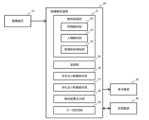
- FIG. 13 is a diagram showing an example of the configuration of an image analysis system according to an embodiment of the present invention.
- FIG. 13 is a diagram showing an example of detection using a skeleton detection model.
- FIG. 13 is a diagram showing an example of detection using a skeleton detection model.
- FIG. 13 is a diagram showing an example of detection using an object detection model.
- FIG. 13 is a diagram showing an example of detection using an object detection model.
- FIG. 13 is a diagram showing an example of how the state of a surveillance area changes over time.
- 2 is a diagram showing an example of a processing flow of an image analysis device in the image analysis system shown in FIG. 1 .
- FIG. 1 shows an example of the configuration of an image analysis system according to one embodiment of the present invention.
- the image analysis system of FIG. 1 comprises an imaging device 10, an image analysis device 20, a display device 30, and a recording device 40. These devices are connected to each other so that they can communicate with each other via a communication line such as an IP network, and can send and receive data between them.
- a communication line such as an IP network
- the imaging device 10 is a device that captures images of a monitored area.
- the imaging device 10 may be a network camera that has the function of transmitting images via an IP network.
- the imaging device 10 may be configured by connecting a camera without a communication function to a communication device via a cable or the like.
- the monitored area is an area that is subject to detection of events such as baggage being left behind or taken away.
- the monitored area may be the entire imaging range of the imaging device 10, or a part of it.
- the monitored area may be captured by only one imaging device 10, or the monitored area may be captured by multiple imaging devices 10.
- the image analysis device 20 is a device that analyzes images captured by the imaging device 10.
- the image analysis device 20 is composed of an electronic computer system equipped with hardware such as a CPU (Central Processing Unit) and memory.
- the image analysis device 20 may also be equipped with other processors such as a DSP (Digital Signal Processor), FPGA (Field-Programmable Gate Array), and GPU (Graphics Processing Unit).
- DSP Digital Signal Processor
- FPGA Field-Programmable Gate Array
- GPU Graphics Processing Unit
- the image analysis device 20 has, as functional units related to image analysis, an object recognition unit 21, a tracking unit 25, an abandonment event detection unit 26, a removal event detection unit 27, and a detection result output unit 28.
- These functional units 21 to 28 are realized, for example, by loading a specific program into main memory and executing it with a processor such as a CPU.
- the image analysis device 20 also has a data storage unit 29 that stores data used during image analysis.
- a flash memory or the like is used as the data storage unit 29, but is not limited to this.
- the data storage unit 29 stores images extracted by image analysis from the images captured by the imaging device 10 (for example, an image of the abandoned item, an image of the person who left the abandoned item, an image of the person who took the abandoned item, or images of candidates thereof), the date and time of abandonment, the date and time of removal, etc.
- the object recognition unit 21 analyzes the images captured by the imaging device 10 at predetermined time intervals (e.g., every frame or every few frames), detects objects contained in the images, and performs a process of annotating them.
- Annotating a detected object is achieved, for example, by setting a rectangular area surrounding the detected object and associating the area with object type information, identification information, and the like.
- the object recognition unit 21 has a luggage detection unit 22, a person detection unit 23, and a luggage carrying detection unit 24.
- the luggage detection unit 22 detects luggage contained in the image.
- the person detection unit 23 detects people contained in the image.
- the luggage carrying detection unit 24 detects the connection between luggage and people contained in the image. In this way, this system not only detects luggage and people, but also detects the connection between luggage and people.
- "luggage” in this specification means any object that can be carried by a person in the hand or arm. Examples of luggage include, but are not limited to, handbags, shoulder bags, trunks, suitcases, and carry cases.
- the tracking unit 25 tracks people and luggage within the monitoring area based on the detection results by the object recognition unit 21. For example, it extracts images of people from the images at each time (frame) and compares them with images of people detected at previous and subsequent times. For each person determined to be the same, the position of the person is associated with the detection time and stored in the data storage unit 29. Similarly, it extracts images of luggage from the images at each time (frame) and compares them with images of luggage detected at previous and subsequent times. For each luggage determined to be the same, the position of the luggage is associated with the detection time and stored in the data storage unit 29. Note that the above tracking method is one example, and people and luggage may be tracked using other methods.
- the abandoned event detection unit 26 judges whether or not a package in the monitoring area is abandoned based on the detection result by the object recognition unit 21 and the tracking result by the tracking unit 25. Specifically, if a person connected to the package is detected and then the connection between the package and the person is severed, the package is judged to be abandoned if a predetermined time has passed since the connection was severed. On the other hand, if the package leaves the monitoring area without being severed, or if the connection is severed but the connection is detected again before the predetermined time has passed, the package is judged not to be abandoned.
- the abandoned event detection unit 26 further detects the person who had a connection with the package immediately before the package was first detected as abandoned (i.e., the person who was carrying the package) as a candidate for the person who left the package (the original owner).
- the abandoned event detection unit 26 stores, for example, an image of the abandoned package, an image of the person (candidate) who left the package, and the date and time of leaving the package in the data storage unit 29.
- the removal event detection unit 27 judges whether or not an abandoned item has been removed based on the detection results by the object recognition unit 21 and the tracking results by the tracking unit 25. Specifically, if the person who had a connection with the item at the time the item was left behind and moved outside the monitoring area (i.e., the person who was carrying the item) is different from the candidates for the person who left the item behind, the removal event detection unit 27 detects that person as a candidate for the person who removed the item as a result of the above process.
- the removal event detection unit 27 stores, for example, an image of the person (candidate) who removed the item, the date and time of removal, etc. in the data storage unit 29.
- the detection result output unit 28 reads out the detection result data from the data storage unit 29 and outputs (transmits) it to the display device 30 or the recording device 40.
- the detection result data includes an image of the abandoned luggage, an image of the person who left or took the luggage, the date and time when the luggage was left behind or taken away, etc.
- the display device 30 is a device that displays the detection result data transmitted from the image analysis device 20.
- a device such as a liquid crystal display may be used as the display device 30, but is not limited to this. By checking the display on the display device 30, the monitor can ascertain the abandoned luggage, the person who left or took the luggage, the date and time when the luggage was left or taken, etc.
- the recording device 40 is a device that records the detection result data transmitted from the image analysis device 20.
- a hard disk drive (HDD) or flash memory may be used as the recording device 40, but is not limited to these.
- the detection result data recorded in the recording device 40 is used for subsequent confirmation, etc.
- the detection result data in the recording device 40 is transmitted to the display device 30 at the instruction of the monitor, and is displayed on the display device 30.
- the connection between luggage and a person can be detected, for example, using skeletal detection technology.
- Skeletal detection technology is a technology that detects a person's skeletal points (joint points) in real time from moving images (video) or still images and recognizes the posture and behavior of the person by analyzing the connections between the skeletal points.
- This system uses a skeletal detection model that has been trained to detect luggage (or parts of it) as part of the skeleton by treating any point on the luggage (for example, the handle of the luggage, the center of the luggage, corners of the luggage, etc.) as a skeletal point. In this way, by using the skeletal detection model, it becomes possible to easily detect the connection between luggage and a person.
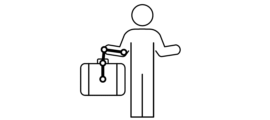
- FIGS. 2A and 2B show examples of detection using a skeleton detection model.
- FIG. 2A shows an example of a case where it is determined that the luggage is being carried by a person
- FIG. 2B shows an example of a case where it is determined that the luggage is not being carried by a person.
- the circles in the figure represent joint points, and the thick lines connecting the circles represent skeletons.
- FIG. 2A when the person's hand or arm and the luggage are connected as a single skeleton, it is determined that the luggage is being carried by the person.
- FIG. 2B when the person's hand or arm and the luggage are separated as separate skeletons, it is determined that the luggage is not being carried by the person.
- the detection of the connection between luggage and a person is not limited to the method using the skeleton detection model described above, and other technologies may be used.
- an object detection model such as YOLO (You Only Look Once).
- the model is trained to detect luggage and a person's hand or arm as a set, as a single composition. Even when such an object detection model is used, it is possible to easily detect the connection between luggage and a person.
- FIG. 3A and 3B show examples of detection using the object detection model.
- FIG. 3A shows an example of a case where it is determined that the luggage is being carried by a person
- FIG. 3B shows an example of a case where it is determined that the luggage is not being carried by a person.
- the dashed rectangular frames in the figures represent the detected objects (luggage, person, and a composition of the luggage and the person's hand or arm).
- FIG. 3A when a composition of the luggage and the person's hand or arm is detected, it is determined that the luggage is being carried by a person. More specifically, it is determined that the luggage related to the composition is being carried by a person who has the hand or arm related to the composition.
- FIG. 3B when a composition of the luggage and the person's hand or arm is not detected, it is determined that the luggage is not being carried by a person.
- FIG. 4 shows an example of how the state of the monitored area changes over time.
- FIG. 4 shows an example of a series of images taken between time Ts-3 and time Ts+2 as an example of a case where an abandoned baggage is detected at time Ts.
- FIG. 5 also shows an example of the processing flow of the image analysis device 20 in the image analysis system shown in FIG. 1.
- the image taken at time Ts-3 shows three people P1, P2, and P3 near the monitored area, with person P1 moving toward the monitored area while carrying baggage B.
- the images taken at times Ts-2 and Ts-1 show person P1 entering the monitored area while carrying baggage B and moving to the right.
- the image taken at time Ts shows person P1 putting baggage B down and leaving.
- the image taken at time Ts+1 shows person P1 leaving the monitored area and another person P4 entering the monitored area.
- the image taken at time Ts+2 shows person P4 passing near abandoned object B.
- the image analysis device 20 detects that person P1 is carrying baggage B using the object recognition unit 21, and starts tracking person P1 and baggage B using the tracking unit 25 (step S11).
- person P1 then moves within the monitoring area (time Ts-1) and leaves baggage B behind (time Ts)
- the connection between person P1 and baggage B is severed, and person P1 is no longer carrying baggage B.
- the baggage carrying detection unit 24 no longer detects the connection between baggage B and person P1.
- the image analysis device 20 determines by the abandonment event detection unit 26 that baggage B has been left abandoned (i.e., there is a possibility of an abandonment event) (step S12).
- the image analysis device 20 sets person P1, who was the owner of baggage B immediately before detecting that the baggage was left behind, as a candidate for the person who left the baggage, and sets baggage B as a candidate for the abandoned item (step S13).
- the image analysis device 20 further associates an event ID given each time an event such as a baggage being left behind or taken away, the type of event (abandonment event), the time of the event, an image of baggage B which is the abandoned item (candidate), an image of person P1 who is the person who left the baggage (candidate), and positional information within the image of baggage B (for example, the X coordinate of the left edge and the Y coordinate of the top edge of the rectangular area surrounding baggage B, the width and height of the rectangular area, etc.), and stores them in the data storage unit 29 as data on the abandoned item event.
- the image of the person who left the baggage is used to check whether the person who later took the baggage B (the person who took it away) is the same person as the person who left the baggage.
- the image analysis device 20 tracks the luggage B and person P1 using the tracking unit 25, and stores these images in the data storage unit 29 in association with the same event ID as the abandoned event. These images are used to check whether the person who left the luggage B (the person who left it) is the same person as the person who took it later (the person who took it), and can also be used as evidentiary information when an investigation into the abandoned item is conducted.
- step S13 may be executed after step S11. That is, in step S11, tracking of the luggage B and person P1 may be started using the luggage detection unit 22, person detection unit 23, and tracking unit 25, and images before and after the luggage B is abandoned may be stored.
- the image analysis device 20 measures the duration of the abandoned state of the luggage B (i.e., a state in which no one has possession of the luggage B) and determines whether the abandoned state of the luggage B has continued for a predetermined time (e.g., 30 seconds) (step S14). As a result, if the abandoned state of the luggage B has continued for the predetermined time, the image analysis device 20 determines that the luggage B is an abandoned item by the abandoned event detection unit 26, and transmits the abandoned event detection result data by the detection result output unit 28 to the display device 30 for display, and also transmits it to the recording device 40 for recording (step S15). While the abandoned state of the luggage B continues, the image analysis device 20 may successively transmit data related to the abandoned event to the recording device 40 for additional recording.
- a predetermined time e.g. 30 seconds
- the image analysis device 20 judges whether that person is the same person as the person who left it behind (step S16). If it turns out that the two are the same person (i.e., person P1), the detection result data of the abandonment event stored in the data storage unit 29 is deleted (step S17), and the process returns to step S11 to track baggage B and person P1.
- step S16 luggage B is in the possession of a person other than the person who left it behind (not shown in FIG. 4)
- the image analysis device 20 uses the removal event detection unit 27 to determine that there is a possibility that luggage B has been removed, and starts tracking luggage B and its possible recipient using the object recognition unit 21 and tracking unit 25 (step S18).
- the image analysis device 20 associates an event ID that is assigned each time an event such as luggage is left behind or removed, the type of event (removal event), the time of the event, an image of the person who is the possible recipient, and position information within the image of luggage B, and stores them in the data storage unit 29 as removal event data.
- the data on the abandonment event and the data on the removal event may be stored in association with each other.
- the image analysis device 20 determines through the taking-away event detection unit 27 that a taking-away event of baggage B has occurred (step S19). In response to this, the image analysis device 20 transmits the detection result data of the taking-away event through the detection result output unit 28 to the display device 30 for display, and also transmits it to the recording device 40 for recording (step S20).
- the image analysis device 20 determines whether or not the luggage is being carried by the person, based on whether or not there is a connection between the luggage and the person. In other words, the image analysis device 20 does not determine that the luggage is being carried by the person simply because the luggage and the person are nearby, but determines that the luggage is being carried by the person when a connection between the luggage and the person is detected. This makes it possible to grasp the relationship between the luggage and the person more accurately. Furthermore, even when there are many people in the monitored area, the relationship between the luggage and the person can be grasped with high accuracy, making it possible to appropriately monitor during crowded times.
- the image analysis device 20 further determines that a package is a candidate for abandoned property and that the person is a candidate for the person who left it behind if it is determined that the package is in the possession of a person, and then the person is released from the possession and is not in the possession of the package for a certain period of time. If a connection is subsequently detected between the package and a person other than the candidate for the person who left it behind, the other person is determined to be a candidate for the person who took it away. This makes it possible to accurately detect whether a package has been left behind or taken away.
- the present invention can be provided not only as the devices described above or as systems composed of these devices, but also as methods executed by these devices, programs for implementing the functions of these devices using a processor, and storage media for storing such programs in a computer-readable format.
- the present invention can be used in an image analysis system that uses image analysis to monitor whether luggage has been left behind or taken away.
- Imaging device 20: Image analysis device, 21: Object recognition unit, 22: Baggage detection unit, 23: Person detection unit, 24: Baggage possession detection unit, 25: Tracking unit, 26: Abandonment event detection unit, 27: Removal event detection unit, 28: Detection result output unit, 29: Data storage unit, 30: Display device, 40: Recording device
Landscapes
- Engineering & Computer Science (AREA)
- Multimedia (AREA)
- Signal Processing (AREA)
- Image Analysis (AREA)
Priority Applications (2)
| Application Number | Priority Date | Filing Date | Title |
|---|---|---|---|
| JP2025507907A JP7821372B2 (ja) | 2023-03-17 | 2023-03-17 | 画像解析システム、画像解析装置、および画像解析方法 |
| PCT/JP2023/010595 WO2024194926A1 (ja) | 2023-03-17 | 2023-03-17 | 画像解析システム、画像解析装置、および画像解析方法 |
Applications Claiming Priority (1)
| Application Number | Priority Date | Filing Date | Title |
|---|---|---|---|
| PCT/JP2023/010595 WO2024194926A1 (ja) | 2023-03-17 | 2023-03-17 | 画像解析システム、画像解析装置、および画像解析方法 |
Publications (1)
| Publication Number | Publication Date |
|---|---|
| WO2024194926A1 true WO2024194926A1 (ja) | 2024-09-26 |
Family
ID=92841055
Family Applications (1)
| Application Number | Title | Priority Date | Filing Date |
|---|---|---|---|
| PCT/JP2023/010595 Ceased WO2024194926A1 (ja) | 2023-03-17 | 2023-03-17 | 画像解析システム、画像解析装置、および画像解析方法 |
Country Status (2)
| Country | Link |
|---|---|
| JP (1) | JP7821372B2 (https=) |
| WO (1) | WO2024194926A1 (https=) |
Citations (4)
| Publication number | Priority date | Publication date | Assignee | Title |
|---|---|---|---|---|
| JP2012235300A (ja) * | 2011-04-28 | 2012-11-29 | Saxa Inc | 置き去り又は持ち去り検知システム及び置き去り又は持ち去り検知記録の生成方法 |
| WO2015004854A1 (ja) * | 2013-07-10 | 2015-01-15 | 日本電気株式会社 | イベント処理装置、イベント処理方法、およびイベント処理プログラム |
| CN111209868A (zh) * | 2020-01-08 | 2020-05-29 | 中国铁道科学研究院集团有限公司电子计算技术研究所 | 一种客运站旅客与行李信息关联方法及装置 |
| JP2021111033A (ja) * | 2020-01-08 | 2021-08-02 | 三菱電機エンジニアリング株式会社 | 物体監視装置、物体監視プログラム、及び監視システム |
Family Cites Families (1)
| Publication number | Priority date | Publication date | Assignee | Title |
|---|---|---|---|---|
| JP5305520B2 (ja) | 2009-05-19 | 2013-10-02 | パナソニック株式会社 | 監視カメラシステム |
-
2023
- 2023-03-17 WO PCT/JP2023/010595 patent/WO2024194926A1/ja not_active Ceased
- 2023-03-17 JP JP2025507907A patent/JP7821372B2/ja active Active
Patent Citations (4)
| Publication number | Priority date | Publication date | Assignee | Title |
|---|---|---|---|---|
| JP2012235300A (ja) * | 2011-04-28 | 2012-11-29 | Saxa Inc | 置き去り又は持ち去り検知システム及び置き去り又は持ち去り検知記録の生成方法 |
| WO2015004854A1 (ja) * | 2013-07-10 | 2015-01-15 | 日本電気株式会社 | イベント処理装置、イベント処理方法、およびイベント処理プログラム |
| CN111209868A (zh) * | 2020-01-08 | 2020-05-29 | 中国铁道科学研究院集团有限公司电子计算技术研究所 | 一种客运站旅客与行李信息关联方法及装置 |
| JP2021111033A (ja) * | 2020-01-08 | 2021-08-02 | 三菱電機エンジニアリング株式会社 | 物体監視装置、物体監視プログラム、及び監視システム |
Also Published As
| Publication number | Publication date |
|---|---|
| JPWO2024194926A1 (https=) | 2024-09-26 |
| JP7821372B2 (ja) | 2026-02-26 |
Similar Documents
| Publication | Publication Date | Title |
|---|---|---|
| JP5988225B2 (ja) | モニタリング装置およびモニタリング方法 | |
| JP6674584B2 (ja) | 映像監視システム | |
| JP6268498B2 (ja) | 警備システム及び人物画像表示方法 | |
| JP6508041B2 (ja) | 対象物監視システム、対象物監視方法および監視対象抽出プログラム | |
| JP6210234B2 (ja) | 画像処理システム、画像処理方法及びプログラム | |
| CN111814510B (zh) | 一种遗留物主体检测方法及装置 | |
| JP2024138974A (ja) | 監視装置 | |
| JP6268497B2 (ja) | 警備システム、及び人物画像表示方法 | |
| CN113792595A (zh) | 目标行为检测方法、装置、计算机设备和存储介质 | |
| NO20240287A1 (en) | Systems and methods to determine an activity associated with an object of interest | |
| KR102175373B1 (ko) | 로이터링 이벤트를 검출하는 방법, 장치 및 시스템 | |
| JP2022011704A (ja) | 画像処理装置、画像処理方法およびプログラム | |
| JP7821372B2 (ja) | 画像解析システム、画像解析装置、および画像解析方法 | |
| US20100157051A1 (en) | System and method for detecting and deterring rfid tag related fraud | |
| WO2017029779A1 (ja) | 警備システム、人物画像表示方法、及びレポート作成方法 | |
| JP2021009488A (ja) | 盗難抑止装置 | |
| JP7592438B2 (ja) | 入出庫管理システム、入出庫管理装置及び入出庫管理方法 | |
| JP6740783B2 (ja) | ゲート管理システム、ゲート管理方法、およびゲート管理プログラム | |
| JP7337399B2 (ja) | 防犯管理システム、および防犯管理方法 | |
| US11810168B2 (en) | Auditing mobile transactions based on symbol cues and transaction data | |
| JP6268496B2 (ja) | 警備システム及び画像表示方法 | |
| JP2009140360A (ja) | 行動分析装置および方法 | |
| JP2022011666A (ja) | 画像処理装置、画像処理方法およびプログラム | |
| CN111767816A (zh) | 一种异常提示方法、装置、设备及存储介质 | |
| JP7829426B2 (ja) | 情報処理装置およびプログラム |
Legal Events
| Date | Code | Title | Description |
|---|---|---|---|
| 121 | Ep: the epo has been informed by wipo that ep was designated in this application |
Ref document number: 23928511 Country of ref document: EP Kind code of ref document: A1 |
|
| ENP | Entry into the national phase |
Ref document number: 2025507907 Country of ref document: JP Kind code of ref document: A |
|
| WWE | Wipo information: entry into national phase |
Ref document number: 2025507907 Country of ref document: JP |
|
| NENP | Non-entry into the national phase |
Ref country code: DE |
|
| 122 | Ep: pct application non-entry in european phase |
Ref document number: 23928511 Country of ref document: EP Kind code of ref document: A1 |