WO2024190872A1 - 化合物、共重合体、組成物、ワニス、及びそれらの硬化体 - Google Patents
化合物、共重合体、組成物、ワニス、及びそれらの硬化体 Download PDFInfo
- Publication number
- WO2024190872A1 WO2024190872A1 PCT/JP2024/010013 JP2024010013W WO2024190872A1 WO 2024190872 A1 WO2024190872 A1 WO 2024190872A1 JP 2024010013 W JP2024010013 W JP 2024010013W WO 2024190872 A1 WO2024190872 A1 WO 2024190872A1
- Authority
- WO
- WIPO (PCT)
- Prior art keywords
- compound
- monomer unit
- aromatic
- copolymer
- composition
- Prior art date
- Legal status (The legal status is an assumption and is not a legal conclusion. Google has not performed a legal analysis and makes no representation as to the accuracy of the status listed.)
- Ceased
Links
Images







Classifications
-
- C—CHEMISTRY; METALLURGY
- C08—ORGANIC MACROMOLECULAR COMPOUNDS; THEIR PREPARATION OR CHEMICAL WORKING-UP; COMPOSITIONS BASED THEREON
- C08F—MACROMOLECULAR COMPOUNDS OBTAINED BY REACTIONS ONLY INVOLVING CARBON-TO-CARBON UNSATURATED BONDS
- C08F210/00—Copolymers of unsaturated aliphatic hydrocarbons having only one carbon-to-carbon double bond
-
- C—CHEMISTRY; METALLURGY
- C08—ORGANIC MACROMOLECULAR COMPOUNDS; THEIR PREPARATION OR CHEMICAL WORKING-UP; COMPOSITIONS BASED THEREON
- C08F—MACROMOLECULAR COMPOUNDS OBTAINED BY REACTIONS ONLY INVOLVING CARBON-TO-CARBON UNSATURATED BONDS
- C08F212/00—Copolymers of compounds having one or more unsaturated aliphatic radicals, each having only one carbon-to-carbon double bond, and at least one being terminated by an aromatic carbocyclic ring
-
- C—CHEMISTRY; METALLURGY
- C08—ORGANIC MACROMOLECULAR COMPOUNDS; THEIR PREPARATION OR CHEMICAL WORKING-UP; COMPOSITIONS BASED THEREON
- C08F—MACROMOLECULAR COMPOUNDS OBTAINED BY REACTIONS ONLY INVOLVING CARBON-TO-CARBON UNSATURATED BONDS
- C08F212/00—Copolymers of compounds having one or more unsaturated aliphatic radicals, each having only one carbon-to-carbon double bond, and at least one being terminated by an aromatic carbocyclic ring
- C08F212/34—Monomers containing two or more unsaturated aliphatic radicals
-
- C—CHEMISTRY; METALLURGY
- C08—ORGANIC MACROMOLECULAR COMPOUNDS; THEIR PREPARATION OR CHEMICAL WORKING-UP; COMPOSITIONS BASED THEREON
- C08L—COMPOSITIONS OF MACROMOLECULAR COMPOUNDS
- C08L23/00—Compositions of homopolymers or copolymers of unsaturated aliphatic hydrocarbons having only one carbon-to-carbon double bond; Compositions of derivatives of such polymers
-
- C—CHEMISTRY; METALLURGY
- C08—ORGANIC MACROMOLECULAR COMPOUNDS; THEIR PREPARATION OR CHEMICAL WORKING-UP; COMPOSITIONS BASED THEREON
- C08L—COMPOSITIONS OF MACROMOLECULAR COMPOUNDS
- C08L47/00—Compositions of homopolymers or copolymers of compounds having one or more unsaturated aliphatic radicals, at least one having two or more carbon-to-carbon double bonds; Compositions of derivatives of such polymers
-
- H—ELECTRICITY
- H05—ELECTRIC TECHNIQUES NOT OTHERWISE PROVIDED FOR
- H05K—PRINTED CIRCUITS; CASINGS OR CONSTRUCTIONAL DETAILS OF ELECTRIC APPARATUS; MANUFACTURE OF ASSEMBLAGES OF ELECTRICAL COMPONENTS
- H05K1/00—Printed circuits
- H05K1/02—Details
- H05K1/03—Use of materials for the substrate
Definitions
- the present invention relates to insulating materials that are copolymers, compositions, varnishes, and their cured products.
- Fluorine-based resins such as perfluoroethylene have the characteristics of excellent low dielectric constant, low dielectric loss, and excellent heat resistance, but they are difficult to mold and form into films, and there are also issues with adhesion to the copper foil of wiring, making them difficult to apply to multilayer substrates, etc.
- substrates and insulating materials made of post-curing resins such as epoxy resins, unsaturated polyester resins, polyimide resins, and phenolic resins have been widely used due to their heat resistance and ease of handling, but their dielectric constants and dielectric losses are relatively high, and improvements are needed as insulating materials for high frequencies (Patent Document 1).
- Patent Document 3 shows a cured body made of an ethylene-olefin (aromatic vinyl compound)-aromatic polyene copolymer and a non-polar vinyl compound copolymer that are obtained from a specific coordination polymerization catalyst and have a specific composition and blend.
- aromatic polyene divininylbenzene
- Cured bodies obtained from similar olefin-aromatic vinyl compound-aromatic polyene copolymers and compositions with auxiliary materials, etc. are characterized by low dielectric constants and low dielectric loss tangents (Patent Documents 4 and 5).
- Patent Documents 4 and 5 the olefin-aromatic vinyl compound-aromatic polyene copolymer specifically described is relatively soft, and in order to harden it is necessary to add a large amount of other hard auxiliary materials or inorganic fillers.
- this copolymer according to the conventional technology has many polymer end structures due to its dendritic (tree-like) structure, and the molecular design for improving heat resistance and durability is complicated due to the end structure specific to cationic polymerization contained therein.
- the present invention provides the following various specific aspects.
- a compound having a chemical structure with a vinylidene group end and a vinyl group end the compound is dissolved in deuterated 1,1,2,2-tetrachloroethane and measured at 23° C. in proton NMR, and among the peaks, the integral value Vd of the peak area showing a vinylidene group terminal appearing at a chemical shift of 4.5 to 4.7 ppm and the integral value Vn of the peak area showing a vinyl group terminal appearing at a chemical shift of 4.8 to 5.0 ppm have a ratio Vd/Vn of 0.4 or more;
- the compound is dissolved in a tetrahydrofuran solvent and the number average molecular weight (Mn) calculated in terms of standard polystyrene is determined by gel permeation chromatography, and the value of the number of polymer ends, which is the reciprocal of the Mn, is 4 ⁇ 10-5 or more; and the compound is dissolved in a toluene solution at a concentration of 50 wt% and has a
- Aspect 2 The compound according to embodiment 1, which is a copolymer comprising an olefin monomer unit, an aromatic vinyl compound monomer unit, and an aromatic polyene monomer unit.
- Aspect 3 A compound according to aspect 2, wherein the content of the aromatic vinyl compound monomer unit in the compound is 15 mol % or more.
- Aspect 4 The compound according to aspect 2 or 3, wherein the content of the aromatic polyene monomer unit in the compound is 1.5 mol % or more.
- Aspect 5 The compound according to any one of Aspects 1 to 4, which is a copolymer having a number average molecular weight of 500 or more.
- Aspect 6 A compound according to any one of aspects 2 to 4, wherein the olefin monomer units comprise ethylene and an ⁇ -olefin having 3 or more carbon atoms.
- a composition comprising the compound according to any one of Aspects 1 to 6 and one or more selected from the following (a) to (d): (a) a curing agent; (b) one or more resins selected from the group consisting of a hydrocarbon-based elastomer, a polyether-based resin, and an aromatic polyene-based resin; (c) a monomer; and (d) another olefin-aromatic vinyl compound-aromatic polyene copolymer satisfying all of the following conditions (i) to (iv): (i) the number average molecular weight of the copolymer is 500 or more and less than 100,000: (ii)
- the aromatic vinyl compound monomer unit is an aromatic vinyl compound having from 8 to 20 carbon atoms, and the content of the aromatic vinyl compound monomer unit is 70 mass% or less.
- the aromatic polyene monomer unit is one or more selected from polyenes having 5 to 20 carbon atoms and having a plurality of vinyl groups and/or vinylene groups in the molecule, and the content of the vinyl groups and/or vinylene groups derived from the aromatic polyene monomer unit is 1.5 to 20 or 1.5 to less than 20 per number average molecular weight.
- the olefin monomer unit is one or more selected from olefins having from 2 to 20 carbon atoms, the content of the olefin monomer unit is 30 mass% or more, and the total of the olefin monomer unit, aromatic vinyl compound monomer unit, and aromatic polyene monomer unit is 100 mass%.
- a varnish comprising the compound according to any one of aspects 1 to 6 or the composition according to aspect 7, and a solvent.
- Aspect 9 A cured product of the compound according to any one of Aspects 1 to 6.
- the present invention provides a compound or the like that has both a very small dielectric tangent when cured and a very small viscosity as a solution. It also provides a composition or the like that contains the compound.
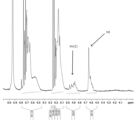
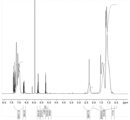
- FIG. 1 is a proton NMR spectrum of the compound according to Example 1, which was measured at 23° C. after dissolving the compound in deuterated 1,1,2,2-tetrachloroethane.
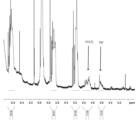
- Fig. 2 is an enlarged view of the proton NMR spectrum of Example 1 shown in Fig. 1, around the chemical shift of 4.0 to 6.0 ppm. The peak indicating the vinylidene group terminal is indicated as "Vd”, and the peak of 2H of the vinyl group terminal CH 2 -CH-R is indicated as "Vn(2)". The same applies to the following drawings.
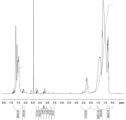
- FIG. 3 is a proton NMR spectrum of the compound according to Example 2, which was measured at 23° C. after dissolving the compound in deuterated 1,1,2,2-tetrachloroethane.
- FIG. 4 is an enlarged view of the proton NMR spectrum of Example 2 shown in FIG. 3, in the vicinity of the chemical shift range of 4.0 to 6.0 ppm.
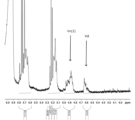
- FIG. 5 is a proton NMR spectrum of the compound according to Comparative Example 1, which was measured at 23° C. after dissolving it in deuterated 1,1,2,2-tetrachloroethane.
- FIG. 6 is an enlarged view of the proton NMR spectrum of Comparative Example 1 shown in FIG. 5, in the vicinity of the chemical shift range of 4.0 to 6.0 ppm.
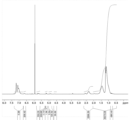
- FIG. 7 shows a proton NMR spectrum of the compound according to Comparative Example 2, which was measured at 23° C. after dissolving it in deuterated 1,1,2,2-tetrachloroethane.
- FIG. 5 is a proton NMR spectrum of the compound according to Comparative Example 1, which was measured at 23° C. after dissolving it in deuterated 1,1,2,2-tetrachloroethane.
- FIG. 8 is an enlarged view of the proton NMR spectrum of Comparative Example 2 shown in FIG. 7, in the vicinity of the chemical shift range of 4.0 to 6.0 ppm.
- FIG. 9 shows a proton NMR spectrum of the compound according to Comparative Example 3, which was measured at 23° C. after dissolving it in deuterated 1,1,2,2-tetrachloroethane.
- FIG. 10 is an enlarged view of the proton NMR spectrum of Comparative Example 3 shown in FIG. 9, in the vicinity of the chemical shift of 4.0 to 6.0 ppm.
- FIG. 11 is a proton NMR spectrum of the compound according to Comparative Example 4, which was dissolved in deuterated 1,1,2,2-tetrachloroethane and measured at 23° C.
- FIG. 12 is an enlarged view of the proton NMR spectrum of Comparative Example 4 shown in FIG. 11, in the vicinity of the chemical shift range of 4.0 to 6.0 ppm.
- FIG. 13 is an enlarged view of the vicinity of chemical shifts of 4.0 to 6.0 ppm in the proton NMR spectrum measured at 23° C. after dissolving the compound according to Comparative Example 5 in deuterated 1,1,2,2-tetrachloroethane.
- the term “sheet” also includes the concept of "film.”
- the term “sheet” also includes the concept of "sheet.”
- composition includes the concept of "varnish.” That is, a composition that is particularly liquid is described as “varnish.”
- interlayer insulating material includes the concept of "interlayer adhesive.”
- the numerical range includes the lower limit and the upper limit unless otherwise specified.
- the term “wt%” also includes the concept of "mass%.”
- a compound having a novel chemical structure with a vinylidene group end and a vinyl group end, and a composition containing said compound can be provided.
- the novel chemical structure of this compound can be confirmed by satisfying the following three conditions.
- the compound is dissolved in deuterated 1,1,2,2-tetrachloroethane (also referred to as 1,1,2,2-tetrachloroethane-d2) and measured at 23° C. in proton NMR ( 1 H-NMR) peaks, where Vd is the integral of the peak area showing a vinylidene terminal appearing at a chemical shift of 4.5 to 4.7 ppm, and Vn is the integral of the peak area showing a vinyl terminal appearing at a chemical shift of 4.8 to 5.0 ppm.
- the ratio Vd/Vn must be 0.4 or more.
- the value of Vd/Vn may be 0.6 or more, and more preferably 0.8 or more. There is no particular upper limit to the value of Vd/Vn, but it may be, for example, 20.0 or less, or 15.0 or less.
- the terminal structure of an organic compound is the following vinylidene group terminal Vd and three vinyl-terminated Vn, 2Vn, and 3Vn It is known that there is a problem that the vinyl group terminal CH 2 -CH-R corresponding to "Vn" among them has a 2H peak at 4.8 to 5.0 ppm and a 1H peak at 5.6 to 5.8 ppm. Based on this, it was found that the dielectric tangent of the cured body of the compound can be significantly reduced by optimizing the ratio of the peak area at the chemical shift of 4.8 to 5.0 ppm to the peak area at the chemical shift of 4.5 to 4.7 ppm, which represents the amount of vinylidene group terminals.
- Vd/Vn of 0.4 or more means that the compound has a chemical structure in which the amount of vinylidene group terminals is not excessively small compared to the amount of the vinyl group terminals. That is, this embodiment is based on the knowledge that the terminal mobility of the compound is high, and therefore the presence of an excessive amount of a vinyl group having high polarity at the terminal deteriorates the dielectric performance.
- the peak showing 2H of Vn may be expressed as "Vn(2)" and the peak showing 1H of Vn may be expressed as "Vn(1)".
- Vn refers to the area of the Vn(2) peak.
- the second condition is that the compound is dissolved in tetrahydrofuran solvent and the standard polystyrene-equivalent number average molecular weight (Mn) is determined by gel permeation chromatography (GPC), and the value of the number of polymer ends, which is the reciprocal of the Mn, must be 4 ⁇ 10 ⁇ 5 or more. Since the value of the number of polymer ends is the reciprocal of the number average molecular weight, the unit in this specification is mol/g.
- the value of the number of polymer ends may be 4.5 ⁇ 10 ⁇ 5 or more, and more preferably 5 ⁇ 10 ⁇ 5 or more. There is no particular upper limit to the value of the number of polymer ends, and it may be, for example, 2 ⁇ 10 ⁇ 3 or less, or 1 ⁇ 10 ⁇ 3 or less.
- the polymer terminal structure of the present compound can be quantified by a known method using 1 H-NMR or 13 C-NMR.
- the third condition is that the compound is dissolved in a toluene solution at a concentration of 50 wt %, and the viscosity measured at 25° C. and a shear rate of 1 sec ⁇ 1 using a rotational rheometer is 20,000 mPa ⁇ s or less.
- the viscosity value may be 15,000 mPa ⁇ s or less, and more preferably 10,000 mPa ⁇ s or less.
- the ratio 2Vn/Vn(2) of the integral value of the peak area appearing at 4.8 to 5.0 ppm, which indicates 2H of "Vn” among the three types of vinyl group terminals mentioned above, to the integral value of the peak area appearing at 5.12 to 5.35 and 5.6 to 5.8 ppm, which indicates "2Vn”, is preferably 0.45 or more, and more preferably 0.45 to 5.00.
- the ratio 2Vn/Vn(2) is within this range and is combined with the first condition above, it is believed that an even more appropriate chemical structure will be obtained.
- the weight average molecular weight Mw of the compound may be 1.0 ⁇ 10 4 or more and 1.0 ⁇ 10 6 or less, more preferably 5.0 ⁇ 10 4 or more and 1.0 ⁇ 10 6 or less.
- the value of Mw/Mn may be in the range of 5 or more and 20 or less, more preferably 7 or more and 20 or less.
- the compound may be a copolymer containing an olefin monomer unit, an aromatic vinyl compound monomer unit, and an aromatic polyene monomer unit.
- a copolymer can have good dielectric properties due to the inclusion of an aromatic portion.
- the olefin monomer unit refers to one or more compounds (units) selected from ⁇ -olefins having 2 to 20 carbon atoms and cyclic olefins having 5 to 20 carbon atoms, which are substantially free of oxygen, nitrogen, and halogens and are composed of carbon and hydrogen.
- ⁇ -olefins having 2 to 20 carbon atoms include, but are not limited to, ethylene, propylene, 1-butene, 1-hexene, 1-octene, 1-decene, 1-dodecene, 4-methyl-1-pentene, and 3,5,5-trimethyl-1-hexene.
- cyclic olefins having 5 to 20 carbon atoms include, but are not limited to, norbornene and cyclopentene.
- a preferred olefin monomer unit may be a combination of ethylene and an ⁇ -olefin other than ethylene or a cyclic olefin.
- the olefin monomer unit may include one or more compounds selected from the group consisting of ethylene and ⁇ -olefins having 3 or more carbon atoms.
- the content of olefin monomer units in the copolymer may be 3 mol% or more, more preferably 10 mol% or more, and even more preferably 20 mol% or more.
- the mol% standard is the total amount of the compound or copolymer, unless otherwise specified.
- the sum of the olefin monomer units, aromatic vinyl compound monomer units, and aromatic polyene monomer units may be considered to be 100%, and the amounts of the other components may be considered as externally calculated.
- aromatic vinyl compound monomer unit refers to an aromatic vinyl compound (unit) having 8 to 20 carbon atoms.
- aromatic vinyl compound monomer units include, but are not limited to, styrene, paramethylstyrene, paraisobutylstyrene, various vinylnaphthalenes, and various vinylanthracenes.
- the content of aromatic vinyl compound monomer units may be 15 mol% or more, more preferably 18 mol% or more, and even more preferably 20 mol% or more.
- the content of aromatic vinyl compound monomer units is within this range, there is a tendency for the effect of improving dielectric properties to be easily obtained.
- aromatic polyene monomer unit refers to a polyene compound (unit) having 5 to 20 carbon atoms and having multiple vinyl and/or vinylene groups in its molecule.
- aromatic polyene monomer unit include, but are not limited to, various ortho-, meta-, and para-divinylbenzenes or mixtures thereof, divinylnaphthalene, divinylanthracene, p-2-propenylstyrene, p-3-butenylstyrene, and other compounds having an aromatic vinyl structure, substantially free of oxygen, nitrogen, and halogens, and composed of carbon and hydrogen.
- bifunctional aromatic vinyl compounds described in JP-A-2004-087639 such as 1,2-bis(vinylphenyl)ethane (abbreviation: BVPE)
- BVPE 1,2-bis(vinylphenyl)ethane
- various ortho-, meta-, and para-divinylbenzenes or mixtures thereof are preferably used, and a mixture of meta-divinylbenzene and para-divinylbenzene is preferably used.
- these divinylbenzenes are referred to as divinylbenzenes.
- divinylbenzenes When divinylbenzenes are used as aromatic polyenes, the curing efficiency is increased during the curing process, making curing easier, which is preferable.
- the content of vinyl groups and/or vinylene groups (preferably vinyl groups) derived from aromatic polyene monomer units may be 1.5 or more and 20 or less than 1.5 or more and 20, preferably 2 or more and less than 7 per number average molecular weight.
- the content of vinyl groups and/or vinylene groups is 1.5 or more, crosslinking efficiency is high, and a cured body with sufficient crosslinking density tends to be easily obtained.
- the vinyl group content derived from aromatic polyene units (divinylbenzene units) per number average molecular weight in the copolymer can be obtained, for example, by comparing the number average molecular weight (Mn) calculated in terms of standard polystyrene obtained by a GPC (gel permeation chromatography) method known to those skilled in the art with the vinyl group content derived from aromatic polyene units obtained by 1 H-NMR measurement.
- Mn number average molecular weight
- the vinyl group content derived from aromatic polyene units (divinylbenzene units) in the copolymer is 0.6% by mass by comparing the intensity of each peak area obtained by 1 H-NMR measurement, and the number average molecular weight converted into standard polystyrene by GPC measurement is 49,000
- the molecular weight of the vinyl group derived from the aromatic polyene units in the number average molecular weight is the product of these, 299, which is divided by the formula weight of the vinyl group, 130, to obtain 2.3.
- the vinyl group content derived from aromatic polyene units per number average molecular weight in this copolymer is determined to be 2.3.
- the assignment of peaks obtained by 1 H-NMR measurement of the copolymer is known from literature.
- a method of determining the composition of the copolymer from a comparison of the peak areas obtained by 1 H-NMR measurement is also known.
- it is also possible to improve the accuracy of the composition by adding data on the peak areas and ratios of 13 C-NMR spectrum measured in a known quantitative mode to the method by 1 H-NMR measurement.
- the content of divinylbenzene units in the copolymer is determined from the peak intensity (measured by 1 H-NMR) of the vinyl group derived from the divinylbenzene unit. That is, the content of divinylbenzene units is determined from the content of vinyl groups derived from the divinylbenzene units, assuming that one vinyl group is derived from one divinylbenzene unit in the copolymer.
- the content of aromatic polyene monomer units may be 1.5 mol% or more, more preferably 2.0 mol% or more, and even more preferably 2.5 mol% or more.
- the content of aromatic polyene monomer units is within this numerical range, it tends to be easier to obtain the effect of improving dielectric properties.
- the combination of the contents of the aromatic vinyl compound monomer units and the aromatic polyene monomer units may be 15 mol% or more and 1.5 mol% or more, more preferably 18 mol% or more and 2.0 mol% or more, and even more preferably 20 mol% or more and 2.5 mol% or more.
- the upper limits of these contents are not particularly limited and can be adjusted according to the content of the olefin monomer.
- the combination of the contents of the aromatic vinyl compound monomer units and the aromatic polyene monomer units may be 15 mol% or more and 80 mol% or less, and 1.5 mol% or more and 10 mol% or less.
- the number average molecular weight (Mn) of the present compound or copolymer is not particularly limited, but may be preferably 500 or more, and more preferably 1000 or more. In this specification, the number average molecular weight is calculated as the molecular weight in terms of standard polystyrene obtained by GPC (gel permeation chromatography).
- a composition containing the above compound or copolymer can be provided.
- the composition may contain, for example, one or more of the following components: (a) a curing agent; (b) one or more resins selected from the group consisting of a hydrocarbon-based elastomer, a polyether-based resin, and an aromatic polyene-based resin; (c) a monomer; (d) an olefin-aromatic vinyl compound-aromatic polyene copolymer other than the above-mentioned copolymer, which satisfies all of the following conditions (i) to (iv): (i) the number average molecular weight of the copolymer is 500 or more and less than 100,000; (ii)
- the aromatic vinyl compound monomer unit is an aromatic vinyl compound having 8 to 20 carbon atoms, and the content of the aromatic vinyl compound monomer unit is 70 mass% or less, preferably more than 0 mass% and 70 mass% or less.
- the aromatic polyene monomer unit is one or more selected from polyenes having 5 to 20 carbon atoms and having a plurality of vinyl groups and/or vinylene groups in the molecule, and the content of the vinyl groups and/or vinylene groups derived from the aromatic polyene monomer unit is 1.5 to 20 or 1.5 to less than 20 per number average molecular weight.
- the olefin monomer unit is one or more selected from olefins having from 2 to 20 carbon atoms, the content of the olefin monomer unit is 30 mass% or more, and the total of the olefin monomer unit, aromatic vinyl compound monomer unit, and aromatic polyene monomer unit is 100 mass%.
- curing agent that may be contained in the present composition
- a known curing agent that can be used for polymerization or curing of aromatic polyenes and aromatic vinyl compounds.
- curing agents include radical polymerization initiators (radical generators), cationic polymerization initiators, and anionic polymerization initiators.
- radical polymerization initiators can be used, but the type is not particularly limited.
- organic peroxides (peroxides), azo polymerization initiators, etc. can be freely selected depending on the application and conditions.
- a catalog listing organic peroxides can be downloaded from the NOF Corporation website, for example, https://www.nof.co.jp/business/chemical/chemical-product01.
- organic peroxides listed in the catalogs of Fujifilm Wako Pure Chemical Industries, Ltd. and Tokyo Chemical Industry Co., Ltd. can also be used.
- a known photopolymerization initiator that uses light, ultraviolet light, or radiation can also be used as a curing agent.
- photopolymerization initiators include photoradical polymerization initiators, photocationic polymerization initiators, and photoanionic polymerization initiators.
- photopolymerization initiators can be obtained, for example, from Tokyo Chemical Industry Co., Ltd.
- curing by radiation or electron beam itself is also possible.
- crosslinking and curing can be performed by thermal polymerization of the raw materials contained without using a curing agent.
- the amount of curing agent used there is no particular limit to the amount of curing agent used, but for example, 0.01 to 10 parts by mass of the curing agent may be used per 100 parts by mass of the compound.
- a curing agent such as a peroxide or azo polymerization initiator
- the curing process is carried out at an appropriate temperature and time, taking into account its half-life.
- the conditions can be determined according to the curing agent, but generally a temperature range of about 50°C to 200°C is appropriate.
- the amount of the hydrocarbon-based elastomer that may be contained in the composition can be appropriately set depending on the desired performance, and is not particularly limited, but is preferably 1 to 200 parts by mass, more preferably 1 to 100 parts by mass, and most preferably 1 to 50 parts by mass, relative to 100 parts by mass of the compound.
- the number average molecular weight of the hydrocarbon-based elastomer is preferably 100 to 100,000, and more preferably 1,000 to 4,500.
- hydrocarbon-based elastomer examples include, but are not limited to, one or more elastomers selected from ethylene-based or propylene-based elastomers, conjugated diene-based polymers, block copolymers or random copolymers of aromatic vinyl compounds-conjugated dienes, and hydrogenated products thereof.
- Examples of the ethylene-based elastomer include ethylene- ⁇ -olefin copolymers such as ethylene-octene copolymer and ethylene-1-hexene copolymer, EPR, EPDM, etc., and examples of the propylene-based elastomer include atactic polypropylene, low stereoregular polypropylene, propylene- ⁇ -olefin copolymers such as propylene-1-butene copolymer, etc., but are not particularly limited thereto.
- Conjugated diene polymers include, but are not limited to, polybutadiene and 1,2-polybutadiene.
- aromatic vinyl compound-conjugated diene block or random copolymers and their hydrogenated products (hydrogenated products) include, but are not limited to, SBS, SIS, SEBS, SEPS, SEEPS, SEEBS, etc., which can be suitably used.
- 1,2-polybutadiene can be obtained, for example, from Nippon Soda Co., Ltd. under the product names of liquid polybutadiene: B-1000, 2000, and 3000.
- an example of a copolymer containing a 1,2-polybutadiene structure which can be suitably used is "Ricon 100" by TOTAL CRAY VALLEY.
- the amount used may be preferably 150 parts by mass or less, more preferably 1 to 30 parts by mass, and most preferably 1 to 20 parts by mass, per 100 parts by mass of the compound, from the viewpoint of the handleability and moldability of the composition in an uncured state (handleability as a thermoplastic resin).
- polyether-based resins examples include polyphenylene ether and polyether.
- polyphenylene ether commercially available known polyphenylene ethers can be used, and the type is not particularly limited.
- the number average molecular weight of the polyphenylene ether is arbitrary and can be appropriately set according to the desired performance, and is not particularly limited, but considering the moldability of the composition, the number average molecular weight (Mn) is preferably 10,000 or less, most preferably 5,000 or less. The number average molecular weight may be preferably 500 or more.
- the molecular end of the polyether resin such as polyphenylene ether is modified with a functional group.
- the polyether resin such as polyphenylene ether has multiple functional groups in one molecule, and for example, the polyether resin may be a modified polyphenylene ether.
- the functional group include radically polymerizable functional groups and functional groups such as epoxy groups, and preferably radically polymerizable functional groups.
- a vinyl group is preferable.
- the vinyl group one or more of the group consisting of an allyl group, a (meth)acryloyl group, and an aromatic vinyl group are preferable, one or more of the group consisting of a (meth)acryloyl group and an aromatic vinyl group are more preferable, and an aromatic vinyl group is most preferable.
- a bifunctional polyphenylene ether in which both ends of the molecular chain are modified with a radically polymerizable functional group is particularly preferable.
- polyphenylene ethers examples include Noryl (trademark) SA9000 from SABIC (modified polyphenylene ether having methacryloyl groups at both ends, number average molecular weight 2200) and bifunctional polyphenylene ether oligomer (OPE-2St, modified polyphenylene ether having vinylbenzyl groups at both ends, number average molecular weight 1200) from Mitsubishi Gas Chemical Co., Ltd. Allylated PPE from Asahi Kasei Corporation can also be used. Of these, the bifunctional polyphenylene ether oligomer (OPE-2St) from Mitsubishi Gas Chemical Co., Ltd. can be preferably used.
- polyether resin aromatic polyether (ELPAC HC-F series) from JSR Corporation can also be used.
- the amount of polyether resin such as polyphenylene ether used in this composition can be set appropriately according to the desired performance and is not particularly limited, but is preferably 1 to 200 parts by mass, more preferably 1 to 100 parts by mass, per 100 parts by mass of the above compound.
- the aromatic polyene resin that may be contained in the composition includes divinylbenzene reactive hyperbranched copolymer (PDV) manufactured by Nippon Steel Chemical & Material Co., Ltd.
- PDV divinylbenzene reactive hyperbranched copolymer
- Such PDV is described, for example, in the literature "Synthesis of polyfunctional aromatic vinyl copolymer and development of a new IPN type low dielectric loss material using the same” (Kawabe Masanao, Journal of Electronics Packaging Society, p. 125, Vol. 12 No. 2 (2009)).
- the amount of aromatic polyene resin used in the composition can be appropriately set according to the desired performance and is not particularly limited, but is preferably 1 to 200 parts by mass, more preferably 1 to 100 parts by mass, and most preferably 1 to 50 parts by mass, relative to 100 parts by mass of the compound.
- the use of the aromatic polyene resin in an amount within these preferred numerical ranges is preferable in order to prevent a decrease in adhesion to other members and a decrease in toughness.
- the amount of the monomer that may be contained in the composition may be preferably 100 parts by mass or less relative to 100 parts by mass of the compound, and the composition may be substantially free of monomers.
- the monomer is a monomer that can be polymerized by either radical polymerization, cationic polymerization, or anionic polymerization, and is preferably a monomer that can be radically polymerized.
- the molecular weight is preferably 5000 or less, preferably less than 5000, more preferably 1000 or less, more preferably less than 1000, even more preferably 500 or less, and even more preferably less than 500.
- the monomer may include a monomer having the same structure as the monomer unit of the above-mentioned "aromatic vinyl compound" or "aromatic polyene". Also preferably, the monomer may include the following polar monomer.
- the amount of the polar monomer that may be contained in the composition can be appropriately set according to the desired performance, and is not particularly limited, but may be preferably 100 parts by mass or less, more preferably 0.1 to 20 parts by mass, and even more preferably 0.1 to 10 parts by mass, relative to 100 parts by mass of the compound. By using an amount in this preferred numerical range, the effect of preventing the dielectric constant and dielectric loss tangent of the obtained cured body from becoming too high tends to be obtained.
- the polar monomer is a monomer having one or more atoms selected from oxygen, nitrogen, phosphorus, and sulfur in the molecule.
- the polar monomer that can be suitably used preferably has a molecular weight of less than 5000, more preferably less than 1000, and even more preferably less than 500.
- a polar monomer that can be polymerized by a radical polymerization initiator is preferable.
- examples of polar monomers include, but are not limited to, various maleimides, bismaleimides, maleic anhydride, triallyl isocyanurate, glycidyl (meth)acrylate, tri(meth)acrylic isocyanurate, trimethylolpropane tri(meth)acrylate, etc.
- Maleimides and bismaleimides that can be used in this embodiment are described in, for example, International Publication No.
- maleimide group-containing compounds may be used as polyamino bismaleimide compounds from the viewpoints of solubility in organic solvents, high frequency characteristics, high adhesion to conductors, moldability of prepregs, etc.
- the polyamino bismaleimide compounds can be obtained, for example, by subjecting a compound having two maleimide groups at the terminals to a Michael addition reaction with an aromatic diamine compound having two primary amino groups in the molecule.
- polar monomer having a multifunctional group of two or more functional groups examples include bismaleimides, triallyl isocyanurate (TAIC), trimethylolpropane tri(meth)acrylate, etc.
- the present composition may contain one or more olefin-aromatic vinyl compound-aromatic polyene copolymers other than the above-mentioned copolymers, and may satisfy any of the following conditions.
- the number average molecular weight of the copolymer is 500 or more and less than 100,000.
- the aromatic vinyl compound monomer unit is an aromatic vinyl compound having 8 to 20 carbon atoms, and the content of the aromatic vinyl compound monomer unit is 70 mass% or less, preferably more than 0 mass% and 70 mass% or less.
- the aromatic polyene monomer unit is one or more selected from polyenes having 5 to 20 carbon atoms and having a plurality of vinyl groups and/or vinylene groups in the molecule, and the content of the vinyl groups and/or vinylene groups derived from the aromatic polyene monomer unit is 1.5 to 20 or 1.5 to less than 20 per number average molecular weight.
- the olefin monomer unit is one or more selected from olefins having 2 to 20 carbon atoms, the content of the olefin monomer unit is 30 mass% or more, and the total of the olefin monomer unit, aromatic vinyl compound monomer unit, and aromatic polyene monomer unit is 100 mass%.
- Such other copolymers may be those described, for example, in WO 2021/112087, WO 2021/112088, and WO 2022/014599.
- Such other olefin-aromatic vinyl compound-aromatic polyene copolymers that satisfy all of the above-mentioned specific conditions tend to be soft and exhibit low dielectric constants and low dielectric tangents, so by combining them with this compound to form a composition, it is possible to obtain a cured body with low dielectric constants and low dielectric tangents that covers a wide range of physical properties.
- the present compound can be designed and produced so as to satisfy the above-mentioned three conditions. Therefore, the present compound can be produced by applying a known production method, and the production method is not particularly limited.
- the present compound is a copolymer, it can be produced by copolymerizing each monomer of an aromatic vinyl compound, an aromatic polyene, and an olefin used as necessary by coordination polymerization.
- a single-site coordination polymerization catalyst composed of a transition metal compound and a cocatalyst described in JP-A-2009-161743, JP-A-2010-280771, WO 00/37517, etc., because it is possible to efficiently produce an olefin-aromatic vinyl compound-aromatic polyene copolymer.
- examples of copolymers particularly aromatic vinyl compound-aromatic polyene copolymers (which may contain olefins), include styrene-divinylbenzene copolymers, ethylene-styrene-divinylbenzene copolymers, ethylene-propylene-styrene-divinylbenzene copolymers, ethylene-1-hexene-styrene-divinylbenzene copolymers, ethylene-1-octene-styrene-divinylbenzene copolymers, etc.
- a varnish containing the above-mentioned compound or composition and a solvent can be provided.
- a varnish is a material that is liquid due to the inclusion of a solvent.
- the varnish has an appropriate viscosity as described above and is a viscous liquid.
- the varnish can be applied, impregnated, filled, or dropped onto other materials by an appropriate method, and the solvent can be removed to form a molded product.
- the varnish can then be cured with heat or light to obtain the desired cured product.
- Such properties are useful because they can be used for various transfer molding (pressure molding), for application on or between substrates or semiconductor device materials, or for forming into sheets or films by extrusion lamination or spin coating, and then cured to form insulating films or insulating layers.
- the polymerization liquid used to manufacture the compound (which generally contains, in addition to the compound, solvents used in polymerization such as toluene, ethylbenzene, cyclohexane, and methylcyclohexane, residual monomers such as styrene and divinylbenzene, residual monomers such as olefin monomers, catalysts, and cocatalyst components) can also be used as a varnish as is.
- a varnish can also be obtained by distilling off part or all of the solvent and residual monomers from the polymerization liquid under reduced pressure, and diluting with the above-mentioned solvent as necessary. That is, the varnish may contain residual monomers from the polymerization or the solvent used in the polymerization.
- ⁇ Solvent> An appropriate solvent may be added to the composition as necessary.
- the amount of the solvent is not particularly limited.
- the solvent is used to adjust the viscosity and fluidity of the composition.
- a solvent is preferably used.
- a solvent having a boiling point of a certain degree or higher is preferred, since a high boiling point under atmospheric pressure, i.e., low volatility, leads to a uniform thickness of the applied film.
- the boiling point is preferably about 75° C. or higher under atmospheric pressure, more preferably 100° C. or higher and 300° C. or lower, and even more preferably 130° C. or higher and 300° C. or lower.
- a solvent known in the art can be used, and is not particularly limited, but for example, cyclohexane, cyclohexanone, methyl ethyl ketone (MEK), toluene, ethylbenzene, xylene, mesitylene, tetralin, acetone, limonene, mixed alkanes, mixed aromatic solvents, etc. can be used.
- the amount of the solvent used in the composition of the present embodiment can be appropriately set depending on the desired performance, and is arbitrary. However, the amount is preferably 5 to 500 parts by mass, more preferably 10 to 300 parts by mass, and most preferably 50 to 150 parts by mass, relative to 100 parts by mass of the present compound.
- methyl ethyl ketone (MEK) can be used as the solvent.
- composition and varnish may contain additives that are commonly used in resins in the industry, such as antioxidants, weathering agents, light stabilizers, lubricants, compatibilizers, and antistatic agents, to the extent that they do not impair the desired effects or purposes.
- additives that are commonly used in resins in the industry, such as antioxidants, weathering agents, light stabilizers, lubricants, compatibilizers, and antistatic agents, to the extent that they do not impair the desired effects or purposes.
- the composition and varnish of this embodiment are obtained by mixing, dissolving, or melting the various additives described above, and any known method can be used for mixing, dissolving, and melting.
- the compound or composition can be mixed by a known mixing method, such as a twin-screw mixer, various rolls, various kneaders, etc.
- a known mixing method such as a twin-screw mixer, various rolls, various kneaders, etc.
- the composition is a varnish, it may be mixed by adding it to the varnish and stirring.
- a cured product of the above-mentioned compound, composition, or varnish can also be provided.
- the cured product can be used to manufacture a CCL substrate, an FCCL substrate, an interlayer insulating material, or a coverlay.
- the compound or composition is particularly suitable as an electrical insulating material for high-frequency signals.
- the shape of the molded article obtained from the compound or the composition is arbitrary. These compositions can exhibit the properties of a thermoplastic resin. Therefore, under conditions that do not cause crosslinking, the composition can be molded into a shape such as a sheet, tube, strip, or pellet in a substantially uncured state by a known molding method for a thermoplastic resin, such as extrusion molding, injection molding, press molding, or inflation molding, and then crosslinked (cured).
- a thermoplastic resin such as extrusion molding, injection molding, press molding, or inflation molding
- cured cured
- a porous substrate, woven fabric, or nonwoven fabric can be impregnated with the varnish and the solvent can be removed to obtain a composite. It can also be dropped onto a substrate and the solvent can be removed to form, for example, a hemispherical shape.
- the sheet may be uncured (semi-cured) to the extent that it can maintain the sheet shape, or may be completely cured.
- the degree of curing of the composition can be quantitatively measured by a known dynamic viscoelasticity measurement method (DMA, Dynamic Mechanical Analysis).
- the curing of the molded article obtained from the present compound or the present composition can be performed by a known method, taking into consideration the curing conditions (temperature, time, pressure) of the raw materials and curing agent contained therein.
- the curing agent used is a peroxide
- the curing conditions can be determined by taking into consideration the half-life temperature and the like disclosed for each peroxide.
- the cured product of the molded product obtained from the compound or composition is sufficiently cured, and the gel content (gel fraction) measured in accordance with ASTM is not particularly limited, but may be 90 mass% or more.
- the dielectric loss tangent is not particularly limited, but may be 0.003 or less, more preferably 0.002 or less, and even more preferably 0.001 or less. More specifically, the dielectric loss tangent may be 0.00063 or less.
- Example 1 to 2 and Comparative Examples 1 to 5 were prepared based on the raw material compositions shown in Table 1 below (shown in mol % and mass % in the table).
- Tritium tetrakis(pentafluorophenyl)borate (“TRI-FABA” manufactured by Tosoh Finechem Co., Ltd.) or modified methylaluminoxane (“MMAO” manufactured by Tosoh Finechem Co., Ltd.) was used as the cocatalyst.
- TRI-FABA Tritium tetrakis(pentafluorophenyl)borate
- MMAO modified methylaluminoxane
- Cyclohexane was used as the solvent.
- Styrene (St), divinylbenzene (DVB), ethylene (Et), and, as necessary, 1-hexene or 1-octene were used as raw monomers, and the above catalyst and cocatalyst were added to carry out polymerization in a 10 L polymerization vessel equipped with a stirrer and a heating and cooling jacket.
- composition ratio of each component is shown in the table.
- the composition ratio of ethylene (Et), ⁇ -olefin (1-hexene or 1-octene in this example), styrene (St), and divinylbenzene (DVB) in the copolymer, the content of vinyl group units derived from divinylbenzene, and the ratio of terminal vinyl groups to terminal vinylidene groups were calculated from the peak area intensity assigned to each of them in 1 H-NMR (using the method described above).
- the sample was dissolved in deuterated 1,1,2,2-tetrachloroethane, and the measurement was performed at 23°C.
- the peak area ratio Vd/Vn of the terminal vinyl group Vn(2) and the terminal vinylidene group Vd was calculated by dividing the peak area of the terminal vinylidene group (Vd) obtained by 1 H-NMR measurement by the peak area of the terminal vinyl group (Vn(2)).
- the peak area ratio 2Vd/Vn of the terminal vinyl group 2Vn and the terminal vinylidene group Vd was calculated in the same manner.
- the molecular weight of the copolymer was determined by GPC (gel permeation chromatography) in terms of standard polystyrene as the number average molecular weight (Mn) and the weight average molecular weight (Mw) and the ratio Mw/Mn. The measurements were performed under the following conditions. Column: Two TSK-GEL MultiporeHXL-M ⁇ 7.8 ⁇ 300 mm (Tosoh Corporation) columns were connected in series. Column temperature: 40°C Solvent: THF (tetrahydrofuran) Flow rate: 1.0 ml/min Detector: RI detector
- the obtained composition was poured into a silicon mold (frame length 7 cm, width 7 cm, thickness 0.5 mm, 1.0 mm, or 2.0 mm) on a Teflon (registered trademark) sheet placed on a glass plate, air-dried, and then further dried in a vacuum dryer at 60°C for 3 hours or more to obtain an uncured sheet. Furthermore, a Teflon sheet and a SUS mold were placed under a load of 5 MPa in a press and heat treatment was performed at 120°C for 30 minutes, 150°C for 30 minutes and then 200°C for 120 minutes. The Teflon sheet and the SUS mold were then removed to obtain a cured sheet.
- Viscosity measurement> The viscosity was measured using a rotational rheometer ("MCR302" manufactured by Anton Paar) at 25° C. and a shear rate of 1 sec ⁇ 1 .
- the solution was concentrated using a rotary evaporator and diluted with toluene to a concentration of 50% by mass to prepare a measurement solution, and then the measurement was performed.
- Comparative Examples 1 to 3 the Vd/Vn value was small and the dielectric tangent was poor.
- Comparative Example 4 the number of polymer ends was small and the viscosity was poor.
- Comparative Example 5 the styrene content was low and the viscosity was poor.
Landscapes
- Chemical & Material Sciences (AREA)
- Health & Medical Sciences (AREA)
- Chemical Kinetics & Catalysis (AREA)
- Medicinal Chemistry (AREA)
- Polymers & Plastics (AREA)
- Organic Chemistry (AREA)
- Engineering & Computer Science (AREA)
- Microelectronics & Electronic Packaging (AREA)
- Addition Polymer Or Copolymer, Post-Treatments, Or Chemical Modifications (AREA)
- Organic Insulating Materials (AREA)
Abstract
本開示は、その硬化体が非常に小さい誘電正接を有し、かつ溶液が非常に小さい粘度を有するということを両立し得る化合物等を提供することを目的とする。本開示の化合物は、ビニリデン基末端とビニル基末端とを持つ化学構造を有する化合物であって、前記化合物を、重1,1,2,2-テトラクロロエタンに溶解して23℃で測定したプロトンNMRのピークのうち、化学シフト4.5~4.7ppmに現われるビニリデン基末端を示すピーク面積の積分値Vdと、化学シフト4.8~5.0ppmに現われるビニル基末端を示すピーク面積の積分値Vnとについて、その比Vd/Vnの値が0.4以上であり、前記化合物をテトラヒドロフラン溶媒に溶解してゲルパーミエーションクロマトグラフィー法により求められる標準ポリスチレン換算の数平均分子量(Mn)について、当該Mnの逆数であるポリマー末端数の値が4×10-5以上であり、かつ前記化合物をトルエン溶液に50wt%の濃度で溶解し、25℃にて回転式レオメーターにより剪断速度1sec-1で測定した粘度が、20000mPa・s以下である。
Description
本発明は、共重合体、組成物、ワニス、及びそれらの硬化体である絶縁材に関する。
通信周波数がギガヘルツ帯及びそれ以上の高周波帯に移行することにともない、低誘電特性を有する絶縁材料を含むCCLやFCCLからなる、多層基板や伝送ライン、アンテナ等に対するニーズが高まっている。パーフルオロエチレン等のフッ素系樹脂は優れた低誘電率、低誘電損失性と耐熱性に優れた特徴を有するが、成形加工性、膜成形性が困難であり、また、配線の銅箔との接着性にも課題があるため、多層基板等への適用が難しい。一方、エポキシ樹脂、不飽和ポリエステル樹脂、ポリイミド樹脂、フェノール樹脂等の後硬化樹脂を用いた基板、絶縁材料は、その耐熱性、易取り扱い性から広く用いられてきているが、誘電率、誘電損失が比較的高く、高周波用の絶縁材料としては改善が望まれている(特許文献1)。
そこで本質的に低誘電特性を有する炭化水素系樹脂に注目が集まっている。本来は熱可塑性樹脂である炭化水素系樹脂を硬化性樹脂とするためには、官能基を導入する必要がある。しかしながら、一般的にラジカル、又は熱で架橋反応する官能基は極性を有するため、これらの官能基を炭化水素系樹脂に導入すると誘電特性が悪化してしまう。炭化水素からのみ構成される官能基、例えば芳香族ビニル基を導入しようとすると、高価な炭化水素系単量体間の分子間反応を利用する場合が多く(特許文献2)、経済的ではない場合が多い。特許文献3には、特定の配位重合触媒から得られ、特定の組成と配合を有するエチレン-オレフィン(芳香族ビニル化合物)-芳香族ポリエン共重合体、非極性ビニル化合物共重合体からなる硬化体が示されている。本技術の場合、芳香族ポリエン(ジビニルベンゼン)の二つのビニル基のうち一つのみが選択的に共重合され残りのビニル基が保存されるため、容易に芳香族ビニル基の官能基を有する、架橋性の炭化水素系共重合体マクロモノマーを得ることができる。同様なオレフィン-芳香族ビニル化合物-芳香族ポリエン共重合体、及び副原料等との組成物から得られる硬化体は、低誘電率、低誘電正接という特徴を有している(特許文献4、5)。しかしながら、具体的に記載されているオレフィン-芳香族ビニル化合物-芳香族ポリエン共重合体は、比較的軟質であり、硬質化するためには他の硬質副原料や無機フィラーを多く配合する必要がある。
公知の硬質な架橋性の原料はその低誘電特性が十分ではなく、多く配合すると硬化体の低誘電特性が悪化してしまうという課題がある。無機フィラーを比較的多く配合すると、一般的に無機フィラーは誘電率が高いために得られる硬化体の特に誘電率が高くなってしまう。また、カチオン重合により得られる低誘電かつ硬化性の芳香族ビニル化合物-芳香族ポリエン共重合体が知られている(特許文献6)。しかしながら、この従来技術に係る共重合体は、そのデンドリック(樹状)な構造故にポリマー末端構造が多く、その含まれるカチオン重合特有の末端構造故に、耐熱性、耐久性を高めるための分子設計が複雑である。
現在当該技術分野において理想とされている水準では、硬化体としての誘電正接と溶液としての粘度の値は非常に小さいことが求められるようになっている。このため、上記の公開文献に記載されている化合物では、現在求められている水準に照らすと、硬化体の誘電正接を十分に低下させながら、かつ溶液の粘度も十分に低下させるということが難しいという課題があった。
本発明者は、上記課題を解決すべく鋭意検討した結果、その硬化体が非常に小さい誘電正接を有し、かつ溶液が非常に小さい粘度を有するということが両立できる化合物を新たに見出し、これを組成物に用いることで上述した従来技術が解決できていなかった課題を解決できることを見出し、本発明を完成させた。すなわち本発明は、以下に示す種々の具体的態様を提供する。
態様1.
ビニリデン基末端とビニル基末端とを持つ化学構造を有する化合物であって、
前記化合物を、重1,1,2,2-テトラクロロエタンに溶解して23℃で測定したプロトンNMRのピークのうち、化学シフト4.5~4.7ppmに現われるビニリデン基末端を示すピーク面積の積分値Vdと、化学シフト4.8~5.0ppmに現われるビニル基末端を示すピーク面積の積分値Vnとについて、その比Vd/Vnの値が0.4以上であり、
前記化合物をテトラヒドロフラン溶媒に溶解してゲルパーミエーションクロマトグラフィー法により求められる標準ポリスチレン換算の数平均分子量(Mn)について、当該Mnの逆数であるポリマー末端数の値が4×10⁻⁵以上であり、かつ
前記化合物をトルエン溶液に50wt%の濃度で溶解し、25℃にて回転式レオメーターにより剪断速度1sec-1で測定した粘度が、20000mPa・s以下である
ことを特徴とする、化合物。
ビニリデン基末端とビニル基末端とを持つ化学構造を有する化合物であって、
前記化合物を、重1,1,2,2-テトラクロロエタンに溶解して23℃で測定したプロトンNMRのピークのうち、化学シフト4.5~4.7ppmに現われるビニリデン基末端を示すピーク面積の積分値Vdと、化学シフト4.8~5.0ppmに現われるビニル基末端を示すピーク面積の積分値Vnとについて、その比Vd/Vnの値が0.4以上であり、
前記化合物をテトラヒドロフラン溶媒に溶解してゲルパーミエーションクロマトグラフィー法により求められる標準ポリスチレン換算の数平均分子量(Mn)について、当該Mnの逆数であるポリマー末端数の値が4×10⁻⁵以上であり、かつ
前記化合物をトルエン溶液に50wt%の濃度で溶解し、25℃にて回転式レオメーターにより剪断速度1sec-1で測定した粘度が、20000mPa・s以下である
ことを特徴とする、化合物。
態様2.
オレフィン単量体単位、芳香族ビニル化合物単量体単位、及び芳香族ポリエン単量体単位を含む共重合体である、態様1に記載の化合物。
オレフィン単量体単位、芳香族ビニル化合物単量体単位、及び芳香族ポリエン単量体単位を含む共重合体である、態様1に記載の化合物。
態様3.
前記化合物中の前記芳香族ビニル化合物単量体単位の含有量が15mol%以上である、態様2に記載の化合物。
前記化合物中の前記芳香族ビニル化合物単量体単位の含有量が15mol%以上である、態様2に記載の化合物。
態様4.
前記化合物中の前記芳香族ポリエン単量体単位の含有量が1.5mol%以上である、態様2又は3に記載の化合物。
前記化合物中の前記芳香族ポリエン単量体単位の含有量が1.5mol%以上である、態様2又は3に記載の化合物。
態様5.
数平均分子量が500以上の共重合体である、態様1~4のいずれかに記載の化合物。
数平均分子量が500以上の共重合体である、態様1~4のいずれかに記載の化合物。
態様6.
前記オレフィン単量体単位が、エチレン及び炭素数3以上のα-オレフィンを含む、態様2~4のいずれかに記載の化合物。
前記オレフィン単量体単位が、エチレン及び炭素数3以上のα-オレフィンを含む、態様2~4のいずれかに記載の化合物。
態様7.
態様1~6のいずれかに記載の化合物と、以下の(a)~(d)から選ばれる一種以上とを含む組成物。
(a)硬化剤
(b)炭化水素系エラストマー、ポリエーテル系樹脂、及び芳香族ポリエン系樹脂からなる群から選択される単数又は複数の樹脂
(c)単量体
(d)下記(i)~(iv)の条件をすべて満たす、別のオレフィン-芳香族ビニル化合物-芳香族ポリエン共重合体
(i)共重合体の数平均分子量が500以上10万未満である。
(ii)芳香族ビニル化合物単量体単位が、炭素数8以上20以下の芳香族ビニル化合物であり、芳香族ビニル化合物単量体単位の含量が70質量%以下である。
(iii)芳香族ポリエン単量体単位が、分子内にビニル基及び/又はビニレン基を複数有する炭素数5以上20以下のポリエンから選ばれる一種以上であり、かつ芳香族ポリエン単量体単位に由来するビニル基及び/又はビニレン基の含有量が数平均分子量あたり1.5個以上20個以下若しくは1.5個以上20個未満である。
(iv)オレフィン単量体単位が炭素数2以上20以下のオレフィンから選ばれる単数又は複数であり、オレフィン単量体単位の含量が30質量%以上であり、前記オレフィン単量体単位と芳香族ビニル化合物単量体単位と芳香族ポリエン単量体単位の合計が100質量%である。
態様1~6のいずれかに記載の化合物と、以下の(a)~(d)から選ばれる一種以上とを含む組成物。
(a)硬化剤
(b)炭化水素系エラストマー、ポリエーテル系樹脂、及び芳香族ポリエン系樹脂からなる群から選択される単数又は複数の樹脂
(c)単量体
(d)下記(i)~(iv)の条件をすべて満たす、別のオレフィン-芳香族ビニル化合物-芳香族ポリエン共重合体
(i)共重合体の数平均分子量が500以上10万未満である。
(ii)芳香族ビニル化合物単量体単位が、炭素数8以上20以下の芳香族ビニル化合物であり、芳香族ビニル化合物単量体単位の含量が70質量%以下である。
(iii)芳香族ポリエン単量体単位が、分子内にビニル基及び/又はビニレン基を複数有する炭素数5以上20以下のポリエンから選ばれる一種以上であり、かつ芳香族ポリエン単量体単位に由来するビニル基及び/又はビニレン基の含有量が数平均分子量あたり1.5個以上20個以下若しくは1.5個以上20個未満である。
(iv)オレフィン単量体単位が炭素数2以上20以下のオレフィンから選ばれる単数又は複数であり、オレフィン単量体単位の含量が30質量%以上であり、前記オレフィン単量体単位と芳香族ビニル化合物単量体単位と芳香族ポリエン単量体単位の合計が100質量%である。
態様8.
態様1~6のいずれかに記載の化合物又は態様7に記載の組成物と、溶剤と、を含むワニス。
態様1~6のいずれかに記載の化合物又は態様7に記載の組成物と、溶剤と、を含むワニス。
態様9.
態様1~6のいずれかに記載の化合物の硬化体。
態様1~6のいずれかに記載の化合物の硬化体。
態様10.
態様7に記載の組成物の硬化体。
態様7に記載の組成物の硬化体。
態様11.
態様8に記載のワニスの硬化体。
態様8に記載のワニスの硬化体。
態様12.
態様9~11のいずれかに記載の硬化体を含む、CCL基板、FCCL基板、層間絶縁材、又はカバーレイ。
態様9~11のいずれかに記載の硬化体を含む、CCL基板、FCCL基板、層間絶縁材、又はカバーレイ。
本発明によれば、その硬化体が非常に小さい誘電正接を有し、かつ溶液が非常に小さい粘度を有するということが両立できる化合物等が得られる。また、当該化合物を含む組成物等も得られる。
以下、本発明の実施の形態について、詳細に説明する。但し、以下の実施の形態は、本発明を説明するための例示であり、本発明はこれらに限定されるものではない。すなわち本発明は、その要旨を逸脱しない範囲内で任意に変更して実施することができる。なお、本明細書において、例えば「1~100」との数値範囲の表記は、その下限値「1」及び上限値「100」の双方を包含するものとする。また、他の数値範囲の表記も同様である。
本明細書において、シートとは、フィルムの概念をも包含するものとする。また、本明細書においてフィルムと記載されていても、シートの概念をも包含するものとする。本明細書において、組成物とは、ワニスを包含する概念である。すなわち、組成物のうち特に液状であるものをワニスと記載している。本明細書において、層間絶縁材は層間接着剤の概念を含む。本明細書において数値範囲は、別段の断わりが無い限りはその下限値及び上限値を含むものとする。本明細書において、wt%とは、質量%の概念をも包含するものとする。
本明細書において、シートとは、フィルムの概念をも包含するものとする。また、本明細書においてフィルムと記載されていても、シートの概念をも包含するものとする。本明細書において、組成物とは、ワニスを包含する概念である。すなわち、組成物のうち特に液状であるものをワニスと記載している。本明細書において、層間絶縁材は層間接着剤の概念を含む。本明細書において数値範囲は、別段の断わりが無い限りはその下限値及び上限値を含むものとする。本明細書において、wt%とは、質量%の概念をも包含するものとする。
本発明のある実施形態では、ビニリデン基末端とビニル基末端とを持つ、新規な化学構造を有する化合物、及び当該化合物を含んだ組成物を提供できる。本化合物の新規な化学構造は、下記の三種の条件を満たすことにより確認できる。
まず第一の条件として、本化合物を重1,1,2,2-テトラクロロエタン(1,1,2,2-テトラクロロエタン-d2とも称する)に溶解して23℃において測定したプロトンNMR(1H-NMR)のピークのうち、化学シフト4.5~4.7ppmに現われるビニリデン基末端を示すピーク面積の積分値Vdと、化学シフト4.8~5.0ppmに現われるビニル基末端を示すピーク面積の積分値Vnとについて、その比Vd/Vnの値が0.4以上であることが必要である。
当該比Vd/Vnの値が0.4未満であると、誘電正接が高くなりすぎる問題が発生する。好ましい実施形態においては、Vd/Vnの値が0.6以上であってよく、より好ましくは0.8以上であってよい。Vd/Vnの値の上限は特に限定されないが、例えば20.0以下であってよく、又は15.0以下であってよい。
一般に有機化合物の末端構造としては、下記のビニリデン基末端Vd

と、三種のビニル基末端Vn、2Vn、及び3Vn

とがあることについて知られている。このうち、上記のうちの「Vn」に相当するビニル基末端CH2-CH-Rについて、2Hのピークが4.8~5.0ppm、1Hのピークが5.6~5.8ppmに現れることになる。それを踏まえて、そのうちの化学シフト4.8~5.0ppmのピーク面積について、ビニリデン基末端の量を表わす化学シフト4.5~4.7ppmのピーク面積との比を最適化することで、その化合物の硬化体の誘電正接を顕著に低下できることを見出した。すなわち三種のビニル基末端のうちから「Vn」の2Hに着目し、それを「Vd」と比較することで、最適化した新規な構造が得られるというのは、本発明者が最初に想到したことである。つまりVd/Vnの値が0.4以上であるということは、ビニリデン基末端の量が上記のビニル基末端の量に比べて過度に少なすぎない化学構造を本化合物が有していることを意味する。すなわち本実施形態は、化合物の末端の運動性が高いことから、その末端に高い極性を持つビニル基が過剰量で存在すると、誘電性能を劣化させてしまうという知見に基づいている。なお、以下の説明では、Vnの2Hを示すピークのことを「Vn(2)」、Vnの1Hを示すピークのことを「Vn(1)」と表現することがある。なお、本明細書では、Vd/Vn等のピーク面積比について述べる文脈においては、別段の定めのない限りはそのVnはVn(2)ピークの面積のことを指すものとする。
次に第二の条件として、本化合物をテトラヒドロフラン溶媒に溶解してゲルパーミエーションクロマトグラフィー(GPC)法により求められる標準ポリスチレン換算の数平均分子量(Mn)について、当該Mnの逆数であるポリマー末端数の値が4×10⁻⁵以上であることが必要である。なお、ポリマー末端数の値は数平均分子量の逆数であるため、本明細書における単位はmol/gである。
当該ポリマー末端数の値が4×10⁻⁵未満であると、高分子化合物としての分子量が大きく、本願出願時の技術水準に照らすと一見誘電性能が良くなりそうであった。しかし予想に反してそれだけでは誘電正接を十分に低くするには及ばず、しかも粘度が上がってしまうことを本発明者は見出した。好ましい実施形態においては、ポリマー末端数の値が4.5×10⁻⁵以上であってよく、より好ましくは5×10⁻⁵以上であってよい。ポリマー末端数の値の上限は特に限定されないが、例えば2×10⁻³以下、又は1×10⁻³以下であってよい。
本化合物のポリマー末端構造は、1H-NMR、13C-NMRを用いた公知の方法によって定量できる。
最後に第三の条件として、本化合物をトルエン溶液に50wt%の濃度で溶解し、25℃にて回転式レオメーターにより剪断速度1sec-1で測定した粘度が、20000mPa・s以下であることが必要である。
当該粘度の値が20000mPa・s超であると、ワニスとしての使用がしづらくなり、電子機械用途への適用が困難になる問題が発生する。好ましい実施形態においては、当該粘度の値が15000mPa・s以下であってよく、より好ましくは10000mPa・s以下であってよい。
これら三種の条件は共に満たすことによって相乗効果を奏するものであり、いずれが欠けても効果は損われてしまうことを本発明者は見出した。
好ましい実施形態では、上述した三種のビニル基末端のうちの「Vn」の2Hを示す4.8~5.0ppmに現われるピーク面積の積分値(Vn(2))と、「2Vn」を示す5.12~5.35、5.6~5.8ppmに現われるピーク面積の積分値(2Vn)の比2Vn/Vn(2)について、その値が0.45以上であることが好ましく、0.45以上5.00以下であることがより好ましい。当該比2Vn/Vn(2)がこの範囲内であり、かつ上記の第一の条件と組み合わされると、さらに適切な化学構造を有することになると考えられる。
好ましい実施形態では、本化合物の重量平均分子量Mwが、1.0×10⁴以上1.0×10⁶以下であってよく、より好ましくは5.0×10⁴以上1.0×10⁶以下であってよい。また好ましい実施形態では、Mw/Mnの値が、5以上20以下の範囲であってよく、より好ましくは7以上20以下の範囲であってよい。
好ましい実施形態では、本化合物がオレフィン単量体単位、芳香族ビニル化合物単量体単位、及び芳香族ポリエン単量体単位を含む共重合体であってよい。このような共重合体であると、芳香族部分が含まれることによって誘電特性を良好にできる。
本明細書において、オレフィン単量体単位とは、炭素数2以上20以下のα-オレフィン及び炭素数5以上20以下の環状オレフィンから選ばれる一種以上であり、実質的に酸素や窒素、ハロゲンを含まず、炭素と水素から構成される化合物(単位)を指すものとする。炭素数2以上20以下のα-オレフィンとしては、例えばエチレン、プロピレン、1-ブテン、1-ヘキセン、1-オクテン、1-デセン、1-ドデセン、4-メチル-1-ペンテン、3,5,5-トリメチル-1-ヘキセン等が例示できるが、これらに特に限定されない。炭素数5以上20以下の環状オレフィンとしては、ノルボルネン、シクロペンテン等が例示できるが、これらに特に限定されない。好ましいオレフィン単量体単位としては、エチレンとエチレン以外のα-オレフィンや環状オレフィンとの組み合わせであってよい。好ましい実施形態では、オレフィン単量体単位がエチレン及び炭素数3以上のα-オレフィンからなる群の1種以上を含んでいてよい。
好ましい実施形態では、共重合体中のオレフィン単量体単位の含量は、3mol%以上であってよく、より好ましくは10mol%以上であってよく、さらに好ましくは20mol%以上であってよい。なお、本明細書中において、mol%の基準は、特に断わらない限り、化合物又は共重合体の総量とする。すなわち当該共重合体の場合、オレフィン単量体単位と芳香族ビニル化合物単量体単位と芳香族ポリエン単量体単位の合計が100%になるものとして考えてよく、その他の構成成分の量は外割りで考えてよい。
本明細書において、芳香族ビニル化合物単量体単位とは、炭素数8以上20以下の芳香族ビニル化合物(単位)を指す。芳香族ビニル化合物単量体単位としては例えば、スチレン、パラメチルスチレン、パライソブチルスチレン、各種ビニルナフタレン、各種ビニルアントラセン等を例示できるが、これらに特に限定されない。
好ましい実施形態では、芳香族ビニル化合物単量体単位の含有量が15mol%以上であってよく、より好ましくは18mol%以上であってよく、さらに好ましくは20mol%以上であってよい。芳香族ビニル化合物単量体単位の含有量がこの数値範囲であると、誘電特性を向上しやすい効果等が得られ易い傾向にある。
本明細書において、芳香族ポリエン単量体単位とは、その分子内にビニル基及び/又はビニレン基を複数有する炭素数5以上20以下のポリエン化合物(単位)を指す。芳香族ポリエン単量体単位としては、好ましくは、オルト、メタ、パラの各種ジビニルベンゼン又はこれらの混合物、ジビニルナフタレン、ジビニルアントラセン、p-2-プロペニルスチレン、p-3-ブテニルスチレン等の芳香族ビニル構造を有し、実質的に酸素や窒素、ハロゲンを含まず、炭素と水素から構成される化合物等が挙げられるが、これらに特に限定されない。また芳香族ポリエン単量体単位としては、特開2004-087639号公報に記載されている二官能性芳香族ビニル化合物、例えば1,2-ビス(ビニルフェニル)エタン(略称:BVPE)を芳香族ポリエン単量体として用いることもできる。これらの中で好ましくは、オルト、メタ、パラの各種ジビニルベンゼン、又はこれらの混合物が用いられ、好ましくはメタジビニルベンゼン及びパラジビニルベンゼンの混合物が用いられる。本明細書では、これらジビニルベンゼンをジビニルベンゼン類と記す。芳香族ポリエンとしてジビニルベンゼン類を用いた場合、硬化処理を行う際に硬化効率が高くなり、硬化が容易になるため好ましい。
本共重合体において、芳香族ポリエン単量体単位に由来するビニル基及び/又はビニレン基(好ましくビニル基)の含有量は数平均分子量あたり1.5個以上20個以下若しくは1.5個以上20個未満であってよく、好ましくは2個以上7個未満であってよい。当該ビニル基及び/又はビニレン基の含有量が1.5個以上だと、架橋効率が高くなり、十分な架橋密度の硬化体が得られ易い傾向にある。共重合体中の数平均分子量あたりの芳香族ポリエン単位(ジビニルベンゼン単位)に由来するビニル基含有量は、例えば、当業者に公知のGPC(ゲルパーミエーションクロマトグラフィー)法により求める標準ポリスチレン換算の数平均分子量(Mn)と、1H-NMR測定により得られる芳香族ポリエン単位に由来するビニル基含有量とを比較することで得ることができる。例として、1H-NMR測定により得られる各ピーク面積の強度比較により、共重合体中の芳香族ポリエン単位(ジビニルベンゼン単位)に由来するビニル基含有量が0.6質量%であり、GPC測定による標準ポリスチレン換算数平均分子量が49000の場合、本数平均分子量中の芳香族ポリエン単位に由来するビニル基の分子量は、これらの積である299となり、これをビニル基の式量130で割ることで、2.3となる。すなわち、本共重合体中の数平均分子量あたりの芳香族ポリエン単位に由来するビニル基含有量は2.3個であると求められる。共重合体の1H-NMR測定で得られるピークの帰属は文献により公知である。また、1H-NMR測定で得られるピーク面積の比較から共重合体の組成を求める方法も公知である。さらに本1H-NMR測定による方法に、公知の定量モードで測定した13C-NMRスペクトルのピーク面積やその比率のデータを加えて、組成の精度を向上させることも可能である。また本明細書では共重合体中のジビニルベンゼン単位の含量をジビニルベンゼン単位に由来するビニル基のピーク強度(1H-NMR測定による)から求めている。すなわちジビニルベンゼン単位に由来するビニル基含有量から、当該ビニル基1個は共重合体中のジビニルベンゼンユニット1個に由来するとしてジビニルベンゼン単位の含量を求めている。
好ましい実施形態では、芳香族ポリエン単量体単位の含有量が1.5mol%以上であってよく、より好ましくは2.0mol%以上であってよく、さらに好ましくは2.5mol%以上であってよい。芳香族ポリエン単量体単位の含有量がこの数値範囲であると、誘電特性を向上しやすい効果が得られ易い傾向にある。
好ましくは、芳香族ビニル化合物単量体単位と芳香族ポリエン単量体単位の含有量の組み合わせ(コンビネーション)が15mol%以上及び1.5mol%以上であってよく、より好ましくは18mol%以上及び2.0mol%以上であってよく、さらに好ましくは20mol%以上及び2.5mol%以上であってよい。これらの含量の上限は特に限定されず、オレフィン単量体の含量に応じて調整可能である。例えば芳香族ビニル化合物単量体単位と芳香族ポリエン単量体単位の含有量の組み合わせが、15mol%以上80mol%以下及び1.5mol%以上10mol%以下であってよい。
本化合物又は本共重合体の数平均分子量(Mn)は、特に限定されないが、好ましくは500以上であってよく、より好ましくは1000以上であってよい。本明細書における数平均分子量は、GPC(ゲルパーミエーションクロマトグラフィー;ゲル浸透クロマトグラフィー)法により得られる、標準ポリスチレン換算の分子量として計算されるものとする。
本発明のある実施形態においては、上記の化合物又は共重合体を含んだ組成物も提供できる。当該組成物が含んでよい成分としては例えば下記のうちの一種以上であってよい。
(a)硬化剤
(b)炭化水素系エラストマー、ポリエーテル系樹脂、芳香族ポリエン系樹脂から選ばれる単数又は複数の樹脂
(c)単量体
(d)下記(i)~(iv)の条件をすべて満たす、上記の共重合体とは別のオレフィン-芳香族ビニル化合物-芳香族ポリエン共重合体
(i)共重合体の数平均分子量が500以上10万未満である。
(ii)芳香族ビニル化合物単量体単位が、炭素数8以上20以下の芳香族ビニル化合物であり、芳香族ビニル化合物単量体単位の含量が70質量%以下、好ましくは0質量%を超え70質量%以下である。
(iii)芳香族ポリエン単量体単位が、分子内にビニル基及び/又はビニレン基を複数有する炭素数5以上20以下のポリエンから選ばれる一種以上であり、かつ芳香族ポリエン単量体単位に由来するビニル基及び/又はビニレン基の含有量が数平均分子量あたり1.5個以上20個以下若しくは1.5個以上20個未満である。
(iv)オレフィン単量体単位が炭素数2以上20以下のオレフィンから選ばれる単数又は複数であり、オレフィン単量体単位の含量が30質量%以上であり、前記オレフィン単量体単位と芳香族ビニル化合物単量体単位と芳香族ポリエン単量体単位の合計が100質量%である。
(a)硬化剤
(b)炭化水素系エラストマー、ポリエーテル系樹脂、芳香族ポリエン系樹脂から選ばれる単数又は複数の樹脂
(c)単量体
(d)下記(i)~(iv)の条件をすべて満たす、上記の共重合体とは別のオレフィン-芳香族ビニル化合物-芳香族ポリエン共重合体
(i)共重合体の数平均分子量が500以上10万未満である。
(ii)芳香族ビニル化合物単量体単位が、炭素数8以上20以下の芳香族ビニル化合物であり、芳香族ビニル化合物単量体単位の含量が70質量%以下、好ましくは0質量%を超え70質量%以下である。
(iii)芳香族ポリエン単量体単位が、分子内にビニル基及び/又はビニレン基を複数有する炭素数5以上20以下のポリエンから選ばれる一種以上であり、かつ芳香族ポリエン単量体単位に由来するビニル基及び/又はビニレン基の含有量が数平均分子量あたり1.5個以上20個以下若しくは1.5個以上20個未満である。
(iv)オレフィン単量体単位が炭素数2以上20以下のオレフィンから選ばれる単数又は複数であり、オレフィン単量体単位の含量が30質量%以上であり、前記オレフィン単量体単位と芳香族ビニル化合物単量体単位と芳香族ポリエン単量体単位の合計が100質量%である。
<硬化剤>
本組成物が含んでよい硬化剤としては、従来から芳香族ポリエン、芳香族ビニル化合物の重合、又は硬化に使用できる公知の硬化剤を用いることが可能である。このような硬化剤には、ラジカル重合開始剤(ラジカル発生剤)、カチオン重合開始剤、アニオン重合開始剤が例示できるが、好ましくはラジカル重合開始剤を用いることができるが、その種類は特に限定されない。さらに好ましくは、有機過酸化物系(パーオキサイド)、アゾ系重合開始剤等であり、用途、条件に応じて自由に選択できる。有機過酸化物が掲載されたカタログは日油社ホームページ、例えばhttps://www.nof.co.jp/business/chemical/chemical-product01からダウンロ-ド可能である。また、富士フイルム和光純薬社や東京化成工業社のカタログ等にも記載されている有機過酸化物も使用可能である。また公知の光、紫外線、放射線を用いる光重合開始剤を硬化剤として用いることもできる。光重合開始剤としては、光ラジカル重合開始剤、光カチオン重合開始剤、又は光アニオン重合開始剤が挙げられる。このような光重合開始剤は例えば東京化成工業社から入手できる。さらに、放射線あるいは電子線そのものによる硬化も可能である。また、硬化剤を含まず、含まれる原料の熱重合による架橋、硬化を行うことも可能である。
本組成物が含んでよい硬化剤としては、従来から芳香族ポリエン、芳香族ビニル化合物の重合、又は硬化に使用できる公知の硬化剤を用いることが可能である。このような硬化剤には、ラジカル重合開始剤(ラジカル発生剤)、カチオン重合開始剤、アニオン重合開始剤が例示できるが、好ましくはラジカル重合開始剤を用いることができるが、その種類は特に限定されない。さらに好ましくは、有機過酸化物系(パーオキサイド)、アゾ系重合開始剤等であり、用途、条件に応じて自由に選択できる。有機過酸化物が掲載されたカタログは日油社ホームページ、例えばhttps://www.nof.co.jp/business/chemical/chemical-product01からダウンロ-ド可能である。また、富士フイルム和光純薬社や東京化成工業社のカタログ等にも記載されている有機過酸化物も使用可能である。また公知の光、紫外線、放射線を用いる光重合開始剤を硬化剤として用いることもできる。光重合開始剤としては、光ラジカル重合開始剤、光カチオン重合開始剤、又は光アニオン重合開始剤が挙げられる。このような光重合開始剤は例えば東京化成工業社から入手できる。さらに、放射線あるいは電子線そのものによる硬化も可能である。また、硬化剤を含まず、含まれる原料の熱重合による架橋、硬化を行うことも可能である。
硬化剤の使用量に特に制限はないが、例えば本化合物100質量部に対し、硬化剤を0.01~10質量部含めてよい。過酸化物系(パーオキサイド)、アゾ系重合開始剤等の硬化剤を用いる場合には、その半減期を考慮し、適切な温度、時間で硬化処理を行う。この場合の条件は、硬化剤に合わせて任意であるが、一般的には50℃から200℃程度の温度範囲が適当である。
<炭化水素系エラストマー>
本組成物が含んでよい炭化水素系エラストマーの使用量は、所望性能に応じて適宜設定することができ、特に限定されないが、本化合物100質量部に対し、1~200質量部が好ましく、1~100質量部がより好ましく、1~50質量部が最も好ましい。炭化水素系エラストマーとしては、数平均分子量が100以上100000以下であることが好ましく、1000以上4500以下であることがより好ましい。炭化水素系エラストマーとして好ましくは、エチレン系やプロピレン系のエラストマー、共役ジエン系重合体や芳香族ビニル化合物-共役ジエン系のブロック共重合体又はランダム共重合体、及びこれらの水素化物(水添物)から選ばれる単数又は複数のエラストマー等が例示できるが、これらに特に限定されない。エチレン系エラストマーとしては、エチレン-オクテン共重合体やエチレン-1-ヘキセン共重合体等のエチレン-αオレフィン共重合体、EPR、EPDM等が挙げられ、プロピレン系エラストマーとしては、アタクティックポリプロピレン、低立体規則性のポリプロピレン、プロピレン-1-ブテン共重合体等のプロピレン-αオレフィン共重合体等が挙げられるが、これらに特に限定されない。
本組成物が含んでよい炭化水素系エラストマーの使用量は、所望性能に応じて適宜設定することができ、特に限定されないが、本化合物100質量部に対し、1~200質量部が好ましく、1~100質量部がより好ましく、1~50質量部が最も好ましい。炭化水素系エラストマーとしては、数平均分子量が100以上100000以下であることが好ましく、1000以上4500以下であることがより好ましい。炭化水素系エラストマーとして好ましくは、エチレン系やプロピレン系のエラストマー、共役ジエン系重合体や芳香族ビニル化合物-共役ジエン系のブロック共重合体又はランダム共重合体、及びこれらの水素化物(水添物)から選ばれる単数又は複数のエラストマー等が例示できるが、これらに特に限定されない。エチレン系エラストマーとしては、エチレン-オクテン共重合体やエチレン-1-ヘキセン共重合体等のエチレン-αオレフィン共重合体、EPR、EPDM等が挙げられ、プロピレン系エラストマーとしては、アタクティックポリプロピレン、低立体規則性のポリプロピレン、プロピレン-1-ブテン共重合体等のプロピレン-αオレフィン共重合体等が挙げられるが、これらに特に限定されない。
共役ジエン系重合体としては、ポリブタジエンや1,2-ポリブタジエンが挙げられるが、これらに特に限定されない。芳香族ビニル化合物-共役ジエン系のブロック共重合体又はランダム共重合体、及びこれらの水素化物(水添物)としては、SBS、SIS、SEBS、SEPS、SEEPS、SEEBS等が例示できるが、これらに特に限定されない。好適に用いることができる1,2-ポリブタジエンは、例えば、日本曹達社から、液状ポリブタジエン:製品名B-1000、2000、3000の製品名で入手できる。また、好適に用いることができる1,2-ポリブタジエン構造を含む共重合体としては、TOTAL CRAY VALLEY社の製品名「Ricon100」が例示できる。これら炭化水素系エラストマーから選ばれる単数又は複数の樹脂が、特に室温(25℃)で液状(概ね300000mPa・s以下)の場合、本組成物の未硬化状態での取扱性や成形加工性(熱可塑性樹脂としての取り扱い性)の観点から、その使用量は、本化合物100質量部に対し、好ましくは150質量部以下、より好ましくは1~30質量部、最も好ましくは1~20質量部の範囲であってよい。
<ポリエーテル系樹脂>
本組成物が含んでよいポリエーテル系樹脂としては、例えばポリフェニレンエーテルやポリエーテルが挙げられる。ポリフェニレンエーテルとしては、市販の公知のポリフェニレンエーテルを用いることができ、その種類は特に限定されない。ポリフェニレンエーテルの数平均分子量は任意であり、所望性能に応じて適宜設定することができ、特に限定されないが、組成物の成形加工性を考慮すると、数平均分子量(Mn)は好ましくは1万以下、最も好ましくは5000以下である。数平均分子量は好ましくは500以上であってよい。
本組成物が含んでよいポリエーテル系樹脂としては、例えばポリフェニレンエーテルやポリエーテルが挙げられる。ポリフェニレンエーテルとしては、市販の公知のポリフェニレンエーテルを用いることができ、その種類は特に限定されない。ポリフェニレンエーテルの数平均分子量は任意であり、所望性能に応じて適宜設定することができ、特に限定されないが、組成物の成形加工性を考慮すると、数平均分子量(Mn)は好ましくは1万以下、最も好ましくは5000以下である。数平均分子量は好ましくは500以上であってよい。
また本組成物の硬化を目的とした添加の場合、ポリフェニレンエーテル等のポリエーテル系樹脂の分子末端が官能基で変性されていることが好ましい。また、本組成物の硬化を目的とした添加の場合、ポリフェニレンエーテル等のポリエーテル系樹脂が一分子内に複数の官能基を有していることが好ましく、例えばポリエーテル系樹脂は変性ポリフェニレンエーテルであってよい。官能基としては、ラジカル重合性の官能基、エポキシ基等の官能基が挙げられ、好ましくは、ラジカル重合性の官能基である。ラジカル重合性の官能基としては、ビニル基が好ましい。ビニル基としては、アリル基、(メタ)アクリロイル基、芳香族ビニル基からなる群の一種以上が好ましく、(メタ)アクリロイル基、芳香族ビニル基からなる群の一種以上がより好ましく、芳香族ビニル基が最も好ましい。つまり、本実施形態の組成物においては、分子鎖の両末端がラジカル重合性の官能基で変性されている二官能性ポリフェニレンエーテルが特に好ましい。このようなポリフェニレンエーテルとしてはSABIC社のNoryl(商標)SA9000(両末端にメタクリロイル基を有する変性ポリフェニレンエーテル、数平均分子量2200)や三菱ガス化学社製二官能ポリフェニレンエーテルオリゴマー(OPE-2St、両末端にビニルベンジル基を有する変性ポリフェニレンエーテル、数平均分子量1200)等が挙げられる。また、旭化成社のアリル化PPEも用いることができる。これらの中で好ましくは三菱ガス化学社製二官能ポリフェニレンエーテルオリゴマー(OPE-2St)を用いることができる。
ポリエーテル系樹脂としては、JSR社の芳香族ポリエーテル(ELPAC HC-Fシリーズ)等も用いることができる。本組成物におけるポリフェニレンエーテル等のポリエーテル系樹脂の使用量は、所望性能に応じて適宜設定することができ、特に限定されないが、上記化合物100質量部に対し、1~200質量部が好ましく、1~100質量部がより好ましい。
<芳香族ポリエン系樹脂>
本組成物が含んでよい芳香族ポリエン系樹脂とは、日鉄ケミカル&マテリアル社製、ジビニルベンゼン系反応性多分岐共重合体(PDV)を包含する。このようなPDVは、例えば文献「多官能芳香族ビニル共重合体の合成とそれを用いた新規IPN型低誘電損失材料の開発」(川辺 正直、エレクトロニクス実装学会誌 p125、Vol.12 No.2(2009))等に記載されている。本組成物に用いる芳香族ポリエン系樹脂の使用量は、所望性能に応じて適宜設定することができ、特に限定されないが、本化合物100質量部に対し、1~200質量部が好ましく、1~100質量部がより好ましく、1~50質量部が最も好ましい。芳香族ポリエン系樹脂のこれら好ましい数値範囲内の量の使用は、他の部材との接着性の低下や靱性の低下を防ぐために好ましい。
本組成物が含んでよい芳香族ポリエン系樹脂とは、日鉄ケミカル&マテリアル社製、ジビニルベンゼン系反応性多分岐共重合体(PDV)を包含する。このようなPDVは、例えば文献「多官能芳香族ビニル共重合体の合成とそれを用いた新規IPN型低誘電損失材料の開発」(川辺 正直、エレクトロニクス実装学会誌 p125、Vol.12 No.2(2009))等に記載されている。本組成物に用いる芳香族ポリエン系樹脂の使用量は、所望性能に応じて適宜設定することができ、特に限定されないが、本化合物100質量部に対し、1~200質量部が好ましく、1~100質量部がより好ましく、1~50質量部が最も好ましい。芳香族ポリエン系樹脂のこれら好ましい数値範囲内の量の使用は、他の部材との接着性の低下や靱性の低下を防ぐために好ましい。
<単量体>
本組成物が含んでよい単量体の使用量は、本化合物100質量部に対し、好ましくは100質量部以下であってよく、また本組成物は実質的に単量体を含まなくてもよい。本明細書において単量体とは、ラジカル重合、カチオン重合、アニオン重合のいずれかで重合可能な単量体であり、好ましくはラジカル重合可能な単量体である。その分子量は5000以下が好ましく、5000未満が好ましく、1000以下がより好ましく、1000未満がより好ましく、500以下がさらに好ましく、500未満がさらに好ましい。単量体としては上述した「芳香族ビニル化合物」や「芳香族ポリエン」の単量体単位と同じ構造の単量体を含んでもよい。また好ましくは、単量体は下記の極性単量体を含んでもよい。
本組成物が含んでよい単量体の使用量は、本化合物100質量部に対し、好ましくは100質量部以下であってよく、また本組成物は実質的に単量体を含まなくてもよい。本明細書において単量体とは、ラジカル重合、カチオン重合、アニオン重合のいずれかで重合可能な単量体であり、好ましくはラジカル重合可能な単量体である。その分子量は5000以下が好ましく、5000未満が好ましく、1000以下がより好ましく、1000未満がより好ましく、500以下がさらに好ましく、500未満がさらに好ましい。単量体としては上述した「芳香族ビニル化合物」や「芳香族ポリエン」の単量体単位と同じ構造の単量体を含んでもよい。また好ましくは、単量体は下記の極性単量体を含んでもよい。
<極性単量体>
本組成物が含んでよい極性単量体の使用量は、所望性能に応じて適宜設定することができ、特に限定されないが、本化合物100質量部に対し、好ましくは100質量部以下であってよく、より好ましくは0.1~20質量部であってよく、さらに好ましくは0.1~10質量部の範囲であってよい。この好ましい数値範囲の量の使用により、得られる硬化体の誘電率や誘電正接が高くなりすぎない効果が得られる傾向にある。本明細書において極性単量体とは、分子内に酸素、窒素、リン、硫黄から選ばれる単数又は複数の原子を有する単量体である。好適に用いることができる極性単量体としては、分子量5000未満が好ましく、1000未満がより好ましく、500未満がさらに好ましい。極性単量体としては、ラジカル重合開始剤により重合させることが可能な極性単量体が好ましい。極性単量体としては、各種のマレイミド類、ビスマレイミド類、無水マレイン酸、トリアリルイソシアヌレート、グリシジル(メタ)アクリレート、トリ(メタ)アクリルイソシアヌレート、トリメチロールプロパントリ(メタ)アクリレート等が挙げられるが、これらに特に限定されない。本実施形態に使用可能なマレイミド類、ビスマレイミド類は、例えば国際公開第2016/114287号や特開2008-291227号等に記載されており、例えば大和化成工業社、日本化薬社、Designer molecules inc社から購入できる。また信越化学社製ビスマレイミド系樹脂「SLK」も用いることができる。これらマレイミド基含有化合物は、有機溶剤への溶解性、高周波特性、導体との高接着性、プリプレグの成形性等の観点から、ビスマレイミド類が好ましい。これらマレイミド基含有化合物は、有機溶媒への溶解性、高周波特性、導体との高接着性、プリプレグの成形性等の観点から、ポリアミノビスマレイミド化合物として用いてもよい。ポリアミノビスマレイミド化合物は、例えば、末端に2個のマレイミド基を有する化合物と分子中に2個の一級アミノ基を有する芳香族ジアミン化合物とをマイケル付加反応させることにより得ることができる。少量の添加で高い架橋効率を得ようとする場合、二官能基以上の多官能基を有する極性単量体の使用が好ましく、そのような極性単量体としては、ビスマレイミド類、トリアリルイソシアヌレート(TAIC)、トリメチロールプロパントリ(メタ)アクリレート等が例示できる。
本組成物が含んでよい極性単量体の使用量は、所望性能に応じて適宜設定することができ、特に限定されないが、本化合物100質量部に対し、好ましくは100質量部以下であってよく、より好ましくは0.1~20質量部であってよく、さらに好ましくは0.1~10質量部の範囲であってよい。この好ましい数値範囲の量の使用により、得られる硬化体の誘電率や誘電正接が高くなりすぎない効果が得られる傾向にある。本明細書において極性単量体とは、分子内に酸素、窒素、リン、硫黄から選ばれる単数又は複数の原子を有する単量体である。好適に用いることができる極性単量体としては、分子量5000未満が好ましく、1000未満がより好ましく、500未満がさらに好ましい。極性単量体としては、ラジカル重合開始剤により重合させることが可能な極性単量体が好ましい。極性単量体としては、各種のマレイミド類、ビスマレイミド類、無水マレイン酸、トリアリルイソシアヌレート、グリシジル(メタ)アクリレート、トリ(メタ)アクリルイソシアヌレート、トリメチロールプロパントリ(メタ)アクリレート等が挙げられるが、これらに特に限定されない。本実施形態に使用可能なマレイミド類、ビスマレイミド類は、例えば国際公開第2016/114287号や特開2008-291227号等に記載されており、例えば大和化成工業社、日本化薬社、Designer molecules inc社から購入できる。また信越化学社製ビスマレイミド系樹脂「SLK」も用いることができる。これらマレイミド基含有化合物は、有機溶剤への溶解性、高周波特性、導体との高接着性、プリプレグの成形性等の観点から、ビスマレイミド類が好ましい。これらマレイミド基含有化合物は、有機溶媒への溶解性、高周波特性、導体との高接着性、プリプレグの成形性等の観点から、ポリアミノビスマレイミド化合物として用いてもよい。ポリアミノビスマレイミド化合物は、例えば、末端に2個のマレイミド基を有する化合物と分子中に2個の一級アミノ基を有する芳香族ジアミン化合物とをマイケル付加反応させることにより得ることができる。少量の添加で高い架橋効率を得ようとする場合、二官能基以上の多官能基を有する極性単量体の使用が好ましく、そのような極性単量体としては、ビスマレイミド類、トリアリルイソシアヌレート(TAIC)、トリメチロールプロパントリ(メタ)アクリレート等が例示できる。
<別のオレフィン-芳香族ビニル化合物-芳香族ポリエン共重合体>
本組成物は、上述した共重合体とは別のオレフィン-芳香族ビニル化合物-芳香族ポリエン共重合体から選ばれる単数又は複数を含んでもよく、下記条件のいずれかを満たしてよい。
(i)共重合体の数平均分子量が500以上10万未満である。
(ii)芳香族ビニル化合物単量体単位が、炭素数8以上20以下の芳香族ビニル化合物であり、芳香族ビニル化合物単量体単位の含量が70質量%以下、好ましくは0質量%を超え70質量%以下である。
(iii)芳香族ポリエン単量体単位が、分子内にビニル基及び/又はビニレン基を複数有する炭素数5以上20以下のポリエンから選ばれる一種以上であり、かつ芳香族ポリエン単量体単位に由来するビニル基及び/又はビニレン基の含有量が数平均分子量あたり1.5個以上20個以下若しくは1.5個以上20個未満である。
(iv)オレフィン単量体単位が炭素数2以上20以下のオレフィンから選ばれる単数又は複数であり、前記オレフィン単量体単位の含量が30質量%以上であり、前記オレフィン単量体単位と芳香族ビニル化合物単量体単位と芳香族ポリエン単量体単位の合計が100質量%である。
本組成物は、上述した共重合体とは別のオレフィン-芳香族ビニル化合物-芳香族ポリエン共重合体から選ばれる単数又は複数を含んでもよく、下記条件のいずれかを満たしてよい。
(i)共重合体の数平均分子量が500以上10万未満である。
(ii)芳香族ビニル化合物単量体単位が、炭素数8以上20以下の芳香族ビニル化合物であり、芳香族ビニル化合物単量体単位の含量が70質量%以下、好ましくは0質量%を超え70質量%以下である。
(iii)芳香族ポリエン単量体単位が、分子内にビニル基及び/又はビニレン基を複数有する炭素数5以上20以下のポリエンから選ばれる一種以上であり、かつ芳香族ポリエン単量体単位に由来するビニル基及び/又はビニレン基の含有量が数平均分子量あたり1.5個以上20個以下若しくは1.5個以上20個未満である。
(iv)オレフィン単量体単位が炭素数2以上20以下のオレフィンから選ばれる単数又は複数であり、前記オレフィン単量体単位の含量が30質量%以上であり、前記オレフィン単量体単位と芳香族ビニル化合物単量体単位と芳香族ポリエン単量体単位の合計が100質量%である。
このような別の共重合体は、例えば、国際公開第2021/112087号、国際公開第2021/112088号、及び国際公開第2022/014599号等に記載されているものであってよい。このような上述した特定の条件をすべて満たす別のオレフィン-芳香族ビニル化合物-芳香族ポリエン共重合体は、軟質でかつ低誘電率、低誘電正接を示す傾向にあるので、本化合物と組み合わせ、組成物とすることで、幅広い物性をカバーする低誘電率、低誘電正接の硬化体を与えることも可能である。
<製造方法>
本化合物は、上述した三種の条件を満たすように設計し製造することが可能である。そのため、本化合物は、公知の製法を適用して製造することができ、その製造方法は特に限定されない。本化合物が共重合体である場合には、芳香族ビニル化合物、芳香族ポリエン、必要に応じて用いるオレフィンの各単量体を配位重合により共重合することで製造できる。例えば特開2009-161743号公報、特開2010-280771号公報、国際公開第00/37517号等に記載されている遷移金属化合物と助触媒とから構成されるシングルサイト配位重合触媒を用いると、効率よくオレフィン-芳香族ビニル化合物-芳香族ポリエン共重合体を製造できるため好ましい。例えば共重合体としては、特に芳香族ビニル化合物-芳香族ポリエン共重合体(オレフィンを含みうる)としては、スチレン-ジビニルベンゼン共重合体、エチレン-スチレン-ジビニルベンゼン共重合体、エチレン-プロピレン-スチレン-ジビニルベンゼン共重合体、エチレン-1-ヘキセン-スチレン-ジビニルベンゼン共重合体、エチレン-1-オクテン-スチレン-ジビニルベンゼン共重合体等が例示できる。
本化合物は、上述した三種の条件を満たすように設計し製造することが可能である。そのため、本化合物は、公知の製法を適用して製造することができ、その製造方法は特に限定されない。本化合物が共重合体である場合には、芳香族ビニル化合物、芳香族ポリエン、必要に応じて用いるオレフィンの各単量体を配位重合により共重合することで製造できる。例えば特開2009-161743号公報、特開2010-280771号公報、国際公開第00/37517号等に記載されている遷移金属化合物と助触媒とから構成されるシングルサイト配位重合触媒を用いると、効率よくオレフィン-芳香族ビニル化合物-芳香族ポリエン共重合体を製造できるため好ましい。例えば共重合体としては、特に芳香族ビニル化合物-芳香族ポリエン共重合体(オレフィンを含みうる)としては、スチレン-ジビニルベンゼン共重合体、エチレン-スチレン-ジビニルベンゼン共重合体、エチレン-プロピレン-スチレン-ジビニルベンゼン共重合体、エチレン-1-ヘキセン-スチレン-ジビニルベンゼン共重合体、エチレン-1-オクテン-スチレン-ジビニルベンゼン共重合体等が例示できる。
<ワニス>
本発明に係るある実施形態では、上述した化合物又は組成物と、溶剤と、を含んだワニスも提供できる。なお、本明細書では、溶剤を含むことで特に液状となるものをワニスと称する。
本発明に係るある実施形態では、上述した化合物又は組成物と、溶剤と、を含んだワニスも提供できる。なお、本明細書では、溶剤を含むことで特に液状となるものをワニスと称する。
上記ワニスは、上述した通り適切な粘度を有し、粘稠な液状を示す。当該ワニスは、適当な方法で他の素材に塗布、含浸、充填、あるいは滴下し、溶剤を除くことで、成形体とすることができる。さらに熱や光により硬化させて目的の硬化体を得ることができる。このような性状は、各種トランスファー成形(圧入成形)したり、基板や半導体デバイス材料の上又は間に塗布したり、押出ラミネーション、又はスピンコートでシート、フィルムに成形し、その後に硬化したりして絶縁皮膜や絶縁層を形成できるため、有用である。また、本化合物の製造に使用される重合液(一般的には本化合物の他にトルエンやエチルベンゼン、シクロヘキサン、メチルシクロヘキサン等の重合に用いられる溶媒と、スチレン、ジビニルベンゼン等の残留モノマーやオレフィンモノマー等の残留モノマー、触媒や助触媒成分を含む)をそのままワニスとして用いることもできる。あるいは、本重合液から溶媒や残留モノマーの一部、又は全部を減圧で留去し、必要に応じて前記溶剤で希釈することでもワニスを得ることができる。すなわち、本ワニスは、重合の際の残留モノマーや重合に用いられた溶媒を含んでいてもよい。
<溶剤>
本組成物に対し、必要に応じて適切な溶剤(溶媒)を添加してもよい。また、その使用量は、特に限定されない。溶剤は、組成物の粘度、流動性を調節するために用いる。特に、本実施形態の樹脂組成物がワニス状の場合、溶剤が好ましく使用される。溶剤としては、大気圧下での沸点が高いと、すなわち揮発性が低いと、塗布した膜の厚さが均一になるため、ある程度以上の沸点を有する溶剤が好ましい。沸点は、大気圧下で概ね75℃以上が好ましく、より好ましくは100℃以上300℃以下、さらに好ましくは130℃以上300℃以下である。溶剤としては、当業界で公知のものを用いることができ、特に限定されないが、例えば、シクロヘキサン、シクロヘキサノン、メチルエチルケトン(MEK)、トルエン、エチルベンゼン、キシレン、メシチレン、テトラリン、アセトン、リモネン、混合アルカン、混合芳香族系溶媒等が用いられる。本実施形態の組成物に用いる溶剤の使用量は、所望性能に応じて適宜設定することができ、任意であるが、本化合物100質量部に対し、5~500質量部が好ましく、10~300質量部がより好ましく、50~150質量部が最も好ましい。
本組成物に対し、必要に応じて適切な溶剤(溶媒)を添加してもよい。また、その使用量は、特に限定されない。溶剤は、組成物の粘度、流動性を調節するために用いる。特に、本実施形態の樹脂組成物がワニス状の場合、溶剤が好ましく使用される。溶剤としては、大気圧下での沸点が高いと、すなわち揮発性が低いと、塗布した膜の厚さが均一になるため、ある程度以上の沸点を有する溶剤が好ましい。沸点は、大気圧下で概ね75℃以上が好ましく、より好ましくは100℃以上300℃以下、さらに好ましくは130℃以上300℃以下である。溶剤としては、当業界で公知のものを用いることができ、特に限定されないが、例えば、シクロヘキサン、シクロヘキサノン、メチルエチルケトン(MEK)、トルエン、エチルベンゼン、キシレン、メシチレン、テトラリン、アセトン、リモネン、混合アルカン、混合芳香族系溶媒等が用いられる。本実施形態の組成物に用いる溶剤の使用量は、所望性能に応じて適宜設定することができ、任意であるが、本化合物100質量部に対し、5~500質量部が好ましく、10~300質量部がより好ましく、50~150質量部が最も好ましい。
本組成物の構成成分として、トルエンやその他の芳香族系溶媒に溶解性が低い原料、例えば特定のビスマレイミドを用いる場合、溶媒としてメチルエチルケトン(MEK)を用いることができる。
本組成物やワニスは、所望する効果や目的を阻害しない範囲で、当業界で通常樹脂に用いられる添加剤、例えば酸化防止剤、耐候剤、光安定剤、滑剤、相溶化剤、帯電防止材等を含んでもよい。本実施形態の組成物やワニスは、前記の各種添加物を混合・溶解又は溶融して得られるが、混合、溶解、溶融の方法は任意の公知の方法が採用できる。
本化合物又は本組成物は、公知の混練法、例えば二軸混練機や各種ロール、各種ニーダー等により混合することができる。組成物がワニスである場合には、ワニスへ添加し攪拌することで混合させてもよい。
本発明に係るある実施形態では、上述した化合物、組成物、又はワニスの硬化体も提供できる。当該硬化体は、CCL基板、FCCL基板、層間絶縁材、又はカバーレイの製造に使用できる。すなわち本化合物又は本組成物等は、特に高周波信号の電気絶縁材料として好適である。
<成形体>
本化合物又は本組成物等から得られる成形体の形状は任意である。これら組成物は、熱可塑性樹脂の性状を示すことができる。そのため、架橋を起こさない条件下、熱可塑性樹脂としての公知の成形加工方法、例えば押出成形、射出成形、プレス成形、インフレーション成形等により、実質的に未硬化の状態でシート、チューブ、短冊、ペレット等の形状に成形でき、その後架橋(硬化)させることができる。例えば組成物がワニスの場合、基材上に塗布した後に溶剤を加熱、減圧、風乾等により除去することにより、一般にシートやフィルム状の成形体となる。これらの方法で未硬化のシート、フィルムを得ることができる。また、多孔性の基材や織布、不織布に、本ワニスを含浸させ溶剤を除去し、複合体を得ることもできる。基材上に滴下し、溶剤を除去することで例えば半球状の形状とすることもできる。シートは、シート形状を維持できる程度に未硬化(半硬化)であるか、又は完全硬化後のものであってもよい。組成物の硬化の程度は、公知の動的粘弾性測定法(DMA、Dynamic Mechanical Analysis)により定量的に測定可能である。
本化合物又は本組成物等から得られる成形体の形状は任意である。これら組成物は、熱可塑性樹脂の性状を示すことができる。そのため、架橋を起こさない条件下、熱可塑性樹脂としての公知の成形加工方法、例えば押出成形、射出成形、プレス成形、インフレーション成形等により、実質的に未硬化の状態でシート、チューブ、短冊、ペレット等の形状に成形でき、その後架橋(硬化)させることができる。例えば組成物がワニスの場合、基材上に塗布した後に溶剤を加熱、減圧、風乾等により除去することにより、一般にシートやフィルム状の成形体となる。これらの方法で未硬化のシート、フィルムを得ることができる。また、多孔性の基材や織布、不織布に、本ワニスを含浸させ溶剤を除去し、複合体を得ることもできる。基材上に滴下し、溶剤を除去することで例えば半球状の形状とすることもできる。シートは、シート形状を維持できる程度に未硬化(半硬化)であるか、又は完全硬化後のものであってもよい。組成物の硬化の程度は、公知の動的粘弾性測定法(DMA、Dynamic Mechanical Analysis)により定量的に測定可能である。
<硬化>
本化合物又は本組成物等から得られる成形体の硬化は、含まれる原料や硬化剤の硬化条件(温度、時間、圧力)を参考に、公知の方法で硬化を行うことができる。用いられる硬化剤が過酸化物の場合は、過酸化物ごとに開示されている半減期温度等を参考に硬化条件を決定することができる。
本化合物又は本組成物等から得られる成形体の硬化は、含まれる原料や硬化剤の硬化条件(温度、時間、圧力)を参考に、公知の方法で硬化を行うことができる。用いられる硬化剤が過酸化物の場合は、過酸化物ごとに開示されている半減期温度等を参考に硬化条件を決定することができる。
本化合物又は本組成物等から得られる成形体の硬化体は十分に硬化しており、ASTMに準拠して測定したゲル分(ゲル分率)は、特に限定されないが、90質量%以上であってよい。また硬化体の10~50GHzの測定範囲において、特に好ましくは40GHzにおいて、誘電正接は、特に限定されないが、0.003以下、より好ましくは0.002以下、さらに好ましくは0.001以下であってよい。さらに具体的には、当該誘電正接は0.00063以下であってよい。
以下に実施例及び比較例を挙げて本発明の特徴をさらに具体的に説明するが、本発明は、これらによりなんら限定されるものではない。すなわち、以下の実施例に示す材料、使用量、割合、処理内容、処理手順等は、本発明の趣旨を逸脱しない限り、適宜変更することができる。また、以下の実施例における各種の製造条件や評価結果の値は、本発明の実施態様における好ましい上限値又は好ましい下限値としての意味をもつものであり、好ましい数値範囲は前記の上限値又は下限値と、下記実施例の値又は実施例同士の値との組み合わせで規定される範囲であってもよい。
(実施例1~2及び比較例1~5)
実施例1~2及び比較例1~5は、下記表1に記載の原料配合(表中にmol%及び質量%で記載)に基づいて調製した。
実施例1~2及び比較例1~5は、下記表1に記載の原料配合(表中にmol%及び質量%で記載)に基づいて調製した。
特開2009-161743号公報、特開2010-280771号公報に記載の製造方法を参考にして、各化合物の製造を行った。触媒としてジメチルメチレンビスシクロペンタジエニルジルコニウムジクロリド、ジフェニルメチレン(1-インデニル)シクロペンタジエニルジルコニウムジクロリド、又はラセミ-ジメチルメチレンビス(4,5-ベンゾ-1-インデニル)ジルコニウムジクロリドを用いた。なお、表中では下記略称を用いて記載した。
ジメチルメチレンビスシクロペンタジエニルジルコニウムジクロリド … Zr100
ジフェニルメチレン(1-インデニル)シクロペンタジエニルジルコニウムジクロリド … Zr101
ラセミ-ジメチルメチレンビス(4,5-ベンゾ-1-インデニル)ジルコニウムジクロリド… racZr
ジメチルメチレンビスシクロペンタジエニルジルコニウムジクロリド … Zr100
ジフェニルメチレン(1-インデニル)シクロペンタジエニルジルコニウムジクロリド … Zr101
ラセミ-ジメチルメチレンビス(4,5-ベンゾ-1-インデニル)ジルコニウムジクロリド… racZr
助触媒としてトリチウムテトラキス(ペンタフルオロフェニル)ボラート(東ソー・ファインケム社製「TRI-FABA」)、又は修飾メチルアルミノキサン(東ソー・ファインケム社製「MMAO」)を使用した。表中では製品名を使って記載した。
また溶媒としてシクロヘキサンを用いた。原料モノマーとしてスチレン(St)、ジビニルベンゼン(DVB)、エチレン(Et)、及び必要に応じて1-ヘキセン又は1-オクテンを用い、容量10L、攪拌機及び加熱冷却用ジャケット付の重合缶を使用して、上記触媒と助触媒を添加して重合を行い、重合を行った。

上記で得られた各化合物の分析及び組成物の分析は以下の手段によって実施した。
<化合物の化学構造の解析>
表中に各成分の組成比を記載した。
共重合体中のエチレン(Et)、α-オレフィン(本実施例では1-ヘキセン又は1-オクテン)、スチレン(St)、及びジビニルベンゼン(DVB)の組成比と、ジビニルベンゼン由来のビニル基単位の含有量と、末端ビニル基と末端ビニリデン基の比との算出は、1H-NMRで、それぞれに帰属されるピーク面積強度から行った(上述した方法を用いた)。サンプルは重1,1,2,2-テトラクロロエタンに溶解し、測定は23℃で行った。
表中に各成分の組成比を記載した。
共重合体中のエチレン(Et)、α-オレフィン(本実施例では1-ヘキセン又は1-オクテン)、スチレン(St)、及びジビニルベンゼン(DVB)の組成比と、ジビニルベンゼン由来のビニル基単位の含有量と、末端ビニル基と末端ビニリデン基の比との算出は、1H-NMRで、それぞれに帰属されるピーク面積強度から行った(上述した方法を用いた)。サンプルは重1,1,2,2-テトラクロロエタンに溶解し、測定は23℃で行った。
NMRスペクトルピークは下記の通りであった。なお図面にスペクトルの詳細を示してある。
0.7~1.02ppm: α-オレフィンのCH3, 3H
0.5~2.1 ppm: St+DVB+Et+α-オレフィンのCH2, 2H
4.5~4.7ppm: 末端ビニリデンCH2, 2H … Vd
4.8~5.0ppm: 末端ビニルCH2, 2H … Vn(2)
5.12~5.35, 5.6~5.8ppm: DVBビニルCH2,2H … 2Vn
6.6~6.8ppm: DVBビニルCH,1H
6.8~7.4ppm: St芳香環C6H5,5H、DVB芳香環C6H4,4h
0.7~1.02ppm: α-オレフィンのCH3, 3H
0.5~2.1 ppm: St+DVB+Et+α-オレフィンのCH2, 2H
4.5~4.7ppm: 末端ビニリデンCH2, 2H … Vd
4.8~5.0ppm: 末端ビニルCH2, 2H … Vn(2)
5.12~5.35, 5.6~5.8ppm: DVBビニルCH2,2H … 2Vn
6.6~6.8ppm: DVBビニルCH,1H
6.8~7.4ppm: St芳香環C6H5,5H、DVB芳香環C6H4,4h
末端ビニル基Vn(2)と末端ビニリデン基Vdのピーク面積比Vd/Vnの算出は、1H-NMR測定で得られる末端ビニリデン基(Vd)のピーク面積を末端ビニル基(Vn(2))のピーク面積で割ることによって求めた。また末端ビニル基2Vnと末端ビニリデン基Vdのピーク面積比2Vd/Vnを同様に求めた。
<分子量の測定>
共重合体の分子量は、GPC(ゲルパーミエーションクロマトグラフィー)法を用いて標準ポリスチレン換算の数平均分子量(Mn)及び重量平均分子量(Mw)、並びにその比Mw/Mnを求めた。測定は以下の条件で行った。
カラム:TSK-GEL MultiporeHXL-M φ7.8×300mm(東ソー社製)を2本直列に繋いで用いた。
カラム温度:40℃
溶媒:THF(テトラヒドロフラン)
送液流量:1.0ml/min
検出器:RI検出器
共重合体の分子量は、GPC(ゲルパーミエーションクロマトグラフィー)法を用いて標準ポリスチレン換算の数平均分子量(Mn)及び重量平均分子量(Mw)、並びにその比Mw/Mnを求めた。測定は以下の条件で行った。
カラム:TSK-GEL MultiporeHXL-M φ7.8×300mm(東ソー社製)を2本直列に繋いで用いた。
カラム温度:40℃
溶媒:THF(テトラヒドロフラン)
送液流量:1.0ml/min
検出器:RI検出器
<ワニスの作製、硬化シートの作製>
加熱、冷却ジャケット、攪拌翼付きの容器を用い、上記で製造した化合物と溶剤(トルエン)を約60℃に加熱して攪拌し当該化合物を溶解した。さらに、硬化剤としてパーヘキシン25B(2,5-ジメチル-2,5-ビス(tert-ブチルペルオキシ)ヘキシン-3、日油株式会社製)を樹脂成分100質量部に対して1質量部加えて溶解し攪拌混合しワニス状の組成物を得た。得られた組成物をガラス板上に設置したテフロン(登録商標)シート上のシリコン製型枠(枠部分長さ7cm、幅7cm、厚さ0.5mm、1.0mm、又は2.0mm)に流し込み、風乾後、さらに真空乾燥機中にて60℃で3時間以上乾燥させ、未硬化のシートを得た。さらにプレス機にて5MPaの荷重下、テフロンシートとSUS型枠を設置し、120℃30分、150℃30分、その後200℃120分の加熱処理を行い、テフロンシートとSUS型枠を取り除いて硬化シートを得た。
加熱、冷却ジャケット、攪拌翼付きの容器を用い、上記で製造した化合物と溶剤(トルエン)を約60℃に加熱して攪拌し当該化合物を溶解した。さらに、硬化剤としてパーヘキシン25B(2,5-ジメチル-2,5-ビス(tert-ブチルペルオキシ)ヘキシン-3、日油株式会社製)を樹脂成分100質量部に対して1質量部加えて溶解し攪拌混合しワニス状の組成物を得た。得られた組成物をガラス板上に設置したテフロン(登録商標)シート上のシリコン製型枠(枠部分長さ7cm、幅7cm、厚さ0.5mm、1.0mm、又は2.0mm)に流し込み、風乾後、さらに真空乾燥機中にて60℃で3時間以上乾燥させ、未硬化のシートを得た。さらにプレス機にて5MPaの荷重下、テフロンシートとSUS型枠を設置し、120℃30分、150℃30分、その後200℃120分の加熱処理を行い、テフロンシートとSUS型枠を取り除いて硬化シートを得た。
<誘電損失(誘電正接)>
誘電正接は空洞共振器摂動法(アジレント・テクノロジー社製8722ES型ネットワークアナライザー、キーサイト・テクノロジー株式会社製スプリットシリンダ共振器 40GHz)を使用し、シートから切り出した0.2mm×25mm×30mmのサンプルを用い、23℃、40GHzでの値を測定した。
誘電正接は空洞共振器摂動法(アジレント・テクノロジー社製8722ES型ネットワークアナライザー、キーサイト・テクノロジー株式会社製スプリットシリンダ共振器 40GHz)を使用し、シートから切り出した0.2mm×25mm×30mmのサンプルを用い、23℃、40GHzでの値を測定した。
<粘度測定>
粘度測定には回転式レオメーター(Anton Paar社製「MCR302」)を用い、25℃、剪断速度1sec-1で測定した。ロータリーエバポレーターで濃縮し、濃度50質量%となるように、トルエンを加えて希釈し、測定用溶液を調製した上で測定を行った。
粘度測定には回転式レオメーター(Anton Paar社製「MCR302」)を用い、25℃、剪断速度1sec-1で測定した。ロータリーエバポレーターで濃縮し、濃度50質量%となるように、トルエンを加えて希釈し、測定用溶液を調製した上で測定を行った。
上記表に示すとおり、本実施例ではいずれも優れた誘電正接と粘度を示した。
一方、比較例1~3では、Vd/Vnの値が小さく、誘電正接が劣った。また比較例4ではポリマー末端数が小さく、粘度が劣った。比較例5はスチレン含量が少なく、粘度が劣った。
Claims (13)
- ビニリデン基末端とビニル基末端とを持つ化学構造を有する化合物であって、
前記化合物を、重1,1,2,2-テトラクロロエタンに溶解して23℃で測定したプロトンNMRのピークのうち、化学シフト4.5~4.7ppmに現われるビニリデン基末端を示すピーク面積の積分値Vdと、化学シフト4.8~5.0ppmに現われるビニル基末端を示すピーク面積の積分値Vnとについて、その比Vd/Vnの値が0.4以上であり、
前記化合物をテトラヒドロフラン溶媒に溶解してゲルパーミエーションクロマトグラフィー法により求められる標準ポリスチレン換算の数平均分子量(Mn)について、当該Mnの逆数であるポリマー末端数の値が4×10⁻⁵以上であり、かつ
前記化合物をトルエン溶液に50wt%の濃度で溶解し、25℃にて回転式レオメーターにより剪断速度1sec-1で測定した粘度が、20000mPa・s以下である
ことを特徴とする、化合物。 - オレフィン単量体単位、芳香族ビニル化合物単量体単位、及び芳香族ポリエン単量体単位を含む共重合体である、請求項1に記載の化合物。
- 前記化合物中の前記芳香族ビニル化合物単量体単位の含有量が15mol%以上である、請求項2に記載の化合物。
- 前記化合物中の前記芳香族ポリエン単量体単位の含有量が1.5mol%以上である、請求項2又は3に記載の化合物。
- 数平均分子量が500以上の共重合体である、請求項1又は2に記載の化合物。
- 前記オレフィン単量体単位が、エチレン及び炭素数3以上のα-オレフィンを含む、請求項2に記載の化合物。
- 請求項1に記載の化合物と、以下の(a)~(d)から選ばれる一種以上とを含む組成物。
(a)硬化剤
(b)炭化水素系エラストマー、ポリエーテル系樹脂、及び芳香族ポリエン系樹脂からなる群から選択される単数又は複数の樹脂
(c)単量体
(d)下記(i)~(iv)の条件をすべて満たす、別のオレフィン-芳香族ビニル化合物-芳香族ポリエン共重合体
(i)共重合体の数平均分子量が500以上10万未満である。
(ii)芳香族ビニル化合物単量体単位が、炭素数8以上20以下の芳香族ビニル化合物であり、芳香族ビニル化合物単量体単位の含量が70質量%以下である。
(iii)芳香族ポリエン単量体単位が、分子内にビニル基及び/又はビニレン基を複数有する炭素数5以上20以下のポリエンから選ばれる一種以上であり、かつ芳香族ポリエン単量体単位に由来するビニル基及び/又はビニレン基の含有量が数平均分子量あたり1.5個以上20個以下若しくは1.5個以上20個未満である。
(iv)オレフィン単量体単位が炭素数2以上20以下のオレフィンから選ばれる単数又は複数であり、オレフィン単量体単位の含量が30質量%以上であり、前記オレフィン単量体単位と芳香族ビニル化合物単量体単位と芳香族ポリエン単量体単位の合計が100質量%である。 - 請求項1に記載の化合物又は請求項7に記載の組成物と、溶剤と、を含むワニス。
- 請求項1に記載の化合物の硬化体。
- 請求項7に記載の組成物の硬化体。
- 請求項8に記載のワニスの硬化体。
- 請求項9又は10に記載の硬化体を含む、CCL基板、FCCL基板、層間絶縁材、又はカバーレイ。
- 請求項11に記載の硬化体を含む、CCL基板、FCCL基板、層間絶縁材、又はカバーレイ。
Applications Claiming Priority (2)
| Application Number | Priority Date | Filing Date | Title |
|---|---|---|---|
| JP2023041095 | 2023-03-15 | ||
| JP2023-041095 | 2023-03-15 |
Publications (1)
| Publication Number | Publication Date |
|---|---|
| WO2024190872A1 true WO2024190872A1 (ja) | 2024-09-19 |
Family
ID=92755385
Family Applications (1)
| Application Number | Title | Priority Date | Filing Date |
|---|---|---|---|
| PCT/JP2024/010013 Ceased WO2024190872A1 (ja) | 2023-03-15 | 2024-03-14 | 化合物、共重合体、組成物、ワニス、及びそれらの硬化体 |
Country Status (2)
| Country | Link |
|---|---|
| TW (1) | TW202502847A (ja) |
| WO (1) | WO2024190872A1 (ja) |
Citations (5)
| Publication number | Priority date | Publication date | Assignee | Title |
|---|---|---|---|---|
| JPH0834819A (ja) * | 1994-05-18 | 1996-02-06 | Mitsubishi Chem Corp | エチレン系重合体 |
| JP2001525461A (ja) * | 1997-12-10 | 2001-12-11 | エクソンモービル・ケミカル・パテンツ・インク | ビニル含有立体特異性ポリプロピレンマクロマー |
| JP2010280860A (ja) * | 2009-06-08 | 2010-12-16 | Denki Kagaku Kogyo Kk | 高充填樹脂組成物 |
| WO2018180483A1 (ja) * | 2017-03-28 | 2018-10-04 | 三井化学株式会社 | 樹脂組成物、シート、太陽電池封止材、太陽電池モジュール、太陽電池封止材用シートの製造方法 |
| WO2022014599A1 (ja) * | 2020-07-15 | 2022-01-20 | デンカ株式会社 | 組成物及び硬化体 |
-
2024
- 2024-03-14 WO PCT/JP2024/010013 patent/WO2024190872A1/ja not_active Ceased
- 2024-03-15 TW TW113109725A patent/TW202502847A/zh unknown
Patent Citations (5)
| Publication number | Priority date | Publication date | Assignee | Title |
|---|---|---|---|---|
| JPH0834819A (ja) * | 1994-05-18 | 1996-02-06 | Mitsubishi Chem Corp | エチレン系重合体 |
| JP2001525461A (ja) * | 1997-12-10 | 2001-12-11 | エクソンモービル・ケミカル・パテンツ・インク | ビニル含有立体特異性ポリプロピレンマクロマー |
| JP2010280860A (ja) * | 2009-06-08 | 2010-12-16 | Denki Kagaku Kogyo Kk | 高充填樹脂組成物 |
| WO2018180483A1 (ja) * | 2017-03-28 | 2018-10-04 | 三井化学株式会社 | 樹脂組成物、シート、太陽電池封止材、太陽電池モジュール、太陽電池封止材用シートの製造方法 |
| WO2022014599A1 (ja) * | 2020-07-15 | 2022-01-20 | デンカ株式会社 | 組成物及び硬化体 |
Also Published As
| Publication number | Publication date |
|---|---|
| TW202502847A (zh) | 2025-01-16 |
Similar Documents
| Publication | Publication Date | Title |
|---|---|---|
| JP7569392B2 (ja) | 組成物及び硬化体 | |
| WO2024014436A1 (ja) | ワニス及びその硬化体 | |
| JP7627379B2 (ja) | 共重合体、組成物、ワニス、及びそれらの硬化体 | |
| TW202502847A (zh) | 化合物、共聚物、組合物、清漆、及其等之硬化體 | |
| JP7664498B1 (ja) | 未硬化シート及びその硬化体 | |
| WO2024190869A1 (ja) | 硬化性組成物、及びその硬化体 | |
| JP7780002B2 (ja) | 組成物 | |
| JP7638410B2 (ja) | 絶縁層を含む多層構造体 | |
| WO2024190862A1 (ja) | 硬化性組成物、及びその硬化体 | |
| CN120858123A (zh) | 组合物及其固化体 | |
| TW202517695A (zh) | 組合物及其硬化體 | |
| WO2025258655A1 (ja) | オレフィン-芳香族ビニル化合物-芳香族ポリエン共重合体及びその製造方法、当該共重合体を含有する組成物、並びにこれらの硬化体 |
Legal Events
| Date | Code | Title | Description |
|---|---|---|---|
| 121 | Ep: the epo has been informed by wipo that ep was designated in this application |
Ref document number: 24770975 Country of ref document: EP Kind code of ref document: A1 |
|
| NENP | Non-entry into the national phase |
Ref country code: DE |
|
| 122 | Ep: pct application non-entry in european phase |
Ref document number: 24770975 Country of ref document: EP Kind code of ref document: A1 |