WO2024190167A1 - 積層セラミックコンデンサ及び積層セラミックコンデンサの製造方法 - Google Patents
積層セラミックコンデンサ及び積層セラミックコンデンサの製造方法 Download PDFInfo
- Publication number
- WO2024190167A1 WO2024190167A1 PCT/JP2024/003777 JP2024003777W WO2024190167A1 WO 2024190167 A1 WO2024190167 A1 WO 2024190167A1 JP 2024003777 W JP2024003777 W JP 2024003777W WO 2024190167 A1 WO2024190167 A1 WO 2024190167A1
- Authority
- WO
- WIPO (PCT)
- Prior art keywords
- internal electrode
- concentration
- layer
- electrode layer
- intermediate layer
- Prior art date
- Legal status (The legal status is an assumption and is not a legal conclusion. Google has not performed a legal analysis and makes no representation as to the accuracy of the status listed.)
- Ceased
Links
Images





Classifications
-
- H—ELECTRICITY
- H01—ELECTRIC ELEMENTS
- H01G—CAPACITORS; CAPACITORS, RECTIFIERS, DETECTORS, SWITCHING DEVICES, LIGHT-SENSITIVE OR TEMPERATURE-SENSITIVE DEVICES OF THE ELECTROLYTIC TYPE
- H01G4/00—Fixed capacitors; Processes of their manufacture
- H01G4/002—Details
- H01G4/005—Electrodes
- H01G4/008—Selection of materials
-
- H—ELECTRICITY
- H01—ELECTRIC ELEMENTS
- H01G—CAPACITORS; CAPACITORS, RECTIFIERS, DETECTORS, SWITCHING DEVICES, LIGHT-SENSITIVE OR TEMPERATURE-SENSITIVE DEVICES OF THE ELECTROLYTIC TYPE
- H01G4/00—Fixed capacitors; Processes of their manufacture
- H01G4/002—Details
- H01G4/005—Electrodes
- H01G4/008—Selection of materials
- H01G4/0085—Fried electrodes
-
- H—ELECTRICITY
- H01—ELECTRIC ELEMENTS
- H01G—CAPACITORS; CAPACITORS, RECTIFIERS, DETECTORS, SWITCHING DEVICES, LIGHT-SENSITIVE OR TEMPERATURE-SENSITIVE DEVICES OF THE ELECTROLYTIC TYPE
- H01G4/00—Fixed capacitors; Processes of their manufacture
- H01G4/002—Details
- H01G4/005—Electrodes
- H01G4/012—Form of non-self-supporting electrodes
-
- H—ELECTRICITY
- H01—ELECTRIC ELEMENTS
- H01G—CAPACITORS; CAPACITORS, RECTIFIERS, DETECTORS, SWITCHING DEVICES, LIGHT-SENSITIVE OR TEMPERATURE-SENSITIVE DEVICES OF THE ELECTROLYTIC TYPE
- H01G4/00—Fixed capacitors; Processes of their manufacture
- H01G4/002—Details
- H01G4/018—Dielectrics
- H01G4/06—Solid dielectrics
- H01G4/08—Inorganic dielectrics
- H01G4/12—Ceramic dielectrics
-
- H—ELECTRICITY
- H01—ELECTRIC ELEMENTS
- H01G—CAPACITORS; CAPACITORS, RECTIFIERS, DETECTORS, SWITCHING DEVICES, LIGHT-SENSITIVE OR TEMPERATURE-SENSITIVE DEVICES OF THE ELECTROLYTIC TYPE
- H01G4/00—Fixed capacitors; Processes of their manufacture
- H01G4/002—Details
- H01G4/228—Terminals
- H01G4/232—Terminals electrically connecting two or more layers of a stacked or rolled capacitor
-
- H—ELECTRICITY
- H01—ELECTRIC ELEMENTS
- H01G—CAPACITORS; CAPACITORS, RECTIFIERS, DETECTORS, SWITCHING DEVICES, LIGHT-SENSITIVE OR TEMPERATURE-SENSITIVE DEVICES OF THE ELECTROLYTIC TYPE
- H01G4/00—Fixed capacitors; Processes of their manufacture
- H01G4/002—Details
- H01G4/228—Terminals
- H01G4/248—Terminals the terminals embracing or surrounding the capacitive element, e.g. caps
-
- H—ELECTRICITY
- H01—ELECTRIC ELEMENTS
- H01G—CAPACITORS; CAPACITORS, RECTIFIERS, DETECTORS, SWITCHING DEVICES, LIGHT-SENSITIVE OR TEMPERATURE-SENSITIVE DEVICES OF THE ELECTROLYTIC TYPE
- H01G4/00—Fixed capacitors; Processes of their manufacture
- H01G4/30—Stacked capacitors
-
- H—ELECTRICITY
- H01—ELECTRIC ELEMENTS
- H01G—CAPACITORS; CAPACITORS, RECTIFIERS, DETECTORS, SWITCHING DEVICES, LIGHT-SENSITIVE OR TEMPERATURE-SENSITIVE DEVICES OF THE ELECTROLYTIC TYPE
- H01G2/00—Details of capacitors not covered by a single one of groups H01G4/00-H01G11/00
- H01G2/02—Mountings
- H01G2/06—Mountings specially adapted for mounting on a printed-circuit support
Definitions
- the disclosure of the present specification mainly relates to a multilayer ceramic capacitor and a method for manufacturing the multilayer ceramic capacitor.
- the disclosure of the present specification also relates to a circuit module including the multilayer ceramic capacitor and an electronic device including the circuit module.
- Patent Document 3 describes a multilayer ceramic capacitor in which an intermediate layer containing a metal element such as Au is provided between the dielectric layer and the internal electrode layer. Patent Document 3 describes that the intermediate layer increases the Schottky barrier between the dielectric layer and the internal electrode layer, thereby improving the insulation reliability of the multilayer ceramic capacitor.
- the inventors discovered that the presence of an intermediate layer in which the sub-elements are concentrated between the internal electrode layer and the dielectric layer reduces the bonding strength between the internal electrode layer and the dielectric layer.
- the object of the invention disclosed in this specification is to solve or alleviate at least part of the above-mentioned problems.
- One of the more specific objects of the invention disclosed in this specification is to suppress the decrease in the bonding strength between the internal electrode layer and the dielectric layer caused by the intermediate layer containing concentrated sub-elements.
- the various inventions disclosed in this specification may be collectively referred to as "the present invention.”
- the multilayer ceramic capacitor comprises a body, a first external electrode, a second external electrode, and a first intermediate layer.
- the body has a first internal electrode layer, a second internal electrode layer, a dielectric layer, and a first intermediate layer.
- the first internal electrode layer contains a main component metal element and an element X different from the main component metal element.
- the dielectric layer is disposed between the first internal electrode layer and the second internal electrode layer in a first direction.
- the first intermediate layer is provided between the first internal electrode layer and the dielectric layer, and contains element X at a concentration 1.2 times or more higher than the concentration of element X in the first internal electrode layer.
- the first external electrode is provided on the body so as to be electrically connected to the first internal electrode layer.
- the second external electrode is provided on the body so as to be electrically connected to the second internal electrode layer.
- the first intermediate layer includes a first high concentration region in which the concentration of element X is 1.5 times or more higher than the average concentration of element X in the entire first intermediate layer in a first cut surface perpendicular to the first direction.
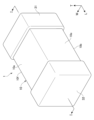
- FIG. 1 is a perspective view showing a schematic diagram of a multilayer ceramic capacitor according to an embodiment of the present invention
- 2 is a cross-sectional view showing a schematic cross section of the capacitor of FIG. 1 taken along line II.
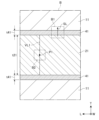
- 3 is an enlarged cross-sectional view showing a part (area A) of the cross section of FIG. 2 .
- 3 is an enlarged cross-sectional view showing a part (region B) of the cross section of FIG. 2 .
- FIG. 3 is an enlarged cross-sectional view showing a part (area C) of the cross section of FIG. 2
- a two-dimensional concentration map in a plane parallel to the LT plane obtained by reconstructing a three-dimensional concentration map of a minor element obtained by three-dimensional atom probe analysis.
- FIG. 2 is a flow chart showing the flow of a method for manufacturing a multilayer ceramic capacitor according to an embodiment of the present invention.
- each figure may include an L axis, a W axis, and a T axis that are perpendicular to each other.
- the dimensions, arrangement, shape, and other characteristics of each component of the multilayer ceramic capacitor 1 may be explained based on the L axis, W axis, and T axis.
- Multilayer ceramic capacitor 1 1-1 Basic Structure of Multilayer Ceramic Capacitor 1
- the basic structure of the multilayer ceramic capacitor 1 according to the first embodiment will be described with reference to Figures 1 and 2.
- Figure 1 is a perspective view of the multilayer ceramic capacitor 1 according to the first embodiment.
- Figure 2 is a cross-sectional view that typically shows a cross section of the multilayer ceramic capacitor 1 taken along line II.
- the multilayer ceramic capacitor 1 comprises a body 10, a first external electrode 31 provided on the body 10, and a second external electrode 32.
- the first external electrode 31 is disposed at a distance from the second external electrode 32.
- the first external electrode 31 is disposed at a distance from the second external electrode 32 in the L-axis direction.
- the main body 10 includes a plurality of dielectric layers 11, a plurality of first internal electrode layers 21, and a plurality of second internal electrode layers 22.
- the dielectric layer 11 is disposed between the first internal electrode layer 21 and the second internal electrode layer 22 adjacent to the first internal electrode layer 21.
- the first internal electrode layer 21 and the second internal electrode layer 22 may be collectively referred to as "internal electrode layers.”
- the main body 10 has an upper surface 10a, a lower surface 10b, a first end surface 10c, a second end surface 10d, a first side surface 10e, and a second side surface 10f.
- the outer surface of the main body 10 is defined by the upper surface 10a, the lower surface 10b, the first end surface 10c, the second end surface 10d, the first side surface 10e, and the second side surface 10f.
- the upper surface 10a and the lower surface 10b each form the surfaces at both ends of the main body 10 in the height direction (T axis direction). In other words, the upper surface 10a and the lower surface 10b face each other in the T axis direction.
- the first end surface 10c and the second end surface 10d each form the surfaces at both ends of the main body 10 in the length direction (L axis direction). In other words, the first end surface 10c and the second end surface 10d face each other in the L axis direction.
- the first side surface 10e and the second side surface 10f each form the surfaces at both ends of the main body 10 in the width direction (W axis direction). In other words, the first side surface 10e and the second side surface 10f face each other in the W axis direction.
- the upper surface 10a and the lower surface 10b are spaced apart by the height dimension of the main body 10
- the first end surface 10c and the second end surface 10d are spaced apart by the length dimension of the main body
- the first side surface 10e and the second side surface 10f are spaced apart by the width dimension of the main body 10.
- the main body 10 is constructed by stacking the dielectric layers 11, the first internal electrode layers 21, and the second internal electrode layers 22 along the stacking direction.
- the dielectric layers 11, the first internal electrode layers 21, and the second internal electrode layers 22 are stacked along the T-axis direction.
- the stacking direction may be along the T-axis as illustrated, or along the L-axis or W-axis.
- the dielectric layers 11 arranged at both ends in the stacking direction are sometimes called cover layers.
- the main body 10 is constructed by stacking the dielectric layer 11, the first internal electrode layer 21, and the second internal electrode layer 22 along the T-axis direction.
- the T-axis direction may be referred to as the stacking direction.
- An upper cover layer 12 may be provided on the upper surface of this stack.
- a lower cover layer 13 may be provided on the lower surface of this stack.
- the upper cover layer 12 and the lower cover layer 13 may be made of the same material as the dielectric layer 11.
- the upper cover layer 12 and the lower cover layer 13 may be part of the main body 10.
- first internal electrode layer 21 is drawn out toward the outside of the main body 10.
- the first internal electrode layer 21 is connected to a first external electrode 31 provided on the surface of the main body 10.
- One end of the second internal electrode layer 22 is drawn out toward the outside of the main body 10.
- the second internal electrode layer 22 is connected to a second external electrode 32 provided on the surface of the main body 10.
- the first internal electrode layer 21 is drawn out toward the outside of the main body 10 from one end in the L-axis direction.
- the first internal electrode layer 21 is connected to the first external electrode 31 at one end of the main body 10 in the L-axis direction.
- the second internal electrode layer 22 is drawn out toward the outside of the main body 10 from the other end in the L-axis direction.
- the second internal electrode layer 22 is connected to the second external electrode 32 at the other end of the main body 10 in the L-axis direction.
- the first internal electrode layer 21 and the second internal electrode layer 22 are drawn out to the opposing first end surface 10c and second end surface 10d, respectively, but the first internal electrode layer 21 and the second internal electrode layer 22 may be drawn out from various surfaces of the main body 10 depending on the arrangement and shape of the first external electrode 31 and the second external electrode 32.
- the first external electrode 31 and the second external electrode 32 are both arranged on the lower surface 10b, the first external electrode 31 and the second external electrode 32 are both drawn out from the lower surface.
- the first external electrode 31 and the second external electrode 32 may be provided on any surface of the main body 10 as long as they are spaced apart from each other.
- a first intermediate layer 41 is disposed between the dielectric layer 11 and the first internal electrode layer 21, and a second intermediate layer 42 is disposed between the dielectric layer 11 and the second internal electrode layer 22, but the first intermediate layer 41 and the second intermediate layer 42 are omitted from illustration in Figures 1 and 2.
- the first intermediate layer 41 and the second intermediate layer 42 may be collectively referred to as "intermediate layer".
- the multilayer ceramic capacitor 1 can have any number of layers.
- the multilayer ceramic capacitor 1 can have 300 to 1000 first internal electrode layers 21 and second internal electrode layers 22. In other words, the number of layers in the multilayer ceramic capacitor 1 can be 300 to 1000.
- the multilayer ceramic capacitor 1 can be mounted on an electronic circuit board.
- An electronic circuit board on which the multilayer ceramic capacitor 1 is mounted is sometimes called a circuit module.
- Various electronic components other than the multilayer ceramic capacitor 1 can also be mounted on the circuit module.
- This circuit module can be mounted on various electronic devices. Electronic devices in which the circuit module can be mounted include smartphones, tablets, game consoles, automotive electrical equipment, servers, and various other electronic devices.
- the body 10 may be configured to have a rectangular parallelepiped shape.
- the term "rectangular parallelepiped” or “rectangular parallelepiped shape” does not mean only a “rectangular parallelepiped” in the strict mathematical sense.
- the corners and/or sides of the body 10 may be curved.
- the dimensions and shape of the body 10 are not limited to those explicitly described in this specification.
- the dimension (length dimension) of the multilayer ceramic capacitor 1 in the L-axis direction is in the range of 0.2 mm to 2.5 mm
- the dimension (width dimension) in the W-axis direction is in the range of 0.1 mm to 3.5 mm
- the dimension (height dimension) in the T-axis direction is in the range of 0.1 mm to 3.0 mm.
- the length dimension of the multilayer ceramic capacitor 1 may be greater than the width dimension.
- the height dimension of the capacitor 1 may be greater than the width dimension.
- the width dimension of the capacitor 1 may be greater than the length dimension.
- the oxide contained as a main component in the dielectric layer 11 may be an oxide represented by the chemical formula Ba1 - xyCaxSryTi1 - zZrzO3 (0 ⁇ x ⁇ 1, 0 ⁇ y ⁇ 1, 0 ⁇ z ⁇ 1).
- this type of oxide include barium strontium titanate, barium calcium titanate, barium zirconate, barium titanate zirconate, calcium titanate zirconate, and barium calcium titanate zirconate.
- the dielectric layer 11 may contain additive elements in addition to the oxides of the main components.
- the additive element contained in the dielectric layer 11 is at least one element selected from the group consisting of Fe (iron), Ni (nickel), Mo (molybdenum), Nb (niobium), Ta (tantalum), W (tungsten), Mg (magnesium), Mn (manganese), V (vanadium), and Cr (chromium).
- the dielectric layer 11 may contain two or more types of the additive elements.
- the dielectric layer 11 may contain glass containing at least one element selected from the group consisting of Co, Ni, Li, B, Na, K, and Si.
- the thickness of the dielectric layer 11 (dimension in the T-axis direction) is 0.2 to 10 ⁇ m.
- the first internal electrode layer 21 contains a base metal such as Ni (nickel), Cu (copper), or Sn (tin) as a main component. Based on the total mass of the first internal electrode layer 21, a component contained in the first internal electrode layer 21 at 50 wt% or more can be the main component of the first internal electrode layer 21.
- the first internal electrode layer 21 desirably contains 60 wt% or more, 70 wt% or more, 80 wt% or more, or 90 wt% or more of the base metal as the main component.
- the explanation regarding the components of the first internal electrode layer 21 also applies to the components of the second internal electrode layer 22.
- the film thickness (dimension in the T-axis direction) of the first internal electrode layer 21 is 0.1 ⁇ m or more and 2 ⁇ m or less. In one embodiment, the film thickness of the first internal electrode layer 21 is desirably 0.4 ⁇ m or less. The explanation regarding the film thickness of the first internal electrode layer 21 also applies to the second internal electrode layer 22.
- the continuity rate of the internal electrode layers in the multilayer ceramic capacitor 1 is desirably 75% or more.
- the continuity rate of the internal electrode layers will be described with reference to FIG. 3.
- FIG. 3 is an enlarged cross-sectional view showing an enlarged region A of the cross section of the main body 10 shown in FIG. 2.
- Region A is an area with a dimension L0 in the L-axis direction of about 50 ⁇ m.
- the first internal electrode layer 21 includes a plurality of electrode regions 21a containing the main component metal element and non-electrode regions 21b present between the electrode regions 21a.
- the non-electrode regions 21b are regions with higher insulation than the electrode regions 21a.
- the non-electrode regions 21b are occupied by, for example, oxides of the secondary elements, parts of the dielectric layer 11, and/or voids.
- the first internal electrode layer 21 is formed by firing an internal electrode pattern containing the main component metal element. As the sintering of the main component metal element progresses in this firing process, the shape of the sintered body of the main component metal element approaches a spherical shape.
- the sintered body of the main component metal element becomes spherical, leaving voids between the spherical sintered bodies, or oxides of the secondary elements and parts of the dielectric layer 11 penetrate into these voids.
- the non-electrode region 21b is composed of voids formed between the sintered bodies of the main component metal elements during the firing process, oxides of the subelements that infiltrate into these voids, and the dielectric layer 11 that infiltrates into the voids.
- the continuity rate of the first internal electrode layer 21 can be calculated as follows. First, the multilayer ceramic capacitor 1 is polished so that the LT surface becomes the observation surface. Next, the region A included in this observation surface is observed with a SEM (scanning electron microscope), and the region that appears bright in the SEM image due to contrast difference is identified as the electrode region 21a. The length of this electrode region 21a is then measured, and the side lengths L1, L2, ..., Ln are summed up. The value obtained by dividing the sum of the lengths of the electrode regions 21a in this region A by the length L0 of the measurement region (i.e., (L1 + L2 + ... Ln) / L0) can be defined as the continuity rate of one first internal electrode layer 21.
- the base 10 includes multiple first internal electrode layers 21, and the continuity rate can vary depending on which layer of the multiple first internal electrode layers 21 is focused on. Therefore, ten different first internal electrode layers 21 are selected, and the average of the continuity rates calculated for each of the selected first internal electrode layers 21 can be defined as the continuity rate of the first internal electrode layers 21 in the multilayer ceramic capacitor 1.
- the second internal electrode layer 22 can also be divided into an electrode region and a non-electrode region. Specifically, as shown in FIG. 3, the 21st internal electrode layer 22 includes a plurality of electrode regions 22a containing a main component metal element, and non-electrode regions 22b present between the electrode regions 22a.
- the continuity rate of the second internal electrode layer 22 is defined in the same manner as the continuity rate of the first internal electrode layer 21.
- the average of the continuity rates of the first internal electrode layer 21 and the second internal electrode layer 22 can be taken as the continuity rate of the internal electrode layers in the multilayer ceramic capacitor 1.
- the multilayer ceramic capacitor 1 capacitance is generated in the region where the electrode region 21a of the first internal electrode layer 21 and the electrode region 22a of the second internal electrode layer 22 face each other in the T-axis direction. Conversely, the non-electrode region 21b and the non-electrode region 22b do not generate capacitance. Therefore, in order to achieve a high capacity in the multilayer ceramic capacitor 1, it is desirable that the continuity rate of the internal electrode layers is high. In one embodiment, the continuity rate of the internal electrode layers is 75% or more. This makes it possible to obtain a multilayer ceramic capacitor 1 with high capacity.
- First external electrode 31 and second external electrode 32 are formed by applying a conductive paste to the main body 10 and heating the conductive paste.
- the conductive paste may include at least one material selected from the group consisting of Ag, Pd, Au, Pt, Ni, Sn, Cu, W, Ti, and alloys thereof.
- FIG. 4 is an enlarged cross-sectional view showing an enlarged region B of the cross section of the main body 10 shown in Figure 2.
- Region B is a region including one of the multiple first internal electrode layers 21 provided in the main body 10 and the dielectric layers 11 located above and below the first internal electrode layer 21. In other words, region B extends from the dielectric layer 11 located below the first internal electrode layer 21 through the first internal electrode layer 21 to the dielectric layer 11 located above the first internal electrode layer 21.
- a first intermediate layer 41 is provided between the dielectric layer 11 and the first internal electrode layer 21.
- the first intermediate layer 41 contains the same element as the sub-element contained in the first internal electrode layer 21. That is, the first intermediate layer 41 contains one element or two or more elements selected from the group consisting of As, Au, Co, Cr, Cu, Fe, In, Ir, Mg, Os, Pd, Pt, Re, Rh, Ru, Se, Sn, Ge, Te, W, Y, Zn, Ag, and Mo.
- the concentration of the sub-element in the first intermediate layer 41 is higher than the concentration of the sub-element in the first internal electrode layer 21. In other words, the sub-element is concentrated in the first intermediate layer 41.
- the first intermediate layer 41 containing concentrated subelements can increase the Schottky barrier formed between the dielectric layer 11 and the first internal electrode layer 21.
- Increasing the Schottky barrier formed between the dielectric layer 11 and the first internal electrode layer 21 can suppress the occurrence of insulation deterioration caused by oxygen defects migrating near the first internal electrode layer 21 and accumulating in the vicinity of the first internal electrode layer 21, thereby improving the insulation reliability of the multilayer ceramic capacitor 1. In other words, the life of the multilayer ceramic capacitor 1 can be extended.
- FIG. 5 is an enlarged cross-sectional view showing an enlarged region C of the cross section of the main body 10 shown in FIG. 2.
- Region C is a region including one of the multiple second internal electrode layers 22 provided in the main body 10 and the dielectric layer 11 located above or below the first internal electrode layer 22.
- the second intermediate layer 42 is provided between the dielectric layer 11 and the second internal electrode layer 22.
- the second intermediate layer 42 contains the same element as the sub-element contained in the second internal electrode layer 22.
- the thickness t41 (dimension in the T-axis direction) of the first intermediate layer 41 is, for example, 0.2 nm or more and 3.0 nm or less.
- the lower limit of the thickness t41 of the first intermediate layer 41 may be 0.3 nm, 0.4 nm, or 0.5 nm.
- the upper limit of the thickness t41 of the first intermediate layer 41 may be 2.0 nm, 1.5 nm, or 1.3.
- the thickness t42 of the second intermediate layer 42 may be approximately the same as the thickness t41 of the first intermediate layer 41.
- the first intermediate layer 41 may cover the entire first internal electrode layer 21.
- the first intermediate layer 41 may cover only a portion of the first internal electrode layer 21. It is desirable that the first intermediate layer 41 cover 80% or more of the entire area of the upper and lower surfaces of the first internal electrode layer 21 in order to suppress leakage current.
- the second intermediate layer 42 may cover the entire second internal electrode layer 22.
- the second intermediate layer 42 may cover only a portion of the second internal electrode layer 22. It is desirable that the second intermediate layer 42 cover 80% or more of the entire area of the upper and lower surfaces of the second internal electrode layer 22 in order to suppress leakage current.
- the first intermediate layer 41 is a region of the base 10 where the subelement contained in the first internal electrode layer 21 is concentrated. In one embodiment, the first intermediate layer 41 contains the subelement at a concentration that is 1.2 times or more higher than the concentration of the subelement in the first internal electrode layer 21.
- FIG. 4 shows a region B2 located near the center of the first internal electrode layer 21 in the T-axis direction (stacking direction).
- the region B2 is determined by setting a virtual line segment VL1 extending from one end of the first internal electrode layer 21 to the other end along the T-axis, and is determined to include a midpoint P1 in the T-axis direction of this virtual line segment VL1.
- the region B2 is, for example, a square region of 15 nm on each side.
- the concentration of the subelement in this region B2 can be used as the concentration of the subelement in the first internal electrode layer 21.
- a plurality of regions B2 may be defined in the first internal electrode layer 21, and the average value obtained by averaging the concentrations of the subelements in each of the plurality of regions B2 may be used as the concentration of the subelement in the first internal electrode layer 21.
- the concentration of the subelement contained in the first internal electrode layer 21 means the atomic ratio (at%) of the subelement to 100 at% of the main component metal element of the first internal electrode layer 21.
- the concentration of the subelement means the atomic ratio (at%) of the subelement to 100 at% of Ni in the first internal electrode layer 21.
- the concentration (at%) of the subelement in the first internal electrode layer 21 is expressed as the atomic ratio of the subelement to 100 at% of the main component metal element (e.g., Ni element) in the first internal electrode layer 21, unless otherwise specified.
- the concentration of the main component metal element measured in the above region B2 can be the concentration of the main component metal element in the first internal electrode layer 21.
- the concentration of the sub-element in the first intermediate layer 41 can be quantified, for example, by three-dimensional atom probe (3DAP) analysis.
- the concentration of the sub-element in the first intermediate layer 41 may also be quantified by a known analytical method other than three-dimensional atom probe analysis.
- the concentration of the sub-element in the first intermediate layer 41 may be quantified by secondary ion mass spectrometry (SIMS), TEM-EDS, or other known analytical methods.
- FIGS. 6 and 7 show examples of the concentration distribution of the subelements in the first intermediate layer 41 quantified by three-dimensional atom probe analysis.
- the two-dimensional concentration map shown in FIG. 6 is a two-dimensional concentration map in a plane parallel to the LT plane that is reconstructed from the three-dimensional concentration map of the subelements obtained by three-dimensional atom probe analysis.
- the two-dimensional concentration map shown in FIG. 7 is a two-dimensional concentration map in a plane parallel to the LW plane that is reconstructed from the three-dimensional concentration map of the subelements obtained by three-dimensional atom probe analysis.
- the concentration map of the subelement in the observation region including the first intermediate layer 41 is divided into multiple regions according to the concentration.
- the region where the concentration of the subelement is 1.2 times or more the concentration of the subelement in the first internal electrode layer 21 is shown as the first region 41a.
- the first intermediate layer 41 refers to a region where the concentration of the subelement is 1.2 times or more the concentration of the subelement in the first internal electrode layer 21, so in this case, the first region 41a defines the outer edge of the first intermediate layer 41.
- Three-dimensional atom probe analysis can obtain concentration maps not only for the minor elements, but also for the elements that make up the main oxide of the dielectric layer 11 and the main metal element of the first internal electrode layer 21.
- concentration map the region with a high concentration of the elements that make up the main oxide can be identified as the dielectric layer 11, and the region with a high concentration of the main metal element can be identified as the first internal electrode layer 21.
- the region above the first region 41a on the paper surface is the dielectric layer 11 with a high concentration of Ba and Ti
- the region below the first region 41a on the paper surface is the first internal electrode layer 21 with a high concentration of Ni.
- a first high concentration region 41b is defined inside the first region 41a.
- the first high concentration region 41b indicates a region containing the subelement at a concentration that is 1.5 times or more the average concentration of the subelement in the entire first intermediate layer 41.
- the average concentration of the subelement in the first intermediate layer 41 means the average concentration of the subelement in the region surrounded by the first region 41a. In other words, the concentration of the subelement in the first high concentration region 41b is 1.8 times or more the concentration of the subelement in the first internal electrode layer 21.
- the first high concentration region 41b is a region in the first intermediate layer 41 where the subelement is particularly concentrated.
- a first low concentration region 41c is defined inside the first region 41a.
- the first low concentration region 41c indicates a region that contains the subelement at a concentration that is 0.5 times or less than the average concentration of the subelement in the first intermediate layer 41.
- the first intermediate layer 41 is divided into a first region 41a, a first high concentration region 41b, and a first low concentration region 41c according to the concentration of the subelement.
- the first region 41a may refer to a region of the first intermediate layer 41 other than the first high concentration region 41b and the first low concentration region 41c.
- the concentration of the secondary element in the first intermediate layer 41 may vary depending on the type of element.
- the concentration of Au in the first region 41a is, for example, 1 to 2.5 at%
- the concentration of Au in the first high concentration region 41b is, for example, 2.5 to 5 at%
- the concentration of Au in the first low concentration region 41c is, for example, 0.1 to 1 at%.
- the concentration of Fe in the first region 41a is, for example, 0.5 to 1 at%
- the concentration of Fe in the first high concentration region 41b is, for example, 1 to 3.5 at%
- the concentration of Fe in the first low concentration region 41c is, for example, 0.1 to 0.5 at%.
- the concentration of Sn in the first region 41a is, for example, 0.5 to 0.8 at%
- the concentration of Sn in the first high concentration region 41b is, for example, 0.8 to 1.5 at%
- the concentration of Sn in the first low concentration region 41c is, for example, 0.1 to 0.5 at%.
- the subelement atoms are arranged so as to be stacked in the direction from the first internal electrode layer 21 toward the dielectric layer 11 (i.e., the stacking direction; in other words, the T-axis direction when the axis shown in the figure is used as a reference).
- the concentration of the subelement in the region where the concentration of the subelement is high, more subelement atoms are stacked in the T-axis direction.
- the concentration of the subelement in the first high concentration region 41b is higher than the concentration of the subelement in the first region 41a, more subelement atoms are stacked in the T-axis direction in the first high concentration region 41b than in the first region 41a.
- the first region 41a can contain 0.5 to 1 at% Fe
- the first high concentration region 41b can contain, for example, 1 to 3.5 at% Fe.
- the concentration of Fe in the first region 41a is 1 at% and the concentration of Fe in the first high concentration region 41b is 3 at%
- the first high concentration region 41b protrudes toward the dielectric layer 11 or the first internal electrode layer 21 by two Fe atoms from the first region 41a. Since the diameter of an Fe atom is approximately 0.25 nm, the first high concentration region 41b protrudes toward the dielectric layer 11 or the first internal electrode layer 21 by about 0.5 nm from the first region 41a.
- the first intermediate layer 41 includes the first high concentration region 41b that contains the subelement at a high concentration, and the first high concentration region 41b increases the unevenness of the surface of the first intermediate layer 41.
- the unevenness of the surface of the first intermediate layer 41 creates an anchor effect, and the first intermediate layer 41 having the first high concentration region 41b can firmly bond the dielectric layer 11 and the first internal electrode layer 21.
- the first intermediate layer 41 may include a plurality of first high concentration regions 41b spaced apart from each other.
- first intermediate layer 41 has a plurality of first high concentration regions 41b, a stronger anchor effect is generated, so that the dielectric layer 11 and the first internal electrode layer 21 are more firmly bonded to each other.
- the first intermediate layer 41 includes the first low concentration region 41c in addition to the first high concentration region 41b, the surface of the first intermediate layer 41 has even greater unevenness, resulting in a stronger anchor effect. Therefore, the first intermediate layer 41 having the first high concentration region 41b and the first low concentration region 41c can firmly bond the dielectric layer 11 and the first internal electrode layer 21.
- the first intermediate layer 41 does not need to include the low concentration region 41c.
- the first region 41a, the first high concentration region 41b, and the first low concentration region 41c are partitioned based on the sum of the concentrations of the two or more subelements.
- the sum of the concentrations of the two or more elements in the first region 41a is 1.2 times or more than the sum of the concentrations of the two or more subelements in the first internal electrode layer 21.
- the total concentration of the concentrations of the two or more subelements in the first high concentration region 41b is 1.5 times or more than the total average concentration of the average concentration of each of the two subelements in the entire first intermediate layer 41.
- the concentration of the subelement contained in the first intermediate layer 41 also applies to the concentration of the subelement in the second intermediate layer 42.
- the second intermediate layer 42 contains the subelement at a concentration 1.2 times or more higher than the concentration of the subelement in the second internal electrode layer 22.
- the second intermediate layer 42 has a second region containing the subelement at a concentration 1.2 times or more higher than the concentration of the subelement in the second internal electrode layer 22, and a second high concentration region inside the second region.
- the second high concentration region of the second intermediate layer 42 contains the subelement at a concentration 1.5 times or more higher than the average concentration of the subelement in the entire second intermediate layer 42.
- the second high concentration region of the second intermediate layer 42 increases the unevenness of the surface of the second intermediate layer 42. Since the unevenness of the surface of the second intermediate layer 42 creates an anchor effect, the second intermediate layer 42 having the second high concentration region can firmly bond the dielectric layer 11 and the second internal electrode layer 22.
- the boundaries between the first intermediate layer 41 and the dielectric layer 11 or the first internal electrode layer 21 can be distinguished using high-angle annular dark-field-scanning transmission electron microscopy (HAADF-STEM).
- HAADF-STEM high-angle annular dark-field-scanning transmission electron microscopy
- the first internal electrode layer 21 and the second internal electrode layer 22 have a higher density than the dielectric layer 11, and are therefore observed as areas of relatively high brightness in HAADF-STEM.
- an observation region extending from the first internal electrode layer 21 to the dielectric layer 11 is set in the cross section of the main body 10, and the presence of the first intermediate layer 41 can be confirmed based on mapping data of Fe elements obtained by performing TEM-EDS (Transmission Electron Microscope-Energy Dispersive X-ray Spectroscopy) in this observation region.
- TEM-EDS Transmission Electron Microscope-Energy Dispersive X-ray Spectroscopy
- the main body 10 is sliced to prepare an analysis sample so that a plane parallel to a plane (for example, an LT plane) including the T axis becomes the observation surface, and an observation area extending from the first internal electrode layer 21 to the dielectric layer 11 is set on the observation surface of the sliced analysis sample. Since the LT plane of the substrate 10 is shown in FIG. 4, the following description will be given assuming that FIG. 4 shows the observation surface of the sliced analysis sample.
- the observation area B1 in FIG. 4 is an example of an observation area by TEM-EDS analysis. TEM-EDS is performed on this observation area B1 to obtain mapping data of the quantified elements contained in the observation area B1 of the analysis sample.
- the observation area B1 is, for example, a square area of 15 nm on each side.
- the quantified elements include elements contained in the main component oxide of the dielectric layer 11 (for example, Ba, Ti, O when the main component oxide is BaTiO 3 ), the main component metal of the first internal electrode layer 21 (for example, Ni), and a subelement.
- a line analysis is performed based on the acquired mapping data. Specifically, a line profile is created for each of the quantitative elements by reconstructing the mapping data of the quantitative elements along a scanning line SL extending from the first internal electrode layer 21 to the dielectric layer 11 in the observation region B1.
- the length of the scanning line SL is, for example, 8 nm.
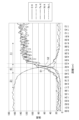
- FIG. 8 shows an example of a line profile obtained by reconstructing the mapping data obtained by TEM-EDS along the scanning line SL in the region A1 of the analysis sample.
- the line profile in FIG. 4 is a graph obtained by reconstructing the mapping data of each element of Ba, Ti, O, Ni, and Fe obtained by performing TEM-EDS on the analysis sample prepared from a multilayer ceramic capacitor 1 in which the dielectric layer 11 is mainly composed of BaTiO 3 and the first internal electrode layer 21 contains Ni as a main component metal element and Fe as a sub-element, along the scanning line SL.
- the dielectric layer 11 is mainly composed of BaTiO 3
- the first internal electrode layer 21 contains Ni as a main component metal element and Fe as a sub-element
- the horizontal axis indicates the detection position on the scanning line SL1
- the vertical axis indicates the detection intensity calculated based on the count numbers of Ba, Ti, O, Ni, and Fe at each detection position.
- a predetermined threshold can be, for example, 1 nm, 0.9 nm, 0.8 nm, 0.7 nm, 0.6 nm, or 0.5 nm.
- the line profile of Ba of BaTiO3 contained as a main component in the dielectric layer 11 and the line profile of Ni contained as a main component in the first internal electrode layer 21 intersect at a position about 4.1 nm from the scanning start position.
- the profile intersection point 52 where the line profile of Ba and the line profile of Ni intersect is located at a position about 4.1 nm from the scanning start position.
- a peak 51 of the line profile of Fe is present at a position about 3.9 nm from the scanning start position. Since the peak 51 of the line profile of Fe is located at a position about 0.2 nm away from the profile intersection point 52, which is smaller than the threshold value, it is determined that the first intermediate layer 41 is present in the region including this peak 51.
- the first intermediate layer 41 contains the subelement at a concentration that is 1.2 times or more higher than the concentration of the subelement in the first internal electrode layer 21. Furthermore, the first high concentration region 41b contained in the first intermediate layer 41 contains the subelement at a concentration that is 1.5 times or more higher than the average concentration of the subelement in the entire first intermediate layer 41.
- the concentration of the subelement for identifying the first intermediate layer 41 and the first high concentration region 41b may be quantified by TEM-EDS.
- Fig. 9 is a flow chart showing the flow of a method for manufacturing a multilayer ceramic capacitor according to an embodiment of the present invention.
- a laminate is formed as a precursor of the main body 10.
- This laminate includes a dielectric green sheet as a precursor of the dielectric layer 11, and an internal conductor pattern as a precursor of each of the first internal electrode layer 21 and the second internal electrode layer 22.
- the laminate may be formed by alternately laminating a dielectric green sheet on the surface of which is provided an internal conductor pattern as a precursor of the first internal electrode layer 21, and a dielectric green sheet on the surface of which is provided an internal conductor pattern as a precursor of the second internal electrode layer 22.
- the internal conductor pattern includes a subelement in addition to the main component metal element.
- step S12 the laminate formed in step S11 is heated in a firing furnace to fire the dielectric green sheet and the internal electrode pattern, thereby obtaining a multilayer ceramic capacitor 1.
- step S11 a binder such as polyvinyl butyral (PVB) resin, an organic solvent such as ethanol or toluene, and a plasticizer are first added to the dielectric powder and wet mixed to obtain a slurry.
- This slurry is then applied to a substrate film by, for example, a die coater method or a doctor blade method, and the slurry applied to the substrate film is dried to obtain a dielectric green sheet.
- the dielectric green sheet is a precursor of the dielectric layer 11.
- the dielectric powder which is the raw material powder for the dielectric green sheet, is, for example, barium titanate powder.
- Barium titanate powder is synthesized by reacting a titanium raw material such as titanium dioxide with a barium raw material such as barium carbonate using a known method such as the solid-phase method, the sol-gel method, or the hydrothermal method.
- the internal electrode patterns are formed on the plurality of dielectric green sheets formed as described above.
- the internal electrode patterns are formed, for example, by printing the internal electrode paste on the dielectric green sheets by a known printing method such as screen printing.
- the internal electrode paste is manufactured by kneading the metal powder, binder resin, and solvent with a three-roll mill.
- the internal electrode paste is a paste in which the metal powder is dispersed in the binder resin.
- the metal powder contained in the internal electrode paste may be a mixed powder obtained by mixing a powder of a main component metal element such as Ni, Cu, Sn, etc., which is the main component of the first internal electrode layer 21 and the second internal electrode layer 22, with a powder containing a sub-element.
- the mixed powder is generated by mixing the main component metal powder with the sub-element powder so that the content ratio of the sub-element to 100 at% of the main component metal element is in the range of 0.01 to 5 at%.
- a cellulose-based resin such as ethyl cellulose or an acrylic-based resin such as butyl methacrylate can be used.
- the internal electrode pattern formed on some of the dielectric green sheets is a precursor of the first internal electrode layer 21, and the internal electrode pattern formed on other dielectric green sheets is a precursor of the second internal electrode layer 22.
- the sub-elements are non-uniformly dispersed.
- a first type of dispersant is adsorbed on the main component metal powder
- a second type of dispersant different from the first type of dispersant is adsorbed on the sub-element powder, thereby making the hydrophilicity (or hydrophobicity) of the main component metal powder adsorbed with each dispersant different from the hydrophilicity (or hydrophobicity) of the sub-element powder, and thereby controlling the compatibility of the main component metal powder and the sub-element powder with the solvent individually.
- the internal electrode pattern may be formed on the dielectric green sheet by a sputtering method. Even when the internal electrode pattern is formed by a sputtering method, the sub-elements can be dispersed non-uniformly within the internal electrode pattern. For example, by individually controlling the nucleation rate and growth rate between the main component metal element and the sub-element, the internal electrode pattern can be formed so that the sub-elements have non-uniform unevenness or concentration unevenness on the surface of the dielectric green sheet.
- the method of forming the internal electrode pattern is not limited to the method specifically described in this specification.
- the internal electrode pattern may be formed by various known methods, such as vacuum deposition, PLD (pulsed laser deposition), MO-CVD (metal organic chemical vapor deposition), MOD (metal organic decomposition), or CSD (chemical solution deposition).
- a laminate unit that has a dielectric green sheet and an internal electrode pattern formed on the surface of the dielectric green sheet.
- a predetermined number of these laminate units are stacked and thermocompressed to obtain a laminate.
- Green sheets that do not have an internal electrode pattern formed thereon may be stacked on the top and bottom layers of the laminate.
- a chip-shaped laminate that serves as a precursor of the main body 10 is obtained.
- a degreasing process may be performed on this chip-shaped laminate.
- the degreasing process may be performed in an N2 atmosphere.
- a metal paste that serves as the base electrode layer of the first external electrode 31 and the second external electrode 32 may be applied by a dipping method to the degreased laminate.
- step S12 the chip stack produced in step S11 is placed in a firing furnace, and the stack is fired in the firing furnace to fire the chip stack and obtain the multilayer ceramic capacitor 1.
- the dielectric green sheets in the chip stack are fired to become the dielectric layer 11, and the internal electrode patterns are fired to become the internal electrode layers (first internal electrode layer 21 and second internal electrode layer 22).
- the auxiliary elements contained in the internal electrode patterns are thermally diffused toward the interface with the dielectric green sheets. Therefore, in the multilayer ceramic capacitor 1, a first intermediate layer 41 and a second intermediate layer 42 containing the auxiliary elements at a higher concentration than the internal electrode layers are formed between the dielectric layer 11 and the first internal electrode layer 21 and between the second internal electrode layer 22, respectively.
- the inside of the firing furnace is kept in an atmosphere in which non-uniform oxidation reactions of metal elements occur, for example, a low-oxygen atmosphere with an oxygen partial pressure of 10-9 to 10-7 atm.
- a low-oxygen atmosphere with an oxygen partial pressure of 10-9 to 10-7 atm.
- the oxygen concentration in the chip stack fluctuates due to the influence of self-generated gas generated by decomposition of the thermal decomposition residue of the binder contained in the dielectric green sheet and the internal electrode, and the main component metal element and the sub-element contained in the internal electrode pattern repeat oxidation and reduction non-uniformly.
- the concentration distribution of the sub-element becomes more uneven in the first intermediate layer 41 and the second intermediate layer 42 obtained after firing.
- the temperature inside the firing furnace is raised from room temperature to the intermediate temperature at a rate of 200-300°C/h.
- the intermediate temperature is set to a temperature slightly lower than the sintering temperature of the main component metal element.
- the main component metal element is Ni
- the intermediate temperature is set to approximately 500-700°C.
- An example of the intermediate temperature is 600°C.
- the temperature is raised from this intermediate temperature to the top firing temperature at a high heating rate.
- the top firing temperature is, for example, 1200-1400°C.
- An example of the top firing temperature is 1300°C.
- the heating rate is, for example, 20,000-40,000°C/h.
- An example of the heating rate is 30,000°C/h.
- the interface between the dielectric green sheet (dielectric layer 11 after sintering) and the internal electrode pattern (internal electrode layer after sintering) tends to be in a thermodynamically non-equilibrium state during the firing process, so that the bias in the concentration distribution in the first intermediate layer 41 and the second intermediate layer 42 formed between the dielectric layer 11 and the internal electrode layer can be increased.
- the holding time at the top firing temperature is within 10 seconds so as not to sinter the internal electrode layer excessively. Cooling may begin immediately after the top firing temperature is reached.
- the multilayer ceramic capacitor 1 obtained by the second heating process in step S12 may be subjected to a reoxidation process at 600°C to 1000°C in an N2 gas atmosphere.
- a plating layer of Cu, Ni, Sn, or the like may be provided on the surfaces of the first external electrode 31 and the second external electrode 32. This plating layer may be formed by electrolytic plating or electroless plating.
- the sub-element powder in Table 1 was weighed so that the content ratio of the sub-element to 100 at% of Ni was the amount described in "Sub-element addition amount" in Table 1, and this weighed sub-element powder was mixed with Ni powder.
- polyvinyl butyral (PVB) resin, a solvent, and a plasticizer were added to this mixed powder and wet-mixed to obtain a slurry for an internal electrode.
- the internal electrode slurry was printed on a partial area of the surface of the dielectric green sheet to form an internal electrode pattern on each of the dielectric green sheets, thereby forming a laminate unit.
- This laminate unit has a dielectric green sheet and an internal electrode pattern formed on the surface of the dielectric green sheet.
- the secondary element in sample 1 is Au
- the secondary element in sample 2 is Fe
- the secondary elements in the other samples are also as shown in Table 1.
- Samples 3 and 14 contain two types of elements, Au and Fe, as secondary elements.
- chip stack was shaped like a 1005 (length: 1.0 mm, width: 0.5 mm, height: 0.5 mm). This chip stack was then degreased in an N2 atmosphere. Next, a metal paste was applied to the molded body after the degreasing process using a dipping method to form an external electrode underlayer on each chip stack.
- the chip stacks which are precursors of each sample obtained as described above, were placed in a sintering furnace, and the chip stacks were sintered under predetermined sintering conditions according to a predetermined temperature profile.
- the chip stacks for samples 1 to 10 were sintered in a low-oxygen atmosphere with an oxygen partial pressure of 7.8 ⁇ 10 ⁇ 8 atm, with the temperature in the sintering furnace increased from room temperature to 600° C. at a rate of 300° C./h, and then increased from 600° C. to 1300° C. at a rate of 30,000° C./h, and cooling was started immediately after the temperature reached 1300° C.
- samples 1 to 14 were produced.
- the dielectric green sheet was fired to form the dielectric layer
- the internal electrode pattern was fired to form the internal electrode layer.
- the base layer formed on the compact serves as the external electrode.
- all of samples 1 to 14 are multilayer ceramic capacitors.
- each sample was embedded in resin, and each sample embedded in resin was polished along a plane parallel to the lamination direction (for example, the LT plane in FIG. 2) to expose a cross section parallel to the lamination direction.
- an observation area (observation area corresponding to observation area A in FIG. 2) was specified in the exposed cross section of each sample at a magnification of 5000 to 20000 times using a field emission scanning secondary electron microscope (FE-SEM), and the cross section of each sample was observed in this specified observation area.
- FE-SEM field emission scanning secondary electron microscope
- the difference between the average position of the ends of the 10 layers of dielectric layers in the T-axis direction and the average position of the ends of the 10 layers of internal electrode layers in the T-axis direction was calculated, and this calculated value can be used as the thickness of the internal electrode layer.
- the film thickness of the internal electrode layer of Samples 1 to 14 in the above manner was 0.4 ⁇ m in all samples.
- the continuity rate of the internal electrode layer in each sample was calculated as follows. For each of the internal electrode layers included in each of the above observation regions, the electrode region was identified based on the contrast difference, and the length of each of these electrode regions was measured. The continuity rate for each internal electrode layer was then calculated based on the measured length of each electrode region. The average value of the calculated continuity rates for each of the internal electrode layers included in each of the five observation regions was calculated, and this average value was used as the continuity rate of the internal electrode layer in each sample.
- the continuity rates of the internal electrode layers calculated in this manner are listed in the "Continuity rate of the internal electrode layer" column in Table 1. A high continuity rate of more than 80% was obtained in all samples.
- Each of samples 1 to 14 was sliced using a focused ion beam (FIB) device so that the LT surface became the observation surface, and a 60 nm-thick sliced analysis sample was extracted from each of samples 1 to 14. Any damage that appeared on the observation surface of the sliced samples was appropriately removed by Ar ion milling.
- the sliced samples were placed in a TEM equipped with an EDS detector (TEM (TEM JEM-2100F, manufactured by JEOL Ltd.), EDS detector (JED-2300T, manufactured by JEOL Ltd.)), and ten observation areas B1 (corresponding to observation area B1 in Figure 4) measuring 15 nm square extending from the internal electrode layer to the dielectric layer were identified, and EDS analysis was performed on each of the ten observation areas B1.
- a concentration map was obtained in each of the observation regions B1, which represents the concentration of the quantitative elements (Ba, Ti, O, Ni, and subelements) in atomic ratio (at%), and the concentration map was reconstructed along a scanning line SL set to extend along the T-axis from the internal electrode layer to the dielectric layer in each of the observation regions B1, thereby obtaining a line profile of each quantitative element for each of the observation regions B1.
- the line profiles of samples 1 to 10 and samples 12 to 14 were generally similar to those in FIG. 8, with the peak of the subelement appearing near the intersection of the Ba profile and the Ni profile. No subelement was detected in sample 11.
- observation regions B2 (corresponding to observation region B2 in Figure 4) including the midpoint (corresponding to midpoint P1 in Figure 4) in the stacking direction (T-axis direction) of the internal electrode layer were identified, and EDS analysis was performed on each of the ten observation regions B2 in the internal conductor layer to quantify the concentrations of Ni element and auxiliary elements.
- the concentration of the subelement contained in each sample piece was measured by three-dimensional atom probe analysis, and a three-dimensional concentration map was obtained.
- this three-dimensional concentration map was reconstructed as a two-dimensional concentration map in a plane (28 nm x 26 nm plane) parallel to the LT plane of the sample piece.
- a first region (corresponding to the first region 41b) was identified in which the concentration of the sub-element in the two-dimensional concentration map was 1.2 times or more the concentration of the sub-element in the internal conductor layer.
- the average concentration of the sub-element in the entire first region was calculated. This identification of the first region and calculation of the average concentration were performed for each of the 10 sample pieces, and the average value of the average concentrations calculated for each of the 10 sample pieces was taken as the average concentration of the sub-element in the entire intermediate layer.
- each sample was examined to see what percentage higher the maximum concentration of the subelement in the acquired two-dimensional concentration map was compared to the average concentration of the subelement in the entire intermediate layer.
- the ratio (percentage) of the maximum concentration of the subelement in the two-dimensional concentration map to the concentration of the subelement in the entire intermediate layer is recorded for each sample.
- samples 1 to 10 contained high concentration regions in which the maximum concentration of the subelement in the acquired two-dimensional concentration map was 50% or more higher than the average concentration of the subelement in the entire intermediate layer (i.e., regions in which the concentration of the subelement was 1.5 times or more compared to the average concentration of the subelement in the entire intermediate layer).
- sample No. 1 has a maximum concentration of the subelement in the two-dimensional concentration map that is 150% (i.e., 1.5 times) of the average concentration in the entire intermediate layer.
- the acquired two-dimensional concentration maps did not contain any high-concentration regions in which the highest concentration of the subelement was 50% or more higher than the average concentration of the subelement in the entire intermediate layer, and the maximum concentration of the subelement was only 10% to 20% higher than the average concentration of the subelement in the entire intermediate layer.
- samples 1 to 10 contain low concentration regions in which the minimum concentration of the subelement in the acquired two-dimensional concentration map is 50% or more lower than the average concentration of the subelement in the entire intermediate layer (i.e., regions in which the concentration of the subelement is 0.5 times or less than the average concentration of the subelement in the entire intermediate layer).
- the minimum concentration of the subelement in the two-dimensional concentration map is 50% (i.e., 0.5 times) of the average concentration in the entire intermediate layer in sample No. 1.
- the acquired two-dimensional concentration map did not contain any low-concentration regions in which the minimum concentration of the subelement was 50% or more lower than the average concentration of the subelement in the entire intermediate layer, and the minimum concentration of the subelement was only 10% to 20% lower than the average concentration of the subelement in the entire intermediate layer.
- HALT accelerated life test
- test samples those in which no delamination of 10 ⁇ m or more was visible between the internal electrode layer and the dielectric layer when the indenter was pressed to a depth of 3 mm were determined to be good products, and those in which delamination of longer length was confirmed were determined to be defective products.
- Column "Deflection Test Results" in Table 2 the number of samples determined to be defective out of the 200 samples tested for each sample is listed.
- samples not included in the present invention i.e., comparative examples
- samples 11 to 14 are comparative examples not included in the present invention.
- the designations "first,” “second,” “third,” and the like are used to identify components, and do not necessarily limit the number, order, or content. Furthermore, numbers for identifying components are used in different contexts, and a number used in one context does not necessarily indicate the same configuration in another context. Furthermore, there is no prohibition on a component identified by a certain number also serving the function of a component identified by another number.
- the first intermediate layer further includes a first low concentration region in which the concentration of the element X is 0.5 times or less an average concentration of the element X in the entire first intermediate layer;
- the first intermediate layer includes a plurality of the first high concentration regions on the first cut surface;
- the element X is selected from the group consisting of As, Au, Co, Cr, Cu, Fe, In, Ir, Mg, Os, Pd, Pt, Re, Rh, Ru, Se, Sn, Ge, Te, W, Y, Zn, Ag, Mo, and Ge;
- the first internal electrode layer further contains an element Y, the first high concentration region has a total concentration of the element X and the element Y that is 1.5 times or more of a total average concentration of the element X and the element Y in the entire first intermediate layer;
- the multilayer ceramic capacitor according to any one of [Appendix 1] to [Appendix 4].
- the first low concentration region has a total concentration of the element X and the element Y that is 0.5 times or less of the total average concentration in the first intermediate layer as a whole;
- the main component metal element is Ni.
- the concentration of the element X in the first internal electrode layer is 0.01 at% or more and 5 at% or less.
- the main body further includes a second intermediate layer provided between the second internal electrode layer and the dielectric layer in the first direction, the second intermediate layer containing the element X at a concentration 1.2 times or more higher than the concentration of the element X in the second internal electrode layer; the second intermediate layer includes, at the first cut surface, a second high concentration region in which the concentration of the element X is 1.5 times or more an average concentration of the element X in the entire second intermediate layer;
- the multilayer ceramic capacitor according to any one of [Appendix 1] to [Appendix 8].
- Appendix 10 A circuit module comprising the multilayer ceramic capacitor according to any one of [Appendix 1] to [Appendix 9].
- Appendix 11 An electronic device comprising the circuit module according to [Supplementary Note 10].
Landscapes
- Engineering & Computer Science (AREA)
- Power Engineering (AREA)
- Manufacturing & Machinery (AREA)
- Microelectronics & Electronic Packaging (AREA)
- Chemical & Material Sciences (AREA)
- Materials Engineering (AREA)
- Ceramic Engineering (AREA)
- Inorganic Chemistry (AREA)
- Fixed Capacitors And Capacitor Manufacturing Machines (AREA)
- Ceramic Capacitors (AREA)
Priority Applications (2)
| Application Number | Priority Date | Filing Date | Title |
|---|---|---|---|
| JP2025506565A JPWO2024190167A1 (https=) | 2023-03-16 | 2024-02-05 | |
| US19/329,153 US20260011494A1 (en) | 2023-03-16 | 2025-09-15 | Laminated ceramic capacitor |
Applications Claiming Priority (2)
| Application Number | Priority Date | Filing Date | Title |
|---|---|---|---|
| JP2023042421 | 2023-03-16 | ||
| JP2023-042421 | 2023-03-16 |
Related Child Applications (1)
| Application Number | Title | Priority Date | Filing Date |
|---|---|---|---|
| US19/329,153 Continuation US20260011494A1 (en) | 2023-03-16 | 2025-09-15 | Laminated ceramic capacitor |
Publications (1)
| Publication Number | Publication Date |
|---|---|
| WO2024190167A1 true WO2024190167A1 (ja) | 2024-09-19 |
Family
ID=92755111
Family Applications (1)
| Application Number | Title | Priority Date | Filing Date |
|---|---|---|---|
| PCT/JP2024/003777 Ceased WO2024190167A1 (ja) | 2023-03-16 | 2024-02-05 | 積層セラミックコンデンサ及び積層セラミックコンデンサの製造方法 |
Country Status (3)
| Country | Link |
|---|---|
| US (1) | US20260011494A1 (https=) |
| JP (1) | JPWO2024190167A1 (https=) |
| WO (1) | WO2024190167A1 (https=) |
Citations (6)
| Publication number | Priority date | Publication date | Assignee | Title |
|---|---|---|---|---|
| JPH0432213A (ja) * | 1990-05-29 | 1992-02-04 | Toshiba Corp | セラミックコンデンサ |
| JP2010109133A (ja) * | 2008-10-30 | 2010-05-13 | Panasonic Corp | セラミックス電子部品、及びこれを用いた電子機器 |
| WO2015016309A1 (ja) * | 2013-08-02 | 2015-02-05 | 株式会社村田製作所 | 積層セラミックコンデンサおよび積層セラミックコンデンサの製造方法 |
| JP2022072584A (ja) * | 2020-10-30 | 2022-05-17 | 太陽誘電株式会社 | セラミック電子部品およびその製造方法 |
| JP2022133147A (ja) * | 2021-03-01 | 2022-09-13 | 太陽誘電株式会社 | セラミック電子部品およびその製造方法 |
| JP2022183751A (ja) * | 2021-05-31 | 2022-12-13 | 太陽誘電株式会社 | セラミック電子部品 |
-
2024
- 2024-02-05 JP JP2025506565A patent/JPWO2024190167A1/ja active Pending
- 2024-02-05 WO PCT/JP2024/003777 patent/WO2024190167A1/ja not_active Ceased
-
2025
- 2025-09-15 US US19/329,153 patent/US20260011494A1/en active Pending
Patent Citations (6)
| Publication number | Priority date | Publication date | Assignee | Title |
|---|---|---|---|---|
| JPH0432213A (ja) * | 1990-05-29 | 1992-02-04 | Toshiba Corp | セラミックコンデンサ |
| JP2010109133A (ja) * | 2008-10-30 | 2010-05-13 | Panasonic Corp | セラミックス電子部品、及びこれを用いた電子機器 |
| WO2015016309A1 (ja) * | 2013-08-02 | 2015-02-05 | 株式会社村田製作所 | 積層セラミックコンデンサおよび積層セラミックコンデンサの製造方法 |
| JP2022072584A (ja) * | 2020-10-30 | 2022-05-17 | 太陽誘電株式会社 | セラミック電子部品およびその製造方法 |
| JP2022133147A (ja) * | 2021-03-01 | 2022-09-13 | 太陽誘電株式会社 | セラミック電子部品およびその製造方法 |
| JP2022183751A (ja) * | 2021-05-31 | 2022-12-13 | 太陽誘電株式会社 | セラミック電子部品 |
Also Published As
| Publication number | Publication date |
|---|---|
| US20260011494A1 (en) | 2026-01-08 |
| JPWO2024190167A1 (https=) | 2024-09-19 |
Similar Documents
| Publication | Publication Date | Title |
|---|---|---|
| US8582277B2 (en) | Laminated type ceramic electronic parts | |
| US6548437B2 (en) | Dielectric ceramics and electronic component | |
| US12243691B2 (en) | Ceramic electronic device | |
| US11915882B2 (en) | Ceramic electronic device and manufacturing method of the same | |
| US20240120153A1 (en) | Ceramic electronic device, and manufacturing method of the same | |
| JP2023050840A (ja) | セラミック電子部品およびその製造方法 | |
| JP2024050136A (ja) | セラミック電子部品およびその製造方法 | |
| WO2024190167A1 (ja) | 積層セラミックコンデンサ及び積層セラミックコンデンサの製造方法 | |
| JP2020178114A (ja) | セラミック電子部品、回路基板、およびセラミック電子部品の製造方法 | |
| WO2024190168A1 (ja) | 積層セラミックコンデンサ及び積層セラミックコンデンサの製造方法 | |
| US20260018342A1 (en) | Capacitor and method of manufacturing the same | |
| WO2024190169A1 (ja) | 積層セラミックコンデンサ及び積層セラミックコンデンサの製造方法 | |
| US20260011499A1 (en) | Multilayer ceramic electronic device and manufacturing method of the same | |
| US20250239401A1 (en) | Multilayer ceramic electronic component and manufacturing method of multilayer ceramic electronic component | |
| US12406809B2 (en) | Multilayer electronic component | |
| US20260011506A1 (en) | Laminated ceramic capacitor and method of manufacturing laminated ceramic capacitor | |
| US20250308800A1 (en) | Multilayer ceramic electronic component, method of producing same, circuit module, and electronic device | |
| WO2024190166A1 (ja) | 積層セラミックコンデンサ及び積層セラミックコンデンサの製造方法 | |
| US20260004973A1 (en) | Capacitor and method of manufacturing the same | |
| JP7752483B2 (ja) | セラミック電子部品およびその製造方法 | |
| US20250308777A1 (en) | Multilayer ceramic electronic component and method for manufacturing same, as well as circuit module, and electronic device | |
| JP2025152795A (ja) | 積層セラミック電子部品、積層セラミック電子部品の製造方法 | |
| WO2024190165A1 (ja) | コンデンサ及びコンデンサの製造方法 | |
| JP2025006578A (ja) | 積層セラミックコンデンサ及び積層セラミックコンデンサの製造方法 | |
| WO2024070427A1 (ja) | セラミック電子部品、およびセラミック電子部品の製造方法 |
Legal Events
| Date | Code | Title | Description |
|---|---|---|---|
| 121 | Ep: the epo has been informed by wipo that ep was designated in this application |
Ref document number: 24770287 Country of ref document: EP Kind code of ref document: A1 |
|
| ENP | Entry into the national phase |
Ref document number: 2025506565 Country of ref document: JP Kind code of ref document: A |
|
| WWE | Wipo information: entry into national phase |
Ref document number: 2025506565 Country of ref document: JP |
|
| NENP | Non-entry into the national phase |
Ref country code: DE |
|
| 122 | Ep: pct application non-entry in european phase |
Ref document number: 24770287 Country of ref document: EP Kind code of ref document: A1 |