WO2024185882A1 - 光電変換素子およびこれを含む太陽電池 - Google Patents
光電変換素子およびこれを含む太陽電池 Download PDFInfo
- Publication number
- WO2024185882A1 WO2024185882A1 PCT/JP2024/008990 JP2024008990W WO2024185882A1 WO 2024185882 A1 WO2024185882 A1 WO 2024185882A1 JP 2024008990 W JP2024008990 W JP 2024008990W WO 2024185882 A1 WO2024185882 A1 WO 2024185882A1
- Authority
- WO
- WIPO (PCT)
- Prior art keywords
- layer
- photoelectric conversion
- conversion element
- conductive layer
- electron transport
- Prior art date
- Legal status (The legal status is an assumption and is not a legal conclusion. Google has not performed a legal analysis and makes no representation as to the accuracy of the status listed.)
- Ceased
Links
Images
















Classifications
-
- H—ELECTRICITY
- H10—SEMICONDUCTOR DEVICES; ELECTRIC SOLID-STATE DEVICES NOT OTHERWISE PROVIDED FOR
- H10K—ORGANIC ELECTRIC SOLID-STATE DEVICES
- H10K30/00—Organic devices sensitive to infrared radiation, light, electromagnetic radiation of shorter wavelength or corpuscular radiation
- H10K30/40—Organic devices sensitive to infrared radiation, light, electromagnetic radiation of shorter wavelength or corpuscular radiation comprising a p-i-n structure, e.g. having a perovskite absorber between p-type and n-type charge transport layers
-
- H—ELECTRICITY
- H10—SEMICONDUCTOR DEVICES; ELECTRIC SOLID-STATE DEVICES NOT OTHERWISE PROVIDED FOR
- H10K—ORGANIC ELECTRIC SOLID-STATE DEVICES
- H10K30/00—Organic devices sensitive to infrared radiation, light, electromagnetic radiation of shorter wavelength or corpuscular radiation
- H10K30/80—Constructional details
- H10K30/81—Electrodes
- H10K30/82—Transparent electrodes, e.g. indium tin oxide [ITO] electrodes
-
- H—ELECTRICITY
- H10—SEMICONDUCTOR DEVICES; ELECTRIC SOLID-STATE DEVICES NOT OTHERWISE PROVIDED FOR
- H10K—ORGANIC ELECTRIC SOLID-STATE DEVICES
- H10K30/00—Organic devices sensitive to infrared radiation, light, electromagnetic radiation of shorter wavelength or corpuscular radiation
- H10K30/80—Constructional details
- H10K30/81—Electrodes
- H10K30/82—Transparent electrodes, e.g. indium tin oxide [ITO] electrodes
- H10K30/83—Transparent electrodes, e.g. indium tin oxide [ITO] electrodes comprising arrangements for extracting the current from the cell, e.g. metal finger grid systems to reduce the serial resistance of transparent electrodes
-
- H—ELECTRICITY
- H10—SEMICONDUCTOR DEVICES; ELECTRIC SOLID-STATE DEVICES NOT OTHERWISE PROVIDED FOR
- H10K—ORGANIC ELECTRIC SOLID-STATE DEVICES
- H10K85/00—Organic materials used in the body or electrodes of devices covered by this subclass
- H10K85/50—Organic perovskites; Hybrid organic-inorganic perovskites [HOIP], e.g. CH3NH3PbI3
-
- Y—GENERAL TAGGING OF NEW TECHNOLOGICAL DEVELOPMENTS; GENERAL TAGGING OF CROSS-SECTIONAL TECHNOLOGIES SPANNING OVER SEVERAL SECTIONS OF THE IPC; TECHNICAL SUBJECTS COVERED BY FORMER USPC CROSS-REFERENCE ART COLLECTIONS [XRACs] AND DIGESTS
- Y02—TECHNOLOGIES OR APPLICATIONS FOR MITIGATION OR ADAPTATION AGAINST CLIMATE CHANGE
- Y02E—REDUCTION OF GREENHOUSE GAS [GHG] EMISSIONS, RELATED TO ENERGY GENERATION, TRANSMISSION OR DISTRIBUTION
- Y02E10/00—Energy generation through renewable energy sources
- Y02E10/50—Photovoltaic [PV] energy
- Y02E10/549—Organic PV cells
Definitions
- the present invention relates to a photoelectric conversion element and a solar cell including the same.
- Non-Patent Documents 1 to 3 describe inverted structure solar cells.
- a Bi electrode and a Bi/Ag electrode are used as the electrode (negative electrode), and methylammonium lead iodide (MAPbI 3 ) is used for the light absorption layer.
- a Ti/Au electrode is used as the electrode (negative electrode), and methylammonium lead iodide (MAPbI 3 ) is used for the light absorption layer.
- an Au electrode is used as the electrode (negative electrode), and silver bismuth iodide (Ag 3 BiI 6 ) is used for the light absorption layer.
- the object of the present invention is to provide a photoelectric conversion element that has high conversion efficiency and can be used stably for a long period of time.
- the photoelectric conversion element of the present invention has a transparent conductive layer, a hole transport layer, a light absorbing layer, an electron transport layer, and an electrode laminated in this order, the light absorbing layer contains a material containing halide ions, the electrode has a first conductive layer, a second conductive layer, and a third conductive layer laminated in this order from the electron transport layer side, the first conductive layer is in ohmic contact with the electron transport layer and prevents the diffusion of the halide ions to the second conductive layer side, the second conductive layer prevents the diffusion of the third conductive layer to the electron transport layer or the light absorbing layer, and the third conductive layer is less reactive with oxygen or the halide ions than the second conductive layer.
- the photoelectric conversion element of the present invention has a transparent conductive layer, a hole transport layer, a light absorbing layer, an electron transport layer, and an electrode laminated in this order, the light absorbing layer contains a material containing halide ions, and the electrode has a Bi layer, a Ti layer or a Cr layer, and an Au layer laminated in this order from the electron transport layer side.
- the photoelectric conversion element of the present invention has high conversion efficiency and can be used stably for a long period of time.
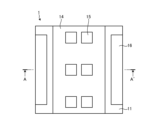
- FIG. 1 is a plan view of a photoelectric conversion element according to the first embodiment.
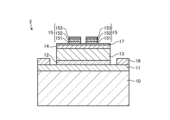
- FIG. 2 is a cross-sectional view taken along line A-A' shown in FIG.
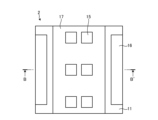
- FIG. 3 is a plan view of a photoelectric conversion element according to the second embodiment.
- FIG. 4 is a cross-sectional view taken along line B-B' shown in FIG.
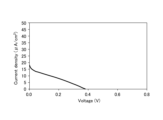
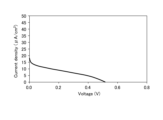
- FIG. 5A is a graph showing the results of measuring the current-voltage characteristics of the photoelectric conversion element of Comparative Example 1.
- FIG. 5B is a graph showing the results of measuring the current-voltage characteristics of the photoelectric conversion element of Comparative Example 1.
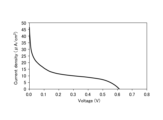
- FIG. 6 is a graph showing the results of measuring the current-voltage characteristics of the photoelectric conversion element of Comparative Example 2.
- FIG. 7 is a graph showing the results of measuring the current-voltage characteristics of the photoelectric conversion element of Comparative Example 3.
- FIG. 8 is a graph showing the results of measuring the current-voltage characteristics of the photoelectric conversion element of Reference Example 2.
- FIG. 9 is a graph showing the results of measuring the current-voltage characteristics of the photoelectric conversion element of Reference Example 3.
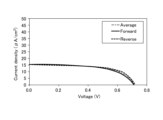
- FIG. 10 is a graph showing the results of measuring the current-voltage characteristics of the photoelectric conversion element 1 of Example 1.
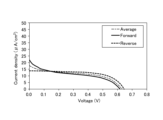
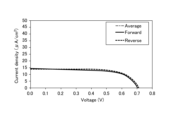
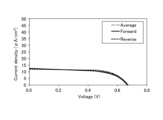
- FIG. 11A is a graph showing the results of measuring the current-voltage characteristics of the photoelectric conversion element 1 of Example 2.
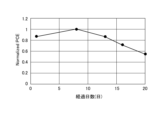
- FIG. 11B is a graph showing the change over time in conversion efficiency for the photoelectric conversion element 1 of Example 2.
- FIG. 12A is a graph showing the current-voltage characteristics of the photoelectric conversion element of Comparative Example 4.
- FIG. 12B is a graph showing the change over time in conversion efficiency for the photoelectric conversion element of Comparative Example 4.
- FIG. 13 is a graph showing the results of measuring the current-voltage characteristics of the photoelectric conversion element 1 of Example 3.
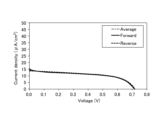
- FIG. 14 is a graph showing the results of measuring the current-voltage characteristics of the photoelectric conversion element 1 of Example 4.
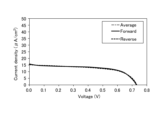
- FIG. 15 is a graph showing the results of measuring the current-voltage characteristics of the photoelectric conversion element 1 of Example 5.
- FIG. 16 is a graph showing the results of measuring the current-voltage characteristics of the photoelectric conversion element 1 of Example 6.
- FIG. 17 is a graph showing the results of measuring the current-voltage characteristics of the photoelectric conversion element 1 of Example 7.
- FIG. 18A is a graph showing the results of measuring the current-voltage characteristics of the photoelectric conversion element of Reference Example 4.
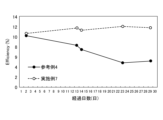
- FIG. 18B is a graph showing the change over time in conversion efficiency for the photoelectric conversion element 1 of Example 7 and the photoelectric conversion element of Reference Example 4.
- FIG. 19 is a graph showing the results of measuring the current-voltage characteristics of the photoelectric conversion element of Reference Example 1.
- FIG. 20 is a graph showing the results of measuring the current-voltage characteristics of the photoelectric conversion element 1 of Example 8.
- FIG. 21 is a graph showing the results of measuring the current-voltage characteristics of the photoelectric conversion element 1 of Example 9.
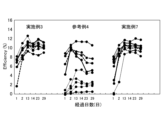
- FIG. 22 is a diagram showing the change over time in conversion efficiency depending on the measurement position for the photoelectric conversion element 1 of Example 3, the photoelectric conversion element of Reference Example 4, and the photoelectric conversion element 1 of Example 7.
- FIG. 23 is a diagram showing the change over time in conversion efficiency for the photoelectric conversion element 1 of Example 1, the photoelectric conversion element of Comparative Example 1, and the photoelectric conversion element of Comparative Example 4.
- FIG. 24A is a graph showing the results of measuring the current-voltage characteristics of the photoelectric conversion element 1 of Example 10.
- FIG. 24B is a graph showing the change over time in conversion efficiency for the photoelectric conversion element 1 of Example 10.
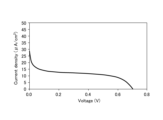
- FIG. 25A is a graph showing the results of measuring the current-voltage characteristics of the photoelectric conversion element of Comparative Example 5.
- FIG. 25B is a graph showing the change over time in conversion efficiency for the photoelectric conversion element of Comparative Example 5.
- FIG. 26 is a graph showing the results of measuring the current-voltage characteristics of the photoelectric conversion element 1 of Example 9.
- FIG. 27 is a graph showing the results of measuring the current-voltage characteristics of the photoelectric conversion element of Example 11.
- FIG. 28 is a graph showing the results of measuring the current-voltage characteristics of the photoelectric conversion element of Example 12.
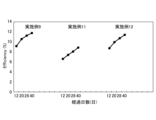
- FIG. 29 is a graph showing the change over time in conversion efficiency for the photoelectric conversion element 1 of Example 9, the photoelectric conversion element of Example 11, and the photoelectric conversion element of Example 12.
- Fig. 1 is a plan view of a photoelectric conversion element according to embodiment 1, and Fig. 2 is a cross-sectional view taken along line A-A' in Fig. 1.
- the photoelectric conversion element 1 includes a transparent conductive layer 11, a hole transport layer 12, a light absorbing layer 13, an electron transport layer 14, and an electrode (upper electrode 15) stacked in this order on a transparent substrate 10.
- the photoelectric conversion element 1 also typically includes a lower electrode 16.
- the photoelectric conversion element 1 is an inverted structure photoelectric conversion element that generates a voltage between the lower electrode 16 and the upper electrode 15 and outputs a current from the lower electrode 16 in response to light incident through the substrate 10 and the transparent conductive layer 11.
- the transparent substrate 10 is formed of a transparent material (such as insulating glass) capable of supporting the components included in the photoelectric conversion element 1 and transmitting the incident light incident on the photoelectric conversion element 1, and the light absorbed by the light absorbing layer 13 is incident on one side.
- the transparent material is a material that transmits light of a wavelength absorbed by the light absorbing layer 13, and is preferably a material having a transmittance of 80% or more for light in the wavelength region absorbed by the light absorbing layer 13, and more preferably a material having a transmittance of 95% or more for light in the wavelength region absorbed by the light absorbing layer 13.
- the transparent substrate 10 may be formed of a conductive material, or may be formed of a flexible synthetic resin such as polyimide, polyethylene naphthalate (PEN), or polyethylene terephthalate (PET).
- the transparent substrate 10 has a thickness of, for example, 0.1 mm or more and 5.0 mm or less.
- the transparent substrate 10 may have, for example, a flat plate shape, a film-like flat plate shape, or a cylindrical flat plate shape.
- the transparent conductive layer 11 is formed of a low-resistance material that is transparent like the transparent substrate 10 and can transport holes with high efficiency, and is formed on the transparent substrate 10 so as to cover the transparent substrate 10, so that one side of the transparent conductive layer 11 faces the other side of the transparent substrate 10.
- the transparent conductive layer 11 is, for example, a thin film formed of tin-doped indium oxide (ITO) that has a smooth surface, is very transparent, and has high conductivity.
- ITO tin-doped indium oxide
- the transparent conductive layer 11 is formed of a material that can be formed by low-temperature heat treatment, is transparent, and has high conductivity.
- the transparent conductive layer 11 preferably has a thickness of 0.01 ⁇ m or more and 10.0 ⁇ m or less, and more preferably has a thickness of 0.05 ⁇ m or more and 1.0 ⁇ m or less.
- the hole transport layer 12 is a p-type semiconductor layer that blocks electrons generated in the light absorption layer 13 and transports holes generated in the light absorption layer 13 to the transparent conductive layer 11 with high efficiency.
- the hole transport layer 12 is formed on the transparent conductive layer 11 so as to cover the transparent conductive layer 11, and is disposed such that one surface of the hole transport layer 12 faces the other surface of the transparent conductive layer 11.
- the hole transport layer 12 is transparent and is formed of, for example, nickel oxide (NiO x ), which has high hole transport properties.
- the hole transport layer 12 may be formed of an oxide such as cuprous oxide (Cu 2 O), copper oxide (CuO), or molybdenum oxide (MoO 3 ), or CuSCN.
- the light absorbing layer 13 is formed from an organic material that is difficult to dissolve in the solvent used when forming the light absorbing layer 13, such as poly[bis(4-phenyl)(2,4,6-trimethylphenyl)amine] (PTAA) or a composite of poly(3,4-ethylenedioxythiophene) (PEDOT) and polystyrene sulfonic acid (PSS) (PEDOT:PSS).
- PTAA poly[bis(4-phenyl)(2,4,6-trimethylphenyl)amine]
- PEDOT poly(3,4-ethylenedioxythiophene)
- PSS polystyrene sulfonic acid
- NiO x (0 ⁇ x ⁇ 1) is a p-type semiconductor with stable chemical properties and in which Ni vacancies function as acceptors without the addition of impurities, and can be used as a material for the hole transport layer 12.
- Nickel oxide (NiO:Zn) to which Zn is added has a lower resistivity than NiO x (0 ⁇ x ⁇ 1) by adding impurities, and the hole transport properties are improved.
- the content ratio of Ni to Zn, Ni:Zn is preferably 99 at% to 80 at%: 1 at% to 20 at%. If the content ratio of Zn is higher than 20 at%, the conversion efficiency of the photoelectric conversion element 1 may decrease.
- the hole transport layer 12 preferably has a film thickness of 10 nm to 300 nm. When the thickness of the hole transport layer 12 is thinner than 10 nm, the light absorption layer 13 may not be sufficiently covered by the hole transport layer 12. When the thickness of the hole transport layer 12 is thicker than 300 nm, the resistance between the transparent conductive layer 11 and the light absorption layer 13 may become large, and the conversion efficiency of the photoelectric conversion element 1 may decrease.
- the light absorbing layer 13 includes a material containing a halide ion.
- a material containing a halide ion a material further containing a silver ion (Ag + ) and a bismuth ion (Bi 3+ ) is preferably used.
- a halide ion F - , Cl - , Br - and I - can be used.
- a specific example of a material that contains silver ions and bismuth ions in addition to halide ions is an Ag/Bi-based material (also called a Rudolf Phyte material).
- the Ag/Bi-based material has a composition represented by Ag a Bi b X c , where X is F, Cl, Br, or I.
- (a+3b) ⁇ 0.8 ⁇ c ⁇ (a+3b) ⁇ 1.2 holds.
- Examples of (a, b) include (1,1), (3,1), (1,3), (2,1), (7,1), (9,1), (5,1), (1,2), and (5,3).
- errors due to defects or different phases contained in the crystal are allowed.
- the Ag/Bi-based material may be used alone or in combination of two or more kinds.
- the material containing halide ions may be a material in which Cu, Au, In, Na, K or NH4 is used instead of Ag in the above-mentioned Ag/Bi-based material, and Sb, Ga, In, Tl or La is used instead of Bi.
- the material containing halide ions may be an organic lead halide perovskite compound.
- An example of the organic lead halide perovskite compound is a compound represented by ( RNH3 ) nPbI ( 2+n) .
- R represents a hydrocarbon group
- n is 1 or 2.
- Specific examples of such compounds include ( CH3NH3 ) PbI3 , ( CH3CH2NH3 ) PbI3 , ( C6H5C2H4NH3 ) 2PbI4 , ( C10H7CH3NH3 ) 2PbI4 , and (C4H9C2H4NH3)2PbI4 .
- the organic lead halide perovskite compound may be used alone or in combination of two or more kinds.
- the light absorbing layer 13 preferably has a thickness of 10 nm or more and 10,000 nm or less, and more preferably has a thickness of 20 nm or more and 900 nm or less.
- the light absorbing layer 13 absorbs light incident through the transparent conductive layer 11 and the hole transport layer 12, and electrons are excited by the absorbed light, generating electrons and holes inside.
- the holes generated inside the light absorbing layer 13 are transported to the lower electrode 16 via the hole transport layer 12 and the transparent conductive layer 11.
- the electrons generated inside the light absorbing layer 13 are transported to the upper electrode 15 via the electron transport layer 14.
- the holes generated inside the light absorbing layer 13 are transported to the lower electrode 16, and the electrons generated inside the light absorbing layer 13 are transported to the upper electrode 15, so that the photoelectric conversion element 1 obtains an electromotive force.
- the electron transport layer 14 is an n-type semiconductor layer that blocks holes generated in the light absorption layer 13 and transports electrons generated in the light absorption layer 13 to the upper electrode 15 with high efficiency.
- the electron transport layer 14 is formed on the light absorption layer 13 so as to cover the light absorption layer 13, and is disposed so that one surface of the electron transport layer 14 faces the other surface of the light absorption layer 13.
- the electron transport layer 14 is preferably formed of a material having high electron transport properties.
- the electron transport layer 14 is formed of, for example, metal oxides such as titanium oxide (TiO 2 , etc.), tin oxide (SnO 2 , etc.), zinc oxide (ZnO), and aluminum oxide (Al 2 O 3 ), and C-based semiconductors such as fullerene (C 60 ) and phenyl-C 61 -butyric acid methyl ester (PCBM).
- the electron transport layer 14 preferably has a thickness of 1 nm or more and 200 nm or less, and more preferably has a thickness of 2 nm or more and 60 nm or less.
- the electron transport layer 14 is preferably made of C60 or PCBM, which can be formed at low temperatures since it is produced on the light absorption layer 13, and has good band alignment.
- the electron transport layer 14 preferably has a thickness of 2 nm to 40 nm. If C60 or PCBM is made thicker than 40 nm, the series resistance may increase and the conversion efficiency may decrease, and if it is made thinner than 2 nm , the conversion efficiency may decrease due to changes over time.
- the upper electrode 15 is constructed by stacking a first conductive layer 151, a second conductive layer 152, and a third conductive layer 153 in this order from the electron transport layer 14 side.
- the first conductive layer 151 is a layer that is in ohmic contact with the electron transport layer 14 and is intended to prevent the diffusion of halide ions to the second conductive layer 152 side, and can be, for example, a Bi layer containing bismuth (Bi). From the viewpoint of preventing the diffusion of halide ions, the film thickness of the first conductive layer 151 is preferably 10 nm or more and 70 nm or less, and more preferably 40 nm or more and 70 nm or less.
- the second conductive layer 152 is a layer intended to prevent a portion of the composition of the third conductive layer 153 from diffusing into the electron transport layer 14 or the light absorption layer 13, and can be, for example, a Ti layer containing titanium (Ti) or a Cr layer containing chromium (Cr).
- the second conductive layer 152 preferably has a thickness of 2 nm or more and 60 nm or less, and more preferably has a thickness of 10 nm or more and 20 nm or less.
- the third conductive layer 153 is disposed on the outermost surface of the photoelectric conversion element 1 and is a layer that is less reactive with oxygen or halide ions than the second conductive layer 152, and can be, for example, an Au layer containing gold (Au). From the viewpoint of efficiently collecting current, the third conductive layer preferably has a thickness of 10 nm to 20 nm.
- the third conductive layer 153 preferably contains a material with a work function of 5.0 eV or more, since a large work function tends to make the third conductive layer 153 less prone to oxidation and less prone to react with halide ions.
- the third conductive layer 153 may also be a transparent conductive film (TCO) such as tin-doped indium oxide (ITO) or aluminum-doped zinc oxide (AZO), which is a material that is less prone to oxidation in the air and less prone to react with halide ions.
- TCO transparent conductive film
- ITO tin-doped indium oxide
- AZO aluminum-doped zinc oxide
- the upper electrode 15 including the first conductive layer 151, the second conductive layer 152, and the third conductive layer 153 prevents interdiffusion of halogens in the metal and light absorbing layer, providing a solar cell with high conversion efficiency and long-term stability.
- C60 which is often used as an electron transport layer in conventional inverted structure types, needs to be thin because its electron transport properties are relatively low.
- metals with a small work function that come into ohmic contact with the electron transport layer are prone to diffusion and also easily react with the halogens that make up the light absorption layer, so their long-term stability is low.
- such metals are prone to oxidation, so the electrode surface is oxidized, the series resistance increases, and the conversion efficiency decreases.
- Au is a stable metal that is difficult to oxidize, but it has a large work function and makes Schottky contact with the electron transport layer, which deteriorates its properties.
- Non-Patent Document 2 an electrode in which Ti is placed between Au and the electron transport layer has been proposed (for example, Non-Patent Document 2).
- Ti suppresses the diffusion of Au into the electron transport layer and light absorption layer, but it cannot be made thick because it reacts with halide ions diffused from the light absorption layer, resulting in high resistance, and the properties deteriorate due to insufficient thickness.
- an electrode using Bi as an electrode or an electrode in which Bi is placed between Ag and the electron transport layer has been proposed (for example, Non-Patent Document 1).
- the electron transport layer side is made of a Bi layer that is in ohmic contact with the electron transport layer and does not react with halide ions, and an Au electrode that is not easily oxidized and does not react with halide ions is provided on top of the Bi layer.
- the photoelectric conversion element 1 includes an electrode formed by stacking a Bi layer/Ti layer or a Cr layer/Au layer, which not only prevents diffusion but also improves contact with the light absorption layer. In other words, the photoelectric conversion element 1 has high conversion efficiency and can be used stably for a long period of time.
- the lower electrode 16 is formed of a material that provides ohmic contact at the junction surface with the transparent conductive layer 11 disposed below.
- the lower electrode 16 may be formed on the transparent conductive layer 11, and may be configured, like the upper electrode 15, by laminating a first conductive layer, a second conductive layer, and a third conductive layer in this order from the transparent conductive layer 11 side.
- a Bi layer containing bismuth (Bi) as the first conductive layer, a Ti layer containing titanium (Ti) or a Cr layer containing chromium (Cr) as the second conductive layer, and an Au layer containing gold (Au) as the third conductive layer are laminated in this order.
- the lower electrode 16 can be simultaneously manufactured by the same manufacturing process as the upper electrode 15.
- the lower electrode 16 may also be formed of metals such as Ag, Al, and Zn that have a relatively small work function, or may be formed of a carbon-based electrode such as graphite.
- the lower electrode 16 may be formed as a single metal layer of any of Ti, Ag, Al, and Zn, but it is possible to prevent oxidation by oxygen in the air by further forming a film of Au, Pt, etc., which are difficult to oxidize.
- the lower electrode 16 may also be formed of a transparent conductive film with high conductivity, such as ITO.
- the lower electrode 16 preferably has a thickness of 2 nm to 200 nm.
- the thickness of the lower electrode 16 When the thickness of the lower electrode 16 is thinner than 2 nm, the resistance value in the extension direction of the lower electrode 16 increases, the efficiency of collecting holes decreases, and the conversion efficiency of the photoelectric conversion element 1 may decrease.
- the thickness of the lower electrode 16 is thicker than 200 nm, the resistance value in the film thickness direction of the lower electrode 16 increases, the conversion efficiency of the photoelectric conversion element 1 decreases, and the amount of material forming the lower electrode 16 increases, which tends to increase the manufacturing cost.
- the photoelectric conversion element 1 can be manufactured, for example, by the following manufacturing method.
- the transparent conductive layer 11 is formed on the transparent substrate 10 by a film formation method such as a vacuum deposition method, a sputtering method, a CVD method, or a plating method.
- the transparent substrate 10 on which the transparent conductive layer 11 is formed is preferably cleaned in a cleaning process such as UV ozone cleaning.
- the hole transport layer 12 is formed on the surface of the transparent conductive layer 11 formed on the transparent substrate 10 by a film formation method such as a vacuum deposition method or a sputtering method.
- the light absorption layer 13 is formed on the surface of the hole transport layer 12 formed on the transparent conductive layer 11 by a film formation method such as a spin coating method or an inkjet method.
- the electron transport layer 14 is formed on the surface of the light absorption layer 13 formed on the hole transport layer 12 by a film formation method such as a vacuum deposition method or a spin coating method.
- the upper electrode 15 is formed on the surface of the electron transport layer 14 formed on the light absorption layer 13 by a film formation method such as a vacuum deposition method, a sputtering method, or a plating method.
- the vacuum deposition method it is preferable to continuously form the Bi layer, the Ti layer or the Cr layer, and the Au layer without opening the vacuum chamber.
- the lower electrode 16 is formed on the surface of the transparent conductive layer 11 formed on the transparent substrate 10 by a film formation method such as a vacuum deposition method, a sputtering method, or a plating method.
- the lower electrode 16 can be formed simultaneously with the upper electrode 15.
- Fig. 3 is a plan view of a photoelectric conversion element according to embodiment 2, and Fig. 4 is a cross-sectional view taken along line BB' in Fig. 3.
- Photoelectric conversion element 2 differs from photoelectric conversion element 1 in that a contact layer 17 is further laminated between the electron transport layer 14 and the electrode (upper electrode 15).
- the configurations and functions of the components of photoelectric conversion element 2 other than the contact layer 17 are the same as those of the components of photoelectric conversion element 1 with the same reference numerals, and therefore detailed description thereof will be omitted here.
- photoelectric conversion element 2 also has high conversion efficiency and can be used stably for a long period of time.
- the contact layer 17 By forming the contact layer 17, the deterioration of the conversion efficiency in the photoelectric conversion element 2 due to changes over time can be further suppressed. In addition, the electrical contact is improved, and an ohmic contact is formed between the electron transport layer 14 and the upper electrode 15. Bathocuproine (BCP) is preferably used as a material for forming the contact layer 17.
- the contact layer 17 preferably has a thickness of 0.2 nm or more and 5 nm or less.
- the photoelectric conversion element 2 can be manufactured, for example, by the same manufacturing method as the photoelectric conversion element 1. However, it differs from the photoelectric conversion element 1 in that the contact layer 17 is formed on the surface of the electron transport layer 14 formed on the light absorption layer 13 by a film formation method such as spin coating or vacuum deposition.
- the upper electrode 15 is formed on the surface of the contact layer 17 formed on the electron transport layer 14 in the same manner as the photoelectric conversion element 1.
- a buffer layer that does not block light or impede hole transport may be formed between the transparent conductive layer 11 and the hole transport layer 12.
- the buffer layer is formed of, for example, [2-(3,6-dimethoxy-9H-carbazol-9-yl)ethyl]phosphonic acid (MeO-2PACz).
- the third conductive layer 153, the second conductive layer 152, the first conductive layer 151, the electron transport layer 14, the light absorbing layer 13, the hole transport layer 12, and the transparent conductive layer 11 may be formed in this order on the transparent substrate 10, and light may be incident on the side of the transparent conductive layer 11 on the outermost surface side.
- a non-transparent substrate may be used instead of the transparent substrate 10.
- the solar cell of the third embodiment includes the photoelectric conversion element described above.
- the solar cell has high conversion efficiency and can be used stably for a long time.
- the solar cell is also suitable for use in portable devices. Examples of portable devices include wristwatches, pocket watches, gyro sensors, air pressure sensors, hearing aids, and handheld GPS; digital cameras, video cameras, portable music players, IC recorders, portable video players, pocket computers, calculators, portable game consoles, notebook computers, PDAs, smartphones, portable printers, portable scanners, portable modems, and electronic dictionaries; and communication devices such as mobile phones, satellite phones, pagers, portable radios, portable televisions, one-segment broadcasting, IC cards with built-in processors, and RFID tags.
- the solar cell of the third embodiment and the portable device including the solar cell can be manufactured by a known method using the photoelectric conversion element described above.
- a photoelectric conversion element comprising a transparent conductive layer, a hole transport layer, a light absorbing layer, an electron transport layer, and an electrode laminated in this order, the light absorbing layer containing a material containing a halide ion, the electrode comprising a first conductive layer, a second conductive layer, and a third conductive layer laminated in this order from the electron transport layer side, the first conductive layer being in ohmic contact with the electron transport layer and preventing diffusion of the halide ion toward the second conductive layer side, the second conductive layer preventing diffusion of the third conductive layer toward the electron transport layer or the light absorbing layer, and the third conductive layer having a lower reactivity with oxygen or the halide ion than the second conductive layer.
- the photoelectric conversion element according to claim 1, wherein the third conductive layer has a work function of 5.0 eV or more. [3] The photoelectric conversion element according to claim 1, wherein the first conductive layer contains Bi. [4] The photoelectric conversion element according to claim 1, wherein the second conductive layer contains Ti or Cr. [5] The photoelectric conversion element according to claim 1, wherein the third conductive layer contains Au, Pt or C.
- a photoelectric conversion element comprising a transparent conductive layer, a hole transport layer, a light absorbing layer, an electron transport layer, and an electrode laminated in this order, the light absorbing layer containing a material containing a halide ion, and the electrode comprising a Bi layer, a Ti layer or a Cr layer, and an Au layer laminated in this order from the electron transport layer side.
- the photoelectric conversion element according to [6] wherein the material contained in the light absorbing layer further contains silver ions and bismuth ions.
- the photoelectric conversion element has high conversion efficiency and can be used stably for a long period of time.
- a solar cell comprising the photoelectric conversion element according to [1] or [6]. The solar cell has high conversion efficiency and can be used stably for a long period of time.
- Comparative Example 1 is a photoelectric conversion element having a different upper electrode 15 from that of the photoelectric conversion element of Embodiment 1. That is, the upper electrode and the lower electrode of Comparative Example 1 were Ti layer/Au layer, and were fabricated so that the Ti layer had a thickness of 2 nm and the Au layer had a thickness of 70 nm.
- an ITO glass substrate having a planar shape of 25 mm ⁇ 25 mm and having a transparent conductive layer 11 formed on a transparent substrate 10 was prepared, and the prepared ITO glass substrate was subjected to UV ozone cleaning.
- the thickness of the glass substrate corresponding to the transparent substrate 10 was 1 mm
- the thickness of the ITO film corresponding to the transparent conductive layer 11 was 1 ⁇ m.
- the NiO:Zn layer corresponding to the hole transport layer 12 was formed on the surface of the ITO film formed on the ITO glass substrate by vacuum deposition using EX-200 manufactured by ULVAC, Inc., by heating with an EB gun.
- the material used for forming the hole transport layer 12 was prepared by mixing NiO powder and ZnO powder in a mortar so that Ni:Zn was 90:10, press molding, and then baking to form a tablet.
- the ITO glass substrate on which the transparent conductive layer 11 was formed was placed on a metal mask with a hole of 25 mm x 15 mm, the NiO:Zn tablet was filled in a water-cooled hearth, and the inside of the vacuum chamber was evacuated to 4 x 10 -5 Torr or less.
- the NiO:Zn sample was degassed and heated with an EB gun, and then the shutter was opened and the evaporated particles from the NiO:Zn sample were deposited on the surface of the transparent conductive layer 11.
- an AgBi2.25I7.75 film corresponding to the light absorbing layer 13 was formed on the surface of the hole transport layer 12 by spin coating.
- the Rudolph Phyte material precursor-containing solution was prepared by placing AgI and BiI3 in a container and dissolving them by pouring DMSO into the container containing the AgI and BiI3.
- the AgI and BiI3 placed in the container were prepared so that the ratio of Ag:Bi:I in the Rudolph Phyte material precursor-containing solution was 1:2.25:7.75.
- the rotation speed in the spin coating was 4000 rpm, and the time for which the Rudolph Phyte material precursor-containing solution was applied was 30 seconds.
- the ITO glass substrate coated with the Rudolf Phytotec material precursor-containing solution was pre-dried at 70° C. for 4 minutes and then baked at 90° C.
- the C 60 layer corresponding to the electron transport layer 14 was formed on the surface of the light absorption layer 13 by heating with an EB-gun by a vacuum deposition method using EX-200 manufactured by ULVAC, Inc.
- the material used for forming the electron transport layer 14 was C 60 powder.
- the ITO glass substrate on which the light absorption layer 13 was formed was placed on a metal mask with a hole of 25 mm x 15 mm, the C 60 powder was filled in a water-cooled hearth, and the inside of the vacuum chamber was evacuated to 4 x 10 -5 Torr or less.
- the C 60 powder was degassed and heated with an EB-gun, and then the shutter was opened, and the evaporated particles evaporated from the C 60 powder were deposited on the surface of the light absorption layer 13.
- the film thickness of the formed C 60 layer was 2 nm.
- the region where the electron transport layer 14 was formed was restricted with a metal mask, and the portions of the hole transport layer 12, the light absorption layer 13 and the electron transport layer 14 exposed from the mask were removed with DMF.
- the Ti layer/Au layer corresponding to the upper electrode 15 and the lower electrode 16 were formed on the surfaces of the ITO film and the C60 layer by heating with an EB gun by a vacuum deposition method using an EX-200 manufactured by ULVAC, Inc., completing the photoelectric conversion element according to Comparative Example 1.
- the ITO glass substrate was placed on a metal mask having two holes of 3.25 mm x 20 mm for electrodes collecting holes and six holes of 3.2 mm x 3.2 mm for electrodes collecting electrons, and the area to be deposited was restricted so that the area of the Ti layer/Au layer would be the desired area.
- Ti having a diameter of 1 mm or more and 2 mm or less was filled into a water-cooled hearth, and after exhausting to 4 ⁇ 10 ⁇ 5 Torr or less, the material was degassed, heated with an EB gun, and the shutter was opened, and deposition was performed so that the Ti layer had a thickness of 2 nm.
- the water-cooled hearth containing Ti was sufficiently cooled, it was switched to a water-cooled hearth filled with Au having a diameter of 1 mm or more and 2 mm or less by the rotation mechanism, and it was confirmed that the pressure had been exhausted to 4 ⁇ 10 ⁇ 5 Torr or less.
- the material was degassed, heated with an EB gun, and the shutter was opened, and deposition was performed so that the Au layer had a thickness of 70 nm.
- Comparative Example 2 In Comparative Example 2, except for changing the thicknesses of the Ti layer/Au layer corresponding to the upper electrode and the lower electrode, a photoelectric conversion element was obtained in the same manner as in Comparative Example 1. That is, the upper electrode and the lower electrode in Comparative Example 2 were Ti layer/Au layer, and were prepared so that the Ti layer was 20 nm thick and the Au layer was 52 nm thick. Specifically, the Ti layer/Au layer corresponding to the upper electrode 15 and the lower electrode 16 were formed on the surfaces of the ITO film and the C60 layer by heating with an EB gun by a vacuum deposition method using an EX-200 manufactured by ULVAC, Inc., completing the photoelectric conversion element according to Comparative Example 2.
- the ITO glass substrate was placed on a metal mask having two holes of 3.25 mm x 20 mm for electrodes collecting holes and six holes of 3.2 mm x 3.2 mm for electrodes collecting electrons, and the area on which the Ti layer/Au layer was deposited was restricted so that the area was the desired area.
- a metal mask having two holes of 3.25 mm x 20 mm for electrodes collecting holes and six holes of 3.2 mm x 3.2 mm for electrodes collecting electrons, and the area on which the Ti layer/Au layer was deposited was restricted so that the area was the desired area.
- Ti having a diameter of 1 mm or more and 2 mm or less was filled into a water-cooled hearth, and after exhausting to 4 ⁇ 10 ⁇ 5 Torr or less, the material was degassed, heated with an EB gun, and the shutter was opened, and deposition was performed so that the Ti layer had a thickness of 20 nm.
- the water-cooled hearth containing Ti was sufficiently cooled, it was switched to a water-cooled hearth filled with Au having a diameter of 1 mm or more and 2 mm or less by the rotation mechanism, and it was confirmed that the pressure had been exhausted to 4 ⁇ 10 ⁇ 5 Torr or less.
- the material was degassed, heated with an EB gun, and the shutter was opened, and deposition was performed so that the Au layer had a thickness of 52 nm.
- Comparative Example 3 In Comparative Example 3, except for changing the thicknesses of the Ti layer/Au layer corresponding to the upper electrode and the lower electrode, a photoelectric conversion element was obtained in the same manner as in Comparative Example 2. That is, the upper electrode and the lower electrode in Comparative Example 3 were Ti layer/Au layer, and were prepared so that the Ti layer was 70 nm thick and the Au layer was 2 nm thick.
- the ITO glass substrate was placed on a metal mask in which two holes of 3.25 mm x 20 mm for electrodes collecting holes and six holes of 3.2 mm x 3.2 mm for electrodes collecting electrons were formed, and the area to be deposited was restricted so that the area of the Bi layer would be the desired area.
- Bi having a diameter of 1 mm to 2 mm was filled into a water-cooled hearth, and after evacuating to 4 ⁇ 10 Torr or less, the material was degassed and heated with an EB gun, the shutter was opened, and deposition was performed so that the Bi layer had a thickness of 72 nm.
- Reference Example 1 a photoelectric conversion element was obtained in the same manner as in Comparative Example 1, except that the Ti layer/Au layer corresponding to the upper electrode and the lower electrode were replaced with a Cr layer/Au layer. That is, the upper electrode and the lower electrode in Reference Example 1 were Cr layer/Au layer, and were prepared so that the Cr layer had a thickness of 2 nm and the Au layer had a thickness of 70 nm. Specifically, the Cr layer/Au layer corresponding to the upper electrode 15 and the lower electrode 16 were formed on the surfaces of the ITO film and the C60 layer by heating with an EB gun according to a vacuum deposition method using an EX-200 manufactured by ULVAC, Inc., completing the photoelectric conversion element according to Reference Example 1.
- the ITO glass substrate was placed on a metal mask having two holes of 3.25 mm x 20 mm for electrodes collecting holes and six holes of 3.2 mm x 3.2 mm for electrodes collecting electrons, and the area to be deposited was restricted so that the area of the Cr layer/Au layer would be the desired area.
- Cr having a diameter of 1 mm to 2 mm was filled into a water-cooled hearth, and after exhausting to 4 ⁇ 10 ⁇ 5 Torr or less, the material was degassed, heated with an EB gun, and the shutter was opened, and deposition was performed so that the Cr layer had a thickness of 2 nm.
- the water-cooled hearth containing Cr was sufficiently cooled, it was switched to a water-cooled hearth filled with Au having a diameter of 1 mm to 2 mm by the rotation mechanism, and it was confirmed that the pressure had been exhausted to 4 ⁇ 10 ⁇ 5 Torr or less.
- the material was degassed, heated with an EB gun, and the shutter was opened, and deposition was performed so that the Au layer had a thickness of 70 nm.
- Reference Example 2 a photoelectric conversion element was obtained in the same manner as in Comparative Example 1, except that the Ti layer/Au layer corresponding to the upper electrode and the lower electrode were replaced with a Bi layer/Au layer. That is, the upper electrode and the lower electrode in Reference Example 2 were fabricated as a Bi layer/Au layer, with the Bi layer being 2 nm thick and the Au layer being 70 nm thick. Specifically, the Bi layer/Au layer corresponding to the upper electrode 15 and the lower electrode 16 were formed on the surfaces of the ITO film and the C60 layer by heating with an EB gun according to a vacuum deposition method using an EX-200 manufactured by ULVAC, Inc., completing the photoelectric conversion element according to Reference Example 2.
- the ITO glass substrate was placed on a metal mask having two holes of 3.25 mm x 20 mm for electrodes collecting holes and six holes of 3.2 mm x 3.2 mm for electrodes collecting electrons, and the area to be deposited was restricted so that the area of the Bi layer/Au layer would be the desired area.
- Bi having a diameter of 1 mm or more and 2 mm or less was filled into a water-cooled hearth, and after exhausting to 4 ⁇ 10 ⁇ 5 Torr or less, the material was degassed, heated with an EB gun, and the shutter was opened, and deposition was performed so that the thickness of the Bi layer was 2 nm.
- the water-cooled hearth containing Bi was sufficiently cooled, it was switched to a water-cooled hearth filled with Au having a diameter of 1 mm or more and 2 mm or less by the rotation mechanism, and it was confirmed that it was exhausted to 4 ⁇ 10 ⁇ 5 Torr or less.
- the material was degassed, heated with an EB gun, and the shutter was opened, and deposition was performed so that the thickness of the Au layer was 70 nm.
- Reference Example 3 In Reference Example 3, except for changing the thicknesses of the Bi layer/Au layer corresponding to the upper electrode and the lower electrode, a photoelectric conversion element was obtained in the same manner as in Reference Example 2. That is, the upper electrode and the lower electrode in Reference Example 3 were Bi layer/Au layer, and were prepared so that the Bi layer was 10 nm thick and the Au layer was 62 nm thick.
- Reference Example 4 a photoelectric conversion element was obtained in the same manner as in Comparative Example 1, except that the Ti layer/Au layer corresponding to the upper electrode and the lower electrode were replaced with a Bi layer/Ti layer. That is, the upper electrode and the lower electrode in Reference Example 4 were fabricated as a Bi layer/Ti layer, with the Bi layer being 70 nm thick and the Ti layer being 30 nm thick. Specifically, the Bi layer/Ti layer corresponding to the upper electrode 15 and the lower electrode 16 were formed on the surfaces of the ITO film and the C60 layer by heating with an EB gun by a vacuum deposition method using an EX-200 manufactured by ULVAC, Inc., completing the photoelectric conversion element according to Reference Example 4.
- the ITO glass substrate was placed on a metal mask having two holes of 3.25 mm x 20 mm for electrodes collecting holes and six holes of 3.2 mm x 3.2 mm for electrodes collecting electrons, and the area to be deposited was restricted so that the area of the Bi layer/Ti layer would be the desired area.
- Bi having a diameter of 1 mm or more and 2 mm or less was filled into a water-cooled hearth, and after exhausting to 4 ⁇ 10 ⁇ 5 Torr or less, the material was degassed, heated with an EB gun, and the shutter was opened, and deposition was performed so that the thickness of the Bi layer was 70 nm.
- the water-cooled hearth containing Bi was sufficiently cooled, it was switched to a water-cooled hearth filled with Ti having a diameter of 1 mm or more and 2 mm or less by the rotation mechanism, and it was confirmed that it was exhausted to 4 ⁇ 10 ⁇ 5 Torr or less.
- the material was degassed, heated with an EB gun, and the shutter was opened, and deposition was performed so that the thickness of the Ti layer was 30 nm.
- Example 1 is the photoelectric conversion element of embodiment 1. That is, the upper electrode 15 of Example 1 was a Bi layer/Ti layer/Au layer, and was fabricated so that the Bi layer had a thickness of 10 nm, the Ti layer had a thickness of 2 nm, and the Au layer had a thickness of 60 nm.
- an ITO glass substrate having a planar shape of 25 mm ⁇ 25 mm and having a transparent conductive layer 11 formed on a transparent substrate 10 was prepared, and the prepared ITO glass substrate was subjected to UV ozone cleaning.
- the thickness of the glass substrate corresponding to the transparent substrate 10 was 1 mm
- the thickness of the ITO film corresponding to the transparent conductive layer 11 was 1 ⁇ m.
- the NiO:Zn layer corresponding to the hole transport layer 12 was formed on the surface of the ITO film formed on the ITO glass substrate by vacuum deposition using EX-200 manufactured by ULVAC, Inc., by heating with an EB gun.
- the material used for forming the hole transport layer 12 was prepared by mixing NiO powder and ZnO powder in a mortar so that Ni:Zn was 90:10, press molding, and then baking to form a tablet.
- the ITO glass substrate on which the transparent conductive layer 11 was formed was placed on a metal mask with a hole of 25 mm x 15 mm, the NiO:Zn tablet was filled in a water-cooled hearth, and the inside of the vacuum chamber was evacuated to 4 x 10 -5 Torr or less.
- the Rudolph Phyte material precursor-containing solution was prepared by placing AgI and BiI3 in a container and dissolving them by pouring DMSO into the container containing the AgI and BiI3. The AgI and BiI3 placed in the container were prepared so that the ratio of Ag:Bi:I in the Rudolph Phyte material precursor-containing solution was 1:2.25:7.75.
- the rotation speed in the spin coating was 4000 rpm, and the time for which the Rudolph Phyte material precursor-containing solution was applied was 30 seconds.
- the ITO glass substrate coated with the Rudolf Phytotec material precursor-containing solution was pre-dried at 70° C. for 4 minutes and then baked at 90° C. for 1 hour to form an AgBi2.25I7.75 film corresponding to the light absorption layer 13 containing the Rudolf Phytotec material.
- the thickness of the formed AgBi2.25I7.75 film was 700 nm.
- the C 60 layer corresponding to the electron transport layer 14 was formed on the surface of the light absorption layer 13 by vacuum deposition using EX-200 manufactured by ULVAC, Inc., by heating with an EB-gun.
- the material used for forming the electron transport layer 14 was C 60 powder, and the ITO glass substrate on which the light absorption layer 13 was formed was placed on a metal mask with a hole of 25 mm x 15 mm, the C 60 powder was filled in a water-cooled hearth, and the inside of the vacuum chamber was evacuated to 4 x 10 -5 Torr or less. Next, the C 60 powder was degassed and heated with an EB-gun, and then the shutter was opened, and the evaporated particles evaporated from the C 60 sample were deposited on the surface of the light absorption layer 13. The film thickness of the formed C 60 layer was 2 nm.
- the region where the electron transport layer 14 was formed was restricted with a metal mask, and the portions of the hole transport layer 12, the light absorption layer 13 and the electron transport layer 14 exposed from the mask were removed with DMF.
- the Bi/Ti/Au layers corresponding to the upper electrode 15 and the lower electrode 16 were formed on the surfaces of the ITO film and the C60 layer by heating with an EB gun by a vacuum deposition method using an EX-200 manufactured by ULVAC, Inc., completing the photoelectric conversion element according to Example 1.
- the ITO glass substrate was placed on a metal mask in which two holes of 3.25 mm ⁇ 20 mm for electrodes collecting holes and six holes of 3.2 mm ⁇ 3.2 mm for electrodes collecting electrons were formed, and the area to be deposited was restricted so that the area of the Bi/Ti/Au layers would be the desired area.
- Bi having a diameter of 1 mm or more and 2 mm or less was filled in a water-cooled hearth, and after exhausting to 4 ⁇ 10 ⁇ 5 Torr or less, the material was degassed, heated with an EB-gun, and the shutter was opened, and deposition was performed so that the thickness of the Bi layer was 10 nm.
- the water-cooled hearth containing Bi when the water-cooled hearth containing Bi was sufficiently cooled, it was switched to a water-cooled hearth filled with Ti having a diameter of 1 mm or more and 2 mm or less by a rotation mechanism, and after exhausting to 4 ⁇ 10 ⁇ 5 Torr or less, the material was degassed, heated with an EB-gun, and the shutter was opened, and deposition was performed so that the thickness of the Ti layer was 2 nm.
- the water-cooled hearth containing Ti when the water-cooled hearth containing Ti was sufficiently cooled, it was switched to a water-cooled hearth filled with Au having a diameter of 1 mm or more and 2 mm or less by a rotation mechanism, and it was confirmed that it was exhausted to 4 ⁇ 10 ⁇ 5 Torr or less.
- the material was degassed, heated with an EB-gun, and the shutter was opened, and deposition was performed so that the thickness of the Au layer was 60 nm.
- Example 2 photoelectric conversion element 1 was obtained in the same manner as in Example 1, except that the thicknesses of the Bi layer/Ti layer/Au layer corresponding to upper electrode 15 and lower electrode 16 were changed. That is, upper electrode 15 and lower electrode 16 in Examples 2 to 7 were Bi layer/Ti layer/Au layer.
- the Bi layer was fabricated to a thickness of 10 nm
- the Ti layer was fabricated to a thickness of 10 nm
- the Au layer was fabricated to a thickness of 52 nm.
- Example 3 the Bi layer was fabricated to a thickness of 50 nm
- the Ti layer to a thickness of 10 nm
- the Au layer to a thickness of 20 nm.
- Example 4 the Bi layer was fabricated to a thickness of 50 nm, the Ti layer to a thickness of 20 nm, and the Au layer to a thickness of 20 nm.
- Example 5 the Bi layer was fabricated to a thickness of 20 nm, the Ti layer to a thickness of 10 nm, and the Au layer to a thickness of 40 nm.
- Example 6 the Bi layer was fabricated to a thickness of 40 nm, the Ti layer to a thickness of 10 nm, and the Au layer to a thickness of 20 nm.
- Example 7 the Bi layer was fabricated to a thickness of 70 nm, the Ti layer to a thickness of 10 nm, and the Au layer to a thickness of 20 nm.
- Example 8 and 9 the photoelectric conversion element 1 was obtained in the same manner as in Examples 3 and 4, except that the Bi layer/Ti layer/Au layer corresponding to the upper electrode 15 and the lower electrode 16 was replaced with a Bi layer/Cr layer/Au layer. Specifically, the photoelectric conversion element 1 was obtained in the same manner as in Examples 3 and 4, except that Cr having a diameter of 1 mm or more and 2 mm or less was used as an evaporation source instead of Ti having a diameter of 1 mm or more and 2 mm or less when forming the upper electrode 15 and the lower electrode 16. That is, the upper electrode 15 and the lower electrode 16 in Examples 8 and 9 were a Bi layer/Cr layer/Au layer.
- Example 8 the Bi layer was fabricated to a thickness of 50 nm, the Cr layer to a thickness of 10 nm, and the Au layer to a thickness of 20 nm.
- Example 9 the Bi layer was fabricated to a thickness of 50 nm, the Cr layer to a thickness of 20 nm, and the Au layer to a thickness of 20 nm.
- Example 10 is the photoelectric conversion element of embodiment 2. That is, the upper electrode 15 and the lower electrode 16 of Example 10 were fabricated as a Bi layer/Ti layer/Au layer, with the Bi layer having a thickness of 20 nm, the Ti layer having a thickness of 10 nm, and the Au layer having a thickness of 40 nm. The process was the same as in Example 1 up to the formation of the C 60 layer corresponding to the electron transport layer 14. Next, the BCP layer corresponding to the contact layer 17 was formed on the surface of the electron transport layer 14 by heating with an EB-gun by a vacuum deposition method using EX-200 manufactured by ULVAC, Inc. The material used for forming the contact layer 17 was BCP powder.
- the ITO glass substrate on which the electron transport layer 14 was formed was placed on a metal mask with a hole of 25 mm x 15 mm, the BCP powder was filled in a water-cooled hearth, and the inside of the vacuum chamber was evacuated to 4 x 10 -5 Torr or less.
- the BCP powder was degassed and heated with the EB-gun, and then the shutter was opened, and the evaporated particles evaporated from the BCP powder were evaporated on the surface of the electron transport layer 14.
- the film thickness of the formed contact layer 17 was 0.2 nm.
- the region where the contact layer 17 was formed was restricted with a metal mask, and the portions of the hole transport layer 12, the light absorption layer 13, the electron transport layer 14 and the contact layer 17 exposed from the mask were removed with DMF.
- the upper electrode 15 and the lower electrode 16 were formed on the surfaces of the ITO film and the contact layer by heating with an EB gun by a vacuum deposition method using an EX-200 manufactured by ULVAC, Inc., completing the photoelectric conversion element according to Example 10.
- the ITO glass substrate was placed on a metal mask in which two holes of 3.25 mm ⁇ 20 mm for electrodes collecting holes and six holes of 3.2 mm ⁇ 3.2 mm for electrodes collecting electrons were formed, and the area to be deposited was restricted so that the area of the Bi layer/Ti layer/Au layer would be the desired area.
- Bi As an evaporation source, Bi having a diameter of 1 mm or more and 2 mm or less was filled in a water-cooled hearth, and after exhausting to 4 ⁇ 10 ⁇ 5 Torr or less, the material was degassed, heated with an EB-gun, and the shutter was opened, and deposition was performed so that the thickness of the Bi layer was 20 nm.
- the water-cooled hearth containing Bi when the water-cooled hearth containing Bi was sufficiently cooled, it was switched to a water-cooled hearth filled with Ti having a diameter of 1 mm or more and 2 mm or less by a rotation mechanism, and after exhausting to 4 ⁇ 10 ⁇ 5 Torr or less, the material was degassed, heated with an EB-gun, and the shutter was opened, and deposition was performed so that the thickness of the Ti layer was 10 nm.
- the water-cooled hearth containing Ti when the water-cooled hearth containing Ti was sufficiently cooled, it was switched to a water-cooled hearth filled with Au having a diameter of 1 mm or more and 2 mm or less by a rotation mechanism, and it was confirmed that it was exhausted to 4 ⁇ 10 ⁇ 5 Torr or less.
- the material was degassed and heated with an EB gun, and then the shutter was opened to perform deposition so that the Au layer had a thickness of 40 nm.
- Example 11 a photoelectric conversion element was obtained in the same manner as in Example 9, except that the upper electrode and the lower electrode were made of a Bi layer/Cr layer/Pt layer. Specifically, the Pt layer was made of Pt having a diameter of 1 mm or more and 2 mm or less as an evaporation source. In Example 11, the Bi layer was made to have a thickness of 50 nm, the Cr layer was made to have a thickness of 20 nm, and the Pt layer was made to have a thickness of 20 nm.
- Example 12 In Example 12, the upper and lower electrodes were Bi layer/Cr layer/C layer, and the thickness of the C layer was 6 nm to obtain a photoelectric conversion element.
- the Bi layer/Cr layer was prepared in the same manner as in Example 9.
- the C layer was formed by depositing carbon to a thickness of 6 nm on the Cr layer by arc discharge in a vacuum chamber.
- the Bi layer was prepared to a thickness of 50 nm
- the Cr layer was prepared to a thickness of 20 nm
- the C layer was prepared to a thickness of 6 nm.
- Comparative Example 5 is a photoelectric conversion element in which the upper electrode 15 and the lower electrode 16 are different from those of the photoelectric conversion element of the second embodiment. That is, the upper electrode and the lower electrode of Comparative Example 5 are Bi layers, and the thickness of the Bi layer was made to be 70 nm. Specifically, when forming the upper electrode and the lower electrode, instead of Ti having a diameter of 1 mm or more and 2 mm or less, Bi having a diameter of 1 mm or more and 2 mm or less was used as an evaporation source, and the Bi layer was formed to a thickness of 70 nm. A photoelectric conversion element was obtained in the same manner as in Example 10.
- ⁇ Evaluation method> Method of measuring current-voltage characteristics under light irradiation
- the current-voltage characteristics under light irradiation were measured by the following method.
- a BLD-100 manufactured by Bunkoukeiki Co., Ltd. was used as the light source, and the illuminance was adjusted so that the light incident on the photoelectric conversion element from the light source was 200 lx.
- the light emitted from the light source was adjusted to be emitted to an area of 2.5 mm x 2.5 mm by a light-shielding mask, and the light source and the photoelectric conversion element were arranged so that the light was incident on the photoelectric conversion element from the transparent substrate side of the photoelectric conversion element.
- the current-voltage characteristics were measured by sequentially sweeping the voltage applied to the photoelectric conversion element from the negative side to the positive side using a PECK2400-N manufactured by Peccell Technologies Co., Ltd. Furthermore, the voltage applied to the photoelectric conversion element was sequentially swept from the positive side to the negative side. The conversion efficiency was also calculated from the measurement results of the current-voltage characteristics. In the figures described below, the measurement results of the current-voltage characteristics are shown as the results of sequentially sweeping from the negative side to the positive side (forward measurement results) unless otherwise specified. The conversion efficiencies obtained from the measurement results of the current-voltage characteristics are summarized in Table 1. Note that the photoelectric conversion elements were stored at room temperature and a humidity of 50% from the time of their production until the time of the measurement of the current-voltage characteristics.
- 5A and 5B show the results of measuring the current-voltage characteristics of the photoelectric conversion element of Comparative Example 1.
- Fig. 5A shows the characteristics 7 days after the photoelectric conversion element of Comparative Example 1 was produced
- Fig. 5B shows the characteristics after long-term storage (15 days) after the photoelectric conversion element of Comparative Example 1 was produced.
- the upper electrode was a Ti layer/Au layer
- the deterioration of the electrode was suppressed and the initial characteristics were greatly improved compared to when the Au layer was a single layer, but degradation was observed after long-term storage.
- 6 and 7 show the results of measuring the current-voltage characteristics of the photoelectric conversion elements of Comparative Examples 2 and 3, respectively. These characteristics are measured 22 days after the production of the photoelectric conversion elements of Comparative Examples 2 and 3.
- the upper electrode is a Ti layer/Au layer, if the Ti layer is made thick, the series resistance increases and the amount of power generation decreases.
- Figures 8 and 9 show the results of measuring the current-voltage characteristics of the photoelectric conversion elements of Reference Examples 2 and 3, respectively. These characteristics are measured 8 and 14 days after the photoelectric conversion elements were fabricated.
- the upper electrode was a Bi layer/Au layer
- discoloration of the Au was observed, which suggests that the Au had diffused.
- Au diffused, raising concerns about deterioration over the long term.
- making the Bi layer thicker suppresses the decrease in current.
- FIG. 10 and FIG. 11A show the results of measuring the current-voltage characteristics of the photoelectric conversion element 1 of Examples 1 and 2, respectively. The characteristics are two days after the photoelectric conversion element was produced.
- FIG. 11A also shows the results of the measurement by sweeping from the negative side to the positive side in sequence (forward measurement results), the results of the measurement by sweeping from the positive side to the negative side in sequence (reverse measurement results), and the average results obtained by averaging the results of the forward measurement and the reverse measurement results.
- the electrical contact was improved compared to the case of the Au layer alone, and V OC was high, but the electrode was slightly altered, although it was less than that of the Bi layer/Au layer.
- Example 2 the electrical contact was improved compared to the case of the Au layer alone, and V OC was high.
- the Ti layer was thickened, but the increase in series resistance was small, and the electrode was also less altered. From Examples 1 and 2, it is found that a photoelectric conversion element with little deterioration over time and high conversion efficiency can be obtained by providing a Bi layer between the electron transport layer and the Ti layer/Au layer.
- the increase in the series resistance is small even if the thickness of the Ti layer is increased, the Ti layer can be made thicker, so that the deterioration of the electrode is small and the diffusion of Au can be more effectively prevented.
- FIG. 11B is a diagram showing the change over time in the conversion efficiency of the photoelectric conversion element 1 of Example 2.
- FIG. 11B is a diagram showing the current-voltage characteristics 1, 2, and 3 days after the photoelectric conversion element was produced, and the current-voltage characteristics after long-term storage (7 and 15 days) were measured, and the conversion efficiency was calculated from these measurement results, with the initial conversion efficiency (after 1 day) being set as 1.
- FIG. 12A also shows the result of measuring the current-voltage characteristics of the photoelectric conversion element of Comparative Example 4. Note that this is the characteristic 1 day after the photoelectric conversion element was produced.
- FIG. 12B is a diagram showing the change over time in the conversion efficiency of the photoelectric conversion element of Comparative Example 4.
- FIG. 12B was also created in the same manner as FIG.
- Figures 13 and 14 show the results of measuring the current-voltage characteristics of the photoelectric conversion element 1 of Examples 3 and 4, respectively. These are the characteristics 13 days after the photoelectric conversion element was fabricated. In addition to the results of measurements swept from the negative side to the positive side in sequence (forward measurement results), the results of measurements swept from the positive side to the negative side in sequence (reverse measurement results), and the average results of the forward and reverse measurement results are also shown. It can be seen that the Bi layer suppresses the diffusion of iodine, and the change in conversion efficiency is small even if the Ti layer is made thicker. On the other hand, as shown in Figures 5A and 6, if the Bi layer is not provided, Ti in the Ti layer is iodized, and therefore the conversion efficiency decreases when the Ti layer is made thicker.
- Figures 15 to 17 show the results of measuring the current-voltage characteristics of the photoelectric conversion element 1 of Examples 5 to 7, respectively. The characteristics are 8 days, 8 days, and 13 days after the photoelectric conversion element was fabricated, respectively. In addition to the results of measurements swept from the negative side to the positive side in sequence (forward measurement results), the results of measurements swept from the positive side to the negative side in sequence (reverse measurement results), and the average results of the forward and reverse measurement results are also shown.
- Figures 10, 13, and 15 to 17 show that high conversion efficiency is obtained by increasing the thickness of the Bi layer, with a thickness of 40 nm to 70 nm being preferable, and approximately 50 nm being considered to be the optimal value.
- Figure 18A shows the results of measuring the current-voltage characteristics of the photoelectric conversion element of Reference Example 4. The characteristics are two days after the photoelectric conversion element was fabricated.
- Figure 18B shows the change in conversion efficiency over time for photoelectric conversion element 1 of Example 7 and the photoelectric conversion element of Reference Example 4.
- Figure 18B shows the conversion efficiency calculated from the current-voltage characteristics measured two days after the photoelectric conversion element was fabricated and after long-term storage (after 13 days, 14 days, 23 days, and 29 days). It can be seen that the Bi layer/Ti layer/Au layer shows smaller changes over time than the Bi layer/Ti layer.
- Figure 19 shows the results of measuring the current-voltage characteristics of the photoelectric conversion element of Reference Example 1. Note that these characteristics are from 7 days after the photoelectric conversion element was fabricated.
- the Cr layer has a large series resistance, so even if it is thin, it is thought that the amount of electricity generated will decrease.
- Figures 20 and 21 show the results of measuring the current-voltage characteristics of the photoelectric conversion element 1 of Examples 8 and 9, respectively. These characteristics are 8 and 15 days after the photoelectric conversion element was fabricated. In addition to the results of measurements swept sequentially from the negative side to the positive side (forward measurement results), the results of measurements swept sequentially from the positive side to the negative side (reverse measurement results), and the average results of the forward and reverse measurement results are also shown. From Figures 13, 14, 20, and 21, it can be seen that a similarly high conversion efficiency was obtained even when the Ti layer of the Bi layer/Ti layer/Au layer was replaced with a Cr layer, and it is believed that the diffusion of Au can also be suppressed with the Cr layer.
- FIG. 22 shows the change over time in conversion efficiency for nine photoelectric conversion elements 1 fabricated on the same transparent substrate 10 for the photoelectric conversion element 1 of Example 3, the photoelectric conversion element of Reference Example 4, and the photoelectric conversion element 1 of Example 7.
- the nine photoelectric conversion elements 1 were measured one and two days after the photoelectric conversion element 1 of Example 3 was fabricated.
- the same nine photoelectric conversion elements 1 (cells A to I) were measured after long-term storage (13 days, 14 days, 23 days, and 29 days) after the photoelectric conversion element 1 of Example 3 was fabricated.
- the photoelectric conversion element of Reference Example 4 and the photoelectric conversion element 1 of Example 7 were similarly measured.
- FIG. 22 shows the conversion efficiency obtained from these measurements. It is considered that the variation is large because electron collection is insufficient if the Au layer is not provided due to iodization caused by the diffusion of iodine and oxidation by oxygen in the air.
- Figure 23 shows the change in conversion efficiency over time for photoelectric conversion element 1 of Example 1, the photoelectric conversion element of Comparative Example 1, and the photoelectric conversion element of Comparative Example 4. Note that Figure 23 shows the conversion efficiency calculated from the current-voltage characteristics measured 1 day, 2 days, and 3 days after the photoelectric conversion element was produced, and the current-voltage characteristics measured after long-term storage (7 days and 15 days). It can be seen that the Bi layer/Ti layer/Au layer shows little change over time.
- Figures 24A and 25A show the results of measuring the current-voltage characteristics of the photoelectric conversion element 1 of Example 10 and the photoelectric conversion element of Comparative Example 5, respectively. The characteristics are 8 days and 1 day after the photoelectric conversion element was fabricated.
- Figure 24B shows the change over time in the conversion efficiency of the photoelectric conversion element 1 of Example 10.
- Figure 24B shows the initial current-voltage characteristics (1 day after fabrication) and the current-voltage characteristics after long-term storage (8 days, 13 days, 16 days, and 20 days after fabrication) of the photoelectric conversion element, and the conversion efficiency is calculated from the measurement results, with the conversion efficiency after 8 days being set as 1.
- Figure 25B was also created in the same manner as Figure 24B, except that the photoelectric conversion element of Comparative Example 5 was used. It can be seen that the deterioration of the conversion efficiency due to changes over time can be further suppressed by providing a contact layer.
- Figures 26, 27, and 28 show the results of measuring the current-voltage characteristics of the photoelectric conversion elements of Examples 9, 11, and 12, respectively. These are the characteristics 40 days after the photoelectric conversion elements were fabricated. In addition to the results of measurements swept sequentially from the negative side to the positive side (forward measurement results), the results of measurements swept sequentially from the positive side to the negative side (reverse measurement results), and the average results of the forward and reverse measurement results are also shown. It can be seen that hysteresis is suppressed when forward and reverse measurements are performed in Examples 11 and 12 as well.
- Figure 29 shows the change in conversion efficiency over time for the photoelectric conversion element 1 of Example 9, the photoelectric conversion element of Example 11, and the photoelectric conversion element of Example 12.
- Figure 29 shows the conversion efficiency calculated from the current-voltage characteristics measured 12, 20, 28, and 40 days after the photoelectric conversion elements were fabricated.
- the Bi layer/Cr layer/Pt layer and Bi layer/Cr layer/C layer it can be seen that stable power generation was achieved even after 12, 20, 28, and 40 days, as in the case of the Bi layer/Cr layer/Au layer.
- the photoelectric conversion elements of Examples 11 and 12 were generating stable power even one day after fabrication. Therefore, it can be seen that the photoelectric conversion elements of Examples 11 and 12 are suppressed from deteriorating in power generation characteristics due to changes over time.
- the upper electrode is made of Bi layer/Ti layer/Au layer or Bi layer/Cr layer/Au layer. This shows that hysteresis is suppressed when forward and reverse measurements are performed ( Figure 11A, Figures 13 to 17, Figures 20 and 21).
Landscapes
- Physics & Mathematics (AREA)
- Electromagnetism (AREA)
- Chemical & Material Sciences (AREA)
- Engineering & Computer Science (AREA)
- Materials Engineering (AREA)
- Photovoltaic Devices (AREA)
Priority Applications (3)
| Application Number | Priority Date | Filing Date | Title |
|---|---|---|---|
| EP24767247.0A EP4679985A1 (en) | 2023-03-09 | 2024-03-08 | Photoelectric conversion element and solar cell comprising same |
| JP2025505685A JPWO2024185882A1 (https=) | 2023-03-09 | 2024-03-08 | |
| CN202480017187.8A CN120836204A (zh) | 2023-03-09 | 2024-03-08 | 光电转换元件和包含该光电转换元件的太阳能电池 |
Applications Claiming Priority (2)
| Application Number | Priority Date | Filing Date | Title |
|---|---|---|---|
| JP2023-036319 | 2023-03-09 | ||
| JP2023036319 | 2023-03-09 |
Publications (1)
| Publication Number | Publication Date |
|---|---|
| WO2024185882A1 true WO2024185882A1 (ja) | 2024-09-12 |
Family
ID=92675295
Family Applications (1)
| Application Number | Title | Priority Date | Filing Date |
|---|---|---|---|
| PCT/JP2024/008990 Ceased WO2024185882A1 (ja) | 2023-03-09 | 2024-03-08 | 光電変換素子およびこれを含む太陽電池 |
Country Status (4)
| Country | Link |
|---|---|
| EP (1) | EP4679985A1 (https=) |
| JP (1) | JPWO2024185882A1 (https=) |
| CN (1) | CN120836204A (https=) |
| WO (1) | WO2024185882A1 (https=) |
Citations (6)
| Publication number | Priority date | Publication date | Assignee | Title |
|---|---|---|---|---|
| JP2018030730A (ja) * | 2016-08-22 | 2018-03-01 | 次世代化学材料評価技術研究組合 | 膜、光デバイス、電子デバイス、光電変換装置、および膜の製造方法 |
| CN107994118A (zh) * | 2017-11-13 | 2018-05-04 | 华中科技大学鄂州工业技术研究院 | 钙钛矿太阳能电池、双层金属电极及其制备方法 |
| JP2022123708A (ja) * | 2021-02-12 | 2022-08-24 | シチズン時計株式会社 | 光電変換素子、光電変換素子の製造方法、太陽電池および携帯用機器 |
| WO2022175687A1 (en) * | 2021-02-19 | 2022-08-25 | Oxford University Innovation Limited | Crystalline compound |
| JP2022538776A (ja) * | 2019-06-11 | 2022-09-06 | オックスフォード ユニヴァーシティ イノヴェーション リミテッド | 光電子デバイス |
| WO2023120428A1 (ja) * | 2021-12-20 | 2023-06-29 | シチズン時計株式会社 | 光電変換素子 |
-
2024
- 2024-03-08 JP JP2025505685A patent/JPWO2024185882A1/ja active Pending
- 2024-03-08 WO PCT/JP2024/008990 patent/WO2024185882A1/ja not_active Ceased
- 2024-03-08 EP EP24767247.0A patent/EP4679985A1/en active Pending
- 2024-03-08 CN CN202480017187.8A patent/CN120836204A/zh active Pending
Patent Citations (6)
| Publication number | Priority date | Publication date | Assignee | Title |
|---|---|---|---|---|
| JP2018030730A (ja) * | 2016-08-22 | 2018-03-01 | 次世代化学材料評価技術研究組合 | 膜、光デバイス、電子デバイス、光電変換装置、および膜の製造方法 |
| CN107994118A (zh) * | 2017-11-13 | 2018-05-04 | 华中科技大学鄂州工业技术研究院 | 钙钛矿太阳能电池、双层金属电极及其制备方法 |
| JP2022538776A (ja) * | 2019-06-11 | 2022-09-06 | オックスフォード ユニヴァーシティ イノヴェーション リミテッド | 光電子デバイス |
| JP2022123708A (ja) * | 2021-02-12 | 2022-08-24 | シチズン時計株式会社 | 光電変換素子、光電変換素子の製造方法、太陽電池および携帯用機器 |
| WO2022175687A1 (en) * | 2021-02-19 | 2022-08-25 | Oxford University Innovation Limited | Crystalline compound |
| WO2023120428A1 (ja) * | 2021-12-20 | 2023-06-29 | シチズン時計株式会社 | 光電変換素子 |
Non-Patent Citations (6)
| Title |
|---|
| KIM MINJIN, JUN HAEYEON, LEE HEEJAE, NAHDI HINDIA, TONDELIER DENIS, BONNASSIEUX YVAN, BOURÉE JEAN‐ÉRIC, GEFFROY BERNARD: "Halide Ion Migration and its Role at the Interfaces in Perovskite Solar Cells", EUROPEAN JOURNAL OF INORGANIC CHEMISTRY, WILEY-VCH VERLAG , WENHEIM, DE, vol. 2021, no. 46, 14 December 2021 (2021-12-14), DE , pages 4781 - 4789, XP093207575, ISSN: 1434-1948, DOI: 10.1002/ejic.202100654 * |
| See also references of EP4679985A1 |
| SHAOHANG WU ET AL.: "A chemically inert bismuth interlayer enhances long-term stability of inverted perovskite solar cells", NATURE COMMUNICATIONS, vol. 10, pages 1161, Retrieved from the Internet <URL:https://doi.org/10.1038/s41467-019-09167-0> |
| TONGFE SHI ET AL.: "Ti/Au Cathode for Electronic transport material-free organic-inorganic hybrid perovskite solar cells", SCIENTIFIC REPORTS, vol. 6, pages 39132 |
| WU SHAOHANG, CHEN RUI, ZHANG SHASHA, BABU B. HARI, YUE YOUFENG, ZHU HONGMEI, YANG ZHICHUN, CHEN CHUANLIANG, CHEN WEITAO, HUANG YUQ: "A chemically inert bismuth interlayer enhances long-term stability of inverted perovskite solar cells", NATURE COMMUNICATIONS, NATURE PUBLISHING GROUP, UK, vol. 10, no. 1, UK, XP093207576, ISSN: 2041-1723, DOI: 10.1038/s41467-019-09167-0 * |
| YEJIN SEO ET AL.: "Dynamic casting in combination with ramped annealing process for implementation of inverted planar Ag BiI rudorffite solar cells", JOURNAL OF POWER SOURCES, vol. 453, 2020, pages 227903 |
Also Published As
| Publication number | Publication date |
|---|---|
| JPWO2024185882A1 (https=) | 2024-09-12 |
| EP4679985A1 (en) | 2026-01-14 |
| CN120836204A (zh) | 2025-10-24 |
Similar Documents
| Publication | Publication Date | Title |
|---|---|---|
| Mali et al. | pin/nip type planar hybrid structure of highly efficient perovskite solar cells towards improved air stability: synthetic strategies and the role of p-type hole transport layer (HTL) and n-type electron transport layer (ETL) metal oxides | |
| Foo et al. | Recent review on electron transport layers in perovskite solar cells | |
| Liu et al. | Efficient carbon-based CsPbBr3 inorganic perovskite solar cells by using Cu-phthalocyanine as hole transport material | |
| Miyasaka | Lead halide perovskites in thin film photovoltaics: background and perspectives | |
| Guo et al. | Low-temperature processed non-TiO 2 electron selective layers for perovskite solar cells | |
| Chen et al. | Cu/Cu2O nanocomposite films as a p-type modified layer for efficient perovskite solar cells | |
| Fu et al. | High-efficiency inverted semi-transparent planar perovskite solar cells in substrate configuration | |
| Feng et al. | High-efficiency and stable inverted planar perovskite solar cells with pulsed laser deposited Cu-doped NiO x hole-transport layers | |
| Li et al. | High-efficiency robust perovskite solar cells on ultrathin flexible substrates | |
| Lyu et al. | Counter electrodes for perovskite solar cells: materials, interfaces and device stability | |
| Makha et al. | A transparent, solvent-free laminated top electrode for perovskite solar cells | |
| Yao et al. | Cesium-doped vanadium oxide as the hole extraction layer for efficient perovskite solar cells | |
| Deepika et al. | Device structures of Perovskite solar cells: A critical review | |
| WO2016002201A1 (en) | Planar structure solar cell with inorganic hole transporting material | |
| Chaudhary et al. | Large area semitransparent inverted organic solar cells with enhanced operational stability using TiO2 electron transport layer for building integrated photovoltaic devices | |
| JP7022200B2 (ja) | グラフェン含有膜の陰イオン透過性評価方法および光電変換素子 | |
| WO2020105207A1 (ja) | 太陽電池 | |
| WO2021181842A1 (ja) | 太陽電池 | |
| Chauhan et al. | An improvement in un-Encapsulated perovskite solar cell’s environmental stability via introduction of an electrode interface layer | |
| Li et al. | Increased efficiency for perovskite photovoltaics based on aluminum-doped zinc oxide transparent electrodes via surface modification | |
| JP7753088B2 (ja) | 光電変換素子 | |
| CN113169279B (zh) | 太阳能电池 | |
| JP7737450B2 (ja) | 電子デバイス | |
| WO2026081788A1 (zh) | 一种抑制像素间信号串扰的薄膜器件、感光装置及显示装置 | |
| WO2024185882A1 (ja) | 光電変換素子およびこれを含む太陽電池 |
Legal Events
| Date | Code | Title | Description |
|---|---|---|---|
| 121 | Ep: the epo has been informed by wipo that ep was designated in this application |
Ref document number: 24767247 Country of ref document: EP Kind code of ref document: A1 |
|
| WWE | Wipo information: entry into national phase |
Ref document number: 2025505685 Country of ref document: JP |
|
| WWE | Wipo information: entry into national phase |
Ref document number: CN2024800171878 Country of ref document: CN Ref document number: 202480017187.8 Country of ref document: CN |
|
| WWE | Wipo information: entry into national phase |
Ref document number: 2024767247 Country of ref document: EP |
|
| NENP | Non-entry into the national phase |
Ref country code: DE |
|
| WWP | Wipo information: published in national office |
Ref document number: 202480017187.8 Country of ref document: CN |
|
| ENP | Entry into the national phase |
Ref document number: 2024767247 Country of ref document: EP Effective date: 20251009 |
|
| ENP | Entry into the national phase |
Ref document number: 2024767247 Country of ref document: EP Effective date: 20251009 |
|
| ENP | Entry into the national phase |
Ref document number: 2024767247 Country of ref document: EP Effective date: 20251009 |
|
| ENP | Entry into the national phase |
Ref document number: 2024767247 Country of ref document: EP Effective date: 20251009 |