WO2024185208A1 - 低周波治療器、制御方法、及び制御プログラム - Google Patents
低周波治療器、制御方法、及び制御プログラム Download PDFInfo
- Publication number
- WO2024185208A1 WO2024185208A1 PCT/JP2023/040266 JP2023040266W WO2024185208A1 WO 2024185208 A1 WO2024185208 A1 WO 2024185208A1 JP 2023040266 W JP2023040266 W JP 2023040266W WO 2024185208 A1 WO2024185208 A1 WO 2024185208A1
- Authority
- WO
- WIPO (PCT)
- Prior art keywords
- low
- pulse current
- frequency
- user
- notification
- Prior art date
- Legal status (The legal status is an assumption and is not a legal conclusion. Google has not performed a legal analysis and makes no representation as to the accuracy of the status listed.)
- Ceased
Links
Images


Classifications
-
- A—HUMAN NECESSITIES
- A61—MEDICAL OR VETERINARY SCIENCE; HYGIENE
- A61N—ELECTROTHERAPY; MAGNETOTHERAPY; RADIATION THERAPY; ULTRASOUND THERAPY
- A61N1/00—Electrotherapy; Circuits therefor
- A61N1/18—Applying electric currents by contact electrodes
- A61N1/32—Applying electric currents by contact electrodes alternating or intermittent currents
- A61N1/36—Applying electric currents by contact electrodes alternating or intermittent currents for stimulation
- A61N1/36014—External stimulators, e.g. with patch electrodes
- A61N1/3603—Control systems
- A61N1/36034—Control systems specified by the stimulation parameters
-
- A—HUMAN NECESSITIES
- A61—MEDICAL OR VETERINARY SCIENCE; HYGIENE
- A61N—ELECTROTHERAPY; MAGNETOTHERAPY; RADIATION THERAPY; ULTRASOUND THERAPY
- A61N1/00—Electrotherapy; Circuits therefor
- A61N1/02—Details
- A61N1/04—Electrodes
-
- A—HUMAN NECESSITIES
- A61—MEDICAL OR VETERINARY SCIENCE; HYGIENE
- A61N—ELECTROTHERAPY; MAGNETOTHERAPY; RADIATION THERAPY; ULTRASOUND THERAPY
- A61N1/00—Electrotherapy; Circuits therefor
- A61N1/02—Details
- A61N1/04—Electrodes
- A61N1/0404—Electrodes for external use
- A61N1/0408—Use-related aspects
- A61N1/0456—Specially adapted for transcutaneous electrical nerve stimulation [TENS]
-
- A—HUMAN NECESSITIES
- A61—MEDICAL OR VETERINARY SCIENCE; HYGIENE
- A61N—ELECTROTHERAPY; MAGNETOTHERAPY; RADIATION THERAPY; ULTRASOUND THERAPY
- A61N1/00—Electrotherapy; Circuits therefor
- A61N1/02—Details
- A61N1/04—Electrodes
- A61N1/0404—Electrodes for external use
- A61N1/0472—Structure-related aspects
- A61N1/0484—Garment electrodes worn by the patient
-
- A—HUMAN NECESSITIES
- A61—MEDICAL OR VETERINARY SCIENCE; HYGIENE
- A61N—ELECTROTHERAPY; MAGNETOTHERAPY; RADIATION THERAPY; ULTRASOUND THERAPY
- A61N1/00—Electrotherapy; Circuits therefor
- A61N1/02—Details
- A61N1/04—Electrodes
- A61N1/0404—Electrodes for external use
- A61N1/0472—Structure-related aspects
- A61N1/0492—Patch electrodes
-
- A—HUMAN NECESSITIES
- A61—MEDICAL OR VETERINARY SCIENCE; HYGIENE
- A61N—ELECTROTHERAPY; MAGNETOTHERAPY; RADIATION THERAPY; ULTRASOUND THERAPY
- A61N1/00—Electrotherapy; Circuits therefor
- A61N1/02—Details
- A61N1/08—Arrangements or circuits for monitoring, protecting, controlling or indicating
-
- A—HUMAN NECESSITIES
- A61—MEDICAL OR VETERINARY SCIENCE; HYGIENE
- A61N—ELECTROTHERAPY; MAGNETOTHERAPY; RADIATION THERAPY; ULTRASOUND THERAPY
- A61N1/00—Electrotherapy; Circuits therefor
- A61N1/18—Applying electric currents by contact electrodes
- A61N1/32—Applying electric currents by contact electrodes alternating or intermittent currents
- A61N1/36—Applying electric currents by contact electrodes alternating or intermittent currents for stimulation
-
- A—HUMAN NECESSITIES
- A61—MEDICAL OR VETERINARY SCIENCE; HYGIENE
- A61N—ELECTROTHERAPY; MAGNETOTHERAPY; RADIATION THERAPY; ULTRASOUND THERAPY
- A61N1/00—Electrotherapy; Circuits therefor
- A61N1/18—Applying electric currents by contact electrodes
- A61N1/32—Applying electric currents by contact electrodes alternating or intermittent currents
- A61N1/36—Applying electric currents by contact electrodes alternating or intermittent currents for stimulation
- A61N1/36014—External stimulators, e.g. with patch electrodes
- A61N1/36021—External stimulators, e.g. with patch electrodes for treatment of pain
-
- A—HUMAN NECESSITIES
- A61—MEDICAL OR VETERINARY SCIENCE; HYGIENE
- A61N—ELECTROTHERAPY; MAGNETOTHERAPY; RADIATION THERAPY; ULTRASOUND THERAPY
- A61N1/00—Electrotherapy; Circuits therefor
- A61N1/18—Applying electric currents by contact electrodes
- A61N1/32—Applying electric currents by contact electrodes alternating or intermittent currents
- A61N1/36—Applying electric currents by contact electrodes alternating or intermittent currents for stimulation
- A61N1/36014—External stimulators, e.g. with patch electrodes
- A61N1/3603—Control systems
-
- A—HUMAN NECESSITIES
- A61—MEDICAL OR VETERINARY SCIENCE; HYGIENE
- A61N—ELECTROTHERAPY; MAGNETOTHERAPY; RADIATION THERAPY; ULTRASOUND THERAPY
- A61N1/00—Electrotherapy; Circuits therefor
- A61N1/02—Details
- A61N1/04—Electrodes
- A61N1/0404—Electrodes for external use
- A61N1/0408—Use-related aspects
- A61N1/0452—Specially adapted for transcutaneous muscle stimulation [TMS]
Definitions
- the present invention relates to a low-frequency therapy device, a control method, and a control program.
- low-frequency therapeutic devices that provide treatment such as relieving stiff shoulders by attaching a pad with a conductive layer to the user's body and supplying a low-frequency pulse current to the body.
- operation feedback that notifies the user that the operation performed by the user has been accepted is important for improving the operability of the device.
- an operation unit for performing the operation is provided on the main body of the low-frequency therapy device that is worn on the human body when used.
- operation feedback is provided by screen display, it may be difficult for the user to see it.
- low-frequency therapy devices that are worn on the back of the user, it is difficult for the user to see the display attached to the back.
- a configuration in which operation feedback is given by voice through a speaker is also conceivable.
- the user may feel resistant to voice notifications (become distracted by their surroundings).
- the device is often far from the user's ear and is covered by clothing, etc., so the audio output must be increased so that the user can hear it, which may be resistant to the user.
- providing a speaker on the main body of the low-frequency therapy device leads to an increase in the size and cost of the device.
- the low-frequency therapy device it is also possible to wirelessly connect the low-frequency therapy device to an information terminal such as a smartphone, and provide operational feedback via the screen display of the information terminal.
- an information terminal such as a smartphone
- wireless communication there can be problems with delayed notifications due to communication delays, and interference with communication waves that can affect low-frequency therapy.
- providing a wireless communication module in the main body of the low-frequency therapy device can lead to larger equipment and higher costs.
- Patent Documents 1 to 4 do not disclose any means for solving such problems.
- the present invention was made in consideration of this situation, and its purpose is to provide technology that can improve the operability.
- the present invention adopts the following configuration.
- a pad portion capable of supplying a pulse current to a contact object; an operation unit that accepts operations from a user; A control unit that controls the supply of a low-frequency pulse current that provides an electrical stimulus for treatment and a notification pulse current that provides an electrical stimulus that notifies the user of the receipt of the operation, the low-frequency pulse current being different from the electrical stimulus for treatment, from the pad unit;
- a low-frequency therapy device equipped with:
- a notification pulse current that provides an electrical stimulus to notify the user that an operation has been accepted is also supplied to the user. Therefore, even if it is difficult for the user to see the low-frequency treatment device, the user can perceive the notification pulse current in distinction from the low-frequency pulse current for treatment and clearly recognize that the operation that the user performed has been accepted by the low-frequency treatment device. This improves the operability of the low-frequency treatment device.
- the low-frequency therapeutic device according to (1), The operation unit is integrally formed with the pad unit. Low frequency therapy device.
- the user can clearly recognize that the operation he or she performed has been accepted by the low-frequency therapy device.
- the operation unit in a low-frequency therapy device where the operation unit is located on the back of the human body and is difficult to see, the user can clearly recognize that the operation he or she performed has been accepted by the low-frequency therapy device.
- a low-frequency therapeutic device according to any one of (1) to (3), The control unit immediately supplies the notification pulse current in response to the reception of the operation.
- Low frequency therapy device The control unit immediately supplies the notification pulse current in response to the reception of the operation.
- the user can intuitively recognize that the notification pulse current indicates acceptance of an operation performed by the user.
- a low-frequency therapeutic device according to any one of (1) to (4), The control unit supplies the notification pulse current that differs depending on the type of the accepted operation. Low frequency therapy device.
- the low-frequency therapeutic device is When an operation for instructing an increase in the stimulation intensity of the low-frequency pulse current is received, the notification pulse current whose stimulation intensity increases over time is supplied; When an operation for instructing a reduction in the stimulation intensity of the low-frequency pulse current is received, the notification pulse current whose stimulation intensity is reduced over time is supplied.
- Low frequency therapy device When an operation for instructing an increase in the stimulation intensity of the low-frequency pulse current is received, the notification pulse current whose stimulation intensity increases over time is supplied; When an operation for instructing a reduction in the stimulation intensity of the low-frequency pulse current is received, the notification pulse current whose stimulation intensity is reduced over time is supplied.
- the user can intuitively distinguish between a case where an operation to increase the stimulation intensity of the low-frequency pulse current has been received and a case where an operation to decrease the stimulation intensity of the low-frequency pulse current has been received.
- a low-frequency therapeutic device can accept a switching operation for switching at least one of a stimulation intensity and a type of the supplied low-frequency pulse current,
- the control unit switches at least one of the stimulation intensity and the type of the low-frequency pulse current in response to the received switching operation, and supplies the notification pulse current that differs in response to at least one of the stimulation intensity and the type of the low-frequency pulse current after the switching.
- Low frequency therapy device can accept a switching operation for switching at least one of a stimulation intensity and a type of the supplied low-frequency pulse current.
- the user can easily recognize the stimulation intensity and type of the low-frequency pulse current after switching by his/her own switching operation.
- a method for controlling a low-frequency therapeutic device including a pad unit capable of supplying a pulse current to a contact object, an operation unit that accepts an operation from a user, and a processor, The processor, A control is performed to supply, from the pad portion, a low-frequency pulse current for providing an electrical stimulus for treatment and a notification pulse current for providing an electrical stimulus for notifying acceptance of the operation, which is different from the electrical stimulus for treatment. Control methods.
- a control program for a low-frequency therapeutic device including a pad unit capable of supplying a pulse current to a contact object, an operation unit that accepts an operation from a user, and a processor, The processor, A control is performed to supply, from the pad portion, a low-frequency pulse current for providing an electrical stimulus for treatment and a notification pulse current for providing an electrical stimulus for notifying acceptance of the operation, which is different from the electrical stimulus for treatment.
- a control program for executing processing.
- the present invention provides technology that can improve the operability.
- FIG. 1 is a plan view showing a schematic configuration of a low-frequency therapy device 100.
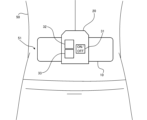
- FIG. 1 is a schematic diagram showing an example of a state in which a low-frequency therapy device 100 is attached to a user's body 50.
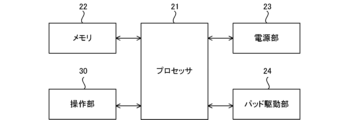
- FIG. FIG. 2 is a block diagram showing an example of a hardware configuration of a main body unit 20.
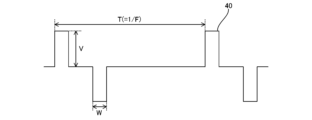
- 4 is a diagram showing an example of a pulse voltage applied by the main body 20 to the pad section 10.
- FIG. 1 is a diagram showing an example of a low-frequency pulse current and a notification pulse current supplied by a low-frequency therapy device 100.
- FIG. 13A and 13B are diagrams illustrating examples of notification pulse currents according to types of operations.
- FIG. 1 is a plan view showing a schematic configuration of a low-frequency therapy device 100. As shown in FIG. 1
- the low-frequency therapy device 100 is a cordless type low-frequency therapy device that performs treatment by supplying a low-frequency pulse current to the user to provide electrical stimulation.
- the frequency of the low-frequency pulse current is not particularly limited, but is, for example, about 1 to 1200 Hz.
- the low-frequency therapy device 100 comprises a pad section 10 that constitutes a mounting section that is mounted on the human body (user's body) and supplied with power, and a main body section 20 that is connected to the pad section 10 and controls the power supplied to the pad section 10.
- the pad section 10 can be attached to the user's body.
- the pad section 10 has a conductive layer (not shown) that supplies a low-frequency pulse current to the user, and can supply a pulse current to the user's body, which is the attachment point (contact object), using power supplied from the main body section 20.
- the pad section 10 is formed, for example, by laminating a conductive carbon layer by printing on the surface of a base material made of soft synthetic resin, and this carbon layer serves as the conductive layer.
- a holder (not shown) is permanently provided on the pad section 10, and the main body section 20 is fixed to this holder, thereby connecting the pad section 10 and the main body section 20. Since the pad section 10 is preferably replaceable (it is a consumable item), it is preferable that the main body section 20 is configured to be detachable from the holder.
- the main body 20 has, for example, a box-shaped housing, and an operation unit 30 is provided on the surface of this housing (the surface facing away from the human body when worn on the human body).
- the operation unit 30 includes, for example, an input device that accepts operation input from the user.
- the input device can be realized, for example, by a key, etc.
- the input devices included in the operation unit 30 include a power key 31 for turning the low-frequency therapy device 100 on and off, and a first key 32 and a second key 33 for adjusting the strength of the stimulation applied to the body by the low-frequency therapy device 100.
- the first key 32 and the second key 33 are also collectively referred to as stimulation adjustment keys.
- the operation unit 30 is configured integrally with the pad unit 10.
- the operation unit 30 and the pad unit 10 being configured integrally means that, for example, the operation unit 30 and the pad unit 10 are not separate configurations connected by a cable or the like, but are configured as an integrated device fixed to each other.
- FIG. 2 is a schematic diagram showing an example of the state in which the low-frequency therapy device 100 is attached to the user's body 50.
- the pad section 10 is attached, for example, to the waist 51 of the user's body 50.
- the waist 51 is an example of the back part of the human body.
- the pad section 10 is in the shape of a band extending in the left-right direction of the user so as to cover a wide area of the waist 51.
- FIG. 2 shows the recommended state of attachment when the low-frequency therapy device 100 is attached to the waist 51 for use.
- the low-frequency therapy device 100 is attached to the back of the body 50 (lower back 51), so the user can operate the operation unit 30, for example, with the fingers of the hand, but it is difficult for the user to see the operation unit 30.
- ⁇ Hardware configuration of main body unit 20> 3 is a block diagram showing an example of a hardware configuration of the main body unit 20.
- the main body unit 20 includes a processor 21, a memory 22, a power supply unit 23, a pad driving unit 24, and an operation unit 30.
- the processor 21 is, for example, a processor such as a CPU (Central Processing Unit) or an MPU (Micro Processing Unit).
- the processor 21 controls the operation of each part of the low-frequency therapy device 100 by reading and executing a program stored in the memory 22.
- the processor 21 may be a combination of multiple processors.
- the processor 21 is an example of a control part of the present invention.
- Memory 22 is realized by RAM (Random Access Memory), ROM (Read Only Memory), flash memory, or the like. Memory 22 stores programs executed by processor 21, data used by processor 21, etc.
- the power supply unit 23 supplies power to each component of the low-frequency therapy device 100.
- a dry cell or a secondary battery such as a lithium-ion battery or a nickel-metal hydride battery is used as the power source, and the battery voltage is stabilized to generate a drive voltage to be supplied to each component.
- the power supply unit 23 is not limited to a battery, and may supply power to each component of the low-frequency therapy device 100 using power supplied from a household power source or the like.
- the main unit 20 may be configured to be connected to an external power source such as a household power source by a cable or the like.
- the pad driving unit 24 applies a pulse voltage to the pad unit 10, thereby controlling the supply of a pulse current to the user by the pad unit 10.
- the pad driving unit 24 is controlled by the processor 21.
- the processor 21 controls the supply of a low-frequency pulse current from the pad unit 10 to provide a therapeutic electrical stimulus.
- the processor 21 controls the supply of a notification pulse current that provides an electrical stimulus to notify the acceptance of the operation by stimulating the skin or muscles different from the therapeutic electrical stimulus provided by the low-frequency pulse current.
- This notification pulse current is a pulse current that provides an electrical stimulus that is different from the therapeutic electrical stimulus.
- the notification pulse current is a pulse current that is different from the low-frequency pulse current in at least one of the pulse width, amplitude, and period.
- the notification pulse current is a pulse current having a narrower pulse width than the low-frequency pulse current. This makes it easier to distinguish and perceive the notification pulse current from the therapeutic low-frequency pulse current, which has a relatively wider pulse width.
- the notification pulse current may also be a pulse current having a wider pulse width than the low-frequency pulse current. In this case as well, the user can distinguish and perceive the notification pulse current from the therapeutic low-frequency pulse current.
- the notification pulse current may also be a pulse current having an amplitude smaller than the amplitude of the low-frequency pulse current. This makes it easier for the user to distinguish and perceive the notification pulse current from the low-frequency pulse current while preventing excessive strain on the user.
- the notification pulse current may also be a pulse current having an amplitude larger than the amplitude of the low-frequency pulse current. In this case as well, the user can distinguish and perceive the notification pulse current from the therapeutic low-frequency pulse current.
- the notification pulse current may also be a pulse current having a shorter period than the period of the low-frequency pulse current (i.e., a high frequency). This makes it easier to distinguish and perceive the notification pulse current from the therapeutic low-frequency pulse current, which has a relatively long period.
- the notification pulse current may also be a pulse current having a shorter period than the period of the low-frequency pulse current. In this case as well, the user can distinguish and perceive the notification pulse current from the therapeutic low-frequency pulse current.
- the low-frequency therapy device 100 supplies the user with a notification pulse current that provides an electrical stimulus to notify the user of the acceptance of an operation from the user, in addition to a low-frequency pulse current that provides an electrical stimulus for treatment.
- a notification pulse current that provides an electrical stimulus to notify the user of the acceptance of an operation from the user
- a low-frequency pulse current that provides an electrical stimulus for treatment.
- the device can be made smaller and less expensive.
- the low-frequency therapy device 100 unlike a configuration in which operational feedback is provided by a screen display on an information terminal wirelessly connected to the low-frequency therapy device 100, it is possible to prevent notification delays due to communication delays and effects on low-frequency therapy due to interference from communication waves. In addition, since there is no need to provide a wireless communication module in the low-frequency therapy device 100, it is possible to reduce the size and cost of the device.
- Fig. 4 is a diagram showing an example of a pulse voltage applied by the main body 20 to the pad section 10.
- a pulse voltage waveform 40 shown in Fig. 4 is an example of the waveform of a pulse voltage applied by the pad driving section 24 of the main body 20 to the pad section 10.
- the main body 20 can change the treatment content for the user by changing at least one of these parameters.
- the main unit 20 boosts the power supply voltage to a predetermined voltage and adjusts the boosted voltage to a voltage corresponding to the set amplitude.
- the main unit 20 can adjust the amplitude V of the pulse voltage at a predetermined number of levels (10 levels) according to instructions from the user.
- the main unit 20 receives a setting input of a certain level from the user, it generates a treatment waveform (pulse waveform) according to the treatment mode based on the amplitude V corresponding to that level, and outputs the treatment waveform to the pad unit 10.
- the low-frequency therapy device 100 is equipped with multiple treatment modes.
- the treatment modes include “massage,” “tapping,” “pushing,” and “sweeping” modes.
- the main body 20 changes the waveform of the pulse voltage applied to the pad section 10, thereby providing the user with electrical stimulation corresponding to each mode from the pad section 10.
- the main unit 20 also controls the pad unit 10 to supply a notification pulse current that provides an electrical stimulus to notify the reception of an operation, in addition to a low-frequency pulse current that provides an electrical stimulus for treatment.
- the main unit 20 applies to the pad unit 10 a pulse voltage for generating a low-frequency pulse current and a pulse voltage for generating a notification pulse current. Each of these pulse voltages is generated based on a predetermined waveform.
- Fig. 5 is a diagram showing an example of the low-frequency pulse current and the notification pulse current supplied by the low-frequency therapy device 100.
- the horizontal axis indicates time, and the vertical axis indicates the amplitude (voltage) of the pulse current.
- the low-frequency therapy device 100 supplies the user with a low-frequency pulsed current 60, for example, as shown in FIG. 5, from the pad section 10.
- the low-frequency pulsed current 60 is a pulsed current that provides electrical stimulation for treatment.
- the low-frequency pulsed current 60 is also a pulsed current that repeats with the same amplitude, pulse width, and period unless the user performs a switching operation.
- an intensity reduction operation e.g., pressing the second key 33
- the low-frequency therapy device 100 reduces the stimulation intensity of the low-frequency pulse current 60 after timing t1 (in this example, reducing the amplitude), and immediately supplies the notification pulse current 71 to the user from the pad unit 10 at timing t1.
- Supplying an immediate pulse current at a certain point in time means, for example, supplying a pulse current from that point in time without performing a process of waiting for the passage of time.
- supplying an immediate pulse current at a certain point in time means supplying a pulse current from that point in time by performing a process of waiting for the passage of a short time (e.g., 100 ms or less) that is almost imperceptible to the user.
- a short time e.g. 100 ms or less
- the stimulation intensity of the low-frequency pulse current 60 is the strength of the stimulation to the user that varies depending on at least one of the amplitude, pulse width, and period of the low-frequency pulse current 60, for example.
- the greater the amplitude of the low-frequency pulse current 60 the higher the stimulation intensity of the low-frequency pulse current 60.
- the shorter the period of the low-frequency pulse current 60 the higher the stimulation intensity of the low-frequency pulse current 60.
- the stimulation intensity of the low-frequency pulse current 60 is the magnitude of the amplitude of the low-frequency pulse current 60.
- the notification pulse current 71 is a pulse current that provides an electrical stimulus to notify the acceptance of an operation, which is different from the therapeutic electrical stimulus provided by the low-frequency pulse current 60.
- the notification pulse current 71 is a pulse current that has a smaller amplitude, narrower pulse width, and shorter period than the low-frequency pulse current 60.
- the notification pulse current 71 is also a pulse current that repeats twice in a short period of time (e.g., a period shorter than the period of the low-frequency pulse current 60).
- the main body unit 20 can supply a notification pulse current 71 from the pad unit 10 by applying a voltage to the pad unit 10 for 0.5 seconds, then turning it off for 0.5 seconds, and then turning it on for 0.5 seconds.
- the user can perceive the notification pulse current 71 as an electrical stimulus different from the low-frequency pulse current 60.
- ⁇ Notification pulse current according to the type of operation> 6 is a diagram showing an example of a notification pulse current according to the type of operation.
- the processor 21 may perform control to supply a different notification pulse current from the pad unit 10 according to the type of operation accepted from the user by the operation unit 30.
- an intensity reduction operation is performed on the operation unit 30 to reduce the stimulation intensity of the low-frequency pulsed current 60 by one step.
- an intensity increase operation is performed on the operation unit 30 to increase the stimulation intensity of the low-frequency pulsed current 60 by one step.
- the processor 21 reduces the stimulation intensity of the low-frequency pulse current 60 after the timing t1 when the intensity reduction operation is performed (in this example, reduces the amplitude), and immediately supplies the notification pulse current 72 to the user from the pad unit 10 at timing t1.
- the notification pulse current 72 is a pulse current that repeats twice in a short period of time, similar to the notification pulse current 71 shown in FIG. 5, but the second pulse current has a smaller amplitude than the first.
- the processor 21 also increases the stimulation intensity of the low-frequency pulse current 60 after timing t2 when the intensity increasing operation is performed (in this example, increases the amplitude), and immediately supplies a notification pulse current 73 to the user from the pad unit 10 at timing t2.
- the notification pulse current 73 is a pulse current that repeats twice in a short period of time, similar to the notification pulse current 71 shown in FIG. 5, but the second pulse current has a larger amplitude than the first.
- the processor 21 when the processor 21 receives an intensity reduction operation to reduce the stimulation intensity (reduce the amplitude) of the low-frequency pulse current 60, the processor 21 supplies a notification pulse current 72 that reduces the stimulation intensity over time (monotonically decreases). This allows the user to intuitively recognize that an intensity reduction operation has been received. Furthermore, when the user mistakenly performs an intensity reduction operation while intending to perform another operation such as an intensity increase operation, the user can intuitively recognize that they have mistakenly performed an intensity reduction operation.
- the processor 21 when the processor 21 receives an intensity increase operation to increase the stimulation intensity of the low-frequency pulse current 60, it supplies a notification pulse current 73 that increases the stimulation intensity. This allows the user to intuitively recognize that an intensity increase operation has been received. In addition, if the user mistakenly performs an intensity increase operation while intending to perform another operation such as an intensity decrease operation, the user can intuitively recognize that they have mistakenly performed an intensity increase operation.
- the stimulation intensity of the low-frequency pulsed current 60 is the magnitude of the amplitude of the low-frequency pulsed current 60
- the stimulation intensity of the low-frequency pulsed current 60 may be the length of the pulse width of the low-frequency pulsed current 60.
- an operation to increase the intensity e.g., pressing the first key 32
- an operation to decrease the intensity e.g., pressing the second key 33
- an operation to shorten the pulse width of the low-frequency pulsed current 60 is an operation to shorten the pulse width of the low-frequency pulsed current 60.
- the notification pulse current 72 in response to the intensity increase operation may be, for example, a pulse current that repeats twice in a short period of time, similar to the notification pulse current 71, and the second pulse may have a longer pulse width than the first.
- the notification pulse current 72 in response to the intensity decrease operation may be, for example, a pulse current that repeats twice in a short period of time, similar to the notification pulse current 71, and the second pulse may have a shorter pulse width than the first.
- the stimulation intensity of the low-frequency pulse current 60 may be the shortness of the period of the low-frequency pulse current 60.
- an operation to increase the intensity e.g., pressing the first key 32
- an operation to decrease the intensity e.g., pressing the second key 33
- an operation to lengthen the period of the low-frequency pulse current 60 is an operation to lengthen the period of the low-frequency pulse current 60.
- the notification pulse current 72 in response to the intensity increase operation may be, for example, a pulse current that repeats three times in a short period of time, and the interval between the second and third pulses may be shorter than the interval between the first and second pulses.
- the notification pulse current 72 in response to the intensity decrease operation may be, for example, a pulse current in which the interval between the second and third pulses is longer than the interval between the first and second pulses.
- the main body 20 may apply a pulse voltage based on a waveform obtained by combining a waveform of a low-frequency pulse current and a waveform of a notification pulse current to the pad section 10.
- a notification pulse current As a specific example of a notification pulse current, a pulse current having a pulse width shorter than that of the low-frequency pulse current, a period shorter than that of the low-frequency pulse current, and an amplitude smaller than that of the low-frequency pulse current, which is repeated mainly twice, has been described.
- the notification pulse current is not limited to this, and may be any type of pulse current that can be distinguished and perceived as a low-frequency pulse current.
- the notification pulse current may be a pulse current that is supplied only once without repetition, or a pulse current that is repeated three or more times.
- the notification pulse current may also be a pulse current that repeats while changing at least one of the amplitude, pulse width, and period.
- the notification pulse current may be a pulse current that has a specific rhythm that leaves an impression on the user.
- the processor 21 may also be configured to supply different notification pulse currents depending on the stimulation intensity of the low-frequency pulse current after switching, for example, depending on an increasing intensity operation or a decreasing intensity operation.
- the operation of increasing the intensity and the operation of decreasing the intensity have been described as the operation that triggers the supply of the notification pulse current
- the operation that triggers the supply of the notification pulse current is not limited to this.
- the processor 21 may also supply the notification pulse current when the power is turned on or off using the power key 31.
- the operation unit 30 may also accept operations other than pressing the power key 31, the first key 32, and the second key 33.
- the pad unit 10 may be capable of supplying multiple types of low-frequency pulsed currents that provide electrical stimulation for treatment, and the operation unit 30 may be capable of accepting an operation to instruct switching of the type of low-frequency pulsed current supplied by the pad unit 10.
- the processor 21 switches the type of low-frequency pulsed current supplied by the pad unit 10 and causes the pad unit 10 to supply a notification pulse current.
- the processor 21 may supply a different notification pulse current depending on the type of low-frequency pulsed current after switching.
- the low-frequency therapy device 100 may include an output device that outputs information to a user.
- the output device may be realized by, for example, a display or a speaker.
- both the input device and the output device may be realized by a touch panel or the like.
- a key as an input device may be realized by a software key displayed on a touch panel integrated with a display.
- the processor 21 may determine whether or not the low-frequency therapy device 100 is attached to the user when the processor 21 receives an operation from the user on the operation unit 30.
- the determination of whether or not the low-frequency therapy device 100 is attached to the user can be performed, for example, by a contact sensor or the like provided on the pad unit 10.
- a situation in which a user operates the operation unit 30 without wearing the low-frequency therapy device 100 is, for example, a situation in which the user turns on the power or performs preliminary settings before wearing the low-frequency therapy device 100. In such a situation, it is highly likely that the user can see the operation unit 30. In addition, such a situation is highly likely to be a situation in which the user does not need to be concerned about the surroundings, such as a situation immediately before the user wears the low-frequency therapy device 100 at home.
- the processor 21 performs operation feedback by supplying a notification pulse current when the low-frequency therapy device 100 is attached to the user, and performs operation feedback through an output device such as a display or speaker when the low-frequency therapy device 100 is not attached to the user.
- operation feedback can be provided to the user through screen display, audio output, etc., so that the user can understand the operation even when the low-frequency therapy device 100 is not worn by the user.
- the control program of the low-frequency therapy device 100 is stored in a non-transitory storage medium that can be read by a computer.
- a "computer-readable storage medium” includes, for example, an optical medium such as a CD-ROM (Compact Disc-ROM) or a magnetic storage medium such as a USB (Universal Serial Bus) memory or a memory card.
- a program can be provided by downloading via a network such as the Internet.
Landscapes
- Health & Medical Sciences (AREA)
- Life Sciences & Earth Sciences (AREA)
- Animal Behavior & Ethology (AREA)
- Nuclear Medicine, Radiotherapy & Molecular Imaging (AREA)
- Radiology & Medical Imaging (AREA)
- Biomedical Technology (AREA)
- Engineering & Computer Science (AREA)
- General Health & Medical Sciences (AREA)
- Public Health (AREA)
- Veterinary Medicine (AREA)
- Heart & Thoracic Surgery (AREA)
- Biophysics (AREA)
- Pain & Pain Management (AREA)
- Neurology (AREA)
- Electrotherapy Devices (AREA)
Priority Applications (3)
| Application Number | Priority Date | Filing Date | Title |
|---|---|---|---|
| CN202380063890.8A CN119836311A (zh) | 2023-03-08 | 2023-11-08 | 低频治疗仪、控制方法以及控制程序 |
| DE112023005943.8T DE112023005943T5 (de) | 2023-03-08 | 2023-11-08 | Therapeutische Niederfrequenzvorrichtung, Steuerverfahren und Steuerprogramm |
| US19/075,553 US20250205488A1 (en) | 2023-03-08 | 2025-03-10 | Low frequency therapeutic apparatus, control method, and control recording medium |
Applications Claiming Priority (2)
| Application Number | Priority Date | Filing Date | Title |
|---|---|---|---|
| JP2023-035943 | 2023-03-08 | ||
| JP2023035943A JP2024127078A (ja) | 2023-03-08 | 2023-03-08 | 低周波治療器、制御方法、及び制御プログラム |
Related Child Applications (1)
| Application Number | Title | Priority Date | Filing Date |
|---|---|---|---|
| US19/075,553 Continuation US20250205488A1 (en) | 2023-03-08 | 2025-03-10 | Low frequency therapeutic apparatus, control method, and control recording medium |
Publications (1)
| Publication Number | Publication Date |
|---|---|
| WO2024185208A1 true WO2024185208A1 (ja) | 2024-09-12 |
Family
ID=92674644
Family Applications (1)
| Application Number | Title | Priority Date | Filing Date |
|---|---|---|---|
| PCT/JP2023/040266 Ceased WO2024185208A1 (ja) | 2023-03-08 | 2023-11-08 | 低周波治療器、制御方法、及び制御プログラム |
Country Status (5)
| Country | Link |
|---|---|
| US (1) | US20250205488A1 (https=) |
| JP (1) | JP2024127078A (https=) |
| CN (1) | CN119836311A (https=) |
| DE (1) | DE112023005943T5 (https=) |
| WO (1) | WO2024185208A1 (https=) |
Citations (4)
| Publication number | Priority date | Publication date | Assignee | Title |
|---|---|---|---|---|
| JP2015536748A (ja) * | 2012-12-07 | 2015-12-24 | コーニンクレッカ フィリップス エヌ ヴェKoninklijke Philips N.V. | 電気刺激デバイスに関する装置及び方法 |
| JP2016209118A (ja) * | 2015-04-30 | 2016-12-15 | 株式会社 Mtg | 筋肉電気刺激装置 |
| JP2019022620A (ja) * | 2017-07-25 | 2019-02-14 | 伊藤超短波株式会社 | 電流刺激装置 |
| JP2022018442A (ja) * | 2020-07-15 | 2022-01-27 | オムロンヘルスケア株式会社 | 低周波治療器、制御方法、及び制御プログラム |
-
2023
- 2023-03-08 JP JP2023035943A patent/JP2024127078A/ja active Pending
- 2023-11-08 WO PCT/JP2023/040266 patent/WO2024185208A1/ja not_active Ceased
- 2023-11-08 DE DE112023005943.8T patent/DE112023005943T5/de active Pending
- 2023-11-08 CN CN202380063890.8A patent/CN119836311A/zh active Pending
-
2025
- 2025-03-10 US US19/075,553 patent/US20250205488A1/en active Pending
Patent Citations (4)
| Publication number | Priority date | Publication date | Assignee | Title |
|---|---|---|---|---|
| JP2015536748A (ja) * | 2012-12-07 | 2015-12-24 | コーニンクレッカ フィリップス エヌ ヴェKoninklijke Philips N.V. | 電気刺激デバイスに関する装置及び方法 |
| JP2016209118A (ja) * | 2015-04-30 | 2016-12-15 | 株式会社 Mtg | 筋肉電気刺激装置 |
| JP2019022620A (ja) * | 2017-07-25 | 2019-02-14 | 伊藤超短波株式会社 | 電流刺激装置 |
| JP2022018442A (ja) * | 2020-07-15 | 2022-01-27 | オムロンヘルスケア株式会社 | 低周波治療器、制御方法、及び制御プログラム |
Also Published As
| Publication number | Publication date |
|---|---|
| JP2024127078A (ja) | 2024-09-20 |
| DE112023005943T5 (de) | 2026-01-15 |
| CN119836311A (zh) | 2025-04-15 |
| US20250205488A1 (en) | 2025-06-26 |
Similar Documents
| Publication | Publication Date | Title |
|---|---|---|
| JP6733513B2 (ja) | 電気治療器、および治療システム | |
| CN110139691B (zh) | 电治疗仪、电治疗系统和存储介质 | |
| JP6733514B2 (ja) | 電気治療器、および治療システム | |
| WO2019087823A1 (ja) | 電気治療器、制御方法、および治療システム | |
| JP2002306604A (ja) | リラクゼーション装置 | |
| JP2019024721A (ja) | 電気治療器、制御方法、および治療システム | |
| WO2008015957A1 (en) | Low frequency therapy device and its control method | |
| US20230139371A1 (en) | Low-frequency treatment apparatus, control method, and non-transitory recording medium in which control program is stored | |
| WO2019225162A1 (ja) | 電気治療器、および治療システム | |
| WO2024185208A1 (ja) | 低周波治療器、制御方法、及び制御プログラム | |
| JP2017192545A (ja) | 低周波治療器 | |
| US20200230409A1 (en) | Low-frequency treatment device | |
| WO2022014241A1 (ja) | 低周波治療器、制御方法、及び制御プログラム | |
| US12605551B2 (en) | Electrical treatment device | |
| KR102649216B1 (ko) | 고탄성체 아암을 이용한 다기능 전기자극기 | |
| JP2019187505A (ja) | 電気治療器、および治療システム | |
| JP2025185753A (ja) | 美顔器具、美顔器具の制御方法、及び美顔器具の制御プログラム | |
| JP2024128531A (ja) | 健康機器、健康機器の制御方法、及び健康機器の制御プログラム | |
| CN116744884A (zh) | 一种面部美容设备、其操作方法以及控制程序 |
Legal Events
| Date | Code | Title | Description |
|---|---|---|---|
| 121 | Ep: the epo has been informed by wipo that ep was designated in this application |
Ref document number: 23925617 Country of ref document: EP Kind code of ref document: A1 |
|
| WWE | Wipo information: entry into national phase |
Ref document number: 202517016945 Country of ref document: IN |
|
| WWE | Wipo information: entry into national phase |
Ref document number: 202380063890.8 Country of ref document: CN |
|
| WWP | Wipo information: published in national office |
Ref document number: 202380063890.8 Country of ref document: CN |
|
| WWP | Wipo information: published in national office |
Ref document number: 202517016945 Country of ref document: IN |
|
| WWE | Wipo information: entry into national phase |
Ref document number: 112023005943 Country of ref document: DE |
|
| WWP | Wipo information: published in national office |
Ref document number: 112023005943 Country of ref document: DE |
|
| 122 | Ep: pct application non-entry in european phase |
Ref document number: 23925617 Country of ref document: EP Kind code of ref document: A1 |