WO2024184955A1 - 推定装置、推定方法及びプログラム - Google Patents
推定装置、推定方法及びプログラム Download PDFInfo
- Publication number
- WO2024184955A1 WO2024184955A1 PCT/JP2023/008036 JP2023008036W WO2024184955A1 WO 2024184955 A1 WO2024184955 A1 WO 2024184955A1 JP 2023008036 W JP2023008036 W JP 2023008036W WO 2024184955 A1 WO2024184955 A1 WO 2024184955A1
- Authority
- WO
- WIPO (PCT)
- Prior art keywords
- estimation
- frame
- frames
- control unit
- condition
- Prior art date
- Legal status (The legal status is an assumption and is not a legal conclusion. Google has not performed a legal analysis and makes no representation as to the accuracy of the status listed.)
- Ceased
Links
Images


Classifications
-
- G—PHYSICS
- G01—MEASURING; TESTING
- G01B—MEASURING LENGTH, THICKNESS OR SIMILAR LINEAR DIMENSIONS; MEASURING ANGLES; MEASURING AREAS; MEASURING IRREGULARITIES OF SURFACES OR CONTOURS
- G01B11/00—Measuring arrangements characterised by the use of optical techniques
- G01B11/02—Measuring arrangements characterised by the use of optical techniques for measuring length, width or thickness
Definitions
- the present invention relates to an estimation device, an estimation method, and a program.
- Non-Patent Documents 1 and 2 In order to estimate the height of a person in a video, there is a technique that replaces the video with multiple still image frames, extracts person and object frames, and estimates the height from the people and objects in the still images (see Non-Patent Documents 1 and 2).
- the estimation results could be poor in accuracy. This is not limited to cases where the estimation target is a person, but is similar for animals other than humans. Furthermore, the quantity to be estimated is not limited to height, but can also be used for other measurements such as shoulder width.
- the present invention aims to provide a technology that improves the accuracy of estimating the size of an object captured in a video.
- One aspect of the present invention is an estimation device that includes a control unit that executes an estimation process for a video to be processed that has at least one frame showing a person to be estimated and a reference object that is an object of a predetermined size, and that estimates an estimation target quantity, which is a predefined size, of the estimation target based on the video, and the control unit estimates the estimation target quantity using frames that, among the frames constituting the video, satisfy a frame condition that is a predetermined condition that is satisfied when the frame is used to estimate the estimation target quantity, and that is a condition that is more likely to be satisfied the closer the distance between the estimation target and the reference object is.
- One aspect of the present invention is an estimation method that includes a control step of executing an estimation process for a video to be processed that has at least one frame showing a person to be estimated and a reference object that is an object of a predetermined size, and that is a process of estimating an estimation target quantity that is a predefined size of the estimation target based on the video, and the control step estimates the estimation target quantity using frames that, among the frames constituting the video, satisfy a frame condition that is a predetermined condition that is satisfied when the frame is used to estimate the estimation target quantity, and that is a condition that is more likely to be satisfied the closer the distance between the estimation target and the reference object is.
- One aspect of the present invention is a program for causing a computer to function as the above-mentioned estimation device.
- the present invention makes it possible to improve the accuracy of estimating the size of an object captured in a video.
- FIG. 1 is an explanatory diagram illustrating an overview of an estimation device according to an embodiment.
- FIG. 11 is a first explanatory diagram illustrating an example of a determination process according to the embodiment.
- FIG. 2 is a second explanatory diagram illustrating an example of a determination process in the embodiment.
- 5 is a flowchart showing an example of a flow of a process executed by a control unit in the embodiment.
- FIG. 2 is a diagram illustrating an example of a hardware configuration of an estimation device according to an embodiment.
- (Embodiment) 1 is an explanatory diagram illustrating an overview of an estimation device 1 according to an embodiment.
- the estimation device 1 executes an estimation process, which is a process for a moving image to be processed (hereinafter referred to as a "moving image to be processed").
- the estimation process is a process for estimating a size of an estimation target that appears in the moving image to be processed, which is a predefined size (hereinafter referred to as an "estimated amount”), based on the moving image to be processed.
- the estimation target is a human; however, the estimation target does not necessarily have to be a human, and may be an animal other than a human. Also, for simplicity, the following description will be given using an example in which the estimation target quantity is the height of the estimation target. However, the estimation target quantity does not necessarily have to be height, and may be other dimensions such as the shoulder width of the estimation target.
- the estimation device 1 includes a control unit 11 including a processor 91, such as a CPU (Central Processing Unit), and a memory 92, connected by a bus.
- the control unit 11 executes estimation processing on the video to be processed.
- the video to be processed is a video having at least one frame (still image) showing the person to be estimated and a reference object whose size is known in advance. In other words, at least one of the frames constituting the video to be processed shows a pair of the person to be estimated and the reference object.
- the estimation process includes a frame division process.
- the frame division process is a process for dividing the video to be processed into one or more frames.
- the division of the video into frames may be performed using any known technique.
- the estimation process includes a bounding box estimation process.
- the bounding box estimation process estimates a bounding box surrounding the person to be estimated (hereinafter referred to as the "estimated target box") and a bounding box surrounding a reference object (hereinafter referred to as the "reference box”) for each frame that constitutes the processing target video.
- the technology by which a computer distinguishes between the person to be estimated and the reference object in the image and estimates the bounding box may be a well-known technology, for example, as described in Non-Patent Document 1 or 2.
- the estimation process includes a determination process.
- the determination process is a process for determining whether or not each frame constituting the video to be processed satisfies a frame condition.
- the frame condition is a predetermined condition that is met when the frame is a frame to be used for estimating the estimation target quantity, and is a condition that is more likely to be met the closer the distance between the estimation target and the reference object.
- a frame that is determined to satisfy the frame condition by the determination process is referred to as the frame to be used.
- the determination process is a process that determines whether or not each frame is a frame to be used based also on the results of the bounding box estimation process.
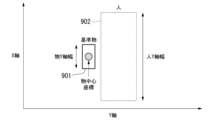
- FIG. 2 is a first explanatory diagram illustrating an example of the determination process in the embodiment.
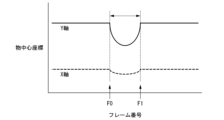
- FIG. 3 is a second explanatory diagram illustrating an example of the determination process in the embodiment. More specifically, FIG. 3 is a diagram illustrating an example of the change in the vertical position coordinate of the reference object in the situation shown in FIG. 2.
- the vertical axis of the graph in Figure 3 indicates the position of the reference object in Figure 2 in the X-axis and Y-axis directions.
- the position of the reference object means the position of the center of the object.
- the horizontal axis of the graph in Figure 3 indicates the frame number in the video being processed. The smaller the value on the horizontal axis of the graph in Figure 3 (i.e., the further to the left in Figure 3), the smaller the frame number. The smaller the frame number, the earlier the frame was shot. Therefore, the frame number is equivalent to the time it was shot.
- the frames in which the reference object is not stationary are the frames between frame number F0 and frame number F1. Therefore, during this period, the distance between the reference object and the person being estimated is relatively closer than the distance in the other frames.
- the determination process determines that the frames between frame numbers F0 and F1 are frames that satisfy the frame condition. Therefore, in the examples of Figures 2 and 3, the frames between frame numbers F0 and F1 are the frames to be used.
- the object Y-axis width in Figure 2 refers to the length of the reference object in the Y-axis direction.
- the person Y-axis width in Figure 2 refers to the length of the person to be estimated in the Y-axis direction.
- the control unit 11 executes a first changed frame estimation process.
- the first changed frame identification process is a process for estimating frames in which there is a change in the position of the object center in the Y-axis direction among the frames constituting the moving image to be processed. More specifically, the control unit 11 determines frames in which there is a difference in the position of the object center in the Y-axis direction from the frames constituting the moving image to be processed between the previous and next frames. In other words, previous and next frame extraction (threshold 1) ⁇ absolute value (object center Y-axis position difference).
- Absolute value refers to the value obtained from the frame, and indicates the deviation in the object center Y-axis position compared to the previous and next frames.
- the control unit 11 determines whether the absolute value of the difference between the previous and next frames is equal to or greater than a predetermined threshold.
- a frame that is equal to or greater than the threshold is identified as a frame in which there is a change in the position of the object center in the Y-axis direction.
- the control unit 11 estimates a frame in which there is a change in the position of the object center in the Y-axis direction.
- a frame estimated to have a change in the position of the object center in the Y-axis direction by the first-change frame estimation process is referred to as a first estimated frame.
- the control unit 11 then executes a second changed frame estimation process.
- the second changed frame estimation process is a process for estimating frames in which there is a change in the position of the object center in the X-axis direction, among the frames constituting the moving image to be processed. More specifically, the control unit 11 determines frames in which there is a difference in the position of the object center in the X-axis direction, among the frames constituting the moving image to be processed, between the previous and next frames. In other words, previous and next frame extraction (threshold 2) ⁇ absolute value (x-axis position difference of object center).
- Absolute value means a value obtained from a frame, and indicates the deviation of the x-axis position of the object center compared to the previous and next frames.
- the control unit 11 determines whether the absolute value of the difference between the previous and next frames is equal to or greater than a predetermined threshold. Frames that are equal to or greater than the threshold are identified as frames in which there is a change in the position of the object center in the X-axis direction. In this way, the control unit 11 estimates frames in which there is a change in the position of the object center in the X-axis direction.
- a frame estimated to have a change in the position of the object center in the X-axis direction by the second-change frame estimation process is referred to as a second estimated frame.
- the determination process executes a bounding box estimation process, but as described above, the bounding box estimation process may output abnormal values.
- the frame in which the abnormal value is output is not determined to be a frame to be used.
- the determination process executes a first condition satisfying frame estimation process for that frame.
- the first condition satisfying frame estimation process is a process for determining whether or not the frame to be processed is a frame for which the first condition is satisfied.
- the first condition is that the frame is both the first estimated frame and the second estimated frame.
- the determination process determines that it is the first estimated frame and not the second estimated frame.
- the determination process will determine that the second estimated frame is the frame to be used.
- a frame that outputs an abnormal value in the bounding box determination process is not determined as a frame to be used.
- a frame that outputs an abnormal value in the bounding box determination process may be a frame whose change obtained by comparing the frame with the previous and next frames satisfies the following four conditions, the first to fourth recognition conditions.
- the first recognition condition is a condition in which the change in the position of the object center in one of two mutually perpendicular axes (for example, the Y-axis direction in the example of FIG. 2) is equal to or greater than a predetermined threshold.
- identifying frames before and after a frame in which an abnormal value occurs due to a recognition error and “absolute value (difference in Y-axis position of object center)>(abnormal threshold 3)".
- “identifying frames before and after a frame in which an abnormal value occurs due to a recognition error” refers to a process in which the control unit 11 determines which frames are before and after the frame in which an abnormal value occurs.
- absolute value (difference in Y-axis position of object center)>(abnormal threshold 3) refers to a process in which the control unit 11 determines what type of abnormal value the abnormal value is based on a predetermined threshold.
- the second recognition condition is a condition in which the change in the position of the object center in the other of the two axes (for example, the X-axis direction in the example of Figure 2) is equal to or greater than a predetermined threshold.
- a predetermined threshold for example, the X-axis direction in the example of Figure 2
- identifying the previous and next frames in which an abnormal value occurs due to a recognition error and “absolute value (X-axis position difference of object center)>(abnormal threshold 4)”.
- “identifying the previous and next frames in which an abnormal value occurs due to a recognition error” refers to a process in which the control unit 11 determines which frames are before and after the frame in which an abnormal value occurs.
- absolute value (X-axis position difference of object center)>(abnormal threshold 4) refers to a process in which the control unit 11 determines what type of abnormal value the abnormal value is based on a predetermined threshold.
- the third recognition condition is that the change in the length of the reference box in one of two mutually perpendicular axes (for example, the Y-axis direction in the example of Figure 2) is equal to or greater than a predetermined threshold.
- identifying frames before and after a frame in which an abnormal value occurs due to a recognition error and “absolute value (object Y-axis width difference) > (abnormal threshold 5)”.
- identifying frames before and after a frame in which an abnormal value occurs due to a recognition error refers to the process in which the control unit 11 determines which frames are before and after the frame in which an abnormal value occurs.
- absolute value (object Y-axis width difference) > (abnormal threshold 5) refers to the process in which the control unit 11 determines what type of abnormal value the abnormal value is based on a predetermined threshold.
- the fourth recognition condition is that the change in the length of the reference box in one of two mutually perpendicular axes (for example, the Y-axis direction in the example of Figure 2) is equal to or greater than a predetermined threshold.
- a predetermined threshold for example, the Y-axis direction in the example of Figure 2
- identifying frames before and after a frame in which an abnormal value occurs due to a recognition error and "absolute value (human Y-axis width difference) > (abnormal threshold 5)”.
- absolute value object Y-axis width difference
- (abnormal threshold 5) refers to a process in which the control unit 11 determines what type of abnormal value an abnormal value is based on a predetermined threshold.
- the object center is the center of the bounding box of the reference object. Therefore, if the estimation of the reference box by the bounding box estimation process is inappropriate due to the influence of the environment at the time of shooting, the position of the object center may not be appropriate. Therefore, for example, even if the estimation of the bounding box is appropriate in frames before and after the target frame, if the estimation of the bounding box is inappropriate in the target frame, the position of the object center may be shifted.
- the first and second recognition conditions can be said to be standards for determining whether or not such a possible scene exists. Note that appropriate means that the estimation is highly accurate. Conversely, inappropriate means that the estimation is low in accuracy.
- the length of the reference box may also be inappropriate. Therefore, for example, even if the estimation of the bounding box was appropriate in the frames before and after the target frame, if the estimation of the bounding box is inappropriate in the target frame, the width of the reference object may change.
- the third and fourth recognition conditions can be considered as standards for determining whether or not such a possible scene exists.
- frames where the changes obtained by comparing with previous and subsequent frames satisfy the first to fourth recognition conditions are frames where the accuracy of the bounding box estimation is likely to be low. Therefore, by not determining such frames as frames to be used, it is possible to suppress a decrease in the estimation accuracy of the estimation process.
- the estimation process includes an estimation target amount estimation process.
- the estimation target amount estimation process is a process for estimating the estimation target amount for all frames determined to be frames to be used, and obtaining the average value of all the estimated estimation target amounts. Note that the process for estimating the estimation target amount shown in a single still image based on that still image may use any well-known technology, such as the technology described in Non-Patent Document 2.
- the estimation target quantity estimation process is a process that estimates the estimation target quantity using frames that satisfy the frame conditions.
- An example of the application target is a video showing a person and an object, in which the person lifts the object at some point.
- An example of the application target is a video showing a person and an object, in which the person lifts the object at some point.
- Another example of the application is, for example, a video containing a scene in which a person and an object are in the frame while the person is walking and holding the object.
- a video containing a scene in which a person and an object are in the frame while the person is walking and pushing the object is, for example, a video containing a scene in which a person is wearing a name tag that features a white rectangle and is walking.
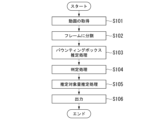
- ⁇ An example of processing flow> 4 is a flowchart showing an example of the flow of processing executed by the control unit 11 in the embodiment.
- the control unit 11 acquires a moving image to be processed (step S101).
- the control unit 11 executes a frame division process on the moving image to be processed (step S102). By executing the frame division process, one or more frames constituting the moving image to be processed are generated.
- the control unit 11 then executes a bounding box estimation process (step S103).
- the control unit 11 then executes a judgment process (step S104).
- the control unit 11 then executes an estimation target quantity estimation process (step S105).
- the control unit 11 then controls the operation of a predetermined output destination such as the output unit 15 described below to output the estimation target quantity obtained in step S105 to the predetermined output destination (step S106).
- the estimation target quantity output in step S106 is the estimation target quantity desired by the user.
- steps S102 to S105 are an example of estimation processing.
- ⁇ Hardware Description> 5 is a diagram illustrating an example of a hardware configuration of the estimation device 1 according to an embodiment.
- the estimation device 1 includes the control unit 11 and executes a program. By executing the program, the estimation device 1 functions as a device including the control unit 11, an input unit 12, a communication unit 13, a storage unit 14, and an output unit 15.
- the processor 91 reads out a program stored in the storage unit 14 and stores the read out program in the memory 92.
- the processor 91 executes the program stored in the memory 92, whereby the estimation device 1 functions as a device including a control unit 11, an input unit 12, a communication unit 13, a storage unit 14, and an output unit 15.
- the control unit 11 controls the operation of the various functional units of the estimation device 1.
- the control unit 11 controls, for example, the operation of the output unit 15.
- the control unit 11 executes, for example, an estimation process.
- the control unit 11 records, in the storage unit 14, various pieces of information generated by the operation of the control unit 11.
- the input unit 12 includes input devices such as a mouse, a keyboard, and a touch panel.
- the input unit 12 may be configured as an interface that connects these input devices to the estimation device 1.
- the input unit 12 accepts input of various types of information to the estimation device 1.
- the communication unit 13 includes a communication interface for connecting the estimation device 1 to an external device.
- the communication unit 13 communicates with the external device via a wired or wireless connection.
- the external device is, for example, a device that is the sender of the video to be processed. In such a case, the communication unit 13 acquires the video to be processed by communicating with the device that is the sender of the video to be processed.
- the video to be processed does not necessarily have to be input via the communication unit 13, but may be input to the input unit 12.
- the memory unit 14 is configured using a computer-readable storage medium device (non-transitory computer-readable recording medium) such as a magnetic hard disk device or a semiconductor storage device.
- the memory unit 14 stores various information related to the estimation device 1.
- the memory unit 14 stores information inputted, for example, via the input unit 12 or the communication unit 13.
- the memory unit 14 stores various information generated, for example, by the execution of processing by the control unit 11.
- the memory unit 14 stores information indicating the size of a reference object in advance.
- the size of the reference object is, for example, height and width.
- the output unit 15 outputs various types of information.
- the output unit 15 includes a display device such as a CRT (Cathode Ray Tube) display, a liquid crystal display, or an organic EL (Electro-Luminescence) display.
- the output unit 15 may be configured as an interface that connects these display devices to the estimation device 1.
- the output unit 15 outputs, for example, information input to the input unit 12.
- the output unit 15 outputs, for example, an estimation target quantity estimated by the estimation process.
- the estimation device 1 of the embodiment configured in this way obtains the average value of each estimation target quantity estimated from each frame that satisfies the frame condition among the frames that make up the video. Therefore, the estimation device 1 can improve the estimation accuracy of the size of the estimation target that appears in the video.
- the process of not determining as a frame to be used a frame whose changes obtained in comparison with the preceding and following frames satisfy the four conditions, the first recognition condition to the fourth recognition condition, below, may or may not be executed.
- the accuracy of the estimation process is improved if the process of not determining as a frame to be used a frame whose changes obtained in comparison with the preceding and following frames satisfy the four conditions, the first recognition condition to the fourth recognition condition, below, is executed.
- the estimation device 1 may be implemented using a plurality of information processing devices communicably connected via a network. In this case, each functional unit of the estimation device 1 may be distributed and implemented in the plurality of information processing devices.
- the control unit 11 may be installed in a smartphone, a mobile phone, or a personal computer.
- the estimation device 1 may be applied to a smartphone, a mobile phone, or a personal computer.
Landscapes
- Physics & Mathematics (AREA)
- General Physics & Mathematics (AREA)
- Image Analysis (AREA)
Priority Applications (2)
| Application Number | Priority Date | Filing Date | Title |
|---|---|---|---|
| PCT/JP2023/008036 WO2024184955A1 (ja) | 2023-03-03 | 2023-03-03 | 推定装置、推定方法及びプログラム |
| JP2025504894A JPWO2024184955A1 (https=) | 2023-03-03 | 2023-03-03 |
Applications Claiming Priority (1)
| Application Number | Priority Date | Filing Date | Title |
|---|---|---|---|
| PCT/JP2023/008036 WO2024184955A1 (ja) | 2023-03-03 | 2023-03-03 | 推定装置、推定方法及びプログラム |
Publications (1)
| Publication Number | Publication Date |
|---|---|
| WO2024184955A1 true WO2024184955A1 (ja) | 2024-09-12 |
Family
ID=92674445
Family Applications (1)
| Application Number | Title | Priority Date | Filing Date |
|---|---|---|---|
| PCT/JP2023/008036 Ceased WO2024184955A1 (ja) | 2023-03-03 | 2023-03-03 | 推定装置、推定方法及びプログラム |
Country Status (2)
| Country | Link |
|---|---|
| JP (1) | JPWO2024184955A1 (https=) |
| WO (1) | WO2024184955A1 (https=) |
Citations (4)
| Publication number | Priority date | Publication date | Assignee | Title |
|---|---|---|---|---|
| JP2008224484A (ja) * | 2007-03-14 | 2008-09-25 | Casio Comput Co Ltd | 撮像装置、及び寸法計測方法、寸法計測プログラム |
| WO2016035350A1 (ja) * | 2014-09-02 | 2016-03-10 | 株式会社sizebook | 携帯情報端末とその制御方法および制御プログラム |
| CN111141215A (zh) * | 2020-01-15 | 2020-05-12 | 大连理工大学 | 影像的目标尺寸测量系统及其使用方法 |
| CN112153320A (zh) * | 2020-09-23 | 2020-12-29 | 北京京东振世信息技术有限公司 | 一种物品尺寸的测量方法、装置、电子设备和存储介质 |
-
2023
- 2023-03-03 JP JP2025504894A patent/JPWO2024184955A1/ja active Pending
- 2023-03-03 WO PCT/JP2023/008036 patent/WO2024184955A1/ja not_active Ceased
Patent Citations (4)
| Publication number | Priority date | Publication date | Assignee | Title |
|---|---|---|---|---|
| JP2008224484A (ja) * | 2007-03-14 | 2008-09-25 | Casio Comput Co Ltd | 撮像装置、及び寸法計測方法、寸法計測プログラム |
| WO2016035350A1 (ja) * | 2014-09-02 | 2016-03-10 | 株式会社sizebook | 携帯情報端末とその制御方法および制御プログラム |
| CN111141215A (zh) * | 2020-01-15 | 2020-05-12 | 大连理工大学 | 影像的目标尺寸测量系统及其使用方法 |
| CN112153320A (zh) * | 2020-09-23 | 2020-12-29 | 北京京东振世信息技术有限公司 | 一种物品尺寸的测量方法、装置、电子设备和存储介质 |
Also Published As
| Publication number | Publication date |
|---|---|
| JPWO2024184955A1 (https=) | 2024-09-12 |
Similar Documents
| Publication | Publication Date | Title |
|---|---|---|
| US9418319B2 (en) | Object detection using cascaded convolutional neural networks | |
| JP7078139B2 (ja) | ビデオ安定化方法及び装置、並びに非一時的コンピュータ可読媒体 | |
| US10380756B2 (en) | Video processing system and method for object detection in a sequence of image frames | |
| JP6044134B2 (ja) | 最適画像サイズによる画像領域分割装置、方法、およびプログラム | |
| KR102277048B1 (ko) | 미리보기 사진 블러링 방법 및 장치 및 저장 매체 | |
| CN112784765B (zh) | 用于识别动作的方法、装置、设备以及存储介质 | |
| JP6024658B2 (ja) | 物体検出装置、物体検出方法及びプログラム | |
| US9773192B2 (en) | Fast template-based tracking | |
| JP7192582B2 (ja) | 物体追跡装置および物体追跡方法 | |
| JP7272024B2 (ja) | 物体追跡装置、監視システムおよび物体追跡方法 | |
| US10254854B2 (en) | Tracker for cursor navigation | |
| CN109767453B9 (zh) | 信息处理装置、背景图像更新方法和非暂态计算机可读存储介质 | |
| JP7312026B2 (ja) | 画像処理装置、画像処理方法およびプログラム | |
| WO2021227723A1 (zh) | 目标检测方法、装置、计算机设备及可读存储介质 | |
| KR20210008087A (ko) | 지평면 검출에 기초한 이미지 시퀀스로부터의 사람 객체의 손실 발 복구 | |
| CN113657518A (zh) | 训练方法、目标图像检测方法、装置、电子设备以及介质 | |
| CN112929562A (zh) | 视频抖动的处理方法、装置、设备以及存储介质 | |
| CN105184825A (zh) | 一种面向室内场景的移动增强现实方法 | |
| CN115004245A (zh) | 目标检测方法、装置、电子设备和计算机存储介质 | |
| JP7338174B2 (ja) | 物体検出装置および物体検出方法 | |
| US9531969B2 (en) | Image processing apparatus, image processing method, and storage medium | |
| CN111292331A (zh) | 图像处理的方法与装置 | |
| CN108734718B (zh) | 用于图像分割的处理方法、装置、存储介质及设备 | |
| KR101592087B1 (ko) | 배경 영상의 위치를 이용한 관심맵 생성 방법 및 이를 기록한 기록 매체 | |
| WO2024184955A1 (ja) | 推定装置、推定方法及びプログラム |
Legal Events
| Date | Code | Title | Description |
|---|---|---|---|
| 121 | Ep: the epo has been informed by wipo that ep was designated in this application |
Ref document number: 23926171 Country of ref document: EP Kind code of ref document: A1 |
|
| ENP | Entry into the national phase |
Ref document number: 2025504894 Country of ref document: JP Kind code of ref document: A |
|
| WWE | Wipo information: entry into national phase |
Ref document number: 2025504894 Country of ref document: JP |
|
| NENP | Non-entry into the national phase |
Ref country code: DE |
|
| 122 | Ep: pct application non-entry in european phase |
Ref document number: 23926171 Country of ref document: EP Kind code of ref document: A1 |