WO2024184940A1 - 車両制御システム - Google Patents
車両制御システム Download PDFInfo
- Publication number
- WO2024184940A1 WO2024184940A1 PCT/JP2023/007975 JP2023007975W WO2024184940A1 WO 2024184940 A1 WO2024184940 A1 WO 2024184940A1 JP 2023007975 W JP2023007975 W JP 2023007975W WO 2024184940 A1 WO2024184940 A1 WO 2024184940A1
- Authority
- WO
- WIPO (PCT)
- Prior art keywords
- control device
- parallel
- vehicle control
- mode
- output
- Prior art date
- Legal status (The legal status is an assumption and is not a legal conclusion. Google has not performed a legal analysis and makes no representation as to the accuracy of the status listed.)
- Ceased
Links
Images



Classifications
-
- B—PERFORMING OPERATIONS; TRANSPORTING
- B60—VEHICLES IN GENERAL
- B60K—ARRANGEMENT OR MOUNTING OF PROPULSION UNITS OR OF TRANSMISSIONS IN VEHICLES; ARRANGEMENT OR MOUNTING OF PLURAL DIVERSE PRIME-MOVERS IN VEHICLES; AUXILIARY DRIVES FOR VEHICLES; INSTRUMENTATION OR DASHBOARDS FOR VEHICLES; ARRANGEMENTS IN CONNECTION WITH COOLING, AIR INTAKE, GAS EXHAUST OR FUEL SUPPLY OF PROPULSION UNITS IN VEHICLES
- B60K6/00—Arrangement or mounting of plural diverse prime-movers for mutual or common propulsion, e.g. hybrid propulsion systems comprising electric motors and internal combustion engines
- B60K6/20—Arrangement or mounting of plural diverse prime-movers for mutual or common propulsion, e.g. hybrid propulsion systems comprising electric motors and internal combustion engines the prime-movers consisting of electric motors and internal combustion engines, e.g. HEVs
- B60K6/42—Arrangement or mounting of plural diverse prime-movers for mutual or common propulsion, e.g. hybrid propulsion systems comprising electric motors and internal combustion engines the prime-movers consisting of electric motors and internal combustion engines, e.g. HEVs characterised by the architecture of the hybrid electric vehicle
- B60K6/44—Series-parallel type
- B60K6/442—Series-parallel switching type
-
- B—PERFORMING OPERATIONS; TRANSPORTING
- B60—VEHICLES IN GENERAL
- B60W—CONJOINT CONTROL OF VEHICLE SUB-UNITS OF DIFFERENT TYPE OR DIFFERENT FUNCTION; CONTROL SYSTEMS SPECIALLY ADAPTED FOR HYBRID VEHICLES; ROAD VEHICLE DRIVE CONTROL SYSTEMS FOR PURPOSES NOT RELATED TO THE CONTROL OF A PARTICULAR SUB-UNIT
- B60W20/00—Control systems specially adapted for hybrid vehicles
- B60W20/20—Control strategies involving selection of hybrid configuration, e.g. selection between series or parallel configuration
-
- Y—GENERAL TAGGING OF NEW TECHNOLOGICAL DEVELOPMENTS; GENERAL TAGGING OF CROSS-SECTIONAL TECHNOLOGIES SPANNING OVER SEVERAL SECTIONS OF THE IPC; TECHNICAL SUBJECTS COVERED BY FORMER USPC CROSS-REFERENCE ART COLLECTIONS [XRACs] AND DIGESTS
- Y02—TECHNOLOGIES OR APPLICATIONS FOR MITIGATION OR ADAPTATION AGAINST CLIMATE CHANGE
- Y02T—CLIMATE CHANGE MITIGATION TECHNOLOGIES RELATED TO TRANSPORTATION
- Y02T10/00—Road transport of goods or passengers
- Y02T10/60—Other road transportation technologies with climate change mitigation effect
- Y02T10/62—Hybrid vehicles
Definitions
- This disclosure relates to a vehicle control system.
- the objective of this disclosure is to provide a vehicle control system that can suppress the decline in actual output.
- the vehicle control system disclosed herein is a vehicle control system mounted on an electric vehicle, and includes an internal combustion engine, a motor, a generator, and a control device capable of switching between a series mode in which the generator is driven by the internal combustion engine, the motor is driven by the generated electric power, and the motor drives an axle, and a parallel mode in which the axle is driven by the internal combustion engine, and the axle is driven by the internal combustion engine.
- the control device acquires the required output of the electric vehicle and the actual output actually transmitted to the axle, and when switching from the series mode to the parallel mode, if the required output is higher than the actual output, executes a first control that changes the parallel ratio, which is the output ratio of the parallel mode, so that the actual output does not decrease.
- This disclosure provides a vehicle control system that can suppress a decrease in actual output.
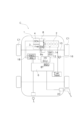
- FIG. 1 is a system diagram of a vehicle control system according to a first embodiment of the present disclosure.
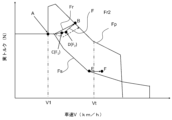
- 5A and 5B are diagrams showing output characteristics in a series mode and a parallel mode according to the first embodiment of the present disclosure.
- FIG. 3 is a diagram showing the parallel ratios at points C and D in FIG. 2 .
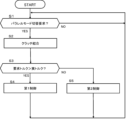
- 4 is a flowchart showing a control procedure executed by a control device according to the first embodiment of the present disclosure.
- FIG. 11 is a system diagram of a vehicle control system according to a second embodiment of the present disclosure.
- FIG. 11 is a diagram showing output characteristics in a series mode and a parallel mode according to the second embodiment of the present disclosure.
- 10 is a flowchart showing a control procedure executed by a control device according to a second embodiment of the present disclosure.
- the vehicle control system 1 includes an internal combustion engine 2, a motor (FrM) 3, a generator (GEN) 4, a drive battery (BT) 6, a transaxle 8, a vehicle control device (one example of a control device) 12, an engine control device 14 that controls the internal combustion engine 2, an accelerator pedal 16 operated by a user of the electric vehicle C, an inverter 18 that controls the motor 3 and the generator 4, and a charger 20.
- the electric vehicle C is a plug-in hybrid vehicle (PHEV) that can externally charge the drive battery 6 with power from an external power source by the charger 20, or can receive external power from the drive battery 6.
- PHEV plug-in hybrid vehicle
- the electric vehicle C may also be a hybrid car, etc.
- the motor 3 is connected to the axle 10 via the transaxle 8.
- the axle 10 drives the wheel C1.
- the motor 3 is, for example, a three-phase AC motor generator. When powering, the motor 3 receives power from the generator 4 and the drive battery 6 via the inverter 18. When regenerating, the motor 3 supplies power to the drive battery 6 via the inverter 18.
- the generator 4 is connected to the internal combustion engine 2 and is capable of driving the internal combustion engine 2.
- the generator 4 performs motoring to drive the internal combustion engine 2 while the internal combustion engine 2 is being powered by electric power from the drive battery 6.
- the generator 4 is driven by the internal combustion engine 2 to generate electricity while the internal combustion engine 2 is in operation. Therefore, the generator 4 is a motor-generator capable of powering and generating electricity.
- the drive battery 6 outputs power to the motor 3 and the generator 4, and also receives the power generated by the motor 3 and the generator 4.
- the drive battery 6 is composed of a secondary battery such as a lithium ion battery.
- the transaxle 8 has multiple gears and a clutch 8a.
- the internal combustion engine 2 is connected to the generator 4 and the axle 10 via the transaxle 8.
- the transaxle 8 cuts off the power transmission between the internal combustion engine 2 and the axle 10, and when the clutch 8a is in the engaged state, the power of the internal combustion engine 2 is transmitted to the axle 10.
- the electric vehicle C of this embodiment has various modes, such as EV mode, series mode, parallel mode, and charging mode.
- EV mode the electric vehicle C drives the motor 3 with power from the drive battery 6.
- series mode the electric vehicle C drives the generator 4 with the internal combustion engine 2 and drives the motor 3 with the power generated by the generator 4.
- the clutch 8a is maintained in an open state.
- parallel mode the electric vehicle C connects the clutch 8a and drives the axle 10 with the power of the internal combustion engine 2.
- the electric vehicle C drives the generator 4 with the internal combustion engine 2 and stores the power generated by the generator 4 in the drive battery 6.
- the electric vehicle C causes the vehicle control device 12 to switch between each mode depending on the depression state of the accelerator pedal 16 and the operation state of the charge button.
- the vehicle control device 12 is a control device that controls switching between EV mode, series mode, and parallel mode (hereinafter referred to as each mode in the specification).
- the vehicle control device 12 is electrically connected to the motor 3, the generator 4, the clutch 8a of the transaxle 8, and the engine control device 14, and controls the motor 3 and the generator 4 via the inverter 18 according to each mode, and also controls the release and connection of the clutch 8a.
- the vehicle control device 12 causes the engine control device 14 to control the internal combustion engine 2 according to each mode.
- the vehicle control device 12 is electrically connected to various devices of the electric vehicle C (e.g., the charger 20) and performs integrated control of the various devices.
- the vehicle control device 12 is actually an ECU (Electronic Control Unit) composed of a microcomputer including a calculation device, a memory, an input/output buffer, etc.
- the vehicle control device 12 executes various controls of the electric vehicle C based on the maps and programs stored in the memory.
- the electric vehicle C has different output characteristics depending on the vehicle speed in the series mode and the parallel mode.
- the vehicle control device 12 calculates the required torque (one example of required output) Fr required to accelerate the electric vehicle C, for example, and controls the clutch 8a according to the required torque Fr to switch from the series mode to the parallel mode.
- the vehicle control device 12 switches from the series mode to the parallel mode while adjusting the first output (torque) Pf in the parallel mode and the second output (torque) Sf, which is the output in the series mode.
- the first output Pf is the output that is distributed directly from the internal combustion engine 2 to the axle 10.
- the second output Sf is the output that drives the motor 3 from the internal combustion engine 2 via the generator 4 and is distributed to the axle 10.
- the vehicle control device 12 calculates the required torque Fr from the accelerator opening Th based on the amount of depression of the accelerator pedal 16.
- the accelerator opening Th may be a value calculated by the vehicle control device 12 when the electric vehicle C is in cruise control, for example.
- the required torque Fr may be a torque that takes into account the amount of power generated by the generator 4, in addition to the accelerator opening Th.
- the vehicle control device 12 further acquires the rotation speed of the axle 10 and the vehicle speed V.
- the vehicle control device 12 calculates the actual torque (one example of actual output) F, which is the torque actually transmitted to the axle 10, from the rotation speed of the axle 10.
- the vehicle control device 12 executes a first control to switch from the series mode to the parallel mode when, for example, the vehicle speed V is the first vehicle speed V1, the actual torque F is at point A in FIG. 2, and the required torque Fr continues to increase and is greater than the actual torque F.
- the vehicle control device 12 calculates the actual torque F for each predetermined cycle.
- the vehicle control device 12 changes the parallel ratio x, which is the output ratio in the parallel mode, so that the actual torque F does not decrease.
- the graph of Fs in Figure 2 is a graph showing the characteristics of series maximum torque (an example of series maximum output) Fs, which is the maximum torque in series mode.
- the graph of Fp in Figure 2 is a graph showing the characteristics of parallel maximum torque (an example of parallel maximum output) Fp, which is the maximum torque in parallel mode according to accelerator opening Th (accelerator opening Th is 100 percent in this embodiment).
- accelerator opening Th accelerator opening Th is 100 percent in this embodiment
- Point C in Fig. 2 is a point where the actual torque F has increased from point A.
- Point D in Fig. 2 is a point where the actual torque F has increased by one cycle from point C.
- the vehicle control device 12 calculates the actual torque F1 at point C using equation (1).
- F 1 F s1 ⁇ (1-x 1 )+F p1 ⁇ x 1 ...Formula (1)
- Fs1 is the series maximum torque Fs at point C.
- Fp1 is the parallel maximum torque Fp at point C.
- x1 is the parallel ratio x at point C.
- Fp1 x1 corresponds to the first output Pf at point C.
- Fs1 x (1- x1 ) corresponds to the second output Sf at point C.
- the parallel ratio x indicates the ratio of the first output Pf to the difference between the parallel maximum torque Fp and the series maximum torque Fs.
- the vehicle control device 12 calculates the actual torque F2 at point D using equation (2).
- F 2 F s2 ⁇ (1-x 2 )+F p2 ⁇ x 2 ...Equation (2)
- Fs2 is the series maximum torque Fs at point D.
- Fp2 is the parallel maximum torque Fp at point D.
- x2 is the parallel ratio x at point C.
- the vehicle control device 12 calculates the parallel ratio x2 so as to satisfy the formula (3) and so that the difference between F2 and F1 becomes greater than zero.
- ⁇ s is the rate of decrease of the series maximum torque Fs from point C to point D.
- ⁇ p is the rate of decrease of the parallel maximum torque Fp from point C to point D.
- the first term of equation (3) indicates the ratio of the series maximum torque Fs that has decreased from point C to point D to the difference between parallel maximum torque Fp2 and series maximum torque Fs2 at point D.
- the second term of equation (3) indicates the ratio of the first output Pf at the parallel ratio x1 at point C to the difference between parallel maximum torque Fp2 and series maximum torque Fs2 at point D.
- the vehicle control device 12 determines the parallel ratio x2 so as to maintain a torque equal to or greater than the sum (corresponding to the actual torque F acquired in the previous cycle) of the first output Pf corresponding to the parallel ratio x1 at point C and the torque compensating for the torque reduction of the series maximum torque Fs from point C to point D. This prevents the actual torque F from decreasing. Also, the ratio of the numerator to the denominator of the first term of formula (3) increases as the rate of decrease from the series maximum torque Fs1 at point C to the series maximum torque Fs2 at point D increases. Therefore, the amount of change in the parallel ratio x from the parallel ratio x1 at point C to the parallel ratio x2 at point D increases as the difference between the parallel maximum torque Fp2 and the series maximum torque Fs2 increases.
- the vehicle control device 12 may determine the parallel ratio x1 at point C by back-calculating from the actual torque F1 .
- the vehicle control device 12 may calculate the actual torque F2 at point D using a parallel ratio x2 that is higher than the parallel ratio x1 . Even with such a calculation, the actual torque F is not reduced.
- the vehicle control device 12 has a second control for switching from the series mode to the parallel mode while keeping the change in the parallel ratio x constant.
- the second control is executed when switching from the series mode to the parallel mode when the required torque Fr is equal to or less than the actual torque F.
- the vehicle control device 12 switches from the series mode to the parallel mode when the vehicle speed V becomes a predetermined vehicle speed (an example of a predetermined speed) Vt.
- the vehicle control device 12 switches from the series mode to the parallel mode by the second control.
- the predetermined vehicle speed Vt is a vehicle speed V at which the parallel mode is more efficient than the series mode.
- the predetermined vehicle speed Vt is a value determined in advance by comparing the power generation efficiency of the generator 4 with the transmission efficiency from the internal combustion engine 2 to the axle 10.
- the vehicle control device 12 keeps the change in the parallel ratio x constant. Specifically, the vehicle control device 12 increases the parallel ratio x at a preset constant rate. In this way, by changing the parallel ratio x, the vehicle control device 12 can easily adjust the feeling related to noise, vibration, and harshness of the electric vehicle C that occurs when switching from the series mode to the parallel mode.
- the vehicle control device 12 starts the control procedure when an ignition switch (not shown) is pressed.
- step S1 the vehicle control device 12 determines whether or not there is a request to switch from series mode to parallel mode. As described above, the vehicle control device 12 may determine that there is a request to switch to parallel mode when a required torque Fr equal to or greater than the series maximum torque Fs occurs. Also, as described above, the vehicle control device 12 may determine that there is a request to switch to parallel mode when the vehicle speed is equal to or greater than a predetermined vehicle speed Vt. If the vehicle control device 12 determines that there is a request to switch to parallel mode (YES in step S1), it proceeds to step S2. On the other hand, if the vehicle control device 12 determines that there is no request to switch to parallel mode (NO in step S1), it repeats the process of step S1 and waits until there is a request to switch to parallel mode.
- step S2 the vehicle control device 12 controls the clutch 8a to put the clutch 8a into an engaged state.
- step S3 the process proceeds to step S3.
- step S3 the vehicle control device 12 determines whether the required torque Fr is greater than the actual torque F. If the vehicle control device 12 determines that the required torque Fr is greater than the actual torque F (step S3 YES), the process proceeds to step S4 and the first control is executed. On the other hand, if the vehicle control device 12 determines that the required torque Fr is equal to or less than the actual torque F (step S3 NO), the vehicle control device 12 executes the second control.
- the vehicle control system 1 uses the first control and the second control selectively to prevent the acceleration feeling of the electric vehicle C from being impaired, while maintaining the feeling related to noise, vibration, and harshness. This allows the vehicle control system 1 to improve the power performance of the electric vehicle C without sacrificing comfort.
- the vehicle control system 201 in the second embodiment differs from the vehicle control system 1 in the first embodiment in that the transaxle 208 has multiple gears.
- the vehicle control system 201 includes an internal combustion engine 202, a motor (FrM) 203, a generator (GEN) 204, a drive battery (BT) 206, a transaxle (an example of a transmission) 208, a vehicle control device (an example of a control device) 212, an engine control device 214 that controls the internal combustion engine 202, an accelerator pedal 216 operated by a user of the electric vehicle C, an inverter 218 that controls the motor 203 and the generator 204, and a charger 220.
- the transaxle 208 has a low gear (an example of a first gear) 208b, a high gear (an example of a second gear) 208c, and a gear switching device 208d.
- the gear switching device 208d is a device that can switch between the low gear 208b and the high gear 208c.
- the vehicle control device 212 can control the gear switching device 208d to switch between the low gear and the high gear.
- the electric vehicle C according to the second embodiment has different output characteristics depending on the vehicle speed V in the series mode, low gear parallel mode, and high gear parallel mode.
- the parallel maximum torque FsHi in the high gear parallel mode is lower than the series maximum torque FsLo in the low gear parallel mode.
- the high gear parallel mode can output up to a position where the vehicle speed V is higher than that in the low gear parallel mode.
- the vehicle control device 212 executes the first control if low gear is selected when switching from series mode to parallel mode.
- the vehicle control device 212 switches from series mode to parallel mode while selecting low gear, for example, when the required torque Fr changes from point G to point H in FIG. 6.
- the vehicle control device 212 executes the first control.
- the vehicle control device 212 executes the second control if high gear is selected when switching from series mode to parallel mode.
- the vehicle control device 212 switches from series mode to parallel mode while selecting high gear when, for example, the required torque Fr changes from point I to point J in FIG. 6.
- the vehicle control system 1 executes the second control when increasing only the vehicle speed V while decreasing the acceleration of the electric vehicle C.
- the vehicle control device 212 starts the control procedure when an ignition switch (not shown) is pressed.
- step S21 the vehicle control device 212 determines whether or not there is a request to switch from series mode to parallel mode. As described above, the vehicle control device 212 may determine that there is a request to switch to parallel mode when a required torque Fr equal to or greater than the series maximum torque Fs occurs. Also, as described above, the vehicle control device 212 may determine that there is a request to switch to parallel mode when the vehicle speed becomes equal to or greater than a predetermined vehicle speed Vt. If the vehicle control device 212 determines that there is a request to switch to parallel mode (YES in step S21), it proceeds to step S22. On the other hand, if the vehicle control device 212 determines that there is no request to switch to parallel mode (NO in step S21), it repeats the process of step S21 and waits until there is a request to switch to parallel mode.
- step S22 the vehicle control device 212 determines whether there is a request to switch to the parallel mode low gear.
- the vehicle control device 212 may select low gear 208b or high gear 208c based on the required torque Fr. For example, the vehicle control device 212 may determine that there is a request to switch to the parallel mode low gear when a torque higher than the series maximum torque Fs is required in the parallel mode. If the vehicle control device 212 determines that there is a request to switch to the parallel mode low gear (YES in step S22), the process proceeds to step S23.
- step S23 the vehicle control device 212 switches to low gear 208b and controls clutch 208a to connect clutch 208a.
- the process proceeds to step S24.
- step S24 the vehicle control device 12 determines whether the required torque Fr is greater than the actual torque F. If the vehicle control device 12 determines that the required torque Fr is greater than the actual torque F (YES in step S24), the process proceeds to step S25 and executes the first control. After executing the first control, the vehicle control device 212 proceeds to step S21.
- step S22 NO If the vehicle control device 212 determines in step S22 that there is no request to switch to the parallel mode low gear (step S22 NO), the vehicle control device 212 proceeds to step S26. In step S26, the vehicle control device 212 switches to the high gear 208c and controls the clutch 208a to connect the clutch 208a. When the vehicle control device 212 has engaged the clutch 208a, the vehicle control device 212 proceeds to step S27. In step S27, the vehicle control device 212 executes the second control.
- step S24 determines that the required torque Fr is equal to or less than the actual torque F (step S24: NO), it executes the second control.
- the vehicle control system 201 in the second embodiment selectively uses the first control and the second control according to the selection situation between the low gear 208b and the high gear 208c, in addition to the magnitude relationship between the required torque Fr and the actual torque F.
- This prevents the acceleration feeling from being impaired when the low gear 208b of the electric vehicle C is selected, while not impairing the feeling related to noise, vibration, and harshness when the high gear 208c is selected.
- This allows the vehicle control system 201 to improve the power performance without sacrificing the comfort of the electric vehicle C.
- the present disclosure provides a vehicle control system 1, 201 that can suppress a decrease in the actual torque (actual output) F.
- transaxle 208 has two gears, low gear 208b and high gear 208c, but the present disclosure is not limited to this.
- the transaxle 208 may have gears with three or more gear ratios, for example.
- the vehicle control device 212 may selectively use the first control and the second control depending on the gear ratio of each gear.
Landscapes
- Engineering & Computer Science (AREA)
- Transportation (AREA)
- Mechanical Engineering (AREA)
- Automation & Control Theory (AREA)
- Chemical & Material Sciences (AREA)
- Combustion & Propulsion (AREA)
- Electric Propulsion And Braking For Vehicles (AREA)
- Hybrid Electric Vehicles (AREA)
Priority Applications (2)
| Application Number | Priority Date | Filing Date | Title |
|---|---|---|---|
| JP2025504882A JPWO2024184940A1 (https=) | 2023-03-03 | 2023-03-03 | |
| PCT/JP2023/007975 WO2024184940A1 (ja) | 2023-03-03 | 2023-03-03 | 車両制御システム |
Applications Claiming Priority (1)
| Application Number | Priority Date | Filing Date | Title |
|---|---|---|---|
| PCT/JP2023/007975 WO2024184940A1 (ja) | 2023-03-03 | 2023-03-03 | 車両制御システム |
Publications (1)
| Publication Number | Publication Date |
|---|---|
| WO2024184940A1 true WO2024184940A1 (ja) | 2024-09-12 |
Family
ID=92674179
Family Applications (1)
| Application Number | Title | Priority Date | Filing Date |
|---|---|---|---|
| PCT/JP2023/007975 Ceased WO2024184940A1 (ja) | 2023-03-03 | 2023-03-03 | 車両制御システム |
Country Status (2)
| Country | Link |
|---|---|
| JP (1) | JPWO2024184940A1 (https=) |
| WO (1) | WO2024184940A1 (https=) |
Citations (1)
| Publication number | Priority date | Publication date | Assignee | Title |
|---|---|---|---|---|
| JP2017206215A (ja) * | 2016-05-20 | 2017-11-24 | 本田技研工業株式会社 | 車両 |
-
2023
- 2023-03-03 WO PCT/JP2023/007975 patent/WO2024184940A1/ja not_active Ceased
- 2023-03-03 JP JP2025504882A patent/JPWO2024184940A1/ja active Pending
Patent Citations (1)
| Publication number | Priority date | Publication date | Assignee | Title |
|---|---|---|---|---|
| JP2017206215A (ja) * | 2016-05-20 | 2017-11-24 | 本田技研工業株式会社 | 車両 |
Also Published As
| Publication number | Publication date |
|---|---|
| JPWO2024184940A1 (https=) | 2024-09-12 |
Similar Documents
| Publication | Publication Date | Title |
|---|---|---|
| US9475486B2 (en) | Controller for hybrid vehicle | |
| CN103402840B (zh) | 混合动力车辆的驱动控制装置 | |
| EP3272606B1 (en) | Damping control device for hybrid vehicle | |
| RU2670503C2 (ru) | Устройство управления для гибридного транспортного средства | |
| US10486685B2 (en) | Driving control mechanism and driving control device | |
| CN115909850B (zh) | 电动车辆的手动变速模拟控制装置 | |
| JP2004129373A (ja) | ハイブリッド車両の出力制御装置 | |
| CN103189259A (zh) | 混合动力车辆的控制装置 | |
| US20120191280A1 (en) | Control apparatus for series hybrid vehicle | |
| KR20210074431A (ko) | 전동식 슈퍼차저를 구비한 하이브리드 차량의 제어 장치 및 이를 이용한 제어 방법 | |
| CN114228506A (zh) | 在电动车辆中使用控制器产生虚拟内燃机振动的方法 | |
| JP5277198B2 (ja) | ハイブリッド車両制御装置 | |
| JP7794598B2 (ja) | 四輪駆動電動化車両の駆動制御装置 | |
| RU2678620C1 (ru) | Устройство управления для гибридного транспортного средства и способ управления | |
| JP2005120907A (ja) | ハイブリッド車両の変速制御装置 | |
| JP3997633B2 (ja) | 車両の駆動力制御装置 | |
| WO2024184940A1 (ja) | 車両制御システム | |
| WO2021261247A1 (ja) | 電動車両の制御装置 | |
| JP7115039B2 (ja) | ハイブリッド車両のモータトルク制御装置 | |
| JP7087999B2 (ja) | ハイブリッド車両の駆動力制御装置 | |
| JP3528751B2 (ja) | 車両のバッテリ充電制御装置 | |
| CN111655557A (zh) | 混合动力车辆 | |
| JP2006298283A (ja) | 車両制御装置 | |
| JP7613599B2 (ja) | 電動車両の制御装置 | |
| US20250100538A1 (en) | Hybrid vehicle |
Legal Events
| Date | Code | Title | Description |
|---|---|---|---|
| 121 | Ep: the epo has been informed by wipo that ep was designated in this application |
Ref document number: 23926156 Country of ref document: EP Kind code of ref document: A1 |
|
| DPE1 | Request for preliminary examination filed after expiration of 19th month from priority date (pct application filed from 20040101) | ||
| WWE | Wipo information: entry into national phase |
Ref document number: 2025504882 Country of ref document: JP |
|
| NENP | Non-entry into the national phase |
Ref country code: DE |
|
| 122 | Ep: pct application non-entry in european phase |
Ref document number: 23926156 Country of ref document: EP Kind code of ref document: A1 |