WO2024180651A1 - 3次元積層造形装置、造形表面モニタ方法、および、情報処理プログラム - Google Patents
3次元積層造形装置、造形表面モニタ方法、および、情報処理プログラム Download PDFInfo
- Publication number
- WO2024180651A1 WO2024180651A1 PCT/JP2023/007240 JP2023007240W WO2024180651A1 WO 2024180651 A1 WO2024180651 A1 WO 2024180651A1 JP 2023007240 W JP2023007240 W JP 2023007240W WO 2024180651 A1 WO2024180651 A1 WO 2024180651A1
- Authority
- WO
- WIPO (PCT)
- Prior art keywords
- thermoelectrons
- additive manufacturing
- modeling
- thermoelectron
- amount
- Prior art date
- Legal status (The legal status is an assumption and is not a legal conclusion. Google has not performed a legal analysis and makes no representation as to the accuracy of the status listed.)
- Ceased
Links
Images




Classifications
-
- B—PERFORMING OPERATIONS; TRANSPORTING
- B33—ADDITIVE MANUFACTURING TECHNOLOGY
- B33Y—ADDITIVE MANUFACTURING, i.e. MANUFACTURING OF THREE-DIMENSIONAL [3D] OBJECTS BY ADDITIVE DEPOSITION, ADDITIVE AGGLOMERATION OR ADDITIVE LAYERING, e.g. BY 3D PRINTING, STEREOLITHOGRAPHY OR SELECTIVE LASER SINTERING
- B33Y30/00—Apparatus for additive manufacturing; Details thereof or accessories therefor
-
- B—PERFORMING OPERATIONS; TRANSPORTING
- B22—CASTING; POWDER METALLURGY
- B22F—WORKING METALLIC POWDER; MANUFACTURE OF ARTICLES FROM METALLIC POWDER; MAKING METALLIC POWDER; APPARATUS OR DEVICES SPECIALLY ADAPTED FOR METALLIC POWDER
- B22F10/00—Additive manufacturing of workpieces or articles from metallic powder
- B22F10/20—Direct sintering or melting
- B22F10/28—Powder bed fusion, e.g. selective laser melting [SLM] or electron beam melting [EBM]
-
- B—PERFORMING OPERATIONS; TRANSPORTING
- B22—CASTING; POWDER METALLURGY
- B22F—WORKING METALLIC POWDER; MANUFACTURE OF ARTICLES FROM METALLIC POWDER; MAKING METALLIC POWDER; APPARATUS OR DEVICES SPECIALLY ADAPTED FOR METALLIC POWDER
- B22F10/00—Additive manufacturing of workpieces or articles from metallic powder
- B22F10/30—Process control
- B22F10/36—Process control of energy beam parameters
- B22F10/368—Temperature or temperature gradient, e.g. temperature of the melt pool
-
- B—PERFORMING OPERATIONS; TRANSPORTING
- B22—CASTING; POWDER METALLURGY
- B22F—WORKING METALLIC POWDER; MANUFACTURE OF ARTICLES FROM METALLIC POWDER; MAKING METALLIC POWDER; APPARATUS OR DEVICES SPECIALLY ADAPTED FOR METALLIC POWDER
- B22F12/00—Apparatus or devices specially adapted for additive manufacturing; Auxiliary means for additive manufacturing; Combinations of additive manufacturing apparatus or devices with other processing apparatus or devices
- B22F12/90—Means for process control, e.g. cameras or sensors
-
- B—PERFORMING OPERATIONS; TRANSPORTING
- B33—ADDITIVE MANUFACTURING TECHNOLOGY
- B33Y—ADDITIVE MANUFACTURING, i.e. MANUFACTURING OF THREE-DIMENSIONAL [3D] OBJECTS BY ADDITIVE DEPOSITION, ADDITIVE AGGLOMERATION OR ADDITIVE LAYERING, e.g. BY 3D PRINTING, STEREOLITHOGRAPHY OR SELECTIVE LASER SINTERING
- B33Y50/00—Data acquisition or data processing for additive manufacturing
- B33Y50/02—Data acquisition or data processing for additive manufacturing for controlling or regulating additive manufacturing processes
-
- Y—GENERAL TAGGING OF NEW TECHNOLOGICAL DEVELOPMENTS; GENERAL TAGGING OF CROSS-SECTIONAL TECHNOLOGIES SPANNING OVER SEVERAL SECTIONS OF THE IPC; TECHNICAL SUBJECTS COVERED BY FORMER USPC CROSS-REFERENCE ART COLLECTIONS [XRACs] AND DIGESTS
- Y02—TECHNOLOGIES OR APPLICATIONS FOR MITIGATION OR ADAPTATION AGAINST CLIMATE CHANGE
- Y02P—CLIMATE CHANGE MITIGATION TECHNOLOGIES IN THE PRODUCTION OR PROCESSING OF GOODS
- Y02P10/00—Technologies related to metal processing
- Y02P10/25—Process efficiency
Definitions
- the present invention relates to a three-dimensional additive manufacturing device, a method for monitoring a manufacturing surface, and an information processing program.
- Patent Document 1 discloses a technology in which a protective cover is used to prevent metal vapor generated from the molten part during modeling and metal spatter caused by fireworks from being deposited on the inner wall of the vacuum container, and the thermoelectrons emitted from the modeling surface are captured and detected as a current by a voltage superimposed current amplifier, and the modeling surface temperature is calculated.
- the object of the present invention is to provide a technology that solves the above problems.
- a three-dimensional additive manufacturing apparatus comprises: A three-dimensional additive manufacturing apparatus that performs additive manufacturing using a modeling beam in a vacuum, comprising: a thermoelectron detection unit for detecting an amount of thermoelectrons radiated from the surface to be irradiated with the modeling beam; a memory unit that stores an irradiation position on the surface to be formed that is irradiated with the object beam and an amount of the thermoelectrons detected by the thermoelectron detection unit at a timing when the object beam is irradiated, in association with each other; a display control unit for displaying a thermoelectron distribution image in which the image representing the amount of thermoelectrons stored in the storage unit is superimposed on the image of the object surface; Equipped with:
- a method for monitoring a modeling surface comprises: A method for monitoring a modeling surface in three-dimensional additive manufacturing, comprising: a thermoelectron detection step of detecting an amount of thermoelectrons radiated from a modeling surface irradiated with a modeling beam for additive manufacturing; a storage step of storing in a storage unit an irradiation position on the surface to be formed that is irradiated with the printing beam and an amount of the thermoelectrons detected at a timing when the printing beam is irradiated, in association with each other; a display control step for displaying a thermoelectron distribution image in which the image representing the amount of thermoelectrons stored in the storage unit is superimposed on the image of the modeling surface;
- an information processing program comprises: a thermoelectron amount acquisition step for acquiring an amount of thermoelectrons radiated from a modeling surface irradiated with a modeling beam for additive manufacturing; a storage step of storing, in a storage unit, an irradiation position on the surface to be formed that is irradiated with the printing beam and an amount of the thermoelectrons acquired at a timing when the printing beam is irradiated, in association with each other; a display control step for displaying a thermoelectron distribution image in which the image representing the amount of thermoelectrons stored in the storage unit is superimposed on the image of the modeling surface; to be executed by the computer.
- the present invention makes it easy to grasp the melting state of the entire molding surface.
- FIG. 1 is a block diagram showing a configuration of a three-dimensional additive manufacturing apparatus according to a first embodiment.
- FIG. FIG. 11 is a block diagram showing the configuration of a three-dimensional additive manufacturing apparatus according to a second embodiment. 13 is a graph showing the relationship between the melting temperature and the amount of thermoelectrons at the irradiation position according to the second embodiment.
- FIG. 11 is a diagram showing the configuration of a thermoelectron amount storage table according to the second embodiment;
- FIG. 11 is a diagram showing a display screen displayed by the three-dimensional additive manufacturing apparatus according to the second embodiment.
- FIG. 11 is a block diagram showing the configuration of a three-dimensional additive manufacturing apparatus according to a third embodiment.
- FIG. 13 is a diagram showing the configuration of a conversion table according to the third embodiment.
- 13A to 13C are diagrams illustrating a process procedure and process contents of a three-dimensional additive manufacturing apparatus according to a fourth embodiment.
- FIG. 13 is a block diagram showing the configuration of a three-dimensional additive manufacturing apparatus according to a fifth embodiment.
- FIG. 13 is a block diagram showing the configuration of a three-dimensional additive manufacturing apparatus according to a sixth embodiment.
- a three-dimensional additive manufacturing apparatus 100 according to a first embodiment of the present invention will be described with reference to Fig. 1.
- the three-dimensional additive manufacturing apparatus 100 is an apparatus that performs additive manufacturing using a manufacturing beam in a vacuum.
- the 3D additive manufacturing device 100 includes a thermoelectron detection unit 101, a storage unit 102, and a display control unit 103.
- the thermoelectron detection unit 101 detects the amount of thermoelectrons 113 emitted from the manufacturing surface 112 irradiated with the manufacturing beam 111.
- the storage unit 102 stores an irradiation position 121 of the manufacturing surface 112 irradiated with the manufacturing beam 111 in association with an amount 122 of thermoelectrons detected by the thermoelectron detection unit 101 at the timing of irradiation with the manufacturing beam 111.
- the display control unit 103 displays a thermoelectron distribution image 114 in which an image 131 representing the amount of thermoelectrons stored in the storage unit 102 is superimposed on an image 132 of the manufacturing surface.
- the melting state of the entire printing surface can be easily grasped by a thermoelectron distribution image in which an image showing the amount of thermoelectrons is superimposed on an image of the printing surface.
- the amount of thermoelectrons is represented by the size of the display dots, but this is not limited to this, and a heat map image based on display brightness or density, or differences in color, may also be used.
- the three-dimensional additive manufacturing apparatus 200 detects the amount of thermoelectrons radiated from the modeling surface irradiated with the modeling beam, stores the irradiation position of the modeling surface irradiated with the modeling beam and the amount of thermoelectrons detected at the timing of irradiation of the modeling beam in association with each other, and displays a thermoelectron distribution image in which an image representing the amount of thermoelectrons is superimposed on an image of the modeling surface.
- the image representing the amount of thermoelectrons may be a heat map image.
- thermoelectrons is performed by detecting a current output from a positively charged metal plate.
- the metal plate is supported by an insulator on the modeling table and placed in a position close to the modeling surface, and the connection part between the metal plate and the current detection part is placed in a position away from the modeling surface.
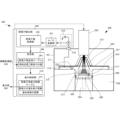
- ⁇ Configuration and Operation of 3D Additive Manufacturing Apparatus> 2 is a block diagram showing the configuration of a three-dimensional additive manufacturing apparatus 200 according to this embodiment.
- the three-dimensional additive manufacturing apparatus 200 includes an additive manufacturing unit 290 and an information processing unit 240.
- an electron gun 202 is attached to a vacuum vessel 201, and a molding frame (modeling box) 203 having a circular or square cross section is provided inside the vacuum vessel 201.
- a Z drive mechanism (mechanism for changing the vertical direction of rotation) 204 is provided below the inside of the molding frame 203, and a powder table 205 can be driven in the Z direction by a rack and pinion, a ball screw, or the like.
- a heat-resistant flexible seal 206 is provided in the gap between the molding frame 203 and the powder table 205, and the sliding surface of the flexible seal 206 and the molding frame 203 on the inner surface provides sliding and airtightness.
- the vacuum vessel 201 is evacuated by a vacuum pump (not shown), and the inside of the vacuum vessel 201 is maintained at a vacuum.
- a modeling plate 209 is placed on the powder table 205, on which the object 208 is formed, raised by the spread powder (unsintered) 213.
- the modeling plate 209 is grounded to the powder table 205, which is at GND potential, by a GND line 210 so that it does not float electrically.
- the object 208 is formed on the modeling plate 209, and when each layer is formed, the metal powder is spread to approximately the same height as the upper surface of the modeling frame table 203 by a linear funnel 212 filled with metal powder 211.
- the linear funnel 212 is replenished with powder as needed from a powder hopper (not shown).
- the area of the object 208 is two-dimensionally melted on one layer of the spread powder (unsintered) 213 by an electron beam from the electron gun 202, and the object 208 is constructed by overlapping the layers.
- the area of the powder (unsintered) 213 spread on the modeling plate 209 other than the model 208 is powder that has been pre-sintered by the electron beam from the electron gun 202 (the spread powder (pre-sintered) 214), and is conductive.
- a protective cover 215 grounded to GND is attached between the printing surface and the electron gun 202 to prevent metal vapor generated during printing and metal sputtering caused by fireworks from being deposited on the inner walls of the chamber.
- This cover also acts as a radiation shield from the high-temperature printing surface.
- thermoelectrons are detected using a thermoelectron detection electrode 220 dedicated to thermoelectron detection.
- a metal electrode such as Ti, which emits a small amount of secondary electrons due to electronic excitation, is used, and an insulator for electrically insulating the electrode from the ground potential is placed away from the modeling surface to suppress a decrease in insulation resistance due to temperature rise.
- thermoelectron detection electrode guides 221, to which thermoelectron detection electrodes 220 are attached via insulators 217, are attached to both ends of the modeling frame 203, which experiences a small temperature rise during modeling.
- a voltage-superimposed current amplifier 219 is connected to the thermoelectron detection electrode guide 221 via a current introduction terminal 218 attached to the vacuum vessel 201.
- the voltage-superimposed current amplifier 219 has almost no effect on the primary electron beam with respect to GND.
- thermoelectron detection electrode 220 a low voltage of + several volts or less is applied so that only thermoelectrons with lower energy than secondary electrons are attracted, and thermoelectrons emitted from the melting point of the model 208 in the melting process are attracted to the thermoelectron detection electrode 220 by a positive potential gradient, and the amount of electrons is detected as a current.
- the application of a positive voltage can increase the detection efficiency of thermoelectrons even when the electron beam is OFF or when the laser beam is melting.
- the amount of attracted thermoelectrons is controlled by changing the positive applied voltage, and the applied voltage is changed depending on whether the temperature is relatively low or high. For example, a positive applied voltage can be used across the entire temperature range without changing the gain of the current amplifier by increasing the positive voltage when the temperature is relatively low and decreasing the voltage when the temperature is high.
- the protection cover 215 is suspended below the electron gun 202, but it is also possible to place a guide with a GND potential on the thermoelectron detection electrode guide 221 via an insulator and then place the protection cover 215 on top of that. This makes it convenient because the thermoelectron detection electrode 220 and the protection cover 215 can be attached together on the printing surface.
- thermoelectron detection unit 250 includes a thermoelectron detection unit 250, a storage unit 260, and a display control unit 270.
- thermoelectron detection unit 250, the storage unit 260, and the display control unit 270 correspond to the thermoelectron detection unit 101, the storage unit 102, and the display control unit 103 in FIG.
- the thermoelectron detection unit 250 has a voltage superimposed current amplifier 219, an A/D conversion unit 251, and a thermoelectron quantity acquisition unit 252.
- the voltage superimposed current amplifier 219 is a circuit that converts the amount of thermoelectrons attracted by the thermoelectron detection electrode 220 into a current.
- the A/D conversion unit 251 converts the analog current value that is the output of the voltage superimposed current amplifier 219 into a digital current value.
- the thermoelectron quantity acquisition unit 252 then acquires the digital current value corresponding to the thermoelectron quantity, and stores it in the memory unit 260 in association with the irradiation position.
- the storage unit 260 has a thermoelectron quantity storage table 261, in which the amount of thermoelectrons is stored in association with the irradiation position.
- the display control unit 270 has a thermoelectron quantity display image table 271, and generates a display screen in which an image showing the amount of thermoelectrons that can be identified by associating the amount of thermoelectrons stored in the thermoelectron quantity storage table 261 of the storage unit 260 with the irradiation position and an image of the modeling surface are superimposed so that the irradiation positions overlap.
- the generated thermoelectron quantity display screen is then sent to the display unit 280 for display.
- the upper surface of the shaping plate 209 covered with the spread powder is placed at approximately the same height as the upper surface of the shaping frame 203, and an electron beam from the electron gun 202 is irradiated onto an area slightly narrower than the entire upper surface of the shaping plate 209, thereby heating the plate in advance to a temperature at which the metal powder 211 is pre-sintered.
- the powder stage 205 is lowered by the Z drive mechanism 204 so that the upper surface of the shaping plate 209 is positioned slightly lower than the upper surface of the shaping frame 203. This slight lowering ⁇ Z corresponds to the layer thickness in the Z direction thereafter.
- the linear funnel 212 filled with the metal powder 211 is moved along the upper surface of the shaping plate 209 to the opposite side, and ⁇ Z amount of the metal powder 211 is spread on and around the shaping plate 209.
- An electron beam from the electron gun 202 is irradiated onto the powder spread on the shaping plate 209 in an area slightly narrower than the shaping plate 209, heating the metal powder 211 spread on the shaping plate 209 and reliably pre-sintering the metal powder in the irradiated area.
- the molding sequence is "squeegeeing” to spread the powder, “powder heating (PH)” to heat the powder, then “melting” the area to be molded, and “preheating (AH)” to prepare for the next squeegee, which are performed for each layer and are repeated to create the object.
- the electron beam from the electron gun 202 melts the two-dimensional shape area according to the two-dimensional shape obtained by slicing the pre-prepared design object at ⁇ Z intervals.
- the electron beam scans according to a preset scan path, and each point is melted with the preset beam current, beam diameter, and scanning speed (determined by the dwell time at one point and the distance to the next point).
- the thermoelectron signal from the voltage superimposed current amplifier 219 is detected, and the intensity distribution of the thermoelectrons is imaged as a brightness signal of the corresponding point on the two-dimensional shape of the object.
- the additive manufacturing unit 290 and the information processing unit 240 are arranged in close proximity to each other, but the additive manufacturing unit 290 and the information processing unit 240, or a part of the information processing unit 240, may be arranged remotely and may exchange information via wired or wireless communication.
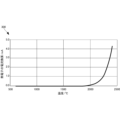
- Fig. 3 is a graph showing the relationship between the melting temperature at the irradiation position and the amount of thermoelectrons according to this embodiment. Fig. 3 shows the result of calculating the amount of thermoelectrons generated from a ⁇ 0.5 mm region in a Ti64 alloy as a function of temperature.
- thermoelectrons increases exponentially with increasing temperature.
- the build surface is heated to about 750°C in the powder heating (PH) process prior to melting, and the thermoelectrons emitted from the entire area are about 0.5 pA (picoamperes).
- the thermoelectrons emitted from a ⁇ 0.5mm area at the melting point are about 1 ⁇ A (microamperes), and when the melting temperature reaches about 2000°C, this falls to about 100 ⁇ A (microamperes), and when it reaches about 2400°C, thermoelectrons of more than 4 mA (milliamperes) are generated.
- thermoelectrons emitted when the build surface is heated during powder heating (PH) or preheating (AH) are small, at about 20nA (nanoamperes), even if the build surface is 110 x 110mm2 and the temperature is 1000°C.
- temperatures other than the melting point are lower than that, so the thermoelectron signal detected during melting reflects the temperature of the melting point (melt pool), which is at a high temperature. Because the thermoelectrons in the molten state are orders of magnitude larger, the thermoelectron image reflects the melt temperature distribution if the melted area is roughly the same.
- the memory unit 260 stores the irradiation position where the modeling beam is irradiated and the integrated value of the thermoelectrons detected by the thermoelectron detection unit 250 at a predetermined time related to the irradiation timing of the modeling beam in association with each other.
- the residence time is a current amount of several tens of microseconds (25 microseconds), and is a current value that can be read at about 100 kHz depending on the amplifier bandwidth.
- the electron beam from the electron gun 202 may be pulsed and lock-in detection may be performed at that frequency. Also, when the electron beam is pulsed to perform lock-in detection, it is not necessary to turn off the electron beam at a predetermined time interval. In addition, if the irradiation current from the electron gun 202 is constant, its effect can be treated as an offset in the thermoelectron current, allowing it to be converted into the amount of thermoelectrons even while the beam is being irradiated.
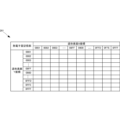
- thermoelectron amount storage table 261 is used in the storage unit 260 to store the thermoelectron amount in association with the irradiation position.
- the thermoelectron quantity storage table 261 stores the thermoelectron quantity in association with the X coordinate in the X direction and the Y coordinate in the Y direction, which indicate the irradiation position on the model surface. Coordinates that are not part of the model (not irradiated) store a value that is zero or a non-thermoelectron quantity. In FIG. 4A, the coordinates are set to "0001" to "0FFF", but are not limited to this.
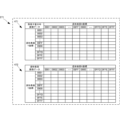
- thermoelectron amount display image table 4B is a diagram showing the configuration of a thermoelectron amount display image table 271 according to this embodiment.
- the thermoelectron amount display image table 271 is used by the display control unit 270 to generate a display screen in which a thermoelectron amount image and a modeling surface image are superimposed.
- the thermoelectron quantity display image table 271 includes image data (thermoelectron quantity distribution image data) 471 that indicates the quantity of thermoelectrons, and image data of the printing surface (printing surface image data) 472.
- image data that has been converted into an identifiable display of the thermoelectron quantity stored in FIG. 4A is stored.
- image data that allows parts of the printed object to be identified from parts that are not printed objects is stored. Note that image data of an image of the printing surface may also be used as the printing surface image data 472.
- ⁇ Processing Procedure of 3D Additive Manufacturing Apparatus> 5 is a flowchart showing a processing procedure of the 3D additive manufacturing apparatus according to this embodiment. This flowchart is executed by a central processing unit (CPU) of the information processing unit 240 using a random access memory (RAM) to realize the components of FIG. 2 so as to operate the 3D additive manufacturing apparatus.
- CPU central processing unit
- RAM random access memory
- step S501 the information processing unit 240 waits for the acquisition of additive manufacturing data.
- the information processing unit 240 instructs the additive manufacturing unit 290 to perform squeegeeing of the additive manufacturing powder.
- step S505 the information processing unit 240 instructs the additive manufacturing unit 290 to perform "powder heating (PH)" to heat the laid powder.
- step S507 the information processing unit 240 instructs the additive manufacturing unit 290 to "melt" the model area.
- step S509 the information processing unit 240 instructs the additive manufacturing unit 290 to perform "preheating (AH)" to prepare for the next squeegee.
- AH preheating
- step S511 the information processing unit 240 instructs the additive manufacturing unit 290 to lower the modeling plate by one layer.
- step S513 the information processing unit 240 determines whether the additive manufacturing is complete, and if not, returns to step S503 to repeat the manufacturing of the next layer.
- steps S571 to S581 are performed as the method for monitoring the object surface of this embodiment.
- the information processing unit 240 acquires the amount of thermoelectrons.
- the information processing unit 240 stores the acquired amount of thermoelectrons in the storage unit 260 in correspondence with the irradiation position.
- the information processing unit 240 determines whether melt-molding in the current molding layer is complete. If melt-molding in the current molding layer is not complete, the information processing unit 240 returns to step S571 and acquires the amount of thermoelectrons corresponding to the next irradiation position.
- step S577 the information processing unit 240 converts the amount of thermoelectrons into the melting temperature in step S577.
- the information processing unit 240 proceeds to step S579.
- step S579 the information processing unit 240 superimposes a thermoelectron distribution image (melting temperature distribution image) on the image of the modeling surface.
- step S581 the information processing unit 240 controls to display the superimposed thermoelectron distribution image (melting temperature distribution image).
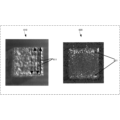
- Fig. 6 is a diagram showing a display screen displayed by the three-dimensional additive manufacturing apparatus 200 according to this embodiment.
- Fig. 6 shows a modeling surface and a thermoelectron image when the surface is melted.
- the arrow 611 on the modeling surface 610 indicates the scanning direction of the melting beam, which scans back and forth across the melting area, so the turning point is affected by the energy input on the way there (outward trip), and the melting temperature becomes higher, causing a slight rise on the modeling surface.
- Thermal electron image 620 contains an image including an area 621 with a large amount of thermoelectrons that reflects this. This is because the molding is performed with a constant input energy, and if the input energy is controlled so that the signal strength in the thermoelectron image 620 is constant, this swelling can be avoided, making it possible to always mold with stable quality. The signal strength of this thermoelectron image is sufficient as an indicator of the melting temperature distribution.
- thermoelectrons is represented by differences in display brightness, but this is not limited to this, and a heat map image based on differences in dot size, display density, or color may also be used.
- the melting state of the entire printing surface can be easily grasped by using a thermoelectron distribution image in which an image showing the amount of thermoelectrons is superimposed on an image of the printing surface.
- thermoelectrons by detecting the thermoelectrons during melting, it is now possible to measure the melting temperature and its index at each melting point in the melting area. In addition, it is possible to measure the amount of thermoelectrons corresponding to the melting temperature without the need to determine the optimal melting conditions by changing parameters such as melting energy and looking at the molten surface shape during modeling or the internal defects and modeled surface shape after modeling. This makes it possible to control the melting temperature to always be constant during the melting process, regardless of the size or location of the molten area. Furthermore, optimizing the melting temperature makes it possible to consistently create objects of stable quality.
- the three-dimensional additive manufacturing device differs from the second embodiment in that it displays a melting temperature distribution image in which an image representing a melting temperature calculated based on the amount of thermoelectrons is superimposed on an image of the modeling surface, instead of thermoelectrons.
- the image representing the melting temperature may be a heat map image.
- FIG. 7 is a block diagram showing the configuration of a three-dimensional additive manufacturing apparatus 700 according to this embodiment.
- the same components as those in Fig. 2 are given the same reference numerals, and duplicated explanations will be omitted.
- FIG. 7 includes a thermoelectron quantity-to-temperature conversion unit 780 and a display control unit 770.
- the thermoelectron quantity-to-temperature conversion unit 780 has a conversion table 781, and converts the thermoelectron value in the storage unit 260 to a melting temperature.
- the display control unit 770 has a melting temperature display image table 771, and generates an image representing the melting temperature that makes the melting temperature converted by the conversion table 781 of the thermoelectron quantity-to-temperature conversion unit 780 identifiable in correspondence with the irradiation position. Then, a melting temperature distribution display screen is generated in which the image representing the melting temperature and the image of the modeling surface are superimposed so that the irradiation positions overlap. The generated display screen is then sent to the display unit 280 for display.
- (Conversion table) 8 is a diagram showing the configuration of the conversion table 781 according to this embodiment.
- the conversion table 781 is used by the thermoelectron amount-temperature converter 780 to convert the thermoelectron amount into the melting temperature.
- thermoelectron signal for the required temperature can be calculated in advance as a threshold value, and the value can be used as a parameter to realize the melting process at the required melting temperature.
- the melting state of the entire printing surface can be more easily understood by using a thermoelectron distribution image in which an image showing the melting temperature is superimposed on an image of the printing surface.
- the melting temperature can be measured without the need to change parameters such as melting energy and determine the optimal melting conditions by looking at the molten surface shape during modeling or the internal defects and modeled surface shape after modeling. This makes it possible to control the melting temperature so that it is always constant during the melting process, regardless of the size or location of the molten area. Furthermore, optimizing the melting temperature makes it possible to consistently create objects of consistent quality.
- thermoelectrons melting temperature
- the three-dimensional additive manufacturing apparatus according to this embodiment is different from the second and third embodiments in that the amount of thermoelectrons (melting temperature) is corrected according to the surrounding conditions of the irradiation position to obtain a more accurate amount of thermoelectrons (melting temperature). That is, the amount of thermoelectrons (melting temperature) is divided by the area of the region between the irradiation position irradiated with the modeling beam and the adjacent irradiation position to obtain the amount of thermoelectrons (melting temperature) at the irradiation position irradiated with the modeling beam.
- Other configurations and operations are similar to those of the second and third embodiments, so the same reference numerals are used for the same configurations and operations and detailed descriptions thereof will be omitted.
- FIG. 9 is a diagram showing the process procedure and process contents of the three-dimensional additive manufacturing apparatus according to this embodiment.
- step S978 the information processing unit 240 corrects the amount of thermoelectrons (melting temperature) taking into account the surrounding area of the irradiation position.
- the melting temperature is estimated by detecting thermoelectrons at each melting point as in the above embodiment, it is not taken into account that the diffusion of heat around the melting point differs depending on the shape of the object and the location of the melt on that shape.
- the bulk part has a higher thermal conductivity than the molten object (bulk part) and the pre-sintered part around it. Therefore, when melting the inside of the printing surface, the input energy is greater to achieve the same temperature due to the greater diffusion of heat, and the melt pool is also relatively large.
- the diffusion of heat is smaller, so the temperature rises more locally and the melt pool is relatively small.
- thermoelectron image is displayed as the thermoelectron signal amount per unit area taking into account the arrangement of the melting points, which is determined according to the model shape, so that the temperature distribution according to the model shape is reflected.
- a scan path is set in advance as indicated by the arrows during melting, and the position of the melting point is determined by the scan pitch (the distance between melting points in the scanning direction) and the line pitch (the distance to the next scan line).
- the intensity of the thermoelectron signal during melting at each melting point is divided by the area surrounded by the surrounding melting points, and the value is visualized as the intensity at that melting point.
- the area of the triangle surrounded by the vertex and the three points on the second line as melting points around that point is shown as a lattice.
- the area surrounded by the lattice and the six surrounding points as melting points around that point is shown as a lattice.
- the area surrounded by the lattice and the four surrounding points as melting points around that point is shown as a lattice.
- the area surrounded by the lattice and the four surrounding points as melting points around that point is shown as a lattice.
- the areas surrounded by the melting points for the other melting points are shown by filling them with lattices. These areas are easily calculated by determining the melting points with the preset scan pitch and line pitch.
- the amount of thermoelectrons (melting temperature) at the irradiation position irradiated by the modeling beam is divided by the area of the region between the irradiation position irradiated by the modeling beam and the adjacent irradiation position to determine the amount of thermoelectrons (melting temperature) at the irradiation position irradiated by the modeling beam.
- thermoelectrons melting temperature
- melting parameters irradiation intensity, scanning speed, beam diameter, film thickness, etc.
- thermoelectrons is performed using a conductor in the existing protective cover.
- a positively charged metal plate for detecting thermoelectrons is provided inside the protective cover that prevents the dissipation of steam radiated from the modeling surface.
- Other configurations and operations are similar to those of the second to fourth embodiments, so the same reference numerals are used for the same configurations and operations and detailed descriptions thereof will be omitted.
- FIG. 10 is a block diagram showing the configuration of a three-dimensional additive manufacturing apparatus 1000 according to this embodiment.
- the same components as those in Fig. 2 are given the same reference numerals, and duplicated explanations will be omitted.
- the device configuration when the protective cover 1015 is used for detecting thermoelectrons is as shown in the layered modeling unit 1090 in FIG. 10, and the protective cover 1015 is attached to the lower part of the electron gun 202 via an insulator 1017.
- the protective cover 1015 is attached to the electron gun 202, but it may be attached to the upper surface of the vacuum vessel 201, or an electrode for detecting thermoelectrons may be provided inside the grounded protective cover 1015.
- a voltage superimposed current amplifier 219 is connected to the protective cover 1015 via a current introduction terminal 218 attached to the vacuum vessel 201.
- thermoelectrons emitted from the melting point of the model 208 in the melting process are attracted to the protective cover 1015 by a positive potential gradient, and the amount of electrons is detected as a current.
- the information processing unit 240 of this embodiment is the same as that in Fig. 2 except that the conductor for detecting thermoelectrons is a protection cover 1015. Note that it may be the same as the information processing unit 740 in Fig. 7.
- the melting state of the entire printing surface can be easily grasped by using a thermoelectron distribution image in which an image showing the amount of thermoelectrons is superimposed on an image of the printing surface, without the need to provide a new conductor to attract thermoelectrons as in the second embodiment.
- the three-dimensional additive manufacturing apparatus according to this embodiment differs from the second to fifth embodiments in that additive manufacturing parameters can be automatically adjusted by an information processing unit.
- the other configurations and operations are the same as those of the second to fifth embodiments, so the same configurations and operations are denoted by the same reference numerals and detailed descriptions thereof will be omitted.
- FIG. 11 is a block diagram showing a three-dimensional additive manufacturing apparatus 1100 according to this embodiment.
- the same components as those in Figs. 2, 7, and 10 are given the same reference numerals, and duplicated explanations will be omitted.
- the information processing unit 1140 in FIG. 11 has an additive manufacturing adjustment unit 1190.
- the additive manufacturing adjustment unit 1190 adjusts the irradiation intensity, scanning speed, layer thickness, beam diameter, and the like so that the melting temperature shown in the melting temperature distribution image from the display control unit 770 becomes the target melting temperature. Note that the additive manufacturing parameters to be adjusted are not limited to these.
- remelting for insufficient melting for each layer can be performed in real time, or the melting adjustment for the next layer can be performed.
- the variation in the melting state can be predicted from the constructed thermoelectron distribution image, and the remelting energy distribution at each point in the melted area can be calculated accordingly, so that the melted area can be remelted to have a uniform thermoelectron distribution.
- Such remelting can also be limited to only the areas with localized insufficient melting.
- thermoelectrons are detected even during beam irradiation.
- the present invention may also be applied to a system made up of multiple devices, or to a stand-alone device. Furthermore, the present invention may also be applied to a case where an information processing program that realizes the functions of the embodiments is supplied to a system or device and executed by a built-in processor.
- a program that is installed on a computer, or a medium storing the program, a server that downloads the program, and a processor that executes the program are also included in the technical scope of the present invention.
- at least a non-transitory computer readable medium that stores a program that causes a computer to execute the processing steps included in the above-mentioned embodiments is included in the technical scope of the present invention.
Landscapes
- Engineering & Computer Science (AREA)
- Chemical & Material Sciences (AREA)
- Manufacturing & Machinery (AREA)
- Materials Engineering (AREA)
- Automation & Control Theory (AREA)
- Physics & Mathematics (AREA)
- Plasma & Fusion (AREA)
- Analytical Chemistry (AREA)
Priority Applications (3)
| Application Number | Priority Date | Filing Date | Title |
|---|---|---|---|
| EP23925208.3A EP4647193A4 (en) | 2023-02-28 | 2023-02-28 | THREE-DIMENSIONAL ADDITIVE MANUFACTURING DEVICE, MANUFACTURED SURFACE MONITORING METHOD, AND INFORMATION PROCESSING PROGRAM |
| JP2025503283A JPWO2024180651A1 (https=) | 2023-02-28 | 2023-02-28 | |
| PCT/JP2023/007240 WO2024180651A1 (ja) | 2023-02-28 | 2023-02-28 | 3次元積層造形装置、造形表面モニタ方法、および、情報処理プログラム |
Applications Claiming Priority (1)
| Application Number | Priority Date | Filing Date | Title |
|---|---|---|---|
| PCT/JP2023/007240 WO2024180651A1 (ja) | 2023-02-28 | 2023-02-28 | 3次元積層造形装置、造形表面モニタ方法、および、情報処理プログラム |
Publications (1)
| Publication Number | Publication Date |
|---|---|
| WO2024180651A1 true WO2024180651A1 (ja) | 2024-09-06 |
Family
ID=92589486
Family Applications (1)
| Application Number | Title | Priority Date | Filing Date |
|---|---|---|---|
| PCT/JP2023/007240 Ceased WO2024180651A1 (ja) | 2023-02-28 | 2023-02-28 | 3次元積層造形装置、造形表面モニタ方法、および、情報処理プログラム |
Country Status (3)
| Country | Link |
|---|---|
| EP (1) | EP4647193A4 (https=) |
| JP (1) | JPWO2024180651A1 (https=) |
| WO (1) | WO2024180651A1 (https=) |
Citations (4)
| Publication number | Priority date | Publication date | Assignee | Title |
|---|---|---|---|---|
| WO2017163430A1 (ja) * | 2016-03-25 | 2017-09-28 | 技術研究組合次世代3D積層造形技術総合開発機構 | 3次元積層造形装置、3次元積層造形装置の制御方法および3次元積層造形装置の制御プログラム |
| JP2019007065A (ja) * | 2017-06-28 | 2019-01-17 | 日本電子株式会社 | 3次元積層造形装置 |
| JP2022050034A (ja) | 2020-09-17 | 2022-03-30 | 日本電子株式会社 | 3次元積層造形装置及び3次元積層造形方法。 |
| JP2022184906A (ja) * | 2018-06-13 | 2022-12-13 | 株式会社ニコン | 演算装置、検出システム、造形装置、演算方法、検出方法、造形方法、演算プログラム、検出プログラムおよび造形プログラム |
Family Cites Families (3)
| Publication number | Priority date | Publication date | Assignee | Title |
|---|---|---|---|---|
| JPS61243647A (ja) * | 1985-04-22 | 1986-10-29 | Mitsubishi Electric Corp | 電子ビームの焦点調整装置 |
| JP2702987B2 (ja) * | 1988-09-30 | 1998-01-26 | 株式会社日立製作所 | イオンビーム加工装置 |
| WO2020005228A1 (en) * | 2018-06-27 | 2020-01-02 | Lawrence Livermore National Security, Llc | Laser powder bed fusion additive manufacturing in-process monitoring and optimization using thermionic emission detection |
-
2023
- 2023-02-28 JP JP2025503283A patent/JPWO2024180651A1/ja active Pending
- 2023-02-28 EP EP23925208.3A patent/EP4647193A4/en active Pending
- 2023-02-28 WO PCT/JP2023/007240 patent/WO2024180651A1/ja not_active Ceased
Patent Citations (4)
| Publication number | Priority date | Publication date | Assignee | Title |
|---|---|---|---|---|
| WO2017163430A1 (ja) * | 2016-03-25 | 2017-09-28 | 技術研究組合次世代3D積層造形技術総合開発機構 | 3次元積層造形装置、3次元積層造形装置の制御方法および3次元積層造形装置の制御プログラム |
| JP2019007065A (ja) * | 2017-06-28 | 2019-01-17 | 日本電子株式会社 | 3次元積層造形装置 |
| JP2022184906A (ja) * | 2018-06-13 | 2022-12-13 | 株式会社ニコン | 演算装置、検出システム、造形装置、演算方法、検出方法、造形方法、演算プログラム、検出プログラムおよび造形プログラム |
| JP2022050034A (ja) | 2020-09-17 | 2022-03-30 | 日本電子株式会社 | 3次元積層造形装置及び3次元積層造形方法。 |
Non-Patent Citations (1)
| Title |
|---|
| See also references of EP4647193A1 |
Also Published As
| Publication number | Publication date |
|---|---|
| EP4647193A4 (en) | 2026-03-25 |
| EP4647193A1 (en) | 2025-11-12 |
| JPWO2024180651A1 (https=) | 2024-09-06 |
Similar Documents
| Publication | Publication Date | Title |
|---|---|---|
| US10766199B2 (en) | Three-dimensional additive manufacturing device | |
| JP7229977B2 (ja) | 3次元積層造形装置及び3次元積層造形方法。 | |
| JP7097391B2 (ja) | 付加製造制御システム | |
| US20210154764A1 (en) | Three-dimensional powder bed fusion additive manufacturing apparatus and three-dimensional powder bed fusion additive manufacturing method | |
| US20200331198A1 (en) | Additive manufacturing device and additive manufacturing method | |
| JP2015015227A (ja) | 放射線発生管及びそれを用いた放射線発生装置と放射線撮影システム | |
| EP4104956A1 (en) | Devices, systems, and methods for using an imaging device to calibrate and operate a plurality of electron beam guns in an additive manufacturing system | |
| WO2024180651A1 (ja) | 3次元積層造形装置、造形表面モニタ方法、および、情報処理プログラム | |
| US20180239335A1 (en) | Device for controlling additive manufacturing machinery | |
| US10394223B2 (en) | Device for controlling additive manufacturing machinery | |
| US20210069790A1 (en) | Device for controlling additive manufacturing machinery | |
| WO2025203451A1 (ja) | 3次元積層造形システム、その制御方法、および、制御プログラム | |
| EP3731598B1 (en) | Additive manufacturing apparatus and modification method therefor | |
| CN108624849B (zh) | 一种电阻蒸发器 | |
| EP3795279A1 (en) | Three-dimensional shaping device and three-dimensional shaping method | |
| US12151286B2 (en) | Devices, systems, and methods for calibrating and operating an additive manufacturing system having a plurality of electron beam guns | |
| US20250065416A1 (en) | Information Processing Apparatus and Three-Dimensional Powder Bed Fusion Additive Manufacturing Apparatus | |
| US10871766B2 (en) | Device for controlling additive manufacturing machinery | |
| US20220167491A1 (en) | Active rise and fall time compensation algorithm | |
| US20250253618A1 (en) | Method for operating a laser device and laser device | |
| EP3403746A1 (en) | Device for controlling additive manufacturing machinery | |
| JP6912629B1 (ja) | 電子線照射装置及び電子線照射装置の製造方法 | |
| JP2017050070A (ja) | X線発生管、x線発生装置、x線撮影システム、x線発生装置の調整方法 |
Legal Events
| Date | Code | Title | Description |
|---|---|---|---|
| 121 | Ep: the epo has been informed by wipo that ep was designated in this application |
Ref document number: 23925208 Country of ref document: EP Kind code of ref document: A1 |
|
| WWE | Wipo information: entry into national phase |
Ref document number: 2025503283 Country of ref document: JP |
|
| NENP | Non-entry into the national phase |
Ref country code: DE |
|
| WWP | Wipo information: published in national office |
Ref document number: 2023925208 Country of ref document: EP |