WO2024176555A1 - 吸収性物品 - Google Patents
吸収性物品 Download PDFInfo
- Publication number
- WO2024176555A1 WO2024176555A1 PCT/JP2023/042480 JP2023042480W WO2024176555A1 WO 2024176555 A1 WO2024176555 A1 WO 2024176555A1 JP 2023042480 W JP2023042480 W JP 2023042480W WO 2024176555 A1 WO2024176555 A1 WO 2024176555A1
- Authority
- WO
- WIPO (PCT)
- Prior art keywords
- skin side
- side layer
- absorbent
- layer
- absorbent article
- Prior art date
- Legal status (The legal status is an assumption and is not a legal conclusion. Google has not performed a legal analysis and makes no representation as to the accuracy of the status listed.)
- Ceased
Links
Images





Classifications
-
- A—HUMAN NECESSITIES
- A61—MEDICAL OR VETERINARY SCIENCE; HYGIENE
- A61F—FILTERS IMPLANTABLE INTO BLOOD VESSELS; PROSTHESES; DEVICES PROVIDING PATENCY TO, OR PREVENTING COLLAPSING OF, TUBULAR STRUCTURES OF THE BODY, e.g. STENTS; ORTHOPAEDIC, NURSING OR CONTRACEPTIVE DEVICES; FOMENTATION; TREATMENT OR PROTECTION OF EYES OR EARS; BANDAGES, DRESSINGS OR ABSORBENT PADS; FIRST-AID KITS
- A61F13/00—Bandages or dressings; Absorbent pads
- A61F13/15—Absorbent pads, e.g. sanitary towels, swabs or tampons for external or internal application to the body; Supporting or fastening means therefor; Tampon applicators
- A61F13/53—Absorbent pads, e.g. sanitary towels, swabs or tampons for external or internal application to the body; Supporting or fastening means therefor; Tampon applicators characterised by the absorbing medium
- A61F13/534—Absorbent pads, e.g. sanitary towels, swabs or tampons for external or internal application to the body; Supporting or fastening means therefor; Tampon applicators characterised by the absorbing medium having an inhomogeneous composition through the thickness of the pad
- A61F13/535—Absorbent pads, e.g. sanitary towels, swabs or tampons for external or internal application to the body; Supporting or fastening means therefor; Tampon applicators characterised by the absorbing medium having an inhomogeneous composition through the thickness of the pad inhomogeneous in the plane of the pad, e.g. core absorbent layers being of different sizes
-
- A—HUMAN NECESSITIES
- A61—MEDICAL OR VETERINARY SCIENCE; HYGIENE
- A61F—FILTERS IMPLANTABLE INTO BLOOD VESSELS; PROSTHESES; DEVICES PROVIDING PATENCY TO, OR PREVENTING COLLAPSING OF, TUBULAR STRUCTURES OF THE BODY, e.g. STENTS; ORTHOPAEDIC, NURSING OR CONTRACEPTIVE DEVICES; FOMENTATION; TREATMENT OR PROTECTION OF EYES OR EARS; BANDAGES, DRESSINGS OR ABSORBENT PADS; FIRST-AID KITS
- A61F13/00—Bandages or dressings; Absorbent pads
- A61F13/15—Absorbent pads, e.g. sanitary towels, swabs or tampons for external or internal application to the body; Supporting or fastening means therefor; Tampon applicators
- A61F13/53—Absorbent pads, e.g. sanitary towels, swabs or tampons for external or internal application to the body; Supporting or fastening means therefor; Tampon applicators characterised by the absorbing medium
- A61F13/534—Absorbent pads, e.g. sanitary towels, swabs or tampons for external or internal application to the body; Supporting or fastening means therefor; Tampon applicators characterised by the absorbing medium having an inhomogeneous composition through the thickness of the pad
- A61F13/537—Absorbent pads, e.g. sanitary towels, swabs or tampons for external or internal application to the body; Supporting or fastening means therefor; Tampon applicators characterised by the absorbing medium having an inhomogeneous composition through the thickness of the pad characterised by a layer facilitating or inhibiting flow in one direction or plane, e.g. a wicking layer
Definitions
- the present invention relates to an absorbent article.
- Patent Document 1 discloses an absorbent article in which the absorbent body includes an SAP layer made of SAP (super absorbent polymer), and an upper absorbent core and a lower absorbent core that are stacked so as to sandwich the SAP layer from above and below.
- SAP layer has multiple SAP regions aligned in a planar direction, and the second sheet is folded so as to enter the gaps between the multiple SAP regions, preventing the multiple SAP regions that have absorbed bodily fluids and become jelly-like from sticking together and forming lumps.
- the upper absorbent core of the absorbent body of Patent Document 1 is a pulp layer made of pulp. Pulp has a faster liquid absorption rate than SAP. Therefore, if the pulp layer (upper absorbent core) is located on the skin contact side of the SAP layer as in the absorbent body of Patent Document 1, the pulp layer quickly absorbs the excreted liquid, making it difficult to draw the excreted liquid to the back side (non-skin contact side) of the absorbent body (absorbent core). This makes it difficult to effectively utilize the absorbent body, and reduces the absorbed water retention capacity of the absorbent body.
- an SAP sheet having an SAP layer supported thereon may be used as an absorbent. However, in the case of an SAP sheet having no pulp layer, the excreted liquid cannot be temporarily stored in the pulp layer, which has a high absorption rate, and there is a risk that the excreted liquid will overflow and leak during excretion.
- the present invention was made in consideration of the above problems, and aims to provide an absorbent article that can draw excrement to the back of the absorbent core, effectively utilize the absorbent core, and prevent excrement from leaking.
- the main invention for achieving the above-mentioned object is an absorbent article having an absorbent core which, in an unfolded state, has a longitudinal direction, a width direction, and a thickness direction which are perpendicular to each other, and which contains liquid-absorbent fibers and a superabsorbent polymer, wherein the absorbent core has, from the skin side in the thickness direction, a skin-side layer in which the volume occupied by the superabsorbent polymer is larger than the volume occupied by the liquid-absorbent fibers, an intermediate layer in which the volume occupied by the liquid-absorbent fibers is larger than the volume occupied by the superabsorbent polymer, and a non-skin-side layer in which the volume occupied by the superabsorbent polymer is larger than the volume occupied by the liquid-absorbent fibers, and wherein the skin-side layer has a low basis weight region in which the basis weight of the absorbent core is lower than the surrounding area.
- the present invention provides an absorbent article that draws excrement to the back of the absorbent core, effectively utilizing the absorbent core, and prevents excrement from leaking out.
- FIG. 1 is a schematic perspective view of a diaper 1.
- FIG. 2 is a plan view of the diaper 1 in an open and stretched state, as viewed from the skin side.
- FIG. 3 is a schematic cross-sectional view taken along the center line CL in FIG. 2 .
- FIG. 2 is a schematic cross-sectional view of the absorbent body 20 of the first embodiment. This is a plan view of absorbent cores 21 to 23 stacked together.
- 6A is a plan view of the skin side layer 21, and
- FIG. 6B is a plan view of the intermediate layer 22 and the non-skin side layer 23.
- FIG. 7A to 7C are plan views of modified examples of absorbent cores 21 to 23.
- FIG. 11 is a plan view of modified examples of absorbent cores 21 to 23.
- FIG. 9A and 9B are schematic cross-sectional views of modified examples of the absorbent body 20.
- FIG. 10A and 10B are schematic cross-sectional views of modified examples of the absorbent body 20.
- FIG. 13 is a schematic cross-sectional view of a modified example of the absorbent body 20.
- FIG. 11 is a schematic cross-sectional view of an absorbent body 20 according to a second embodiment.
- An absorbent article having an absorbent core which, in an unfolded state, has a longitudinal direction, a width direction, and a thickness direction which are perpendicular to each other, and which contains liquid-absorbent fibers and a superabsorbent polymer, wherein the absorbent core has, from the skin side in the thickness direction, a skin-side layer in which the volume occupied by the superabsorbent polymer is larger than the volume occupied by the liquid-absorbent fibers, an intermediate layer in which the volume occupied by the liquid-absorbent fibers is larger than the volume occupied by the superabsorbent polymer, and a non-skin-side layer in which the volume occupied by the superabsorbent polymer is larger than the volume occupied by the liquid-absorbent fibers, and wherein the skin-side layer has a low basis weight region in which the basis weight of the absorbent core is lower than that of
- excreted liquid is likely to migrate quickly from the low basis weight region to the intermediate layer before it is absorbed by the superabsorbent polymer of the skin-side layer, and the excreted liquid can be quickly temporarily absorbed by the liquid-absorbent fibers of the intermediate layer. This makes it possible to prevent the excreted liquid from overflowing or leaking.
- the excreted liquid absorbed between the liquid-absorbent fibers of the intermediate layer then migrates by gravity to the non-skin-side layer, where it is absorbed and held by the superabsorbent polymer of the non-skin-side layer. This allows the excreted liquid to be drawn deep into the absorbent core, making effective use of the absorbent core.
- the absorbent article according to aspect 1 is characterized in that the skin side layer has a different type of superabsorbent polymer from the non-skin side layer, and the superabsorbent polymer in the skin side layer has a slower liquid absorption rate, as measured by a vortex method, than the superabsorbent polymer in the non-skin side layer.
- excreted liquid is more likely to migrate to the intermediate layer before it is absorbed by the highly absorbent polymer in the skin-facing layer.
- An absorbent article having an absorbent core which, in an unfolded state, has a longitudinal direction, a width direction, and a thickness direction which are perpendicular to each other, and which contains liquid-absorbent fibers and a superabsorbent polymer, wherein the absorbent core has, from the skin side in the thickness direction, a skin-side layer in which the volume occupied by the superabsorbent polymer is larger than the volume occupied by the liquid-absorbent fibers, an intermediate layer in which the volume occupied by the liquid-absorbent fibers is larger than the volume occupied by the superabsorbent polymer, and a non-skin-side layer in which the volume occupied by the superabsorbent polymer is larger than the volume occupied by the liquid-absorbent fibers, wherein the skin-side layer has a different type of superabsorbent polymer from that of the non-skin-side layer, and the superabsorbent polymer in the skin-side layer has
- excreted liquid is likely to migrate to the intermediate layer before being absorbed by the superabsorbent polymer of the skin side layer, and the excreted liquid can be quickly and temporarily absorbed by the liquid absorbent fiber of the intermediate layer. This prevents the excreted liquid from overflowing and leaking.
- the excreted liquid absorbed between the liquid absorbent fibers in the middle layer then migrates to the non-skin side layer by gravity, where it is absorbed and held by the highly absorbent polymer in the non-skin side layer. This allows the excreted liquid to be drawn deep into the absorbent core, making effective use of the absorbent core.
- the discharged liquid falls into the slits, and the migration speed of the discharged liquid from the low basis weight area to the intermediate layer is increased.
- At least one of the intermediate layer and the non-skin side layer has another low basis weight region in which the basis weight of the absorbent core is lower than that of the surrounding area.
- excreted liquid can easily migrate from other low basis weight areas of the intermediate layer to the non-skin side layer, or from other low basis weight areas of the non-skin side layer to the deeper side of the non-skin side layer. This makes it easier to draw excreted liquid deep into the absorbent core.
- excreted liquid that flows through the low basis weight area of the skin-side layer is more likely to flow to other low basis weight areas of the intermediate layer or non-skin-side layer, making it easier to draw excreted liquid deep into the absorbent core.
- the absorbent article according to aspect 5 or 6 has another low basis weight region, and the liquid absorbent fiber is arranged in the other low basis weight region of the non-skin side layer at a basis weight lower than the basis weight of the liquid absorbent fiber of the intermediate layer, characterized in that
- the liquid absorbent fibers in the other low basis weight regions make it easier for the excreted liquid to spread in the planar direction, and the superabsorbent polymer is less likely to roll onto the other low basis weight regions, ensuring the functionality of the other low basis weight regions.
- excreted liquid is more likely to fall into other low basis weight areas, and the non-skin-facing layer is more quickly absorbed by the excreted liquid.
- the excreted liquid can be transferred to the intermediate layer while being spread in the longitudinal direction along the low basis weight regions of the skin-side layer, so that the absorbent core can be effectively utilized in the longitudinal direction.
- An absorbent article according to any one of aspects 5 to 9 An absorbent article characterized in that the intermediate layer has another low basis weight region extending in the longitudinal direction, and at least a portion of the other low basis weight region of the intermediate layer is located in an area rearward of a center line that divides the absorbent article in an unfolded state in half in the longitudinal direction.
- the other low basis weight regions become the folding starting points, making it easier for the absorbent core (particularly the intermediate layer) to deform into a shape that is curved in the width direction along the wearer's buttocks.
- An absorbent article according to any one of aspects 1 to 10 An absorbent article characterized in that, on a cut surface of the absorbent core after absorbing colored water, cut along the width direction, the number of superabsorbent polymers per unit area located in the skin side layer and the number of superabsorbent polymers per unit area located in the non-skin side layer are greater than the number of superabsorbent polymers per unit area located in the intermediate layer.
- excreted liquid is more likely to migrate to the intermediate layer before it is absorbed by the skin-side layer.
- the number of superabsorbent polymers per unit area is small, so the liquid-absorbent fibers are more likely to temporarily absorb excreted liquid, which makes it possible to prevent excreted liquid from overflowing or leaking.
- excreted liquid between the liquid-absorbent fibers in the intermediate layer is more likely to be absorbed and retained by the superabsorbent polymer in the non-skin-side layer, allowing the absorbent core to be used more effectively all the way to the back.
- Aspect 12 An absorbent article according to any one of aspects 1 to 11, The absorbent article is characterized in that the intermediate layer has an average thickness of 0.5 mm or more.
- the amount of excreted liquid absorbed by the liquid absorbent fibers is increased compared to when the average thickness of the intermediate layer is less than 0.5 mm, and overflow of excreted liquid can be suppressed.
- An absorbent article according to any one of aspects 1 to 12 An absorbent article, comprising: an intermediate layer having an average thickness greater than the sum of an average thickness of the skin side layer and an average thickness of the non-skin side layer.
- the average thickness of the intermediate layer is equal to or less than the sum of the average thicknesses of the skin-side layer and the non-skin-side layer, more space is secured between the liquid-absorbent fibers of the intermediate layer, the amount of excreted liquid absorbed is increased, and overflow and leakage of excreted liquid can be suppressed.
- At least one of the skin side layer and the non-skin side layer comprises the liquid-absorbent fiber.
- the liquid-absorbent fibers increase the absorption rate of excreted liquid in the skin-side layer and non-skin-side layer.
- Aspect 15 An absorbent article according to any one of aspects 1 to 14, At least one of the skin side layer and the non-skin side layer is laminated adjacent to the intermediate layer in the thickness direction without an adhesive.
- Aspect 16 An absorbent article according to any one of aspects 1 to 15, At least one of the skin side layer and the non-skin side layer is laminated adjacent to the intermediate layer in the thickness direction without a nonwoven fabric therebetween.
- Aspect 17 An absorbent article according to any one of aspects 1 to 16, At least one of the skin side layer and the non-skin side layer is laminated adjacent to the intermediate layer in the thickness direction with a nonwoven fabric interposed therebetween.
- excreted liquid is more likely to diffuse in a planar direction on the nonwoven fabric before migrating to the intermediate layer or non-skin-side layer. Therefore, excreted liquid that has diffused in a planar direction can migrate to the intermediate layer or non-skin-side layer, and the absorbent core can be effectively utilized.
- the skin-side layer and the non-skin-side layer can be easily deformed together, and deformation of the absorbent core can be suppressed.
- the absorbent article according to aspect 17 or 18, An absorbent article characterized in that it has a core wrap sheet on the skin side in the thickness direction of the skin side layer and on the non-skin side in the thickness direction of the non-skin side layer, and the water absorption capacity of the nonwoven fabric is greater than the water absorption capacity of the core wrap sheet.
- the nonwoven fabric disposed inside the absorbent core can also temporarily absorb excreted liquid, preventing the excreted liquid from overflowing or leaking.
- An absorbent article according to any one of aspects 1 to 19, is characterized in that the intermediate layer has a constricted portion at the center of the longitudinal direction, which is constricted on the inside in the width direction, and at least one of the skin side layer and the non-skin side layer extends outward in the width direction beyond the constricted portion.
- the narrow narrow part of the intermediate layer reduces the discomfort (feeling of stiffness) felt when worn, while the skin-side layer or non-skin-side layer extending from the narrow narrow part can prevent leakage of excretory fluids.
- excreted liquid is likely to migrate to the intermediate layer before it is absorbed by the superabsorbent polymer of the skin-side layer, and the liquid absorbent fiber of the intermediate layer can quickly and temporarily absorb the excreted liquid. This makes it possible to prevent the excreted liquid from overflowing or leaking.
- the absorbent article according to the present invention will be described taking as an example a pants-type disposable diaper 1 for infants (hereinafter also referred to as "diaper 1").
- the absorbent article according to the present invention also includes tape-type disposable diapers, shorts-type napkins, absorbent pads, sanitary napkins and other absorbent articles.
- the wearer of the absorbent article is not limited to infants, but may be an adult or a living organism such as an animal.
- Fig. 1 is a schematic perspective view of the diaper 1.
- Fig. 2 is a plan view of the diaper 1 in an unfolded and stretched state, as viewed from the skin side.
- Fig. 3 is a schematic cross-sectional view taken along the center line CL of Fig. 2.
- the "stretched state" of the diaper 1 refers to a state in which the diaper 1 as a whole is stretched without wrinkles, specifically, a state in which the dimensions of each component constituting the diaper 1 (e.g., the absorbent body 10 and waist circumference parts 30, 40, etc., described below) are stretched until they match or are close to the dimensions of the individual components.
- the "unfolded state” of the diaper 1 refers to a state in which the diaper 1 is opened and unfolded in a plane by separating a pair of side joint parts 2 provided on both sides of the diaper 1.
- the diaper 1 has a vertical direction, a width direction, and a front-to-rear direction that are perpendicular to one another, and has a waist opening BH and a pair of leg openings LH.
- the upper side in the vertical direction corresponds to the waist opening BH side, and the lower side corresponds to the crotch side.
- the front side in the front-to-rear direction corresponds to the wearer's abdomen side, and the rear side corresponds to the wearer's back side.
- the width direction is a direction along the stretch direction of the rubber threads 33, 43 of the front waist section 30 and the rear waist section 40.
- the vertical direction is a direction along the orthogonal direction that is perpendicular to the stretch direction.
- the diaper 1 is a so-called three-piece pants-type diaper having a liquid-absorbent body 10 and a pair of waistbands 30, 40.
- the pair of waistbands the one that covers the wearer's abdominal side is also referred to as the front waistband 30, and the one that covers the wearer's back side is also referred to as the rear waistband 40.
- the diaper 1 In the unfolded state of FIG. 2, the diaper 1 has a longitudinal direction, a width direction, and a thickness direction that are perpendicular to each other.
- the longitudinal direction is along the longitudinal direction of the absorbent body 10 and along the vertical direction of the pants-type diaper 1.
- the thickness direction is the direction in which the materials constituting the diaper 1 are layered, as shown in FIG. 3.
- the side that contacts the wearer's skin is the skin side
- the opposite side is the non-skin side.
- the front waist portion 30 and the rear waist portion 40 are arranged in parallel with each other at a distance in the longitudinal direction, and the absorbent body 10 is hung between them, with each end of the absorbent body 10 in the longitudinal direction being joined and fixed to the skin side of the nearest waist portion 30, 40, respectively, and the external shape is approximately H-shaped in plan view.
- the absorbent body 10 is folded in half at the longitudinal center line CL.
- the front waistband portion 30 and the rear waistband portion 40 facing each other are joined and connected at both sides in the width direction to form a pair of side joints 2.
- the side joints 2 are formed by known joining methods such as welding or adhesion.
- the absorbent body 10 has an absorbent body 20 (details will be described later), a liquid-permeable top sheet 12 arranged on the skin side of the absorbent body 20, and a back sheet 13 arranged on the non-skin side of the absorbent body 20.
- the back sheet 13 has a two-layer structure of a liquid-impermeable sheet 13a and a hydrophobic outer sheet 13b arranged on the non-skin side.
- the absorbent body 10 may also include other sheet members.
- a second sheet (not shown) may be provided between the top sheet 12 and the absorbent body 20 in the thickness direction.
- a pair of leakage prevention walls 15 are provided along the longitudinal direction of the absorbent body 10 on both sides in the width direction of the absorbent body 10.
- a part of the exterior sheet 13b extends outward beyond both ends of the absorber 20 in the width direction and is folded toward the skin at multiple points to form the pair of leakage prevention walls 15.
- a leakage prevention wall elastic member 16 such as rubber thread is attached to the tip of the leakage prevention wall 15 in a stretched state along the longitudinal direction of the absorbent body 10, and the leakage prevention wall 15 is configured to be able to stand up toward the skin side.
- leg elastic members 17 such as rubber threads are attached to both widthwise sides of the absorbent body 10 in a stretched state along the longitudinal direction of the absorbent body 10 .
- the front waist section 30 and the rear waist section 40 each have a skin-side sheet 31, 41, a non-skin-side sheet 32, 42, and multiple waist elastic members 33, 43 such as rubber thread.
- the multiple waist elastic members 33, 43 are arranged in a line in the vertical direction between the skin-side sheet 31, 41 and the non-skin-side sheet 32, 42, and are attached in a stretched state in the width direction.
- the elasticity of the waist elastic members 33, 43 allows the front waist section 30 and the rear waist section 40 to fit the waist of the wearer.
- a cover sheet 34, 44 may be provided to cover the upper end of the absorbent body 10 from the skin side. The cover sheet 34, 44 can prevent the absorbent body 10 from opening.
- the planar shapes of the front waistline section 30 and the rear waistline section 40 in the unfolded and stretched state are different.
- the front waistline section 30 has a vertical length that is roughly the same as the side joint section 2, and is rectangular in shape that is long in the width direction.
- the rear waistline section 40 has a rectangular section that overlaps with the front waistline section 30, and a roughly trapezoidal section 40E that extends downward from that section.
- the extending section 40E can cover the wearer's buttocks.
- the front waist section 30 and the rear waist section 40 may be formed from a single continuous member, or an exterior member may be provided for the crotch area connecting the front waist section 30 and the rear waist section 40.
- the elastic members such as the waist elastic members 33, 43 may be sheet-like elastic members instead of rubber thread.
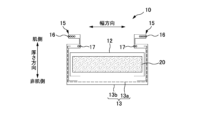
- Fig. 4 is a schematic cross-sectional view of the absorbent body 20 of the first embodiment.
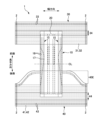
- Fig. 5 is a plan view of the absorbent cores 21 to 23 superimposed on each other.
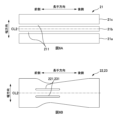
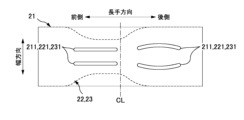
- Fig. 6A is a plan view of the skin side layer 21, and
- Fig. 6B is a plan view of the intermediate layer 22 and the non-skin side layer 23.
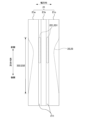
- Figs. 7A to 7C and 8 are plan views of modified examples of the absorbent cores 21 to 23.
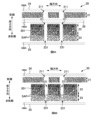
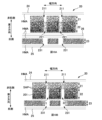
- Figs. 9A, 9B, 10A, 10B, and 11 are schematic cross-sectional views of modified examples of the absorbent body 20.
- the absorbent body 20 has absorbent cores 21-23 between a core wrap sheet 24 on the skin side and a core wrap sheet 25 on the non-skin side.
- the absorbent cores 21-23 are members that absorb and retain excreted liquids such as urine, and include a liquid absorbent fiber 201 and a super absorbent polymer.
- the liquid absorbent fiber 201 and the super absorbent polymer (hereinafter also referred to as SAP) are not particularly limited as long as they can be used as an absorbent core of an absorbent article.
- examples of the liquid absorbent fiber 201 include wood pulp fiber, non-wood pulp fiber such as bagasse, kenaf, bamboo, hemp, cotton, etc., regenerated cellulose fiber such as rayon fiber, and semi-synthetic fiber such as acetate fiber.
- examples of SAP include starch-based, cellulose-based, and synthetic polymer-based polymer absorbents.
- the core wrap sheets 24, 25 are liquid-permeable sheets, and examples of such sheets include tissue and nonwoven fabric.
- the absorbent cores 21-23 have, in order from the skin side in the thickness direction, a skin side layer 21, an intermediate layer 22, and a non-skin side layer 23.
- the skin side layer 21 and the non-skin side layer 23 are layers in which the volume occupied by SAP is larger than the volume occupied by the liquid-absorbent fiber 201.
- the intermediate layer 22 is a layer in which the volume occupied by the liquid-absorbent fiber 201 is larger than the volume occupied by SAP.
- the skin side layer 21 has a low basis weight region 211 in which the basis weight of the absorbent core (i.e., the total basis weight of the liquid-absorbent fiber 201 and the SAP: g/m 2 ) is lower than the surrounding area.
- the wearer excretes into the diaper 1 and the absorbent body 20 receives the excreted liquid
- the excreted liquid is quickly drawn from the low basis weight region 211 into the inside of the absorbent body 20 (intermediate layer 22).
- the liquid-absorbent fiber 201 has a faster liquid absorption speed than SAP. Since the volume occupancy rate of the liquid-absorbent fiber 201 is high in the intermediate layer 22, the excreted liquid that has migrated from the low basis weight region 211 to the intermediate layer 22 is quickly and temporarily absorbed by the intermediate layer 22. Furthermore, the volume occupancy of SAP, which has a slow liquid absorption rate, is high in the skin side layer 21.
- excreted liquid is likely to migrate to the intermediate layer 22 before being absorbed by the SAP of the skin side layer 21. Thereafter, the excreted liquid absorbed between the fibers of the liquid-absorbent fibers 201 of the intermediate layer 22 gradually migrates by gravity to the non-skin side layer 23.
- the volume occupancy rate of SAP in the non-skin side layer 23 is high. Therefore, the excreted liquid is firmly absorbed and held by the SAP in the non-skin side layer 23.
- the excreted liquid would be quickly absorbed by the skin-side layer. This would make it difficult for the excreted liquid to penetrate deep into the absorbent core. In addition, the skin-side surface of the absorbent core would easily become damp.
- the absorbent cores 21-23 of this embodiment easily draw excreted liquid up to the non-skin side layer 23, and the absorbent cores 21-23 can be effectively utilized in the thickness direction. This increases the water absorption and retention capacity of the absorbent cores 21-23, and even if excretion is repeated, leakage of excreted liquid can be suppressed. In addition, the dryness of the skin side of the absorbent cores 21-23 is ensured, improving the comfort of wearing the diaper 1.
- the SAP in the skin side layer 21 absorbs and retains the excreted liquid. This prevents the excreted liquid from rewetting. This also ensures that the skin side of the absorbent cores 21-23 remains dry.
- the absorbent core does not have an intermediate layer that quickly absorbs excreted liquid.
- the absorbent cores 21 to 23 of this embodiment have an intermediate layer 22 in which the volume occupancy rate of the liquid absorbent fiber 201 is high, and therefore it is possible to prevent excreted liquid from overflowing and leaking.
- excreted liquid also diffuses in the planar direction while transferring to the intermediate layer 22. Therefore, the excreted liquid that has diffused in the planar direction can be transferred to the intermediate layer 22.
- this does not mean that the skin-side layer 21 does not absorb excreted liquid at all, and the SAP of the skin-side layer 21 also absorbs the excreted liquid appropriately, so that overflow and leakage of the excreted liquid can be suppressed.
- the excreted liquid that has migrated to the intermediate layer 22 also diffuses in the planar direction while transferring to the non-skin-side layer 23. Therefore, the excreted liquid that has diffused in the planar direction can be transferred to the intermediate layer 22.
- the absorbent cores 21-23 can be effectively utilized in the planar direction as well.
- excreted liquid can be drawn to the inner side (non-skin side layer 23) of the absorbent cores 21-23, thereby making effective use of the absorbent cores 21-23 and preventing excreted liquid from leaking.
- the three layers of the skin side layer 21, the intermediate layer 22, and the non-skin side layer 23 are laminated over the entire area of the absorbent core 21-23, but it is sufficient that the three layers (21-23) are laminated at any part.
- the three layers (21-23) are laminated at the position where the wearer's urinary excretion opening contacts when the diaper 1 is worn and in the vicinity thereof.
- the low basis weight region 211 of the skin side layer 21 and the low basis weight regions 221, 231 of the intermediate layer 22 and the non-skin side layer 23 described later are also preferably provided at the position where the wearer's urinary excretion opening contacts and in the vicinity thereof. In this way, excreted liquid can be quickly drawn to the back side of the absorbent core 21-23 at the position where a large amount of excreted liquid is directly received during excretion.
- the skin side layer 21 illustrated in FIG. 5 has the same longitudinal length as the intermediate layer 22 and the non-skin side layer 23, but as in the modified examples shown in FIG. 7A and FIG. 7C, the longitudinal length of the skin side layer 21 may be short, and the skin side layer 21 may not be provided on the back side (rear side).
- the non-skin side layer 23 may not be provided on the back side.
- materials can be reduced, and the rigidity of the absorbent core on the back side is reduced and flexibility is increased.
- the back side area is also away from the wearer's urinary excretion opening, problems such as overflow and leakage of excreted liquid are less likely to occur even if the skin side layer 21 and non-skin side layer 23 are not present.
- the low basis weight region 211 of the skin side layer 21 is preferably a slit penetrating the skin side layer 21 in the thickness direction.
- the excreted liquid falls into the low basis weight region 211, and the migration speed of the excreted liquid from the skin side layer 21 to the intermediate layer 22 increases. Therefore, overflow and leakage of the excreted liquid can be suppressed.
- liquid absorbent fibers 201 and SAP may be present in the low basis weight region 211 of the skin side layer 21.
- the low basis weight region 211 may be a portion of the skin side layer 21 that is recessed in the thickness direction.
- the volumes occupied by the liquid-absorbent fibers 201 and the SAP in each layer of the absorbent cores 21 to 23 can be compared by a known method.
- the diaper 1 (absorbent body 20) is cut widthwise at an arbitrary position in the longitudinal direction of the absorbent body 20, specifically, at a position where the three layers 21 to 23 are laminated and away from the product folding position.
- the cut surface is magnified (e.g., 30 to 100 times) and photographed using an optical microscope (e.g., Keyence Corporation's Digital Microscope VHX-7000, or an equivalent). In the photographed cross-sectional image, the liquid absorbent fiber 201 and the SAP are identified.
- the skin side layer 21 in which the area occupied by the SAP is larger than the area occupied by the liquid absorbent fiber 201, the intermediate layer 22 in which the area occupied by the liquid absorbent fiber 201 is larger than the area occupied by the SAP, and the non-skin side layer 23 in which the area occupied by the SAP is larger than the area occupied by the liquid absorbent fiber 201 are laminated in this order from the skin side in the thickness direction.
- they are regarded as the absorbent cores 21 to 23 of this embodiment. It is preferable to confirm that the three layers 21 to 23 are laminated in cross-sectional images of a plurality of positions in the longitudinal direction of the absorbent body 20. Based on the captured cross-sectional image, it can also be confirmed that the skin side layer 21 has a low basis weight region 211, and that the low basis weight region 211 is a slit.
- the absorbent cores 21-23 that have absorbed the colored water are cut widthwise, it is preferable that the number of SAPs per unit area located in the skin-side layer 21 and the number of SAPs per unit area located in the non-skin-side layer 23 are greater than the number of SAPs per unit area located in the intermediate layer 22 on the cut surface.
- the high number of SAPs per unit area of the skin-side layer 21 makes it easier for excreted liquid to migrate to the intermediate layer 22 before it is absorbed by the skin-side layer 21, and also helps to ensure that the surface of the absorbent 20 is dry.
- the low number of SAPs per unit area of the intermediate layer 22 makes it easier for the liquid-absorbent fibers 201 to temporarily absorb excreted liquid, which helps to prevent the excreted liquid from overflowing or leaking.
- the high number of SAPs per unit area of the non-skin-side layer 23 makes it easier for the excreted liquid between the liquid-absorbent fibers 201 of the intermediate layer 22 to be absorbed and retained by the SAPs of the non-skin-side layer 23. This allows the absorbent cores 21-23 to be effectively utilized all the way to the back.
- the absorbent core in a state in which colored water has been absorbed is, for example, one in which the absorbent cores 21-23 are entirely immersed in blue-colored water for 10 minutes, and then the absorbent cores 21-23 are taken out and hung and left for 10 minutes, etc., to remove excess water.
- the diaper 1 may be immersed in the colored water either in its entirety, or in a state in which the absorbent main body 10 and the absorbent body 20 have been separated from the diaper 1 using toluene or the like. Thereafter, the absorbent core is cut in the width direction at a portion where three layers (skin side layer 21, intermediate layer 22, non-skin side layer 23) are laminated.
- the absorbent cores 21-23 When the absorbent cores 21-23 have sufficiently absorbed the colored water, the SAP that has absorbed the colored water, swelled, and become colored becomes more visible. Therefore, by observing the cut surface of the absorbent core, the number of SAPs per unit area of each of the layers 21-23 can be compared. The cut surface may be observed visually or with an optical microscope. The color and concentration of the colored water are not particularly limited as long as they allow the SAP to be visually recognized.
- the skin side layer 21 may also have a different type of SAP than the non-skin side layer 23.
- SAP in the skin side layer 21 has a slower liquid absorption rate, as measured by the vortex method, than the SAP in the non-skin side layer 23.
- the liquid absorption rate of an SAP by the vortex method can be measured by a known method. For example, 50.0 ml ( ⁇ 0.5 ml) of saline solution with a concentration of 0.900% ( ⁇ 0.009%) and a temperature of 25° C. ( ⁇ 2° C.) is placed in a beaker with a volume of 100 ml. The beaker is then placed on a magnetic stirrer and a stirrer bar is placed in the beaker. The stirrer bar is then rotated at 600 rpm ( ⁇ 30 rpm) to ensure that the saline solution in the beaker forms a stable vortex.
- a stopwatch is then started to measure the time from the moment that 2.00 g ( ⁇ 0.02 g) of the SAP to be measured, taken out of the diaper 1, is placed in the beaker, and the time until the vortex disappears and the liquid level becomes horizontal is measured. The longer this time, the slower the liquid absorption speed.
- the SAP in the skin side layer 21 may have higher liquid permeability than the SAP in the non-skin side layer 23 . This allows the excreted liquid to easily migrate to the intermediate layer 22 before it is absorbed by the SAP in the skin-side layer 21, thereby enabling effective use of the absorbent body 20. Furthermore, absorption in the skin-side layer 21 is appropriately suppressed, ensuring dryness of the skin-side surfaces of the absorbent cores 21-23. Furthermore, it is possible to prevent the SAP in the skin-side layer 21 from swelling and inhibiting liquid absorption.
- the lower the liquid permeability of an SAP the higher the water retention capacity. Therefore, the lower the liquid permeability of the SAP in the non-skin side layer 23, the higher the water retention capacity. As a result, most of the excreted liquid that has permeated deep into the absorbent cores 21-23 is retained by the SAP in the non-skin side layer 23, suppressing rewetting.
- the liquid permeability of an SAP can be measured by a known method. For example, the following method can be exemplified. First, 0.32 g of a measurement sample (SAP) was immersed in 150 ml of physiological saline for 30 minutes to prepare swollen gel particles.
- SAP measurement sample
- the type of SAP contained in each of the skin side layer 21 and the non-skin side layer 23 may be the same. In that case, the manufacturing effort and costs can be reduced. Furthermore, when the types of SAP contained in the skin side layer 21 and the non-skin side layer 23 are different, both the liquid absorption rate and the liquid permeability measured by the vortex method may be different, or only one of them may be different.
- the skin side layer 21 illustrated in FIG. 6A has three rectangular divided regions 21a-21c that are long in the longitudinal direction.
- the three divided regions 21a-21c are arranged side by side with a gap in the width direction.
- the two regions between the three divided regions 21a-21c become low basis weight regions 211 (slits) of the skin side layer 21.
- the two low basis weight regions 211 are arranged symmetrically in the width direction on either side of the center line CL2 in the width direction of the skin side layer 21.
- the intermediate layer 22 and non-skin side layer 23 illustrated in FIG. 6B are integrally formed and have the same planar shape.
- the intermediate layer 22 and non-skin side layer 23 have narrowed portions 222, 232 narrowed inward in the width direction at the longitudinal center.
- the central region when the intermediate layer 22 and non-skin side layer 23 are divided into thirds at their maximum longitudinal length is defined as the longitudinal center, and at least a part of the narrowed portions 222, 232 may be located there.
- the skin side layer 21 extends outward in the width direction beyond the constricted portions 222, 232 of the intermediate layer 22 and the non-skin side layer 23, as shown in Figure 5.
- This allows the SAP to be disposed on the outside of the narrow constricted portions 222, 232 of the intermediate layer 22 and the non-skin side layer 23, while reducing the discomfort felt by the wearer when opening and closing their legs due to the constricted portions 222, 232. This makes it possible to suppress lateral leakage of excreted liquid.
- the absorbent body 20 may be one in which the skin side layer 21 and the intermediate layer 22 are integrally formed, and the non-skin side layer 23 is laminated thereon.
- the non-skin side layer 23 may be configured to extend outward in the width direction beyond the constricted portion.
- At least one of the intermediate layer 22 and the non-skin side layer 23 preferably has a low basis weight region (corresponding to another low basis weight region) in which the basis weight of the absorbent core (i.e., the total basis weight of the liquid-absorbent fiber 201 and the SAP: g/ m2 ) is lower than that of the surrounding area.
- the absorbent core i.e., the total basis weight of the liquid-absorbent fiber 201 and the SAP: g/ m2
- both the intermediate layer 22 and the non-skin side layer 23 have low basis weight regions 221, 231.
- the low basis weight region 211 of the skin side layer 21 has a portion that overlaps with the low basis weight regions 221, 231 of the intermediate layer 22 and the non-skin side layer 23.
- the intermediate layer 22 and the non-skin side layer 23 each have two low basis weight regions 221, 231.
- the two low basis weight regions 221, 231 of the intermediate layer 22 and the non-skin side layer 23 each overlap with the two low basis weight regions 211 of the skin side layer 21.
- excreted liquid that has flowed into the low basis weight region 211 of the skin side layer 21 is more likely to flow directly into the low basis weight regions 221, 231 of the intermediate layer 22 and the non-skin side layer 23.
- the low basis weight regions 221, 231 of the intermediate layer 22 and the non-skin side layer 23 may be slits that penetrate in the thickness direction, or the low basis weight regions 221, 231 may contain liquid absorbent fibers 201 or SAP, or the low basis weight regions 221, 231 may be partially recessed in thickness.
- the liquid absorbent fibers 201 are arranged with a basis weight lower than that of the liquid absorbent fibers 201 in the intermediate layer 22 .
- the thin presence of the liquid absorbent fiber 201 in the low basis weight region 231 of the non-skin side layer 23 makes it difficult for the surrounding SAP to roll in the low basis weight region 231, ensuring the functionality of the low basis weight region 231 and suppressing deformation of the absorbent cores 21 to 23.
- excreted liquid is unlikely to stagnate in the low basis weight region 231 of the bottom layer, and is easily diffused in the planar direction along the low basis weight region 231.
- the liquid-absorbent fibers 201 may not be disposed in the low basis weight region 231 of the non-skin side layer 23.
- the low basis weight region 231 of the non-skin side layer 23 is a slit.
- the liquid absorbent fiber 201 may be provided in the low basis weight region 221 of the intermediate layer 22 as shown in Fig. 10A.
- the excreted liquid can be diffused by the low basis weight region 221 and transferred to the non-skin side layer 23.
- a thin layer of liquid-absorbent fibers 221 may be provided in the low basis weight region 211 of the skin side layer 21 with a basis weight lower than that of the intermediate layer 21.
- excreted liquid can be diffused and transferred to the intermediate layer 22, and SAP is less likely to roll in the low basis weight region 211 of the skin side layer 21, ensuring the function of the low basis weight region 211.
- the low basis weight regions 221, 231 of the intermediate layer 22 and non-skin side layer 23 are preferably arranged on the inside of both longitudinal ends of the intermediate layer 22 or non-skin side layer 23 where the low basis weight regions 221, 231 are arranged. Furthermore, as shown in FIG. 5, it is preferable that the low basis weight region 211 of the skin side layer 21 has a longer longitudinal length than the low basis weight regions 221, 231 of the intermediate layer 22 and non-skin side layer 23.
- the intermediate layer 22 and the non-skin side layer 23 may not have low basis weight regions 221, 231, and the low basis weight regions 221, 231 of the intermediate layer 22 and the non-skin side layer 23 may not overlap with the low basis weight region 211 of the skin side layer 21.
- the shape, size, number, arrangement position, etc. of the low basis weight regions 211-231 of each layer are not particularly limited.
- each layer may have one low basis weight region 211-231, which may be located on the center line CL2 in the width direction of the absorbent cores 21-23.
- the low basis weight regions 21-23 of each layer 21-23 may completely overlap, or multiple low basis weight regions 221-231 may be arranged at intervals in the longitudinal direction.
- At least a portion of the low basis weight region 221 extending in the longitudinal direction of the intermediate layer 22 may be provided in an area on the rear side of the center line CL (product center line) that bisects the diaper 1 in the unfolded state in the longitudinal direction.
- the low basis weight regions 221, 231 extending in the longitudinal direction become the folding starting points. Therefore, the intermediate layer 22, which has a high volume occupancy rate of the liquid absorbent fiber 201 and is relatively rigid, is likely to bend in the width direction along the buttocks of the wearer. This improves the fit and can disperse wrinkles that occur when the wearer closes their legs. Furthermore, when the absorbent core is worn by a young baby who spends most of his or her time in a sleeping position, body pressure is likely to be applied to the back region of the absorbent cores 21 to 23.
- the intermediate layer 22 preferably has a basis weight of 50 g/cm 2 or more and 200 g/cm 2 or less.
- the excreted liquid can be absorbed more easily between the fibers of the liquid absorbent fibers 201 of the intermediate layer 22. Therefore, the excreted liquid can be quickly and temporarily absorbed by the intermediate layer 22, and overflow and leakage of the excreted liquid during excretion can be suppressed.
- the thickness of the intermediate layer 22 can be appropriately suppressed compared to when the basis weight of the intermediate layer 22 is greater than 200 g/ cm2 . This reduces the discomfort (feeling of stiffness) felt when worn, and also suppresses delamination of the intermediate layer 22 alone due to a weakening of the sense of unity between the skin side layer 21 and the non-skin side layer 23.
- the basis weight of the intermediate layer 22 can be measured by a known method.
- the average thickness t2 of the intermediate layer 22 is preferably 0.5 mm or more.
- the excreted liquid can be absorbed between the fibers of the liquid-absorbent fibers 201 of the intermediate layer 22. Therefore, the excreted liquid can be quickly and temporarily absorbed by the intermediate layer 22, and overflow and leakage of the excreted liquid during excretion can be suppressed.
- the average thickness of the intermediate layer 22 is set to 2.5 mm or less.
- the average thickness t2 of the intermediate layer 22 is preferably greater than the sum of the average thickness t1 of the skin side layer 21 and the average thickness t3 of the non-skin side layer 23 (t2>t1+t3). By doing so, the thickness of the intermediate layer 22 is ensured and excreted liquid can be absorbed between the fibers of the liquid-absorbent fibers 201 of the intermediate layer 22, compared to when the average thickness t2 of the intermediate layer 22 is equal to or less than the sum t1 + t3 of the average thicknesses of the skin side layer 21 and the non-skin side layer 23.
- the excreted liquid can be quickly and temporarily absorbed by the intermediate layer 22, and overflow and leakage of the excreted liquid during excretion can be suppressed.
- the thicknesses t1 and t3 of the skin side layer 21 and the non-skin side layer 23 it is possible to prevent SAP from being distributed more than necessary in the absorbent cores 11-13.
- each layer 21 to 23 can be measured by a known method. For example, in a natural and dry state where no external force is acting, the diaper 1 (absorbent body 20) is cut in the width direction at an arbitrary position in the longitudinal direction of the absorbent body 20, specifically, at a position where the three layers 21 to 23 are laminated and away from the product folding position. Next, the cut surface is enlarged (e.g., 30 to 100 times) and photographed using an optical microscope (e.g., Keyence Digital Microscope VHX-7000 or equivalent). At this time, the enlarged photograph is taken with the focus on the liquid absorbent fiber 201.
- an optical microscope e.g., Keyence Digital Microscope VHX-7000 or equivalent
- the layer in which the liquid-absorbent fiber 201 is visible is determined as the intermediate layer 22, and the portions of the absorbent core closer to the skin or closer to the skin than that are determined as the skin-side layer 21 and the non-skin-side layer 23, respectively. Furthermore, measurement positions at multiple locations (e.g., three locations) in the width direction are determined in the cross-sectional image, and the thickness of each of the layers 21 to 23 at each measurement position is obtained. Preferably, cross-sectional images of multiple locations in the longitudinal direction of the absorbent body 20 are photographed to obtain the thickness of each of the layers 21 to 23.
- the average value of the obtained thicknesses is calculated for each of the layers 21 to 23, and is set as the average thickness t1 of the skin-side layer 21, the average thickness t2 of the intermediate layer 22, and the average thickness t3 of the non-skin-side layer 23.
- the density of the intermediate layer 22 is lower than the density of the skin side layer 21 and lower than the density of the non-skin side layer 23 .
- the density of each of the layers 21 to 23 can be measured by a known method.
- the non-skin side layer 23 may contain liquid absorbent fibers 201 in addition to SAP.
- the liquid absorbent fibers 201 in the non-skin side layer 23 increase the absorption rate of excreted liquid from the intermediate layer 22 to the non-skin side layer 23. This allows the excreted liquid to be quickly drawn to the inner side of the absorbent cores 21-23, and prevents the excreted liquid from overflowing or leaking.
- the skin-side layer 21 may have not only SAP but also liquid-absorbent fibers 201.
- the liquid-absorbent fibers 201 of the skin-side layer 21 quickly absorb excreted liquid, further suppressing overflow of excreted liquid.
- the intermediate layer 22 and non-skin side layer 23 illustrated in FIG. 4 are integrally formed, so that the volume occupancy of the liquid absorbent fiber 201 decreases and the volume occupancy of the SAP increases from the intermediate layer 22 toward the non-skin side layer 23. Conversely, the volume occupancy of the liquid absorbent fiber 201 increases and the volume occupancy of the SAP decreases in the skin side layer 21 and intermediate layer 22 of FIG. 10A and FIG. 10B from the skin side layer 21 toward the intermediate layer 22.
- Such an absorbent core can be manufactured, for example, by adjusting the order, amount, timing, etc. of feeding the SAP and liquid absorbent fiber 201 toward a mold (recess) that corresponds to the shape of the absorbent core and is provided on the outer circumferential surface of a rotating drum.
- the non-skin side layer 23 illustrated in FIG. 4 is formed integrally with the intermediate layer 22, and is laminated adjacent to the intermediate layer 22 in the thickness direction without the adhesive HMA therebetween.
- the adhesive HMA since the adhesive HMA is not provided, the rigidity of the absorbent body 20 is reduced, and the feeling of stiffness can be reduced.
- the non-skin side layer 23 illustrated in FIG. 4 is formed integrally with the intermediate layer 22, and is laminated adjacent to the intermediate layer 22 in the thickness direction without any nonwoven fabric therebetween. In this case, it is possible to prevent the nonwoven fabric from impeding the transfer of excreted liquid from the intermediate layer 22 to the non-skin side layer 23. Therefore, the excreted liquid can be quickly drawn to the deeper side of the absorbent cores 21 to 23. Furthermore, since no nonwoven fabric is provided, the rigidity of the absorbent body 20 is reduced, and the feeling of stiffness can be reduced.
- the skin-side layer 21 when the skin-side layer 21 and the intermediate layer 22 are integrally formed, the skin-side layer 21 can be adjacent to the intermediate layer 22 in the thickness direction without the adhesive HMA or nonwoven fabric. This prevents the adhesive HMA or nonwoven fabric from impeding the transfer of excreted fluid from the skin-side layer 21 to the intermediate layer 22.
- the skin-side layer 21 illustrated in FIG. 4 is not formed integrally with the intermediate layer 22, but is laminated adjacent to the intermediate layer 22 in the thickness direction via the nonwoven fabric 26.
- the excreted liquid migrates from the skin-side layer 21 to the intermediate layer 22, the excreted liquid diffuses in the planar direction on the nonwoven fabric 26. Therefore, the excreted liquid diffused in the planar direction can be migrated to the intermediate layer 22, and the absorbent cores 21-23 can be effectively utilized in the planar direction.
- the skin-side layer 21 that is not formed integrally with the intermediate layer 22 may be laminated to the intermediate layer 22 without the adhesive HMA or nonwoven fabric. This prevents the nonwoven fabric or adhesive HMA from impeding the transfer of excreted liquid from the skin-side layer 21 to the intermediate layer 22.
- the non-skin-side layer 23 that is not formed integrally with the intermediate layer 22 may be laminated to the intermediate layer 22 without the adhesive HMA or nonwoven fabric.
- the intermediate layer 22 is not limited to being formed integrally with either the skin side layer 21 or the non-skin side layer 23, but may be formed integrally with both.
- the three layers 21 to 23 may be formed separately and then laminated together.
- nonwoven fabrics 26, 27 and adhesive HMA may or may not be provided between the skin side layer 21 and the intermediate layer 22, and between the intermediate layer 22 and the non-skin side layer 23, respectively.
- the nonwoven fabric 26 disposed between the intermediate layer 21 and the skin side layer 21 or the non-skin side layer 23 preferably has a basis weight smaller than that of the core wrap sheets 24 , 25 .
- the layers 21 to 23 separated by the nonwoven fabric 26 are unlikely to separate from each other and are likely to deform integrally. This reduces discomfort when worn and prevents the absorbent cores 21 to 23 from losing their shape.
- the water absorption capacity of the nonwoven fabric 26 disposed between the intermediate layer 21 and the skin side layer 21 or the non-skin side layer 23 is preferably greater than the water absorption capacity of the core wrap sheets 24 , 25 . This allows the nonwoven fabric 26 inside the absorbent cores 21 to 23 to temporarily absorb the excreted liquid as well, thereby preventing the excreted liquid from overflowing and leaking during excretion.
- FIG. 12 is a schematic cross-sectional view of an absorbent body 20 according to the second embodiment.
- the diaper 1 (absorbent article) of the second embodiment is different from the diaper 1 of the first embodiment in the configuration of the absorbent body 20.
- the following mainly describes the differences from the first embodiment.
- the absorbent core 21-23 of the second embodiment has, in order from the skin side in the thickness direction, a skin side layer 21 in which the volume occupied by SAP is larger than the volume occupied by the liquid absorbent fiber 201, an intermediate layer 22 in which the volume occupied by the liquid absorbent fiber 201 is larger than the volume occupied by SAP, and a non-skin side layer 23 in which the volume occupied by SAP is larger than the volume occupied by the liquid absorbent fiber 201.
- the skin side layer 21 has a different type of SAP than the non-skin side layer 23, and the SAP in the skin side layer 21 has a slower liquid absorption rate measured by the vortex method than the SAP in the non-skin side layer 23.
- the method for measuring the liquid absorption rate by the vortex method is the same as the method described in the first embodiment.
- the skin side layer 21 of the absorbent body 20 of the second embodiment may or may not have a low basis weight region 211.
- the skin side layer 21 illustrated in FIG. 12 does not have a low basis weight region 211.
- the absorption speed of the SAP in the skin side layer 21 is slow, so that the excreted liquid is likely to migrate to the intermediate layer 22 before the skin side layer 21 absorbs the excreted liquid.
- the excreted liquid that has migrated to the intermediate layer 22 is quickly absorbed by the liquid absorbent fibers 201 of the intermediate layer 22. This makes it possible to suppress overflow and leakage of the excreted liquid.
- excreted liquid absorbed between the fibers of the liquid absorbent fibers 201 of the intermediate layer 22 gradually migrates to the non-skin side layer 23 by gravity.
- the volume occupancy rate of SAP is high in the non-skin side layer 23. Therefore, the excreted liquid is firmly absorbed and held by the SAP of the non-skin side layer 23.
- excreted liquid can be drawn to the inner side (non-skin side layer 23) of the absorbent cores 21-23, thereby making effective use of the absorbent cores 21-23 and preventing excreted liquid from leaking.
- the intermediate layer 22 and the non-skin side layer 23 do not have a low basis weight region, but the intermediate layer 22 and the non-skin side layer 23 may have a low basis weight region.
- Pants-type disposable diapers 2 side joints, 10 Absorbent body, 12 top sheet, 13a Back sheet (liquid-impermeable sheet), 13b back sheet (outer sheet), 15 leak-proof wall portion, 16 leak-proof wall elastic member, 17 leg elastic member, 20 absorbent, 201 Liquid absorbent fibers, SAP superabsorbent polymer, 21 skin side layer (absorbent core), 211 low basis weight region, 22 intermediate layer (absorbent core), 221 low basis weight region, 23 non-skin side layer (absorbent core), 231 low basis weight region, 24 Core wrap sheet, 25 Core wrap sheet, 26 Nonwoven fabric, 27 Nonwoven fabric, 30 front waist portion, 31 skin side sheet, 32 non-skin side sheet, 33 waist elastic member, 34 cover sheet, 40 rear waist portion, 41 skin side sheet, 42 non-skin side sheet, 43 waist elastic member, 44 cover sheet,
Landscapes
- Health & Medical Sciences (AREA)
- Epidemiology (AREA)
- Engineering & Computer Science (AREA)
- Biomedical Technology (AREA)
- Heart & Thoracic Surgery (AREA)
- Vascular Medicine (AREA)
- Life Sciences & Earth Sciences (AREA)
- Animal Behavior & Ethology (AREA)
- General Health & Medical Sciences (AREA)
- Public Health (AREA)
- Veterinary Medicine (AREA)
- Absorbent Articles And Supports Therefor (AREA)
Abstract
Description
また、シートにSAP層を担持させたSAPシートが吸収体として用いられることがある。しかし、パルプ層を有さないSAPシートの場合、吸収速度の速いパルプ層で排泄液を一時貯蔵できず、排泄時に排泄液が溢れ漏れるおそれがある。
本発明の他の特徴については、本明細書及び添付図面の記載により明らかにする。
(態様1)
展開状態において、互いに直交する長手方向、幅方向、及び、厚さ方向を有し、液体吸収性繊維、及び、高吸収性ポリマーを含む吸収性コアを有する吸収性物品であって、前記吸収性コアは、前記厚さ方向の肌側から順に、前記高吸収性ポリマーの占める体積が、前記液体吸収性繊維の占める体積よりも大きい肌側層と、前記液体吸収性繊維の占める体積が、前記高吸収性ポリマーの占める体積よりも大きい中間層と、前記高吸収性ポリマーの占める体積が、前記液体吸収性繊維の占める体積よりも大きい非肌側層と、を有し、前記肌側層は、周囲に比べて、前記吸収性コアの坪量が低い低坪量領域を有すること、を特徴とする吸収性物品。
前記肌側層は、前記非肌側層とは異なる種類の前記高吸収性ポリマーを有し、前記肌側層が有する前記高吸収性ポリマーは、前記非肌側層が有する前記高吸収性ポリマーに比べて、ボルテックス法により測定した液体吸収速度が遅いこと、を特徴とする吸収性物品。
展開状態において、互いに直交する長手方向、幅方向、及び、厚さ方向を有し、液体吸収性繊維、及び、高吸収性ポリマーを含む吸収性コアを有する吸収性物品であって、前記吸収性コアは、前記厚さ方向の肌側から順に、前記高吸収性ポリマーの占める体積が、前記液体吸収性繊維の占める体積よりも大きい肌側層と、前記液体吸収性繊維の占める体積が、前記高吸収性ポリマーの占める体積よりも大きい中間層と、前記高吸収性ポリマーの占める体積が、前記液体吸収性繊維の占める体積よりも大きい非肌側層と、を有し、前記肌側層は、前記非肌側層とは異なる種類の前記高吸収性ポリマーを有し、前記肌側層が有する前記高吸収性ポリマーは、前記非肌側層が有する前記高吸収性ポリマーに比べて、ボルテックス法により測定した液体吸収速度が遅いこと、を特徴とする吸収性物品。
よって、排泄液の溢れ漏れを抑制できる。その後、中間層の液体吸収性繊維間に吸収された排泄液は、重力により非肌側層に移行して、非肌側層の高吸収性ポリマーに吸収保持される。よって、吸収性コアの奥側まで排泄液を引き込み、吸収性コアを有効活用できる。
前記低坪量領域は、前記肌側層を前記厚さ方向に貫通するスリットであること、を特徴とする吸収性物品。
前記中間層と前記非肌側層の少なくとも一方は、周囲に比べて、前記吸収性コアの坪量が低い他の低坪量領域を有すること、を特徴とする吸収性物品。
前記吸収性コアの平面視において、前記低坪量領域は、前記他の低坪量領域と重複する部位を有すること、を特徴とする吸収性物品。
前記非肌側層は、前記他の低坪量領域を有し、前記非肌側層が有する前記他の低坪量領域には、前記中間層の前記液体吸収性繊維の坪量よりも低い坪量にて、前記液体吸収性繊維が配されていること、を特徴とする吸収性物品。
前記非肌側層は、前記他の低坪量領域を有し、前記非肌側層が有する前記他の低坪量領域には、前記液体吸収性繊維が配されていないこと、を特徴とする吸収性物品。
前記他の低坪量領域は、当該他の低坪量領域が配置されている前記中間層又は前記非肌側層の長手方向の両端縁よりも内側に配されており、前記低坪量領域の方が、前記他の低坪量領域よりも、前記長手方向の長さが長いこと、を特徴とする吸収性物品。
前記中間層は、前記長手方向に延在する前記他の低坪量領域を有し、前記中間層が有する前記他の低坪量領域の少なくとも一部は、展開状態の前記吸収性物品を前記長手方向に二等分する中心線よりも背側の領域に設けられていること、を特徴とする吸収性物品。
色水を吸収した状態の前記吸収性コアを、前記幅方向に沿って切断したときの切断面において、前記肌側層に位置する単位面積当たりの前記高吸収性ポリマーの数、及び、前記非肌側層に位置する前記単位面積当たりの前記高吸収性ポリマーの数は、前記中間層に位置する前記単位面積当たりの前記高吸収性ポリマーの数よりも多いこと、を特徴とする吸収性物品。
前記中間層の平均厚みは0.5mm以上であること、を特徴とする吸収性物品。
前記中間層の平均厚みは、前記肌側層の平均厚みと、前記非肌側層の平均厚みとを合計した値よりも大きいこと、を特徴とする吸収性物品。
前記肌側層と前記非肌側層の少なくとも一方は、前記液体吸収性繊維を有すること、を特徴とする吸収性物品。
前記肌側層と前記非肌側層の少なくとも一方は、接着剤を介さずに、前記中間層と前記厚さ方向に隣接して積層されていること、を特徴とする吸収性物品。
前記肌側層と前記非肌側層の少なくとも一方は、不織布を介さずに、前記中間層と前記厚さ方向に隣接して積層されていること、を特徴とする吸収性物品。
前記肌側層と前記非肌側層の少なくとも一方は、不織布を介して、前記中間層と前記厚さ方向に隣接して積層されていること、を特徴とする吸収性物品。
前記肌側層よりも前記厚さ方向の肌側、及び、前記非肌側層よりも前記厚さ方向の非肌側において、コアラップシートを有し、前記不織布の坪量は、前記コアラップシートの坪量よりも小さいこと、を特徴とする吸収性物品。
前記肌側層よりも前記厚さ方向の肌側、及び、前記非肌側層よりも前記厚さ方向の非肌側において、コアラップシートを有し、前記不織布の吸水量は、前記コアラップシートの吸水量よりも大きいこと、を特徴とする吸収性物品。
前記中間層は、前記長手方向の中央部において、前記幅方向の内側に括れた括れ部を有し、前記肌側層と前記非肌側層の少なくとも一方は、前記括れ部よりも前記幅方向の外側に延出していること、を特徴とする吸収性物品。
前記肌側層は、前記非肌側層とは異なる種類の前記高吸収性ポリマーを有し、
前記肌側層が有する前記高吸収性ポリマーは、前記非肌側層が有する前記高吸収性ポリマーに比べて、通液性が高いこと、を特徴とする吸収性物品。
本発明に係る吸収性物品として、乳幼児用のパンツ型使い捨ておむつ1(以下、「おむつ1」とも呼ぶ)を例に挙げて説明する。ただし、本発明に係る吸収性物品には、テープ型使い捨ておむつ、ショーツ型ナプキン、吸収パッド、生理用ナプキンやその他の吸収性物品も含まれる。また、吸収性物品の着用者は、乳幼児に限らず、大人又は動物等の生物であってもよい。
図1は、おむつ1の概略斜視図である。図2は、展開且つ伸長状態のおむつ1を肌側から見た平面図である。図3は、図2の中央線CLでの概略断面図である。おむつ1の「伸長状態」とは、おむつ1全体を皺なく伸長させた状態、具体的には、おむつ1を構成する各部材(例えば、後述する吸収性本体10や胴回り部30、40等)の寸法がその部材単体の寸法と一致又はそれに近い寸法になるまで伸長させた状態のことを言う。おむつ1の「展開状態」とは、おむつ1の両側部に設けられている一対のサイド接合部2を分離して、おむつ1を開いて平面的に展開した状態である。
また、吸収性本体10の幅方向の両側部には、糸ゴム等の脚回り弾性部材17が吸収性本体10の長手方向に沿って伸長した状態で取り付けられている。
図4は、第1実施形態の吸収体20の断面模式図である。図5は、吸収性コア21~23を重ね合わせた平面図である。図6Aは、肌側層21の平面図であり、図6Bは、中間層22及び非肌側層23の平面図である。図7A~図7C、図8は、吸収性コア21~23の変形例の平面図である。図9A、図9B、図10A、図10B、及び図11は、吸収体20の変形例の断面模式図である。
また、コアラップシート24,25は、液透過性のシートであり、ティッシュや不織布等を例示できる。
また、肌側層21では、液体の吸収速度が遅いSAPの体積占有率が高い。そのため、低坪量領域211以外の肌側層21の領域においても、排泄液は、肌側層21のSAPに吸収される前に、中間層22に移行しやすい。
その後、中間層22の液体吸収性繊維201の繊維間に吸収された排泄液は、重力により徐々に非肌側層23に移行する。非肌側層23ではSAPの体積占有率が高い。そのため、排泄液は非肌側層23のSAPにしっかりと吸収保持される。
以上のように、第1実施形態の吸収性コア21~23によれば、吸収性コア21~の奥側(非肌側層23)まで排泄液を引き込み、吸収性コア21~23を有効活用でき、且つ、排泄液の溢れ漏れを抑制できる。
この場合、排泄液が低坪量領域211に落ち込む為、肌側層21から中間層22への排泄液の移行速度が速くなる。よって、排泄液の溢れ漏れを抑制できる。
例えば、外力が作用していない自然状態且つ乾燥状態のおむつ1において、吸収体20の長手方向の任意の位置、具体的には、3層21~23が積層されている箇所、かつ、製品折り位置から離れた箇所にて、おむつ1(吸収体20)を幅方向に沿って切断する。次に、光学顕微鏡(例:キーエンス社製デジタルマイクロスコープVHX-7000、又はそれと同等のもの)を用いて、切断面を拡大し(例:30~100倍)、撮影する。
撮影された断面画像において、液体吸収性繊維201とSAPを識別する。そして、断面画像において、SAPの占める面積が液体吸収性繊維201の占める面積よりも大きい肌側層21と、液体吸収性繊維201の占める面積がSAPの占める面積よりも大きい中間層22と、SAPの占める面積が液体吸収性繊維201の占める面積よりも大きい非肌側層23とが、厚さ方向の肌側から順に積層されていることを確認する。上記のことが確認された場合、本実施形態の吸収性コア21~23とする。なお、好ましくは、吸収体20の長手方向の複数箇所の断面画像において、3層21~23が重ねられていることを確認するが望ましい。
また、撮影された断面画像に基づいて、肌側層21が低坪量領域211を有することや、低坪量領域211がスリットであることも確認できる。
その後、吸収性コアのうち3層(肌側層21、中間層22、非肌側層23)が積層されている部位を、幅方向に沿って切断する。吸収性コア21~23が色水を十分に吸収した状態では、色水を吸収して膨潤し着色されたSAPの視認性が高まる。そのため、吸収性コアの切断面を観察することで、各層21~23の単位面積当たりのSAP数を比較できる。切断面の観察は、目視で行ったり、光学顕微鏡を用いて行ったりするとよい。また、色水の色や濃度は特に限定されず、SAPが視認可能となるものであればよい。
例えば、容積が100mlのビーカーに濃度が0.900%(±0.009%)、温度が25℃(±2℃)の生理食塩水を50.0ml(±0.5ml)入れる。次いで、マグネットスターラー上にビーカーを置き、スターラーバーをビーカーの中に入れる。次いで、600rpm(±30rpm)でスターラーバーを回転させ、ビーカー内の生理食塩水が安定して渦を形成することを確かめる。次いで、おむつ1から取り出した測定対象のSAPを2.00g(±0.02g)ビーカー内に入れた瞬間からストップウォッチで計測を開始し、渦が消え液面が水平になった時点までの時間を計測する。この時間が長いほど、液体吸収速度が遅い。
そうすることで、肌側層21のSAPが排泄液を吸収する前に、排泄液が中間層22に移行しやすくなり、吸収体20を有効活用できる。また、肌側層21での吸収が適度に抑えられ、吸収性コア21~23の肌側面のドライ性が確保される。また、肌側層21のSAPが膨潤して液吸収を阻害してしまうことを防止できる。
例えば以下の方法を例示できる。先ず、測定試料(SAP)0.32gを150mlの生理食塩水に30分間浸漬して膨潤ゲル粒子を調製した。そして、垂直に立てた円筒{直径(内径)25.4mm、長さ40cm、底部から60mlの位置及び40mlの位置にそれぞれ目盛り線が設けてある。}の底部に、金網(目開き106μm、JIS Z8801-1:2006)と、開閉自在のコック(通液部の内径5mm)とを有する濾過円筒管内に、コックを閉鎖した状態で、調製した膨潤ゲル粒子を生理食塩水と共に移した後、この膨潤ゲル粒子の上に円形金網(目開き150μm、直径25mm)が金網面に対して垂直に結合する加圧軸(重さ22g、長さ47cm)を金網と膨潤ゲル粒子とが接触するように載せ、更に加圧軸におもり(88.5g)を載せ、1分間静置した。引き続き、コックを開き、濾過円筒管内の液面が60ml目盛り線から40ml目盛り線になるのに要する時間(T1:秒)を計測し、次式よりゲル通液速度(ml/分)を求めた。
生理食塩水によるゲル通液速度(ml/分)=20ml×60/(T1-T2)
なお、使用する生理食塩水及び測定雰囲気の温度は25℃±2℃で行い、T2は測定試料の無い場合について上記と同様の操作により計測した時間である。ゲル通液速度が速いほど、通液性が高い。
そうすることで、括れ部222,232によって着用者が脚を開閉した際の違和感を軽減しつつ、幅の狭い中間層22及び非肌側層23の括れ部222,232の外側にSAPを配することができる。そのため、排泄液の横漏れを抑制できる。
この場合、図示しないが、肌側層21と中間層22が括れ部を有する形状である場合、非肌側層23が、その括れ部よりも幅方向の外側に延出する構成であってもよい。
このように、非肌側層23の低坪量領域231に液体吸収性繊維201が薄っすら存在することで、低坪量領域231に周囲のSAPが転がり難く、低坪量領域231の機能を確保でき、また、吸収性コア21~23の型崩れを抑制できる。また、最下層の低坪量領域231にて排泄液が停滞し難く、低坪量領域231に沿って平面方向に拡散しやすくなる。
そうすることで、非肌側層23の低坪量領域231の液体吸収性繊維201に排泄液が一時吸収されないので、非肌側層23のより奥側まで排泄液を素早く引き込むことができる。
又は、図10Bに示すように、肌側層21の低坪量領域211に、中間層21の坪量よりも低い坪量にて、薄っすら液体吸収性繊維221が設けられていてもよい。この場合、排泄液を拡散させつつ中間層22へ移行でき、また、肌側層21の低坪量領域211に、SAPが転がり難く、低坪量領域211の機能が確保される。
また、寝姿勢で過ごすことの多い低月齢の乳児を着用対象とした場合、吸収性コア21~23の背側の領域に体圧が掛かり易い。そのため、背側の領域に、中間層22の低坪量領域221や、他の2層の低坪量領域211,231が設けられていることで、排泄液を吸収性コア21の奥側に素早く引き込むことができ、背側での漏れを抑制できる。
そうすることで、中間層22の坪量が50g/cm2未満である場合に比べて、例えば、中間層22がパルプ繊維等で形成された不織布(シート部材)である場合に比べて、中間層22が有する液体吸収性繊維201の繊維間に排泄液を吸収できる。よって、中間層22にて排泄液を素早く一時吸収でき、排泄時の排泄液の溢れ漏れを抑制できる。
一方、中間層22の坪量が200g/cm2よりも大きい場合に比べて、中間層22の厚みを適度に抑えることができる。ゆえに、着用時の違和感(ごわつき感)を軽減でき、また、肌側層21及び非肌側層23との一体感が薄れて中間層22のみで層間剥離してしまうことを抑制できる。なお、中間層22の坪量の測定は、周知の方法で測定できる。
そうすることで、中間層22の平均厚みが0.5mm未満である場合に比べて、例えば、中間層22がパルプ繊維等で形成された不織布(シート部材)である場合に比べて、中間層22が有する液体吸収性繊維201の繊維間に排泄液を吸収できる。よって、中間層22にて排泄液を素早く一時吸収でき、排泄時の排泄液の溢れ漏れを抑制できる。
但し、中間層22が厚すぎると、上記のように、ごわつき感等が生じるため、好ましくは中間層22の平均厚みを2.5mm以下にするとよい。
そうすることで、中間層22の平均厚みt2が肌側層21と非肌側層23の平均厚みの合計値t1+t3以下である場合に比べて、中間層22の厚みが確保され、中間層22が有する液体吸収性繊維201の繊維間に排泄液を吸収できる。よって、中間層22にて排泄液を素早く一時吸収でき、排泄時の排泄液の溢れ漏れを抑制できる。一方、肌側層21及び非肌側層23の厚みt1,t3を抑えることで、SAPが吸収性コア11~13に必要以上に配されてしまうことを防止できる。
撮影された断面画像において、液体吸収性繊維201が見えている層を中間層22と判定し、それよりも肌側又は非肌側の吸収性コアの部位をそれぞれ肌側層21及び非肌側層23とする。また、断面画像において幅方向の複数箇所(例えば3箇所)の測定位置を決定し、各測定位置での各層21~23の厚みを取得する。好ましくは、吸収体20の長手方向の複数箇所の断面画像を撮影して、各層21~23の厚みを取得するとよい。層21~23毎に、取得した厚みの平均値を算出し、肌側層21の平均厚みt1、中間層22の平均厚みt2、非肌側層23の平均厚みt3とする。
そうすることで、中間層22の密度が肌側層21及び非肌側層23の密度以上である場合に比べて、中間層22が有する液体吸収性繊維201の繊維間の空間が確保される。よって、その繊維間の空間に排泄液を一時吸収でき、排泄時の排泄液の溢れ漏れを抑制できる。なお、各層21~23の密度は、周知の方法にて測定できる。
非肌側層23が有する液体吸収性繊維201によって、中間層22から非肌側層23への排泄液の吸収速度が高まる。そのため、吸収性コア21~23の奥側に排泄液を素早く引き込むことができ、排泄液の溢れ漏れを抑制できる。
この場合、接着剤HMAによって中間層22から非肌側層23への排泄液の移行が阻害されてしまうことを防止できる。よって、吸収性コア21~23のより奥側に排泄液を素早く引き込むことができる。また、接着剤HMAが設けられていないことで、吸収体20の剛性が下がり、ごわつき感を軽減できる。
この場合、不織布によって中間層22から非肌側層23への排泄液の移行が阻害されてしまうことを防止できる。よって、吸収性コア21~23のより奥側に排泄液を素早く引き込むことができる。また、不織布が設けられていないことで、吸収体20の剛性が下がり、ごわつき感を軽減できる。
又は、3層21~23が個別に形成されて積層されたものであってもよい。その場合、図11に示すように、肌側層21と中間層22の間、及び、中間層22と非肌側層23の間に、それぞれ不織布26,27や接着剤HMAが設けられていてもよいし、設けられていなくてもよい。
そうすることで、不織布26を介して区画される層21~23同士が分離し難く、一体的に変形しやすい。よって、着用時の違和感を軽減でき、吸収性コア21~23の型崩れを抑制できる。
そうすることで、吸収性コア21~23の内部の不織布26においても、排泄液を一時吸収でき、排泄時の排泄液の溢れ漏れを抑制できる。
そして、以下の式から吸水量を算出する。
吸水量(g/m2)=浸漬後のサンプル質量-浸漬前のサンプル質量/サンプルの面積
図12は、第2実施形態の吸収体20の断面模式図である。
第2実施形態のおむつ1(吸収性物品)と、第1実施形態のおむつ1とでは、吸収体20の構成が異なる。以下、第1実施形態と異なる点について、主に説明する。
以上のように、第2実施形態の吸収性コア21~23によれば、吸収性コア21~の奥側(非肌側層23)まで排泄液を引き込み、吸収性コア21~23を有効活用でき、且つ、排泄液の溢れ漏れを抑制できる。
2 サイド接合部、
10 吸収性本体、
12 トップシート、
13a バックシート(液不透過性シート)、
13b バックシート(外装シート)、
15 防漏壁部、16 防漏壁弾性部材、
17 脚回り弾性部材、
20 吸収体、
201 液体吸収性繊維、
SAP 高吸収性ポリマー、
21 肌側層(吸収性コア)、211 低坪量領域、
22 中間層(吸収性コア)、221 低坪量領域、
23 非肌側層(吸収性コア)、231 低坪量領域、
24 コアラップシート、25 コアラップシート、
26 不織布、27 不織布、
30 前側胴回り部、
31 肌側シート、32 非肌側シート、
33 胴回り弾性部材、
34 カバーシート、
40 後側胴回り部、
41 肌側シート、42 非肌側シート、
43 胴回り弾性部材、
44 カバーシート、
Claims (21)
- 展開状態において、互いに直交する長手方向、幅方向、及び、厚さ方向を有し、
液体吸収性繊維、及び、高吸収性ポリマーを含む吸収性コアを有する吸収性物品であって、
前記吸収性コアは、前記厚さ方向の肌側から順に、
前記高吸収性ポリマーの占める体積が、前記液体吸収性繊維の占める体積よりも大きい肌側層と、
前記液体吸収性繊維の占める体積が、前記高吸収性ポリマーの占める体積よりも大きい中間層と、
前記高吸収性ポリマーの占める体積が、前記液体吸収性繊維の占める体積よりも大きい非肌側層と、を有し、
前記肌側層は、周囲に比べて、前記吸収性コアの坪量が低い低坪量領域を有すること、を特徴とする吸収性物品。 - 請求項1に記載の吸収性物品であって、
前記肌側層は、前記非肌側層とは異なる種類の前記高吸収性ポリマーを有し、
前記肌側層が有する前記高吸収性ポリマーは、前記非肌側層が有する前記高吸収性ポリマーに比べて、ボルテックス法により測定した液体吸収速度が遅いこと、を特徴とする吸収性物品。 - 展開状態において、互いに直交する長手方向、幅方向、及び、厚さ方向を有し、
液体吸収性繊維、及び、高吸収性ポリマーを含む吸収性コアを有する吸収性物品であって、
前記吸収性コアは、前記厚さ方向の肌側から順に、
前記高吸収性ポリマーの占める体積が、前記液体吸収性繊維の占める体積よりも大きい肌側層と、
前記液体吸収性繊維の占める体積が、前記高吸収性ポリマーの占める体積よりも大きい中間層と、
前記高吸収性ポリマーの占める体積が、前記液体吸収性繊維の占める体積よりも大きい非肌側層と、を有し、
前記肌側層は、前記非肌側層とは異なる種類の前記高吸収性ポリマーを有し、
前記肌側層が有する前記高吸収性ポリマーは、前記非肌側層が有する前記高吸収性ポリマーに比べて、ボルテックス法により測定した液体吸収速度が遅いこと、を特徴とする吸収性物品。 - 請求項1又は2に記載の吸収性物品であって、
前記低坪量領域は、前記肌側層を前記厚さ方向に貫通するスリットであること、を特徴とする吸収性物品。 - 請求項1又は2に記載の吸収性物品であって、
前記中間層と前記非肌側層の少なくとも一方は、周囲に比べて、前記吸収性コアの坪量が低い他の低坪量領域を有すること、を特徴とする吸収性物品。 - 請求項5に記載の吸収性物品であって、
前記吸収性コアの平面視において、
前記低坪量領域は、前記他の低坪量領域と重複する部位を有すること、を特徴とする吸収性物品。 - 請求項5に記載の吸収性物品であって、
前記非肌側層は、前記他の低坪量領域を有し、
前記非肌側層が有する前記他の低坪量領域には、前記中間層の前記液体吸収性繊維の坪量よりも低い坪量にて、前記液体吸収性繊維が配されていること、を特徴とする吸収性物品。 - 請求項5に記載の吸収性物品であって、
前記非肌側層は、前記他の低坪量領域を有し、
前記非肌側層が有する前記他の低坪量領域には、前記液体吸収性繊維が配されていないこと、を特徴とする吸収性物品。 - 請求項5に記載の吸収性物品であって、
前記他の低坪量領域は、当該他の低坪量領域が配置されている前記中間層又は前記非肌側層の長手方向の両端縁よりも内側に配されており、
前記低坪量領域の方が、前記他の低坪量領域よりも、前記長手方向の長さが長いこと、を特徴とする吸収性物品。 - 請求項5に記載の吸収性物品であって、
前記中間層は、前記長手方向に延在する前記他の低坪量領域を有し、
前記中間層が有する前記他の低坪量領域の少なくとも一部は、展開状態の前記吸収性物品を前記長手方向に二等分する中心線よりも背側の領域に設けられていること、を特徴とする吸収性物品。 - 請求項1~3の何れか1項に記載の吸収性物品であって、
色水を吸収した状態の前記吸収性コアを、前記幅方向に沿って切断したときの切断面において、前記肌側層に位置する単位面積当たりの前記高吸収性ポリマーの数、及び、前記非肌側層に位置する前記単位面積当たりの前記高吸収性ポリマーの数は、前記中間層に位置する前記単位面積当たりの前記高吸収性ポリマーの数よりも多いこと、を特徴とする吸収性物品。 - 請求項1~3の何れか1項に記載の吸収性物品であって、
前記中間層の平均厚みは0.5mm以上であること、を特徴とする吸収性物品。 - 請求項1~3の何れか1項に記載の吸収性物品であって、
前記中間層の平均厚みは、前記肌側層の平均厚みと、前記非肌側層の平均厚みとを合計した値よりも大きいこと、を特徴とする吸収性物品。 - 請求項1~3の何れか1項に記載の吸収性物品であって、
前記肌側層と前記非肌側層の少なくとも一方は、前記液体吸収性繊維を有すること、を特徴とする吸収性物品。 - 請求項1~3の何れか1項に記載の吸収性物品であって、
前記肌側層と前記非肌側層の少なくとも一方は、接着剤を介さずに、前記中間層と前記厚さ方向に隣接して積層されていること、を特徴とする吸収性物品。 - 請求項1~3の何れか1項に記載の吸収性物品であって、
前記肌側層と前記非肌側層の少なくとも一方は、不織布を介さずに、前記中間層と前記厚さ方向に隣接して積層されていること、を特徴とする吸収性物品。 - 請求項1~3の何れか1項に記載の吸収性物品であって、
前記肌側層と前記非肌側層の少なくとも一方は、不織布を介して、前記中間層と前記厚さ方向に隣接して積層されていること、を特徴とする吸収性物品。 - 請求項17に記載の吸収性物品であって、
前記肌側層よりも前記厚さ方向の肌側、及び、前記非肌側層よりも前記厚さ方向の非肌側において、コアラップシートを有し、
前記不織布の坪量は、前記コアラップシートの坪量よりも小さいこと、を特徴とする吸収性物品。 - 請求項17に記載の吸収性物品であって、
前記肌側層よりも前記厚さ方向の肌側、及び、前記非肌側層よりも前記厚さ方向の非肌側において、コアラップシートを有し、
前記不織布の吸水量は、前記コアラップシートの吸水量よりも大きいこと、を特徴とする吸収性物品。 - 請求項1~3の何れか1項に記載の吸収性物品であって、
前記中間層は、前記長手方向の中央部において、前記幅方向の内側に括れた括れ部を有し、
前記肌側層と前記非肌側層の少なくとも一方は、前記括れ部よりも前記幅方向の外側に延出していること、を特徴とする吸収性物品。 - 請求項1~3の何れか1項に記載の吸収性物品であって、
前記肌側層は、前記非肌側層とは異なる種類の前記高吸収性ポリマーを有し、
前記肌側層が有する前記高吸収性ポリマーは、前記非肌側層が有する前記高吸収性ポリマーに比べて、通液性が高いこと、を特徴とする吸収性物品。
Applications Claiming Priority (2)
| Application Number | Priority Date | Filing Date | Title |
|---|---|---|---|
| JP2023-024402 | 2023-02-20 | ||
| JP2023024402A JP2024118140A (ja) | 2023-02-20 | 2023-02-20 | 吸収性物品 |
Publications (1)
| Publication Number | Publication Date |
|---|---|
| WO2024176555A1 true WO2024176555A1 (ja) | 2024-08-29 |
Family
ID=91085630
Family Applications (1)
| Application Number | Title | Priority Date | Filing Date |
|---|---|---|---|
| PCT/JP2023/042480 Ceased WO2024176555A1 (ja) | 2023-02-20 | 2023-11-28 | 吸収性物品 |
Country Status (3)
| Country | Link |
|---|---|
| JP (2) | JP2024118140A (ja) |
| TW (1) | TW202442204A (ja) |
| WO (1) | WO2024176555A1 (ja) |
Citations (3)
| Publication number | Priority date | Publication date | Assignee | Title |
|---|---|---|---|---|
| JP2013132434A (ja) * | 2011-12-27 | 2013-07-08 | Livedo Corporation | 吸収性物品 |
| JP2014108131A (ja) * | 2012-11-30 | 2014-06-12 | Nippon Paper Crecia Co Ltd | 吸収性物品 |
| JP2020130653A (ja) * | 2019-02-20 | 2020-08-31 | 王子ホールディングス株式会社 | 吸収体及びそれを備える吸収性物品 |
Family Cites Families (2)
| Publication number | Priority date | Publication date | Assignee | Title |
|---|---|---|---|---|
| JP7357497B2 (ja) | 2019-09-24 | 2023-10-06 | 大王製紙株式会社 | 吸収性物品 |
| JP2022140913A (ja) | 2021-03-15 | 2022-09-29 | 花王株式会社 | 吸収性物品 |
-
2023
- 2023-02-20 JP JP2023024402A patent/JP2024118140A/ja active Pending
- 2023-11-28 WO PCT/JP2023/042480 patent/WO2024176555A1/ja not_active Ceased
- 2023-11-29 JP JP2023201416A patent/JP7487397B1/ja active Active
-
2024
- 2024-01-25 TW TW113102902A patent/TW202442204A/zh unknown
Patent Citations (3)
| Publication number | Priority date | Publication date | Assignee | Title |
|---|---|---|---|---|
| JP2013132434A (ja) * | 2011-12-27 | 2013-07-08 | Livedo Corporation | 吸収性物品 |
| JP2014108131A (ja) * | 2012-11-30 | 2014-06-12 | Nippon Paper Crecia Co Ltd | 吸収性物品 |
| JP2020130653A (ja) * | 2019-02-20 | 2020-08-31 | 王子ホールディングス株式会社 | 吸収体及びそれを備える吸収性物品 |
Also Published As
| Publication number | Publication date |
|---|---|
| JP7487397B1 (ja) | 2024-05-20 |
| JP2024118418A (ja) | 2024-08-30 |
| TW202442204A (zh) | 2024-11-01 |
| JP2024118140A (ja) | 2024-08-30 |
Similar Documents
| Publication | Publication Date | Title |
|---|---|---|
| JP5848312B2 (ja) | 使い捨ておむつ | |
| JP2017108883A (ja) | 吸収性物品 | |
| JP5281977B2 (ja) | 吸収性物品 | |
| CN206063309U (zh) | 短裤型吸收性物品 | |
| JP4646830B2 (ja) | 吸収性物品 | |
| JP7487397B1 (ja) | 吸収性物品 | |
| JP2022140913A (ja) | 吸収性物品 | |
| JP6583108B2 (ja) | 吸収性物品 | |
| JP2021083694A (ja) | パンツ型吸収性物品 | |
| JP6583107B2 (ja) | 吸収性物品 | |
| WO2019107192A1 (ja) | 吸収性物品 | |
| JP6631731B1 (ja) | 吸収体及びそれを備える吸収性物品 | |
| JP3474497B2 (ja) | 使い捨て吸収性物品 | |
| JP2025118454A (ja) | パンツ型吸収性物品 | |
| JP7413595B1 (ja) | 吸収性物品 | |
| JP2025118448A (ja) | 吸収性物品 | |
| WO2020105278A1 (ja) | 吸収性物品 | |
| WO2025164780A1 (ja) | 吸収性物品 | |
| JP7016305B2 (ja) | 吸収性物品 | |
| JP2025118452A (ja) | パンツ型吸収性物品 | |
| JPH11216162A (ja) | 吸収性物品 | |
| JP2025118451A (ja) | 吸収性物品 | |
| JP2025118449A (ja) | 吸収性物品 | |
| JP2025118450A (ja) | 吸収性物品 | |
| JP2026042153A (ja) | パンツ型吸収性物品 |
Legal Events
| Date | Code | Title | Description |
|---|---|---|---|
| 121 | Ep: the epo has been informed by wipo that ep was designated in this application |
Ref document number: 23924199 Country of ref document: EP Kind code of ref document: A1 |
|
| REG | Reference to national code |
Ref country code: BR Ref legal event code: B01A Ref document number: 112025013759 Country of ref document: BR |
|
| WWE | Wipo information: entry into national phase |
Ref document number: 2501005489 Country of ref document: TH |
|
| NENP | Non-entry into the national phase |
Ref country code: DE |
|
| 122 | Ep: pct application non-entry in european phase |
Ref document number: 23924199 Country of ref document: EP Kind code of ref document: A1 |
|
| ENP | Entry into the national phase |
Ref document number: 112025013759 Country of ref document: BR Kind code of ref document: A2 Effective date: 20250702 |