WO2024171937A1 - ステータ部材、回転電気機械及びステータ部材の製造方法 - Google Patents
ステータ部材、回転電気機械及びステータ部材の製造方法 Download PDFInfo
- Publication number
- WO2024171937A1 WO2024171937A1 PCT/JP2024/004254 JP2024004254W WO2024171937A1 WO 2024171937 A1 WO2024171937 A1 WO 2024171937A1 JP 2024004254 W JP2024004254 W JP 2024004254W WO 2024171937 A1 WO2024171937 A1 WO 2024171937A1
- Authority
- WO
- WIPO (PCT)
- Prior art keywords
- stator member
- winding portion
- stator
- winding
- back portion
- Prior art date
- Legal status (The legal status is an assumption and is not a legal conclusion. Google has not performed a legal analysis and makes no representation as to the accuracy of the status listed.)
- Ceased
Links
Images










Classifications
-
- H—ELECTRICITY
- H02—GENERATION; CONVERSION OR DISTRIBUTION OF ELECTRIC POWER
- H02K—DYNAMO-ELECTRIC MACHINES
- H02K1/00—Details of the magnetic circuit
- H02K1/02—Details of the magnetic circuit characterised by the magnetic material
-
- H—ELECTRICITY
- H02—GENERATION; CONVERSION OR DISTRIBUTION OF ELECTRIC POWER
- H02K—DYNAMO-ELECTRIC MACHINES
- H02K15/00—Processes or apparatus specially adapted for manufacturing, assembling, maintaining or repairing of dynamo-electric machines
- H02K15/02—Processes or apparatus specially adapted for manufacturing, assembling, maintaining or repairing of dynamo-electric machines of stator or rotor bodies
Definitions
- the present invention relates to a stator member for use in a rotating electric machine, a rotating electric machine equipped with a stator member, and a method for manufacturing a stator member for use in a rotating electric machine.
- a known example of an invention relating to a conventional stator member is the motor described in Patent Document 1.
- the motor described in Patent Document 1 includes a drive coil, a stator around which the drive coil is wound, an insulating member that insulates the stator, a knotting pin protruding from the insulating member to which an end of the winding of the drive coil is knotted, a board joint pin protruding from the insulating member and electrically connected to the knotting pin, and a circuit board having a through-hole and a conductive pattern.
- the board joint pin passes through the through-hole.
- the conductive pattern is formed on the edge of the through-hole.
- the board joint pin is connected to the conductive pattern.
- Patent Document 1 The manufacturing process of the motor described in Patent Document 1 requires a process for making the entanglement portion, a process for assembling the stator and the insulating member, and a process for placing the entanglement pin in the insulating member. There is a demand for reducing the manufacturing process of the motor described in Patent Document 1.
- a stator member includes: 1.
- a stator member for use in a rotating electrical machine comprising: a core-back portion which is a compact formed from soft magnetic powder, the core-back portion having an end face facing a first direction along a rotation axis of the rotating electric machine when the stator member is assembled into the rotating electric machine, and a first end and a second end which are both ends in a circumferential direction centered on the rotation axis; a winding portion around which the coil is wound; Equipped with The winding portion is provided on the end surface between the first end and the second end.
- the present invention provides a stator member, a rotating electric machine, and a method for manufacturing a stator member that can simplify the motor manufacturing process.
- FIG. 1 is a perspective view of the appearance of a brushless motor 100.
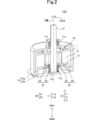
- FIG. FIG. 2 is a schematic perspective view showing brushless motor 100 with a part cut away.
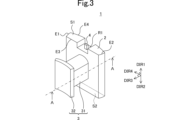
- FIG. 3 is a perspective view of the stator member 1.
- FIG. 4 is an enlarged cross-sectional view of the vicinity of the winding portion 4 as viewed in the opposite direction to the third direction DIR3.
- FIG. 5 is a plan view of the core back portion 2 and the winding portion 4 as viewed in the second direction DIR2.
- FIG. 6 is a flowchart showing an example of a method for manufacturing the stator member 1.
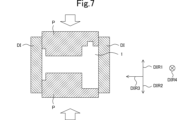
- FIG. 7 is a cross-sectional view taken along line AA, showing an example of a manufacturing process for the stator member 1. As shown in FIG. FIG. FIG.
- FIG. 8 is a perspective view of the stator member 1a.
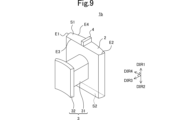
- FIG. 9 is a perspective view of the stator member 1b.
- FIG. 10 is a perspective view of the stator member 1c.
- FIG. 11 is a perspective view of the stator member 1d.
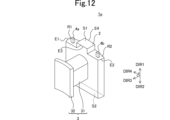
- FIG. 12 is a perspective view of the stator member 1e.
- FIG. 13 is a perspective view of the stator member 1f.
- FIG. 14 is a flowchart showing an example of a manufacturing method for the stator member 1f.
- FIG. 15 is a cross-sectional view taken along line AA, showing an example of a manufacturing process for the stator member 1f.
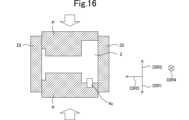
- FIG. 16 is a cross-sectional view taken along line AA, showing an example of a manufacturing process for the stator member 1f.
- FIG. 15 is a cross-sectional view taken along line AA, showing an example of a manufacturing process for the stator member 1f.
- FIG. 16 is a cross-sectional view taken along line
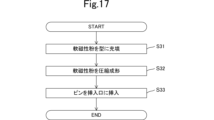
- FIG. 17 is a flowchart showing an example of a manufacturing method for the stator member 1g.
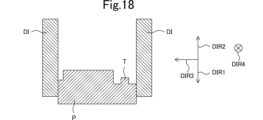
- FIG. 18 is a cross-sectional view taken along line AA, showing an example of a manufacturing process for the stator member 1g.
- FIG. 19 is a cross-sectional view taken along line AA, showing an example of a manufacturing process for the stator member 1g.
- FIG. 20 is a perspective view showing an example of a manufacturing process for the stator member 1g.
- FIG. 1 is an external perspective view of a brushless motor 100.
- Fig. 2 is a perspective schematic view showing a part of the brushless motor 100 in a cutaway. Note that in Fig. 2, reference symbols are given to only representative stator members 1 and coils 13 among the multiple stator members 1 and multiple coils 13.
- first direction DIR1 The opposite direction of first direction DIR1 is defined as second direction DIR2.
- second direction DIR2 One of the radial directions centered on the rotation axis of brushless motor 100, which is the direction from teeth tip 32 toward the rotation axis of brushless motor 100 as viewed in first direction DIR1, is defined as third direction DIR3.
- fourth direction DIR4 the fourth direction DIR4. Note that the definitions of directions in this specification are merely examples.
- the brushless motor 100 includes a rotor 20 and a stator assembly 10.
- the stator assembly 10 is disposed around the rotor 20 when viewed in the first direction DIR1.
- the brushless motor 100 is an inner rotor type.
- the brushless motor 100 is an example of a rotating electric machine of the present invention.
- the rotor 20 includes a shaft 21 and a rotor member 22.
- the shaft 21 is cylindrical and extends in the first direction DIR1.
- the rotor member 22 is cylindrical and extends in the first direction DIR1.
- the central axes of the shaft 21 and the rotor member 22 are the Z-axis. In other words, the rotation axis of the brushless motor 100 is the Z-axis. Therefore, the first direction DIR1 and the second direction DIR2 are each a direction along the Z-axis.
- the rotor member 22 has a soft magnetic body 23 and a hard magnetic body 24.
- the rotor member 22 is attached to the outer peripheral surface of the shaft 21 in the radial direction centered on the Z axis. More specifically, the soft magnetic body 23 is attached to the outer peripheral surface of the shaft 21 in the radial direction centered on the Z axis.
- the hard magnetic body 24 is attached to the outer peripheral surface of the soft magnetic body 23 in the radial direction centered on the Z axis.
- the soft magnetic material 23 is a soft magnetic material.
- the hard magnetic material 24 is a magnetized hard magnetic material. The hard magnetic material becomes magnetized when a magnetic field is applied from the outside. Even if the application of the magnetic field is then stopped, the hard magnetic material does not lose its magnetization.
- the stator assembly 10 includes a bearing 11, a housing 12, a coil 13, and a stator member 1.
- the bearing 11 supports the shaft 21 so that it can rotate in the circumferential direction around the Z-axis. More specifically, the bearing 11 has a first bearing 11a and a second bearing 11b. Each of the first bearing 11a and the second bearing 11b is, for example, a ball bearing. Each of the first bearing 11a and the second bearing 11b is cylindrical and extends in the first direction DIR1. The central axis of each of the first bearing 11a and the second bearing 11b is the Z-axis. In other words, the central axis of each of the first bearing 11a and the second bearing 11b coincides with the central axis of the shaft 21.
- the second bearing 11b is located in the second direction DIR2 from the first bearing 11a.
- the first bearing 11a is located in the first direction DIR1 from the rotor member 22.
- the second bearing 11b is located in the second direction DIR2 from the rotor member 22.
- the second bearing 11b supports the end of the shaft 21 in the second direction DIR2.
- the housing 12 has a first housing 12a and a second housing 12b.
- the first housing 12a is cylindrical.
- the central axis of the first housing 12a is the Z-axis.
- the first housing 12a is positioned in the first direction DIR1 from the second housing 12b.
- the first housing 12a also has an opening OP.
- the shaft 21 protrudes from the opening OP in the first direction DIR1.
- the brushless motor 100 is a single-shaft type.
- the first housing 12a supports the first bearing 11a, the multiple stator members 1, and the multiple coils 13.
- the second housing 12b supports the second bearing 11b.
- the materials of the first housing 12a and the second housing 12b are, for example, a highly rigid material such as SUS.
- the number of coils 13 and the number of stator members 1 are each nine.
- the nine coils 13 and the nine stator members 1 are arranged in the circumferential direction centered on the Z-axis.
- the nine stator members 1 are arranged around the hard magnetic material 24 with a gap between them.
- the coil 13 is made of a conductive material such as copper.
- the coil 13 has a structure in which the surface of the copper wire is covered with an insulating coating. Since the surface of the copper wire is covered with an insulating coating, the coil 13 and the stator member 1 are electrically insulated. However, at the two end portions of the coil 13, the surface of the copper wire is not covered with an insulating coating and the copper wire is exposed.
- the coil 13 is supplied with current from a power source (not shown). When current flows through the coil 13, the coil 13 generates a magnetic field.
- the stator member 1 is magnetized by both the magnetic field generated by the hard magnetic material 24 and the magnetic field generated by the coil 13.
- the rotation of the rotor 20 is controlled by controlling the current supplied from the power source (not shown).
- FIG. 3 is a perspective view of the stator member 1.
- Fig. 4 is an enlarged cross-sectional view of the vicinity of the winding portion 4 viewed in the opposite direction to the third direction DIR3.
- Fig. 5 is a plan view of the core back portion 2 and the winding portion 4 viewed in the second direction DIR2.
- the stator member 1 has a core back portion 2, a teeth portion 3, and a winding portion 4.
- the core back portion 2, the teeth portion 3, and the winding portion 4 are included in the stator member 1, which is a single member.
- the teeth portion 3 has a shape extending from the core back portion 2 in the third direction DIR3. More specifically, the teeth portion 3 has a teeth main body portion 31 extending from the core back portion 2 in the third direction DIR3, and a teeth tip portion 32 formed at the tip of the teeth main body portion 31.
- the coil 13 is wound around the teeth main body portion 31.
- the teeth tip portion 32 faces the hard magnetic body 24. However, there is an air gap between the teeth tip portion 32 and the hard magnetic body 24.
- the stator member 1 is a soft magnetic material. More specifically, in this embodiment, the stator member 1 is a molded body formed from soft magnetic powder. That is, each of the core back portion 2 and the teeth portion 3 is a molded body formed from soft magnetic powder.
- the material of the soft magnetic powder includes, for example, iron and a binder.
- the binder is, for example, a resin.
- the soft magnetic powder is, for example, a mixture of iron powder and epoxy resin powder, which is an example of a binder powder.
- Such a stator member 1 is produced, for example, by compression molding. In addition, an insulating treatment is applied to the outer surface of the stator member 1 that comes into contact with another member.
- the core back portion 2 has a first end face S1 facing the first direction DIR1, a second end face S2 facing the second direction DIR2, an inner main surface facing the third direction DIR3, an outer main surface facing the opposite direction to the third direction DIR3, a side surface facing the fourth direction DIR4, and a side surface facing the opposite direction to the fourth direction DIR4.
- the first end face S1 includes a first end E1 and a second end E2 which are both ends in the fourth direction DIR4, and a third end E3 and a fourth end E4 which are both ends in the third direction DIR3.
- the first end E1 is located in the fourth direction DIR4 from the second end E2.
- the third end E3 is located in the third direction DIR3 from the fourth end E4.
- each of the first end face S1, the second end face S2, and the inner main surface is a flat surface.
- the outer main surface and the two side surfaces are curved.
- the first end face S1 has a recess R1.
- the recess R1 is provided in the center of the first end face S1.
- the recess R1 has a shape recessed in the second direction DIR2.
- the recess R1 is provided between the first end E1 and the second end E2.
- the recess R1 also connects the inner main surface and the outer main surface. In other words, by providing the recess R1, the length of a portion of the core back portion 2 in the first direction DIR1 is shortened.
- one winding portion 4 extends from the core back portion 2 in the first direction DIR1.
- the coil 13 is wound around the winding portion 4. More specifically, in this embodiment, one of the two end portions of the coil 13 wound around the teeth main body portion 31 of the stator member 1 and one of the two end portions of the coil 13 wound around the teeth main body portion 31 of the stator member 1 arranged adjacent to the stator member 1 in the fourth direction DIR4 are wound around the winding portion 4 so that one of the two end portions of the coil 13 wound around the teeth main body portion 31 of the stator member 1 comes into contact with one of the two end portions of the coil 13 wound around the teeth main body portion 31 of the stator member 1 arranged adjacent to the stator member 1 in the fourth direction DIR4.
- the winding portion 4 is rod-shaped.
- the length of the winding portion 4 in the first direction DIR1 is smaller than the recess amount of the recess R1 in the second direction DIR2.
- the outer edge of the core back portion 2 as viewed in the second direction DIR2 surrounds the outer edge of the winding portion 4.
- the winding portion 4 is a soft magnetic material. More specifically, the winding portion 4 is a molded body formed from soft magnetic powder.
- the material of the soft magnetic powder includes, for example, iron and a binder.
- the binder is, for example, a resin.
- the soft magnetic powder is, for example, a mixture of iron powder and epoxy resin powder, which is an example of a binder powder.
- Such a winding portion 4 is produced, for example, by compression molding.
- the core back portion 2 and the winding portion 4 are integrally formed by molding the soft magnetic powder.
- an insulating treatment is applied to the outer surface of the winding portion 4 that comes into contact with the coil 13. In other words, the winding portion 4 has insulating properties.
- the winding portion 4 is provided in the recess R1. As a result, a portion of the core back portion 2 is located in the first direction DIR1 from the contact surface between the first end face S1 and the winding portion 4.
- the winding portion 4 is also provided between the first end E1 and the second end E2 on the first end face S1. In this embodiment, the winding portion 4 is also provided between the third end E3 and the fourth end E4 on the first end face S1.
- FIG. 6 is a flow chart showing an example of the method for manufacturing the stator member 1.
- Fig. 7 is a cross-sectional view taken along line A-A showing an example of the manufacturing process of the stator member 1.
- This manufacturing method begins by filling mold DI with soft magnetic powder that is a mixture of iron powder and epoxy resin powder ( Figure 6: step S11).
- the soft magnetic powder filled in the mold DI is compressed with a punch P to compress the soft magnetic powder (FIG. 6: step S12).
- the core back portion 2, the teeth portion 3, and the winding portion 4 are integrally formed to form the stator member 1 (first forming process).
- the stator member 1 can simplify the manufacturing process of the motor. More specifically, the winding portion 4 is provided on the first end surface S1 of the core back portion 2. Therefore, the process of assembling the stator and the insulating member is not required. As a result, the stator member 1 can simplify the manufacturing process of the motor.
- the multiple coils 13 and the multiple stator members 1 can be arranged in a circumferential direction centered on the Z axis. More specifically, the winding portion 4 is provided between the first end E1 and the second end E2 on the first end face S1 of the core back portion 2. This makes it possible to prevent the coil 13 wound around the winding portion 4 from protruding from the first end E1 into the fourth direction DIR4 or from protruding from the second end E2 in the opposite direction to the fourth direction DIR4 when viewed in the second direction DIR2. As a result, with the stator member 1, the multiple coils 13 and the multiple stator members 1 can be arranged in a circumferential direction centered on the Z axis.
- the manufacturing method of the stator member 1 can further simplify the manufacturing process of the motor. More specifically, the core back portion 2 and the winding portion 4 are integrally formed by compression molding a soft magnetic powder that is a mixture of iron powder and epoxy resin powder, to form the stator member 1. This eliminates the need for a process for making the entanglement portion and a process for placing the entanglement pin in the insulating member when manufacturing the stator member 1.
- the stator member 1 can suppress the core back portion from being easily magnetically saturated. More specifically, the tooth tip portion 32 faces the hard magnetic body 24. As a result, the magnetic flux generated by the hard magnetic body 24 flows from the tooth tip portion 32, through the tooth tip portion 32, the tooth main body portion 31, and the core back portion 2 in that order. The magnetic flux that flows into the core back portion 2 spreads radially when viewed in the opposite direction to the third direction DIR3. Therefore, the magnetic flux value that reaches the first end face S1 is small. Therefore, by providing the recess R1, which has a shape recessed in the second direction DIR2, on the first end face S1, the core back portion 2 is less likely to be magnetically saturated.
- the core back portion 2 since a part of the core back portion 2 is located in the first direction DIR1 from the contact surface between the first end face S1 and the winding portion 4, the core back portion 2 is less likely to be magnetically saturated.
- the magnetic flux value that reaches the center of the first end face S1 is particularly small. Therefore, by providing the recess R1 in the center of the first end face S1, the core back portion 2 is less likely to become magnetically saturated. As a result, the stator member 1 can prevent the core back portion from becoming magnetically saturated.
- the stator member 1 can prevent the coil and the core back portion from being electrically connected. More specifically, the end portion of the coil 13 is wound around the winding portion 4. At the end portion of the coil 13, the copper wire is exposed. Therefore, it is easy for the end portion of the coil 13 and the core back portion 2 to be electrically connected. Therefore, the winding portion 4 has insulating properties. As a result, the stator member 1 can prevent the coil and the core back portion from being electrically connected.
- the stator member 1 can further simplify the manufacturing process of the motor. More specifically, the core back portion 2 and the winding portion 4 are integrally formed by molding soft magnetic powder. This eliminates the need for a process for making the entanglement portion and a process for placing the entanglement pin in the insulating member when manufacturing the stator member 1.
- FIG. 8 is a perspective view of the stator member 1a.
- the stator member 1a according to the first modified example only the parts different from the stator member 1 according to the first embodiment will be described, and the rest will be omitted.
- the stator member 1a differs from the stator member 1 in that the first end surface S1 does not have a recess R1 and the winding portion 4 is not provided in the recess R1.
- the above stator member 1a also provides the same effects as the stator member 1.
- FIG. 9 is a perspective view of the stator member 1b. Note that, regarding the stator member 1b according to the second modified example, only the parts different from the stator member 1a according to the first modified example will be described, and the rest will be omitted.
- Stator member 1b differs from stator member 1a in that winding portion 4 connects the inner main surface and the outer main surface.
- stator member 1b also provides the same effects as stator member 1a.
- FIG. 10 is a perspective view of the stator member 1c. Note that, regarding the stator member 1c according to the third modified example, only the parts different from the stator member 1a according to the first modified example will be described, and the rest will be omitted.
- Stator member 1c differs from stator member 1a in that it has two winding portions 4a and 4b.
- the winding portion 4a is located in the fourth direction DIR4 from the winding portion 4b.
- the coil 13 is wound around the winding portions 4a and 4b. More specifically, one of the two end portions of the coil 13 wound around the teeth main body portion 31 of the stator member 1c and one of the two end portions of the coil 13 wound around the teeth main body portion 31 of the stator member 1c arranged adjacent to the stator member 1c in the fourth direction DIR4 are wound around the winding portion 4a so that one of the two end portions of the coil 13 wound around the teeth main body portion 31 of the stator member 1c comes into contact with one of the two end portions of the coil 13 wound around the teeth main body portion 31 of the stator member 1c arranged adjacent to the stator member 1c in the fourth direction DIR4.
- the other of the two end portions of the coil 13 wound around the teeth main body 31 of the stator member 1c and the other of the two end portions of the coil 13 wound around the teeth main body 31 of the stator member 1c arranged next to the stator member 1c in the fourth direction DIR4 are wound around the winding portion 4b so that the other of the two end portions of the coil 13 wound around the teeth main body 31 of the stator member 1c contacts the other of the two end portions of the coil 13 wound around the teeth main body 31 of the stator member 1c arranged next to the stator member 1c in the fourth direction DIR4.
- FIG. 11 is a perspective view of the stator member 1d. Note that, regarding the stator member 1d according to the fourth modified example, only the parts different from the stator member 1c according to the third modified example will be described, and the rest will be omitted.
- Stator member 1d differs from stator member 1c in that winding portions 4a and 4b each connect the inner main surface and the outer main surface.
- stator member 1d also provides the same effects as stator member 1c.
- FIG. 12 is a perspective view of the stator member 1e.
- the stator member 1e according to the fifth modified example only the parts different from the stator member 1c according to the third modified example will be described, and the rest will be omitted.
- the stator member 1e differs from the stator member 1c in that the first end surface S1 has two recesses R1a and R1b.
- the recess R1a is located in the fourth direction DIR4 from the recess R1b.
- the winding portion 4a is provided in the recess R1a.
- the winding portion 4b is provided in the recess R1b.
- stator member 1e also provides the same effects as stator member 1c.
- FIG. 13 is a perspective view of the stator member 1f. Note that, for the stator member 1f according to the second embodiment, only the parts different from the stator member 1 according to the first embodiment will be described, and the rest will be omitted.
- the stator member 1f differs from the stator member 1 in that the core back portion 2 and the winding portion 4c are not integrally formed by molding soft magnetic powder.
- the winding portion 4c is a rod-shaped pin.
- the material of the winding portion 4c is, for example, a copper-based material such as phosphor bronze.
- the outer surface of the winding portion 4c that comes into contact with the core back portion 2 is insulated.
- the outer surface of the winding portion 4c that comes into contact with the coil 13 is not insulated. Therefore, the winding portion 4c is conductive.
- the core back portion 2 and the winding portion 4c are separate members.
- FIG. 14 is a flow chart showing an example of a method for manufacturing a stator member 1f.
- FIG. 15 is a cross-sectional view taken along line A-A, showing an example of a manufacturing process for a stator member 1f.
- FIG. 16 is a cross-sectional view taken along line A-A, showing an example of a manufacturing process for a stator member 1f.
- this manufacturing method begins by placing a rod-shaped pin (wrapping portion 4c) in a punch P (FIG. 14: step S21). More specifically, the punch P is provided with an insertion opening for placing the rod-shaped pin (wrapping portion 4c). The rod-shaped pin (wrapping portion 4c) is inserted into the insertion opening of the punch P.
- the soft magnetic powder which is a mixture of iron powder and epoxy resin powder, is filled into the mold DI ( Figure 14: step S22).
- the soft magnetic powder and the winding portion 4c filled in the mold DI are compressed with a punch P to compress the soft magnetic powder and the winding portion 4c (FIG. 14: step S23).
- the core back portion 2 is formed, and the winding portion 4c is fixed to the first end surface S1 (second forming process).
- stator member 1f also has the same effect as the stator member 1. Furthermore, the stator member 1f allows easy electrical connection between the end of the coil and the electrodes and busbars (not shown) of the substrate (not shown). More specifically, the winding portion 4c is conductive. Therefore, the end of the coil 13 can be electrically connected to the electrodes and busbars of the substrate via the winding portion 4c. The winding portion 4c is also fixed to the first end surface S1. Therefore, by using the winding portion 4c as a positioning device when joining the substrate and busbar to the stator member 1f, the end of the coil can be easily electrically connected to the electrodes and busbars of the substrate.
- FIG. 17 is a flow chart showing an example of a manufacturing method for the stator member 1g.
- FIG. 18 is a cross-sectional view taken along line A-A showing an example of a manufacturing process for the stator member 1g.
- FIG. 19 is a cross-sectional view taken along line A-A showing an example of a manufacturing process for the stator member 1g.
- FIG. 20 is a perspective view showing an example of a manufacturing process for the stator member 1g. Note that with regard to the stator member 1g according to the third embodiment, only the parts that are different from the stator member 1f according to the first embodiment will be described, and the rest will be omitted.
- Stator member 1g differs from stator member 1f in the manufacturing method.
- This manufacturing method begins by filling the mold DI with soft magnetic powder that is a mixture of iron powder and epoxy resin powder (FIG. 17: step S31). More specifically, as shown in FIG. 18, the punch P is provided with a protrusion T that protrudes in the second direction DIR2.
- the soft magnetic powder filled in the mold DI is compressed with a punch P to compression mold the soft magnetic powder (FIG. 17: step S32).
- a core back portion 2 having an insertion port on the first end surface S1 and a teeth portion 3 are formed (core back portion forming process).
- a portion of the winding portion 4c is inserted into an insertion opening provided in the first end surface S1, thereby fixing the winding portion 4c to the first end surface S1 (FIG. 17: step S33, winding portion fixing process).
- stator member 1g also provides the same effects as stator member 1f.
- stator according to the present invention is not limited to the stator members 1, 1a to 1g, and may be modified within the scope of the present invention.
- the structures of the stator members 1, 1a to 1g may be combined in any manner.
- the rotating electric machine may have a structure in which the rotor is rotated by electricity, or a structure in which electricity is generated by the rotation of the rotor.
- Rotating electric machines include brushless motors, permanent magnet synchronous motors, permanent magnet synchronous generators, etc.
- the rotating electric machine may have at least one of the stator members 1, 1a to 1g, and may have brushes.
- the brushless motor 100 may also be an outer rotor type.
- the brushless motor 100 is not limited to a single-shaft type.
- the brushless motor 100 may be, for example, a double-shaft type.
- first bearing 11a and the second bearing 11b are not limited to ball bearings.
- the materials for the first housing 12a and the second housing 12b may be any material that has high rigidity.
- the number of coils 13 and the number of stator members 1 are not limited to nine.
- the core back portion 2 having an insertion port on the first end face S1 and the teeth portion 3 can be formed not only by compression molding soft magnetic powder, but also by laminating electromagnetic steel sheets to form the core back portion 2 having an insertion port on the first end face S1 and the teeth portion 3.
- each of the first end surface S1, the second end surface S2, and the inner main surface of the core back portion 2 may be a curved surface.
- each of the outer main surface and the two side surfaces of the core back portion 2 may be a flat surface.
- the tooth body portion 31 does not have to extend from the core back portion 2 in the third direction DIR3.
- the tooth tip portion 32 does not have to be formed at the tip of the tooth body portion 31 in the third direction DIR3.
- the length of the winding portion 4 in the first direction DIR1 may be equal to the recess amount of the recess R1 in the second direction DIR2. If the length of the winding portion 4 in the first direction DIR1 is equal to or less than the recess amount of the recess R1 in the second direction DIR2, the length of the brushless motor 100 in the first direction DIR1 can be reduced. Also, the length of the winding portion 4 in the first direction DIR1 may be greater than the recess amount of the recess R1 in the second direction DIR2. In this case, the winding portion 4 can be used for positioning when joining a substrate (not shown) having a hole to the stator member 1, so that the joining of the substrate having a hole to the stator member 1 can be easily performed.
- the outer surface of the stator member 1 that comes into contact with another member does not need to be insulated.
- the outer surface of the winding portion 4 that comes into contact with the coil 13 does not need to be insulated.
- the material of the winding portion 4c does not have to be a copper-based material such as phosphor bronze.
- the material of the winding portion 4c may be, for example, a resin. In this case, the winding portion 4c has insulating properties.
- three or more recesses R1 may be provided on the first end surface S1.
- the stator member 1 may have three or more winding portions 4.
- stator member 1g it is not necessary to fix the winding portion 4c to the first end surface S1 by inserting a portion of the winding portion 4c into an insertion opening provided in the first end surface S1.
- the winding portion 4c may be fixed to the first end surface S1 with an adhesive.
- the present invention has the following configuration.
- a stator member for use in a rotating electrical machine comprising: a core-back portion which is a compact formed from soft magnetic powder, the core-back portion having an end face facing a first direction along a rotation axis of the rotating electric machine when the stator member is assembled into the rotating electric machine, and a first end and a second end which are both ends in a circumferential direction centered on the rotation axis; a winding portion around which the coil is wound; Equipped with The winding portion is provided on the end surface between the first end and the second end. Stator components.
- the end surface is provided with a recess having a shape recessed in a direction opposite to the first direction, The winding portion is provided in the recess.
- a stator member as described in (1).
- the core back portion further has a third end and a fourth end which are both ends in a radial direction centered on the rotation axis,
- the winding portion is provided on the end surface between the third end and the fourth end.
- a portion of the core back portion is located in the first direction from a contact surface between the end surface and the winding portion;
- the stator member according to any one of (1) to (3).
- the number of the winding portions is 1.
- the number of the winding portions is two.
- the winding portion is conductive.
- the winding portion has insulating properties.
- a recess having a shape recessed in a direction opposite to the first direction is provided in a central portion of the end surface, The winding portion is provided in the recess, a portion of the core back portion is located in the first direction from a contact surface between the end surface and the winding portion;
- the core back portion and the winding portion are integrally formed by molding soft magnetic powder.
- stator member 2 core back portion 3: teeth portion 4, 4a to 4c: winding portion 10: stator assembly 11: bearing 11a: first bearing 11b: second bearing 12: housing 12a: first housing 12b: second housing 13: coil 20: rotor 21: shaft 22: rotor member 23: soft magnetic material 24: hard magnetic material 31: teeth main body portion 32: teeth tip portion 100: brushless motor DI: mold DIR1: first direction DIR2: second direction DIR3: third direction DIR4: fourth direction E1: first end E2: second end E3: third end E4: fourth end OP: opening P: punch R1, R1a, R1b: recess S1: first end face S2: second end face T: protrusion
Landscapes
- Engineering & Computer Science (AREA)
- Power Engineering (AREA)
- Manufacturing & Machinery (AREA)
- Iron Core Of Rotating Electric Machines (AREA)
Priority Applications (1)
| Application Number | Priority Date | Filing Date | Title |
|---|---|---|---|
| JP2025501099A JP7848933B2 (ja) | 2023-02-16 | 2024-02-08 | ステータ部材、回転電気機械及びステータ部材の製造方法 |
Applications Claiming Priority (2)
| Application Number | Priority Date | Filing Date | Title |
|---|---|---|---|
| JP2023022744 | 2023-02-16 | ||
| JP2023-022744 | 2023-02-16 |
Publications (1)
| Publication Number | Publication Date |
|---|---|
| WO2024171937A1 true WO2024171937A1 (ja) | 2024-08-22 |
Family
ID=92421860
Family Applications (1)
| Application Number | Title | Priority Date | Filing Date |
|---|---|---|---|
| PCT/JP2024/004254 Ceased WO2024171937A1 (ja) | 2023-02-16 | 2024-02-08 | ステータ部材、回転電気機械及びステータ部材の製造方法 |
Country Status (2)
| Country | Link |
|---|---|
| JP (1) | JP7848933B2 (https=) |
| WO (1) | WO2024171937A1 (https=) |
Citations (5)
| Publication number | Priority date | Publication date | Assignee | Title |
|---|---|---|---|---|
| JPH07143699A (ja) * | 1993-11-18 | 1995-06-02 | Daikin Ind Ltd | 電動機 |
| JPH11234995A (ja) * | 1998-02-17 | 1999-08-27 | Tamagawa Seiki Co Ltd | レゾルバ巻線方法及び構造 |
| JP2002078271A (ja) * | 2000-08-31 | 2002-03-15 | Japan Servo Co Ltd | 回転電機の固定子 |
| JP2002209359A (ja) * | 2001-01-11 | 2002-07-26 | Matsushita Seiko Co Ltd | 電動機の固定子とその接続装置 |
| JP2005094923A (ja) * | 2003-09-17 | 2005-04-07 | Denso Corp | 電磁アクチュエータ、電磁アクチュエータの製造方法、および燃料噴射弁 |
-
2024
- 2024-02-08 WO PCT/JP2024/004254 patent/WO2024171937A1/ja not_active Ceased
- 2024-02-08 JP JP2025501099A patent/JP7848933B2/ja active Active
Patent Citations (5)
| Publication number | Priority date | Publication date | Assignee | Title |
|---|---|---|---|---|
| JPH07143699A (ja) * | 1993-11-18 | 1995-06-02 | Daikin Ind Ltd | 電動機 |
| JPH11234995A (ja) * | 1998-02-17 | 1999-08-27 | Tamagawa Seiki Co Ltd | レゾルバ巻線方法及び構造 |
| JP2002078271A (ja) * | 2000-08-31 | 2002-03-15 | Japan Servo Co Ltd | 回転電機の固定子 |
| JP2002209359A (ja) * | 2001-01-11 | 2002-07-26 | Matsushita Seiko Co Ltd | 電動機の固定子とその接続装置 |
| JP2005094923A (ja) * | 2003-09-17 | 2005-04-07 | Denso Corp | 電磁アクチュエータ、電磁アクチュエータの製造方法、および燃料噴射弁 |
Also Published As
| Publication number | Publication date |
|---|---|
| JP7848933B2 (ja) | 2026-04-21 |
| JPWO2024171937A1 (https=) | 2024-08-22 |
Similar Documents
| Publication | Publication Date | Title |
|---|---|---|
| JP5614501B2 (ja) | 回転電機用ロータ、回転電機、および、回転電機用ロータの製造方法 | |
| EP1404003B1 (en) | Stator yoke for a commutator motor | |
| US20080093951A1 (en) | Electric machine with teeth and bridges | |
| US20050285468A1 (en) | Motor | |
| JP2015012679A (ja) | アキシャルギャップ型回転電機 | |
| CN113544945B (zh) | 定子 | |
| US7719159B2 (en) | Apparatus and method for constructing electrodynamic machines | |
| JP2883409B2 (ja) | 小型電動機 | |
| US20250219477A1 (en) | Magnetic core, coil-equipped magnetic core, and rotary electric machine | |
| JP2020156137A (ja) | 回転電機およびその製造方法 | |
| WO2024171937A1 (ja) | ステータ部材、回転電気機械及びステータ部材の製造方法 | |
| JP7852742B2 (ja) | 磁性体コア、ステータアッシー、回転電気機械及びブラシレスモータ | |
| JP2018207616A (ja) | モータ | |
| JP2018207617A (ja) | モータ | |
| JP7845505B2 (ja) | 磁性体コア、回転電気機械及びブラシレスモータ | |
| CN101501961B (zh) | 电动机 | |
| JPWO2024122405A5 (https=) | ||
| WO2024122407A1 (ja) | 磁性体コア及び回転電気機械 | |
| JP2024121489A (ja) | ステータ及び回転電気機械 | |
| US20260106519A1 (en) | Stator and motor | |
| EP4535615A1 (en) | Electric motor, core block, and stator core | |
| WO2024181096A1 (ja) | ステータ及び回転電気機械 | |
| WO2026083818A1 (ja) | 分割コア、環状コア及びその製造方法、並びに、回転電気機械 | |
| WO2023228581A1 (ja) | 接続端子、ステータ組立体及び電動機 | |
| WO2023228551A1 (ja) | 接続端子、ステータ組立体、電動機及びステータ組立体の製造方法 |
Legal Events
| Date | Code | Title | Description |
|---|---|---|---|
| 121 | Ep: the epo has been informed by wipo that ep was designated in this application |
Ref document number: 24756784 Country of ref document: EP Kind code of ref document: A1 |
|
| WWE | Wipo information: entry into national phase |
Ref document number: 2025501099 Country of ref document: JP |
|
| NENP | Non-entry into the national phase |
Ref country code: DE |
|
| 122 | Ep: pct application non-entry in european phase |
Ref document number: 24756784 Country of ref document: EP Kind code of ref document: A1 |