WO2024171920A1 - 着色硬化性樹脂組成物、カラーフィルタ、表示装置、及び固体撮像素子 - Google Patents
着色硬化性樹脂組成物、カラーフィルタ、表示装置、及び固体撮像素子 Download PDFInfo
- Publication number
- WO2024171920A1 WO2024171920A1 PCT/JP2024/004063 JP2024004063W WO2024171920A1 WO 2024171920 A1 WO2024171920 A1 WO 2024171920A1 JP 2024004063 W JP2024004063 W JP 2024004063W WO 2024171920 A1 WO2024171920 A1 WO 2024171920A1
- Authority
- WO
- WIPO (PCT)
- Prior art keywords
- meth
- mass
- colorant
- acrylate
- curable resin
- Prior art date
- Legal status (The legal status is an assumption and is not a legal conclusion. Google has not performed a legal analysis and makes no representation as to the accuracy of the status listed.)
- Ceased
Links
Classifications
-
- G—PHYSICS
- G03—PHOTOGRAPHY; CINEMATOGRAPHY; ANALOGOUS TECHNIQUES USING WAVES OTHER THAN OPTICAL WAVES; ELECTROGRAPHY; HOLOGRAPHY
- G03F—PHOTOMECHANICAL PRODUCTION OF TEXTURED OR PATTERNED SURFACES, e.g. FOR PRINTING, FOR PROCESSING OF SEMICONDUCTOR DEVICES; MATERIALS THEREFOR; ORIGINALS THEREFOR; APPARATUS SPECIALLY ADAPTED THEREFOR
- G03F7/00—Photomechanical, e.g. photolithographic, production of textured or patterned surfaces, e.g. printing surfaces; Materials therefor, e.g. comprising photoresists; Apparatus specially adapted therefor
- G03F7/004—Photosensitive materials
- G03F7/027—Non-macromolecular photopolymerisable compounds having carbon-to-carbon double bonds, e.g. ethylenic compounds
-
- C—CHEMISTRY; METALLURGY
- C08—ORGANIC MACROMOLECULAR COMPOUNDS; THEIR PREPARATION OR CHEMICAL WORKING-UP; COMPOSITIONS BASED THEREON
- C08F—MACROMOLECULAR COMPOUNDS OBTAINED BY REACTIONS ONLY INVOLVING CARBON-TO-CARBON UNSATURATED BONDS
- C08F2/00—Processes of polymerisation
- C08F2/44—Polymerisation in the presence of compounding ingredients, e.g. plasticisers, dyestuffs, fillers
-
- C—CHEMISTRY; METALLURGY
- C08—ORGANIC MACROMOLECULAR COMPOUNDS; THEIR PREPARATION OR CHEMICAL WORKING-UP; COMPOSITIONS BASED THEREON
- C08F—MACROMOLECULAR COMPOUNDS OBTAINED BY REACTIONS ONLY INVOLVING CARBON-TO-CARBON UNSATURATED BONDS
- C08F220/00—Copolymers of compounds having one or more unsaturated aliphatic radicals, each having only one carbon-to-carbon double bond, and only one being terminated by only one carboxyl radical or a salt, anhydride ester, amide, imide or nitrile thereof
- C08F220/02—Monocarboxylic acids having less than ten carbon atoms; Derivatives thereof
- C08F220/10—Esters
-
- C—CHEMISTRY; METALLURGY
- C08—ORGANIC MACROMOLECULAR COMPOUNDS; THEIR PREPARATION OR CHEMICAL WORKING-UP; COMPOSITIONS BASED THEREON
- C08F—MACROMOLECULAR COMPOUNDS OBTAINED BY REACTIONS ONLY INVOLVING CARBON-TO-CARBON UNSATURATED BONDS
- C08F265/00—Macromolecular compounds obtained by polymerising monomers on to polymers of unsaturated monocarboxylic acids or derivatives thereof as defined in group C08F20/00
- C08F265/04—Macromolecular compounds obtained by polymerising monomers on to polymers of unsaturated monocarboxylic acids or derivatives thereof as defined in group C08F20/00 on to polymers of esters
-
- C—CHEMISTRY; METALLURGY
- C08—ORGANIC MACROMOLECULAR COMPOUNDS; THEIR PREPARATION OR CHEMICAL WORKING-UP; COMPOSITIONS BASED THEREON
- C08F—MACROMOLECULAR COMPOUNDS OBTAINED BY REACTIONS ONLY INVOLVING CARBON-TO-CARBON UNSATURATED BONDS
- C08F290/00—Macromolecular compounds obtained by polymerising monomers on to polymers modified by introduction of aliphatic unsaturated end or side groups
- C08F290/02—Macromolecular compounds obtained by polymerising monomers on to polymers modified by introduction of aliphatic unsaturated end or side groups on to polymers modified by introduction of unsaturated end groups
- C08F290/06—Polymers provided for in subclass C08G
-
- G—PHYSICS
- G02—OPTICS
- G02B—OPTICAL ELEMENTS, SYSTEMS OR APPARATUS
- G02B5/00—Optical elements other than lenses
- G02B5/20—Filters
-
- G—PHYSICS
- G03—PHOTOGRAPHY; CINEMATOGRAPHY; ANALOGOUS TECHNIQUES USING WAVES OTHER THAN OPTICAL WAVES; ELECTROGRAPHY; HOLOGRAPHY
- G03F—PHOTOMECHANICAL PRODUCTION OF TEXTURED OR PATTERNED SURFACES, e.g. FOR PRINTING, FOR PROCESSING OF SEMICONDUCTOR DEVICES; MATERIALS THEREFOR; ORIGINALS THEREFOR; APPARATUS SPECIALLY ADAPTED THEREFOR
- G03F7/00—Photomechanical, e.g. photolithographic, production of textured or patterned surfaces, e.g. printing surfaces; Materials therefor, e.g. comprising photoresists; Apparatus specially adapted therefor
- G03F7/0005—Production of optical devices or components in so far as characterised by the lithographic processes or materials used therefor
- G03F7/0007—Filters, e.g. additive colour filters; Components for display devices
-
- G—PHYSICS
- G03—PHOTOGRAPHY; CINEMATOGRAPHY; ANALOGOUS TECHNIQUES USING WAVES OTHER THAN OPTICAL WAVES; ELECTROGRAPHY; HOLOGRAPHY
- G03F—PHOTOMECHANICAL PRODUCTION OF TEXTURED OR PATTERNED SURFACES, e.g. FOR PRINTING, FOR PROCESSING OF SEMICONDUCTOR DEVICES; MATERIALS THEREFOR; ORIGINALS THEREFOR; APPARATUS SPECIALLY ADAPTED THEREFOR
- G03F7/00—Photomechanical, e.g. photolithographic, production of textured or patterned surfaces, e.g. printing surfaces; Materials therefor, e.g. comprising photoresists; Apparatus specially adapted therefor
- G03F7/004—Photosensitive materials
- G03F7/09—Photosensitive materials characterised by structural details, e.g. supports, auxiliary layers
- G03F7/105—Photosensitive materials characterised by structural details, e.g. supports, auxiliary layers having substances, e.g. indicators, for forming visible images
-
- H—ELECTRICITY
- H10—SEMICONDUCTOR DEVICES; ELECTRIC SOLID-STATE DEVICES NOT OTHERWISE PROVIDED FOR
- H10F—INORGANIC SEMICONDUCTOR DEVICES SENSITIVE TO INFRARED RADIATION, LIGHT, ELECTROMAGNETIC RADIATION OF SHORTER WAVELENGTH OR CORPUSCULAR RADIATION
- H10F39/00—Integrated devices, or assemblies of multiple devices, comprising at least one element covered by group H10F30/00, e.g. radiation detectors comprising photodiode arrays
- H10F39/80—Constructional details of image sensors
- H10F39/805—Coatings
- H10F39/8053—Colour filters
Definitions
- the present invention relates to a colored curable resin composition, a color filter, a display device, and a solid-state imaging device.
- Color filters used in displays such as liquid crystal displays, electroluminescent displays, and plasma displays, as well as solid-state imaging devices such as CCD and CMOS sensors, are manufactured from colored curable resin compositions. It is known that certain polymerizable compounds are used in these colored curable resin compositions (Patent Documents 1 and 2).
- an object of the present invention is to provide a colored curable resin composition that can form a color filter with further reduced residue and improved adhesion.
- a composition comprising a colorant (A), a resin (B), a polymerizable compound (C), and a polymerization initiator (D),
- the colored curable resin composition characterized in that the polymerizable compound (C) contains a polymerizable compound (C1) having a hydroxyl value of more than 10 mgKOH/g and not more than 100 mgKOH/g and 10 or more alkyleneoxy units.
- the polymerizable compound (C1) contains a compound represented by formula (1).
- Y represents a hydrogen atom or a (meth)acryloyl group, and at least one Y is a (meth)acryloyl group.
- Z represents an alkylene group having 2 to 10 carbon atoms. a to f independently represent the number of alkyleneoxy units, and a+b+c+d+e+f is 10 or more.
- a display device comprising the color filter according to [5].
- a solid-state imaging device comprising the color filter according to [5].
- the present invention provides a colored curable resin composition that can form a color filter with even less residue and improved adhesion.
- the colored curable resin composition of the present invention comprises a colorant (A), a resin (B), a polymerizable compound (C), and a polymerization initiator (D), and is characterized in that the polymerizable compound (C) comprises a polymerizable compound (C1) having a hydroxyl value of more than 10 mgKOH/g and not more than 100 mgKOH/g and having 10 or more alkyleneoxy units.
- the colored curable resin composition of the present invention may further contain a solvent (hereinafter, may be referred to as solvent (E)).
- the colored curable resin composition of the present invention may further contain a polymerization initiation aid (hereinafter, may be referred to as polymerization initiation aid (D1)).
- the colored curable resin composition of the present invention may further contain a thiol compound (hereinafter, may be referred to as thiol compound (T)).
- the colored curable resin composition of the present invention may further contain a leveling agent (hereinafter, may be referred to as leveling agent (F)).
- leveling agent hereinafter, may be referred to as leveling agent (F)
- the compounds exemplified as each component may be used alone or in combination of two or more kinds, unless otherwise specified.
- the colorant (A) may be a dye (A1) or a pigment (A2), and the pigment (A2) is preferred. These may be used alone or in combination of two or more.
- the dye (A1) is not particularly limited, and known dyes can be used, such as solvent dyes, acid dyes, direct dyes, and mordant dyes.
- dyes include compounds classified as dyes in the Color Index (published by The Society of Dyers and Colourists) and known dyes described in Dyeing Notes (Shikisensha).
- examples of dyes that can be used according to their chemical structure include azo dyes, cyanine dyes, triphenylmethane dyes, xanthene dyes, anthraquinone dyes, naphthoquinone dyes, quinoneimine dyes, methine dyes, azomethine dyes, squarylium dyes, acridine dyes, styryl dyes, coumarin dyes, quinoline dyes, nitro dyes, phthalocyanine dyes, perylene dyes, quinophthalone dyes, and isoindoline dyes.
- organic solvent-soluble dyes are preferred.
- dyes having the following Color Index (C.I.) numbers are included.
- C.I. Color Index
- Solvent Orange 2 7, 11, 15, 26, 41, 54, 56, 77, 86, 99; C.I. Solvent Violet 11, 13, 14, 26, 31, 36, 37, 38, 45, 47, 48, 51, 59, 60; C.I. Solvent Blue 4, 5, 14, 18, 35, 36, 37, 38, 44, 45, 58, 59, 59:1, 63, 67, 68, 69, 70, 78, 79, 83, 90, 94, 97, 98, 100, 101, 102, 104, 105, 111, 112, 122, 128, 132, 136, 139; C.I. Solvent dyes such as C.I. Solvent Green 1, 3, 4, 5, 7, 28, 29, 32, 33, 34, 35; C.I.
- Acid dyes such as C. I. Acid Green 1, 3, 5, 6, 7, 8, 9, 11, 13, 14, 15, 16, 22, 25, 27, 28, 41, 50, 50:1, 58, 63, 65, 80, 104, 105, 106, 109; C.I. Direct Yellow 2, 4, 28, 33, 34, 35, 38, 39, 43, 44, 47, 50, 54, 58, 68, 69, 70, 71, 86, 93, 94, 95, 98, 102, 108, 109, 129, 132, 136, 138, 141; C.I.
- Direct dyes such as C.I. Direct Green 25, 27, 31, 32, 34, 37, 63, 65, 66, 67, 68, 69, 72, 79, 82; C.I. Disperse Yellow 51, 54, 76; C.I. Disperse Violet 26, 27; C.I. Disperse dyes such as C.I. Disperse Blue 1, 14, 56, 6;0, C.I. Basic Red 1, 10; C.I. Basic Blue 1, 3, 5, 7, 9, 19, 21, 22, 24, 25, 26, 28, 29, 40, 41, 45, 47, 54, 58, 59, 60, 64, 65, 66, 67, 68, 81, 83, 88, 89; C.I. Basic Violet 2; C.I. Basic Red 9; C.I.
- Basic dyes such as C.I. Basic Green 1; C.I. Reactive Yellow 2, 76, 116; C.I. Reactive Orange 16; C.I. Reactive dyes such as C.I. Reactive Red 36; C.I. Mordant Yellow 5, 8, 10, 16, 20, 26, 30, 31, 33, 42, 43, 45, 56, 61, 62, 65; C.I. Mordant Red 1, 2, 3, 4, 9, 11, 12, 14, 17, 18, 19, 22, 23, 24, 25, 26, 27, 29, 30, 32, 33, 36, 37, 38, 39, 41, 42, 43, 45, 46, 48, 52, 53, 56, 62, 63, 71, 74, 76, 78, 85, 86, 88, 90, 94, 95; C.I.
- These dyes can be selected appropriately to match the spectral spectrum of the desired color filter.
- Pigments (A2) may be any known pigment, including, for example, pigments classified as pigments in the Color Index (published by The Society of Dyers and Colourists).
- examples include azo pigments, cyanine pigments, triphenylmethane pigments, xanthene pigments, anthraquinone pigments, naphthoquinone pigments, quinoneimine pigments, methine pigments, azomethine pigments, squarylium pigments, acridine pigments, styryl pigments, coumarin pigments, quinoline pigments, nitro pigments, phthalocyanine pigments, perylene pigments, quinophthalone pigments, isoindoline pigments, etc.
- phthalocyanine pigments, quinophthalone pigments, isoindoline pigments, etc. are preferred.
- pigments classified as C.I. Pigment include yellow pigments such as C.I. Pigment Yellow 1, 3, 12, 13, 14, 15, 16, 17, 20, 24, 31, 53, 83, 86, 93, 94, 109, 110, 117, 125, 128, 129, 137, 138, 139, 147, 148, 150, 153, 154, 166, 173, 185, 194, 214, 231, and 233; Orange pigments such as C.I. Pigment Orange 13, 31, 34, 36, 38, 40, 42, 43, 51, 55, 59, 61, 64, 65, 71, 73; red pigments such as C.I.
- These pigments can be selected appropriately to match the optical spectrum of the desired color filter.
- the colorant (A) preferably contains at least one selected from the group consisting of a yellow dye and a yellow pigment (hereinafter, these may be collectively referred to as "yellow colorant”), a green dye and a green pigment (hereinafter, these may be collectively referred to as "green colorant”), and more preferably contains a yellow pigment and/or a green pigment.
- the yellow dye may be any of the above dyes whose hues are classified as yellow
- the yellow pigment may be any of the above pigments whose hues are classified as yellow.
- the yellow pigments quinophthalone yellow pigments, metal-containing yellow pigments, and isoindoline yellow pigments are preferred
- C.I. Pigment Yellow 129, 138, 139, 150, and 185 are more preferred
- C.I. Pigment Yellow 138, 139, 150, and 185 are even more preferred
- C.I. Pigment Yellow 138, 139, and 185 are even more preferred.
- the green dye may be any of the above dyes whose hue is classified as green, and the green pigment may be any of the above pigments whose hue is classified as green.
- phthalocyanine pigments are preferred, at least one selected from the group consisting of halogenated copper phthalocyanine pigments and halogenated zinc phthalocyanine pigments is more preferred, C.I. Pigment Green 7, 36, 58, 59, 62, and 63 are even more preferred, and C.I. Pigment Green 36, 58, and 59 are even more preferred.
- the colorant (A) preferably contains a yellow colorant and/or a green colorant in total in an amount of, for example, 50 mass% or more, preferably 70 mass% or more, more preferably 90 mass% or more, and particularly preferably 95 mass% or more, based on 100 mass% of all colorants.
- a yellow colorant and a green colorant are contained.
- the content of the yellow colorant is, for example, 10 mass% or more and 70 mass% or less, preferably 15 mass% or more and 60 mass% or less, and more preferably 20 mass% or more and 55 mass% or less, based on 100 mass% in total of the yellow colorant and the green colorant.
- the content of the green colorant is, for example, 30% by mass or more and 90% by mass or less, preferably 40% by mass or more and 85% by mass or less, and more preferably 45% by mass or more and 80% by mass or less, based on 100% by mass of the total of the yellow colorant and the green colorant.
- the colorant (A) preferably contains at least one selected from the group consisting of a yellow colorant, a red dye, and a red pigment (hereinafter, these may be collectively referred to as "red colorant”), and more preferably contains a yellow pigment and/or a red pigment.
- yellow colorants include those used in preparing the green colored curable resin composition, and the preferred embodiments are also the same.
- the red dye may be any of the above dyes whose hue is classified as red
- the red pigment may be any of the above pigments whose hue is classified as red.
- the red pigments one or more selected from the group consisting of C.I. Pigment Red 149, 176, 177, 242, 254, 255, 264, 269, 272, and 291 are preferred, one or more selected from the group consisting of C.I. Pigment Red 177, 242, 254, 269, 272, and 291 are more preferred, and one or more selected from the group consisting of C.I. Pigment Red 254, 269, 272, and 291 are even more preferred.
- the colorant (A) When preparing a red colored curable resin composition, the colorant (A) preferably contains, for example, 50% by mass or more, preferably 70% by mass or more, more preferably 90% by mass or more, and especially 100% by mass of a yellow colorant and/or a red colorant in total, based on 100% by mass of all colorants. It is also preferable that the colorant (A) contains both a yellow colorant and a red colorant.
- the content of the red colorant is, for example, 50% by mass or more and 95% by mass or less, preferably 60% by mass or more and 90% by mass or less, and more preferably 70% by mass or more and 85% by mass or less, based on the total of the yellow colorant and the red colorant.
- the colorant (A) preferably contains at least one selected from the group consisting of a blue dye and a blue pigment (hereinafter, these may be collectively referred to as "blue colorant”), and more preferably contains a blue pigment.
- blue dyes include those dyes that have a hue classified as blue among the above dyes
- blue pigments include those pigments that have a hue classified as blue among the above pigments.
- a phthalocyanine pigment is preferable, and C.I. Pigment Blue 15, 15:3, 15:4, 15:6, and 16 are more preferable.
- a purple dye and a purple pigment (hereinafter, these may be collectively referred to as “purple colorant”) in addition to the blue colorant.
- the purple dye may be any of the above dyes whose hue is classified as purple, and the purple pigment may be any of the above pigments whose hue is classified as purple.
- the purple colorant a purple pigment is preferable, and among the purple pigments, C.I. Pigment Violet 19, 23, and 29 are more preferable.
- the colorant (A) preferably contains, for example, 30% by mass or more and 99% by mass or less, preferably 50% by mass or more, and more preferably 60% by mass or more, of the blue colorant in 100% by mass of the total colorants.
- the content of the blue colorant is, for example, 5% by mass or more and 95% by mass or less, preferably 10% by mass or more and 80% by mass or less, and more preferably 20% by mass or more and 60% by mass or less, in 100% by mass of the total of the blue colorant and the purple colorant.
- the colorant (A) preferably contains at least one yellow colorant, more preferably contains at least one yellow pigment, and even more preferably contains two or more yellow pigments.
- C.I. Pigment Yellow 129, 138, 139, 150, and 185 are preferred, and C.I. Pigment Yellow 138, 139, 150, and 185 are more preferred.
- the colorant (A) preferably contains a yellow colorant in an amount of, for example, 50% by mass or more, preferably 70% by mass or more, more preferably 80% by mass or more, even more preferably 90% by mass or more, and especially 100% by mass, based on 100% by mass of all colorants.
- a colorant-containing liquid containing the colorant (A) and the solvent (E) may be prepared in advance, and then the colorant-containing liquid may be used to prepare the colored curable resin composition.
- the colorant (A) is not soluble in the solvent (E), for example when the colorant (A) contains a pigment (A2)
- the colorant-containing liquid can be prepared by dispersing the colorant (A) in the solvent (E) and mixing.
- the colorant-containing liquid may contain a part or all of the solvent (E) contained in the colored curable resin composition.
- the solid content in the colorant-containing liquid is less than 100% by mass, preferably 1% by mass to 80% by mass, more preferably 2% by mass to 70% by mass, and even more preferably 5% by mass to 65% by mass, based on the total amount of the colorant-containing liquid.
- the content of colorant (A) in the colorant-containing liquid is less than 100% by mass, preferably 1% by mass or more and 70% by mass or less, more preferably 2% by mass or more and 60% by mass or less, and even more preferably 5% by mass or more and 50% by mass or less, based on the total amount of solids in the colorant-containing liquid.
- the colorant (A) may be subjected to a rosin treatment, a surface treatment using a derivative having an acidic or basic group introduced therein, a grafting treatment to the surface of the colorant (A) using a polymer compound, a micronization treatment using a sulfuric acid micronization method or a salt milling method, a washing treatment using an organic solvent or water to remove impurities, a removal treatment using an ion exchange method for ionic impurities, etc. It is preferable that the particle size of the colorant (A) is approximately uniform.
- the colorant (A) can be made to be uniformly dispersed in the solution by adding a dispersant and carrying out a dispersion treatment.
- a dispersant When using a combination of two or more types of colorant (A), each may be dispersed alone, or multiple types may be mixed and dispersed.
- the dispersant may be, for example, a surfactant, which may be any of cationic, anionic, nonionic, and amphoteric surfactants. Specific examples include polyester, polyamine, and acrylic surfactants. These dispersants may be used alone or in combination of two or more.
- dispersants by trade name examples include KP (manufactured by Shin-Etsu Chemical Co., Ltd.), FLORENE (manufactured by Kyoeisha Chemical Co., Ltd.), Solsperse (registered trademark) (manufactured by Zeneca Co., Ltd.), EFKA (registered trademark) (manufactured by BASF), AJISPER (registered trademark) (manufactured by Ajinomoto Fine-Techno Co., Ltd.), Disperbyk (registered trademark) (manufactured by BYK-Chemie Co., Ltd.), and BYK (registered trademark) (manufactured by BYK-Chemie Co., Ltd.).
- the resin (B) described later preferably at least one selected from resins [K2] and [K6]
- the resin (B) described later may be used as the dispersant.
- the amount of the dispersant (solid content) used is usually 1 part by mass to 10,000 parts by mass, preferably 5 parts by mass to 5,000 parts by mass, more preferably 10 parts by mass to 1,000 parts by mass, and even more preferably 15 parts by mass to 800 parts by mass, per 100 parts by mass of colorant (A) in the colorant-containing liquid.
- a colorant-containing liquid hereinafter sometimes referred to as a colorant dispersion or pigment dispersion
- the colorant-containing liquid may already contain a part or all, preferably a part, of the resin (B) contained in the colored curable resin composition.
- the resin (B) By including the resin (B) in advance, the dispersion stability of the colorant-containing liquid can be further improved.
- the content of resin (B) is, for example, 10 parts by mass or more and 10,000 parts by mass or less, preferably 20 parts by mass or more and 5,000 parts by mass or less, and more preferably 25 parts by mass or more and 2,500 parts by mass or less, relative to 100 parts by mass of colorant (A) in the colorant-containing liquid.
- the content of the colorant (A) is preferably 1% by mass or more and 93% by mass or less, more preferably 10% by mass or more and 91% by mass or less, even more preferably 15% by mass or more and 89% by mass or less, and even more preferably 18% by mass or more and 87% by mass or less, based on the total amount of solids in the colored curable resin composition.
- the content of the colorant (A) is within the above range, the color density when made into a color filter is sufficient, and the necessary amount of the resin (B) can be contained in the composition, so that a pattern with sufficient mechanical strength can be formed, which is preferable.
- total amount of solids in this specification refers to the amount obtained by subtracting the content of the solvent from the total amount of the colored curable resin composition.
- the total amount of solids and the content of each component relative thereto can be measured by a known analytical means such as liquid chromatography or gas chromatography.
- Resin (B) (also referred to as binder resin (B)) is not particularly limited, but is preferably an alkali-soluble resin.
- resin (B) include the following resins [K1] to [K6].
- Resin [K1] a copolymer having a structural unit derived from at least one monomer (a) (hereinafter sometimes referred to as "(a)”) selected from the group consisting of unsaturated carboxylic acids and unsaturated carboxylic anhydrides, and a structural unit derived from a monomer (b) (hereinafter sometimes referred to as "(b)") having a cyclic ether structure having 2 to 4 carbon atoms and an ethylenically unsaturated bond;
- Resin [K2] a copolymer having a structural unit derived from the (a), a structural unit derived from the (b), and a structural unit derived from a monomer (c) copolymerizable with (a) (however, different from (a) and (b)) (hereinafter, may be referred to as "(c)”);
- Resin [K3] a copolymer having a structural unit derived from the (a) and a structural unit derived from
- the monomer (a) include unsaturated monocarboxylic acids such as acrylic acid, methacrylic acid, crotonic acid, o-, m-, and p-vinylbenzoic acid; Unsaturated dicarboxylic acids such as maleic acid, fumaric acid, citraconic acid, mesaconic acid, itaconic acid, 3-vinylphthalic acid, 4-vinylphthalic acid, 3,4,5,6-tetrahydrophthalic acid, 1,2,3,6-tetrahydrophthalic acid, dimethyltetrahydrophthalic acid, and 1,4-cyclohexenedicarboxylic acid; Bicyclounsaturated compounds containing a carboxy group, such as methyl-5-norbornene-2,3-dicarboxylic acid, 5-carboxybicyclo[2.2.1]hept-2-ene, 5,6-dicarboxybicyclo[2.2.1]hept-2-ene, 5-carboxy-5-methylbicyclo[2.
- acrylic acid refers to at least one selected from the group consisting of acrylic acid and methacrylic acid.
- (meth)acryloyl and “(meth)acrylate” have the same meaning.
- Monomer (b) is, for example, a polymerizable compound having a cyclic ether structure having 2 to 4 carbon atoms (for example, at least one selected from the group consisting of an oxirane ring, an oxetane ring, and a tetrahydrofuran ring) and an ethylenically unsaturated bond.
- (b) is preferably a monomer having a cyclic ether having 2 to 4 carbon atoms and a (meth)acryloyloxy group.
- monomer (b) examples include monomer (b1) having an oxiranyl group and an ethylenically unsaturated bond (hereinafter sometimes referred to as "(b1)"), monomer (b2) having an oxetanyl group and an ethylenically unsaturated bond (hereinafter sometimes referred to as “(b2)”), and monomer (b3) having a tetrahydrofuryl group and an ethylenically unsaturated bond (hereinafter sometimes referred to as "(b3)”), etc.
- monomer (b1) having an oxiranyl group and an ethylenically unsaturated bond hereinafter sometimes referred to as "(b1)
- monomer (b2) having an oxetanyl group and an ethylenically unsaturated bond hereinafter sometimes referred to as "(b2)
- monomer (b3) having a tetrahydrofuryl group and an ethylenically unsaturated bond
- monomer (b1) examples include monomer (b1-1) (hereinafter sometimes referred to as "(b1-1)”) having a structure in which a linear or branched aliphatic unsaturated hydrocarbon is epoxidized, and monomer (b1-2) (hereinafter sometimes referred to as "(b1-2)”) having a structure in which an alicyclic unsaturated hydrocarbon is epoxidized.
- Monomer (b1-1) includes glycidyl (meth)acrylate, ⁇ -methyl glycidyl (meth)acrylate, ⁇ -ethyl glycidyl (meth)acrylate, glycidyl vinyl ether, o-vinylbenzyl glycidyl ether, m-vinylbenzyl glycidyl ether, p-vinylbenzyl glycidyl ether, ⁇ -methyl-o-vinylbenzyl glycidyl ether, ⁇ -methyl-m-vinylbenzyl glycidyl ether, ⁇ -methyl-p-vinylbenzyl glycidyl ether, 2,3-bis(glycidyl Examples of such styrene include 2,4-bis(glycidyloxymethyl)styrene, 2,5-bis(glycidyloxymethyl)styrene, 2,6-bis(glycid
- Examples of the monomer (b1-2) include vinylcyclohexene monoxide, 1,2-epoxy-4-vinylcyclohexane (e.g., Celloxide (registered trademark) 2000; manufactured by Daicel Corporation), 3,4-epoxycyclohexylmethyl (meth)acrylate (e.g., Cyclomer (registered trademark) A400; manufactured by Daicel Corporation), 3,4-epoxycyclohexylmethyl (meth)acrylate (e.g., Cyclomer (registered trademark) M100; manufactured by Daicel Corporation), compounds represented by formula (I) and compounds represented by formula (II).
- vinylcyclohexene monoxide e.g., 1,2-epoxy-4-vinylcyclohexane
- 3,4-epoxycyclohexylmethyl (meth)acrylate e.g., Cyclomer (registered trademark) A400; manufactured by Daicel Corporation
- R a and R b represent a hydrogen atom or an alkyl group having 1 to 4 carbon atoms, and the hydrogen atom contained in the alkyl group may be substituted with a hydroxy group.
- X a and X b each represent a single bond, *-R c -, *-R c -O-, *-R c -S- or *-R c -NH-.
- R c represents an alkanediyl group having 1 to 6 carbon atoms. * represents a bond to O.
- alkyl group having 1 to 4 carbon atoms examples include a methyl group, an ethyl group, an n-propyl group, an isopropyl group, an n-butyl group, a sec-butyl group, and a tert-butyl group.
- Examples of the alkyl group in which a hydrogen atom is substituted with a hydroxy group include a hydroxymethyl group, a 1-hydroxyethyl group, a 2-hydroxyethyl group, a 1-hydroxypropyl group, a 2-hydroxypropyl group, a 3-hydroxypropyl group, a 1-hydroxy-1-methylethyl group, a 2-hydroxy-1-methylethyl group, a 1-hydroxybutyl group, a 2-hydroxybutyl group, a 3-hydroxybutyl group, and a 4-hydroxybutyl group.
- R a and R b are preferably a hydrogen atom, a methyl group, a hydroxymethyl group, a 1-hydroxyethyl group, or a 2-hydroxyethyl group, and more preferably a hydrogen atom or a methyl group.
- Alkanediyl groups include methylene, ethylene, propane-1,2-diyl, propane-1,3-diyl, butane-1,4-diyl, pentane-1,5-diyl, and hexane-1,6-diyl groups.
- X a and X b are preferably a single bond, a methylene group, an ethylene group, *-CH 2 -O- and *-CH 2 CH 2 -O-, more preferably a single bond or *-CH 2 CH 2 -O- (* represents a bond to O).
- the compound represented by formula (I) includes compounds represented by any of formulas (I-1) to (I-15). Among them, compounds represented by formulas (I-1), (I-3), (I-5), (I-7), (I-9) or (I-11) to (I-15) are preferred, and compounds represented by formulas (I-1), (I-7), (I-9) or (I-15) are more preferred.
- the compound represented by formula (II) may be any of the compounds represented by formulas (II-1) to (II-15). Among them, compounds represented by formulas (II-1), (II-3), (II-5), (II-7), (II-9) or (II-11) to (II-15) are preferred, and compounds represented by formulas (II-1), (II-7), (II-9) or (II-15) are more preferred.
- the compound represented by formula (I) and the compound represented by formula (II) may be used alone or in combination of two or more kinds.
- the content ratio thereof [compound represented by formula (I): compound represented by formula (II)] is preferably 5:95 to 95:5, more preferably 20:80 to 80:20 on a molar basis.
- the monomer (b2) a monomer having an oxetanyl group and a (meth)acryloyloxy group is more preferable.
- the monomer (b2) include 3-methyl-3-methacryloyloxymethyloxetane, 3-methyl-3-acryloyloxymethyloxetane, 3-ethyl-3-methacryloyloxymethyloxetane, 3-ethyl-3-acryloyloxymethyloxetane, 3-methyl-3-methacryloyloxyethyloxetane, 3-methyl-3-acryloyloxyethyloxetane, 3-ethyl-3-methacryloyloxyethyloxetane, 3-ethyl-3-acryloyloxyethyloxetane, and the like.
- the monomer (b3) a monomer having a tetrahydrofuryl group and a (meth)acryloyloxy group is more preferable.
- Specific examples of the monomer (b3) include tetrahydrofurfuryl acrylate (e.g., Viscoat V#150, manufactured by Osaka Organic Chemical Industry Co., Ltd.), tetrahydrofurfuryl methacrylate, etc.
- the monomer (b1) is preferable since it can improve the reliability of the heat resistance, chemical resistance, etc. of the obtained color filter. Furthermore, the monomer (b1-2) is more preferable since it provides excellent storage stability of the colored curable resin composition.
- Examples of the monomer (c) include methyl (meth)acrylate, ethyl (meth)acrylate, n-butyl (meth)acrylate, sec-butyl (meth)acrylate, tert-butyl (meth)acrylate, 2-ethylhexyl (meth)acrylate, dodecyl (meth)acrylate, lauryl (meth)acrylate, stearyl (meth)acrylate, cyclopentyl (meth)acrylate, cyclohexyl (meth)acrylate, 2-methylcyclohexyl (meth)acrylate, tricyclo[5.2.1.0 2,6 ]decan-8-yl (meth)acrylate (commonly known in the art as "dicyclopentanyl (meth)acrylate” and sometimes referred to as "tricyclodecyl (meth)acrylate”), tricyclo[5.2.1.0 2,6 ]decan-9-yl (meth)acrylate, tri
- the ratio of the structural units derived from each of them to all the structural units constituting the resin [K1] is as follows: Structural units derived from (a): 2 to 60 mol% Structural units derived from (b): 40 to 98 mol% It is preferred that Structural units derived from (a): 10 to 50 mol % Structural units derived from (b): 50 to 90 mol% It is more preferable that: When the ratio of the structural units of the resin [K1] is within the above range, the colored curable resin composition tends to have excellent storage stability, developability when forming a colored pattern, and solvent resistance of the obtained color filter.
- Resin [K1] can be produced, for example, by referring to the method described in the literature "Experimental Methods for Polymer Synthesis” (written by Otsu Takayuki, published by Kagaku Dojin Co., Ltd., 1st edition, 1st printing, published March 1, 1972) and the references cited in said literature.
- Such methods include placing predetermined amounts of (a) and (b), a polymerization initiator, a solvent, and the like in a reaction vessel, replacing oxygen with nitrogen, for example, to create a deoxygenated atmosphere, and heating and keeping the temperature while stirring.
- the polymerization initiator and solvent used here are not particularly limited, and those commonly used in the field can be used.
- polymerization initiators include azo compounds (2,2'-azobisisobutyronitrile, 2,2'-azobis(2,4-dimethylvaleronitrile), etc.) and organic peroxides (benzoyl peroxide, t-butylperoxy-2-ethylhexanoate, etc.), and the solvent may be any that dissolves each monomer, such as the solvents described below as the organic solvent (E) of the colored curable resin composition of the present invention.
- the copolymer obtained may be used as it is in the solution after the reaction, or may be a concentrated or diluted solution, or may be extracted as a solid (powder) by a method such as reprecipitation.
- the solvent contained in the colored curable resin composition of the present invention as the solvent during this polymerization, the solution after the reaction can be used as it is in the preparation of the colored curable resin composition of the present invention, and the manufacturing process of the colored curable resin composition of the present invention can be simplified.
- the ratio of the structural units derived from each of them to all the structural units constituting the resin [K2] is as follows: Structural units derived from (a): 2 to 45 mol% Structural units derived from (b): 2 to 95 mol% Structural units derived from (c): 1 to 65 mol% It is preferred that Structural units derived from (a): 5 to 40 mol% Structural units derived from (b): 5 to 80 mol% Structural units derived from (c): 5 to 60 mol% It is more preferable that: When the ratio of the structural units of the resin [K2] is within the above range, the colored curable resin composition tends to have excellent storage stability, developability when forming a colored pattern, and the obtained color filter tends to have excellent solvent resistance, heat resistance, and mechanical strength. Resin [K2] can be produced, for example, in the same manner as described above for producing resin [K1].
- the ratio of the structural units derived from each of them to all the structural units constituting the resin [K3] is as follows: Structural units derived from (a): 2 to 60 mol% Structural units derived from (c): 40 to 98 mol% It is preferred that Structural units derived from (a): 10 to 50 mol % Structural units derived from (c): 50 to 90 mol% It is more preferable that: Resin [K3] can be produced, for example, in the same manner as described above for producing resin [K1].
- Resin [K4] can be produced by obtaining a copolymer of (a) and (c), and adding the cyclic ether having 2 to 4 carbon atoms contained in (b) to the carboxylic acid and/or carboxylic acid anhydride contained in (a).
- a copolymer of (a) and (c) is produced in the same manner as described for the production method of resin [K1].
- the ratio of the structural units derived from each is preferably the same as that described for resin [K3].
- a part of the carboxylic acid and/or carboxylic acid anhydride derived from (a) in the copolymer is reacted with a cyclic ether having 2 to 4 carbon atoms contained in (b).
- the atmosphere in the flask is replaced with air from nitrogen, and (b) a catalyst for the reaction of a carboxylic acid or a carboxylic acid anhydride with a cyclic ether (e.g., tris(dimethylaminomethyl)phenol, etc.), a polymerization inhibitor (e.g., hydroquinone, etc.), etc. are placed in the flask, and the mixture is reacted, for example, at 60 to 130° C. for 1 to 10 hours, thereby producing the resin [K4].
- a catalyst for the reaction of a carboxylic acid or a carboxylic acid anhydride with a cyclic ether e.g., tris(dimethylaminomethyl)phenol, etc.
- a polymerization inhibitor
- the amount of (b) used is preferably 5 to 80 moles, more preferably 10 to 75 moles, per 100 moles of (a). This range tends to improve the balance of the storage stability of the colored curable resin composition, the developability when forming a pattern, and the solvent resistance, heat resistance, mechanical strength, and sensitivity of the resulting pattern. Because the reactivity of cyclic ethers is high and unreacted (b) is unlikely to remain, (b1) is preferred as (b) used in resin [K4], and (b1-1) is even more preferred.
- the amount of the reaction catalyst used is preferably 0.001 to 5 parts by mass per 100 parts by mass of the total amount of (a), (b) and (c).
- the amount of the polymerization inhibitor used is preferably 0.001 to 5 parts by mass per 100 parts by mass of the total amount of (a), (b) and (c).
- the reaction conditions such as the charging method, reaction temperature and time can be appropriately adjusted in consideration of the production equipment, the amount of heat generated by the polymerization, etc.
- the charging method and reaction temperature can be appropriately adjusted in consideration of the production equipment, the amount of heat generated by the polymerization, etc.
- Resin [K5] is produced in the first step by the same method as that for producing resin [K1] described above, to obtain a copolymer of (b) and (c).
- the copolymer obtained may be used as it is in the form of a solution after the reaction, or may be a concentrated or diluted solution, or may be extracted as a solid (powder) by a method such as reprecipitation.
- the ratios of the structural units derived from (b) and (c) to the total number of moles of all structural units constituting the copolymer are, respectively, Structural units derived from (b): 5 to 95 mol% Structural units derived from (c): 5 to 95 mol% It is preferred that Structural units derived from (b): 10 to 90 mol% Structural units derived from (c): 10 to 90 mol% It is more preferable that:
- resin [K5] can be obtained by reacting a cyclic ether derived from (b) contained in a copolymer of (b) and (c) with a carboxylic acid or carboxylic anhydride contained in (a).
- the amount of (a) to be reacted with the copolymer is preferably 5 to 100 moles per 100 moles of (b). Because the reactivity of cyclic ethers is high and unreacted (b) is unlikely to remain, (b1) is preferred as (b) for use in resin [K5], and (b1-1) is more preferred.
- Resin [K6] is a resin obtained by further reacting resin [K5] with a polycarboxylic acid and/or a carboxylic anhydride.
- the hydroxyl group generated by the reaction of the cyclic ether derived from (b) with the carboxylic acid or carboxylic anhydride derived from (a) is further reacted with a polycarboxylic acid and/or a carboxylic anhydride.
- the polyvalent carboxylic acid include oxalic acid, malonic acid, succinic acid, maleic acid, fumaric acid, glutaric acid, and tricarbanilic acid.
- carboxylic acid anhydride examples include succinic anhydride, maleic anhydride, citraconic anhydride, itaconic anhydride, 3-vinylphthalic anhydride, 4-vinylphthalic anhydride, 3,4,5,6-tetrahydrophthalic anhydride, 1,2,3,6-tetrahydrophthalic anhydride, dimethyltetrahydrophthalic anhydride, and 5,6-dicarboxybicyclo[2.2.1]hept-2-ene anhydride.
- the amount of the polyvalent carboxylic acid and/or carboxylic acid anhydride used is preferably 0.05 to 1 mol, and more preferably 0.1 to 0.5 mol, relative to 1 mol of the amount of (a) used.
- the resin (B) include resins [K1] such as 3,4-epoxycyclohexylmethyl(meth)acrylate/(meth)acrylic acid copolymer and 3,4-epoxytricyclo[5.2.1.0 2,6 ]decyl acrylate/(meth)acrylic acid copolymer; Resins [K2] such as glycidyl (meth)acrylate/benzyl (meth)acrylate/(meth)acrylic acid copolymer, glycidyl (meth)acrylate/styrene/(meth)acrylic acid copolymer, 3,4-epoxytricyclo[5.2.1.0 2,6 ]decyl acrylate/(meth)acrylic acid/N-cyclohexylmaleimide copolymer, 3,4-epoxytricyclo[5.2.1.0 2,6 ]decyl acrylate/(meth)acrylic acid/phenoxybenzyl (meth)acrylate cop
- the polystyrene-equivalent weight average molecular weight of the resin (B) is preferably 3,000 to 100,000, more preferably 5,000 to 50,000, and even more preferably 5,000 to 30,000. When the molecular weight is within the above range, the hardness of the color filter is improved, the residual film rate is high, the solubility of the unexposed portion in the developer is good, and the resolution of the colored pattern tends to be improved.
- the polydispersity of the resin (B) [weight average molecular weight (Mw)/number average molecular weight (Mn)] is preferably 1.1-6, and more preferably 1.2-4.
- the acid value of resin (B) is preferably 20 to 170 mg-KOH/g, more preferably 25 to 150 mg-KOH/g, and even more preferably 30 to 135 mg-KOH/g, calculated as solid content.
- the acid value is a value measured as the amount (mg) of potassium hydroxide required to neutralize 1 g of resin (B), and can be determined, for example, by titration with an aqueous potassium hydroxide solution.
- the content of resin (B) is preferably 1 to 50 mass % relative to the total amount of solids, more preferably 2 to 45 mass %, and even more preferably 3 to 40 mass %.
- the content of resin (B) is within the above range, a colored pattern can be formed, and the resolution and remaining film rate of the colored pattern tend to improve.
- the polymerizable compound (C) is a compound that can be polymerized by the active radicals and/or acids generated from the polymerization initiator (D).
- a compound having a polymerizable ethylenically unsaturated bond can be mentioned.
- the polymerizable compound (C) includes a polymerizable compound (C1) having a hydroxyl value of more than 10 mgKOH/g and not more than 100 mgKOH/g and having 10 or more alkyleneoxy units.
- the polymerizable compound (C1) may be one kind or two kinds. More than one species may be used in combination.
- the polymerizable compound (C1) preferably has a hydroxyl value of 12 mgKOH/g or more and 95 mgKOH/g or less, more preferably 15 mgKOH/g or more and 85 mgKOH/g or less, even more preferably 20 mgKOH/g or more and 75 mgKOH/g or less, and even more preferably 70 mgKOH/g or less. If the hydroxyl value is 10 mgKOH/g or less, there is a risk that the amount of residue increases and the adhesion decreases, and if the hydroxyl value is more than 100 mgKOH/g, there is a risk that the amount of residue increases. When multiple polymerizable compounds (C1) are included, the hydroxyl value may be an average hydroxyl value.
- the hydroxyl value can be measured according to JIS K 0070-1992 by adding an acetylation reagent to the sample, heating it in a glycerin bath, allowing it to cool, adding a phenolphthalein solution as an indicator, and titrating it with an ethanolic potassium hydroxide solution.
- the polymerizable compound (C1) preferably has 11 to 24 alkyleneoxy units, more preferably 11 to 20 alkyleneoxy units, even more preferably 12 to 18 alkyleneoxy units, and even more preferably 12 to 15 alkyleneoxy units.
- An alkyleneoxy unit is a divalent group consisting of one oxygen atom and an alkylene group.
- a polymerizable compound (C1) in which the alkyleneoxy unit is bonded to a polyol is preferred.
- the polymerizable compound (C1) preferably contains a structure derived from a dipentaerythritol compound, and more preferably contains a compound represented by formula (1).
- Y represents a hydrogen atom or a (meth)acryloyl group, and at least one Y is a (meth)acryloyl group.
- Z represents an alkylene group having 2 to 10 carbon atoms. a to f independently represent the number of alkyleneoxy units, and a+b+c+d+e+f is 10 or more.
- the compound represented by formula (1) is preferably a mixture of a compound in which six Y's are (meth)acryloyl groups and a compound in which five Y's are (meth)acryloyl groups and one Y is a hydrogen atom.
- Examples of the alkylene group represented by Z include an ethylene group, a propylene group, a butylene group, a pentylene group, a hexylene group, a heptylene group, an octylene group, a nonylene group, and a decylene group.
- Z is preferably an alkylene group having 2 to 8 carbon atoms, more preferably an alkylene group having 2 to 6 carbon atoms, and even more preferably an alkylene group having 2 to 4 carbon atoms.
- a+b+c+d+e+f is preferably 11 or more and 24 or less, more preferably 11 or more and 20 or less, even more preferably 12 or more and 18 or less, and still more preferably 12 or more and 15 or less.
- Each of a to f is preferably an integer of 1 to 5, more preferably an integer of 1 to 4, even more preferably an integer of 1 to 3, still more preferably an integer of 2 or 3, and even more preferably 2.
- the alkyleneoxy unit is preferably represented by -CH2-CH2-O-, -CH2 - CH2 - CH2 - O-, -CH2- CH2 - CH2 - CH2 - O-, -CH2 - CH2-CH2 - CH2- CH2 - CH2 - O- , -CH2-CH2-CH2-CH2- CH2 -CH2 - O-, -CH2- CH2 -CH2-CH2- CH2 - CH2 - CH2 - CH2-O- or -CH2 - CH2 -CH2- CH2 -CH2 - CH2-CH2-CH2- CH2 -O-, -CH2- CH2 - CH2 -CH2-CH2-CH2 - CH2 - O- or -CH2- CH2 - CH2 - CH2 - CH2 -CH2-CH2-CH2 - CH2 - O- or -CH2- CH2 - CH2 - CH2 - CH2 -CH2 - CH2
- alkyleneoxy units contained in formula (I) may all be the same alkyleneoxy units, but may also contain different alkyleneoxy units, and it is preferred that all be the same alkyleneoxy units.
- the molar ratio [(C1-1)/(C1-2)] of the polymerizable compound (C1-1) having the largest number of (meth)acryloyl groups (preferably 6) and the polymerizable compound (C1-2) having a different number of (meth)acryloyl groups than the polymerizable compound (C1-1) (preferably 5 (meth)acryloyl groups) is, from the viewpoint of satisfying the desired hydroxyl value range, for example, 50/50 to 99/1, preferably 55/45 to 90/10, more preferably 60/40 to 85/15, and even more preferably 65/35 to 80/20.
- the polymerizable compound (C) may further contain a polymerizable compound (C2) having a hydroxyl value of 0 mgKOH/g or more and 500 mgKOH/g or less and having less than 10, preferably less than 2, alkyleneoxy units.
- the polymerizable compound (C2) preferably has a hydroxyl value of 1 mgKOH/g or more and 450 mgKOH/g or less, more preferably 5 mgKOH/g or more and 400 mgKOH/g or less, even more preferably 10 mgKOH/g or more and 350 mgKOH/g or less, and still more preferably 20 mgKOH/g or more and 300 mgKOH/g or less.
- the polymerizable compound (C2) preferably contains one or less alkyleneoxy units, and more preferably contains zero alkyleneoxy units.
- the polymerizable compound (C2) preferably contains at least one selected from the group consisting of a compound represented by formula (3) and a compound represented by formula (4).
- the polymerizable compound (C2) may be one type or a combination of two or more types.
- Y represents a hydrogen atom or a (meth)acryloyl group. At least one Y is a (meth)acryloyl group.
- Y represents a hydrogen atom or a (meth)acryloyl group. At least one Y is a (meth)acryloyl group.
- four Y's may be (meth)acryloyl groups, three Y's may be (meth)acryloyl groups and one Y may be a hydrogen atom, two Y's may be (meth)acryloyl groups and two Y's may be hydrogen atoms, one Y may be a (meth)acryloyl group and three Y's may be hydrogen atoms, or a mixture of two or more selected from these.
- the compound represented by formula (3) is preferably a mixture of a compound in which four Y's are (meth)acryloyl groups, a compound in which three Y's are (meth)acryloyl groups and one Y is a hydrogen atom, a compound in which two Y's are (meth)acryloyl groups and two Y's are hydrogen atoms, and a compound in which one Y is a (meth)acryloyl group and three Y's are hydrogen atoms.
- six Y's may be (meth)acryloyl groups, five Y's may be (meth)acryloyl groups and one Y may be a hydrogen atom, four Y's may be (meth)acryloyl groups and two Y's may be hydrogen atoms, three Y's may be (meth)acryloyl groups and three Y's may be hydrogen atoms, two Y's may be (meth)acryloyl groups and four Y's may be hydrogen atoms, one Y may be a (meth)acryloyl group and five Y's may be hydrogen atoms, or a mixture of two or more selected from these.
- the compound represented by formula (4) is preferably a mixture of a compound in which six Y's are (meth)acryloyl groups and a compound in which five Y's are (meth)acryloyl groups and one Y is a hydrogen atom.
- polymerizable compounds (C1) and (C2) include A-DPH-12EL, A-9530, A-TMM-3LM-N (Shin-Nakamura Chemical Co., Ltd.), Aronix MT-3545, MT-3548 (Toagosei Co., Ltd.), etc.
- the mass ratio of the polymerizable compound (C1)/polymerizable compound (C2) is, for example, 1 to 20, preferably 1.2 to 10, more preferably 1.5 to 5, and even more preferably 1.8 to 3.5.
- the polymerizable compound (C) of the present invention may contain another polymerizable compound (C3) as long as it contains the polymerizable compound (C1) and/or the polymerizable compound (C2) and exhibits the effects of the present invention.
- Examples of the other polymerizable compound (C3) include the following.
- Examples of the polymerizable compound having one ethylenically unsaturated bond include nonylphenylcarbitol acrylate, 2-hydroxy-3-phenoxypropyl acrylate, 2-ethylhexylcarbitol acrylate, 2-hydroxyethyl acrylate, and N-vinylpyrrolidone.
- polymerizable compounds having two ethylenically unsaturated bonds examples include 1,6-hexanediol di(meth)acrylate, ethylene glycol di(meth)acrylate, neopentyl glycol di(meth)acrylate, triethylene glycol di(meth)acrylate, bis(acryloyloxyethyl)ether of bisphenol A, and 3-methylpentanediol di(meth)acrylate.
- Examples of polymerizable compounds having three or more ethylenically unsaturated bonds include trimethylolpropane tri(meth)acrylate, tripentaerythritol octa(meth)acrylate, tripentaerythritol hepta(meth)acrylate, tetrapentaerythritol deca(meth)acrylate, tetrapentaerythritol nona(meth)acrylate, and tris(2-(meth)acryloyloxyethyl)isocyanurate.
- the weight average molecular weight of the polymerizable compound (C3) is preferably 50 or more and 4,000 or less, more preferably 70 or more and 3,500 or less, even more preferably 100 or more and 3,000 or less, even more preferably 150 or more and 2,900 or less, and particularly preferably 250 or more and 1,500 or less.
- the content of the polymerizable compounds (C1), (C2), and (C3) (preferably the content of the polymerizable compounds (C1) and (C2) or the content of the polymerizable compound (C1)) is preferably 70% by mass or more, more preferably 80% by mass or more, even more preferably 90% by mass or more, and even more preferably 100% by mass, in 100% by mass of the polymerizable compound (C).
- the content of the polymerizable compound (C) may be, for example, 1% by mass or more and 99% by mass or less, preferably 3% by mass or more and 90% by mass or less, more preferably 5% by mass or more and 80% by mass or less, and even more preferably 7% by mass or more and 70% by mass or less, based on the total amount of solids in the colored curable resin composition.
- the polymerization initiator (D) may be any compound that can generate active radicals, acids, etc. by the action of light or heat and initiate polymerization.
- Examples of the polymerization initiator (D) include O-acyloxime compounds, alkylphenone compounds, biimidazole compounds, triazine compounds, and acylphosphine oxide compounds.
- the O-acyloxime compound is a compound having a partial structure represented by formula (d-1).
- * represents a bond.
- O-acyloxime compounds examples include N-benzoyloxy-1-(4-phenylsulfanylphenyl)butan-1-one-2-imine, N-benzoyloxy-1-(4-phenylsulfanylphenyl)octan-1-one-2-imine, N-benzoyloxy-1-(4-phenylsulfanylphenyl)-3-cyclopentylpropan-1-one-2-imine, N-acetoxy-1-[9-ethyl-6-(2-methylbenzoyl)-9H-carbazol-3-yl]ethane-1-imine, N-acetoxy-1-[9-ethyl-6- ⁇ 2-methyl-4-(3,3-di N-acetoxy-1-[9-ethyl-6-(2-methylbenzoyl)-9H-carbazol-3-yl]-3-cyclopentylpropan-1-imine, N-benzoyloxy-1-[9-ethyl
- IRGACURE OXE01 N-benzoyloxy-1-(4-phenylsulfanylphenyl)octan-1-one-2-imine
- IRGACURE OXE02 N-acetoxy-1-[9-ethyl-6-(2-methylbenzoyl)-9H-carbazol-3-yl]ethane-1-imine) (both manufactured by BASF)
- N-1919 manufactured by ADEKA
- the O-acyloxime compounds include N-acetyloxy-1-(4-phenylsulfanylphenyl)-3-cyclohexylpropan-1-one-2-imine, N-benzoyloxy-1-(4-phenylsulfanylphenyl)butan-1-one-2-imine, N-benzoyloxy-1-(4-phenylsulfanylphenyl)octan-1-one-2-imine, N-acetoxy-1-[9-ethyl-6-(2-methylbenzoyl)-9H-carbazol-3-yl]ethan-1-imine and N-benzoyloxy- At least one selected from the group consisting of 1-(4-phenylsulfanylphenyl)-3-cyclopentylpropan-1-one-2-imine is preferred, with N-acetyloxy-1-(4-phenylsulfanylphenyl)-3-cyclohexylpropan-1
- the alkylphenone compound is a compound having a partial structure represented by formula (d-2) or a partial structure represented by formula (d-3).
- the benzene ring may have a substituent.
- * represents a bond.
- Examples of compounds having the partial structure represented by formula (d-2) include 2-methyl-2-morpholino-1-(4-methylsulfanylphenyl)propan-1-one, 2-dimethylamino-1-(4-morpholinophenyl)-2-benzylbutan-1-one, and 2-(dimethylamino)-2-[(4-methylphenyl)methyl]-1-[4-(4-morpholinyl)phenyl]butan-1-one.
- Commercially available products such as Irgacure 369, 907, and 379 (all manufactured by BASF) may also be used.
- Examples of the compound having a partial structure represented by formula (d-3) include 2-hydroxy-2-methyl-1-phenylpropan-1-one, 2-hydroxy-2-methyl-1-[4-(2-hydroxyethoxy)phenyl]propan-1-one, 1-hydroxycyclohexyl phenyl ketone, oligomers of 2-hydroxy-2-methyl-1-(4-isopropenylphenyl)propan-1-one, ⁇ , ⁇ -diethoxyacetophenone, and benzyl dimethyl ketal.
- the alkylphenone compound is preferably a compound having a partial structure represented by formula (d-2).
- triazine compounds examples include 2,4-bis(trichloromethyl)-6-(4-methoxyphenyl)-1,3,5-triazine, 2,4-bis(trichloromethyl)-6-(4-methoxynaphthyl)-1,3,5-triazine, 2,4-bis(trichloromethyl)-6-piperonyl-1,3,5-triazine, 2,4-bis(trichloromethyl)-6-(4-methoxystyryl)-1,3,5-triazine, and 2,4-bis(trichloromethyl)-6- Examples include [2-(5-methylfuran-2-yl)ethenyl]-1,3,5-triazine, 2,4-bis(trichloromethyl)-6-[2-(furan-2-yl)ethenyl]-1,3,5-triazine, 2,4-bis(trichloromethyl)-6-[2-(4-diethylamino-2-methylphenyl
- the acylphosphine oxide compound may be 2,4,6-trimethylbenzoyldiphenylphosphine oxide.
- Commercially available products such as Irgacure (registered trademark) 819 (manufactured by BASF) may also be used.
- the biimidazole compound may, for example, be 2,2'-bis(2-chlorophenyl)-4,4',5,5'-tetraphenylbiimidazole, 2,2'-bis(2,3-dichlorophenyl)-4,4',5,5'-tetraphenylbiimidazole (see, for example, JP-A-6-75372 and JP-A-6-75373), 2,2'-bis(2-chlorophenyl)-4,4',5,5'-tetra(alkoxyphenyl)biimidazole, 2,2'-bis(2 2,2'-bis(2-chlorophenyl)-4,4',5,5'-tetra(dialkoxyphenyl)biimidazole, 2,2'-bis(2-chlorophenyl)-4,4',5,5'-tetra(trialkoxyphenyl)biimidazole (see, for example, JP-B-48-3
- polymerization initiator (D) examples include benzoin compounds such as benzoin, benzoin methyl ether, benzoin ethyl ether, benzoin isopropyl ether, and benzoin isobutyl ether; benzophenone compounds such as benzophenone, o-benzoyl methyl benzoate, 4-phenylbenzophenone, 4-benzoyl-4'-methyldiphenyl sulfide, 3,3',4,4'-tetra(tert-butylperoxycarbonyl)benzophenone, and 2,4,6-trimethylbenzophenone; quinone compounds such as 9,10-phenanthrenequinone, 2-ethylanthraquinone, and camphorquinone; 10-butyl-2-chloroacridone, benzyl, methyl phenylglyoxylate, and titanocene compounds. These are preferably used in combination with the polymerization initiator aid (D1) (especially amine), and
- polymerization initiators that generate acid include onium salts such as 4-hydroxyphenyldimethylsulfonium p-toluenesulfonate, 4-hydroxyphenyldimethylsulfonium hexafluoroantimonate, 4-acetoxyphenyldimethylsulfonium p-toluenesulfonate, 4-acetoxyphenylmethylbenzylsulfonium hexafluoroantimonate, triphenylsulfonium p-toluenesulfonate, triphenylsulfonium hexafluoroantimonate, diphenyliodonium p-toluenesulfonate, and diphenyliodonium hexafluoroantimonate, as well as nitrobenzyl tosylates and benzoin tosylates.
- onium salts such as 4-hydroxyphenyldimethylsulfonium p-
- a polymerization initiator containing at least one selected from the group consisting of an alkylphenone compound, a triazine compound, an acylphosphine oxide compound, an O-acyloxime compound, and a biimidazole compound is preferred, a polymerization initiator containing an O-acyloxime compound and/or a biimidazole compound is more preferred, and a polymerization initiator containing an O-acyloxime compound is even more preferred.
- the content of the polymerization initiator (D) is preferably 0.1 parts by mass or more and 30 parts by mass or less, and more preferably 1 part by mass or more and 20 parts by mass or less, relative to 100 parts by mass of the total amount of the resin (B) and the polymerizable compound (C).
- the content of the polymerization initiator (D) is within the above range, the sensitivity tends to be increased and the exposure time tends to be shortened, thereby improving the productivity of the optical filter.
- the polymerization initiation aid (D1) is a compound used to promote the polymerization of the polymerizable compound (C) whose polymerization has been initiated by the polymerization initiator (D), or a sensitizer. When the polymerization initiation aid (D1) is contained, it is usually used in combination with the polymerization initiator (D).
- Examples of the polymerization initiator aid (D1) include amine compounds, alkoxyanthracene compounds, thioxanthone compounds, and carboxylic acid compounds.
- Amine compounds include triethanolamine, methyldiethanolamine, triisopropanolamine, methyl 4-dimethylaminobenzoate, ethyl 4-dimethylaminobenzoate, isoamyl 4-dimethylaminobenzoate, 2-dimethylaminoethyl benzoate, 2-ethylhexyl 4-dimethylaminobenzoate, N,N-dimethyl-p-toluidine, 4,4'-bis(dimethylamino)benzophenone (commonly known as Michler's ketone), 4,4'-bis(diethylamino)benzophenone, and 4,4'-bis(ethylmethylamino)benzophenone, with 4,4'-bis(diethylamino)benzophenone being preferred.
- Commercially available amine compounds such as EAB-F (manufactured by Hodogaya Chemical Co., Ltd.) may also be used.
- Alkoxyanthracene compounds include 9,10-dimethoxyanthracene, 2-ethyl-9,10-dimethoxyanthracene, 9,10-diethoxyanthracene, 2-ethyl-9,10-diethoxyanthracene, 9,10-dibutoxyanthracene, and 2-ethyl-9,10-dibutoxyanthracene.
- Thioxanthone compounds include 2-isopropylthioxanthone, 4-isopropylthioxanthone, 2,4-diethylthioxanthone, 2,4-dichlorothioxanthone, and 1-chloro-4-propoxythioxanthone.
- Carboxylic acid compounds include phenylsulfanylacetic acid, methylphenylsulfanylacetic acid, ethylphenylsulfanylacetic acid, methylethylphenylsulfanylacetic acid, dimethylphenylsulfanylacetic acid, methoxyphenylsulfanylacetic acid, dimethoxyphenylsulfanylacetic acid, chlorophenylsulfanylacetic acid, dichlorophenylsulfanylacetic acid, N-phenylglycine, phenoxyacetic acid, naphthylthioacetic acid, N-naphthylglycine, and naphthoxyacetic acid.
- the content is preferably 0.1 parts by mass or more and 30 parts by mass or less, more preferably 1 part by mass or more and 20 parts by mass or less, relative to 100 parts by mass of the total amount of all resins (B) and polymerizable compounds (C) contained in the colored curable resin composition.
- the solvent (E) is not particularly limited, and any solvent commonly used in the relevant field can be used.
- the solvent (E) include ester solvents (solvents containing -COO- in the molecule and not containing -O-), ether solvents (solvents containing -O- in the molecule and not containing -COO-), ether ester solvents (solvents containing -COO- and -O- in the molecule), ketone solvents (solvents containing -CO- in the molecule and not containing -COO-), alcohol solvents (solvents containing OH in the molecule and not containing -O-, -CO- and -COO-), aromatic hydrocarbon solvents, amide solvents, dimethyl sulfoxide, etc. Two or more of these solvents may be used in combination. Two or more of these solvents may be used in combination. Two or more of these solvents may be used in combination.
- Ester solvents include methyl lactate, ethyl lactate, butyl lactate, methyl 2-hydroxyisobutanoate, ethyl acetate, n-butyl acetate, isobutyl acetate, pentyl formate, isopentyl acetate, butyl propionate, isopropyl butyrate, ethyl butyrate, butyl butyrate, methyl pyruvate, ethyl pyruvate, propyl pyruvate, methyl acetoacetate, ethyl acetoacetate, cyclohexanol acetate, and gamma-butyrolactone.
- Ether solvents include ethylene glycol monomethyl ether, ethylene glycol monoethyl ether, ethylene glycol monopropyl ether, ethylene glycol monobutyl ether, diethylene glycol monomethyl ether, diethylene glycol monoethyl ether, diethylene glycol monobutyl ether, propylene glycol monomethyl ether, propylene glycol monoethyl ether, propylene glycol monopropyl ether, propylene glycol monobutyl ether, 3-methoxy-1-butanol, 3-methoxy-3-methylbutanol, tetrahydrofuran, tetrahydropyran, 1,4-dioxane, diethylene glycol dimethyl ether, diethylene glycol diethyl ether, diethylene glycol methyl ethyl ether, diethylene glycol dipropyl ether, diethylene glycol dibutyl ether, anisole, phenetole, and methylanisole.
- Ether ester solvents include methyl methoxyacetate, ethyl methoxyacetate, butyl methoxyacetate, methyl ethoxyacetate, ethyl ethoxyacetate, methyl 3-methoxypropionate, ethyl 3-methoxypropionate, methyl 3-ethoxypropionate, ethyl 3-ethoxypropionate, methyl 2-methoxypropionate, ethyl 2-methoxypropionate, propyl 2-methoxypropionate, methyl 2-ethoxypropionate, ethyl 2-ethoxypropionate, methyl 2-methoxy-2-methylpropionate, methyl 2-ethoxypropionate, ethyl 2-ethoxypropionate, methyl 2-methoxy-2-methylpropionate, 2-ethoxy-2-methylpropionate, 2-ethoxy-2-methylpropionate, 2-ethoxy-2-methylpropionate, Examples of such ethers include ethyl
- Ketone solvents include 4-hydroxy-4-methyl-2-pentanone, acetone, 2-butanone, 2-heptanone, 3-heptanone, 4-heptanone, 4-methyl-2-pentanone, cyclopentanone, cyclohexanone, and isophorone.
- Alcohol solvents include methanol, ethanol, propanol, butanol, hexanol, cyclohexanol, ethylene glycol, propylene glycol, and glycerin.
- Aromatic hydrocarbon solvents include benzene, toluene, xylene, mesitylene, etc.
- Amide solvents include N,N-dimethylformamide, N,N-dimethylacetamide, and N-methylpyrrolidone.
- propylene glycol monomethyl ether acetate propylene glycol monomethyl ether, ethyl lactate and cyclohexanone are preferred, and propylene glycol monomethyl ether acetate and propylene glycol monomethyl ether are more preferred.
- the content of the solvent (E) is usually 99.99% by mass or less, preferably 40% by mass or more and 99% by mass or less, more preferably 50% by mass or more and 97% by mass or less, even more preferably 70% by mass or more and 96% by mass or less, and even more preferably 73% by mass or more and 95% by mass or less, based on the total amount of the colored curable resin composition.
- the total amount of solids in the colored curable resin composition is usually 0.01% by mass or more, preferably 1% by mass or more and 60% by mass or less, more preferably 3% by mass or more and 50% by mass or less, even more preferably 4% by mass or more and 30% by mass or less, and even more preferably 5% by mass or more and 27% by mass or less.
- the content of the solvent (E) is within the above range, the flatness during application is good, and the color density is not insufficient when a color filter is formed, so that the display characteristics tend to be good.
- the colored curable resin composition of the present invention may contain a thiol compound (T).
- the thiol compound (T) is a compound having a sulfanyl group (-SH) in the molecule.
- Examples of compounds having one sulfanyl group in the molecule include 2-sulfanyloxazole, 2-sulfanylthiazole, 2-sulfanylbenzimidazole, 2-sulfanylbenzothiazole, 2-sulfanylbenzoxazole, 2-sulfanylnicotinic acid, 2-sulfanylpyridine, 2-sulfanylpyridin-3-ol, 2-sulfanylpyridine-N-oxide, 4-amino-6-hydroxy-2-sulfanylpyrimidine, 4-amino-6-hydroxy-2-sulfanylpyrimidine, 4-amino-2-sulfanylpyrimidine, 6-amino-5-nitroso-2-thiouracil, 4,5-diamino-6-hydroxy-2-sulfanylpyrimidine, 4,6-diamino-2-sulfanylpyrimidine, 2,4-diamino-6-sulfanylpyrimidine, 4,6-di
- Compounds with two or more sulfanyl groups in the molecule include hexanedithiol, decanedithiol, 1,4-bis(methylsulfanyl)benzene, butanediol bis(3-sulfanylpropionate), butanediol bis(3-sulfanyl acetate), ethylene glycol bis(3-sulfanyl acetate), trimethylolpropane tris(3-sulfanyl acetate), butanediol bis(3-sulfanylpropionate), trimethylolpropane tris(3-sulfanyl acetate), Examples include propane tris(3-sulfanylpropionate), trimethylolpropane tris(3-sulfanyl acetate), pentaerythritol tetrakis(3-sulfanylpropionate), pentaerythritol tetrakis(3
- the content of the thiol compound (T) is preferably 0.5 to 50 parts by mass, more preferably 5 to 45 parts by mass, and even more preferably 10 to 40 parts by mass, per 100 parts by mass of the polymerization initiator (D).
- the content of the thiol compound (T) is within this range, the sensitivity tends to be high and the developability tends to be good.
- Leveling Agent (F) examples include silicone surfactants, fluorine surfactants, and silicone surfactants having fluorine atoms, which may have a polymerizable group in the side chain.
- silicone surfactants include surfactants having a siloxane bond in the molecule.
- Specific examples include Toray Silicone DC3PA, SH7PA, DC11PA, SH21PA, SH28PA, SH29PA, SH30PA, and SH8400 (product names: manufactured by Toray Dow Corning Co., Ltd.), KP321, KP322, KP323, KP324, KP326, KP340, and KP341 (manufactured by Shin-Etsu Chemical Co., Ltd.), TSF400, TSF401, TSF410, TSF4300, TSF4440, TSF4445, TSF4446, TSF4452, and TSF4460 (manufactured by Momentive Performance Materials Japan, LLC).
- Fluorosurfactants include surfactants having a fluorocarbon chain in the molecule. Specific examples include Fluorad (registered trademark) FC430 and FC431 (manufactured by Sumitomo 3M Limited), Megafac (registered trademark) F142D, F171, F172, F173, F177, F183, F554, R30, and RS-718-K (manufactured by DIC Corporation), F-top (registered trademark) EF301, EF303, EF351, and EF352 (manufactured by Mitsubishi Materials Electronic Chemicals Co., Ltd.), Surflon (registered trademark) S381, S382, SC101, and SC105 (manufactured by AGC Corporation), and E5844 (manufactured by Daikin Fine Chemicals Research Institute Ltd.).
- Fluorad registered trademark
- FC430 and FC431 manufactured by Sumitomo 3M Limited
- Megafac registered trademark
- F142D F171, F172, F17
- silicone surfactants containing fluorine atoms include surfactants that have siloxane bonds and fluorocarbon chains in the molecule. Specific examples include Megafac (registered trademark) R08, BL20, F475, F477, and F443 (manufactured by DIC Corporation).
- the content of the leveling agent (F) is preferably 0.0005% by mass or more and 1% by mass or less, more preferably 0.001% by mass or more and 0.5% by mass or less, and even more preferably 0.005% by mass or more and 0.1% by mass or less, based on the total amount of the colored curable resin composition. Note that this content does not include the content of the pigment dispersant. When the content of the leveling agent (F) is within the above range, the flatness of the color filter can be improved.
- the colored curable resin composition may contain additives known in the technical field, such as a filler, another polymer compound, an adhesion promoter, a quencher, an antioxidant, a light stabilizer, and a chain transfer agent, as necessary.
- adhesion promoters examples include vinyltrimethoxysilane, vinyltriethoxysilane, vinyltris(2-methoxyethoxy)silane, 3-glycidyloxypropyltrimethoxysilane, 3-glycidyloxypropylmethyldimethoxysilane, 3-glycidyloxypropylmethyldiethoxysilane, 2-(3,4-epoxycyclohexyl)ethyltrimethoxysilane, 3-chloropropylmethyldimethoxysilane, 3-chloropropyltrimethoxysilane, 3-methacryloyloxypropyltrimethoxysilane, 3-sulfur
- the silane examples include anylpropyltrimethoxysilane, 3-isocyanatopropyltriethoxysilane, N-2-(aminoethyl)-3-aminopropylmethyldimethoxysilane, N-2-(aminoethy
- the colored curable resin composition can be prepared by mixing the colorant (A), the resin (B), the polymerizable compound (C), the polymerization initiator (D), and optionally the polymerization initiator aid (D1), the solvent (E), the leveling agent (F), and other components.
- the mixing can be carried out using known or conventional equipment and conditions.
- the colorant (A) may be used as a colorant-containing liquid obtained by mixing with a part or all of the solvent (E) in advance and dispersing using a bead mill or the like until the average particle size becomes about 0.2 ⁇ m or less, and it is preferable to use it as a colorant-containing liquid.
- the dispersant and a part or all of the resin (B) may be blended as necessary.
- the remaining components are mixed into the colorant-containing liquid obtained in this way to a predetermined concentration, whereby the desired colored curable resin composition can be prepared.
- the dye when a dye is contained as the colorant (A), the dye may be dissolved in advance in a part or all of the solvent (E) to prepare a solution.
- the solution is preferably filtered through a filter having a pore size of about 0.01 to 1 ⁇ m.
- a color filter can be formed from the colored curable resin composition of the present invention.
- methods for producing a colored pattern include a photolithography method, an inkjet method, and a printing method.
- the photolithography method is preferred.
- the photolithography method is a method in which the colored curable resin composition is applied to a substrate, dried to form a colored composition layer, and the colored composition layer is exposed through a photomask and developed.
- a colored coating film which is a cured product of the colored composition layer, can be formed by not using a photomask during exposure and/or not developing.
- the colored pattern or colored coating film thus formed is the color filter of the present invention.
- the film thickness of the color filter to be produced is not particularly limited and can be adjusted appropriately depending on the purpose and application, and is, for example, 30 ⁇ m or less, preferably 20 ⁇ m or less, more preferably 6 ⁇ m or less, even more preferably 4.5 ⁇ m or less, and is preferably 0.1 ⁇ m or more, more preferably 0.2 ⁇ m or more, even more preferably 0.3 ⁇ m or more.
- the substrate may be a glass plate such as quartz glass, borosilicate glass, alumina silicate glass, or soda lime glass with a silica-coated surface; a resin plate such as polycarbonate, polymethylmethacrylate, or polyethylene terephthalate; silicon; or a substrate on which aluminum, silver, or a thin film of a silver/copper/palladium alloy is formed. On these substrates, other color filter layers, resin layers, transistors, circuits, etc. may be formed. A silicon substrate treated with HMDS (hexamethyldisilazane) may also be used.
- HMDS hexamethyldisilazane
- each color pixel by photolithography can be carried out using known or conventional devices and conditions.
- the pixel can be produced as follows. First, the colored curable resin composition is applied onto a substrate, and then dried by heating and drying (pre-baking) and/or drying under reduced pressure to remove volatile components such as a solvent, thereby obtaining a smooth colored composition layer. Examples of the application method include spin coating, slit coating, and slit and spin coating.
- the temperature at which the heat drying is performed is preferably 30° C. or higher and 120° C. or lower, and more preferably 50° C. or higher and 110° C. or lower.
- the heating time is preferably 10 seconds or higher and 60 minutes or lower, and more preferably 30 seconds or higher and 30 minutes or lower.
- the thickness of the colored composition layer is not particularly limited and may be appropriately selected depending on the thickness of the intended color filter.
- the colored composition layer is then exposed through a photomask to form the desired colored pattern.
- a photomask There are no particular limitations on the pattern on the photomask, and a pattern appropriate for the intended use is used.
- an exposure device such as a mask aligner or stepper, since it is possible to uniformly irradiate the entire exposed surface with parallel light and to accurately align the photomask with the substrate on which the colored composition layer is formed.
- exposure can be performed without using a photomask.
- the light source used for exposure is preferably a light source that generates light with a wavelength of 250 nm or more and 450 nm or less.
- light less than 350 nm may be cut using a filter that cuts this wavelength range, or light around 436 nm, 408 nm, and 365 nm may be selectively extracted using a bandpass filter that extracts these wavelength ranges.
- Specific examples include mercury lamps, light-emitting diodes, metal halide lamps, and halogen lamps.
- the colored composition layer after exposure is brought into contact with a developer and developed to form a colored coating film (colored pattern) on the substrate.
- the unexposed portion of the colored composition layer is dissolved in the developer and removed by development.
- the developer is preferably an aqueous solution of an alkaline compound such as potassium hydroxide, sodium bicarbonate, sodium carbonate, or tetramethylammonium hydroxide.
- the concentration of these alkaline compounds in the aqueous solution is preferably 0.01% by mass or more and 10% by mass or less, more preferably 0.03% by mass or more and 5% by mass or less.
- the developer may contain a surfactant.
- the development method may be any of a paddle method, a dipping method, and a spray method.
- the substrate may be tilted at any angle during development. After development, the substrate is preferably washed with water.
- the post-baking temperature is preferably from 80° C. to 250° C., and more preferably from 100° C. to 245° C.
- the post-baking time is preferably from 1 minute to 120 minutes, and more preferably from 2 minutes to 30 minutes.
- the colored pattern and colored coating film thus obtained are useful as a color filter.
- the color filter is useful as a color filter for use in display devices (for example, liquid crystal display devices, organic EL devices, electronic paper, etc.), solid-state imaging devices, and the like.
- the viscosity of the produced copolymer measured with a B-type viscometer (23°C) was 26 mPa ⁇ s, the solid content was 38.5%, the weight average molecular weight Mw was 6600, and the acid value calculated as the solid content was 92.5 mgKOH/g.
- copolymer (resin (B-4)) having a B-type viscosity (23°C) of 51 mPa ⁇ s and a solid content of 36.0%.
- the weight average molecular weight Mw of the produced copolymer was 11,000 and the dispersity was 1.98.
- a colored curable resin composition was applied to the surface of a 4-inch silicon substrate by spin coating, and then prebaked at 100 ° C. for 2 minutes to obtain a colored composition layer.
- the substrate on which the colored composition layer was formed was irradiated with light at an exposure dose of 500 J / m 2 to 3000 J / m 2 (based on 365 nm) using an exposure machine (NSR-2205i11D; manufactured by Nikon Corporation).
- a photomask pitch: 1.6 ⁇ m, 2.0 ⁇ m, 4.0 ⁇ m, respectively
- dot patterns 0.8 ⁇ m, 1.0 ⁇ m, and 2.0 ⁇ m squares.
- the colored composition layer after light irradiation was immersed and developed in an aqueous developer containing 0.3% tetramethylammonium hydroxide at 23 ° C. for 30 seconds, washed with water, and then post-baked on a hot plate at 220 ° C. for 5 minutes to obtain a colored pattern after post-baking.
- ⁇ Residue evaluation> The silicon substrate having the colored pattern obtained above was observed at a magnification of 25,000 times using an electron microscope (S-4100; manufactured by Hitachi High-Tech Corporation) in terms of the formed colored pattern and a 5 ⁇ m square unexposed area, and evaluated according to the following criteria.
- ⁇ Adhesion evaluation> In a colored pattern having a line width of 1.0 ⁇ m, 100 dots, including those peeled off from the substrate, were observed under a microscope for each exposure dose, the number of dots remaining without peeling off from the substrate was counted, and the line width of the colored pattern at an exposure dose at which 95 or more dots remained was measured, and the substrate adhesion of the colored pattern after post-baking was evaluated according to the following evaluation criteria.
- ⁇ Adhesion evaluation criteria> ⁇ : 0.8 ⁇ m or less ⁇ : 0.81 to 0.85 ⁇ m ⁇ :0.86 ⁇ 9.0 ⁇ m x: 9.1 ⁇ m or more It can be said that the more dots remain at a low exposure dose, the better the adhesion.
- Example 1 was able to form a color filter with reduced residues and improved adhesion compared to Comparative Example 1 and Comparative Example 2. It was also found that Examples 2 to 8 were able to form color filters with reduced residues and improved adhesion compared to the case where a conventional polymerizable compound was used. Furthermore, since all of Examples 1 to 8 show similar levels of residue reduction and adhesion improvement, it is found that a polymerizable compound with a hydroxyl value of more than 10 mgKOH/g and 100 mgKOH/g or less and 10 or more alkyleneoxy units can be applied to various colorants.
Landscapes
- Physics & Mathematics (AREA)
- Chemical & Material Sciences (AREA)
- General Physics & Mathematics (AREA)
- Chemical Kinetics & Catalysis (AREA)
- Organic Chemistry (AREA)
- Polymers & Plastics (AREA)
- Medicinal Chemistry (AREA)
- Health & Medical Sciences (AREA)
- Spectroscopy & Molecular Physics (AREA)
- Architecture (AREA)
- Structural Engineering (AREA)
- Engineering & Computer Science (AREA)
- Optics & Photonics (AREA)
- Optical Filters (AREA)
- Materials For Photolithography (AREA)
Abstract
Description
そこで、本発明は、残渣がさらに低減されており、密着性が改善されたカラーフィルタを形成できる着色硬化性樹脂組成物を提供することを課題とする。
[1]着色剤(A)、樹脂(B)、重合性化合物(C)、及び重合開始剤(D)を含み、
前記重合性化合物(C)が、水酸基価10mgKOH/g超100mgKOH/g以下、アルキレンオキシ単位10以上の重合性化合物(C1)を含むことを特徴とする着色硬化性樹脂組成物。
[2]前記重合性化合物(C1)が、式(1)で表される化合物を含む[1]に記載の着色硬化性樹脂組成物。

[3]式(1)において、アルキレンオキシ単位が-CH2-CH2-O-又は-CH2-CH2-CH2-O-で表される[1]又は[2]に記載の着色硬化性樹脂組成物。
[4]前記着色剤(A)がC.I.ピグメントレッド149、176、177、242、254、255、264、269、272、及び291から選択される赤色顔料である[1]又は[2]に記載の着色硬化性樹脂組成物。
[5][1]~[4]のいずれかに記載の着色硬化性樹脂組成物から形成されるカラーフィルタ。
[6][5]に記載のカラーフィルタを含む表示装置。
[7][5]に記載のカラーフィルタを含む固体撮像素子。
本発明の着色硬化性樹脂組成物は、さらに溶剤(以下、溶剤(E)という場合がある)を含んでいてもよい。
本発明の着色硬化性樹脂組成物は、さらに重合開始助剤(以下、重合開始助剤(D1)という場合がある)を含んでいてもよい。
本発明の着色硬化性樹脂組成物は、さらにチオール化合物(以下、チオール化合物(T)という場合がある)を含んでいてもよい。
本発明の着色硬化性樹脂組成物は、さらにレベリング剤(以下、レベリング剤(F)という場合がある)を含んでいてもよい。
なお、本明細書において、各成分として例示する化合物は、特に断りのない限り、単独で又は複数種を組み合わせて使用することができる。
着色剤(A)としては、染料(A1)及び顔料(A2)が挙げられ、顔料(A2)が好ましい。これらは単独で用いてもよく、又は2種以上を組み合わせて使用してもよい。
C.I.ソルベントイエロー4、14、15、23、24、25、38、62、63、68、79、81、82、83、89、94、98、99、117、162、163、167、189;
C.I.ソルベントレッド24、45、49、90,91、111、118、119、122、124、125、127、130、132、143、145、146、150、151、155、160、168、169、172、175、181、207、218、222、227、230、245、247;
C.I.ソルベントオレンジ2、7、11、15、26、41、54、56、77、86、99;
C.I.ソルベントバイオレット11、13、14、26、31、36、37、38、45、47、48、51、59、60;
C.I.ソルベントブルー4、5、14、18、35、36、37、38、44、45、58、59、59:1、63、67、68、69、70、78、79、83、90、94、97、98、100、101、102、104、105、111、112、122、128、132、136、139;
C.I.ソルベントグリーン1、3、4、5、7、28、29、32、33、34、35;等のC.I.ソルベント染料、
C.I.アシッドイエロー1、3、7、9、11、17、23、25、29、34、36、38、40、42、54、65、72、73、76、79、98、99、111、112、113、114、116、119、123、128、134、135、138、139、140、144、150、155、157、160、161、163、168、169、172、177、178、179、184、190、193、196、197、199、202、203、204、205、207、212、214、220、221、228、230、232、235、238、240、242、243、251;
C.I.アシッドレッド1、4、8、14、17、18、26、27、29、31、33、34、35、37、40、42、44、50、51、52、57、66、73、76、80、87、88、91、92、94、95、97、98、103、106、111、114、129、133、134、138、143、145、150、151、155、158、160、172、176、182、183、195、198、206、211、215、216、217、227、228、249、252、257、258、260、261、266、268、270、274、277、280、281、289、308、312、315、316、339、341、345、346、349、382、383、388、394、401、412、417、418、422、426;
C.I.アシッドオレンジ6、7、8、10、12、26、50、51、52、56、62、63、64、74、75、94、95、107、108、149、162、169、173;
C.I.アシッドバイオレット6B、7、9、15、16、17、19、21、23、24、25、30、34、38、49、72、102;
C.I.アシッドブルー1、3、5、7、9、11、13、15、17、18、22、23、24、25、26、27、29、34、38、40、41、42、43、45、48、51、54、59、60、62、70、72、74、75、78、80、82、83、86、87、88、90、90:1、91、92、93、93:1、96、99、100、102、103、104、108、109、110、112、113、117、119、120、123、126、127、129、130、131、138、140、142、143、147、150、151、154、158、161、166、167、168、170、171、175、182、183、184、187、192、199、203、204、205、210、213、229、234、236、242、243、249、256、259、267、269、278、280、285、290、296、315、324:1、335、340;
C.I.アシッドグリーン1、3、5、6、7、8、9、11、13、14、15、16、22、25、27、28、41、50、50:1、58、63、65、80、104、105、106、109;等のC.I.アシッド染料、
C.I.ダイレクトイエロー2、4、28、33、34、35、38、39、43、44、47、50、54、58、68、69、70、71、86、93、94、95、98、102、108、109、129、132、136、138、141;
C.I.ダイレクトレッド79、82、83、84、91、92、96、97、98、99、105、106、107、172、173、176、177、179、181、182、184、204、207、211、213、218、220、221、222、232、233、234、241、243、246、250;
C.I.ダイレクトオレンジ26、34、39、41、46、50、52、56、57、61、64、65、68、70、96、97、106、107;
C.I.ダイレクトバイオレット47、52、54、59、60、65、66、79、80、81、82、84、89、90、93、95、96、103、104;
C.I.ダイレクトブルー1、2、3、6、8、15、22、25、28、29、40、41、42、47、52、55、57、71、76、77、78、80、81、84、85、86、87、90、93、94、95、97、98、99、100、101、106、107、108、109、113、114、115、117、119、120、137、149、150、153、155、156、158、159、160、161、162、163、164、165、166、167、168、170、171、172、173、188、189、190、192、193、194、195、196、198、199、200、201、202、203、207、209、210、212、213、214、222、225、226、228、229、236、237、238、242、243、244、245、246、247、248、249、250、251、252、256、257、259、260、268、274、275、293;
C.I.ダイレクトグリーン25、27、31、32、34、37、63、65、66、67、68、69、72、79、82;等のC.I.ダイレクト染料、
C.I.ディスパースイエロー51、54、76;
C.I.ディスパースバイオレット26、27;
C.I.ディスパースブルー1、14、56、6;0等のC.I.ディスパース染料、
C.I.ベーシックレッド1、10;
C.I.ベーシックブルー1、3、5、7、9、19、21、22、24、25、26、28、29、40、41、45、47、54、58、59、60、64、65、66、67、68、81、83、88、89;
C.I.ベーシックバイオレット2;
C.I.ベーシックレッド9;
C.I.ベーシックグリーン1;等のC.I.ベーシック染料、
C.I.リアクティブイエロー2、76、116;
C.I.リアクティブオレンジ16;
C.I.リアクティブレッド36;等のC.I.リアクティブ染料、
C.I.モーダントイエロー5、8、10、16、20、26、30、31、33、42、43、45、56、61、62、65;
C.I.モーダントレッド1、2、3、4、9、11、12、14、17、18、19、22、23、24、25、26、27、29、30、32、33、36、37、38、39、41、42、43、45、46、48、52、53、56、62、63、71、74、76、78、85、86、88、90、94、95;
C.I.モーダントオレンジ3、4、5、8、12、13、14、20、21、23、24、28、29、32、34、35、36、37、42、43、47、48;
C.I.モーダントバイオレット1、1:1、2、3、4、5、6、7、8、10、11、14、15、16、17、18、19、21、22、23、24、27、28、30、31、32、33、36、37、39、40、41、44、45、47、48、49、53、58;
C.I.モーダントブルー1、2、3、7、8、9、12、13、15、16、19、20、21、22、23、24、26、30、31、32、39、40、41、43、44、48、49、53、61、74、77、83、84;
C.I.モーダントグリーン1、3、4、5、10、13、15、19、21、23、26、29、31、33、34、35、41、43、53;等のC.I.モーダント染料、
C.I.バットグリーン1;等のC.I.バット染料等
C.I.ピグメントオレンジ13、31、34、36、38、40、42、43、51、55、59、61、64、65、71、73等の橙色顔料;
C.I.ピグメントレッド9、97、105、122、123、144、149、166、168、176、177、178、179、180、190、192、202、209、215、216、224、242、254、255、264、265、266、268、269、272、273、291等の赤色顔料;
C.I.ピグメントブルー15、15:1、15:2、15:3、15:4、15:6、16、60等の青色顔料;
C.I.ピグメントバイオレット1、19、23、29、32、36、38等の紫色顔料;
C.I.ピグメントグリーン7、36、58、59、62、63等の緑色顔料;
C.I.ピグメントブラウン23、25等の茶色顔料;
C.I.ピグメントブラック1、7、31、32等の黒色顔料;等が挙げられる。
黄色顔料のなかでも、キノフタロン黄色顔料、金属含有黄色顔料、イソインドリン黄色顔料が好ましく、C.I.ピグメントイエロー129、138、139、150、185がより好ましく、C.I.ピグメントイエロー138、139、150、185がさらに好ましく、C.I.ピグメントイエロー138、139、185がさらにより好ましい。
緑色顔料のなかでも、フタロシアニン顔料が好ましく、ハロゲン化銅フタロシアニン顔料及びハロゲン化亜鉛フタロシアニン顔料からなる群から選ばれる少なくとも一種がより好ましく、C.I.ピグメントグリーン7、36、58、59、62、63がさらに好ましく、C.I.ピグメントグリーン36、58、59がさらにより好ましい。
また、黄色着色剤及び緑色着色剤の両方を含むことが好ましく、黄色着色剤及び緑色着色剤の両方を含む場合、黄色着色剤の含有率は、黄色着色剤及び緑色着色剤の合計100質量%中、例えば、10質量%以上70質量%以下であり、15質量%以上60質量%以下が好ましく、20質量%以上55質量%以下がより好ましい。
黄色着色剤及び緑色着色剤の両方を含む場合、緑色着色剤の含有率は、黄色着色剤及び緑色着色剤の合計100質量%中、例えば、30質量%以上90質量%以下であり、40質量%以上85質量%以下が好ましく、45質量%以上80質量%以下がより好ましい。
赤色顔料のなかでも、C.I.ピグメントレッド149、176、177、242、254、255、264、269、272、及び291からなる群から選択される1種以上が好ましく、C.I.ピグメントレッド177、242、254、269、272、及び291からなる群から選択される1種以上がより好ましく、C.I.ピグメントレッド254、269、272、及び291からなる群から選択される1種以上がさらに好ましい。
青色顔料としては、フタロシアニン顔料が好ましく、C.I.ピグメントブルー15、15:3、15:4、15:6、16がより好ましい。
紫色着色剤としては、紫色顔料が好ましく、紫色顔料のなかでも、C.I.ピグメントバイオレット19、23、29がより好ましい。
ここで、本明細書における「固形分の総量」とは、着色硬化性樹脂組成物の総量から溶剤の含有量を除いた量のことをいう。固形分の総量及びこれに対する各成分の含有量は、例えば、液体クロマトグラフィー又はガスクロマトグラフィーなどの公知の分析手段で測定することができる。
樹脂(B)(バインダー樹脂(B)ともいう)は、特に限定されないが、アルカリ可溶性樹脂であることが好ましい。樹脂(B)としては、以下の樹脂[K1]~[K6]等が挙げられる。
樹脂[K1];不飽和カルボン酸及び不飽和カルボン酸無水物からなる群から選ばれる少なくとも1種の単量体(a)(以下「(a)」という場合がある)に由来する構造単位と、炭素数2~4の環状エーテル構造とエチレン性不飽和結合とを有する単量体(b)(以下「(b)」という場合がある)に由来する構造単位とを有する共重合体;
樹脂[K2];前記(a)に由来する構造単位と前記(b)に由来する構造単位と、(a)と共重合可能な単量体(c)(ただし、(a)及び(b)とは異なる。)(以下「(c)」という場合がある)に由来する構造単位とを有する共重合体;
樹脂[K3];前記(a)に由来する構造単位と前記(c)に由来する構造単位とを有する共重合体;
樹脂[K4];前記(a)に由来する構造単位に前記(b)を付加させた構造単位と前記(c)に由来する構造単位とを有する共重合体;
樹脂[K5];前記(b)に由来する構造単位に前記(a)を付加させた構造単位と前記(c)に由来する構造単位とを有する共重合体;
樹脂[K6];前記(b)に由来する構造単位に前記(a)を付加させ、カルボン酸無水物をさらに付加させた構造単位と前記(c)に由来する構造単位とを有する共重合体。
マレイン酸、フマル酸、シトラコン酸、メサコン酸、イタコン酸、3-ビニルフタル酸、4-ビニルフタル酸、3,4,5,6-テトラヒドロフタル酸、1,2,3,6-テトラヒドロフタル酸、ジメチルテトラヒドロフタル酸、1、4-シクロヘキセンジカルボン酸等の不飽和ジカルボン酸類;
メチル-5-ノルボルネン-2,3-ジカルボン酸、5-カルボキシビシクロ[2.2.1]ヘプト-2-エン、5,6-ジカルボキシビシクロ[2.2.1]ヘプト-2-エン、5-カルボキシ-5-メチルビシクロ[2.2.1]ヘプト-2-エン、5-カルボキシ-5-エチルビシクロ[2.2.1]ヘプト-2-エン、5-カルボキシ-6-メチルビシクロ[2.2.1]ヘプト-2-エン、5-カルボキシ-6-エチルビシクロ[2.2.1]ヘプト-2-エン等のカルボキシ基を含有するビシクロ不飽和化合物類;
無水マレイン酸、シトラコン酸無水物、イタコン酸無水物、3-ビニルフタル酸無水物、4-ビニルフタル酸無水物、3,4,5,6-テトラヒドロフタル酸無水物、1,2,3,6-テトラヒドロフタル酸無水物、ジメチルテトラヒドロフタル酸無水物、5,6-ジカルボキシビシクロ[2.2.1]ヘプト-2-エン無水物等の不飽和ジカルボン酸無水物類;
こはく酸モノ〔2-(メタ)アクリロイルオキシエチル〕、フタル酸モノ〔2-(メタ)アクリロイルオキシエチル〕等の2価以上の多価カルボン酸の不飽和モノ〔(メタ)アクリロイルオキシアルキル〕エステル類;
α-(ヒドロキシメチル)アクリル酸のような、同一分子中にヒドロキシ基及びカルボキシ基を含有する不飽和アクリレート類等が挙げられる。
これらのうち、共重合反応性の点や得られる樹脂のアルカリ水溶液への溶解性の点から、アクリル酸、メタクリル酸、無水マレイン酸等が好ましい。
尚、本明細書において、「(メタ)アクリル酸」とは、アクリル酸及びメタクリル酸よりなる群から選ばれる少なくとも1種を表す。「(メタ)アクリロイル」及び「(メタ)アクリレート」等の表記も、同様の意味を有する。
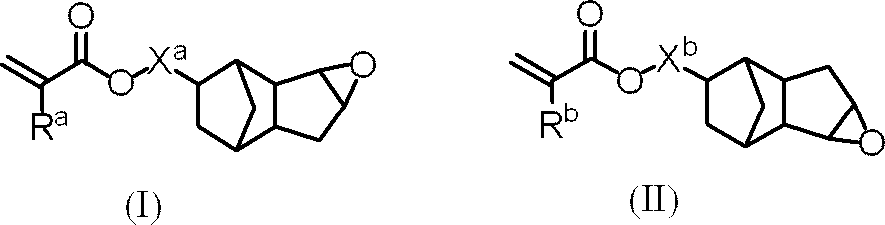
Xa及びXbは、単結合、*-Rc-、*-Rc-O-、*-Rc-S-又は*-Rc-NH-を表す。
Rcは、炭素数1~6のアルカンジイル基を表す。
*は、Oとの結合手を表す。]
水素原子がヒドロキシで置換されたアルキル基としては、ヒドロキシメチル基、1-ヒドロキシエチル基、2-ヒドロキシエチル基、1-ヒドロキシプロピル基、2-ヒドロキシプロピル基、3-ヒドロキシプロピル基、1-ヒドロキシ-1-メチルエチル基、2-ヒドロキシ-1-メチルエチル基、1-ヒドロキシブチル基、2-ヒドロキシブチル基、3-ヒドロキシブチル基、4-ヒドロキシブチル基等が挙げられる。
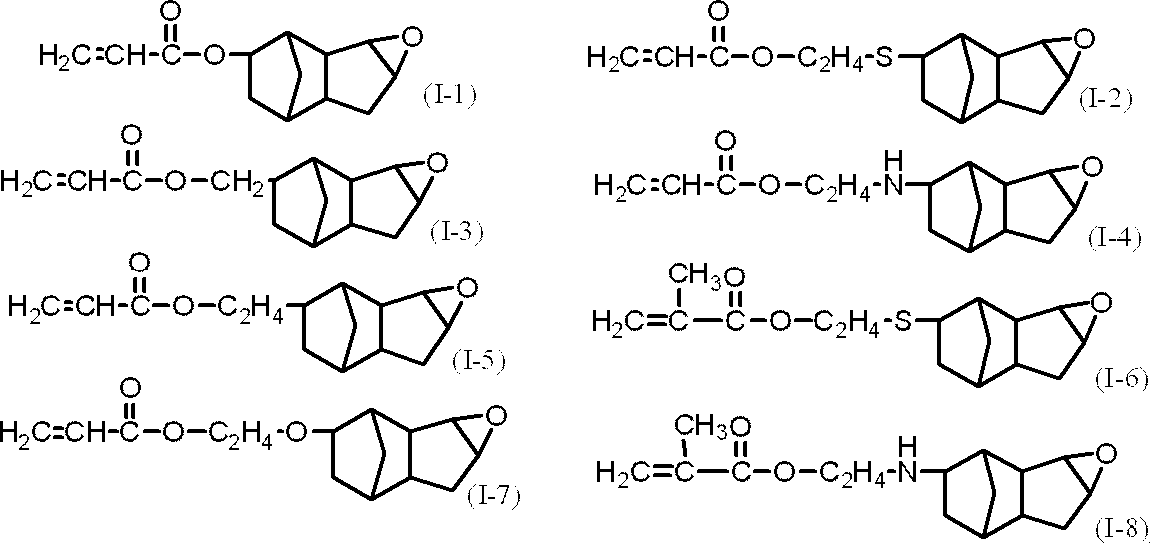
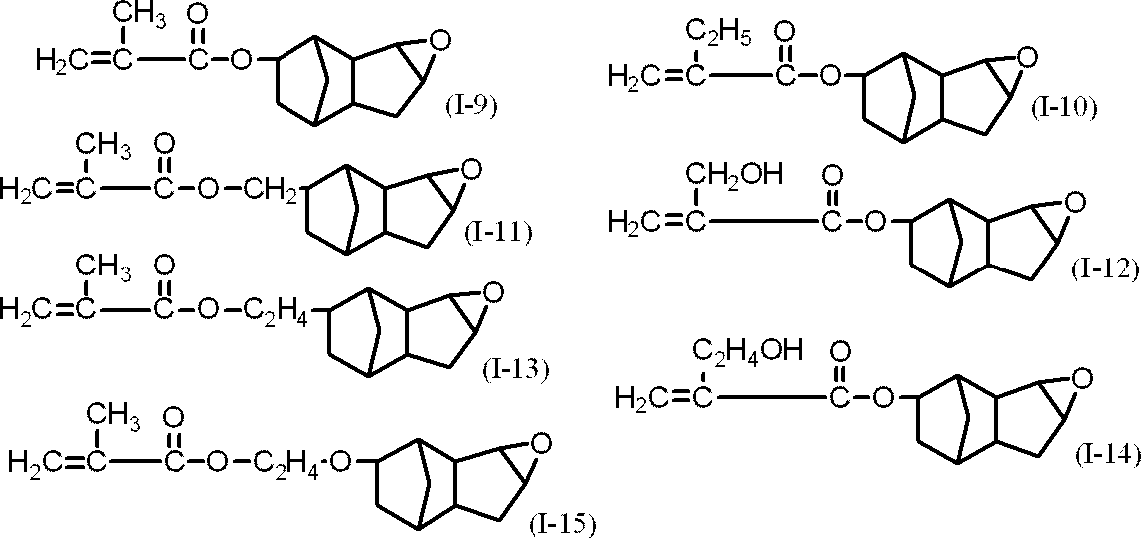
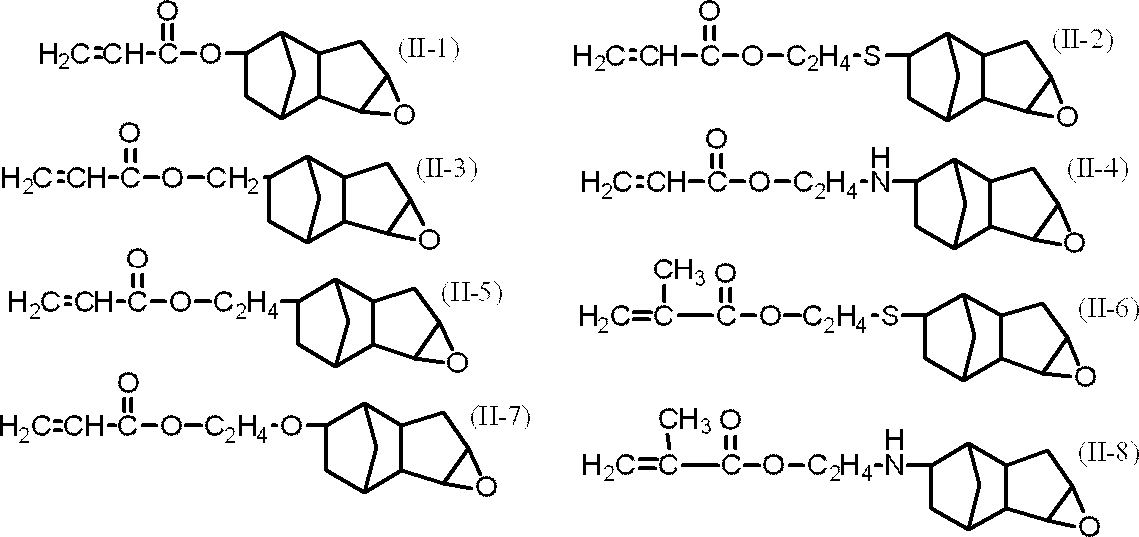

2-ヒドロキシエチル(メタ)アクリレート及び2-ヒドロキシプロピル(メタ)アクリレート等のヒドロキシ基含有(メタ)アクリル酸エステル;
マレイン酸ジエチル、フマル酸ジエチル及びイタコン酸ジエチル等のジカルボン酸ジエステル;
ビシクロ[2.2.1]ヘプト-2-エン、5-メチルビシクロ[2.2.1]ヘプト-2-エン、5-エチルビシクロ[2.2.1]ヘプト-2-エン、5-ヒドロキシビシクロ[2.2.1]ヘプト-2-エン、5-ヒドロキシメチルビシクロ[2.2.1]ヘプト-2-エン、5-(2’-ヒドロキシエチル)ビシクロ[2.2.1]ヘプト-2-エン、5-メトキシビシクロ[2.2.1]ヘプト-2-エン、5-エトキシビシクロ[2.2.1]ヘプト-2-エン、5,6-ジヒドロキシビシクロ[2.2.1]ヘプト-2-エン、5,6-ジ(ヒドロキシメチル)ビシクロ[2.2.1]ヘプト-2-エン、5,6-ジ(2’-ヒドロキシエチル)ビシクロ[2.2.1]ヘプト-2-エン、5,6-ジメトキシビシクロ[2.2.1]ヘプト-2-エン、5,6-ジエトキシビシクロ[2.2.1]ヘプト-2-エン、5-ヒドロキシ-5-メチルビシクロ[2.2.1]ヘプト-2-エン、5-ヒドロキシ-5-エチルビシクロ[2.2.1]ヘプト-2-エン、5-ヒドロキシメチル-5-メチルビシクロ[2.2.1]ヘプト-2-エン、5-tert-ブトキシカルボニルビシクロ[2.2.1]ヘプト-2-エン、5-シクロヘキシルオキシカルボニルビシクロ[2.2.1]ヘプト-2-エン、5-フェノキシカルボニルビシクロ[2.2.1]ヘプト-2-エン、5,6-ビス(tert-ブトキシカルボニル)ビシクロ[2.2.1]ヘプト-2-エン及び5,6-ビス(シクロヘキシルオキシカルボニル)ビシクロ[2.2.1]ヘプト-2-エン等のビシクロ不飽和化合物;
N-フェニルマレイミド、N-シクロヘキシルマレイミド、N-ベンジルマレイミド、N-スクシンイミジル-3-マレイミドベンゾエート、N-スクシンイミジル-4-マレイミドブチレート、N-スクシンイミジル-6-マレイミドカプロエート、N-スクシンイミジル-3-マレイミドプロピオネート及びN-(9-アクリジニル)マレイミド等のジカルボニルイミド誘導体;
スチレン、o-メチルスチレン、m-メチルスチレン、p-メチルスチレン、ビニルトルエン及びp-メトキシスチレン等のビニル基含有芳香族化合物;(メタ)アクリロニトリル等のビニル基含有ニトリル;塩化ビニル及び塩化ビニリデン等のハロゲン化炭化水素;(メタ)アクリルアミド等のビニル基含有アミド;酢酸ビニル等のエステル;1,3-ブタジエン、イソプレン及び2,3-ジメチル-1,3-ブタジエン等のジエン;等が挙げられる。
(a)に由来する構造単位;2~60モル%
(b)に由来する構造単位;40~98モル%
であることが好ましく、
(a)に由来する構造単位;10~50モル%
(b)に由来する構造単位;50~90モル%
であることがより好ましい。
樹脂[K1]の構造単位の比率が、上記の範囲にあると、着色硬化性樹脂組成物の保存安定性、着色パターンを形成する際の現像性、及び得られるカラーフィルタの耐溶剤性に優れる傾向がある。
(a)に由来する構造単位;2~45モル%
(b)に由来する構造単位;2~95モル%
(c)に由来する構造単位;1~65モル%
であることが好ましく、
(a)に由来する構造単位;5~40モル%
(b)に由来する構造単位;5~80モル%
(c)に由来する構造単位;5~60モル%
であることがより好ましい。
樹脂[K2]の構造単位の比率が、上記の範囲にあると、着色硬化性樹脂組成物の保存安定性、着色パターンを形成する際の現像性、並びに、得られるカラーフィルタの耐溶剤性、耐熱性及び機械強度に優れる傾向がある。
樹脂[K2]は、例えば、樹脂[K1]の製造方法として記載した方法と同様に製造することができる。
(a)に由来する構造単位;2~60モル%
(c)に由来する構造単位;40~98モル%
であることが好ましく、
(a)に由来する構造単位;10~50モル%
(c)に由来する構造単位;50~90モル%
であることがより好ましい。
樹脂[K3]は、例えば、樹脂[K1]の製造方法として記載した方法と同様に製造することができる。
まず(a)と(c)との共重合体を、樹脂[K1]の製造方法として記載した方法と同様に製造する。この場合、それぞれに由来する構造単位の比率は、樹脂[K3]で挙げたもの同じ比率であることが好ましい。
(a)と(c)との共重合体の製造に引き続き、フラスコ内雰囲気を窒素から空気に置換し、(b)、カルボン酸又はカルボン酸無水物と環状エーテルとの反応触媒(例えばトリス(ジメチルアミノメチル)フェノール等)及び重合禁止剤(例えばハイドロキノン等)等をフラスコ内に入れて、例えば、60~130℃で、1~10時間反応することにより、樹脂[K4]を製造することができる。
仕込方法、反応温度及び時間等の反応条件は、製造設備や重合による発熱量等を考慮して適宜調整することができる。なお、重合条件と同様に、製造設備や重合による発熱量等を考慮し、仕込方法や反応温度を適宜調整することができる。
(b)及び(c)に由来する構造単位の比率は、前記の共重合体を構成する全構造単位の合計モル数に対して、それぞれ、
(b)に由来する構造単位;5~95モル%
(c)に由来する構造単位;5~95モル%
であることが好ましく、
(b)に由来する構造単位;10~90モル%
(c)に由来する構造単位;10~90モル%
であることがより好ましい。
前記の共重合体に反応させる(a)の使用量は、(b)100モルに対して、5~100モルが好ましい。環状エーテルの反応性が高く、未反応の(b)が残存しにくいことから、樹脂[K5]に用いる(b)としては(b1)が好ましく、さらに(b1-1)が好ましい。
多価カルボン酸としては、シュウ酸、マロン酸、コハク酸、マレイン酸、フマル酸、グルタル酸、トリカルバニル酸等が挙げられる。カルボン酸無水物としては、無水コハク酸、無水マレイン酸、シトラコン酸無水物、イタコン酸無水物、3-ビニルフタル酸無水物、4-ビニルフタル酸無水物、3,4,5,6-テトラヒドロフタル酸無水物、1,2,3,6-テトラヒドロフタル酸無水物、ジメチルテトラヒドロフタル酸無水物、5,6-ジカルボキシビシクロ[2.2.1]ヘプト-2-エン無水物等が挙げられる。多価カルボン酸及び/又はカルボン酸無水物の使用量は、(a)の使用量1モルに対して、0.05~1モルが好ましく、0.1~0.5モルがより好ましい。
グリシジル(メタ)アクリレート/ベンジル(メタ)アクリレート/(メタ)アクリル酸共重合体、グリシジル(メタ)アクリレート/スチレン/(メタ)アクリル酸共重合体、3,4-エポキシトリシクロ[5.2.1.02,6]デシルアクリレート/(メタ)アクリル酸/N-シクロヘキシルマレイミド共重合体、3,4-エポキシトリシクロ[5.2.1.02,6]デシルアクリレート/(メタ)アクリル酸/フェノキシベンジル(メタ)アクリレート共重合体、3-メチル-3-(メタ)アクリルロイルオキシメチルオキセタン/(メタ)アクリル酸/スチレン共重合体等の樹脂[K2];
ベンジル(メタ)アクリレート/(メタ)アクリル酸共重合体、スチレン/(メタ)アクリル酸共重合体等の樹脂[K3];
ベンジル(メタ)アクリレート/(メタ)アクリル酸共重合体にグリシジル(メタ)アクリレートを付加させた樹脂、トリシクロデシル(メタ)アクリレート/スチレン/(メタ)アクリル酸共重合体にグリシジル(メタ)アクリレートを付加させた樹脂、トリシクロデシル(メタ)アクリレート/ベンジル(メタ)アクリレート/(メタ)アクリル酸共重合体にグリシジル(メタ)アクリレートを付加させた樹脂等の樹脂[K4];
トリシクロデシル(メタ)アクリレート/グリシジル(メタ)アクリレートの共重合体に(メタ)アクリル酸を反応させた樹脂、トリシクロデシル(メタ)アクリレート/スチレン/グリシジル(メタ)アクリレートの共重合体に(メタ)アクリル酸を反応させた樹脂等の樹脂[K5];
トリシクロデシル(メタ)アクリレート/グリシジル(メタ)アクリレートの共重合体に(メタ)アクリル酸を反応させた樹脂にさらにテトラヒドロフタル酸無水物を反応させた樹脂、2-エチルヘキシル(メタ)アクリレート/ジシクロペンタニル(メタ)アクリレート/グリシジル(メタ)アクリレートの共重合体に(メタ)アクリル酸を反応させた樹脂にさらに無水コハク酸を反応させた樹脂、2-エチルヘキシル(メタ)アクリレート/トリシクロデシル(メタ)アクリレート/グリシジル(メタ)アクリレートの共重合体に(メタ)アクリル酸を反応させた樹脂にさらに無水コハク酸を反応させた樹脂等の樹脂[K6]等が挙げられる。
樹脂(B)は、樹脂[K2]及び樹脂[K6]であることがより好ましく、樹脂[K6]であることが特に好ましい。
樹脂(B)の分散度[重量平均分子量(Mw)/数平均分子量(Mn)]は、好ましくは1.1~6であり、より好ましくは1.2~4である。
重合性化合物(C)は、重合開始剤(D)から発生した活性ラジカル及び/又は酸によって重合しうる化合物であり、例えば、重合性のエチレン性不飽和結合を有する化合物等が挙げられ、好ましくは(メタ)アクリル酸エステル化合物又はその変性物(例えばアルキレンオキシ変性物)である。
重合性化合物(C)は、水酸基価10mgKOH/g超100mgKOH/g以下、アルキレンオキシ単位10以上の重合性化合物(C1)を含む。重合性化合物(C1)は、1種であってもよく2種以上を組み合わせて使用してもよい。

中でも、式(1)で表される化合物は、6つのYが(メタ)アクリロイル基である化合物及び5つのYが(メタ)アクリロイル基であり1つのYが水素原子である化合物の混合物であることが好ましい。
Zは、好ましくは炭素数2~8のアルキレン基、より好ましくは炭素数2~6のアルキレン基、さらに好ましくは炭素数2~4のアルキレン基である。
a~fはそれぞれ、好ましくは1~5の整数、より好ましくは1~4の整数、さらに好ましくは1~3の整数、さらに好ましくは2又は3の整数、さらにより好ましくは2である。
式(I)に含まれるアルキレンオキシ単位は、全て同じアルキレンオキシ単位であってもよいが、異なるアルキレンオキシ単位を含んでいてもよく、全て同じアルキレンオキシ単位であることが好ましい。
重合性化合物(C2)は、好ましくは水酸基価1mgKOH/g以上450mgKOH/g以下、より好ましくは5mgKOH/g以上400mgKOH/g以下、さらに好ましくは10mgKOH/g以上350mgKOH/g以下、さらにより好ましくは20mgKOH/g以上300mgKOH/g以下を有する。
重合性化合物(C2)は、アルキレンオキシ単位が1以下であることが好ましく、アルキレンオキシ単位が0であることがより好ましい。
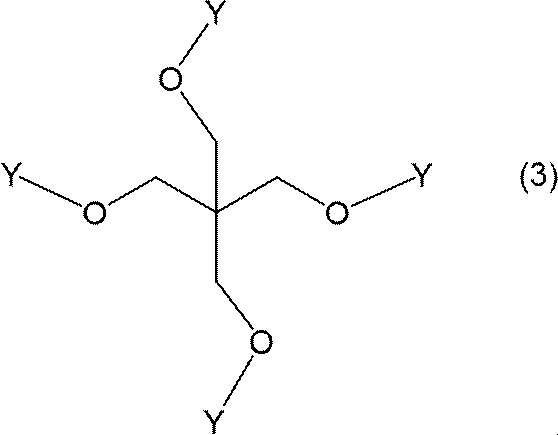

中でも、式(3)で表される化合物は、4つのYが(メタ)アクリロイル基である化合物、3つのYが(メタ)アクリロイル基であり1つのYが水素原子である化合物、2つのYが(メタ)アクリロイル基であり2つのYが水素原子である化合物、及び1つのYが(メタ)アクリロイル基であり3つのYが水素原子である化合物の混合物であることが好ましい。
中でも、式(4)で表される化合物は、6つのYが(メタ)アクリロイル基である化合物及び5つのYが(メタ)アクリロイル基であり1つのYが水素原子である化合物の混合物であることが好ましい。
エチレン性不飽和結合を1つ有する重合性化合物としては、例えば、ノニルフェニルカルビトールアクリレート、2-ヒドロキシ-3-フェノキシプロピルアクリレート、2-エチルヘキシルカルビトールアクリレート、2-ヒドロキシエチルアクリレート、N-ビニルピロリドン等が挙げられる。
重合開始剤(D)は、光や熱の作用により活性ラジカル、酸等を発生し、重合を開始しうる化合物であればよい。


感度の点で、アルキルフェノン化合物としては、式(d-2)で表される部分構造を有する化合物が好ましい。
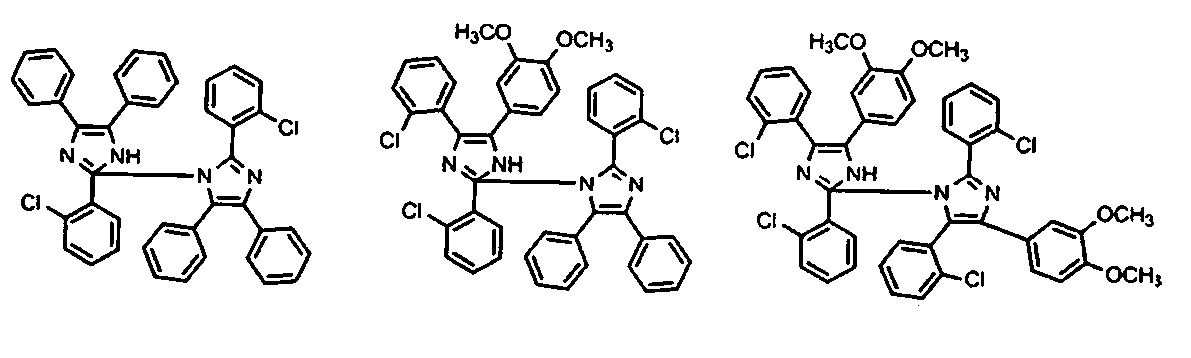
重合開始助剤(D1)は、重合開始剤(D)によって重合が開始された重合性化合物(C)の重合を促進するために用いられる化合物、もしくは増感剤である。重合開始助剤(D1)を含む場合、通常、重合開始剤(D)と組み合わせて用いられる。
溶剤(E)は、特に限定されず、当該分野で通常使用される溶剤を用いることができる。
溶剤(E)は、例えば、エステル溶剤(分子内に-COO-を含み、-O-を含まない溶剤)、エーテル溶剤(分子内に-O-を含み、-COO-を含まない溶剤)、エーテルエステル溶剤(分子内に-COO-と-O-とを含む溶剤)、ケトン溶剤(分子内に-CO-を含み、-COO-を含まない溶剤)、アルコール溶剤(分子内にOHを含み、-O-、-CO-及び-COO-を含まない溶剤)、芳香族炭化水素溶剤、アミド溶剤、ジメチルスルホキシド等が挙げられる。これらの溶剤は、2種以上を併用してもよい。
本発明の着色硬化性樹脂組成物は、チオール化合物(T)を含んでいてもよい。チオール化合物(T)は、分子内にスルファニル基(-SH)を有する化合物である。
レベリング剤(F)としては、シリコーン系界面活性剤、フッ素系界面活性剤及びフッ素原子を有するシリコーン系界面活性剤等が挙げられる。これらは、側鎖に重合性基を有していてもよい。
着色硬化性樹脂組成物は、必要に応じて、充填剤、他の高分子化合物、密着促進剤、クエンチャー、酸化防止剤、光安定剤、連鎖移動剤等、当該技術分野で公知の添加剤を含んでもよい。
密着促進剤としては、ビニルトリメトキシシラン、ビニルトリエトキシシラン、ビニルトリス(2-メトキシエトキシ)シラン、3-グリシジルオキシプロピルトリメトキシシラン、3-グリシジルオキシプロピルメチルジメトキシシラン、3-グリシジルオキシプロピルメチルジエトキシシラン、2-(3,4-エポキシシクロヘキシル)エチルトリメトキシシラン、3-クロロプロピルメチルジメトキシシラン、3-クロロプロピルトリメトキシシラン、3-メタクリロイルオキシプロピルトリメトキシシラン、3-スルファニルプロピルトリメトキシシラン、3-イソシアナトプロピルトリエトキシシラン、N-2-(アミノエチル)-3-アミノプロピルメチルジメトキシシラン、N-2-(アミノエチル)-3-アミノプロピルメチルジエトキシシラン、N-2-(アミノエチル)-3-アミノプロピルトリメトキシシラン、3-アミノプロピルトリメトキシシラン、3-アミノプロピルトリエトキシシラン、N-フェニル-3-アミノプロピルトリメトキシシラン及びN-フェニル-3-アミノプロピルトリエトキシシラン等が挙げられる。
着色硬化性樹脂組成物は、着色剤(A)、樹脂(B)、重合性化合物(C)、重合開始剤(D)、並びに必要に応じて用いられる重合開始助剤(D1)、溶剤(E)、レベリング剤(F)及びその他の成分を混合することにより調製できる。混合は公知又は慣用の装置や条件により行うことができる。
着色剤(A)は、予め溶剤(E)の一部又は全部と混合し、平均粒子径が0.2μm以下程度となるまで、ビーズミル等を用いて分散させて得られた着色剤含有液として用いてもよく、着色剤含有液として用いることが好ましい。この際、必要に応じて前記分散剤、樹脂(B)の一部又は全部を配合してもよい。このようにして得られた着色剤含有液に、残りの成分を、所定の濃度となるように混合することにより、目的の着色硬化性樹脂組成物を調製できる。
また着色剤(A)として染料を含む場合の該染料は、予め溶剤(E)の一部又は全部に溶解させて溶液を調製してもよい。該溶液を、孔径0.01~1μm程度のフィルタでろ過することが好ましい。
本発明の着色硬化性樹脂組成物からカラーフィルタを形成することができる。着色パターンを製造する方法としては、フォトリソグラフ法、インクジェット法、印刷法等が挙げられる。中でも、フォトリソグラフ法が好ましい。フォトリソグラフ法は、前記着色硬化性樹脂組成物を基板に塗布し、乾燥させて着色組成物層を形成し、フォトマスクを介して該着色組成物層を露光して、現像する方法である。フォトリソグラフ法において、露光の際にフォトマスクを用いないこと、及び/又は現像しないことにより、前記着色組成物層の硬化物である着色塗膜を形成することができる。このように形成した着色パターンや着色塗膜が本発明のカラーフィルタである。
まず、着色硬化性樹脂組成物を基板上に塗布し、加熱乾燥(プリベーク)及び/又は減圧乾燥することにより溶剤等の揮発成分を除去して乾燥させ、平滑な着色組成物層を得る。塗布方法としては、スピンコート法、スリットコート法、スリット アンド スピンコート法等が挙げられる。加熱乾燥を行う場合の温度は、30℃以上120℃以下が好ましく、50℃以上110℃以下がより好ましい。また加熱時間としては、10秒間以上60分間以下であることが好ましく、30秒間以上30分間以下であることがより好ましい。
減圧乾燥を行う場合は、50Pa以上150Pa以下の圧力下、20℃以上25℃以下の温度範囲で行うことが好ましい。着色組成物層の膜厚は、特に限定されず、目的とするカラーフィルタの膜厚に応じて適宜選択すればよい。
現像後の基板は、水洗されることが好ましい。
このようにして得られた着色パターン及び着色塗膜は、カラーフィルタとして有用である。
前記カラーフィルタは、表示装置(例えば、液晶表示装置、有機EL装置、電子ペーパー等)、及び固体撮像素子等に用いられるカラーフィルタとして有用である。
C.I.ピグメントレッド254 12.0部
アクリル系顔料分散剤 2.4部
樹脂(B-1)(固形分換算) 3.0部
プロピレングリコールモノメチルエーテル 5.0部
プロピレングリコールモノメチルエーテルアセテート 77.6部
を混合して顔料分散液(A-1)を得た。
C.I.ピグメントイエロー139 12.0部
アクリル系顔料分散剤 4.2部
樹脂(B-1)(固形分換算) 3.0部
プロピレングリコールモノメチルエーテル 1.6部
プロピレングリコールモノメチルエーテルアセテート 79.2部
を混合して顔料分散液(A-2)を得た。
C.I.ピグメントイエロー185 8.0部
アクリル系顔料分散剤 2.4部
樹脂(B-2)(固形分換算) 4.4部
プロピレングリコールモノメチルエーテル 3.4部
プロピレングリコールモノメチルエーテルアセテート 81.8部
を混合して顔料分散液(A-3)を得た。
C.I.ピグメントレッド269 12.0部
アクリル系顔料分散剤 2.4部
樹脂(B-3)(固形分換算) 3.0部
プロピレングリコールモノメチルエーテル 5.0部
プロピレングリコールモノメチルエーテルアセテート 77.6部
を混合して顔料分散液(A-4)を得た。
C.I.ピグメントレッド272 12.0部
アクリル系顔料分散剤 2.4部
樹脂(B-3)(固形分換算) 3.0部
プロピレングリコールモノメチルエーテル 5.0部
プロピレングリコールモノメチルエーテルアセテート 77.6部
を混合して顔料分散液(A-5)を得た。
C.I.ピグメントレッド291 12.0部
アクリル系顔料分散剤 2.4部
樹脂(B-3)(固形分換算) 3.0部
プロピレングリコールモノメチルエーテル 5.0部
プロピレングリコールモノメチルエーテルアセテート 77.6部
を混合して顔料分散液(A-6)を得た。
C.I.ピグメントグリーン36 12.0部
アクリル系顔料分散剤 2.4部
樹脂(B-3)(固形分換算) 3.0部
プロピレングリコールモノメチルエーテル 5.0部
プロピレングリコールモノメチルエーテルアセテート 77.6部
を混合して顔料分散液(A-7)を得た。
C.I.ピグメントイエロー138 12.0部
アクリル系顔料分散剤 2.4部
樹脂(B-3)(固形分換算) 3.0部
プロピレングリコールモノメチルエーテル 5.0部
プロピレングリコールモノメチルエーテルアセテート 77.6部
を混合して顔料分散液(A-8)を得た。
還流冷却器、滴下フロート及び撹拌機を備えた1Lのフラスコ内に窒素を適量流し窒素雰囲気に置換し、プロピレングリコールモノメチルエーテルアセテート256部を入れ、攪拌しながら80℃まで加熱した。次いで、3,4-エポキシトリシクロ[5.2.1.02,6]デカン-8又は/及び9-イルアクリレートの混合物44部、アクリル酸57部、3-フェノキシベンジルアクリレート249部、プロピレングリコールモノメチルエーテルアセテート159部の混合溶液を3時間かけて滴下した。
攪拌装置、滴下ロート、コンデンサー、温度計及びガス導入菅を備えたフラスコにプロピレングリコールモノメチルエーテルアセテート241部を加え、窒素置換しながら攪拌し、130℃に昇温した。次いで、2-エチルヘキシルアクリレート73部、グリシジルメタクリレート145部、およびジシクロペンタニルメタクリレート10部からなるモノマー混合物に、34部のt-ブチルパーオキシ-2-エチルヘキサノエートを添加したものを、滴下ロートから2時間にわたって前記フラスコ中に滴下した。滴下終了後、さらに30分攪拌して共重合反応を行った。その後、フラスコ内を空気に置換し、アクリル酸を74部、トリフェニルホスフィン1部およびメトキノン1部を投入し、120℃で10時間にわたり反応を続け、次いで、反応系に無水コハク酸65部を加え、さらに1.5時間にわたり反応を続け、ポリマーを得た。最後に、反応溶液に、プロピレングリコールモノメチルエーテル300部を加えた後、ポリマー固形分40%になるようにプロピレングリコールモノメチルエーテルアセテートを加え、ポリマー溶液を得た。生成した共重合体のB型粘度計(23℃)で測定した粘度は26mPa・s、固形分38.5%、重量平均分子量Mwは6600、固形分換算の酸価は92.5mgKOH/gであった。
攪拌装置、滴下ロート、コンデンサー、温度計及びガス導入管を備えたフラスコに、プロピレングリコールモノメチルエーテルアセテート241部を加え、窒素置換しながら攪拌し、130℃に昇温した。
次いで、2-エチルヘキシルアクリレート72.6部、グリシジルメタクリレート145.3部、およびジシクロペンタニルメタクリレート9.7部からなるモノマー混合物に、33.5部のt-ブチルパーオキシ-2-エチルヘキサノエートを添加したものを、滴下ロートから2時間にわたって前記フラスコ中に滴下した。滴下終了後、さらに30分攪拌して共重合反応を行った。
その後、フラスコ内を空気に置換し、アクリル酸73.7部、トリフェニルホスフィン0.9部およびメトキノン0.9部を投入し、120℃で10時間にわたり反応を続け、次いで、反応系に無水コハク酸65.2部を加え、さらに1.5時間にわたり反応を続け、ポリマーを得た。最後に、反応溶液に、プロピレングリコールモノメチルエーテル300部を加えた後、ポリマー固形分濃度40%になるようプロピレングリコールモノメチルエーテルアセテートを加え、ポリマー溶液を得た。生成した共重合体の重量平均分子量Mwは6100、固形分換算の酸価は96.6mgKOH/gであった。
還流冷却器、滴下ロート及び攪拌機を備えた1Lのフラスコ内に窒素を適量流し窒素雰囲気に置換し、プロピレングリコールモノメチルエーテルアセテート256部を入れ、攪拌しながら80℃まで加熱した。次いで、3,4-エポキシトリシクロ[5.2.1.02,6]デカン-8-イルアクリレート及び3,4-エポキシトリシクロ[5.2.1.02,6]デカン-9-イルアクリレートの混合物44部、アクリル酸57部、3-フェノキシベンジルアクリレート249部、プロピレングリコールモノメチルエーテルアセテート159部の混合溶液を3時間かけて滴下した。
一方、2,2-アゾビス(2,4-ジメチルバレロニトリル)25部をプロピレングリコールモノメチルエーテルアセテート210部に溶解した混合溶液を5時間かけて滴下した。滴下終了後、4時間同温度で保持した後、室温まで冷却して、B型粘度(23℃)51mPa・s、固形分36.0%の共重合体(樹脂(B-4))を得た。生成した共重合体の重量平均分子量Mwは11000、分散度1.98であった。
<実施例1~8及び比較例1~2>
各成分を表1に記載の配合比で混合して着色硬化性樹脂組成物を得た。
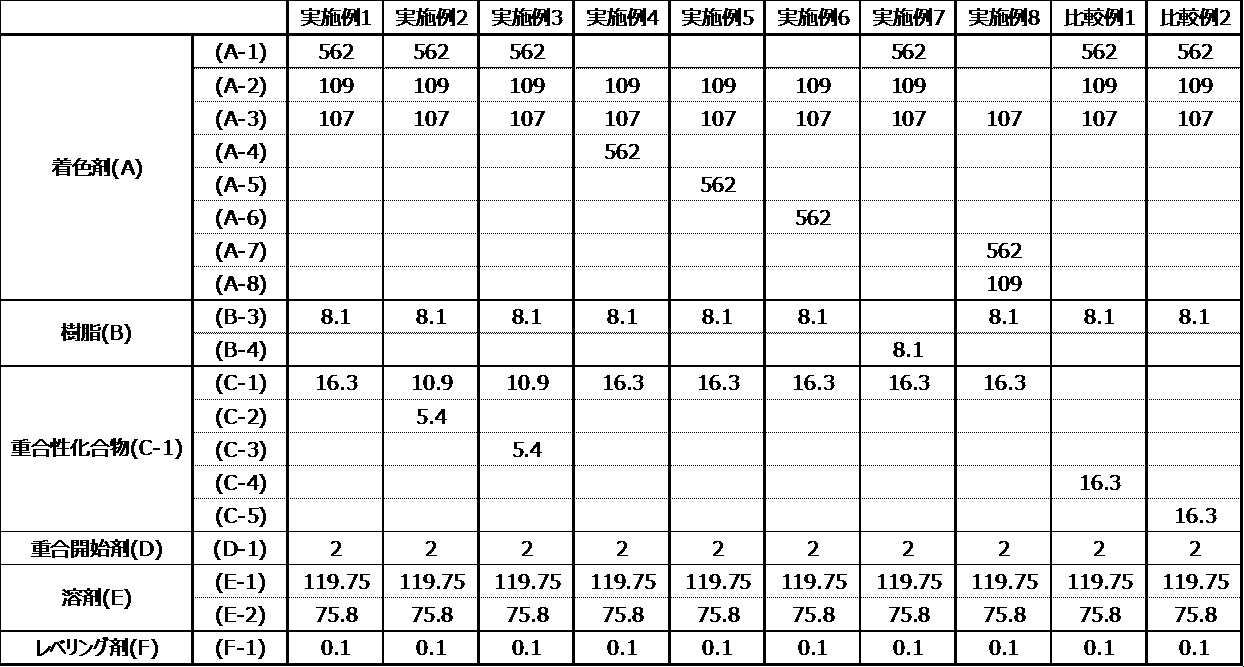
着色剤(A-1):前記顔料分散液(A-1)
着色剤(A-2):前記顔料分散液(A-2)
着色剤(A-3):前記顔料分散液(A-3)
着色剤(A-4):前記顔料分散液(A-4)
着色剤(A-5):前記顔料分散液(A-5)
着色剤(A-6):前記顔料分散液(A-6)
着色剤(A-7):前記顔料分散液(A-7)
着色剤(A-8):前記顔料分散液(A-8)
<樹脂(B)>
樹脂(B-3):前記樹脂(B-3)(固形分換算)
樹脂(B-4);前記樹脂(B-4)(固形分換算)
<重合性化合物(C)>
重合性化合物(C-1):式(1)で表される化合物(5つ又は6つのYがアクリロイル基、Z=-CH2-CH2-、a+b+c+d+e+f=12(a~fはそれぞれ2)、水酸基価=30mgKOH/g、エチレンオキシ基変性ジペンタエリスリトールヘキサアクリレート70モル%とエチレンオキシ基変性ジペンタエリスリトールペンタアクリレート30モル%の混合物)
重合性化合物(C-2):式(4)で表される化合物(5つ又は6つのYがアクリロイル基、水酸基価=120mgKOH/g、ジペンタエリスリトールペンタアクリレート70モル%とジペンタエリスリトールヘキサアクリレート30モル%の混合物)
重合性化合物(C-3):式(3)で表される化合物(1つ、2つ、3つ又は4つのYがアクリロイル基、水酸基価=280mgKOH/g、ペンタエリスリトールモノアクリレート5モル%、ペンタエリスリトールジアクリレート30モル%、ペンタエリスリトールトリアクリレート50モル%、ペンタエリスリトールテトラアクリレート15モル%の混合物)
重合性化合物(C-4):ジペンタエリスリトールペンタアクリレートとジペンタエリスリトールヘキサアクリレートの混合物(水酸基価=10mgKOH/g、アルキレンオキシ基=0)
重合性化合物(C-5):エチレンオキシ基変性ジペンタエリスリトールペンタアクリレートとエチレンオキシ基変性ジペンタエリスリトールヘキサアクリレートの混合物(水酸基価=4mgKOH/g、アルキレンオキシ基(エチレンオキシ基)=12)
<重合開始剤(D)>
重合開始剤(D-1):N-アセチルオキシ-1-(4-フェニルスルファニルフェニル)-3-シクロヘキシルプロパン-1-オン-2-イミン(常州強力電子新材料(株)製「PBG-327(O-アシルオキシム化合物)」)
<溶剤(E)>
溶剤(E-1):プロピレングリコールモノメチルエーテルアセテート
溶剤(E-2):プロピレングリコールモノメチルエーテル
<レベリング剤>
レベリング剤(F-1):ポリエーテル変性シリコーンオイル(東レ・ダウコーニング(株)製「トーレシリコーンSH8400」)
4インチのシリコン基板の表面に、着色硬化性樹脂組成物をスピンコート法で塗布した後、100℃で2分間プリベークして着色組成物層を得た。冷却後、着色組成物層を形成した基板を露光機(NSR-2205i11D;ニコン(株)製)を用いて、500J/m2~3000J/m2の露光量(365nm基準)で光照射した。光照射の際に、0.8μm、1.0μm、及び2.0μm四方のドットパターンを形成するためのフォトマスク(ピッチは、それぞれ、1.6μm、2.0μm、4.0μm)を使用した。光照射後の着色組成物層を、テトラメチルアンモニウムヒドロキシドを0.3%含む水系現像液に23℃で30秒間浸漬現像し、水洗後、220℃のホットプレートで5分間ポストベークを行い、ポストベーク後の着色パターンを得た。
上記で得られた着色パターンを有するシリコン基板について、電子顕微鏡(S-4100;(株)日立ハイテク社製)を用いて、倍率25000倍で形成された着色パターンおよび未露光部5μm四方を観察して、下記の判定基準で評価を行った。
<残渣判定基準>
◎:残渣5%以下
〇:残渣6~10%
△:残渣11~20%
×:残渣21%以上
線幅1.0μmの着色パターンにおいて、顕微鏡により各露光量での着色パターンについて、基板から剥がれたものも含めて100個のドットを観察し、基板から剥がれずに残存しているドットの個数を数え、95個以上ドットが残存する露光量での着色パターンの線幅を測定し、下記の評価基準にしたがって、ポストベーク後の着色パターンの基板密着性を評価した。
<密着性評価基準>
◎:0.8μm以下
〇:0.81~0.85μm
△:0.86~9.0μm
×:9.1μm以上
低露光量で残存するドットが多いほど、密着性が良好であるといえる。

実施例1は、比較例1、及び比較例2と比べて、残渣が低減され、密着性が改善されたカラーフィルタを形成できることがわかった。また、実施例2~実施例8についても、従来の重合性化合物を用いた場合と比較して、残渣が低減され、密着性が改善されたカラーフィルタを形成できることがわかった。さらに、実施例1~8はいずれも、残渣低減及び密着性改善が同程度であることを示すことから、水酸基価10mgKOH/g超100mgKOH/g以下、アルキレンオキシ単位10以上の重合性化合物は、様々な着色剤に適用できることが分かる。
Claims (7)
- 着色剤(A)、樹脂(B)、重合性化合物(C)、及び重合開始剤(D)を含み、
前記重合性化合物(C)が、水酸基価10mgKOH/g超100mgKOH/g以下、アルキレンオキシ単位10以上の重合性化合物(C1)を含むことを特徴とする着色硬化性樹脂組成物。 - 前記重合性化合物(C1)が、式(1)で表される化合物を含む請求項1に記載の着色硬化性樹脂組成物。
(式中、Yは、水素原子又は(メタ)アクリロイル基を表し、少なくとも1つのYは、(メタ)アクリロイル基である。Zは、炭素数2~10のアルキレン基を表す。a~fは、独立して、アルキレンオキシの単位数を表し、a+b+c+d+e+fは、10以上である。)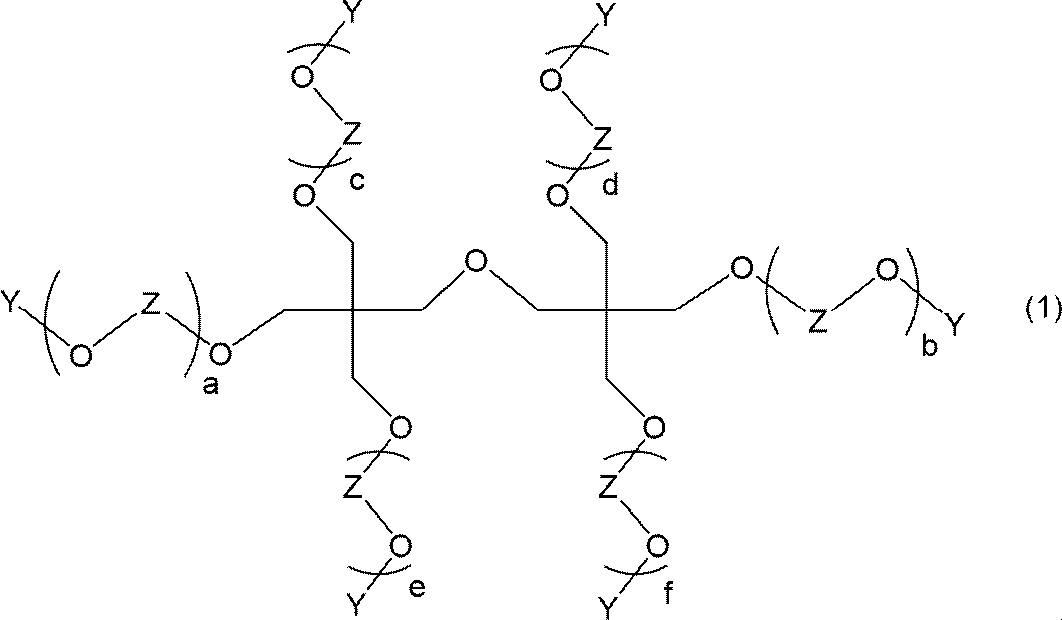
- 式(1)において、アルキレンオキシ単位が-CH2-CH2-O-又は-CH2-CH2-CH2-O-で表される請求項1に記載の着色硬化性樹脂組成物。
- 前記着色剤(A)がC.I.ピグメントレッド149、176、177、242、254、255、264、269、272、及び291から選択される赤色顔料である請求項1又は2に記載の着色硬化性樹脂組成物。
- 請求項1又は2に記載の着色硬化性樹脂組成物から形成されるカラーフィルタ。
- 請求項5に記載のカラーフィルタを含む表示装置。
- 請求項5に記載のカラーフィルタを含む固体撮像素子。
Priority Applications (2)
| Application Number | Priority Date | Filing Date | Title |
|---|---|---|---|
| KR1020257030282A KR20250150049A (ko) | 2023-02-16 | 2024-02-07 | 착색 경화성 수지 조성물, 컬러 필터, 표시 장치 및 고체 촬상 소자 |
| CN202480011023.4A CN120641827A (zh) | 2023-02-16 | 2024-02-07 | 着色固化性树脂组合物、滤色器、显示装置及固体摄像器件 |
Applications Claiming Priority (2)
| Application Number | Priority Date | Filing Date | Title |
|---|---|---|---|
| JP2023022829 | 2023-02-16 | ||
| JP2023-022829 | 2023-02-16 |
Publications (1)
| Publication Number | Publication Date |
|---|---|
| WO2024171920A1 true WO2024171920A1 (ja) | 2024-08-22 |
Family
ID=92421821
Family Applications (1)
| Application Number | Title | Priority Date | Filing Date |
|---|---|---|---|
| PCT/JP2024/004063 Ceased WO2024171920A1 (ja) | 2023-02-16 | 2024-02-07 | 着色硬化性樹脂組成物、カラーフィルタ、表示装置、及び固体撮像素子 |
Country Status (5)
| Country | Link |
|---|---|
| JP (1) | JP2024117073A (ja) |
| KR (1) | KR20250150049A (ja) |
| CN (1) | CN120641827A (ja) |
| TW (1) | TW202436371A (ja) |
| WO (1) | WO2024171920A1 (ja) |
Citations (2)
| Publication number | Priority date | Publication date | Assignee | Title |
|---|---|---|---|---|
| JP2010113244A (ja) * | 2008-11-07 | 2010-05-20 | Taiyo Ink Mfg Ltd | 光硬化性樹脂組成物、そのドライフィルム及び硬化物並びにそれらを用いたプリント配線板 |
| WO2014103761A1 (ja) * | 2012-12-26 | 2014-07-03 | 第一工業製薬株式会社 | カラーフィルター、ブラックマトリックス、又は回路形成用の硬化性樹脂組成物 |
Family Cites Families (2)
| Publication number | Priority date | Publication date | Assignee | Title |
|---|---|---|---|---|
| JP3911875B2 (ja) | 1998-10-22 | 2007-05-09 | 住友化学株式会社 | カラーフィルター用着色組成物及びカラーフィルター |
| JP5355069B2 (ja) | 2007-12-28 | 2013-11-27 | 富士フイルム株式会社 | 着色硬化性組成物、カラーフィルタ及びその製造方法、並びに固体撮像素子 |
-
2024
- 2024-02-06 JP JP2024016679A patent/JP2024117073A/ja active Pending
- 2024-02-07 KR KR1020257030282A patent/KR20250150049A/ko active Pending
- 2024-02-07 CN CN202480011023.4A patent/CN120641827A/zh active Pending
- 2024-02-07 WO PCT/JP2024/004063 patent/WO2024171920A1/ja not_active Ceased
- 2024-02-07 TW TW113105071A patent/TW202436371A/zh unknown
Patent Citations (2)
| Publication number | Priority date | Publication date | Assignee | Title |
|---|---|---|---|---|
| JP2010113244A (ja) * | 2008-11-07 | 2010-05-20 | Taiyo Ink Mfg Ltd | 光硬化性樹脂組成物、そのドライフィルム及び硬化物並びにそれらを用いたプリント配線板 |
| WO2014103761A1 (ja) * | 2012-12-26 | 2014-07-03 | 第一工業製薬株式会社 | カラーフィルター、ブラックマトリックス、又は回路形成用の硬化性樹脂組成物 |
Also Published As
| Publication number | Publication date |
|---|---|
| JP2024117073A (ja) | 2024-08-28 |
| KR20250150049A (ko) | 2025-10-17 |
| CN120641827A (zh) | 2025-09-12 |
| TW202436371A (zh) | 2024-09-16 |
Similar Documents
| Publication | Publication Date | Title |
|---|---|---|
| WO2021145283A1 (ja) | 着色硬化性組成物 | |
| JP7702243B2 (ja) | 着色樹脂組成物 | |
| CN111801604B (zh) | 着色固化性树脂组合物、滤色器和显示装置 | |
| JP7736441B2 (ja) | 赤色着色組成物 | |
| JP7812654B2 (ja) | 着色硬化性樹脂組成物 | |
| JP7684814B2 (ja) | 着色硬化性樹脂組成物 | |
| WO2023037790A1 (ja) | 着色硬化性樹脂組成物、カラーフィルタ、表示装置、及び固体撮像素子 | |
| CN109212899B (zh) | 着色固化性树脂组合物、滤色器及显示装置 | |
| JP7696786B2 (ja) | 着色硬化性樹脂組成物、カラーフィルタ、及び表示装置 | |
| JP7751380B2 (ja) | 着色樹脂組成物 | |
| WO2024171921A1 (ja) | 着色硬化性樹脂組成物、カラーフィルタ、表示装置、及び固体撮像素子 | |
| JP2024117073A (ja) | 着色硬化性樹脂組成物、カラーフィルタ、表示装置、及び固体撮像素子 | |
| JP7594962B2 (ja) | 赤色着色組成物 | |
| JP7696787B2 (ja) | 着色硬化性樹脂組成物、カラーフィルタ、及び表示装置 | |
| WO2024101219A1 (ja) | 着色硬化性樹脂組成物、カラーフィルタ、表示装置、及び固体撮像素子 | |
| JP7203625B2 (ja) | 着色硬化性樹脂組成物 | |
| JP2025156118A (ja) | 着色硬化性樹脂組成物、カラーフィルタ、それを含む表示装置、及び前記カラーフィルタの製造方法 | |
| JP2025146701A (ja) | 着色硬化性樹脂組成物、カラーフィルタ及び表示装置 | |
| JP2026017517A (ja) | 着色硬化性樹脂組成物、カラーフィルタ、及び表示装置 | |
| JP2025130364A (ja) | カラーフィルタ及び該カラーフィルタを含む表示装置 | |
| JP2025054198A (ja) | 着色硬化性樹脂組成物、カラーフィルタ、表示装置、及び固体撮像素子 | |
| JP2024088596A (ja) | 着色硬化性樹脂組成物、カラーフィルタ、表示装置、及び固体撮像素子 |
Legal Events
| Date | Code | Title | Description |
|---|---|---|---|
| 121 | Ep: the epo has been informed by wipo that ep was designated in this application |
Ref document number: 24756768 Country of ref document: EP Kind code of ref document: A1 |
|
| WWE | Wipo information: entry into national phase |
Ref document number: 202480011023.4 Country of ref document: CN |
|
| ENP | Entry into the national phase |
Ref document number: 1020257030282 Country of ref document: KR Free format text: ST27 STATUS EVENT CODE: A-0-1-A10-A15-NAP-PA0105 (AS PROVIDED BY THE NATIONAL OFFICE) |
|
| WWP | Wipo information: published in national office |
Ref document number: 202480011023.4 Country of ref document: CN |
|
| NENP | Non-entry into the national phase |
Ref country code: DE |
|
| WWP | Wipo information: published in national office |
Ref document number: 1020257030282 Country of ref document: KR |
|
| 122 | Ep: pct application non-entry in european phase |
Ref document number: 24756768 Country of ref document: EP Kind code of ref document: A1 |