WO2024166315A1 - Dispositif de changement d'hébergement, procédé de changement d'hébergement, et programme de changement d'hébergement - Google Patents
Dispositif de changement d'hébergement, procédé de changement d'hébergement, et programme de changement d'hébergement Download PDFInfo
- Publication number
- WO2024166315A1 WO2024166315A1 PCT/JP2023/004414 JP2023004414W WO2024166315A1 WO 2024166315 A1 WO2024166315 A1 WO 2024166315A1 JP 2023004414 W JP2023004414 W JP 2023004414W WO 2024166315 A1 WO2024166315 A1 WO 2024166315A1
- Authority
- WO
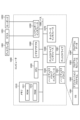
- WIPO (PCT)
- Prior art keywords
- accommodation
- change
- user
- route
- accommodation change
- Prior art date
- Legal status (The legal status is an assumption and is not a legal conclusion. Google has not performed a legal analysis and makes no representation as to the accuracy of the status listed.)
- Ceased
Links
Images



Classifications
-
- H—ELECTRICITY
- H04—ELECTRIC COMMUNICATION TECHNIQUE
- H04L—TRANSMISSION OF DIGITAL INFORMATION, e.g. TELEGRAPHIC COMMUNICATION
- H04L41/00—Arrangements for maintenance, administration or management of data switching networks, e.g. of packet switching networks
- H04L41/06—Management of faults, events, alarms or notifications
- H04L41/0654—Management of faults, events, alarms or notifications using network fault recovery
- H04L41/0659—Management of faults, events, alarms or notifications using network fault recovery by isolating or reconfiguring faulty entities
-
- H—ELECTRICITY
- H04—ELECTRIC COMMUNICATION TECHNIQUE
- H04L—TRANSMISSION OF DIGITAL INFORMATION, e.g. TELEGRAPHIC COMMUNICATION
- H04L45/00—Routing or path finding of packets in data switching networks
- H04L45/28—Routing or path finding of packets in data switching networks using route fault recovery
Definitions
- the present invention relates to a storage change device, a storage change method, and a storage change program.
- the service can be continued by changing the user's accommodation to another device.
- operations are carried out such that the user's accommodation is changed back to the original device when the failure is restored.
- operations are also carried out such that the user's accommodation is temporarily changed.
- BGP Border Gateway Protocol
- the location of the user is advertised to the entire core network.
- BGP Border Gateway Protocol
- the user's route information is aggregated and advertised on a device basis, etc. (see Non-Patent Document 1).
- the present invention was made in consideration of the above, and aims to make it easy to change the accommodation for each user.
- the accommodation change device is characterized by having an acquisition unit that acquires information about a user who is the subject of accommodation change, and a setting unit that sets, for each user, a route to the user via a tunnel from the accommodation change source device to the accommodation change destination device.
- the present invention makes it easy to change the accommodation for each user.
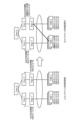
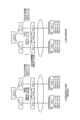
- FIG. 1 is a diagram for explaining an overview of the accommodation change device of the present embodiment.
- FIG. 2 is a diagram for explaining an overview of the accommodation change device of this embodiment.
- FIG. 3 is a diagram for explaining an overview of the accommodation change device of this embodiment.
- FIG. 4 is a diagram for explaining an overview of the accommodation change device of this embodiment.
- FIG. 5 is a diagram for explaining an overview of the accommodation change device of this embodiment.
- FIG. 6 is a schematic diagram illustrating a schematic configuration of the accommodation changing device of this embodiment.
- FIG. 7 is a diagram for explaining the processing of the accommodation change device.
- FIG. 8 is a diagram for explaining the processing of the accommodation change device.
- FIG. 9 is a flowchart showing the accommodation change processing procedure.
- FIG. 10 is a diagram for explaining the effect of the accommodation change process.
- FIG. 11 is a diagram for explaining the effect of the accommodation change process.
- FIG. 12 is a diagram illustrating an example of a computer that executes a storage change program.
- FIGS. 1 to 5 are diagrams for explaining an overview of the accommodation change device of the present embodiment.
- the accommodation of the user HGW, Home GateWay
- the accommodation of the user is changed to another device Edge-2, so that the service can be continued.
- the BGP advertisement information would change as the user's location changed.
- the advertisement information for "2002:0:1::0/48" that aggregated users accommodated in Edge-1, as shown in Figure 1(a) is changed to advertisement information for Edge-2, as shown in Figure 1(b).
- the relocation is performed one user at a time to minimize the service interruption time.
- users accommodated in Edge-1 are relocated to Edge-2 one user at a time.
- user "2002:0:1:1::0/56" accommodated in Edge-1 is relocated to Edge-2 as shown in FIG. 3(b).
- the route information for user "2002:0:1:1::0/56" is not aggregated but is added to the BGP advertisement information of Edge-2. In this way, the amount of route information circulating in the core network increases even during the process of relocation due to maintenance or the like.
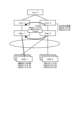
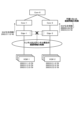
- the increase in route information circulating within the core network is suppressed by utilizing a tunnel from the relocation source device to the relocation destination device.
- a static route is set to the user via a tunnel from the relocation source Edge-2 to the relocation destination Edge-1.
- the example shown in FIG. 4 illustrates a case where user "2002:0:1:1::0/56" is relocated to Edge-1.
- upstream traffic A and downstream traffic B for the user "2002:0:1:1::0/56" that is the target of the accommodation change will take different routes.
- upstream traffic is sent from Edge-1, the destination of the accommodation change
- downstream traffic travels from Edge-2, the source of the accommodation change, via a tunnel to reach Edge-1, the destination of the accommodation change.
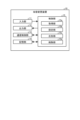
- FIG. 6 is a schematic diagram illustrating the schematic configuration of the accommodation change device of this embodiment.
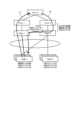
- Fig. 7 and Fig. 8 are diagrams for explaining the processing of the accommodation change device.
- the accommodation change device 10 of this embodiment is realized by a general-purpose computer such as a personal computer, and includes an input unit 11, an output unit 12, a communication control unit 13, a storage unit 14, and a control unit 15.
- the input unit 11 is realized using input devices such as a keyboard and a mouse, and inputs various instruction information such as starting processing to the control unit 15 in response to input operations by an operator.
- the output unit 12 is realized by a display device such as a liquid crystal display, a printing device such as a printer, etc. For example, the output unit 12 displays the results of the accommodation change processing described below.
- the communication control unit 13 is realized by a NIC (Network Interface Card) or the like, and controls communication between the control unit 15 and external devices via telecommunication lines such as a LAN (Local Area Network) or the Internet.
- the communication control unit 13 controls communication between the control unit 15 and a network device that is the target of accommodation change processing, or a management device that manages information on users accommodated in each device.
- the storage unit 14 is realized by a semiconductor memory element such as a RAM (Random Access Memory) or a flash memory, or a storage device such as a hard disk or an optical disk.
- the storage unit 14 stores in advance the processing program that operates the accommodation change device 10 and data used during the execution of the processing program, or stores it temporarily each time processing is performed.
- the storage unit 14 may be configured to communicate with the control unit 15 via the communication control unit 13.
- the control unit 15 is realized using a CPU (Central Processing Unit), NP (Network Processor), FPGA (Field Programmable Gate Array), etc., and executes a processing program stored in memory. As a result, the control unit 15 functions as an acquisition unit 15a, a setting unit 15b, an advertising unit 15c, and a deletion unit 15d, as illustrated in FIG. 6, to execute the accommodation change process. Note that each of these functional units, or a part of them, may be implemented in different hardware. For example, the advertising unit 15c and the deletion unit 15d may be implemented in a device different from the acquisition unit 15a and the setting unit 15b. The control unit 15 may also have other functional units.
- CPU Central Processing Unit
- NP Network Processor
- FPGA Field Programmable Gate Array
- the acquisition unit 15a acquires information about the user who is the target of the accommodation change. For example, the acquisition unit 15a acquires the address of the user who will perform the accommodation change, information about the device from which the accommodation change is to be performed, and the device to which the accommodation change is to be performed, via the input unit 11, or from a management device or the like via the communication control unit 13. The acquisition unit 15a may store this information acquired in advance in the storage unit 14.
- the setting unit 15b sets a route to the user via a tunnel from the device at the source of the change to the device at the destination of the change for each user to be changed. Specifically, as shown in FIG. 4, the setting unit 15b sets a static route to the user via a tunnel from Edge-2 at the source of the change to Edge-1 at the destination of the change. This route is originally set at the edge using connected or the like, so there is no problem with an increase in the number of routes.
- upstream traffic A and downstream traffic B for the user take different routes.
- the BGP advertisement information of the device from which the accommodation change originates does not need to be changed and remains the aggregated advertisement information. Therefore, the increase in the amount of route information is suppressed, the impact on network stability is reduced, and services can be continued seamlessly. Furthermore, since this is a temporary state, it does not pose any major operational problems.
- the amount of upstream traffic on the upstream side of the device from which the accommodation was changed (Edge-2) or the downstream side of the device to which the accommodation was changed (Edge-1) increases.
- upstream traffic is generally less than downstream traffic, the risk of congestion occurring is small.
- the risk of congestion can be avoided by adding rate control to the tunnel.
- the setting unit 15b may change the static route of an individual route that passes through a tunnel from the source device to the destination device, and may use a static route of an aggregated route or route advertisement such as BGP from the destination device to the source device.
- the advertising unit 15c aggregates and advertises the routes from the destination device to all users. For example, as shown in FIG. 7(a), when the setting of the static route via the tunnel is completed for all users who are the subject of the accommodation change from Edge-2 to Edge-1, the advertising unit 15c aggregates and advertises the route information of all users from the destination Edge-1 as shown in FIG. 7(b). In the example shown in FIG. 7(b), the aggregated route information "2002:0:1:1:0/48" is advertised from Edge-1 to Core-1.
- the deletion unit 15d deletes unnecessary route information. Specifically, the deletion unit 15d deletes routes that go through the set tunnels and aggregated routes from the source device of the accommodation change to the users advertised. For example, as illustrated in FIG. 8, the deletion unit 15d deletes the advertisement information "2002:0:1::0/48" of Edge-2 that is no longer necessary. The deletion unit 15d also deletes the tunnel illustrated in FIG. 7(a) and the information on the static routes of all users that go through the tunnels.
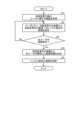
- Fig. 9 is a flowchart showing the accommodation change process procedure.
- the flowchart in Fig. 9 is started, for example, when the user performs an operation input to instruct the start of the process.
- the acquisition unit 15a acquires information about the user who is the target of the accommodation change (step S1). For example, the acquisition unit 15a acquires the address of the user who will perform the accommodation change, information about the device from which the accommodation change is to be performed, and the device to which the accommodation change is to be performed, via the input unit 11 or from a management device or the like via the communication control unit 13.
- the setting unit 15b sets, for each user to be changed, a route to the user via a tunnel from the device at the source of the change to the device at the destination of the change (step S2). For example, the setting unit 15b sets a static route to the user via a tunnel from the edge device at the source of the change to the edge device at the destination of the change.
- step S3 the setting unit 15b repeats the setting of a route via a tunnel from the device at the source of the accommodation change to the device at the destination of the accommodation change for each user that is the subject of the accommodation change.
- step S3 Yes
- step S4 the setting unit 15b proceeds to step S4.
- the advertising unit 15c aggregates and advertises the routes from the new device to all users (step S4).
- the deletion unit 15d also deletes the route that passes through the set tunnel (step S5).
- the deletion unit 15d also deletes the aggregated route from the source device of the accommodation change to the advertised user that is no longer necessary. This completes the series of accommodation change processes.
- the acquisition unit 15a acquires information on users who are the targets of accommodation change.
- the setting unit 15b sets, for each user who is the target of accommodation change, a route to the user that passes through a tunnel from the accommodation change source device to the accommodation change destination device.
- the BGP advertisement information of the device from which the accommodation change originates does not need to be changed and remains the aggregated advertisement information.
- the route via the tunnel is information that was originally set in the device from which the accommodation change originates/destination, and does not contribute to an increase in the amount of route information. Therefore, an increase in the amount of route information is suppressed, the impact on network stability is reduced, and service can be continued seamlessly. In this way, even when accommodation is changed on a user-by-user basis, the accommodation change device 10 suppresses the generation of a large amount of route advertisements, enabling stable operation of the network. Therefore, it becomes easy to change accommodation on a user-by-user basis.
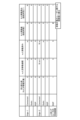
- Figures 10 and 11 are diagrams for explaining the effect of accommodation change processing.
- the number of route information received by the upstream core router becomes N+1, and a large amount of route information is circulated within the core network.
- it may be difficult to incorporate all the route information or the processing costs for route calculation may be large, which may affect the stability of the network.
- the number of pieces of route information received by the upstream core router is almost 1 except when it becomes 2 immediately after the movement of all N users to be accommodated is completed, and it can be said that the impact of the number of pieces of route information within the core network is extremely minor.
- the generation of a large amount of route advertisements is suppressed, device costs are reduced, and stable operation of the network is possible.
- the advertising unit 15c when the advertising unit 15c has completed setting routes to users via a tunnel from the device at the source of the accommodation change to the device at the destination of the accommodation change for all users that are the subject of the accommodation change, the advertising unit 15c aggregates and advertises routes from the device at the destination of the accommodation change to all users. This enables the accommodation change device 10 to streamline route information.
- the deletion unit 15d also deletes the route that passes through the tunnel from the configured device at the source of the change to the device at the destination of the change, and the aggregated route from the device at the source of the change to the advertised user. In this way, by deleting route information that is no longer necessary after the change of accommodation process is completed, it is possible to streamline the route information.
- a program can be created in which the process executed by the accommodation change device 10 according to the above embodiment is written in a language executable by a computer.
- the accommodation change device 10 can be implemented by installing an accommodation change program that executes the above accommodation change process as package software or online software on a desired computer.
- the information processing device can function as the accommodation change device 10 by executing the above accommodation change program on an information processing device.
- the information processing device referred to here includes desktop or notebook personal computers.
- the information processing device also includes mobile communication terminals such as smartphones, mobile phones, and PHS (Personal Handyphone System), as well as slate terminals such as PDAs (Personal Digital Assistants).
- the functions of the accommodation change device 10 may be implemented on a cloud server.
- FIG. 12 is a diagram showing an example of a computer that executes a storage change program.
- the computer 1000 has, for example, a memory 1010, a CPU 1020, a hard disk drive interface 1030, a disk drive interface 1040, a serial port interface 1050, a video adapter 1060, and a network interface 1070. These components are connected by a bus 1080.
- the memory 1010 includes a ROM (Read Only Memory) 1011 and a RAM 1012.
- the ROM 1011 stores a boot program such as a BIOS (Basic Input Output System).
- BIOS Basic Input Output System
- the hard disk drive interface 1030 is connected to a hard disk drive 1031.
- the disk drive interface 1040 is connected to a disk drive 1041.
- a removable storage medium such as a magnetic disk or optical disk is inserted into the disk drive 1041.
- the serial port interface 1050 is connected to a mouse 1051 and a keyboard 1052, for example.
- the video adapter 1060 is connected to a display 1061, for example.
- the hard disk drive 1031 stores, for example, an OS (Operating System) 1091, an application program 1092, a program module 1093, and program data 1094. Each piece of information described in the above embodiment is stored, for example, in the hard disk drive 1031 or memory 1010.
- OS Operating System
- the storage change program is stored in the hard disk drive 1031, for example, as a program module 1093 in which commands to be executed by the computer 1000 are written.
- the program module 1093 in which the processes executed by the storage change device 10 described in the above embodiment are written is stored in the hard disk drive 1031.
- data used for information processing by the accommodation change program is stored as program data 1094, for example, in the hard disk drive 1031.
- the CPU 1020 reads the program module 1093 and program data 1094 stored in the hard disk drive 1031 into the RAM 1012 as necessary, and executes each of the above-mentioned procedures.
- the program module 1093 and program data 1094 related to the storage change program are not limited to being stored in the hard disk drive 1031, but may be stored in a removable storage medium, for example, and read by the CPU 1020 via the disk drive 1041 or the like.
- the program module 1093 and program data 1094 related to the storage change program may be stored in another computer connected via a network such as a LAN or WAN (Wide Area Network), and read by the CPU 1020 via the network interface 1070.
Landscapes
- Engineering & Computer Science (AREA)
- Computer Networks & Wireless Communication (AREA)
- Signal Processing (AREA)
- Data Exchanges In Wide-Area Networks (AREA)
Abstract
Priority Applications (2)
| Application Number | Priority Date | Filing Date | Title |
|---|---|---|---|
| JP2024576009A JPWO2024166315A1 (fr) | 2023-02-09 | 2023-02-09 | |
| PCT/JP2023/004414 WO2024166315A1 (fr) | 2023-02-09 | 2023-02-09 | Dispositif de changement d'hébergement, procédé de changement d'hébergement, et programme de changement d'hébergement |
Applications Claiming Priority (1)
| Application Number | Priority Date | Filing Date | Title |
|---|---|---|---|
| PCT/JP2023/004414 WO2024166315A1 (fr) | 2023-02-09 | 2023-02-09 | Dispositif de changement d'hébergement, procédé de changement d'hébergement, et programme de changement d'hébergement |
Publications (1)
| Publication Number | Publication Date |
|---|---|
| WO2024166315A1 true WO2024166315A1 (fr) | 2024-08-15 |
Family
ID=92262183
Family Applications (1)
| Application Number | Title | Priority Date | Filing Date |
|---|---|---|---|
| PCT/JP2023/004414 Ceased WO2024166315A1 (fr) | 2023-02-09 | 2023-02-09 | Dispositif de changement d'hébergement, procédé de changement d'hébergement, et programme de changement d'hébergement |
Country Status (2)
| Country | Link |
|---|---|
| JP (1) | JPWO2024166315A1 (fr) |
| WO (1) | WO2024166315A1 (fr) |
Citations (2)
| Publication number | Priority date | Publication date | Assignee | Title |
|---|---|---|---|---|
| JPH09252321A (ja) * | 1996-03-15 | 1997-09-22 | Toshiba Corp | 移動端末用パケット交換機 |
| JP2010226470A (ja) * | 2009-03-24 | 2010-10-07 | Kddi Corp | ハンドオーバ制御システム、magおよびハンドオーバ制御方法 |
-
2023
- 2023-02-09 WO PCT/JP2023/004414 patent/WO2024166315A1/fr not_active Ceased
- 2023-02-09 JP JP2024576009A patent/JPWO2024166315A1/ja active Pending
Patent Citations (2)
| Publication number | Priority date | Publication date | Assignee | Title |
|---|---|---|---|---|
| JPH09252321A (ja) * | 1996-03-15 | 1997-09-22 | Toshiba Corp | 移動端末用パケット交換機 |
| JP2010226470A (ja) * | 2009-03-24 | 2010-10-07 | Kddi Corp | ハンドオーバ制御システム、magおよびハンドオーバ制御方法 |
Also Published As
| Publication number | Publication date |
|---|---|
| JPWO2024166315A1 (fr) | 2024-08-15 |
Similar Documents
| Publication | Publication Date | Title |
|---|---|---|
| US11405316B2 (en) | Live application and kernel migration using routing table entries | |
| US20190310875A1 (en) | Nondisruptive updates in a networked computing environment | |
| CN111666585A (zh) | 子应用访问的方法、装置、电子设备以及可读存储介质 | |
| CN113656198A (zh) | 客户端到云手机的复制粘贴方法和装置 | |
| WO2023066246A1 (fr) | Procédé et système d'installation d'application sur un téléphone infonuagique, et téléphone infonuagique client | |
| US20120072907A1 (en) | Proxy tool for guest machine relocation | |
| CN113703760B (zh) | 一种页面跳转控制方法和装置 | |
| CN113656041A (zh) | 数据处理方法、装置、设备及存储介质 | |
| JP2020136701A (ja) | 作成装置、作成システム、作成方法および作成プログラム | |
| CN102959513B (zh) | 虚拟机器合并方法和系统 | |
| CN114443076A (zh) | 镜像构建方法、装置、设备及存储介质 | |
| JP6930443B2 (ja) | プロセス処理装置、プロセス処理システム、プロセス移行順序決定方法、及びプログラム | |
| CN110599112B (zh) | 一种网络页面开发、维护方法和装置 | |
| US11010143B2 (en) | Executing formulas written using formula language | |
| US9727257B2 (en) | Maintaining relative references when unlinking volumes from a volume chain | |
| CN113655977B (zh) | 一种素材展示方法、装置、电子设备及存储介质 | |
| US20060293877A1 (en) | Method and apparatus for uni-lingual workflow usage in multi-lingual data center environments | |
| CN116009792A (zh) | 一种图像处理中的数据读取、写入装置及方法、电子设备 | |
| US20180341717A1 (en) | Providing instant preview of cloud based file | |
| US20210342070A1 (en) | Method, electronic device, and computer storage medium for information processing | |
| JP5940502B2 (ja) | ルータ、通信システム、管理方法、および、管理プログラム | |
| JP6483633B2 (ja) | 画像再構成装置、画像再構成方法、および、画像再構成プログラム | |
| CN112015409A (zh) | 网页编辑数据同步方法、装置、系统及计算机存储介质 | |
| JP7556466B2 (ja) | 解析装置、解析方法、および、解析プログラム | |
| US11558448B1 (en) | Sparse information sharing system |
Legal Events
| Date | Code | Title | Description |
|---|---|---|---|
| 121 | Ep: the epo has been informed by wipo that ep was designated in this application |
Ref document number: 23921146 Country of ref document: EP Kind code of ref document: A1 |
|
| ENP | Entry into the national phase |
Ref document number: 2024576009 Country of ref document: JP Kind code of ref document: A |
|
| WWE | Wipo information: entry into national phase |
Ref document number: 2024576009 Country of ref document: JP |
|
| NENP | Non-entry into the national phase |
Ref country code: DE |
|
| 122 | Ep: pct application non-entry in european phase |
Ref document number: 23921146 Country of ref document: EP Kind code of ref document: A1 |