WO2024157448A1 - 電子制御装置 - Google Patents
電子制御装置 Download PDFInfo
- Publication number
- WO2024157448A1 WO2024157448A1 PCT/JP2023/002615 JP2023002615W WO2024157448A1 WO 2024157448 A1 WO2024157448 A1 WO 2024157448A1 JP 2023002615 W JP2023002615 W JP 2023002615W WO 2024157448 A1 WO2024157448 A1 WO 2024157448A1
- Authority
- WO
- WIPO (PCT)
- Prior art keywords
- protective member
- electronic control
- control device
- protrusion
- board
- Prior art date
- Legal status (The legal status is an assumption and is not a legal conclusion. Google has not performed a legal analysis and makes no representation as to the accuracy of the status listed.)
- Ceased
Links
Images




Classifications
-
- H—ELECTRICITY
- H05—ELECTRIC TECHNIQUES NOT OTHERWISE PROVIDED FOR
- H05K—PRINTED CIRCUITS; CASINGS OR CONSTRUCTIONAL DETAILS OF ELECTRIC APPARATUS; MANUFACTURE OF ASSEMBLAGES OF ELECTRICAL COMPONENTS
- H05K9/00—Screening of apparatus or components against electric or magnetic fields
Definitions
- the present invention relates to an electronic control device.
- Automobiles are equipped with electronic control devices that have electronic components that control the vehicle.
- ADAS advanced driver assistance systems
- AD autonomous driving
- electronic control devices are equipped with integrated circuits with high operating frequencies.
- high-frequency electromagnetic noise emitted by electronic control devices to increase, and it is necessary to suppress this noise below the standard values set by the laws of each country.
- Patent Document 1 describes a technology that includes a main board, a connector disposed at a predetermined position on the main board, and a CPU disposed at a predetermined position on the main board.
- Patent Document 1 also describes a technology that includes a conductive metal board disposed perpendicular to the plane of the main board at a predetermined position between the connector and the CPU on the main board, and that includes a bare chip disposed on the metal board.
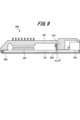
- FIG. 9 is a cross-sectional view showing a conventional electronic control device.
- a conventional electronic control device 300 has a board 101 on which electronic components 104 such as semiconductor components are mounted, a base 402 and a cover 401 that form a housing, and a connector 102 mounted on the board 101.
- the cover 401 is provided with a protruding portion 410 that protrudes toward the board 101.
- a metal board 505 is disposed perpendicular to the board 101 between the electronic components 104 and the connector 102 on the board 101.
- the objective of this study is to provide an electronic control device that takes the above problems into consideration and can reduce the leakage of electromagnetic noise outside the housing.
- the electronic control device includes a board on which electronic components and connectors are mounted, a protective member, a housing, and a protrusion.
- the protective member is mounted between the electronic components and the connector on the board.
- the housing is made up of a base on which the board is placed and a cover that covers the base on which the board is placed.
- the protrusion is provided at a position on the cover opposite the protective member, and protrudes towards the board and base.
- a recess is formed in one of the protrusion and the protective member, and the other of the protrusion and the protective member is inserted into the recess. Then, when viewed from the outside from the internal space of the housing, the protrusion and the protective member are arranged to overlap.
- the electronic control device configured as above can reduce the leakage of electromagnetic noise outside the housing.
- FIG. 2 is a perspective view showing a circuit board of the electronic control device according to the first embodiment.
- 1 is a cross-sectional view of an electronic control device according to a first embodiment.
- 2 is an enlarged cross-sectional view showing a protrusion and a protective member of the electronic control device according to the first embodiment.
- FIG. FIG. 13 is a perspective view showing a protective member of the electronic control device according to the second embodiment.
- FIG. 13 is a perspective view showing a protective member of an electronic control device according to a third embodiment. 13 is an enlarged cross-sectional view showing a protrusion and a protective member of an electronic control device according to a fourth embodiment.
- FIG. 13 is an enlarged cross-sectional view showing a protrusion and a protective member of an electronic control device according to a fifth embodiment.
- FIG. 13 is an enlarged cross-sectional view showing a protrusion and a protective member of an electronic control device according to a sixth embodiment.
- FIG. FIG. 1 is a cross-sectional view showing a conventional electronic control device.
- FIG. 1 is a plan view showing a board of an electronic control device
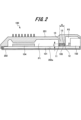
- FIG. 2 is a cross-sectional view showing the electronic control device.
- the device shown in Figures 1 and 2 is an electronic control device that is mounted on an automobile and has an electronic circuit that controls the automobile.
- the electronic control device 100 comprises a board 101 on which electronic components 104 such as semiconductor components are mounted, a base 202 and a cover 201 that form a housing, connectors 102, 103 mounted on the board 101, and two protective members 105.
- the board 101 is housed in the base 202 and the cover 201.
- the two protective members 105 are mounted on the board 101.
- the substrate 101 is formed in a generally flat plate shape.
- a plurality of fixing holes 101a are formed in the substrate 101.
- the substrate 101 is placed on one surface 202a of the base 202.
- the cover 201 is arranged so as to cover the one surface of the base 202 on which the substrate 101 is placed.
- the cover 201 is then fixed to the base 202 by inserting fixing screws into the fixing holes 101a provided in the substrate 101.
- the base 202 and cover 201 that constitute the housing are formed from a conductive material, for example, metal, conductive resin, or a resin surface with plating.
- Connectors 102, 103 are mounted on one end of the board 101.
- the protective member 105 is disposed between the connectors 102, 103 mounted on the board 101 and the electronic component 104. Of the two protective members 105, 105, one protective member 105 is disposed near the connector 102, and the remaining protective member 105 is disposed near the connector 103. Note that a fixing hole 101a is formed between the two protective members 105, 105 on the board 101, into which a fixing screw is inserted.
- the protective member 105 may be made of a conductive material or a material capable of absorbing electromagnetic waves, such as a copper plate, conductive resin, a resin surface with plating, or a radio wave absorbing material.
- the protective member 105 is electrically connected to the base 202 through a land (not shown) on the substrate 101.
- the protective member 105 is formed, for example, in a generally rectangular plate shape. As shown in FIG. 2, the length h of the protective member 105 in the height direction perpendicular to the mounting surface of the substrate 101 is set to be shorter than the length W of the protective member 105 in the width direction parallel to the mounting surface of the substrate 101 (W>h). In other words, the protective member 105 is formed in a horizontally elongated shape.
- the cover 201 that constitutes the housing covers the base 202 on which the board 101 is placed.
- a protrusion 10 is formed on the cover 201 at a position facing the protective member 105.
- the protrusion 10 protrudes from the inner wall surface of the cover 201 toward the board 101 and the base 202.
- This protrusion 10 divides the internal space of the electronic control device 100 into a first space P1 on the electronic component 104 side and a second space P2 on the connectors 102, 103 side.
- a recess 13 is formed at the tip of the protrusion 10.
- FIG. 3 is an enlarged cross-sectional view showing the protrusion 10 and the protective member 105.
- the recess 13 is recessed from the tip of the protrusion 10 in a direction away from the substrate 101 and the base 202.
- the recess 13 is recessed in a substantially rectangular shape to match the shape of the protective member 105.
- the protective member 105 mounted on the substrate 101 is inserted into the recess 13.
- a gap Q3 is provided between the recess 13 and a surface 105a of the protective member 105 opposite the mounting surface of the substrate 101.
- the tip of the protrusion 10 is formed with a first tip 11 on the first space P1 side and a second tip 12 on the second space P2 side.
- the recess 13 is formed between the first tip 11 and the second tip 12.
- the first tip 11 is disposed closer to the first space P1 than the protective member 105
- the second tip 12 is disposed closer to the second space P2 than the protective member 105.
- a gap Q1 is provided between the first tip 11 and the substrate 101.
- a gap Q2 is provided between the second tip 12 and the substrate 101.
- the first tip 11 and the second tip 12 are located closer to the board 101 than the surface 105a of the protective member 105 opposite the mounting surface of the board 101. Therefore, when the internal space of the electronic control device 100 is viewed from the first space P1 side to the second space P2, the first tip 11 and the second tip 12 of the protrusion 10 overlap with the protective member 105. Therefore, the electromagnetic noise L1 generated from the electronic component 104 can be blocked by the protrusion 10 and the protective member 105. As a result, it is possible to prevent the electromagnetic noise L1 from the electronic component 104 from leaking out to the outside of the housing, i.e., from the first space P1 to the second space P2. It is also possible to prevent external electromagnetic noise from entering the inside of the housing, i.e., from the second space P2 to the first space P1.
- low-frequency noise is diffusely reflected as shown in Figure 3 when passing through the gaps Q1, Q2, and Q3 between the protrusion 10 and the protective member 105. This allows the electromagnetic noise to be attenuated.
- the protective member 105 is formed in a rectangular flat plate shape, and is not intended for mounting electronic components on the protective member 105. Therefore, not only the protective member 105 but also the shape of the protrusion 10 that covers this protective member 105 can be made relatively simple in manufacturing. As a result, the gaps Q1, Q2, and Q3 between the protective member 105 and the protrusion 10 can be narrowed, and high-frequency noise can be further attenuated.
- the electronic control device 100 of this example can not only provide a countermeasure against electromagnetic noise, but also improve the heat dissipation effect.
- the protective member 105 and the protrusion 10 are brought into contact with each other, not only does it require high-precision machining of the cover 201, which is the housing, but the substrate 101 and the protrusion 10 expand and contract due to temperature changes and vibrations, causing repeated contact and non-contact states, which can cause distortion of the substrate 101.
- providing gaps Q1, Q2, and Q3 between the protective member 105 and the protrusion 10 not only simplifies the design of the cover 201, but also makes it easier to assemble the cover 201.
- the gaps Q1, Q2, and Q3 between the protective member 105 and the protrusion 10 may be filled with a conductive adhesive. This can improve electromagnetic noise countermeasures. Note that it is preferable to place the adhesive at intervals in order to maintain the heat insulation effect.
- a fixing screw is inserted between the two protective members 105, 105 to fix the cover 201. Therefore, electromagnetic noise leaking from the gap between the two protective members 105, 105 is blocked by the fixing screw and the cover 201.
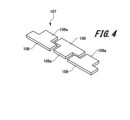
- FIG. 4 is a perspective view showing a protective member of an electronic control device according to the second embodiment.
- the electronic control device according to the second embodiment differs from the electronic control device 100 according to the first embodiment in the shape of the protective member. Therefore, the protective member will be described here, and parts common to the electronic control device 100 according to the first embodiment will be given the same reference numerals and duplicate descriptions will be omitted.
- the protective member 107 is divided into multiple roughly T-shaped blocks 106.
- the blocks 106 are mounted so that the convex portions 106a are parallel to the mounting surface of the board 101.
- the multiple blocks 106 are arranged so that the convex portions 106a face in the opposite direction to the convex portions 106a of adjacent blocks 106. Therefore, the multiple blocks 106106 are mounted so that the orientations of their convex portions 106a are staggered.
- the protective member 107 by dividing the protective member 107 into small blocks 106, it can be handled as a reeled product like other electronic components.
- the blocks 106 can be mounted using a chip mounter, which makes it possible to improve checkout efficiency.
- the heat capacity per block 106 can be reduced compared to the protective member 105 of the first embodiment. As a result, the solder melts more easily, improving mountability.
- the blocks 106 are arranged overlapping each other. This allows the blocks 106 to diffusely reflect electromagnetic noise that attempts to pass through the gaps between the blocks 106. Furthermore, the length of the gap between the two blocks 106 from the first space P1 to the second space P2 can be lengthened. As a result, the electromagnetic noise that passes between the two blocks 106 can be attenuated, and the electromagnetic noise can be prevented from leaking from the inside of the housing to the outside. It is also possible to prevent noise from the outside from entering the inside of the housing. From the outside of the housing to the inside to the outside
- the rest of the configuration is the same as that of the electronic control device 100 according to the first embodiment, so a description thereof will be omitted.
- An electronic control device having such a protective member 107 can also obtain the same effects as the electronic control device 100 according to the first embodiment described above.
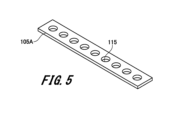
- FIG. 5 is a perspective view showing a protective member of an electronic control device according to the third embodiment.
- the electronic control device according to the third embodiment differs from the electronic control device 100 according to the first embodiment in the shape of the protective member. Therefore, the protective member will be described here, and parts common to the electronic control device 100 according to the first embodiment will be given the same reference numerals and duplicate descriptions will be omitted.
- the protective member 105A is formed in a generally flat plate shape.
- a plurality of holes 115 are formed in the protective member 105A.
- the rest of the configuration is the same as that of the electronic control device 100 according to the first embodiment, so a description thereof will be omitted.
- An electronic control device having such a protective member 105A can also obtain the same effects as the electronic control device 100 according to the first embodiment described above.
- FIG. 6 is a cross-sectional view showing a protrusion and a protective member of an electronic control device according to a fourth embodiment.
- the electronic control device according to the third embodiment differs from the electronic control device 100 according to the first embodiment in the shape of the protrusion and protective member. Therefore, the protective member will be described here, and parts common to the electronic control device 100 according to the first embodiment will be given the same reference numerals and duplicate descriptions will be omitted.
- a protective member 108 is mounted on the substrate 101.
- a protrusion 10B is formed on the cover 201B that constitutes the housing at a position facing the protective member 108.
- the protrusion 10B protrudes from the inner wall surface of the cover 201 toward the substrate 101 and the base 202.
- no recess is formed at the tip of the protrusion 10B in the fourth embodiment.
- the protective member 108 has a U-shaped cross section.
- a recess 108c is formed on one side of the protective member 108 that faces the protruding portion 10B.
- the recess 108c is recessed from the one side of the protective member 108 toward the substrate 101 and the base 202.
- the tip of the protruding portion 10B is inserted into the recess 108c.
- a first tip 108a and a second tip 108b are formed on one surface of the protective member 108, with a recess 108c between them.
- the first tip 108a is formed on the first space P1 side
- the second tip 108b is formed on the second space P2 side.
- the first tip 108a and the second tip 108b are positioned farther away from the substrate 101 than the tip of the protrusion 10B. Therefore, when it is desired to view the internal space of the housing of the electronic control device from the first space P1 side to the second space P2 (outside), the tip of the protrusion 10B overlaps with the first tip 108a and the second tip 108b of the protective member 108.
- the protective member 108 may be divided into a first tip portion 108a and a second tip portion 108b.
- the rest of the configuration is the same as that of the electronic control device 100 according to the first embodiment, so a description thereof will be omitted.
- An electronic control device having such a protective member 108 and protrusion 10B can also obtain the same effects as those of the electronic control device 100 according to the first embodiment described above.
- a recess is formed in one of the protrusion and the protective member, and the other of the protrusion and the protective member is inserted into the recess.
- FIG. 7 is a cross-sectional view showing a protrusion and a protective member of an electronic control device according to a fifth embodiment.
- the electronic control device according to the fifth embodiment differs from the electronic control device 100 according to the first embodiment in the dimensions of the protective member. Therefore, the protective member will be described here, and parts common to the electronic control device 100 according to the first embodiment will be given the same reference numerals and duplicate descriptions will be omitted.
- the cross-sectional shape of the protective member 105C is square.
- the cover 201C is formed with a protrusion 10C.
- a recess corresponding to the dimensions of the protective member 105C is formed at the tip of the protrusion 10C.
- the rest of the configuration is the same as that of the electronic control device 100 according to the first embodiment, so a description thereof will be omitted.
- An electronic control device having such a protective member 105C and protrusion 10C can also obtain the same effects as those of the electronic control device 100 according to the first embodiment described above.
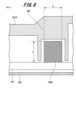
- FIG. 8 is a cross-sectional view showing a protrusion and a protective member of an electronic control device according to the sixth embodiment.
- the electronic control device according to the sixth embodiment differs from the electronic control device 100 according to the first embodiment in the dimensions of the protective member. Therefore, the protective member will be described here, and parts common to the electronic control device 100 according to the first embodiment will be given the same reference numerals and duplicate descriptions will be omitted.
- the height h of the protective member 105D perpendicular to the mounting surface of the board 101 is set to be longer than the width W of the protective member 105D parallel to the mounting surface of the board 101 (W ⁇ h).
- the protective member 105D has a vertically elongated cross-sectional shape.
- the cover 201D is formed with a protrusion 10D.
- a recess corresponding to the dimensions of the protective member 105D is formed at the tip of the protrusion 10D.
- the rest of the configuration is the same as that of the electronic control device 100 according to the first embodiment, so a description thereof will be omitted.
- An electronic control device having such a protective member 105D and protrusion 10D can also obtain the same effects as those of the electronic control device 100 according to the first embodiment described above.
- a member with a horizontally elongated cross-sectional shape such as protective member 105 in the first embodiment, can be positioned more perpendicularly to substrate 101 than a vertically elongated member such as protective member 105D in the sixth embodiment.
- horizontally elongated protective member 105 in the first embodiment can improve vibration resistance more than vertically elongated protective member 105D in the sixth embodiment.
Landscapes
- Engineering & Computer Science (AREA)
- Microelectronics & Electronic Packaging (AREA)
- Shielding Devices Or Components To Electric Or Magnetic Fields (AREA)
Priority Applications (2)
| Application Number | Priority Date | Filing Date | Title |
|---|---|---|---|
| PCT/JP2023/002615 WO2024157448A1 (ja) | 2023-01-27 | 2023-01-27 | 電子制御装置 |
| JP2024572780A JPWO2024157448A1 (https=) | 2023-01-27 | 2023-01-27 |
Applications Claiming Priority (1)
| Application Number | Priority Date | Filing Date | Title |
|---|---|---|---|
| PCT/JP2023/002615 WO2024157448A1 (ja) | 2023-01-27 | 2023-01-27 | 電子制御装置 |
Publications (1)
| Publication Number | Publication Date |
|---|---|
| WO2024157448A1 true WO2024157448A1 (ja) | 2024-08-02 |
Family
ID=91970104
Family Applications (1)
| Application Number | Title | Priority Date | Filing Date |
|---|---|---|---|
| PCT/JP2023/002615 Ceased WO2024157448A1 (ja) | 2023-01-27 | 2023-01-27 | 電子制御装置 |
Country Status (2)
| Country | Link |
|---|---|
| JP (1) | JPWO2024157448A1 (https=) |
| WO (1) | WO2024157448A1 (https=) |
Citations (4)
| Publication number | Priority date | Publication date | Assignee | Title |
|---|---|---|---|---|
| JPH10322075A (ja) * | 1997-05-21 | 1998-12-04 | Advantest Corp | シールドケース |
| JP2001135967A (ja) * | 1999-11-05 | 2001-05-18 | Anritsu Corp | 高周波ユニットのシールド構造 |
| JP2008005461A (ja) * | 2006-05-24 | 2008-01-10 | Sharp Corp | 衛星信号用コンバータ、アンテナ装置および衛星放送受信装置 |
| JP2022178791A (ja) * | 2021-05-21 | 2022-12-02 | 日立Astemo株式会社 | 電子制御装置 |
-
2023
- 2023-01-27 JP JP2024572780A patent/JPWO2024157448A1/ja active Pending
- 2023-01-27 WO PCT/JP2023/002615 patent/WO2024157448A1/ja not_active Ceased
Patent Citations (4)
| Publication number | Priority date | Publication date | Assignee | Title |
|---|---|---|---|---|
| JPH10322075A (ja) * | 1997-05-21 | 1998-12-04 | Advantest Corp | シールドケース |
| JP2001135967A (ja) * | 1999-11-05 | 2001-05-18 | Anritsu Corp | 高周波ユニットのシールド構造 |
| JP2008005461A (ja) * | 2006-05-24 | 2008-01-10 | Sharp Corp | 衛星信号用コンバータ、アンテナ装置および衛星放送受信装置 |
| JP2022178791A (ja) * | 2021-05-21 | 2022-12-02 | 日立Astemo株式会社 | 電子制御装置 |
Also Published As
| Publication number | Publication date |
|---|---|
| JPWO2024157448A1 (https=) | 2024-08-02 |
Similar Documents
| Publication | Publication Date | Title |
|---|---|---|
| JP6452849B2 (ja) | マイクロ波モジュール及び高周波モジュール | |
| US8116099B2 (en) | Circuit board device, electronic device provided with the same, and GND connecting method | |
| WO2019111655A1 (ja) | 電子制御装置 | |
| US12171071B2 (en) | Electronic control device | |
| US11744056B2 (en) | Housing for receiving electronic devices and electronic system having the same | |
| EP4290274B1 (en) | Electronic apparatus, terminal device, and radar | |
| JPWO2019181290A1 (ja) | 電子制御装置 | |
| WO2023238471A1 (ja) | 電子制御装置 | |
| EP3065167B1 (en) | High-frequency module and microwave transceiver | |
| CN112803180B (zh) | 逆变器装置 | |
| WO2021149393A1 (ja) | 電子制御装置 | |
| WO2024157448A1 (ja) | 電子制御装置 | |
| US12058822B2 (en) | Electronic control device | |
| US10700015B2 (en) | Electronic control unit | |
| US20260020205A1 (en) | Shielding combining press-fit with surface mount compression | |
| EP4383974A1 (en) | Electronic assembly with electromagnetic shielding | |
| US10863615B2 (en) | Electronic apparatus | |
| WO2025022657A1 (ja) | 電子制御装置 | |
| JPH01112681A (ja) | ハイブリッド化プリント基板 | |
| WO2023127079A1 (ja) | 電子制御装置 | |
| WO2026034165A1 (ja) | 電子制御装置 | |
| JP2025098616A (ja) | 電子部品ユニット | |
| WO2025009370A1 (ja) | 電子制御装置 | |
| WO2022194372A1 (en) | Housings for electromagnetically insulating electrical components | |
| JP2024082299A (ja) | 電子制御装置 |
Legal Events
| Date | Code | Title | Description |
|---|---|---|---|
| 121 | Ep: the epo has been informed by wipo that ep was designated in this application |
Ref document number: 23918410 Country of ref document: EP Kind code of ref document: A1 |
|
| WWE | Wipo information: entry into national phase |
Ref document number: 2024572780 Country of ref document: JP |
|
| NENP | Non-entry into the national phase |
Ref country code: DE |
|
| 122 | Ep: pct application non-entry in european phase |
Ref document number: 23918410 Country of ref document: EP Kind code of ref document: A1 |