WO2024154591A1 - 乳化化粧料 - Google Patents
乳化化粧料 Download PDFInfo
- Publication number
- WO2024154591A1 WO2024154591A1 PCT/JP2024/000032 JP2024000032W WO2024154591A1 WO 2024154591 A1 WO2024154591 A1 WO 2024154591A1 JP 2024000032 W JP2024000032 W JP 2024000032W WO 2024154591 A1 WO2024154591 A1 WO 2024154591A1
- Authority
- WO
- WIPO (PCT)
- Prior art keywords
- mass
- fatty acid
- oil
- triglyceride
- emulsion cosmetic
- Prior art date
- Legal status (The legal status is an assumption and is not a legal conclusion. Google has not performed a legal analysis and makes no representation as to the accuracy of the status listed.)
- Ceased
Links
Classifications
-
- A—HUMAN NECESSITIES
- A61—MEDICAL OR VETERINARY SCIENCE; HYGIENE
- A61K—PREPARATIONS FOR MEDICAL, DENTAL OR TOILETRY PURPOSES
- A61K8/00—Cosmetics or similar toiletry preparations
- A61K8/02—Cosmetics or similar toiletry preparations characterised by special physical form
- A61K8/04—Dispersions; Emulsions
- A61K8/06—Emulsions
-
- A—HUMAN NECESSITIES
- A61—MEDICAL OR VETERINARY SCIENCE; HYGIENE
- A61K—PREPARATIONS FOR MEDICAL, DENTAL OR TOILETRY PURPOSES
- A61K8/00—Cosmetics or similar toiletry preparations
- A61K8/18—Cosmetics or similar toiletry preparations characterised by the composition
- A61K8/30—Cosmetics or similar toiletry preparations characterised by the composition containing organic compounds
- A61K8/33—Cosmetics or similar toiletry preparations characterised by the composition containing organic compounds containing oxygen
- A61K8/37—Esters of carboxylic acids
-
- A—HUMAN NECESSITIES
- A61—MEDICAL OR VETERINARY SCIENCE; HYGIENE
- A61K—PREPARATIONS FOR MEDICAL, DENTAL OR TOILETRY PURPOSES
- A61K8/00—Cosmetics or similar toiletry preparations
- A61K8/18—Cosmetics or similar toiletry preparations characterised by the composition
- A61K8/30—Cosmetics or similar toiletry preparations characterised by the composition containing organic compounds
- A61K8/33—Cosmetics or similar toiletry preparations characterised by the composition containing organic compounds containing oxygen
- A61K8/39—Derivatives containing from 2 to 10 oxyalkylene groups
-
- A—HUMAN NECESSITIES
- A61—MEDICAL OR VETERINARY SCIENCE; HYGIENE
- A61K—PREPARATIONS FOR MEDICAL, DENTAL OR TOILETRY PURPOSES
- A61K8/00—Cosmetics or similar toiletry preparations
- A61K8/18—Cosmetics or similar toiletry preparations characterised by the composition
- A61K8/30—Cosmetics or similar toiletry preparations characterised by the composition containing organic compounds
- A61K8/40—Cosmetics or similar toiletry preparations characterised by the composition containing organic compounds containing nitrogen
- A61K8/44—Aminocarboxylic acids or derivatives thereof, e.g. aminocarboxylic acids containing sulfur; Salts; Esters or N-acylated derivatives thereof
-
- A—HUMAN NECESSITIES
- A61—MEDICAL OR VETERINARY SCIENCE; HYGIENE
- A61K—PREPARATIONS FOR MEDICAL, DENTAL OR TOILETRY PURPOSES
- A61K8/00—Cosmetics or similar toiletry preparations
- A61K8/18—Cosmetics or similar toiletry preparations characterised by the composition
- A61K8/72—Cosmetics or similar toiletry preparations characterised by the composition containing organic macromolecular compounds
- A61K8/84—Cosmetics or similar toiletry preparations characterised by the composition containing organic macromolecular compounds obtained by reactions otherwise than those involving only carbon-carbon unsaturated bonds
- A61K8/86—Polyethers
-
- A—HUMAN NECESSITIES
- A61—MEDICAL OR VETERINARY SCIENCE; HYGIENE
- A61Q—SPECIFIC USE OF COSMETICS OR SIMILAR TOILETRY PREPARATIONS
- A61Q19/00—Preparations for care of the skin
Definitions
- the present invention relates to emulsion cosmetics, and in particular to oil-in-water emulsion cosmetics.
- Patent Document 1 proposes blending tranexamic acid or a derivative thereof to obtain an emulsion-type topical skin preparation that provides a good moisturizing feeling, is less sticky after use, and has an excellent refreshing feeling.
- Patent Document 1 discloses a skin preparation for use that reduces stickiness caused by tranexamic acid or its derivatives after application. However, further improvements are required in terms of stickiness after application, slippery feeling during application, and quick absorption.
- the blending amount of component (B) is 0.3% by mass or more and 3.0% by mass or less, relative to the total mass of the emulsion cosmetic.
- the emulsion cosmetic according to the present invention contains (A) tranexamic acid or a derivative thereof, (B) a surfactant, and (C) a powdered oil as essential components. Furthermore, the emulsion cosmetic according to the present invention may further contain an oily component other than the powdered oil, water, and other components depending on the purpose. Moreover, the emulsion cosmetic according to the present invention is preferably an oil-in-water emulsion cosmetic. The emulsion cosmetic according to the present invention can simultaneously improve the lack of stickiness after application, the lack of sliminess during application, and the quickness of absorption. Furthermore, the emulsion cosmetic according to the present invention can improve emulsion stability. Below, each component contained in the emulsion cosmetic according to the present invention will be described in detail.
- tranexamic acid or derivatives thereof examples include tranexamic acid (trans-4-aminomethylcyclohexane-1-carboxylic acid), tranexamic acid esters (for example, vitamin esters such as vitamin A ester, vitamin E ester, vitamin C ester, and vitamin D ester, phenyl esters, hydroquinone esters, gentisic acid esters, etc.), tranexamic acid amides (methylamides or salts thereof, etc.), and tranexamic acid dimers. Among these, tranexamic acid is preferred.
- the content of (A) tranexamic acid or a derivative thereof is preferably 0.5% by mass or more and 10% by mass or less, more preferably 0.7% by mass or more and 7.0% by mass or less, even more preferably 1.0% by mass or more and 5.0% by mass or less, and most preferably 1.0% by mass or more and 3.0% by mass or less, relative to the total mass of the emulsion cosmetic. If the content of tranexamic acid or a derivative thereof is within the above numerical range, many of the characteristics of the emulsion cosmetic during use (particularly, the lack of stickiness after application, the lack of sliminess during application, and the quickness of absorption) will be good.
- the surfactant is not particularly limited, and any surfactant known for use in cosmetics can be used.
- a nonionic surfactant more preferably to use at least one selected from the group consisting of polyglycerin fatty acid esters and polyoxyethylene alkyl ethers, and particularly preferably to use polyglycerin fatty acid esters.
- the surfactant may be used alone or in combination of two or more.
- polyglycerol fatty acid esters examples include polyglycerol fatty acid esters formed by ester condensation of one molecule of polyglycerol having an average degree of polymerization of 4 to 12 with one to five molecules of a fatty acid having 12 or more carbon atoms.
- the average degree of polymerization of polyglycerol is preferably 6 to 10.
- the number of molecules of the fatty acid that undergoes ester condensation with one molecule of polyglycerol is preferably 1 to 3, more preferably 1 to 2, and even more preferably 1.
- the number of carbon atoms of the fatty acid is preferably 12 to 22, and more preferably 14 to 20.
- fatty acids having 12 or more carbon atoms include lauric acid, myristic acid, palmitic acid, stearic acid, isostearic acid, oleic acid, linoleic acid, arachidic acid, and behenic acid.
- palmitic acid, stearic acid, isostearic acid, oleic acid, and linoleic acid are preferred, and stearic acid, isostearic acid, and oleic acid are more preferred.
- polyglycerol fatty acid esters examples include polyglyceryl-6 stearate, polyglyceryl-10 stearate, polyglyceryl-10 distearate, polyglyceryl-6 oleate, polyglyceryl-10 oleate, etc.
- the number of carbon atoms in the alkyl group of the polyoxyethylene (POE) alkyl ether is preferably 14 to 24, more preferably 16 to 22.
- the number of moles of POE added is preferably 15 to 30, more preferably 20 to 25.
- polyoxyethylene alkyl ethers examples include beheneth-20 and beheneth-25.
- the content of (B) the surfactant is preferably 0.3% by mass or more and 3.0% by mass or less, more preferably 0.5% by mass or more and 2.7% by mass or less, and even more preferably 0.8% by mass or more and 2.5% by mass or less, relative to the total mass of the emulsion cosmetic. If the content of the surfactant is within the above numerical range, many of the characteristics of the cosmetic during use (in particular, the lack of stickiness after application, the lack of sliminess during application, and the quickness of absorption) will be good.
- the powdered oil and fat in the present invention is a solid oil and fat in a powder form at room temperature (20°C).
- the melting point of the powdered oil and fat is preferably 25°C or more and 50°C or less, more preferably 25°C or more and 45°C or less, even more preferably 25°C or more and 40°C or less, and even more preferably 25°C or more and 35°C or less.
- the melting point of the powdered oil and fat can be measured by a conventional method using a differential scanning calorimeter (DSC), and the value of the peak top of the DSC chart is taken as the melting point. If the melting point of the powdered oil and fat is within the above numerical range, it will easily melt when applied to the skin, and heat will be taken away from the skin, making it easier to feel a cool sensation.
- DSC differential scanning calorimeter
- Powdered fats and oils are usually in the form of plate-like or spherical crystals, and preferably in the form of plate-like crystals.
- Powdered fats and oils have an average particle size (effective diameter) of, for example, 50 to 400 ⁇ m, preferably 50 to 300 ⁇ m, more preferably 50 to 250 ⁇ m, and even more preferably 50 to 200 ⁇ m.
- the average particle size (effective diameter) is the value (d50) measured by dry measurement based on the laser diffraction scattering method (ISO133201, ISO9276-1) using a particle size distribution measuring device (for example, Microtrac MT3300ExII manufactured by Nikkiso Co., Ltd.).
- the effective diameter means the particle size of the sphere when the measured diffraction pattern of the crystal to be measured matches the theoretical diffraction pattern obtained by assuming the crystal to be spherical. In this way, with the laser diffraction scattering method, the effective diameter is calculated by matching the theoretical diffraction pattern obtained assuming a spherical shape with the actually measured diffraction pattern, so measurements can be made using the same principles whether the object being measured is a plate-like crystal or a spherical crystal.
- the powdered oil contains one or more XXX triglycerides having fatty acid residue X with carbon number x at positions 1 to 3, and one or more X2Y triglycerides in which one of the fatty acid residues X in the XXX triglyceride is replaced with fatty acid residue Y with carbon number y.
- the fatty acid residue X may be a saturated or unsaturated fatty acid residue.
- the carbon number x of the fatty acid residue X in the XXX triglyceride is an integer selected from 8 to 12, and is preferably 10.
- Specific examples of the fatty acid residue X include saturated fatty acid residues such as caprylic acid (C8:0), capric acid (C10:0), and lauric acid (C12:0), and is preferably capric acid.
- the carbon number y of the fatty acid residue Y in the XXX triglyceride is each independently x+2 to x+8, and is preferably x+4 to x+8.
- Specific examples of the fatty acid residue Y include saturated fatty acid residues such as myristic acid (C14:0), palmitic acid (C16:0), and stearic acid (C18:0), and is preferably myristic acid.
- the content of XXX triglycerides is 80-99% by mass, preferably 90-99% by mass, and the content of X2Y triglycerides is 20-1% by mass, preferably 10-1% by mass.
- the presence of a small amount of X2Y triglycerides with a long chain length of one fatty acid causes the X2Y triglycerides to be mixed into the fat crystals composed of XXX triglycerides when the X2Y triglycerides are cooled and crystallized from a molten state, disrupting the continuous crystal growth of the XXX triglycerides, resulting in a solid product crystallized in a very sparse state (a state in which the volume has increased and voids have been formed).
- the obtained solid product has the form of an aggregate of powdery fats and oils crystallized in a very sparse state, and is brittle and crumbles even with a light impact, easily becoming powdery.
- powdered oils and fats commercially available products can be used.
- powdered oils and fats it is preferable to use, for example, Enequick manufactured by Nisshin Oillio Group, Ltd.
- the powdered fat obtained in the above step (d) may be obtained by a step (e) of pulverizing the solid obtained after the cooling in the step (d) to obtain a powdered fat.
- step (a) Preparation of the oil composition step I
- the oil and fat composition prepared in step (a) contains the above-mentioned XXX triglyceride (one or more types) and X2Y triglyceride (one or more types) in the above-mentioned mass %.
- an XXX triglyceride (one or more types) having a fatty acid residue X with a carbon number of x at the 1st to 3rd positions and a YYY triglyceride (one or more types) having a fatty acid residue Y with a carbon number of y at the 1st to 3rd positions are separately obtained and mixed in a mass ratio of XXX triglyceride/YYY triglyceride of 90/10 to 99/1 to obtain a reaction substrate (wherein the carbon number x is an integer selected from 8 to 12 and the carbon number y is an integer selected from x+2 to x+8), and the reaction substrate is heated and subjected to an ester exchange reaction in the presence of a catalyst.
- a reaction substrate is obtained by mixing XXX triglyceride (one or more types) and YYY triglyceride (one or more types), the details of which are as described above.
- a YYY triglyceride is a triglyceride having a fatty acid residue Y with a carbon number of y at positions 1 to 3.
- the carbon number y and the fatty acid residue Y are as described above.
- the above XXX type triglycerides and the above YYY type triglycerides can also be obtained by direct synthesis using fatty acid or fatty acid derivative and glycerin.
- the direct synthesis method of XXX type triglycerides includes (i) direct esterification of fatty acid having carbon number X with glycerin (direct ester synthesis), (ii) reaction of fatty acid alkyl (e.g., fatty acid methyl and fatty acid ethyl) in which the carboxyl group of fatty acid X having carbon number x is bonded to alkoxyl group with glycerin under basic or acidic catalytic conditions (ester exchange synthesis using fatty acid alkyl), (iii) reaction of fatty acid halide (e.g., fatty acid chloride and fatty acid bromide) in which the hydroxyl group of carboxyl group of fatty acid X having
- XXX triglycerides and YYY triglycerides can be produced by any of the above-mentioned methods (i) to (iii). From the viewpoint of ease of production, however, (i) direct ester synthesis or (ii) transesterification synthesis using a fatty acid alkyl is preferred, and (i) direct ester synthesis is more preferred.
- reaction temperature in (i) direct ester synthesis of XXX triglyceride or YYY triglyceride may be any temperature at which the water produced by the esterification reaction can be removed from the system, and is, for example, preferably 120° C. to 300° C., more preferably 150° C. to 270° C., and even more preferably 180° C. to 250° C. By carrying out the reaction at 180° C. to 250° C., XXX triglyceride or YYY triglyceride can be produced particularly efficiently.
- a catalyst for promoting the esterification reaction may be used.
- the catalyst include acid catalysts and alkaline earth metal alkoxides.
- the amount of the catalyst used is preferably about 0.001 to 1% by mass based on the total mass of the reaction raw materials.
- the catalyst and unreacted raw materials can be removed by carrying out known purification treatments such as washing with water, alkaline deoxidation and/or reduced pressure deoxidation, and adsorption treatment. Furthermore, the obtained reaction product can be further purified by carrying out decolorization and deodorization treatment.
- the mass ratio of XXX triglyceride/YYY triglyceride is preferably 95/5 to 99/1.
- the triglyceride used as the raw material of the reaction substrate may include various triglycerides other than the above-mentioned XXX triglyceride and YYY triglyceride, so long as the effects of the present invention are not impaired.
- examples of other triglycerides include X2Y triglycerides in which one of the fatty acid residues X in the above-mentioned XXX triglyceride is replaced with fatty acid residue Y, and XY2 triglycerides in which two of the fatty acid residues X in the above-mentioned XXX triglyceride are replaced with fatty acid residue Y.
- the amount of the other triglycerides is, for example, 0 to 15% by mass, preferably 0 to 7% by mass, and more preferably 0 to 4% by mass, when the total mass of the XXX triglycerides and YYY triglycerides is taken as 100% by mass.
- naturally occurring triglyceride compositions may be used instead of the above XXX type triglycerides or YYY type triglycerides.
- naturally occurring triglyceride compositions include palm kernel oil, palm kernel olein, palm kernel stearin, rapeseed oil, coconut oil, soybean oil, sunflower oil, safflower oil, palm stearin, etc.
- the triglyceride having Y residues at positions 1 to 3 contained in the extremely hydrogenated palm kernel stearin oil is contained in an amount necessary for the above-mentioned YYY triglyceride, i.e., an amount satisfying a mass ratio of XXX triglyceride/YYY triglyceride of 90/10 to 99/1, preferably 93/7 to 99/1, and more preferably 95/5 to 98/2.
- the raw materials constituting the reaction substrate may contain, in addition to the above triglyceride, other components such as partial glycerides, antioxidants, emulsifiers, solvents such as water, etc.
- the amount of these other components may be any amount as long as it does not impair the effects of the present invention, but for example, when the mass of the obtained reaction substrate is taken as 100 mass%, it is 0 to 5 mass%, preferably 0 to 2 mass%, more preferably 0 to 1 mass%.
- the mixing may be carried out by any known mixing method as long as a homogeneous reaction substrate can be obtained.
- the mixing may be carried out by using a paddle mixer, an Ajihomo mixer, a Disper mixer, or the like.
- the mixing may be performed under heating as necessary.
- the heating temperature is preferably about the same as the heating temperature in the step (b) described below, for example, 50 to 120°C, preferably 60 to 100°C, more preferably 70 to 90°C, and even more preferably 80°C.
- an enzyme is added as a catalyst, it is preferable that water is not present as much as possible before the enzyme is added.
- the amount of water before the enzyme is added is, for example, 10% by mass or less, preferably 0.001 to 5% by mass, more preferably 0.01 to 3% by mass, and even more preferably 0.01 to 2% by mass, based on the mass of the entire raw material. This mixing may be continued for, for example, 5 to 60 minutes, preferably 10 to 50 minutes, and more preferably 20 to 40 minutes.
- the reaction substrate (a mixture containing XXX triglyceride and YYY triglyceride) is heated and subjected to an ester exchange reaction in the presence of a catalyst to obtain an ester exchange reaction product (an oil or fat composition containing XXX triglyceride and X2Y triglyceride).
- the transesterification reaction is not particularly limited, and any commonly used transesterification reaction can be used.
- the heating is carried out at, for example, 50 to 120°C, preferably 60 to 100°C, more preferably 70 to 90°C, and further preferably 80°C.
- the catalyst may be an enzyme, an alkali metal alkoxide, an alkaline earth metal alkoxide, etc.
- the enzyme may be an immobilized enzyme or a powdered enzyme, with the powdered enzyme being preferred in terms of enzyme activity and ease of handling.
- Powdered enzymes are enzyme-containing aqueous liquids that have been dried and powdered by methods such as spray drying, freeze drying, and drying after solvent precipitation. There are no particular limitations on the type of powdered enzyme, but an example of such an enzyme is lipase derived from Alcaligenes sp. (Meito Sangyo Co., Ltd., product name: Lipase QLM).
- the immobilized enzyme may be an enzyme immobilized on a carrier such as silica, celite, diatomaceous earth, perlite, polyvinyl alcohol, anion exchange resin, phenol adsorption resin, hydrophobic carrier, cation exchange resin, or chelating resin.
- a carrier such as silica, celite, diatomaceous earth, perlite, polyvinyl alcohol, anion exchange resin, phenol adsorption resin, hydrophobic carrier, cation exchange resin, or chelating resin.
- alkali metal alkoxides and alkaline earth metal alkoxides usable as catalysts lithium, sodium, potassium, etc. can be preferably used as the alkali metal.
- Magnesium and calcium can be preferably used as the alkaline earth metal.
- the alkoxides include methoxide, ethoxide, propoxide, n-butoxide, t-butoxide, etc., and methoxide and ethoxide are preferred.
- examples of the preferred alkali metal alkoxides and alkaline earth metal alkoxides include sodium methoxide, sodium ethoxide, magnesium methoxide, magnesium ethoxide, etc., and sodium methoxide is more preferred.
- catalysts may be used alone or in combination of two or more, but it is preferable not to use an enzyme catalyst and an alkoxide catalyst at the same time.
- the amount of catalyst may be any amount that allows the transesterification reaction to proceed sufficiently, and is added in an amount of, for example, 0.01 to 20% by mass, preferably 0.05 to 10% by mass, more preferably 0.1 to 5% by mass, and even more preferably 0.2 to 1% by mass, based on the total mass of the raw triglyceride.
- any co-catalyst may be used.
- the transesterification reaction is carried out, for example, under normal pressure or reduced pressure, at the heating temperature described above, for example, for 0.5 to 50 hours, preferably 1 to 40 hours, more preferably 5 to 30 hours, and even more preferably 10 to 20 hours, with optional stirring.
- the above-mentioned predetermined amount of catalyst may be added all at once, or the predetermined amount of catalyst may be added in 2 to 30 portions, preferably 3 to 20 portions, and more preferably 5 to 15 portions.
- the catalyst may be added immediately after the above step (a), or every 1 to 2 hours after the first catalyst addition.
- step II of the oil composition can include a method for simultaneously and directly synthesizing an XXX triglyceride and an X2Y triglyceride as shown below.
- an XXX triglyceride and a YYY triglyceride are not separately synthesized and transesterified, but the raw materials for producing both triglycerides (fatty acid or fatty acid derivative and glycerin) are charged, for example, into a single reaction vessel and simultaneously and directly synthesized, and the production method can be any of the following methods.
- a method is preferred in which, in the first stage, glycerin is reacted with a fatty acid X having a carbon number of x, which contains a fatty acid Y having a carbon number of y, and then, in the second stage, a fatty acid X having a carbon chain of x is added and reacted to obtain an oil and fat composition containing a predetermined amount of XXX triglyceride and X2Y triglyceride.
- the total molar amount of fatty acid Y and fatty acid X adjusted to a range in which the X2Y triglyceride is a desired mass % in all glycerides, is preferably 0.5 to 2.8 molar amount relative to 1 mole of glycerin, more preferably 0.8 to 2.57 molar amount, and most preferably 1.1 to 2.2 molar amount. This allows fatty acid Y to be reliably esterified with glycerin without being left behind, and ultimately allows X2Y glyceride to be more reliably produced in the system.
- the reaction temperature in the direct ester synthesis of the oil and fat composition of the present invention may be any temperature at which the water produced by the esterification reaction can be removed from the system, and is preferably 120° C. to 300° C., more preferably 150° C. to 270° C., and even more preferably 180° C. to 250° C. In particular, by carrying out the reaction at 180 to 250° C., X2Y triglycerides can be produced efficiently.
- a catalyst for promoting the esterification reaction may be used.
- the catalyst include an acid catalyst and an alkoxide of an alkaline earth metal.
- the amount of the catalyst used is preferably about 0.001 to 1% by mass based on the total mass of the reaction raw materials.
- the catalyst and unreacted raw materials can be removed by carrying out known purification treatments such as washing with water, alkali deoxidation and/or deoxidation under reduced pressure, and adsorption treatment. Furthermore, the obtained reaction product can be further purified by carrying out decolorization and deodorization treatment.
- the oil and fat composition may be prepared by first preparing an oil and fat composition containing XXX triglycerides outside the range of 80-99% by mass and/or X2Y triglycerides outside the range of 20-1% by mass, and then further adding XXX triglycerides or X2Y triglycerides to obtain an oil and fat composition containing 80-99% by mass of XXX triglycerides and 20-1% by mass of X2Y triglycerides (preparation of oil and fat composition by dilution).
- an oil and fat composition containing 50-70% by mass of XXX triglycerides and 50-30% by mass of X2Y triglycerides may be prepared by adding a desired amount of XXX triglycerides to obtain an oil and fat composition containing 80-99% by mass of XXX triglycerides and 20-1% by mass of X2Y triglycerides.
- the above-mentioned adjustment step III also includes a step of first preparing an oil-and-fat composition containing XXX triglycerides in the range of 80 to 99% by mass and/or X2Y triglycerides in the range of 20 to 1% by mass by the above-mentioned preparation step I or II, and then further adding XXX triglycerides or X2Y triglycerides to adjust the mass percentages of XXX triglycerides and X2Y triglycerides to fall within a more preferred range (preparation of a more suitable oil-and-fat composition by dilution).
- the cooling of the molten oil and fat composition is carried out, for example, when x is 8 to 10, by cooling so that the final temperature is preferably 10 to 30°C, more preferably 15 to 25°C, and even more preferably 18 to 22°C.
- the final temperature in cooling is preferably 30 to 40°C, more preferably 32 to 38°C, and even more preferably 33 to 37°C.
- step (c) it may be necessary to leave the mixture to stand for, for example, 2 to 8 days, specifically 3 to 7 days, and more specifically, for about 6 days.
- step (c) Powder Formation Promotion Step Furthermore, between the above steps (a) or (b) and (d), as an optional step for promoting powder formation (c), the molten oil and fat composition used in step (d) may be treated with a seeding method (c1), a tempering method (c2) and/or a preliminary cooling method (c3). These optional steps (c1) to (c3) may be performed alone or in combination of a plurality of steps.
- "between step (a) or (b) and step (d)” means during step (a) or (b), after step (a) or (b) and before step (d), and during step (d).
- the temperature of the molten oil-and-fat composition reaches, for example, a temperature of the final cooling temperature ⁇ 0 to +10°C, preferably +5 to +10°C, during cooling of the molten oil-and-fat composition, 0.1 to 1 part by mass, preferably 0.2 to 0.8 parts by mass of this core oil-and-fat powder is added to 100 parts by mass of the molten oil-and-fat composition, thereby promoting powderization of the oil-and-fat composition.
- the tempering method is a method for promoting powderization of an oil or fat composition by cooling the oil or fat composition in a molten state, by cooling the oil or fat composition once to a temperature lower than the cooling temperature in step (d), for example, a temperature lower by 5 to 20° C., preferably a temperature lower by 7 to 15° C., and more preferably about 10° C., for preferably 10 to 120 minutes, and more preferably about 30 to 90 minutes, before leaving the oil or fat composition to stand at the final cooling temperature.
- the pre-cooling method is a method in which the molten oil-and-fat composition obtained in the step (a) or (b) is pre-cooled once at a temperature lower than the temperature of the molten state in the step (a) or (b) and higher than the cooling temperature in the step (d) before cooling in the step (d).
- the temperature higher than the cooling temperature in the step (d) may be, for example, a temperature 2 to 40°C higher than the cooling temperature in the step (d), preferably a temperature 3 to 30°C higher, more preferably a temperature 4 to 30°C higher, and even more preferably a temperature about 5 to 10°C higher.
- step (e) Step of pulverizing the solid material to obtain powdered fats and oils
- the step of obtaining powdered fats and oils by cooling in the above step (d) may be carried out, more specifically, by a step (e) of pulverizing the solid material obtained by the cooling in step (d) to obtain powdered fats and oils.
- the oil composition containing the XXX triglyceride and the X2Y triglyceride is melted to obtain a molten oil composition, which is then cooled to form a solid having voids and a volume larger than that of the molten oil composition.
- the oil composition in the form of a solid having voids can be pulverized by applying a light impact, and the solid easily disintegrates into a powder.
- the means for applying the light impact is not particularly specified, but a method of crushing (loosening) the material by applying light vibration (impact) such as shaking or sieving is simple and preferable.
- silicone oils include linear polysiloxanes (e.g., dimethylpolysiloxane, methylphenylpolysiloxane, diphenylpolysiloxane, etc.), cyclic polysiloxanes (e.g., octamethylcyclotetrasiloxane, decamethylcyclopentasiloxane, dodecamethylcyclohexasiloxane, etc.), silicone resins that form a three-dimensional network structure, silicone rubber, various modified polysiloxanes (amino-modified polysiloxane, polyether-modified polysiloxane, alkyl-modified polysiloxane, fluorine-modified polysiloxane, etc.), acrylic silicones, etc.
- linear polysiloxanes e.g., dimethylpolysiloxane, methylphenylpolysiloxane, diphenylpolysiloxane, etc.
- liquid oils examples include avocado oil, camellia oil, turtle oil, macadamia nut oil, corn oil, mink oil, olive oil, rapeseed oil, egg yolk oil, sesame oil, persic oil, wheat germ oil, sasanqua oil, castor oil, linseed oil, safflower oil, cottonseed oil, perilla oil, soybean oil, peanut oil, tea seed oil, kaya oil, rice bran oil, Chinese tung oil, Japanese tung oil, jojoba oil, germ oil, triglycerin, etc.
- waxes examples include beeswax, candelilla wax, cotton wax, carnauba wax, bayberry wax, ivory wax, whale wax, montan wax, bran wax, lanolin, kapok wax, lanolin acetate, liquid lanolin, sugarcane wax, lanolin fatty acid isopropyl, hexyl laurate, reduced lanolin, jojoba wax, hard lanolin, shellac wax, POE lanolin alcohol ether, POE lanolin alcohol acetate, POE cholesterol ether, lanolin fatty acid polyethylene glycol, POE hydrogenated lanolin alcohol ether, etc.
- hydrocarbon oils examples include liquid paraffin, isohexadecane, isododecane, ozokerite, squalane, squalene, pristane, paraffin, isoparaffin, ceresin, petrolatum, microcrystalline wax, hydrogenated polyisobutene, hydrogenated polydecene, olefin oligomers, and volatile hydrocarbon oils (e.g., isododecane, isohexadecane, undecane, tridecane, etc.).
- higher fatty acids examples include lauric acid, myristic acid, palmitic acid, stearic acid, behenic acid, oleic acid, undecylenic acid, tallic acid, isostearic acid, linoleic acid, linoleic acid, eicosapentaenoic acid (EPA), and docosahexaenoic acid (DHA).
- the content of oily components other than powdered oils is not particularly limited, but is preferably 10% by mass or more and 40% by mass or less, more preferably 13% by mass or more and 37% by mass or less, and even more preferably 15% by mass or more and 35% by mass or less, relative to the total mass of the emulsified cosmetic. If the content of oily components other than powdered oils and fats is within the above numerical range, many of the characteristics of the cosmetic during use (particularly, lack of stickiness after application, lack of sliminess during application, and quick absorption) will be good.
- Water As the water, any water that is normally used in cosmetics can be used, such as purified water, ion-exchanged water, tap water, etc.
- the amount of water contained can be adjusted appropriately depending on the amount of other ingredients contained, and is, for example, preferably from 20% to 80% by mass, more preferably from 30% to 70% by mass, relative to the total mass of the cosmetic.
- the emulsion cosmetic according to the present invention may contain other components that can be incorporated into cosmetics in addition to the above-mentioned components, so long as the effects of the present invention are not impaired.
- Such other components include aqueous solvents, UV absorbers, moisturizers, dispersants, neutralizing agents, chelating agents, preservatives, antioxidants, stabilizers, coloring agents, fragrances, etc. These components can be incorporated as appropriate depending on the formulation of the cosmetic.
- the aqueous solvent is not particularly limited, and any conventionally known aqueous solvent can be used.
- an alcohol can be used as the aqueous solvent.
- a lower alcohol such as ethanol, 1-propanol, 2-propanol, isobutyl alcohol, or t-butyl alcohol can be used as the alcohol.
- ultraviolet absorbers examples include benzoic acid-based ultraviolet absorbers (e.g., para-aminobenzoic acid (hereinafter abbreviated as PABA), PABA monoglycerin ester, N,N-dipropoxy PABA ethyl ester, N,N-diethoxy PABA ethyl ester, N,N-dimethyl PABA ethyl ester, N,N-dimethyl PABA butyl ester, N,N-dimethyl PABA ethyl ester, etc.); anthranilic acid-based ultraviolet absorbers (e.g., homomenthyl-N-acetylanthranilate, etc.); salicylic acid-based ultraviolet absorbers (e.g., amyl salicylate, menthyl salicylate, homomenthyl salicylate, octyl salicylate, phenyl salicylate, benzyl salicylate, p- isopropanol phenyl sal
- the emulsified cosmetic preparation according to the present invention can be produced according to conventional methods, and the emulsification method is not particularly limited.
- emulsion cosmetic examples include skin care cosmetics (e.g., lotion, milky lotion, cream, beauty essence, pack, mask, etc.), makeup cosmetics (e.g., foundation, makeup base, etc.), skin cleansing agents (e.g., facial cleanser, makeup remover, etc.), sunscreen cosmetics, ointments, etc.
- skin care cosmetics e.g., lotion, milky lotion, cream, beauty essence, pack, mask, etc.
- makeup cosmetics e.g., foundation, makeup base, etc.
- skin cleansing agents e.g., facial cleanser, makeup remover, etc.
- sunscreen cosmetics e.g., ointments, etc.
- Examples 1 to 10 Comparative Examples 1 to 2
- Oil-in-water emulsion cosmetics of each Example and Comparative Example were prepared according to the formulations shown in Tables 1 and 2.
- Tables 1 and 2 the blending ratio of each component is expressed as mass %.
- the triglyceride composition of the powdered oil used in the emulsion cosmetic was analyzed by the following method.
Landscapes
- Health & Medical Sciences (AREA)
- Life Sciences & Earth Sciences (AREA)
- General Health & Medical Sciences (AREA)
- Veterinary Medicine (AREA)
- Public Health (AREA)
- Animal Behavior & Ethology (AREA)
- Birds (AREA)
- Epidemiology (AREA)
- Emergency Medicine (AREA)
- Chemical & Material Sciences (AREA)
- Dispersion Chemistry (AREA)
- Dermatology (AREA)
- Fats And Perfumes (AREA)
Abstract
[課題]使用時における多くの特性が同時に改善された乳化化粧料の提供。
[解決手段](A)トラネキサム酸またはその誘導体、(B)界面活性剤、および、(C)全トリグリセリド含有量を100質量%とした場合、1位~3位に炭素数xの脂肪酸残基Xを有する1種以上のXXX型トリグリセリドを80~99質量%と、前記XXX型トリグリセリドの脂肪酸残基Xの1つを炭素数yの脂肪酸残基Yに置換した1種以上のX2Y型トリグリセリドを20~1質量%とを含有し、炭素数xは8~12から選択される整数であり、炭素数yは、それぞれ独立して、x+2~x+8から選択される整数である粉末状油脂を含む、乳化化粧料を用いる。
Description
本発明は、乳化化粧料に関するものであり、特に水中油型乳化化粧料に関する。
従来、肌に塗布して肌の質感を高めるための各種乳化化粧料が検討されている。このような化粧料には、使用時における様々な特性が求められている。
例えば、特許文献1では、良好な保湿感が得られ、かつ、使用後のべたつきが少なく、さっぱり感に優れた乳化型皮膚外用剤を得るために、トラネキサム酸またはその誘導体を配合することが提案されている。
特許文献1ではトラネキサム酸またはその誘導体に起因する塗布後のべたつきを改善する皮膚外用剤が知られている。しかし、塗布後のべたつき、塗布中のぬるつき、なじみの早さについて更なる改善が求められている。
また、一般的に、化粧料には用途に応じて目的とする特性を改善すると、その他の特性とのバランスが取りにくくなり、すべての特性を同時に満足することが難しい。そのため、依然として、そのようなバランスをとりながら、多くの特性を同時に改善した乳化化粧料が望まれている。
本発明者らは、上記課題を解決するために鋭意検討を行った結果、乳化化粧料にトラネキサム酸またはその誘導体、界面活性剤、および特定の粉末状油脂を配合することで、上記課題を解決できることを見出して、本発明を完成するに至った。
本発明によれば、以下の発明が提供される。
[1](A)トラネキサム酸またはその誘導体、
(B)界面活性剤、および
(C)全トリグリセリド含有量を100質量%とした場合、1位~3位に炭素数xの脂肪酸残基Xを有する1種以上のXXX型トリグリセリドを80~99質量%と、前記XXX型トリグリセリドの脂肪酸残基Xの1つを炭素数yの脂肪酸残基Yに置換した1種以上のX2Y型トリグリセリドを20~1質量%とを含有し、炭素数xは8~12から選択される整数であり、炭素数yは、それぞれ独立して、x+2~x+8から選択される整数である、粉末状油脂、
を含む、乳化化粧料。
[2](C)粉末状油脂が、全トリグリセリド含有量を100質量%とした場合、1位~3位に炭素数xの脂肪酸残基Xを有するXXX型トリグリセリドを90~99質量%と、前記XXX型トリグリセリドの脂肪酸残基Xの1つを炭素数yの脂肪酸残基Yに置換した1種以上のX2Y型トリグリセリドを10~1質量%とを含有し、炭素数xは10であり、炭素数yは、それぞれ独立して、x+4~x+8から選択される整数である、[1]に記載の乳化化粧料。
[3](C)粉末状油脂の融点が、25℃以上50℃以下である、[1]または[2]に記載の乳化化粧料。
[4](C)成分の配合量が、前記乳化化粧料の総質量に対して、0.5質量%以上20質量%以下である、[1]~[3]のいずれかに記載の乳化化粧料。
[5](B)界面活性剤が、ポリグリセリン脂肪酸エステルおよびポリオキシエチレンアルキルエーテルからなる群から選択される少なくとも1種を含む、[1]~[4]のいずれかに記載の乳化化粧料。
[6](B)界面活性剤が、平均重合度が4~12のポリグリセリン1分子と、炭素数12以上の脂肪酸1~5分子とがエステル縮合してなるポリグリセリン脂肪酸エステルを含む、[1]~[4]のいずれかに記載の乳化化粧料。
[7](B)成分の配合量が、前記乳化化粧料の総質量に対して、0.3質量%以上3.0質量%以下である、[1]~[6]のいずれかに記載の乳化化粧料。
[8](A)成分の配合量が、前記乳化化粧料の総質量に対して、0.5質量%以上10質量%以下である、[1]~[7]のいずれかに記載の乳化化粧料。
[9](B)成分の(C)成分に対する配合比(B/C)が、質量基準で、0.1以上3.0以下である、[1]~[8]のいずれかに記載の乳化化粧料。
[10] (A)成分の(C)成分に対する配合比(A/C)が、質量基準で、0.1以上4.0以下である、[1]~[9]のいずれかに記載の乳化化粧料。
[11]水中油型乳化化粧料である、[1]~[10]のいずれかに記載の乳化化粧料。
本発明によれば、塗布後のべたつきのなさ、塗布中のぬるつきのなさ、およびなじみの早さに優れた乳化化粧料が提供される。
[乳化化粧料]
本発明による乳化化粧料は、(A)トラネキサム酸またはその誘導体、(B)界面活性剤、(C)粉末状油脂を必須成分として含むものである。さらに、本発明による乳化化粧料は、目的に応じて、粉末状油脂以外の油性成分、水および他の成分をさらに含んでもよい。また、本発明による乳化化粧料は、水中油型乳化化粧料であることが好ましい。本発明による乳化化粧料は、塗布後のべたつきのなさ、塗布中のぬるつきのなさ、およびなじみの早さを同時に改善できるものである。さらに、本発明による乳化化粧料は、乳化安定性を改善することができる。以下、本発明による乳化化粧料に含まれる各成分について詳細に説明する。
本発明による乳化化粧料は、(A)トラネキサム酸またはその誘導体、(B)界面活性剤、(C)粉末状油脂を必須成分として含むものである。さらに、本発明による乳化化粧料は、目的に応じて、粉末状油脂以外の油性成分、水および他の成分をさらに含んでもよい。また、本発明による乳化化粧料は、水中油型乳化化粧料であることが好ましい。本発明による乳化化粧料は、塗布後のべたつきのなさ、塗布中のぬるつきのなさ、およびなじみの早さを同時に改善できるものである。さらに、本発明による乳化化粧料は、乳化安定性を改善することができる。以下、本発明による乳化化粧料に含まれる各成分について詳細に説明する。
(A)トラネキサム酸またはその誘導体
トラネキサム酸またはその誘導体としては、例えば、トラネキサム酸(トランス-4-アミノメチルシクロヘキサン-1-カルボン酸)、トラネキサム酸エステル類(例えば、ビタミンAエステル、ビタミンEエステル、ビタミンCエステル、及びビタミンDエステル等のビタミンエステル類、フェニルエステル類、ハイドロキノンエステル類、ゲンチシン酸エステル類等)、トラネキサム酸アミド(メチルアミド又はその塩等)、トラネキサム酸二量体等が挙げられる。これらの中でも、好ましくはトラネキサム酸である。トラネキサム酸誘導体の塩としては、例えば、マグネシウム塩、カルシウム塩、ナトリウム塩、カリウム塩等の金属塩類;リン酸塩、塩酸塩、臭化水素塩、硫酸塩等の無機塩類等が挙げられる。トラネキサム酸またはその誘導体は、1種単独で用いてもよいし、または2種以上を組み合わせて用いてもよい。
トラネキサム酸またはその誘導体としては、例えば、トラネキサム酸(トランス-4-アミノメチルシクロヘキサン-1-カルボン酸)、トラネキサム酸エステル類(例えば、ビタミンAエステル、ビタミンEエステル、ビタミンCエステル、及びビタミンDエステル等のビタミンエステル類、フェニルエステル類、ハイドロキノンエステル類、ゲンチシン酸エステル類等)、トラネキサム酸アミド(メチルアミド又はその塩等)、トラネキサム酸二量体等が挙げられる。これらの中でも、好ましくはトラネキサム酸である。トラネキサム酸誘導体の塩としては、例えば、マグネシウム塩、カルシウム塩、ナトリウム塩、カリウム塩等の金属塩類;リン酸塩、塩酸塩、臭化水素塩、硫酸塩等の無機塩類等が挙げられる。トラネキサム酸またはその誘導体は、1種単独で用いてもよいし、または2種以上を組み合わせて用いてもよい。
(A)トラネキサム酸またはその誘導体の含有量は、乳化化粧料の総質量に対して、好ましくは0.5質量%以上10質量%以下であり、より好ましくは0.7質量%以上7.0質量%以下であり、さらに好ましくは1.0質量%以上5.0質量%以下であり、最も好ましくは1.0質量%以上3.0質量%以下である。トラネキサム酸またはその誘導体の含有量が上記数値範囲内であれば、乳化化粧料を使用時における多くの特性(特に、塗布後のべたつきのなさ、塗布中のぬるつきのなさ、およびなじみの早さ)が良好となる。
(B)界面活性剤
界面活性剤としては、特に限定されず、化粧料用として従来公知の界面活性剤を用いることができる。界面活性剤としては、非イオン性界面活性剤を用いることが好ましく、ポリグリセリン脂肪酸エステルおよびポリオキシエチレンアルキルエーテルからなる群から選択される少なくとも1種を用いることがより好ましく、ポリグリセリン脂肪酸エステルを用いることが特に好ましい。界面活性剤は、1種単独で用いてもよいし、または2種以上を組み合わせて用いてもよい。
界面活性剤としては、特に限定されず、化粧料用として従来公知の界面活性剤を用いることができる。界面活性剤としては、非イオン性界面活性剤を用いることが好ましく、ポリグリセリン脂肪酸エステルおよびポリオキシエチレンアルキルエーテルからなる群から選択される少なくとも1種を用いることがより好ましく、ポリグリセリン脂肪酸エステルを用いることが特に好ましい。界面活性剤は、1種単独で用いてもよいし、または2種以上を組み合わせて用いてもよい。
ポリグリセリン脂肪酸エステルとしては、例えば、平均重合度が4~12のポリグリセリン1分子と、炭素数12以上の脂肪酸1~5分子とがエステル縮合してなるポリグリセリン脂肪酸エステルが挙げられる。ポリグリセリンの平均重合度は、6~10が好ましい。ポリグリセリン1分子とエステル縮合する脂肪酸の分子数は、1~3が好ましく、1~2がより好ましく、1がさらに好ましい。脂肪酸の炭素数は、12以上22以下が好ましく、14以上20以下がより好ましい。炭素数12以上の脂肪酸としては、ラウリン酸、ミリスチン酸、パルミチン酸、ステアリン酸、イソステアリン酸、オレイン酸、リノール酸、アラキジン酸、およびベヘン酸等が挙げられる。これらの中でも、パルミチン酸、ステアリン酸、イソステアリン酸、オレイン酸、リノール酸等が好ましく、ステアリン酸、イソステアリン酸、オレイン酸がより好ましい。
ポリグリセリン脂肪酸エステルとしては、例えば、ステアリン酸ポリグリセリル-6、ステアリン酸ポリグリセリル-10、ジステアリン酸ポリグリセリル-10、オレイン酸ポリグリセリル-6、オレイン酸ポリグリセリル-10等が挙げられる。
ポリオキシエチレン(POE)アルキルエーテルは、アルキル基の炭素数が好ましくは14~24であり、より好ましくは16~22である。POEの付加モル数が好ましくは15~30であり、より好ましくは20~25である。
ポリオキシエチレンアルキルエーテルとしては、例えば、ベヘネス-20、ベヘネス-25等が挙げられる。
(B)界面活性剤の含有量は、乳化化粧料の総質量に対して、好ましくは0.3質量%以上3.0質量%以下であり、より好ましくは0.5質量%以上2.7質量%以下であり、さらに好ましくは0.8質量%以上2.5質量%以下である。界面活性剤の含有量が上記数値範囲内であれば、化粧料を使用時における多くの特性(特に、塗布後のべたつきのなさ、塗布中のぬるつきのなさ、およびなじみの早さ)が良好となる。
(C)粉末状油脂
本発明における粉末状油脂とは、常温(20℃)で粉末状の固体油脂である。粉末状油脂の融点は、好ましくは25℃以上50℃以下であり、より好ましくは25℃以上45℃以下であり、さらに好ましくは25℃以上40℃以下であり、さらにより好ましくは25℃以上35℃以下である。粉末状油脂の融点は、示差走査熱量計(DSC)により常法により測定することができ、DSCチャートのピークトップの値を融点とする。粉末状油脂の融点が上記数値範囲内であれば、肌上に使用した際に融解し易く、肌から熱が奪われてヒンヤリ感を感じ易くなる。
本発明における粉末状油脂とは、常温(20℃)で粉末状の固体油脂である。粉末状油脂の融点は、好ましくは25℃以上50℃以下であり、より好ましくは25℃以上45℃以下であり、さらに好ましくは25℃以上40℃以下であり、さらにより好ましくは25℃以上35℃以下である。粉末状油脂の融点は、示差走査熱量計(DSC)により常法により測定することができ、DSCチャートのピークトップの値を融点とする。粉末状油脂の融点が上記数値範囲内であれば、肌上に使用した際に融解し易く、肌から熱が奪われてヒンヤリ感を感じ易くなる。
粉末状油脂は、通常、板状結晶または球状結晶の形態を有し、好ましくは、板状結晶の形態を有する。粉末状油脂は、例えば、50~400μm、好ましくは50~300μm、より好ましくは50~250μm、さらに好ましくは50~200μmの平均粒径(有効径)を有する。ここで、当該平均粒径(有効径)は、粒度分布測定装置(例えば、日機装株式会社製 Microtrac MT3300ExII)でレーザー回折散乱法(ISO133201、ISO9276-1)に基づいて、乾式測定により測定した値(d50)である。有効径とは、測定対象となる結晶の実測回折パターンが、球形と仮定して得られる理論的回折パターンに適合する場合の、当該球形の粒径を意味する。このように、レーザー回折散乱法の場合、球形と仮定して得られる理論的回折パターンと、実測回折パターンを適合させて有効径を算出しているので、測定対象が板状結晶であっても球状結晶であっても同じ原理で測定することができる。
粉末状油脂は、1位~3位に炭素数xの脂肪酸残基Xを有する1種以上のXXX型トリグリセリドと、前記XXX型トリグリセリドの脂肪酸残基Xの1つを炭素数yの脂肪酸残基Yに置換した1種以上のX2Y型トリグリセリドとを含有する。
脂肪酸残基Xは、飽和あるいは不飽和の脂肪酸残基であってもよい。XXX型トリグリセリドにおける脂肪酸残基Xの炭素数xは8~12から選択される整数であり、好ましくは10である。具体的な脂肪酸残基Xとしては、例えば、カプリル酸(C8:0)、カプリン酸(C10:0)、およびラウリン酸(C12:0)等の飽和脂肪酸残基が挙げられ、好ましくはカプリン酸である。また、XXX型トリグリセリドにおける脂肪酸残基Yの炭素数yは、それぞれ独立して、x+2~x+8であり、好ましくx+4~x+8である。具体的な脂肪酸残基Yとしては、例えば、ミリスチン酸(C14:0)、パルミチン酸(C16:0)、ステアリン酸(C18:0)等の飽和脂肪酸残基が挙げられ、好ましくはミリスチン酸である。
全トリグリセリド含有量を100質量%とした場合、XXX型トリグリセリドの含有量は80~99質量%であり、好ましくは90~99質量%であり、X2Y型トリグリセリドの含有量は20~1質量%であり、好ましくは10~1質量%である。XXX型トリグリセリドおよびX2Y型トリグリセリドの含有量が上記範囲内の場合、一つの脂肪酸の鎖長が長いX2Y型トリグリセリドが少量存在することにより、該X2Y型トリグリセリドが溶融状態から冷却結晶化するときにXXX型トリグリセリドからなる油脂結晶中に混入して、XXX型トリグリセリドが連続化して結晶成長することを分断し、結果として、非常に疎な状態(体積が増えて空隙ができた状態)で結晶化した固形物になると考えられる。得られた固形物は、非常に疎な状態で結晶化した粉末状油脂の凝集体の形態を有し、軽い衝撃によっても脆くくずれ、容易に粉末状を呈するようになる。
粉末状油脂としては、市販品を用いることができる。粉末状油脂としては、例えば、日清オイリオグループ株式会社製のエネクイック等を用いることが好ましい。
粉末状油脂の製造方法は、特許第5937771号を参照することができる。具体的には、以下の工程により、粉末状油脂を製造することができる。
(a)全トリグリセリド含有量を100質量%とした場合、1位~3位に炭素数xの脂肪酸残基Xを有するXXX型トリグリセリドを80~99質量%と、前記XXX型トリグリセリドの脂肪酸残基Xの1つを炭素数yの脂肪酸残基Yに置換したX2Y型トリグリセリドを20~1質量%とを含有し、前記炭素数xは8~12から選択される整数であり、前記炭素数yは、それぞれ独立して、x+2~x+8から選択される整数である、油脂組成物を調製する工程、
(b)前記油脂組成物を加熱し、前記油脂組成物中に含まれるトリグリセリドを融解して溶融状態の前記油脂組成物を得る任意の工程、
(d)溶融状態の前記油脂組成物を冷却して粉末状油脂を得る工程、
を含む方法によって製造することができる。
また、上記工程(b)と(d)の間に、工程(c)として粉末生成を促進するための任意工程、例えば(c1)シーディング工程、(c2)テンパリング工程、および/または(c3)予備冷却工程を含んでいてもよい。さらに上記工程(d)で得られる粉末状油脂は、工程(d)の冷却後に得られる固形物を粉砕して粉末状の油脂を得る工程(e)によって得られるものであってもよい。以下、上記工程(a)~(e)について説明する。
(a)油脂組成物の調製工程I
工程(a)で調製される油脂組成物は、上述したとおりのXXX型トリグリセリド(1種類またはそれ以上)とX2Y型トリグリセリド(1種類またはそれ以上)とを、上述した質量%で含有するものである。具体的には、例えば、1位~3位に炭素数xの脂肪酸残基Xを有するXXX型トリグリセリド(1種類またはそれ以上)と、1位~3位に炭素数yの脂肪酸残基Yを有するYYY型トリグリセリド(1種類またはそれ以上)とを別々に入手し、XXX型トリグリセリド/YYY型トリグリセリドの質量比で90/10~99/1にて混合して反応基質を得(ここで、前記炭素数xは8~12から選択される整数であり、前記炭素数yはx+2~x+8から選択される整数である)、前記反応基質を加熱し、触媒の存在下でエステル交換反応する工程を経て得られる。
工程(a)で調製される油脂組成物は、上述したとおりのXXX型トリグリセリド(1種類またはそれ以上)とX2Y型トリグリセリド(1種類またはそれ以上)とを、上述した質量%で含有するものである。具体的には、例えば、1位~3位に炭素数xの脂肪酸残基Xを有するXXX型トリグリセリド(1種類またはそれ以上)と、1位~3位に炭素数yの脂肪酸残基Yを有するYYY型トリグリセリド(1種類またはそれ以上)とを別々に入手し、XXX型トリグリセリド/YYY型トリグリセリドの質量比で90/10~99/1にて混合して反応基質を得(ここで、前記炭素数xは8~12から選択される整数であり、前記炭素数yはx+2~x+8から選択される整数である)、前記反応基質を加熱し、触媒の存在下でエステル交換反応する工程を経て得られる。
<反応基質>
まず、XXX型トリグリセリド(1種類またはそれ以上)とYYY型トリグリセリド(1種類またはそれ以上)とを混合して反応基質を得る。ここでXXX型トリグリセリドの詳細は、上述した通りである。
YYY型トリグリセリドは、1位~3位に炭素数yの脂肪酸残基Yを有するトリグリセリドである。ここで、当該炭素数yおよび脂肪酸残基Yは、上述した通りである。
まず、XXX型トリグリセリド(1種類またはそれ以上)とYYY型トリグリセリド(1種類またはそれ以上)とを混合して反応基質を得る。ここでXXX型トリグリセリドの詳細は、上述した通りである。
YYY型トリグリセリドは、1位~3位に炭素数yの脂肪酸残基Yを有するトリグリセリドである。ここで、当該炭素数yおよび脂肪酸残基Yは、上述した通りである。
上記XXX型トリグリセリドおよび上記YYY型トリグリセリドは、脂肪酸または脂肪酸誘導体とグリセリンを用いた直接合成によっても得ることができる。XXX型トリグリセリドを例にとると、XXX型トリグリセリドを直接合成する方法としては、(i)炭素数Xの脂肪酸とグリセリンとを直接エステル化する方法(直接エステル合成)、(ii)炭素数xである脂肪酸Xのカルボキシル基がアルコキシル基と結合した脂肪酸アルキル(例えば、脂肪酸メチルおよび脂肪酸エチル)とグリセリンとを塩基性または酸性触媒条件下にて反応させる方法(脂肪酸アルキルを用いたエステル交換合成)、(iii)炭素数xである脂肪酸Xのカルボキシル基の水酸基がハロゲンに置換された脂肪酸ハロゲン化物(例えば、脂肪酸クロリドおよび脂肪酸ブロミド)とグリセリンとを塩基性触媒下にて反応させる方法(酸ハライド合成)が挙げられる。
XXX型トリグリセリドおよびYYY型トリグリセリドは前述の(i)~(iii)のいずれの方法によっても製造できるが、製造の容易さの観点から、(i)直接エステル合成または(ii)脂肪酸アルキルを用いたエステル交換合成が好ましく、(i)直接エステル合成がより好ましい。
XXX型トリグリセリドおよびYYY型トリグリセリドは前述の(i)~(iii)のいずれの方法によっても製造できるが、製造の容易さの観点から、(i)直接エステル合成または(ii)脂肪酸アルキルを用いたエステル交換合成が好ましく、(i)直接エステル合成がより好ましい。
XXX型トリグリセリドまたはYYY型トリグリセリドを(i)直接エステル合成によって製造するには、製造効率の観点から、グリセリン1モルに対して脂肪酸Xまたは脂肪酸Yを3~5モルを用いることが好ましく、3~4モルを用いることがより好ましい。
XXX型トリグリセリドまたはYYY型トリグリセリドの(i)直接エステル合成における反応温度は、エステル化反応によって生ずる生成水が系外に除去できる温度であればよく、例えば、120℃~300℃が好ましく、150℃~270℃がより好ましく、180℃~250℃がさらに好ましい。反応を180~250℃で行うことで、特に効率的にXXX型トリグリセリドまたはYYY型トリグリセリドを製造することができる。
XXX型トリグリセリドまたはYYY型トリグリセリドの(i)直接エステル合成における反応温度は、エステル化反応によって生ずる生成水が系外に除去できる温度であればよく、例えば、120℃~300℃が好ましく、150℃~270℃がより好ましく、180℃~250℃がさらに好ましい。反応を180~250℃で行うことで、特に効率的にXXX型トリグリセリドまたはYYY型トリグリセリドを製造することができる。
XXX型トリグリセリドまたはYYY型トリグリセリドの(i)直接エステル合成においては、エステル化反応を促進する触媒を用いても良い。触媒としては酸触媒、およびアルカリ土類金属のアルコキシド等が挙げられる。触媒の使用量は、反応原料の総質量に対して0.001~1質量%程度であることが好ましい。
XXX型トリグリセリドまたはYYY型トリグリセリドの(i)直接エステル合成においては、反応後、水洗、アルカリ脱酸および/または減圧脱酸、および吸着処理等の公知の精製処理を行うことで、触媒や原料未反応物を除去することができる。更に、脱色・脱臭処理を施すことで、得られた反応物をさらに精製することができる。
XXX型トリグリセリドまたはYYY型トリグリセリドの(i)直接エステル合成においては、反応後、水洗、アルカリ脱酸および/または減圧脱酸、および吸着処理等の公知の精製処理を行うことで、触媒や原料未反応物を除去することができる。更に、脱色・脱臭処理を施すことで、得られた反応物をさらに精製することができる。
これらXXX型トリグリセリドおよびYYY型トリグリセリドは、XXX型トリグリセリド/YYY型トリグリセリドの質量比で90/10~99/1、好ましくは93/7~99/1、より好ましくは95/5~99/1にて混合する。特に、脂肪酸残基Xが炭素数10かつ脂肪酸残基Yが炭素数14~18の場合、XXX型トリグリセリド/YYY型トリグリセリドの質量比は95/5~99/1であることが好ましい。また、脂肪酸残基Xが炭素数12かつ脂肪酸残基Yが炭素数16~18の場合、XXX型トリグリセリド/YYY型トリグリセリドの質量比は95/5~99/1であることが好ましい。
<その他のトリグリセリド>
反応基質の原料となるトリグリセリドとしては、上記XXX型トリグリセリドやYYY型トリグリセリドの他、本発明の効果を損なわない限り、各種トリグリセリドを含めてもよい。その他のトリグリセリドとしては、例えば、上記XXX型トリグリセリドの脂肪酸残基Xの1つが脂肪酸残基Yに置換したX2Y型トリグリセリド、上記XXX型トリグリセリドの脂肪酸残基Xの2つが脂肪酸残基Yに置換したXY2型トリグリセリド等を挙げることができる。
上記その他のトリグリセリドの量は、例えば、XXX型トリグリセリドおよびYYY型トリグリセリドの合計質量を100質量%とした場合、0~15質量%、好ましくは0~7質量%、より好ましくは0~4質量%である。
また、上記XXX型トリグリセリドやYYY型トリグリセリドの代わりに、天然由来のトリグリセリド組成物を使用してもよい。天然由来のトリグリセリド組成物としては、例えば、パーム核油、パーム核オレイン、パーム核ステアリン、ナタネ油、ヤシ油、大豆油、ヒマワリ油、サフラワー油、パームステアリン等を挙げることができる。これらの天然由来のトリグリセリド組成物は、さらに水素添加等により改質した硬化油、部分硬化油、極度硬化油であってもよい。
上記天然由来のトリグリセリド組成物の量は、これら天然由来のトリグリセリド組成物に含まれる必要なXXX型トリグリセリドまたはYYY型トリグリセリドの量に依存するが、例えば、XXX型トリグリセリドのXがカプリン酸で、YYY型トリグリセリドの由来としてパーム核ステアリン極度硬化油を使用する場合、当該パーム核ステアリン極度硬化油に含まれる1位~3位にY残基を有するトリグリセリドが上述したYYY型トリグリセリドとして必要な量、即ちXXX型トリグリセリド/YYY型トリグリセリドの質量比で90/10~99/1、好ましくは93/7~99/1、より好ましくは95/5~98/2を満たす量で含まれることが適当である。
<その他の成分>
反応基質を構成する原料としては、上記トリグリセリドの他、任意に部分グリセリド、抗酸化剤、乳化剤、水などの溶媒等のその他の成分を含んでいてもよい。これらその他の成分の量は、本発明の効果を損なわない限り任意の量とすることができるが、例えば、得られる反応基質の質量を100質量%とした場合、0~5質量%、好ましくは0~2質量%、より好ましくは0~1質量%である。
反応基質を構成する原料としては、上記トリグリセリドの他、任意に部分グリセリド、抗酸化剤、乳化剤、水などの溶媒等のその他の成分を含んでいてもよい。これらその他の成分の量は、本発明の効果を損なわない限り任意の量とすることができるが、例えば、得られる反応基質の質量を100質量%とした場合、0~5質量%、好ましくは0~2質量%、より好ましくは0~1質量%である。
混合は、均質な反応基質が得られる限り公知のいかなる混合方法を用いてもよいが、例えば、パドルミキサー、アジホモミキサー、ディスパーミキサー等で行うことができる。
当該混合は、必要に応じて加熱下で混合してもよい。加熱は、後述の工程(b)における加熱温度と同程度であることが好ましく、例えば、50~120℃、好ましくは60~100℃、より好ましくは70~90℃、さらに好ましくは80℃で行われる。なお、触媒として酵素を添加する場合、酵素添加前に水は極力存在しないことが好ましい。酵素添加前の水の量は、原料全体の質量に対し、例えば10質量%以下、好ましくは0.001~5質量%、より好ましくは0.01~3質量%、更に好ましくは0.01~2質量%であることが適当である。この混合は、例えば5~60分、好ましくは10~50分、より好ましくは20~40分継続してもよい。
当該混合は、必要に応じて加熱下で混合してもよい。加熱は、後述の工程(b)における加熱温度と同程度であることが好ましく、例えば、50~120℃、好ましくは60~100℃、より好ましくは70~90℃、さらに好ましくは80℃で行われる。なお、触媒として酵素を添加する場合、酵素添加前に水は極力存在しないことが好ましい。酵素添加前の水の量は、原料全体の質量に対し、例えば10質量%以下、好ましくは0.001~5質量%、より好ましくは0.01~3質量%、更に好ましくは0.01~2質量%であることが適当である。この混合は、例えば5~60分、好ましくは10~50分、より好ましくは20~40分継続してもよい。
<エステル交換反応>
上記反応基質(XXX型トリグリセリドとYYY型トリグリセリドとを含有する混合物)を加熱し、触媒の存在下でエステル交換反応してエステル交換反応物(XXX型トリグリセリドとX2Y型トリグリセリドとを含有する油脂組成物)を得る。
エステル交換反応は、特に限定なく、通常用いられるエステル交換反応を使用することができる。
ここで加熱は、例えば、50~120℃、好ましくは60~100℃、より好ましくは70~90℃、さらに好ましくは80℃で行われる。
触媒としては、酵素、アルカリ金属アルコキシド、アルカリ土類金属アルコキシド等を使用することができる。酵素としては、固定化酵素および粉末酵素を使用できるが、酵素活性および取扱い容易性の面から、粉末酵素であることが好ましい。
粉末酵素は、酵素含有水性液体をスプレードライ、フリーズドライ、溶剤沈澱後の乾燥などの方法で乾燥、粉末化したものであり、特に限定するものではないが、例えば、アルカリゲネス エスピー(Alcaligenes sp.)由来のリパーゼ(名糖産業株式会社、商品名リパーゼQLM)が挙げられる。
固定化酵素としては、酵素をシリカ、セライト、珪藻土、パーライト、ポリビニールアルコール、陰イオン交換樹脂、フェノール吸着樹脂、疎水性担体、陽イオン交換樹脂、キレート樹脂等の担体に固定化したものを用いることができる。
触媒として使用できるアルカリ金属アルコキシドおよびアルカリ土類金属アルコキシドにおいて、アルカリ金属としては、リチウム、ナトリウム、カリウム等を好ましくは使用できる。アルカリ土類金属としては、マグネシウムおよびカルシウムを好ましくは使用できる。アルコキシドとしては、メトキシド、エトキシド、プロポキシド、n-ブトキシド、t-ブトキシド等を挙げることができ、好ましくはメトキシドおよびエトキシドである。好ましいアルカリ金属アルコキシドおよびアルカリ土類金属アルコキシドとしては、ナトリウムメトキシド、ナトリウムエトキシド、マグネシウムメトキシド、マグネシウムエトキシド等を挙げることができ、より好ましくはナトリウムメトキシドである。
これらの触媒は、1種または2種以上を混合して使用してもよいが、酵素系の触媒とアルコキシド系の触媒は同時に使用しない方が好ましい。
触媒の量は、エステル交換反応が十分に進行する量であればよいが、原料であるトリグリセリドの合計質量に対し、例えば、0.01~20質量%、好ましくは、0.05~10質量%、より好ましくは0.1~5質量%、更に好ましくは0.2~1質量%加えられる。上記触媒の他、任意の助触媒を使用してもよい。
エステル交換反応は、例えば、常圧下もしくは減圧下、上述した加熱温度で、例えば0.5~50時間、好ましくは1~40時間、より好ましくは5~30時間、更に好ましくは10~20時間、任意に攪拌しながら行われる。また、この反応工程では、例えば、上記所定量の触媒を1度に投入してもよいが、所定量の触媒を2~30回、好ましくは3~20回、より好ましくは5~15回に分けて投入してもよい。触媒を投入する時期は、上記工程(a)直後の他、第1回触媒投入から1~2時間おきに投入してもよい。
(a)油脂組成物の調製工程II
本発明の工程(a)で調製される油脂組成物の製造方法としては、さらに以下に示すようなXXX型トリグリセリドとX2Y型トリグリセリドを同時かつ直接合成する方法を挙げることができる。すなわち、本調製工程IIは、XXX型トリグリセリドとX2Y型トリグリセリドを得るために、XXX型トリグリセリドとYYY型トリグリセリドとを別々に合成してエステル交換するということはせず、双方のトリグリセリドを製造するための原料(脂肪酸または脂肪酸誘導体とグリセリン)を、例えば単一の反応容器に投入し、同時かつ直接合成するものであり、その製造方法は、次のいずれかの方法が挙げられる。
(iv)炭素数Xである脂肪酸Xおよび炭素鎖yの脂肪酸Yとグリセリンとを直接エステル化する方法(直接エステル合成)、(v)炭素数xである脂肪酸Xおよび炭素鎖yである脂肪酸Yのカルボキシル基がアルコキシル基と結合した脂肪酸アルキル(例えば、脂肪酸メチルおよび脂肪酸エチル)とグリセリンとを塩基性または酸性触媒条件下にて反応させる方法(脂肪酸アルキルを用いたエステル交換合成)、(vi)炭素数xである脂肪酸Xおよび炭素鎖yである脂肪酸Yのカルボキシル基の水酸基がハロゲンに置換された脂肪酸ハロゲン化物(例えば、脂肪酸クロリドおよび脂肪酸ブロミド)とグリセリンとを塩基性触媒下にて反応させる方法(酸ハライド合成)が挙げられる。
本発明の油脂組成物は前述の方法のいずれによっても製造できるが、製造の容易さの観点から、(iv)直接エステル合成もしくは(v)脂肪酸アルキルを用いたエステル交換合成が好ましく、(iv)直接エステル合成がより好ましい。
本発明の油脂組成物の(iv)直接エステル合成においては、全トリグリセリド中におけるXXX型トリグリセリドとX2Y型トリグリセリドが所望の質量%になる範囲であれば製造方法は限定されるものではないが、所望のトリグリセリドを確実に系内で生成させるため、2段階の反応を行うことが好ましい。すなわち、1段階目に、グリセリンと炭素数yである脂肪酸Yを含む炭素数xの脂肪酸Xを反応させた後、2段階目に炭素鎖xである脂肪酸Xを加え反応をさせXXX型トリグリセリドとX2Y型トリグリセリドを所定量含む油脂組成物とする方法が好ましい。
2段階反応を行う際の1段階目の反応においては、全グリセリド中におけるX2Y型トリグリセリドが所望の質量%になる範囲に調整した脂肪酸Yと脂肪酸Xの総モル量が、グリセリン1モルに対して、0.5~2.8モル量であることが好ましく、0.8~2.57モル量であることがより好ましく、1.1~2.2モルであることが最も好ましい。これにより、脂肪酸Yを余すことなくグリセリンと確実にエステル化でき、最終的に系内でより確実にX2Y型グリセリドを生成させることができる。
本発明の油脂組成物の直接エステル合成における反応温度は、エステル化反応によって生ずる生成水が系外に除去できる温度であればよく、120℃~300℃が好ましく、150℃~270℃がより好ましく、180℃~250℃がさらに好ましい。特に反応を180~250℃で行うことで、効率的にX2Y型トリグリセリドを製造することができる。
本発明の油脂組成物の(iv)直接エステル合成においては、エステル化反応を促進する触媒を用いても良い。触媒としては酸触媒、およびアルカリ土類金属のアルコキシド等が挙げられる。触媒の使用量は、反応原料の総質量に対して0.001~1質量%程度であることが好ましい。
本発明の油脂組成物の(iv)直接エステル合成においては、反応後、水洗、アルカリ脱酸および/または減圧脱酸、および吸着処理等の公知の精製処理を行うことで、触媒や原料未反応物を除去することができる。更に、脱色・脱臭処理を施すことで、得られた反応物をさらに精製することができる。
本発明の油脂組成物の(iv)直接エステル合成においては、反応後、水洗、アルカリ脱酸および/または減圧脱酸、および吸着処理等の公知の精製処理を行うことで、触媒や原料未反応物を除去することができる。更に、脱色・脱臭処理を施すことで、得られた反応物をさらに精製することができる。
(a)油脂組成物の調製工程III
油脂組成物は、さらに80~99質量%の範囲外にあるXXX型トリグリセリドおよび/または20~1質量%の範囲外にあるX2Y型トリグリセリドを含む油脂組成物を調製した後、XXX型トリグリセリドまたはX2Y型トリグリセリドを更に添加することによって80~99質量%のXXX型トリグリセリドと20~1質量%のX2Y型トリグリセリドとを含む油脂組成物を得てもよい(希釈による油脂組成物の調製)。例えば、50~70質量%のXXX型トリグリセリドと50~30質量%のX2Y型トリグリセリドとを含む油脂組成物を得た後、所望量のXXX型トリグリセリドを添加して80~99質量%のXXX型トリグリセリドと20~1質量%のX2Y型トリグリセリドとを含む油脂組成物を得てもよい。
さらに、上記調整工程IIIには、上記調製工程IまたはIIによって、80~99質量%の範囲内にあるXXX型トリグリセリドおよび/または20~1質量%の範囲内にあるX2Y型トリグリセリドを含む油脂組成物を一旦調製した後、XXX型トリグリセリドまたはX2Y型トリグリセリドを更に添加することによって、XXX型トリグリセリドとX2Y型トリグリセリドの質量%をより好ましい範囲内へ調節することも含まれる(希釈による一層好適な油脂組成物の調製)。
(b)溶融状態の前記油脂組成物を得る工程
上記(d)工程の前に、上記工程(a)で得られた油脂組成物は、調製された時点で溶融状態にある場合、加熱せずにそのまま冷却されるが、得られた時点で溶融状態にない場合は、任意に加熱され、該油脂組成物中に含まれるトリグリセリドを融解して溶融状態の油脂組成物を得る。
ここで、油脂組成物の加熱は、上記油脂組成物中に含まれるトリグリセリドの融点以上の温度、特にXXX型トリグリセリドおよびX2Y型トリグリセリドを融解できる温度、例えば、70~200℃、好ましくは、75~150℃、より好ましくは80~100℃であることが適当である。また、加熱は、例えば、0.5~3時間、好ましくは、0.5~2時間、より好ましくは0.5~1時間継続することが適当である。
(d)溶融状態の油脂組成物を冷却して粉末油脂組成物を得る工程
上記工程(a)または(b)で得られた溶融状態の油脂組成物は、さらに冷却されて粉末状油を形成する。
ここで、「溶融状態の油脂組成物を冷却」とは、溶融状態の油脂組成物を、当該油脂組成物の融点より低い温度に保つことを意味する。「油脂組成物の融点より低い温度」とは、例えば、当該融点より1~30℃低い温度、好ましくは当該融点より1~20℃低い温度、より好ましくは当該融点より1~15℃低い温度である。溶融状態にある油脂組成物の冷却は、例えばxが8~10のときは最終温度が、好ましくは10~30℃、より好ましくは15~25℃、更に好ましくは18~22℃の温度になるように冷却することによって行われる。冷却における最終温度は、例えばxが11または12のときは、好ましくは30~40℃、より好ましくは32~38℃、更に好ましくは33~37℃である。上記最終温度において、例えば、好ましくは2時間以上、より好ましくは4時間以上、更に好ましくは6時間~2日間静置することが適当である。特に以下の(c)工程を使用しない場合、例えば2~8日間、具体的には3~7日間、より具体的には約6日間静置しなければならない場合もある。
(c)粉末生成促進工程
さらに、上記工程(a)または(b)と(d)との間に、(c)粉末生成を促進するための任意工程として、工程(d)で使用する溶融状態の油脂組成物に対し、シーディング法(c1)、テンパリング法(c2)および/または(c3)予備冷却法による処理を行ってもよい。これらの任意工程(c1)~(c3)は、いずれか単独で行ってもよいし、複数の工程を組み合わせて行ってもよい。ここで、工程(a)または(b)と工程(d)との間とは、工程(a)または(b)中、工程(a)または(b)の後であって工程(d)の前、工程(d)中を含む意味である。
シーディング法(c1)およびテンパリング法(c2)は、粉末状油脂の製造において、溶融状態にある油脂組成物をより確実に粉末状とするために、最終温度まで冷却する前に、溶融状態にある油脂組成物を処置する粉末生成促進方法である。
ここで、シーディング法とは、粉末の核(種)となる成分を溶融状態にある油脂組成物の冷却時に少量添加して、粉末化を促進する方法である。具体的には、例えば、工程(b)で得られた溶融状態にある油脂組成物に、当該油脂組成物中のXXX型トリグリセリドと炭素数が同じXXX型トリグリセリドを好ましくは80質量%以上、より好ましくは90質量%以上含む油脂粉末を核(種)となる成分として準備する。この核となる油脂粉末を、溶融状態にある油脂組成物の冷却時、当該油脂組成物の温度が、例えば、最終冷却温度±0~+10℃、好ましくは+5~+10℃の温度に到達した時点で、当該溶融状態にある油脂組成物100質量部に対して0.1~1質量部、好ましくは0.2~0.8質量部添加することにより、油脂組成物の粉末化を促進する方法である。
テンパリング法とは、溶融状態にある油脂組成物の冷却において、最終冷却温度で静置する前に一度、工程(d)の冷却温度よりも低い温度、例えば5~20℃低い温度、好ましくは7~15℃低い温度、より好ましくは10℃程度低い温度に、好ましくは10~120分間、より好ましくは30~90分間程度冷却することにより、油脂組成物の粉末化を促進する方法である。
(c3)予備冷却法とは、前記工程(a)または(b)で得られた溶融状態の油脂組成物を、工程(d)にて冷却する前に、工程(a)または(b)の溶融状態の温度よりも低く、工程(d)の冷却温度よりも高い温度で一旦予備冷却する方法である。工程(d)の冷却温度より高い温度とは、例えば、工程(d)の冷却温度よりも2~40℃高い温度、好ましくは3~30℃高い温度、より好ましくは4~30℃高い温度、さらに好ましくは5~10℃程度高い温度であり得る。前記予備冷却する温度を低く設定すればするほど、工程(d)の冷却温度における本冷却時間を短くすることができる。すなわち、予備冷却法とは、シーディング法やテンパリング法と異なり、冷却温度を段階的に下げるだけで油脂組成物の粉末化を促進できる方法であり、工業的に製造する場合に利点が大きい。
(e)固形物を粉砕して粉末状油脂を得る工程
上記工程(d)の冷却によって粉末状油脂を得る工程は、より具体的には、工程(d)の冷却によって得られる固形物を粉砕して粉末状油脂を得る工程(e)によって行われてもよい。
詳細に説明すると、まず、上記XXX型トリグリセリドと上記X2Y型トリグリセリドを含有する油脂組成物を融解して溶融状態の油脂組成物を得て、その後冷却して溶融状態の油脂組成物よりも体積が増加した空隙を有する固形物を形成する。空隙を有する固形物となった油脂組成物は、軽い衝撃を加えることで粉砕でき、固形物が容易に崩壊して粉末状となる。
ここで、軽い衝撃を加える手段は特に特定されないが、振る、篩に掛ける等により、軽く振動(衝撃)を与えて粉砕する(ほぐす)方法が、簡便で好ましい。
(C)粉末状油脂の含有量は、化粧料の総質量に対して、好ましくは0.5質量%以上20質量%以下であり、より好ましくは0.7質量%以上15質量%以下であり、さらに好ましくは0.8質量%以上12質量%以下であり、さらにより好ましくは1.0質量%以上10質量%以下であり、最も好ましくは2.0質量%以上7.0質量%以下である。粉末状油脂の含有量が上記数値範囲内であれば、乳化化粧料を使用時における多くの特性(特に、塗布後のべたつきのなさ、塗布中のぬるつきのなさ、およびなじみの早さ)が良好となる。
乳化化粧料中の(A)成分(トラネキサム酸またはその誘導体)の(C)成分(粉末状油脂)に対する配合比(A/C)は、質量基準で、好ましくは0.1以上4.0以下であり、より好ましくは0.15以上3.5以下であり、さらに好ましくは0.2以上3.0以下であり、さらにより好ましくは0.25以上2.5以下である。
乳化化粧料中の(B)成分(界面活性剤)の(C)成分(粉末状油脂)に対する配合比(B/C)が、質量基準で、0.1以上3.0以下であり、より好ましくは0.12以上2.5以下であり、さらに好ましくは0.15以上2.0以下であり、さらにより好ましくは0.20以上1.5以下である。
乳化化粧料中の(A)成分~(C)成分の配合比を上記の数値範囲に調節することで、化粧料を使用時における多くの特性(特に、塗布後のべたつきのなさ、塗布中のぬるつきのなさ、およびなじみの早さ)が良好となる。
乳化化粧料中の(B)成分(界面活性剤)の(C)成分(粉末状油脂)に対する配合比(B/C)が、質量基準で、0.1以上3.0以下であり、より好ましくは0.12以上2.5以下であり、さらに好ましくは0.15以上2.0以下であり、さらにより好ましくは0.20以上1.5以下である。
乳化化粧料中の(A)成分~(C)成分の配合比を上記の数値範囲に調節することで、化粧料を使用時における多くの特性(特に、塗布後のべたつきのなさ、塗布中のぬるつきのなさ、およびなじみの早さ)が良好となる。
粉末状油脂以外の油性成分
粉末状油脂以外の油性成分としては、例えば、エステル油、シリコーン油、液体油脂、固体油脂、ロウ、炭化水素、および高級脂肪酸等を用いることができる。これらの油性成分は、1種単独で用いてもよいし、または2種以上を組み合わせて用いてもよい。
粉末状油脂以外の油性成分としては、例えば、エステル油、シリコーン油、液体油脂、固体油脂、ロウ、炭化水素、および高級脂肪酸等を用いることができる。これらの油性成分は、1種単独で用いてもよいし、または2種以上を組み合わせて用いてもよい。
エステル油としては、ミリスチン酸イソプロピル、オクタン酸セチル、ミリスチン酸オクチルドデシル、パルミチン酸イソプロピル、ステアリン酸ブチル、ラウリン酸ヘキシル、ミリスチン酸ミリスチル、オレイン酸デシル、ジメチルオクタン酸ヘキシルデシル、乳酸セチル、乳酸ミリスチル、酢酸ラノリン、ステアリン酸イソセチル、イソステアリン酸イソセチル、12-ヒドロキシステアリン酸コレステリル、ジ-2-エチルヘキサン酸エチレングリコール、ジペンタエリスリトール脂肪酸エステル、モノイソステアリン酸N-アルキルグリコール、ジカプリン酸ネオペンチルグリコール、リンゴ酸ジイソステアリル、ジ-2-ヘプチルウンデカン酸グリセリン、トリ-2-エチルヘキサン酸トリメチロールプロパン、トリイソステアリン酸トリメチロールプロパン、テトラ-2-エチルヘキサン酸ペンタエリスリトール、トリ-2-エチルヘキサン酸グリセリン、トリオクタン酸グリセリン、トリイソパルミチン酸グリセリン、トリイソステアリン酸トリメチロールプロパン、セチル2-エチルヘキサノエート、2-エチルヘキシルパルミテート、トリミリスチン酸グリセリン、トリ-2-ヘプチルウンデカン酸グリセライド、ヒマシ油脂肪酸メチルエステル、オレイン酸オレイル、アセトグリセライド、パルミチン酸2-ヘプチルウンデシル、アジピン酸ジイソブチル、N-ラウロイル-L-グルタミン酸-2-オクチルドデシルエステル、アジピン酸ジ-2-ヘプチルウンデシル、エチルラウレート、セバシン酸ジ-2-エチルヘキシル、ミリスチン酸2-ヘキシルデシル、パルミチン酸2-ヘキシルデシル、アジピン酸2-ヘキシルデシル、セバシン酸ジイソプロピル、コハク酸2-エチルヘキシル、クエン酸トリエチル等が挙げられる。
シリコーン油としては、例えば、鎖状ポリシロキサン(例えば、ジメチルポリシロキサン、メチルフェニルポリシロキサン、ジフェニルポリシロキサン等)、環状ポリシロキサン(例えば、オクタメチルシクロテトラシロキサン、デカメチルシクロペンタシロキサン、ドデカメチルシクロヘキサシロキサン等)、3次元網目構造を形成しているシリコーン樹脂、シリコーンゴム、各種変性ポリシロキサン(アミノ変性ポリシロキサン、ポリエーテル変性ポリシロキサン、アルキル変性ポリシロキサン、フッ素変性ポリシロキサン等)、アクリルシリコーン類等が挙げられる。
液体油脂としては、例えば、アボガド油、ツバキ油、タートル油、マカデミアナッツ油、トウモロコシ油、ミンク油、オリーブ油、ナタネ油、卵黄油、ゴマ油、パーシック油、小麦胚芽油、サザンカ油、ヒマシ油、アマニ油、サフラワー油、綿実油、エノ油、大豆油、落花生油、茶実油、カヤ油、コメヌカ油、シナギリ油、日本キリ油、ホホバ油、胚芽油、トリグリセリン等が挙げられる。
固体油脂としては、例えば、カカオ脂、ヤシ油、馬脂、硬化ヤシ油、パーム油、牛脂、羊脂、硬化牛脂、パーム核油、豚脂、牛骨脂、モクロウ核油、硬化油、牛脚脂、モクロウ、硬化ヒマシ油等が挙げられる。
ロウ類としては、例えば、ミツロウ、キャンデリラロウ、綿ロウ、カルナウバロウ、ベイベリーロウ、イボタロウ、鯨ロウ、モンタンロウ、ヌカロウ、ラノリン、カポックロウ、酢酸ラノリン、液状ラノリン、サトウキビロウ、ラノリン脂肪酸イソプロピル、ラウリン酸ヘキシル、還元ラノリン、ジョジョバロウ、硬質ラノリン、セラックロウ、POEラノリンアルコールエーテル、POEラノリンアルコールアセテート、POEコレステロールエーテル、ラノリン脂肪酸ポリエチレングリコール、POE水素添加ラノリンアルコールエーテル等が挙げられる。
炭化水素油としては、例えば、流動パラフィン、イソヘキサデカン、イソドデカン、オゾケライト、スクワラン、スクワレン、プリスタン、パラフィン、イソパラフィン、セレシン、ワセリン、マイクロクリスタリンワックス、水添ポリイソブテン、水添ポリデセン、オレフィンオリゴマー、揮発性炭化水素油(例えば、イソドデカン、イソヘキサデカン、ウンデカン、トリデカン等)等が挙げられる。
高級脂肪酸としては、例えば、ラウリン酸、ミリスチン酸、パルミチン酸、ステアリン酸、ベヘン酸、オレイン酸、ウンデシレン酸、トール酸、イソステアリン酸、リノール酸、リノレイン酸、エイコサペンタエン酸(EPA)、ドコサヘキサエン酸(DHA)等が挙げられる。
粉末状油脂以外の油性成分の含有量は、特に限定されないが、乳化化粧料の総質量に対して、好ましくは10質量%以上40質量%以下であり、より好ましくは13質量%以上37質量%以下であり、さらに好ましくは15質量%以上35質量%以下である。粉末状油脂以外の油性成分の含有量が上記数値範囲内であれば、化粧料を使用時における多くの特性(特に、塗布後のべたつきのなさ、塗布中のぬるつきのなさ、およびなじみの早さ)が良好となる。
水
水としては、化粧料に通常使用される水を使用することができ、例えば、精製水、イオン交換水、水道水等を使用することができる。
水としては、化粧料に通常使用される水を使用することができ、例えば、精製水、イオン交換水、水道水等を使用することができる。
水の含有量は、他の成分の含有量に応じて適宜調節することができ、例えば、化粧料の総質量に対して、好ましくは20質量%以上80質量%以下であり、より好ましくは30質量%以上70質量%以下である。
(他の成分)
本発明による乳化化粧料は、本発明の効果を損なわない範囲で、上記成分以外にも、化粧料に配合可能な他の成分を含むことができる。そのような他の成分としては、水性溶媒、紫外線吸収剤、保湿剤、分散剤、中和剤、キレート剤、防腐剤、酸化防止剤、安定化剤、色剤、香料等が挙げられる。これらの成分は、化粧料の剤形に応じて適宜配合することができる。
本発明による乳化化粧料は、本発明の効果を損なわない範囲で、上記成分以外にも、化粧料に配合可能な他の成分を含むことができる。そのような他の成分としては、水性溶媒、紫外線吸収剤、保湿剤、分散剤、中和剤、キレート剤、防腐剤、酸化防止剤、安定化剤、色剤、香料等が挙げられる。これらの成分は、化粧料の剤形に応じて適宜配合することができる。
水性溶媒としては、特に限定されず、従来公知の水性溶媒を用いることができる。水性溶媒としては、例えば、アルコールを用いることができる。アルコールとしては、例えば、エタノール、1-プロパノール、2-プロパノール、イソブチルアルコール、t-ブチルアルコール等の低級アルコールを用いることができる。
紫外線吸収剤としては、例えば、安息香酸系紫外線吸収剤(例えば、パラアミノ安息香酸(以下、PABAと略す)、PABAモノグリセリンエステル、N,N-ジプロポキシPABAエチルエステル、N,N-ジエトキシPABAエチルエステル、N,N-ジメチルPABAエチルエステル、N,N-ジメチルPABAブチルエステル、N,N-ジメチルPABAエチルエステル等);アントラニル酸系紫外線吸収剤(例えば、ホモメンチル-N-アセチルアントラニレート等);サリチル酸系紫外線吸収剤(例えば、アミルサリシレート、メンチルサリシレート、ホモメンチルサリシレート、オクチルサリシレート、フェニルサリシレート、ベンジルサリシレート、p-イソプロパノールフェニルサリシレート等);桂皮酸系紫外線吸収剤(例えば、オクチルシンナメート、エチル-4-イソプロピルシンナメート、メチル-2,5-ジイソプロピルシンナメート、エチル-2,4-ジイソプロピルシンナメート、メチル-2,4-ジイソプロピルシンナメート、プロピル-p-メトキシシンナメート、イソプロピル-p-メトキシシンナメート、イソアミル-p-メトキシシンナメート、オクチル-p-メトキシシンナメート(2-エチルヘキシル-p-メトキシシンナメート)、2-エトキシエチル-p-メトキシシンナメート、シクロヘキシル-p-メトキシシンナメート、エチル-α-シアノ-β-フェニルシンナメート、2-エチルヘキシル-α-シアノ-β-フェニルシンナメート、グリセリルモノ-2-エチルヘキサノイル-ジパラメトキシシンナメート等);ベンゾフェノン系紫外線吸収剤(例えば、2,4-ジヒドロキシベンゾフェノン、2,2’-ジヒドロキシ-4-メトキシベンゾフェノン、2,2’-ジヒドロキシ-4,4’-ジメトキシベンゾフェノン、2,2’,4,4’-テトラヒドロキシベンゾフェノン、2-ヒドロキシ-4-メトキシベンゾフェノン、2-ヒドロキシ-4-メトキシ-4’-メチルベンゾフェノン、2-ヒドロキシ-4-メトキシベンゾフェノン-5-スルホン酸塩、4-フェニルベンゾフェノン、2-エチルヘキシル-4’-フェニル-ベンゾフェノン-2-カルボキシレート、2-ヒドロキシ-4-n-オクトキシベンゾフェノン、4-ヒドロキシ-3-カルボキシベンゾフェノン等);3-(4’-メチルベンジリデン)-d,l-カンファー、3-ベンジリデン-d,l-カンファー;2-フェニル-5-メチルベンゾキサゾール;2,2’-ヒドロキシ-5-メチルフェニルベンゾトリアゾール;2-(2’-ヒドロキシ-5’-t-オクチルフェニル)ベンゾトリアゾール;2-(2’-ヒドロキシ-5’-メチルフェニルベンゾトリアゾール;ジベンザラジン;ジアニソイルメタン;4-メトキシ-4’-t-ブチルジベンゾイルメタン;5-(3,3-ジメチル-2-ノルボルニリデン)-3-ペンタン-2-オン等が挙げられる。
保湿剤としては、特に限定されず、化粧料用として従来公知の保湿剤を用いることができる。このような保湿剤としては、例えば、多価アルコールやグリコールエーテル、より具体的には、グリセリン、プロパンジオール、エチレングリコール、ジエチレングリコール、ジプロピレングリコール、1,3-ブチレングリコール、ヘキサメチレングリコール、イソプレングリコール、ポリエチレングリコール、ヒアルロン酸、キシリトール、ソルビトール、マルチトール、ジグリセリン(EO)PO付加物等が挙げられる。
本発明による乳化化粧料は、常法に従って製造することができ、乳化の方法は特に限定されるものではない。
(用途)
本発明による乳化化粧料は、例えば、スキンケア化粧料(例えば、化粧水、乳液、クリーム、美容液、パック、マスク等)、メーキャップ化粧料(例えば、ファンデーション、化粧下地等)、皮膚洗浄料(例えば、洗顔料、メイク落とし等)、日焼け止め化粧料、軟膏等が挙げられる。
本発明による乳化化粧料は、例えば、スキンケア化粧料(例えば、化粧水、乳液、クリーム、美容液、パック、マスク等)、メーキャップ化粧料(例えば、ファンデーション、化粧下地等)、皮膚洗浄料(例えば、洗顔料、メイク落とし等)、日焼け止め化粧料、軟膏等が挙げられる。
以下の例に基づいて本発明を具体的に説明するが、本発明はこれらの例に限定されるものではない。含有量は特記しない限り、質量%で示す。
[実施例1~10、比較例1~2]
<化粧料の調製>
表1~2に示される配合で、各実施例および比較例の水中油型乳化化粧料を調製した。なお、表1~2中、各成分の配合率は質量%である。
また、乳化化粧料に使用した粉末状油脂のトリグリド組成は、以下の方法で分析した。
[分析方法]
・卜リグリセリド組成
ガスク口マ卜グラフィ一分析条件
DB1-ht(0.32mm×0.1μm×5m)Agilent Technologies社(123-1131)
注入量:1.0μL
注入口:370℃
検出器:370℃
スプリッ卜比:50/1 35.1kPa コンスタン卜プレッシャ-
カラムCT:200℃(0min hold)~(15℃/min)~370℃(4min hold)
<乳化化粧料の性能評価>
上記で調製した各乳化化粧料の使用性について評価を行った。具体的には、官能評価の訓練を受け、一定の基準で評価が可能な専門パネル10名が顔面に試料を塗布し、下記の各特性について評価した。評価結果を表1~2に示す。なお、各項目の評価結果が全て、「A」~「B」であれば合格である。
上記で調製した各乳化化粧料の使用性について評価を行った。具体的には、官能評価の訓練を受け、一定の基準で評価が可能な専門パネル10名が顔面に試料を塗布し、下記の各特性について評価した。評価結果を表1~2に示す。なお、各項目の評価結果が全て、「A」~「B」であれば合格である。
[塗布後のべたつきのなさ]
A:7名以上が、塗布後のべたつきがないと回答した。
B:5~6名が、塗布後のべたつきがないと回答した。
C:3~4名が、塗布後のべたつきがないと回答した。
D:1~2名が、塗布後のべたつきがないと回答した。
E:塗布後のべたつきがないと回答したパネルがいなかった。
[塗布中のぬるつきのなさ]
A:7名以上が、肌への塗布中にぬるつきがないと回答した。
B:5~6名が、肌への塗布中にぬるつきがないと回答した。
C:3~4名が、肌への塗布中にぬるつきがないと回答した。
D:1~2名が、肌への塗布中にぬるつきがないと回答した。
E:肌への塗布中にぬるつきがないと回答したパネルがいなかった。
[なじみの早さ]
A:7名以上が、肌へのなじみが早いと回答した。
B:5~6名が、肌へのなじみが早いと回答した。
C:3~4名が、肌へのなじみが早いと回答した。
D:1~2名が、肌へのなじみが早いと回答した。
E:肌へのなじみが早いと回答したパネルがいなかった。

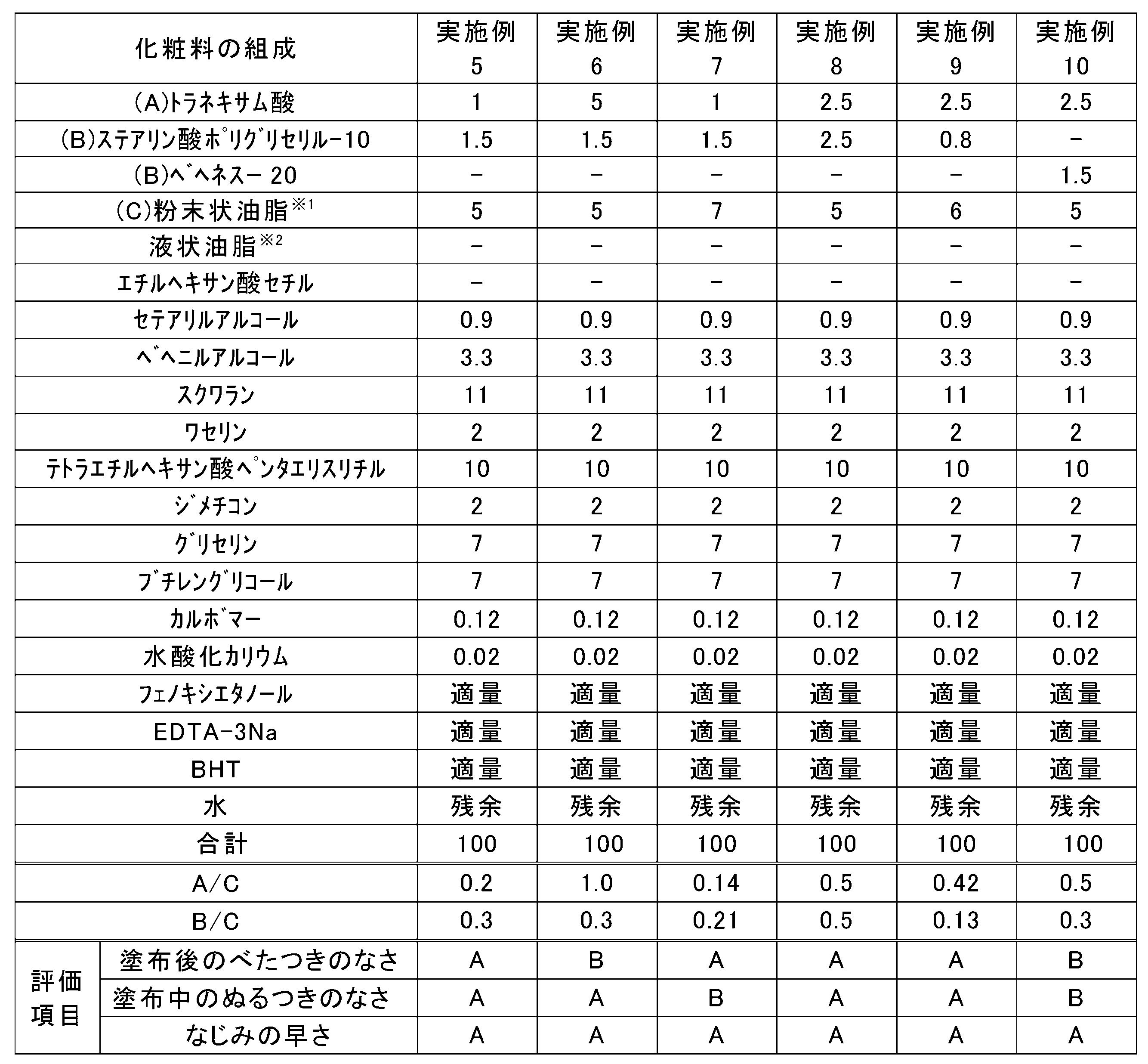
※1:日清オイリオグループ株式会社製、商品名:エネクイック(全トリグリセリド含有量を100質量%とした場合、1位~3位に炭素数10の脂肪酸残基Xを有する1種以上のXXX型トリグリセリド含量は93.9質量%、XXX型トリグリセリドの脂肪酸残基Xの1つを炭素数14の脂肪酸残基Yに置換したX2Y型トリグリセリド含量は5.4質量%である。融点(DSCチャートのピークトップの値)28.5℃)
※2:トリ(カプリル酸/カプリン酸)グリセリル、日清オイリオグループ株式会社製、商品名:O.D.O
※2:トリ(カプリル酸/カプリン酸)グリセリル、日清オイリオグループ株式会社製、商品名:O.D.O
上記の結果から、本発明による乳化化粧料はいずれも、乳化安定性に優れながら、塗布後のべたつきのなさ、塗布中のぬるつきのなさ、およびなじみの早さに優れたものであることがわかる。また、比較例の結果を併せて考えると、本発明による乳化化粧料においては、トラネキサム酸、界面活性剤、および特定の粉末状油脂を配合することで優れた効果を達成していることがわかる。
Claims (11)
- (A)トラネキサム酸またはその誘導体、
(B)界面活性剤、および
(C)全トリグリセリド含有量を100質量%とした場合、1位~3位に炭素数xの脂肪酸残基Xを有する1種以上のXXX型トリグリセリドを80~99質量%と、前記XXX型トリグリセリドの脂肪酸残基Xの1つを炭素数yの脂肪酸残基Yに置換した1種以上のX2Y型トリグリセリドを20~1質量%とを含有し、炭素数xは8~12から選択される整数であり、炭素数yは、それぞれ独立して、x+2~x+8から選択される整数である、粉末状油脂、
を含む、乳化化粧料。 - (C)粉末状油脂が、全トリグリセリド含有量を100質量%とした場合、1位~3位に炭素数xの脂肪酸残基Xを有するXXX型トリグリセリドを90~99質量%と、前記XXX型トリグリセリドの脂肪酸残基Xの1つを炭素数yの脂肪酸残基Yに置換した1種以上のX2Y型トリグリセリドを10~1質量%とを含有し、炭素数xは10であり、炭素数yは、それぞれ独立して、x+4~x+8から選択される整数である、請求項1に記載の乳化化粧料。
- (C)粉末状油脂の融点が、25℃以上50℃以下である、請求項1に記載の乳化化粧料。
- (C)成分の配合量が、前記乳化化粧料の総質量に対して、0.5質量%以上20質量%以下である、請求項1に記載の乳化化粧料。
- (B)界面活性剤が、ポリグリセリン脂肪酸エステルおよびポリオキシエチレンアルキルエーテルからなる群から選択される少なくとも1種を含む、請求項1に記載の乳化化粧料。
- (B)界面活性剤が、平均重合度が4~12のポリグリセリン1分子と、炭素数12以上の脂肪酸1~5分子とがエステル縮合してなるポリグリセリン脂肪酸エステルを含む、請求項1に記載の乳化化粧料。
- (B)成分の配合量が、前記乳化化粧料の総質量に対して、0.3質量%以上3.0質量%以下である、請求項1に記載の乳化化粧料。
- (A)成分の配合量が、前記乳化化粧料の総質量に対して、0.5質量%以上10質量%以下である、請求項1に記載の乳化化粧料。
- (B)成分の(C)成分に対する配合比(B/C)が、質量基準で、0.1以上3.0以下である、請求項1に記載の乳化化粧料。
- (A)成分の(C)成分に対する配合比(A/C)が、質量基準で、0.1以上4.0以下である、請求項1に記載の乳化化粧料。
- 水中油型乳化化粧料である、請求項1~10のいずれか一項に記載の乳化化粧料。
Priority Applications (1)
| Application Number | Priority Date | Filing Date | Title |
|---|---|---|---|
| JP2024571697A JPWO2024154591A1 (ja) | 2023-01-18 | 2024-01-05 |
Applications Claiming Priority (2)
| Application Number | Priority Date | Filing Date | Title |
|---|---|---|---|
| JP2023006122 | 2023-01-18 | ||
| JP2023-006122 | 2023-01-18 |
Publications (1)
| Publication Number | Publication Date |
|---|---|
| WO2024154591A1 true WO2024154591A1 (ja) | 2024-07-25 |
Family
ID=91955889
Family Applications (1)
| Application Number | Title | Priority Date | Filing Date |
|---|---|---|---|
| PCT/JP2024/000032 Ceased WO2024154591A1 (ja) | 2023-01-18 | 2024-01-05 | 乳化化粧料 |
Country Status (2)
| Country | Link |
|---|---|
| JP (1) | JPWO2024154591A1 (ja) |
| WO (1) | WO2024154591A1 (ja) |
Citations (3)
| Publication number | Priority date | Publication date | Assignee | Title |
|---|---|---|---|---|
| JP2013147433A (ja) * | 2012-01-17 | 2013-08-01 | Shiseido Co Ltd | 液状化粧料 |
| JP6178950B1 (ja) * | 2016-01-21 | 2017-08-09 | 日清オイリオグループ株式会社 | 液状成分の増粘剤 |
| JP2021054731A (ja) * | 2019-09-27 | 2021-04-08 | 富士フイルム株式会社 | 水中油型乳化組成物、及び皮膚外用剤 |
-
2024
- 2024-01-05 JP JP2024571697A patent/JPWO2024154591A1/ja active Pending
- 2024-01-05 WO PCT/JP2024/000032 patent/WO2024154591A1/ja not_active Ceased
Patent Citations (3)
| Publication number | Priority date | Publication date | Assignee | Title |
|---|---|---|---|---|
| JP2013147433A (ja) * | 2012-01-17 | 2013-08-01 | Shiseido Co Ltd | 液状化粧料 |
| JP6178950B1 (ja) * | 2016-01-21 | 2017-08-09 | 日清オイリオグループ株式会社 | 液状成分の増粘剤 |
| JP2021054731A (ja) * | 2019-09-27 | 2021-04-08 | 富士フイルム株式会社 | 水中油型乳化組成物、及び皮膚外用剤 |
Also Published As
| Publication number | Publication date |
|---|---|
| JPWO2024154591A1 (ja) | 2024-07-25 |
Similar Documents
| Publication | Publication Date | Title |
|---|---|---|
| JP6044699B2 (ja) | メイクアップ化粧料用組成物、及びメイクアップ化粧料 | |
| EP2550954B1 (en) | Vaseline-like composition, and cosmetic preparation | |
| JP2008291027A (ja) | 水中油型乳化組成物及びその製造方法 | |
| JPWO2006003992A1 (ja) | 液状エステル組成物及びそれを含有する化粧料 | |
| JP2010254624A (ja) | マイクロエマルション | |
| WO2023090164A1 (ja) | 化粧料 | |
| WO2024157788A1 (ja) | 粉末化粧料 | |
| WO2024154592A1 (ja) | 化粧料 | |
| JP4039542B2 (ja) | O/w/o型複合エマルジョン | |
| JPH11171737A (ja) | 水中油型毛髪化粧料 | |
| WO2024142802A1 (ja) | 化粧料 | |
| JP2004189693A (ja) | 水中油型乳化化粧料 | |
| JPH11228378A (ja) | 乳化化粧料 | |
| JP7132251B2 (ja) | 高含量の植物性バターを含む化粧品フォーム組成物 | |
| JP5662750B2 (ja) | 油中水型乳化組成物 | |
| JP5134197B2 (ja) | 水中油型マイクロエマルション及びその製造方法 | |
| JP2022147656A (ja) | 水中油型乳化化粧料 | |
| JPH11286418A (ja) | 水中油型毛髪化粧料 | |
| JP7346772B1 (ja) | ポリグリセリンと脂肪酸及びジカルボン酸をエステル化した化合物 | |
| US12491150B2 (en) | Compound in which polyglycerol, fatty acid, and dicarboxylic acid have been esterified | |
| JP2021070686A (ja) | 乳化化粧料 | |
| JP7627733B2 (ja) | ポリグリセリン脂肪酸エステル | |
| JP2006045133A (ja) | 水中油型乳化組成物 | |
| KR102923031B1 (ko) | 오일의 굴절률을 이용한 광택감이 향상된 화장료 조성물 | |
| JP2026017831A (ja) | 粉末化粧料 |
Legal Events
| Date | Code | Title | Description |
|---|---|---|---|
| 121 | Ep: the epo has been informed by wipo that ep was designated in this application |
Ref document number: 24744514 Country of ref document: EP Kind code of ref document: A1 |
|
| WWE | Wipo information: entry into national phase |
Ref document number: 2024571697 Country of ref document: JP |
|
| NENP | Non-entry into the national phase |
Ref country code: DE |
|
| 122 | Ep: pct application non-entry in european phase |
Ref document number: 24744514 Country of ref document: EP Kind code of ref document: A1 |