WO2024150624A1 - 合成単結晶ダイヤモンド - Google Patents
合成単結晶ダイヤモンド Download PDFInfo
- Publication number
- WO2024150624A1 WO2024150624A1 PCT/JP2023/045616 JP2023045616W WO2024150624A1 WO 2024150624 A1 WO2024150624 A1 WO 2024150624A1 JP 2023045616 W JP2023045616 W JP 2023045616W WO 2024150624 A1 WO2024150624 A1 WO 2024150624A1
- Authority
- WO
- WIPO (PCT)
- Prior art keywords
- single crystal
- crystal diamond
- synthetic single
- synthetic
- less
- Prior art date
- Legal status (The legal status is an assumption and is not a legal conclusion. Google has not performed a legal analysis and makes no representation as to the accuracy of the status listed.)
- Ceased
Links
Images

Classifications
-
- C—CHEMISTRY; METALLURGY
- C30—CRYSTAL GROWTH
- C30B—SINGLE-CRYSTAL GROWTH; UNIDIRECTIONAL SOLIDIFICATION OF EUTECTIC MATERIAL OR UNIDIRECTIONAL DEMIXING OF EUTECTOID MATERIAL; REFINING BY ZONE-MELTING OF MATERIAL; PRODUCTION OF A HOMOGENEOUS POLYCRYSTALLINE MATERIAL WITH DEFINED STRUCTURE; SINGLE CRYSTALS OR HOMOGENEOUS POLYCRYSTALLINE MATERIAL WITH DEFINED STRUCTURE; AFTER-TREATMENT OF SINGLE CRYSTALS OR A HOMOGENEOUS POLYCRYSTALLINE MATERIAL WITH DEFINED STRUCTURE; APPARATUS THEREFOR
- C30B29/00—Single crystals or homogeneous polycrystalline material with defined structure characterised by the material or by their shape
- C30B29/02—Elements
- C30B29/04—Diamond
-
- C—CHEMISTRY; METALLURGY
- C01—INORGANIC CHEMISTRY
- C01B—NON-METALLIC ELEMENTS; COMPOUNDS THEREOF; METALLOIDS OR COMPOUNDS THEREOF NOT COVERED BY SUBCLASS C01C
- C01B32/00—Carbon; Compounds thereof
- C01B32/25—Diamond
- C01B32/26—Preparation
-
- C—CHEMISTRY; METALLURGY
- C30—CRYSTAL GROWTH
- C30B—SINGLE-CRYSTAL GROWTH; UNIDIRECTIONAL SOLIDIFICATION OF EUTECTIC MATERIAL OR UNIDIRECTIONAL DEMIXING OF EUTECTOID MATERIAL; REFINING BY ZONE-MELTING OF MATERIAL; PRODUCTION OF A HOMOGENEOUS POLYCRYSTALLINE MATERIAL WITH DEFINED STRUCTURE; SINGLE CRYSTALS OR HOMOGENEOUS POLYCRYSTALLINE MATERIAL WITH DEFINED STRUCTURE; AFTER-TREATMENT OF SINGLE CRYSTALS OR A HOMOGENEOUS POLYCRYSTALLINE MATERIAL WITH DEFINED STRUCTURE; APPARATUS THEREFOR
- C30B9/00—Single-crystal growth from melt solutions using molten solvents
- C30B9/04—Single-crystal growth from melt solutions using molten solvents by cooling of the solution
- C30B9/08—Single-crystal growth from melt solutions using molten solvents by cooling of the solution using other solvents
- C30B9/10—Metal solvents
-
- C—CHEMISTRY; METALLURGY
- C01—INORGANIC CHEMISTRY
- C01P—INDEXING SCHEME RELATING TO STRUCTURAL AND PHYSICAL ASPECTS OF SOLID INORGANIC COMPOUNDS
- C01P2002/00—Crystal-structural characteristics
- C01P2002/80—Crystal-structural characteristics defined by measured data other than those specified in group C01P2002/70
- C01P2002/82—Crystal-structural characteristics defined by measured data other than those specified in group C01P2002/70 by IR- or Raman-data
-
- C—CHEMISTRY; METALLURGY
- C01—INORGANIC CHEMISTRY
- C01P—INDEXING SCHEME RELATING TO STRUCTURAL AND PHYSICAL ASPECTS OF SOLID INORGANIC COMPOUNDS
- C01P2006/00—Physical properties of inorganic compounds
- C01P2006/90—Other properties not specified above
Definitions
- single crystal diamonds are widely used in tools such as cutting tools, grinding tools, and wear-resistant tools.
- the single crystal diamonds used in tools include natural diamonds and synthetic diamonds.
- Normal synthetic diamonds contain isolated substitutional nitrogen atoms as impurities (type Ib).
- type Ib isolated substitutional nitrogen atoms as impurities
- Type IIa synthetic diamonds that contain almost no nitrogen impurities.
- Type IIa synthetic diamonds do not contain impurities or crystal defects that would prevent cracks from progressing, so when used in tools, they tend to chip the cutting edge.
- Patent Document 1 discloses a synthetic single crystal diamond that has high hardness and excellent chipping resistance.
- the synthetic single crystal diamond of the present disclosure is a synthetic single crystal diamond containing nitrogen atoms at a concentration of 200 ppm or more and 1500 ppm or less based on the number of atoms,
- the Raman shift ⁇ 1 cm ⁇ 1 of the peak in the first-order Raman scattering spectrum of the synthetic single crystal diamond and the Raman shift ⁇ 2 cm ⁇ 1 of the peak in the first-order Raman scattering spectrum of a synthetic type IIa single crystal diamond having a nitrogen atom concentration based on atomic number of 1 ppm or less satisfy the following formula A: -0.85 ⁇ 1- ⁇ 2 ⁇ -0.15 Formula A It is a synthetic single crystal diamond.
- FIG. 1 is a schematic cross-sectional view showing an example of a sample chamber configuration for use in producing synthetic single crystal diamond according to one embodiment of the present disclosure.
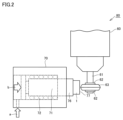
- FIG. 2 is a schematic view of the sliding test device.
- an object of the present disclosure is to provide a synthetic single crystal diamond that has excellent wear resistance, particularly in low-load, long-term sliding processing.
- This disclosure makes it possible to provide synthetic single crystal diamond that has excellent wear resistance, especially when processed for long periods of time under low loads.
- the synthetic single crystal diamond of the present disclosure is a synthetic single crystal diamond containing nitrogen atoms at a concentration of 200 ppm or more and 1500 ppm or less based on the number of atoms,
- the Raman shift ⁇ 1 cm ⁇ 1 of the peak in the first-order Raman scattering spectrum of the synthetic single crystal diamond and the Raman shift ⁇ 2 cm ⁇ 1 of the peak in the first-order Raman scattering spectrum of a synthetic type IIa single crystal diamond having a nitrogen atom concentration based on atomic number of 1 ppm or less satisfy the following formula A: -0.85 ⁇ 1- ⁇ 2 ⁇ -0.15 Formula A It is a synthetic single crystal diamond.
- This disclosure makes it possible to provide synthetic single crystal diamond that has excellent wear resistance, especially when processed for long periods of time under low loads.
- the synthetic single crystal diamond may have a peak half-width W in a first-order Raman scattering spectrum of 2.7 cm -1 or more and 4.5 cm -1 or less. This means that when the synthetic single crystal diamond is used as a material for a wear-resistant tool such as a die, the tool can have excellent wear resistance for a long period of time.
- the synthetic single crystal diamond may have an absorption peak in the wave number range of 2680 cm -1 to 2695 cm -1 in an infrared absorption spectrum measured by Fourier transform infrared spectroscopy.
- a synthetic single crystal diamond having such an absorption peak has improved sliding properties.
- the maximum absorption intensity IA of an absorption peak in the wave number range of 2680 cm -1 to 2695 cm -1 may be 1.0% or more of the absorption intensity IB at a wave number of 2160 cm -1 . This further improves the sliding properties of the synthetic single crystal diamond.
- the Knoop hardness in the ⁇ 100> direction on the ⁇ 001 ⁇ plane of the synthetic single crystal diamond may be 65 GPa or more and 90 GPa or less.
- the Knoop hardness is measured in accordance with JIS Z 2251:2009 at a temperature of 23°C ⁇ 5°C and a test load of 4.9 N. If the ⁇ 001 ⁇ ⁇ 100> Knoop hardness of the synthetic single crystal diamond is 65 GPa or more, it is much harder than metal materials and can therefore be suitably used for processing metal materials such as SUS, Ni alloys, and Ti alloys.
- the infrared absorption spectrum of the synthetic single crystal diamond measured by Fourier transform infrared spectroscopy may not include any absorption peaks derived from aggregates of nitrogen atoms. In this way, most of the nitrogen atoms in the synthetic single crystal diamond are present as isolated substitutional nitrogen atoms, which makes it easier for tensile stress to increase and improves the effect of suppressing abrasive wear.
- Nitrogen atoms in diamond crystals can be classified into isolated substitutional nitrogen atoms, aggregated nitrogen atoms, etc., depending on their form.
- An isolated substitutional nitrogen atom is one in which a nitrogen atom replaces one carbon atom in the position of a carbon atom in a diamond crystal.
- Synthetic single crystal diamond containing isolated substitutional nitrogen atoms exhibits an absorption peak at a wave number of about 1130 cm -1 (ie, wave number 1130 ⁇ 2 cm -1 ) in an infrared absorption spectrum measured by Fourier transform infrared spectroscopy.
- ESR Electron Spin Resonance
- Agglomerated nitrogen atoms are those in which two or more nitrogen atoms are aggregated together and present in a diamond crystal.
- Aggregated nitrogen atoms exist in A centers (pairs of two nitrogen atoms), B centers (aggregations of four nitrogen atoms), B' centers (platelets), H3 centers (aggregations of two nitrogen atoms), N3 centers (aggregations of three nitrogen atoms), etc.
- the A center (two nitrogen atom pair) is an aggregate consisting of two nitrogen atoms, which are covalently bonded and each nitrogen atom is substituted for a carbon atom constituting a diamond crystal.
- Diamonds containing the A center (two nitrogen atom pair) are called IaA type.
- Synthetic single crystal diamonds containing the A center (two nitrogen atom pair) show an absorption peak at a wave number of about 1282 cm -1 (for example, wave number 1282 ⁇ 2 cm -1 ) in the infrared absorption spectrum measured by Fourier transform infrared spectroscopy.
- the B center (agglomerate of four nitrogen atoms) is an aggregate consisting of one vacancy and four nitrogen atoms adjacent to the vacancy, and each nitrogen atom replaces a carbon atom that makes up the diamond crystal.
- Diamonds containing four nitrogen atom aggregates are called IaB type. Synthetic single crystal diamonds containing four nitrogen atom aggregates exhibit an absorption peak at a wave number of about 1175 cm ⁇ 1 (for example, wave number 1175 ⁇ 2 cm ⁇ 1 ) in an infrared absorption spectrum measured by Fourier transform infrared spectroscopy.
- B' centers are plate-shaped aggregates consisting of five or more nitrogen atoms and interstitial carbon, and are incorporated as inclusions within the crystal.
- Diamonds containing a B' center are called IaB' type. Synthetic single crystal diamonds containing a B' center (platelet) exhibit an absorption peak at a wave number of 1358 cm -1 or more and 1385 cm -1 or less in an infrared absorption spectrum measured by Fourier transform infrared spectroscopy.
- H3 centers are aggregates consisting of one vacancy and two nitrogen atoms adjacent to the vacancy, with each nitrogen atom substituting a carbon atom that constitutes a diamond crystal.
- nitrogen atom adjacent to a vacancy refers to the nitrogen atom with the shortest interatomic distance to the carbon atom (i.e., the nearest neighbor) when it is assumed that a carbon atom exists at the position of the vacancy. This also has the same meaning in the N3 center and B center described below.
- Synthetic single crystal diamond containing an H3 center exhibits an emission peak at a fluorescence wavelength of approximately 503 nm (e.g., 503 ⁇ 2 nm) in the fluorescence spectrum obtained by irradiating it with excitation light shorter than approximately 500 nm, for example, excitation light with a wavelength of 325 nm.
- An N3 center (agglomerate of three nitrogen atoms) is an aggregate consisting of one vacancy and three nitrogen atoms adjacent to the vacancy, and each nitrogen atom replaces a carbon atom that makes up the diamond crystal.
- Synthetic single crystal diamond containing an N3 center exhibits emission peaks near a fluorescence wavelength of 415 nm (e.g., a fluorescence wavelength of 415 ⁇ 2 nm) and/or within the range of fluorescence wavelengths of 420 nm to 470 nm in the fluorescence spectrum obtained by irradiating the diamond with excitation light shorter than approximately 410 nm, for example, excitation light with a wavelength of 325 nm.
- the inventors investigated the wear pattern when conventional synthetic single crystal diamond is used in sliding processing at low load for long periods of time. As a result, they estimated that the wear that occurs when used in sliding processing at low load for long periods of time is not wear due to mechanical destruction (accumulation of microcleavage), but rather wear caused by atoms falling off due to the accumulation of fatigue caused by long periods of sliding at low load.
- a ⁇ B means greater than or equal to A and less than or equal to B. If no unit is stated for A and only a unit is stated for B, the units of A and B are the same.
- a synthetic single crystal diamond according to one embodiment of the present disclosure (hereinafter also referred to as "this embodiment") is a synthetic single crystal diamond containing nitrogen atoms at a concentration of 200 ppm or more and 1500 ppm or less based on the number of atoms,
- the Raman shift ⁇ 1 cm ⁇ 1 of the peak in the first-order Raman scattering spectrum of the synthetic single crystal diamond and the Raman shift ⁇ 2 cm ⁇ 1 of the peak in the first-order Raman scattering spectrum of a synthetic type IIa single crystal diamond having a nitrogen atom concentration based on atomic number of 1 ppm or less show the relationship of the following formula A: -0.85 ⁇ 1- ⁇ 2 ⁇ -0.15 Formula A It is a synthetic single crystal diamond.
- the synthetic single crystal diamond of this embodiment has excellent wear resistance, especially when processed for long periods of time under low load. The reason for this is unclear, but is presumed to be as follows (i) and (ii).
- the synthetic single crystal diamond of this embodiment contains nitrogen atoms at a concentration of 200 ppm or more and 1500 ppm or less based on the atomic number. Furthermore, the Raman shift ⁇ 1 cm ⁇ 1 of the peak in the first-order Raman scattering spectrum of the synthetic single crystal diamond of this embodiment and the Raman shift ⁇ 2 cm ⁇ 1 of the peak in the first-order Raman scattering spectrum of a synthetic type IIa single crystal diamond having a nitrogen atom concentration of 1 ppm or less based on the atomic number of the diamond show the relationship of the following formula A. -0.85 ⁇ 1- ⁇ 2 ⁇ -0.15 Formula A
- the synthetic single crystal diamond of this embodiment contains a large amount of nitrogen, which changes the electronic state of the surface of the synthetic single crystal diamond, improving the sliding properties and reducing the coefficient of friction.
- the synthetic single crystal diamond of this embodiment contains nitrogen atoms at a concentration of 200 ppm or more and 1500 ppm or less based on the number of atoms (hereinafter also referred to as "nitrogen atom concentration").
- nitrogen atom concentration the lower limit of the nitrogen atom concentration of synthetic single crystal diamond is 200 ppm or more, may be 300 ppm or more, or may be 400 ppm or more.
- the upper limit of the nitrogen atom concentration of synthetic single crystal diamond is 1500 ppm or less, may be 1400 ppm or less, or may be 1300 ppm or less.
- the nitrogen atom concentration in synthetic single crystal diamond may be 200 ppm or more and 1500 ppm or less, may be 300 ppm or more and 1400 ppm or less, or may be 400 ppm or more and 1300 ppm or less.
- N (ppm) of a synthetic single crystal diamond is calculated from the absorption coefficient A (cm ⁇ 1 ) at a wave number of 1130 cm ⁇ 1 in the infrared absorption spectrum of the synthetic single crystal diamond measured by Fourier transform infrared spectroscopy, using the following calculation formula 1.
- N (ppm) 25 ⁇ A (cm ⁇ 1 )
- the state of internal stress of synthetic single crystal diamond can be evaluated by comparing the Raman shift ⁇ 1cm ⁇ 1 of the peak in the first-order Raman scattering spectrum of synthetic single crystal diamond with the Raman shift ⁇ 2cm ⁇ 1 of the peak in the first-order Raman scattering spectrum of synthetic type IIa single crystal diamond (hereinafter, also referred to as standard sample or synthetic type IIa single crystal diamond) with a nitrogen atom concentration of 1 ppm or less based on the atomic number of atoms.
- the state of internal stress of synthetic single crystal diamond can be evaluated by the magnitude of the peak position shift amount represented by the difference ( ⁇ 1- ⁇ 2) between the above ⁇ 1 and ⁇ 2. The reason for this will be explained below.
- the synthetic type IIa single crystal diamond used as the standard sample means a single crystal diamond that is synthesized by a temperature difference method under high temperature and high pressure, has high purity, and does not have lattice defects or internal strain.
- it is commercially available as a high purity type IIa single crystal diamond manufactured by Sumitomo Electric Co., Ltd.
- Synthetic type IIa single crystal diamond has a nitrogen atom concentration based on the atomic number of 1 ppm or less, and contains almost no nitrogen atoms, so there is no internal stress in the diamond crystal.
- synthetic type IIa single crystal diamond shows a sharp and strong single peak in the first-order Raman scattering spectrum.
- the Raman shift of this peak appears in the range of 1332 cm -1 to 1333 cm -1 .
- the value of the Raman shift changes depending on the temperature of the environment during measurement. In this specification, the Raman shift is a value measured at room temperature (20°C or more and 25°C or less).
- the Raman shift shifts to a lower frequency than synthetic type IIa single crystal diamond. At this time, tensile stress resulting from the isolated substitutional nitrogen atoms is generated within the diamond crystal.
- the Raman shift shifts to a higher frequency than synthetic type IIa single crystal diamond. At this time, either no tensile stress is generated within the diamond crystal, or compressive stress is generated.
- the amount of isolated substitutional nitrogen atoms in the synthetic single crystal diamond is sufficiently large, and the synthetic single crystal diamond can have excellent sliding properties and excellent wear resistance.
- the lower limit of ( ⁇ 1- ⁇ 2) is greater than -0.85, and may be greater than or equal to -0.83, greater than or equal to -0.76, or greater than or equal to -0.68.
- the upper limit of ( ⁇ 1- ⁇ 2) is less than or equal to -0.15, less than or equal to -0.20, or less than or equal to -0.25.
- ( ⁇ 1- ⁇ 2) is greater than -0.85 and less than or equal to -0.15, and may be greater than or equal to -0.83 and less than or equal to -0.15, greater than or equal to -0.76 and less than or equal to -0.20, or greater than or equal to -0.68 and less than or equal to -0.25.
- the half width W of the peak in the first-order Raman scattering spectrum of the synthetic single crystal diamond of this embodiment may be 2.7 cm -1 or more and 4.5 cm -1 or less.
- the half width means full width at half maximum (FWHM). Since the synthetic single crystal diamond of this embodiment contains a large amount of isolated substitutional nitrogen atoms, it is presumed that the isolated substitutional nitrogen atoms cause lattice distortion, and the half width W of the peak widens.
- the large amount of isolated substitutional nitrogen atoms in the synthetic single crystal diamond of this embodiment generates tensile stress in the carbon atoms on the diamond surface, reducing the frequency of atoms falling off due to prolonged sliding, and reducing wear due to fatigue. Therefore, when the synthetic single crystal diamond of this embodiment is used as a material for wear-resistant tools such as dies, the tools can have excellent wear resistance for a long period of time.
- the lower limit of the half width W may be 2.7 cm -1 or more, 2.9 cm -1 or more, or 3.1 cm -1 or more from the viewpoint of improving wear resistance.
- the upper limit of the half width W may be 4.5 cm -1 or less, 4.3 cm -1 or less, or 4.2 cm -1 or less from the viewpoint of improving sliding characteristics.
- the half width W may be 2.7 cm -1 or more and 4.5 cm -1 or less, 2.9 cm -1 or more and 4.3 cm -1 or less, or 3.1 cm -1 or more and 4.2 cm -1 or less.
- the Raman shift and half-width of the peak in the first-order Raman scattering spectrum of synthetic single crystal diamond and a standard sample are measured using a Raman microscope. Measurements are performed at room temperature (20°C to 25°C) using a 532 nm laser as the excitation light. Temperature changes in the detector and optical system of the Raman microscope during measurements are kept to within ⁇ 1°C.
- An arbitrary surface of a synthetic single crystal diamond is polished and the Raman shift ⁇ 1 cm ⁇ 1 of the peak in the first-order Raman scattering spectrum of the polished surface is measured.
- An arbitrary surface of a synthetic type IIa single crystal diamond as a standard sample is polished and the Raman shift ⁇ 2 cm ⁇ 1 of the peak in the first-order Raman scattering spectrum of the polished surface is measured.
- ⁇ 1 and ⁇ 2 are the wave numbers at which the first-order Raman scattering spectrum signal is strongest.
- the peak shape is evaluated by peak fitting using a Lorentzian function or a Gaussian function. Based on the peak shape after peak fitting, the value of ( ⁇ 1- ⁇ 2) cm -1 is calculated. Based on the peak shape, the half-width W of the peak in the first-order Raman scattering spectrum of the synthetic single crystal diamond is obtained.
- an absorption peak may exist in the wave number range of 2680 cm -1 or more and 2695 cm -1 or less.
- Synthetic single crystal diamond having such an absorption peak has improved sliding properties. Although the mechanism is not clear, the inventors speculate that the electronic state of the isolated substitutional nitrogen atom in the crystal lattice is a favorable state for improving sliding properties.
- the presence of an absorption peak in the wavenumber range of 2680 cm -1 or more and 2695 cm -1 or less in an infrared absorption spectrum means that a maximum value exists in a chart prepared by subtracting a baseline in the wavenumber range of 2680 cm -1 or more and 2695 cm -1 or less in an absorption spectrum chart, and the shape of the peak including the maximum value is a substantially symmetrical mountain-shaped figure.
- the maximum absorption intensity IA of the absorption peak in the wave number range of 2680 cm -1 to 2695 cm -1 may be 1.0% or more of the absorption intensity IB at the wave number 2160 cm -1 . This further improves the sliding properties of the synthetic single crystal diamond.
- the absorption intensity IB at the wave number 2160 cm -1 is the absorption intensity derived from the absorption by diamond phonons.
- the lower limit of the percentage (IA/IB) x 100 of the maximum absorption intensity IA to the absorption intensity IB may be 1.0% or more, 1.5% or more, or 2.0% or more.
- the upper limit of the percentage (IA/IB) x 100 is not particularly limited, but may be, for example, 30% or less.
- the percentage (IA/IB) x 100 may be 1.0% or more and 30% or less, 1.5% or more and 0% or less, or 2.0% or more and 30% or less.
- the synthetic single crystal diamond of this embodiment measured by Fourier transform infrared spectroscopy, there may be no absorption peaks derived from nitrogen atom aggregates. Nitrogen atom aggregates that show absorption peaks in the infrared absorption spectrum are the A center, B center, and B' center. In other words, the synthetic single crystal diamond of this embodiment may not contain the A center, B center, or B' center. As a result, most of the nitrogen atoms in the synthetic single crystal diamond exist as isolated substitutional nitrogen atoms, which makes it easier for the tensile stress to increase and improves the effect of suppressing abrasive wear.
- the absorption peak A exists at a wave number of 1280 cm -1 or more and 1284 cm -1 or less in the infrared absorption spectrum.
- the absorption peak B exists at a wave number of 1173 cm -1 or more and 1177 cm -1 or less in the infrared absorption spectrum.
- the absorption peak C exists at a wave number of 1358 cm -1 or more and 1385 cm -1 or less in the infrared absorption spectrum.
- the absorption peak originating from the aggregate of nitrogen atoms exists in the infrared absorption spectrum.
- the absorption peak originating from the aggregate of nitrogen atoms does not exist in the infrared absorption spectrum.
- Possible forms of nitrogen atoms contained in the synthetic single crystal diamond of this embodiment include NV centers in which a nitrogen atom is bonded to a vacancy, and H3 centers consisting of two nitrogen atoms and a vacancy. The presence or absence of these cannot be confirmed by infrared absorption spectroscopy, but can be confirmed by luminescence.
- the infrared absorption spectrum of synthetic single crystal diamond is created by processing a synthetic single crystal diamond into a plate about 1 mm thick, polishing the two light-transmitting surfaces to a mirror finish, and then measuring the absorbance in the infrared region using Fourier transform infrared spectroscopy. Measurements are performed at room temperature (20°C or higher and 25°C or lower). Temperature changes in the measuring equipment and sample during measurement are kept to less than ⁇ 1°C.
- Knoop hardness> The Knoop hardness in the ⁇ 100> direction on the ⁇ 001 ⁇ plane of the synthetic single crystal diamond of this embodiment (also referred to as " ⁇ 001 ⁇ 100> Knoop hardness" in this disclosure) may be 65 GPa or more and 90 GPa or less.
- a generic plane orientation including a plane orientation that is equivalent in crystal geometry is indicated by ⁇
- a generic direction including a direction that is equivalent in crystal geometry is indicated by ⁇ >.
- the hardness in the ⁇ 100> direction on the ⁇ 001 ⁇ plane of a normal Ib type single crystal diamond (atomic number-based concentration of nitrogen atoms: 50 to 200 ppm) is about 100 GPa.
- the synthetic single crystal diamond of this embodiment may be lower than this. If the ⁇ 001 ⁇ 100> Knoop hardness of the synthetic single crystal diamond is 65 GPa or more, it is much harder than metal materials, and can be suitably used for applications in processing metal materials such as SUS, Ni alloys, and Ti alloys.
- the lower limit of the ⁇ 001 ⁇ 100> Knoop hardness may be 65 GPa or more, 73 GPa or more, or 77 GPa or more.
- the upper limit of the ⁇ 001 ⁇ 100> Knoop hardness may be 90 GPa or less, 87 GPa or less, or 85 GPa or less.
- the ⁇ 001 ⁇ 100> Knoop hardness may be 65 GPa or more and 90 GPa or less, 73 GPa or more and 87 GPa or less, or 77 GPa or more and 85 GPa or less.
- the ⁇ 001 ⁇ 100> Knoop hardness (hereafter also referred to as HK, in GPa) is measured in accordance with JIS Z 2251:2009 at a temperature of 23°C ⁇ 5°C and a test load of 4.9 N.
- HK Knoop hardness
- Embodiment 2 Method for producing synthetic single crystal diamond
- An example of a method for producing the synthetic single crystal diamond of embodiment 1 is described below.
- the synthetic single crystal diamond of embodiment 1 can be produced by a temperature difference method using a sample chamber having the configuration shown in Figure 1, for example.
- a sample chamber 10 used for producing a synthetic single crystal diamond 1 an insulator 2, a carbon source 3, a solvent metal 4, and a seed crystal 5 are arranged in a space surrounded by a graphite heater 7, and a pressure medium 6 is arranged outside the graphite heater 7.
- the temperature difference method is a synthesis method in which a vertical temperature gradient is provided inside the sample chamber 10, a carbon source 3 is arranged in a high temperature section ( Thigh ) and a diamond seed crystal 5 is arranged in a low temperature section ( Tlow ), a solvent metal 4 is arranged between the carbon source 3 and the seed crystal 5, and synthetic single crystal diamond 1 is grown on the seed crystal 5 under conditions maintained above the temperature at which the solvent metal 4 melts and above the pressure at which diamond becomes thermally stable.
- diamond powder As the carbon source 3. It is preferable to use diamond powder as the carbon source 3. Graphite or pyrolytic carbon can also be used.
- the solvent metal 4 may be one or more metals selected from iron (Fe), cobalt (Co), nickel (Ni), manganese (Mn), etc., or an alloy containing these metals.
- the solvent metal 4 may further contain one or more elements selected from the group consisting of titanium (Ti), vanadium (V), chromium (Cr), manganese (Mn), copper (Cu), zirconium (Zr), niobium (Nb), molybdenum (Mo), ruthenium (Ru), rhodium (Rh), hafnium (Hf), tantalum (Ta), tungsten (W), osmium (Os), iridium (Ir), and platinum (Pt).
- nitrides such as iron nitride (Fe 2 N, Fe 3 N), aluminum nitride (AlN), phosphorus nitride (P 3 N 4 ), silicon nitride (Si 3 N 4 ), or organic nitrogen compounds such as melamine and sodium azide can be added as a single or mixed body.
- diamond or graphite containing a large amount of nitrogen can be added as a nitrogen supply source.
- nitrogen atoms are contained in the synthetic single crystal diamond 1 that is synthesized. At this time, the nitrogen atoms in the synthetic single crystal diamond 1 mainly exist as isolated substitution type nitrogen atoms.
- the content of the nitrogen source in the carbon source 3 or the solvent metal 4 is adjusted so that the concentration of nitrogen atoms in the synthesized diamond single crystal is 200 ppm or more and 1500 ppm or less.
- the solvent metal is an alloy consisting of iron-cobalt-nickel and the nitrogen source is iron nitride (Fe 3 N)
- the concentration of iron nitride (Fe 3 N) in the solvent metal can be 0.01 to 0.15 mass %.
- the pressure and temperature are controlled to predetermined conditions using an ultra-high pressure generator. Specifically, the temperature of the low temperature section is first raised to 1350-1400°C. Next, the pressure is raised to 5.5 GPa while maintaining the temperature (hereinafter also referred to as “first step”). Next, while maintaining the pressure at 5.5 GPa, the power input to the ultra-high pressure generator is gradually reduced over 60 hours so that the temperature of the low temperature section can be lowered to 1300°C ⁇ 10°C (hereinafter also referred to as "second step”). This allows the synthetic single crystal diamond of embodiment 1 to be obtained. By setting the pressure and temperature conditions during synthesis to the same as those in the first and second steps, the obtained synthetic single crystal diamond can contain a large amount of isolated substitutional nitrogen atoms. Such synthesis conditions were newly discovered by the present inventors.
- An alloy of iron-cobalt-nickel was prepared as the solvent metal, and iron nitride (Fe 3 N) powder was added thereto as a nitrogen source.
- the concentration of iron nitride in the solvent metal is shown in the "Iron nitride concentration (mass %)" column under "Manufacturing conditions" in Table 1. For example, in sample 2, the concentration of iron nitride in the solvent metal was 0.01 mass %.
- Diamond powder was used as the carbon source, and about 0.5 mg of a single diamond crystal was used as the seed crystal.
- the temperature inside the sample chamber was adjusted with a heater so that there was a temperature difference of several tens of degrees between the high-temperature area where the carbon source was placed and the low-temperature area where the seed crystal was placed.
- the temperature of the low-temperature section was first raised to the temperature listed in the "Temperature °C” column of "First Step” under “Manufacturing Conditions” in Table 1. Next, the pressure was raised to 5.5 GPa while maintaining the temperature (first step). Next, for samples marked “Yes” in the “Second Step: Power Input Adjustment” column in Table 1, the power input to the ultra-high pressure generator was gradually reduced over 60 hours so that the temperature of the low-temperature section could be lowered to 1300°C ⁇ 10°C while maintaining the pressure at 5.5 GPa (second step). For samples marked "No” in the "Second Step: Power Input Adjustment” column in Table 1, the second step was not performed, and the temperature and pressure of the first step were maintained for 60 hours. Through the above steps, synthetic single crystal diamonds were obtained from each sample.
- the obtained synthetic single crystal diamond was subjected to nitrogen atom concentration measurement, Raman spectroscopic analysis, infrared spectroscopic analysis, Knoop hardness measurement, and sliding test.
- the sliding test device 80 includes a machining center 60 and a sample holder 70.
- the machining center 60 includes a spindle 61 and a fixing screw 62 for fixing a SUS wheel 63 to the spindle 61.
- the sample holder 70 includes a jig 76 for holding the synthetic single crystal diamond 1 of each sample to be measured, an air cylinder 71 for moving the jig 76 toward the SUS wheel 63, and a linear guide 72 arranged around the air cylinder 71.
- the SUS wheel 63 is a disk-shaped wheel with a diameter of 10 mm and a thickness of 2 mm, and the cutting edge is U-shaped with a cutting edge radius of 1 mm.
- the synthetic single crystal diamond 1 of each sample is a plate-shaped wheel with a first surface 77 pressed against the SUS wheel 63 polished by a diamond grinding machine.
- the first surface of the synthetic single crystal diamond 1 is a (100) surface.
- the sliding test conditions are as follows. The following conditions correspond to a long-term sliding process under a low load. Load: 0.5N Circumferential speed: 150 m/min Test time: 200 min At the end of the test (after 200 min), the depth of the sliding wear mark formed on the surface of the synthetic single crystal diamond 1 of each sample was measured. The results are shown in the "Sliding wear mark depth ⁇ m" column of "Sliding test” in Table 1. The smaller the sliding wear mark depth, the better the sliding characteristics and wear resistance of the synthetic single crystal diamond.
- Samples 3 to 16 correspond to Examples.
- Samples 1, 2, and 17 correspond to Comparative Examples.
- Samples 3 to 16 showed smaller sliding wear mark depths in the sliding test than Samples 1, 2, and 17 (Comparative Examples), and it was confirmed that they have excellent wear resistance even in long-term sliding processing under low load.
Landscapes
- Chemical & Material Sciences (AREA)
- Organic Chemistry (AREA)
- Engineering & Computer Science (AREA)
- Crystallography & Structural Chemistry (AREA)
- Materials Engineering (AREA)
- Metallurgy (AREA)
- Life Sciences & Earth Sciences (AREA)
- General Life Sciences & Earth Sciences (AREA)
- Geology (AREA)
- Inorganic Chemistry (AREA)
- Crystals, And After-Treatments Of Crystals (AREA)
- Carbon And Carbon Compounds (AREA)
Priority Applications (4)
| Application Number | Priority Date | Filing Date | Title |
|---|---|---|---|
| KR1020257023242A KR20250133896A (ko) | 2023-01-11 | 2023-12-20 | 합성 단결정 다이아몬드 |
| EP23916238.1A EP4650497A1 (en) | 2023-01-11 | 2023-12-20 | Synthetic monocrystalline diamond |
| JP2024570114A JPWO2024150624A1 (https=) | 2023-01-11 | 2023-12-20 | |
| CN202380090759.0A CN120569520A (zh) | 2023-01-11 | 2023-12-20 | 合成单晶金刚石 |
Applications Claiming Priority (2)
| Application Number | Priority Date | Filing Date | Title |
|---|---|---|---|
| JP2023002185 | 2023-01-11 | ||
| JP2023-002185 | 2023-01-11 |
Publications (1)
| Publication Number | Publication Date |
|---|---|
| WO2024150624A1 true WO2024150624A1 (ja) | 2024-07-18 |
Family
ID=91896833
Family Applications (1)
| Application Number | Title | Priority Date | Filing Date |
|---|---|---|---|
| PCT/JP2023/045616 Ceased WO2024150624A1 (ja) | 2023-01-11 | 2023-12-20 | 合成単結晶ダイヤモンド |
Country Status (6)
| Country | Link |
|---|---|
| EP (1) | EP4650497A1 (https=) |
| JP (1) | JPWO2024150624A1 (https=) |
| KR (1) | KR20250133896A (https=) |
| CN (1) | CN120569520A (https=) |
| TW (1) | TW202432917A (https=) |
| WO (1) | WO2024150624A1 (https=) |
Citations (6)
| Publication number | Priority date | Publication date | Assignee | Title |
|---|---|---|---|---|
| JP2015134718A (ja) * | 2010-06-03 | 2015-07-27 | エレメント シックス リミテッド | ダイヤモンド工具 |
| JP2017007887A (ja) * | 2015-06-19 | 2017-01-12 | 住友電気工業株式会社 | ダイヤモンド単結晶、工具およびダイヤモンド単結晶の製造方法 |
| WO2019077844A1 (ja) * | 2017-10-20 | 2019-04-25 | 住友電気工業株式会社 | 合成単結晶ダイヤモンド |
| WO2019077888A1 (ja) | 2017-10-20 | 2019-04-25 | 住友電気工業株式会社 | 合成単結晶ダイヤモンド、工具、及び、合成単結晶ダイヤモンドの製造方法 |
| WO2021106283A1 (ja) * | 2019-11-26 | 2021-06-03 | 住友電気工業株式会社 | 合成単結晶ダイヤモンド、それを備える工具、及び、合成単結晶ダイヤモンドの製造方法 |
| JP2023002185A (ja) | 2021-06-22 | 2023-01-10 | トヨタ自動車株式会社 | 情報処理装置、算出方法及び算出プログラム |
Family Cites Families (1)
| Publication number | Priority date | Publication date | Assignee | Title |
|---|---|---|---|---|
| JP6709302B2 (ja) | 2019-02-14 | 2020-06-10 | 信越ポリマー株式会社 | 高耐熱・高摺動性フィルム |
-
2023
- 2023-12-20 EP EP23916238.1A patent/EP4650497A1/en active Pending
- 2023-12-20 JP JP2024570114A patent/JPWO2024150624A1/ja active Pending
- 2023-12-20 WO PCT/JP2023/045616 patent/WO2024150624A1/ja not_active Ceased
- 2023-12-20 CN CN202380090759.0A patent/CN120569520A/zh active Pending
- 2023-12-20 KR KR1020257023242A patent/KR20250133896A/ko active Pending
-
2024
- 2024-01-04 TW TW113100390A patent/TW202432917A/zh unknown
Patent Citations (6)
| Publication number | Priority date | Publication date | Assignee | Title |
|---|---|---|---|---|
| JP2015134718A (ja) * | 2010-06-03 | 2015-07-27 | エレメント シックス リミテッド | ダイヤモンド工具 |
| JP2017007887A (ja) * | 2015-06-19 | 2017-01-12 | 住友電気工業株式会社 | ダイヤモンド単結晶、工具およびダイヤモンド単結晶の製造方法 |
| WO2019077844A1 (ja) * | 2017-10-20 | 2019-04-25 | 住友電気工業株式会社 | 合成単結晶ダイヤモンド |
| WO2019077888A1 (ja) | 2017-10-20 | 2019-04-25 | 住友電気工業株式会社 | 合成単結晶ダイヤモンド、工具、及び、合成単結晶ダイヤモンドの製造方法 |
| WO2021106283A1 (ja) * | 2019-11-26 | 2021-06-03 | 住友電気工業株式会社 | 合成単結晶ダイヤモンド、それを備える工具、及び、合成単結晶ダイヤモンドの製造方法 |
| JP2023002185A (ja) | 2021-06-22 | 2023-01-10 | トヨタ自動車株式会社 | 情報処理装置、算出方法及び算出プログラム |
Non-Patent Citations (2)
| Title |
|---|
| CHEN LIANGCHAO, MIAO XINYUAN, MA HONGAN, GUO LONGSUO, WANG ZHANKE, YANG ZHIQIANG, FANG CHAO, JIA XIAOPENG: "Synthesis and characterization of diamonds with different nitrogen concentrations under high pressure and high temperature conditions", CRYSTENGCOMM, ROYAL SOCIETY OF CHEMISTRY, CAMBRIDGE, GB, vol. 20, no. 44, 13 November 2018 (2018-11-13), GB , pages 7164 - 7169, XP093192380, ISSN: 1466-8033, DOI: 10.1039/C8CE01533C * |
| See also references of EP4650497A1 |
Also Published As
| Publication number | Publication date |
|---|---|
| TW202432917A (zh) | 2024-08-16 |
| JPWO2024150624A1 (https=) | 2024-07-18 |
| EP4650497A1 (en) | 2025-11-19 |
| CN120569520A (zh) | 2025-08-29 |
| KR20250133896A (ko) | 2025-09-09 |
Similar Documents
| Publication | Publication Date | Title |
|---|---|---|
| JP7462419B2 (ja) | 合成単結晶ダイヤモンド | |
| JP6582597B2 (ja) | ダイヤモンド単結晶、工具およびダイヤモンド単結晶の製造方法 | |
| CN115698393B (zh) | 合成单晶金刚石及其制造方法 | |
| WO2019077888A1 (ja) | 合成単結晶ダイヤモンド、工具、及び、合成単結晶ダイヤモンドの製造方法 | |
| JP4732169B2 (ja) | ダイヤモンド工具および単結晶ダイヤモンドの合成方法 | |
| WO2022264706A1 (ja) | 合成単結晶ダイヤモンド及びその製造方法 | |
| JP7722370B2 (ja) | 合成単結晶ダイヤモンド及びその製造方法 | |
| WO2024150624A1 (ja) | 合成単結晶ダイヤモンド | |
| WO2022264705A1 (ja) | 合成単結晶ダイヤモンド及びその製造方法 | |
| JP2022139094A (ja) | 合成単結晶ダイヤモンド及びその製造方法 |
Legal Events
| Date | Code | Title | Description |
|---|---|---|---|
| 121 | Ep: the epo has been informed by wipo that ep was designated in this application |
Ref document number: 23916238 Country of ref document: EP Kind code of ref document: A1 |
|
| WWE | Wipo information: entry into national phase |
Ref document number: 2024570114 Country of ref document: JP |
|
| WWE | Wipo information: entry into national phase |
Ref document number: 202380090759.0 Country of ref document: CN |
|
| ENP | Entry into the national phase |
Ref document number: 1020257023242 Country of ref document: KR Free format text: ST27 STATUS EVENT CODE: A-0-1-A10-A15-NAP-PA0105 (AS PROVIDED BY THE NATIONAL OFFICE) |
|
| NENP | Non-entry into the national phase |
Ref country code: DE |
|
| WWP | Wipo information: published in national office |
Ref document number: 202380090759.0 Country of ref document: CN |
|
| WWP | Wipo information: published in national office |
Ref document number: 2023916238 Country of ref document: EP |