WO2024143488A1 - センサ素子、センサ素子の製造方法およびガス測定装置 - Google Patents
センサ素子、センサ素子の製造方法およびガス測定装置 Download PDFInfo
- Publication number
- WO2024143488A1 WO2024143488A1 PCT/JP2023/046994 JP2023046994W WO2024143488A1 WO 2024143488 A1 WO2024143488 A1 WO 2024143488A1 JP 2023046994 W JP2023046994 W JP 2023046994W WO 2024143488 A1 WO2024143488 A1 WO 2024143488A1
- Authority
- WO
- WIPO (PCT)
- Prior art keywords
- gas
- sensor element
- sensitive film
- tertiary amine
- aldehyde
- Prior art date
- Legal status (The legal status is an assumption and is not a legal conclusion. Google has not performed a legal analysis and makes no representation as to the accuracy of the status listed.)
- Ceased
Links
Images



Classifications
-
- G—PHYSICS
- G01—MEASURING; TESTING
- G01N—INVESTIGATING OR ANALYSING MATERIALS BY DETERMINING THEIR CHEMICAL OR PHYSICAL PROPERTIES
- G01N5/00—Analysing materials by weighing, e.g. weighing small particles separated from a gas or liquid
- G01N5/02—Analysing materials by weighing, e.g. weighing small particles separated from a gas or liquid by absorbing or adsorbing components of a material and determining change of weight of the adsorbent, e.g. determining moisture content
Definitions
- Patent Document 1 describes an odor sensor including two or more sensor elements each having a substance adsorption film that adsorbs odorous substances and an electrical signal conversion unit that measures the electrical properties of the substance adsorption film, and an odor measurement system using the odor sensor.
- Patent Document 1 also describes that the substance adsorption film of the sensor element includes a basic skeleton including a conductive polymer and a dopant that modifies the basic skeleton of the conductive polymer.
- Patent Document 1 further describes that the substance adsorption films of the two or more sensor elements each have a different content ratio of dopant to conductive polymer.
- the sensor element of the present invention has a sensitive film containing a tertiary amine, an acid, and a polymer. Therefore, when aldehyde gas comes into contact with the sensitive film of the sensor element, the aldehyde gas reacts with the tertiary amine due to the catalytic action of the acid, producing hemiaminal. At the same time, a reaction occurs in which the hemiaminal decomposes to release aldehyde gas and return to the tertiary amine.
- the present inventors have focused on the crystal size of the tertiary amine in order to promote the reaction between the tertiary amine in the sensitive film and the aldehyde, and have further investigated.
- the sensitive film can be formed by a method in which a first solution containing a tertiary amine and an acid and a second solution in which a polymer is dissolved in a dispersion solvent are mixed, coated, and dried.
- the sensitive film formed by the above method has fine crystals of tertiary amines because the crystal growth of the tertiary amines during the film formation process is suppressed.
- the contact area between the tertiary amines and the aldehyde gas becomes sufficiently large, which is believed to facilitate the reaction of the tertiary amines in the sensitive film with the aldehyde.
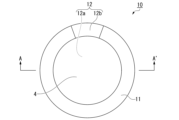
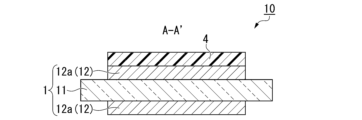
- the sensitive film 4 contains a tertiary amine, an acid, and a polymer.
- the sensitive film 4 comes into contact with aldehyde gas, its mass immediately changes depending on the concentration of the aldehyde gas. This is because two reversible reactions occur: the aldehyde gas reacts with the tertiary amine due to the catalytic action of the acid to produce hemiaminal, and the hemiaminal thus produced decomposes to release aldehyde gas and return to the tertiary amine.
- the tertiary amine contained in the sensitive film 4 is preferably one or more selected from aliphatic amines, aromatic amines, and heterocyclic amines.
- Specific examples of tertiary amines include triethylenediamine (diazabicyclooctane (DABCO)), N,N-dimethyloctadecylamine, and N,N-dimethylbehenylamine.
- DABCO diazabicyclooctane
- N,N-dimethyloctadecylamine N,N-dimethylbehenylamine.
- it is preferable to use triethylenediamine since it has high reactivity with aldehyde gas and results in a sensitive film 4 that can detect aldehyde gas with higher sensitivity.
- the acid contained in the sensitive film 4 is preferably one or more selected from inorganic acids, sulfonic acids, and carboxylic acids.
- acids include dodecylbenzenesulfonic acid, p-toluenesulfonic acid, 1-octanesulfonic acid, n-octanoic acid, stearic acid, acetic acid, hydrochloric acid, sulfuric acid, and phosphoric acid.
- sulfonic acid it is preferable to use sulfonic acid, and in particular, it is preferable to use dodecylbenzenesulfonic acid, because the above-mentioned reversible reaction occurs stably.
- the content of the acid contained in the sensitive film 4 is preferably 1.0 to 2.5 parts by mass, more preferably 0.8 to 1.5 parts by mass, and even more preferably 1.2 to 1.5 parts by mass, per 100 parts by mass of the polymer contained in the sensitive film 4.
- the content of the acid is 1.0 part by mass or more, the catalytic action that promotes the reaction between the aldehyde gas and the tertiary amine becomes better, resulting in a sensitive film 4 in which the above-mentioned reversible reaction occurs stably.
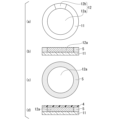
- FIG. 3 is a process diagram for explaining an example of the method for manufacturing the sensor element of this embodiment.
- Fig. 3(a) and Fig. 3(c) are plan views of the sensor element during the manufacturing process.
- Fig. 3(b) and Fig. 3(d) are cross-sectional views of the sensor element during the manufacturing process corresponding to the position cut along line A-A' shown in Fig. 1.
- a quartz crystal oscillator 1 is prepared, which has a quartz crystal plate 11 and electrodes 12 provided on both sides of the quartz crystal plate 11.
- both sides of the quartz crystal oscillator 1 are cleaned using a known method such as ultrasonic cleaning, ultraviolet light irradiation, ozone treatment, or plasma treatment.
- a protective mask is formed on the surface of the quartz crystal oscillator 1.
- the protective mask 5 is formed on one side of the quartz crystal oscillator 1 so as to cover the surface of the quartz crystal oscillator 1, leaving only the central region 12a (the surface on which the sensitive film is formed) of the electrode 12 exposed.
- the protective mask 5 is also formed on the entire other side of the quartz crystal oscillator 1 (the electrode and protective mask 5 on the other side are not shown).
- a photocurable resin film such as an ultraviolet curable resin film, a thermosetting resin film, a heat peelable resin sheet, masking tape, or other known masks can be used.
- a sensitive film 4 containing a tertiary amine, an acid, and a polymer is formed on the central region 12a (sensitive film formation surface) of the electrode 12 of the quartz crystal unit 1 on which the protective mask 5 is formed, by the method described below.
- a tertiary amine is dissolved in water to prepare a tertiary amine solution.
- an acid is added dropwise to the tertiary amine solution to prepare a first solution (first solution preparation process).
- the concentration of the tertiary amine solution in the first solution can be, for example, 5.0% by mass to 1.5% by mass.
- the concentration of the acid in the first solution can be, for example, 0.7% by mass to 2.2% by mass.
- the first solution and the second solution are mixed and stirred to prepare a raw solution in which the first solution and the second solution are dispersed (raw solution preparation process).
- the ratio of tertiary amine, acid, and polymer in the raw solution is prepared to be the same as the ratio of tertiary amine, acid, and polymer in the sensitive film 4.
- a known method can be used to stir the raw solution.
- the raw material solution is applied to the central region 12a (surface on which the sensitive film is to be formed) of the electrode 12 in the quartz crystal resonator 1 by a known method such as a drop casting method, a spin coating method, or an ink jet method. Thereafter, the quartz crystal unit 1 on which the raw material solution has been applied is dried, for example, in a nitrogen atmosphere at 60° C. to 80° C. for 15 to 30 minutes (film formation step).
- film formation step By carrying out the above steps, the sensitive film 4 attached to the sensitive film formation surface of the quartz crystal resonator 1 is obtained as shown in FIG.
- the protective mask 5 is removed from the quartz crystal resonator 1 on which the sensitive film 4 is formed.
- the protective mask 5 can be removed by a known method depending on the material of the protective mask 5 used. For example, when a thermally peelable resin sheet is used as the protective mask 5, the protective mask 5 can be removed by a method of heating at a predetermined temperature for a predetermined time. Furthermore, when a thermosetting resin or photocurable resin is used as the protective mask 5, the protective mask 5 can be removed by a method of dissolving it in an organic solvent or the like. Through the above steps, the sensor element 10 of the present embodiment is obtained.
- FIG. 4 is a schematic diagram showing the gas measurement device of this embodiment.
- the gas measurement device 100 of this embodiment includes the sensor element 10 of this embodiment, a flow cell 81, a gas supply means 83, a gas exhaust means 84, a frequency measurement device 82, and a personal computer 85.
- the flow cell 81 houses the sensor element 10.
- the sensor element 10 is brought into contact with the aldehyde gas (or a mixed gas containing aldehyde gas and other gases) to be detected within the flow cell 81, and the concentration of the aldehyde gas is measured.
- the gas supply means 83 supplies the aldehyde gas to be detected (or a mixed gas containing an aldehyde gas and other gases) and a base gas to the flow cell 81 at a predetermined mixing ratio and flow rate.
- the gas discharge means 84 discharges the aldehyde gas (or a mixed gas containing the aldehyde gas and other gases) to be detected and the base gas from the flow cell 81 .
- the frequency measuring device 82 measures the number of vibrations (frequency) oscillated by the quartz crystal resonator 1 and detects the amount of change in frequency.
- the frequency measuring device 82 is electrically connected to the connection regions 12b of the two electrodes 12 of the sensor element 10 by lead wires.
- the personal computer 85 is communicably connected to the frequency measuring device 82 via wire or wirelessly, and outputs the results detected by the frequency measuring device 82 .
- known components can be used other than the sensor element 10 .
- the gas measuring device 100 of this embodiment includes the sensor element 10 of this embodiment.
- the sensor element 10 of this embodiment has a sensitive film 4 containing a tertiary amine, an acid, and a polymer. Therefore, when an aldehyde gas comes into contact with the sensitive film 4 of the sensor element 10, the aldehyde gas reacts with the tertiary amine due to the catalytic action of the acid, and hemiaminal is generated. At the same time, a reaction occurs in which the hemiaminal decomposes to release aldehyde gas and return to the tertiary amine.
- the sensor element 10 of this embodiment can continuously detect aldehyde gas with high sensitivity using the quartz crystal microbalance (QCM) method.
- aldehyde gas (or a mixed gas containing aldehyde gas and other gases) is continuously supplied to the flow cell 81 and the aldehyde gas is continuously brought into contact with the sensitive film 4 of the sensor element 10, aldehyde gas and hemiaminal, which is a reaction product of the aldehyde gas and the tertiary amine, do not accumulate on the sensitive film 4. Therefore, even if aldehyde gas (or a mixed gas containing aldehyde gas and other gases) is continuously brought into contact with the sensitive film 4, the sensitivity of the sensor element 10 does not decrease, and aldehyde gas can be continuously detected with high sensitivity.
- the sensor element for example, adsorbs the gas to be detected onto a sensitive film and detects the change in the fundamental frequency of the quartz oscillator caused by an increase in the mass of the sensitive film, it is difficult to make the sensitive film adsorb only the aldehyde gas in a mixed gas that contains aldehyde gas and other gases. Therefore, it is difficult for this sensor element to selectively detect aldehyde gas in a mixed gas, and it is also difficult to detect aldehyde when the mixed gas contains only a trace amount of aldehyde.
- the gas measuring device 100 of this embodiment since the gas measuring device 100 of this embodiment is equipped with the sensor element 10 of this embodiment, it can continuously detect aldehyde gas with high sensitivity. Moreover, according to the gas measuring device 100 of this embodiment, even if aldehyde gas is contained in a mixed gas that contains, for example, alcohol gas and/or ketone gas, the aldehyde gas in the mixed gas can be selectively detected continuously with high sensitivity.
- a quartz crystal resonator 1 (product name: SEN-9E-H-10, fundamental frequency 9 MHz, manufactured by Tama Devices Co., Ltd.) was prepared, which had a quartz crystal plate 11 having a diameter of 8.7 mm in a planar circular shape and electrodes 12 provided on both sides of the quartz crystal plate 11 and having a central region 12a made of a gold film having a diameter of 5.0 mm.
- the quartz crystal oscillator 1 was immersed in acetone and ultrasonically cleaned for 15 minutes, then immersed in pure water and ultrasonically cleaned for 15 minutes, and then dried in air at a temperature of 70°C to clean both sides of the quartz crystal oscillator.
- a protective mask was formed on the surface of the quartz crystal oscillator 1.
- the protective mask 5 was formed on one side of the quartz crystal oscillator 1 so as to cover the surface of the quartz crystal oscillator 1, leaving only the central region 12a (surface on which the sensitive film is formed) of the electrode 12 exposed.
- the protective mask 5 was also formed on the entire other side of the quartz crystal oscillator 1 (the electrode and protective mask 5 on the other side are not shown).
- a thermally peelable resin sheet product name: REVALPHA (registered trademark), manufactured by Nitto Denko Corporation) was used as the protective mask 5.
- a sensitive film 4 was formed on the central region 12a (sensitive film formation surface) of the electrode 12 of the quartz crystal unit 1 on which the protective mask 5 was formed, using a raw material solution produced by the method described below.
- polystyrene molecular weight 35,000, product name: polystyrene, manufactured by Sigma-Aldrich
- acetone a dispersion solvent
- the frequency measuring device 82 detected the average vibration frequency (frequency) when the gas to be detected (formaldehyde or ethanol gas) was supplied at a gas concentration of 5 ppm, and the difference between the average vibration frequency and the baseline (frequency change amount) was detected as the sensitivity, and the result was output to the personal computer 85.
- the results are shown in Table 1.
- the ratio of the frequency change when formaldehyde gas was supplied to the frequency change when ethanol gas was supplied was calculated to evaluate the gas selectivity of the sensor element. The results are shown in Table 1.
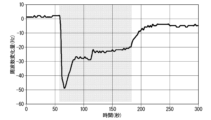
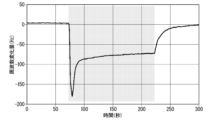
- Fig. 5 is a graph showing a change in vibration frequency when formaldehyde gas is supplied to a flow cell equipped with the sensor element of Example 1.
- Fig. 6 is a graph showing a change in vibration frequency when ethanol gas is supplied to a flow cell equipped with the sensor element of Example 1.
- Fig. 7 is a graph showing a change in vibration frequency when formaldehyde gas is supplied to the flow cell equipped with the sensor element of Comparative Example 5.
- Fig. 8 is a graph showing a change in vibration frequency when ethanol gas is supplied to the flow cell equipped with the sensor element of Comparative Example 5.
- the sensor element of Example 1 can detect formaldehyde gas with high sensitivity, and does not react to ethanol gas. From this, it was confirmed that the sensor element of Example 1 can selectively detect the concentration of aldehyde gas in a mixed gas containing aldehyde gas and ethanol gas with high sensitivity.
- the sensor element of Comparative Example 5 reacts not only to formaldehyde gas but also to ethanol gas. This shows that it is difficult for the sensor element of Comparative Example 5 to selectively detect the concentration of aldehyde gas in a mixed gas containing aldehyde gas and ethanol gas with high sensitivity.
Landscapes
- Physics & Mathematics (AREA)
- Health & Medical Sciences (AREA)
- Life Sciences & Earth Sciences (AREA)
- Chemical & Material Sciences (AREA)
- Analytical Chemistry (AREA)
- Biochemistry (AREA)
- General Health & Medical Sciences (AREA)
- General Physics & Mathematics (AREA)
- Immunology (AREA)
- Pathology (AREA)
- Investigating Or Analyzing Materials By The Use Of Fluid Adsorption Or Reactions (AREA)
Priority Applications (2)
| Application Number | Priority Date | Filing Date | Title |
|---|---|---|---|
| JP2024567945A JPWO2024143488A1 (https=) | 2022-12-28 | 2023-12-27 | |
| CN202380088473.9A CN120418629A (zh) | 2022-12-28 | 2023-12-27 | 传感器元件、传感器元件的制造方法和气体测定装置 |
Applications Claiming Priority (2)
| Application Number | Priority Date | Filing Date | Title |
|---|---|---|---|
| US202263435648P | 2022-12-28 | 2022-12-28 | |
| US63/435,648 | 2022-12-28 |
Publications (1)
| Publication Number | Publication Date |
|---|---|
| WO2024143488A1 true WO2024143488A1 (ja) | 2024-07-04 |
Family
ID=91717710
Family Applications (1)
| Application Number | Title | Priority Date | Filing Date |
|---|---|---|---|
| PCT/JP2023/046994 Ceased WO2024143488A1 (ja) | 2022-12-28 | 2023-12-27 | センサ素子、センサ素子の製造方法およびガス測定装置 |
Country Status (3)
| Country | Link |
|---|---|
| JP (1) | JPWO2024143488A1 (https=) |
| CN (1) | CN120418629A (https=) |
| WO (1) | WO2024143488A1 (https=) |
Citations (4)
| Publication number | Priority date | Publication date | Assignee | Title |
|---|---|---|---|---|
| JPH0320762Y2 (https=) * | 1984-12-24 | 1991-05-07 | ||
| JP6700238B2 (ja) * | 2016-12-30 | 2020-05-27 | ローム アンド ハース エレクトロニック マテリアルズ エルエルシーRohm and Haas Electronic Materials LLC | ガスセンサ及びその製造方法 |
| JP2022007969A (ja) * | 2020-03-17 | 2022-01-13 | 株式会社東芝 | 分子センサ、分子検出装置及び分子検出方法 |
| JP2022027167A (ja) * | 2020-07-31 | 2022-02-10 | 太陽誘電株式会社 | においセンサ、ガス吸着膜、およびにおいセンサの製造方法 |
-
2023
- 2023-12-27 JP JP2024567945A patent/JPWO2024143488A1/ja active Pending
- 2023-12-27 WO PCT/JP2023/046994 patent/WO2024143488A1/ja not_active Ceased
- 2023-12-27 CN CN202380088473.9A patent/CN120418629A/zh active Pending
Patent Citations (4)
| Publication number | Priority date | Publication date | Assignee | Title |
|---|---|---|---|---|
| JPH0320762Y2 (https=) * | 1984-12-24 | 1991-05-07 | ||
| JP6700238B2 (ja) * | 2016-12-30 | 2020-05-27 | ローム アンド ハース エレクトロニック マテリアルズ エルエルシーRohm and Haas Electronic Materials LLC | ガスセンサ及びその製造方法 |
| JP2022007969A (ja) * | 2020-03-17 | 2022-01-13 | 株式会社東芝 | 分子センサ、分子検出装置及び分子検出方法 |
| JP2022027167A (ja) * | 2020-07-31 | 2022-02-10 | 太陽誘電株式会社 | においセンサ、ガス吸着膜、およびにおいセンサの製造方法 |
Also Published As
| Publication number | Publication date |
|---|---|
| CN120418629A (zh) | 2025-08-01 |
| JPWO2024143488A1 (https=) | 2024-07-04 |
Similar Documents
| Publication | Publication Date | Title |
|---|---|---|
| Buvailo et al. | TiO2/LiCl-based nanostructured thin film for humidity sensor applications | |
| TWI242639B (en) | Humidity sensor element, device and method for manufacturing thereof | |
| Mazeina et al. | Functionalized Ga2O3 nanowires as active material in room temperature capacitance-based gas sensors | |
| EP1923697A1 (en) | High sensitive resistive-type gas sensor and its manufacturing process comprising an organic-inorganic intercalated hydbrid sensing material | |
| Vallejos et al. | Detection of volatile organic compounds using flexible gas sensing devices based on tungsten oxide nanostructures functionalized with Au and Pt nanoparticles | |
| CN103154714A (zh) | 传感器元件及其制备方法和包括所述传感器元件的传感器装置 | |
| CN105111439B (zh) | 一种联苯型聚酰亚胺湿敏电容及其制备方法 | |
| KR101767341B1 (ko) | 은 나노선이 내장된 투명 폴리이미드 히터 상에 광학적으로 개질된 그래핀 산화물 감지체, 이를 사용하는 웨어러블 가스 센서 및 그 제조 방법 | |
| CN116773651B (zh) | 声表面波气体传感器及其制备方法、气体报警器 | |
| CN103336034B (zh) | 一种苯胺气体传感器及其制备方法 | |
| Lim et al. | Surface acoustic device for high response NO2 gas sensor using p-phenylenediamine-reduced graphene oxide nanocomposite coated on langasite | |
| Hadiyan et al. | Sub-ppm acetone gas sensing properties of free-standing ZnO nanorods | |
| Girma et al. | Large-area printed oxide film sensors enabling ultrasensitive and dual electrical/colorimetric detection of hydrogen at room temperature | |
| WO2024143488A1 (ja) | センサ素子、センサ素子の製造方法およびガス測定装置 | |
| Ma et al. | ZnO piezoelectric film resonator modified with multi-walled carbon nanotubes/polyethyleneimine bilayer for the detection of trace formaldehyde | |
| Li et al. | Engineering silver nanostructures for surface acoustic wave humidity sensors sensitivity enhancement | |
| KR20190046320A (ko) | 금속산화물 다공성 나노튜브 및 이를 이용한 가스센서 부재 및 그 제조방법 | |
| KR101922187B1 (ko) | 가스센서용 감지물질 및 그 제조방법, 그리고 상기 감지물질을 포함하는 가스센서 및 그 제조방법 | |
| JP2020016461A (ja) | センサー | |
| CA3090640A1 (en) | Sensing elements comprising gold nanoparticle-grafted carbon black | |
| Jain et al. | Zinc oxide nanoflowers based graphene nanocomposite platform for catalytic studies of febuxostat | |
| CN113072062B (zh) | 一种石墨烯量子点/ZnO/小球藻复合薄膜及其制备方法与应用 | |
| KR102317490B1 (ko) | 활성산소종의 검출이 가능한 하이브리드 채널층을 포함하는 유기 전계효과 트랜지스터 소자 및 이를 포함하는 활성산소종 검출 센서 | |
| Zor et al. | QCM humidity sensors based on organic/inorganic nanocomposites of water soluble-conductive poly (diphenylamine sulfonic acid) | |
| US12222307B2 (en) | Polymer material, sensor element, and gas measurement device |
Legal Events
| Date | Code | Title | Description |
|---|---|---|---|
| 121 | Ep: the epo has been informed by wipo that ep was designated in this application |
Ref document number: 23912266 Country of ref document: EP Kind code of ref document: A1 |
|
| WWE | Wipo information: entry into national phase |
Ref document number: 2024567945 Country of ref document: JP |
|
| WWE | Wipo information: entry into national phase |
Ref document number: 202380088473.9 Country of ref document: CN |
|
| NENP | Non-entry into the national phase |
Ref country code: DE |
|
| WWP | Wipo information: published in national office |
Ref document number: 202380088473.9 Country of ref document: CN |
|
| 122 | Ep: pct application non-entry in european phase |
Ref document number: 23912266 Country of ref document: EP Kind code of ref document: A1 |