WO2024143118A1 - 非水電解質二次電池の充電制御方法、非水電解質二次電池の充電制御システム、およびそれらを用いた電源装置 - Google Patents
非水電解質二次電池の充電制御方法、非水電解質二次電池の充電制御システム、およびそれらを用いた電源装置 Download PDFInfo
- Publication number
- WO2024143118A1 WO2024143118A1 PCT/JP2023/045744 JP2023045744W WO2024143118A1 WO 2024143118 A1 WO2024143118 A1 WO 2024143118A1 JP 2023045744 W JP2023045744 W JP 2023045744W WO 2024143118 A1 WO2024143118 A1 WO 2024143118A1
- Authority
- WO
- WIPO (PCT)
- Prior art keywords
- charging
- secondary battery
- negative electrode
- electrolyte secondary
- charge
- Prior art date
- Legal status (The legal status is an assumption and is not a legal conclusion. Google has not performed a legal analysis and makes no representation as to the accuracy of the status listed.)
- Ceased
Links
Images



Classifications
-
- H—ELECTRICITY
- H01—ELECTRIC ELEMENTS
- H01M—PROCESSES OR MEANS, e.g. BATTERIES, FOR THE DIRECT CONVERSION OF CHEMICAL ENERGY INTO ELECTRICAL ENERGY
- H01M10/00—Secondary cells; Manufacture thereof
- H01M10/05—Accumulators with non-aqueous electrolyte
- H01M10/052—Li-accumulators
-
- H—ELECTRICITY
- H01—ELECTRIC ELEMENTS
- H01M—PROCESSES OR MEANS, e.g. BATTERIES, FOR THE DIRECT CONVERSION OF CHEMICAL ENERGY INTO ELECTRICAL ENERGY
- H01M10/00—Secondary cells; Manufacture thereof
- H01M10/42—Methods or arrangements for servicing or maintenance of secondary cells or secondary half-cells
- H01M10/44—Methods for charging or discharging
-
- H—ELECTRICITY
- H01—ELECTRIC ELEMENTS
- H01M—PROCESSES OR MEANS, e.g. BATTERIES, FOR THE DIRECT CONVERSION OF CHEMICAL ENERGY INTO ELECTRICAL ENERGY
- H01M10/00—Secondary cells; Manufacture thereof
- H01M10/42—Methods or arrangements for servicing or maintenance of secondary cells or secondary half-cells
- H01M10/44—Methods for charging or discharging
- H01M10/446—Initial charging measures
-
- H—ELECTRICITY
- H01—ELECTRIC ELEMENTS
- H01M—PROCESSES OR MEANS, e.g. BATTERIES, FOR THE DIRECT CONVERSION OF CHEMICAL ENERGY INTO ELECTRICAL ENERGY
- H01M10/00—Secondary cells; Manufacture thereof
- H01M10/42—Methods or arrangements for servicing or maintenance of secondary cells or secondary half-cells
- H01M10/48—Accumulators combined with arrangements for measuring, testing or indicating the condition of cells, e.g. the level or density of the electrolyte
-
- H—ELECTRICITY
- H01—ELECTRIC ELEMENTS
- H01M—PROCESSES OR MEANS, e.g. BATTERIES, FOR THE DIRECT CONVERSION OF CHEMICAL ENERGY INTO ELECTRICAL ENERGY
- H01M50/00—Constructional details or processes of manufacture of the non-active parts of electrochemical cells other than fuel cells, e.g. hybrid cells
- H01M50/40—Separators; Membranes; Diaphragms; Spacing elements inside cells
- H01M50/463—Separators, membranes or diaphragms characterised by their shape
-
- H—ELECTRICITY
- H01—ELECTRIC ELEMENTS
- H01M—PROCESSES OR MEANS, e.g. BATTERIES, FOR THE DIRECT CONVERSION OF CHEMICAL ENERGY INTO ELECTRICAL ENERGY
- H01M50/00—Constructional details or processes of manufacture of the non-active parts of electrochemical cells other than fuel cells, e.g. hybrid cells
- H01M50/40—Separators; Membranes; Diaphragms; Spacing elements inside cells
- H01M50/471—Spacing elements inside cells other than separators, membranes or diaphragms; Manufacturing processes thereof
- H01M50/474—Spacing elements inside cells other than separators, membranes or diaphragms; Manufacturing processes thereof characterised by their position inside the cells
-
- H—ELECTRICITY
- H02—GENERATION; CONVERSION OR DISTRIBUTION OF ELECTRIC POWER
- H02J—ELECTRIC POWER NETWORKS; CIRCUIT ARRANGEMENTS OR SYSTEMS FOR SUPPLYING OR DISTRIBUTING ELECTRIC POWER; SYSTEMS FOR STORING ELECTRIC ENERGY
- H02J7/00—Circuit arrangements for charging or discharging batteries or for supplying loads from batteries
- H02J7/80—Circuit arrangements for charging or discharging batteries or for supplying loads from batteries including monitoring or indicating arrangements
- H02J7/82—Control of state of charge [SOC]
-
- H—ELECTRICITY
- H02—GENERATION; CONVERSION OR DISTRIBUTION OF ELECTRIC POWER
- H02J—ELECTRIC POWER NETWORKS; CIRCUIT ARRANGEMENTS OR SYSTEMS FOR SUPPLYING OR DISTRIBUTING ELECTRIC POWER; SYSTEMS FOR STORING ELECTRIC ENERGY
- H02J7/00—Circuit arrangements for charging or discharging batteries or for supplying loads from batteries
- H02J7/80—Circuit arrangements for charging or discharging batteries or for supplying loads from batteries including monitoring or indicating arrangements
- H02J7/84—Control of state of health [SOH]
-
- Y—GENERAL TAGGING OF NEW TECHNOLOGICAL DEVELOPMENTS; GENERAL TAGGING OF CROSS-SECTIONAL TECHNOLOGIES SPANNING OVER SEVERAL SECTIONS OF THE IPC; TECHNICAL SUBJECTS COVERED BY FORMER USPC CROSS-REFERENCE ART COLLECTIONS [XRACs] AND DIGESTS
- Y02—TECHNOLOGIES OR APPLICATIONS FOR MITIGATION OR ADAPTATION AGAINST CLIMATE CHANGE
- Y02E—REDUCTION OF GREENHOUSE GAS [GHG] EMISSIONS, RELATED TO ENERGY GENERATION, TRANSMISSION OR DISTRIBUTION
- Y02E60/00—Enabling technologies; Technologies with a potential or indirect contribution to GHG emissions mitigation
- Y02E60/10—Energy storage using batteries
Definitions
- the charging control unit charges the electrolyte secondary battery, and the charging control unit executes a normal charging step of charging the nonaqueous electrolyte secondary battery with a first charging profile, a determination step of determining whether or not predetermined data related to the nonaqueous electrolyte secondary battery has reached a predetermined value, and a recovery charging step of charging the nonaqueous electrolyte secondary battery with a second charging profile in the next charging step when it is determined that the predetermined data has reached the predetermined value, and the average charging current value in the second charging profile is smaller than the average charging current value in the first charging profile.
- (Determination step) it is determined whether recovery of the secondary battery (B) is necessary based on the data (D) of the secondary battery (B). In a situation where it is not determined that recovery of the secondary battery (B) is necessary, charging is performed by the normal charging step. That is, in the charging and discharging of the secondary battery (B), the normal charging step is basically repeated. After one charging step (normal charging step or recovery charging step) is completed, a determination step is performed before the next charging step is performed. If it is determined in the determination step that the data (D) has reached a predetermined value, a recovery charging step is performed in the next charging. That is, when the data (D) has reached a predetermined value, it is determined that recovery of the secondary battery (B) is necessary, and a recovery charging step is performed in the next charging.
- the data (D) may be the number of times the nonaqueous electrolyte secondary battery (B) is charged and discharged.
- the recovery charge step may be performed in the next charge when the number of times the nonaqueous electrolyte secondary battery (B) is charged and discharged from the initial state or the number of times the nonaqueous electrolyte secondary battery (B) is charged and discharged reaches a predetermined value N.
- the recovery charge step may be performed every (N+1) times the charging steps (normal charging step and recovery charge step).
- the value N may be in the range of 49 to 99.
- the recovery charge step can be performed at a timing when the deterioration of the charge and discharge characteristics of the nonaqueous electrolyte secondary battery (B) becomes large.
- the charging step normal charging step, recovery charge step
- the discharging are each performed once, the number of times the nonaqueous electrolyte secondary battery (B) is considered to be one.
- the determination may be made based on the number of times the nonaqueous electrolyte secondary battery (B) is charged. In other words, the number of times the nonaqueous electrolyte secondary battery (B) is charged and discharged may be read as the number of times the nonaqueous electrolyte secondary battery (B) is charged and discharged.
- the data (D) may be the accumulated charge amount of the nonaqueous electrolyte secondary battery (B).
- the recovery charge step may be performed in the next charge when the accumulated charge amount from the beginning or the accumulated charge amount after the previous recovery charge step reaches a predetermined value X.
- the value X may be in the range of 50 to 100 times the initial charge capacity of the nonaqueous electrolyte secondary battery (B).
- the recovery charge step can be performed at a timing when the charge/discharge characteristics of the nonaqueous electrolyte secondary battery (B) become significantly deteriorated.
- the accumulated charge amount of electricity is the accumulated value of the charged battery amount.
- the timing for ending the recovery charging step and the normal charging step may be determined based on any of the charging time, the charged amount of electricity, the battery voltage, and the SOC.
- the first charging profile may be a profile for constant current charging at a current density of 2.0 mA/cm 2 or more. According to this configuration, the normal charging step can be performed in a short time.
- the amount of electricity charged in the first charging step may be 15% or less (e.g., in the range of 5 to 15%) of the total amount of electricity charged in the first charging profile, and the sum of the amount of electricity charged in the first charging step and the amount of electricity charged in the second charging step may be 50% or less (e.g., 40% or less) of the total amount of electricity charged.
- the nonaqueous electrolyte secondary battery (B) includes a spacer disposed on at least one member selected from the group consisting of a positive electrode, a negative electrode, and a separator.
- the spacer forms a space between the positive electrode and the negative electrode. The presence of the space can suppress the expansion of the electrode group when lithium metal is deposited on the negative electrode.
- the spacer may be formed of a material containing a polymeric material (resin, rubber, etc.).
- the spacer may be formed of only the polymeric material, or may be formed of a composition containing the polymeric material.
- the composition includes components other than the polymeric material (e.g., an insulating inorganic filler). Examples of insulating inorganic fillers include aluminum oxide particles and silicon dioxide particles.
- the polymeric material constituting the spacer may be an insulating material.
- polymeric materials constituting the spacer include fluorine-containing resins (polyvinylidene fluoride, polytetrafluoroethylene, etc.), rubbers (styrene-butadiene copolymers, acrylonitrile-butadiene copolymers, and hydrogenated versions of these), celluloses, acrylic resins, polyimides, polyamides, polyolefins, polyesters, silicone resins, and other polymeric materials.
- the planar shape of the spacer may be dot-shaped, linear, or a combination of these.
- the spacer may include a plurality of dot-shaped protrusions arranged at regular intervals.
- the spacer may include a plurality of linear protrusions arranged in a stripe pattern.
- the spacer may include linear protrusions arranged in a mesh pattern (e.g., a honeycomb pattern).
- the height h of the spacer may be 10 ⁇ m or more, 15 ⁇ m or more, or 30 ⁇ m or more, and may be 100 ⁇ m or less, or 60 ⁇ m or less.
- the height h of the spacer may be 15 ⁇ m or more and 60 ⁇ m or less.
- the method for forming the spacers is not particularly limited, and they may be formed by a known method.
- a forming method first, the spacer material is placed in a predetermined pattern on a predetermined member by using a dispenser or screen printing. Next, the material is dried or hardened. In this manner, the spacers are formed.
- the first power supply device includes at least one non-aqueous electrolyte secondary battery (B).
- the charging of the at least one non-aqueous electrolyte secondary battery (B) is controlled by the above-mentioned charging control method (M).
- the charging control method (M) and the non-aqueous electrolyte secondary battery (B) have been described above, so redundant description will be omitted.
- the first power supply device can suppress performance degradation when charging and discharging are repeated.
- the charge control system (S) implements the charge control method (M) described above.
- the matters described about the charge control method (M) can be applied to the charge control system (S), so duplicated explanations may be omitted.
- the matters described about the charge control system (S) may also be applied to the charge control method (M).
- the nonaqueous electrolyte secondary battery whose charging is controlled by the charge control system (S) is the same as the nonaqueous electrolyte secondary battery (B) described above, so duplicated explanations may be omitted.
- the specified data (data (D)) used in the determination has been described above, so duplicated explanations may be omitted.
- the charge control system (S) can suppress the deterioration of the characteristics of the nonaqueous electrolyte secondary battery (B) due to charge/discharge cycles.
- the charging control unit (charging control system (S)) is connected to an external power source.
- the charging control unit converts the voltage and/or current of the power supplied from the external power source into a predetermined voltage and/or a predetermined current suitable for charging the nonaqueous electrolyte secondary battery (B), and charges the nonaqueous electrolyte secondary battery (B).
- An example of a charging control unit includes an arithmetic processing device.
- the arithmetic processing device stores a program for executing each of the above steps.
- the arithmetic processing device executes each of the above steps based on the stored program.
- a general arithmetic processing device can be used as the arithmetic processing device.
- the first charging profile and the second charging profile may be the profiles described above.
- the second charging profile may be a constant current charging profile at a current density of 1.0 mA/ cm2 or less.
- the first charging profile may include, in this order, a first charging step of performing constant current charging at a first current density of 1.0 mA/ cm2 or less, a second charging step of performing constant current charging at a second current density greater than the first current density and less than or equal to 4.0 mA/ cm2 , and a third charging step of performing constant current charging at a third current density greater than the second current density and greater than or equal to 4.0 mA/ cm2 .
- the second power supply device is connected to another device and supplies power to that device.
- the charging control unit of the charging control system (S) is connected to a power supply source for charging the nonaqueous electrolyte secondary battery (B) and charges the nonaqueous electrolyte secondary battery (B) using the supplied power.
- the lithium ion storage layer is a layer of a negative electrode mixture containing a negative electrode active material.
- the negative electrode mixture may also contain a binder, a thickener, a conductive agent, etc.
- Binders include, for example, fluororesins, polyacrylonitrile, polyimide resins, acrylic resins, polyolefin resins, rubber-like polymers, etc.
- Fluororesins include polytetrafluoroethylene, polyvinylidene fluoride, etc.
- the material of the negative electrode current collector may be any conductive material other than lithium metal and lithium alloy.
- the conductive material may be a metallic material such as a metal or an alloy.
- the conductive material is preferably a material that does not react with lithium. More specifically, a material that does not form an alloy or an intermetallic compound with lithium is preferable.
- Such conductive materials include, for example, copper (Cu), nickel (Ni), iron (Fe), and alloys containing these metal elements, or graphite with the basal surface preferentially exposed.
- alloys include copper alloys and stainless steel (SUS). Among them, copper and/or copper alloys, which have high conductivity, are preferable.
- the negative electrode current collector may be copper foil or copper alloy foil.
- the transition metal elements contained in the lithium-containing transition metal oxide include Sc, Ti, V, Cr, Mn, Fe, Co, Ni, Cu, Y, Zr, W, etc.
- the lithium-containing transition metal oxide may contain one type of transition metal element, or may contain two or more types.
- the transition metal element may be Co, Ni, and/or Mn.
- the lithium-containing transition metal oxide may contain one or more typical elements as necessary.
- the typical elements include Mg, Al, Ca, Zn, Ga, Ge, Sn, Sb, Pb, Bi, etc.
- the typical element may be Al, etc.
- Non-aqueous electrolyte The non-aqueous electrolyte having lithium ion conductivity contains, for example, a non-aqueous solvent, and lithium ions and anions dissolved in the non-aqueous solvent.
- the non-aqueous electrolyte may be in a liquid state or a gel state.
- the non-aqueous electrolyte preferably contains at least an anion of an oxalate complex, and more preferably contains an oxalate complex anion having fluorine (particularly a difluorooxalate borate anion).
- the interaction between the oxalate complex anion having fluorine and lithium makes it easier for the lithium metal to be precipitated uniformly in the form of fine particles. This makes it easier to suppress localized precipitation of the lithium metal.
- the oxalate complex anion having fluorine may be combined with another anion.
- the other anion may be an anion of PF 6 - and/or an imide.
- the structure of the secondary battery (B) is a structure in which a wound electrode group and an electrolyte are housed in an exterior body.
- the wound electrode group is formed by winding a positive electrode and a negative electrode with a separator between them.
- the electrode group of the secondary battery (B) may be an electrode group other than a wound type.
- the electrode group may be a laminated type electrode group in which a positive electrode and a negative electrode are laminated with a separator between them.
- the shape of the secondary battery (B) is not limited, and may be a cylindrical type, a square type, a coin type, a button type, a laminate type, etc.
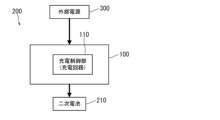
- the power supply device 200 includes a charge control system 100 and a secondary battery (non-aqueous electrolyte secondary battery (B)) 210.
- the charge control system 100 includes a charge control unit 110.
- the charge control system 100 may include a measurement unit (measurement device) as necessary.
- the charge control unit 110 is connected to an external power source 300.
- the external power source 300 supplies power for charging to the charge control unit 110.
- the charge control unit 110 charges the secondary battery 210 using the supplied power.
- the charge control unit 110 records data (D) such as the number of charge/discharge cycles, and controls charging based on the recorded data (D).
- the secondary battery 210 is connected to an external device (not shown) and supplies power to the external device.
- the external power source 300 may be considered as part of the power supply device 200, or may be considered as a device separate from the power supply device 200.
- a normal charging step is performed and data (D) (in this example, the number of charging times) is recorded (step S11).
- power is supplied to an external device using the charged secondary battery 210 (step S12).
- step S13 it is determined whether data (D) has reached a predetermined value (step S13). If data (D) has not reached the predetermined value, the process returns to step S11, and a normal charging step is performed and data (D) is recorded. If data (D) has reached the predetermined value in step S13, a recovery charging step is performed as the next charge and data (D) is recorded (step S14). After step S14, the process returns to step S12, and power is supplied to an external device.
- the normal charging step and recovery charging step are performed under the conditions described above. In this manner, the charging control method (M) is executed.
- FIG. 4 is a schematic cross-sectional view of a portion of an example of an electrode group 1 in which a spacer is formed on a separator.
- the electrode group 1 shown in FIG. 4 includes a positive electrode 11, a negative electrode 12, a separator 13, and a spacer 14.
- the spacer 14 is formed on one side of the separator 13.
- the positive electrode 11 includes a positive electrode current collector 11a and a positive electrode composite layer 11b disposed on both sides of the positive electrode current collector 11a.
- the negative electrode 12 is the negative electrode described above.
- FIG. 4 shows the height h of the spacer 14.
- the spacer 14 is, for example, a linearly extending convex portion. The presence of the spacer 14 forms a space 1s between the positive electrode 11 and the negative electrode 12.
- FIG. 4 shows an example in which the spacer 14 is adjacent to the negative electrode 12. However, the spacer 14 may be adjacent to the positive electrode 11.
- the spacer 14 may be formed on the positive electrode 11 or the negative electrode 12.
- a method for controlling charging of a non-aqueous electrolyte secondary battery comprising: The non-aqueous electrolyte secondary battery includes a positive electrode, a negative electrode, a separator, and a non-aqueous electrolyte, the negative electrode is an negative electrode in which lithium metal is deposited on the negative electrode during charging and the lithium metal is dissolved in the non-aqueous electrolyte during discharging, a spacer for forming a space between the positive electrode and the negative electrode is disposed on at least one member selected from the group consisting of the positive electrode, the negative electrode, and the separator;
- the charging control method includes: a normal charging step of charging the nonaqueous electrolyte secondary battery with a first charging profile; a determining step of determining whether or not predetermined data related to the nonaqueous electrolyte secondary battery has reached a predetermined value; a recovery charging step of charging the nonaqueous electroly
- the predetermined data is the number of times the nonaqueous electrolyte secondary battery has been charged and discharged
- the recovery charge step is performed in the next charge when the number of charge/discharge cycles from the initial time point or the number of charge/discharge cycles after the previous recovery charge step reaches a predetermined value N,
- the charge control method according to claim 1 or 2 wherein the value N is in the range of 49 to 99.
Landscapes
- Chemical & Material Sciences (AREA)
- Chemical Kinetics & Catalysis (AREA)
- Electrochemistry (AREA)
- General Chemical & Material Sciences (AREA)
- Engineering & Computer Science (AREA)
- Manufacturing & Machinery (AREA)
- Power Engineering (AREA)
- Secondary Cells (AREA)
- Charge And Discharge Circuits For Batteries Or The Like (AREA)
Priority Applications (3)
| Application Number | Priority Date | Filing Date | Title |
|---|---|---|---|
| JP2024567686A JPWO2024143118A1 (https=) | 2022-12-26 | 2023-12-20 | |
| CN202380088376.XA CN120530551A (zh) | 2022-12-26 | 2023-12-20 | 非水电解质二次电池的充电控制方法、非水电解质二次电池的充电控制系统和使用它们的电源装置 |
| EP23911898.7A EP4645646A4 (en) | 2022-12-26 | 2023-12-20 | METHOD FOR CHARGE CONTROL FOR A SECONDARY BATTERY WITH NON-AQUEOUS ELECTROLYTE, CHARGE CONTROL SYSTEM FOR A SECONDARY BATTERY WITH NON-AQUEOUS ELECTROLYTE, AND POWER SUPPLY DEVICE USING IT |
Applications Claiming Priority (2)
| Application Number | Priority Date | Filing Date | Title |
|---|---|---|---|
| JP2022-208901 | 2022-12-26 | ||
| JP2022208901 | 2022-12-26 |
Publications (1)
| Publication Number | Publication Date |
|---|---|
| WO2024143118A1 true WO2024143118A1 (ja) | 2024-07-04 |
Family
ID=91717581
Family Applications (1)
| Application Number | Title | Priority Date | Filing Date |
|---|---|---|---|
| PCT/JP2023/045744 Ceased WO2024143118A1 (ja) | 2022-12-26 | 2023-12-20 | 非水電解質二次電池の充電制御方法、非水電解質二次電池の充電制御システム、およびそれらを用いた電源装置 |
Country Status (4)
| Country | Link |
|---|---|
| EP (1) | EP4645646A4 (https=) |
| JP (1) | JPWO2024143118A1 (https=) |
| CN (1) | CN120530551A (https=) |
| WO (1) | WO2024143118A1 (https=) |
Citations (6)
| Publication number | Priority date | Publication date | Assignee | Title |
|---|---|---|---|---|
| WO2012124211A1 (ja) | 2011-03-14 | 2012-09-20 | 三菱自動車工業株式会社 | リチウムイオン電池の容量回復方法 |
| WO2020202845A1 (ja) * | 2019-03-29 | 2020-10-08 | パナソニックIpマネジメント株式会社 | 非水電解質二次電池 |
| WO2021172175A1 (ja) * | 2020-02-28 | 2021-09-02 | パナソニックIpマネジメント株式会社 | 非水電解質二次電池の充放電方法および充放電システム |
| WO2022163539A1 (ja) * | 2021-01-29 | 2022-08-04 | パナソニックIpマネジメント株式会社 | 二次電池の充電方法および充電システム |
| WO2022209601A1 (ja) * | 2021-03-30 | 2022-10-06 | パナソニックIpマネジメント株式会社 | リチウム二次電池 |
| WO2022224872A1 (ja) * | 2021-04-20 | 2022-10-27 | パナソニックIpマネジメント株式会社 | リチウム二次電池 |
Family Cites Families (1)
| Publication number | Priority date | Publication date | Assignee | Title |
|---|---|---|---|---|
| CN116235313B (zh) * | 2020-09-28 | 2026-04-17 | 松下知识产权经营株式会社 | 二次电池的充电方法及充电系统 |
-
2023
- 2023-12-20 CN CN202380088376.XA patent/CN120530551A/zh active Pending
- 2023-12-20 WO PCT/JP2023/045744 patent/WO2024143118A1/ja not_active Ceased
- 2023-12-20 EP EP23911898.7A patent/EP4645646A4/en active Pending
- 2023-12-20 JP JP2024567686A patent/JPWO2024143118A1/ja active Pending
Patent Citations (6)
| Publication number | Priority date | Publication date | Assignee | Title |
|---|---|---|---|---|
| WO2012124211A1 (ja) | 2011-03-14 | 2012-09-20 | 三菱自動車工業株式会社 | リチウムイオン電池の容量回復方法 |
| WO2020202845A1 (ja) * | 2019-03-29 | 2020-10-08 | パナソニックIpマネジメント株式会社 | 非水電解質二次電池 |
| WO2021172175A1 (ja) * | 2020-02-28 | 2021-09-02 | パナソニックIpマネジメント株式会社 | 非水電解質二次電池の充放電方法および充放電システム |
| WO2022163539A1 (ja) * | 2021-01-29 | 2022-08-04 | パナソニックIpマネジメント株式会社 | 二次電池の充電方法および充電システム |
| WO2022209601A1 (ja) * | 2021-03-30 | 2022-10-06 | パナソニックIpマネジメント株式会社 | リチウム二次電池 |
| WO2022224872A1 (ja) * | 2021-04-20 | 2022-10-27 | パナソニックIpマネジメント株式会社 | リチウム二次電池 |
Non-Patent Citations (1)
| Title |
|---|
| See also references of EP4645646A1 |
Also Published As
| Publication number | Publication date |
|---|---|
| EP4645646A1 (en) | 2025-11-05 |
| EP4645646A4 (en) | 2026-04-01 |
| JPWO2024143118A1 (https=) | 2024-07-04 |
| CN120530551A (zh) | 2025-08-22 |
Similar Documents
| Publication | Publication Date | Title |
|---|---|---|
| JP7329803B2 (ja) | リチウム二次電池 | |
| US9847529B2 (en) | Nonaqueous electrolyte secondary battery | |
| CN103904368A (zh) | 锂二次电池 | |
| JP7681841B2 (ja) | 非水電解質二次電池の充放電方法および充放電システム | |
| TW200810182A (en) | Non-aqueous electrolyte secondary battery | |
| JP7209258B2 (ja) | リチウム二次電池 | |
| CN108604682A (zh) | 非水电解质二次电池用负极活性物质 | |
| CN104979588A (zh) | 一种锂离子电池非水电解液及锂离子电池 | |
| JP7788643B2 (ja) | 二次電池の充電方法および充電システム | |
| JP2010287512A (ja) | リチウムイオン二次電池の製造方法 | |
| WO2020017580A1 (ja) | 蓄電素子 | |
| CN114026726B (zh) | 二次电池 | |
| JP7727942B2 (ja) | 二次電池の充電方法および充電システム | |
| JP6680244B2 (ja) | リチウムイオン二次電池およびその製造方法 | |
| EP3826092A1 (en) | Nonaqueous electrolyte power storage element, and power storage device | |
| WO2024143000A1 (ja) | リチウム二次電池およびセパレータ | |
| US20200381737A1 (en) | Secondary battery | |
| CN110556589B (zh) | 锂二次电池 | |
| CN118541841A (zh) | 圆筒形锂二次电池 | |
| JP7850966B2 (ja) | リチウム二次電池 | |
| JP7724425B2 (ja) | 非水電解質二次電池の充電方法および充電システム | |
| JP5998924B2 (ja) | 二次電池システムおよび二次電池制御装置 | |
| WO2024143118A1 (ja) | 非水電解質二次電池の充電制御方法、非水電解質二次電池の充電制御システム、およびそれらを用いた電源装置 | |
| JP7466112B2 (ja) | 非水電解質二次電池 | |
| JP2018170081A (ja) | リチウム二次電池用集電体及びリチウム二次電池 |
Legal Events
| Date | Code | Title | Description |
|---|---|---|---|
| 121 | Ep: the epo has been informed by wipo that ep was designated in this application |
Ref document number: 23911898 Country of ref document: EP Kind code of ref document: A1 |
|
| WWE | Wipo information: entry into national phase |
Ref document number: 2024567686 Country of ref document: JP Ref document number: 202380088376.X Country of ref document: CN |
|
| WWE | Wipo information: entry into national phase |
Ref document number: 2023911898 Country of ref document: EP |
|
| NENP | Non-entry into the national phase |
Ref country code: DE |
|
| ENP | Entry into the national phase |
Ref document number: 2023911898 Country of ref document: EP Effective date: 20250728 |
|
| ENP | Entry into the national phase |
Ref document number: 2023911898 Country of ref document: EP Effective date: 20250728 |
|
| WWP | Wipo information: published in national office |
Ref document number: 202380088376.X Country of ref document: CN |
|
| WWP | Wipo information: published in national office |
Ref document number: 2023911898 Country of ref document: EP |