WO2024143071A1 - 推定装置、推定方法、及び、プログラム - Google Patents
推定装置、推定方法、及び、プログラム Download PDFInfo
- Publication number
- WO2024143071A1 WO2024143071A1 PCT/JP2023/045521 JP2023045521W WO2024143071A1 WO 2024143071 A1 WO2024143071 A1 WO 2024143071A1 JP 2023045521 W JP2023045521 W JP 2023045521W WO 2024143071 A1 WO2024143071 A1 WO 2024143071A1
- Authority
- WO
- WIPO (PCT)
- Prior art keywords
- transfer function
- complex transfer
- unit
- transmitting antenna
- elements
- Prior art date
- Legal status (The legal status is an assumption and is not a legal conclusion. Google has not performed a legal analysis and makes no representation as to the accuracy of the status listed.)
- Ceased
Links
Images




Classifications
-
- G—PHYSICS
- G01—MEASURING; TESTING
- G01S—RADIO DIRECTION-FINDING; RADIO NAVIGATION; DETERMINING DISTANCE OR VELOCITY BY USE OF RADIO WAVES; LOCATING OR PRESENCE-DETECTING BY USE OF THE REFLECTION OR RERADIATION OF RADIO WAVES; ANALOGOUS ARRANGEMENTS USING OTHER WAVES
- G01S13/00—Systems using the reflection or reradiation of radio waves, e.g. radar systems; Analogous systems using reflection or reradiation of waves whose nature or wavelength is irrelevant or unspecified
- G01S13/02—Systems using reflection of radio waves, e.g. primary radar systems; Analogous systems
- G01S13/06—Systems determining position data of a target
- G01S13/42—Simultaneous measurement of distance and other co-ordinates
-
- G—PHYSICS
- G01—MEASURING; TESTING
- G01S—RADIO DIRECTION-FINDING; RADIO NAVIGATION; DETERMINING DISTANCE OR VELOCITY BY USE OF RADIO WAVES; LOCATING OR PRESENCE-DETECTING BY USE OF THE REFLECTION OR RERADIATION OF RADIO WAVES; ANALOGOUS ARRANGEMENTS USING OTHER WAVES
- G01S7/00—Details of systems according to groups G01S13/00, G01S15/00, G01S17/00
- G01S7/02—Details of systems according to groups G01S13/00, G01S15/00, G01S17/00 of systems according to group G01S13/00
Definitions
- This disclosure has been made in consideration of the above circumstances, and provides an estimation device that can estimate information about a living body with higher accuracy.
- the third distance can be calculated with greater accuracy.
- the transmitting unit 1100 applies appropriate processing to the signal generated by the transmission signal generating unit 1200 to generate a transmission wave.
- the processing performed here includes, for example, up-conversion to convert a signal from an intermediate frequency (IF) frequency band to a radio frequency (RF) frequency band, and amplification to amplify a signal to an appropriate transmission level.
- the transmitting unit 1100 outputs the processed multicarrier signal to the transmitting antenna unit 1000, thereby causing the transmitting antenna unit 1000 to transmit the multicarrier signal.
- the multicarrier signal is transmitted from M (M is a natural number equal to or greater than 1) transmitting antenna elements 1001 provided in the transmitting antenna unit 1000.
- the receiving antenna section 1300 has N (N is a natural number equal to or greater than 1) receiving antenna elements 1301. In this embodiment, the receiving antenna section 1300 has one receiving antenna element 1301. For example, as shown in FIG. 1 , the single receiving antenna element 1301 receives a signal (received signal) transmitted from the single transmitting antenna element 1001 and reflected by the living body 200.
- the receiving unit 1400 may constantly monitor the received signal received by the receiving antenna unit 1300 and continuously or periodically transmit S ⁇ M subcarrier signals (IQ symbols) to the first complex transfer function calculation unit 1500.
- the first complex transfer function calculation unit 1500 uses the S subcarrier signals (IQ symbols) transmitted from the receiving unit 1400 to calculate a first complex transfer function vector h as a first complex transfer function representing the propagation characteristics between the transmitting antenna element 1001 and the receiving antenna element 1301 for each of the S subcarrier signals, as shown in Equation 1.
- the frequency fluctuation components originating from the transmitter and receiver include, for example, (i) attenuation or phase rotation due to spatial propagation of the transmission signal, (ii) a clock frequency error (f RX -f TX ) between the transmitter and receiver, and (iii) a sampling clock frequency error used in the radio device for DA conversion, etc.
- the second complex transfer function calculation unit 1600 extracts any one element h l of the first complex transfer function vector h as a direct wave component.
- the second complex transfer function calculation unit 1600 calculates the second complex transfer function vector h' by dividing all elements of the first complex transfer function vector h by one element h1 extracted as a direct wave component as shown in Equation 2.
- the element of the direct wave component may be any element of the first complex transfer function vector h, such as element h1 .
- the second complex transfer function vector h' is an example of the second complex transfer function.
- the second complex transfer function calculation unit 1600 performs a predetermined calculation using one or more elements of the first complex transfer function vector h to calculate a second complex transfer function vector h' from the first complex transfer function vector h in which components corresponding to at least one of (1) clock fluctuations between the transmitter consisting of the transmission signal generation unit 1200 and the transmission unit 1100 that transmits from the transmission antenna unit 1000 and the receiver consisting of the reception unit 1400 that receives by the reception antenna unit 1300, and (2) timing fluctuations of the digital-to-analog conversion of the transmission signal or the analog-to-digital conversion of the reception signal are suppressed.
- the second complex transfer function calculation unit 1600 calculates the second complex transfer function by dividing all elements of the first complex transfer function by direct wave components extracted using one or more elements of the first complex transfer function.
- the direct wave components are components extracted from multiple reception signals that do not pass through the living body 200.
- the third complex transfer function calculation unit 1700 obtains the second complex transfer function vector h' calculated by the second complex transfer function calculation unit 1600, and calculates a frequency phase correction value hcal1 for calibrating (correcting) the phase error in the frequency direction.
- the phase error in the frequency direction is the phase error between a plurality of signals having different frequencies. The phase error that requires calibration will be described with reference to FIG. 2.
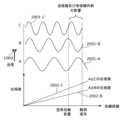
- FIG. 2 is a schematic diagram showing that the phase of a received signal changes depending on the frequency and distance.
- the antenna distance When signals with different frequencies propagate through space and are received, the amount of phase rotation of the transmitted signal relative to the received signal varies depending on the frequency and the distance between the transmitting antenna and the receiving antenna (hereinafter referred to as the antenna distance).
- the three transmitted waves 2001-A, 2001-B, and 2001-C in FIG. 2 are signals with different frequencies transmitted from the transmitting antenna unit 1000 with the same phase, and it can be seen that the phases become different as the propagation distance increases (2002-B, 2002-C). For this reason, the antenna distance can be calculated backwards by transmitting and receiving signals of known frequencies and measuring the phase difference.
- phase difference actually measured includes not only the influence of spatial propagation between the transmitting antenna and the receiving antenna, but also errors (hereinafter referred to as phase errors) due to the influence of the internal circuits of the transmitter and receiver and the phase characteristics of the antennas. For this reason, in order to correctly measure the antenna distance, it is necessary to remove the phase error from the observed signal.
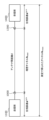
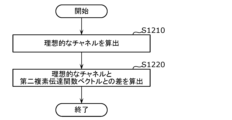
- Figure 3 shows the correspondence between the aforementioned phase error and the channel (complex transfer function).
- the phase error can be obtained by calculating the difference between the channel h meas represented by the matrix obtained by measurement and the ideal channel h ideal in space represented by the matrix that can be calculated from the antenna distance. This is not limited to the estimation of the antenna distance, but also applies to the estimation of the distance to the living body 200.
- the third complex transfer function calculation unit 1700 acquires the second complex transfer function vector h' and corrects the frequency phase error.
- the frequency phase error refers to the difference between the phase of the reference subcarrier signal S0 in the second complex transfer function matrix that is not caused by spatial propagation between antennas.
- the frequency phase error includes errors caused by the frequency characteristics of the transmitting unit 1100 and the receiving unit 1400, the electrical length of the circuit inside the transmitting unit 1100, the electrical length of the circuit inside the receiving unit 1400, and the like.
- the phase error includes a phase error e j ⁇ tx caused by the transmitting antenna unit 1000 and the transmitting unit 1100, and a phase error e j ⁇ rx caused by the receiving antenna unit 1300 and the receiving unit 1400.
- the third complex transfer function calculation unit 1700 calculates a frequency phase correction value for each element of the second complex transfer function vector by a predetermined method.
- the third complex transfer function calculation unit 1700 calculates h ideal, which is an ideal channel between antenna elements, based on the distance d between the transmitting antenna element 1001 and the receiving antenna element 1301 that is input in advance.
- h ideal is a complex vector having elements of the number S of subcarriers, and the i-th element is calculated by Equation 3.
- h ideal1 is an ideal complex transfer function between the transmitting antenna element and the receiving antenna element, which is obtained based on the inter-antenna distance between the transmitting antenna element 1001 and the receiving antenna element 1301 .
- the third complex transfer function calculation unit 1700 corrects the second complex transfer function vector h' based on the frequency phase correction value hcal in accordance with the following Equation 5 to calculate a third complex transfer function vector h''.
- the third complex transfer function vector h'' is an example of the third complex transfer function.
- the third complex transfer function calculation unit 1700 calculates a third complex transfer function vector h'' that has been corrected for frequency phase errors in multiple subcarriers based on the distance between the transmitting antenna element 1001 and the receiving antenna element 1301 and the reference complex transfer function matrix, which is the complex transfer function observed for the second period.
- the third complex transfer function calculation unit 1700 outputs the calibrated third complex transfer function vector h'' obtained in this manner to the downstream biological correlation matrix calculation unit 1800.
- a method for calculating the calibration value from the measurement results of the complex transfer function has been described.
- a value measured using a measuring device such as a network analyzer in a factory or the like may be stored in memory as the calibration value, and the calibration value may be used to calculate the third complex transfer function vector h''.
- Biometric correlation matrix calculation unit 1800 The biological correlation matrix calculation unit 1800 sequentially records the calculated third complex transfer function vector h'' for each of the S subcarriers and for each of the M x N combinations in chronological order, which is the order in which they were observed. Then, the biological correlation matrix calculation unit 1800 calculates a biological component transfer function vector expressed by an M x N dimensional matrix for each of the S subcarriers by extracting a component related to the biological body from the third complex transfer function vector h'' observed in a first period sequentially recorded in chronological order for each of the S subcarriers and for each of the M x N combinations.
- the biological component transfer function vector is an extracted reflected wave or scattered wave (biological component) that passes through the living body 200 and is included in the received signal.
- Methods for determining the biological component from a complex transfer function recorded in time series include the Fourier transform disclosed in Patent Document 1 and a method using difference information disclosed in Patent Document 2.
- the third complex transfer function vector h'' is Fourier transformed with respect to the observation time (slow time) to extract only specific frequency components, thereby calculating the biological component transfer function vector h''fft.
- the biological component transfer function vector hfft is calculated for each of a plurality of frequency components included in a frequency range that may include the influence of biological activity, for example, between 0.1 Hz and 3 Hz.
- the calculated biological component transfer function vector hfft is further inverse Fourier transformed in the subcarrier direction to obtain the biological component transfer function vector hifft expressed in the time domain, thereby calculating the time from when a signal including a biological component is transmitted from the transmitting unit 1100 to when it is received by the receiving unit 1400.
- FIG. 4 shows the relationship between the frequency (column direction of the matrix) and phase of the biological component transfer function vector h′′ fft .
- the solid line 4100 represents the state in which the phase of each component of the biological component transfer function vector varies with the subcarrier frequency when the biological component 200 is present at a certain position.
- the phase is the difference from the phase in the channel h l (frequency of the subcarrier S0) that was used as the reference when calculating the second complex transfer function.
- the ToF Time Of Flight
- this biological component transfer function vector h′′ fft is further inverse Fourier transformed in the subcarrier direction to obtain the time domain biological component transfer function vector h′′ ifft , and the time from when the signal containing the biological component is transmitted from the transmitter to when it is received by the receiver can be obtained.
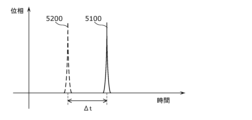
- Fig. 5 shows the relationship between time (column direction of the matrix) and phase of the time domain biological component transfer function vector h''ifft .
- the phase changes of the solid line 4100 and the dashed line 4200 in Fig. 4 appear as peaks indicated by the solid line 5100 and the dashed line 5200, respectively.
- the time resolution ⁇ t found here is expressed by Equation 6 using the subcarrier bandwidth B.
- the time resolution is equivalent to 0.05 ⁇ s, which translates to a distance resolution of about 15 m, which is not practical.
- the resolution is improved by using the MUSIC (MUltiple SIgnal Classification) method.
- the biological correlation matrix calculation unit 1800 calculates the correlation matrix R f (biological correlation matrix) of the biological component transfer function vector h′′ fft according to the following formula 7.
- the distance measuring unit 1900 performs distance measurement by the MUSIC method using the correlation matrix Rf calculated by the biological correlation matrix calculation unit 1800. First, the distance measuring unit 1900 performs eigenvalue decomposition of the correlation matrix Rf to obtain a vector U S corresponding to the signal and an eigenvector U N corresponding to the noise.
- the eigenvector corresponding to the signal is a vector from the first eigenvector up to the number of objects to be measured, and for example, if there is one object, it is only the first eigenvector.
- the eigenvector corresponding to the signal is, for example, k eigenvectors from the first eigenvector to the kth eigenvector if there are k objects (k is a natural number of 2 or more).
- the eigenvector corresponding to the noise refers to an eigenvector other than the eigenvector corresponding to the signal.
- a MUSIC spectrum P MUSIC (d) is calculated according to the following equation.
- ⁇ i represents the wavelength of the i-th subcarrier.
- the maximum value d of the MUSIC spectrum P MUSIC (d) thus obtained corresponds to the sum (third distance) of the distance a (first distance) and the distance b (second distance) in FIG. 6 described later.
- the distance a (first distance) is the distance between the transmitting antenna element 1001 and the living body 200.
- the distance b (second distance) is the distance between the receiving antenna element 1301 and the living body 200.
- the distance measuring unit 1900 can calculate the third distance by calculating the maximum value d. In this way, the distance measuring unit 1900 estimates the third distance, which is the sum of the first distance and the second distance between the transmitting antenna unit 1000 and the living body 200, using the living body correlation matrix calculated for each of the multiple subcarriers.
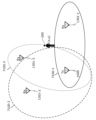
- FIG. 6 is a schematic diagram showing the positional relationship between the living body, the transmitting antenna element, and the receiving antenna element, and the position of the living body defined by the third distance.
- the position of the living body 200 on a plane is limited to the circumference of an ellipse 6100 whose foci are the positions of the transmitting antenna unit 1000 and the receiving antenna unit 1300.
- three or more transmitting antenna units 1000 or receiving antenna units 1300 may be used to estimate multiple third distances, thereby estimating the position of the living body 200 from the intersection of the ellipse.
- Figure 7 is a schematic diagram showing how the position of a living body is estimated using multiple receiving antenna elements.
- the receiving antenna section 1300 of the estimation device 100 has three receiving antenna elements 1301-1, 1301-2, and 1301-3. Note that the receiving antenna section 1300 is not limited to having three receiving antenna elements as long as it has three or more receiving antenna elements. Also, instead of the receiving antenna section 1300 having three or more receiving antenna elements, the transmitting antenna section 1000 may have three or more transmitting antenna elements.
- ellipses 7100-1, 7100-2, and 7100-3 are calculated with the positions of the transmitting antenna element and the receiving antenna element included in the combination as their focal points and the length of the major axis being the third distance, and the position of the living body 200 is estimated based on the three (i.e., M ⁇ N) intersections of the three (i.e., M ⁇ N) ellipses 7100-1, 7100-2, and 7100-3 obtained by the calculation that are closest to each other (i.e., M ⁇ N).
- the second complex transfer function calculation unit 1600 of the embodiment calculates the second complex transfer function vector h' by dividing the first complex transfer function vector h by any one element h_l in the first complex transfer function vector h as a direct wave component, but is not limited to dividing by one element h_l .
- two or more elements corresponding to two or more subcarriers adjacent in frequency among the multiple subcarriers may be used.
- the two or more elements are elements corresponding to two or more subcarriers that are all adjacent to each other among the multiple subcarriers having different frequencies.
- the two or more subcarriers have at least two first subcarriers, each of which is adjacent to only one other subcarrier.
- the subcarriers other than the two first subcarriers are each adjacent to the other two subcarriers.
- the two or more subcarriers adjacent to each other include a plurality of subcarriers that are consecutively adjacent from the subcarrier corresponding to the lowest frequency to the subcarrier corresponding to the highest frequency among the two subcarriers.
- the direct wave component used in dividing the l-th element h l of the first complex transfer function vector h may be the average value of the l-th element h l of the first complex transfer function vector h and K elements adjacent in the subcarrier direction.
- the average value h l of the l-th element is calculated using the following formula 10
- the l-th element h l ' of the second complex transfer function vector h' is calculated using the calculated average value h l of the l-th element and formula 11.
- the second complex transfer function vector h' is calculated using Equation 11 based on each element of the first complex transfer function vector h.
- the number of elements of the second complex transfer function vector h' that can be calculated using Equation 10 is S-K.
- the steering vector a(d) used in Equation 8 is calculated as shown in Equation 12.
- the biological correlation matrix calculation unit 1800 may calculate the correlation matrix R of the second complex transfer function vector h' as shown in Equation 17.
- the biological correlation matrix calculation section 1800 calculates the steering vector a(d) by vectorizing the lower triangular matrix excluding the diagonal terms of the correlation matrix R a (d) as shown in Equation 21.
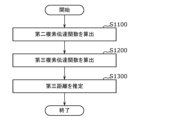
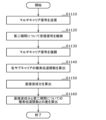
- FIG. 8 is a flowchart showing the estimation process of the estimation device 100 in this embodiment.
- the estimation device 100 calculates a second complex transfer function by dividing the first complex transfer function by the direct wave component (S1100).
- the estimation device 100 calculates a third complex transfer function based on the calculated frequency phase correction value (S1200).
- the estimation device 100 calculates a plurality of first complex transfer functions representing the propagation characteristics between the transmitting antenna element 1001 and the receiving antenna element 1301 from the S subcarrier signals observed in the second time period, for each of the plurality of subcarriers to which the plurality of subcarrier signals respectively correspond (S1140). These processes are performed in parallel or sequentially for each subcarrier. The details are as described above, so a description thereof will be omitted here. The same applies below.
- the estimation device 100 transmits a multicarrier signal including S subcarriers from the transmitting antenna element 1001 (S1310).
- the estimation device 100 performs multicarrier demodulation on the received signals observed during the first period, demodulating them into a sequence of S signals (S1330).
- the estimation device 100 calculates the second complex transfer function vector h' according to Equation 2 (S1350).
- the estimation apparatus 100 calculates a third complex transfer function vector h'' by correcting the second complex transfer function vector h' according to Equation 5 using the frequency phase correction value hcal (S1360).
- the estimation apparatus 100 calculates a biological component transfer function vector h fft '' from the calibrated third complex transfer function vector h'', and calculates the correlation matrix R f according to Equation 5 (S1370).
- the estimation apparatus 100 searches for d at which the MUSIC spectrum P MUSIC (d) is maximized, and outputs the search result as the sum of the distance a between the transmitting antenna element 1001 and the living body 200 and the distance b between the living body 200 and the receiving antenna element 1301 (S1390).
- the estimation device 100 and estimation method of this embodiment by using a multicarrier signal such as OFDM as the transmission signal, it is possible to estimate the distance between a living body and an antenna by utilizing an existing multicarrier transceiver.
- a multicarrier signal such as OFDM
- the position of the living body can be estimated from the intersection of the ellipse.
- the position of the living body can be estimated from the intersection of the ellipse by estimating multiple third distances to the transmitter using three or more receivers.
- the estimation device 100 of this embodiment it is possible to estimate the distance between a living body and an antenna and the position of the living body even in a MISO (Multiple-Input Single-output), SIMO (Single-Input Multiple-output), or MIMO (Multiple-Input Multiple-output) configuration.
- MISO Multiple-Input Single-output
- SIMO Single-Input Multiple-output
- MIMO Multiple-Input Multiple-output
- the estimation device 100 can realize an estimation device and estimation method that can estimate the distance and position of a living body in a short time and with high accuracy by using wireless signals.
- a positioning sensor and a distance estimation method according to one aspect of the present disclosure have been described above based on an embodiment, but the present disclosure is not limited to these embodiments. As long as they do not deviate from the spirit of the present disclosure, various modifications conceivable by a person skilled in the art to this embodiment, or forms constructed by combining components in different embodiments, are also included within the scope of the present disclosure.
- distance estimation and position estimation of the living body 200 have been described as an example, but this is not limited to the living body 200. It is applicable to various moving objects (machines, etc.) that, when irradiated with a high-frequency signal, produce a Doppler effect on the reflected wave due to their activity.
- the estimation device 100 is provided with the third complex transfer function calculation unit 1700, the biological correlation matrix calculation unit 1800, and the distance measurement unit 1900, but these components may not be included.
- the estimation device 100 is only required to estimate information about the biological body 200 using the second complex transfer function vector h' calculated by the second complex transfer function calculation unit 1600.
- the information about the biological body 200 is, for example, the distance from the estimation device to the biological body, the direction from the estimation device to the biological body, the position of the biological body, the biological body identifier, etc.
- the second complex transfer function vector h' calculated by the estimation device 100 can be used to estimate the direction from the estimation device to the biological body, the position of the biological body, the biological body identifier, etc., in addition to estimating the distance from the estimation device to the biological body.
- the second complex transfer function vector h' has suppressed components corresponding to at least one of the frequency phase error and (1) clock fluctuation between the transmitter consisting of the transmission signal generation unit 1200 and the transmission unit 1100 that transmits from the transmission antenna unit 1000 and the receiver consisting of the reception unit 1400 that receives by the reception antenna unit 1300, and (2) timing fluctuation of the digital-to-analog conversion of the transmission signal or the analog-to-digital conversion of the reception signal.
- This makes it possible to estimate with high accuracy the direction from the estimation device to the living body, the position of the living body, the identifier of the living body, etc.
- the present disclosure can be realized not only as a positioning sensor equipped with such characteristic components, but also as an estimation method in which the characteristic components included in the positioning sensor are steps. It can also be realized as a computer program that causes a computer to execute each of the characteristic steps included in such a method. Needless to say, such a computer program can be distributed on a non-transitory computer-readable recording medium such as a CD-ROM or via a communication network such as the Internet.
- Estimation device 200 Living body 1000 Transmitting antenna unit 1001 Transmitting antenna element 1100 Transmitting unit 1200 Transmitting signal generating unit 1300, 1300-1, 1300-2, 1300-3 Receiving antenna unit 1301 Receiving antenna element 1400 Receiving unit 1500 First complex transfer function calculating unit 1600 Second complex transfer function calculating unit 1700 Third complex transfer function calculating unit 1800 Living body correlation matrix calculating unit 1900 Distance measuring unit 2001-A, 2001-B, 2001-C Phase of each subcarrier signal transmitted from the transmitting antenna unit 2002-B, 2002-C Phase change of signals with different frequencies transmitted from the transmitting antenna unit 4100, 4200 Phase change with respect to frequency of complex transfer function matrix 5100, 5200 Phase after inverse Fourier transform of complex transfer function matrix 6100, 7100-1, 7100-2, 7100-3 Ellipse in which a living body may exist, determined by the third distance
Landscapes
- Engineering & Computer Science (AREA)
- Radar, Positioning & Navigation (AREA)
- Remote Sensing (AREA)
- Computer Networks & Wireless Communication (AREA)
- Physics & Mathematics (AREA)
- General Physics & Mathematics (AREA)
- Radar Systems Or Details Thereof (AREA)
- Variable-Direction Aerials And Aerial Arrays (AREA)
Priority Applications (2)
| Application Number | Priority Date | Filing Date | Title |
|---|---|---|---|
| JP2024567659A JP7796342B2 (ja) | 2022-12-27 | 2023-12-19 | 推定装置、推定方法、及び、プログラム |
| CN202380088769.0A CN120457359A (zh) | 2022-12-27 | 2023-12-19 | 估计装置、估计方法以及程序 |
Applications Claiming Priority (2)
| Application Number | Priority Date | Filing Date | Title |
|---|---|---|---|
| JP2022-209187 | 2022-12-27 | ||
| JP2022209187 | 2022-12-27 |
Publications (1)
| Publication Number | Publication Date |
|---|---|
| WO2024143071A1 true WO2024143071A1 (ja) | 2024-07-04 |
Family
ID=91717494
Family Applications (1)
| Application Number | Title | Priority Date | Filing Date |
|---|---|---|---|
| PCT/JP2023/045521 Ceased WO2024143071A1 (ja) | 2022-12-27 | 2023-12-19 | 推定装置、推定方法、及び、プログラム |
Country Status (3)
| Country | Link |
|---|---|
| JP (1) | JP7796342B2 (https=) |
| CN (1) | CN120457359A (https=) |
| WO (1) | WO2024143071A1 (https=) |
Citations (5)
| Publication number | Priority date | Publication date | Assignee | Title |
|---|---|---|---|---|
| JP2020008548A (ja) * | 2018-07-03 | 2020-01-16 | パナソニックIpマネジメント株式会社 | 推定装置および推定方法 |
| JP2020505179A (ja) * | 2017-02-03 | 2020-02-20 | ユニバーシティ・オブ・ノートル・ダム・デュ・ラック | コヒーレント信号分散を用いた心臓および肺の監視 |
| CN111157960A (zh) * | 2019-12-03 | 2020-05-15 | 南京汇君半导体科技有限公司 | 基于毫米波雷达的生命体征信号增强方法及设备、提取方法及设备 |
| JP2020109389A (ja) * | 2018-12-28 | 2020-07-16 | パナソニックIpマネジメント株式会社 | 推定方法、推定装置およびプログラム |
| JP2020109391A (ja) * | 2018-12-28 | 2020-07-16 | パナソニックIpマネジメント株式会社 | 推定方法、推定装置、及び、プログラム |
-
2023
- 2023-12-19 JP JP2024567659A patent/JP7796342B2/ja active Active
- 2023-12-19 WO PCT/JP2023/045521 patent/WO2024143071A1/ja not_active Ceased
- 2023-12-19 CN CN202380088769.0A patent/CN120457359A/zh active Pending
Patent Citations (5)
| Publication number | Priority date | Publication date | Assignee | Title |
|---|---|---|---|---|
| JP2020505179A (ja) * | 2017-02-03 | 2020-02-20 | ユニバーシティ・オブ・ノートル・ダム・デュ・ラック | コヒーレント信号分散を用いた心臓および肺の監視 |
| JP2020008548A (ja) * | 2018-07-03 | 2020-01-16 | パナソニックIpマネジメント株式会社 | 推定装置および推定方法 |
| JP2020109389A (ja) * | 2018-12-28 | 2020-07-16 | パナソニックIpマネジメント株式会社 | 推定方法、推定装置およびプログラム |
| JP2020109391A (ja) * | 2018-12-28 | 2020-07-16 | パナソニックIpマネジメント株式会社 | 推定方法、推定装置、及び、プログラム |
| CN111157960A (zh) * | 2019-12-03 | 2020-05-15 | 南京汇君半导体科技有限公司 | 基于毫米波雷达的生命体征信号增强方法及设备、提取方法及设备 |
Also Published As
| Publication number | Publication date |
|---|---|
| CN120457359A (zh) | 2025-08-08 |
| JP7796342B2 (ja) | 2026-01-09 |
| JPWO2024143071A1 (https=) | 2024-07-04 |
Similar Documents
| Publication | Publication Date | Title |
|---|---|---|
| JP6587199B1 (ja) | 推定装置および推定方法 | |
| Xie et al. | mD-Track: Leveraging multi-dimensionality for passive indoor Wi-Fi tracking | |
| Chen et al. | AoA-aware probabilistic indoor location fingerprinting using channel state information | |
| CN116545559B (zh) | 通信感知一体化大规模mimo信道状态与目标参数的获取方法 | |
| CN102461291B (zh) | 用于位置估计的rf指纹识别 | |
| CN114879173B (zh) | 基于mimo-ofdm信号的感知性能优化方法 | |
| JP5250336B2 (ja) | タイミング同期方法およびその装置、並びにプリアンブルおよびその生成方法と装置 | |
| JP5089460B2 (ja) | 伝搬遅延時間測定装置及びレーダ装置 | |
| JP7349661B2 (ja) | 推定方法、推定装置およびプログラム | |
| CN114760173A (zh) | 一种基于谱分析优化的载波频偏估计方法 | |
| Zhang et al. | A novel fingerprinting using channel state information with MIMO–OFDM | |
| CN116418644A (zh) | 基于正交多载波fscm信号的isac方法、设备和网络 | |
| JP7653624B2 (ja) | 推定装置、推定方法及びプログラム | |
| JP7796342B2 (ja) | 推定装置、推定方法、及び、プログラム | |
| Xue et al. | WiZoom: Accurate multipath profiling using commodity WiFi devices with limited bandwidth | |
| Han et al. | A new high precise indoor localization approach using single access point | |
| JP7769942B2 (ja) | 推定装置、推定方法及びプログラム | |
| Valiulahi et al. | Isac super-resolution receivers: The effect of different dictionary matrices | |
| JP7801675B2 (ja) | 推定装置、推定方法及びプログラム | |
| CN116500600A (zh) | 基于角度时延联合估计的雷达通信一体化定位方法及系统 | |
| Zhao et al. | A novel high-resolution imaging method using reduced-dimension beamspace unitary MUSIC for OFDM-MIMO radar | |
| Wang et al. | Intelligent positioning algorithm based on csi channel mode | |
| US20250155551A1 (en) | Circuit and method for handling wireless sensing | |
| WO2025009427A1 (ja) | 推定装置、推定方法及びプログラム | |
| Tahir et al. | PLAIN: Scalable estimation architecture for integrated sensing and communication |
Legal Events
| Date | Code | Title | Description |
|---|---|---|---|
| 121 | Ep: the epo has been informed by wipo that ep was designated in this application |
Ref document number: 23911851 Country of ref document: EP Kind code of ref document: A1 |
|
| WWE | Wipo information: entry into national phase |
Ref document number: 2024567659 Country of ref document: JP |
|
| WWE | Wipo information: entry into national phase |
Ref document number: 202380088769.0 Country of ref document: CN |
|
| NENP | Non-entry into the national phase |
Ref country code: DE |
|
| WWP | Wipo information: published in national office |
Ref document number: 202380088769.0 Country of ref document: CN |
|
| 122 | Ep: pct application non-entry in european phase |
Ref document number: 23911851 Country of ref document: EP Kind code of ref document: A1 |