WO2024143005A1 - リチウム二次電池およびセパレータ - Google Patents
リチウム二次電池およびセパレータ Download PDFInfo
- Publication number
- WO2024143005A1 WO2024143005A1 PCT/JP2023/045079 JP2023045079W WO2024143005A1 WO 2024143005 A1 WO2024143005 A1 WO 2024143005A1 JP 2023045079 W JP2023045079 W JP 2023045079W WO 2024143005 A1 WO2024143005 A1 WO 2024143005A1
- Authority
- WO
- WIPO (PCT)
- Prior art keywords
- separator
- negative electrode
- positive electrode
- spacer layer
- lithium
- Prior art date
- Legal status (The legal status is an assumption and is not a legal conclusion. Google has not performed a legal analysis and makes no representation as to the accuracy of the status listed.)
- Ceased
Links
Images



Classifications
-
- H—ELECTRICITY
- H01—ELECTRIC ELEMENTS
- H01M—PROCESSES OR MEANS, e.g. BATTERIES, FOR THE DIRECT CONVERSION OF CHEMICAL ENERGY INTO ELECTRICAL ENERGY
- H01M4/00—Electrodes
- H01M4/02—Electrodes composed of, or comprising, active material
- H01M4/13—Electrodes for accumulators with non-aqueous electrolyte, e.g. for lithium-accumulators; Processes of manufacture thereof
- H01M4/134—Electrodes based on metals, Si or alloys
-
- H—ELECTRICITY
- H01—ELECTRIC ELEMENTS
- H01M—PROCESSES OR MEANS, e.g. BATTERIES, FOR THE DIRECT CONVERSION OF CHEMICAL ENERGY INTO ELECTRICAL ENERGY
- H01M10/00—Secondary cells; Manufacture thereof
- H01M10/05—Accumulators with non-aqueous electrolyte
- H01M10/052—Li-accumulators
-
- H—ELECTRICITY
- H01—ELECTRIC ELEMENTS
- H01M—PROCESSES OR MEANS, e.g. BATTERIES, FOR THE DIRECT CONVERSION OF CHEMICAL ENERGY INTO ELECTRICAL ENERGY
- H01M10/00—Secondary cells; Manufacture thereof
- H01M10/05—Accumulators with non-aqueous electrolyte
- H01M10/058—Construction or manufacture
- H01M10/0587—Construction or manufacture of accumulators having only wound construction elements, i.e. wound positive electrodes, wound negative electrodes and wound separators
-
- H—ELECTRICITY
- H01—ELECTRIC ELEMENTS
- H01M—PROCESSES OR MEANS, e.g. BATTERIES, FOR THE DIRECT CONVERSION OF CHEMICAL ENERGY INTO ELECTRICAL ENERGY
- H01M4/00—Electrodes
- H01M4/02—Electrodes composed of, or comprising, active material
- H01M4/36—Selection of substances as active materials, active masses, active liquids
- H01M4/38—Selection of substances as active materials, active masses, active liquids of elements or alloys
- H01M4/381—Alkaline or alkaline earth metals elements
- H01M4/382—Lithium
-
- H—ELECTRICITY
- H01—ELECTRIC ELEMENTS
- H01M—PROCESSES OR MEANS, e.g. BATTERIES, FOR THE DIRECT CONVERSION OF CHEMICAL ENERGY INTO ELECTRICAL ENERGY
- H01M50/00—Constructional details or processes of manufacture of the non-active parts of electrochemical cells other than fuel cells, e.g. hybrid cells
- H01M50/40—Separators; Membranes; Diaphragms; Spacing elements inside cells
- H01M50/409—Separators, membranes or diaphragms characterised by the material
- H01M50/449—Separators, membranes or diaphragms characterised by the material having a layered structure
-
- H—ELECTRICITY
- H01—ELECTRIC ELEMENTS
- H01M—PROCESSES OR MEANS, e.g. BATTERIES, FOR THE DIRECT CONVERSION OF CHEMICAL ENERGY INTO ELECTRICAL ENERGY
- H01M50/00—Constructional details or processes of manufacture of the non-active parts of electrochemical cells other than fuel cells, e.g. hybrid cells
- H01M50/40—Separators; Membranes; Diaphragms; Spacing elements inside cells
- H01M50/463—Separators, membranes or diaphragms characterised by their shape
-
- Y—GENERAL TAGGING OF NEW TECHNOLOGICAL DEVELOPMENTS; GENERAL TAGGING OF CROSS-SECTIONAL TECHNOLOGIES SPANNING OVER SEVERAL SECTIONS OF THE IPC; TECHNICAL SUBJECTS COVERED BY FORMER USPC CROSS-REFERENCE ART COLLECTIONS [XRACs] AND DIGESTS
- Y02—TECHNOLOGIES OR APPLICATIONS FOR MITIGATION OR ADAPTATION AGAINST CLIMATE CHANGE
- Y02E—REDUCTION OF GREENHOUSE GAS [GHG] EMISSIONS, RELATED TO ENERGY GENERATION, TRANSMISSION OR DISTRIBUTION
- Y02E60/00—Enabling technologies; Technologies with a potential or indirect contribution to GHG emissions mitigation
- Y02E60/10—Energy storage using batteries
-
- Y—GENERAL TAGGING OF NEW TECHNOLOGICAL DEVELOPMENTS; GENERAL TAGGING OF CROSS-SECTIONAL TECHNOLOGIES SPANNING OVER SEVERAL SECTIONS OF THE IPC; TECHNICAL SUBJECTS COVERED BY FORMER USPC CROSS-REFERENCE ART COLLECTIONS [XRACs] AND DIGESTS
- Y02—TECHNOLOGIES OR APPLICATIONS FOR MITIGATION OR ADAPTATION AGAINST CLIMATE CHANGE
- Y02P—CLIMATE CHANGE MITIGATION TECHNOLOGIES IN THE PRODUCTION OR PROCESSING OF GOODS
- Y02P70/00—Climate change mitigation technologies in the production process for final industrial or consumer products
- Y02P70/50—Manufacturing or production processes characterised by the final manufactured product
Definitions
- Non-aqueous electrolyte secondary batteries are used for ICT applications such as personal computers and smartphones, in-vehicle applications, and for power storage. In these applications, non-aqueous electrolyte secondary batteries are required to have even higher capacities.
- Lithium ion batteries are known as high-capacity non-aqueous electrolyte secondary batteries. Increasing the capacity of lithium ion batteries can be achieved by using, for example, a combination of graphite and an alloy active material such as a silicon compound as the negative electrode active material. However, increasing the capacity of lithium ion batteries is reaching its limit.
- Lithium secondary batteries (lithium metal secondary batteries) are promising high-capacity non-aqueous electrolyte secondary batteries that exceed lithium-ion batteries.
- lithium metal precipitates on the negative electrode during charging, and this lithium metal dissolves into the non-aqueous electrolyte during discharging.
- Patent Document 1 proposes providing a spacer (protrusion) between the positive electrode and the separator to ensure space for lithium metal to precipitate during charging, improving charge/discharge efficiency and suppressing cracks in the negative electrode current collector caused by local expansion of the negative electrode.
- the spacer is placed between the positive electrode and the separator so that when a straight line is drawn in the width direction (short direction) of the positive electrode current collector, the straight line passes through the spacer at three or more points.
- Spacers tend to reduce the circulation of electrolyte around the spacers. For this reason, the spacers can be arranged so as not to impede the circulation of electrolyte as much as possible, for example by arranging multiple spacers intermittently and leaving gaps. However, the effect of the gaps provided to ensure the electrolyte flow path may reduce the spacers' ability to ensure the space in which lithium metal can precipitate.
- One aspect of the present disclosure is a battery comprising an electrode group including a positive electrode, a negative electrode facing the positive electrode, and a separator disposed between the positive electrode and the negative electrode, and a non-aqueous electrolyte, the positive electrode and the negative electrode being wound via the separator, the positive electrode, the negative electrode, and the separator being elongated in shape having a length D2 in a first direction D1 parallel to the winding axis and a length L2 (L1 ⁇ L2) in a second direction D2 perpendicular to the first direction, lithium metal being precipitated in the negative electrode during charging and the lithium metal being dissolved during discharging, and at least one member selected from the group consisting of the positive electrode, the negative electrode, and the separator being a spacer layer.
- the spacer layer includes at least a first linear portion along a first geometric pattern and a second linear portion along a second geometric pattern, and at least the first portion has a plurality of defects so as not to be continuous in both the first direction and the second direction.
- the member is divided in the first direction into a central portion having an area S1 and two outer portions each having an area of 1/2 of S1, the central portion includes the first portion, and the proportion of the defects in the central portion is smaller than the proportion of the defects in the outer portions.
- a separator having an elongated shape having a length L1 in a first direction D1 and a length L2 (L1 ⁇ L2) in a second direction D2 perpendicular to the first direction, the separator including a base material layer and a spacer layer, the spacer layer being configured with a plurality of convex portions so as to be discontinuous in both the first direction and the second direction, the spacer layer including at least a first linear portion along a first geometric pattern and a second linear portion along a second geometric pattern, at least the second portion having a plurality of missing portions so as to be discontinuous in both the first direction and the second direction, when the separator is divided in the first direction into a central portion having an area S1 and two outer portions each having an area of 1/2 of S1, the central portion includes the first portion, and the proportion of the missing portions in the central portion is smaller than the proportion of the missing portions in the outer portions.
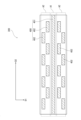
- FIG. 2 is a plan view illustrating an example of the arrangement of a spacer layer provided on a surface of a separator in a lithium secondary battery according to an embodiment of the present disclosure.
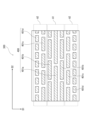
- 11 is a plan view showing another example of the arrangement of the spacer layer provided on the surface of the separator.
- FIG. 11 is a plan view showing another example of the arrangement of the spacer layer provided on the surface of the separator.
- FIG. 13 is a plan view showing a schematic diagram of still another example of the arrangement of the spacer layer provided on the surface of the separator.
- FIG. 13 is a plan view showing a schematic diagram of still another example of the arrangement of the spacer layer provided on the surface of the separator.
- FIG. 1 is a vertical cross-sectional view illustrating a lithium secondary battery according to an embodiment of the present disclosure.
- FIG. 6 is an enlarged view showing a schematic view of a main part of the lithium secondary battery shown in FIG. 5 .
- the description "numerical value A to numerical value B" includes numerical value A and numerical value B and can be read as “numerical value A or more and numerical value B or less.”
- any of the exemplified lower limits and any of the exemplified upper limits can be arbitrarily combined as long as the lower limit is not equal to or greater than the upper limit.
- one of them may be selected and used alone, or two or more may be used in combination.
- a lithium secondary battery includes an electrode group including a positive electrode, a negative electrode facing the positive electrode, and a separator disposed between the positive electrode and the negative electrode, and a non-aqueous electrolyte.
- the positive electrode and the negative electrode are wound with the separator interposed therebetween.
- the positive electrode, the negative electrode, and the separator have a length L1 in a first direction D1 parallel to the winding axis, and a length L2 in a second direction D2 perpendicular to the first direction, and are of an elongated shape in which the length L1 is shorter than the length L2 (L1 ⁇ L2).
- a lithium secondary battery is a type of secondary battery in which lithium metal is precipitated on the negative electrode during charging, and lithium metal dissolves from the negative electrode during discharging.
- the positive electrode and the negative electrode may be collectively referred to as electrodes.
- lithium secondary batteries for example, 70% or more of the rated capacity is achieved by the deposition and dissolution of lithium metal.
- the movement of electrons at the negative electrode during charging and discharging is mainly due to the deposition and dissolution of lithium metal at the negative electrode.
- 70-100% (for example, 80-100% or 90-100%) of the movement of electrons (current from another perspective) at the negative electrode during charging and discharging is due to the deposition and dissolution of lithium metal.
- the negative electrode of a lithium secondary battery is different from a negative electrode in which the movement of electrons at the negative electrode during charging and discharging is mainly due to the absorption and release of lithium ions by the negative electrode active material (such as graphite).
- At least one member selected from the group consisting of a positive electrode, a negative electrode, and a separator has a spacer layer.
- the spacer layer forms a space between the positive electrode and the separator or between the negative electrode and the separator, and suppresses expansion of the negative electrode due to charging and discharging.
- the spacer layer ensures a space for lithium metal to deposit on the negative electrode surface, and reduces the volume change of the negative electrode due to the deposition of lithium metal.
- the spacer layer is provided as a convex portion on at least one of the positive electrode, the negative electrode, and the separator.
- the spacer layer or the convex portion may be provided on the surface of the positive electrode, the surface of the negative electrode, or the surface of the separator facing the positive electrode or the negative electrode.
- the convex portion provided on the surface of the positive electrode and/or the surface of the separator facing the positive electrode forms a space between the positive electrode and the separator
- the convex portion provided on the surface of the negative electrode and/or the surface of the separator facing the negative electrode forms a space between the negative electrode and the separator.
- the spacer layer includes at least a first linear portion along the first geometric pattern and a second linear portion along the second geometric pattern.
- the spacer layer may include a third portion along a third geometric pattern in addition to the first and second portions.
- Linear geometric patterns include straight line patterns and curved line patterns.
- Mesh-like geometric patterns are obtained by connecting a plurality of straight and/or curved line patterns to form a mesh, and are therefore included in line patterns.
- Dot-like geometric patterns are considered to be patterns in which the extension length of the linear protrusions is short, approximately the line width of the linear protrusions, and are therefore included in line patterns.
- At least the second portion has a plurality of defects so that they are not continuous in both the first and second directions.
- the electrolyte can circulate through the defects, which improves circulation and further suppresses deterioration of cycle characteristics.
- the first portion and/or the third portion may have defects.
- the second portion is located on the outside, farther from the center in the first direction than the first portion. The proportion of defects in each of the first, second, and third portions is determined so that the proportion of defects decreases the closer to the center in the first direction.
- the member is divided into a central portion having an area S1, and an outer portion other than the central portion.
- the outer portion is made up of two portions at both ends in the first direction, each having an area of 1/2 of S1.
- the first portion is considered to be included in the central portion.
- the proportion of defects in the central area is smaller than the proportion of defects in the outer areas. This ensures sufficient space for lithium metal to precipitate while maintaining high electrolyte circulation. As a result, deterioration of cycle characteristics can be sufficiently suppressed.
- the outer parts are more susceptible to poor circulation of the electrolyte than the parts closer to the center. Therefore, the proportion of defects in the outer parts is made greater than in the parts closer to the center, giving priority to ensuring a flow path for the electrolyte. On the other hand, in the parts closer to the center, the proportion of defects is made smaller than in the outer parts, giving priority to ensuring space for lithium metal to precipitate, and preventing the space from being crushed due to an increase in internal pressure, etc., and reducing the amount of space in which lithium metal precipitates. This makes it possible to both prevent a decrease in circulation and ensure space for lithium metal to precipitate, significantly reducing the decrease in cycle characteristics.
- the percentage of defects refers to the percentage of the total length of the defects relative to the total length of the linear convexities when it is assumed that the convexities exist in a line shape in the defects.
- the length of each of the multiple defects is the shortest distance between two linear convexities adjacent to each other in the direction in which the linear convexities extend, sandwiching the defect.
- the percentage of defects is calculated by adding up all the convexities and defects included in the area to be evaluated.
- the imaginary line when drawing an imaginary line parallel to the first direction at any position on the member, it is preferable that the imaginary line always passes through the first portion at one or more points in the central portion.
- the first portion may extend continuously along the second direction without having any missing portions.
- the virtual line passes through the spacer layer at two or more places.
- the spacer layer since there are two convex portions facing each other in the first direction at any position in the second direction, a space for lithium metal to precipitate can be reliably secured.
- a virtual line parallel to the first direction does not pass through the spacer layer at a certain position in the second direction, or passes through only one spacer layer, the space in the area around the virtual line may be crushed due to an increase in internal pressure of the electrode group caused by lithium metal precipitation, and sufficient space may not be secured.
- a space for lithium metal to precipitate can be secured more reliably, and a decrease in cycle characteristics can be suppressed.
- the second geometric pattern may be, for example, a substantially linear pattern extending along the second direction, or may be a mesh pattern.
- the second geometric pattern as a linear pattern may be, for example, a pattern in which a plurality of linear protrusions are intermittently arranged along straight lines that are substantially parallel to a plurality of second directions. In this case, the plurality of linear protrusions may be arranged in a staggered pattern.
- the shape of the mesh in the mesh pattern is not particularly limited, but may be polygonal, preferably rectangular or hexagonal. From the viewpoint of suppressing unevenness of the space between the electrode and the separator, the interior angle of the polygon may be 120° or less.
- the quadrilateral mesh may be rectangular or square, or may be rhombic.
- the average height h of the convex portion may be 0.02 mm or more and 0.09 mm or less, or 0.015 mm or more and 0.01 mm or less, depending on the battery size.
- the average height h of the convex portion is calculated by averaging the measured values at any 10 points.
- the height of a portion of the convex portion may be different from the height of the remaining portion of the convex portion, and the heights of adjacent convex portions may be different.
- the multiple convex portions may include a convex portion with a height h1 and a convex portion with a height h2 smaller than the height h1.
- the ratio h2/h1 of the height h2 to the height h1 may be, for example, 0.8 or more and less than 1.0, or 0.8 or more and 0.95 or less.
- the width of the convex portion (width W of the linear convex portion 401 in FIG. 1) is, for example, 1 mm or less, and may be 0.1 mm or more and 1 mm or less.
- the protrusions may be made of a material that is less conductive than the electrode, or may be made of a resin material.
- the material constituting the spacer layer is not particularly limited.
- the spacer layer may be composed of a conductive material and/or an insulating material.
- insulating materials are preferred. Lithium metal is less likely to precipitate on the surface of insulating materials, which can enhance the effect of suppressing the expansion of the negative electrode.
- the conductive material can be appropriately selected from those described below as materials for the negative electrode current collector or the positive electrode current collector.
- a spacer layer can be provided by forming a convex portion on the negative electrode current collector by pressing or the like.
- a conductive paint can be applied to the surface of the separator or electrode, or a conductive tape can be attached to the surface of the separator or electrode.
- a resin material can be used as an insulating material.
- the resin material include polyolefin resin, acrylic resin, polyamide resin, polyimide resin, silicone resin, fluorine-based resin, urethane resin, melamine resin, and urea resin.
- a cured product of a curable resin such as an epoxy resin can be used.
- inorganic fillers and the like can be mixed into these resin materials.
- the material constituting the spacer layer is preferably a material having a Young's modulus of 0.01 GPa or more and 10 GPa or less. This makes it easier to alleviate stress caused by expansion and contraction of the negative electrode, and makes it easier to maintain the space that contains the lithium metal. In addition, damage to the electrode caused by the spacer layer is easier to suppress.
- insulating materials having a Young's modulus in the above range include the cured product of the above-mentioned curable resin.
- the spacer layer may be formed, for example, by attaching a resin adhesive tape to the surface of the separator or electrode.
- the spacer layer may also be formed by applying a solution or dispersion containing a resin material to the surface of the separator or electrode and drying it.
- the spacer layer may also be formed by applying a curable resin to the surface of the separator or electrode in a desired shape and curing it.
- the spacer layer may be formed by scattering particles of a resin material in a desired shape on the surface of the separator or electrode.
- the spacer layer may be provided on both surfaces of the member.
- the spacer layer includes a first spacer layer disposed on the first surface of the member, and a second spacer layer disposed on the second surface of the member.
- the convex portions formed by the first spacer layer and the convex portions formed by the second spacer layer are each arranged in a pattern that satisfies the relationship of the missing portions described above, thereby ensuring that space is available for lithium metal to precipitate and suppressing deterioration of cycle characteristics.
- the lithium secondary battery may have a stacked electrode group formed by stacking positive and negative electrodes with a separator between them, or may have a wound electrode group formed by winding positive and negative electrodes in a spiral shape with a separator between them.
- a separator relates to a separator provided with the spacer layer.
- the separator has an elongated shape having a length L1 in a first direction D1 and a length L2 (L1 ⁇ L2) in a second direction D2 perpendicular to the first direction, and includes a base material layer and a spacer layer.
- the spacer layer is composed of a plurality of convex portions so as not to be continuous in both the first direction and the second direction.
- the spacer layer includes at least a first linear portion along the first geometric pattern and a second linear portion along the second geometric pattern. At least the second portion has a plurality of missing portions so as not to be continuous in both the first direction and the second direction.
- the spacer layer is provided on the surface of the separator.
- the embodiment of the present disclosure is not limited to this, and the spacer layer may be provided on the surface of the electrode.
- Figure 1 is a plan view that shows a schematic of a spacer layer disposed on the surface of a separator.
- the spacer layer 400 has convex portions 401 (first portions) arranged in a first geometric pattern in a first region A1 at the center of the separator surface in a first direction D1, and convex portions 402 (second portions) arranged in a second geometric pattern in a second region A2 outside the first region A1 on the separator surface.
- the convex portion 401 is a single, continuously formed, linear convex portion that extends substantially parallel to the second direction D2.
- the convex portion 401 does not have any missing portions. Therefore, the proportion of missing portions in the first region A1 is 0%.
- each second region A2 the linear convex portion extending along one of the two straight lines along the second direction D2 is at a different position in the second direction D2 from the linear convex portion extending along the remaining straight line.
- the linear convex portions are arranged in a staggered pattern.
- the length of each convex portion 402 is approximately the same as the length of the missing portion. Therefore, the proportion of missing portions in the second region A2 is 50%.
- the negative electrode current collector can be a conductive sheet.
- conductive sheets include foil and film.
- the transition metal elements contained in the lithium-containing transition metal oxide include Sc, Ti, V, Cr, Mn, Fe, Co, Ni, Cu, Y, Zr, W, etc.
- the lithium-containing transition metal oxide may contain one type of transition metal element, or may contain two or more types.
- the transition metal element may be Co, Ni, and/or Mn.
- the lithium-containing transition metal oxide may contain one or more typical elements as necessary.
- the typical elements include Mg, Al, Ca, Zn, Ga, Ge, Sn, Sb, Pb, Bi, etc.
- the typical element may be Al, etc.
- lithium-containing transition metal oxides composite oxides containing Co, Ni and/or Mn as transition metal elements, and optionally containing Al, and having a layered rock-salt crystal structure are preferred in terms of obtaining high capacity.
- the molar ratio mLi/mM of the total amount of lithium in the positive and negative electrodes mLi to the amount mM of metal M other than lithium in the positive electrode is set to, for example, 1.1 or less.
- the positive electrode current collector may be a conductive sheet.
- conductive sheets include foil and film.
- the surface of the positive electrode current collector may be coated with a carbon material.
- the thickness of the positive electrode current collector is not particularly limited, and is, for example, 5 ⁇ m or more and 300 ⁇ m or less.
- Non-aqueous electrolyte The non-aqueous electrolyte having lithium ion conductivity contains, for example, a non-aqueous solvent, and lithium ions and anions dissolved in the non-aqueous solvent.
- the non-aqueous electrolyte may be in a liquid state or a gel state.
- a liquid non-aqueous electrolyte is prepared by dissolving a lithium salt in a non-aqueous solvent. When the lithium salt dissolves in the non-aqueous solvent, lithium ions and anions are produced.
- the anion of the oxalate complex may contain boron and/or phosphorus.
- Examples of the anion of the oxalate complex include bisoxalate borate anion, BF 2 (C 2 O 4 ) ⁇ , PF 4 (C 2 O 4 ) ⁇ , PF 2 (C 2 O 4 ) 2 ⁇ , etc.
- the non-aqueous electrolyte may contain these anions alone or in combination of two or more kinds.
- Ethers include cyclic ethers and chain ethers.
- cyclic ethers include 1,3-dioxolane, 4-methyl-1,3-dioxolane, tetrahydrofuran, and 2-methyltetrahydrofuran.
- chain ethers include 1,2-dimethoxyethane, diethyl ether, ethyl vinyl ether, methyl phenyl ether, benzyl ethyl ether, diphenyl ether, dibenzyl ether, 1,2-diethoxyethane, and diethylene glycol dimethyl ether.
- the configuration of the lithium secondary battery according to the present disclosure will be explained with reference to the drawings, using as an example a cylindrical battery equipped with a wound electrode group.
- the present disclosure is not limited to the following configuration.
- FIG. 5 is a vertical cross-sectional view of a lithium secondary battery 10.
- the lithium secondary battery 10 is a cylindrical battery that includes a cylindrical battery case, a wound electrode group 14 housed in the battery case, and a non-aqueous electrolyte (not shown).
- the battery case is composed of a case body 15, which is a cylindrical metal container with a bottom, and a sealing body 16 that seals the opening of the case body 15.
- the case body 15 has an annular step 21 formed by partially pressing the side wall from the outside near the opening.
- the sealing body 16 is supported by the surface of the step 21 on the opening side.
- a gasket 27 is disposed between the case body 15 and the sealing body 16, thereby ensuring the hermeticity of the battery case.
- insulating plates 17 and 18 are disposed at both ends of the electrode group 14 in the winding axis direction.
- an electrode group including a positive electrode, a negative electrode facing the positive electrode, and a separator disposed between the positive electrode and the negative electrode;
- the negative electrode lithium metal is precipitated during charging, and the lithium metal is dissolved during discharging,
- At least one member selected from the group consisting of the positive electrode, the negative electrode, and the separator has a spacer layer; the spacer layer includes at least a first portion in a line shape along a first geometric pattern and a second portion in a line shape along a second geometric pattern; At least the
- the obtained positive electrode mixture slurry was applied to both sides of an Al foil (positive electrode current collector), dried, and the coating film of the positive electrode mixture was rolled using a roller. Finally, the obtained laminate of the positive electrode current collector and the positive electrode mixture was cut to a predetermined electrode size to prepare a positive electrode having a positive electrode mixture layer on both sides of the positive electrode current collector.
- a polyethylene separator (microporous membrane) was prepared.
- a polyimide ink was applied to a predetermined area on the surface of the separator, and then the surface was dried with hot air to provide a spacer layer formed of polyimide resin (Young's modulus 2 GPa).
- the polyimide ink was applied using a dispenser.
- the spacer layer had a first geometric pattern in which one linear convex portion was continuously formed along a straight line parallel to the second direction D2 in the first region A1 at the center in the first direction D1, as shown in FIG. 2A, and a second geometric pattern in which a regular hexagonal mesh-like convex portion was formed with missing portions in the second region A2 outside the first region A1.
- each protrusion width perpendicular to the direction in which the protrusion extends
- the spacing between the protrusions in the second region A2 was 2.25 mm.
- the proportion of missing parts in the hexagonal mesh-like protrusions in the second region A2 was 25%.
- the electrode group was placed in a bag-shaped exterior body made of a laminate sheet with an Al layer, and the nonaqueous electrolyte was injected. The exterior body was then sealed to complete the lithium secondary battery A1.
- each protrusion width perpendicular to the direction in which the protrusion extends
- the spacing between the protrusions in the second region A2 was 2.25 mm.
- the proportion of missing parts in the diamond-shaped mesh-like protrusions in the second region A2 was 25%.
- Example 3 In the formation of the spacer in (2) above, the arrangement pattern of the spacer layer was set to a pattern similar to that shown in Fig. 4, in which a first region A1 in the center in the first direction D1 had a first geometric pattern, a second region A2 outside the first region A1 had a second geometric pattern, and a third region A3 outside the second region A2 had a third geometric pattern.
- the first, second, and third geometric patterns are patterns in which a plurality of linear convex portions are intermittently or continuously formed along straight lines parallel to the second direction D2, but the proportion of defective portions in the linear convex portions was made different.
- the proportion of defective portions was set to 0% (no defective portions) in the first region A1 having the first geometric pattern, 25% in the second region A2 having the second geometric pattern, and 50% in the third region A3 having the third geometric pattern.
- each convex portion width perpendicular to the direction in which the convex portion extends was the same at 1 mm in the first region A1, the second region A2, and the third region A3.
- the spacing between the convex portions was the same at 5 mm in the first region A1, the second region A2, and the third region A3.
- the arrangement pattern of the spacer layer was a pattern having only a first geometric pattern in which a plurality of linear convex portions were intermittently or continuously formed along a straight line parallel to the second direction D2.
- the line width of each convex portion was 1 mm, and the spacing between the convex portions (distance between the convex portions in the first direction D1) was 5 mm.
- the proportion of defective portions in the linear convex portions was 0% (no defective portions), and continuous linear convex portions were formed.
- the arrangement pattern of the spacer layer was a pattern having only a first geometric pattern in which hexagonal mesh-like convex portions were formed.
- the line width of the convex portions was 0.5 mm, and the spacing between the convex portions (the distance between the parallel opposite sides of the hexagons that make up the mesh) was 2.25 mm.
- the hexagonal mesh-like convex portions were formed continuously without any missing portions, and the proportion of missing portions was 0%.
- Comparative Example 3 In Comparative Example 1, the proportion of missing parts in the linear protrusions was changed to 50%, and linear protrusions were formed that extended intermittently along straight lines parallel to the second direction D2. A lithium secondary battery B3 was completed in the same manner as in Comparative Example 1 except for this.
- Comparative Example 4 In Comparative Example 2, the hexagonal mesh-shaped protrusions were provided with defects, and the proportion of defects in the hexagonal mesh-shaped protrusions was changed to 25%. Except for this, a lithium secondary battery B4 was completed in the same manner as in Comparative Example 2.
- the battery was charged at a constant current of 10 mA per unit area (square centimeter) of the electrode until the battery voltage reached 4.3 V, and then charged at a constant voltage of 4.3 V until the current value per unit area of the electrode reached 1 mA.
- the above charge and discharge constituted one cycle, and the charge and discharge cycle was repeated.
- the ratio (%) of the discharge capacity at the 50th cycle to the discharge capacity at the 1st cycle was calculated as the capacity retention rate.
- Batteries A1 to A3 had a greater number of cycles until cycle stop occurred than batteries B3 and B4, and was comparable to battery B1. Their capacity retention rates were also higher than batteries B1 and B2, and comparable to batteries B3 and B4. Thus, batteries A1 to A3 were able to achieve a high capacity retention rate while suppressing cycle stop due to expansion of the negative electrode.
Landscapes
- Chemical & Material Sciences (AREA)
- Chemical Kinetics & Catalysis (AREA)
- Electrochemistry (AREA)
- General Chemical & Material Sciences (AREA)
- Engineering & Computer Science (AREA)
- Manufacturing & Machinery (AREA)
- Materials Engineering (AREA)
- Secondary Cells (AREA)
- Cell Separators (AREA)
Priority Applications (3)
| Application Number | Priority Date | Filing Date | Title |
|---|---|---|---|
| JP2024567495A JPWO2024143005A1 (https=) | 2022-12-27 | 2023-12-15 | |
| CN202380088917.9A CN120419012A (zh) | 2022-12-27 | 2023-12-15 | 锂二次电池和隔膜 |
| EP23911786.4A EP4645511A4 (en) | 2022-12-27 | 2023-12-15 | SECONDARY LITHIUM BATTERY AND SEPARATOR |
Applications Claiming Priority (2)
| Application Number | Priority Date | Filing Date | Title |
|---|---|---|---|
| JP2022210609 | 2022-12-27 | ||
| JP2022-210609 | 2022-12-27 |
Publications (1)
| Publication Number | Publication Date |
|---|---|
| WO2024143005A1 true WO2024143005A1 (ja) | 2024-07-04 |
Family
ID=91717334
Family Applications (1)
| Application Number | Title | Priority Date | Filing Date |
|---|---|---|---|
| PCT/JP2023/045079 Ceased WO2024143005A1 (ja) | 2022-12-27 | 2023-12-15 | リチウム二次電池およびセパレータ |
Country Status (4)
| Country | Link |
|---|---|
| EP (1) | EP4645511A4 (https=) |
| JP (1) | JPWO2024143005A1 (https=) |
| CN (1) | CN120419012A (https=) |
| WO (1) | WO2024143005A1 (https=) |
Citations (3)
| Publication number | Priority date | Publication date | Assignee | Title |
|---|---|---|---|---|
| WO2020066254A1 (ja) | 2018-09-28 | 2020-04-02 | パナソニックIpマネジメント株式会社 | リチウム二次電池 |
| WO2021192645A1 (ja) * | 2020-03-27 | 2021-09-30 | パナソニックIpマネジメント株式会社 | リチウム二次電池 |
| WO2022209601A1 (ja) * | 2021-03-30 | 2022-10-06 | パナソニックIpマネジメント株式会社 | リチウム二次電池 |
Family Cites Families (3)
| Publication number | Priority date | Publication date | Assignee | Title |
|---|---|---|---|---|
| JP7289072B2 (ja) * | 2018-05-31 | 2023-06-09 | パナソニックIpマネジメント株式会社 | リチウム二次電池 |
| WO2023054151A1 (ja) * | 2021-09-30 | 2023-04-06 | パナソニックIpマネジメント株式会社 | リチウム二次電池 |
| WO2024048136A1 (ja) * | 2022-08-31 | 2024-03-07 | パナソニックIpマネジメント株式会社 | リチウム二次電池および複合部材 |
-
2023
- 2023-12-15 CN CN202380088917.9A patent/CN120419012A/zh active Pending
- 2023-12-15 EP EP23911786.4A patent/EP4645511A4/en active Pending
- 2023-12-15 WO PCT/JP2023/045079 patent/WO2024143005A1/ja not_active Ceased
- 2023-12-15 JP JP2024567495A patent/JPWO2024143005A1/ja active Pending
Patent Citations (3)
| Publication number | Priority date | Publication date | Assignee | Title |
|---|---|---|---|---|
| WO2020066254A1 (ja) | 2018-09-28 | 2020-04-02 | パナソニックIpマネジメント株式会社 | リチウム二次電池 |
| WO2021192645A1 (ja) * | 2020-03-27 | 2021-09-30 | パナソニックIpマネジメント株式会社 | リチウム二次電池 |
| WO2022209601A1 (ja) * | 2021-03-30 | 2022-10-06 | パナソニックIpマネジメント株式会社 | リチウム二次電池 |
Non-Patent Citations (1)
| Title |
|---|
| See also references of EP4645511A1 |
Also Published As
| Publication number | Publication date |
|---|---|
| CN120419012A (zh) | 2025-08-01 |
| JPWO2024143005A1 (https=) | 2024-07-04 |
| EP4645511A1 (en) | 2025-11-05 |
| EP4645511A4 (en) | 2026-04-22 |
Similar Documents
| Publication | Publication Date | Title |
|---|---|---|
| JP7675381B2 (ja) | リチウム二次電池 | |
| CN112673504B (zh) | 锂二次电池 | |
| JP7813987B2 (ja) | リチウム二次電池 | |
| CN110556541A (zh) | 锂二次电池 | |
| CN110556539A (zh) | 锂二次电池 | |
| EP3537522B1 (en) | Lithium secondary battery including lithium-ion conductive nonaqueous electrolyte | |
| US20240128591A1 (en) | Lithium secondary battery | |
| EP3537523B1 (en) | Lithium secondary battery including lithium-ion conductive nonaqueous electrolyte | |
| JP2019212605A (ja) | リチウム二次電池 | |
| WO2024143000A1 (ja) | リチウム二次電池およびセパレータ | |
| US20240347864A1 (en) | Lithium secondary battery | |
| JP7162174B2 (ja) | リチウム二次電池 | |
| WO2023234223A1 (ja) | リチウム二次電池および複合部材 | |
| WO2024048136A1 (ja) | リチウム二次電池および複合部材 | |
| JP7162175B2 (ja) | リチウム二次電池 | |
| WO2024143005A1 (ja) | リチウム二次電池およびセパレータ | |
| CN116325262A (zh) | 锂二次电池 | |
| WO2024143004A1 (ja) | リチウム二次電池およびセパレータ | |
| WO2026071195A1 (ja) | 二次電池およびセパレータ | |
| WO2025070578A1 (ja) | 二次電池 | |
| WO2026070785A1 (ja) | 二次電池およびセパレータ | |
| WO2026048595A1 (ja) | リチウム二次電池 | |
| WO2026048847A1 (ja) | 二次電池 | |
| WO2024262513A1 (ja) | リチウム二次電池および複合部材 | |
| WO2025047687A1 (ja) | リチウム二次電池 |
Legal Events
| Date | Code | Title | Description |
|---|---|---|---|
| 121 | Ep: the epo has been informed by wipo that ep was designated in this application |
Ref document number: 23911786 Country of ref document: EP Kind code of ref document: A1 |
|
| WWE | Wipo information: entry into national phase |
Ref document number: 2024567495 Country of ref document: JP |
|
| WWE | Wipo information: entry into national phase |
Ref document number: 202380088917.9 Country of ref document: CN |
|
| WWE | Wipo information: entry into national phase |
Ref document number: 2023911786 Country of ref document: EP |
|
| NENP | Non-entry into the national phase |
Ref country code: DE |
|
| WWP | Wipo information: published in national office |
Ref document number: 202380088917.9 Country of ref document: CN |
|
| ENP | Entry into the national phase |
Ref document number: 2023911786 Country of ref document: EP Effective date: 20250728 |
|
| ENP | Entry into the national phase |
Ref document number: 2023911786 Country of ref document: EP Effective date: 20250728 |
|
| WWP | Wipo information: published in national office |
Ref document number: 2023911786 Country of ref document: EP |