WO2024142907A1 - 電解加工工具、電解加工装置、及び翼の製造方法 - Google Patents
電解加工工具、電解加工装置、及び翼の製造方法 Download PDFInfo
- Publication number
- WO2024142907A1 WO2024142907A1 PCT/JP2023/044391 JP2023044391W WO2024142907A1 WO 2024142907 A1 WO2024142907 A1 WO 2024142907A1 JP 2023044391 W JP2023044391 W JP 2023044391W WO 2024142907 A1 WO2024142907 A1 WO 2024142907A1
- Authority
- WO
- WIPO (PCT)
- Prior art keywords
- tool
- electrochemical machining
- electrode
- inner circumferential
- electrolyte
- Prior art date
- Legal status (The legal status is an assumption and is not a legal conclusion. Google has not performed a legal analysis and makes no representation as to the accuracy of the status listed.)
- Ceased
Links
Images






Classifications
-
- B—PERFORMING OPERATIONS; TRANSPORTING
- B23—MACHINE TOOLS; METAL-WORKING NOT OTHERWISE PROVIDED FOR
- B23H—WORKING OF METAL BY THE ACTION OF A HIGH CONCENTRATION OF ELECTRIC CURRENT ON A WORKPIECE USING AN ELECTRODE WHICH TAKES THE PLACE OF A TOOL; SUCH WORKING COMBINED WITH OTHER FORMS OF WORKING OF METAL
- B23H3/00—Electrochemical machining, i.e. removing metal by passing current between an electrode and a workpiece in the presence of an electrolyte
- B23H3/04—Electrodes specially adapted therefor or their manufacture
-
- B—PERFORMING OPERATIONS; TRANSPORTING
- B23—MACHINE TOOLS; METAL-WORKING NOT OTHERWISE PROVIDED FOR
- B23H—WORKING OF METAL BY THE ACTION OF A HIGH CONCENTRATION OF ELECTRIC CURRENT ON A WORKPIECE USING AN ELECTRODE WHICH TAKES THE PLACE OF A TOOL; SUCH WORKING COMBINED WITH OTHER FORMS OF WORKING OF METAL
- B23H3/00—Electrochemical machining, i.e. removing metal by passing current between an electrode and a workpiece in the presence of an electrolyte
- B23H3/10—Supply or regeneration of working media
-
- B—PERFORMING OPERATIONS; TRANSPORTING
- B23—MACHINE TOOLS; METAL-WORKING NOT OTHERWISE PROVIDED FOR
- B23H—WORKING OF METAL BY THE ACTION OF A HIGH CONCENTRATION OF ELECTRIC CURRENT ON A WORKPIECE USING AN ELECTRODE WHICH TAKES THE PLACE OF A TOOL; SUCH WORKING COMBINED WITH OTHER FORMS OF WORKING OF METAL
- B23H9/00—Machining specially adapted for treating particular metal objects or for obtaining special effects or results on metal objects
- B23H9/10—Working turbine blades or nozzles
-
- B—PERFORMING OPERATIONS; TRANSPORTING
- B23—MACHINE TOOLS; METAL-WORKING NOT OTHERWISE PROVIDED FOR
- B23H—WORKING OF METAL BY THE ACTION OF A HIGH CONCENTRATION OF ELECTRIC CURRENT ON A WORKPIECE USING AN ELECTRODE WHICH TAKES THE PLACE OF A TOOL; SUCH WORKING COMBINED WITH OTHER FORMS OF WORKING OF METAL
- B23H9/00—Machining specially adapted for treating particular metal objects or for obtaining special effects or results on metal objects
- B23H9/14—Making holes
Definitions
- the present invention relates to an electrochemical machining tool, an electrochemical machining apparatus including the tool, and a method for manufacturing a blade using the apparatus.
- Patent Document 1 discloses an electrochemical machining tool for an electrochemical machining device.
- This electrochemical machining tool has a cylindrical tool electrode around the tool axis and an insulating layer that covers the outer circumferential surface of the cylindrical tool axis.
- an electrochemical machining tool comprises:
- the tool electrode has a cylindrical shape about a tool axis and an inner peripheral side thereof forming an electrolyte passage, and an insulating layer formed on an outer peripheral surface of the cylindrical tool electrode.
- the electrolyte passage has an outlet formed at an end of the first side of the tool electrode in an axial direction of the tool axis, and an expanded diameter portion whose inner diameter gradually increases toward the first side. The first end of the expanded diameter portion is the outlet.
- the electrolyte passage in this embodiment has an expanded diameter section whose inner diameter gradually increases toward the first side, and the first end of the expanded diameter section is the outlet of the electrolyte passage. Therefore, in this embodiment, a vortex flow of the electrolyte is unlikely to form on the first side of the tool electrode, and multiple bubbles flow smoothly, making it possible to suppress the retention of multiple bubbles between the tool electrode and the workpiece.
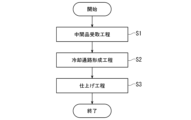
- a method for manufacturing a blade comprises the steps of: The method includes a process for forming an intermediate blade having an outer surface of a desired shape, a process for forming cooling passages inside the intermediate blade, and a process for finishing the intermediate blade with the cooling passages formed therein.
- the cooling passage forming process the cooling passages are formed in the intermediate blade using the electrochemical machining apparatus.
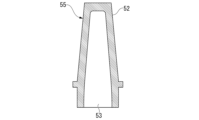
- FIG. 2 is a cross-sectional view of a blade intermediate product during a cooling passage forming process in one embodiment according to the present disclosure.
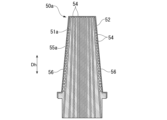
- FIG. 2 is a cross-sectional view of an airfoil in one embodiment according to the present disclosure.
- FIG. 13 is a cross-sectional view of a wing in a modified embodiment of the present disclosure.
- FIG. 1 An electrochemical processing apparatus according to an embodiment of the present disclosure will be described with reference to FIGS. 1 to 3.
- FIG. 1 An electrochemical processing apparatus according to an embodiment of the present disclosure will be described with reference to FIGS. 1 to 3.
- FIG. 1 An electrochemical processing apparatus according to an embodiment of the present disclosure will be described with reference to FIGS. 1 to 3.
- FIG. 1 An electrochemical processing apparatus according to an embodiment of the present disclosure will be described with reference to FIGS. 1 to 3.
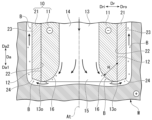
- the electrochemical machining tool 10 has a tool electrode 11 that is cylindrical around the tool axis At and whose inner circumference forms an electrolyte passage 13, and an insulating layer 21 formed on the outer circumference of the cylindrical tool electrode 11.
- the power supply circuit 1 is a circuit capable of applying a voltage between the tool electrode 11 and the workpiece W so that the tool electrode 11 is a negative electrode and the workpiece W machined by the electrochemical machining tool 10 is a positive electrode.
- the moving mechanism 2 is a mechanism that moves the electrochemical machining tool 10 relative to the workpiece W.
- the moving mechanism 2 may be a mechanism that moves the electrochemical machining tool 10 or a mechanism that moves the workpiece W.
- the tool electrode 11 is made of a conductive metal, such as stainless steel, pure Ti, Ti alloy, etc.
- the electrolyte passage 13 formed in the tool electrode 11 extends in the axial direction Da with the tool axis At as the center.
- the electrolyte passage 13 has an inlet 13i (see FIG. 1), an outlet 13o, a main passage portion 14, and an enlarged diameter portion 15.
- the inlet 13i of the electrolyte passage 13 is formed at the end of the second side Da2 of the tool electrode 11.
- the outlet 13o of the electrolyte passage 13 is formed at the end of the radially outer side Dro of the tool electrode 11, at the end of the first side Da1 of the tool electrode 11.
- the inner circumferential surface 16 of the tool electrode 11, which defines the expanded diameter portion 15 of the electrolyte passage 13, is shaped along a curve with a radius of curvature R, with the center of curvature being a position radially outward Dro from the inner circumferential surface 16 and on the second side Da2 from the outlet 13o. Therefore, the inner circumferential surface 16 is a curved surface that corresponds to the shape of the inner circumferential surface of the trumpet. Therefore, the inner circumferential surface 16 is a gently continuing curved surface, and the entire inner circumferential surface 16 is a curved surface that is convex on the side approaching the tool axis At.
- the first side insulating layer end surface 24 extends radially outward Dro from the end of the first side Da1 of the electrode outer peripheral surface 12 to the end of the first side Da1 of the insulating layer outer peripheral surface 23.
- This first side insulating layer end surface 24 gradually extends toward the second side Da2 as it moves toward the radially outward Dro.
- the first-side insulating layer end surface 24 in the cross section of the tool electrode 11 that includes the tool axis At has a linear shape.
- the position of the end of the first side Da1 of the insulating layer inner surface 22 coincides with the position of the end of the first side Da1 of the electrode outer surface 12 in the axial direction Da.
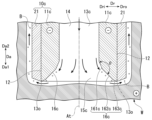
- the electrochemical machining tool 10x in the comparative example like the electrochemical machining tool 10 in this embodiment, has a tool electrode 11x that is cylindrical around the tool axis At and whose inner circumference forms an electrolyte passage 13x, and an insulating layer 21x that is formed on the electrode outer circumference 12x, which is the outer circumference of the cylindrical tool electrode 11x.
- hydrogen ions or water contained in the electrolyte receive electrons from the tool electrodes 11, 11x, which are the cathodes, and become hydrogen bubbles B.
- the electrolyte passage 13 of this embodiment has an expanded diameter portion 15 whose inner diameter gradually increases toward the first side Da1.
- the inner peripheral surface 16 of the tool electrode 11 that defines this expanded diameter portion 15 is a gently continuous curved surface that corresponds to the inner peripheral surface of the trumpet, and the entire inner peripheral surface 16 is a convex curved surface on the side approaching the tool axis At. Therefore, in this embodiment, a vortex flow V of the electrolyte is not substantially formed on the first side Da1 of the tool electrode 11, and multiple bubbles B flow smoothly, and the retention of multiple bubbles B between the tool electrode 11 and the workpiece W can be suppressed.
- the increase in electrical resistance between the tool electrode 11 and the workpiece W can be suppressed, and when the voltage applied between the tool electrode 11 and the workpiece W is increased, the value of the current flowing between the tool electrode 11 and the workpiece W also increases with the increase in voltage, and the machining efficiency of the workpiece W can be improved.
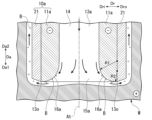
- the electrochemical machining tool 10a in this modified example like the electrochemical machining tool 10 in the above embodiment, has a tool electrode 11a that is cylindrical around the tool axis At and whose inner circumference forms an electrolyte passage 13a, and an insulating layer 21 that is formed on the electrode outer circumference 12, which is the outer circumference of the cylindrical tool electrode 11a.
- the inner peripheral surface 16a of the tool electrode 11a that defines the expanded diameter portion 15a in this modified example is also a curved surface that corresponds to the shape of the inner peripheral surface of the trumpet, as in the above embodiment. Therefore, this inner peripheral surface 16a is also a gently continuing curved surface, and the entire inner peripheral surface 16a is a convex curved surface on the side approaching the tool axis At. Therefore, as in the electrochemical machining tool 10 in the above embodiment, the electrochemical machining tool 10a in this modified example also suppresses the retention of multiple air bubbles B between the tool electrode 11a and the workpiece W, and prevents an increase in electrical resistance between the tool electrode 11a and the workpiece W.
- the inner circumferential surface 16a of the tool electrode 11a that defines the enlarged diameter portion 15a is a curved surface defined by two radii of curvature R1 and R2, but it may be a curved surface defined by three or more radii of curvature. Furthermore, the radius of curvature of this inner circumferential surface 16a may gradually change in response to the change in position in the axial direction Da, like an ellipse.
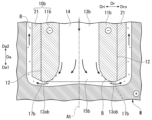
- the electrochemical machining tool 10b in this modified example like the electrochemical machining tool 10 in the above embodiment, has a tool electrode 11b that is cylindrical around the tool axis At and whose inner circumference forms an electrolyte passage 13b, and an insulating layer 21 that is formed on the electrode outer circumference 12, which is the outer circumference of the cylindrical tool electrode 11b.
- the outer surface of the tool electrode 11b between the outlet 13ob of the electrolyte passage 13b and the outer electrode surface 12 of the tool electrode 11b forms a first-side electrode end surface 17b facing the first side Da1.
- This first-side electrode end surface 17b is a surface that is formed so as to gradually turn toward the second side Da2 as it moves from the outlet 13ob of the electrolyte passage 13b toward the radially outward side Dro, and is a convex curved surface toward the radially outward side Dro.
- this blade 50 is manufactured through an intermediate product receiving process S1, a cooling passage forming process S2, and a finishing process S3.
Landscapes
- Engineering & Computer Science (AREA)
- Mechanical Engineering (AREA)
- Physics & Mathematics (AREA)
- Thermal Sciences (AREA)
- Chemical & Material Sciences (AREA)
- Chemical Kinetics & Catalysis (AREA)
- Electrochemistry (AREA)
- Manufacturing & Machinery (AREA)
- Electrical Discharge Machining, Electrochemical Machining, And Combined Machining (AREA)
Priority Applications (4)
| Application Number | Priority Date | Filing Date | Title |
|---|---|---|---|
| CN202380084296.7A CN120265412A (zh) | 2022-12-28 | 2023-12-12 | 电解加工工具、电解加工装置及叶片的制造方法 |
| DE112023005453.3T DE112023005453T5 (de) | 2022-12-28 | 2023-12-12 | Elektrochemisches bearbeitungswerkzeug, elektrochemische bearbeitungsvorrichtung und schaufelherstellungsverfahren |
| JP2024567430A JPWO2024142907A1 (https=) | 2022-12-28 | 2023-12-12 | |
| KR1020257018950A KR20250107235A (ko) | 2022-12-28 | 2023-12-12 | 전해 가공 공구, 전해 가공 장치, 및 날개의 제조 방법 |
Applications Claiming Priority (2)
| Application Number | Priority Date | Filing Date | Title |
|---|---|---|---|
| JP2022211124 | 2022-12-28 | ||
| JP2022-211124 | 2022-12-28 |
Publications (1)
| Publication Number | Publication Date |
|---|---|
| WO2024142907A1 true WO2024142907A1 (ja) | 2024-07-04 |
Family
ID=91717308
Family Applications (1)
| Application Number | Title | Priority Date | Filing Date |
|---|---|---|---|
| PCT/JP2023/044391 Ceased WO2024142907A1 (ja) | 2022-12-28 | 2023-12-12 | 電解加工工具、電解加工装置、及び翼の製造方法 |
Country Status (5)
| Country | Link |
|---|---|
| JP (1) | JPWO2024142907A1 (https=) |
| KR (1) | KR20250107235A (https=) |
| CN (1) | CN120265412A (https=) |
| DE (1) | DE112023005453T5 (https=) |
| WO (1) | WO2024142907A1 (https=) |
Citations (3)
| Publication number | Priority date | Publication date | Assignee | Title |
|---|---|---|---|---|
| JP2013136140A (ja) * | 2011-11-29 | 2013-07-11 | Mitsubishi Heavy Ind Ltd | 電解加工工具及び電解加工システム |
| WO2014073453A1 (ja) * | 2012-11-08 | 2014-05-15 | 株式会社放電精密加工研究所 | 電極、前記電極を用いた電解加工装置、電解加工方法、及びその方法によって加工された加工品 |
| JP2019018281A (ja) * | 2017-07-18 | 2019-02-07 | 三菱日立パワーシステムズ株式会社 | 電解加工方法、孔あき部材の製造方法、加工用電極、及び、電解加工システム |
Family Cites Families (1)
| Publication number | Priority date | Publication date | Assignee | Title |
|---|---|---|---|---|
| JP6071742B2 (ja) | 2013-05-16 | 2017-02-01 | 三菱重工業株式会社 | 電解加工工具、電解加工システム、及び孔空き部材の製造方法 |
-
2023
- 2023-12-12 JP JP2024567430A patent/JPWO2024142907A1/ja active Pending
- 2023-12-12 KR KR1020257018950A patent/KR20250107235A/ko active Pending
- 2023-12-12 CN CN202380084296.7A patent/CN120265412A/zh active Pending
- 2023-12-12 DE DE112023005453.3T patent/DE112023005453T5/de active Pending
- 2023-12-12 WO PCT/JP2023/044391 patent/WO2024142907A1/ja not_active Ceased
Patent Citations (3)
| Publication number | Priority date | Publication date | Assignee | Title |
|---|---|---|---|---|
| JP2013136140A (ja) * | 2011-11-29 | 2013-07-11 | Mitsubishi Heavy Ind Ltd | 電解加工工具及び電解加工システム |
| WO2014073453A1 (ja) * | 2012-11-08 | 2014-05-15 | 株式会社放電精密加工研究所 | 電極、前記電極を用いた電解加工装置、電解加工方法、及びその方法によって加工された加工品 |
| JP2019018281A (ja) * | 2017-07-18 | 2019-02-07 | 三菱日立パワーシステムズ株式会社 | 電解加工方法、孔あき部材の製造方法、加工用電極、及び、電解加工システム |
Also Published As
| Publication number | Publication date |
|---|---|
| DE112023005453T5 (de) | 2025-10-09 |
| KR20250107235A (ko) | 2025-07-11 |
| CN120265412A (zh) | 2025-07-04 |
| JPWO2024142907A1 (https=) | 2024-07-04 |
Similar Documents
| Publication | Publication Date | Title |
|---|---|---|
| US5306401A (en) | Method for drilling cooling holes in turbine blades | |
| CN102019470B (zh) | 弯曲电极和采用该弯曲电极的电化学加工方法和组件 | |
| CA1333783C (en) | Method and apparatus for electrochemically machining airfoil blades | |
| US7204926B2 (en) | Tandem blisk electrochemical machining | |
| CN103752965B (zh) | 可直线与旋转复合进给的整体叶盘电解加工工具及方法 | |
| US4772372A (en) | Electrodes for electrochemically machining airfoil blades | |
| JP2004209639A (ja) | ブリスクをニアネットシェイプ高速荒加工するための方法及び装置 | |
| CN111940858B (zh) | 回转体表面凸台结构成形的工具电极及其方法 | |
| Tianyu et al. | Electrochemical discharge machining for fabricating holes in conductive materials: A review | |
| CN108372335A (zh) | 一种密集斜方孔的电解加工方法 | |
| CN108723525B (zh) | 一种用于内壁环槽的电解加工阴极 | |
| CN111673210B (zh) | 采用回吸式电极的高速电弧加工装置及加工方法 | |
| CN107378154B (zh) | 一种用于电解加工孔的多功能伸缩工具电极 | |
| Liu et al. | Electrochemical cutting with flexible electrode of controlled online deformation | |
| WO2024142907A1 (ja) | 電解加工工具、電解加工装置、及び翼の製造方法 | |
| CN108620699A (zh) | 用于电弧放电加工的防短路多孔高效冲液电极 | |
| Shen et al. | Improving flatness of machined surface in rotating cathode electrochemical milling | |
| CN109664080A (zh) | 一种三联叶片的加工方法 | |
| KR20190016135A (ko) | 가공 시스템 | |
| CN103862120B (zh) | 阀门节流盘片迷宫槽的成型方法 | |
| CN106334844A (zh) | 柔性结构件的加工方法及装置 | |
| CN110153517B (zh) | 异形通道涡流器数控展成加工方法及其专用电极装夹装置 | |
| CN207447536U (zh) | 一种用于电解加工孔的多功能伸缩工具电极 | |
| CN115582588B (zh) | 一种管电极及电解加工深小孔的方法和装置 | |
| CN218694661U (zh) | 一种短电弧磨削航空发动机蜂窝环内冲液电极 |
Legal Events
| Date | Code | Title | Description |
|---|---|---|---|
| 121 | Ep: the epo has been informed by wipo that ep was designated in this application |
Ref document number: 23911688 Country of ref document: EP Kind code of ref document: A1 |
|
| WWE | Wipo information: entry into national phase |
Ref document number: 2024567430 Country of ref document: JP |
|
| WWE | Wipo information: entry into national phase |
Ref document number: 202380084296.7 Country of ref document: CN |
|
| WWE | Wipo information: entry into national phase |
Ref document number: 1020257018950 Country of ref document: KR |
|
| WWP | Wipo information: published in national office |
Ref document number: 202380084296.7 Country of ref document: CN |
|
| WWP | Wipo information: published in national office |
Ref document number: 1020257018950 Country of ref document: KR |
|
| WWE | Wipo information: entry into national phase |
Ref document number: 112023005453 Country of ref document: DE |
|
| WWP | Wipo information: published in national office |
Ref document number: 112023005453 Country of ref document: DE |
|
| 122 | Ep: pct application non-entry in european phase |
Ref document number: 23911688 Country of ref document: EP Kind code of ref document: A1 |