WO2024135232A1 - インパクト検出装置、インパクト検出方法およびプログラム - Google Patents
インパクト検出装置、インパクト検出方法およびプログラム Download PDFInfo
- Publication number
- WO2024135232A1 WO2024135232A1 PCT/JP2023/042297 JP2023042297W WO2024135232A1 WO 2024135232 A1 WO2024135232 A1 WO 2024135232A1 JP 2023042297 W JP2023042297 W JP 2023042297W WO 2024135232 A1 WO2024135232 A1 WO 2024135232A1
- Authority
- WO
- WIPO (PCT)
- Prior art keywords
- swing
- video data
- impact
- frame
- reference motion
- Prior art date
- Legal status (The legal status is an assumption and is not a legal conclusion. Google has not performed a legal analysis and makes no representation as to the accuracy of the status listed.)
- Ceased
Links
Images



Classifications
-
- A—HUMAN NECESSITIES
- A63—SPORTS; GAMES; AMUSEMENTS
- A63B—APPARATUS FOR PHYSICAL TRAINING, GYMNASTICS, SWIMMING, CLIMBING, OR FENCING; BALL GAMES; TRAINING EQUIPMENT
- A63B24/00—Electric or electronic controls for exercising apparatus of preceding groups; Controlling or monitoring of exercises, sportive games, training or athletic performances
- A63B24/0003—Analysing the course of a movement or motion sequences during an exercise or trainings sequence, e.g. swing for golf or tennis
- A63B24/0006—Computerised comparison for qualitative assessment of motion sequences or the course of a movement
-
- A—HUMAN NECESSITIES
- A63—SPORTS; GAMES; AMUSEMENTS
- A63B—APPARATUS FOR PHYSICAL TRAINING, GYMNASTICS, SWIMMING, CLIMBING, OR FENCING; BALL GAMES; TRAINING EQUIPMENT
- A63B69/00—Training appliances or apparatus for special sports
- A63B69/36—Training appliances or apparatus for special sports for golf
-
- A—HUMAN NECESSITIES
- A63—SPORTS; GAMES; AMUSEMENTS
- A63B—APPARATUS FOR PHYSICAL TRAINING, GYMNASTICS, SWIMMING, CLIMBING, OR FENCING; BALL GAMES; TRAINING EQUIPMENT
- A63B71/00—Games or sports accessories not covered in groups A63B1/00 - A63B69/00
- A63B71/06—Indicating or scoring devices for games or players, or for other sports activities
- A63B71/0619—Displays, user interfaces and indicating devices, specially adapted for sport equipment, e.g. display mounted on treadmills
- A63B71/0622—Visual, audio or audio-visual systems for entertaining, instructing or motivating the user
-
- G—PHYSICS
- G11—INFORMATION STORAGE
- G11B—INFORMATION STORAGE BASED ON RELATIVE MOVEMENT BETWEEN RECORD CARRIER AND TRANSDUCER
- G11B27/00—Editing; Indexing; Addressing; Timing or synchronising; Monitoring; Measuring tape travel
- G11B27/02—Editing, e.g. varying the order of information signals recorded on, or reproduced from, record carriers
- G11B27/031—Electronic editing of digitised analogue information signals, e.g. audio or video signals
-
- H—ELECTRICITY
- H04—ELECTRIC COMMUNICATION TECHNIQUE
- H04N—PICTORIAL COMMUNICATION, e.g. TELEVISION
- H04N5/00—Details of television systems
- H04N5/222—Studio circuitry; Studio devices; Studio equipment
- H04N5/262—Studio circuits, e.g. for mixing, switching-over, change of character of image, other special effects ; Cameras specially adapted for the electronic generation of special effects
-
- A—HUMAN NECESSITIES
- A63—SPORTS; GAMES; AMUSEMENTS
- A63B—APPARATUS FOR PHYSICAL TRAINING, GYMNASTICS, SWIMMING, CLIMBING, OR FENCING; BALL GAMES; TRAINING EQUIPMENT
- A63B24/00—Electric or electronic controls for exercising apparatus of preceding groups; Controlling or monitoring of exercises, sportive games, training or athletic performances
- A63B24/0003—Analysing the course of a movement or motion sequences during an exercise or trainings sequence, e.g. swing for golf or tennis
- A63B24/0006—Computerised comparison for qualitative assessment of motion sequences or the course of a movement
- A63B2024/0012—Comparing movements or motion sequences with a registered reference
-
- A—HUMAN NECESSITIES
- A63—SPORTS; GAMES; AMUSEMENTS
- A63B—APPARATUS FOR PHYSICAL TRAINING, GYMNASTICS, SWIMMING, CLIMBING, OR FENCING; BALL GAMES; TRAINING EQUIPMENT
- A63B2102/00—Application of clubs, bats, rackets or the like to the sporting activity ; particular sports involving the use of balls and clubs, bats, rackets, or the like
- A63B2102/32—Golf
-
- A—HUMAN NECESSITIES
- A63—SPORTS; GAMES; AMUSEMENTS
- A63B—APPARATUS FOR PHYSICAL TRAINING, GYMNASTICS, SWIMMING, CLIMBING, OR FENCING; BALL GAMES; TRAINING EQUIPMENT
- A63B2220/00—Measuring of physical parameters relating to sporting activity
- A63B2220/80—Special sensors, transducers or devices therefor
- A63B2220/806—Video cameras
-
- A—HUMAN NECESSITIES
- A63—SPORTS; GAMES; AMUSEMENTS
- A63B—APPARATUS FOR PHYSICAL TRAINING, GYMNASTICS, SWIMMING, CLIMBING, OR FENCING; BALL GAMES; TRAINING EQUIPMENT
- A63B2220/00—Measuring of physical parameters relating to sporting activity
- A63B2220/80—Special sensors, transducers or devices therefor
- A63B2220/808—Microphones
Definitions
- This disclosure relates to, for example, an impact detection device, an impact detection method, and a program.
- Patent Document 1 has the problem that it is difficult to distinguish between a swing that does not involve impact (hitting), specifically a simple practice swing or a missed swing, and a swing that actually involves impact.
- one aspect of the present disclosure has an object to provide a technique that makes it easy to distinguish between a practice swing or a whiff swing and a swing that results in impact.
- An impact detection device includes a first acquisition unit that acquires video data including sounds recorded when a user swings, the video data being a plurality of frames of the swing; a second acquisition unit that acquires reference motion data showing the time progression of a swing by a model, the reference motion data being given an identifier indicating the timing of impact in the swing; an identification unit that identifies a section of the video data that includes a frame corresponding to the timing of the identifier in the reference motion data; and a determination unit that determines whether or not a frame including a hitting sound is present in the section, and determines that the video data includes a swing with impact if it is determined that a frame including a hitting sound is present in the section.
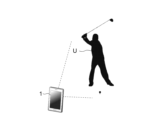
- FIG. 1 is a diagram illustrating an example of a usage state of an impact detection device according to an embodiment.
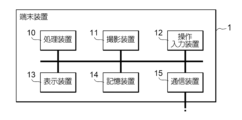
- FIG. 2 is a diagram illustrating a hardware configuration of the impact detection device.
- FIG. 2 is a functional block diagram of the impact detection device.
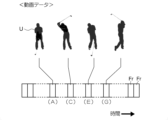
- FIG. 2 is a diagram illustrating an example of video data.
- FIG. 11 is a diagram illustrating an example of reference motion data.
- 4 is a flowchart showing an operation of the impact detection device.
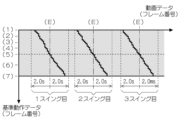
- FIG. 13 is a diagram illustrating impact detection in the relationship between video data and audio data.
- FIG. 13 is a diagram showing an example of video data showing a series of swings.
- FIG. 13 is a diagram showing the extraction of video data.
- FIG. 13 is a diagram showing an example of playback of video data.
- FIG. 1 is a diagram showing an example of a usage state of the impact detection device 1 according to the embodiment.
- the impact detection device 1 is, for example, an information processing device with a shooting function, specifically, a smartphone.
- the impact detection device 1 shoots a swing accompanied by an impact by a user U, for example, a golf swing, and analyzes the shot video data.
- the impact detection device 1 may be a device other than a smartphone, such as a portable terminal device or a personal computer, that has a function of analyzing video data.
- FIG. 2 is a diagram showing the hardware configuration of the impact detection device 1. Impact detection by the impact detection device 1 is achieved through the cooperation of hardware and software.
- the impact detection device 1 includes a processing device 10, a photographing device 11, an operation input device 12, a display device 13, a storage device 14, and a communication device 15.
- the processing device 10 is composed of one or more arithmetic processing circuits, such as a CPU (Central Processing Unit), and controls all elements of the impact detection device 1, which is an information processing device.
- the processing device 10 may also be composed of circuits such as a DSP (Digital Signal Processor) and an ASIC (Application Specific Integrated Circuit) in addition to a CPU.
- DSP Digital Signal Processor
- ASIC Application Specific Integrated Circuit
- the photographing device 11 photographs the swing of the user U and outputs video data including the photographed audio and video.
- the operation input device 12 accepts operations by a user.
- the operation input device 12 is, for example, a plurality of operators pressed by the user or a touch panel that detects contact by the user, and is overlaid on the image display screen of the display device 13. Note that the user who operates the operation input device 12 may be the user who made the swing, or may be another user.
- the display device 13 is composed of, for example, a liquid crystal panel or an organic EL panel, and displays various images under the control of the processing device 10. For example, the photographed swing and an editing screen for that swing are displayed on the display device 13.
- the storage device 14 is a single or multiple memories configured with known recording media such as magnetic recording media or semiconductor recording media, and stores the programs executed by the processing device 10, various data used by the processing device 10, and video data of the swing.
- the storage device 14 may be configured with a combination of multiple types of recording media.
- a portable recording medium that can be attached to and detached from the impact detection device 1, or an external recording medium (e.g., online storage) with which the impact detection device 1 can communicate via a network may be used as part of the storage device 14.
- the communication device 15 communicates with a server etc. via a network under the control of the processing device 10.
- FIG. 3 is a block diagram illustrating a functional configuration of the processing device 10.
- the processing device 10 executes a program stored in the storage device 14 to function as a plurality of elements (a control unit 100, a first acquisition unit 101, a second acquisition unit 102, an analysis unit 103, an identification unit 104, and a determination unit 105) for detecting an impact frame in video data where an impact occurs.
- the processing device 10 After detecting an impact frame in the video data, the processing device 10 also functions as an editing unit 106 for editing the video data and a playback unit 107 for playing the video data.
- some of the functions of the processing device 10 may be implemented by another device, for example, a server connected via a network.
- Fig. 4 is a diagram showing an example of video data.
- the video data is an object of impact detection, and is a golf swing by a user U, captured by, for example, the impact detection device 1.
- the video data includes a video portion made up of a plurality of frames Fr, and an audio portion synchronized with the video portion, although this is omitted in Fig. 4.
- a swing image is recorded for each frame Fr, and in the audio portion, sounds picked up during the swing are recorded.
- Each frame Fr of the video data is associated with a frame number as a serial number from the start frame.
- the address, top, impact and finish of typical swing movements are shown as (A), (C), (E) and (G), respectively.
- the moving image data is, for example, in the MPEG format, but any format is acceptable as long as it includes a video portion consisting of a series of multiple frames and an audio portion synchronized with the video portion.
- the impact detection device 1 refers to the reference motion data to detect impact frames in the video data.
- the reference motion data we will explain the reference motion data.
- FIG. 5 is a diagram for explaining the reference action data.
- the reference motion data is data showing a model/example swing.
- the reference motion data is data showing a time transition of three-dimensional coordinates of each joint J of skeletal information when the model M swings.
- the reference of the three-dimensional coordinates is, for example, the center of gravity coordinates of both feet of the model M, and the three-dimensional coordinates of each joint J are defined for each frame Fr by relative coordinates from the center of gravity coordinates.
- Each frame Fr of the reference action data is associated with a frame number as a serial number from the start frame, similar to the video data.
- Examples of the joint J include a left knee, a right knee, a left hip joint, a right hip joint, a left shoulder joint, a right shoulder joint, a left elbow, and a right elbow.
- the joints J of a right-handed model M when swinging are shown as black circles when viewed from the front (east, if the ball is hit in the direction of north).
- Representative parts of the swing, including the address, take-back, top, downswing, impact, follow-through, and finish, are illustrated, in that order, as (1) to (7).
- the frame indicating the impact is tagged in advance with an identifier to distinguish it from the other frames.
- the reference motion data indicates the three-dimensional coordinates of each joint J, it is possible to view the swing of the model M from any point by specifying a viewpoint.
- swings differ depending on the attributes of the user U, such as the gender, dominant hand, generation (age), and golf skill (professional, semi-professional, amateur).
- the database of reference motion data may be configured to be stored in the storage device 14 or may be configured to be stored in a server on the cloud.
- a tree diagram showing the similarity of swings (time transition of joint coordinates) indicated by the reference motion data may be created in advance.
- FIG. 6 is a flowchart showing the operation of the impact detection device 1. This operation is executed when, for example, a user U operates an icon corresponding to an application program that detects impact frames on the impact detection device 1.
- control unit 100 instructs the first acquisition unit 101 to acquire video data for which impact frames are to be detected (step Sa11).
- the instructed first acquisition unit 101 displays, for example, a list of one or more video data on the display device 13, and prompts the user U to select a video file that is to be detected for an impact frame.
- the first acquisition unit 101 acquires the selected video file as a video file that is to be detected for an impact frame.
- the video file may be acquired from the storage device 14 or an external device via a network.
- the video files stored in the storage device 14 include the most recent video file captured by the imaging device 11 and video files captured in the past.
- the control unit 100 transfers the video data acquired by the first acquisition unit 101 to the analysis unit 103.
- the analysis unit 103 analyzes the time transition of the joint coordinates of the user swinging in the video data by using a known method.
- the analysis unit 103 transfers information indicating the analyzed changes in the joint coordinates over time to the second acquisition unit 102 .
- the second acquisition unit 102 searches a database to identify and acquire the reference motion data that is most similar to the time progression of the joint coordinates obtained by analyzing the video data (step Sa12).
- the reference motion data that is most similar to the time progression of the joint coordinates obtained by analysis may be identified using, for example, Subsequence Dynamic Time Warping.
- the control unit 100 transfers the video data acquired by the first acquisition unit 101 and the reference action data acquired by the second acquisition unit 102 to the identification unit 104.
- the identification unit 104 determines the correlation between each frame of the video data and each frame of the reference action data, specifically, which frame of the reference action data each frame of the video data corresponds to.
- the upper column of Figure 7 is a diagram showing the correlation between each frame of the video data and each frame of the reference action data; specifically, black dots indicate which frame of the reference action data each frame of the video data corresponds to.
- frame (A) in the video data corresponds to the frame of address (1) in the reference motion data.
- frame (E) in the video data corresponds to the frame of impact (5) in the reference motion data.
- frame (G) in the video data corresponds to the frame of finish (7) in the reference motion data.
- the identification unit 104 After determining the correlation, the identification unit 104 identifies a section S from, for example, 0.3 seconds earlier in time to, for example, 0.3 seconds later in time, based on frame (E) of the video data corresponding to impact (5) in the reference action data, as a section in the video data that is likely to include an impact frame (step Sa13). The identification unit 104 transfers information indicating the identified section S to the determination unit 105 .
- the determination unit 105 determines whether or not there is one impact sound in the audio portion of the section S identified by the identification unit 104 in the video data (step Sa14).
- An impact sound is a sound whose volume exceeds a threshold within an extremely short period of time (e.g., 0.01 seconds).
- the lower section of Figure 7 shows an example waveform showing the audio portion of the section S identified by the identification unit 104, which is an example of a case in which there are two impact sounds in the section S.
- the determination unit 105 determines that only one impact sound is present in the audio portion of section S (if the determination result in step Sa14 is "Yes"), it detects the frame in the video portion of section S in which the impact sound reaches its peak value as an impact frame (step Sa15).
- step Sa16 determines whether there are two or more impact sounds in the audio portion of section S.
- the determination unit 105 determines that, among the two or more impact sounds present in the section S, the impact sound having the timing closest to frame (E) of the video data is the impact that occurred during the swing by the user U. Then, the determination unit 105 identifies the frame in which the impact sound reaches its peak value as the impact frame (step Sa17).
- the lower section of Figure 7 shows an example of a case where impact sounds occur at timings a and b in the audio portion of section S.
- the volume of the impact sound generated at timing b is greater than the volume of the impact sound generated at timing a, there is a possibility that the impact in user U's swing will be erroneously detected as occurring at timing b.
- step Sa18 the determination unit 105 notifies the control unit 100 that there is no impact frame in the video data, and the control unit 100 executes error processing (step Sa18).
- the determination unit 105 when the swing by the user U is merely a practice swing, no impact sound is generated in the section S, and therefore error processing is executed in step Sa18. For this reason, in a swing that does not include an impact sound, frame (E) is not identified as an impact frame. Examples of error processing include displaying a message on the display device 13 indicating that there is no impact frame in the video data, or that the swing in the video data is a practice swing, etc.
- This embodiment not only makes it possible to distinguish between practice swings and misses and swings that result in actual impact, but also makes it possible to accurately detect impact frames captured from users' swings, even when multiple people are swinging simultaneously.
- the explanation is based on the assumption that the user U takes one swing, but in reality, the swing is repeated multiple times from the start of filming to the end of filming. If the video data includes multiple swings, the impact frame can be identified for each swing.
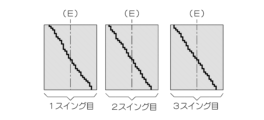
- FIG 8 is a diagram showing the correlation between each frame of the video data and each frame of the reference motion data when the video data includes multiple swings.
- the correlation shown in the figure is an example in which one video data includes three swings.
- the audio portion is not shown, but if an impact sound occurs near frame (E) of each swing, the frame in which the impact sound occurs is detected as the impact frame.
- the editing unit 106 may edit the video data to extract each swing. Specifically, when frame (E) is identified as an impact frame among the three swings in the video data, the editing unit 106 extracts the period from 2.0 seconds before frame (E) to 2.0 seconds after frame (E) as one swing, as shown in FIG. 9 .
- three pieces of video data showing the swing are extracted.
- the extracted video data are associated with information such as the shooting date and time.
- 2.0 seconds before frame (E) is an example of the first time
- 2.0 seconds after frame (E) is an example of the second time.
- the first time and the second time may be set to any time by the user U.
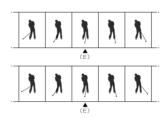
- the playback unit 107 may be configured to play two videos side by side for comparison, as shown in FIG. 10, for example.
- the frames (E) identified as the impact frame are aligned as shown in the figure, the user U can easily grasp the difference in the swing before and after impact in the two videos.
- the number of pieces of video data to be played back is not limited to two, but may be three or more.
- the video data to be played back is not limited to that stored in the storage device 14, but may be video data stored in a server on the cloud. For example, by comparing one's swing with the swing of a more advanced player, it becomes easier to grasp the inferior points of one's swing. Also, by comparing a past swing with a current swing, it is possible to grasp the degree of improvement.
- the playback unit 107 is not limited to playback at a constant speed, and may play back in slow motion, fast forward, or frame by frame.
- the application program for identifying the impact frame is executed in response to an operation by the user U, but the application program may be executed in response to, for example, completion of filming of the swing.
- the first acquisition unit 101 acquires video data of the filmed swing as a detection target for impact.
- the analysis of the video data is configured to be performed by the analysis unit 103 of the impact detection device 1, but the analysis may also be performed by a device other than the impact detection device 1, for example an external device, and the second acquisition unit 102 may acquire information indicating the time progression of the joint coordinates, which is the analysis result.
- a golf swing is given as an example of a swing, but the invention can also be applied to swings that involve impact sounds, such as tennis, baseball, and table tennis.
- An impact detection device includes a first acquisition unit that acquires video data including sounds recorded when a user swings, the video data being a plurality of frames of the swing; a second acquisition unit that acquires reference motion data showing the time progression of a swing by a model, the reference motion data being given an identifier indicating the timing of impact in the swing; an identification unit that identifies a section of the video data that includes a frame corresponding to the timing of the identifier in the reference motion data; and a determination unit that determines whether or not a frame including a hitting sound is present in the section, and determines that the video data includes a swing with impact if it is determined that a frame including a hitting sound is present in the section.
- a section is identified in the video data that includes a frame that corresponds to a timing in the reference motion data that is assigned an identifier indicating an impact
- second if a frame including a hitting sound is present in that section, it is determined that the video data includes a swing with impact.
- a frame including a hitting sound is not present in that section, it is determined that the video data does not include a swing with impact. Therefore, according to aspect 1, it is possible to distinguish between a swing that does not include impact, such as a practice swing or a whiff, and a swing that includes impact.
- the determination unit determines the frame closest to the timing at which the identifier is assigned to be the impact frame.
- the frame closest to the timing when the identifier was added is determined to be the impact frame. Therefore, the frame including the hitting sound by the target user can be identified with high accuracy without being affected by the hitting sounds by other users.
- the impact detection device relating to a specific aspect 3 of aspect 1
- a plurality of pieces of reference motion data are prepared for each model, and the second acquisition unit acquires one piece of reference motion data from the plurality of pieces of reference motion data that is similar to the swing shown in the video data.
- the section is identified by using, from among the plurality of reference motion data, reference motion data similar to the swing shown in the video data.
- the reference motion data is data indicating the time progression of the joint coordinates in the model
- an analysis unit is provided that analyzes the time progression of the joint coordinates of the user in the video data
- the second acquisition unit acquires, from the plurality of reference motion data, the reference motion data having the time progression that is most similar to the time progression of the joint coordinates of the user in the video data.
- An impact detection device relating to a specific aspect 5 of aspect 2 has an editing unit that edits the video data, and the editing unit cuts out frames from the video data that are a first time ahead to a second time behind the impact frame identified by the identification unit. According to the fifth aspect, the editing unit cuts out from the video data a frame that is a first time before the impact frame and a frame that is a second time after the impact frame.
- the editing unit cuts out the video data for each of the swings.
- a series of video data including multiple swings is cut out for each swing.
- the impact detection device which is a specific example of aspect 6, includes a playback unit that aligns and plays two or more pieces of video data extracted by the editing unit. According to aspect 7, swings can be compared by playing two or more videos.
- the impact detection method causes a computer to execute the steps of: acquiring video data including sounds recorded when a user swings, the video data being a multiple-frame shot of the swing; acquiring reference motion data showing the time progression of a swing by a model, the reference motion data being given an identifier indicating the timing of impact in the swing; identifying a section of the video data that includes a frame corresponding to the timing of the identifier in the reference motion data; and determining whether or not a frame including a hitting sound is present in the section, and determining that the video data includes a swing with impact if it is determined that a frame including a hitting sound is present in the section.
- the program according to a preferred aspect 9 of the present disclosure causes a computer to function as a first acquisition unit that acquires video data including sounds recorded when a user swings, the video data being a plurality of frames of the swing; a second acquisition unit that acquires reference motion data showing the time progression of a swing by a model, the reference motion data being given an identifier indicating the timing of impact in the swing; an identification unit that identifies a section of the video data that includes a frame corresponding to the timing of impact in the reference motion data that is given the identifier; and a determination unit that determines whether or not a frame including a hitting sound is present in the section, and determines that the video data includes a swing with impact if it is determined that a frame including a hitting sound is present in the section.
- 1...impact detection device 10...processing device, 11...imaging device, 12...operation input device, 13...display device, 14...storage device, 15...communication device, 100...control unit, 101...first acquisition unit, 102...second acquisition unit, 103...analysis unit, 104...identification unit, 105...determination unit, 106...editing unit, 107...playback unit.
Landscapes
- Engineering & Computer Science (AREA)
- Multimedia (AREA)
- Health & Medical Sciences (AREA)
- General Health & Medical Sciences (AREA)
- Physical Education & Sports Medicine (AREA)
- Signal Processing (AREA)
- Human Computer Interaction (AREA)
- Image Analysis (AREA)
Abstract
Description
このような事情を考慮して、本開示のひとつの態様は、素振りや空振りと、インパクトを伴うスイングとを区別することが容易な技術を提供することを目的とする。
なお、各図において、各部の寸法および縮尺は、実際のものと適宜に異ならせてある。また、以下に述べる実施の形態は、好適な具体例であるから、技術的に好ましい種々の限定が付されているが、本発明の範囲は、以下の説明において特に本発明を限定する旨の記載がない限り、これらの形態に限られるものではない。
操作入力装置12は、ユーザーによる操作を受け付ける。操作入力装置12は、例えばユーザーが押下する複数の操作子、またはユーザーによる接触を検知するタッチパネルであり、表示装置13による画像表示面に重ねられる。なお、操作入力装置12を操作するユーザーは、スイングをしたユーザー本人であってもよいし、他のユーザーであってもよい。
なお、処理装置10における機能の一部を他の装置、例えばネットワークを介して接続されたサーバーに負担させる構成としてもよい。
なお、動画データの各フレームFrには、開始フレームからの通し番号としてフレーム番号が関連付けられる。
また、動画データは、例えばMPEG方式であるが、複数のフレームで連続する映像部分と、当該映像部分に同期した音声部分とを含むのであれば、方式は問わない。
基準動作データは、模範/見本になるスイングを示すデータである。詳細には、基準動作データは、モデルMがスイングした際の骨格情報の各関節Jにおける三次元座標の時間推移を示すデータである。三次元座標の基準は、例えばモデルMにおける両足の重心座標であり、各関節Jにおける三次元座標は、当該重心座標からの相対座標によりフレームFr毎に規定される。
なお、基準動作データの各フレームFrには、動画データと同様に、開始フレームからの通し番号としてフレーム番号が関連付けられる。
図では、右利きのモデルMが正面(打球方向を北とした場合に、東)から見たスイングした際の関節Jが黒丸で示され、スイングのうち、代表的なアドレス、テイクバック、トップ、ダウンスイング、インパクト、フォロースルーおよびフィニッシュについて、順に(1)~(7)として例示されている。
基準動作データで示されるスイングのフレームのうち、インパクトを示すフレームインパクトフレームには、他のフレームとは区別するために識別子が予めタグ付けされる。
スイングは、一般的に言えば、ユーザーUの性別、利き手、世代(年齢)、ゴルフの巧拙(プロ、セミプロ、アマ)などの属性によって異なる。このため、基準動作データは、これらの属性に応じて、複数の種類が用意されてデータベース化される。基準動作データのデータベースは、記憶装置14に記憶する構成としてもよいし、クラウド上のサーバーに記憶する構成としてもよい。
また、基準動作データのデータベースの検索性を向上させるために、基準動作データで示されるスイング(関節座標の時間推移)の類似性を示す樹形図を、予め作成してもよい。
なお、動画ファイルの取得元としては、記憶装置14や、ネットワークを介した外部装置などが挙げられる。記憶装置14に記憶された動画ファイルとしては、撮影装置11で撮影された直近の動画ファイルや、過去に撮影された動画ファイルなどが含まれる。
解析部103は、解析した関節座標の時間推移を示す情報を第2取得部102に転送する。
例えば、動画データにおいてフレーム(A)が、基準動作データにおいてアドレス(1)のフレームに対応していることを示す。同様に、動画データにおいてフレーム(E)が、基準動作データにおいてインパクト(5)のフレームに対応していることを示す。また、動画データにおいてフレーム(G)が、基準動作データにおいてフィニッシュ(7)のフレームに対応していることを示す。
特定部104は、特定した区間Sを示す情報を判定部105に転送する。
本実施形態では、ユーザーUによるスイングが単なる素振りである場合、区間Sに打撃音が発生しないので、ステップSa18においてエラー処理が実行される。このため、打撃音を伴わないスイングにおいてフレーム(E)がインパクトフレームである、と特定されることはない。
なお、エラー処理の例としては、動画データにはインパクトフレームが存在しない旨や、動画データのスイングは素振りです旨などのメッセージを、表示装置13に表示させることなどが挙げられる。
この例において、音声部分の図示は省略されているが、仮に、各スイングのフレーム(E)付近に打撃音が発生していれば、当該打撃音の発生しているフレームがインパクトフレームとして検出される。
具体的には、当該動画データのうち、3回のスイングにおいてフレーム(E)がインパクトフレームとして特定された場合、図9に示されるように、編集部106が、フレーム(E)の時間的に前の2.0秒から、フレーム(E)の時間的に後の2.0秒までを、1つのスイングとして切り出す。
また、フレーム(E)の時間的に前の2.0秒が第1時間の一例であり、フレーム(E)の時間的に後の2.0秒が第2時間の一例である。第1時間および第2時間については、ユーザーUによって任意の時間に設定可能にしてもよい。
例えば、自己のスイングと、より上級者のスイングとを比較することによって、自己のスイングが劣っている点を把握しやすくなる。また例えば過去のスイングと現在のスイングとを比較することによって上達の度合いを把握することもできる。る、 なお、再生部107は、等速の再生に限られず、スロー再生してもよいし、早送り再生してもよいし、コマ送りで再生してもよい。
また、実施形態では、動画データの解析を、インパクト検出装置1の解析部103が行う構成としたが、インパクト検出装置1以外の装置、例えば外部装置が解析し、当該解析結果である、関節座標の時間推移を示す情報を、第2取得部102が取得する構成でもよい。
態様2によれば、区間に打球音を含むフレームが2以上存在する場合、識別子が付されたタイミングに最も近いフレームがインパクトフレームとして判定される。このため、対象ユーザーによる打球音を伴うフレームを、他のユーザーによる打球音の影響を受けずに、精度良く特定することができる。
態様3によれば、複数の基準動作データのうち、動画データで示されるスイングに類似する基準動作データが用いられて、区間が特定される。
態様5によれば、動画データのうち、インパクトフレームに対し第1時間だけ前方のフレームから、インパクトフレームに対し第2時間だけ後方のフレームまでが、編集部によって切り出される。
Claims (9)
- ユーザーによるスイングの際に収録した音を含む動画データであって、当該スイングが複数フレームで撮影された動画データを取得する第1取得部と、
モデルによるスイングの時間推移を示す基準動作データであって、前記スイングにおいてインパクトのタイミングであることを示す識別子が付された基準動作データを取得する第2取得部と、
前記動画データのうち、前記基準動作データにおいて前記識別子が付されたタイミングに相当するフレームを含んだ区間を、特定する特定部と、
前記区間に、打球音を含むフレームが存在するか否かを判定し、
前記区間に打球音を含むフレームが存在すると判定した場合には、前記動画データに、インパクトを伴うスイングが含まれると判定する判定部と、
を有するインパクト検出装置。 - 前記区間に打球音を含むフレームが2以上存在する場合、
前記判定部は、
前記識別子が付されたタイミングに最も近いフレームをインパクトフレームとして判定する
請求項1に記載のインパクト検出装置。 - 前記基準動作データは、モデル毎に複数で用意され、
前記第2取得部は、
前記複数の基準動作データのうち、前記動画データで示されるスイングに類似する一の基準動作データを取得する
請求項1に記載のインパクト検出装置。 - 前記基準動作データは、前記モデルにおける関節座標の時間推移を示すデータであり、
前記動画データにおけるユーザーにおける関節座標の時間推移を解析する解析部を有し、
前記第2取得部は、
前記複数の基準動作データのうち、
前記動画データの、ユーザーにおける関節座標の時間推移に最も類似する時間推移を有する基準動作データを取得する
請求項3に記載のインパクト検出装置。 - 前記動画データを編集する編集部を有し、
前記編集部は、
前記動画データに対し、前記特定部で特定されたインパクトフレームを基準に、第1時間だけ前方のフレームから第2時間だけ後方のフレームまでを切り出す
請求項2に記載のインパクト検出装置。 - 前記動画データに2以上のスイングが含まれている場合、
前記編集部は、
前記スイング毎に、当該動画データを切り出す
請求項5に記載のインパクト検出装置。 - 前記編集部によって切り出された2以上の動画データを並べて再生する再生部を備える
請求項6に記載のインパクト検出装置。 - コンピューターに、
ユーザーによるスイングの際に収録した音を含む動画データであって、当該スイングが複数フレームで撮影された動画データを取得する過程と、
モデルによるスイングの時間推移を示す基準動作データであって、前記スイングにおいてインパクトのタイミングであることを示す識別子が付された基準動作データを取得する過程部と、
前記動画データのうち、前記基準動作データにおいて前記識別子が付されたタイミングに相当するフレームを含んだ区間を、特定する過程と、
前記区間に、打球音を含むフレームが存在するか否かを判定し、
前記区間に打球音を含むフレームが存在すると判定した場合には、前記動画データに、インパクトを伴うスイングが含まれると判定する過程と、
を実行させるインパクト検出方法。 - コンピューターを、
ユーザーによるスイングの際に収録した音を含む動画データであって、当該スイングが複数フレームで撮影された動画データを取得する第1取得部、
モデルによるスイングの時間推移を示す基準動作データであって、前記スイングにおいてインパクトのタイミングであることを示す識別子が付された基準動作データを取得する第2取得部、
前記動画データのうち、前記基準動作データにおいて前記識別子が付されたタイミングに相当するフレームを含んだ区間を、特定する特定部、および、
前記区間に、打球音を含むフレームが存在するか否かを判定し、前記区間に打球音を含むフレームが存在すると判定した場合には、前記動画データに、インパクトを伴うスイングが含まれると判定する判定部、
として機能させるプログラム。
Priority Applications (2)
| Application Number | Priority Date | Filing Date | Title |
|---|---|---|---|
| KR1020257015437A KR20250086739A (ko) | 2022-12-22 | 2023-11-27 | 임팩트 검출 장치, 임팩트 검출 방법 및 프로그램 |
| CN202380082038.5A CN120265362A (zh) | 2022-12-22 | 2023-11-27 | 击球瞬间检测装置、击球瞬间检测方法以及程序 |
Applications Claiming Priority (2)
| Application Number | Priority Date | Filing Date | Title |
|---|---|---|---|
| JP2022-205279 | 2022-12-22 | ||
| JP2022205279A JP2024089828A (ja) | 2022-12-22 | 2022-12-22 | インパクト検出装置、インパクト検出方法およびプログラム |
Publications (1)
| Publication Number | Publication Date |
|---|---|
| WO2024135232A1 true WO2024135232A1 (ja) | 2024-06-27 |
Family
ID=91588199
Family Applications (1)
| Application Number | Title | Priority Date | Filing Date |
|---|---|---|---|
| PCT/JP2023/042297 Ceased WO2024135232A1 (ja) | 2022-12-22 | 2023-11-27 | インパクト検出装置、インパクト検出方法およびプログラム |
Country Status (4)
| Country | Link |
|---|---|
| JP (1) | JP2024089828A (ja) |
| KR (1) | KR20250086739A (ja) |
| CN (1) | CN120265362A (ja) |
| WO (1) | WO2024135232A1 (ja) |
Citations (7)
| Publication number | Priority date | Publication date | Assignee | Title |
|---|---|---|---|---|
| JPH10258146A (ja) * | 1997-03-17 | 1998-09-29 | Yamaha Corp | フォーム解析装置及びそれに用いる画像記録再生装置 |
| US20060008116A1 (en) * | 2002-06-06 | 2006-01-12 | Kiraly Christopher M | Flight parameter measurement system |
| JP2016168196A (ja) * | 2015-03-13 | 2016-09-23 | ヤマハ株式会社 | スイング計測システム |
| JP2017169203A (ja) * | 2017-04-12 | 2017-09-21 | カシオ計算機株式会社 | 画像処理装置、画像処理方法及びプログラム |
| JP2021058760A (ja) * | 2021-01-19 | 2021-04-15 | 株式会社ユピテル | 装置およびプログラム |
| KR102281124B1 (ko) * | 2020-12-24 | 2021-07-23 | 주식회사 유라이크 | 사용자의 골프 스윙 영상 편집 방법 및 이에 사용되는 관리 서버 |
| JP2021125075A (ja) * | 2020-02-07 | 2021-08-30 | 株式会社Nttドコモ | 情報処理装置 |
-
2022
- 2022-12-22 JP JP2022205279A patent/JP2024089828A/ja not_active Withdrawn
-
2023
- 2023-11-27 CN CN202380082038.5A patent/CN120265362A/zh active Pending
- 2023-11-27 KR KR1020257015437A patent/KR20250086739A/ko active Pending
- 2023-11-27 WO PCT/JP2023/042297 patent/WO2024135232A1/ja not_active Ceased
Patent Citations (7)
| Publication number | Priority date | Publication date | Assignee | Title |
|---|---|---|---|---|
| JPH10258146A (ja) * | 1997-03-17 | 1998-09-29 | Yamaha Corp | フォーム解析装置及びそれに用いる画像記録再生装置 |
| US20060008116A1 (en) * | 2002-06-06 | 2006-01-12 | Kiraly Christopher M | Flight parameter measurement system |
| JP2016168196A (ja) * | 2015-03-13 | 2016-09-23 | ヤマハ株式会社 | スイング計測システム |
| JP2017169203A (ja) * | 2017-04-12 | 2017-09-21 | カシオ計算機株式会社 | 画像処理装置、画像処理方法及びプログラム |
| JP2021125075A (ja) * | 2020-02-07 | 2021-08-30 | 株式会社Nttドコモ | 情報処理装置 |
| KR102281124B1 (ko) * | 2020-12-24 | 2021-07-23 | 주식회사 유라이크 | 사용자의 골프 스윙 영상 편집 방법 및 이에 사용되는 관리 서버 |
| JP2021058760A (ja) * | 2021-01-19 | 2021-04-15 | 株式会社ユピテル | 装置およびプログラム |
Also Published As
| Publication number | Publication date |
|---|---|
| JP2024089828A (ja) | 2024-07-04 |
| KR20250086739A (ko) | 2025-06-13 |
| CN120265362A (zh) | 2025-07-04 |
Similar Documents
| Publication | Publication Date | Title |
|---|---|---|
| JP4905474B2 (ja) | 映像処理装置、映像処理方法及びプログラム | |
| CN101377852B (zh) | 用来判断运动视频中精采片段的装置 | |
| US8848058B2 (en) | Method for analyzing the motion of a person during an activity | |
| JP2010183301A (ja) | 映像処理装置、映像処理方法及びプログラム | |
| JP2003117045A (ja) | スイングフォーム診断装置 | |
| JPH11339009A (ja) | 解析データ生成装置 | |
| TWI590856B (zh) | 擷取方法及裝置 | |
| KR101705836B1 (ko) | 깊이 정보를 이용한 골프 스윙 분석 시스템 및 방법 | |
| CN120935433A (zh) | 视频剪辑方法、装置、电子设备及非易失性存储介质 | |
| CN112287771A (zh) | 用于检测视频事件的方法、装置、服务器和介质 | |
| CN110310302B (zh) | 显示装置、显示方法及非暂态计算机可读记录介质 | |
| US7590286B2 (en) | Image recognition apparatus and program for recognizing the substance of an image, particularly in a motion picture environment | |
| JP3929811B2 (ja) | 画像合成装置及び画像合成方法 | |
| JP7295053B2 (ja) | シーン抽出方法、装置およびプログラム | |
| JP2024089828A (ja) | インパクト検出装置、インパクト検出方法およびプログラム | |
| KR102055146B1 (ko) | 이벤트 기반 비전 센서를 이용한 운동 자세 점검 방법 및 운동 자세 점검 장치 | |
| KR102281124B1 (ko) | 사용자의 골프 스윙 영상 편집 방법 및 이에 사용되는 관리 서버 | |
| JP2003141505A (ja) | 画像合成装置およびプログラム | |
| JP7704196B2 (ja) | 情報処理装置、情報処理方法、プログラム | |
| JP2017131308A (ja) | 指導アシストシステム、および指導アシストプログラム | |
| KR20250145652A (ko) | 동영상 재생 장치, 프로그램, 및 동영상 재생 방법 | |
| TWI559760B (zh) | 擷取方法及裝置(二) | |
| KR20020046862A (ko) | 카메라를 이용한 동작비교장치 및 그 비교방법 | |
| JP2017022659A (ja) | 画像再生装置及びコンピュータプログラム | |
| JPH08219691A (ja) | 標的装置 |
Legal Events
| Date | Code | Title | Description |
|---|---|---|---|
| 121 | Ep: the epo has been informed by wipo that ep was designated in this application |
Ref document number: 23906601 Country of ref document: EP Kind code of ref document: A1 |
|
| ENP | Entry into the national phase |
Ref document number: 20257015437 Country of ref document: KR Kind code of ref document: A |
|
| WWE | Wipo information: entry into national phase |
Ref document number: 202380082038.5 Country of ref document: CN |
|
| WWP | Wipo information: published in national office |
Ref document number: 1020257015437 Country of ref document: KR |
|
| WWP | Wipo information: published in national office |
Ref document number: 202380082038.5 Country of ref document: CN |
|
| NENP | Non-entry into the national phase |
Ref country code: DE |
|
| 122 | Ep: pct application non-entry in european phase |
Ref document number: 23906601 Country of ref document: EP Kind code of ref document: A1 |