WO2024117223A1 - 粘着シート、及び、積層体の製造方法 - Google Patents
粘着シート、及び、積層体の製造方法 Download PDFInfo
- Publication number
- WO2024117223A1 WO2024117223A1 PCT/JP2023/042945 JP2023042945W WO2024117223A1 WO 2024117223 A1 WO2024117223 A1 WO 2024117223A1 JP 2023042945 W JP2023042945 W JP 2023042945W WO 2024117223 A1 WO2024117223 A1 WO 2024117223A1
- Authority
- WO
- WIPO (PCT)
- Prior art keywords
- adhesive sheet
- meth
- pressure
- sensitive adhesive
- acrylate
- Prior art date
- Legal status (The legal status is an assumption and is not a legal conclusion. Google has not performed a legal analysis and makes no representation as to the accuracy of the status listed.)
- Ceased
Links
Images
Classifications
-
- C—CHEMISTRY; METALLURGY
- C09—DYES; PAINTS; POLISHES; NATURAL RESINS; ADHESIVES; COMPOSITIONS NOT OTHERWISE PROVIDED FOR; APPLICATIONS OF MATERIALS NOT OTHERWISE PROVIDED FOR
- C09J—ADHESIVES; NON-MECHANICAL ASPECTS OF ADHESIVE PROCESSES IN GENERAL; ADHESIVE PROCESSES NOT PROVIDED FOR ELSEWHERE; USE OF MATERIALS AS ADHESIVES
- C09J4/00—Adhesives based on organic non-macromolecular compounds having at least one polymerisable carbon-to-carbon unsaturated bond ; adhesives, based on monomers of macromolecular compounds of groups C09J183/00 - C09J183/16
-
- B—PERFORMING OPERATIONS; TRANSPORTING
- B32—LAYERED PRODUCTS
- B32B—LAYERED PRODUCTS, i.e. PRODUCTS BUILT-UP OF STRATA OF FLAT OR NON-FLAT, e.g. CELLULAR OR HONEYCOMB, FORM
- B32B27/00—Layered products comprising a layer of synthetic resin
-
- C—CHEMISTRY; METALLURGY
- C08—ORGANIC MACROMOLECULAR COMPOUNDS; THEIR PREPARATION OR CHEMICAL WORKING-UP; COMPOSITIONS BASED THEREON
- C08F—MACROMOLECULAR COMPOUNDS OBTAINED BY REACTIONS ONLY INVOLVING CARBON-TO-CARBON UNSATURATED BONDS
- C08F2/00—Processes of polymerisation
- C08F2/44—Polymerisation in the presence of compounding ingredients, e.g. plasticisers, dyestuffs, fillers
-
- C—CHEMISTRY; METALLURGY
- C08—ORGANIC MACROMOLECULAR COMPOUNDS; THEIR PREPARATION OR CHEMICAL WORKING-UP; COMPOSITIONS BASED THEREON
- C08F—MACROMOLECULAR COMPOUNDS OBTAINED BY REACTIONS ONLY INVOLVING CARBON-TO-CARBON UNSATURATED BONDS
- C08F2/00—Processes of polymerisation
- C08F2/46—Polymerisation initiated by wave energy or particle radiation
- C08F2/48—Polymerisation initiated by wave energy or particle radiation by ultraviolet or visible light
- C08F2/50—Polymerisation initiated by wave energy or particle radiation by ultraviolet or visible light with sensitising agents
-
- C—CHEMISTRY; METALLURGY
- C08—ORGANIC MACROMOLECULAR COMPOUNDS; THEIR PREPARATION OR CHEMICAL WORKING-UP; COMPOSITIONS BASED THEREON
- C08F—MACROMOLECULAR COMPOUNDS OBTAINED BY REACTIONS ONLY INVOLVING CARBON-TO-CARBON UNSATURATED BONDS
- C08F220/00—Copolymers of compounds having one or more unsaturated aliphatic radicals, each having only one carbon-to-carbon double bond, and only one being terminated by only one carboxyl radical or a salt, anhydride ester, amide, imide or nitrile thereof
- C08F220/02—Monocarboxylic acids having less than ten carbon atoms; Derivatives thereof
- C08F220/10—Esters
-
- C—CHEMISTRY; METALLURGY
- C08—ORGANIC MACROMOLECULAR COMPOUNDS; THEIR PREPARATION OR CHEMICAL WORKING-UP; COMPOSITIONS BASED THEREON
- C08L—COMPOSITIONS OF MACROMOLECULAR COMPOUNDS
- C08L53/00—Compositions of block copolymers containing at least one sequence of a polymer obtained by reactions only involving carbon-to-carbon unsaturated bonds; Compositions of derivatives of such polymers
-
- C—CHEMISTRY; METALLURGY
- C09—DYES; PAINTS; POLISHES; NATURAL RESINS; ADHESIVES; COMPOSITIONS NOT OTHERWISE PROVIDED FOR; APPLICATIONS OF MATERIALS NOT OTHERWISE PROVIDED FOR
- C09J—ADHESIVES; NON-MECHANICAL ASPECTS OF ADHESIVE PROCESSES IN GENERAL; ADHESIVE PROCESSES NOT PROVIDED FOR ELSEWHERE; USE OF MATERIALS AS ADHESIVES
- C09J11/00—Features of adhesives not provided for in group C09J9/00, e.g. additives
- C09J11/02—Non-macromolecular additives
- C09J11/06—Non-macromolecular additives organic
-
- C—CHEMISTRY; METALLURGY
- C09—DYES; PAINTS; POLISHES; NATURAL RESINS; ADHESIVES; COMPOSITIONS NOT OTHERWISE PROVIDED FOR; APPLICATIONS OF MATERIALS NOT OTHERWISE PROVIDED FOR
- C09J—ADHESIVES; NON-MECHANICAL ASPECTS OF ADHESIVE PROCESSES IN GENERAL; ADHESIVE PROCESSES NOT PROVIDED FOR ELSEWHERE; USE OF MATERIALS AS ADHESIVES
- C09J11/00—Features of adhesives not provided for in group C09J9/00, e.g. additives
- C09J11/08—Macromolecular additives
-
- C—CHEMISTRY; METALLURGY
- C09—DYES; PAINTS; POLISHES; NATURAL RESINS; ADHESIVES; COMPOSITIONS NOT OTHERWISE PROVIDED FOR; APPLICATIONS OF MATERIALS NOT OTHERWISE PROVIDED FOR
- C09J—ADHESIVES; NON-MECHANICAL ASPECTS OF ADHESIVE PROCESSES IN GENERAL; ADHESIVE PROCESSES NOT PROVIDED FOR ELSEWHERE; USE OF MATERIALS AS ADHESIVES
- C09J201/00—Adhesives based on unspecified macromolecular compounds
-
- C—CHEMISTRY; METALLURGY
- C09—DYES; PAINTS; POLISHES; NATURAL RESINS; ADHESIVES; COMPOSITIONS NOT OTHERWISE PROVIDED FOR; APPLICATIONS OF MATERIALS NOT OTHERWISE PROVIDED FOR
- C09J—ADHESIVES; NON-MECHANICAL ASPECTS OF ADHESIVE PROCESSES IN GENERAL; ADHESIVE PROCESSES NOT PROVIDED FOR ELSEWHERE; USE OF MATERIALS AS ADHESIVES
- C09J7/00—Adhesives in the form of films or foils
- C09J7/30—Adhesives in the form of films or foils characterised by the adhesive composition
- C09J7/38—Pressure-sensitive adhesives [PSA]
-
- C—CHEMISTRY; METALLURGY
- C09—DYES; PAINTS; POLISHES; NATURAL RESINS; ADHESIVES; COMPOSITIONS NOT OTHERWISE PROVIDED FOR; APPLICATIONS OF MATERIALS NOT OTHERWISE PROVIDED FOR
- C09J—ADHESIVES; NON-MECHANICAL ASPECTS OF ADHESIVE PROCESSES IN GENERAL; ADHESIVE PROCESSES NOT PROVIDED FOR ELSEWHERE; USE OF MATERIALS AS ADHESIVES
- C09J7/00—Adhesives in the form of films or foils
- C09J7/30—Adhesives in the form of films or foils characterised by the adhesive composition
- C09J7/38—Pressure-sensitive adhesives [PSA]
- C09J7/381—Pressure-sensitive adhesives [PSA] based on macromolecular compounds obtained by reactions involving only carbon-to-carbon unsaturated bonds
- C09J7/385—Acrylic polymers
-
- C—CHEMISTRY; METALLURGY
- C09—DYES; PAINTS; POLISHES; NATURAL RESINS; ADHESIVES; COMPOSITIONS NOT OTHERWISE PROVIDED FOR; APPLICATIONS OF MATERIALS NOT OTHERWISE PROVIDED FOR
- C09J—ADHESIVES; NON-MECHANICAL ASPECTS OF ADHESIVE PROCESSES IN GENERAL; ADHESIVE PROCESSES NOT PROVIDED FOR ELSEWHERE; USE OF MATERIALS AS ADHESIVES
- C09J2301/00—Additional features of adhesives in the form of films or foils
- C09J2301/40—Additional features of adhesives in the form of films or foils characterized by the presence of essential components
- C09J2301/416—Additional features of adhesives in the form of films or foils characterized by the presence of essential components use of irradiation
Definitions
- the present invention relates to an adhesive sheet.
- the present invention also relates to a method for producing a laminate having the adhesive sheet.
- Adhesives are used to bond electronic components inside electronic devices such as smartphones and PCs.
- an adhesive sheet is first prepared with separators on both sides of the adhesive, and then the adhesive sheet is cut into the desired shape.
- One separator is then peeled off from the cut adhesive sheet, and one side of the exposed adhesive is bonded to a first adherend, and then the other separator is peeled off, and the other side of the exposed adhesive is bonded to a second adherend.
- part of the adhesive sheet is discarded after cutting, generating waste. Also, air bubbles can sometimes get into the bonded surfaces.
- Patent Document 1 discloses an invention for providing a radiation-curable adhesive composition that allows fine patterning and exhibits high adhesion to various adherends such as metals and plastics.
- Patent Document 1 describes a radiation-curable adhesive composition that contains 10 to 70% by weight of an ethylenically unsaturated monomer that does not contain an aromatic ring, 1 to 10% by weight of a photopolymerization initiator, and 10 to 55% by weight of a crosslinking agent.
- Patent Document 2 discloses an invention for providing a photocurable adhesive composition that, even when irradiated with light in the presence of oxygen, gives a laminate having adhesive strength equivalent to that in the absence of oxygen.
- Patent Document 2 describes a photocurable adhesive composition that contains (A) a (meth)acrylate oligomer, (B) a monofunctional (meth)acrylic monomer, (C) a di- to tetrafunctional (meth)acrylic monomer, (D) a photoinitiator, (E) a tackifier having a softening point of 70 to 150°C, and (F) a liquid plasticizer.
- the method of printing the adhesive composition in a desired shape, forming an adhesive sheet, and laminating it to an adherend without preparing an adhesive sheet in advance can suppress the generation of waste and prevent air bubbles from being introduced into the lamination surface.
- ultraviolet curing is desirable from the viewpoint of avoiding heating of the adherend and reducing CO2 emissions, but the adhesive sheet obtained by ultraviolet curing has a problem of poor impact resistance.
- the present invention aims to provide an adhesive sheet that is obtained by UV curing and has excellent impact resistance.
- the present invention also aims to provide a method for producing a laminate having the adhesive sheet.
- Disclosure 1 is a pressure-sensitive adhesive sheet that is a cured product of a pressure-sensitive adhesive composition containing a photopolymerization initiator, and in a viscoelasticity chart obtained by performing dynamic viscoelasticity measurement under conditions of a shear method, a measurement temperature of -70°C to 200°C, and a frequency of 1 Hz, when Ggtemp is the temperature at which the loss modulus is maximized on the lowest temperature side, Tg is the lowest temperature among the temperatures at which tan ⁇ is maximized in a region higher than Ggtemp, GF1temp is the lowest temperature in a temperature region from Tg to 50°C among the temperatures at which the ratio of storage modulus to loss modulus is minimum, GF2temp is the lowest temperature among the temperatures at which the loss tangent is minimized in a region higher than GF1temp, and GF2tan ⁇ is the loss tangent at GF2temp, the temperature difference between Ggtemp and GF1temp is 25.0°C or more, and GF2tan
- Disclosure 2 is a pressure-sensitive adhesive sheet according to Disclosure 1, in which, when GEtemp is the temperature at which the storage modulus becomes a minimum value in a region higher than the GF2temp in the viscoelasticity chart, or 200°C if there is no temperature at which the storage modulus becomes a minimum value in a region higher than the GF2temp, the loss tangent at the GEtemp is GEtan ⁇ , and delta tan ⁇ is a value calculated by the formula (GEtan ⁇ -GF2tan ⁇ )/(GEtemp-GF2temp), the delta tan ⁇ is -0.006 or more.
- the present disclosure 3 is the pressure-sensitive adhesive sheet of the present disclosure 1 or 2, in which the temperature difference between the Ggtemp and the GF1temp is 50.0°C or more.
- the present disclosure 4 is the pressure-sensitive adhesive sheet of the present disclosure 1, 2, or 3, in which the GF2 tan ⁇ is 0.50 or more.
- the present disclosure 5 is the pressure-sensitive adhesive sheet according to claim 1, 2, 3 or 4, wherein the pressure-sensitive adhesive sheet has a 180° peel adhesive strength to a SUS substrate at 25°C of 6 N/cm or more after being aged for one day in an environment of 25°C and 50% RH.
- the present disclosure 6 is the pressure-sensitive adhesive sheet according to the present disclosure 1, 2, 3, 4, or 5, wherein the pressure-sensitive adhesive composition contains a nitrogen-containing compound.
- the present disclosure 7 is the pressure-sensitive adhesive sheet according to the present disclosure 6, wherein the nitrogen-containing compound includes a maleimide derivative.
- the present disclosure 8 is the pressure-sensitive adhesive sheet of the present disclosure 1, 2, 3, 4, 5, 6, or 7, wherein the pressure-sensitive adhesive composition comprises at least one selected from the group consisting of a hydrogen abstraction type photopolymerization initiator and a polymer type photopolymerization initiator.
- the present disclosure 9 is the pressure-sensitive adhesive sheet according to the present disclosure 1, 2, 3, 4, 5, 6, 7, or 8, wherein the pressure-sensitive adhesive composition contains a thermoplastic resin.
- the present disclosure 10 is the PSA sheet of the present disclosure 1, 2, 3, 4, 5, 6, 7, 8, or 9, wherein the PSA composition contains a tackifier.
- Disclosure 11 is a method for producing a laminate in which the adhesive composition is partially coated on the first adherend, the method comprising the steps of coating the adhesive composition on a first adherend or a separator and exposing the composition to light to form an adhesive sheet according to Disclosures 1, 2, 3, 4, 5, 6, 7, 8, 9, or 10, and attaching a second adherend to the adhesive sheet, the method for coating the adhesive composition being inkjet printing, screen printing, spray coating, spin coating, gravure offset, or reverse offset printing.
- the present invention will be described in detail below.
- the present inventors have investigated how to make a viscoelasticity chart obtained by performing dynamic viscoelasticity measurement under specific conditions on an adhesive sheet obtained by UV curing an adhesive composition exhibit specific behavior. As a result, they have found that an adhesive sheet with excellent impact resistance can be obtained, leading to the completion of the present invention.
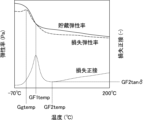
- the lowest temperature at which the loss modulus is maximum on the lowest temperature side is defined as Ggtemp and the lowest temperature at which tan ⁇ is maximum in a region higher than Ggtemp is defined as Tg
- the lowest temperature at which the ratio of the storage modulus to the loss modulus is minimum in a temperature region from Tg to 50°C is defined as GF1temp
- the lowest temperature at which the loss tangent is minimum in a region higher than GF1temp is defined as GF2temp
- the loss tangent at GF2temp is defined as GF2tan ⁇
- the lower limit of the temperature difference between Ggtemp and GF1temp is 25.0°C
- the lower limit of GF2tan ⁇ is 0.34.
- FIG. 1 A schematic diagram showing the relationship between the Ggtemp, GF1temp, GF2temp, and GF2tan ⁇ in a viscoelasticity chart is shown in Figure 1.
- the preferred lower limit of the temperature difference between Ggtemp and GF1temp is 40.0° C., and the more preferred lower limit is 50.0° C.
- there is no particular preferred upper limit of the temperature difference between Ggtemp and GF1temp but the substantial upper limit is 120.0° C.
- the preferred lower limit of GF2 tan ⁇ is 0.50.
- the substantial upper limit is 4.0.
- the loss tangent at the GEtemp is GEtan ⁇
- the value calculated by the formula (GEtan ⁇ -GF2tan ⁇ )/(GEtemp-GF2temp) is delta tan ⁇
- the preferred lower limit of the delta tan ⁇ is -0.006.
- the pressure-sensitive adhesive sheet has better impact resistance.
- the more preferred lower limit of the delta tan ⁇ is 0.002.
- the substantial upper limit is 0.5.
- the viscoelasticity chart can be obtained by performing dynamic viscoelasticity measurement under the following conditions using a dynamic viscoelasticity measuring device, for example, MCR-702e (manufactured by Anton Paar) or the like.
- a dynamic viscoelasticity measuring device for example, MCR-702e (manufactured by Anton Paar) or the like.
- Shear method Measured with twin drive using 8 mm parallel plate Measurement temperature: -70°C to 200°C Heating rate: 7°C/min Frequency: 1Hz While cooling from 50°C to -70°C at a rate of 10°C/min, pre-pressure was applied at 8N, and measurements were taken from the low temperature as described below in (1) to (6).
- the temperature is raised with a normal force of 1 N and a strain of 10%, and measurements are performed under these conditions until the temperature reaches 200° C. (6)
- the measurement is terminated. If the storage modulus does not reach a minimum point up to this point, 200° C. or the temperature at the end of the measurement becomes the GEtemp.
- the pressure-sensitive adhesive sheet of the present invention has a glass transition temperature of preferably ⁇ 30° C. at its lower limit and 20° C. at its upper limit. By having the glass transition temperature in this range, the adhesive sheet can have better adhesion to various substrates.
- the more preferable upper limit of the glass transition temperature is 10° C.
- the tan ⁇ peak temperature derived from the above-mentioned viscoelasticity chart can be determined as the above-mentioned glass transition temperature.
- the pressure-sensitive adhesive sheet of the present invention has a preferred lower limit of 6 N/cm in 180° peel adhesive strength to a SUS substrate at 25° C. after aging for one day in an environment of 25° C. and 50% RH.
- the 180° peel adhesive strength to a SUS substrate at 25° C. is 6 N/cm or more
- the resulting pressure-sensitive adhesive sheet can be suitably used for adhering electronic components and the like that require high adhesiveness.
- a more preferred lower limit of the 180° peel adhesive strength to a SUS substrate at 25° C. is 8 N/cm.
- the substantial upper limit is 25 N/cm.
- the 180° peel adhesive strength to a SUS substrate at 25° C. can be measured, for example, by the following method. That is, first, the adhesive composition described later is coated on a release PET film, and then cured by simultaneously irradiating ultraviolet light having a wavelength of 365 nm and an illuminance of 20 mW/cm 2 and light having a wavelength of 405 nm and an illuminance of 40 mW/cm 2 so that the total irradiation amount is 900 mJ/cm 2 , to obtain a cured product (adhesive sheet) having a thickness of 100 ⁇ m.
- the air surface of the cured product is sealed with an easy-adhesive polyester film, and cut to a predetermined size to prepare a laminated film.
- the release PET film is peeled off from the laminated film, and the exposed surface is attached to a SUS substrate, and pressure-bonded by moving it back and forth with a 2 kg roller to obtain a test piece.
- the 180 ° peel adhesive strength can be measured by performing 180 ° peel at a speed of 300 mm / min using a universal testing machine.
- An example of the universal testing machine is Tensilon RTI-1310 (manufactured by A&D Co., Ltd.).
- the pressure-sensitive adhesive sheet of the present invention is a cured product of a pressure-sensitive adhesive composition containing a photopolymerization initiator, that is, an ultraviolet-cured product obtained by curing the pressure-sensitive adhesive composition with ultraviolet light. Since the pressure-sensitive adhesive sheet of the present invention is an ultraviolet-cured product of the pressure-sensitive adhesive composition, it can be said that the pressure-sensitive adhesive sheet of the present invention is produced in a production process with little CO2 emission.
- the pressure-sensitive adhesive composition preferably contains a nitrogen-containing compound.
- the resulting pressure-sensitive adhesive sheet has excellent surface curing properties.
- the nitrogen-containing compound examples include maleimide derivatives, nitrogen-containing vinyl compounds, etc. Among these, maleimide derivatives are preferred.
- the reaction system of the maleimide derivative basically proceeds as a hydrogen abstraction (Type II) reaction. Photoradical polymerization by hydrogen abstraction reaction is not easily inhibited by oxygen, and can therefore increase the surface curability.
- photoradical polymerization by hydrogen abstraction reaction does not produce a linear polymer as in cleavage (Type I) reaction, but produces a branched polymer, which also has high cohesive strength. Therefore, by containing the maleimide derivative, the pressure-sensitive adhesive composition can produce a pressure-sensitive adhesive sheet that is less susceptible to bleeding due to a decrease in surface curability and cohesive failure due to a decrease in surface curability and cohesive strength.
- the above-mentioned "maleimide derivative” means a compound having a maleimide group.
- examples of the monofunctional maleimide include N-cyclohexylmaleimide, N-laurylmaleimide, 4-hydroxyphenylmaleimide, N-(4-carboxycyclohexylmethyl)maleimide, N-phenylmaleimide, N-(2-methylphenyl)maleimide, N-(4-methylphenyl)maleimide, N-(2,6-diethylphenyl)maleimide, N-(2-chlorophenyl)maleimide, N-methylmaleimide, and N-ethylmaleimide.
- Examples of the monofunctional maleimide include N-isopropylmaleimide, N-butylmaleimide, N-benzylmaleimide, N-phenylmethylmaleimide, N-(2,4,6-tribromophenyl)maleimide, N-[3-(triethoxysilyl)propyl]maleimide, N-octadecenylmaleimide, N-dodecenylmaleimide, N-(2-methoxyphenyl)maleimide, N-(2,4,6-trichlorophenyl)maleimide, and N-(1-hydroxyphenyl)maleimide.
- the monofunctional maleimide is preferably at least one selected from the group consisting of N-cyclohexylmaleimide, 4-hydroxyphenylmaleimide, and N-(4-carboxycyclohexylmethyl)maleimide.
- examples of polyfunctional maleimides include N,N'-methylene bismaleimide, N,N'-trimethylene bismaleimide, N,N'-dodecamethylene bismaleimide, N,N'-(4,4'-diphenylmethane) bismaleimide, 1,4-dimaleimidecyclohexane, isophorone bisurethane bis(N-ethylmaleimide), N,N'-P-phenylene bismaleimide, N,N'-m-phenylene bismaleimide, N,N'-m-toluylene bismaleimide, and N,N'-4,4'-biphenyl.
- the above-mentioned monofunctional maleimide and these polyfunctional maleimides may be used in combination as the maleimide derivative.
- the gel fraction becomes high, it is not preferable to use a large amount of the polyfunctional maleimide in combination.
- an amide compound having a vinyl group is preferred, and a cyclic amide compound having a vinyl group is more preferred.
- the cyclic amide compound having a vinyl group preferably has a lactam structure, and is more preferably a compound represented by the following formula (1):
- n represents an integer from 2 to 6.
- Examples of the compound represented by the above formula (1) include N-vinyl-2-pyrrolidone and N-vinyl- ⁇ -caprolactam. Of these, N-vinyl- ⁇ -caprolactam is preferred.
- examples other than the above-mentioned cyclic amide compounds having a vinyl group include N-vinylacetamide, etc.
- the preferred lower limit of the content of the nitrogen-containing compound in 100 parts by mass of the adhesive composition is 0.4 parts by mass, and the preferred upper limit is 15 parts by mass.
- the resulting adhesive sheet has superior surface curing properties and adhesion to various substrates.
- a more preferred lower limit of the content of the nitrogen-containing compound is 1.5 parts by mass, and a more preferred upper limit is 12 parts by mass.
- the pressure-sensitive adhesive composition preferably contains a (meth)acrylic monomer.
- a (meth)acrylic monomer By containing the (meth)acrylic monomer, the resulting pressure-sensitive adhesive composition has better curability.
- (meth)acrylic means acrylic or methacrylic
- (meth)acrylic monomer means a monomer having a (meth)acryloyl group
- (meth)acryloyl means acryloyl or methacryloyl.
- the (meth)acrylic monomer preferably contains a monofunctional (meth)acrylic monomer.
- the term "monofunctional (meth)acrylic monomer” refers to a monomer having one (meth)acryloyl group in one molecule.
- Examples of the monofunctional (meth)acrylic monomer include monofunctional (meth)acrylic acid ester compounds, monofunctional (meth)acrylamide compounds, etc.
- Examples of the monofunctional (meth)acrylic acid ester compound include methyl (meth)acrylate, ethyl (meth)acrylate, propyl (meth)acrylate, n-butyl (meth)acrylate, isobutyl (meth)acrylate, t-butyl (meth)acrylate, 2-ethylhexyl (meth)acrylate, n-octyl (meth)acrylate, n-heptyl (meth)acrylate, isooctyl (meth)acrylate, isononyl (meth)acrylate, isodecyl (meth)acrylate, lauryl (meth)acrylate, isomyristyl (meth)acrylate, stearyl (meth)acrylate, 2-hydroxyethyl (meth)acrylate, 2-hydroxypropyl (meth)acrylate, 2-hydroxy-3-phenoxypropyl (meth)acrylate, and 2-hydroxybutyl (meth
- Examples of the monofunctional (meth)acrylamide compounds include N,N-dimethyl(meth)acrylamide, N-(meth)acryloylmorpholine, N-hydroxyethyl(meth)acrylamide, N,N-diethyl(meth)acrylamide, N-isopropyl(meth)acrylamide, and N,N-dimethylaminopropyl(meth)acrylamide.
- the preferred lower limit of the content of the monofunctional (meth)acrylic monomer in 100 parts by mass of the adhesive composition is 15 parts by mass, and the preferred upper limit is 90 parts by mass.
- the resulting adhesive composition has better curing properties, and the resulting adhesive sheet has better adhesion to various substrates.
- a more preferred lower limit of the content of the monofunctional (meth)acrylic monomer is 20 parts by mass, and a more preferred upper limit is 60 parts by mass.
- the (meth)acrylic monomer may contain a polyfunctional (meth)acrylic monomer.
- the polyfunctional (meth)acrylic monomer serves as a cross-linking component.
- polyfunctional (meth)acrylic monomer examples include polyfunctional urethane (meth)acrylates, polyfunctional (meth)acrylic acid ester compounds, and polyfunctional epoxy (meth)acrylates.
- epoxy (meth)acrylate refers to a compound in which all epoxy groups in an epoxy compound have been reacted with (meth)acrylic acid.
- the above-mentioned polyfunctional urethane (meth)acrylate can be obtained, for example, by reacting a (meth)acrylic acid derivative having a hydroxyl group with an isocyanate compound in the presence of a catalytic amount of a tin-based compound.
- MDI diphenylmethane-4,4'-
- isocyanate compound serving as a raw material for the polyfunctional urethane (meth)acrylate a chain-extended isocyanate compound obtained by reacting a polyol with an excess of an isocyanate compound can also be used.
- the polyol include ethylene glycol, propylene glycol, glycerin, sorbitol, trimethylolpropane, carbonate diol, polyether diol, polyester diol, and polycaprolactone diol.
- Examples of the (meth)acrylic acid derivative having a hydroxyl group include hydroxyalkyl mono(meth)acrylates, mono(meth)acrylates of dihydric alcohols, and mono(meth)acrylates or di(meth)acrylates of trihydric alcohols.
- Examples of the hydroxyalkyl mono(meth)acrylate include 2-hydroxyethyl(meth)acrylate, 2-hydroxypropyl(meth)acrylate, 2-hydroxybutyl(meth)acrylate, and 4-hydroxybutyl(meth)acrylate.
- Examples of the dihydric alcohol include ethylene glycol, propylene glycol, 1,3-propanediol, 1,3-butanediol, 1,4-butanediol, and polyethylene glycol.
- Examples of the trihydric alcohol include trimethylolethane, trimethylolpropane, and glycerin.
- polyfunctional (meth)acrylic acid ester compounds examples include 1,3-butanediol di(meth)acrylate, 1,4-butanediol di(meth)acrylate, 1,6-hexanediol di(meth)acrylate, 1,9-nonanediol di(meth)acrylate, 1,10-decanediol di(meth)acrylate, ethylene glycol di(meth)acrylate, diethylene glycol di(meth)acrylate, tetraethylene glycol di(meth)acrylate, polyethylene glycol di(meth)acrylate, 2-n-butyl-2-ethyl-1,3-propanediol di(meth)acrylate, dipropylene glycol di(meth)acrylate, tripropylene glycol di(meth)acrylate, polypropylene glycol di(meth)acrylate, neopentyl glycol di(meth)acrylate, ethylene oxide-added
- polyfunctional epoxy (meth)acrylate examples include bisphenol A type epoxy (meth)acrylate, bisphenol F type epoxy (meth)acrylate, bisphenol E type epoxy (meth)acrylate, and caprolactone modified versions of these.
- the preferred lower limit of the content of the polyfunctional (meth)acrylic monomer in 100 parts by mass of the pressure-sensitive adhesive composition is 0.5 parts by mass, and the preferred upper limit is 10 parts by mass.
- the resulting pressure-sensitive adhesive composition has superior cohesive strength, and the resulting pressure-sensitive adhesive sheet has superior adhesion to various substrates.
- a more preferred lower limit of the content of the polyfunctional (meth)acrylic monomer is 1.5 parts by mass, and a more preferred upper limit is 6 parts by mass.
- the (meth)acrylic monomer preferably contains a monomer capable of acting as a hydrogen donor.
- the monomer capable of serving as a hydrogen donor is preferably a monomer having at least one structure selected from the group consisting of an ether bond, an acetyl group, a phenoxy group, a benzyl group, and an amide bond.
- the monomer capable of serving as a hydrogen donor is preferably a monomer having at least one structure selected from the group consisting of an ether bond, an acetyl group, a phenoxy group, a benzyl group, and an amide bond, so that the monomer can more easily provide hydrogen to a hydrogen abstraction reaction.
- the monomer capable of serving as a hydrogen donor is more preferably a monomer having at least one structure selected from the group consisting of an ether bond, a phenoxy group, and an amide bond.
- the (meth)acrylic monomer preferably contains 50% by mass or more of a monomer having at least one structure selected from the group consisting of an ether bond, an acetyl group, a phenoxy group, a benzyl group, and an amide bond.
- the (meth)acrylic monomer contains 50% by mass or more of a monomer having at least one structure selected from the group consisting of an ether bond, an acetyl group, a phenoxy group, a benzyl group, and an amide bond, so that the resulting pressure-sensitive adhesive composition has better surface curing properties.
- the (meth)acrylic monomer more preferably contains 70% by mass or more of a monomer having at least one structure selected from the group consisting of an ether bond, an acetyl group, a phenoxy group, a benzyl group, and an amide bond.
- the (meth)acrylic monomer may contain only a monomer having at least one structure selected from the group consisting of an ether bond, an acetyl group, a phenoxy group, a benzyl group, and an amide bond.
- the pressure-sensitive adhesive composition contains a photopolymerization initiator.
- the photopolymerization initiator preferably includes at least one selected from the group consisting of hydrogen abstraction type photopolymerization initiators and polymer type photopolymerization initiators.
- the resulting pressure-sensitive adhesive sheet is less susceptible to bleeding due to a decrease in surface curability and cohesive failure due to a decrease in surface curability and cohesive strength.
- the hydrogen abstraction type photopolymerization initiator is preferably a benzophenone-based photopolymerization initiator.
- benzophenone-based photopolymerization initiator examples include benzophenone, 4-chlorobenzophenone, 4,4'-dimethylbenzophenone, 4-methylbenzophenone, 2,4,6-trimethylbenzophenone, o-benzoyl methyl benzoate, 3,3'-dimethyl-4-methoxybenzophenone, 4-phenylbenzophenone, 4-benzoyl-4'-methyl-diphenyl sulfide, 4-morpholinobenzophenone, 4,4'-diphenoxybenzophenone, 4-hydroxybenzophenone, 2-carboxybenzophenone, 2-hydroxy-1-(4-(4-(2-hydroxy-2-methyl-propionyl)-benzyl)-phenyl)-2-methyl-propan-1-one, 1-(4-(4-benzoylphenylthio)phenyl)-2-tos
- polymeric photopolymerization initiator examples include polymers of ethyl (2,4,6-trimethylbenzoyl)-phenyl phosphonate, polyethylene glycol di( ⁇ -4(4-(2-dimethylamino-2-benzyl)butanoylphenyl)piperazine)propionate, and bis(benzophenone-2-carboxylic acid) polyethylene glycol ester.
- Omnipol TP Omnipol 910
- Omnipol 2702 All manufactured by IGM Resins.
- cleavage type photopolymerization initiator As the photopolymerization initiator, a cleavage type photopolymerization initiator can also be used.
- the cleavage type photopolymerization initiator include 1-hydroxycyclohexyl phenyl ketone, 2,4,6-trimethylbenzoyldiphenylphosphine oxide, and bis(2,4,6-trimethylbenzoyl)phenylphosphine oxide.
- the preferred lower limit of the content of the photopolymerization initiator in 100 parts by mass of the pressure-sensitive adhesive composition is 1 part by mass, and the preferred upper limit is 15 parts by mass.
- the resulting pressure-sensitive adhesive composition has better storage stability and curing properties, and the resulting pressure-sensitive adhesive sheet has better adhesion to various substrates.
- a more preferred lower limit of the content of the photopolymerization initiator is 3 parts by mass, and a more preferred upper limit is 8 parts by mass.
- the pressure-sensitive adhesive composition preferably contains an amine compound.
- an amine compound As described above, by using the amine compound in combination with at least one selected from the group consisting of the hydrogen abstraction type photopolymerization initiator and the polymer type photopolymerization initiator, the resulting pressure-sensitive adhesive sheet is less susceptible to bleeding due to reduced surface curability and cohesive failure due to reduced surface curability and cohesive strength.
- amine compounds examples include (bis-N,N-(4-dimethylaminobenzoyl)oxyethylene-1-yl)-methylamine, bis(2-morpholinoethyl)ether, 1-methyl 10-(1,2,2,6,6-pentamethyl-4-piperidinyl) decanedioate, tetrakis(1,2,2,6,6-pentamethyl-4-piperidyl)butane-1,2,3,4-tetracarboxylate, and bis(1,2,2,6,6-pentamethyl-4-piperidyl) sebacate.
- the preferred lower limit of the content of the amine compound in 100 parts by mass of the adhesive composition is 0.5 parts by mass, and the preferred upper limit is 5 parts by mass.
- the resulting adhesive composition has better surface curing properties.
- the content of the amine compound is 5 parts by mass or less, the resulting adhesive sheet is less likely to cause cohesive failure.
- a more preferred lower limit of the content of the amine compound is 1.5 parts by mass, and a more preferred upper limit is 3 parts by mass.
- the pressure-sensitive adhesive composition preferably contains a thermoplastic resin.
- the thermoplastic resin is preferably a compound that does not contain a reactive double bond, or a compound that has a reactive double bond but does not substantially exhibit photoradical polymerization reactivity.
- thermoplastic resin examples include a solvent-free acrylic polymer and a polymer obtained by drying a polymer dissolved in a solvent.
- solvent-free acrylic polymer examples include a polymer of at least one monomer selected from (meth)acrylic acid alkyl esters having an alkyl group with 1 to 20 carbon atoms, and a copolymer of the monomer and another copolymerizable monomer.
- commercially available ones include, for example, the ARUFON-UP1000 series, UH2000 series, UC3000 series (all manufactured by Toagosei Co., Ltd.), the Clarity LA series, and the Clarity LK series (all manufactured by Kuraray Co., Ltd.).
- the preferred lower limit of the content of the thermoplastic resin in 100 parts by mass of the pressure-sensitive adhesive composition is 5 parts by mass, and the preferred upper limit is 45 parts by mass.
- the content of the thermoplastic resin is within this range, the viscosity of the resulting pressure-sensitive adhesive composition is improved, a thick coating film can be formed, the printability is superior, and the decrease in adhesion at high temperatures can be suppressed.
- a more preferred lower limit of the content of the thermoplastic resin is 10 parts by mass, and a more preferred upper limit is 25 parts by mass.
- the adhesive composition may contain a thermosetting resin or a moisture-curing resin, and thus may exhibit reactivity to triggers such as heat and moisture.
- thermosetting resin examples include epoxy resin, phenol resin, urea resin, melamine resin, etc.
- epoxy resin is preferable.
- the epoxy resin include bisphenol A type epoxy resins, bisphenol F type epoxy resins, bisphenol S type epoxy resins, phenol novolac type epoxy resins, biphenyl type epoxy resins, biphenyl novolac type epoxy resins, biphenol type epoxy resins, naphthalene type epoxy resins, fluorene type epoxy resins, phenol aralkyl type epoxy resins, naphthol aralkyl type epoxy resins, dicyclopentadiene type epoxy resins, anthracene type epoxy resins, epoxy resins having an adamantane skeleton, epoxy resins having a tricyclodecane skeleton, and epoxy resins having a triazine nucleus in the skeleton.
- thermosetting agent is contained in the pressure-sensitive adhesive composition.
- the heat curing agent include cyanate ester compounds (cyanate ester curing agents), phenol compounds (phenol heat curing agents), amine compounds (amine heat curing agents), thiol compounds (thiol heat curing agents), imidazole compounds, phosphine compounds, acid anhydrides, active ester compounds, and dicyandiamide.
- a photocationic polymerization initiator may be contained in the adhesive composition. This allows the curing to proceed gradually even after the first stage of irradiation with active energy rays. As a result, the resulting adhesive sheet has even better initial adhesive strength.
- the photocationic polymerization initiator is not particularly limited as long as it generates a protonic acid or a Lewis acid upon irradiation with light, and may be an ionic photoacid generating type or a non-ionic photoacid generating type.
- Examples of the ionic photoacid generating type photocationic polymerization initiator include the following: onium salts in which the cationic moiety is an aromatic sulfonium, aromatic iodonium, aromatic diazonium, aromatic ammonium, or (2,4-cyclopentadiene-1-yl)((1-methylethyl)benzene)-Fe cation and the anionic moiety is BF 4 - , PF 6 - , SbF 6 - , or (BX 4 ) - , where X represents a phenyl group substituted with at least two or more fluorine or trifluoromethyl groups.
- aromatic sulfonium salts include, for example, bis(4-(diphenylsulfonio)phenyl)sulfide bishexafluorophosphate, bis(4-(diphenylsulfonio)phenyl)sulfide bishexafluoroantimonate, bis(4-(diphenylsulfonio)phenyl)sulfide bistetrafluoroborate, bis(4-(diphenylsulfonio)phenyl)sulfide tetrakis(pentafluorophenyl)borate, diphenyl-4-(phenylthio)phenylsulfonium hexafluorophosphate, diphenyl-4-(phenylthio)phenylsulfonium hexafluoroantimonate, diphenyl-4-(phenylthio)phenylsulfonium tetrafluoroborate, and
- triphenylsulfonium hexafluorophosphate triphenylsulfonium hexafluoroantimonate, triphenylsulfonium tetrafluoroborate, triphenylsulfonium tetrakis(pentafluorophenyl)borate, bis(4-(di(4-(2-hydroxyethoxy))phenylsulfonio)phenyl)sulfide bishexafluorophosphate, bis(4-(di(4-(2-hydroxyethoxy))phenylsulfonio)phenyl)sulfide bishexafluoroantimonate, bis(4-(di(4-(2-hydroxyethoxy))phenylsulfonio)phenyl)sulfide bistetrafluoroborate, bis(4-(di(4-(2-hydroxyethoxy))phenylsulfonio)phenyls
- aromatic diazonium salt examples include phenyldiazonium hexafluorophosphate, phenyldiazonium hexafluoroantimonate, phenyldiazonium tetrafluoroborate, and phenyldiazonium tetrakis(pentafluorophenyl)borate.
- aromatic ammonium salts examples include 1-benzyl-2-cyanopyridinium hexafluorophosphate, 1-benzyl-2-cyanopyridinium hexafluoroantimonate, 1-benzyl-2-cyanopyridinium tetrafluoroborate, 1-benzyl-2-cyanopyridinium tetrakis(pentafluorophenyl)borate, 1-(naphthylmethyl)-2-cyanopyridinium hexafluorophosphate, 1-(naphthylmethyl)-2-cyanopyridinium hexafluoroantimonate, 1-(naphthylmethyl)-2-cyanopyridinium tetrafluoroborate, and 1-(naphthylmethyl)-2-cyanopyridinium tetrakis(pentafluorophenyl)borate.
- Examples of the (2,4-cyclopentadiene-1-yl)((1-methylethyl)benzene)-Fe salt include (2,4-cyclopentadiene-1-yl)((1-methylethyl)benzene)-Fe(II) hexafluorophosphate, (2,4-cyclopentadiene-1-yl)((1-methylethyl)benzene)-Fe(II) hexafluoroantimonate, (2,4-cyclopentadiene-1-yl)((1-methylethyl)benzene)-Fe(II) tetrafluoroborate, and (2,4-cyclopentadiene-1-yl)((1-methylethyl)benzene)-Fe(II) tetrakis(pentafluorophenyl)borate.
- nonionic photoacid generating cationic photopolymerization initiator examples include nitrobenzyl esters, sulfonic acid derivatives, phosphate esters, phenolsulfonic acid esters, diazonaphthoquinones, and N-hydroxyimidesulfonates.
- the above cationic photopolymerization initiators may be used alone or in combination of two or more kinds.
- the content of the photocationic polymerization initiator is preferably such that the lower limit is 0.1 parts by mass and the upper limit is 10 parts by mass relative to 100 parts by mass of the epoxy resin.
- the moisture-curing resin examples include moisture-curing urethane resin and resin having a crosslinkable silyl group. Among them, moisture-curing urethane resin is preferable. Moisture-curing urethane resin has a urethane bond and an isocyanate group, and the isocyanate group in the molecule reacts with moisture to cure. It is preferable that the isocyanate group is at the end of the molecule.
- the moisture-curable urethane resin may have a radical reactive functional group.
- the moisture-curable urethane resin can be obtained by reacting a polyol compound having two or more hydroxyl groups in one molecule with a polyisocyanate compound having two or more isocyanate groups in one molecule.
- the moisture-curable resin When the moisture-curable resin is used, it is preferable to add a moisture-curing accelerator to the pressure-sensitive adhesive composition from the viewpoint of improving the curing speed during moisture curing.
- the moisture curing accelerator include a compound having a morpholine skeleton, a compound having a piperidine skeleton, and a compound having a piperazine skeleton.
- the pressure-sensitive adhesive composition preferably contains a tackifier.
- tackifier include rosin-based resins and terpene-based resins.
- the rosin-based resin includes, for example, rosin diol.
- the rosin diol is not particularly limited as long as it is a rosin-modified diol having two rosin skeletons and two hydroxyl groups in the molecule.
- Diols having a rosin component in the molecule are called rosin polyols, and these include polyether types such as polypropylene glycol (PPG) in which the skeleton excluding the rosin component is polyether, and polyester types such as condensation polyester polyols, lactone polyester polyols, and polycarbonate diols.
- PPG polypropylene glycol
- polyester types such as condensation polyester polyols, lactone polyester polyols, and polycarbonate diols.
- rosin diol examples include rosin ester obtained by reacting rosin with a polyhydric alcohol, epoxy-modified rosin ester obtained by reacting rosin with an epoxy compound, and modified rosin having a hydroxyl group, such as polyether having a rosin skeleton, etc. These can be produced by conventionally known methods.
- the rosin component includes, for example, abietic acid and its derivatives, such as pimaric acid type resin acids as dehydroabietic acid, dihydroabietic acid, tetrahydroabietic acid, diabietic acid, neoabietic acid, and levopimaric acid, hydrogenated rosins obtained by hydrogenating these, and disproportionated rosins obtained by disproportionating these.
- abietic acid and its derivatives such as pimaric acid type resin acids as dehydroabietic acid, dihydroabietic acid, tetrahydroabietic acid, diabietic acid, neoabietic acid, and levopimaric acid, hydrogenated rosins obtained by hydrogenating these, and disproportionated rosins obtained by disproportionating these.
- rosin-based resins include Pine Crystal D-6011, Pine Crystal KE-615-3, Pine Crystal KR-614, Pine Crystal KE-100, Pine Crystal KE-311, Pine Crystal KE-359, Pine Crystal KE-604, and Pine Crystal D-6250 (all manufactured by Arakawa Chemical Industries Co., Ltd.).
- the terpene resin examples include terpene phenol resins.
- the terpene phenol resin is a copolymer of phenol and a terpene resin, which is an essential oil component obtained from natural products such as rosin and orange peel, and also includes partially hydrogenated terpene phenol resins in which at least a portion of the copolymer is hydrogenated, and fully hydrogenated terpene phenol resins in which the copolymer is completely hydrogenated.
- the fully hydrogenated terpene phenolic resin is a terpene resin obtained by substantially completely hydrogenating a terpene phenolic resin
- the partially hydrogenated terpene phenolic resin is a terpene resin obtained by partially hydrogenating a terpene phenolic resin.
- the terpene phenolic resin has a double bond derived from a terpene and an aromatic ring double bond derived from a phenol. Therefore, the fully hydrogenated terpene phenolic resin means a resin in which both the terpene portion and the phenol portion are completely or almost hydrogenated, and the partially hydrogenated terpene phenolic resin means a resin in which the degree of hydrogenation of these portions is not complete but partial.
- the hydrogenation method and reaction form are not particularly limited.
- examples of commercially available ones include YS Polystar NH (fully hydrogenated terpene phenol-based resin) manufactured by Yasuhara Chemical Co., Ltd.
- the preferred lower limit of the content of the tackifier in 100 parts by mass of the adhesive composition is 5 parts by mass, and the preferred upper limit is 50 parts by mass.
- the resulting adhesive sheet has better adhesion to various substrates.
- a more preferred lower limit of the content of the tackifier is 15 parts by mass, and a more preferred upper limit is 35 parts by mass.
- the pressure-sensitive adhesive composition may contain a plasticizer.
- the plasticizer include organic acid esters, organic phosphates, and organic phosphites.
- Examples of the organic acid ester include monobasic organic acid esters and polybasic organic acid esters.
- Examples of the monobasic organic acid ester include glycol esters obtained by reacting a monobasic organic acid such as butyric acid, isobutyric acid, caproic acid, 2-ethylbutyric acid, heptyl acid, n-octylic acid, 2-ethylhexyl acid, pelargonic acid (n-nonylic acid), or decylic acid with a glycol such as triethylene glycol, tetraethylene glycol, or tripropylene glycol.
- a monobasic organic acid such as butyric acid, isobutyric acid, caproic acid, 2-ethylbutyric acid, heptyl acid, n-octylic acid, 2-ethylhexyl acid, pelargonic acid (n-nonylic acid), or decylic acid with a glycol such as triethylene glycol
- polybasic organic acid ester examples include ester compounds obtained by reacting a polybasic organic acid such as adipic acid, sebacic acid, or azelaic acid with an alcohol having a linear or branched structure having 4 to 8 carbon atoms.
- organic acid esters include triethylene glycol di-2-ethylbutyrate (3GH), triethylene glycol di-2-ethylhexanoate (3GO), triethylene glycol dicaprylate, triethylene glycol di-n-octanoate, and triethylene glycol di-n-heptanoate (3G7).
- tetraethylene glycol di-n-heptanoate (4G7) tetraethylene glycol di-2-ethylhexanoate, dibutyl sebacate, dioctyl azelate, dibutyl carbitol adipate, ethylene glycol di-2-ethylbutyrate, and 1,3-propylene glycol di-2-ethylbutyrate.
- 1,4-butylene glycol di-2-ethylbutyrate, diethylene glycol di-2-ethylbutyrate, diethylene glycol di-2-ethylhexanoate, and dipropylene glycol di-2-ethylbutyrate are also included.
- Examples include triethylene glycol di-2-ethylpentanoate, tetraethylene glycol di-2-ethylbutyrate (4GH), diethylene glycol dicapryate, dihexyl adipate (DHA), dioctyl adipate, hexylcyclohexyl adipate, diisononyl adipate, heptylnonyl adipate, etc.
- Other examples include oil-modified sebacic acid alkyd, a mixture of a phosphate ester and an adipate ester, and a mixed adipate ester made from an alkyl alcohol having 4 to 9 carbon atoms and a cyclic alcohol having 4 to 9 carbon atoms.
- the organic phosphate or organic phosphite may be a compound obtained by a condensation reaction between phosphoric acid or phosphorous acid and an alcohol.
- a compound obtained by a condensation reaction between an alcohol having 1 to 12 carbon atoms and phosphoric acid or phosphorous acid is preferable.
- the alcohol having 1 to 12 carbon atoms include methanol, ethanol, butanol, hexanol, 2-ethylbutanol, heptanol, octanol, 2-ethylhexanol, decanol, dodecanol, butoxyethanol, butoxyethoxyethanol, and benzyl alcohol.
- organic phosphate ester or organic phosphite ester examples include trimethyl phosphate, triethyl phosphate, tripropyl phosphate, tributyl phosphate, tri(2-ethylhexyl) phosphate, tri(butoxyethyl) phosphate, tri(2-ethylhexyl) phosphite, isodecylphenyl phosphate, and triisopropyl phosphate.
- the pressure-sensitive adhesive composition may contain a defoaming agent.
- the defoaming agent include silicone-based defoaming agents, acrylic polymer-based defoaming agents, vinyl ether polymer-based defoaming agents, and olefin polymer-based defoaming agents.
- the pressure-sensitive adhesive composition may further contain various known additives such as a crosslinking agent, a viscosity modifier, a silane coupling agent, a sensitizer, a heat curing agent, a cure retarder, an antioxidant, a storage stabilizer, a dispersant, and a filler, within the scope of not impairing the object of the present invention.
- various known additives such as a crosslinking agent, a viscosity modifier, a silane coupling agent, a sensitizer, a heat curing agent, a cure retarder, an antioxidant, a storage stabilizer, a dispersant, and a filler, within the scope of not impairing the object of the present invention.
- the pressure-sensitive adhesive composition is substantially free of organic solvents, and specifically, it is preferable that the content of the organic solvent per 100 mass of the pressure-sensitive adhesive composition is 1.5 parts by mass or less.
- the method for preparing the pressure-sensitive adhesive composition includes, for example, a method in which the nitrogen-containing compound, the (meth)acrylic monomer, the photopolymerization initiator, the thermoplastic resin, and additives added as necessary are mixed using a mixer.
- the mixer include a homodisper, a homomixer, a universal mixer, a planetary mixer, a kneader, and a three-roll mixer.
- the pressure-sensitive adhesive composition has a viscosity at 25° C. of preferably 5 mPa ⁇ s at the lower limit and 250,000 mPa ⁇ s at the upper limit. By setting the viscosity within this range, the pressure-sensitive adhesive composition is more suitable for printing.
- the more preferred lower limit of the viscosity is 100 mPa ⁇ s, and the more preferred upper limit is 150,000 mPa ⁇ s.
- the viscosity can be measured, for example, using a VISCOMETER TV-22 (manufactured by Toki Sangyo Co., Ltd.) as an E-type viscometer and using an appropriate cone plate depending on the viscosity range of the pressure-sensitive adhesive composition, under conditions of 25° C. and 10 rpm.
- the adhesive sheet of the present invention is formed by irradiating the adhesive composition with ultraviolet light to cure it.
- the adhesive sheet of the present invention may be formed on a substrate (separator) and transferable to an adherend, or may be formed directly on an adherend.
- the adhesive sheet of the present invention is formed directly on an adherend, the number of times of lamination can be minimized and air bubbles can be prevented from being introduced at the interface during lamination.
- the adhesive sheet of the present invention is formed on a substrate (separator), the adhesive sheet is placed on the adherend by transfer, which has the advantage of fewer constraints on application.
- the thickness of the adhesive sheet of the present invention is preferably 30 ⁇ m or more, and more preferably 50 ⁇ m or more. By having a thickness of the adhesive layer of 30 ⁇ m or more, sufficient adhesion can be obtained. Furthermore, from the viewpoint of responding to the trend toward thinner electronic devices, the thickness of the adhesive layer is preferably 1000 ⁇ m or less, and more preferably 500 ⁇ m or less.
- the method includes a step of forming the adhesive sheet of the present invention by applying the adhesive composition to a first adherend or a separator and exposing the composition to light, and a step of attaching a second adherend to the adhesive layer, and the method of applying the adhesive composition is inkjet printing, screen printing, spray coating, spin coating, gravure offset, or reverse offset printing.
- the present invention also includes a method of manufacturing a laminate in which the adhesive composition is partially applied to the first adherend. When the adhesive sheet of the present invention is formed on the separator, a step of transferring the obtained adhesive sheet to the first adherend is performed, and then a step of attaching a second adherend to the adhesive layer is performed.
- Examples of the material for the first adherend and the second adherend include metals such as stainless steel and aluminum, resins, etc.
- an adhesive sheet that is obtained by UV curing and has excellent impact resistance.
- a method for producing a laminate having the adhesive sheet it is possible to provide a laminate having the adhesive sheet.
- FIG. 1 is a schematic diagram showing the relationship between Ggtemp, GF1temp, GF2temp, and GF2tan ⁇ in a viscoelasticity chart.
- Adhesive Sheets (Examples 1 to 4, 6, 7, 9 to 18, Comparative Example 2)
- the obtained adhesive composition was applied to the inner treated surface of a release PET film (manufactured by Nippa Corporation, "1-C", thickness 38 ⁇ m) with an applicator to a thickness of 100 ⁇ m.
- a crosslinking agent was mixed into the adhesive composition before application so as to have the content shown in Tables 1 to 3.
- the adhesive composition was cured by simultaneously irradiating ultraviolet light having a wavelength of 365 nm and an illuminance of 20 mW/cm 2 and light having a wavelength of 405 nm and an illuminance of 40 mW/cm 2 in an atmospheric environment without sealing the coated surface, using a batch-type UV LED curing device, so that the total irradiation amount was 900 mJ/cm 2.
- a batch-type UV LED curing device M UVBA (manufactured by ITEC Co., Ltd.) was used.
- the air side of the pressure-sensitive adhesive sheet was sealed with a PET sheet (Nippa Corporation "1-E", thickness 50 ⁇ m) that had been release-treated on one side, to obtain a laminate including the pressure-sensitive adhesive sheet.
- a PET sheet Nippa Corporation "1-E", thickness 50 ⁇ m
- the pressure-sensitive adhesive sheet obtained by this method is formed by only irradiating the pressure-sensitive adhesive composition with ultraviolet light without heating it, it can be said to have an excellent effect of reducing CO2 emissions.
- the pressure-sensitive adhesive sheet obtained without using the acrylic polymers A and B produced by heating can be said to have an excellent effect of reducing CO2 emissions.
- Examples 5 and 8, Comparative Example 1 The obtained adhesive composition was applied to the inner treated surface of a release PET film (manufactured by Nippa Corporation, "1-C", thickness 38 ⁇ m) with an applicator to a thickness of 100 ⁇ m.
- a crosslinking agent was mixed into the adhesive composition before application to the contents shown in Tables 1 and 3.
- the air surface was sealed with a release PET film (manufactured by Nippa Corporation, "1-E", thickness 50 ⁇ m).
- a batch-type UV LED curing device was used to simultaneously irradiate ultraviolet light with a wavelength of 365 nm and an illuminance of 4 mW/cm 2 and light with a wavelength of 405 nm and an illuminance of 4 mW/cm 2 to a total irradiation amount of 1500 mJ/cm 2 , thereby curing the adhesive composition and obtaining a laminate including an adhesive sheet.
- the pressure-sensitive adhesive sheet obtained by this method is also formed by only irradiating the pressure-sensitive adhesive composition with ultraviolet light without heating it, and therefore can be said to have an excellent effect of reducing CO2 emissions.
- the pressure-sensitive adhesive sheet obtained without using the acrylic polymers A and B produced by heating can be said to have an excellent effect of reducing CO2 emissions.
- the time when the dropping started was defined as the polymerization initiation time, and a polymer solution was obtained by carrying out a polymerization reaction at 60°C for 6 hours from the start of polymerization.
- the crosslinking agent was mixed into the obtained polymer solution in an amount shown in Table 3, and then the mixture was applied using an applicator onto a release PET film (manufactured by Nippa Corporation, "1-C", thickness 38 ⁇ m) so that the thickness after drying would be 100 ⁇ m, to obtain an adhesive sheet. Drying was performed in the order of 20 minutes at 40° C., 20 minutes at 60° C., and 10 minutes at 110° C.
- the air side of the adhesive sheet was sealed with a PET sheet (manufactured by Nippa Corporation, "1-E", thickness 50 ⁇ m) that had been release-treated on one side, to obtain a laminate including the adhesive sheet.
- a PET sheet manufactured by Nippa Corporation, "1-E", thickness 50 ⁇ m
- the pressure-sensitive adhesive sheet obtained by this method is formed by heating the pressure-sensitive adhesive composition, and therefore is inferior in terms of the effect of reducing CO2 emissions.
- Shear method Measured with twin drive using 8 mm parallel plate Measurement temperature: -70°C to 200°C Heating rate: 7°C/min Frequency: 1Hz While cooling from 50°C to -70°C at 10°C/min, pre-pressure is applied at 8N, and measurements are taken from the low temperature as described below in (3-1) to (3-6). (3-1) The temperature is raised with a normal force of 20 N and a strain of 0.005%, and measurements are taken under these conditions until the torque value becomes less than 1500 ⁇ N ⁇ m. (3-2) After (3-1), the temperature is increased with a normal force of 8 N and a strain of 0.05%, and measurements are taken under these conditions until the torque value becomes less than 200 ⁇ N ⁇ m.
- the laminate including the obtained pressure-sensitive adhesive sheet was cut to a width of 75 mm and a length of 125 mm, and then one of the release PET films was peeled off and transferred to the inner treated surface of an easily adhesive polyester film (manufactured by Toyobo Co., Ltd., "Cosmoshine A4100"), and cut to a width of 25 mm and a length of 200 mm (adhering surface 25 mm x 125 mm) to obtain a laminated film.
- an easily adhesive polyester film manufactured by Toyobo Co., Ltd., "Cosmoshine A4100
- the other release PET film was peeled off from the laminated film, and the exposed surface was attached to a SUS 304-BA substrate having a width of 80 mm, a length of 125 mm, and a thickness of 1 mm, and pressure-bonded by moving it back and forth once with a 2 kg roller to obtain a test piece.
- the obtained test piece was aged for one day in an environment of 25°C and 50% RH, and then 180° peel adhesion was measured by performing 180° peel at a speed of 300 mm/min using a universal testing machine (manufactured by A&D Co., Ltd., "Tensilon RTI-1310").
- the laminate including the obtained adhesive sheet was cut into 25 mm x 25 mm, and both release PET films were peeled off. Next, a SUS substrate of 40 mm x 40 mm x 3 mmt with a hole of 20 mm x 20 mm x 3 mmt in the center and a SUS substrate of 25 mm x 25 mm x 3 mmt were bonded together through the adhesive sheet to obtain a laminate.
- the obtained laminate was pressed at 62 N using a universal testing machine (manufactured by A & D Co., Ltd., "Tensilon RTI-1310") to prepare a test piece.
- a drop weight impact tester manufactured by IMATEK Co., Ltd., "IM1C-15 type"
- a drop weight of 16 ⁇ and a total mass of 5 kg was dropped naturally from a height of 51 mm to impact the center of the test piece.
- the area (amount of energy) of the first peak was calculated as the impact absorption rate ⁇ E (J).
- the maximum point was taken as the peak force (impact resistance test force (N)).
- the impact resistance was evaluated according to the following criteria.
- ⁇ E When ⁇ E exceeds 0.345 J or when the peak force exceeds 1.60 N ⁇ : When ⁇ E is 0.120 J or more and 0.345 J or less and the peak force is 1.20 N or more and 1.60 N or less ⁇ : When ⁇ E is less than 0.120 J and the peak force is 1.20 N or more and 1.60 N or less, or when ⁇ E is 0.120 J or more and 0.345 J or less and the peak force is less than 1.20 N XX: When ⁇ E is less than 0.120 J and the peak force is less than 1.20 N
- an adhesive sheet that is obtained by UV curing and has excellent impact resistance.
- a method for producing a laminate having the adhesive sheet it is possible to provide a laminate having the adhesive sheet.
Landscapes
- Chemical & Material Sciences (AREA)
- Organic Chemistry (AREA)
- Chemical Kinetics & Catalysis (AREA)
- Health & Medical Sciences (AREA)
- Medicinal Chemistry (AREA)
- Polymers & Plastics (AREA)
- Adhesives Or Adhesive Processes (AREA)
Priority Applications (3)
| Application Number | Priority Date | Filing Date | Title |
|---|---|---|---|
| CN202380062091.9A CN119698450A (zh) | 2022-12-01 | 2023-11-30 | 粘合片和层叠体的制造方法 |
| KR1020257002834A KR20250117636A (ko) | 2022-12-01 | 2023-11-30 | 점착 시트, 및, 적층체의 제조 방법 |
| JP2024542976A JP7751120B2 (ja) | 2022-12-01 | 2023-11-30 | 粘着シート、及び、積層体の製造方法 |
Applications Claiming Priority (2)
| Application Number | Priority Date | Filing Date | Title |
|---|---|---|---|
| JP2022-192752 | 2022-12-01 | ||
| JP2022192752 | 2022-12-01 |
Publications (1)
| Publication Number | Publication Date |
|---|---|
| WO2024117223A1 true WO2024117223A1 (ja) | 2024-06-06 |
Family
ID=91324013
Family Applications (1)
| Application Number | Title | Priority Date | Filing Date |
|---|---|---|---|
| PCT/JP2023/042945 Ceased WO2024117223A1 (ja) | 2022-12-01 | 2023-11-30 | 粘着シート、及び、積層体の製造方法 |
Country Status (5)
| Country | Link |
|---|---|
| JP (1) | JP7751120B2 (https=) |
| KR (1) | KR20250117636A (https=) |
| CN (1) | CN119698450A (https=) |
| TW (1) | TW202436547A (https=) |
| WO (1) | WO2024117223A1 (https=) |
Cited By (1)
| Publication number | Priority date | Publication date | Assignee | Title |
|---|---|---|---|---|
| WO2026071083A1 (ja) * | 2024-09-30 | 2026-04-02 | 積水化学工業株式会社 | 光硬化型粘着剤組成物、積層体、粘着テープ、及び、粘着テープの製造方法 |
Citations (6)
| Publication number | Priority date | Publication date | Assignee | Title |
|---|---|---|---|---|
| JP2013181088A (ja) * | 2012-03-01 | 2013-09-12 | Mitsubishi Plastics Inc | 画像表示装置用透明両面粘着シート及びこれを用いた画像表示装置 |
| US20140224577A1 (en) * | 2011-08-23 | 2014-08-14 | Avery Dennison Corporation | Pressure Sensitive Adhesive Laminate for High Performance Noise and Vibration Damping Applications |
| WO2017154660A1 (ja) * | 2016-03-09 | 2017-09-14 | 株式会社カネカ | ラジカル硬化性組成物およびその硬化物 |
| JP2018159066A (ja) * | 2017-03-22 | 2018-10-11 | 三菱ケミカル株式会社 | 硬化性組成物、硬化シート、画像表示装置 |
| JP2019172916A (ja) * | 2018-03-29 | 2019-10-10 | 三菱ケミカル株式会社 | 樹脂組成物、成形体、積層体及び画像表示装置 |
| JP2021088698A (ja) * | 2019-11-22 | 2021-06-10 | 三菱ケミカル株式会社 | 粘着シート、積層シート、フレキシブル画像表示装置部材及びフレキシブル画像表示装置 |
Family Cites Families (2)
| Publication number | Priority date | Publication date | Assignee | Title |
|---|---|---|---|---|
| JP5989381B2 (ja) | 2012-04-05 | 2016-09-07 | スリーエム イノベイティブ プロパティズ カンパニー | 放射線硬化性粘着組成物及びそれを用いた積層体 |
| JP6528103B2 (ja) | 2015-04-06 | 2019-06-12 | 協立化学産業株式会社 | 光硬化型接着組成物 |
-
2023
- 2023-11-30 KR KR1020257002834A patent/KR20250117636A/ko active Pending
- 2023-11-30 CN CN202380062091.9A patent/CN119698450A/zh active Pending
- 2023-11-30 WO PCT/JP2023/042945 patent/WO2024117223A1/ja not_active Ceased
- 2023-11-30 JP JP2024542976A patent/JP7751120B2/ja active Active
- 2023-12-01 TW TW112146812A patent/TW202436547A/zh unknown
Patent Citations (6)
| Publication number | Priority date | Publication date | Assignee | Title |
|---|---|---|---|---|
| US20140224577A1 (en) * | 2011-08-23 | 2014-08-14 | Avery Dennison Corporation | Pressure Sensitive Adhesive Laminate for High Performance Noise and Vibration Damping Applications |
| JP2013181088A (ja) * | 2012-03-01 | 2013-09-12 | Mitsubishi Plastics Inc | 画像表示装置用透明両面粘着シート及びこれを用いた画像表示装置 |
| WO2017154660A1 (ja) * | 2016-03-09 | 2017-09-14 | 株式会社カネカ | ラジカル硬化性組成物およびその硬化物 |
| JP2018159066A (ja) * | 2017-03-22 | 2018-10-11 | 三菱ケミカル株式会社 | 硬化性組成物、硬化シート、画像表示装置 |
| JP2019172916A (ja) * | 2018-03-29 | 2019-10-10 | 三菱ケミカル株式会社 | 樹脂組成物、成形体、積層体及び画像表示装置 |
| JP2021088698A (ja) * | 2019-11-22 | 2021-06-10 | 三菱ケミカル株式会社 | 粘着シート、積層シート、フレキシブル画像表示装置部材及びフレキシブル画像表示装置 |
Cited By (1)
| Publication number | Priority date | Publication date | Assignee | Title |
|---|---|---|---|---|
| WO2026071083A1 (ja) * | 2024-09-30 | 2026-04-02 | 積水化学工業株式会社 | 光硬化型粘着剤組成物、積層体、粘着テープ、及び、粘着テープの製造方法 |
Also Published As
| Publication number | Publication date |
|---|---|
| KR20250117636A (ko) | 2025-08-05 |
| JPWO2024117223A1 (https=) | 2024-06-06 |
| JP7751120B2 (ja) | 2025-10-07 |
| CN119698450A (zh) | 2025-03-25 |
| TW202436547A (zh) | 2024-09-16 |
Similar Documents
| Publication | Publication Date | Title |
|---|---|---|
| US20240271019A1 (en) | Uv-curable adhesive composition and adhesive | |
| KR101789557B1 (ko) | 이중 가교 점착부여된 감압 접착제 | |
| JP7751120B2 (ja) | 粘着シート、及び、積層体の製造方法 | |
| JP7696246B2 (ja) | 光硬化性粘着シート | |
| JP7610764B2 (ja) | 印刷用光硬化型粘着剤組成物、硬化物、及び、積層体 | |
| US20240301243A1 (en) | Ultraviolet-curable composition | |
| WO2024117226A1 (ja) | 紫外線硬化型粘着剤組成物、及び、積層体の製造方法 | |
| JP7594712B2 (ja) | 紫外線硬化型粘着剤組成物、及び、積層体の製造方法 | |
| EP3902888A1 (en) | Curable adhesive, and adhesive tape, laminate, and laminated mirror button including layer including the adhesive | |
| JP7463101B2 (ja) | 接着剤 | |
| CN117165201A (zh) | Uv减粘胶带及其应用 | |
| US20240368328A1 (en) | Ultraviolet-curable heat-dissipating resin composition, heat-dissipating pressure-sensitive adhesive sheet, layered product, and method for producing layered product | |
| WO2024117222A1 (ja) | 印刷用紫外線硬化性組成物、及び、積層体の製造方法 | |
| WO2026071083A1 (ja) | 光硬化型粘着剤組成物、積層体、粘着テープ、及び、粘着テープの製造方法 | |
| JP2026011489A (ja) | 光硬化性樹脂組成物、粘着シート、及び、積層体の製造方法 | |
| CN117363249A (zh) | 一种高粘接强度的环保型紫外固化热熔压敏胶带及其制备方法 | |
| CN121406286A (zh) | 一种可uv固化的丙烯酸酯复合胶及其制备方法 | |
| KR20250166517A (ko) | 아크릴 수지 조성물, 아크릴 점착 필름 및 아크릴 점착 필름 제조 방법 |
Legal Events
| Date | Code | Title | Description |
|---|---|---|---|
| 121 | Ep: the epo has been informed by wipo that ep was designated in this application |
Ref document number: 23897869 Country of ref document: EP Kind code of ref document: A1 |
|
| WWE | Wipo information: entry into national phase |
Ref document number: 2024542976 Country of ref document: JP |
|
| WWE | Wipo information: entry into national phase |
Ref document number: 202380062091.9 Country of ref document: CN |
|
| WWP | Wipo information: published in national office |
Ref document number: 202380062091.9 Country of ref document: CN |
|
| NENP | Non-entry into the national phase |
Ref country code: DE |
|
| WWP | Wipo information: published in national office |
Ref document number: 1020257002834 Country of ref document: KR |
|
| 122 | Ep: pct application non-entry in european phase |
Ref document number: 23897869 Country of ref document: EP Kind code of ref document: A1 |