WO2024106510A1 - 蛍光体シート、発光素子、及び発光装置 - Google Patents
蛍光体シート、発光素子、及び発光装置 Download PDFInfo
- Publication number
- WO2024106510A1 WO2024106510A1 PCT/JP2023/041277 JP2023041277W WO2024106510A1 WO 2024106510 A1 WO2024106510 A1 WO 2024106510A1 JP 2023041277 W JP2023041277 W JP 2023041277W WO 2024106510 A1 WO2024106510 A1 WO 2024106510A1
- Authority
- WO
- WIPO (PCT)
- Prior art keywords
- less
- particle size
- phosphor
- phosphor sheet
- particles
- Prior art date
- Legal status (The legal status is an assumption and is not a legal conclusion. Google has not performed a legal analysis and makes no representation as to the accuracy of the status listed.)
- Ceased
Links
Images





Classifications
-
- C—CHEMISTRY; METALLURGY
- C09—DYES; PAINTS; POLISHES; NATURAL RESINS; ADHESIVES; COMPOSITIONS NOT OTHERWISE PROVIDED FOR; APPLICATIONS OF MATERIALS NOT OTHERWISE PROVIDED FOR
- C09K—MATERIALS FOR MISCELLANEOUS APPLICATIONS, NOT PROVIDED FOR ELSEWHERE
- C09K11/00—Luminescent materials, e.g. electroluminescent or chemiluminescent
- C09K11/02—Use of particular materials as binders, particle coatings or suspension media therefor
-
- C—CHEMISTRY; METALLURGY
- C09—DYES; PAINTS; POLISHES; NATURAL RESINS; ADHESIVES; COMPOSITIONS NOT OTHERWISE PROVIDED FOR; APPLICATIONS OF MATERIALS NOT OTHERWISE PROVIDED FOR
- C09K—MATERIALS FOR MISCELLANEOUS APPLICATIONS, NOT PROVIDED FOR ELSEWHERE
- C09K11/00—Luminescent materials, e.g. electroluminescent or chemiluminescent
- C09K11/08—Luminescent materials, e.g. electroluminescent or chemiluminescent containing inorganic luminescent materials
- C09K11/56—Luminescent materials, e.g. electroluminescent or chemiluminescent containing inorganic luminescent materials containing sulfur
-
- C—CHEMISTRY; METALLURGY
- C09—DYES; PAINTS; POLISHES; NATURAL RESINS; ADHESIVES; COMPOSITIONS NOT OTHERWISE PROVIDED FOR; APPLICATIONS OF MATERIALS NOT OTHERWISE PROVIDED FOR
- C09K—MATERIALS FOR MISCELLANEOUS APPLICATIONS, NOT PROVIDED FOR ELSEWHERE
- C09K11/00—Luminescent materials, e.g. electroluminescent or chemiluminescent
- C09K11/08—Luminescent materials, e.g. electroluminescent or chemiluminescent containing inorganic luminescent materials
- C09K11/62—Luminescent materials, e.g. electroluminescent or chemiluminescent containing inorganic luminescent materials containing gallium, indium or thallium
-
- G—PHYSICS
- G02—OPTICS
- G02B—OPTICAL ELEMENTS, SYSTEMS OR APPARATUS
- G02B5/00—Optical elements other than lenses
- G02B5/20—Filters
-
- H—ELECTRICITY
- H10—SEMICONDUCTOR DEVICES; ELECTRIC SOLID-STATE DEVICES NOT OTHERWISE PROVIDED FOR
- H10H—INORGANIC LIGHT-EMITTING SEMICONDUCTOR DEVICES HAVING POTENTIAL BARRIERS
- H10H20/00—Individual inorganic light-emitting semiconductor devices having potential barriers, e.g. light-emitting diodes [LED]
- H10H20/80—Constructional details
- H10H20/85—Packages
- H10H20/851—Wavelength conversion means
Definitions
- the present invention relates to a phosphor sheet, a light-emitting element, and a light-emitting device.
- Quantum dot (QD) films and phosphor sheets are attracting attention as color conversion materials used in displays.
- Quantum dots (QDs) are spherical semiconductor materials of molecular size, and although they are highly colorful, they have the disadvantages of being poorly resistant to heat and moisture, and being toxic.
- phosphor sheets have excellent heat and moisture resistance, are non-toxic, and displays using them have the advantage of being highly bright and highly colorful.
- the phosphor sheet is a sheet containing phosphor powder and resin, and can emit light of various tones by combining it with a light-emitting diode (LED) as a light source (excitation source).
- LED light-emitting diode
- white light can be obtained by irradiating a phosphor sheet containing green and red phosphors with radiation from a blue LED.
- the green phosphor is a phosphor that converts blue light to green light
- the red phosphor is a phosphor that converts blue light to red light.
- a part of the radiation light (blue light) from the blue LED is color-converted by the green and red phosphors contained in the phosphor sheet to become green light and red light.
- White light can also be obtained by combining a phosphor sheet containing green, red, and blue phosphors with a blue LED or near-ultraviolet LED.
- LEDs have excellent color reproducibility and are widely used in various light-emitting devices such as lighting, backlights for mobile devices, and displays.
- Patent Document 1 discloses a green phosphor containing a host crystal containing one or a combination of two or more of Sr, Ba, and Ca, Ga, and S, and a luminescent center (claim 1 of Patent Document 1). It is also described that this green phosphor is used for lighting and displays ([0001] of Patent Document 1).
- Patent Document 2 describes that a ⁇ -type sialon represented by the general formula Si6 - zAlzOzN8 -z and containing Eu as a solid solution can be used in a light-emitting device using a blue or ultraviolet light-emitting diode chip (claims 1 and [0001] of Patent Document 2).
- mini-LED displays have been attracting attention as a new type of display following LCD and OLED.
- LCD displays display images by shining light from a surface light source (backlight) on the back of the LCD.
- mini-LED displays have many mini-LEDs arranged on a substrate instead of a surface light source.
- Mini-LEDs are tiny, with a diameter of around 100 to 200 ⁇ m, and are equipped with a phosphor sheet with an extremely thin film thickness.
- Patent Document 3 which discloses a mini-LED display, discloses a display device including a backlight module and a display module. It also describes that in this display device, a first light source is installed within the light-collecting area of the backlight module, and that the first light source is composed of a red mini-LED, a green mini-LED, and a blue mini-LED (claims 1 and 11 of Patent Document 3).
- EQE external quantum efficiency
- the external quantum efficiency (EQE) of a phosphor sheet is proportional to the internal quantum efficiency (IQE) and absorptance (Abs).
- IQE internal quantum efficiency
- Abs absorptance
- the absorptance in particular varies significantly depending on the microstructure of the phosphor sheet, so increasing the absorptance is important in increasing the external quantum efficiency.
- by increasing the absorptance of the phosphor sheet it is possible to increase the external quantum efficiency of the phosphor sheet and the luminous efficiency of the element.
- the inventors conducted extensive research in light of these conventional problems. As a result, they discovered that, contrary to conventional common knowledge, in a phosphor sheet containing phosphor powder and resin, the absorption rate of the sheet is higher when the particles constituting the powder are finer than when they are coarse.
- Patent Document 1 describes that by restricting the particle diameter (D10) of 10% of the particles passing through from the small particle diameter side to 4.5 ⁇ m or more in the volume-based particle size distribution obtained by measuring using a laser diffraction scattering type particle size distribution measurement method, the absorptivity of the phosphor particles can be increased to 65% or more, and the external quantum efficiency of the phosphor particles can be increased ([0013] of Patent Document 1).
- Patent Document 2 also describes that if the average particle diameter D50 is too small, the luminous efficiency will be low, and that fine powder of 5 ⁇ m or less can be removed by underwater classification after particle size adjustment ([0023] and [0031] of Patent Document 2).
- the inventors conducted research and found that, although coarse particles have a higher absorptivity in the powder state, in a phosphor sheet in which particles are dispersed in a resin, even fine particles have a high absorptivity. As a result of further investigation by the inventors, it was found that in a phosphor sheet containing medium-sized particles in addition to fine particles, it is possible to obtain a phosphor sheet that is thin yet has a high absorptivity by controlling the ratio of fine particles to medium-sized particles within an appropriate range.
- the present invention was completed based on these findings, and aims to provide a phosphor sheet that is thin yet has high absorption, as well as a light-emitting element and a light-emitting device that include the phosphor sheet.
- the present invention encompasses the following aspects (1) to (14).
- the expression "to” includes both ends.
- "X to Y” is synonymous with "X or more and Y or less.”
- any combination of suitable aspects may be adopted as long as no technical contradiction arises.
- one suitable numerical range may be combined with the other suitable range.
- a phosphor sheet containing phosphor powder and resin having a wavelength range in which the absorption rate is 30% or more within the range of 350 nm or more and 480 nm or less of the wavelength of excitation light, and having a film thickness of 18 ⁇ m or less.
- the phosphor powder is a phosphor sheet of (1) or (2) above, in which the total volume frequency of particles with a particle size of less than 5 ⁇ m is 5% or more, and the total volume frequency of particles with a particle size of 5 ⁇ m or more and less than 10 ⁇ m is 5% or more and 90% or less, as measured by laser diffraction scattering type particle size distribution measurement, and further the cumulative 50% diameter (Dv50) in the volume particle size distribution is 10 ⁇ m or less.
- the phosphor powder is a phosphor sheet of any one of (1) to (3) above, in which the total volume frequency of particles with a particle size of less than 2.5 ⁇ m is 10% or more, and the total volume frequency of particles with a particle size of 2.5 ⁇ m or more and less than 10 ⁇ m is 5% or more and 80% or less, when the particle size distribution measured by cross-sectional SEM observation of the phosphor sheet is converted to a volume basis.
- a phosphor sheet containing phosphor powder and a resin and having a film thickness of 18 ⁇ m or less The phosphor powder has a total volume frequency of particles with a particle size of less than 5 ⁇ m as measured by laser diffraction scattering particle size distribution measurement of 5% or more, and a total volume frequency of particles with a particle size of 5 ⁇ m or more and less than 10 ⁇ m as measured by laser diffraction scattering particle size distribution measurement, and further has a cumulative 50% diameter (Dv50) in the volume particle size distribution of 10 ⁇ m or less.
- Dv50 cumulative 50% diameter
- a phosphor sheet containing phosphor powder and a resin and having a film thickness of 18 ⁇ m or less The phosphor powder has a total volume frequency of particles having a particle size of less than 2.5 ⁇ m of 10% or more, and a total volume frequency of particles having a particle size of 2.5 ⁇ m or more and less than 10 ⁇ m of 5% or more and 80% or less, when the particle size distribution measured by cross-sectional SEM observation of the phosphor sheet is converted to a volume basis.
- the phosphor powder is any one of the phosphor sheets of (1) to (10) above, which includes a host crystal containing at least one metal element selected from the group consisting of barium (Ba), strontium (Sr) and calcium (Ca), gallium (Ga) and sulfur (S), and a host crystal containing at least one metal element selected from the group consisting of strontium (Sr) and calcium (Ca) and sulfur (S), and a luminescent center.
- a light-emitting element comprising any one of the phosphor sheets (1) to (11) above and an excitation source.
- a light emitting device comprising the light emitting element described above in (12).
- the present invention provides a phosphor sheet that is thin yet has high absorptivity, as well as a light-emitting element and a light-emitting device that include the phosphor sheet.
- 1 is a diagram illustrating a mini LED display.
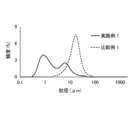
- 1 shows volume frequency distribution curves of phosphor powders (Example 1 and Comparative Example 1).
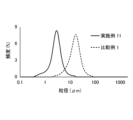
- 1 shows volume frequency distribution curves of phosphor powders (Example 2 and Comparative Example 1).
- 1 shows volume frequency distribution curves of phosphor powders (Examples 3 to 9 and Comparative Example 1).
- 1 shows volume frequency distribution curves of phosphor powders (Example 10 and Comparative Example 1).
- 1 shows volume frequency distribution curves of phosphor powders (Example 11 and Comparative Example 1).
- 1 shows volume frequency distribution curves of phosphor powders (Example 12 and Comparative Example 1).
- 1 shows volume frequency distribution curves of phosphor powders (Example 13 and Comparative Example 1).
- 1 shows volume frequency distribution curves of phosphor powders (Example 14 and Comparative Example 1). 1 shows volume frequency distribution curves of phosphor powders (Example 15 and Comparative Example 1). 1 shows a volume frequency distribution curve of phosphor powder (Comparative Example 1). 1 shows a volume frequency distribution curve of phosphor powder (Comparative Example 2).
- present embodiment A specific embodiment of the present invention (hereinafter referred to as the "present embodiment") will be described. Note that the present invention is not limited to the following embodiment, and various modifications are possible without departing from the gist of the present invention.
- the phosphor sheet of this embodiment includes phosphor powder and resin. That is, it includes resin and phosphor powder dispersed in the resin.
- the phosphor powder is the powder that is the main component of the fluorescent properties, absorbing light energy from the outside, converting it to light with different energy, and emitting the light with the converted energy.
- the powder also means an aggregate of many particles. It can also be said that many particles constitute the powder.
- the phosphor sheet of this embodiment preferably has a thickness of 18 ⁇ m or less.
- the thickness may be 15 ⁇ m or less. There is no lower limit to the thickness. However, from the viewpoint of ensuring high absorptance, the thickness may be 1 ⁇ m or more, 3 ⁇ m or more, or 5 ⁇ m or more.
- the thickness is preferably 1 ⁇ m or more and 18 ⁇ m or less, more preferably 3 ⁇ m or more and 18 ⁇ m or less, and even more preferably 5 ⁇ m or more and 15 ⁇ m or less.
- the phosphor sheet of this embodiment has a wavelength range in which the absorption rate is 30% or more within the range of 350 nm or more and 480 nm or less of the excitation light wavelength.
- the absorption rate of the phosphor sheet is 30% or more at at least one point in the above-mentioned excitation light wavelength range (350 nm or more and 480 nm or less).
- the absorption rate may be 30% or more in the entire range of the above-mentioned excitation source wavelength range, or the absorption rate may be 30% or more only for some wavelengths, for example, at 450 nm.
- the absorption rate is preferably 35% or more, and more preferably 40% or more.
- a portion of the light from the excitation source may be transmitted through the phosphor sheet and the transmitted light may be utilized.
- the transmitted light may be utilized in a three-wavelength white LED that combines a green phosphor, a red phosphor, and a blue LED.
- a portion of the light emitted by the blue LED or the near-ultraviolet LED is transmitted through the phosphor sheet, thereby obtaining white light.
- the absorption rate may be 95% or less, 90% or less, or 85% or less.
- the absorption rate is preferably 30% or more and 95% or less, more preferably 35% or more and 90% or less, and even more preferably 40% or more and 85% or less.
- the reason for specifying the absorptance for excitation light in the wavelength range of 350 nm to 480 nm is that near-ultraviolet or blue light LEDs are often used as the excitation source for light-emitting elements, and it is appropriate to specify this wavelength range.
- near-ultraviolet or blue light LEDs are often used as the excitation source for light-emitting elements, and it is appropriate to specify this wavelength range.
- a three-wavelength white LED that combines a green phosphor, a red phosphor, and a blue LED, it is more preferable to specify the absorptance for excitation light with a central wavelength of 440 nm to 460 nm in order to obtain white light.
- the phosphor powder has a total volume frequency of particles (first fine particles) with a particle size of less than 5 ⁇ m as measured by laser diffraction scattering particle size distribution measurement of 5% or more, and a total volume frequency of particles (first medium-sized particles) with a particle size of 5 ⁇ m or more and less than 10 ⁇ m is 5% or more and 90% or less. Furthermore, the cumulative 50% diameter in the volume particle size distribution (volume average particle size; Dv50) is 10 ⁇ m or less.
- the average particle size of the phosphor powder is reduced and the particle size distribution is made relatively broad. This allows the phosphor powder to be densely packed in the phosphor sheet, thereby making it possible to increase the absorption rate. In addition, it becomes easier to design components that are required for mini LED display applications to be made thinner.
- the total volume frequency of the fine particles is 5% or more.
- the total volume frequency of the fine particles is preferably 10% or more, more preferably 30% or more, and even more preferably 50% or more.
- the ratio of the fine particles it becomes possible to include medium-sized particles (first medium-sized particles), and the internal quantum efficiency becomes even higher.
- the total volume frequency of the fine particles is preferably 95% or less, and more preferably 90% or less.
- the total volume frequency of the fine particles (first fine particles) is preferably 5% or more and 95% or less, more preferably 10% or more and 95% or less, even more preferably 30% or more and 90% or less, and particularly preferably 50% or more and 90% or less.
- the total volume frequency of the medium-sized particles is 5% or more and 90% or less.
- the total volume frequency is preferably 5% or more, more preferably 6% or more, and even more preferably 7% or more.
- the total volume frequency of the medium-sized particles is preferably 90% or less, more preferably 85% or less, and particularly preferably 80% or less.
- the total volume frequency of the medium-sized particles (first medium-sized particles) is preferably 5% or more and 90% or less, preferably 6% or more and 85% or less, and more preferably 7% or more and 80% or less.
- the total volume frequency of the fine particles (first fine particles) and the medium-sized particles (first medium-sized particles) is 10% or more.
- the total volume frequency of particles (coarse particles) with a particle size of 10 ⁇ m or more is 90% or less.
- the total volume frequency of the coarse particles is preferably 30% or less, more preferably 20% or less, even more preferably 15% or less, and most preferably 10% or less.
- the total volume frequency of the coarse particles is preferably 0% or more and 30% or less, more preferably 0% or more and 20% or less, even more preferably 0% or more and 15% or less, and most preferably 0% or more and 10% or less.
- the total volume frequency of fine particles can be found by measuring the particle size distribution of the phosphor powder contained in the phosphor sheet to obtain a volumetric frequency distribution curve, and adding up the frequencies of particles with particle sizes less than 5 ⁇ m on this frequency distribution curve.
- the total volume frequency of medium-sized particles can be found by adding up the frequencies of particles with particle sizes between 5 ⁇ m and less than 10 ⁇ m on this frequency distribution curve.
- the total volume frequency of coarse particles (%) can be found by [100 - (total volume frequency of fine particles) - (total volume frequency of medium-sized particles)].
- the particle size distribution of the phosphor powder can also be determined by dissolving the resin in the phosphor sheet with a solvent such as an organic solvent to obtain phosphor powder, and then measuring the phosphor powder obtained. The particle size distribution of the phosphor powder added when making the phosphor sheet can also be examined.
- the cumulative 50% diameter (volume average particle diameter; Dv50) is preferably 10 ⁇ m or less.
- Dv50 is preferably 9.0 ⁇ m or less, and more preferably 8.0 ⁇ m or less.
- Dv50 is preferably 1.0 ⁇ m or more, and more preferably 2.0 ⁇ m or more.
- Dv50 is preferably 1.0 ⁇ m or more and 10 ⁇ m or less, more preferably 1.0 ⁇ m or more and 9.0 ⁇ m or less, and even more preferably 2.0 ⁇ m or more and 8.0 ⁇ m or less.
- Dv50 can be obtained by calculating a cumulative distribution curve on a volume basis of the phosphor powder, and taking the 50% diameter on this cumulative distribution curve.
- the particle diameter and volume average particle diameter of the phosphor powder described above may also be satisfied by particles provided with a coating as described below.
- the phosphor powder has a total volume frequency of particles with a particle size of less than 2.5 ⁇ m (second fine particles) of 10% or more, and a total volume frequency of particles with a particle size of 2.5 ⁇ m or more and less than 10 ⁇ m (second medium-sized particles) of 5% or more and 80% or less, when the particle size distribution measured by cross-sectional SEM observation of the phosphor sheet is converted to a volume basis.
- the total volume frequency of the fine particles is 10% or more.
- the total volume frequency of the fine particles is preferably 20% or more, more preferably 30% or more, and even more preferably 40% or more.
- the total volume frequency of the fine particles is preferably 95% or less, and more preferably 90% or less.
- the total volume frequency of the fine particles (second fine particles) is preferably 10% or more and 95% or less, more preferably 20% or more and 95% or less, even more preferably 30% or more and 90% or less, and most preferably 40% or more and 90% or less.
- the total volume frequency of the medium-sized particles is 5% or more and 80% or less.
- the total volume frequency is preferably 8% or more, and more preferably 10% or more.
- the total volume frequency of the medium-sized particles is preferably 70% or less, and more preferably 60% or less.
- the total volume frequency of the medium-sized particles (second medium-sized particles) is preferably 8% or more and 70% or less, and more preferably 10% or more and 60% or less.
- the total volume frequency of the fine particles (second fine particles) and the medium-sized particles (second medium-sized particles) is 15% or more.
- the total volume frequency of particles (coarse particles) with a particle size of 10 ⁇ m or more is 85% or less.
- the proportion of coarse particles (second coarse particles) is small.
- the total volume frequency of the coarse particles is preferably 10% or less, and more preferably 3% or less.
- the total volume frequency of the coarse particles (second coarse particles) is preferably 0% or more and 10% or less, and more preferably 0% or more and 3% or less.
- the total volume frequency of fine particles can be found by adding up the frequency of particles with a particle size of less than 2.5 ⁇ m in the volume-based frequency distribution curve obtained from cross-sectional SEM observation of the phosphor sheet.
- the total volume frequency of medium-sized particles can be found by adding up the frequency of particles with a particle size of 2.5 ⁇ m or more and less than 10 ⁇ m in this frequency distribution curve.
- the total volume frequency (%) of coarse particles can be found by [100 - (total volume frequency of fine particles) - (total volume frequency of medium-sized particles)].
- the volume-based frequency distribution curve can also be obtained by observing the cross section of the phosphor sheet with a scanning electron microscope (SEM), determining the cross-sectional particle size distribution of the phosphor powder from the resulting cross-sectional SEM image, and converting this cross-sectional particle size distribution into a volume-based distribution.
- SEM scanning electron microscope
- the average particle size of the phosphor powder is small and the particle size distribution is relatively broad. This makes it possible to increase not only the absorption rate but also the internal quantum efficiency. In addition, it becomes easier to design components that are thin, which is required for mini LED display applications.
- the particle size of the phosphor powder described above may also satisfy these requirements for particles that are coated as described below.
- particle size distribution measurements using laser diffraction differ in the measurement principles and state of the sample being measured, so the measured values do not necessarily match.
- laser diffraction a laser is irradiated onto a powder dispersed in a solvent, and the scattered light is converted into a volume distribution, so if coarse particles are present, their influence becomes greater in terms of volume weighting.
- the measured values of the two methods do not necessarily match, it is desirable to determine the optimal range for each method.
- the mode diameter is preferably less than 7.0 ⁇ m when the particle size distribution measured by cross-sectional SEM observation of the phosphor sheet is converted to a volume standard.
- the mode diameter is the diameter that gives the highest frequency in a particle size (frequency) distribution curve.
- the mode diameter is preferably 6.0 ⁇ m or less, more preferably 5.0 ⁇ m or less, and even more preferably 4.5 ⁇ m or less.
- the mode diameter of the phosphor powder described above may also satisfy these requirements for particles that are coated as described below.
- the phosphor sheet of this embodiment is not limited to satisfying the first and second aspects as long as it has a predetermined absorption rate and film thickness. However, from the viewpoint of reliably ensuring a high absorption rate, it is desirable for it to satisfy either or both of the first and second aspects.
- Fluorescent materials consist of a host crystal and a luminescent center (activator), and in many cases the luminescent center is dissolved in an appropriate host crystal at a level of a few percent.
- Known fluorescent materials include oxides, sulfides, oxysulfides, nitrides, and oxynitrides, and any of these may be used.
- oxide-based fluorescent materials include (Y, Gd, Lu) 3 (Al, Ga) 5 O 12 : Ce 3+ , (Ba, Sr, Ca) 2 SiO 4 : Eu 2+ , (Ba, Sr, Ca) 3 MgSi 2 O 8 : Eu 2+ , CaAl 12 O 19 : Mn 4+ , Ca 3 Sc 2 Si 3 O 12 : Ce 3+ , CaSc 2 O 4 : Ce 3+ , (Ba, Sr) 3 SiO 5 : Eu 2+ , Li 2 Sr SiO 4 : Eu 2+ , Ba 9 Sc 2 Si 6 O 24 : Eu 2+ , Ca 3 Si 2 O 7 : Eu 2+ , LiSrPO4 : Eu2 + , CaLa4Si3O13 : Eu3 + , Ba2Gd3Li3Mo8O32 : Eu3 + , and BaMgAl10O17 :Eu2 + ,Mn2 + .
- Examples of sulfide-based fluorescent materials include (Ba, Sr, Ca)Ga2S4 : Eu2 + , (Ba, Sr, Ca) Ga2S4 :Ce3 + , (Sr, Ca)S:Eu2 + , (Sr, Cd)S:Eu2 + , and ZnS:Cu.
- Examples of oxysulfide fluorescent materials include (La,Y) 2O2S : Eu3 + , La(Ca,Sr) Ga3S6O :Eu2 + , and La2O2S : Eu3 + .
- nitride-based fluorescent materials include (Ba,Sr,Ca)2Si5N8 : Eu2 + , (Ba,Ca, Sr ) AlSiN3 :Eu2 + , La3Si6N11 : Ce3 + , (Ba,Sr,Ca) LiAl3N4 :Eu2 + , Sr( Mg3SiN4 ):Eu2 + and (Ba , Sr ) 2Si5N8 :Eu2 + .
- Examples of oxynitride-based fluorescent materials include Eu - containing ⁇ -type sialon, Eu-containing ⁇ - type sialon, Ba9Sc3Si6O21N3 : Eu2 + , Ba3Si6O12N2 : Eu2+, BaSi2O2N2:Eu2+ , and ( Ba , Sr,Ca)AlSi ( ON) 3 :Eu2 + .
- fluorescent materials include, for example, Sr10 ( PO4 ) 6C12 : Eu2 + and K2 (Si,Ge,Ti) F6 :Mn4 + .
- the phosphor powder includes a host crystal containing at least one metal element selected from the group consisting of barium (Ba), strontium (Sr) and calcium (Ca) capable of generating properties equivalent to those of an alkaline earth metal, gallium (Ga) and sulfur (S), as well as a luminescent center, as shown in the composition listed above as the sulfide-based fluorescent material.
- the luminescent center it is preferable to include at least one element selected from the group consisting of europium (Eu), cerium (Ce), manganese (Mn) and samarium (Sm).
- the luminescent center preferably includes Eu, more preferably includes a divalent ion of Eu (Eu 2+ ), and even more preferably includes only Eu 2+ .
- the phosphor powder contains a crystal represented by the general formula: MGa2S4 :A (wherein M is at least one element selected from the group consisting of Ba, Sr, and Ca, and A is a luminescent center element such as Eu2 + ).
- a phosphor powder having such a composition emits green light when excited by excitation light having a wavelength in the near ultraviolet to blue regions (approximately 300 nm to 510 nm).
- the phosphor powder as in the composition listed as the sulfide-based fluorescent material described above, includes a host crystal containing at least one metal element selected from the group consisting of barium (Ba), strontium (Sr) and calcium (Ca) that can generate properties equivalent to those of an alkaline earth metal, sulfur (S), and a luminescent center.
- a host crystal containing at least one metal element selected from the group consisting of barium (Ba), strontium (Sr) and calcium (Ca) that can generate properties equivalent to those of an alkaline earth metal, sulfur (S), and a luminescent center.
- the luminescent center it is preferable to include at least one element selected from the group consisting of europium (Eu), cerium (Ce), manganese (Mn) and samarium (Sm).
- the phosphor powder includes a crystal represented by the general formula: MS:A (wherein M is at least one element selected from the group consisting of Ba, Sr and Ca, and A is a luminescent center element such as Eu 2+ ).
- MS:A a crystal represented by the general formula: MS:A (wherein M is at least one element selected from the group consisting of Ba, Sr and Ca, and A is a luminescent center element such as Eu 2+ ).
- the phosphor powder having such a composition emits red light when excited by light having a wavelength (about 250 nm to 610 nm) in the ultraviolet to visible light range.
- the phosphor powder contains a crystal represented by the general formula: MGa 2 S 4 : A (wherein M is at least one element selected from the group consisting of Ba, Sr, and Ca, and A is a luminescence center element such as Eu 2+ ), or a crystal represented by the general formula: MS: A (wherein M is at least one element selected from the group consisting of Ba, Sr, and Ca, and A is a luminescence center element such as Eu 2+ ), it is preferable to adjust the ratio of the luminescence center element A from the viewpoint of improving the luminescence characteristics of the phosphor powder.
- the ratio (XA/(XM+XA)) of the molar amount XA of element A to the sum (XM+XA) of the molar amount XM of element M and the molar amount XA of the luminescence center element A contained in the phosphor powder is preferably 0.05 or more, more preferably 0.07 or more, and even more preferably 0.10 or more in the case of a green phosphor, and is preferably 0.001 or more, more preferably 0.003 or more, and even more preferably 0.005 or more in the case of a red phosphor.
- XA/(XM+XA) is preferably 0.30 or less, more preferably 0.25 or less, and even more preferably 0.20 or less in the case of a green phosphor, and is preferably 0.05 or less, more preferably 0.04 or less, and even more preferably 0.02 or less in the case of a red phosphor.
- the phosphor powder contained in the phosphor sheet may be of one type alone or two or more types in combination.
- a three-wavelength white LED can be produced.
- the phosphor powder may or may not have a surface coating layer. However, from the viewpoint of improving durability such as moisture resistance, it is preferable that the phosphor powder has a surface coating layer. From the viewpoint of improving durability while maintaining good luminescence of the phosphor, the coating layer is preferably made of one or more inorganic compounds such as oxides containing silicon dioxide (SiO 2 ), zinc oxide (ZnO), aluminum oxide (Al 2 O 3 ), titanium oxide (TiO 2 ), and/or boron (B), metal sulfates such as barium sulfate (BaSO 4 ), and nitrides such as aluminum nitride and gallium nitride.
- the coating layer is preferably made of one or more inorganic compounds such as oxides containing silicon dioxide (SiO 2 ), zinc oxide (ZnO), aluminum oxide (Al 2 O 3 ), titanium oxide (TiO 2 ), and/or boron (B), metal sulfates such as barium sul
- the resin is not limited to a particular type, so long as it functions as a binder.
- thermoplastic resins include polyolefin resins such as polyethylene and polypropylene; polyester resins such as polyethylene terephthalate and polybutylene terephthalate; polyacrylic acid resins such as polycarbonate resins, polyacrylic acid or its esters, and polymethacrylic acid or its esters; polyvinyl resins such as polystyrene and polyvinyl chloride; cellulose resins such as triethyl cellulose; and urethane resins such as polyurethane.
- thermosetting resins include silicone resins, phenolic resins, epoxy resins, melamine resins, urea resins, unsaturated polyester resins, alkyd resins, polyurethane resins, and polyimide resins.
- photocurable resins include acrylic resins, urethane resins, vinyl ester resins, and polyester alkyd resins. Not only polymers but also oligomers and monomers can be used for these resins.
- An example of a two-part curable resin is epoxy resin.
- the ratio of phosphor powder to resin contained in the phosphor sheet is not limited.
- the amount of phosphor powder is preferably 10 parts by mass or more, more preferably 20 parts by mass or more, per 100 parts by mass of resin.
- the amount of phosphor powder is preferably 200 parts by mass or less, more preferably 150 parts by mass or less, and even more preferably 100 parts by mass or less, per 100 parts by mass of resin.
- the amount of phosphor powder is preferably 10 parts by mass or more and 200 parts by mass or less, more preferably 10 parts by mass or more and 150 parts by mass or less, and even more preferably 20 parts by mass or more and 100 parts by mass or less, per 100 parts by mass of resin.
- the product of the amount of phosphor powder per 100 parts by mass of resin and the film thickness of the phosphor sheet is preferably 100 parts by mass ⁇ m or more, more preferably 300 parts by mass ⁇ m or more, even more preferably 400 parts by mass ⁇ m or more, and particularly preferably 500 parts by mass ⁇ m or more.
- the upper limit of the product of the amount of phosphor powder and the film thickness of the phosphor sheet is typically 3600 parts by mass ⁇ m or less.
- the phosphor sheet may contain other components in addition to the phosphor powder and resin.
- Such other components include solvents such as organic solvents, or additives such as dispersants, leveling materials, surface modifiers, adhesives, and/or diffusion materials.
- the phosphor sheet of this embodiment has a high absorptance even though it is thin. This allows the light-emitting element and light-emitting device obtained using this phosphor sheet to be made thinner and more compact, and contributes to improving the light-emitting characteristics.
- the phosphor sheet of the present embodiment is not limited in its manufacturing method as long as it satisfies the above-mentioned requirements.
- a suitable manufacturing method includes the steps of synthesizing phosphor coarse powder from raw materials (synthesis step), performing particle size adjustment processing such as crushing and classification on the obtained phosphor coarse powder to prepare phosphor powder (particle size adjustment step), and mixing and kneading the obtained phosphor powder with resin to prepare a dispersion composition, and forming the obtained dispersion composition into a sheet to prepare a phosphor sheet (sheeting step).
- a preferred manufacturing method is described below using as an example a host crystal containing at least one metal element selected from the group consisting of barium (Ba), strontium (Sr) and calcium (Ca), gallium (Ga) and sulfur (S), and a phosphor powder containing europium (Eu) as the luminescent center.
- a host crystal containing at least one metal element selected from the group consisting of barium (Ba), strontium (Sr) and calcium (Ca), gallium (Ga) and sulfur (S), and a phosphor powder containing europium (Eu) as the luminescent center.
- phosphor crude powder is synthesized from raw materials. For example, at least one of strontium (Sr) raw material, barium (Ba) raw material, and calcium (Ca) raw material, gallium (Ga) raw material, sulfur (S) raw material, and europium (Eu) raw material are weighed and mixed to obtain a raw material mixture.
- strontium (Sr) raw material barium (Ba) raw material, and calcium (Ca) raw material, oxides, double oxides, and/or carbonates of each element can be used.
- gallium (Ga) raw material oxides (Ga 2 O 3 , GaO) can be used.
- S strontium sulfide
- BaS barium sulfide
- CaS calcium sulfide
- sulfur (S) silicon sulfide
- SiS 2 silicon sulfide
- Ce 2 S 3 cerium sulfide
- hydrogen sulfide (H 2 S) gas etc.
- europium (Eu) raw material europium compounds such as europium fluoride (EuF 3 ), europium oxide (Eu 2 O 3 ), and europium chloride (EuCl 3 ) can be used.
- rare earth elements such as praseodymium (Pr) and samarium (Sm) may be added to the raw material.
- at least one element selected from rare earth elements such as scandium (Sc), lanthanum (La), gadolinium (Gd), and lutetium (Lu) may be added to the raw material as a sensitizer.
- the amount of each of these elements is 5 mol% or less relative to strontium (Sr). If the content of these elements exceeds 5 mol%, a large amount of heterogeneous phases may be precipitated, and the brightness may be significantly reduced.
- alkali metal elements monovalent cationic metals such as silver ions (Ag + ), and halogen ions such as chlorine (Cl), fluorine (F), and iodine (I) may be added to the raw material as a charge compensation agent.
- halogen ions such as chlorine (Cl), fluorine (F), and iodine (I)
- the amount of addition is approximately equal to the content of the aluminum group and rare earth elements.
- the method of mixing the raw materials is not limited. Either dry or wet mixing may be used.
- dry mixing the raw materials may be mixed in a mixer such as a paint shaker or ball mill using zirconia balls as media, and dried as necessary to produce a raw material mixture.
- wet mixing a solvent such as water may be added to the raw materials to form a suspension, which may then be mixed in a mixer such as a paint shaker or ball mill using zirconia balls as media, after which the media may be separated using a sieve or the like, and the solvent may be removed from the suspension by a drying method such as reduced pressure drying or vacuum drying.
- the resulting raw material mixture is fired to produce a fired product.
- the raw material mixture may or may not be crushed, classified, and/or dried as necessary.
- the firing it is preferable to perform the firing at a temperature of 1000°C or higher. At 1000°C or higher, sufficient and uniform firing can be performed.
- the upper limit of the firing temperature cannot be determined in general because it is determined by the endurance temperature of the firing furnace and the production temperature. However, it is preferable to perform the firing at a temperature of 1000°C or higher and 1200°C or lower.
- the firing time is determined in relation to the firing temperature. However, it is preferable to perform the firing for about 2 hours or higher and 24 hours or lower.
- the firing atmosphere may be an inert gas or a reducing gas.
- examples include an argon atmosphere, a nitrogen atmosphere, a sulfur atmosphere, an argon atmosphere containing hydrogen gas, a nitrogen atmosphere containing hydrogen gas, and/or a hydrogen sulfide atmosphere. Of these, firing in a hydrogen sulfide atmosphere is preferred.
- the raw material mixture contains a sulfur (S) raw material
- it can be fired under an atmosphere of hydrogen sulfide, carbon disulfide, or an inert gas.
- hydrogen sulfide or carbon disulfide When hydrogen sulfide or carbon disulfide is used, these become sulfur compounds during firing, which has the effect of suppressing decomposition of the product.
- the raw materials do not contain a sulfur raw material, it is preferable to fire in a sulfur-containing atmosphere such as hydrogen sulfide or carbon disulfide.
- the fired product obtained in this way is used in the next process as phosphor crude powder.
- the obtained phosphor coarse powder is subjected to particle size adjustment treatments such as crushing and classification to produce phosphor powder.
- Crushing may be performed using a known crusher such as a ball mill, stamp mill, jet mill, crusher, and/or paint shaker. If necessary, the crushed material obtained by crushing may be subjected to classification treatment. Classification may be performed by a known method such as a sieve or air classifier. In this manner, phosphor powder can be produced.
- the phosphor powder from phosphors containing not only medium-sized particles but also fine particles, the absorption rate can be sufficiently increased and the internal quantum efficiency can be increased.
- the particle size of the phosphor powder obtained after crushing is adjusted so that the total volume frequency of fine particles measured by laser diffraction scattering type particle size distribution measurement is 5% or more, the total volume frequency of medium-sized particles is 5% to 90%, and Dv50 is 10 ⁇ m or less.
- the method for adjusting the particle size distribution is not limited.
- the particle size distribution can be adjusted by controlling the conditions during crushing and the conditions for classification. For example, when crushing using a ball mill, conditions such as the processing time, ball mill rotation speed, media (ball) size, and media (ball) packing rate can be adjusted. When crushing using a jet mill, conditions such as the grinding pressure and type of gas supplied can be adjusted. When performing classification, the sieve opening and classification point (cut point) can be adjusted. When adjusting the media size in ball mill crushing, it is desirable to use a combination of media of multiple sizes.
- the obtained phosphor powder and resin are mixed and kneaded to prepare a dispersion composition, and the obtained dispersion composition is formed into a sheet to prepare a phosphor sheet.
- Mixing and kneading may be performed using a known mixing device or kneading device such as an agitation type disperser, a self-revolving agitation mixer, a three-roll, a kneader, a single-axis or two-axis kneader, etc.
- sheeting may be performed using a sheeting device such as a bar coater, a reverse roll coater, a blade coater, a slit die coater, a direct gravure coater, an offset gravure coater, a kiss coater, a natural roll coater, an air knife coater, a roll blade coater, a bar bar roll blade coater, a two-stream coater, a rod coater, an applicator, a dip coater, a curtain coater, a spin coater, and a knife coater.
- a sheeting device such as a bar coater, a reverse roll coater, a blade coater, a slit die coater, a direct gravure coater, an offset gravure coater, a kiss coater, a natural roll coater, an air knife coater, a roll blade coater, a bar bar roll blade coater, a two-stream coater, a rod coater, an applicator, a dip coater, a curtain coater,
- the phosphor sheet of this embodiment can be produced.
- two or more types of phosphor powder may be used in combination.
- phosphor powders produced separately may be mixed in the particle size adjustment process.
- a phosphor powder that emits green light and a phosphor powder that emits red light may be synthesized separately, and the mixed powder obtained after mixing may be subjected to a crushing and/or classification process.
- a solvent such as an organic solvent, or additives such as a dispersant, leveling material, surface modifier, adhesive, and/or diffusion material may be added in the sheet production process.
- the light-emitting element of this embodiment includes the above-mentioned phosphor sheet and an excitation source.
- the excitation source has the function of emitting light toward the phosphor to excite the phosphor.
- an LED that emits light including a wavelength of 250 nm or more and 510 nm or less is suitable.
- the arrangement of the phosphor and the excitation source is not limited. However, it is preferable to arrange the phosphor directly above the excitation source. This allows the phosphor to absorb all the light emitted from the excitation source and perform color conversion.
- the light-emitting element when the light-emitting element is applied to a mini LED display, it is preferable to arrange an LED as an excitation source at the bottom and a phosphor sheet above it.
- the light-emitting element of this embodiment has the features that it can be made thin and small because it is provided with the above-mentioned phosphor sheet, and has high luminous efficiency.
- the light emitting device of the present embodiment includes the above-mentioned light emitting element.
- the light emitting device is preferably a mini LED display.
- the light emitting device of the present embodiment has the features that it can be made thin and small, and has high light emitting efficiency.
- the mini LED display (20) includes a near-ultraviolet or blue LED (2) housed in a package (4), a phosphor sheet (6) arranged on the near-ultraviolet or blue LED (2), and liquid crystal (8) and a color filter (10) arranged on the phosphor sheet (6).
- the phosphor sheet (6) contains green and red phosphors. A portion of the near-ultraviolet or blue light emitted from the near-ultraviolet or blue LED (2) is color-converted by the phosphor sheet (6), and the remainder passes through the phosphor sheet.
- the color-converted light and the transmitted light are combined and emitted as white light from the top surface of the phosphor sheet.
- the transmission of the emitted white light is controlled by the liquid crystal (8), and the light passes through the color filter and is emitted to the outside as red light, green light, and blue light.
- the obtained raw material composition was fired under a hydrogen sulfide (H 2 S) gas atmosphere under the conditions of a temperature rise rate of 5° C./min, a firing temperature of 1100° C., and a firing time of 6 hours, to obtain a green phosphor powder represented by the general formula (Ba, Sr) Ga 2 S 4 : Eu.
- the amount of the raw materials was adjusted so that the europium (Eu) concentration (XA/(XM+XA)) was 6.5 mol%.
- the volume of the zirconia balls was calculated using the true specific gravity of zirconia of 6.0 g/cm 3 , and the amount of the zirconia balls put in was adjusted so that this volume was equal to the volume of the mixed liquid.
- the ball mill crushing was also performed under the condition of a pot rotation speed of 300 rpm.
- the obtained crushed product was evaluated as a phosphor powder.
- the mixing ratio of the green phosphor powder and the red phosphor powder, and the amount of the zirconia balls put in the pot are summarized in Table 1.
- the obtained phosphor powder was mixed with silicone resin in the ratio shown in Table 2, and dispersed using a revolution type stirring and degassing device to prepare a slurry.
- the dispersion was performed under the following conditions. After that, a coating film was made from the obtained dispersion composition as a phosphor sheet, and the coating film was evaluated.
- the thickness of the obtained phosphor sheet is shown in Table 2.
- Example 2 to 13 The mixing ratio of the green phosphor powder and the red phosphor powder, and the amount of balls put into the ball mill pot were changed as shown in Table 1. Other than that, phosphor sheets were produced using the same procedure as in Example 1. In Examples 4 to 9, phosphor sheets were produced using the phosphor powder obtained by the crushing treatment in Example 3. In Example 12, no red phosphor powder was added, and in Example 13, no green phosphor powder was added.
- the red phosphor powder was synthesized by the following procedure. First, strontium carbonate (SrCO 3 ) was weighed, pulverized using a bead mill, dried, and then fired in a hydrogen sulfide gas atmosphere at 850° C. for 4 hours. Next, europium oxide (Eu 2 O 3 ) was added and fired in an argon (Ar) gas atmosphere under the conditions of a temperature increase rate of 5° C./min, a firing temperature of 1000° C., and a firing time of 4 hours, to obtain a red phosphor powder represented by the general formula SrS:Eu. At this time, the amount of raw materials was adjusted so that the europium (Eu) concentration (XA/(XM+XA)) was 0.5 mol%.
- SrS:Eu argon
- the mixing ratio of the green phosphor powder and the red phosphor powder, and the amount of balls added to the ball mill pot were changed as shown in Table 1. Otherwise, the phosphor sheet was produced using the same procedure as in Example 1. Note that in Example 15, no green phosphor powder was added.
- ⁇ Powder particle size distribution> The particle size distribution of the phosphor powder was measured using a laser diffraction particle size distribution measuring instrument (Microtrack Bell, MT3300EXII). First, the inside of the circulation system of the device was filled with a 99.5% ethanol solution, and the sample (phosphor powder) was added so that the transmittance was 95 to 60%. When adding, the sample was subjected to a dispersion treatment such as ultrasonic dispersion (40 W, 180 seconds). Next, the particle size was measured while circulating the particles in the solvent in the measurement cell.
- a dispersion treatment such as ultrasonic dispersion (40 W, 180 seconds).
- a frequency particle size distribution curve and a cumulative particle size distribution curve on a volume basis were obtained, and from these, the total volume frequency of particles with a particle size of less than 5 ⁇ m (fine particles), the total volume frequency of particles with a particle size of 5 ⁇ m or more and less than 10 ⁇ m (medium-sized particles), and the cumulative 50% diameter (D50) were obtained.
- the total volume frequency of particles with a particle size of 10 ⁇ m or more (coarse particles) was also obtained from [100-(total volume frequency of fine particles)-(total volume frequency of medium-sized particles)].
- the particle size measurement was performed under the following conditions.
- ⁇ Cross-sectional particle size distribution> The phosphor sheet was cut using a scriber (Replacement Scriber, OML LABORATORY), and the cross section of the sheet obtained was observed using a scanning electron microscope (Phenom XL G2; SEM, Thermo Scientific Corp.) at a magnification of 2000 to 10000 times and an accelerating voltage of 10 to 15 kV to obtain a backscattered electron image.
- the particle size distribution was obtained from the obtained cross-sectional SEM image using image analysis type particle size distribution measurement software (Mountech, Mac-View). Specifically, the particles were drawn until the number of particles reached approximately 300, and the number of particles was counted. Through analysis, a frequency particle size distribution curve and a cumulative particle size distribution curve on a volume basis were obtained, from which the total volume frequency of particles with a particle size of less than 2.5 ⁇ m (fine particles) and the total volume frequency of particles with a particle size of 2.5 ⁇ m or more and less than 10 ⁇ m (medium-sized particles) were obtained.
- the total volume frequency of particles with a particle size of 10 ⁇ m or more was obtained from [100 - (total volume frequency of fine particles) - (total volume frequency of medium-sized particles)].
- the analysis was performed under the following conditions.
- IQE internal quantum efficiency
- EQE external quantum efficiency
- Abs absorptivity
- P 1 ( ⁇ ) was the LED light spectrum at 450 nm
- P 2 ( ⁇ ) was the sample spectrum.
- the area L 1 surrounded by the spectrum P 1 ( ⁇ ) in the excitation wavelength range of 451 nm to 481 nm was calculated according to the following formula (i), and the obtained value was taken as the excitation intensity.
- the area L 2 surrounded by the spectrum P 2 ( ⁇ ) in the excitation wavelength range of 451 nm to 481 nm was calculated according to the following formula (ii), and the obtained value was taken as the sample scattering intensity.
- the area E 2 surrounded by the spectrum P 2 ( ⁇ ) in the excitation wavelength range of 482 nm to 800 nm was calculated according to the following formula (iii), and the obtained value was taken as the sample fluorescence intensity.
- the absorptance (Abs) is the ratio of the excitation light reduced by the sample to the incident light, and was calculated according to the following formula (iv).
- the external quantum efficiency (EQE) is the value obtained by dividing the number of photons N em of the fluorescence emitted from the sample by the number of photons N ex of the excitation light irradiated to the sample, and was calculated according to the following formula (v).
- the internal quantum efficiency (IQE) is the value obtained by dividing the number of photons N em of the fluorescence emitted from the sample by the number of photons N abs of the excitation light absorbed by the sample, and was calculated according to the following formula (vi).
- the phosphor powder contained in the phosphor sheets of Examples 1 to 15 satisfied the particle size distribution defined in the first and second aspects.
- the sheet thickness was 18 ⁇ m or less. And despite the small sheet thickness, the absorption rate was high at 30% or more.
Landscapes
- Chemical & Material Sciences (AREA)
- Engineering & Computer Science (AREA)
- Materials Engineering (AREA)
- Organic Chemistry (AREA)
- Inorganic Chemistry (AREA)
- Physics & Mathematics (AREA)
- General Physics & Mathematics (AREA)
- Optics & Photonics (AREA)
- Manufacture Of Macromolecular Shaped Articles (AREA)
- Luminescent Compositions (AREA)
Priority Applications (1)
| Application Number | Priority Date | Filing Date | Title |
|---|---|---|---|
| JP2024558940A JPWO2024106510A1 (https=) | 2022-11-18 | 2023-11-16 |
Applications Claiming Priority (2)
| Application Number | Priority Date | Filing Date | Title |
|---|---|---|---|
| JP2022185000 | 2022-11-18 | ||
| JP2022-185000 | 2022-11-18 |
Publications (1)
| Publication Number | Publication Date |
|---|---|
| WO2024106510A1 true WO2024106510A1 (ja) | 2024-05-23 |
Family
ID=91084532
Family Applications (1)
| Application Number | Title | Priority Date | Filing Date |
|---|---|---|---|
| PCT/JP2023/041277 Ceased WO2024106510A1 (ja) | 2022-11-18 | 2023-11-16 | 蛍光体シート、発光素子、及び発光装置 |
Country Status (3)
| Country | Link |
|---|---|
| JP (1) | JPWO2024106510A1 (https=) |
| TW (1) | TW202440872A (https=) |
| WO (1) | WO2024106510A1 (https=) |
Citations (3)
| Publication number | Priority date | Publication date | Assignee | Title |
|---|---|---|---|---|
| JPH11193379A (ja) * | 1997-10-31 | 1999-07-21 | Matsushita Electric Ind Co Ltd | 蛍光体材料とその製造方法,蛍光体膜およびプラズマディスプレイパネル |
| WO2009136505A1 (ja) * | 2008-05-09 | 2009-11-12 | 三井金属鉱業株式会社 | 緑色蛍光体 |
| JP2022522915A (ja) * | 2020-02-12 | 2022-04-21 | 武漢華星光電技術有限公司 | 表示装置 |
-
2023
- 2023-11-16 WO PCT/JP2023/041277 patent/WO2024106510A1/ja not_active Ceased
- 2023-11-16 JP JP2024558940A patent/JPWO2024106510A1/ja active Pending
- 2023-11-17 TW TW112144572A patent/TW202440872A/zh unknown
Patent Citations (3)
| Publication number | Priority date | Publication date | Assignee | Title |
|---|---|---|---|---|
| JPH11193379A (ja) * | 1997-10-31 | 1999-07-21 | Matsushita Electric Ind Co Ltd | 蛍光体材料とその製造方法,蛍光体膜およびプラズマディスプレイパネル |
| WO2009136505A1 (ja) * | 2008-05-09 | 2009-11-12 | 三井金属鉱業株式会社 | 緑色蛍光体 |
| JP2022522915A (ja) * | 2020-02-12 | 2022-04-21 | 武漢華星光電技術有限公司 | 表示装置 |
Also Published As
| Publication number | Publication date |
|---|---|
| JPWO2024106510A1 (https=) | 2024-05-23 |
| TW202440872A (zh) | 2024-10-16 |
Similar Documents
| Publication | Publication Date | Title |
|---|---|---|
| EP2730635B1 (en) | Sialon-based oxynitride phosphor and production method thereof | |
| CN101935526B (zh) | 荧光体、其制备方法和发光装置 | |
| US10000697B2 (en) | Magnesium alumosilicate-based phosphor | |
| JPWO2020054351A1 (ja) | 蛍光体及び発光装置 | |
| JP7430182B2 (ja) | 蛍光体、蛍光体の製造方法、発光素子、発光装置および画像表示装置 | |
| JP4756104B2 (ja) | 緑色蛍光体 | |
| JP5238753B2 (ja) | 照明装置 | |
| US20250207022A1 (en) | Phosphor powder, phosphor-containing composition, light-emitting element, and light-emitting device | |
| JP2009293022A (ja) | 緑色蛍光体 | |
| WO2024106510A1 (ja) | 蛍光体シート、発光素子、及び発光装置 | |
| JP7638453B1 (ja) | 蛍光体粉末、蛍光体樹脂組成物、蛍光体、発光素子、及び発光装置 | |
| JP2025186586A (ja) | 蛍光体粉末、蛍光体含有組成物、蛍光体、発光素子、及び発光装置 | |
| JP2017518412A (ja) | 変換蛍光体 | |
| WO2025134882A1 (ja) | 蛍光体粉末、蛍光体樹脂組成物、蛍光体、発光素子、発光装置、及び表示装置 | |
| JP2025149274A (ja) | 混合蛍光体樹脂組成物の製造方法及び蛍光体シートの製造方法 | |
| WO2025105489A1 (ja) | 蛍光体、発光装置、照明装置、画像表示装置及び車両用表示灯 |
Legal Events
| Date | Code | Title | Description |
|---|---|---|---|
| 121 | Ep: the epo has been informed by wipo that ep was designated in this application |
Ref document number: 23891657 Country of ref document: EP Kind code of ref document: A1 |
|
| WWE | Wipo information: entry into national phase |
Ref document number: 2024558940 Country of ref document: JP |
|
| NENP | Non-entry into the national phase |
Ref country code: DE |
|
| 122 | Ep: pct application non-entry in european phase |
Ref document number: 23891657 Country of ref document: EP Kind code of ref document: A1 |