WO2024106357A1 - 成形食品の製造方法及び成形食品 - Google Patents
成形食品の製造方法及び成形食品 Download PDFInfo
- Publication number
- WO2024106357A1 WO2024106357A1 PCT/JP2023/040676 JP2023040676W WO2024106357A1 WO 2024106357 A1 WO2024106357 A1 WO 2024106357A1 JP 2023040676 W JP2023040676 W JP 2023040676W WO 2024106357 A1 WO2024106357 A1 WO 2024106357A1
- Authority
- WO
- WIPO (PCT)
- Prior art keywords
- molded food
- mass
- molded
- dough
- producing
- Prior art date
- Legal status (The legal status is an assumption and is not a legal conclusion. Google has not performed a legal analysis and makes no representation as to the accuracy of the status listed.)
- Ceased
Links
Images



Classifications
-
- A—HUMAN NECESSITIES
- A23—FOODS OR FOODSTUFFS; TREATMENT THEREOF, NOT COVERED BY OTHER CLASSES
- A23F—COFFEE; TEA; THEIR SUBSTITUTES; MANUFACTURE, PREPARATION, OR INFUSION THEREOF
- A23F3/00—Tea; Tea substitutes; Preparations thereof
- A23F3/06—Treating tea before extraction; Preparations produced thereby
- A23F3/14—Tea preparations, e.g. using additives
-
- A—HUMAN NECESSITIES
- A23—FOODS OR FOODSTUFFS; TREATMENT THEREOF, NOT COVERED BY OTHER CLASSES
- A23F—COFFEE; TEA; THEIR SUBSTITUTES; MANUFACTURE, PREPARATION, OR INFUSION THEREOF
- A23F5/00—Coffee; Coffee substitutes; Preparations thereof
- A23F5/10—Treating roasted coffee; Preparations produced thereby
-
- A—HUMAN NECESSITIES
- A23—FOODS OR FOODSTUFFS; TREATMENT THEREOF, NOT COVERED BY OTHER CLASSES
- A23G—COCOA; COCOA PRODUCTS, e.g. CHOCOLATE; SUBSTITUTES FOR COCOA OR COCOA PRODUCTS; CONFECTIONERY; CHEWING GUM; ICE-CREAM; PREPARATION THEREOF
- A23G1/00—Cocoa; Cocoa products, e.g. chocolate; Substitutes therefor
-
- A—HUMAN NECESSITIES
- A23—FOODS OR FOODSTUFFS; TREATMENT THEREOF, NOT COVERED BY OTHER CLASSES
- A23G—COCOA; COCOA PRODUCTS, e.g. CHOCOLATE; SUBSTITUTES FOR COCOA OR COCOA PRODUCTS; CONFECTIONERY; CHEWING GUM; ICE-CREAM; PREPARATION THEREOF
- A23G1/00—Cocoa; Cocoa products, e.g. chocolate; Substitutes therefor
- A23G1/30—Cocoa products, e.g. chocolate; Substitutes therefor
- A23G1/32—Cocoa products, e.g. chocolate; Substitutes therefor characterised by the composition containing organic or inorganic compounds
-
- A—HUMAN NECESSITIES
- A23—FOODS OR FOODSTUFFS; TREATMENT THEREOF, NOT COVERED BY OTHER CLASSES
- A23G—COCOA; COCOA PRODUCTS, e.g. CHOCOLATE; SUBSTITUTES FOR COCOA OR COCOA PRODUCTS; CONFECTIONERY; CHEWING GUM; ICE-CREAM; PREPARATION THEREOF
- A23G1/00—Cocoa; Cocoa products, e.g. chocolate; Substitutes therefor
- A23G1/30—Cocoa products, e.g. chocolate; Substitutes therefor
- A23G1/32—Cocoa products, e.g. chocolate; Substitutes therefor characterised by the composition containing organic or inorganic compounds
- A23G1/36—Cocoa products, e.g. chocolate; Substitutes therefor characterised by the composition containing organic or inorganic compounds characterised by the fats used
- A23G1/38—Cocoa butter substitutes
-
- A—HUMAN NECESSITIES
- A23—FOODS OR FOODSTUFFS; TREATMENT THEREOF, NOT COVERED BY OTHER CLASSES
- A23G—COCOA; COCOA PRODUCTS, e.g. CHOCOLATE; SUBSTITUTES FOR COCOA OR COCOA PRODUCTS; CONFECTIONERY; CHEWING GUM; ICE-CREAM; PREPARATION THEREOF
- A23G1/00—Cocoa; Cocoa products, e.g. chocolate; Substitutes therefor
- A23G1/30—Cocoa products, e.g. chocolate; Substitutes therefor
- A23G1/50—Cocoa products, e.g. chocolate; Substitutes therefor characterised by shape, structure or physical form, e.g. products with an inedible support
-
- A—HUMAN NECESSITIES
- A23—FOODS OR FOODSTUFFS; TREATMENT THEREOF, NOT COVERED BY OTHER CLASSES
- A23G—COCOA; COCOA PRODUCTS, e.g. CHOCOLATE; SUBSTITUTES FOR COCOA OR COCOA PRODUCTS; CONFECTIONERY; CHEWING GUM; ICE-CREAM; PREPARATION THEREOF
- A23G3/00—Sweetmeats; Confectionery; Marzipan; Coated or filled products
- A23G3/34—Sweetmeats, confectionery or marzipan; Processes for the preparation thereof
-
- A—HUMAN NECESSITIES
- A23—FOODS OR FOODSTUFFS; TREATMENT THEREOF, NOT COVERED BY OTHER CLASSES
- A23L—FOODS, FOODSTUFFS OR NON-ALCOHOLIC BEVERAGES, NOT OTHERWISE PROVIDED FOR; PREPARATION OR TREATMENT THEREOF
- A23L29/00—Foods or foodstuffs containing additives; Preparation or treatment thereof
- A23L29/20—Foods or foodstuffs containing additives; Preparation or treatment thereof containing gelling or thickening agents
- A23L29/206—Foods or foodstuffs containing additives; Preparation or treatment thereof containing gelling or thickening agents of vegetable origin
- A23L29/231—Pectin; Derivatives thereof
-
- A—HUMAN NECESSITIES
- A23—FOODS OR FOODSTUFFS; TREATMENT THEREOF, NOT COVERED BY OTHER CLASSES
- A23L—FOODS, FOODSTUFFS OR NON-ALCOHOLIC BEVERAGES, NOT OTHERWISE PROVIDED FOR; PREPARATION OR TREATMENT THEREOF
- A23L29/00—Foods or foodstuffs containing additives; Preparation or treatment thereof
- A23L29/20—Foods or foodstuffs containing additives; Preparation or treatment thereof containing gelling or thickening agents
- A23L29/206—Foods or foodstuffs containing additives; Preparation or treatment thereof containing gelling or thickening agents of vegetable origin
- A23L29/238—Foods or foodstuffs containing additives; Preparation or treatment thereof containing gelling or thickening agents of vegetable origin from seeds, e.g. locust bean gum or guar gum
-
- A—HUMAN NECESSITIES
- A23—FOODS OR FOODSTUFFS; TREATMENT THEREOF, NOT COVERED BY OTHER CLASSES
- A23L—FOODS, FOODSTUFFS OR NON-ALCOHOLIC BEVERAGES, NOT OTHERWISE PROVIDED FOR; PREPARATION OR TREATMENT THEREOF
- A23L29/00—Foods or foodstuffs containing additives; Preparation or treatment thereof
- A23L29/20—Foods or foodstuffs containing additives; Preparation or treatment thereof containing gelling or thickening agents
- A23L29/206—Foods or foodstuffs containing additives; Preparation or treatment thereof containing gelling or thickening agents of vegetable origin
- A23L29/25—Exudates, e.g. gum arabic, gum acacia, gum karaya or tragacanth
-
- A—HUMAN NECESSITIES
- A23—FOODS OR FOODSTUFFS; TREATMENT THEREOF, NOT COVERED BY OTHER CLASSES
- A23L—FOODS, FOODSTUFFS OR NON-ALCOHOLIC BEVERAGES, NOT OTHERWISE PROVIDED FOR; PREPARATION OR TREATMENT THEREOF
- A23L29/00—Foods or foodstuffs containing additives; Preparation or treatment thereof
- A23L29/20—Foods or foodstuffs containing additives; Preparation or treatment thereof containing gelling or thickening agents
- A23L29/269—Foods or foodstuffs containing additives; Preparation or treatment thereof containing gelling or thickening agents of microbial origin, e.g. xanthan or dextran
Definitions
- the present invention relates to a method for producing a molded food product and a molded food product. Specifically, the present invention relates to a method for producing a molded food product, which is capable of producing a molded food product having excellent heat resistance, shape retention and manufacturability, and to a molded food product.
- Patent documents 1 to 6 disclose foods containing fats and oils and sugars.
- Patent Document 1 discloses a baked confectionery dough with a specific gravity of 0.8 to 1.1, which contains 5 to 55% by mass of one or more solids selected from solids derived from cocoa beans and solids derived from milk, 10 to 30% by mass of fats and oils, and 25 to 55% by mass of sugars.
- Patent Document 2 discloses a method for producing a water-containing heat-resistant chocolate, which includes a step of gradually adding water to a chocolate dough to prepare a water-containing chocolate dough.
- Patent Document 3 discloses a method for producing water-containing heat-resistant chocolate, which includes a seeding agent addition step of adding a specific seeding agent to a molten chocolate dough having a dough temperature of 32 to 40°C, and a water addition step of adding water to the chocolate dough.
- Patent Document 4 discloses a decorative confectionery containing a sugar sweetener, starch, and fats and oils, the fats and oils being present in an amount of 10.5 to 26.4% by mass of the total weight of the decorative confectionery, and the sugar sweetener and starch being dispersed in an undissolved state.
- Patent Document 5 discloses a confectionery product in which a non-heated mixture of dough ingredients, the main components of which are a carbohydrate component made of crystalline carbohydrate, a compatibility component which is a homogenized mixture of fats and oils and an emulsifier, and a viscoelasticity-imparting component, is formed into a specified shape.
- Patent Document 6 discloses an oil-based food material that contains fats and sugars as its main components, contains coarse particles of solids other than fats and oils with a particle size of 30 ⁇ m or more, and contains a ratio of specific fatty acids to the total amount of fats and oils in the oil-based food material of 30 mass% or more.
- One of the objects of the present invention is to provide a method for producing molded foods that can produce molded foods with excellent heat resistance, shape retention, and manufacturing suitability, and to provide such molded foods.
- a molded food having excellent heat resistance, shape retention and manufacturability can be produced by a method for producing a molded food, the method comprising the steps of mixing fats and oils, including one or more selected from the group consisting of cocoa butter and cocoa butter substitutes, with sugars to obtain a dough, and extruding the dough to obtain a molded food, wherein the dough contains 10 to 22% by mass of fats and oils having a solid fat content of 70% or more at 25°C and a solid fat content of 15% or less at 35°C, and 70% by mass or more of sugars, and have completed the present invention.
- the following formed foods and the like can be provided. 1.
- a method for producing a molded food comprising the steps of: mixing a sugar with an oil or fat, the oil or fat comprising at least one selected from the group consisting of cocoa butter and cocoa butter substitutes, to obtain a dough; and extruding the dough to obtain a molded food,
- the fabric is Contains 10 to 22% by mass of an oil or fat having a solid fat content of 70% or more at 25°C and a solid fat content of 15% or less at 35°C;
- the present invention provides a method for producing molded foods that can produce molded foods with excellent heat resistance, shape retention, and manufacturing suitability, and a molded food product.
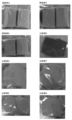
- Photographs of molded foods according to Example 1 and Comparative Examples 1 and 2 after a heat resistance test.
- Photographs of molded foods according to Examples 2 and 3 and Comparative Examples 3 and 4 after a heat resistance test.
- 1 shows the results of differential scanning calorimetry (DSC) measurements (DSC curves) of the molded foods of Examples 5 and 6.
- x to y represents a numerical range of "not less than x and not more than y.”
- the upper and lower limits described in relation to the numerical ranges can be combined in any combination.
- a manufacturing method of a molded food according to one embodiment of the present invention is a method for manufacturing a molded food, comprising the steps of mixing a fat or oil, including at least one selected from the group consisting of cocoa butter and cocoa butter substitutes, with a sugar to obtain a dough, and extruding the dough to obtain a molded food, wherein the dough contains 10 to 22% by mass of a fat or oil having a solid fat content of 70% or more at 25°C and a solid fat content of 15% or less at 35°C, and contains 70% or more by mass of a sugar.
- molded foods having excellent heat resistance, shape retention and manufacturing suitability can be manufactured. Furthermore, according to the method for producing a molded food product of this embodiment, it is possible to impart to the obtained molded food product a good fragrance, a smooth texture when eaten, and a lingering aftertaste.
- molded foods such as typical chocolate, contain 30 to 40% by mass of fats and oils, so heat resistance must be considered, and temperature control is essential during distribution and storage, such as storing at 28° C. or less.
- conventional general tablet candy dosage forms tablette
- peelability manufacturability
- hardness hardness during long-term storage.
- the molded food obtained by the manufacturing method of the molded food according to the present embodiment can have higher heat resistance and shape retention than general chocolate.
- the molded food can have better melting in the mouth and superior manufacturing suitability than general tablet confectioneries.
- fats and oils including at least one selected from the group consisting of cocoa butter and cocoa butter substitutes are mixed with sugar to obtain a dough, which contains 10 to 22 mass % of fats and oils having a solid fat content of 70% or more at 25° C. and a solid fat content of 15% or less at 35° C.
- a dough which contains 10 to 22 mass % of fats and oils having a solid fat content of 70% or more at 25° C. and a solid fat content of 15% or less at 35° C.
- SFC solid fat content
- the dough has a total content of 10 to 22% by weight of cocoa butter and cocoa butter substitutes having the above SFC properties (i.e., a solid fat content of 70% or more at 25° C. and a solid fat content of 15% or less at 35° C.).
- the dough may or may not contain fats that do not have the above SFC properties.
- the total content of fats and oils contained in the dough is 10 to 22 mass %, and the fats and oils contained in the dough as a whole have the above-mentioned SFC properties.
- the dough contains 70% or more sugar by mass. This provides a unique texture that is both disintegratable and melts easily in the mouth. If the sugar content is less than 70% by mass, such an effect cannot be obtained.
- the "sugars" referred to here do not include starch.
- the dough may or may not contain starch, but it is important that the dough contains 70% by mass or more of sugars other than starch.
- the sugar content in the dough is 70% by weight or more, more than 70% by weight, 71% by weight or more, 72% by weight or more, 73% by weight or more, or 74% by weight or more, and is less than 90% by weight, 89% by weight or less, 85% by weight or less, or 83% by weight or less.
- sugars examples include sugar (sucrose), powdered starch syrup, powdered reduced starch syrup, glucose, fructose, lactose, maltose, etc.
- sugars include sugar alcohols such as maltitol, sorbitol, and xylitol.
- sugars exemplified above may or may not be crystalline sugars.
- crystalline sugars are solids with a water content of 5% by mass or less that can be obtained by evaporating water from an aqueous solution of sugar and crystallizing it.
- the crystalline carbohydrate is preferably not vitrified, which gives the resulting molded food a crumbly texture.
- the fact that the crystalline sugar is not vitrified can be confirmed by the DSC measurement described in the Examples. Even if the crystalline carbohydrate is not vitrified, the dough can have excellent heat resistance and shape retention, for example, heat resistance and shape retention at 40° C. as described below.
- the dough may contain one or more sugars.
- the content is, for example, less than 2.0% by mass, 1.9% by mass or less, 1.8% by mass or less, 1.5% by mass or less, 1.0% by mass or less, or 0.5% by mass or less. It is also preferable that the dough does not contain starch. As mentioned above, in this specification, "sugars" does not include starch, so if the dough contains starch, its content is not included in the sugar content.
- the dough preferably further contains a palatability imparting material.
- a palatability-imparting material in the dough, the resulting molded food product is imparted with the favorable flavor of the palatability-imparting material and is also made highly palatable.
- the palatability-imparting material is preferably a powder.
- the powder referred to here has an average particle size of 20 ⁇ m or less.
- the average particle size of the powder is preferably 15 ⁇ m or less.
- the "average particle size” is the value measured as the "average value” on a particle size distribution graph measured using a particle size distribution measuring device (Shimadzu Corporation's "SALD-3100").
- the palatability-imparting material preferably contains one or more selected from the group consisting of coffee beans, tea leaves, cacao, and ingredients derived therefrom.
- the coffee beans and components derived therefrom dried coffee beans or coffee bean extract processed into a powder or granules are preferred, and dried coffee bean extract processed into a powder is more preferred. It is preferable that the coffee beans and components derived therefrom have a moisture content of 5% by mass or less.
- the water content is measured according to the "Appendix: Nutritional Ingredients Analysis Methods, etc.” 5. Carbohydrates A. Water (4) Normal Pressure Heat Drying Method in the "Appendix: Nutritional Labeling" section of the Consumer Affairs Agency of Japan website. (https://www.caa.go.jp/policies/policy/food_labeling/food_labeling_act/pdf/food_labeling_cms101_200327_11.pdf) Specifically, the water content is measured according to the following procedure. The constant weight (W 0 (g)) of a weighing dish (with lid) with a bottom diameter of 50 mm is determined.
- the coffee beans and components derived therefrom preferably have a caffeine content of 0.01 to 2.9% by mass.
- the total caffeine content is a value measured by a known method using high performance liquid chromatography.
- the coffee beans and components derived therefrom preferably have a total content of chlorogenic acids of 0.60 to 29.2% by mass.
- the total content of chlorogenic acids is a value measured by a known method using high performance liquid chromatography.
- the average particle size is 20 ⁇ m or less.
- tea leaves and ingredients derived therefrom powdered matcha (tencha powder) or green tea (sencha) is preferred.
- the tea leaves and components derived therefrom preferably have a moisture content of 5% by mass or less.
- the tea leaves and components derived therefrom preferably have a total catechin content of 3.89 to 17.90% by mass, the total catechin content being a value measured by a known method using high performance liquid chromatography.
- the average particle size is 11 ⁇ m or less.
- cacao nibs processed into a powder form are preferred, for example, powder obtained by freezing and grinding cacao nibs can be mentioned.
- the cacao and components derived therefrom preferably have a moisture content of 5% by mass or less.
- the cacao and components derived therefrom preferably have a total cacao polyphenol content of 3.3 to 5.0% by mass.
- the total cacao polyphenol content is a value measured in accordance with the "Cacao Polyphenol Measurement Method" attached to the "Labeling Standards for Cacao Polyphenols in Chocolate Products" of the Japan Chocolate Industry Trade Council.
- the cacao and ingredients derived therefrom are in powder form, it is preferred that the average particle size is 20 ⁇ m or less.
- the content may be 1% by mass or more, 2% by mass or more, 5% by mass or more, or 7% by mass or more, and may be 20% by mass or less, 18% by mass or less, 15% by mass or less, or 13% by mass or less.
- the dough may or may not contain ingredients other than those described above, provided that the ingredients do not impair the effects of the present invention.
- the dough has a total content of gelatin, pectin, pullulan, gum arabic, guar gum and locust bean gum of 0 to less than 0.1 parts by mass per 100 parts by mass of the above-mentioned crystalline carbohydrates contained in the dough.
- the dough contains an emulsifier that is less than 0.2% by mass, 0.19% by mass or less, 0.18% by mass or less, 0.15% by mass or less, 0.1% by mass or less, 0.05% by mass or less, or 0.01% by mass or less.
- the dough may contain no emulsifier.
- emulsifiers include emulsifiers with a viscosity reducing effect (lecithin, polyglycerol condensed ricinoleic acid ester (PGPR), etc.).
- lecithin and PGPR are used in combination as emulsifiers.
- Lecithin and PGPR may be used in combination in a mass ratio of 4:6 to 8:2.
- the value exemplified as the emulsifier content may be the total content of lecithin and PGPR.
- the steps from the mixing to the molding may be continuously carried out by an apparatus capable of kneading and extrusion molding.
- the apparatus capable of kneading and extrusion molding is not particularly limited, and examples thereof include an extruder.
- the extruder is preferably, for example, a twin-screw extruder.
- fats and oils and sugars may be mixed in advance to obtain a dough, which may then be fed to an apparatus capable of kneading and extruding.
- the process from mixing to extrusion molding is preferably carried out at a temperature within the range in which cocoa butter is usually melted, specifically, at about 35°C to 45°C.
- the extrusion molding can be performed at the discharge port of the extruder.
- the molded food obtained by the molded food manufacturing method according to this embodiment is an extrusion molded product of the dough in the molded food manufacturing method according to this embodiment (extruded dough product), and the explanation given for the dough applies to the composition, etc., of the molded food.
- the molded food obtained by the method for producing a molded food according to this embodiment preferably has a sugar skeleton.
- the heat resistance and shape retention are further improved. Whether or not a molded food has a sugar skeleton is determined by the hexane degreasing test described in the Examples. If the shape of the molded food is maintained after the hexane degreasing test, it is determined to have a sugar skeleton, and if the shape is not maintained, it is determined not to have a sugar skeleton.
- the molded food obtained by the method for producing a molded food according to this embodiment preferably has heat resistance and shape retention at 40°C.
- heat-resistant shape retention at 40° C means that when the appearance of a molded food is observed after it has been left to stand for 3 hours at 40° C., the shape before the standing is maintained. If deformation is observed at the edges of the molded food after it has been left to stand for 3 hours at 40° C., but the overall shape is maintained (the overall shape looks the same as before it was left to stand for 3 hours at 40° C.), the food is judged to have heat-resistant shape retention at 40° C.
- the molded food obtained by the method for producing a molded food according to this embodiment can achieve both heat resistance and shape retention at 40°C and good melt-in-the-mouth feel.
- the formed food according to one embodiment of the present invention is obtained by the method for producing a formed food according to one embodiment of the present invention described above.
- the molded food product according to this embodiment has the effect of providing excellent heat resistance, shape retention and manufacturability.
- the explanation given above regarding the method for producing a molded food product of one embodiment of the present invention is applicable.
- the molded food according to this embodiment is subject to circumstances in which it is impossible or practical to directly identify the object (molded food) by its structure or properties. That is, the behavior of the solid fat content of the cocoa butter and cocoa butter substitute contained in the molded food with respect to temperature is very specific, and the molded food tends to melt when the temperature of the molded food is increased by irradiation with energy rays (electron beams, etc.) during observation with an electron microscope, etc. In other words, the structure or properties of the molded food change during observation due to the influence of temperature changes, etc., making it extremely difficult to identify the structure or properties.
- the molded food may have a relatively low total oil content, but in this case, the fluidity is extremely low or nonexistent, making measurement using a viscometer, etc., extremely difficult, and in this respect, it is also extremely difficult to identify the structure or properties of the molded food.
- Coffee-containing molded food (Example 1 and Comparative Examples 1 and 2)
- the coffee used was ground coffee beans obtained by grinding lightly roasted (L value 20 to 23) beans from Brazil.
- the ground coffee beans had a moisture content of 5% by mass or less, a caffeine content of 0.01 to 2.9% by mass, and a chlorogenic acid content of 0.60 to 29.2% by mass, and the same ground coffee beans were used in each example.
- the average particle size of the ground coffee beans was 14.470 ⁇ m.
- the content of chlorogenic acids in the ground coffee beans was 2.910 mass%.
- the ground coffee beans, cocoa butter (SFC 80-90% at 25°C, SFC 0-10% at 35°C; the same applies to the following Examples and Comparative Examples) and maltitol were mixed in the ratio shown in Table 1.
- a Dalton universal mixer "5DM-L-03-r" was used for mixing, and the mixture was stirred at low speed for 10 minutes and then at high speed for 10 minutes.
- the raw materials were mixed and then extruded using an extruder (twin-screw extruder "Laboruder Mark II” manufactured by Japan Steel Works, Ltd.) to obtain a molded food product.
- the temperature inside the extruder is kept above the melting point of cocoa butter.
- the temperature of the molded food extruded from the extruder (extrusion molding) is 40°C.
- evaluation criteria A: The overall shape of the molded food is maintained, and no deformation is observed at the edges of the molded food.
- B Deformation is observed at the edges of the molded food, but the overall shape of the molded food is maintained (the overall shape appears the same as before the hexane degreasing test).
- C The overall shape of the molded food is slightly deformed.
- D The overall shape of the molded food is significantly deformed.
- Hexane degreasing test 2 solid content remaining rate
- the molded food after immersion and shaking in the above-mentioned hexane degreasing test 1 was removed from the beaker together with the sieve, and the molded food and the sieve were dried.
- the mass after drying (sieve + molded food) was measured, and the mass of the sieve was subtracted to obtain the mass M1 of the molded food after the test.
- the residual solid content was calculated from the above masses M0 and M1 .
- Solid content remaining rate [%] (M 1 /M 0 ) ⁇ 100
- Tea-containing molded food (Examples 2 and 3 and Comparative Examples 3 and 4)
- the tea powder used was Japanese matcha (previously ground in a dry ball mill) with a moisture content of 5% by mass or less and a total catechin content of 3% to 20% by mass or less, and the same powder was used in each example.
- the average particle size was 10.168 ⁇ m.
- the catechin content in the ground tea leaves was 11.56% by mass.
- the ground tea leaves, cocoa butter, and maltitol were mixed in the ratio shown in Table 3.
- a Dalton universal mixer "5DM-L-03-r" was used for mixing, and the mixture was stirred at low speed for 10 minutes, then at high speed for 10 minutes.
- Cocoa-containing molded foods (Examples 4 to 6 and Comparative Examples 5 to 9)
- Frozen cacao nibs (manufactured by Meiji Co., Ltd.) were pulverized using a mill grinder (IKA Corporation's "M20 General-Purpose Mill") at -40 to 0°C while maintaining the frozen state, to obtain pulverized cacao nibs.
- the average particle size of the resulting ground cacao nibs was 10.219 ⁇ m.
- the water content in the resulting ground cacao nib product was 5% by mass or less.
- the cacao polyphenol content in the resulting ground cacao nib product was 4.14% by mass.
- the ground cacao nibs, cocoa butter, medium chain triglycerides (abbreviated as “MCT”; “Nissin MCT Oil” manufactured by Nisshin Oillio Co., Ltd.), maltitol, and sugar (sucrose) were mixed according to the ratio shown in Table 5.
- MCT medium chain triglycerides
- maltitol maltitol
- sugar sugar
- the molded foods obtained in Examples 5 and 6 were measured using a differential scanning calorimeter (DSC) under the following conditions to confirm the vitrified state of the sugar in the molded foods.
- DSC measurement conditions Apparatus: DSC7000X AS-3DX (Hitachi High-Tech Science Corporation) Sample amount: 5.00 mg
- Temperature program The temperature was decreased from 23° C. to 20° C. at a rate of 10° C./min, and then held at 20° C. for 1 minute. Next, the temperature was increased from 20° C. to 300° C. at a rate of 5° C./min, and then held at 300° C. for 1 minute. Next, the temperature was decreased from 300° C. to 23° C. at a rate of 10° C./min, and then held at 23° C. for 5 minutes. DSC measurement was performed during the above-mentioned temperature increase process from 20° C. to 300° C.
- the DSC curve obtained by the above DSC measurement is shown in Figure 4.
- the melting points and glass transition points of the sugars confirmed by DSC measurement are shown in Table 7.
Landscapes
- Chemical & Material Sciences (AREA)
- Life Sciences & Earth Sciences (AREA)
- Engineering & Computer Science (AREA)
- Food Science & Technology (AREA)
- Polymers & Plastics (AREA)
- Dispersion Chemistry (AREA)
- Health & Medical Sciences (AREA)
- Nutrition Science (AREA)
- Inorganic Chemistry (AREA)
- Confectionery (AREA)
Priority Applications (2)
| Application Number | Priority Date | Filing Date | Title |
|---|---|---|---|
| CN202380078638.4A CN120225064A (zh) | 2022-11-15 | 2023-11-13 | 成形食品的制造方法和成形食品 |
| JP2024558840A JPWO2024106357A1 (https=) | 2022-11-15 | 2023-11-13 |
Applications Claiming Priority (2)
| Application Number | Priority Date | Filing Date | Title |
|---|---|---|---|
| JP2022-182529 | 2022-11-15 | ||
| JP2022182529 | 2022-11-15 |
Publications (1)
| Publication Number | Publication Date |
|---|---|
| WO2024106357A1 true WO2024106357A1 (ja) | 2024-05-23 |
Family
ID=91084662
Family Applications (1)
| Application Number | Title | Priority Date | Filing Date |
|---|---|---|---|
| PCT/JP2023/040676 Ceased WO2024106357A1 (ja) | 2022-11-15 | 2023-11-13 | 成形食品の製造方法及び成形食品 |
Country Status (3)
| Country | Link |
|---|---|
| JP (1) | JPWO2024106357A1 (https=) |
| CN (1) | CN120225064A (https=) |
| WO (1) | WO2024106357A1 (https=) |
Citations (6)
| Publication number | Priority date | Publication date | Assignee | Title |
|---|---|---|---|---|
| JP2011229493A (ja) * | 2010-04-30 | 2011-11-17 | Uha Mikakuto Co Ltd | 複合菓子 |
| WO2016047453A1 (ja) * | 2014-09-24 | 2016-03-31 | 日清オイリオグループ株式会社 | 耐熱性チョコレート及びその製造方法 |
| WO2017170676A1 (ja) * | 2016-03-31 | 2017-10-05 | 株式会社 ロッテ | 菓子およびその製造方法 |
| JP2018153102A (ja) * | 2017-03-15 | 2018-10-04 | 株式会社Adeka | 焼成油脂性菓子及び焼成油脂性菓子の製造方法 |
| JP2021003022A (ja) * | 2019-06-25 | 2021-01-14 | 株式会社明治 | 油脂性菓子及びその製造方法 |
| WO2021246468A1 (ja) * | 2020-06-03 | 2021-12-09 | 株式会社明治 | 含水油性食品 |
-
2023
- 2023-11-13 JP JP2024558840A patent/JPWO2024106357A1/ja active Pending
- 2023-11-13 WO PCT/JP2023/040676 patent/WO2024106357A1/ja not_active Ceased
- 2023-11-13 CN CN202380078638.4A patent/CN120225064A/zh active Pending
Patent Citations (6)
| Publication number | Priority date | Publication date | Assignee | Title |
|---|---|---|---|---|
| JP2011229493A (ja) * | 2010-04-30 | 2011-11-17 | Uha Mikakuto Co Ltd | 複合菓子 |
| WO2016047453A1 (ja) * | 2014-09-24 | 2016-03-31 | 日清オイリオグループ株式会社 | 耐熱性チョコレート及びその製造方法 |
| WO2017170676A1 (ja) * | 2016-03-31 | 2017-10-05 | 株式会社 ロッテ | 菓子およびその製造方法 |
| JP2018153102A (ja) * | 2017-03-15 | 2018-10-04 | 株式会社Adeka | 焼成油脂性菓子及び焼成油脂性菓子の製造方法 |
| JP2021003022A (ja) * | 2019-06-25 | 2021-01-14 | 株式会社明治 | 油脂性菓子及びその製造方法 |
| WO2021246468A1 (ja) * | 2020-06-03 | 2021-12-09 | 株式会社明治 | 含水油性食品 |
Also Published As
| Publication number | Publication date |
|---|---|
| JPWO2024106357A1 (https=) | 2024-05-23 |
| CN120225064A (zh) | 2025-06-27 |
Similar Documents
| Publication | Publication Date | Title |
|---|---|---|
| EP3087847B1 (en) | Method for manufacturing water-containing heat-resistant chocolate, method for suppressing increase in viscosity of water-containing chocolate dough, and method for forming saccharide skeleton in water-containing heat-resistant chocolate | |
| US7186435B2 (en) | Milk chocolate containing water | |
| US8802178B2 (en) | Method of making a heat stable chocolate confectionery product | |
| Fibrianto et al. | Effect of cocoa bean origin and conching time on the physicochemical and microstructural properties of Indonesian dark chocolate | |
| CN101835386A (zh) | 用于耐热巧克力的脂肪混合物 | |
| US20170273333A1 (en) | Heat-resistant chocolate and method for manufacturing the same | |
| CA2906803C (en) | Method of making a heat stable chocolate confectionery product | |
| EP0980650B1 (en) | Process for producing water-containing chocolates | |
| MX2013010606A (es) | Metodo para fabricar producto de confiteria de chocolate reducido en grasa. | |
| WO2006029139A1 (en) | Low and no trans fat confections | |
| US3737322A (en) | Treatment of arabinogalactan | |
| CA2921022C (en) | Heat stable chocolate confectionery product and method of making same | |
| WO2024106357A1 (ja) | 成形食品の製造方法及び成形食品 | |
| CN113194736B (zh) | 巧克力底料及其制造方法、巧克力及其制造方法 | |
| EP3087846A1 (en) | Chocolate-like food product for baking | |
| JP6347506B2 (ja) | 油性菓子の製造方法 | |
| JP7782138B2 (ja) | チョコレート | |
| JP7210033B2 (ja) | カカオパルプパウダーおよびその製造方法、ならびに、チョコレートおよび油脂加工品 | |
| JP7345461B2 (ja) | 耐熱性を有する油性菓子及びその製造方法 | |
| KR102052365B1 (ko) | 블룸 방지를 위한 초콜릿 조성물 및 이의 제조방법 | |
| CN111789180A (zh) | 一种抗起霜巧克力及其制作方法 | |
| JP7840848B2 (ja) | 耐熱性チョコレート及びその製造方法 | |
| RU2840495C1 (ru) | Способ повышения тропикостойкости шоколада | |
| JP5496775B2 (ja) | チョコレート及びその製造法 | |
| CN111248330B (zh) | 耐热巧克力组合物及其制备方法 |
Legal Events
| Date | Code | Title | Description |
|---|---|---|---|
| 121 | Ep: the epo has been informed by wipo that ep was designated in this application |
Ref document number: 23891504 Country of ref document: EP Kind code of ref document: A1 |
|
| WWE | Wipo information: entry into national phase |
Ref document number: 2024558840 Country of ref document: JP Ref document number: 202380078638.4 Country of ref document: CN |
|
| NENP | Non-entry into the national phase |
Ref country code: DE |
|
| WWP | Wipo information: published in national office |
Ref document number: 202380078638.4 Country of ref document: CN |
|
| 122 | Ep: pct application non-entry in european phase |
Ref document number: 23891504 Country of ref document: EP Kind code of ref document: A1 |