WO2024095519A1 - リンパ系検査装置 - Google Patents
リンパ系検査装置 Download PDFInfo
- Publication number
- WO2024095519A1 WO2024095519A1 PCT/JP2023/021080 JP2023021080W WO2024095519A1 WO 2024095519 A1 WO2024095519 A1 WO 2024095519A1 JP 2023021080 W JP2023021080 W JP 2023021080W WO 2024095519 A1 WO2024095519 A1 WO 2024095519A1
- Authority
- WO
- WIPO (PCT)
- Prior art keywords
- light
- imaging
- excitation light
- image
- lymphatic system
- Prior art date
- Legal status (The legal status is an assumption and is not a legal conclusion. Google has not performed a legal analysis and makes no representation as to the accuracy of the status listed.)
- Ceased
Links
Images







Classifications
-
- A—HUMAN NECESSITIES
- A61—MEDICAL OR VETERINARY SCIENCE; HYGIENE
- A61B—DIAGNOSIS; SURGERY; IDENTIFICATION
- A61B5/00—Measuring for diagnostic purposes; Identification of persons
- A61B5/41—Detecting, measuring or recording for evaluating the immune or lymphatic systems
-
- A—HUMAN NECESSITIES
- A61—MEDICAL OR VETERINARY SCIENCE; HYGIENE
- A61B—DIAGNOSIS; SURGERY; IDENTIFICATION
- A61B5/00—Measuring for diagnostic purposes; Identification of persons
- A61B5/0059—Measuring for diagnostic purposes; Identification of persons using light, e.g. diagnosis by transillumination, diascopy, fluorescence
- A61B5/0071—Measuring for diagnostic purposes; Identification of persons using light, e.g. diagnosis by transillumination, diascopy, fluorescence by measuring fluorescence emission
-
- A—HUMAN NECESSITIES
- A61—MEDICAL OR VETERINARY SCIENCE; HYGIENE
- A61B—DIAGNOSIS; SURGERY; IDENTIFICATION
- A61B5/00—Measuring for diagnostic purposes; Identification of persons
- A61B5/0059—Measuring for diagnostic purposes; Identification of persons using light, e.g. diagnosis by transillumination, diascopy, fluorescence
- A61B5/0077—Devices for viewing the surface of the body, e.g. camera, magnifying lens
-
- A—HUMAN NECESSITIES
- A61—MEDICAL OR VETERINARY SCIENCE; HYGIENE
- A61B—DIAGNOSIS; SURGERY; IDENTIFICATION
- A61B5/00—Measuring for diagnostic purposes; Identification of persons
- A61B5/41—Detecting, measuring or recording for evaluating the immune or lymphatic systems
- A61B5/414—Evaluating particular organs or parts of the immune or lymphatic systems
- A61B5/418—Evaluating particular organs or parts of the immune or lymphatic systems lymph vessels, ducts or nodes
-
- A—HUMAN NECESSITIES
- A61—MEDICAL OR VETERINARY SCIENCE; HYGIENE
- A61B—DIAGNOSIS; SURGERY; IDENTIFICATION
- A61B5/00—Measuring for diagnostic purposes; Identification of persons
- A61B5/68—Arrangements of detecting, measuring or recording means, e.g. sensors, in relation to patient
- A61B5/6887—Arrangements of detecting, measuring or recording means, e.g. sensors, in relation to patient mounted on external non-worn devices, e.g. non-medical devices
- A61B5/6888—Cabins
-
- A—HUMAN NECESSITIES
- A61—MEDICAL OR VETERINARY SCIENCE; HYGIENE
- A61B—DIAGNOSIS; SURGERY; IDENTIFICATION
- A61B5/00—Measuring for diagnostic purposes; Identification of persons
- A61B5/70—Means for positioning the patient in relation to the detecting, measuring or recording means
-
- A—HUMAN NECESSITIES
- A61—MEDICAL OR VETERINARY SCIENCE; HYGIENE
- A61B—DIAGNOSIS; SURGERY; IDENTIFICATION
- A61B5/00—Measuring for diagnostic purposes; Identification of persons
- A61B5/70—Means for positioning the patient in relation to the detecting, measuring or recording means
- A61B5/702—Posture restraints
-
- G—PHYSICS
- G01—MEASURING; TESTING
- G01N—INVESTIGATING OR ANALYSING MATERIALS BY DETERMINING THEIR CHEMICAL OR PHYSICAL PROPERTIES
- G01N21/00—Investigating or analysing materials by the use of optical means, i.e. using sub-millimetre waves, infrared, visible or ultraviolet light
- G01N21/62—Systems in which the material investigated is excited whereby it emits light or causes a change in wavelength of the incident light
- G01N21/63—Systems in which the material investigated is excited whereby it emits light or causes a change in wavelength of the incident light optically excited
- G01N21/64—Fluorescence; Phosphorescence
Definitions
- This disclosure relates to a lymphatic system testing device.
- the lymphatic system is a network that functions as a circulatory system for lymphatic fluid, and is composed of lymph nodes, lymphatic vessels, etc.
- a known test method for diagnosing lymphatic system diseases involves irradiating a specific area of a subject whose lymphatic system has been injected with a fluorescent dye such as indocyanine green, with excitation light, and detecting the fluorescence emitted from the specific area in response to the irradiation with the excitation light, thereby obtaining a fluorescent image of the specific area (see, for example, Patent Document 1).
- the devices used in the above-mentioned tests have a limited range of excitation light irradiation and fluorescence detection, making it difficult to efficiently test the lymphatic system in the subject's lower body.
- the present disclosure aims to provide a lymphatic system examination device suitable for examining the lymphatic system in the lower body of a subject.
- the lymphatic system examination device is [1] "a lymphatic system examination device having a mounting section on which a subject whose lymphatic system has been injected with a fluorescent dye stands, a main body section for positioning the lower half of the subject in an imaging area on the mounting section, an illumination section for irradiating the lower half with excitation light, and an imaging section for detecting fluorescence emitted from the lower half in response to the irradiation with the excitation light, the illumination section and the imaging section being disposed on one side of the imaging area in a first horizontal direction, the illumination section having a first light-emitting region and a second light-emitting region arranged apart from each other in a second horizontal direction perpendicular to the first horizontal direction, each of the first light-emitting region and the second light-emitting region extending in the vertical direction facing the imaging area, and the imaging section facing the imaging area via a region between the first light-emitting region and the second light-emitting region.”
- the first and second light-emitting regions of the illumination unit each extend vertically facing the imaging region, and the imaging unit faces the imaging region via the region between the first and second light-emitting regions.
- This allows excitation light to be uniformly irradiated onto the lower body of the subject located in the imaging region, and fluorescence emitted from the lower body in response to the uniform irradiation of excitation light can be detected. Therefore, with the lymphatic system examination device described in [1] above, a fluorescent image of the lower body suitable for examining the lymphatic system in the lower body of the subject can be obtained.
- the lymphatic system examination device may be [2] "the lymphatic system examination device described in [1] above, in which the imaging unit is located at the center of the imaging area when viewed from the first horizontal direction.”
- the lymphatic system examination device described in [2] can suppress distortion of the acquired fluorescent image.
- the lymphatic system examination device may be [3] "the lymphatic system examination device described in [1] or [2] above, in which the illumination unit is located between the imaging area and the imaging unit in the first horizontal direction.” According to the lymphatic system examination device described in [3], the lower half of the subject's body located in the imaging area can be more uniformly irradiated with excitation light.
- the lymphatic system examination device may be [4] "the lymphatic system examination device according to any one of [1] to [3] above, in which the first light-emitting region includes a plurality of first light-emitting portions, the second light-emitting region includes a plurality of second light-emitting portions, and the illumination unit has a function of adjusting the light-emitting intensity of each of the plurality of first light-emitting portions and the light-emitting intensity of each of the plurality of second light-emitting portions.”
- the lymphatic system examination device According to the lymphatic system examination device according to [4], the lower half of the subject's body can be uniformly irradiated with excitation light in accordance with the shape of the lower half of the body located in the imaging region, etc.
- the lymphatic system examination device may be [5] "the lymphatic system examination device according to any one of [1] to [4] above, in which the first light-emitting region and the second light-emitting region are arranged so as to move away from each other in the second horizontal direction as they approach the imaging region in the first horizontal direction.” According to the lymphatic system examination device according to [5], the lower half of the subject's body located in the imaging region can be more uniformly irradiated with excitation light.
- the lymphatic system examination device is [6] "a lymphatic system examination device having a base on which a subject whose lymphatic system has been injected with a fluorescent dye stands, a main body for positioning the lower body of the subject in an imaging area on the base, an illumination unit for irradiating the lower body with excitation light, an imaging unit for acquiring an excitation light image of the lower body produced by the excitation light and a fluorescence image of the lower body produced by fluorescence emitted from the lower body in response to the irradiation with the excitation light, and a control unit for generating excitation light correction data based on the excitation light image of the lower body and correcting the fluorescence image of the lower body based on the excitation light correction data.”
- an excitation light image of the lower body and a fluorescence image of the lower body are acquired, excitation light correction data is generated based on the excitation light image of the lower body, and the fluorescence image of the lower body is corrected based on the excitation light correction data.
- the lymphatic system examination device may be the lymphatic system examination device described in [6] above, in which, with a brightness calibration plate positioned in the imaging area, the imaging unit acquires an excitation light image of the plate by the excitation light and a fluorescence image of the plate by fluorescence emitted from the plate in response to irradiation with the excitation light, and the imaging unit uses a filter that selectively transmits the fluorescence when acquiring the fluorescence image of the plate, and the control unit generates filter correction data based on the excitation light image of the plate and the fluorescence image of the plate, and corrects the fluorescence image of the lower body based on the excitation light correction data and the filter correction data.
- the lymphatic system examination device described in [7] can suppress unevenness in the fluorescence image of the lower body due to the angle dependency of the transmission wavelength of the filter.
- the lymphatic system examination device may be [8] "the lymphatic system examination device described in [6] or [7] above, in which the control unit corrects the contour of the fluorescent image of the lower body in the fluorescent image of the lower body.”
- the lymphatic system examination device described in [8] can prevent the contour of the fluorescent image of the lower body from being emphasized by correction based on the excitation light correction data.
- the lymphatic system examination device may be [9] "the lymphatic system examination device according to any one of [6] to [8] above, further comprising a display unit that displays the fluorescent image of the lower body corrected by the control unit, and the control unit generates a plurality of images arranged in time series as the corrected fluorescent image of the lower body, and controls the display unit so that the plurality of images are displayed continuously.”
- the lymphatic system examination device according to [9]
- the fluorescent image of the lower body can be grasped continuously in time series.
- the lymphatic system examination method is [10] "a lymphatic system examination method implemented in a lymphatic system examination device, the lymphatic system examination device having a mounting section on which a subject whose lymphatic system has been injected with a fluorescent dye stands, a main body section for positioning the lower body of the subject in an imaging area on the mounting section, an illumination section for irradiating the lower body with excitation light, and an imaging section for acquiring an excitation light image of the lower body produced by the excitation light and a fluorescent image of the lower body produced by fluorescence emitted from the lower body in response to the irradiation with the excitation light, the lymphatic system examination method comprising the steps of acquiring the excitation light image of the lower body and the fluorescent image of the lower body, generating excitation light correction data based on the excitation light image of the lower body, and correcting the fluorescent image of the lower body based on the excitation light correction data.”
- an excitation light image of the lower body and a fluorescence image of the lower body are acquired, excitation light correction data is generated based on the excitation light image of the lower body, and the fluorescence image of the lower body is corrected based on the excitation light correction data.
- This disclosure provides a lymphatic system testing device suitable for testing the lymphatic system in the lower body of a subject.
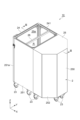
- FIG. 1 is a perspective view of a lymphatic system examination device according to one embodiment.
- FIG. 2 is a perspective view of the main body of the apparatus shown in FIG.
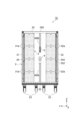
- FIG. 3 is a cross-sectional view of the device body taken along line III-III shown in FIG.
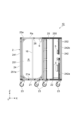
- FIG. 4 is a cross-sectional view of the device body taken along line IV-IV shown in FIG.
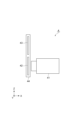
- FIG. 5 is a cross-sectional view of the device body taken along line VV shown in FIG.
- FIG. 6 is a cross-sectional view of the restricting portion shown in FIG.
- FIG. 7 is a cross-sectional view of the device body in which the second plate for brightness calibration is disposed.
- FIG. 8 is a diagram showing a visible light image of an object.
- FIG. 8 is a diagram showing a visible light image of an object.
- FIG. 9 is a diagram showing a display unit on which a plurality of types of fluorescent images of the object shown in FIG. 8 are displayed.
- FIG. 10 is a plan view of the device body of the modified example.
- FIG. 11 is a diagram showing the configuration of an image capturing unit according to an embodiment.
- FIG. 12 is a flowchart showing the process of generating filter correction data.
- FIG. 13 is a diagram for explaining the process of generating filter correction data.
- FIG. 14 is a diagram for explaining a specific example of the process of generating filter correction data.
- FIG. 15 is a flowchart showing the process of generating a fluorescent image of a subject.
- FIG. 16 is a diagram for explaining the process of generating a fluorescent image of a subject.
- FIG. 17 is a diagram for explaining a specific example of the process for generating a fluorescent image of a subject.
- FIG. 18 is a diagram showing the effect of the process of generating a fluorescent image of a subject.
- FIG. 19 is a diagram showing the configuration of an imaging unit according to a modified example.
- the lymphatic system examination device 1 shown in FIG. 1 is a device that performs an examination of the lymphatic system in the lower body of a subject S in order to diagnose lymphatic system diseases (e.g., lymphedema). More specifically, the lymphatic system examination device 1 is a device that obtains a fluorescent image of the lower body by irradiating excitation light onto the lower body of a subject S, whose lymphatic system has been injected with a fluorescent dye such as indocyanine green, and detecting fluorescence emitted from the lower body in response to the irradiation with the excitation light.
- the vertical direction is referred to as the Z direction
- the first horizontal direction is referred to as the X direction
- the second horizontal direction perpendicular to the first horizontal direction is referred to as the Y direction.
- the lymphatic system testing device 1 comprises a device main body 10, a control unit 11, a display unit 12, and an input unit 13.
- the control unit 11 is composed of a processing unit and a memory unit.
- the processing unit of the control unit 11 is a computer device composed of a processor, memory, storage, a communication device, etc., and processes various data by executing software (programs).
- the memory unit of the control unit 11 is a hard disk or the like, and stores various data.
- the display unit 12 is a display or the like, and displays various data to the operator.
- the input unit 13 is a mouse, keyboard, etc., and accepts input of various data from the operator.
- the device main body 10 includes a main body section 2.
- the main body section 2 includes a mounting section 21 and a support section 22.
- the mounting section 21 is the section on which the subject S stands
- the support section 22 is the section located on one side of the mounting section 21 in the X direction.
- the main body section 2 positions the lower body L of the subject S (i.e., the area from the lower abdomen to the toes) in the imaging area R on the mounting section 21.
- a number of casters 23 are attached to the underside of each of the mounting section 21 and the support section 22. This allows the device main body 10 to move smoothly.
- the main body 2 further includes a frame 24 and a wall 25.
- the frame 24 is composed of a first frame 241 and a second frame 242.
- the first frame 241 is attached to the placement portion 21, and the second frame 242 is attached to the support portion 22.
- the wall 25 is composed of a first wall 251 and a second wall 252.
- the first wall 251 is attached to the placement portion 21 via the first frame 241, and the second wall 252 is attached to the support portion 22 via the second frame 242.
- the unit composed of the support portion 22, the second frame 242, and the second wall 252 is detachable from the unit composed of the placement portion 21, the first frame 241, and the first wall 251.
- the width of each unit in the X direction and the width of each unit in the Y direction are 70 cm or less. This can improve the portability of each unit.
- the wall 25 forms a housing 250 on the mounting section 21 and the support section 22.
- the housing 250 defines an imaging area R on the mounting section 21.
- An opening 25a is formed in the housing 250 so as to face the mounting section 21 across the imaging area R.
- the waist of the subject S is located inside the opening 25a.
- the wall 25 forms an opening 25a inside which the subject S is positioned.
- the inner surface of the housing 250 is, for example, black. Note that in the first wall 251, a door is formed by the wall portion 251a on the opposite side to the second wall 252. This allows the subject S to get on and off the mounting section 21.
- the main body 2 further includes a restricting portion 26.
- the restricting portion 26 is disposed along the upper end portion Ra of the imaging region R.
- the restricting portion 26 restricts the movement of the subject S to one side (the support portion 22 side) in the X direction.
- the restricting portion 26 extends in the Y direction along the upper end portion Ra of the imaging region R, and is hung across the first frame 241 across the opening 25a.
- the restricting portion 26 is composed of a bar material 261 and a cushion material 262.
- the bar material 261 is a core material hung across the first frame 241.
- the cushion material 262 is an elastic material wrapped around the bar material 261.
- the device body 10 further includes an illumination unit 3, an imaging unit 4, and a distance sensor 5.
- the illumination unit 3, imaging unit 4, and distance sensor 5 are arranged on one side (the support unit 22 side) in the X direction with respect to the imaging region R.
- the housing 250 houses the illumination unit 3, imaging unit 4, and distance sensor 5 on the support unit 22.
- the illumination unit 3 irradiates the lower body L with excitation light.
- the illumination unit 3 has a first light-emitting region 31 and a second light-emitting region 32 arranged at a distance from each other in the Y direction.
- Each of the first light-emitting region 31 and the second light-emitting region 32 extends in the Z direction facing the imaging region R.
- the first light-emitting region 31 and the second light-emitting region 32 are arranged so that they move away from each other in the Y direction as they approach the imaging region R in the X direction.
- the first light-emitting region 31 includes a plurality of first light-emitting portions 31a
- the second light-emitting region 32 includes a plurality of second light-emitting portions 32a.
- the illumination unit 3 has a function of adjusting the light emission intensity of each first light-emitting portion 31a and the light emission intensity of each second light-emitting portion 32a.
- Each of the first light-emitting portion 31a and the second light-emitting portion 32a is composed of a plurality of LEDs that emit light having a center wavelength of, for example, 735 nm.
- the illumination unit 3 is attached to the second frame 242. In other words, the lighting unit 3 is supported by the support unit 22 via the second frame 242.
- the imaging unit 4 detects fluorescence emitted from the lower body L in response to irradiation with excitation light.
- the imaging unit 4 faces the imaging region R via the region between the first light-emitting region 31 and the second light-emitting region 32.
- the imaging unit 4 is disposed on one side in the X direction (the side opposite the imaging region R) of the illumination unit 3.
- the illumination unit 3 is located between the imaging region R and the imaging unit 4 in the X direction.
- the imaging unit 4 is located in the center of the imaging region R when viewed from the X direction.
- the imaging unit 4 is attached to a bar material 242a, which is a member of the second frame 242 that extends upward from the support unit 22 side.
- the imaging unit 4 is supported by the support unit 22 via the second frame 242.
- the imaging unit 4 is composed of a photodetector, a filter arranged in front of the photodetector, and a lens arranged in front of the filter.
- the photodetector uses an area sensor (e.g., CCD, CMOS, etc.) that is sensitive to fluorescence (e.g., light in the near-infrared region).
- the filter uses a deposition filter that selectively transmits fluorescence.
- the filter may include an absorption filter to remove the effects of oblique light.
- the lens uses a wide-angle lens so that the entire lower body L can be imaged.
- the distance sensor 5 measures the distance to the lower body L located in the imaging region R.
- the distance sensor 5 may be, for example, an ultrasonic distance sensor, or an optical distance sensor using a triangulation method or a ToF method.
- the distance sensor 5 faces the imaging region R through the region between the first light-emitting region 31 and the second light-emitting region 32.
- the distance sensor 5 is disposed on one side in the X direction (the opposite side to the imaging region R) with respect to the illumination unit 3. When viewed from the X direction, the distance sensor 5 is located at the center of the imaging region R in the Y direction.
- the distance sensor 5 is attached to the bar material 242b, which is a member of the second frame 242 that extends downward from the opposite side to the support unit 22.
- the distance sensor 5 is supported by the support unit 22 via the second frame 242.
- the light emission intensity of the illumination unit 3 may be adjusted based on the distance measured by the distance sensor 5 so that the intensity of the excitation light irradiated to the lower body L is uniform. Such adjustment of the light emission intensity of the illumination unit 3 may be performed based on the intensity of the excitation light detected by a separately provided photodetector.
- the device body 10 includes a camera 6.
- the camera 6 is attached to the first frame 241 so as to face the placement section 21 and not to be in the field of view of the imaging section 4.
- the housing 250 accommodates the camera 6 on the placement section 21.
- the space inside the housing 250 is made into a darkroom by a cover 7 that covers the opening 25a when the camera 6 is worn by the subject S.
- the camera 6 captures an image of the feet of the subject S in the space inside the housing 250, which is made into a darkroom, and therefore may be composed of a lighting device and an imaging device, or may be composed only of an imaging device such as an infrared camera.
- the image acquired by the camera 6 is displayed on the display section 12 and shown to the subject S.
- the camera 6 may be attached to the restriction section 26 or the second frame 242. When the camera 6 is composed of a lighting device and an imaging device, the lighting device may be separated from the imaging device.
- the mounting section 21 is provided with a positioning section 8 that indicates the position where the subject S is standing.
- the positioning section 8 includes a foot impression 81 when the subject S is facing the imaging section 4, and a foot impression 82 when the subject S is facing away from the imaging section 4.
- Each of the foot impressions 81, 82 is a mark formed on the mounting surface 21a of the mounting section 21.
- the positioning section 8 is imaged by the camera 6.
- the first plate 14 is a plate for brightness calibration.
- the first plate 14 is made of multiple types of members (e.g., cloth and acrylic plate) that emit different intensities of fluorescence in response to irradiation with excitation light.
- the scale 15 is a member having graduations indicating length.
- the second plate 16 is detachable from the main body portion 2.
- the second plate 16 is arranged on the main body portion 2 so as to be located in the imaging region R while contacting the regulating portion 26 from the side opposite the imaging portion 4.
- the second plate 16 is a plate for brightness calibration, and is, for example, an acrylic plate.
- the control unit 11 is electrically connected to each of the illumination unit 3, the imaging unit 4, the distance sensor 5, the camera 6, the display unit 12, and the input unit 13.
- the control unit 11 controls the illumination unit 3 to emit the excitation light as a flash in accordance with the imaging timing of the imaging unit 4. This makes it possible to suppress changes in the amount of excitation light irradiated on the lower body L when the lower body L is imaged.
- the control unit 11 generates a fluorescent image of the lower body L based on the fluorescence detected by the imaging unit 4, and controls the display unit 12 to display the fluorescent image of the lower body L.
- the control unit 11 stores fluorescent images of the lower body L previously generated for the subject S, and is capable of controlling the display unit 12 so that the previously generated fluorescent image of the lower body L and the newly generated fluorescent image of the lower body L are displayed side by side.
- the control unit 11 is also capable of controlling the display unit 12 so that the visible light image of the lower body L and the fluorescent image of the lower body L are displayed side by side.
- the control unit 11 can control the display unit 12 so that a portion of at least one image (visible light image, fluorescent image) of the lower body L is enlarged based on instructions input to the control unit 11 via the input unit 13.
- control unit 11 controls at least one of the illumination unit 3 and the image capture unit 4 so that at least one of the light emission time of the illumination unit 3 and the exposure time of the image capture unit 4 is changed, thereby generating multiple types of fluorescent images as fluorescent images of the lower body L, and controls the display unit 12 so that the multiple types of fluorescent images are displayed side by side.
- the lymphatic system examination device 1 implements a lymphatic system examination method that includes the steps of generating multiple types of fluorescent images as fluorescent images of the lower body L by controlling at least one of the illumination unit 3 and the image capture unit 4 so that at least one of the light emission time of the illumination unit 3 and the exposure time of the image capture unit 4 is changed (i.e., so that the amount of exposure in the image capture unit 4 is changed), and controlling the display unit 12 so that the multiple types of fluorescent images are displayed side by side.
- the control unit 11 In this lymphatic system examination method, the control unit 11 generates each of the multiple types of fluorescent images in a time of 1 second or less (i.e., 1 second or less after an image capture command is input to the control unit 11 via the input unit 13).
- the exposure amount in the image capture unit 4 may be changed by changing at least one of the light emission time of the illumination unit 3, the light emission intensity of the illumination unit 3, the exposure time of the image capture unit 4, the sensor gain of the image capture unit 4, and the lens aperture of the image capture unit 4.
- FIG. 8 is a diagram showing a visible light image of an object
- FIG. 9 is a diagram showing the display unit 12 on which multiple types of fluorescent images I of the object shown in FIG. 8 are displayed.
- the object shown in FIG. 8 is an arm model with a fluorescent material extending in the vertical direction attached thereto, wrapped in blank paper.
- the blank paper covers the fluorescent material in a single layer, double layer, and triple layer from the top.
- the multiple types of fluorescent images I shown in FIG. 9 are images generated when the light emission time of the illumination unit 3 and the exposure time of the imaging unit 4 are set to 1000 ms, 500 ms, 250 ms, 125 ms, and 62.5 ms.
- the fluorescent material In the single layer of blank paper, when the light emission time of the illumination unit 3 and the exposure time of the imaging unit 4 are 500 ms or more, the fluorescent material is observed to be much thicker than the actual fluorescent material due to scattering of the fluorescent material. In the double layer of blank paper, when the light emission time of the illumination unit 3 and the exposure time of the imaging unit 4 are 125 ms or more, the fluorescent material can be seen. In the triple white paper area, the fluorescent material is visible when the light emission time of the illumination unit 3 and the exposure time of the imaging unit 4 are 500 ms or more. From the above, it can be seen that the state of the lymphatic system in the lower body L can be appropriately grasped by adjusting at least one of the light emission time of the illumination unit 3 and the exposure time of the imaging unit 4.
- the first light-emitting region 31 and the second light-emitting region 32 of the illumination unit 3 each extend in the Z direction facing the imaging region R, and the imaging unit 4 faces the imaging region R via the region between the first light-emitting region 31 and the second light-emitting region 32.
- This allows excitation light to be uniformly irradiated onto the lower body L of the subject S located in the imaging region R, and fluorescence emitted from the lower body L in response to the uniform irradiation of excitation light can be detected. Therefore, with the lymphatic system examination device 1, a fluorescent image of the lower body L suitable for examining the lymphatic system in the lower body L of the subject S can be obtained.
- the imaging unit 4 when viewed from the X direction, the imaging unit 4 is located at the center of the imaging region R. This makes it possible to prevent distortion of the acquired fluorescent image.
- the illumination unit 3 is located between the imaging region R and the imaging unit 4 in the X direction. This allows the excitation light to be more uniformly irradiated onto the lower body L of the subject S located in the imaging region R.
- the illumination unit 3 has a function of adjusting the light emission intensity of each first light-emitting portion 31a and the light emission intensity of each second light-emitting portion 32a. This allows the excitation light to be uniformly irradiated onto the lower body L of the subject S located in the imaging region R according to the shape of the lower body L, etc.
- the first light-emitting region 31 and the second light-emitting region 32 are arranged so that they move away from each other in the Y direction as they approach the imaging region R in the X direction. This allows the excitation light to be more uniformly irradiated onto the lower body L of the subject S located in the imaging region R.
- the illumination unit 3 and the imaging unit 4 are arranged on one side in the X direction with respect to the imaging region R in which the lower body L of the subject S is located, and the movement of the subject S to one side in the X direction is restricted by a restricting unit 26 arranged along the upper end portion Ra of the imaging region R.
- a restricting unit 26 arranged along the upper end portion Ra of the imaging region R.
- the restriction section 26 extends in the Y direction, and the first plate 14 for brightness calibration is disposed on the surface 26a of the restriction section 26 on the imaging section 4 side. This makes it possible to adjust the brightness of the fluorescent image for each acquired fluorescent image.
- the restriction section 26 extends in the Y direction, and the scale 15 is disposed on the surface 26a of the restriction section 26 on the imaging section 4 side. This makes it possible to grasp the size of each part of the lower body L from the acquired fluorescent image.
- the second plate 16 for brightness calibration is placed on the main body 2 so that it is located in the imaging region R while in contact with the restricting portion 26 from the side opposite the imaging portion 4. This allows the brightness of the fluorescent image to be adjusted for each lymphatic system examination device 1.
- a distance sensor 5 is placed on one side in the X direction relative to the imaging area R. This makes it possible to accurately grasp the position of the lower body L of the subject S in the X direction.
- the lymphatic system examination device 1 (and the lymphatic system examination method described above), at least one of the light emission time of the illumination unit 3 and the exposure time of the imaging unit 4 is changed, so that multiple types of fluorescent images are generated as fluorescent images of the lower body L of the subject S, and the multiple types of fluorescent images are displayed side by side.
- the intensity of the fluorescence changes depending on the state of the lymphatic system in the lower body L
- the state of the lymphatic system in the lower body L can be appropriately grasped from the multiple types of fluorescent images generated and displayed as described above. Therefore, according to the lymphatic system examination device 1 (and the lymphatic system examination method described above), an examination of the lymphatic system in the lower body L of the subject S can be appropriately performed.
- control unit 11 In the lymphatic system examination device 1, the control unit 11 generates each of the multiple types of fluorescent images in less than one second. This makes it possible to obtain multiple types of fluorescent images while suppressing blurring of the lower body L of the subject S.
- control unit 11 controls the illumination unit 3 to emit the excitation light as a flash. This makes it possible to obtain multiple types of fluorescent images while suppressing changes in the amount of excitation light irradiated onto the lower body L of the subject S.
- control unit 11 stores fluorescent images of the lower body L previously generated for the subject S, and controls the display unit 12 so that previously generated fluorescent images of the lower body L and newly generated fluorescent images of the lower body L are displayed side by side. This makes it possible to appropriately grasp changes over time in the state of the lymphatic system in the lower body L of the subject S.
- the placement section 21 on which the subject S stands is provided with a positioning section 8 that indicates the position at which the subject S stands.
- a positioning section 8 that indicates the position at which the subject S stands.
- the positioning unit 8 includes a foot impression 81 when the subject S faces the imaging unit 4, and a foot impression 82 when the subject S faces the opposite side of the imaging unit 4. This makes it possible to align the orientation of both feet of the subject S relative to the illumination unit 3 and the imaging unit 4 to a predetermined orientation when the subject S faces the imaging unit 4 and when the subject S faces the opposite side of the imaging unit 4.
- the wall 25 constitutes a housing 250 that defines the imaging region R and houses the illumination unit 3 and imaging unit 4, and an opening 25a inside which the subject S is placed is formed in the wall 25. This makes it possible to obtain a fluorescent image of the lower body L of the subject S while suppressing the effects of ambient light.
- the cover 7 worn by the subject S covers the opening 25a. This makes it possible to obtain a fluorescent image of the lower body L of the subject S while more reliably suppressing the effects of ambient light.
- the support section 22 and the second wall section 252 are detachable from the mounting section 21 and the first wall section 251. This improves the portability of the lymphatic system inspection device 1.
- the camera 6 captures an image of the positioning unit 8. This allows the subject S to align his/her standing position with the positioning unit 8 while visually checking the image captured by the camera 6, even when it is difficult for the subject S to directly view the positioning unit 8.
- lymphatic system examination method implemented in lymphatic system examination device 1
- fluorescent image of subject S the fluorescent image of the lower body L of subject S
- excitation light image of subject S the excitation light image of subject S
- the imaging unit 4 used in the correction process includes a camera 41, a light-transmitting member 42, a filter 43, and a holding member 44.
- the camera 41 is sensitive to the excitation light emitted from the illumination unit 3 (hereinafter simply referred to as "excitation light") and the fluorescence emitted from the lower body L (hereinafter simply referred to as "fluorescence").
- the camera 41 uses an area sensor such as a CCD or CMOS.
- the light-transmitting member 42 transmits the excitation light and the fluorescence.
- the light-transmitting member 42 is, for example, a glass plate.
- the filter 43 cuts out the excitation light and selectively transmits the fluorescence.
- the filter 43 is, for example, a long-pass filter or a band-pass filter.
- the holding member 44 holds the light-transmitting member 42 and the filter 43.
- the holding member 44 positions the light-transmitting member 42 or the filter 43 in front of the camera 41 (on the imaging region R side).
- the holding member 44 is, for example, a wheel that rotates about an axis parallel to the X direction as its center line, or a slider that reciprocates along a predetermined direction perpendicular to the X direction.
- the control unit 11 controls the holding member 44 so that the light-transmitting member 42 or the filter 43 is positioned in front of the camera 41.
- the light-transmitting member 42 has a thickness such that the optical path length of the excitation light passing through the light-transmitting member 42 and entering the camera 41 approaches the optical path length of the fluorescence passing through the filter 43 and entering the camera 41 (ideally, a thickness such that the difference between these optical path lengths is zero).
- the imaging unit 4 does not have to include the light-transmitting member 42.
- a wide-angle lens is arranged in front of the light-transmitting member 42 or filter 43 arranged in front of the camera 41 so that the entire lower body L can be imaged.
- the wide-angle lens may be provided in the camera 41 and arranged between the light-transmitting member 42 or filter 43 arranged in front of the camera 41 and the area sensor of the camera 41.
- the control unit 11 performs a "filter correction data generation process” and a "fluorescence image generation process of subject S” as a correction process of the fluorescence image of subject S based on the excitation light image of subject S.
- the "filter correction data generation process” is performed at the timing of calibration of the lymphatic system inspection device 1.
- the "fluorescence image generation process of subject S” is performed at the timing of acquiring the fluorescence image of subject S.
- the second plate (a plate for brightness calibration) 16 is placed in the main body 2 so as to be located in the imaging region R while contacting the restriction portion 26 from the side opposite to the imaging unit 4 (see Figure 7). With the second plate located in the imaging region R, the light-transmitting member 42 is placed in front of the camera 41 in the imaging unit 4 (see Figure 11). Then, the illumination unit 3 irradiates the second plate 16 with excitation light, and the imaging unit 4 acquires an excitation light image 101 of the second plate 16 (S01).
- the excitation light image 101 is an image of the second plate 16 by the excitation light (excitation light reflected by the second plate 16, which passes through the light-transmitting member 42 and enters the camera 41). Note that the fluorescence emitted from the second plate 16 in response to the irradiation of the excitation light also passes through the light transmitting member 42 and enters the camera 41 together with the excitation light. However, since the intensity of the fluorescence is much lower than the intensity of the excitation light, the effect of the fluorescence can be substantially ignored in the excitation light image 101.
- the control unit 11 generates excitation light correction data 102 based on the excitation light image 101 of the second plate 16 (S02).
- the excitation light correction data 102 is data for correcting (uniformizing) the "unevenness of the excitation light image of the second plate 16" caused by the "non-uniformity of the irradiation intensity of the excitation light on the second plate 16" in the excitation light image 101, and is data for uniformizing the brightness value of each pixel constituting the excitation light image of the second plate 16.
- the fluorescence image 103 is an image of the second plate 16 based on fluorescence (fluorescence emitted from the second plate 16 in response to irradiation with the excitation light, which passes through the filter 43 and enters the camera 41).
- the control unit 11 corrects the fluorescence image 103 of the second plate 16 based on the excitation light correction data 102 to generate a corrected fluorescence image 104 of the second plate 16 (S04).
- the control unit 11 generates filter correction data 105 based on the corrected fluorescence image 104 of the second plate 16 (S05).
- the filter correction data 105 is data for correcting (uniformizing) the "unevenness of the fluorescent image of the second plate 16" in the fluorescent image 104, which is caused by the "angle dependency of the transmission wavelength in the filter 43," and is data for uniformizing the luminance value of each pixel constituting the fluorescent image of the second plate 16.
- the control unit 11 stores the generated filter correction data 105.
- an excitation light image 101V is acquired as the excitation light image 101 of the second plate 16
- a fluorescence image 103V is acquired as the fluorescence image 103 of the second plate 16.
- Each of the excitation light image 101V and the fluorescence image 103V is composed of a plurality of pixels arranged in a matrix.
- the numerical value written for each pixel indicates the brightness value.
- excitation light correction data 102D is generated as the excitation light correction data 102 based on the excitation light image 101V.
- the excitation light correction data 102D is composed of a plurality of coefficients. Each coefficient of the excitation light correction data 102D corresponds to each pixel of the excitation light image 101V.
- the coefficient corresponding to a certain pixel is the maximum value of the luminance values of all pixels ("200" in this specific example) divided by the luminance value of that pixel.
- a pixel having a luminance value less than a predetermined threshold value (“30" in this specific example) is considered to be a pixel that constitutes the background of the second plate 16, and the coefficient corresponding to that pixel is set to "1".
- the fluorescence image 103V is corrected based on the excitation light correction data 102D to generate the fluorescence image 104V as the fluorescence image 104 of the second plate 16.
- the fluorescence image 104V is generated by multiplying each pixel of the fluorescence image 103V by each coefficient of the excitation light correction data 102D.
- filter correction data 105D is generated as filter correction data 105 based on the fluorescence image 104V.
- the filter correction data 105D is composed of multiple coefficients.
- Each coefficient of the filter correction data 105 corresponds to each pixel of the fluorescence image 104V.
- the coefficient corresponding to a certain pixel is the maximum value of the luminance values of all pixels ("188" in this specific example) divided by the luminance value of the pixel.
- a pixel having a luminance value less than a predetermined threshold value (“30" in this specific example) is considered to be a pixel that constitutes the background of the second plate 16, and the coefficient corresponding to the pixel is set to "1".
- the luminance value used as a reference when generating each of the excitation light correction data 102D and the filter correction data 105D is not limited to the maximum luminance value of all pixels, and may be the top n% value of the luminance value distribution, the average luminance value, etc., in order to eliminate spike noise. Furthermore, in order to remove local coefficient fluctuations in each of the excitation light correction data 102D and the filter correction data 105D, a two-dimensional filter such as a smoothing filter or a Gaussian filter may be applied when calculating each of the excitation light correction data 102D and the filter correction data 105D.
- subject S stands on the placement section 21 so that the lower body L is located in the imaging region R (see Figure 3). With the lower body L located in the imaging region R, the light-transmitting member 42 is placed in front of the camera 41 in the imaging section 4 (see Figure 11). Then, the illumination section 3 irradiates the lower body L of subject S with excitation light, and the imaging section 4 acquires an excitation light image 201 of subject S (step of acquiring an excitation light image of the lower body, S11).
- the excitation light image 201 is an image of the lower body L using excitation light (excitation light reflected by the lower body L of subject S, which passes through the light-transmitting member 42 and enters the camera 41). Note that the fluorescence emitted from the lower body L of the subject S in response to the irradiation of the excitation light also passes through the light transmitting member 42 and enters the camera 41 together with the excitation light. However, since the intensity of the fluorescence is much lower than the intensity of the excitation light, the effect of the fluorescence can be substantially ignored in the excitation light image 201.
- the control unit 11 generates excitation light correction data 202 based on the excitation light image 201 of the subject S (S12).
- the excitation light correction data 202 is data for correcting (uniformizing) the "unevenness of the excitation light image of the lower body L" caused by the "non-uniformity of the irradiation intensity of the excitation light on the lower body L" in the excitation light image 201, and is data for uniformizing the brightness value of each pixel constituting the excitation light image of the lower body L.
- the filter 43 is placed in front of the camera 41 in the imaging unit 4 (see FIG. 11). Then, the illumination unit 3 irradiates the lower body L of the subject S with excitation light, and the imaging unit 4 acquires a fluorescent image 203 of the subject S (step of acquiring a fluorescent image of the lower body, S13).
- the fluorescent image 203 is an image of the lower body L by fluorescence (fluorescence emitted from the lower body L of the subject S in response to irradiation with the excitation light, which has passed through the filter 43 and entered the camera 41).
- control unit 11 corrects the fluorescent image 203 of the subject S based on the excitation light correction data 202 to generate a corrected fluorescent image 204 of the subject S (step of correcting the fluorescent image of the lower body, S14).
- control unit 11 corrects the fluorescent image 204 of the subject S based on the filter correction data 105 stored in advance to generate a further corrected fluorescent image 205 of the subject S (S15).
- correction based on either the excitation light correction data 202 or the filter correction data 105 may be performed first, or correction based on both data may be performed simultaneously.
- the control unit 11 corrects the contour of the fluorescent image of the lower body L in the fluorescent image 205 of the subject S (S16) and generates a fluorescent image of the subject S (S17).
- the control unit 11 causes the display unit 12 to display the generated fluorescent image of the subject S.
- the control unit 11 generates multiple images arranged in chronological order as the fluorescent image of the subject S, and controls the display unit 12 so that the multiple images are displayed consecutively.
- the reason for correcting the contour of the fluorescent image of the lower body L in the fluorescent image 205 of the subject S is that the contour of the fluorescent image of the lower body L may be emphasized by the correction based on the excitation light correction data 202.
- a blurring filter for example, is used to correct the contour.
- an excitation light image 201V is acquired as the excitation light image 201 of subject S
- a fluorescence image 203V is acquired as the fluorescence image 203 of subject S.
- Each of the excitation light image 201V and the fluorescence image 203V is composed of a plurality of pixels arranged in a matrix.
- the numerical value written for each pixel indicates the brightness value.
- excitation light correction data 202D is generated as the excitation light correction data 202 based on the excitation light image 201V.
- the excitation light correction data 202D is composed of a plurality of coefficients. Each coefficient of the excitation light correction data 202D corresponds to each pixel of the excitation light image 201V.
- the coefficient corresponding to a certain pixel is the maximum value of the luminance values of all pixels ("215" in this specific example) divided by the luminance value of that pixel.
- a pixel having a luminance value less than a predetermined threshold value (“30" in this specific example) is considered to be a pixel that constitutes the background of the lower body L, and the coefficient corresponding to that pixel is set to "1".
- the fluorescence image 204 of the subject S is generated by correcting the fluorescence image 203V based on the excitation light correction data 202D.
- the fluorescence image 204V is generated by multiplying each pixel of the fluorescence image 203V by each coefficient of the excitation light correction data 202D.
- the fluorescence image 205 of the subject S is generated by correcting the fluorescence image 204V based on the filter correction data 105D shown in FIG. 14.
- the fluorescence image 205V is generated by multiplying each pixel of the fluorescence image 204V by each coefficient of the filter correction data 105D.
- the luminance value used as a reference when generating the excitation light correction data 202D is not limited to the maximum luminance value of all pixels, and may be the top n% value of the luminance value distribution, the average luminance value, etc., in order to eliminate spike noise. Furthermore, in order to remove local coefficient fluctuations in the excitation light correction data 202D, a two-dimensional filter such as a smoothing filter or a Gaussian filter may be applied when calculating the excitation light correction data 202D.
- the lymphatic system examination device 1 (lymphatic system examination method performed in the lymphatic system examination device 1)
- an excitation light image 201 of the subject S and a fluorescence image 203 of the subject S are acquired, excitation light correction data 202 is generated based on the excitation light image 201 of the subject S, and the fluorescence image 203 of the subject S is corrected based on the excitation light correction data 202.
- an excitation light image 101 of the second plate 16 and a fluorescence image 103 of the second plate 16 are acquired, filter correction data 105 is generated based on the excitation light image 101 of the second plate 16 and the fluorescence image 103 of the second plate 16, and a fluorescence image 203 of the subject S is corrected based on the excitation light correction data 202 and the filter correction data 105.
- the contour of the fluorescent image of the lower body L is corrected in the fluorescent image 205 of the subject S. This makes it possible to prevent the contour of the fluorescent image of the lower body L from being emphasized by the correction based on the excitation light correction data 202.
- lymphatic system examination device 1 multiple images arranged in chronological order are generated as corrected fluorescent images of the subject S, and the multiple images are displayed continuously on the display unit 12. This allows the fluorescent images of the lower body L to be grasped continuously in chronological order.
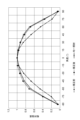
- FIG 18 is a diagram showing the effect of the process of generating a fluorescent image of a subject.
- a capillary tube with an inner diameter of 0.4 mm filled with indocyanine green (hereinafter simply referred to as a "capillary tube”) was prepared as the imaging subject.
- the capillary tube was placed so as to extend in the Z direction at each angle position on a cylindrical surface having a "center line passing through the center of the imaging region R and extending in the Z direction", and an excitation light image of the capillary tube and a fluorescent image of the capillary tube were obtained.
- 0° is the position in front of the imaging unit 4
- a positive angle is the position on the right side as viewed from the imaging unit 4 side
- a negative angle is the position on the left side as viewed from the imaging unit 4 side.
- the result “before correction” is the relative intensity of the luminance value of the fluorescent image of the capillary tube when the fluorescent image of the capillary tube is not corrected.
- the result “after correction” is the relative intensity of the luminance value of the fluorescent image of the capillary tube when excitation light correction data is generated based on the excitation light image of the capillary tube and the fluorescent image of the capillary tube is corrected based on the excitation light correction data.
- the result of "uniform illumination” is the result obtained under conditions in which the excitation light panel is placed in a front position with respect to each angle position without using only the illumination unit 3 in the lymphatic system examination device 1 described above, and is the relative intensity of the luminance value of the fluorescent image of the capillary tube when the fluorescent image of the capillary tube obtained under these conditions is not corrected. As shown in FIG. 18, the result “after correction” is closer to the result of "uniform illumination” than the result "before correction".
- the imaging unit 4 used in the above-mentioned correction process may be configured as shown in (a) and (b) of FIG. 19.
- the imaging unit 4 shown in FIG. 19(a) includes a first camera 41A, a second camera 41B, a filter 43, and a dichroic mirror 45.
- the first camera 41A is sensitive to excitation light.
- the second camera 41B is sensitive to fluorescence.
- the dichroic mirror 45 guides the excitation light to the first camera 41A and the fluorescence to the second camera 41B.
- the filter 43 selectively transmits the fluorescence between the dichroic mirror 45 and the second camera 41B. Note that the same camera sensitive to the excitation light and fluorescence may be used as each of the first camera 41A and the second camera 41B.
- dichroic mirror 45 instead of the dichroic mirror 45, other optical elements (e.g., a prism, a half mirror, etc.) that guide the excitation light to the first camera 41A and the fluorescence to the second camera 41B may be used.
- a light-transmitting member 42 that transmits the excitation light may be disposed between the dichroic mirror 45 and the first camera 41A.
- the imaging unit 4 shown in FIG. 19(b) includes a first camera 41A, a second camera 41B, and a filter 43.
- the first camera 41A is sensitive to excitation light.
- the second camera 41B is sensitive to fluorescence.
- the first camera 41A and the second camera 41B are arranged side by side facing the imaging region R.
- the filter 43 selectively transmits fluorescence in front of the second camera 41B.
- the same camera sensitive to excitation light and fluorescence may be used as each of the first camera 41A and the second camera 41B.
- a light-transmitting member 42 that transmits excitation light may be arranged in front of the first camera 41A.
- the imaging unit 4 shown in (a) and (b) of Figure 19 makes it possible to simultaneously acquire an excitation light image 201 of the subject S and a fluorescence image 203 of the subject S. Therefore, it is possible to generate excitation light correction data 202 based on the excitation light image 201 while correcting the fluorescence image 203 based on the excitation light correction data 202. This is particularly effective in cases where multiple images arranged in chronological order are generated as corrected fluorescence images of the subject S and the multiple images are displayed continuously on the display unit 12.
- the surface 26b of the regulating unit 26 opposite the imaging unit 4 may be a curved surface that curves to fit the lower abdomen of the subject S (i.e., concave toward the imaging unit 4).
- the positioning unit 8 may be a concave or convex portion provided on the placement surface 21a to fit the foot impression of the subject S.
- at least one of the illumination unit 3, the imaging unit 4, the distance sensor 5, the camera 6, and the regulating unit 26 may be attached to the frame 24 so as to enable at least one of position adjustment and angle adjustment.
- 1...lymphatic system testing device 2...main body, 3...illumination unit, 4...imaging unit, 5...distance sensor, 6...camera, 7...cover, 8...positioning unit, 11...control unit, 12...display unit, 14...first plate, 15...scale, 16...second plate, 21...mounting unit, 22...support unit, 25...wall unit, 25a...opening, 26...regulating unit, 26a...surface, 31...first light-emitting area, 31a...first light-emitting portion, 32...second light-emitting area, 32a...second light-emitting portion, 81, 82...footprint, 250...housing, 251...first wall unit, 252...second wall unit, L...lower body, R...imaging area, Ra...upper end, S...subject.
Landscapes
- Health & Medical Sciences (AREA)
- Life Sciences & Earth Sciences (AREA)
- Pathology (AREA)
- General Health & Medical Sciences (AREA)
- Physics & Mathematics (AREA)
- Surgery (AREA)
- Public Health (AREA)
- Engineering & Computer Science (AREA)
- Biomedical Technology (AREA)
- Heart & Thoracic Surgery (AREA)
- Medical Informatics (AREA)
- Molecular Biology (AREA)
- Veterinary Medicine (AREA)
- Animal Behavior & Ethology (AREA)
- Biophysics (AREA)
- Immunology (AREA)
- Vascular Medicine (AREA)
- Nuclear Medicine, Radiotherapy & Molecular Imaging (AREA)
- Chemical & Material Sciences (AREA)
- Analytical Chemistry (AREA)
- Biochemistry (AREA)
- General Physics & Mathematics (AREA)
- Physical Education & Sports Medicine (AREA)
- Investigating, Analyzing Materials By Fluorescence Or Luminescence (AREA)
Priority Applications (4)
| Application Number | Priority Date | Filing Date | Title |
|---|---|---|---|
| KR1020257017935A KR20250107204A (ko) | 2022-11-04 | 2023-06-07 | 림프계 검사 장치 |
| EP23885293.3A EP4603028A4 (en) | 2022-11-04 | 2023-06-07 | LYMPHATIC SYSTEM INSPECTION DEVICE |
| CN202380076458.2A CN120152667A (zh) | 2022-11-04 | 2023-06-07 | 淋巴系统检查装置 |
| JP2024554108A JPWO2024095519A1 (https=) | 2022-11-04 | 2023-06-07 |
Applications Claiming Priority (2)
| Application Number | Priority Date | Filing Date | Title |
|---|---|---|---|
| JP2022-177496 | 2022-11-04 | ||
| JP2022177496 | 2022-11-04 |
Publications (1)
| Publication Number | Publication Date |
|---|---|
| WO2024095519A1 true WO2024095519A1 (ja) | 2024-05-10 |
Family
ID=90930094
Family Applications (1)
| Application Number | Title | Priority Date | Filing Date |
|---|---|---|---|
| PCT/JP2023/021080 Ceased WO2024095519A1 (ja) | 2022-11-04 | 2023-06-07 | リンパ系検査装置 |
Country Status (6)
| Country | Link |
|---|---|
| EP (1) | EP4603028A4 (https=) |
| JP (1) | JPWO2024095519A1 (https=) |
| KR (1) | KR20250107204A (https=) |
| CN (1) | CN120152667A (https=) |
| TW (1) | TW202419061A (https=) |
| WO (1) | WO2024095519A1 (https=) |
Citations (8)
| Publication number | Priority date | Publication date | Assignee | Title |
|---|---|---|---|---|
| JP2004349959A (ja) * | 2003-02-03 | 2004-12-09 | Omron Corp | 写真撮影装置、プリントシート、写真撮影装置の制御方法、写真撮影装置の制御プログラム、これを記録したコンピュータ読み取り可能な記録媒体 |
| JP2005237973A (ja) * | 2004-02-28 | 2005-09-08 | Trumpf Kreuzer Medizin Systeme Gmbh & Co Kg | 手術用ランプ |
| JP2008232913A (ja) * | 2007-03-22 | 2008-10-02 | Shimadzu Corp | 診断装置 |
| WO2015004810A1 (ja) * | 2013-07-12 | 2015-01-15 | 浜松ホトニクス株式会社 | 撮像装置及び撮像装置の製造方法 |
| JP2015161581A (ja) * | 2014-02-27 | 2015-09-07 | 富士フイルム株式会社 | 蛍光撮影装置及び蛍光撮影装置用の光源ユニット |
| JP2016531700A (ja) * | 2013-08-28 | 2016-10-13 | ビューワークス カンパニー リミテッド | 生体組織診断装置及び方法 |
| JP2019118803A (ja) | 2018-01-04 | 2019-07-22 | 国立大学法人 岡山大学 | リンパ系の機能を評価する方法 |
| JP2020511191A (ja) * | 2017-02-10 | 2020-04-16 | ノバダック テクノロジーズ ユーエルシー | オープンフィールドハンドヘルド蛍光イメージングシステムおよび方法 |
Family Cites Families (2)
| Publication number | Priority date | Publication date | Assignee | Title |
|---|---|---|---|---|
| GB2361430A (en) * | 2000-04-17 | 2001-10-24 | Photo Therapeutics Ltd | Therapeutic discharge lamps |
| US11246948B2 (en) * | 2018-01-04 | 2022-02-15 | National University Corporation Okayama University | Method of evaluating lymphatic system function |
-
2023
- 2023-06-07 JP JP2024554108A patent/JPWO2024095519A1/ja active Pending
- 2023-06-07 CN CN202380076458.2A patent/CN120152667A/zh active Pending
- 2023-06-07 KR KR1020257017935A patent/KR20250107204A/ko active Pending
- 2023-06-07 WO PCT/JP2023/021080 patent/WO2024095519A1/ja not_active Ceased
- 2023-06-07 EP EP23885293.3A patent/EP4603028A4/en active Pending
- 2023-06-07 TW TW112121244A patent/TW202419061A/zh unknown
Patent Citations (8)
| Publication number | Priority date | Publication date | Assignee | Title |
|---|---|---|---|---|
| JP2004349959A (ja) * | 2003-02-03 | 2004-12-09 | Omron Corp | 写真撮影装置、プリントシート、写真撮影装置の制御方法、写真撮影装置の制御プログラム、これを記録したコンピュータ読み取り可能な記録媒体 |
| JP2005237973A (ja) * | 2004-02-28 | 2005-09-08 | Trumpf Kreuzer Medizin Systeme Gmbh & Co Kg | 手術用ランプ |
| JP2008232913A (ja) * | 2007-03-22 | 2008-10-02 | Shimadzu Corp | 診断装置 |
| WO2015004810A1 (ja) * | 2013-07-12 | 2015-01-15 | 浜松ホトニクス株式会社 | 撮像装置及び撮像装置の製造方法 |
| JP2016531700A (ja) * | 2013-08-28 | 2016-10-13 | ビューワークス カンパニー リミテッド | 生体組織診断装置及び方法 |
| JP2015161581A (ja) * | 2014-02-27 | 2015-09-07 | 富士フイルム株式会社 | 蛍光撮影装置及び蛍光撮影装置用の光源ユニット |
| JP2020511191A (ja) * | 2017-02-10 | 2020-04-16 | ノバダック テクノロジーズ ユーエルシー | オープンフィールドハンドヘルド蛍光イメージングシステムおよび方法 |
| JP2019118803A (ja) | 2018-01-04 | 2019-07-22 | 国立大学法人 岡山大学 | リンパ系の機能を評価する方法 |
Non-Patent Citations (1)
| Title |
|---|
| See also references of EP4603028A4 |
Also Published As
| Publication number | Publication date |
|---|---|
| EP4603028A4 (en) | 2026-03-25 |
| JPWO2024095519A1 (https=) | 2024-05-10 |
| EP4603028A1 (en) | 2025-08-20 |
| TW202419061A (zh) | 2024-05-16 |
| KR20250107204A (ko) | 2025-07-11 |
| CN120152667A (zh) | 2025-06-13 |
Similar Documents
| Publication | Publication Date | Title |
|---|---|---|
| US10244981B2 (en) | Skin test image analysis apparatuses and methods thereof | |
| WO2006062895A2 (en) | Systems and methods for in-vivo optical imaging and measurement | |
| CN106264476B (zh) | 舌象检测设备 | |
| CN101152088B (zh) | 无创生物测定装置及无创生物测定方法 | |
| KR101284349B1 (ko) | 검안기 및 검안방법 | |
| US20250352056A1 (en) | Ophthalmic apparatus and ophthalmic information processing apparatus | |
| WO2024095519A1 (ja) | リンパ系検査装置 | |
| KR101984849B1 (ko) | 다중-노출 레이저 스펙클 영상 수집 장치 및 이의 보정 방법 | |
| KR102351785B1 (ko) | 조직의 기능적 영상 획득 장치 및 이의 생성 방법 | |
| JP7812773B2 (ja) | リンパ系検査装置 | |
| JP7817139B2 (ja) | リンパ系検査装置 | |
| JP7433400B1 (ja) | リンパ系検査装置及びリンパ系検査方法 | |
| JP6127731B2 (ja) | 眼底カメラ及び画像処理プログラム | |
| KR20230118215A (ko) | 결함 검사 장치 및 결함 검사 방법 | |
| KR102429455B1 (ko) | 다방향 광 조사 구조를 갖는 안면 피부 진단 장치 | |
| JP2021000177A (ja) | 眼科装置 | |
| JP2007278931A (ja) | 画像評価装置および画像評価方法 | |
| KR20160065342A (ko) | 소동물용 형광 영상화 장치 및 방법 | |
| KR20150143986A (ko) | 피부 검사 장치 및 방법 |
Legal Events
| Date | Code | Title | Description |
|---|---|---|---|
| 121 | Ep: the epo has been informed by wipo that ep was designated in this application |
Ref document number: 23885293 Country of ref document: EP Kind code of ref document: A1 |
|
| WWE | Wipo information: entry into national phase |
Ref document number: 2024554108 Country of ref document: JP |
|
| WWE | Wipo information: entry into national phase |
Ref document number: 202380076458.2 Country of ref document: CN |
|
| WWE | Wipo information: entry into national phase |
Ref document number: 2023885293 Country of ref document: EP |
|
| ENP | Entry into the national phase |
Ref document number: 2023885293 Country of ref document: EP Effective date: 20250513 |
|
| NENP | Non-entry into the national phase |
Ref country code: DE |
|
| WWP | Wipo information: published in national office |
Ref document number: 202380076458.2 Country of ref document: CN |
|
| WWP | Wipo information: published in national office |
Ref document number: 1020257017935 Country of ref document: KR |
|
| WWP | Wipo information: published in national office |
Ref document number: 2023885293 Country of ref document: EP |