WO2024090047A1 - 固体電解コンデンサ - Google Patents
固体電解コンデンサ Download PDFInfo
- Publication number
- WO2024090047A1 WO2024090047A1 PCT/JP2023/032476 JP2023032476W WO2024090047A1 WO 2024090047 A1 WO2024090047 A1 WO 2024090047A1 JP 2023032476 W JP2023032476 W JP 2023032476W WO 2024090047 A1 WO2024090047 A1 WO 2024090047A1
- Authority
- WO
- WIPO (PCT)
- Prior art keywords
- capacitor element
- capacitor
- solid electrolytic
- electrode
- electrolytic capacitor
- Prior art date
- Legal status (The legal status is an assumption and is not a legal conclusion. Google has not performed a legal analysis and makes no representation as to the accuracy of the status listed.)
- Ceased
Links
Images









Classifications
-
- H—ELECTRICITY
- H01—ELECTRIC ELEMENTS
- H01G—CAPACITORS; CAPACITORS, RECTIFIERS, DETECTORS, SWITCHING DEVICES, LIGHT-SENSITIVE OR TEMPERATURE-SENSITIVE DEVICES OF THE ELECTROLYTIC TYPE
- H01G4/00—Fixed capacitors; Processes of their manufacture
- H01G4/30—Stacked capacitors
-
- H—ELECTRICITY
- H01—ELECTRIC ELEMENTS
- H01G—CAPACITORS; CAPACITORS, RECTIFIERS, DETECTORS, SWITCHING DEVICES, LIGHT-SENSITIVE OR TEMPERATURE-SENSITIVE DEVICES OF THE ELECTROLYTIC TYPE
- H01G4/00—Fixed capacitors; Processes of their manufacture
- H01G4/38—Multiple capacitors, i.e. structural combinations of fixed capacitors
-
- H—ELECTRICITY
- H01—ELECTRIC ELEMENTS
- H01G—CAPACITORS; CAPACITORS, RECTIFIERS, DETECTORS, SWITCHING DEVICES, LIGHT-SENSITIVE OR TEMPERATURE-SENSITIVE DEVICES OF THE ELECTROLYTIC TYPE
- H01G9/00—Electrolytic capacitors, rectifiers, detectors, switching devices, light-sensitive or temperature-sensitive devices; Processes of their manufacture
- H01G9/004—Details
- H01G9/04—Electrodes or formation of dielectric layers thereon
- H01G9/048—Electrodes or formation of dielectric layers thereon characterised by their structure
-
- H—ELECTRICITY
- H01—ELECTRIC ELEMENTS
- H01G—CAPACITORS; CAPACITORS, RECTIFIERS, DETECTORS, SWITCHING DEVICES, LIGHT-SENSITIVE OR TEMPERATURE-SENSITIVE DEVICES OF THE ELECTROLYTIC TYPE
- H01G9/00—Electrolytic capacitors, rectifiers, detectors, switching devices, light-sensitive or temperature-sensitive devices; Processes of their manufacture
- H01G9/15—Solid electrolytic capacitors
Definitions
- the present invention relates to a solid electrolytic capacitor that comprises a laminate of multiple capacitor elements.
- Patent Document 1 describes a method for manufacturing a solid electrolytic capacitor and a solid electrolytic capacitor.
- the solid electrolytic capacitor described in Patent Document 1 comprises multiple flat-film capacitor elements and multiple metal foils (cathodes).
- the flat-film capacitor elements comprise a foil-shaped valve metal substrate (anode), a porous portion of the valve metal substrate and a dielectric layer formed on the surface, and a solid electrolyte layer formed on the surface of the dielectric layer.
- the porous portion of the capacitor element of Patent Document 1 is impregnated with insulating resin (mask member). Furthermore, an insulating adhesive is formed in a frame shape in this insulating resin. A solid electrolyte layer is formed within the frame of the insulating adhesive. The flat film-shaped capacitor elements and metal foil are layered alternately. This forms an element stack.
- the object of the present invention is therefore to provide a solid electrolytic capacitor that has high voltage resistance, is compact, and is easy to manufacture.
- the solid electrolytic capacitor of the present invention comprises a sheet laminate formed by stacking a first capacitor element and a second capacitor element, each of which has a dielectric layer formed on the surface of a flat electrode foil and a solid electrolyte layer formed on the surface of the dielectric layer, and an insulating resin that seals the sheet laminate.
- the first pole is formed by drawing out the electrode foil of the first capacitor element from a first end face of the sheet laminate
- the second pole is formed by drawing out the electrode foil of the second capacitor element from a second end face that faces the first end face of the sheet laminate.
- This configuration makes it easy to form a non-polar solid electrolytic capacitor.
- each capacitor element is connected in series, a high breakdown voltage can be achieved.
- This invention makes it possible to provide a solid electrolytic capacitor that has high voltage resistance, is compact, and is easy to manufacture.
- FIG. 1 is a side cross-sectional view showing the configuration of the solid electrolytic capacitor according to the first embodiment.
- FIG. 2A is a side cross-sectional view showing the configuration of a capacitor element before being divided into individual pieces
- FIG. 2B is a side cross-sectional view showing an outline of a structure in which the capacitor elements are stacked.
- FIG. 3 is a circuit diagram of the solid electrolytic capacitor according to the first embodiment.
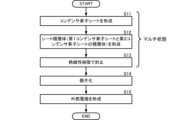
- FIG. 4 is a flowchart showing an example of a schematic flow of the method for manufacturing the solid electrolytic capacitor according to the first embodiment.
- FIG. 5 is a flow chart showing an example of a process for forming a capacitor element sheet.
- FIG. 6A is an external perspective view showing the shape of a capacitor element before being singulated, and FIG.
- FIG. 6B is an external perspective view showing the shape of a capacitor element before being singulated.
- FIG. 7 is an external view of the capacitor element in a multi-connected state.
- FIG. 8 is a flow chart showing an example of a process for forming a sheet laminate.
- FIG. 9 is an exploded perspective view of the sheet stack.
- FIG. 10 is an exploded perspective view of a set of capacitor elements being stacked.
- FIG. 11 is a side cross-sectional view showing the configuration of the solid electrolytic capacitor according to the second embodiment.
- FIG. 12 is a side cross-sectional view showing an outline of a structure in which capacitor elements according to the second embodiment are stacked.
- FIG. 13A is an external perspective view showing the shape of the third capacitor element before being singulated, and FIG.
- FIG. 13B is an external perspective view showing the shape of the third capacitor element before being singulated.
- FIG. 14 is a circuit diagram of the solid electrolytic capacitor according to the second embodiment.
- FIG. 15 is a side cross-sectional view showing the configuration of the solid electrolytic capacitor according to the third embodiment.
- FIG. 16 is a side cross-sectional view showing an outline of a structure in which capacitor elements according to the third embodiment are stacked.
- FIG. 17 is a side cross-sectional view showing an outline of a structure in which capacitor elements according to the fourth embodiment are stacked.
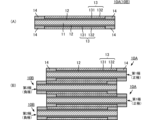
- Fig. 1 is a side cross-sectional view showing the configuration of a solid electrolytic capacitor according to a first embodiment. In Fig. 1, only the insulating resin and the external electrodes are hatched to make the drawing easier to see.
- Fig. 2(A) is a side cross-sectional view showing the configuration of a capacitor element before being divided into individual pieces, and Fig. 2(B) is a side cross-sectional view showing an outline of a structure in which the capacitor elements are stacked.
- the solid electrolytic capacitor 1 comprises a capacitor element laminate 100, insulating resin 50, an external electrode 61 and an external electrode 62.
- the capacitor element laminate 100 comprises a plurality of flat film-shaped first capacitor elements 10A and a plurality of second capacitor elements 10B. Note that in Figure 1, the number (number) of flat film-shaped first capacitor elements 10A and second capacitor elements 10B is two each, but this is not limited to this.
- the external electrode 61 corresponds to the "first external electrode” in the present invention, and the external electrode 62 corresponds to the "second external electrode” in the present invention.
- the first capacitor element 10A and the second capacitor element 10B include a flat film-like electrode 11, a dielectric layer 12, and a CP layer (solid electrolyte layer) 13.
- the electrode 11 corresponds to the "electrode foil" of the present invention.
- the electrode 11 has many holes. In other words, the electrode 11 is in a porous state (porous body). The ratio of the thickness of the porous portion on one side of the electrode 11 to the thickness of the core metal portion and the porous portion on the other side is about 1:1:1.
- the dielectric layer 12 covers the outer surface of the electrode 11. Since detailed structure of the electrode 11 is omitted in Fig. 2(A) and Fig. 2(B), the dielectric layer 12 is illustrated as if it were covering the macroscopic surface of the electrode 11. In reality, the dielectric layer 12 covers not only the macroscopic surface of the electrode 11 but also the surfaces of the many holes in the electrode 11.
- the CP layer 13 covers the surface of the dielectric layer 12.
- the CP layer 13 is formed inside a frame-shaped first dam 14.
- the first dam 14 has insulating properties.
- the first dam 14 restricts the formation area of the CP layer 13.
- the first dam 14 is formed in a frame shape, and then the CP layer 13 is formed inside the first dam 14.
- the first dam 14 does not have to be formed in a frame shape. That is, the first dam 14 may be formed on one side, or on two sides having a corner. Furthermore, the first dam 14 may be formed on two sides that are opposite to each other in a plan view.
- the CP layer can be formed only on the surface of the dielectric layer 12, the first dam 14 may be omitted.
- the CP layer 13 has a laminated structure of an inner layer CP (inner layer solid electrolyte layer) 131 and an outer layer CP (outer layer solid electrolyte layer) 132.
- the inner layer CP 131 is formed on the surface of the dielectric layer 12, and the outer layer CP 132 is formed on the surface of the inner layer CP 131.
- the multiple first capacitor elements 10A and the multiple second capacitor elements 10B are alternately stacked so that their flat film surfaces are parallel and overlap when viewed in a plane.
- An outer layer CP (outer solid electrolyte layer) 132 is disposed between the first capacitor element 10A and the second capacitor element 10B.
- the first capacitor element 10A and the second capacitor element 10B are bonded together using this outer layer CP 132.
- a carbon layer may be formed between the first capacitor element 10A and the second capacitor element 10B so as to abut against the outer layer CP132.
- the adhesion strength between the first capacitor element 10A and the second capacitor element 10B can be improved, and low resistance can be achieved.
- a second dam (not shown) is present to restrict the formation area of the carbon layer.
- each of the first capacitor element 10A and the second capacitor element 10B has an outer layer CP132, but it is also possible to omit one of the outer layers CP132 at the surface where the first capacitor element 10A and the second capacitor element 10B abut. In this case, the thickness of the solid electrolytic capacitor 1 can be made thinner by the amount of the omitted outer layer CP132.
- the first ends EA1 of the multiple first capacitor elements 10A are at approximately the same position in side view.
- the second ends EA2 of the multiple first capacitor elements 10A are at approximately the same position in side view.
- the first ends EB1 of the multiple second capacitor elements 10B are at approximately the same position in side view.
- the second ends EB2 of the multiple second capacitor elements 10B are at approximately the same position in side view.
- the first ends EA1 of the multiple first capacitor elements 10A and the second ends EB2 of the multiple second capacitor elements 10B are arranged on the first end side of the capacitor element stack 100.
- the first ends EA1 of the multiple first capacitor elements 10A protrude outward further than the second ends EB2 of the multiple second capacitor elements 10B.
- the first end EA1 of the first capacitor element 10A corresponds to the "first pole" of the present invention. This first end EA1 is part of the first end surface of the capacitor element stack 100.
- the first ends EB1 of the multiple second capacitor elements 10B and the second ends EA2 of the multiple first capacitor elements 10A are arranged on the second end side of the capacitor element stack 100.
- the first ends EB1 of the multiple second capacitor elements 10B protrude outward further than the second ends EA2 of the multiple first capacitor elements 10A.
- the first ends EB1 of the second capacitor elements 10B correspond to the "second pole" of the present invention. This first end EB1 is part of the second end surface of the capacitor element stack 100.
- the capacitor element laminate 100 is realized with this structure.
- the capacitor element stack 100 is sealed with insulating resin 50. More specifically, the insulating resin 50 covers the capacitor element stack 100 except for the first ends EA1 of the multiple first capacitor elements 10A and the first ends EB1 of the multiple second capacitor elements 10B.
- the external electrode 61 covers the first end of the insulating resin 50 (the first end EA1 of the first capacitor element 10A).
- the external electrode 61 is connected to the first ends EA1 of the electrodes 11 of the multiple first capacitor elements 10A.
- the external electrode 62 covers the second end of the insulating resin 50 (the first end EB1 of the second capacitor element 10B).
- the external electrode 62 is connected to the first ends EB1 of the electrodes 11 of the multiple second capacitor elements 10B.
- the above configuration realizes the non-polar (bipolar) solid electrolytic capacitor 1 of the first embodiment.
- the solid electrolytic capacitor 1 has a symmetrical shape in which the structure from the external electrode 61 to the external electrode 62 is the same as the structure from the external electrode 62 to the external electrode 61.
- the first capacitor element 10A and the second capacitor element 10B have been described with different symbols, but in the first embodiment, the first capacitor element 10A and the second capacitor element 10B have the same configuration. However, the first capacitor element 10A and the second capacitor element 10B may have different configurations.
- first capacitor element 10A and the second capacitor element 10B have the same configuration with the case where they have different configurations.
- the capacitance efficiency is good and the voltage balance for the solid electrolytic capacitor 1 can be designed to be even.
- Fig. 3 shows a circuit formed by a pair of a first capacitor element 10A and a second capacitor element 10B. As shown in the equivalent circuit diagram of the solid electrolytic capacitor 1, the first capacitor element 10A, the second capacitor element 10B, the first capacitor element 10A, and the second capacitor element 10B are connected in series.
- the withstand voltage across both ends of solid electrolytic capacitor 1 is the sum of the withstand voltage of first capacitor element 10A, the withstand voltage of second capacitor element 10B, the withstand voltage of first capacitor element 10A, and the withstand voltage of second capacitor element 10B.
- the present invention can easily realize a high-voltage solid electrolytic capacitor.
- first capacitor elements 10A and second capacitor elements 10B there are capacitors connected in parallel, so a more reliable high-voltage resistance can be achieved.
- Fig. 4 is a flow chart showing an example of a schematic flow of the method for manufacturing the solid electrolytic capacitor according to the first embodiment.
- a capacitor element sheet is formed (FIG. 4: S11).
- a plurality of first capacitor elements 10A that form different solid electrolytic capacitors 1 are formed in an array on the first capacitor element sheet.
- a plurality of second capacitor elements 10B that form different solid electrolytic capacitors 1 are formed in an array on the second capacitor element sheet.
- the first capacitor element sheet and the second capacitor element sheet are laminated to form a sheet laminate (FIG. 4: S12).
- the sheet laminate is a structure in which a plurality of capacitor element laminates 100 are arranged in a plane.
- the sheet laminate is sealed with insulating resin 50 (Fig. 4: S13). Details will be described later, but at this time, through holes that penetrate from the top surface to the bottom surface of the sheet laminate are provided in the sheet laminate, and resin sealing is performed by compression molding.
- the solid electrolytic capacitor 1 is in a multi-state (a state in which multiple solid electrolytic capacitors 1 are arranged) before being separated into individual pieces.
- the sheet laminate sealed with insulating resin 50 is cut and separated into individual pieces (FIG. 4: S14). Specifically, the cutting is performed along the cutting lines formed at any position. As a result, a plurality of solid electrolytic capacitors 1 (referred to as the body of solid electrolytic capacitor 1) without external electrodes are formed. After this, the body of solid electrolytic capacitor 1 is secondary sealed with insulating resin 50. More specifically, the side surfaces of the body of solid electrolytic capacitor 1 (surfaces cut along the cutting lines formed at any position (upper surface, lower surface, and side surfaces other than the end surfaces where the electrodes 11 of the first capacitor element 10A and the electrodes 11 of the second capacitor element 10B are exposed)) are covered with secondary sealing of insulating resin 50. As a result, the electrodes 11 of the first capacitor element 10A and the electrodes 11 of the second capacitor element 10B that are unnecessarily exposed during singulation are covered with insulating resin 50.
- FIG. 5 is a flow chart showing an example of a forming process of a capacitor element sheet.
- Fig. 6(A) is an external perspective view showing the shape of the electrodes of the capacitor element before singulation
- Fig. 6(B) is an external perspective view showing the shape of the capacitor element before singulation.
- Fig. 7 is an external view of the capacitor element in a multi-state. In the following forming process, the forming process of the first capacitor element 10A and the second capacitor element 10B are the same. Here, the first capacitor element 10A will be described as an example.
- the electrode 11 of the first capacitor element 10A is subjected to a chemical conversion treatment to form the dielectric layer 12 (FIG. 5: S111). At this time, a large number of holes are formed on the surface of the electrode 11 by etching, and the area near the surface of the electrode 11 is porous.
- the dielectric layer 12 covers the surface of the electrode 11, including the inner surfaces of the holes.
- through holes are formed in the electrode 11 (FIG. 5: S112). More specifically, as shown in FIG. 6(A), a plurality of cylindrical through holes 19C and groove-shaped through holes 19L are formed in the electrode 11.
- the plurality of cylindrical through holes 19C and groove-shaped through holes 19L are arranged alternately along the direction in which the portions that will become the plurality of electrodes 11 are arranged.
- the plurality of cylindrical through holes 19C are formed at a position that realizes the first end EA1 of the electrode 11, and the groove-shaped through holes 19L are formed at a position that straddles the portions that will become the adjacent electrodes 11 and at a position that realizes the second end EA2 of the adjacent electrodes 11.
- a CP layer (solid electrolyte layer) 13 is formed on the surface of the dielectric layer 12 (FIG. 5: S113). More specifically, as shown in FIG. 6(B), a first dam 14 having a frame-shaped opening is formed. Then, a CP layer 13 (a laminated structure of an inner layer CP 131 and an outer layer CP 132) is formed within the opening of the first dam 14.
- this structure is made in a multi-state in which multiple capacitor elements 10 (structures consisting of electrodes 11, dielectric layers 12, CP layers 13, and first dams 14) are arranged two-dimensionally. As described above, cutting is performed along the cutting lines to form solid electrolytic capacitors 1. This forms multiple solid electrolytic capacitors 1 (referred to as solid electrolytic capacitor 1 bodies) without external electrodes formed.
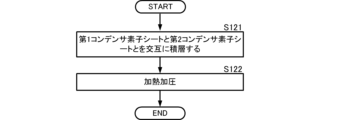
- Fig. 8 is a flow chart showing an example of a process for forming a sheet laminate.
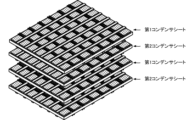
- Fig. 9 is an exploded perspective view showing a state in which a first capacitor element sheet and a second capacitor element sheet are laminated.
- Fig. 10 is an exploded perspective view showing a state in which a pair of a first capacitor element 10A and a second capacitor element 10B are laminated.
- the first capacitor element sheets and the second capacitor element sheets are alternately stacked (FIG. 8: S121). At this time, the first capacitor element sheets and the second capacitor element sheets are stacked so that their orientations are staggered. This makes it possible to realize a structure in which the first end E1 of the first capacitor element 10A and the second end E2 of the second capacitor element 10B protrude, as shown in FIG. 1, for example.
- the first capacitor element 10A and the second capacitor element 10B are alternately stacked.
- the through hole 19C of the first capacitor element 10A overlaps with the through hole 19L of the second capacitor element 10B when viewed in the stacking direction (Z-axis direction in Figure 10).
- the through hole 19L of the first capacitor element 10A overlaps with the through hole 19C of the second capacitor element 10B when viewed in the stacking direction (Z-axis direction in Figure 10).
- the through hole 19C of the first capacitor element 10A overlaps with the through hole 19L of the second capacitor element 10B when viewed in the stacking direction (the Z-axis direction in FIG. 10), and the through hole 19L of the first capacitor element 10A overlaps with the through hole 19C of the second capacitor element 10B.
- These through holes are formed in a number corresponding to the number of capacitor elements arranged in the sheet laminate.
- the sheet laminate is formed with a number of through holes that penetrate from the top surface to the bottom surface of the sheet laminate.
- the sheet laminate is heated and pressurized (FIG. 8: S122). This bonds the first capacitor element sheet and the second capacitor element sheet together to form a sheet laminate. Note that the first capacitor element sheet and the second capacitor element sheet are bonded together by the outer layer CP132 as described above.
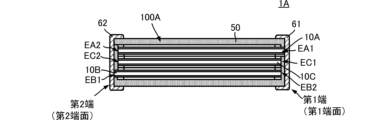
- Fig. 11 is a side cross-sectional view showing the configuration of the solid electrolytic capacitor according to the second embodiment.
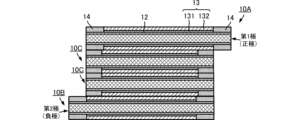
- Fig. 12 is a side cross-sectional view showing an outline of a structure in which capacitor elements according to the second embodiment are stacked.
- Fig. 13(A) is an external perspective view showing the shape of the electrodes of a third capacitor element before singulation, and
- Fig. 13(B) is an external perspective view showing the shape of the third capacitor element before singulation.
- the solid electrolytic capacitor 1A according to the second embodiment differs from the solid electrolytic capacitor 1 according to the first embodiment in that it includes a third capacitor element 10C.
- the other configuration of the solid electrolytic capacitor 1A is the same as that of the solid electrolytic capacitor 1, and a description of similar parts will be omitted.
- the number (number) of the flat film-shaped first capacitor element 10A, second capacitor element 10B, and third capacitor element 10C is one each, but this is not limited to this.
- the capacitor element laminate 100A comprises a flat film-shaped first capacitor element 10A, a second capacitor element 10B, and a third capacitor element 10C.
- the external electrode 61 corresponds to the "first pole” (positive pole) in the present invention
- the external electrode 62 corresponds to the "second pole” (negative pole) in the present invention.
- the first capacitor element 10A and the second capacitor element 10B have a flat film-shaped electrode 11, a dielectric layer 12, and a CP layer (solid electrolyte layer) 13.
- the third capacitor element 10C has a flat film-shaped electrode 11C, a dielectric layer 12, and a CP layer (solid electrolyte layer) 13.
- the dielectric layer 12 and the CP layer 13 have the same configuration as the first capacitor element 10A and the second capacitor element 10B.
- the first capacitor element 10A and the third capacitor element 10C are stacked so that their flat film surfaces are parallel and overlap when viewed from above.
- the third capacitor element 10C and the second capacitor element 10B are stacked so that their flat film surfaces are parallel and overlap when viewed from above.
- the first capacitor element 10A, the third capacitor element 10C, and the second capacitor element 10B are stacked alternately so that their respective flat film surfaces are parallel and overlap when viewed from above.
- An outer layer CP132 exists between the first capacitor element 10A and the third capacitor element 10C.
- the first capacitor element 10A and the third capacitor element 10C are bonded together using this outer layer CP132.
- an outer layer CP132 exists between the third capacitor element 10C and the second capacitor element 10B.
- the third capacitor element 10C and the second capacitor element 10B are bonded together using this outer layer CP132.
- the thickness of the solid electrolytic capacitor 1A can be reduced by the amount of the omitted outer layer CP132.
- the first end EA1 of the first capacitor element 10A, the second end EB2 of the second capacitor element 10B, and the first end EC1 of the third capacitor are arranged on the first end side of the capacitor element stack 100.
- the first end EA1 of the first capacitor element 10A protrudes outward beyond the second end EB2 of the second capacitor element 10B and the first end EC1 of the third capacitor.
- the first end EB1 of the second capacitor element 10B, the second end EA2 of the first capacitor element 10A, and the second end EC2 of the third capacitor are arranged on the second end side of the capacitor element stack 100.
- the first end EB1 of the second capacitor element 10B and the second end EC2 of the third capacitor protrude outward beyond the second end EA2 of the first capacitor element 10A.
- the first end EC1 of the third capacitor element 10C is not connected to the external electrode 61. Also, the second end EC2 is not connected to the external electrode 62.
- a through hole is formed in the electrode 11C. More specifically, a groove-shaped through hole 19L is formed at both ends of the electrode 11C. The groove-shaped through hole 19L is formed at a position that realizes the first end EC1 and the second end EC2 of the third capacitor element 10C.
- the capacitor element laminate 100A is sealed with insulating resin 50. More specifically, the insulating resin 50 covers the capacitor element laminate 100A except for the first end EA1 of the first capacitor element 10A and the first end EB1 of the second capacitor element 10B.
- the external electrode 61 covers the first end of the insulating resin 50 (the first end EA1 of the first capacitor element 10A).
- the external electrode 61 is connected to the first ends EA1 of the electrodes 11 of the multiple first capacitor elements 10A.
- the external electrode 62 covers the second end of the insulating resin 50 (the first end EB1 of the second capacitor element 10B).
- the external electrode 62 is connected to the first ends EB1 of the electrodes 11 of the multiple second capacitor elements 10B.
- the first capacitor element 10A, the third capacitor element 10C, and the second capacitor element 10B are connected in series.
- the withstand voltage across both ends of solid electrolytic capacitor 1A is the sum of the withstand voltage of first capacitor element 10A, the withstand voltage of second capacitor element 10B, and the withstand voltage of third capacitor element 10C.
- the present invention can realize a solid electrolytic capacitor with high voltage resistance compared to conventional solid electrolytic capacitors formed by stacking cathode and anode electrodes.
- Fig. 15 is a side cross-sectional view showing the configuration of the solid electrolytic capacitor according to the third embodiment.
- Fig. 16 is a side cross-sectional view showing an outline of a structure in which capacitor elements according to the third embodiment are stacked.
- the solid electrolytic capacitor 1B according to the third embodiment differs from the solid electrolytic capacitor 1A according to the second embodiment in that it includes a plurality of third capacitor elements 10C.
- the other configuration of the solid electrolytic capacitor 1B is the same as that of the solid electrolytic capacitor 1A, and a description of similar parts will be omitted.
- the capacitor element laminate 100A comprises a plurality of flat film-shaped first capacitor elements 10A, second capacitor elements 10B, and a plurality of third capacitor elements 10C.
- the external electrode 61 corresponds to the "first external electrode” (positive electrode) in the present invention
- the external electrode 62 corresponds to the "second external electrode” (negative electrode) in the present invention.
- the first capacitor element 10A and the third capacitor element 10C are stacked so that their flat film surfaces are parallel and overlap when viewed from above.
- the third capacitor element 10C and the third capacitor element 10C are stacked so that their flat film surfaces are parallel and overlap when viewed from above.
- the third capacitor element 10C and the second capacitor element 10B are stacked so that their flat film surfaces are parallel and overlap when viewed from above.
- the first capacitor element 10A and the multiple third capacitor elements 10C and the second capacitor element 10B are stacked alternately so that their respective flat film surfaces are parallel and overlap when viewed from above.
- An outer layer CP132 exists between the first capacitor element 10A and the third capacitor element 10C.
- the first capacitor element 10A and the third capacitor element 10C are bonded together using this outer layer CP132.
- an outer layer CP132 is present between the third capacitor element 10C and the third capacitor element 10C.
- this outer layer CP132 By using this outer layer CP132, the third capacitor element 10C and the third capacitor element 10C are bonded together.
- an outer layer CP132 exists between the third capacitor element 10C and the second capacitor element 10B.
- this outer layer CP132 the third capacitor element 10C and the second capacitor element 10B are bonded together.
- the thickness of the solid electrolytic capacitor 1B can be made thinner by the amount of the omitted outer layer CP132.
- the first end EA1 of the first capacitor element 10A, the second end EB2 of the second capacitor element 10B, and the first end EC1 of the third capacitor are arranged on the first end side of the capacitor element stack 100.
- the first end EA1 of the first capacitor element 10A protrudes outward beyond the second end EB2 of the second capacitor element 10B and the first end EC1 of the third capacitor.
- the first end EB1 of the second capacitor element 10B, the second end EA2 of the first capacitor element 10A, and the second end EC2 of the third capacitor are arranged on the second end side of the capacitor element stack 100.
- the first end EB1 of the second capacitor element 10B and the second end EC2 of the third capacitor protrude outward beyond the second end EA2 of the first capacitor element 10A.
- the capacitor element laminate 100B is sealed with insulating resin 50. More specifically, the insulating resin 50 covers the capacitor element laminate 100B except for the first end EA1 of the first capacitor element 10A and the first end EB1 of the second capacitor element 10B.
- the external electrode 61 covers the first end of the insulating resin 50.
- the external electrode 61 is connected to the first ends EA1 of the electrodes 11 of the multiple first capacitor elements 10A.
- the external electrode 62 covers the second end of the insulating resin 50.
- the external electrode 62 is connected to the first ends EB1 of the electrodes 11 of the multiple second capacitor elements 10B.
- the withstand voltage across the solid electrolytic capacitor 1B is the sum of the withstand voltage of the first capacitor element 10A, the withstand voltage of the second capacitor element 10B, and the withstand voltage of the multiple third capacitor elements 10C.
- the present invention can realize a solid electrolytic capacitor with high voltage resistance compared to conventional solid electrolytic capacitors formed by stacking cathode and anode electrodes.
- Fig. 17 is a side cross-sectional view showing an outline of a structure in which capacitor elements according to the fourth embodiment are stacked.
- the solid electrolytic capacitor 1C according to the fourth embodiment differs from the solid electrolytic capacitor 1A according to the second embodiment in that it includes a plurality of first capacitor elements 10A, a plurality of second capacitor elements 10B, and a plurality of third capacitor elements 10C.
- the other configuration of the solid electrolytic capacitor 1C is the same as that of the solid electrolytic capacitor 1A, and a description of similar parts will be omitted.
- the capacitor element laminate 100C is laminated in the following order: first capacitor element 10A, third capacitor element 10C, second capacitor element 10B, third capacitor element 10C, first capacitor element 10A, third capacitor element 10C, and second capacitor element 10B.
- the withstand voltage across both ends of solid electrolytic capacitor 1C is the sum of the withstand voltage of first capacitor element 10A, the withstand voltage of third capacitor element 10C, the withstand voltage of second capacitor element 10B, the withstand voltage of third capacitor element 10C, the withstand voltage of first capacitor element 10A, the withstand voltage of third capacitor element 10C, and the withstand voltage of second capacitor element 10B.
- the present invention can realize a solid electrolytic capacitor with high voltage resistance compared to conventional solid electrolytic capacitors formed by stacking cathode and anode electrodes.
- the number of first capacitor elements 10A and the number of second capacitor elements 10B are the same, but they can also be different.
- the number of first capacitor elements 10A, the number of second capacitor elements 10B, and the number of third capacitor elements 10C may be determined by appropriate combination to obtain the desired withstand voltage (high withstand voltage) and capacitance (high capacity). If the number of first capacitor elements 10A and the number of second capacitor elements 10B are the same, a non-polar (bipolar) solid electrolytic capacitor can be realized.
- the capacitor element 10 (first capacitor element, second capacitor element, third capacitor element) is realized, for example, with the following materials and thicknesses.
- the electrode 11 is made of, for example, a single metal such as aluminum, tantalum, niobium, titanium, zirconium, magnesium, copper, or an alloy containing these metals.
- the electrode 11 (electrode 11C) is preferably made of aluminum or an aluminum alloy.
- the electrode 11 (electrode 11C) may be any valve action metal that exhibits so-called valve action.
- the electrode 11 is preferably flat, and the thickness of the core (the center part not reached by the pores of the porous body) of the electrode 11 (electrode 11C) is preferably 5 ⁇ m or more and 100 ⁇ m or less.
- the thickness (thickness of one side) of the porous part is preferably 5 ⁇ m or more and 200 ⁇ m or less.
- the dielectric layer 12 is preferably made of an oxide film of the electrode 11 (electrode 11C).
- the dielectric layer 12 is formed by oxidizing it in an aqueous solution containing boric acid, phosphoric acid, adipic acid, or their sodium salts, ammonium salts, etc.
- the thickness of the dielectric layer 12 is preferably 1 nm or more and 100 nm or less.
- the inner layer CP131 may be a layer of PEDOT:PSS, which is realized by, for example, a conductive polymer having a skeleton of pyrroles, thiophenes, anilines, etc., or a conductive polymer having a skeleton of thiophenes such as PEDOT [poly(3,4-ethylenedioxythiophene)], which is a conductive polymer having a skeleton of thiophenes, and is composited with polystyrene sulfonic acid (PSS) as a dopant.
- PEDOT poly(3,4-ethylenedioxythiophene)
- the inner layer CP131 is formed, for example, by a method of forming a polymer film of poly(3,4-ethylenedioxythiophene) or the like on the surface of the dielectric layer 12 using a treatment liquid containing a monomer such as 3,4-ethylenedioxythiophene, or a method of applying a dispersion of a polymer such as poly(3,4-ethylenedioxythiophene) to the surface of the dielectric part and drying it.
- the thickness of the outer layer CP132 is preferably 2 ⁇ m or more and 20 ⁇ m or less.
- the material of the outer layer CP132 is the same as the material of the inner layer CP131.
- the insulating resin 50 may contain a filler.
- the resin are preferably epoxy resin, phenol resin, polyimide resin, silicone resin, polyamide resin, liquid crystal polymer, etc.
- the filler are preferably insulating oxide particles such as silica particles, alumina particles, titania particles, zirconia particles, etc.
- the maximum diameter of the filler is preferably, for example, 10 ⁇ m or more and 50 ⁇ m or less.
- a material containing silica particles in solid epoxy resin and phenol resin is more preferable.
- the capacitor further includes a plurality of flat-film-shaped third capacitor elements each having a dielectric layer and a solid electrolyte layer formed in that order on a surface of a flat-film-shaped electrode foil,
- the first external electrode is formed on a first end surface of the sheet laminate
Landscapes
- Engineering & Computer Science (AREA)
- Power Engineering (AREA)
- Microelectronics & Electronic Packaging (AREA)
- Manufacturing & Machinery (AREA)
- Fixed Capacitors And Capacitor Manufacturing Machines (AREA)
Priority Applications (1)
| Application Number | Priority Date | Filing Date | Title |
|---|---|---|---|
| JP2024552864A JPWO2024090047A1 (https=) | 2022-10-24 | 2023-09-06 |
Applications Claiming Priority (2)
| Application Number | Priority Date | Filing Date | Title |
|---|---|---|---|
| JP2022-169688 | 2022-10-24 | ||
| JP2022169688 | 2022-10-24 |
Publications (1)
| Publication Number | Publication Date |
|---|---|
| WO2024090047A1 true WO2024090047A1 (ja) | 2024-05-02 |
Family
ID=90830608
Family Applications (1)
| Application Number | Title | Priority Date | Filing Date |
|---|---|---|---|
| PCT/JP2023/032476 Ceased WO2024090047A1 (ja) | 2022-10-24 | 2023-09-06 | 固体電解コンデンサ |
Country Status (2)
| Country | Link |
|---|---|
| JP (1) | JPWO2024090047A1 (https=) |
| WO (1) | WO2024090047A1 (https=) |
Citations (2)
| Publication number | Priority date | Publication date | Assignee | Title |
|---|---|---|---|---|
| JP2019079866A (ja) * | 2017-10-20 | 2019-05-23 | 株式会社村田製作所 | 固体電解コンデンサの製造方法、及び、固体電解コンデンサ |
| WO2022163644A1 (ja) * | 2021-01-28 | 2022-08-04 | パナソニックIpマネジメント株式会社 | 電解コンデンサ |
-
2023
- 2023-09-06 WO PCT/JP2023/032476 patent/WO2024090047A1/ja not_active Ceased
- 2023-09-06 JP JP2024552864A patent/JPWO2024090047A1/ja active Pending
Patent Citations (2)
| Publication number | Priority date | Publication date | Assignee | Title |
|---|---|---|---|---|
| JP2019079866A (ja) * | 2017-10-20 | 2019-05-23 | 株式会社村田製作所 | 固体電解コンデンサの製造方法、及び、固体電解コンデンサ |
| WO2022163644A1 (ja) * | 2021-01-28 | 2022-08-04 | パナソニックIpマネジメント株式会社 | 電解コンデンサ |
Also Published As
| Publication number | Publication date |
|---|---|
| JPWO2024090047A1 (https=) | 2024-05-02 |
Similar Documents
| Publication | Publication Date | Title |
|---|---|---|
| CN109791844B (zh) | 固体电解电容器 | |
| US11170941B2 (en) | Solid electrolytic capacitor | |
| CN111724994B (zh) | 固体电解电容器 | |
| US9552928B2 (en) | Solid-state electrolytic capacitor manufacturing method and solid-state electrolytic capacitor | |
| JP2006049760A (ja) | 湿式電解コンデンサ | |
| JP2012049351A (ja) | 固体電解コンデンサ及びその製造方法 | |
| WO2024090047A1 (ja) | 固体電解コンデンサ | |
| JP7619541B1 (ja) | コンデンサ素子 | |
| CN103531361B (zh) | 固体电解电容器及其制造方法 | |
| CN223155823U (zh) | 固体电解电容器 | |
| WO2019156120A1 (ja) | 電解コンデンサ | |
| WO2025105152A1 (ja) | 固体電解コンデンサ、および固体電解コンデンサの製造方法 | |
| WO2026058571A1 (ja) | 固体電解コンデンサおよび固体電解コンデンサの製造方法 | |
| WO2025142527A1 (ja) | 固体電解コンデンサの製造方法、および固体電解コンデンサ | |
| JP2023181685A (ja) | 固体電解コンデンサ | |
| JP7750382B2 (ja) | 固体電解コンデンサの製造方法 | |
| WO2026070017A1 (ja) | 固体電解コンデンサおよび固体電解コンデンサの製造方法 | |
| JP4671347B2 (ja) | 固体電解コンデンサ | |
| JP7750381B2 (ja) | 固体電解コンデンサの製造方法 | |
| WO2024135309A1 (ja) | 固体電解コンデンサ | |
| JP7294563B1 (ja) | コンデンサアレイ及びコンデンサアレイ集合体 | |
| JP2025085955A (ja) | 固体電解コンデンサ、固体電解コンデンサの製造方法、およびコンデンサ素子 | |
| WO2024135308A1 (ja) | 固体電解コンデンサ | |
| WO2024029458A1 (ja) | 固体電解コンデンサ | |
| JP2025039520A (ja) | コンデンサ素子、固体電解コンデンサ、および固体電解コンデンサの製造方法 |
Legal Events
| Date | Code | Title | Description |
|---|---|---|---|
| 121 | Ep: the epo has been informed by wipo that ep was designated in this application |
Ref document number: 23882260 Country of ref document: EP Kind code of ref document: A1 |
|
| WWE | Wipo information: entry into national phase |
Ref document number: 2024552864 Country of ref document: JP |
|
| NENP | Non-entry into the national phase |
Ref country code: DE |
|
| 122 | Ep: pct application non-entry in european phase |
Ref document number: 23882260 Country of ref document: EP Kind code of ref document: A1 |