WO2024089970A1 - 蓄電モジュールの製造装置及び蓄電モジュールの製造方法 - Google Patents
蓄電モジュールの製造装置及び蓄電モジュールの製造方法 Download PDFInfo
- Publication number
- WO2024089970A1 WO2024089970A1 PCT/JP2023/028792 JP2023028792W WO2024089970A1 WO 2024089970 A1 WO2024089970 A1 WO 2024089970A1 JP 2023028792 W JP2023028792 W JP 2023028792W WO 2024089970 A1 WO2024089970 A1 WO 2024089970A1
- Authority
- WO
- WIPO (PCT)
- Prior art keywords
- storage module
- restraining member
- restraining
- sealing body
- region
- Prior art date
- Legal status (The legal status is an assumption and is not a legal conclusion. Google has not performed a legal analysis and makes no representation as to the accuracy of the status listed.)
- Ceased
Links
Images




Classifications
-
- H—ELECTRICITY
- H01—ELECTRIC ELEMENTS
- H01G—CAPACITORS; CAPACITORS, RECTIFIERS, DETECTORS, SWITCHING DEVICES, LIGHT-SENSITIVE OR TEMPERATURE-SENSITIVE DEVICES OF THE ELECTROLYTIC TYPE
- H01G11/00—Hybrid capacitors, i.e. capacitors having different positive and negative electrodes; Electric double-layer [EDL] capacitors; Processes for the manufacture thereof or of parts thereof
- H01G11/78—Cases; Housings; Encapsulations; Mountings
- H01G11/80—Gaskets; Sealings
-
- H—ELECTRICITY
- H01—ELECTRIC ELEMENTS
- H01M—PROCESSES OR MEANS, e.g. BATTERIES, FOR THE DIRECT CONVERSION OF CHEMICAL ENERGY INTO ELECTRICAL ENERGY
- H01M50/00—Constructional details or processes of manufacture of the non-active parts of electrochemical cells other than fuel cells, e.g. hybrid cells
- H01M50/60—Arrangements or processes for filling or topping-up with liquids; Arrangements or processes for draining liquids from casings
- H01M50/609—Arrangements or processes for filling with liquid, e.g. electrolytes
- H01M50/627—Filling ports
-
- H—ELECTRICITY
- H01—ELECTRIC ELEMENTS
- H01G—CAPACITORS; CAPACITORS, RECTIFIERS, DETECTORS, SWITCHING DEVICES, LIGHT-SENSITIVE OR TEMPERATURE-SENSITIVE DEVICES OF THE ELECTROLYTIC TYPE
- H01G11/00—Hybrid capacitors, i.e. capacitors having different positive and negative electrodes; Electric double-layer [EDL] capacitors; Processes for the manufacture thereof or of parts thereof
- H01G11/10—Multiple hybrid or EDL capacitors, e.g. arrays or modules
- H01G11/12—Stacked hybrid or EDL capacitors
-
- H—ELECTRICITY
- H01—ELECTRIC ELEMENTS
- H01G—CAPACITORS; CAPACITORS, RECTIFIERS, DETECTORS, SWITCHING DEVICES, LIGHT-SENSITIVE OR TEMPERATURE-SENSITIVE DEVICES OF THE ELECTROLYTIC TYPE
- H01G11/00—Hybrid capacitors, i.e. capacitors having different positive and negative electrodes; Electric double-layer [EDL] capacitors; Processes for the manufacture thereof or of parts thereof
- H01G11/84—Processes for the manufacture of hybrid or EDL capacitors, or components thereof
-
- H—ELECTRICITY
- H01—ELECTRIC ELEMENTS
- H01M—PROCESSES OR MEANS, e.g. BATTERIES, FOR THE DIRECT CONVERSION OF CHEMICAL ENERGY INTO ELECTRICAL ENERGY
- H01M10/00—Secondary cells; Manufacture thereof
- H01M10/04—Construction or manufacture in general
-
- H—ELECTRICITY
- H01—ELECTRIC ELEMENTS
- H01M—PROCESSES OR MEANS, e.g. BATTERIES, FOR THE DIRECT CONVERSION OF CHEMICAL ENERGY INTO ELECTRICAL ENERGY
- H01M10/00—Secondary cells; Manufacture thereof
- H01M10/04—Construction or manufacture in general
- H01M10/0404—Machines for assembling batteries
-
- H—ELECTRICITY
- H01—ELECTRIC ELEMENTS
- H01M—PROCESSES OR MEANS, e.g. BATTERIES, FOR THE DIRECT CONVERSION OF CHEMICAL ENERGY INTO ELECTRICAL ENERGY
- H01M10/00—Secondary cells; Manufacture thereof
- H01M10/04—Construction or manufacture in general
- H01M10/0468—Compression means for stacks of electrodes and separators
-
- H—ELECTRICITY
- H01—ELECTRIC ELEMENTS
- H01M—PROCESSES OR MEANS, e.g. BATTERIES, FOR THE DIRECT CONVERSION OF CHEMICAL ENERGY INTO ELECTRICAL ENERGY
- H01M10/00—Secondary cells; Manufacture thereof
- H01M10/05—Accumulators with non-aqueous electrolyte
- H01M10/052—Li-accumulators
-
- H—ELECTRICITY
- H01—ELECTRIC ELEMENTS
- H01M—PROCESSES OR MEANS, e.g. BATTERIES, FOR THE DIRECT CONVERSION OF CHEMICAL ENERGY INTO ELECTRICAL ENERGY
- H01M10/00—Secondary cells; Manufacture thereof
- H01M10/05—Accumulators with non-aqueous electrolyte
- H01M10/058—Construction or manufacture
-
- H—ELECTRICITY
- H01—ELECTRIC ELEMENTS
- H01M—PROCESSES OR MEANS, e.g. BATTERIES, FOR THE DIRECT CONVERSION OF CHEMICAL ENERGY INTO ELECTRICAL ENERGY
- H01M10/00—Secondary cells; Manufacture thereof
- H01M10/05—Accumulators with non-aqueous electrolyte
- H01M10/058—Construction or manufacture
- H01M10/0585—Construction or manufacture of accumulators having only flat construction elements, i.e. flat positive electrodes, flat negative electrodes and flat separators
-
- H—ELECTRICITY
- H01—ELECTRIC ELEMENTS
- H01M—PROCESSES OR MEANS, e.g. BATTERIES, FOR THE DIRECT CONVERSION OF CHEMICAL ENERGY INTO ELECTRICAL ENERGY
- H01M50/00—Constructional details or processes of manufacture of the non-active parts of electrochemical cells other than fuel cells, e.g. hybrid cells
- H01M50/10—Primary casings; Jackets or wrappings
- H01M50/183—Sealing members
- H01M50/186—Sealing members characterised by the disposition of the sealing members
-
- H—ELECTRICITY
- H01—ELECTRIC ELEMENTS
- H01M—PROCESSES OR MEANS, e.g. BATTERIES, FOR THE DIRECT CONVERSION OF CHEMICAL ENERGY INTO ELECTRICAL ENERGY
- H01M50/00—Constructional details or processes of manufacture of the non-active parts of electrochemical cells other than fuel cells, e.g. hybrid cells
- H01M50/40—Separators; Membranes; Diaphragms; Spacing elements inside cells
- H01M50/471—Spacing elements inside cells other than separators, membranes or diaphragms; Manufacturing processes thereof
- H01M50/474—Spacing elements inside cells other than separators, membranes or diaphragms; Manufacturing processes thereof characterised by their position inside the cells
-
- H—ELECTRICITY
- H01—ELECTRIC ELEMENTS
- H01M—PROCESSES OR MEANS, e.g. BATTERIES, FOR THE DIRECT CONVERSION OF CHEMICAL ENERGY INTO ELECTRICAL ENERGY
- H01M10/00—Secondary cells; Manufacture thereof
- H01M10/04—Construction or manufacture in general
- H01M10/0413—Large-sized flat cells or batteries for motive or stationary systems with plate-like electrodes
-
- H—ELECTRICITY
- H01—ELECTRIC ELEMENTS
- H01M—PROCESSES OR MEANS, e.g. BATTERIES, FOR THE DIRECT CONVERSION OF CHEMICAL ENERGY INTO ELECTRICAL ENERGY
- H01M4/00—Electrodes
- H01M4/02—Electrodes composed of, or comprising, active material
- H01M2004/026—Electrodes composed of, or comprising, active material characterised by the polarity
- H01M2004/029—Bipolar electrodes
-
- Y—GENERAL TAGGING OF NEW TECHNOLOGICAL DEVELOPMENTS; GENERAL TAGGING OF CROSS-SECTIONAL TECHNOLOGIES SPANNING OVER SEVERAL SECTIONS OF THE IPC; TECHNICAL SUBJECTS COVERED BY FORMER USPC CROSS-REFERENCE ART COLLECTIONS [XRACs] AND DIGESTS
- Y02—TECHNOLOGIES OR APPLICATIONS FOR MITIGATION OR ADAPTATION AGAINST CLIMATE CHANGE
- Y02E—REDUCTION OF GREENHOUSE GAS [GHG] EMISSIONS, RELATED TO ENERGY GENERATION, TRANSMISSION OR DISTRIBUTION
- Y02E60/00—Enabling technologies; Technologies with a potential or indirect contribution to GHG emissions mitigation
- Y02E60/10—Energy storage using batteries
-
- Y—GENERAL TAGGING OF NEW TECHNOLOGICAL DEVELOPMENTS; GENERAL TAGGING OF CROSS-SECTIONAL TECHNOLOGIES SPANNING OVER SEVERAL SECTIONS OF THE IPC; TECHNICAL SUBJECTS COVERED BY FORMER USPC CROSS-REFERENCE ART COLLECTIONS [XRACs] AND DIGESTS
- Y02—TECHNOLOGIES OR APPLICATIONS FOR MITIGATION OR ADAPTATION AGAINST CLIMATE CHANGE
- Y02P—CLIMATE CHANGE MITIGATION TECHNOLOGIES IN THE PRODUCTION OR PROCESSING OF GOODS
- Y02P70/00—Climate change mitigation technologies in the production process for final industrial or consumer products
- Y02P70/50—Manufacturing or production processes characterised by the final manufactured product
Definitions
- This disclosure relates to an energy storage module manufacturing apparatus and an energy storage module manufacturing method.
- An example of a conventional energy storage module is the bipolar battery described in Patent Document 1.
- This conventional energy storage module has multiple bipolar electrodes, with a positive electrode formed on one side of a current collector and a negative electrode formed on the other side.
- the multiple bipolar electrodes are stacked via a separator that holds an electrolyte layer.
- a sealing resin is molded and placed on the outer periphery of the separator.
- the manufacturing process of the above-mentioned storage module may include a step of injecting an electrolyte into the internal space formed between the electrodes, or a step of injecting a gas into the internal space for airtightness testing.
- Patent Document 2 discloses an injection device that injects an electrolyte into an electricity storage module.
- electrolyte is injected into the vacuum state internal space through the communication holes by pressing multiple supply nozzles against the communication holes provided in the sealing body of the electricity storage module.
- the injection device is provided with a restraining jig that restrains the electricity storage module at a constant pressure or size in the stacking direction of the electrodes.
- Constraining the energy storage module helps to suppress deformation of the energy storage module when fluids such as electrolyte are injected.
- the dimensional tolerance in the thickness direction may differ between the electrode stack, in which multiple electrodes are stacked, and the sealing body that seals the multiple internal spaces formed between the electrodes of the electrode stack.
- the dimensions in the stacking direction of the electrode stack and the dimensions in the stacking direction of the sealing body vary from one energy storage module to another, and this changes the constraining pressure applied to the energy storage module, which may make it impossible to properly suppress deformation of the energy storage module.
- the present disclosure has been made to solve the above problems, and aims to provide an energy storage module manufacturing device and an energy storage module manufacturing method that can appropriately suppress deformation when injecting fluid into each energy storage module that has dimensional variations due to dimensional tolerances.
- the manufacturing apparatus for an energy storage module is an energy storage module manufacturing apparatus used for manufacturing an energy storage module including an electrode stack in which a plurality of electrodes including current collectors are stacked, and a sealing body provided on the periphery of each of the current collectors so as to surround the electrode stack, sealing a plurality of internal spaces located between adjacent current collectors in the stacking direction, and having a plurality of communication holes that communicate with each of the plurality of internal spaces, and the manufacturing apparatus includes a fluid injection nozzle that is pressed against the periphery of the opening of the communication hole on the side of the sealing body to inject a fluid into each of the plurality of internal spaces through the communication holes, a first restraining member that restrains a first region of the sealing body in which the plurality of communication holes are provided, and a second restraining member that is provided independently of the first restraining member and restrains a second region including the internal spaces in the stacking direction.
- the first region of the sealing body having multiple communication holes and the second region including the internal space can be independently restrained by the first restraining member and the second restraining member. Therefore, even if the dimensions differ between the electrode stack and the sealing body, it is possible to apply the necessary restraining pressure to each of the first and second regions. This makes it possible to appropriately suppress deformation of the energy storage module when fluid is injected into each of the energy storage modules that have dimensional variations due to dimensional tolerances.
- the first restraining pressure by the first restraining member may be greater than the second restraining pressure by the second restraining member.
- the first region of the sealing body can be securely protected against the pressure of the fluid injection nozzle, while preventing excessive restraining force from being applied to the electrode stack. Therefore, damage to the electrode stack caused by the restraining force can be suppressed.
- the sealing body may include a plurality of sealing materials that cover the periphery of each current collector, and a spacer interposed between adjacent sealing materials in the stacking direction, and the first restraining member may restrain an area where the sealing materials and spacers overlap in the stacking direction as a first area.
- a first restraining pressure is applied to the area in the first area where the sealing materials and spacers overlap in the stacking direction. Therefore, it is possible to suppress deformation of the internal space between the current collectors and current collectors that constitute the electrode due to the first restraining pressure.
- the device may further include a decompression chamber in which the energy storage module is placed, and a first restraining member and a second restraining member may be provided in the decompression chamber.
- a decompression chamber in which the energy storage module is placed, and a first restraining member and a second restraining member may be provided in the decompression chamber.
- the internal space of the energy storage module can be decompressed using the decompression chamber, thereby allowing efficient injection of fluid through the communication hole.
- it is not necessary to detach the restraining members from the energy storage module each time fluid is injected simplifying the work process.
- the device may further include a decompression chamber in which the energy storage module is placed, with a first restraining member provided in the decompression chamber and a wall of the decompression chamber forming the second restraining member.
- a decompression chamber in which the energy storage module is placed, with a first restraining member provided in the decompression chamber and a wall of the decompression chamber forming the second restraining member.
- the internal space of the energy storage module is decompressed using the decompression chamber, allowing efficient injection of fluid through the communication hole.
- the wall of the decompression chamber as the second restraining member, it is no longer necessary to attach and detach the restraining member to the energy storage module each time fluid is injected, and the simpler configuration simplifies the work process.
- the second restraining member may be provided with a protrusion that corresponds to the exposed portion of the electrode stack from the sealing body.
- the protrusion can more reliably ensure contact of the second restraining member with the electrode stack. Therefore, even if there is a large difference in dimensions between the electrode stack and the sealing body, the second restraining member can appropriately apply a restraining force to the electrode stack.
- a method for manufacturing an electric storage module is a method for manufacturing an electric storage module used in the manufacture of an electric storage module including an electrode stack in which multiple electrodes including current collectors are stacked, and a sealing body provided on the periphery of each of the current collectors so as to surround the electrode stack, sealing multiple internal spaces located between adjacent current collectors in the stacking direction, and having multiple communication holes that communicate with each of the multiple internal spaces, the method including an injection step of pressing a fluid injection nozzle against the periphery of the opening of the communication hole on the side of the sealing body to inject a fluid into each of the multiple internal spaces through the communication hole, and in the injection step, a first region of the sealing body in which the multiple communication holes are provided is restrained by a first restraining member, and a second region including the internal spaces is restrained in the stacking direction by a second restraining member.
- a first region of the sealing body having a plurality of communication holes and a second region including the internal space are independently constrained by a first restraining member and a second restraining member. Therefore, even if the dimensions differ between the electrode stack and the sealing body, it is possible to apply the necessary constraining pressure to each of the first and second regions. This makes it possible to appropriately suppress deformation of the energy storage module when fluid is injected into each of the energy storage modules in which dimensional variations have occurred due to dimensional tolerances.
- deformation that occurs when injecting fluid into each energy storage module that has dimensional variation due to dimensional tolerances can be appropriately suppressed.
- FIG. 1 is a schematic cross-sectional view showing an embodiment of an electricity storage module.
- 4 is a schematic cross-sectional view showing a configuration around a communication hole in a sealing body.
- FIG. 1A is a schematic side view showing the positional relationship between the cells and the communication holes
- FIG. 1B is a schematic side view showing the positional relationship between the frame and the communication holes.
- 1 is a schematic partial cross-sectional view showing a manufacturing apparatus for an electricity storage module according to one aspect of the present disclosure.
- 10 is a schematic cross-sectional view showing the state around the communication hole in the injection step.
- FIG. 5A and 5B are schematic side views showing the relationship between the dimension of the electrode stack in the stacking direction between the works and the dimension of the sealing body in the stacking direction.
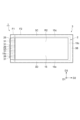
- FIG. 3 is a schematic plan view showing a first region restrained by a first restraining member and a second region restrained by a second restraining member
- FIG. 4 is a schematic cross-sectional view showing a first region restrained by a first restraining member and a second region restrained by a second restraining member
- FIG. 13A and 13B are schematic partial cross-sectional views showing modified examples of an energy storage module manufacturing apparatus.
- FIG. 10 is a schematic plan view showing a first modified example of the first region and the second region.
- FIG. 11 is a schematic plan view showing a second modified example of the first region and the second region.
- each drawing shows an orthogonal coordinate system defined by a coordinate axis indicating a first direction D1, a coordinate axis indicating a second direction D2, and a coordinate axis indicating a third direction D3.
- FIG. 1 is a schematic cross-sectional view showing one embodiment of an energy storage module.
- the energy storage module 1 is a module used in batteries for various vehicles such as forklifts, hybrid vehicles, and electric vehicles.
- the energy storage module 1 is a secondary battery such as a nickel-metal hydride secondary battery or a lithium-ion secondary battery.
- the energy storage module 1 may be an electric double layer capacitor or an all-solid-state battery.
- a case in which the energy storage module 1 is a lithium-ion secondary battery will be illustrated as an example.
- the energy storage module 1 comprises an electrode stack 2 and a sealing body 3.
- the electrode stack 2 includes a plurality of electrodes stacked along a first direction D1.
- the first direction D1 is the stacking direction of the electrodes in the electrode stack 2, and corresponds to the thickness direction of the energy storage module 1.
- the second direction D2 and the third direction D3 are in-plane directions of the current collector 15 described below.
- the second direction D2 corresponds to the depth direction of the energy storage module 1
- the third direction D3 corresponds to the width direction of the energy storage module 1.
- the electrodes are composed of a plurality of bipolar electrodes 11, a positive terminal electrode 12, and a negative terminal electrode 13.
- the electrode laminate 2 is formed by stacking a plurality of bipolar electrodes 11 between the positive terminal electrode 12 and the negative terminal electrode 13.
- a separator 14 is disposed between adjacent electrodes in the stacking direction.
- the bipolar electrode 11 has a current collector 15, a positive electrode active material layer 16, and a negative electrode active material layer 17.
- the current collector 15 has, for example, a rectangular sheet shape.
- the current collector 15 includes a first surface 15a, which is one surface, and a second surface 15b, which is the other surface opposite to the first surface 15a. That is, the current collector 15 has a first surface 15a and a second surface 15b that are opposite to each other in the first direction D1.
- the positive electrode active material layer 16 is provided on the first surface 15a of the current collector 15.
- the negative electrode active material layer 17 is provided on the second surface 15b of the current collector 15.
- the first surface 15a of the current collector 15 faces one side of the first direction D1, and the second surface 15b of the current collector 15 faces the other side of the first direction D1.
- the multiple bipolar electrodes 11 are stacked so that the positive electrode active material layer 16 of one bipolar electrode 11 faces the negative electrode active material layer 17 of another bipolar electrode 11 adjacent to the first bipolar electrode 11.
- the positive electrode active material layer 16 and the negative electrode active material layer 17 are rectangular when viewed from the first direction D1.
- the negative electrode active material layer 17 is slightly larger than the positive electrode active material layer 16 when viewed from the first direction D1. That is, in a plan view viewed from the first direction D1, the entire formation area of the positive electrode active material layer 16 is located within the formation area of the negative electrode active material layer 17.
- the positive terminal electrode 12 has a current collector 15 and a positive active material layer 16 provided on the first surface 15a of the current collector 15. No active material layer is provided on the second surface 15b of the current collector 15 in the positive terminal electrode 12.
- the positive terminal electrode 12 is laminated on the bipolar electrode 11 at one end of the electrode laminate 2 in the first direction D1.
- the positive active material layer 16 of the positive terminal electrode 12 and the negative active material layer 17 of the bipolar electrode 11 adjacent to the positive terminal electrode 12 are opposed to each other.
- the second surface 15b of the current collector 15 in the positive terminal electrode 12 has an exposed portion R1 exposed from the sealing body 3 as one stacking end of the electrode laminate 2. That is, the second surface 15b of the current collector 15 in the positive terminal electrode 12 is the positive terminal surface of the storage module 1.
- the negative terminal electrode 13 has a current collector 15 and a negative active material layer 17 provided on the second surface 15b of the current collector 15.
- the first surface 15a of the current collector 15 in the negative terminal electrode 13 does not have an active material layer.
- the negative terminal electrode 13 is laminated on the bipolar electrode 11 at the other end of the electrode laminate 2 in the first direction D1.
- the negative active material layer 17 of the negative terminal electrode 13 and the positive active material layer 16 of the bipolar electrode 11 adjacent to the negative terminal electrode 13 are in a state of facing each other.
- the first surface 15a of the current collector 15 in the negative terminal electrode 13 has an exposed portion R2 exposed from the sealing body 3 as the other laminate end of the electrode laminate 2. That is, the first surface 15a of the current collector 15 in the negative terminal electrode 13 is the negative terminal surface of the storage module 1.
- a conductive member 18 is disposed on the exposed portion R1 of the first surface 15a of the current collector 15 of the positive terminal electrode 12, which is exposed from the sealing body 3, and on the exposed portion R2 of the second surface 15b of the current collector 15 of the negative terminal electrode 13, which is exposed from the sealing body 3.
- the conductive members 18 disposed on the exposed portions R1 and R2 are electrically connected to the electrode stack 2 via the exposed portions R1 and R2, respectively, and function as terminals for extracting current from the energy storage module 1.
- the conductive member 18 also functions as a restraining member that applies a predetermined restraining load to the electrode stack 2.
- a cooling flow path may be formed in the conductive member 18.
- the electrode stack 2 can be efficiently cooled by circulating a cooling medium through the cooling flow path.
- Separators 14 are disposed between adjacent bipolar electrodes 11 in the first direction D1, between the positive electrode terminal electrode 12 and the bipolar electrode 11, and between the negative electrode terminal electrode 13 and the bipolar electrode 11. Separators 14 are disposed between the positive electrode active material layer 16 and the negative electrode active material layer 17 between the electrodes. By isolating the positive electrode active material layer 16 and the negative electrode active material layer 17, separators 14 have the role of preventing short circuits caused by contact between adjacent electrodes while allowing charge carriers such as lithium ions to pass through.
- the separator 14 is composed of, for example, a porous sheet containing a polymer that absorbs and retains electrolyte, or a nonwoven fabric.
- materials for the separator 14 include polypropylene, polyethylene, polyolefin, and polyester.
- the separator 14 may have either a single-layer structure or a multi-layer structure. If it has a multi-layer structure, the separator 14 may have, for example, a ceramic layer as an adhesive layer or a heat-resistant layer.
- the separator 14 may be impregnated with an electrolyte.
- the electrolyte impregnated in the separator 14 may be, for example, a liquid electrolyte (electrolytic solution) containing a non-aqueous solvent and an electrolyte salt dissolved in the non-aqueous solvent.
- the electrolyte salt contained in the electrolyte may be, for example, a lithium salt such as LiClO 4 , LiAsF 6 , LiPF 6 , LiBF 4 , LiCF 3 SO 3 , LiN(FSO 2 ) 2 , or LiN(CF 3 SO 2 ) 2 .
- the non-aqueous solvent may be, for example, a solvent such as cyclic carbonates, cyclic esters, chain carbonates, chain esters, or ethers. Two or more of these solvents may be used in combination.
- the current collector 15 is a chemically inactive electrical conductor for continuously supplying current to the positive electrode active material layer 16 and the negative electrode active material layer 17 during discharging or charging of the lithium ion secondary battery.
- materials for the current collector 15 include metal materials, conductive resin materials, and conductive inorganic materials.
- conductive resin materials include conductive polymer materials and resins in which conductive fillers are added as necessary to non-conductive polymer materials.
- the current collector 15 may have multiple layers. In this case, each layer of the current collector 15 may contain the above-mentioned metal materials, conductive resin materials, etc.
- a coating layer may be formed on the surface of the current collector 15.
- the coating layer is formed by a method such as plating or spray coating.
- the current collector 15 may have various shapes such as a plate, foil (e.g., metal foil), film, mesh, etc. Examples of metal foil include aluminum foil, copper foil, nickel foil, titanium foil, and stainless steel foil.
- the current collector 15 may be an alloy foil of the above metals, or a foil in which multiple metal foils are integrated. When the current collector 15 is in the form of a foil, the thickness of the current collector 15 may be, for example, about 1 ⁇ m to 100 ⁇ m.
- the positive electrode active material layer 16 is a layer containing a positive electrode active material capable of absorbing and releasing charge carriers such as lithium ions.
- the positive electrode active material include lithium composite metal oxides having a layered rock salt structure, metal oxides having a spinel structure, and polyanion-based compounds.
- the positive electrode active material layer 16 may contain a plurality of positive electrode active materials.
- the positive electrode active material layer 16 contains olivine-type lithium iron phosphate (LiFePO 4 ), which is a composite oxide.
- the negative electrode active material layer 17 is a layer containing a negative electrode active material capable of absorbing and releasing charge carriers such as lithium ions.
- the negative electrode active material may be any of a simple substance, an alloy, and a compound. Examples of the negative electrode active material include Li, carbon, and metal compounds.
- the negative electrode active material may be an element that can be alloyed with lithium, or a compound thereof. Examples of carbon include natural graphite, artificial graphite, hard carbon (hardly graphitizable carbon), and soft carbon (easily graphitizable carbon). Examples of artificial graphite include highly oriented graphite and mesocarbon microbeads. Examples of elements that can be alloyed with lithium include silicon and tin.
- the negative electrode active material layer 17 contains graphite, which is a carbon-based material.
- Each of the positive electrode active material layer 16 and the negative electrode active material layer 17 may further contain, as necessary, a conductive assistant to increase electrical conductivity, a binder, an electrolyte (polymer matrix, ionically conductive polymer, electrolyte solution, etc.), an electrolyte supporting salt (lithium salt) to increase ionic conductivity, etc.
- the conductive assistant is added to increase the conductivity of each electrode (bipolar electrode 11, positive terminal electrode 12, negative terminal electrode 13).
- Examples of the conductive assistant that can be used include acetylene black, carbon black, and graphite.
- Binders include, for example, fluorine-containing resins such as polyvinylidene fluoride, polytetrafluoroethylene, and fluororubber; thermoplastic resins such as polypropylene and polyethylene; imide resins such as polyimide and polyamideimide; alkoxysilyl group-containing resins; acrylic resins such as acrylic acid or methacrylic acid; styrene-butadiene rubber (SBR); carboxymethyl cellulose; alginates such as sodium alginate and ammonium alginate; water-soluble cellulose ester crosslinked bodies; and starch-acrylic acid graft polymers. These binders may be used alone or in combination. Solvents that may be used include, for example, water and N-methyl-2-pyrrolidone (NMP).
- NMP N-methyl-2-pyrrolidone
- the sealing body 3 is formed in a frame shape on the periphery of the electrode laminate 2 so as to surround the electrode laminate 2.
- the sealing body 3 is joined to each of the first surface 15a and the second surface 15b of the current collector 15 at each periphery 15c of the current collector 15.
- the sealing body 3 forms an internal space S between the current collectors 15 adjacent to each other in the first direction D1, and seals each of these internal spaces S.
- the above-mentioned electrolyte electrolytic solution
- the sealing body 3, together with the current collectors 15 adjacent to each other in the first direction D1, defines the internal space S that contains the electrolyte, and prevents leakage of the electrolyte from the internal space S to the outside.
- the sealing body 3 prevents moisture and the like from penetrating from the outside of the electrode stack 2 into the internal space S.
- the peripheral portion of the separator 14 is joined to the sealing body 3 while being embedded in the sealing body 3.
- the sealing body 3 is formed, for example, from a resin material having insulating properties. Examples of the resin material include polypropylene, polyethylene, polystyrene, ABS resin, acid-modified polypropylene, acid-modified polyethylene, and acrylonitrile-styrene resin.
- the main body 20 of the sealing body 3 is composed of a plurality of sealing materials 21, a plurality of spacers 22, and a welded end portion 23.
- the sealing material 21 is provided for each current collector 15.
- the sealing material 21 is frame-shaped and provided on the peripheral portion 15c of the current collector 15.
- the sealing material 21 covers the first surface 15a, the second surface 15b, and the end surface at the peripheral portion 15c of the current collector 15.
- the sealing material 21 is welded to at least one of the first surface 15a and the second surface 15b of the current collector 15.
- the spacer 22 is disposed between adjacent sealing materials 21 in the first direction D1.
- the spacer 22 maintains the space between adjacent sealing materials 21, i.e., the space between adjacent current collectors 15.
- the spacer 22 is frame-shaped and disposed on the peripheral portion 15c of the current collector 15.
- the peripheral portion of the separator 14 is sandwiched between the sealing material 21 and the spacer 22.
- the peripheral portion of the separator 14 is welded to at least one of the sealing material 21 and the spacer 22.
- each spacer 22 facing the internal space S is located outside (opposite the internal space S) of the edge 21a of each seal material 21 facing the internal space S.
- the edge 22a of each spacer 22 facing the internal space S is located outside (opposite the internal space S) of the edge 21a of each seal material 21 facing the internal space S.
- the spacer 22 is interposed between adjacent seal materials 21, so that the seal materials 21 and the spacer 22 overlap each other.
- the welded end 23 is frame-shaped to surround the electrode stack 2 when viewed from the first direction D1.
- the welded end 23 is formed by integrating the edge of each sealant 21 opposite the internal space S with the edge of each spacer 22 opposite the internal space S by welding.
- the welded end 23 is formed by welding together a portion of each sealant 21 located outside the outer periphery of the current collector 15 and a portion of each spacer 22 located outside the outer periphery of the current collector 15.
- the side surface 23s of the welded end 23 located opposite the internal space S extends along the first direction D1 and constitutes the side surface of the main body 20, i.e., the side surface of the sealing body 3.
- the sealing body 3 has a build-up portion 25 and a frame portion 26.
- the build-up portion 25 is provided on the outer surface in the first direction D1 of the seal material 21 provided on the current collector 15 of the positive terminal electrode 12 and the negative terminal electrode 13.
- the build-up portion 25 is disposed in the same region as the seal material 21 when viewed from the first direction D1, and is adhered to the seal material 21.
- the edge of the build-up portion 25 on the opposite side to the internal space S is welded to the edge of each seal material 21 on the opposite side to the internal space S, and forms part of the welded end portion 23.
- the frame 26 is joined to the side of the sealing body 3, i.e., the side 23s of the welded end 23.
- the frame 26 extends from the buildup portion 25 on the positive terminal electrode 12 side to the buildup portion 25 on the negative terminal electrode 13 side.
- the outer edge of the frame 26 in the first direction D1 coincides with the outer surface of the buildup portion 25 in the first direction D1.
- the frame 26 may be joined to the buildup portion 25 or may be formed integrally with the buildup portion 25.
- the frame 26 and the buildup portion 25 may be formed integrally by, for example, injection molding.
- the frame 26 is sealed by the sealing film 30. This seals the multiple cells of the storage module 1.
- the sealing film 30 is, for example, a resin film or a laminate film.
- the configuration of the sealing body 3 is explained in more detail below.
- Figure 2 is a schematic cross-sectional view showing the configuration around the communication hole in the sealing body.
- Figure 3(a) is a schematic side view showing the positional relationship between the cell and the communication hole
- Figure 3(b) is a schematic side view showing the positional relationship between the frame body and the communication hole.
- the frame 26 and sealing film 30 are omitted in Figure 3(a)
- the sealing film 30 is omitted in Figure 3(b).
- the main body 20 of the sealing body 3 has a plurality of communication holes 31 that communicate with each of the plurality of internal spaces S.
- the plurality of communication holes 31 are provided in a wall portion 3A (see Figure 7) of the frame-shaped sealing body 3 that is located on one side of the second direction D2.
- the communication holes 31 are formed, for example, by cutting out a part of the spacer 22, penetrating the spacer 22 and the welded end portion 23.
- One opening 31A of the communication hole 31 faces the side surface 23s of the welded end portion 23, and the other opening 31B faces the internal space S.
- a cell C including one internal space S is formed by a pair of current collectors 15 adjacent to each other in the first direction D1.
- one communication hole 31 is provided for each cell C.
- FIG. 3(a) when viewed from a second direction D2 intersecting (orthogonal to) the side surface 23s, the position of the communication hole 31 in the first direction D1 differs for each cell C.
- the positions of the communication holes 31 in the third direction D3 of the cells C adjacent to each other in the first direction D1 differ from each other.
- the positions of the communication holes 31 adjacent to each other in the first direction D1 are staggered in the third direction D3.
- a plurality of communication holes 31 at the same position in the third direction D3 are provided corresponding to every other cell C.
- a group of openings 31A arranged along the first direction D1 and another group of openings 31A arranged along the first direction D1 are lined up at different positions in the third direction D3 on the side surface 23s.
- the frame portion 26 is provided to protrude from the side surface 23s so as to surround each of the openings 31A of the multiple communication holes 31.
- multiple frame portions 26 are provided for the multiple communication holes 31.
- the multiple frame portions 26 are arranged spaced apart from each other in the third direction D3.
- one frame portion 26 surrounds each of a group of openings 31A arranged along the first direction D1
- another frame portion 26 surrounds each of another group of openings 31A arranged along the first direction D1.
- the multiple frame portions 26 may be configured to form multiple enclosed regions having the same length in the first direction D1, or may be configured to form multiple enclosed regions 33 having different lengths in the first direction D1.
- each of the frame portions 26 forms three enclosed regions 33.
- the length in the first direction D1 is greater than the length in the first direction D1 of the other two.
- two of the frame portions 26 may have the arrangement patterns of the enclosed areas 33 reversed in the first direction.
- the positions of the enclosed areas 33A in the first direction D1 are different between the frame portions 26 adjacent to each other in the third direction D3.
- the manufacturing method of this energy storage module 1 includes an injection step in which a fluid injection nozzle 43 (see Figures 4 and 5) is pressed against the periphery of the opening 31A of the communication hole 31, and fluid F is injected into each of the multiple internal spaces S through the communication hole 31.
- Specific examples of the injection step include a step of injecting an electrolyte into the internal space S, and a step of inspecting the airtightness of the energy storage module 1.
- the electrolyte which is the fluid F, is injected into the internal space S of each cell C through the communication hole 31.
- the process of conducting an airtightness test is carried out before the process of injecting the electrolyte.
- an airtightness test is carried out between the cell and the outside to test the airtightness of each cell against the outside.
- the fluid F is a test gas.
- a test gas such as helium is injected into the internal space S of all cells C through the communication holes 31, and a detection sensor placed outside the energy storage module 1 detects whether or not the test gas has leaked. If the detection sensor does not detect the test gas, it is determined that there is no problem with the airtightness between the cell and the outside.
- FIG. 4 is a schematic partial cross-sectional view showing a manufacturing apparatus for an energy storage module according to one aspect of the present disclosure.
- the injection process is carried out using an energy storage module manufacturing apparatus 41.
- the manufacturing apparatus 41 includes a decompression chamber 42, a fluid injection nozzle 43, a first restraining member 44, and a second restraining member 45.
- the energy storage module 1 which is the workpiece in the injection process
- the conductive member 18 and the sealing film 30, which are the components shown in FIG. 1 are not provided.
- the conductive member 18 and the sealing film 30 are attached to the workpiece in a process subsequent to the injection process, and the energy storage module 1 shown in FIG. 1 is obtained.
- the decompression chamber 42 has a stage 46 and a chamber 47.
- the stage 46 has a mounting surface 46a on which the energy storage module 1 is placed.
- the energy storage module 1 is placed on the mounting surface 46a, for example, while being placed on a flat pallet 48.
- the chamber 47 is formed in a box shape by four side walls 49 erected on the stage 46 and a roof 50 that closes the space formed by the stage 46 and the side walls 49.
- one of the four side walls 49 is configured to be freely opened and closed. By opening this side wall 49, the energy storage module 1 placed on the flat pallet 48 can be inserted and removed from the chamber 47.
- a pair of side walls 49, 49 intersecting the side wall 49 on which the fluid injection nozzle 43 is provided may be configured to be freely opened and closed.
- the energy storage module 1 placed on the flat pallet 48 can be introduced into the chamber 47 from one side of the pair of side walls 49, 49, and can be removed from the other side of the pair of side walls 49, 49 after the injection process is performed. Therefore, it is possible to perform the injection process while transporting multiple energy storage modules 1 in one direction, which improves the efficiency of the injection process.
- the fluid injection nozzle 43 is provided on one side wall portion 49 of the chamber 47 so as to be movable forward and backward relative to the mounting surface 46a.
- the fluid injection nozzle 43 has a nozzle head 51 that ejects fluid F.
- the nozzle head 51 has a head body 52 and a packing 53, and is disposed within the chamber 47.
- the head body 52 is provided with a flow path 54 through which the fluid F flows.
- the packing 53 is provided on the tip surface of the head body 52.
- the packing 53 is provided with an ejection hole 55 that communicates with the flow path 54.
- the energy storage module 1 If the internal space S of the energy storage module 1 is depressurized under atmospheric pressure, the energy storage module 1 will be crushed by the atmospheric pressure, and the collectors 15 that make up each internal space S will deform, which may cause the entrance to the internal space S (the part that connects to the communication hole 31) to become blocked. As a result, it is considered that the efficiency of injection of fluid F such as electrolyte or test gas will not improve.
- the energy storage module 1 in a depressurized chamber 42 and depressurizing the outside of the energy storage module 1 together with the internal space S of the energy storage module 1, the pressure difference between the inside and outside of each cell C is eliminated, and the efficiency of injection of fluid F such as electrolyte or test gas can be sufficiently improved.
- the test gas can be efficiently injected through the communication hole 31. Furthermore, by placing the energy storage module 1 inside the decompression chamber 42, the influence of the test gas contained in the atmosphere is suppressed, improving the accuracy of the airtightness inspection.
- the first restraining member 44 and the second restraining member 45 are members that restrain the energy storage module 1 at a constant pressure or size in order to protect the electrode stack 2 and the sealing body 3 from the load when injecting the fluid F.
- Examples of the load when injecting the fluid F include the pressing force applied to the main body 20 of the sealing body 3 when the fluid injection nozzle 43 is pressed against the periphery of the opening 31A of the communication hole 31, the expansion force of the internal space S due to the injection of the fluid F, and the expansion force of the internal space S due to the air pressure difference between the inside and outside of the cell C when placed in the decompression chamber 42.
- the dimensional tolerance in the thickness direction may differ between the electrode stack 2 in which multiple electrodes are stacked, and the sealing body 3 that seals the internal space S formed between the electrodes of the electrode stack 2. Because the dimensional tolerance in the stacking direction during manufacturing differs between the electrode stack 2 and the sealing body 3, the dimensions in the stacking direction may differ between the electrode stack 2 and the sealing body 3 for each energy storage module 1 (work).
- the dimensional tolerance in the stacking direction of the electrode stack 2, in which multiple electrodes are stacked may be larger than the dimensional tolerance in the stacking direction of the sealing body 3.
- the dimension in the stacking direction of the electrode stack 2 may be smaller than the dimension in the stacking direction of the sealing body 3.
- the end face in the stacking direction of the electrode stack 2 (here, the first surface 15a of the current collector 15 in the positive terminal electrode 12 and the second surface 15b of the current collector 15 in the negative terminal electrode 13) is recessed relative to the end face in the stacking direction of the sealing body 3 (here, the outer surface in the first direction D1 of the seal material 21 provided on the current collector 15 of the positive terminal electrode 12 and the negative terminal electrode 13).
- the dimension of the electrode stack 2 in the stacking direction may be larger than the dimension of the sealing body 3 in the stacking direction.
- the end faces in the stacking direction of the electrode stack 2 here, the first surface 15a of the current collector 15 in the positive terminal electrode 12 and the second surface 15b of the current collector 15 in the negative terminal electrode 13
- rise up relative to the end faces in the stacking direction of the sealing body 3 here, the outer surfaces in the first direction D1 of the seal material 21 provided on the current collector 15 of the positive terminal electrode 12 and the negative terminal electrode 13).
- the manufacturing device 41 has a first restraining member 44 and a second restraining member 45 that are provided independently of each other, so that even if the dimensions in the stacking direction of the electrode stack 2 and the dimensions in the stacking direction of the sealing body 3 vary for each energy storage module 1, it is possible to apply an appropriate restraining pressure to both the portion of the sealing body 3 against which the fluid injection nozzle 43 is pressed, and the electrode stack 2 in which the internal space S is located.
- the first restraining member 44 has a cylinder 61 that can expand and contract in the first direction D1, and a restraining plate 62 attached to the tip of the cylinder 61.
- a pair of first restraining members 44A, 44B is used.
- the first restraining member 44A is provided on the stage 46 of the decompression chamber 42 so as to be able to move back and forth in the first direction D1.
- the first restraining member 44B is provided on the roof 50 of the chamber 47 so as to face the first restraining member 44A and to be able to move back and forth in the first direction D1.
- the restraining plate 62 is made of, for example, a metal, or a laminate of a metal and a hard resin. Examples of metal include aluminum or stainless steel (SUS). Examples of hard resin include hard urethane and acrylic resin.
- Both the restraint plates 62A and 62B are disposed within the chamber 47.
- the restraint plates 62A and 62B have, for example, the same planar shape.
- the cylinder 61A of the first restraint member 44 and the cylinder 61B of the second restraint member 45 cooperate to sandwich the workpiece, the energy storage module 1, between the restraint plates 62A and 62B, and a restraint pressure is applied to a specified area of the energy storage module 1.
- the first restraining member 44 restrains the first region F1 of the sealing body 3 in which the multiple communication holes 31 are provided, with a first restraining pressure P1.
- the first restraining pressure P1 by the first restraining member 44 is applied to the first region F1 in the stacking direction (first direction D1).
- the first region F1 is a region where the sealant 21 and the spacer 22 overlap in the stacking direction.
- the first region F1 is a rectangular (here, rectangular) region corresponding to the wall portion 3A in the sealing body 3 in which the multiple communication holes 31 are provided.
- the first restraining member 44 restrains the area outside the edge 22a of the spacer 22 on the internal space S side of the wall portion 3A as a first region F1 when viewed from the first direction D1. That is, the first region F1 extends in the second direction D2 from the edge 22a of the spacer 22 on the internal space S side to the side surface 23s of the welded end portion 23 of the wall portion 3A.
- the buildup portion 25 is provided on the outer surface in the first direction D1 of the sealing material 21 provided on the current collector 15 of the positive terminal electrode 12 and the negative terminal electrode 13.
- the entire formation area of the buildup portion 25 is included in the first region F1.
- the length in the third direction D3 of the restraint plates 62A and 62B that sandwich the first region F1 may be greater than the length of the first region F1 in the third direction D3.
- the second restraining member 45 has a plurality of cylinders 63 that can expand and contract in the first direction D1, and a restraining plate 64 attached to the tip of the plurality of cylinders 63.
- the second restraining member 45 is provided on the roof 50 of the chamber 47 so as to be able to move forward and backward in the first direction D1, facing the mounting surface 46a of the stage 46.
- the restraining plate 64 is disposed in the chamber 47 alongside the restraining plate 62B.
- the restraining plate 64 is made of, for example, a metal. Examples of metals include aluminum and stainless steel (SUS).
- the second restraining member 45 restrains the second region F2 including the internal space S with a second restraining pressure P2.
- the second restraining pressure P2 by the second restraining member 45 is applied to the second region F2 in the first direction D1.
- the second region F2 is a rectangular (here, rectangular) region corresponding to the exposed portions R1, R2 and the three wall portions 3B, 3C, and 3D of the sealing body 3 excluding wall portion 3A.
- the second restraining member 45 restrains the area opposite the first area F1 as a second area F2, with the edge 22a of the spacer 22 of the wall portion 3A on the side of the internal space S as the boundary, when viewed from the first direction D1. That is, the second area F2 extends in the second direction D2 from the edge 22a of the spacer 22 on the side of the internal space S to the side surface 23s of the welded end portion 23 of the wall portion 3B.
- the length of the restraining plate 64 that sandwiches the second area F2 may be greater than the length of the second area F2 in the third direction D3.
- the second restraining member 45 is provided with a protrusion 65 that corresponds to the exposed portion R1 of the electrode stack 2 from the sealing body 3.
- the planar shape of the protrusion 65 is, for example, the same as the planar shape of the exposed portion R1.
- the protrusion 65 is formed, for example, by thickening a portion of the restraining plate 64 of the second restraining member 45.
- the first restraining pressure P1 by the first restraining member 44 is greater than the second restraining pressure P2 by the second restraining member 45.
- the second restraining pressure P2 need only be capable of suppressing deformation of the electrode stack 2 due to expansion of the internal space S, and a weaker restraining pressure than the first restraining pressure P1 may be sufficient in some cases.
- the second restraining pressure P2 By not making the second restraining pressure P2 excessively large, damage to the electrode stack 2 due to restraint (such as breakage or deformation of the current collector 15) can be suppressed.
- the workpiece, the energy storage module 1 is placed in the chamber 47 of the decompression chamber 42.
- the cylinder 61 of the first restraining member 44 is driven relative to the energy storage module 1 in the chamber 47, so that the first region F1 of the energy storage module 1 is sandwiched between the restraining plates 62A and 62B.
- the first region F1 of the sealing body 3, in which the multiple communication holes 31 are provided is restrained in the stacking direction by the first restraining member 44 with the first restraining pressure P1.
- the second region F2 of the energy storage module 1 is sandwiched between the restraining plate 64, the stage 46, and the pallet 48.
- the second region F2 including the exposed portions R1, R2 of the electrode stack 2 is restrained by the second restraining member 45 with the second restraining pressure P2.
- the restraint by the first restraining member 44 and the restraint by the second restraining member 45 may be performed in either order, or may be performed simultaneously.
- the chamber 47 is evacuated. This reduces the pressure inside the chamber 47, and the internal space S of each cell C is evacuated through the multiple communication holes 31, reducing the pressure in these internal spaces S.
- the fluid injection nozzle 43 is pressed against the frame 26 around the opening 31A of the communication hole 31, and the fluid F discharged from the nozzle head 51 is injected into the internal space S of each cell C through the communication hole 31.
- the conductive member 18 and the sealing film 30 are attached to the storage module 1, which is the workpiece, to obtain the storage module 1 shown in FIG. 1.
- the fluid injection nozzle 43 injects the fluid F into the internal space S from the communication hole 31, the first region F1 of the sealing body 3 in which the multiple communication holes 31 are provided and the second region F2 including the internal space S can be constrained by the first constraining member 44 and the second constraining member 45 with mutually independent constraining pressures. Therefore, even if the dimensions of the electrode stack 2 and the sealing body 3 are different, it is possible to apply the necessary constraining pressure to each of the first region F1 and the second region F2. As a result, for each of the storage modules 1 in which dimensional variations have occurred due to dimensional tolerances, deformation of the storage module 1 when the fluid F is injected can be appropriately suppressed.
- the electrode stack 2 and the sealing body 3 can be appropriately protected from, for example, expansion and deformation of the electrode stack 2 due to the injection of the fluid F and damage to the sealing body 3 due to the pressure of the fluid injection nozzle 43.
- the first restraining pressure P1 by the first restraining member 44 is greater than the second restraining pressure P2 by the second restraining member 45.
- the first region F1 in the sealing body 3 can be securely protected against the pressure of the fluid injection nozzle 43, while preventing excessive restraining force from being applied to the electrode stack 2. Therefore, damage to the electrode stack 2 caused by the restraining force can be suppressed.
- the sealing body 3 includes a plurality of sealing materials 21 that cover the peripheral portions 15c of each of the current collectors 15, and spacers 22 that are interposed between adjacent sealing materials 21 in the stacking direction.
- the first restraining member 44 restrains the region where the sealing materials 21 and the spacers 22 overlap in the stacking direction as a first region F1.
- the manufacturing apparatus 41 further includes a decompression chamber 42 in which the energy storage module 1 is placed, and a first restraining member 44 and a second restraining member 45 are provided in the decompression chamber 42.
- a decompression chamber 42 in which the energy storage module 1 is placed, and a first restraining member 44 and a second restraining member 45 are provided in the decompression chamber 42.
- the second restraining member 45 is provided with a protrusion 65 that corresponds to the exposed portion R1 of the electrode stack 2 from the sealing body 3.
- a protrusion 65 can more reliably ensure contact of the second restraining member 45 with the electrode stack 2. Therefore, even if there is a large difference in dimensions between the electrode stack 2 and the sealing body 3, the second restraining member 45 can appropriately apply a restraining force to the electrode stack 2.
- the present disclosure is not limited to the above embodiment.
- the first restraining member 44 and the second restraining member 45 are provided in the decompression chamber 42, but as in the manufacturing apparatus 71 shown in Figures 9(a) and 9(b), the first restraining member 44 may be provided in the decompression chamber 42, and the wall of the decompression chamber 42 may constitute the second restraining member 45.
- a convex portion 65 corresponding to the second region F2 of the energy storage module 1 is provided in the roof portion 50 so as to face the stage 46, and the roof portion 50 having this convex portion 65 constitutes the second restraining member 45.
- the "second restraining member" of the present disclosure is not limited to one that restrains the second region F2 in the stacking direction before the injection of the fluid F as in the above embodiment, but may also include one that restrains the second region F2 in the stacking direction after the start of the injection of the fluid F.
- the distance between the protrusion 65 and the stage 46 is set to be slightly larger than the dimension of the storage module 1 in the stacking direction before the fluid is injected.
- the manufacturing apparatus 71 as shown in FIG. 9(b), in the injection process, the internal space S expands due to the injection of the fluid F, so that the storage module 1, which is the workpiece, comes into contact with the protrusion 65, and the amount of expansion is regulated by the protrusion 65.
- the internal space S of the energy storage module 1 can be depressurized using the decompression chamber 42, allowing the fluid F to be efficiently injected through the communication hole 31. Furthermore, by using the wall portion (here, the roof portion 50) of the decompression chamber 42 as the second restraining member 45, it is no longer necessary to attach and detach the restraining member to the energy storage module 1 each time fluid F is injected, and the work process can be simplified with a simpler configuration.
- the first confinement pressure P1 by the first confinement member 44 is applied to the first region F1 in the stacking direction (first direction D1), but the first confinement pressure P1 may also be applied to the first region F1 in a direction intersecting the stacking direction (e.g., third direction D3). That is, the first confinement pressure P1 may be applied in any direction intersecting the extension direction of the communication hole 31 (second direction D2 in the above embodiment). Even when the first confinement pressure P1 is applied in these directions, the necessary confinement pressure can be applied to the first region F1. Therefore, damage to the sealing body 3 caused by pressing the fluid injection nozzle 43 against it can be suppressed.
- the first confining pressure P1 is greater than the second confining pressure P2, but the magnitude relationship between the first confining pressure P1 and the second confining pressure P2 is not limited to this.
- the first confining pressure P1 and the second confining pressure P2 may be set independently of each other, taking into account the load caused by the pressing of the fluid injection nozzle 43 and the expansion force of the internal space S. As a result, the first confining pressure P1 may be smaller than the second confining pressure P2, or the first confining pressure P1 and the second confining pressure P2 may be equal.
- the energy storage module 1 when arranging the energy storage module 1 in the decompression chamber 42, the energy storage module 1 is placed on a flat pallet 48, but a convex portion equivalent to the convex portion 65 of the second restraining member 45 may be provided on the pallet 48.
- the electrode stack 2 can be sandwiched between a pair of convex portions, so that contact of the second restraining member 45 with the electrode stack 2 can be more reliably ensured. Therefore, even if the dimensions of the electrode stack 2 and the sealing body 3 differ significantly, the restraining force of the second restraining member 45 on the electrode stack 2 can be more appropriately applied.
- the sealing body 3 may be composed of only the sealing material 21, omitting the spacer 22.
- the communication hole 31 is formed by cutting or drilling a hole in a part of the sealing material 21, and the welded end portion 23 is formed by welding the outer edges of the sealing materials 21 adjacent to each other in the stacking direction.
- the first restraining member 44 and the second restraining member 45 do not necessarily have to be provided in the decompression chamber 42.
- the first restraining member 44 and the second restraining member 45 may be provided on a pallet 48, and the workpiece, the energy storage module 1, may be restrained by the first restraining member 44 and the second restraining member 45 before being introduced into the decompression chamber 42.
- the second restraining member 45 does not necessarily have to have a protrusion 65. Even in this case, the first region F1 of the sealing body 3, in which the multiple communication holes 31 are provided, and the second region F2 including the internal space S, can be restrained with mutually independent restraining pressures by the first restraining member 44 and the second restraining member 45. Therefore, even if the dimensions differ between the electrode stack 2 and the sealing body 3, the necessary restraining pressure can be applied to each of the first region F1 and the second region F2.
- the internal space S of the energy storage module 1 is evacuated together with the depressurization of the chamber 47, but the internal space S may be evacuated via a nozzle separately from the depressurization of the chamber 47.
- the injection process may be performed without disposing the energy storage module 1 in the depressurization chamber 42.
- a restraining jig having the first restraining member 44 and the second restraining member 45 may be attached to the workpiece, the energy storage module 1, in advance, and then the injection process may be performed.
- the internal space S may be depressurized via a nozzle, or may not be depressurized.
- the nozzle that separately evacuates the internal space S may also be the fluid injection nozzle 43.
- a switching unit that switches the connection destination between a tank of the fluid F and a vacuum pump may be provided on the base end side of the fluid injection nozzle 43, and the connection destination of the fluid injection nozzle 43 may be switched between when the internal space S is depressurized and when the fluid F is injected.
- the first restraining member 44 may restrain only the buildup portion 25 of the sealing body 3 with a first restraining pressure P1.
- the outer edge of the first region F1 restrained by the first restraining member 44 coincides with the outer edge of the buildup portion 25.
- the first region F1 may be a rectangular (here, rectangular) region of the wall portion 3A corresponding to the buildup portion 25. Since the multiple communication holes 31 are included in the buildup portion 25 when viewed from the first direction D1, the first region F1 is also a region including the multiple communication holes 31 in the example of FIG. 10.
- the shape of the restraining plate 62 of the first restraining member 44 may be a rectangular shape corresponding to the buildup portion 25.
- the second restraining member 45 may restrain the sealing body 3 in a region other than the build-up portion 25 as the second region F2.
- the second region F2 includes the sealing material 21 provided on the current collector 15 of the positive terminal electrode 12 and the negative terminal electrode 13 in a region other than the build-up portion 25.
- the second region F2 includes a rectangular (here, rectangular) region corresponding to the exposed portions R1, R2 and the three wall portions 3B, 3C, and 3D of the sealing body 3 other than the wall portion 3A.
- the second region F2 when viewed from the first direction D1, the second region F2 has a shape in which the region corresponding to the build-up portion 25 is cut out from the rectangle corresponding to the exposed portions R1, R2 and the wall portions 3A, 3B, 3C, and 3D.
- the shape of the restraining plate 62 of the second restraining member 45 may be a rectangle corresponding to the exposed portions R1, R2 and the walls 3A, 3B, 3C, and 3D, with the area corresponding to the buildup portion 25 cut out so as to match the shape of the second region F2.
- the first region F1 and the second region F2 can be restrained with independent restraining pressures by the first restraining member 44 and the second restraining member 45. Therefore, even if the dimensions of the electrode stack 2 and the sealing body 3 are different, it is possible to apply the necessary restraining pressure to each of the first region F1 and the second region F2.
- the first region F1 may include a plurality of regions.
- the first region F1 includes a first division region F1a, a second division region F1b, and a third division region F1c.
- the first division region F1a may be a region corresponding to the buildup portion 25.
- the second division region F1b may be a region on one side of the opposing long sides of the sealing body 3 (the region on the wall portion 3C side) of the region excluding the buildup portion 25 from the wall portion 3A.
- the third division region F1c may be a region on the other side of the opposing long sides of the sealing body 3 (the region on the wall portion 3D side) of the region excluding the buildup portion 25 from the wall portion 3A.
- the first restraining member 44 may have multiple cylinders and multiple restraining plates corresponding to the multiple regions.
- the first restraining member 44 may control the restraining pressure for each of the multiple regions independently.
- the first restraining member 44 may have a restraining plate and a cylinder for restraining the first divided region F1a, a restraining plate and a cylinder for restraining the second divided region F1b, and a restraining plate and a cylinder for restraining the third divided region F1c.
- the first restraining member 44 may independently control the restraining pressure for restraining the first divided region F1a, the restraining pressure for restraining the second divided region F1b, and the restraining pressure for restraining the third divided region F1c. This allows the necessary restraining pressure to be applied to each of the first divided region F1a, the second divided region F1b, and the third divided region F1c, even if the dimensions are different between the electrode stack 2 and the sealing body 3.
- 1...energy storage module 2...electrode stack, 3...sealing body, 11...bipolar electrode (electrode), 12...positive terminal electrode (electrode), 13...negative terminal electrode (electrode), 15...current collector, 15c...periphery, 21...sealing material, 22...spacer, 22a...edge, 23s...side, 31...communication hole, 31A...opening, 41, 71...manufacturing apparatus, 42...reduced pressure chamber, 43...fluid injection nozzle, 44 (44A, 44B)... first restraining member, 45...second restraining member, 65...convex portion, F...fluid, F1...first region, F2...second region, P1...first restraining pressure, P2...second restraining pressure, R1, R2...exposed portion, S...internal space.
Landscapes
- Engineering & Computer Science (AREA)
- Chemical & Material Sciences (AREA)
- Chemical Kinetics & Catalysis (AREA)
- Electrochemistry (AREA)
- General Chemical & Material Sciences (AREA)
- Manufacturing & Machinery (AREA)
- Power Engineering (AREA)
- Microelectronics & Electronic Packaging (AREA)
- Sealing Battery Cases Or Jackets (AREA)
- Secondary Cells (AREA)
Priority Applications (4)
| Application Number | Priority Date | Filing Date | Title |
|---|---|---|---|
| JP2024552838A JP7816552B2 (ja) | 2022-10-28 | 2023-08-07 | 蓄電モジュールの製造装置及び蓄電モジュールの製造方法 |
| KR1020257013658A KR20250073427A (ko) | 2022-10-28 | 2023-08-07 | 축전 모듈의 제조 장치 및 축전 모듈의 제조 방법 |
| EP23882186.2A EP4583304A4 (en) | 2022-10-28 | 2023-08-07 | DEVICE FOR PRODUCING ELECTRICITY STORAGE MODULES AND METHOD FOR PRODUCING ELECTRICITY STORAGE MODULES |
| CN202380075315.XA CN120113098A (zh) | 2022-10-28 | 2023-08-07 | 蓄电模块的制造装置和蓄电模块的制造方法 |
Applications Claiming Priority (2)
| Application Number | Priority Date | Filing Date | Title |
|---|---|---|---|
| JP2022-172876 | 2022-10-28 | ||
| JP2022172876 | 2022-10-28 |
Publications (1)
| Publication Number | Publication Date |
|---|---|
| WO2024089970A1 true WO2024089970A1 (ja) | 2024-05-02 |
Family
ID=90830482
Family Applications (1)
| Application Number | Title | Priority Date | Filing Date |
|---|---|---|---|
| PCT/JP2023/028792 Ceased WO2024089970A1 (ja) | 2022-10-28 | 2023-08-07 | 蓄電モジュールの製造装置及び蓄電モジュールの製造方法 |
Country Status (5)
| Country | Link |
|---|---|
| EP (1) | EP4583304A4 (https=) |
| JP (1) | JP7816552B2 (https=) |
| KR (1) | KR20250073427A (https=) |
| CN (1) | CN120113098A (https=) |
| WO (1) | WO2024089970A1 (https=) |
Cited By (2)
| Publication number | Priority date | Publication date | Assignee | Title |
|---|---|---|---|---|
| WO2025239185A1 (ja) * | 2024-05-15 | 2025-11-20 | 株式会社豊田自動織機 | 蓄電モジュール製造方法 |
| WO2025239186A1 (ja) * | 2024-05-15 | 2025-11-20 | 株式会社豊田自動織機 | 蓄電モジュール製造方法 |
Citations (7)
| Publication number | Priority date | Publication date | Assignee | Title |
|---|---|---|---|---|
| JP2009181862A (ja) * | 2008-01-31 | 2009-08-13 | Nec Tokin Corp | フィルム外装電気デバイスの製造方法及び製造装置 |
| JP2011151016A (ja) | 2004-12-10 | 2011-08-04 | Nissan Motor Co Ltd | バイポーラ電池 |
| JP2014071945A (ja) * | 2012-09-27 | 2014-04-21 | Nec Corp | シート積層体収容材の製造方法および製造装置 |
| WO2018055717A1 (ja) * | 2016-09-23 | 2018-03-29 | 日産自動車株式会社 | フィルム外装電池の製造方法 |
| JP2018063846A (ja) * | 2016-10-13 | 2018-04-19 | 日産自動車株式会社 | 注液装置 |
| JP2018106850A (ja) | 2016-12-22 | 2018-07-05 | 株式会社豊田自動織機 | 注液装置及び注液方法 |
| EP4016723A1 (en) * | 2019-11-25 | 2022-06-22 | Lg Energy Solution, Ltd. | Electrolyte injection device and electrolyte injection method using same |
Family Cites Families (4)
| Publication number | Priority date | Publication date | Assignee | Title |
|---|---|---|---|---|
| JP2005183347A (ja) | 2003-12-24 | 2005-07-07 | Toyota Motor Corp | 二次電池およびその製造方法,その電解液注液方法,その電解液注液装置 |
| JP5531641B2 (ja) | 2010-01-21 | 2014-06-25 | 日産自動車株式会社 | 電解液注入装置及び電解液注入方法 |
| JP2019096392A (ja) * | 2017-11-17 | 2019-06-20 | 株式会社豊田自動織機 | バイポーラ電池の製造方法 |
| WO2019167219A1 (ja) | 2018-03-01 | 2019-09-06 | 株式会社エンビジョンAescジャパン | 注液装置および注液方法 |
-
2023
- 2023-08-07 CN CN202380075315.XA patent/CN120113098A/zh active Pending
- 2023-08-07 KR KR1020257013658A patent/KR20250073427A/ko active Pending
- 2023-08-07 EP EP23882186.2A patent/EP4583304A4/en active Pending
- 2023-08-07 WO PCT/JP2023/028792 patent/WO2024089970A1/ja not_active Ceased
- 2023-08-07 JP JP2024552838A patent/JP7816552B2/ja active Active
Patent Citations (7)
| Publication number | Priority date | Publication date | Assignee | Title |
|---|---|---|---|---|
| JP2011151016A (ja) | 2004-12-10 | 2011-08-04 | Nissan Motor Co Ltd | バイポーラ電池 |
| JP2009181862A (ja) * | 2008-01-31 | 2009-08-13 | Nec Tokin Corp | フィルム外装電気デバイスの製造方法及び製造装置 |
| JP2014071945A (ja) * | 2012-09-27 | 2014-04-21 | Nec Corp | シート積層体収容材の製造方法および製造装置 |
| WO2018055717A1 (ja) * | 2016-09-23 | 2018-03-29 | 日産自動車株式会社 | フィルム外装電池の製造方法 |
| JP2018063846A (ja) * | 2016-10-13 | 2018-04-19 | 日産自動車株式会社 | 注液装置 |
| JP2018106850A (ja) | 2016-12-22 | 2018-07-05 | 株式会社豊田自動織機 | 注液装置及び注液方法 |
| EP4016723A1 (en) * | 2019-11-25 | 2022-06-22 | Lg Energy Solution, Ltd. | Electrolyte injection device and electrolyte injection method using same |
Non-Patent Citations (1)
| Title |
|---|
| See also references of EP4583304A4 |
Cited By (2)
| Publication number | Priority date | Publication date | Assignee | Title |
|---|---|---|---|---|
| WO2025239185A1 (ja) * | 2024-05-15 | 2025-11-20 | 株式会社豊田自動織機 | 蓄電モジュール製造方法 |
| WO2025239186A1 (ja) * | 2024-05-15 | 2025-11-20 | 株式会社豊田自動織機 | 蓄電モジュール製造方法 |
Also Published As
| Publication number | Publication date |
|---|---|
| EP4583304A4 (en) | 2025-12-31 |
| EP4583304A1 (en) | 2025-07-09 |
| JP7816552B2 (ja) | 2026-02-18 |
| JPWO2024089970A1 (https=) | 2024-05-02 |
| KR20250073427A (ko) | 2025-05-27 |
| CN120113098A (zh) | 2025-06-06 |
Similar Documents
| Publication | Publication Date | Title |
|---|---|---|
| JP7816552B2 (ja) | 蓄電モジュールの製造装置及び蓄電モジュールの製造方法 | |
| KR20140018014A (ko) | 파우치형 이차전지의 제조방법 | |
| EP4553962A1 (en) | Power storage module and method for manufacturing power storage module | |
| US20260058339A1 (en) | Method for manufacturing power storage module, and power storage module | |
| WO2022264583A1 (ja) | 蓄電装置の製造方法 | |
| JP2024002627A (ja) | 蓄電モジュール、及び、蓄電モジュール製造方法 | |
| US20260094943A1 (en) | Power storage module and power storage device | |
| JP7740533B2 (ja) | 蓄電モジュール | |
| JP2025081034A (ja) | 蓄電モジュール製造装置 | |
| US20250219206A1 (en) | Power storage module and manufacturing method of power storage module | |
| WO2025084153A1 (ja) | 蓄電モジュール製造方法 | |
| US20260074334A1 (en) | Electric power storage module | |
| KR102768521B1 (ko) | 전지 셀, 전지 셀을 포함하는 전지 모듈, 및 실링 장치 | |
| US20250132474A1 (en) | Bipolar battery module | |
| WO2025239186A1 (ja) | 蓄電モジュール製造方法 | |
| WO2025187231A1 (ja) | 蓄電装置の製造方法 | |
| WO2025074694A1 (ja) | 蓄電モジュール製造方法 | |
| WO2025239185A1 (ja) | 蓄電モジュール製造方法 | |
| JP2025002705A (ja) | 蓄電装置 | |
| WO2025187230A1 (ja) | 蓄電装置の製造方法 | |
| JP2025086115A (ja) | 蓄電装置 | |
| JP2025088457A (ja) | 蓄電モジュール | |
| KR20260061240A (ko) | 축전 모듈 | |
| JP2025086610A (ja) | 電池の製造方法、及び、電池 | |
| CN121794813A (zh) | 蓄电模块 |
Legal Events
| Date | Code | Title | Description |
|---|---|---|---|
| 121 | Ep: the epo has been informed by wipo that ep was designated in this application |
Ref document number: 23882186 Country of ref document: EP Kind code of ref document: A1 |
|
| WWE | Wipo information: entry into national phase |
Ref document number: 2024552838 Country of ref document: JP |
|
| WWE | Wipo information: entry into national phase |
Ref document number: 2023882186 Country of ref document: EP |
|
| ENP | Entry into the national phase |
Ref document number: 2023882186 Country of ref document: EP Effective date: 20250401 |
|
| ENP | Entry into the national phase |
Ref document number: 20257013658 Country of ref document: KR Kind code of ref document: A |
|
| WWE | Wipo information: entry into national phase |
Ref document number: 1020257013658 Country of ref document: KR |
|
| WWE | Wipo information: entry into national phase |
Ref document number: 202380075315.X Country of ref document: CN |
|
| WWE | Wipo information: entry into national phase |
Ref document number: 202517046449 Country of ref document: IN |
|
| NENP | Non-entry into the national phase |
Ref country code: DE |
|
| WWP | Wipo information: published in national office |
Ref document number: 202517046449 Country of ref document: IN Ref document number: 202380075315.X Country of ref document: CN |
|
| WWP | Wipo information: published in national office |
Ref document number: 2023882186 Country of ref document: EP |