WO2024079997A1 - 液晶光シャッタおよび撮像装置 - Google Patents
液晶光シャッタおよび撮像装置 Download PDFInfo
- Publication number
- WO2024079997A1 WO2024079997A1 PCT/JP2023/030332 JP2023030332W WO2024079997A1 WO 2024079997 A1 WO2024079997 A1 WO 2024079997A1 JP 2023030332 W JP2023030332 W JP 2023030332W WO 2024079997 A1 WO2024079997 A1 WO 2024079997A1
- Authority
- WO
- WIPO (PCT)
- Prior art keywords
- light
- liquid crystal
- mask
- transparent electrode
- electrode layer
- Prior art date
- Legal status (The legal status is an assumption and is not a legal conclusion. Google has not performed a legal analysis and makes no representation as to the accuracy of the status listed.)
- Ceased
Links
Images







Classifications
-
- G—PHYSICS
- G02—OPTICS
- G02F—OPTICAL DEVICES OR ARRANGEMENTS FOR THE CONTROL OF LIGHT BY MODIFICATION OF THE OPTICAL PROPERTIES OF THE MEDIA OF THE ELEMENTS INVOLVED THEREIN; NON-LINEAR OPTICS; FREQUENCY-CHANGING OF LIGHT; OPTICAL LOGIC ELEMENTS; OPTICAL ANALOGUE/DIGITAL CONVERTERS
- G02F1/00—Devices or arrangements for the control of the intensity, colour, phase, polarisation or direction of light arriving from an independent light source, e.g. switching, gating or modulating; Non-linear optics
- G02F1/01—Devices or arrangements for the control of the intensity, colour, phase, polarisation or direction of light arriving from an independent light source, e.g. switching, gating or modulating; Non-linear optics for the control of the intensity, phase, polarisation or colour
- G02F1/13—Devices or arrangements for the control of the intensity, colour, phase, polarisation or direction of light arriving from an independent light source, e.g. switching, gating or modulating; Non-linear optics for the control of the intensity, phase, polarisation or colour based on liquid crystals, e.g. single liquid crystal display cells
- G02F1/133—Constructional arrangements; Operation of liquid crystal cells; Circuit arrangements
- G02F1/1333—Constructional arrangements; Manufacturing methods
- G02F1/1343—Electrodes
- G02F1/13439—Electrodes characterised by their electrical, optical, physical properties; materials therefor; method of making
-
- G—PHYSICS
- G02—OPTICS
- G02F—OPTICAL DEVICES OR ARRANGEMENTS FOR THE CONTROL OF LIGHT BY MODIFICATION OF THE OPTICAL PROPERTIES OF THE MEDIA OF THE ELEMENTS INVOLVED THEREIN; NON-LINEAR OPTICS; FREQUENCY-CHANGING OF LIGHT; OPTICAL LOGIC ELEMENTS; OPTICAL ANALOGUE/DIGITAL CONVERTERS
- G02F1/00—Devices or arrangements for the control of the intensity, colour, phase, polarisation or direction of light arriving from an independent light source, e.g. switching, gating or modulating; Non-linear optics
- G02F1/01—Devices or arrangements for the control of the intensity, colour, phase, polarisation or direction of light arriving from an independent light source, e.g. switching, gating or modulating; Non-linear optics for the control of the intensity, phase, polarisation or colour
- G02F1/13—Devices or arrangements for the control of the intensity, colour, phase, polarisation or direction of light arriving from an independent light source, e.g. switching, gating or modulating; Non-linear optics for the control of the intensity, phase, polarisation or colour based on liquid crystals, e.g. single liquid crystal display cells
-
- G—PHYSICS
- G02—OPTICS
- G02F—OPTICAL DEVICES OR ARRANGEMENTS FOR THE CONTROL OF LIGHT BY MODIFICATION OF THE OPTICAL PROPERTIES OF THE MEDIA OF THE ELEMENTS INVOLVED THEREIN; NON-LINEAR OPTICS; FREQUENCY-CHANGING OF LIGHT; OPTICAL LOGIC ELEMENTS; OPTICAL ANALOGUE/DIGITAL CONVERTERS
- G02F1/00—Devices or arrangements for the control of the intensity, colour, phase, polarisation or direction of light arriving from an independent light source, e.g. switching, gating or modulating; Non-linear optics
- G02F1/01—Devices or arrangements for the control of the intensity, colour, phase, polarisation or direction of light arriving from an independent light source, e.g. switching, gating or modulating; Non-linear optics for the control of the intensity, phase, polarisation or colour
- G02F1/13—Devices or arrangements for the control of the intensity, colour, phase, polarisation or direction of light arriving from an independent light source, e.g. switching, gating or modulating; Non-linear optics for the control of the intensity, phase, polarisation or colour based on liquid crystals, e.g. single liquid crystal display cells
- G02F1/133—Constructional arrangements; Operation of liquid crystal cells; Circuit arrangements
- G02F1/1333—Constructional arrangements; Manufacturing methods
- G02F1/1335—Structural association of cells with optical devices, e.g. polarisers or reflectors
- G02F1/133509—Filters, e.g. light shielding masks
- G02F1/133512—Light shielding layers, e.g. black matrix
-
- G—PHYSICS
- G02—OPTICS
- G02F—OPTICAL DEVICES OR ARRANGEMENTS FOR THE CONTROL OF LIGHT BY MODIFICATION OF THE OPTICAL PROPERTIES OF THE MEDIA OF THE ELEMENTS INVOLVED THEREIN; NON-LINEAR OPTICS; FREQUENCY-CHANGING OF LIGHT; OPTICAL LOGIC ELEMENTS; OPTICAL ANALOGUE/DIGITAL CONVERTERS
- G02F1/00—Devices or arrangements for the control of the intensity, colour, phase, polarisation or direction of light arriving from an independent light source, e.g. switching, gating or modulating; Non-linear optics
- G02F1/01—Devices or arrangements for the control of the intensity, colour, phase, polarisation or direction of light arriving from an independent light source, e.g. switching, gating or modulating; Non-linear optics for the control of the intensity, phase, polarisation or colour
- G02F1/13—Devices or arrangements for the control of the intensity, colour, phase, polarisation or direction of light arriving from an independent light source, e.g. switching, gating or modulating; Non-linear optics for the control of the intensity, phase, polarisation or colour based on liquid crystals, e.g. single liquid crystal display cells
- G02F1/133—Constructional arrangements; Operation of liquid crystal cells; Circuit arrangements
- G02F1/1333—Constructional arrangements; Manufacturing methods
- G02F1/1343—Electrodes
-
- G—PHYSICS
- G02—OPTICS
- G02F—OPTICAL DEVICES OR ARRANGEMENTS FOR THE CONTROL OF LIGHT BY MODIFICATION OF THE OPTICAL PROPERTIES OF THE MEDIA OF THE ELEMENTS INVOLVED THEREIN; NON-LINEAR OPTICS; FREQUENCY-CHANGING OF LIGHT; OPTICAL LOGIC ELEMENTS; OPTICAL ANALOGUE/DIGITAL CONVERTERS
- G02F1/00—Devices or arrangements for the control of the intensity, colour, phase, polarisation or direction of light arriving from an independent light source, e.g. switching, gating or modulating; Non-linear optics
- G02F1/01—Devices or arrangements for the control of the intensity, colour, phase, polarisation or direction of light arriving from an independent light source, e.g. switching, gating or modulating; Non-linear optics for the control of the intensity, phase, polarisation or colour
- G02F1/13—Devices or arrangements for the control of the intensity, colour, phase, polarisation or direction of light arriving from an independent light source, e.g. switching, gating or modulating; Non-linear optics for the control of the intensity, phase, polarisation or colour based on liquid crystals, e.g. single liquid crystal display cells
- G02F1/133—Constructional arrangements; Operation of liquid crystal cells; Circuit arrangements
- G02F1/1333—Constructional arrangements; Manufacturing methods
- G02F1/1343—Electrodes
- G02F1/134309—Electrodes characterised by their geometrical arrangement
-
- G—PHYSICS
- G03—PHOTOGRAPHY; CINEMATOGRAPHY; ANALOGOUS TECHNIQUES USING WAVES OTHER THAN OPTICAL WAVES; ELECTROGRAPHY; HOLOGRAPHY
- G03B—APPARATUS OR ARRANGEMENTS FOR TAKING PHOTOGRAPHS OR FOR PROJECTING OR VIEWING THEM; APPARATUS OR ARRANGEMENTS EMPLOYING ANALOGOUS TECHNIQUES USING WAVES OTHER THAN OPTICAL WAVES; ACCESSORIES THEREFOR
- G03B9/00—Exposure-making shutters; Diaphragms
- G03B9/08—Shutters
-
- H—ELECTRICITY
- H04—ELECTRIC COMMUNICATION TECHNIQUE
- H04N—PICTORIAL COMMUNICATION, e.g. TELEVISION
- H04N23/00—Cameras or camera modules comprising electronic image sensors; Control thereof
- H04N23/50—Constructional details
- H04N23/55—Optical parts specially adapted for electronic image sensors; Mounting thereof
Definitions
- the present invention relates to a liquid crystal optical shutter and an imaging device.
- DFD Depth From Defocus
- Non-Patent Document 1 The DFD technology is described in, for example, Non-Patent Document 1.
- two masks are prepared, each with an opening through which light passes at a different position.
- coded imaging is performed in which the mask is placed in the light entrance area of the optical system and the same subject is imaged.
- the two captured images obtained by the coded imaging are subjected to a decoding process based on the point spread function specific to each mask, and the depth of the subject is estimated.
- the point spread function is generally called PSF (Point Spread Function) and is also called the blur function, blur spread function, point image distribution function, etc.
- a representative embodiment of the present invention is a liquid crystal optical shutter that forms a mask used in coded imaging, comprising a first transparent electrode layer, a second transparent electrode layer that is disposed opposite the first transparent electrode layer and has a plurality of transparent segment electrodes, a liquid crystal layer that is disposed between the first transparent electrode layer and the second transparent electrode layer, and a light shielding layer that shields light in the outer region of the opening, in which an opening is formed corresponding to an area that includes a light entrance area of an optical system used in the coded imaging and is wider than the light entrance area, the plurality of segment electrodes including peripheral segment electrodes that correspond to the peripheral area of the light entrance area that includes the outline of the opening, and the mask is formed by controlling the electrical signals applied to the first transparent electrode layer and each of the plurality of segment electrodes.
- a representative embodiment of the present invention is an imaging device equipped with the liquid crystal optical shutter.
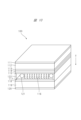
- FIG. 1 is a diagram illustrating an example of the configuration of a liquid crystal optical shutter according to a first embodiment.
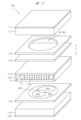
- 1 is a diagram showing the liquid crystal optical shutter according to the first embodiment disassembled into a plurality of parts;
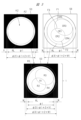
- FIG. 2 is a diagram showing the configuration of a light shielding layer and a second transparent electrode layer.
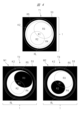
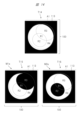
- 13A and 13B are diagrams for explaining the formation of a mask using a liquid crystal light shutter without misalignment of the light-shielding layer.
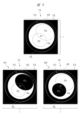
- 13A and 13B are diagrams for explaining the formation of a mask using a liquid crystal light shutter with a misaligned light-shielding layer.
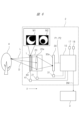
- FIG. 11 is a diagram illustrating an example of the configuration of an imaging device according to a second embodiment.
- FIG. 11 is a diagram illustrating an example of the configuration of an arithmetic and control unit according to a second embodiment.
- FIG. 11 is a flowchart showing an example of the flow of operations of an imaging device according to a second embodiment.
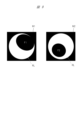
- FIG. 1 shows an example of two masks used in the DFD technique.
- 1A and 1B are diagrams illustrating schematic configurations of typical liquid crystal optical shutters.
- FIG. 1 is a diagram showing a generally conceivable liquid crystal light shutter disassembled into a plurality of parts.
- FIG. 2 is a diagram showing the configuration of a light shielding layer and a second transparent electrode layer.
- 13A and 13B are diagrams for explaining the formation of a mask using a liquid crystal light shutter.
- 11A and 11B are diagrams showing how the opening pattern of the mask changes due to misalignment of the light shielding layer.
- 1A to 1C are diagrams illustrating an example of a manufacturing method for a liquid crystal light shutter.
- the manner in which a subject is blurred in a captured image generally depends on the point spread function, which is determined by the optical system of the imaging device and the shape of the light entrance area of the optical system.
- the point spread function is determined for each mask. Imaging a subject with an imaging device equipped with a mask is called coded imaging.
- coded imaging When a subject is coded, a blurred image is obtained based on the point spread function specific to the mask used.
- FIG. 9 is a diagram showing examples of two masks used in DFD technology.
- Non-Patent Document 1 describes DFD technology using coded imaging with two masks.
- the black areas are areas that block light entering the optical system
- the white areas are areas of openings that allow light entering the optical system to pass through.
- the two masks M1 and M2 shown in FIG. 9 have different geometric patterns of openings (hereinafter also referred to as opening patterns) through which light can pass.
- Mask M1 is a mask in which an elliptical light-shielding region F1 is formed in the upper right corner of a circular light-entrance region RL.
- Mask M2 is a mask in which an elliptical light-shielding region F2 is formed in the lower left corner of the light-entrance region RL.
- the light entrance area RL may be the entire area where light enters the optical system of the imaging device from the subject, or may be an area narrower than that area.
- the light entrance area RL is generally defined by the user in relation to the optical system, but may also be determined based on other factors.
- the light entrance area RL is generally a circular area, but is not limited to this.
- one possible method for switching between multiple masks is to install a liquid crystal optical shutter in the light entrance area, which is the area where light enters the optical system.
- FIG. 10 is a schematic diagram showing an example of a typical liquid crystal optical shutter configuration.
- FIG. 11 is a diagram showing a typical liquid crystal optical shutter 100 disassembled into multiple parts. Note that the z direction in the diagram is the principal axis direction of the optical system of the imaging device.
- the liquid crystal light shutter 100 has a first polarizing plate 111, a first glass substrate 112, a light shielding layer 113, a first transparent electrode layer 114, a first alignment film 115, a liquid crystal layer 116, a second alignment film 117, a second transparent electrode layer 118, a second glass substrate 119, a second polarizing plate 120, a spacer 121, and a sealing layer 122.
- the liquid crystal optical shutter 100 forms the masks M1 and M2 shown in FIG. 9.
- an opening K1 of the same shape and size as the light entrance region RL of the optical system is formed in the light shielding layer 113, and four segment electrodes CR1 to CR4 corresponding to the divided regions obtained by dividing the light entrance region RL are formed in the second transparent electrode layer 118.
- FIG. 12 is a diagram showing the configuration of the light shielding layer 113 and the second transparent electrode layer 118.
- the light shielding layer 113 shields light in an area A1 other than the opening K1.
- the area of the opening K1 is, for example, a circular area with a diameter ⁇ 1.
- the light shielding layer 113 is made of, for example, a metal or resin, and has a black color that absorbs light.
- the segment electrodes CR1 to CR4 of the second transparent electrode layer 118 correspond to the segments R1 to R4 formed in the liquid crystal light shutter 100, respectively.
- a segment is an area in the liquid crystal layer 116 that can independently assume either a light blocking state or a light transmitting state by controlling the electrical signals applied to the segment electrodes CR1 to CR4 in the first transparent electrode layer 114 and the second transparent electrode layer 118.
- Segment R1 corresponds to the overlap region F3 between the light-shielding region F1 in the upper right corner of mask M1 and the light-shielding region F2 in the lower left corner of mask M2.
- Segment R2 corresponds to the region obtained by excluding overlap region F3 from light-shielding region F2.
- Segment R3 corresponds to the region obtained by excluding overlap region F3 from light-shielding region F1.
- Segment R4 corresponds to the region obtained by excluding light-shielding regions F1 and F2, i.e., segments R1 to R3, from the light entrance region RL.
- FIG. 13 is a diagram for explaining the formation of masks M1 and M2 using the liquid crystal optical shutter 100.
- a process is performed to apply the necessary electrical signals to the first transparent electrode layer 114 and each segment electrode so that segments R1 to R4 are in a light-transmitting state, as shown in state T11 in FIG. 13.
- a process is performed to apply the necessary electrical signals to the first transparent electrode layer 114 and each segment electrode so that segments R1 and R3 are in a light-shielding state and segments R2 and R4 are in a light-transmitting state, as shown in state T12 of FIG. 13.
- a process is performed to apply the necessary electrical signals to the first transparent electrode layer 114 and each segment electrode so that segments R1 and R2 are in a light-shielding state and segments R3 and R4 are in a light-transmitting state, as shown in state T13 of FIG. 13.
- the position and shape of the segment electrodes can be relatively accurately determined, but the position accuracy of the light-shielding layer tends to be relatively low. In other words, the alignment accuracy between the light-shielding layer and each segment electrode is likely to be low. If the alignment accuracy between the light-shielding layer and each segment electrode is low, the deviation between the actually formed mask aperture pattern and the intended aperture pattern cannot be ignored. Therefore, when decoding the captured image obtained by encoded imaging, the accuracy of estimating the depth of the subject decreases. The manner in which the mask aperture pattern deviates from the originally intended aperture pattern is explained with reference to the figure.
- Figure 14 shows how the mask opening pattern changes due to misalignment of the light shielding layer.
- the light-shielding layer 113 may erode part of the segment, or an area other than the segment may be formed that is always light-transmitting.
- a mask M1a different from mask M1 is formed.
- a mask M2a different from mask M2 is formed.
- FIG. 15 is a diagram showing an example of a manufacturing method for liquid crystal light shutters. It is assumed that the main manufacturing process for liquid crystal light shutters is carried out by a user operating a dedicated robot or device, but some of the manufacturing process may be carried out by the user himself.
- step H1 the light shielding layer 113 is bonded to the first glass substrate 112. Specifically, a work process is carried out in which the light shielding layer 113 is bonded to the first glass substrate 112 with an adhesive or the like.
- a transparent electrode layer is formed on the first glass substrate 112. Specifically, a transparent conductive film is vapor-deposited on the first glass substrate 112 to which the light-shielding layer 113 is attached, and a process is carried out to form the first transparent electrode layer 114, which serves as a common electrode.
- step H3 a transparent electrode layer is formed on the second glass substrate 119. Specifically, a process of depositing a transparent conductive film on the second glass substrate 119 is carried out.
- step H4 the electrode pattern is processed by photolithography. Specifically, a process is carried out in which a pattern of multiple segment electrodes is drawn by photolithography on the transparent conductive film deposited on the second glass substrate 119.
- the processing accuracy of electrode patterns by lithography is known to be very high, and it is said that it is possible to process within an error of about 1 ⁇ m.
- step H5 the alignment film is formed and the surface is treated. Specifically, a process is carried out in which a first alignment film 115 is formed on the first transparent electrode layer 114, and a second alignment film 117 is formed on the second transparent electrode layer 118. In addition, a process is carried out in which fine grooves are formed on the surfaces of the first alignment film 115 and the second alignment film 117 in order to align the liquid crystal molecules in a certain direction.
- step H6 the glass substrates are bonded together. Specifically, a work process is carried out in which a spacer 121 is sandwiched between the first glass substrate 112 and the second glass substrate 119, and the peripheral edge of the first glass substrate 112 and the peripheral edge of the second glass substrate 119 are fixed together with a sealing layer 122. These glass substrates can be bonded together with an error of about 1 ⁇ m to 5 ⁇ m.
- step H7 liquid crystal is injected and sealed. Specifically, the process of generating liquid crystal layer 116 is carried out by injecting liquid crystal between first glass substrate 112 and second glass substrate 119 and sealing the injection port.
- step H8 the polarizing plates are attached. Specifically, a work process is carried out in which the first polarizing plate 111 is attached to the outer side of the first glass substrate 112, i.e., the surface opposite the liquid crystal layer 116. In addition, a work process is carried out in which the second polarizing plate 120 is attached to the outer side of the second glass substrate 119, i.e., the surface opposite the liquid crystal layer 116.
- the second transparent electrode layer 118 is formed by depositing a transparent conductive film onto the second glass substrate 119 and processing the electrode pattern by lithography.
- Each segment is formed to correspond to the position and shape of each segment electrode in the second transparent electrode layer 118, so deviation from the intended position on the glass substrate can be suppressed to about 1 ⁇ m to 2 ⁇ m.
- the light-shielding layer 113 is adhered to the first glass substrate 112 using an adhesive or the like.
- the light-shielding layer 113 may be relatively largely displaced from the intended position on the first glass substrate 112 by about 5 ⁇ m to 10 ⁇ m. If the positional relationship between the light-shielding layer 113 and the first glass substrate 112 is displaced, a misalignment will occur in the positional relationship between the light-shielding layer 113 and the second transparent electrode layer 118 formed on the second glass substrate 119.
- the light shielding layer 113 may erode part of the light incidence region RL, and the opening pattern of the mask that is actually formed may deviate from the intended opening pattern to a non-negligible extent.
- encoded imaging is performed using a mask whose opening pattern is misaligned from the intended position, and the resulting captured image is decoded based on a point spread function that corresponds to the intended opening pattern, the depth accuracy of the subject will decrease.
- the liquid crystal light shutter according to embodiment 1 of the present application is a liquid crystal light shutter that forms a mask used for coding imaging, and includes a first transparent electrode layer, a second transparent electrode layer that is disposed opposite to the first transparent electrode layer and has a plurality of transparent segment electrodes, a liquid crystal layer that is disposed between the first transparent electrode layer and the second transparent electrode layer, and a light shielding layer that has an opening formed therein corresponding to an area that includes a light entrance area of an optical system used for coding imaging and is wider than the light entrance area, and that shields light in an outer area of the opening, the plurality of segment electrodes including an outer peripheral segment electrode that corresponds to an outer peripheral area of the light entrance area that includes the outline of the opening, and the mask is formed by controlling an electric signal applied to the first transparent electrode layer and each of the plurality of segment electrodes. Details of this liquid crystal light shutter are as follows.
- FIG. 1 is a schematic diagram showing an example of the configuration of a liquid crystal optical shutter according to embodiment 1.
- FIG. 2 is a diagram showing the liquid crystal optical shutter according to embodiment 1 disassembled into multiple parts. Note that the z direction in the diagram is the principal axis direction of the optical system of the imaging device.
- the liquid crystal light shutter 1 has a first polarizing plate 51, a first glass substrate 52, a light shielding layer 53, a first transparent electrode layer 54, a first alignment film 55, a liquid crystal layer 56, a second alignment film 57, a second transparent electrode layer 58, a second glass substrate 59, a second polarizing plate 60, a spacer 61, and a sealing layer 62.
- the liquid crystal light shutter 1 forms the masks M1 and M2 shown in FIG. 9.
- an opening K2 is formed in the light shielding layer 53, which corresponds to an area that includes the light entrance region RL of the optical system and is wider than the light entrance region RL.
- the opening K2 has a shape similar to the light entrance region RL, and is larger than the light entrance region RL by a width V.
- a total of five electrodes are formed on the second transparent electrode layer 58: four segment electrodes CR1 to CR4 and an outer peripheral segment electrode CR5.
- FIG. 3 is a diagram showing the configuration of the light shielding layer 53 and the second transparent electrode layer 58.
- the light shielding layer 53 shields light in the outer area A2 of the opening K2.
- the light incidence area RL is a circular area with a diameter of ⁇ 1
- the light shielding layer 53 is made of, for example, metal or resin, and has a black color that absorbs light.
- the segment electrodes CR1 to CR4 and the peripheral segment electrode CR5 in the second transparent electrode layer 58 correspond to the segments R1 to R4 and the peripheral segment R5 formed in the liquid crystal light shutter 1, respectively.
- Segments R1 to R4 are the same as segments R1 to R4 in the liquid crystal optical shutter 100 described above. That is, segment R1 is a segment corresponding to overlapping region F3 between light-shielding region F1 in the upper right of mask M1 and light-shielding region F2 in the lower left of mask M2. Segment R2 is a segment corresponding to the region obtained by excluding overlapping region F3 from light-shielding region F2. Segment R3 is a segment corresponding to the region obtained by excluding overlapping region F3 from light-shielding region F1. Segment R4 is a segment corresponding to the region obtained by excluding light-shielding regions F1 and F2, i.e., segments R1 to R3, from light entrance region RL.
- the peripheral segment R5 is a segment that corresponds to the combined region of segments R1 to R4, i.e., the peripheral region of the light entrance region RL.
- the peripheral segment R5 is a ring-shaped segment that is located adjacent to the outside of the light entrance region RL.
- Widths V and W are designed so that even if the light-shielding layer 53 is shifted from the intended position by the maximum expected deviation, the light-shielding layer 53 will not extend beyond the inner end of the outer peripheral segment R5.
- the width W of the band of the outer peripheral segment R5 is designed, for example, to be several to ten times the maximum expected deviation of the light-shielding layer 53. If the maximum expected deviation is, for example, 5 ⁇ m, then the width W is, for example, 10 ⁇ m to 30 ⁇ m, and the width V is, for example, W/2.
- the target position for placing the light-shielding layer 53 is, for example, a position where the inner end of the light-shielding layer 53 is as close as possible to the center of the band of the outer peripheral segment R5.
- widths V and W are merely examples and are not limited to these. However, the specific values in this embodiment are an example of realistic values when considering current manufacturing technology and the estimated amount of misalignment of the light shielding layer when manufacturing liquid crystal light shutters.
- Figure 4 is a diagram to explain the formation of a mask using a liquid crystal light shutter 1 with no misalignment of the light shielding layer.
- a process is performed to apply the necessary electrical signals to the first transparent electrode layer 54 and the electrodes corresponding to each segment so that segments R1, R3, and R5 are in a light-shielding state and segments R2 and R4 are in a light-transmitting state, as shown in state T2 in Figure 4.
- Figure 5 is a diagram to explain the formation of a mask using a liquid crystal light shutter 1 with a misaligned light shielding layer.
- the electrical signals applied to each electrode are controlled so that segments R1 to R4 are in a light-transmitting state and peripheral segment R5 is in a light-shielding state, as shown in state T4 in Figure 5.
- the light-shielding layer 53 is positioned at a position shifted from the intended position shown by the dashed line, the end of opening K2 in the light-shielding layer 53 is hidden by peripheral segment R5, which is in a light-shielding state, and does not encroach on the light incidence region RL, i.e., the region of segments R1 to R4. Therefore, it is possible to obtain a state in which no mask is formed and the opening is formed as intended.
- the electrical signals applied to each electrode are controlled so that segments R1, R3 and peripheral segment R5 are in a light-shielding state, and segments R2 and R4 are in a light-transmitting state, as shown in state T5 in Figure 5.
- the light-shielding layer 53 is positioned at a position shifted from the intended position, but the end of opening K2 in light-shielding layer 53 is hidden by peripheral segment R5 and does not encroach on the light incidence region RL, i.e., the region of segments R1 to R4. Therefore, it is possible to form a mask M1 with openings formed as intended.
- the electrical signals applied to each electrode are controlled so that segments R1, R2 and peripheral segment R5 are in a light-shielding state, and segments R3 and R4 are in a light-transmitting state, as shown in state T6 in FIG. 5.
- the light-shielding layer 53 is positioned at a position shifted from the intended position, but the end of opening K2 in light-shielding layer 53 is hidden by peripheral segment R5 and does not encroach on light incidence region RL, i.e., the region of segments R1 to R4. Therefore, it is possible to form mask M2 with openings formed as intended.
- the second transparent electrode layer 58 is formed by depositing a transparent conductive film onto the second glass substrate 59. Since each segment is formed to correspond to the shape of each electrode in the second transparent electrode layer 58, deviation from the intended position on the glass substrate can be suppressed to approximately 1 ⁇ m to 2 ⁇ m.
- the light-shielding layer 53 is bonded to the first glass substrate 52.
- the light-shielding layer 53 it is difficult to maintain high positional accuracy with respect to the glass substrate, and there is a possibility that the light-shielding layer 53 may be misaligned by several ⁇ m to 10 ⁇ m from the intended alignment position of the segments R1 to R4.
- the multiple segments include a ring-shaped peripheral segment R5 that is positioned outside the light incidence region RL. That is, a ring-shaped peripheral segment electrode CR5 that corresponds to the ring-shaped peripheral segment R5 is provided in the second transparent electrode layer 58. If the peripheral segment R5 is placed in a light-shielding state when the mask is formed, the inner end of the peripheral segment R5 is guaranteed to have high positional accuracy even if the light-shielding layer 53 is misaligned from the intended position.
- the opening pattern of the mask that is formed is not affected by the misalignment, and the difference from the intended opening pattern can be reduced.
- the first embodiment it is possible to provide a more practical DFD technology. More specifically, even if the light shielding layer 53 of the liquid crystal optical shutter 1 is arranged at a position shifted from the intended position due to the above-mentioned configuration, the position shift is absorbed by the presence of the peripheral segment R5. In other words, the opening pattern of the mask formed does not change. If the opening pattern of the mask does not change, the position shift of the light shielding layer 53 does not affect the decoding even if the captured image obtained by the coded imaging is decoded based on the point spread function corresponding to the originally intended mask opening pattern. Therefore, when decoding the captured image obtained by the coded imaging, it is possible to eliminate the decrease in the accuracy of subject depth estimation due to the position shift of the light shielding layer 53. This effect leads to improved practicality in the DFD technology.
- the liquid crystal light shutter 1 may have a configuration in which, among the multiple segment electrodes, two or more segment electrodes corresponding to segments that are commonly in a light-blocking state when multiple masks are formed include an outer peripheral segment electrode CR5 and are connected to each other.
- the liquid crystal optical shutter 1 is configured to connect an electrode corresponding to the ring-shaped peripheral segment R5 to an electrode corresponding to a segment that is always in a light-shielding state when forming a mask.
- the liquid crystal optical shutter 1 is configured to connect the peripheral segment electrode CR5 corresponding to the peripheral segment R5 and the segment electrode CR1 corresponding to segment R1 to each other.
- the electrodes of multiple segments that are in a light-blocking state can be combined into a single electrode, which not only simplifies the wiring of the electrodes but also reduces the wiring area that reduces transparency.
- the imaging device according to embodiment 2 is an imaging device that includes the liquid crystal optical shutter according to embodiment 1.
- FIG. 6 is a diagram showing an example of the configuration of an imaging device according to embodiment 2.
- the imaging device 2 according to embodiment 2 has an optical system section 20, an image sensor 30, a liquid crystal mask section 40, an optical system control section 21, an image sensor control section 31, a liquid crystal mask control section 41, and an arithmetic control section 10.
- the z direction in the figure is the principal axis direction of the optical system section 20.
- the optical system unit 20 collects light L, which is emitted or reflected light from the subject 4, and forms an image on the light receiving surface 30a of the image sensor 30 described below.
- the optical system unit 20 includes a lens 20a.
- the lens 20a is, for example, a fixed focus lens or a zoom lens.
- the lens 20a is generally a compound lens made up of multiple lenses, but may also be a single lens.
- the optical system unit 20 may be of an autofocus type or a fixed focus type.
- the image sensor 30 is an electronic component that performs photoelectric conversion.
- the image sensor 30 is a device that forms an image on the light receiving surface 30a of the image sensor 30 through the optical system unit 20, which receives light L that is emitted or reflected from the subject 4 that is a distance D (depth) away from the lens 20a, photoelectrically converts the brightness and darkness of the image into an amount of electric charge, and reads out and converts it into an electrical signal.
- the imaging element 30 generally has a plurality of photoelectric conversion elements arranged in a two-dimensional array, and these plurality of photoelectric conversion elements form a light receiving surface 30a.
- the imaging element 30 is positioned so that light L that enters the optical system unit 20 from the subject 4 and passes through the optical system unit 20 is received by the light receiving surface 30a.
- the imaging element 30 converts the intensity of the light received by the light receiving surface 30a, i.e., brightness, into an electrical signal and outputs an image signal.
- the imaging element 30 may be one that outputs a color image signal representing a color image, or one that outputs a monochrome image signal representing a monochrome image.
- the imaging element 30 is, for example, a CCD (Charge Coupled Devices) image sensor or a COMS (Complementary Metal Oxide Semiconductor) image sensor.
- CCD Charge Coupled Devices
- COMS Complementary Metal Oxide Semiconductor
- the liquid crystal mask unit 40 is provided in front of the optical system unit 20 on the subject 4 side.
- the liquid crystal mask unit 40 has the function of making one of a number of predetermined masks appear, or making none of the masks appear.
- the liquid crystal mask unit 40 may be provided inside the optical system unit 20.
- the liquid crystal mask section 40 is configured so that it can be placed in a state where either the mask M1 or M2 is installed on the subject 4 side of the optical system section 20, or in a state where there is no mask.
- the liquid crystal mask section 40 has the liquid crystal optical shutter 1 described above.
- the optical system control unit 21 adjusts the position of the movable parts included in the optical system unit 20 based on a control signal received from the calculation control unit 10.
- the optical system control unit 21 has, for example, a drive motor, and moves at least a part of the lens by operating the drive motor.
- the optical system control unit 21 may change the zoom magnification by moving some of the lenses that make up the zoom lens, or adjust the focus by moving the entire zoom lens. If the optical system unit 20 includes a fixed focal length lens, the focus may be adjusted by moving the entire lens. If the optical system unit 20 includes an aperture mechanism, the aperture opening diameter may be adjusted by operating the aperture mechanism.
- the imaging device control unit 31 performs imaging by reading the image signal output from the imaging device 30 based on the control signal received from the calculation control unit 10.
- the imaging device control unit 31 transmits the read image signal to the calculation control unit 10.
- the shutter method used to control the imaging device 30 to capture an image of the subject 4 may be, for example, a global shutter method or a rolling shutter method.
- the liquid crystal mask control unit 41 controls the liquid crystal mask unit 40 based on the control signal received from the calculation control unit 10, and realizes a state in which the intended mask M is installed in the liquid crystal mask unit 40, or a state in which the mask M is not installed.
- ⁇ Configuration example of the arithmetic control unit> 7 is a diagram showing an example of the configuration of the arithmetic and control unit 10 according to embodiment 2.
- the arithmetic and control unit 10 is, for example, a computer, and has a processor 11, a memory 12, and an interface 13.
- Memory 12 stores programs P that are used by processor 11 to execute various types of arithmetic processing or image processing, and to execute various types of control processing. Memory 12 also temporarily or long-term stores data that processor 11 processes.
- Processor 11 reads and executes program P stored in memory 12 to execute various processes including arithmetic processing, image processing, and control processing. When executing various processes, processor 11 stores data in memory 12 and accesses data stored in memory 12 to execute the processes.
- the processor 11 executes unmasked imaging process, representative edge direction determination process, mask selection process, first mask imaging process, second mask imaging process, decoding process, subject depth estimation process, depth map generation process, data output process, and imaging continuation determination process. Details of these various processes will be described later.
- the processor 11 transmits control signals to the optical system control unit 21, the image sensor control unit 31, and the liquid crystal mask control unit 41 to execute the above-mentioned maskless imaging process, representative edge direction determination process, mask selection process, first mask imaging process, and second mask imaging process.
- the interface 13 is connected to the external device 3 and transmits the decoded image or depth map DM generated in the calculation control unit 10 to the external device 3.
- all or part of the above computer may be composed of semiconductor circuits such as a DSP (Digital Signal Processor), ASIC (Application Specific Integrated Circuit), FPGA (Field Programmable Gate Array), or CPLD (Complex Programmable Logic Device).
- DSP Digital Signal Processor
- ASIC Application Specific Integrated Circuit
- FPGA Field Programmable Gate Array
- CPLD Complex Programmable Logic Device
- the external device 3 is, for example, an image processing device, a vehicle driving assistance device, etc.
- the image processing device processes the captured image, for example, by blurring the background that is far from the optical system and emphasizing the subject that is attracting attention.
- the vehicle driving assistance device detects, for example, the positions or relative moving speed of objects around the vehicle, and issues warnings or controls the vehicle to avoid danger.
- the operation unit 17 and the display unit 18 are connected to the calculation control unit 10.
- the operation unit 17 is for receiving input operations from the user, and the display unit 18 is for visually outputting information for the user.
- the operation unit 17 is, for example, a keyboard, a mouse, a button, a dial, etc.
- the display unit 18 is, for example, a liquid crystal panel, an organic EL panel, etc.
- the operation unit 17 and the display unit 18 may be an integrated touch panel.
- the operation unit 17 and the display unit 18 may be provided on the external device 3 side.
- FIG. 8 is a flow diagram showing an example of the flow of operations of the imaging device 2 according to the second embodiment.
- step S1 the first mask M1 is formed.
- the calculation control unit 10 sends a control signal to the liquid crystal mask control unit 41 so that mask M1 is formed on the liquid crystal light shutter 1.
- the liquid crystal mask control unit 41 applies the necessary electrical signals to each electrode of the liquid crystal light shutter 1, and controls the state of each segment to a light-transmitting state or a light-blocking state, thereby creating a state in which mask M1 is formed.
- step S2 encoded imaging of the subject is performed using the first mask.
- the calculation control unit 10 transmits a control signal to the image sensor control unit 31 so that the subject 4 is encoded and imaged using the formed mask M1.
- the image sensor control unit 31 controls the image sensor 30 so that the subject 4 is imaged, i.e., so that an imaged image P1 of the subject 4 represented by the output signal of the image sensor 30 is transmitted to the calculation control unit 10.
- step S3 the second mask M2 is formed.
- the calculation control unit 10 sends a control signal to the liquid crystal mask control unit 41 so that mask M2 is formed on the liquid crystal light shutter 1.
- the liquid crystal mask control unit 41 applies the necessary electrical signals to each electrode of the liquid crystal light shutter 1, and controls the state of each segment to a light-transmitting state or a light-blocking state, thereby creating a state in which mask M2 is formed.
- step S4 encoded imaging of the subject is performed using the second mask.
- the calculation control unit 10 transmits a control signal to the image sensor control unit 31 so that the subject 4 is encoded and imaged using the formed mask M2.
- the image sensor control unit 31 controls the image sensor 30 so that the subject 4 is imaged, i.e., so that an imaged image P2 of the subject 4 represented by the output signal of the image sensor 30 is transmitted to the calculation control unit 10.
- step S5 the captured images are decoded. Specifically, the calculation control unit 10 decodes the captured images P1 and P2 obtained based on the point spread function corresponding to mask M1 and the point spread function corresponding to mask M2.
- step S6 a decoded image and subject depth information are obtained.
- the calculation control unit 10 obtains a decoded image of the subject 4 and depth estimation information of objects corresponding to each position in the decoded image based on the information obtained by the above decoding.
- step S7 a depth map is generated. Specifically, the calculation control unit 10 generates a depth map DM of the subject 4 based on the obtained decoded image and the depth estimation information.
- step S8 the depth map is output. Specifically, the calculation control unit 10 outputs the generated depth map DM to the external device 3.
- the imaging device 2 the formation of a mask used for encoding imaging is realized by the liquid crystal optical shutter 1.
- the liquid crystal optical shutter 1 can realize any mask depending on the design of the segments, and there is no need to physically switch hardware to switch the state of the mask. Therefore, the position of the mask can be controlled with high precision, and the mechanism for switching the mask can also be simplified.
- the present invention is not limited to the above-mentioned embodiments and includes various modified examples. Furthermore, the above-mentioned embodiments have been described in detail to clearly explain the present invention, and are not necessarily limited to those having all of the configurations described. Furthermore, it is possible to replace part of the configuration of one embodiment with the configuration of another embodiment, and it is also possible to add the configuration of another embodiment to the configuration of one embodiment. All of these belong to the scope of the present invention. Furthermore, the numerical values etc. contained in the text and figures are merely examples, and the effect of the present invention will not be impaired if different ones are used.
- 1...liquid crystal optical shutter 2...imaging device, 3...external device, 4...subject, 10...arithmetic control unit, 11...processor, 12...memory, 13...interface, 17...operation unit, 18...display unit, 20...optical system unit, 21...optical system control unit, 30...imaging element, 31...imaging element control unit, 40...liquid crystal mask unit, 41...liquid crystal mask control unit, 51...first polarizing plate, 52...first glass substrate, 53...light shielding layer, 54...first transparent electrode layer, 55...first alignment film, 56...liquid crystal layer, 57...second alignment film , 58...second transparent electrode layer, 59...second glass substrate, 60...second polarizing plate, 61...spacer, 62...sealing layer, A2...outer region, CR1-CR4...segment electrodes, CR5...peripheral segment electrode, D...depth, K2...opening, L...light, M1, M2, M1a, M2a...mask, P...pro
Landscapes
- Physics & Mathematics (AREA)
- Nonlinear Science (AREA)
- General Physics & Mathematics (AREA)
- Chemical & Material Sciences (AREA)
- Crystallography & Structural Chemistry (AREA)
- Optics & Photonics (AREA)
- Mathematical Physics (AREA)
- Geometry (AREA)
- Engineering & Computer Science (AREA)
- Multimedia (AREA)
- Signal Processing (AREA)
- Liquid Crystal (AREA)
- Diaphragms For Cameras (AREA)
- Studio Devices (AREA)
Priority Applications (2)
| Application Number | Priority Date | Filing Date | Title |
|---|---|---|---|
| JP2024551261A JPWO2024079997A1 (https=) | 2022-10-12 | 2023-08-23 | |
| US19/097,072 US20250231446A1 (en) | 2022-10-12 | 2025-04-01 | Liquid crystal optical shutter and imaging device |
Applications Claiming Priority (2)
| Application Number | Priority Date | Filing Date | Title |
|---|---|---|---|
| JP2022-164120 | 2022-10-12 | ||
| JP2022164120 | 2022-10-12 |
Related Child Applications (1)
| Application Number | Title | Priority Date | Filing Date |
|---|---|---|---|
| US19/097,072 Continuation US20250231446A1 (en) | 2022-10-12 | 2025-04-01 | Liquid crystal optical shutter and imaging device |
Publications (1)
| Publication Number | Publication Date |
|---|---|
| WO2024079997A1 true WO2024079997A1 (ja) | 2024-04-18 |
Family
ID=90669374
Family Applications (1)
| Application Number | Title | Priority Date | Filing Date |
|---|---|---|---|
| PCT/JP2023/030332 Ceased WO2024079997A1 (ja) | 2022-10-12 | 2023-08-23 | 液晶光シャッタおよび撮像装置 |
Country Status (3)
| Country | Link |
|---|---|
| US (1) | US20250231446A1 (https=) |
| JP (1) | JPWO2024079997A1 (https=) |
| WO (1) | WO2024079997A1 (https=) |
Citations (3)
| Publication number | Priority date | Publication date | Assignee | Title |
|---|---|---|---|---|
| WO2011129055A1 (ja) * | 2010-04-13 | 2011-10-20 | パナソニック株式会社 | ブラー補正装置およびブラー補正方法 |
| WO2012008337A1 (ja) * | 2010-07-16 | 2012-01-19 | オリンパス株式会社 | 撮像装置 |
| WO2022059279A1 (ja) * | 2020-09-18 | 2022-03-24 | 株式会社ジャパンディスプレイ | カメラモジュール |
-
2023
- 2023-08-23 JP JP2024551261A patent/JPWO2024079997A1/ja active Pending
- 2023-08-23 WO PCT/JP2023/030332 patent/WO2024079997A1/ja not_active Ceased
-
2025
- 2025-04-01 US US19/097,072 patent/US20250231446A1/en active Pending
Patent Citations (3)
| Publication number | Priority date | Publication date | Assignee | Title |
|---|---|---|---|---|
| WO2011129055A1 (ja) * | 2010-04-13 | 2011-10-20 | パナソニック株式会社 | ブラー補正装置およびブラー補正方法 |
| WO2012008337A1 (ja) * | 2010-07-16 | 2012-01-19 | オリンパス株式会社 | 撮像装置 |
| WO2022059279A1 (ja) * | 2020-09-18 | 2022-03-24 | 株式会社ジャパンディスプレイ | カメラモジュール |
Also Published As
| Publication number | Publication date |
|---|---|
| JPWO2024079997A1 (https=) | 2024-04-18 |
| US20250231446A1 (en) | 2025-07-17 |
Similar Documents
| Publication | Publication Date | Title |
|---|---|---|
| CN101371568B (zh) | 复眼方式的照相机模块及其制造方法 | |
| US20120019736A1 (en) | Imaging device | |
| US10110811B2 (en) | Imaging module and imaging device | |
| JP2008216626A (ja) | 可変焦点レンズ | |
| CN103348668B (zh) | 光场摄像装置以及摄像元件 | |
| CN105472357A (zh) | 成像方法、成像装置和拍摄系统 | |
| US7768711B2 (en) | Manufacturing method of light-collecting device, light-collecting device and phase shift mask | |
| CN111201481B (zh) | 相位调制装置 | |
| JPWO2006046396A1 (ja) | カメラモジュール | |
| WO2024079997A1 (ja) | 液晶光シャッタおよび撮像装置 | |
| CN102971666B (zh) | 减光装置以及摄像装置 | |
| JP6123250B2 (ja) | 液晶装置、液晶装置の製造方法、及び電子機器 | |
| US20250124585A1 (en) | Imaging apparatus, subject depth estimation method, and program | |
| JP6442065B2 (ja) | フォーカス装置,撮像システムおよびフォーカス駆動信号出力方法 | |
| JP2014085517A (ja) | 液晶装置、及び電子機器 | |
| CN109313379A (zh) | 图像摄像装置及滤光片 | |
| US8848276B2 (en) | Optical-path conversion device and imaging apparatus | |
| JPH10229181A (ja) | 固体撮像装置とその製造方法 | |
| US20250238943A1 (en) | Imaging device, method of estimating subject depth, and program | |
| JPH06148593A (ja) | 光量調整装置を有した光学系 | |
| JPWO2022137807A5 (https=) | ||
| US20210105412A1 (en) | Image sensor with pixelated cutoff filter for phase detection autofocus | |
| JP2011082795A (ja) | 撮像装置及びデジタルカメラ | |
| CN116300272A (zh) | 投影设备、投影设备调整方法、系统、介质及产品 | |
| WO2020261852A1 (ja) | 投影装置 |
Legal Events
| Date | Code | Title | Description |
|---|---|---|---|
| 121 | Ep: the epo has been informed by wipo that ep was designated in this application |
Ref document number: 23877005 Country of ref document: EP Kind code of ref document: A1 |
|
| WWE | Wipo information: entry into national phase |
Ref document number: 2024551261 Country of ref document: JP |
|
| NENP | Non-entry into the national phase |
Ref country code: DE |
|
| 122 | Ep: pct application non-entry in european phase |
Ref document number: 23877005 Country of ref document: EP Kind code of ref document: A1 |