WO2024075762A1 - 化合物、組成物、異方性色素膜及び光学素子 - Google Patents
化合物、組成物、異方性色素膜及び光学素子 Download PDFInfo
- Publication number
- WO2024075762A1 WO2024075762A1 PCT/JP2023/036161 JP2023036161W WO2024075762A1 WO 2024075762 A1 WO2024075762 A1 WO 2024075762A1 JP 2023036161 W JP2023036161 W JP 2023036161W WO 2024075762 A1 WO2024075762 A1 WO 2024075762A1
- Authority
- WO
- WIPO (PCT)
- Prior art keywords
- ring
- group
- dye
- composition
- substituent
- Prior art date
- Legal status (The legal status is an assumption and is not a legal conclusion. Google has not performed a legal analysis and makes no representation as to the accuracy of the status listed.)
- Ceased
Links
Classifications
-
- C—CHEMISTRY; METALLURGY
- C09—DYES; PAINTS; POLISHES; NATURAL RESINS; ADHESIVES; COMPOSITIONS NOT OTHERWISE PROVIDED FOR; APPLICATIONS OF MATERIALS NOT OTHERWISE PROVIDED FOR
- C09B—ORGANIC DYES OR CLOSELY-RELATED COMPOUNDS FOR PRODUCING DYES, e.g. PIGMENTS; MORDANTS; LAKES
- C09B29/00—Monoazo dyes prepared by diazotising and coupling
- C09B29/0003—Monoazo dyes prepared by diazotising and coupling from diazotized anilines
-
- C—CHEMISTRY; METALLURGY
- C08—ORGANIC MACROMOLECULAR COMPOUNDS; THEIR PREPARATION OR CHEMICAL WORKING-UP; COMPOSITIONS BASED THEREON
- C08F—MACROMOLECULAR COMPOUNDS OBTAINED BY REACTIONS ONLY INVOLVING CARBON-TO-CARBON UNSATURATED BONDS
- C08F20/00—Homopolymers and copolymers of compounds having one or more unsaturated aliphatic radicals, each having only one carbon-to-carbon double bond, and only one being terminated by only one carboxyl radical or a salt, anhydride, ester, amide, imide or nitrile thereof
- C08F20/02—Monocarboxylic acids having less than ten carbon atoms, Derivatives thereof
- C08F20/10—Esters
- C08F20/40—Esters of unsaturated alcohols, e.g. allyl (meth)acrylate
-
- C—CHEMISTRY; METALLURGY
- C09—DYES; PAINTS; POLISHES; NATURAL RESINS; ADHESIVES; COMPOSITIONS NOT OTHERWISE PROVIDED FOR; APPLICATIONS OF MATERIALS NOT OTHERWISE PROVIDED FOR
- C09B—ORGANIC DYES OR CLOSELY-RELATED COMPOUNDS FOR PRODUCING DYES, e.g. PIGMENTS; MORDANTS; LAKES
- C09B31/00—Disazo and polyazo dyes of the type A->B->C, A->B->C->D, or the like, prepared by diazotising and coupling
- C09B31/02—Disazo dyes
- C09B31/04—Disazo dyes from a coupling component "C" containing a directive amino group
- C09B31/043—Amino-benzenes
-
- C—CHEMISTRY; METALLURGY
- C09—DYES; PAINTS; POLISHES; NATURAL RESINS; ADHESIVES; COMPOSITIONS NOT OTHERWISE PROVIDED FOR; APPLICATIONS OF MATERIALS NOT OTHERWISE PROVIDED FOR
- C09B—ORGANIC DYES OR CLOSELY-RELATED COMPOUNDS FOR PRODUCING DYES, e.g. PIGMENTS; MORDANTS; LAKES
- C09B31/00—Disazo and polyazo dyes of the type A->B->C, A->B->C->D, or the like, prepared by diazotising and coupling
- C09B31/16—Trisazo dyes
- C09B31/18—Trisazo dyes from a coupling component "D" containing a directive amine group
-
- C—CHEMISTRY; METALLURGY
- C09—DYES; PAINTS; POLISHES; NATURAL RESINS; ADHESIVES; COMPOSITIONS NOT OTHERWISE PROVIDED FOR; APPLICATIONS OF MATERIALS NOT OTHERWISE PROVIDED FOR
- C09B—ORGANIC DYES OR CLOSELY-RELATED COMPOUNDS FOR PRODUCING DYES, e.g. PIGMENTS; MORDANTS; LAKES
- C09B67/00—Influencing the physical, e.g. the dyeing or printing properties of dyestuffs without chemical reactions, e.g. by treating with solvents grinding or grinding assistants, coating of pigments or dyes; Process features in the making of dyestuff preparations; Dyestuff preparations of a special physical nature, e.g. tablets, films
- C09B67/006—Preparation of organic pigments
-
- G—PHYSICS
- G02—OPTICS
- G02B—OPTICAL ELEMENTS, SYSTEMS OR APPARATUS
- G02B5/00—Optical elements other than lenses
- G02B5/30—Polarising elements
-
- H—ELECTRICITY
- H05—ELECTRIC TECHNIQUES NOT OTHERWISE PROVIDED FOR
- H05B—ELECTRIC HEATING; ELECTRIC LIGHT SOURCES NOT OTHERWISE PROVIDED FOR; CIRCUIT ARRANGEMENTS FOR ELECTRIC LIGHT SOURCES, IN GENERAL
- H05B33/00—Electroluminescent light sources
- H05B33/02—Details
-
- H—ELECTRICITY
- H10—SEMICONDUCTOR DEVICES; ELECTRIC SOLID-STATE DEVICES NOT OTHERWISE PROVIDED FOR
- H10K—ORGANIC ELECTRIC SOLID-STATE DEVICES
- H10K50/00—Organic light-emitting devices
- H10K50/10—OLEDs or polymer light-emitting diodes [PLED]
Definitions
- the present invention relates to compounds and compositions that are useful for polarizing films and the like provided in display elements such as light control elements, liquid crystal elements (LCDs), and organic electroluminescence elements (OLEDs).
- display elements such as light control elements, liquid crystal elements (LCDs), and organic electroluminescence elements (OLEDs).
- the present invention also relates to anisotropic dye films and optical elements that use the compositions.
- linear and circular polarizing films are used to control the optical rotation and birefringence of the display.
- Circular polarizing films are also used in OLEDs to prevent reflection of external light in bright places.
- polarizing films include a polarizing film made of polyvinyl alcohol (PVA) dyed with low concentration of iodine (iodine-PVA polarizing film) (Patent Document 1).
- PVA polyvinyl alcohol
- iodine-PVA polarizing film low-concentration iodine-PVA polarizing plates have problems such as the iodine sublimating or deteriorating, causing a change in color, and warping due to relaxation of the stretching of the PVA, depending on the usage environment.
- Patent Document 2 an anisotropic dye film formed by applying a liquid crystal composition containing a dye functions as a polarizing film
- anisotropic dye film When using an anisotropic dye film as a polarizer, it is important that the anisotropic dye film has excellent optical performance, particularly a good dichroic ratio, and light resistance, and there is a demand for the development of an anisotropic dye film that has both high optical performance and high light resistance.
- the present invention aims to provide a compound and composition that produces an anisotropic dye film that exhibits a high dichroic ratio and has excellent light resistance, an anisotropic dye film obtained from the composition, and an optical element that includes the anisotropic dye film.
- the present inventors have discovered that a compound having a specific structure can solve the above problems.
- the first aspect of the present invention has the following aspects.
- -XA represents a monovalent organic group.
- -RA1 and -RA2 each independently represent an alkyl group which may have a substituent.
- -RA1 and -RA2 may be joined together to form a ring, but the -RA1 and -RA2 portions of the ring formed by -RA1 and -RA2 are formed only by a hydrocarbon chain.
- -A 1 -, -A 2 -, -A 3 - and -A 4 - each independently represent a 1,4-phenylene group which may have a substituent.
- n represents 0, 1, or 2. When n is 2, multiple -A 3 - may be the same or different.
- -Ra and -Rb may together form a ring having 2 to 15 carbon atoms, and the ring may have a substituent.
- a composition containing a compound represented by the following formula (2) and a polymerizable liquid crystal compound containing a compound represented by the following formula (2) and a polymerizable liquid crystal compound.
- -XB represents a monovalent organic group.
- Each of -RB1 and -RB2 independently represents an alkyl group which may have a substituent, and -RB1 and -RB2 may combine together to form a ring.
- -B 1 - and -B 2 - each independently represents a 1,4-phenylene group which may have a substituent.
- Each of -B 3 - and -B 4 - independently represents a divalent aromatic hydrocarbon ring group which may have a substituent.
- n represents 0, 1, or 2. When n is 2, multiple -B 3 - may be the same or different.
- -Ra and -Rb may together form a ring having 2 to 15 carbon atoms, and the ring may have a substituent.
- the present inventors have found that the above-mentioned problems can be solved by a composition containing a polymerizable liquid crystal compound and a dye exhibiting specific maximum absorption wavelength characteristics.
- the second aspect of the present invention has the following aspects.
- [2-1] A composition containing a polymerizable liquid crystal compound and a dye, A composition in which the maximum absorption wavelength of the dye satisfies the following relation (11): ⁇ max2 ⁇ max1 ⁇ 0 (11) (In formula (11), ⁇ max1 represents the maximum absorption wavelength of the dye in a solvent, and ⁇ max2 represents the maximum absorption wavelength of the dye in a dye film formed using the composition.)
- the compounds and compositions of the present invention can provide an anisotropic dye film that exhibits a high dichroic ratio and has excellent light resistance.
- the present invention will be described in detail below with reference to the embodiments.
- the present invention is not limited to the following embodiments, and can be modified in various ways within the scope of the present invention.
- the "first invention” and the “second invention” will be collectively referred to as "the present invention.”
- the anisotropic dye film in the present invention is a dye film having anisotropy in electromagnetic properties in any two directions selected from a total of three directions in a three-dimensional coordinate system including the thickness direction of the anisotropic dye film and any two orthogonal in-plane directions.
- the electromagnetic properties include optical properties such as absorption and refraction, and electrical properties such as resistance and capacitance.
- films having optical anisotropy such as absorption and refraction include polarizing films such as linear polarizing films and circular polarizing films, retardation films, and conductive anisotropic dye films.
- the anisotropic dye film using the compound and composition of the present invention is preferably used as a polarizing film or a conductive anisotropic dye film, and more preferably used as a polarizing film.
- the dye is a substance or compound that absorbs at least a part of the wavelengths in the visible light region (350 nm to 800 nm).
- Dyes that can be used in the present invention include dichroic dyes.
- the dichroic dye refers to a dye that has different absorbance in the long axis direction of the molecule and absorbance in the short axis direction.
- the dye may or may not have liquid crystallinity.
- liquid crystallinity refers to the ability to exhibit a liquid crystal phase at any temperature.
- the compound of the first invention is a compound represented by the following formula (1) (hereinafter, sometimes referred to as "compound (1)").
- -XA represents a monovalent organic group.
- -RA1 and -RA2 each independently represent an alkyl group which may have a substituent.
- -RA1 and -RA2 may be joined together to form a ring, but the -RA1 and -RA2 portions of the ring formed by -RA1 and -RA2 are formed only by a hydrocarbon chain.
- -A 1 -, -A 2 -, -A 3 - and -A 4 - each independently represent a 1,4-phenylene group which may have a substituent.
- n represents 0, 1, or 2. When n is 2, multiple -A 3 - may be the same or different.
- ⁇ -XA> -XA represents a monovalent organic group.
- the monovalent organic group in -XA does not have a polymerizable group, which will be described later.
- the monovalent organic group in -XA has a polymerizable group, which will be described later.
- the alkyl group having 1 to 15 carbon atoms which may have a branch, the cycloalkyl group having 5 to 14 ring-constituting atoms, and the aryl group having 5 to 14 ring-constituting atoms in -Ra and -Rb each may have a substituent.
- one or more methylene groups contained in an alkyl group having 1 to 15 carbon atoms which may have a branch, a cycloalkyl group having 5 to 14 ring atoms, or a ring formed by combining -Ra and -Rb may have a structure in which they are replaced (displaced) by -O-, -S-, -NH-, -N(R z )-, -C( ⁇ O)-, -C( ⁇ O)-O-, -C( ⁇ O)-NH-, -CHF-, -CF 2 -, -CHCl-, or -CCl 2 -, or may have a structure in which they are replaced by a polymerizable group such as an acryloyloxy group, a methacryloyloxy group, or a glycidyloxy group.
- R z represents a straight-chain or branched alkyl group having 1 to 6 carbon atoms.
- -R f and -R g each independently represent a straight-chain or branched alkyl group having 1 to 15 carbon atoms, preferably 1 to 10 carbon atoms.
- One or more methylene groups contained in the linear or branched alkyl group having 1 to 15 carbon atoms may be displaced by -O-, -S-, -NH-, -N(R h )-, -C( ⁇ O)-, -C( ⁇ O)-O-, -C( ⁇ O)-NH-, -CHF-, -CF 2 -, -CHCl-, or -CCl 2 -, or may be replaced by a polymerizable group such as an acryloyloxy group, a methacryloyloxy group, or a glycidyloxy group.
- R h represents a linear or branched alkyl group having 1 to 6 carbon atoms.
- the substituent permitted for the branched alkyl group having 1 to 15 carbon atoms in -Ra and -Rb is preferably -O- Rf , and examples thereof include methoxy, ethoxy, n-propoxy, n-butoxy, n-pentoxy, n-hexoxy, n-heptoxy, n-octoxy, acryloyloxy, methacryloyloxy, and glycidyloxy.
- -R i and -R j each independently represent a straight-chain or
- substituents for the cycloalkyl group or aryl group having 5 to 14 ring-constituting atoms in -Ra and -Rb are -R i and -O-R i , and examples thereof include methyl, ethyl, n-propyl, n-butyl, n-pentyl, n-hexyl, n-heptyl, n-octyl, 2-ethylhexyl, methoxy, ethoxy, n-propoxy, n-butoxy, n-pentoxy, n-hexoxy, n-heptoxy, n-octoxy, 2-ethylhexyloxy, 5,5-dimethyl-3-methylhexyloxy, and the like.
- Cycloalkane rings of cycloalkyl groups with 5 to 14 ring-constituting atoms of -Ra and -Rb include a cyclopropane ring, a cyclobutane ring, a cyclopentane ring, a cyclohexane ring, a cycloheptane ring, a cyclooctane ring, a cyclohexene ring, a norbornane ring, a bornane ring, an adamantane ring, a tetrahydronaphthalene ring, and a bicyclo[2.2.2]octane ring.
- the aryl group having 5 to 14 ring-constituting atoms of -Ra and -Rb includes a monovalent group of an aromatic hydrocarbon ring or an aromatic heterocyclic ring.
- the aromatic hydrocarbon ring of the monovalent group of the aromatic hydrocarbon ring include a benzene ring, a naphthalene ring, an anthracene ring, a phenanthrene ring, a perylene ring, a tetracene ring, a pyrene ring, a benzpyrene ring, a chrysene ring, a triphenylene ring, an acenaphthene ring, a fluoranthene ring, and a fluorene ring.
- Examples of the aromatic heterocycle of the monovalent group of the aromatic heterocycle include a furan ring, a benzofuran ring, a thiophene ring, a benzothiophene ring, a pyrrole ring, a pyrazole ring, an imidazole ring, a thiazole ring, an isothiazole ring, an oxadiazole ring, a thiadiazole ring, a triazole ring, an indole ring, a carbazole ring, a pyrroloimidazole ring, a pyrrolopyrazole ring, a pyrrolopyrrole ring, a thienopyrrole ring, a thienothiophene ring, a furopyrrole ring, a furofuran ring, a furothiazole ring, a thienofuran ring, a thienothiazole
- -Ra and -Rb are preferably alkyl groups having 1 to 15 carbon atoms which may be branched, or -Ra and -Rb together form a ring having 2 to 15 carbon atoms which may be substituted.
- -Ra and -Rb are more preferably alkyl groups having 1 to 9 carbon atoms which may be branched, or -Ra and -Rb together form a ring having 2 to 10 carbon atoms; more preferably alkyl groups having 1 to 5 carbon atoms which may be branched, or -Ra and -Rb together form a ring having 2 to 6 carbon atoms; and particularly preferably alkyl groups having 1 to 3 carbon atoms which do not have a branch, or -Ra and -Rb together form a ring having 2 to 6 carbon atoms.
- the above tends to improve the molecular orientation of compound (1).
- ⁇ -RA1 and -RA2 > -RA1 and -RA2 each independently represent an alkyl group which may have a substituent.
- -RA1 and -RA2 may be joined together to form a ring, but the -RA1 and -RA2 portions of the ring formed by -RA1 and -RA2 are formed only by a hydrocarbon chain.
- the alkyl group of the alkyl group which may have a substituent of -RA1 and -RA2 may be linear or branched, and examples thereof include those exemplified as -Ra and -Rb, and the same applies to preferred examples.
- a fluorine atom is preferred.
- the ring When -RA1 and -RA2 combine together to form a ring, the ring preferably has 3 to 8 carbon atoms, and more preferably 4 or 5 carbon atoms.
- substituents which may be possessed by the alkyl groups of -RA1 and -RA2 or the ring which -RA1 and -RA2 together form there may be mentioned those exemplified as the substituents which -Ra and -Rb may have.
- -RA1 and -RA2 are preferably alkyl groups having 1 to 10 carbon atoms, which may have a substituent, more preferably alkyl groups having 1 to 6 carbon atoms, and even more preferably alkyl groups having 1 to 4 carbon atoms.
- -N(-RA 1 )RA 2 include dimethylamino, diethylamino, dipropylamino, dibutylamino, ethylmethylamino, methylpropylamino, methylbutylamino, ethylpropylamino, ethylbutyl, azetidinyl, pyrrolidinyl, piperidinyl, azepanyl, and the above group having a fluorine atom.
- diethylamino, isopropyl(methyl)amino, ethyl(isopropyl)amino, pyrrolidinyl, piperidinyl, and the above group having a fluorine atom are more preferred.
- di(fluoroethyl)amino, di(fluoropropyl)amino, fluoroethyl(isopropyl)amino, and ethyl(fluoroisopropyl)amino are more preferred.
- ⁇ -A 1 -, -A 2 -, -A 3 - and -A 4 -> -A 1 -, -A 2 -, -A 3 - and -A 4 - each independently represent a 1,4-phenylene group which may have a substituent.
- examples of the substituent include -R A , -OH, -O-R A , -O-C( ⁇ O)-R A , -NH 2 , -NH-R A , -N(-R B )-R A , -C( ⁇ O)-R A , -C( ⁇ O)-O-R A , -C( ⁇ O)-NH 2 , -C( ⁇ O)-NH-R A , -C( ⁇ O)-N(-R B )-R A , -SH, -S-R A , trifluoromethyl group, sulfamoyl group, carboxy group, cyano group, nitro group and halogen.
- -R A and -R B each independently represent a linear or branched alkyl group having 1 to 15 carbon atoms.
- the number of carbon atoms in -R A and -R B is preferably 1 to 12, more preferably 1 to 9, from the viewpoint of improving molecular orientation with the polymerizable liquid crystal compound used in the first invention.
- One or more methylene groups contained in the linear or branched alkyl group may be replaced by an ether oxygen atom, a thioether sulfur atom, an aminic nitrogen atom (-NH-, -N( Rz )-: here, Rz represents a linear or branched alkyl group having 1 to 6 carbon atoms, preferably 1 to 4 carbon atoms), a carbonyl group, an ester bond, an amide bond, -CHF-, -CF2- , -CHCl- or -CCl2- , or may be substituted by a polymerizable group such as an acryloyloxy group, a methacryloyloxy group or a glycidyloxy group.
- substituents for the 1,4-phenylene group are -R A , -O-R A , a trifluoromethyl group, and a fluoro group.
- -R A include n-propyl, n-butyl, n-pentyl, n-hexyl, n-heptyl, n-octyl, and 5,5-dimethyl-3-methylhexyl.
- the presence of the above-mentioned substituents tends to improve the molecular orientation of the dye of compound (1).
- -A 1 -, -A 2 -, -A 3 - and -A 4 - are all unsubstituted 1,4-phenylene groups, since the absorption transition moment of compound (1) tends to coincide with the long axis direction of the compound, thereby increasing the dichroic ratio.
- n represents 0, 1, or 2.
- n is preferably 0 or 1, and more preferably 1. This tends to improve the molecular orientation of compound (1).
- each -A 3 - may be the same or different.
- the molecular weight of compound (1) is preferably 300 or more, more preferably 350 or more, and even more preferably 380 or more, and is preferably 1500 or less, more preferably 1200 or less, and even more preferably 1000 or less. Specifically, the molecular weight of compound (1) is preferably 300 to 1500, more preferably 350 to 1200, and even more preferably 380 to 1000. When the molecular weight is within the above range, appropriate molecular length and bulkiness are obtained, and therefore the molecular orientation as a dye tends to be good.
- Specific examples of compound (1) include the following compounds, but are not limited to these.
- Compound (1) can be produced by combining known chemical reactions such as alkylation reaction, esterification reaction, amidation reaction, etherification reaction, ipso substitution reaction, diazo coupling reaction, and coupling reaction using a metal catalyst.
- compound (1) can be synthesized according to the methods described in the Examples below, or in “New Dye Chemistry” (Hosoda Yutaka, December 21, 1973, Gihodo), “General Overview of Synthetic Dyes” (Horiguchi Hiroshi, 1968, Sankyo Publishing), and “Theoretical Manufacturing Dye Chemistry” (Hosoda Yutaka, 1957, Gihodo).
- composition of the first invention is a composition containing a compound represented by the following formula (2) (hereinafter, sometimes referred to as "compound (2)”) and a polymerizable liquid crystal compound.
- -XB represents a monovalent organic group.
- Each of -RB1 and -RB2 independently represents an alkyl group which may have a substituent, and -RB1 and -RB2 may combine together to form a ring.
- -B 1 - and -B 2 - each independently represents a 1,4-phenylene group which may have a substituent.
- Each of -B 3 - and -B 4 - independently represents a divalent aromatic hydrocarbon ring group which may have a substituent.
- n represents 0, 1, or 2. When n is 2, multiple -B 3 - may be the same or different.
- the composition of the first invention may be in a solution, liquid crystal, or dispersion state, so long as it does not cause phase separation.
- the composition for forming an anisotropic dye film is preferably in a solution from the viewpoint of ease of application to a substrate.
- the solid components remaining after removing the solvent from the composition for forming an anisotropic dye film are preferably in a liquid crystal phase state at any temperature from the viewpoint of alignment on a substrate as described below.
- the liquid crystal phase state specifically refers to a liquid crystal state that exhibits both liquid and crystalline properties or intermediate properties, such as a nematic phase, smectic phase, cholesteric phase, or discotic phase, as described on pages 1-16 of "Basics and Applications of Liquid Crystals” (by Shoichi Matsumoto and Ichiro Tsunoda; 1991).
- composition of the first invention contains compound (2) as a dye. It is presumed that by containing compound (2) having the specific structure represented by the above formula (2) as a dye, the dye association state in the anisotropic dye film is optimized, and an anisotropic dye film having good optical properties such as a dichroic ratio when used as a polarizer and high light resistance can be obtained.
- composition of the first invention may contain only one type of compound (2), or may contain two or more types.
- (-XB) -XB represents a monovalent organic group.
- -XB the same groups as -XA in the above formula (1) can be mentioned, and preferred groups are also the same.
- Each of --RB1 and --RB2 independently represents an alkyl group which may have a substituent, and --RB1 and --RB2 may combine together to form a ring.
- Examples of --RB1 and --RB2 include the same as --RA1 and --RA2 in the above formula (1), and preferred examples are also the same.
- (-B 1 - and -B 2 -) -B 1 - and -B 2 - each independently represent a 1,4-phenylene group which may have a substituent, and examples of the substituent which the 1,4-phenylene group may have include those exemplified as the substituent which the 1,4-phenylene groups of -A 1 -, -A 2 -, -A 3 - and -A 4 - in formula (1) may have, and preferred examples thereof are also the same.
- -B 1 - and -B 2 - are preferably unsubstituted 1,4-phenylene groups.
- Each of -B 3 - and -B 4 - independently represents a divalent aromatic hydrocarbon ring group which may have a substituent.
- Aromatic hydrocarbon rings of divalent groups of aromatic hydrocarbon rings which may have a substituent include a benzene ring, a naphthalene ring, an anthracene ring, a phenanthrene ring, a perylene ring, a tetracene ring, a pyrene ring, a benzpyrene ring, a chrysene ring, a triphenylene ring, an acenaphthene ring, a fluoranthene ring, and a fluorene ring.
- the absorption transition moment of compound (2) tends to coincide with the long axis direction of the dye, and the dichroic ratio can be increased, so a divalent group of a benzene ring (phenylene group) or a divalent group of a naphthalene ring (naphthylene group) is preferred, and a divalent group of a benzene ring (phenylene group) is more preferred.
- a 1,4-phenylene group, a 1,4-naphthylene group, or a 2,6-naphthylene group is more preferred, a 1,4-phenylene group is even more preferred, and a 1,4-phenylene group having no substituent is particularly preferred.
- Examples of the substituent permitted for the divalent group of the aromatic hydrocarbon ring include those exemplified as the substituent which the 1,4-phenylene group of -A 1 -, -A 2 -, -A 3 - and -A 4 - may have, and the preferred ones are also the same.
- n 0, 1, or 2.
- n is preferably 0 or 1, and more preferably 1. In this case, the molecular orientation of compound (2) tends to be good.
- each --B 3 -- may be the same or different.
- a suitable example of the compound (2) is the above-mentioned compound (1).
- Specific examples of compound (2) include the following compounds in addition to the specific examples of compound (1) described above, but are not limited thereto.
- composition of the second invention contains a dye whose maximum absorption wavelength satisfies the following relational expression (11) (hereinafter, may be referred to as "the dye of the second invention") and a polymerizable liquid crystal compound.
- the composition of the second invention may contain only one type of the dye of the second invention, or may contain two or more types.
- ⁇ max2 ⁇ max1 ⁇ 0 (11) In formula (11), ⁇ max1 represents the maximum absorption wavelength of the dye in a solvent, and ⁇ max2 represents the maximum absorption wavelength of the dye in a dye film formed using the composition.
- the composition of the second invention may be in a solution, liquid crystal, or dispersion state, so long as it does not cause phase separation.
- the composition for forming an anisotropic dye film is preferably in a solution from the viewpoint of ease of application to a substrate.
- the solid components remaining after removing the solvent from the composition for forming an anisotropic dye film are preferably in a liquid crystal phase state at any temperature from the viewpoint of alignment on a substrate as described below.
- the liquid crystal phase state specifically refers to a liquid crystal state that exhibits both liquid and crystalline properties or intermediate properties, such as a nematic phase, smectic phase, cholesteric phase, or discotic phase, as described on pages 1-16 of "Basics and Applications of Liquid Crystals” (by Shoichi Matsumoto and Ichiro Tsunoda; 1991).
- the dye of the second invention satisfies ⁇ max2 - ⁇ max1 ⁇ 0, that is, ⁇ max2 is smaller than ⁇ max1 , and there is no particular restriction on the difference between ⁇ max1 and ⁇ max2 .
- the dye of the second invention satisfies the following relational formula (11A).
- ⁇ max1 and ⁇ max2 satisfy the following relational expression (11B), and it is even more preferable that they satisfy the following relational expression (11C).
- the solvent in which the maximum absorption wavelength ⁇ max1 of the dye is measured is not particularly limited, and any solvent may be used as long as the dye dissolves to form a homogeneous solution.
- the maximum absorption wavelength ⁇ max1 of the dye i.e., the wavelength ⁇ max1 at which the absorbance of the dye is maximized
- the maximum absorption wavelength ⁇ max2 of the dye in the dye film is the wavelength ⁇ max2 at which the orthogonal absorbance of the dye in the dye film is maximized.
- the maximum absorption wavelengths ⁇ max1 and ⁇ max2 are specifically measured by a spectrophotometer.
- the values of the maximum absorption wavelengths ⁇ max1 and ⁇ max2 of the dye of the second invention are not particularly limited as long as they satisfy the above-mentioned relational formula (11).
- the maximum absorption wavelength ⁇ max1 of the dye of the second invention is preferably in the range of 380 to 800 nm, more preferably in the range of 400 to 750 nm, and even more preferably in the range of 410 to 700 nm.
- the maximum absorption wavelength ⁇ max2 of the dye of the second invention is preferably in the range of 350 to 800 nm, more preferably in the range of 380 to 750 nm, and further preferably in the range of 400 to 700 nm.
- the dye of the second invention is not particularly limited as long as it satisfies the above relational formula (11), preferably the above relational formula (11A), more preferably the above relational formula (11B), and even more preferably the above relational formula (11C), but is preferably an azo dye from the viewpoint of optical performance such as dichroic ratio.
- azo dyes a compound represented by the following formula (12) (hereinafter sometimes referred to as "compound (12)”) tends to have better optical performance such as dichroic ratio, and is therefore preferred.
- -A 21 -, -A 22 -, and -A 23 - each independently represent a divalent group of an aromatic hydrocarbon ring which may have a substituent, or an aromatic heterocycle which may have a substituent
- -X 20 and -Y 20 each independently represent an arbitrary monovalent substituent
- m1 represents 1 or 2
- n1 represents 0, 1, 2, or 3.
- a divalent group of an aromatic hydrocarbon ring which may have a substituent examples include a benzene ring, a naphthalene ring, an anthracene ring, a phenanthrene ring, a perylene ring, a tetracene ring, a pyrene ring, a benzpyrene ring, a chrysene ring, a triphenylene ring, an acenaphthene ring, a fluoranthene ring, and a fluorene ring.
- the absorption transition moment of compound (12) tends to coincide with the long axis direction of the dye, and the dichroic ratio can be increased, so a divalent group of a benzene ring (phenylene group) or a divalent group of a naphthalene ring (naphthylene group) is preferred, and a divalent group of a benzene ring (phenylene group) is more preferred.
- a 1,4-phenylene group, a 1,4-naphthylene group, or a 2,6-naphthylene group is more preferred, a 1,4-phenylene group is even more preferred, and a 1,4-phenylene group having no substituent is particularly preferred.
- substituents permitted for the divalent group of the aromatic hydrocarbon ring include -R A , -OH, -O-R A , -O-C( ⁇ O)-R A , -NH 2 , -NH-R A , -N(-R B )-R A , -C( ⁇ O)-R A , -C( ⁇ O)-O-R A , -C( ⁇ O)-NH 2 , -C( ⁇ O)-NH-R A , -C( ⁇ O)-N(-R B )-R A , -SH, -S-R A , trifluoromethyl group, sulfamoyl group, carboxy group, cyano group, nitro group, and halogen.
- -R A and -R B each independently represent a straight-chain or branched alkyl group having 1 to 15 carbon atoms.
- the number of carbon atoms in -R A and -R B is preferably 1 or more and 12 or less, and more preferably 1 or more and 9 or less, from the viewpoint of improving molecular alignment with the polymerizable liquid crystal compound used in the present invention.
- One or more methylene groups contained in the linear or branched alkyl group may be replaced by an ether oxygen atom, a thioether sulfur atom, an aminic nitrogen atom (-NH-, -N( Rz )-: here, Rz represents a linear or branched alkyl group having 1 to 6 carbon atoms, preferably 1 to 4 carbon atoms), a carbonyl group, an ester bond, an amide bond, -CHF-, -CF2- , -CHCl- or -CCl2- , or may be substituted by a polymerizable group such as an acryloyloxy group, a methacryloyloxy group or a glycidyloxy group.
- substituent permitted for the divalent group of the aromatic hydrocarbon ring are -R A , -O-R A , a trifluoromethyl group, and a fluoro group.
- substituents permitted for the divalent group of the aromatic hydrocarbon ring are -R A , -O-R A , a trifluoromethyl group, and a fluoro group.
- -R A include n-propyl, n-butyl, n-pentyl, n-hexyl, n-heptyl, n-octyl, and 5,5-dimethyl-3-methylhexyl.
- the presence of the above-mentioned substituents tends to improve the molecular orientation of the dye of compound (2).
- a divalent group of an aromatic heterocycle which may have a substituent examples include a furan ring, a benzofuran ring, a thiophene ring, a benzothiophene ring, a pyrrole ring, a pyrazole ring, an imidazole ring, a thiazole ring, an isothiazole ring, an oxadiazole ring, a thiadiazole ring, a triazole ring, an indole ring, a carbazole ring, a pyrroloimidazole ring, a pyrrolopyrazole ring, a pyrrolopyrrole ring, a thienopyrrole ring, a thienothiophene ring, a furopyrrole ring, a furofuran ring, a furothiazole
- Permissible substituents for the divalent group of the aromatic heterocycle include the same as those that may be possessed by the divalent group of the aromatic hydrocarbon ring, and the preferred substituents are also the same.
- -A 21 - and -A 23 - are preferably each independently a divalent group of an aromatic hydrocarbon ring which may have a substituent, more preferably each independently a phenylene group which may have a substituent, particularly preferably a 1,4-phenylene group which may have a substituent, and particularly preferably an unsubstituted 1,4-phenylene group.
- -A 22 - from the viewpoint of optical performance such as dichroic ratio, it is preferable that it is a divalent group of an aromatic hydrocarbon ring which may have a substituent, it is more preferable that it is a phenylene group which may have a substituent, it is particularly preferable that it is a 1,4-phenylene group which may have a substituent, and it is particularly preferable that it is a 1,4-phenylene group which has no substituent.
- Each of -X 20 and -Y 20 independently represents any monovalent substituent.
- -R x and -R y each independently represent an alkyl group, a cycloalkyl group, or an aryl group which may have a branch, and these may have a substituent.
- the alkyl group preferably has 1 to 15 carbon atoms
- the cycloalkyl group preferably has 5 to 14 ring atoms
- the aryl group preferably has 5 to 14 ring atoms.
- --R x and --R y may join together to form a ring preferably having 2 to 15 carbon atoms, more preferably 2 to 10 carbon atoms.
- the monovalent substituents in -X 20 and -Y 20 do not have a polymerizable group as described below, while from the viewpoint of improving the mechanical strength of the anisotropic dye film, it is preferable that the monovalent substituents in -X 20 and -Y 20 have a polymerizable group as described below.
- An alkyl group having 1 to 15 carbon atoms which may be branched, preferably has 1 to 10 carbon atoms, more preferably 1 to 6 carbon atoms.
- a cycloalkyl group having 5 to 14 ring atoms preferably has 5 to 10 ring atoms, more preferably 5 to 6 ring atoms, and even more preferably 6 ring atoms.
- An aryl group having 5 to 14 ring atoms preferably has 5 to 10 ring atoms, more preferably 5 to 6 ring atoms, and even more preferably 6 ring atoms. The above tends to result in good optical performance such as dichroic ratio and optimal dye association state.
- An alkyl group having 1 to 15 carbon atoms, which may be branched, a cycloalkyl group having 5 to 14 atoms constituting a ring, and an aryl group having 5 to 14 atoms constituting a ring may each have a substituent.
- one or more methylene groups contained in an alkyl group having 1 to 15 carbon atoms which may have a branch, a cycloalkyl group having 5 to 14 ring atoms, or a ring formed by combining -R x and -R y may have a structure in which they are replaced (displaced) by -O-, -S-, -NH-, -N(R z )-, -C( ⁇ O)-, -C( ⁇ O)-O-, -C( ⁇ O)-NH-, -CHF-, -CF 2 -, -CHCl-, or -CCl 2 -, or may have a structure in which they are replaced by a polymerizable group such as an acryloyloxy group, a methacryloyloxy group, or a glycidyloxy group.
- R z represents a straight-chain or branched alkyl group having 1 to 6 carbon atoms.
- -R f and -R g each independently represent a straight-chain or branched alkyl group having 1 to 15 carbon atoms, preferably 1 to 10 carbon atoms.
- One or more methylene groups contained in the linear or branched alkyl group having 1 to 15 carbon atoms may be displaced by -O-, -S-, -NH-, -N(R h )-, -C( ⁇ O)-, -C( ⁇ O)-O-, -C( ⁇ O)-NH-, -CHF-, -CF 2 -, -CHCl-, or -CCl 2 -, or may be replaced by a polymerizable group such as an acryloyloxy group, a methacryloyloxy group, or a glycidyloxy group.
- R h represents a linear or branched alkyl group having 1 to 6 carbon atoms.
- the substituent permitted for the branched alkyl group having 1 to 15 carbon atoms in -R x and -R y is preferably -O-R f , and examples thereof include methoxy, ethoxy, n-propoxy, n-butoxy, n-pentoxy, n-hexoxy, n-heptoxy, n-octoxy, acryloyloxy, methacryloyloxy, and glycidyloxy.
- -R i and -R j each independently represent a straight-
- substituents for the cycloalkyl group or aryl group having 5 to 14 ring-constituting atoms in -R x and -R y are -R i and -O-R i , and examples thereof include methyl, ethyl, n-propyl, n-butyl, n-pentyl, n-hexyl, n-heptyl, n-octyl, 2-ethylhexyl, methoxy, ethoxy, n-propoxy, n-butoxy, n-pentoxy, n-hexoxy, n-heptoxy, n-octoxy, 2-ethylhexyloxy, 5,5-dimethyl-3-methylhexyloxy, and the like.
- Examples of the cycloalkane ring of the cycloalkyl group having 5 to 14 ring-constituting atoms of -R x and -R y include a cyclopropane ring, a cyclobutane ring, a cyclopentane ring, a cyclohexane ring, a cycloheptane ring, a cyclooctane ring, a cyclohexene ring, a norbornane ring, a bornane ring, an adamantane ring, a tetrahydronaphthalene ring, and a bicyclo[2.2.2]octane ring.
- Examples of the aryl group having 5 to 14 ring-constituting atoms of -R x and -R y include the monovalent groups of the rings exemplified as the aromatic heterocycle and aromatic hydrocarbon ring in -A 21 -, -A 22 -, and -A 23 -.
- -R x and -R y it is preferable that they are an alkyl group having 1 to 15 carbon atoms which may have a branch, or -R x and -R y together form a ring having 2 to 15 carbon atoms which may have a substituent.
- the molecular orientation of the compound (12) tends to be good.
- -R x is preferably a cycloalkyl group having 5 to 8 carbon atoms constituting the ring, which has no substituent or has an alkyl group having 1 to 10 carbon atoms as a substituent at the p-position, more preferably a cyclohexyl group having no substituent or has an alkyl group having 1 to 10 carbon atoms as a substituent at the p-position, and even more preferably a cyclohexyl group having an alkyl group having 3 to 6 carbon atoms as a substituent at the p-position.
- -R x is preferably an alkyl group having 3 to 12 carbon atoms which may have a branch, and more preferably -R x is an alkyl group having 3 to 10 carbon atoms which may have a branch.
- -R x , -O-R x , -O-C( ⁇ O)-R x , -C( ⁇ O)-O-R x , and -N(-R y )-R x are preferable, -O-R x , -O-C( ⁇ O)-R x , and -N(-R y )-R x are more preferable, -O-R x , -N(-R y )-R x , and -NH-R x are even more preferable, and a group represented by the following formula (12a) is particularly preferable.
- -R x and -R y each independently represent an alkyl group or an aryl group which may have a branch, and the alkyl group or aryl group may have a substituent.
- -R x and -R y may together form a ring having 2 to 15 carbon atoms together with N, and the ring may have a substituent.
- Specific examples of the group represented by formula (12a) include preferred dimethylamino, diethylamino, di-n-propylamino, ethylmethylamino, methylpropylamino, ethylpropylamino, methylbutylamino, ethylbutylamino, azetidinyl, pyrrolidinyl, piperidinyl, azepanyl, morpholinyl, piperazinyl, and thiomorpholinyl groups, with diethylamino, pyrrolidinyl, and piperidinyl groups being more preferred.
- the absorption transition moment of compound (12) coincides with the long axis direction of the compound, and therefore the dichroism tends to be good.
- -R x and/or -R y in formula ( 12a ) are preferably a branched alkyl group, more preferably an isopropyl group or an isobutyl group.
- -R x and -R y preferably have a substituent when it is necessary to adjust the absorption wavelength of the dye, and as the substituent, -OH, -O-R f , -O-C( ⁇ O)-R f , -C( ⁇ O)-R f , -C( ⁇ O)-O-R f , or a halogen atom is more preferable, and a fluorine atom is even more preferable.
- -R f represents a linear or branched alkyl group having 1 to 15 carbon atoms, preferably 1 to 10 carbon atoms.
- m1 represents 1 or 2. m1 is preferably 2. This tends to result in an optimal dye association state.
- m1 is 2, each -A 21 - may be the same or different, but is preferably the same since this tends to result in an optimal dye association state.
- n1 represents 0, 1, 2, or 3.
- n1 is preferably 1 or 2 since this tends to result in an optimal dye association state, and more preferably 1 since this tends to result in better molecular orientation of compound (12).
- each -A 22 - may be the same or different, but is preferably the same since this tends to result in an optimal dye association state.
- m1 and n1 is not particularly limited as long as m1 and n1 are within the above range, but is preferably 2 or 3, and more preferably 3. This tends to improve the molecular orientation of compound (12).
- Specific examples of compound (12) include the following compounds, but are not limited thereto.
- the composition of the first invention contains compound (2).
- the composition of the first invention may contain a dye other than compound (2).
- the dye other than compound (2) contained in the composition of the first invention include azo dyes other than compound (2), quinone dyes (including naphthoquinone dyes, anthraquinone dyes, etc.), stilbene dyes, cyanine dyes, phthalocyanine dyes, indigo dyes, and condensed polycyclic dyes (including perylene dyes, oxazine dyes, acridine dyes, etc.).
- the composition of the first invention may contain only one type of dye other than compound (2) alone, or may contain two or more types in any combination and ratio.
- the composition of the second invention preferably contains compound (12) as the dye of the second invention.
- the composition of the second invention may contain a dye other than the dye of the second invention.
- Examples of the dye other than the dye of the second invention contained in the composition of the second invention that do not satisfy the above relational formula (11) include azo dyes, quinone dyes (including naphthoquinone dyes, anthraquinone dyes, etc.), stilbene dyes, cyanine dyes, phthalocyanine dyes, indigo dyes, and condensed polycyclic dyes (including perylene dyes, oxazine dyes, acridine dyes, etc.).
- the composition of the present invention i.e., the composition of the first invention and the composition of the second invention, preferably contains a dye other than compound (2) or the dye of the second invention, whose wavelength showing a maximum value in the absorption curve in the wavelength range of 350 nm to 800 nm is 5 nm or more different from the wavelength showing a maximum value in the absorption curve in the wavelength range of 350 nm to 800 nm of compound (2) or the dye of the second invention contained in the composition, and more preferably contains a compound whose wavelength showing a maximum value in the absorption curve in the wavelength range of 350 nm to 800 nm is 10 nm or more different from the wavelength showing a maximum value in the absorption curve in the wavelength range of 350 nm to 800 nm of compound (2) or the dye of the second invention contained in the composition.
- a dye other than compound (2) or the dye of the second invention whose wavelength showing a maximum value in the absorption curve in the wavelength range of 350 nm to 800 nm is 5 nm
- the molecular weight of the dye contained in the composition of the present invention (when two or more dyes are used in combination, the molecular weight of each dye) is preferably 300 or more, more preferably 350 or more, and even more preferably 380 or more, and is preferably 1500 or less, more preferably 1200 or less, and even more preferably 1000 or less.
- the molecular weight of the dye contained in the composition of the present invention is preferably 300 to 1500, more preferably 350 to 1200, and even more preferably 380 to 1000.
- the molecular weight of the dye is the sum of the atomic weights contained in the dye molecule.
- the content of the dye in the composition of the present invention (when two or more dyes are used in combination, the total content of each dye) is, for example, preferably 0.01 parts by mass or more, more preferably 0.05 parts by mass or more, and preferably 30 parts by mass or less, more preferably 10 parts by mass or less, relative to the solid content (100 parts by mass) of the composition.
- the content of the dye in the composition is, for example, preferably 0.01 to 30 parts by mass, more preferably 0.05 to 10 parts by mass, relative to the solid content (100 parts by mass) of the composition.
- the content of the dye is within the above range, the polymerizable liquid crystal compound contained in the composition of the present invention tends to be polymerized without disturbing the alignment of the liquid crystal compound contained in the composition of the present invention. If the content of the dye is equal to or greater than the above lower limit, sufficient light absorption and sufficient polarization performance tend to be obtained. If the content of the dye is equal to or less than the above upper limit, inhibition of the alignment of the liquid crystal molecules tends to be suppressed.
- the solids content of the composition corresponds to the sum of all components in the composition other than the solvent.
- the composition of the present invention may contain, as an essential component, compound (2) or the dye of the second invention as a dye, and may also contain the above-mentioned other dyes together with compound (2) or the dye of the second invention.
- the proportion of compound (2) or the dye of the second invention in 100% by mass of the total amount of dyes in the composition of the present invention is preferably 5% by mass or more, more preferably 10% by mass or more, and particularly preferably 15 to 100% by mass.
- Compound (2) contained in the composition of the present invention and dyes such as the dye of the second invention can be produced by combining known chemical reactions such as an alkylation reaction, an esterification reaction, an amidation reaction, an etherification reaction, an ipso substitution reaction, a diazo coupling reaction, and a coupling reaction using a metal catalyst.
- compound (2) the dye of the second invention
- compound (2) can be synthesized according to the method described in the Examples below, or in “New Dye Chemistry” (Hosoda Yutaka, December 21, 1973, Gihodo), “General Synthetic Dyes” (Horiguchi Hiroshi, 1968, Sankyo Publishing), and “Theoretical Manufacturing Dye Chemistry” (Hosoda Yutaka, 1957, Gihodo).
- the liquid crystal compound refers to a substance that exhibits a liquid crystal state, and specifically refers to a compound that does not directly transition from a crystal to a liquid state but becomes a liquid state via an intermediate state that exhibits properties of both a crystal and a liquid, as described on pages 1 to 28 of "Liquid Crystal Handbook" (Maruzen Co., Ltd., published on October 30, 2000).
- the polymerizable liquid crystal compound contained in the composition of the present invention is a liquid crystal compound having a polymerizable group, which will be described later.
- the polymerizable group can be located at any position in the liquid crystal compound molecule.
- the polymerizable group is preferably substituted at the terminal of the liquid crystal compound molecule from the viewpoint of ease of polymerization.
- one or more polymerizable groups may be present in the liquid crystal compound molecule. When two or more polymerizable groups are present, it is preferable that they are present at both ends of the liquid crystal compound molecule from the viewpoint of ease of polymerization.
- the polymerizable liquid crystal compound is preferably a compound having a carbon-carbon triple bond in the liquid crystal compound molecule.
- the carbon-carbon triple bond is capable of rotational motion while also being able to become the core of the liquid crystal molecule, and the molecular mobility is high, and there is strong intermolecular interaction between the liquid crystal molecules and with compounds having a ⁇ -conjugated system such as dye molecules, which tends to result in high molecular orientation.
- the polymerizable liquid crystal compound contained in the composition of the present invention is not particularly limited, and any liquid crystal compound having a polymerizable group can be used.
- the polymerizable liquid crystal compound contained in the composition of the present invention may be a compound represented by the following formula (3) (hereinafter, sometimes referred to as "polymerizable liquid crystal compound (3)").
- -Q1 represents a hydrogen atom or a polymerizable group
- -Q2 represents a polymerizable group
- -R 1 - and -R 2 - each independently represent a chain organic group
- -A 11 - and -A 13 - each independently represent a partial structure represented by the following formula (4), a divalent organic group, or a single bond
- -A 12 - represents a partial structure represented by the following formula (4) or a divalent organic group:
- -C y - represents a hydrocarbon ring group or a heterocyclic group
- formula (3) may be the following formula (3A) or the following formula (3B).
- formula (3) may be the following formula (3C) or the following formula (3D).
- formula (3) may be the following formula (3E) or the following formula (3F).
- Q 1 -R 1 -A 11 -Y 1 -A 12 -(Y 2 -X 1 -C ⁇ C-X 2 -C y ) k -R 2 -Q 2 (3F)
- -A 11 -, -A 12 - and -A 13 - are each independently a partial structure or a divalent organic group represented by formula (4).
- -A 11 - and -A 13 - may be a single bond, but -A 11 - and -A 13 - are not both single bonds.
- the hydrocarbon ring group in -C y - includes an aromatic hydrocarbon ring group and a non-aromatic hydrocarbon ring group.
- the aromatic hydrocarbon ring group includes an unlinked aromatic hydrocarbon ring group and a linked aromatic hydrocarbon ring group.
- the non-linked aromatic hydrocarbon ring group is a divalent group of a monocyclic or condensed aromatic hydrocarbon ring, and preferably has 6 to 20 carbon atoms, because the appropriate core size provides good molecular orientation.
- the non-linked aromatic hydrocarbon ring group more preferably has 6 to 15 carbon atoms.
- aromatic hydrocarbon rings examples include a benzene ring, a naphthalene ring, an anthracene ring, a phenanthrene ring, a perylene ring, a tetracene ring, a pyrene ring, a benzpyrene ring, a chrysene ring, a triphenylene ring, an acenaphthene ring, a fluoranthene ring, and a fluorene ring.
- the linked aromatic hydrocarbon ring group is a divalent group in which a plurality of monocyclic or condensed aromatic hydrocarbon rings are bonded by single bonds and have a bond on an atom constituting the ring.
- the number of carbon atoms in the monocyclic or condensed ring is preferably 6 to 20 because the molecular orientation is good due to the appropriate core size.
- the number of carbon atoms in the monocyclic or condensed ring is more preferably 6 to 15.
- Examples of the linked aromatic hydrocarbon ring group include a divalent group in which a first monocyclic or condensed aromatic hydrocarbon ring having 6 to 20 carbon atoms is bonded by a single bond to a second monocyclic or condensed aromatic hydrocarbon ring having 6 to 20 carbon atoms, which has a first bond on an atom constituting the ring of the first monocyclic or condensed aromatic hydrocarbon ring having 6 to 20 carbon atoms, and a second bond on an atom constituting the ring of the second monocyclic or condensed aromatic hydrocarbon ring having 6 to 20 carbon atoms.
- Specific examples of the linked aromatic hydrocarbon ring group include a biphenyl-4,4'-diyl group.
- the aromatic hydrocarbon ring group a non-linked aromatic hydrocarbon ring group is preferable because it optimizes the intermolecular interaction acting between liquid crystal compounds, thereby improving the molecular alignment.
- the aromatic hydrocarbon ring group is preferably a divalent group of a benzene ring or a divalent group of a naphthalene ring, and more preferably a divalent group of a benzene ring (phenylene group).
- phenylene group a 1,4-phenylene group is preferable.
- -C y - is one of these groups, the linearity of the liquid crystal molecules is increased, and the effect of improving molecular alignment tends to be obtained.
- Non-aromatic hydrocarbon ring groups include unlinked non-aromatic hydrocarbon ring groups and linked non-aromatic hydrocarbon ring groups.
- the non-linked non-aromatic hydrocarbon ring group is a divalent group of a monocyclic or condensed non-aromatic hydrocarbon ring, and preferably has 3 to 20 carbon atoms because the appropriate core size provides good molecular orientation.
- the non-linked non-aromatic hydrocarbon ring group more preferably has 3 to 15 carbon atoms.
- non-aromatic hydrocarbon rings examples include a cyclopropane ring, a cyclobutane ring, a cyclopentane ring, a cyclohexane ring, a cycloheptane ring, a cyclooctane ring, a cyclohexene ring, a norbornane ring, a bornane ring, an adamantane ring, a tetrahydronaphthalene ring, and a bicyclo[2.2.2]octane ring.
- the non-linked non-aromatic hydrocarbon ring group includes an alicyclic hydrocarbon ring group that does not have an unsaturated bond between the atoms that constitute the ring of the non-aromatic hydrocarbon ring, and an unsaturated non-aromatic hydrocarbon ring group that has an unsaturated bond between the atoms that constitute the ring of the non-aromatic hydrocarbon ring.
- the non-linked non-aromatic hydrocarbon ring group is preferably an alicyclic hydrocarbon ring group.
- the linked non-aromatic hydrocarbon ring group is a divalent group in which a plurality of monocyclic or condensed non-aromatic hydrocarbon rings are bonded together with single bonds and has a bond on an atom constituting the ring; or a divalent group in which one or more rings selected from the group consisting of monocyclic aromatic hydrocarbon rings, condensed aromatic hydrocarbon rings, monocyclic non-aromatic hydrocarbon rings, and condensed non-aromatic hydrocarbon rings are bonded together with a monocyclic or condensed non-aromatic hydrocarbon ring with a single bond and has a bond on an atom constituting the ring.
- the number of carbon atoms in the single ring or condensed ring is preferably 3 to 20 because an appropriate core size provides good molecular orientation.
- Examples of the linked non-aromatic hydrocarbon ring group include a divalent group in which a first monocyclic or condensed non-aromatic hydrocarbon ring having 3 to 20 carbon atoms is bonded to a second monocyclic or condensed non-aromatic hydrocarbon ring having 3 to 20 carbon atoms by a single bond, the divalent group having a first bond on an atom constituting the first monocyclic or condensed non-aromatic hydrocarbon ring having 3 to 20 carbon atoms, and a second bond on an atom constituting the second monocyclic or condensed non-aromatic hydrocarbon ring having 3 to 20 carbon atoms.
- Further examples include a divalent group in which a monocyclic or condensed aromatic hydrocarbon ring having 3 to 20 carbon atoms is bonded to a monocyclic or condensed non-aromatic hydrocarbon ring having 3 to 20 carbon atoms by a single bond, the divalent group having a first bond on an atom constituting the monocyclic or condensed aromatic hydrocarbon ring having 3 to 20 carbon atoms, and a second bond on an atom constituting the monocyclic or condensed non-aromatic hydrocarbon ring having 3 to 20 carbon atoms.
- linking non-aromatic hydrocarbon ring groups include bis(cyclohexane)-4,4'-diyl and 1-cyclohexylbenzene-4,4'-diyl groups.
- non-aromatic hydrocarbon ring group a non-linked non-aromatic hydrocarbon ring group is preferred because it optimizes the intermolecular interactions that act between liquid crystal compounds, thereby improving molecular orientation.
- non-linked non-aromatic hydrocarbon ring group a divalent group of cyclohexane (cyclohexanediyl group) is preferable.
- cyclohexanediyl group a cyclohexane-1,4-diyl group is preferable.
- -C y - is one of these groups, the linearity of the liquid crystal molecules is increased, and the effect of improving molecular alignment tends to be obtained.
- the heterocyclic group in -C y - includes an aromatic heterocyclic group and a non-aromatic heterocyclic group.
- Aromatic heterocyclic groups include unlinked aromatic heterocyclic groups and linked aromatic heterocyclic groups.
- the non-linked aromatic heterocyclic group is a divalent group of a monocyclic or condensed aromatic heterocyclic ring, and preferably has 4 to 20 carbon atoms because the appropriate core size provides good molecular orientation.
- the non-linked aromatic heterocyclic group more preferably has 4 to 15 carbon atoms.
- Aromatic heterocycles include furan ring, benzofuran ring, thiophene ring, benzothiophene ring, pyrrole ring, pyrazole ring, imidazole ring, thiazole ring, isothiazole ring, oxadiazole ring, thiadiazole ring, triazole ring, indole ring, carbazole ring, pyrroloimidazole ring, pyrrolopyrazole ring, pyrrolopyrrole ring, thienopyrrole ring, thienothiophene ring, furopyrrole ring, furofuran ring, thienofuran ring, thienothiazole ring, benzoisoxazole ring, benzoisothiazole ring, benzimidazole ring, pyridine ring, pyrazine ring, pyridazine ring, pyrimidine ring, tri
- the linked aromatic heterocyclic group is a divalent group in which multiple monocyclic or condensed aromatic heterocyclic rings are bonded with single bonds and have bonds on the atoms that make up the ring.
- the number of carbon atoms in the monocyclic or condensed ring is preferably 4 to 20, because the appropriate core size provides good molecular orientation.
- the number of carbon atoms in the linked aromatic heterocyclic group is more preferably 4 to 15.
- linked aromatic heterocyclic groups include divalent groups in which a first monocyclic or condensed aromatic heterocyclic ring having 4 to 20 carbon atoms is bonded to a second monocyclic or condensed aromatic heterocyclic ring having 4 to 20 carbon atoms by a single bond, the divalent group having a first bond on an atom constituting the ring of the first monocyclic or condensed aromatic heterocyclic ring having 4 to 20 carbon atoms, and a second bond on an atom constituting the ring of the second monocyclic or condensed aromatic heterocyclic ring having 4 to 20 carbon atoms.
- Non-aromatic heterocyclic groups include unlinked non-aromatic heterocyclic groups and linked non-aromatic heterocyclic groups.
- the non-linked non-aromatic heterocyclic group is a divalent group of a monocyclic or condensed non-aromatic heterocyclic ring, and preferably has 4 to 20 carbon atoms because the appropriate core size provides good molecular orientation.
- the non-linked non-aromatic heterocyclic group more preferably has 4 to 15 carbon atoms.
- non-aromatic heterocycles that are divalent groups of monocyclic or condensed non-aromatic heterocycles having 4 to 20 carbon atoms include a tetrahydrofuran ring, a tetrahydropyran ring, a dioxane ring, a tetrahydrothiophene ring, a tetrahydrothiopyran ring, a pyrrolidine ring, a piperidine ring, a dihydropyridine ring, a piperazine ring, a tetrahydrothiazole ring, a tetrahydrooxazole ring, an octahydroquinoline ring, a tetrahydroquinoline ring, an octahydroquinazoline ring, a tetrahydroquinazoline ring, a tetrahydroimidazole ring, a tetrahydrobenzimidazole ring
- a linked non-aromatic heterocyclic group is a divalent group in which multiple monocyclic or condensed non-aromatic heterocyclic rings are bonded with single bonds and have bonds on the atoms that make up the ring.
- the number of carbon atoms in the monocyclic or condensed ring is preferably 4 to 20, because the appropriate core size provides good molecular orientation.
- the number of carbon atoms in the linked non-aromatic heterocyclic group is more preferably 4 to 15.
- linked aromatic heterocyclic groups include divalent groups in which a first monocyclic or condensed non-aromatic heterocyclic ring having 4 to 20 carbon atoms is bonded to a second monocyclic or condensed non-aromatic heterocyclic ring having 4 to 20 carbon atoms by a single bond, the divalent group having a first bond on an atom constituting the ring of the first monocyclic or condensed non-aromatic heterocyclic ring having 4 to 20 carbon atoms, and a second bond on an atom constituting the ring of the second monocyclic or condensed non-aromatic heterocyclic ring having 4 to 20 carbon atoms.
- the aromatic hydrocarbon ring group, non-aromatic hydrocarbon ring group, aromatic heterocyclic group and non-aromatic heterocyclic group in -C y - may each be substituted with one or more groups selected from the group consisting of -R k , -OH, -O-R k , -O-C( ⁇ O)-R k , -NH 2 , -NH-R k , -N(R k' )-R k , -C( ⁇ O)-R k , -C( ⁇ O)-O-R k , -C( ⁇ O)-NH 2 , -C( ⁇ O)-NH-R k , -C( ⁇ O)-N(R k' )-R k , -SH, -S-R k , trifluoromethyl group, sulfamoyl group, carboxy group, sulfo group, cyano group, nitro group, and
- the aromatic hydrocarbon ring group, non-aromatic hydrocarbon ring group, aromatic heterocyclic group and non-aromatic heterocyclic group in -C y - are each preferably independently unsubstituted or substituted with a methyl group, a methoxy group, a fluorine atom, a chlorine atom or a bromine atom, and more preferably unsubstituted, in terms of high linearity of the molecular structure, and ease of association of the polymerizable liquid crystal compounds (3) with each other to exhibit a liquid crystal state.
- the substituents possessed by the aromatic hydrocarbon ring group, non-aromatic hydrocarbon ring group, aromatic heterocyclic group and non-aromatic heterocyclic group in -C y - may be the same or different.
- the aromatic hydrocarbon ring group, non-aromatic hydrocarbon ring group, aromatic heterocyclic group and non-aromatic heterocyclic group may be entirely substituted, entirely unsubstituted, or partly substituted and partly unsubstituted.
- a hydrocarbon ring group is preferable, and a phenylene group or a cyclohexanediyl group is more preferable, because the molecular alignment of the polymerizable liquid crystal compound (3) is improved.
- a 1,4-phenylene group or a cyclohexane-1,4-diyl group is further preferable, and a 1,4-phenylene group is particularly preferable, because the linearity of the molecular structure of the polymerizable liquid crystal compound (3) can be improved.
- -X 1 - is preferably -C( ⁇ O)O-, -OC( ⁇ O)-, -C( ⁇ S)O-, -OC( ⁇ S)-, -C( ⁇ O)S-, -SC( ⁇ O)-, -CH 2 CH 2 -, -CH 2 O-, -OCH 2 -, -CH 2 S-, -SCH 2 -, etc., which have small ⁇ bonding property, because the polymerizable liquid crystal compound (3) tends to have linearity and easy rotational motion around the molecular short axis.
- —X 1 — is preferably —CH 2 CH 2 —, —CH 2 O—, or —OCH 2 —.
- -X 2 - is preferably a single bond, or -C( ⁇ O)O-, -OC( ⁇ O)-, -C( ⁇ S)O-, -OC( ⁇ S)-, -C( ⁇ O)S-, -SC( ⁇ O)-, -CH ⁇ CH-, -C( ⁇ O)NH-, or -NHC( ⁇ O)- having ⁇ -bonding properties, and is more preferably a single bond due to its higher linearity.
- the polymerizable group in -Q1 and -Q2 is a group having a partial structure capable of being polymerized by light, heat, and/or radiation, and is a functional group or atomic group necessary for ensuring the function of polymerization. From the viewpoint of producing an anisotropic dye film, the polymerizable group is preferably a photopolymerizable group.
- the polymerizable group includes, for example, an acryloyl group, a methacryloyl group, an acryloyloxy group, a methacryloyloxy group, an acryloylamino group, a methacryloylamino group, a vinyl group, a vinyloxy group, an ethynyl group, an ethynyloxy group, a 1,3-butadienyl group, a 1,3-butadienyloxy group, an oxiranyl group, an oxetanyl group, a glycidyl group, a glycidyloxy group, a styryl group, a styryloxy group, and the like, and an acryloyl group, a methacryloyl group, , acryloyloxy group, methacryloyloxy group, acryloylamino group, methacryloylamino group, oxiranyl
- the chain organic group in -R 1 - and -R 2 - is a divalent organic group that does not contain a cyclic structure such as the above-mentioned aromatic hydrocarbon ring, non-aromatic hydrocarbon ring, aromatic heterocycle, or non-aromatic heterocycle.
- alkylene group in these chain organic groups examples include linear or branched alkylene groups having 1 to 25 carbon atoms.
- the carbon-carbon bond of the alkylene group may be partially unsaturated.
- One or more methylene groups contained in the alkylene group may be displaced by -O-, -S-, -NH-, -N(R m )-, -C( ⁇ O)-, -C( ⁇ O)-O-, -C( ⁇ O)-NH-, -CHF-, -CF 2 -, -CHCl-, or -CCl 2 -.
- R m represents a linear or branched alkyl group having 1 to 6 carbon atoms.
- the alkylene group in these chain organic groups is preferably a straight-chain alkylene group having 1 to 25 carbon atoms, in which some of the carbon atoms may be unsaturated, and in which one or more methylene groups contained in the alkylene group may be replaced (displaced) by the above-mentioned groups, due to their high molecular linearity.
- the number of atoms in the main chain (meaning the longest chain portion in the chain organic group) in the chain organic group is preferably 3 to 25, more preferably 5 to 20, and even more preferably 6 to 20.
- r is an integer of 1 to 24, preferably an integer of 2 to 24, more preferably an integer of 4 to 19, and even more preferably an integer of 5 to 19.
- r1, r2, and r3 each independently represent an integer, and the number of atoms in the main chain (meaning the longest chain portion in the chain organic group) in the chain organic group is appropriately adjusted to be preferably 3 to 25, more preferably 5 to 20, and even more preferably 6 to 20.
- Each of -R 1 - and -R 2 - is preferably independently -(alkylene group)- or -O-(alkylene group)-, and more preferably -(alkylene group)- or -O-(alkylene group)-.
- the chain organic group in -R 1 - and -R 2 - is -(alkylene group)-, and in another embodiment, it is -O-(alkylene group)-.
- -R 1 - or -R 2 - which is not directly bonded to -X 1 -, -Y 1 - or -Y 2 - is preferably -O-(alkylene group)-.
- the divalent organic group in -A 11 -, -A 12 - and -A 13 - is preferably a group represented by the following formula (5).
- Q3 represents a hydrocarbon ring group or a heterocyclic group.
- the hydrocarbon ring group in -Q 3 - includes an aromatic hydrocarbon ring group and a non-aromatic hydrocarbon ring group.
- the aromatic hydrocarbon ring group includes an unlinked aromatic hydrocarbon ring group and a linked aromatic hydrocarbon ring group.
- the non-linked aromatic hydrocarbon ring group is a divalent group of a monocyclic or condensed aromatic hydrocarbon ring, and preferably has 6 to 20 carbon atoms because the appropriate core size provides good molecular orientation.
- the non-linked aromatic hydrocarbon ring group more preferably has 6 to 15 carbon atoms.
- aromatic hydrocarbon rings examples include a benzene ring, a naphthalene ring, an anthracene ring, a phenanthrene ring, a perylene ring, a tetracene ring, a pyrene ring, a benzpyrene ring, a chrysene ring, a triphenylene ring, an acenaphthene ring, a fluoranthene ring, and a fluorene ring.
- the linked aromatic hydrocarbon ring group is a divalent group in which a plurality of monocyclic or condensed aromatic hydrocarbon rings are bonded by single bonds and have a bond on an atom constituting the ring.
- the number of carbon atoms in the monocyclic or condensed ring is preferably 6 to 20 because the appropriate core size provides good orientation.
- the number of carbon atoms in the linked aromatic hydrocarbon ring group is more preferably 6 to 15.
- Examples of the linked aromatic hydrocarbon ring group include a divalent group in which a first monocyclic or condensed aromatic hydrocarbon ring having 6 to 20 carbon atoms is bonded by a single bond to a second monocyclic or condensed aromatic hydrocarbon ring having 6 to 20 carbon atoms, which has a first bond on an atom constituting the ring of the first monocyclic or condensed aromatic hydrocarbon ring having 6 to 20 carbon atoms, and a second bond on an atom constituting the ring of the second monocyclic or condensed aromatic hydrocarbon ring having 6 to 20 carbon atoms.
- Specific examples of the linked aromatic hydrocarbon ring group include biphenyl-4,4'-diyl groups.
- the aromatic hydrocarbon ring group a non-linked aromatic hydrocarbon ring group is preferable because it optimizes the intermolecular interaction acting between liquid crystal compounds, thereby improving the molecular alignment.
- the aromatic hydrocarbon ring group is preferably a divalent group of a benzene ring or a divalent group of a naphthalene ring, and more preferably a divalent group of a benzene ring (phenylene group).
- phenylene group a 1,4-phenylene group is preferable. When -Q 3 - is one of these groups, the linearity of the liquid crystal molecules is increased, and the effect of improving molecular alignment tends to be obtained.
- Non-aromatic hydrocarbon ring groups include unlinked non-aromatic hydrocarbon ring groups and linked non-aromatic hydrocarbon ring groups.
- the non-linked non-aromatic hydrocarbon ring group is a divalent group of a monocyclic or condensed non-aromatic hydrocarbon ring, and preferably has 3 to 20 carbon atoms because the appropriate core size provides good molecular orientation.
- the non-linked non-aromatic hydrocarbon ring group more preferably has 3 to 15 carbon atoms.
- non-aromatic hydrocarbon rings examples include a cyclopropane ring, a cyclobutane ring, a cyclopentane ring, a cyclohexane ring, a cycloheptane ring, a cyclooctane ring, a cyclohexene ring, a norbornane ring, a bornane ring, an adamantane ring, a tetrahydronaphthalene ring, and a bicyclo[2.2.2]octane ring.
- the non-linked non-aromatic hydrocarbon ring group includes an alicyclic hydrocarbon ring group that does not have an unsaturated bond between the atoms that constitute the ring of the non-aromatic hydrocarbon ring, and an unsaturated non-aromatic hydrocarbon ring group that has an unsaturated bond between the atoms that constitute the ring of the non-aromatic hydrocarbon ring.
- the non-linked non-aromatic hydrocarbon ring group is preferably an alicyclic hydrocarbon ring group.
- the linked non-aromatic hydrocarbon ring group is a divalent group in which a plurality of monocyclic or condensed non-aromatic hydrocarbon rings are bonded together with single bonds and has a bond on an atom constituting the ring; or a divalent group in which one or more rings selected from the group consisting of monocyclic aromatic hydrocarbon rings, condensed aromatic hydrocarbon rings, monocyclic non-aromatic hydrocarbon rings, and condensed non-aromatic hydrocarbon rings are bonded together with a monocyclic or condensed non-aromatic hydrocarbon ring with a single bond and has a bond on an atom constituting the ring.
- the number of carbon atoms in the single ring or condensed ring is preferably 3 to 20 because an appropriate core size provides good molecular orientation.
- Examples of the linked non-aromatic hydrocarbon ring group include a divalent group in which a first monocyclic or condensed non-aromatic hydrocarbon ring having 3 to 20 carbon atoms is bonded to a second monocyclic or condensed non-aromatic hydrocarbon ring having 3 to 20 carbon atoms by a single bond, the divalent group having a first bond on an atom constituting the first monocyclic or condensed non-aromatic hydrocarbon ring having 3 to 20 carbon atoms, and a second bond on an atom constituting the second monocyclic or condensed non-aromatic hydrocarbon ring having 3 to 20 carbon atoms.
- Further examples include a divalent group in which a monocyclic or condensed aromatic hydrocarbon ring having 3 to 20 carbon atoms is bonded to a monocyclic or condensed non-aromatic hydrocarbon ring having 3 to 20 carbon atoms by a single bond, the divalent group having a first bond on an atom constituting the monocyclic or condensed aromatic hydrocarbon ring having 3 to 20 carbon atoms, and a second bond on an atom constituting the monocyclic or condensed non-aromatic hydrocarbon ring having 3 to 20 carbon atoms.
- linking non-aromatic hydrocarbon ring groups include bis(cyclohexane)-4,4'-diyl and 1-cyclohexylbenzene-4,4'-diyl groups.
- non-aromatic hydrocarbon ring group a non-linked non-aromatic hydrocarbon ring group is preferred because it optimizes the intermolecular interactions that act between liquid crystal compounds, thereby improving molecular orientation.
- cyclohexanediyl group a divalent group of cyclohexane (cyclohexanediyl group) is preferred.
- cyclohexanediyl group a cyclohexane-1,4-diyl group is preferred.
- the heterocyclic group in -Q 3 - includes an aromatic heterocyclic group and a non-aromatic heterocyclic group.
- Aromatic heterocyclic groups include unlinked aromatic heterocyclic groups and linked aromatic heterocyclic groups.
- the non-linked aromatic heterocyclic group is a divalent group of a monocyclic or condensed aromatic heterocyclic ring, and preferably has 4 to 20 carbon atoms because the appropriate core size provides good molecular orientation.
- the non-linked aromatic heterocyclic group more preferably has 4 to 15 carbon atoms.
- Aromatic heterocycles include a furan ring, a benzofuran ring, a thiophene ring, a benzothiophene ring, a pyrrole ring, a pyrazole ring, an imidazole ring, a thiazole ring, an oxadiazole ring, an indole ring, a carbazole ring, a pyrroloimidazole ring, a pyrrolopyrazole ring, a pyrrolopyrrole ring, a thienopyrrole ring, a thienothiophene ring, a furopyrrole ring, a furofuran ring, a thienofuran ring, a thienothiazole ring, a benzisoxazole ring, a benzisothiazole ring, a benzimidazole ring, a pyridine ring, a
- the linked aromatic heterocyclic group is a divalent group in which multiple monocyclic or condensed aromatic heterocyclic rings are bonded with single bonds and have bonds on the atoms that make up the ring.
- the number of carbon atoms in the monocyclic or condensed ring is preferably 4 to 20, because the appropriate core size provides good molecular orientation.
- the number of carbon atoms in the linked aromatic heterocyclic group is more preferably 4 to 15.
- linked aromatic heterocyclic groups include divalent groups in which a first monocyclic or condensed aromatic heterocyclic ring having 4 to 20 carbon atoms is bonded to a second monocyclic or condensed aromatic heterocyclic ring having 4 to 20 carbon atoms by a single bond, the divalent group having a first bond on an atom constituting the ring of the first monocyclic or condensed aromatic heterocyclic ring having 4 to 20 carbon atoms, and a second bond on an atom constituting the ring of the second monocyclic or condensed aromatic heterocyclic ring having 4 to 20 carbon atoms.
- Non-aromatic heterocyclic groups include unlinked non-aromatic heterocyclic groups and linked non-aromatic heterocyclic groups.
- the non-linked non-aromatic heterocyclic group is a divalent group of a monocyclic or condensed non-aromatic heterocyclic ring, and preferably has 4 to 20 carbon atoms because the appropriate core size provides good molecular orientation.
- the non-linked non-aromatic heterocyclic group more preferably has 4 to 15 carbon atoms.
- non-aromatic heterocycles that are divalent groups of monocyclic or condensed non-aromatic heterocycles having 4 to 20 carbon atoms include a tetrahydrofuran ring, a tetrahydropyran ring, a dioxane ring, a tetrahydrothiophene ring, a tetrahydrothiopyran ring, a pyrrolidine ring, a piperidine ring, a dihydropyridine ring, a piperazine ring, a tetrahydrothiazole ring, a tetrahydrooxazole ring, an octahydroquinoline ring, a tetrahydroquinoline ring, an octahydroquinazoline ring, a tetrahydroquinazoline ring, a tetrahydroimidazole ring, a tetrahydrobenzimidazole ring
- a linked non-aromatic heterocyclic group is a divalent group in which multiple monocyclic or condensed non-aromatic heterocyclic rings are bonded with single bonds and have bonds on the atoms that make up the ring.
- the number of carbon atoms in the monocyclic or condensed ring is preferably 4 to 20, because the appropriate core size provides good molecular orientation.
- the number of carbon atoms in the linked non-aromatic heterocyclic group is more preferably 4 to 15.
- linked aromatic heterocyclic groups include divalent groups in which a first monocyclic or condensed non-aromatic heterocyclic ring having 4 to 20 carbon atoms is bonded to a second monocyclic or condensed non-aromatic heterocyclic ring having 4 to 20 carbon atoms by a single bond, the divalent group having a first bond on an atom constituting the ring of the first monocyclic or condensed non-aromatic heterocyclic ring having 4 to 20 carbon atoms, and a second bond on an atom constituting the ring of the second monocyclic or condensed non-aromatic heterocyclic ring having 4 to 20 carbon atoms.
- the aromatic hydrocarbon ring group, non-aromatic hydrocarbon ring group, aromatic heterocyclic group and non-aromatic heterocyclic group in -Q 3 - may each be substituted with one or more groups selected from the group consisting of -R n , -OH, -O-R n , -O-C( ⁇ O)-R n , -NH 2 , -NH-R n , -N(R n' )-R n , -C( ⁇ O)-R n , -C( ⁇ O )-O-R n , -C( ⁇ O)-NH 2 , -C( ⁇ O)-NH-R n, -C( ⁇ O)-N(R n' )-R n , -SH, -S-R n , trifluoromethyl group, sulfamoyl group, carboxy group, sulfo group, cyano group, nitro group and hal
- the aromatic hydrocarbon ring group, non-aromatic hydrocarbon ring group, aromatic heterocyclic group and non-aromatic heterocyclic group in -Q 3 - are each preferably independently unsubstituted or substituted with a methyl group, a methoxy group, a fluorine atom, a chlorine atom or a bromine atom, and more preferably unsubstituted, in terms of high linearity of the molecular structure, and ease of association of the polymerizable liquid crystal compounds (3) with each other to exhibit a liquid crystal state.
- the substituents possessed by the aromatic hydrocarbon ring group, non-aromatic hydrocarbon ring group, aromatic heterocyclic group and non-aromatic heterocyclic group in -Q 3 - may be the same or different, and the aromatic hydrocarbon ring group, non-aromatic hydrocarbon ring group, aromatic heterocyclic group and non-aromatic heterocyclic group may be entirely substituted, entirely unsubstituted, or partially substituted and partially unsubstituted.
- the substituents possessed by the divalent organic groups in -A 11 -, -A 12 -, and -A 13 - may be the same or different, and all of the divalent organic groups in -A 11 -, -A 12 -, and -A 13 - may be substituted, all of them may be unsubstituted, or some of them may be substituted and some of them may be unsubstituted.
- -Q 3 - is preferably a hydrocarbon ring group, more preferably a phenylene group or a cyclohexanediyl group, and further preferably a 1,4-phenylene group or a cyclohexane-1,4-diyl group, since the linearity of the molecular structure of the polymerizable liquid crystal compound (3) can be increased.
- the divalent organic group of -A 11 -, -A 12 - and -A 13 -, -Q 3 - is preferably a hydrocarbon ring group, i.e., the divalent organic group is preferably a hydrocarbon ring group.
- the divalent organic group a phenylene group or a cyclohexanediyl group is more preferable, and a 1,4-phenylene group or a cyclohexane-1,4-diyl group is even more preferable because the linearity of the molecular structure of the polymerizable liquid crystal compound (3) can be increased.
- one of -A 11 -, -A 12 -, and -A 13 - is a partial structure represented by formula (4), and the other two are each independently a divalent organic group.
- -C y - of the partial structure represented by formula (4) is a hydrocarbon ring group, and it is particularly preferable that the divalent organic group is a hydrocarbon ring group.
- the hydrocarbon ring group is a 1,4-phenylene group or a cyclohexane-1,4-diyl group.
- one of -A 11 - and -A 13 - is a cyclohexane-1,4-diyl group.
- one of -A 11 - and -A 13 - is a partial structure represented by formula (4), and the remaining one and -A 12 - are divalent organic groups.
- one of -A 11 - and -A 13 - which is a divalent organic group is a cyclohexane-1,4-diyl group, and it is particularly preferable that -A 12 - is a 1,4-phenylene group.
- -X 1 - and -Y 1 - or -X 1 - and -Y 2 - are bonded to each other as in the formulae (3A), (3C), (3D) and (3F), -Y 1 - bonded to -X 1 - or -Y 2 - bonded to -X 1 - is preferably a single bond.
- the other of -X 1 -, -Y 1 - and -Y 2 - is preferably -C( ⁇ O)O- or -OC( ⁇ O)-.
- (k) k is 1 or 2. In one embodiment, k is preferably 1. In another embodiment, k is preferably 2. When k is 2, each -Y 2 - may be the same or different, and each -A 13 - may be the same or different.
- a compound represented by the above formula (3A), (3B), (3E) or (3F) is preferable because it optimizes the intermolecular interaction acting between the liquid crystal compounds and has an appropriate core size, resulting in good molecular orientation.
- the polymerizable liquid crystal compound used in the present invention is preferably a low molecular weight polymerizable liquid crystal compound, since it tends to provide good molecular orientation, and is particularly preferably a low molecular weight polymerizable liquid crystal compound that does not have a copolymer structure.
- the molecular weight of the low molecular weight polymerizable liquid crystal compound is preferably 2000 or less, more preferably 1500 or less, and even more preferably 1000 or less. There is no particular lower limit, but 400 or more is preferable, and 500 or more is more preferable.
- the molecular weight range is preferably 400 to 2000, more preferably 400 to 1500, and particularly preferably 500 to 1000.
- the molecular weight of the polymerizable liquid crystal compound is the sum of the atomic weights contained in the polymerizable liquid crystal compound molecule.
- polymerizable liquid crystal compound contained in the composition of the present invention include, but are not limited to, the polymerizable liquid crystal compounds described below.
- C 6 H 13 represents an n-hexyl group
- C 5 H 11 represents an n-pentyl group.
- the liquid crystal compound contained in the composition of the present invention is preferably a polymerizable liquid crystal compound (3).
- the composition of the present invention may contain only one type of polymerizable liquid crystal compound alone, or may contain two or more types in any combination and ratio.
- the content of the liquid crystal compound in the composition of the present invention (when two or more liquid crystal compounds are used in combination, the total content of each compound) is preferably 50 parts by mass or more, more preferably 55 parts by mass or more, and preferably 99 parts by mass or less, and more preferably 98 parts by mass or less, relative to the solid content (100 parts by mass) of the composition. If the content of the liquid crystal compound in the composition is between the above lower limit and the above upper limit, the alignment of the liquid crystal molecules tends to be high.
- the composition of the present invention may contain one or more polymerizable or non-polymerizable liquid crystal compounds other than the polymerizable liquid crystal compound (3).
- the proportion of the polymerizable liquid crystal compound (3) in the total amount of the liquid crystal compounds contained in the composition of the present invention (100% by mass) is preferably 5% by mass or more, more preferably 10% by mass or more, and particularly preferably 15 to 100% by mass.
- the polymerizable liquid crystal compound contained in the composition of the present invention preferably has an isotropic phase appearance temperature of 160° C. or lower, more preferably 140° C. or lower, even more preferably 115° C. or lower, even more preferably 110° C. or lower, and particularly preferably 105° C. or lower.
- the isotropic phase appearance temperature means the phase transition temperature from liquid crystal to liquid and the phase transition temperature from liquid to liquid crystal.
- it is preferable that at least one of these phase transition temperatures is equal to or lower than the above upper limit, and it is more preferable that both of these phase transition temperatures are equal to or lower than the above upper limit.
- the polymerizable liquid crystal compound contained in the composition of the present invention can be produced by combining known chemical reactions such as an alkylation reaction, an esterification reaction, an amidation reaction, an etherification reaction, an ipso substitution reaction, and a coupling reaction using a metal catalyst.
- the polymerizable liquid crystal compound contained in the composition of the present invention can be synthesized according to the method described in the Examples below or the method described on pages 449 to 468 of "Liquid Crystal Handbook" (Maruzen Co., Ltd., published on October 30, 2000).
- the ratio (r n1 /r n2 ) of the number of ring structures (r n1 ) possessed by the polymerizable liquid crystal compound contained in the composition to the number of ring structures (r n2 ) possessed by the dye contained in the composition is 0.6 to 1.5.
- a fused ring in which two or more rings are fused is counted as one ring structure.
- the number of ring structures (r n2 ) possessed by compound (2) represented by formula (2) is the sum of B 1 , B 2 , B 3 and B 4 in the formula, and specifically, when n is 0, r n2 is 4; when n is 1, r n2 is 5; and when n is 2, r n2 is 6. Even if N(-RB 1 )RB 2 is a cyclic functional group such as a pyrrolidinyl group or a piperidinyl group, the ring structure contained in N(-RB 1 )RB 2 is not included in the number (r n2 ) of ring structures contained in compound (2) represented by formula (2).
- r n2 when n is 0, r n2 is 4, so r n1 is 3, 4, 5, or 6; when n is 1, r n2 is 5, so r n1 is preferably 4, 5, 6, or 7, since the ratio (r n1 /r n2 ) of the number of ring structures (r n1 ) possessed by the polymerizable liquid crystal compound contained in the composition for forming an anisotropic dye film to the number of ring structures (r n2 ) possessed by compound ( 2 ) contained in the composition for forming an anisotropic dye film is 0.6 to 1.5.
- the number of ring structures (r n2 ) contained in compound (12) represented by formula (12) is the sum of the ring structures contained in A 21 , A 22 , A 23 and -X 20 in the formula, and specifically, when n1 is 1 and m1 is 1, r n2 is 3; when n1 is 1 and m1 is 2, r n2 is 4; when n1 is 2 and m1 is 1, r n2 is 4; when n1 is 2 and m1 is 2, r n2 is 5; and when n1 is 3 and m1 is 1, r n2 is 5.
- -Y 20 is a cyclic functional group such as a pyrrolidinyl group or a piperidinyl group, the ring structure contained in -Y 20 is not included in the number (r n2 ) of ring structures contained in compound (12) represented by formula (12).
- the ratio (r n1 /r n2 ) of the number of ring structures possessed by the polymerizable liquid crystal compound contained in the composition for forming an anisotropic dye film to the number of ring structures possessed by the compound of the second invention contained in the composition for forming an anisotropic dye film is ) is preferably 0.6 to 1.5.
- the number (r n1 ) of ring structures in the polymerizable liquid crystal compound contained in the composition of the present invention does not include ring structures (such as oxirane rings and oxetane rings) contained in the polymerizable groups in the polymerizable liquid crystal compound.
- composition of the present invention may contain a polymerization initiator, if necessary.
- the polymerization initiator is a compound that can initiate the polymerization reaction of a polymerizable liquid crystal compound.
- a photopolymerization initiator that generates active radicals by the action of light is preferable.
- Usable polymerization initiators include, for example, titanocene derivatives; biimidazole derivatives; halomethylated oxadiazole derivatives; halomethyl-s-triazine derivatives; alkylphenone derivatives; oxime ester derivatives; benzoins; benzophenone derivatives; acylphosphine oxide derivatives; iodonium salts; sulfonium salts; anthraquinone derivatives; acetophenone derivatives; thioxanthone derivatives; benzoic acid ester derivatives; acridine derivatives; phenazine derivatives; anthrone derivatives, etc.
- alkylphenone derivatives alkylphenone derivatives, oxime ester derivatives, biimidazole derivatives, acetophenone derivatives, and thioxanthone derivatives are more preferred.
- titanocene derivatives include dicyclopentadienyltitanium dichloride, dicyclopentadienyltitanium bisphenyl, dicyclopentadienyltitanium bis(2,3,4,5,6-pentafluorophenyl-1-yl), dicyclopentadienyltitanium bis(2,3,5,6-tetrafluorophenyl-1-yl), dicyclopentadienyltitanium bis(2,4,6-trifluorophenyl-1-yl), dicyclopentadienyltitanium Examples include titanium di(2,6-difluorophenyl-1-yl), dicyclopentadienyltitanium di(2,4-difluorophenyl-1-yl), di(methylcyclopentadienyl)titanium bis(2,3,4,5,6-pentafluorophenyl-1-yl), di(methylcyclopent
- Biimidazole derivatives include 2-(2'-chlorophenyl)-4,5-diphenylimidazole dimer, 2-(2'-chlorophenyl)-4,5-bis(3'-methoxyphenyl)imidazole dimer, 2-(2'-fluorophenyl)-4,5-diphenylimidazole dimer, 2-(2'-methoxyphenyl)-4,5-diphenylimidazole dimer, (4'-methoxyphenyl)-4,5-diphenylimidazole dimer, etc.
- Halomethylated oxadiazole derivatives include 2-trichloromethyl-5-(2'-benzofuryl)-1,3,4-oxadiazole, 2-trichloromethyl-5-[ ⁇ -(2'-benzofuryl)vinyl]-1,3,4-oxadiazole, 2-trichloromethyl-5-[ ⁇ -(2'-(6''-benzofuryl)vinyl)]-1,3,4-oxadiazole, and 2-trichloromethyl-5-furyl-1,3,4-oxadiazole.
- Halomethyl-s-triazine derivatives include 2-(4-methoxyphenyl)-4,6-bis(trichloromethyl)-s-triazine, 2-(4-methoxynaphthyl)-4,6-bis(trichloromethyl)-s-triazine, 2-(4-ethoxynaphthyl)-4,6-bis(trichloromethyl)-s-triazine, and 2-(4-ethoxycarbonylnaphthyl)-4,6-bis(trichloromethyl)-s-triazine.
- Alkylphenone derivatives include diethoxyacetophenone, 2-methyl-1-[4-(methylthio)phenyl]-2-morpholinopropan-1-one, 2-benzyl-2-dimethylamino-1-(4-morpholinophenyl)-butanone-1, 2-benzyl-2-dimethylamino-1-(4-morpholinophenyl)butan-1-one, 4-dimethylaminoethyl benzoate, 4-dimethylaminoisoamyl benzoate, 4-diethylaminoacetophenone, 4-dimethylaminopropiophenone, 2-ethylhexyl-1,4-dimethylaminobenzoate, 2,5-bis(4-diethylaminobenzal)cyclohexanone, 7-diethylamino-3-(4-diethylaminobenzoyl)coumarin, and 4-(diethylamino)chalcone.
- Oxime ester derivatives include 2-(benzoyloxyimino)-1-[4-(phenylthio)phenyl]-1-octanone, O-acetyl-1-[6-(2-methylbenzoyl)-9-ethyl-9H-carbazol-3-yl]ethanone oxime, and the oxime ester derivatives described in JP 2000-80068 A, JP 2006-36750 A, WO 2009/131189, etc.
- benzoins examples include benzoin, benzoin methyl ether, benzoin phenyl ether, benzoin isobutyl ether, and benzoin isopropyl ether.
- benzophenone derivatives include benzophenone, Michler's ketone, 2-methylbenzophenone, 3-methylbenzophenone, 4-methylbenzophenone, 2-chlorobenzophenone, 4-bromobenzophenone, 2-carboxybenzophenone, methyl o-benzoylbenzoate, 4-phenylbenzophenone, 4-benzoyl-4'-methyldiphenyl sulfide, 3,3',4,4'-tetra(tert-butylperoxycarbonyl)benzophenone, and 2,4,6-trimethylbenzophenone.
- Acylphosphine oxide derivatives include 2,4,6-trimethylbenzoyldiphenylphosphine oxide, bis-(2,6-dimethoxybenzoyl)-2,4,4-trimethylpentylphosphine oxide, and bis(2,4,6-trimethylbenzoyl)phenylphosphine oxide.
- Iodonium salts include diphenyliodonium tetrakis(pentafluorophenyl)borate, diphenyliodonium hexafluorophosphate, diphenyliodonium hexafluoroantimonate, and di(4-nonylphenyl)iodonium hexafluorophosphate.
- Sulfonium salts include triphenylsulfonium hexafluorophosphate, triphenylsulfonium hexafluoroantimonate, triphenylsulfonium tetrakis(pentafluorophenyl)borate, diphenyl[4-(phenylthio)phenyl]sulfonium hexafluorophosphate, 4,4'-bis[diphenylsulfonio]diphenylsulfide bishexafluorophosphate, 4,4'-bis[di( ⁇ -hydroxyethoxy)phenylsulfonio]diphenylsulfide bishexafluoroantimonate, 4,4'-bis[di( ⁇ -hydroxyethoxy)phenylsulfonio]diphenylsulfide bishexafluorophosphate -, 7-[di(p-toluyl)sulfoni
- Anthraquinone derivatives include 2-methylanthraquinone, 2-ethylanthraquinone, 2-t-butylanthraquinone, 1-chloroanthraquinone, etc.
- Acetophenone derivatives include 2,2-dimethoxy-2-phenylacetophenone, 2,2-diethoxyacetophenone, 1-hydroxycyclohexyl phenyl ketone, ⁇ -hydroxy-2-methylphenylpropanone, 1-hydroxy-1-methylethyl-(p-isopropylphenyl)ketone, 1-hydroxy-1-(p-dodecylphenyl)ketone, 2-methyl-(4'-methylthiophenyl)-2-morpholino-1-propanone, 1,1,1-trichloromethyl-(p-butylphenyl)ketone, etc.
- Thioxanthone derivatives include thioxanthone, 2-ethylthioxanthone, 2-isopropylthioxanthone, 2-chlorothioxanthone, 2,4-dimethylthioxanthone, 2,4-diethylthioxanthone, 2,4-diisopropylthioxanthone, etc.
- Benzoic acid ester derivatives examples include ethyl p-dimethylaminobenzoate, ethyl p-diethylaminobenzoate, etc.
- Acridine derivatives include 9-phenylacridine, 9-(p-methoxyphenyl)acridine, etc.
- Phenazine derivatives include 9,10-dimethylbenzphenazine, etc.
- Anthrone derivatives include benzanthrone, etc.
- the polymerization initiator may be used alone or in combination with two or more types.
- a commercially available product can also be used.
- examples of commercially available products include IRGACURE (registered trademark, the same applies below) 250, IRGACURE 651, IRGACURE 184, DAROCURE 1173, IRGACURE 2959, IRGACURE 127, IRGACURE 907, IRGACURE 369, IRGACURE 379EG, LUCIRIN TPO, IRGACURE 819, and IRGACURE 784, OXE-01, OXE-02 (all manufactured by BASF); Seikuol (registered trademark) BZ, Z, and BEE (manufactured by Seiko Chemical Co., Ltd.); Kayacure (registered trademark) BP100, and UVI-6992 (manufactured by The Dow Chemical Company); ADEKA OPTOMER SP-152, and SP-170 (manufactured by ADEK Corporation).
- TAZ-A, and TAZ-PP manufactured by Nippon SiberHegner Co., Ltd.
- TAZ-104 manufactured by Sanwa Chemical Co., Ltd.
- TRONLYTR-PBG-304, TRONLYTR-PBG-309, TRONLYTR-PBG-305, and TRONLYTR-PBG-314 manufactured by CHANGZHOU TRONLY NEW ELECTRONIC MATERIALS CO., LTD.
- the content of the polymerization initiator in the composition of the present invention is usually 0.1 to 30 parts by mass, preferably 0.5 to 10 parts by mass, and more preferably 0.5 to 8 parts by mass, relative to 100 parts by mass of the polymerizable liquid crystal compound, from the viewpoint of not easily disturbing the orientation of the polymerizable liquid crystal compound.
- a polymerization accelerator may be used in combination with the polymerization initiator.
- the polymerization accelerator to be used include N,N-dialkylaminobenzoic acid alkyl esters such as N,N-dimethylaminobenzoic acid ethyl ester, mercapto compounds having a heterocycle such as 2-mercaptobenzothiazole, 2-mercaptobenzoxazole, and 2-mercaptobenzimidazole, and mercapto compounds such as aliphatic polyfunctional mercapto compounds.
- the polymerization accelerator may also be used alone or in combination of two or more kinds.
- Sensitizing dyes may be used in combination for the purpose of increasing the sensitivity as required. Sensitizing dyes that are appropriate for the wavelength of the exposure light source are used. For example, xanthene dyes described in JP-A-4-221958 and JP-A-4-219756, etc.; coumarin dyes having a heterocycle described in JP-A-3-239703 and JP-A-5-289335, etc.; 3-ketocoumarin dyes described in JP-A-3-239703 and JP-A-5-289335, etc.; pyrromethene dyes described in JP-A-6-19240, etc.; and JP-A-47-2528 and JP-A-54-155292, etc.
- sensitizing dyes may also be used alone or in combination of two or more kinds.
- composition of the present invention may contain a solvent, if necessary.
- the solvent that can be used in the composition of the present invention is not particularly limited as long as it can sufficiently disperse or dissolve the dye or other additives in the polymerizable liquid crystal compound.
- the solvent include alcohol solvents such as methanol, ethanol, ethylene glycol, isopropyl alcohol, propylene glycol, ethylene glycol methyl ether, ethylene glycol butyl ether, and propylene glycol monomethyl ether; ester solvents such as ethyl acetate, butyl acetate, ethylene glycol methyl ether acetate, ⁇ -butyrolactone, propylene glycol methyl ether acetate, and ethyl lactate; ketone solvents such as acetone, methyl ethyl ketone, cyclopentanone, cyclohexanone, 2-heptanone, and methyl isobutyl ketone; aliphatic hydrocarbon solvents such as pentane, hexane, and hept
- the solvent is preferably one that can dissolve the polymerizable liquid crystal compound and the dye, and more preferably one that completely dissolves the polymerizable liquid crystal compound and the dye.
- the solvent is also preferably one that is inactive in the polymerization reaction of the polymerizable liquid crystal compound. From the viewpoint of applying the composition of the present invention described later, the solvent is also preferably one that has a boiling point in the range of 50 to 200°C.
- the content of the solvent in the composition of the present invention is preferably 50 to 98 mass% relative to the total amount (100 mass%) of the composition of the present invention.
- the solid content in the composition of the present invention is preferably 2 to 50 mass%.
- the solid content of the composition of the present invention can be determined taking into consideration the thickness of the polarizing film to be produced.
- the viscosity of the composition of the present invention is not particularly important as long as a uniform film without uneven thickness is produced by the coating method described below. From the viewpoint of obtaining uniformity of thickness over a large area, productivity such as coating speed, and in-plane uniformity of optical properties, the viscosity of the composition of the present invention is preferably 0.1 mPa ⁇ s or more, and preferably 500 mPa ⁇ s or less, more preferably 100 mPa ⁇ s or less, and even more preferably 50 mPa ⁇ s or less.
- the composition of the present invention may further contain, as necessary, other additives such as a polymerization inhibitor, a polymerization aid, a polymerizable non-liquid crystal compound, a surfactant, a leveling agent, a coupling agent, a pH adjuster, a dispersant, an antioxidant, an organic or inorganic filler, an organic or inorganic nanosheet, an organic or inorganic nanofiber, or a metal oxide, in addition to the above-mentioned polymerization initiator, as components other than the dye and the polymerizable liquid crystal compound.
- additives such as a polymerization inhibitor, a polymerization aid, a polymerizable non-liquid crystal compound, a surfactant, a leveling agent, a coupling agent, a pH adjuster, a dispersant, an antioxidant, an organic or inorganic filler, an organic or inorganic nanosheet, an organic or inorganic nanofiber, or a metal oxide, in addition to the above-mentioned polymerization initi
- the method for producing the composition of the present invention is not particularly limited.
- a dye containing compound (2) or the dye of the second invention, a polymerizable liquid crystal compound, a solvent and other additives as necessary are mixed, and the mixture is stirred and shaken at 0 to 80° C. to dissolve the dye. If these are poorly soluble, a homogenizer, a bead mill disperser, or the like may be used.
- the method for producing the composition of the present invention may include a filtration step for the purpose of removing foreign matter from the composition.
- composition of the present invention may or may not be liquid crystal at any temperature after the solvent has been removed from the composition, but it is preferable that the composition exhibits liquid crystallinity at any temperature.
- the composition of the present invention from which the solvent has been removed preferably has an isotropic phase appearance temperature of less than 160°C, more preferably less than 140°C, even more preferably less than 115°C, even more preferably less than 110°C, and particularly preferably less than 105°C.
- the anisotropic dye film of the present invention is formed using the composition of the present invention. Therefore, the anisotropic dye film of the first invention contains a dye and one or both of a polymerizable liquid crystal compound and a polymer having a unit based on a polymerizable liquid crystal compound, and the dye contains compound (2).
- the anisotropic dye film of the second invention includes a dye and one or both of a polymerizable liquid crystal compound and a polymer having a unit based on a polymerizable liquid crystal compound, and the dye includes the dye of the second invention.
- anisotropic dye film of the first invention and the “anisotropic dye film of the second invention” will be collectively referred to as the "anisotropic dye film of the present invention.”
- the composition of the present invention for forming the anisotropic dye film of the present invention may be referred to as an "anisotropic dye film-forming composition”.
- the anisotropic dye film of the present invention may contain other components such as non-polymerizable liquid crystal compounds, polymerization initiators, polymerization inhibitors, polymerization aids, polymerizable non-liquid crystal compounds, non-polymerizable non-liquid crystal compounds, surfactants, leveling agents, coupling agents, pH adjusters, dispersants, antioxidants, organic/inorganic fillers, organic/inorganic nanosheets, organic/inorganic nanofibers, metal oxides, etc.
- other components such as non-polymerizable liquid crystal compounds, polymerization initiators, polymerization inhibitors, polymerization aids, polymerizable non-liquid crystal compounds, non-polymerizable non-liquid crystal compounds, surfactants, leveling agents, coupling agents, pH adjusters, dispersants, antioxidants, organic/inorganic fillers, organic/inorganic nanosheets, organic/inorganic nanofibers, metal oxides, etc.
- the anisotropic dye film of the present invention can function as a polarizing film that uses the anisotropy of light absorption to obtain linearly polarized light, circularly polarized light, elliptically polarized light, etc., and can also function as various anisotropic dye films with refractive anisotropy, conductive anisotropy, etc., depending on the film formation process and the selection of the composition containing the substrate and organic compound (dye or transparent material).
- the orientation characteristics of the anisotropic dye film can be expressed by the dichroic ratio.
- a dichroic ratio of 8 or more will enable the element to function as a polarizing element, but in the first invention, the dichroic ratio is preferably 23 or more, more preferably 25 or more, further preferably 30 or more, and particularly preferably 40 or more.
- the dichroic ratio is preferably 13 or more, and more preferably 20 or more. The higher the dichroic ratio of the anisotropic dye film, the more preferable it is.
- the dichroic ratio is equal to or more than the lower limit, the film is useful as an optical element, particularly a polarizing element, as described below.
- the dichroic ratio (D) in the present invention is expressed by the following formula when the dyes are uniformly oriented.
- D Az/Ay
- Az is the absorbance observed when the polarization direction of light incident on the anisotropic dye film is parallel to the orientation direction of the anisotropic dye
- Ay is the absorbance observed when the polarization direction of light incident on the anisotropic dye film is perpendicular to the orientation direction of the anisotropic dye.
- the absorbance (Az, Ay) there are no particular limitations on the absorbance (Az, Ay) as long as they are of the same wavelength, and any wavelength may be selected depending on the purpose.
- the degree of orientation of an anisotropic dye film it is preferable to use a value corrected for visual sensitivity in a specific wavelength range of 350 nm to 800 nm for the anisotropic dye film, or a value at the maximum absorption wavelength in the visible range.
- the transmittance of the anisotropic dye film of the present invention is preferably 25% or more, more preferably 35% or more, and particularly preferably 40% or more, at the wavelength of the intended use.
- the transmittance of the anisotropic dye film in the visible light wavelength range is preferably 25% or more, more preferably 35% or more, and particularly preferably 40% or more.
- the transmittance of the anisotropic dye film of the present invention may be an upper limit according to the application. For example, when the degree of polarization is to be increased, the transmittance is preferably 50% or less.
- the transmittance is in the above range, it is useful as an optical element described later, and is particularly useful as an optical element for liquid crystal displays used for color display and for antireflection films combining an anisotropic dye film and a retardation film.
- the anisotropic dye film has a dry thickness of preferably 10 nm or more, more preferably 100 nm or more, and even more preferably 500 nm or more.
- the anisotropic dye film has a dry thickness of preferably 30 ⁇ m or less, more preferably 10 ⁇ m or less, even more preferably 5 ⁇ m or less, and especially preferably 3 ⁇ m or less.
- the anisotropic dye film of the present invention is preferably produced by a wet film-forming method using the composition of the present invention.
- the wet film-forming method referred to in this invention is a method in which an anisotropic dye film composition is applied and oriented on a substrate by some method. Therefore, the anisotropic dye film composition only needs to have fluidity, and may or may not contain a solvent. From the viewpoint of viscosity during application and film uniformity, it is more preferable for the composition to contain a solvent.
- the liquid crystals and dyes in the anisotropic dye film may be oriented by shear during the coating process, or may be oriented during the drying process of the solvent.
- the liquid crystals and dyes may be oriented and laminated on the substrate through a process of heating after coating and drying to re-align the liquid crystals and dyes.
- the dyes and liquid crystal compounds self-associate (a molecular association state such as a liquid crystal state) already in the composition for anisotropic dye film, or during the drying process of the solvent, or after the solvent has been completely removed, and orientation occurs in a small area.
- orientation can be achieved in a certain direction in a macroscopic region, and an anisotropic dye film with the desired performance can be obtained.
- the external field includes the influence of an orientation treatment layer previously applied to the substrate, shear force, magnetic field, electric field, heat, etc. These may be used alone or in combination. If necessary, a heating process may be performed.
- the process of applying the anisotropic dye film composition onto a substrate to form a film, the process of applying an external field to orient the film, and the process of drying the solvent may be performed sequentially or simultaneously.
- examples of methods for applying the composition for forming an anisotropic dye film onto a substrate include a coating method, a dip coating method, an LB film formation method, and a known printing method. There is also a method of transferring the anisotropic dye film thus obtained onto another substrate.
- composition for forming an anisotropic dye film onto the substrate using a coating method.
- the orientation direction of the anisotropic dye film may be different from the coating direction.
- the orientation direction of the anisotropic dye film refers to, for example, the transmission axis (polarization axis) or absorption axis of polarized light in the case of a polarizing film.
- the orientation direction refers to the fast axis or slow axis.
- the method of applying the composition for anisotropic dye film to obtain an anisotropic dye film is not particularly limited, but examples include the method described in "Coating Engineering” by Harasaki Yuji (published by Asakura Publishing Co., Ltd. on March 20, 1971) on pages 253-277, the method described in "Creation and Application of Molecular Cooperative Materials” edited by Ichimura Kunihiro (published by CMC Publishing Co., Ltd. on March 3, 1998) on pages 118-149, and the method of applying the composition to a substrate having a stepped structure (which may be pre-treated for orientation) by slot die coating, spin coating, spray coating, bar coating, roll coating, blade coating, curtain coating, fountain coating, dip coating, etc.
- the slot die coating and bar coating methods are preferable because they can obtain an anisotropic dye film with high uniformity.
- the die coater used in the slot die coating method is generally equipped with a coating machine that ejects the coating liquid, a so-called slit die.
- Slit dies are disclosed, for example, in JP-A-2-164480, JP-A-6-154687, JP-A-9-131559, “Fundamentals and Applications of Dispersion, Coating, and Drying” (2014, Techno System Co., Ltd., ISBN 9784924728707 C 305), “Wet Coating Technology for Displays and Optical Components” (2007, Information Organization, ISBN 9784901677752), and “Precision Coating and Drying Technology in the Electronics Field” (2007, Technical Information Association, ISBN 9784861041389).
- These known slit dies can be used to coat flexible materials such as films and tapes, as well as hard materials such as glass substrates.
- Substrates used in the formation of the anisotropic dye film of the present invention include glass, triacetate, acrylic, polyester, polyimide, polyetherimide, polyetheretherketone, polycarbonate, cycloolefin polymer, polyolefin, polyvinyl chloride, triacetyl cellulose, or urethane-based films.
- the substrate surface may be subjected to an orientation treatment (orientation film) by a known method (rubbing method, method of forming grooves (fine groove structure) on the surface of the orientation film, method of using polarized ultraviolet light/polarized laser (photo-orientation method), orientation method by forming an LB film, orientation method by oblique deposition of inorganic material, etc.) described on pages 226-239 of "Liquid Crystal Handbook” (Maruzen Co., Ltd., published October 30, 2000).
- orientation treatment by rubbing method and photo-orientation method are preferable.
- Materials used in the rubbing method include polyvinyl alcohol (PVA), polyimide (PI), epoxy resin, acrylic resin, etc.
- Materials used in the photo-orientation method include polycinnamate, polyamic acid/polyimide, azobenzene, etc.
- orientation treatment layer it is thought that the liquid crystal compound and the dye are oriented by the influence of the orientation treatment of the orientation treatment layer and the shear force applied to the anisotropic dye film composition during application.
- composition for anisotropic dye film there are no particular limitations on the method of supplying the composition for anisotropic dye film or the supply interval. If the operation of supplying the coating liquid becomes complicated or the coating film thickness fluctuates when the coating liquid is started and stopped, it is desirable to apply the composition for anisotropic dye film while continuously supplying it when the anisotropic dye film is thin.
- the speed at which the composition for anisotropic dye film is applied is usually 0.001 m/min or more, preferably 0.01 m/min or more, more preferably 0.1 m/min or more, even more preferably 1.0 m/min or more, and particularly preferably 5.0 m/min or more.
- the speed at which the composition for anisotropic dye film is applied is usually 400 m/min or less, preferably 200 m/min or less, more preferably 100 m/min or less, and even more preferably 50 m/min or less.
- the coating temperature for the anisotropic dye film composition is usually 0°C or higher and 100°C or lower, preferably 80°C or lower, and more preferably 60°C or lower.
- the humidity during application of the anisotropic dye film composition is preferably 10% RH or higher, and preferably 80% RH or lower.
- the anisotropic dye film may be subjected to an insolubilization treatment.
- Insolubilization refers to a treatment for reducing the solubility of a compound in the anisotropic dye film, thereby controlling the elution of the compound from the anisotropic dye film and increasing the stability of the film.
- film polymerization or overcoating is preferred from the standpoint of ease of post-processing and durability of the anisotropic dye film.
- the film in which the liquid crystal molecules and dye molecules are oriented is polymerized using light, heat, and/or radiation.
- the light source of the active energy ray having a wavelength of 190 to 450 nm is not particularly limited.
- the light source include lamp light sources such as xenon lamps, halogen lamps, tungsten lamps, high-pressure mercury lamps, ultra-high-pressure mercury lamps, metal halide lamps, medium-pressure mercury lamps, low-pressure mercury lamps, carbon arcs, and fluorescent lamps; and laser light sources such as argon ion lasers, YAG lasers, excimer lasers, nitrogen lasers, helium cadmium lasers, and semiconductor lasers.
- an optical filter can also be used.
- the exposure dose of the active energy rays is preferably 10 to 10,000 J/ m2 .
- Polymerization may be carried out using light, heat, and/or radiation, but photopolymerization or a combination of photopolymerization and thermal polymerization is preferred because the film formation process takes a short time and requires simple equipment.
- optical elements The optical element of the present invention includes the anisotropic dye film of the present invention.
- the optical element in this invention refers to a polarizing element that utilizes the anisotropy of light absorption to obtain linearly polarized light, circularly polarized light, elliptically polarized light, etc., a phase difference element, and an element that has functions such as refractive anisotropy and conductive anisotropy. These functions can be appropriately adjusted by selecting the anisotropic dye film formation process and the composition containing the substrate and organic compound (dye or transparent material).
- the optical element of the present invention is most preferably used as a polarizing element.
- the optical element of the present invention can be suitably used for applications such as flexible displays because a polarizing element can be obtained by forming an anisotropic dye film on a substrate by coating or the like.
- the optical element may be provided with other layers to maintain or improve the functionality of the anisotropic dye film.
- layers include layers that have the function of blocking specific wavelengths or layers that have the function of blocking specific substances (e.g., barrier films such as oxygen barrier films and water vapor barrier films) that are used to improve durability such as light resistance, heat resistance, and water resistance; wavelength cut filters or layers containing materials that absorb specific wavelengths that are used to change the color gamut or improve optical properties; etc.
- a polarizing element (hereinafter, sometimes referred to as "the polarizing element of the present invention") can be produced using the anisotropic dye film of the present invention.
- the polarizing element of the present invention may have any other film (layer) as long as it has the anisotropic dye film of the present invention.
- it can be manufactured by providing an alignment film on a substrate and forming the anisotropic dye film of the present invention on the surface of the alignment film.
- the polarizing element is not limited to anisotropic dye films, and may be used in combination with an overcoat layer having functions such as improving polarization performance and mechanical strength; an adhesive layer or anti-reflection layer; an alignment film; a layer having optical functions such as a phase difference film, a brightness enhancement film, a reflective or anti-reflection film, a semi-transparent reflective film, or a diffusion film; etc.
- the layers having the various functions described above may be laminated by coating or lamination, etc., and used as a laminate.
- each layer can be formed on the anisotropic dye film, or on the opposite side of the substrate on which the anisotropic dye film is provided.
- the order in which each layer is formed may be either before or after the anisotropic dye film is formed.
- the layer that functions as a retardation film can be formed by coating or laminating a retardation film onto other layers that make up the polarizing element.
- the retardation film can be formed, for example, by carrying out the stretching treatment described in JP-A-2-59703 and JP-A-4-230704, or the treatment described in JP-A-7-230007.
- the layer that functions as a brightness enhancement film can be formed by coating or laminating the brightness enhancement film onto other layers that make up the polarizing element.
- the brightness enhancement film can be formed, for example, by forming micropores using the methods described in JP-A-2002-169025 and JP-A-2003-29030, or by superimposing two or more cholesteric liquid crystal layers that have different central wavelengths of selective reflection.
- a layer that functions as a reflective film or semi-transparent reflective film can be formed, for example, by coating or laminating a thin metal film obtained by vapor deposition or sputtering onto other layers that make up the polarizing element.
- the layer that functions as a diffusion film can be formed, for example, by coating the other layers that make up the polarizing element with a resin solution that contains fine particles.
- Layers that function as retardation films or optical compensation films can be formed by applying liquid crystal compounds such as discotic liquid crystal compounds, nematic liquid crystal compounds, smectic liquid crystal compounds, and cholesteric liquid crystal compounds to other layers that make up the polarizing element and orienting them.
- liquid crystal compounds such as discotic liquid crystal compounds, nematic liquid crystal compounds, smectic liquid crystal compounds, and cholesteric liquid crystal compounds
- an orientation film may be provided on the substrate, and the retardation film or optical compensation film may be formed on the surface of the orientation film.
- the anisotropic dye film of the present invention When the anisotropic dye film of the present invention is used as an anisotropic dye film in various display elements such as liquid crystal elements (LCDs) and organic electroluminescence elements (OLEDs), the anisotropic dye film of the present invention may be formed directly on the surface of an electrode substrate or the like that constitutes these display elements, or a substrate on which the anisotropic dye film of the present invention is formed may be used as a component of these display elements.
- LCDs liquid crystal elements
- OLEDs organic electroluminescence elements
- the composition was injected in an isotropic phase into a sandwich cell (cell gap: 8.0 ⁇ m or 10.0 ⁇ m, polyimide film previously rubbed with cloth) with a polyimide alignment film (LX1400, Hitachi Chemical DuPont Microsystems) formed on a glass substrate, and an anisotropic dye film was obtained by cooling to 80°C at 10°C/min.
- the dichroic ratio was then measured at each temperature while further cooling to 40°C at 10°C/min. The dichroic ratio at the temperature and wavelength that showed the maximum dichroic ratio was determined to be the dichroic ratio of the anisotropic dye film.
- the dichroic ratio of the anisotropic dye film measured as described above is preferably 23 or more.
- the dichroic ratio of the anisotropic dye film measured as described above is preferably 13 or more, and more preferably 20 or more.
- the composition was injected into the sandwich cell in an isotropic phase, cooled to 40°C at 10°C/min, and then photopolymerized under a nitrogen atmosphere with a high pressure mercury lamp (500mJ/ cm2 ) to obtain a polymerized anisotropic dye film, and Tz was measured at 5 nm intervals in the wavelength range of 400 to 800 nm with the above spectrophotometer to obtain Az before the light resistance test.
- a high pressure mercury lamp 500mJ/ cm2
- the film was placed in a weather resistance tester (manufactured by Atlas, product name "Atlas Weatherometer CI4000", black panel temperature 58.0°C, test chamber temperature 33.0°C, relative humidity 50%, irradiance 0.55W/ m2 (340nm), total exposure 79.2kJ/ m2 ) for 40 hours to perform a light resistance test.
- a weather resistance tester manufactured by Atlas, product name "Atlas Weatherometer CI4000", black panel temperature 58.0°C, test chamber temperature 33.0°C, relative humidity 50%, irradiance 0.55W/ m2 (340nm), total exposure 79.2kJ/ m2 ) for 40 hours to perform a light resistance test.
- Tz was measured with the above spectrophotometer, and Az after the light resistance test was measured. Az and Tz are as described above.
- the isotropic phase appearance temperature (phase transition temperature from liquid crystal to liquid and from liquid to liquid crystal) of the polymerizable liquid crystal compound (I-1) was determined by differential scanning calorimetry. For the differential scanning calorimetry, 0.2 parts by mass of 4-methoxyphenol was added as a polymerization inhibitor to 100 parts by mass of the polymerizable liquid crystal compound (I-1).
- the phase transition temperature of this polymerizable liquid crystal compound (I-1) from liquid crystal to liquid was 111.0°C, and the phase transition temperature from liquid crystal to liquid crystal was 109.4°C. It should be noted that it was confirmed by observation with a polarizing microscope and X-ray structural analysis that this temperature was the isotropic phase appearance temperature.
- Dye (II-1) was synthesized according to the synthesis method described below: Compound (II-1-a) was synthesized according to the method described in JP-A-2010-155924.
- compound (II-1-a) (1.61 g, 5.0 mmol) was dissolved in N-methylpyrrolidone (30 mL) under a nitrogen atmosphere at room temperature, and then concentrated hydrochloric acid (2.1 mL, 4.2 eq.) was added and cooled to an internal temperature of 5°C.
- An aqueous solution of sodium nitrite (40% by mass, 0.40 g, 1.2 eq.) was added and stirred at an internal temperature of 0 to 5°C for 1.5 hours to obtain a diazonium salt solution.
- diethylaniline (1.49 g, 2.0 eq.) was dissolved in N-methylpyrrolidone (10 mL) under a nitrogen atmosphere at room temperature, and then cooled to an internal temperature of 0°C.
- the diazonium salt solution was added to this at an internal temperature of 0 to 5°C, and then sodium acetate (5.0 g, 12 eq.) was added and stirred for 1 hour while returning to room temperature.
- Purified water 40 mL was added dropwise, and the precipitate was collected by suction filtration and washed with purified water (20 mL) to obtain a brown wet solid.
- compound (II-1-a) (0.64 g, 2.0 mmol) was dissolved in N-methylpyrrolidone (10 mL), and concentrated hydrochloric acid (0.84 mL, 5.0 eq.) was added and cooled to an internal temperature of 5°C.
- sodium nitrite (0.145 g, 1.05 eq.) was dissolved in a small amount of water and added, and the mixture was stirred at an internal temperature of 0 to 5°C for 1.5 hours to obtain a diazonium salt solution.
- 1-phenylpyrrolidine (0.59 g, 2.0 eq.) was dissolved in methanol (10 mL) and cooled to an internal temperature of 0°C.
- the diazonium salt solution was added to this at an internal temperature of 0 to 5°C, and then sodium acetate (2.0 g, 12 eq.) was added and the mixture was stirred for 1 hour while returning to room temperature.
- Purified water was added dropwise, and the precipitate was collected by suction filtration and washed with purified water to obtain a brown wet solid.
- This crude product was separated, purified, and concentrated by silica gel column chromatography (toluene). The resulting yellow solid was dispersed in methanol and stirred at room temperature for 1 hour, after which the solid was filtered to obtain 0.49 g of dye (II-2).
- Dye (II-3) was synthesized according to the synthesis method described below.
- compound (II-1-a) (0.64 g, 2.0 mmol) was dissolved in N-methylpyrrolidone (10 mL) under a nitrogen atmosphere at room temperature, and then concentrated hydrochloric acid (0.99 mL, 5.0 eq.) was added and cooled to an internal temperature of 5°C.
- An aqueous solution of sodium nitrite (40% by mass, 0.145 g, 1.05 eq.) was added, and the mixture was stirred at an internal temperature of 0 to 5°C for 1.5 hours, and then sulfamic acid (10% by mass, 0.3 mL) was added to obtain a diazonium salt solution.
- N-phenylpiperidine (0.645 g, 2.0 eq.) was dissolved in methanol (10 mL) under a nitrogen atmosphere at room temperature, and then cooled to an internal temperature of 0°C.
- the diazonium salt solution was added here at an internal temperature of 0 to 5°C, and then sodium acetate (2.0 g, 12 eq.) was added, and the mixture was stirred for 1 hour while being returned to room temperature.
- Purified water 40 mL was added dropwise, and the precipitate was collected by suction filtration and washed with purified water (20 mL) to obtain a brown wet solid.
- diethylaniline (1.05 g, 1.5 eq.) and sulfamic acid (0.138 g, 1.4 mmol) were dissolved in methanol (50 mL) at room temperature under a nitrogen atmosphere, and the mixture was cooled to an internal temperature of 5° C.
- the diazonium salt solution was added thereto at an internal temperature of 0 to 5° C., and the mixture was stirred for 4 hours at an internal temperature of 0 to 5° C. for 1 hour while returning to room temperature.
- Sodium acetate (0.85 g, 14 mmol) was added and the mixture was stirred at room temperature for 1 hour.
- the maximum absorption wavelength ( ⁇ max1 ) of dye (II-4) in a 10 ppm chloroform solution was 495 nm.
- compound (II-5-a) 0.42 g, 2.0 eq.
- sulfamic acid 1.0 g, 10.5 mmol
- methanol (12 mL) and tetrahydrofuran (2 mL) were dissolved in methanol (12 mL) and tetrahydrofuran (2 mL), and then cooled to an internal temperature of 0° C.
- the diazonium salt solution was added thereto over 20 minutes at an internal temperature of 0 to 5° C., and stirring was continued for 4 hours at an internal temperature of 0 to 5° C., and for 1 hour while returning to room temperature.
- Sodium acetate (0.85 g, 14 mmol) was added and stirred at room temperature for 1 hour.
- the maximum absorption wavelength ( ⁇ max1 ) of dye (II-5) in a 10 ppm chloroform solution was 497 nm.
- Dye (II-6) was synthesized according to the synthesis method described below.
- the maximum absorption wavelength ( ⁇ max1 ) of dye (II-6) in a 10 ppm chloroform solution was 491 nm.
- the structure of dye (II-6) was confirmed by NMR spectrum measurement, and the results are shown below.
- Dye (II-7) was synthesized according to the synthesis method described below.
- the maximum absorption wavelength ( ⁇ max1 ) of dye (II-7) in a 10 ppm chloroform solution was 470 nm.
- the structure of dye (II-7) was confirmed by NMR spectrum measurement, and the results are shown below.
- the aqueous layer was extracted with dichloromethane (1.3 L), combined with the original organic layer, washed successively with purified water (1.3 L), saturated sodium bicarbonate water (1.3 L), and saturated saline (500 mL), dried over anhydrous magnesium sulfate, filtered, and the filtrate was concentrated to obtain a reddish brown solid.
- the maximum absorption wavelength ( ⁇ max1 ) of this dye (III-2) in a 10 ppm chloroform solution was 454 nm.
- Example 1 20.05 parts of the polymerizable liquid crystal compound (I-1) and 0.40 parts of the dye (II-1) were added to 4016.05 parts of chloroform, and the mixture was stirred to dissolve, and then the solvent was removed to obtain a composition 1A.
- the r n1 /r n2 ratio of the composition 1A was 0.75. It was confirmed that Composition 1A exhibited liquid crystallinity by observing birefringence at 40° C. using a polarizing microscope equipped with a hot stage.
- an anisotropic dye film 1A was prepared using the obtained composition 1A in a sandwich cell having a cell gap of 8.0 ⁇ m, and the dichroic ratio of the anisotropic dye film 1A was determined. Furthermore, 24.15 parts of the polymerizable liquid crystal compound (I-1), 0.48 parts of the dye (II-1), 0.48 parts of a polymerization initiator (Irgacure 369 manufactured by IGM Resins B.V.), and 0.36 parts of a surfactant (BYK-361N manufactured by BYK) were added to 6013.38 parts of chloroform, and the mixture was stirred to dissolve, and then the solvent was removed to obtain composition 1B.
- a polymerization initiator Irgacure 369 manufactured by IGM Resins B.V.
- BYK-361N manufactured by BYK
- an anisotropic dye film 1B was prepared using the obtained composition 1B in a sandwich cell having a cell gap of 8.0 ⁇ m, and the light resistance of the anisotropic dye film 1B was determined.
- the evaluation results of the dichroic ratio and the light fastness are shown in Table 1.
- composition 2A and anisotropic dye film 2A were obtained in the same manner as composition 1A and anisotropic dye film 1A in Example 1.
- r n1 /r n2 of composition 2A was 0.75. It was confirmed that Composition 2A exhibited liquid crystallinity by observing birefringence at 40° C. using a polarizing microscope equipped with a hot stage. The dichroic ratio of the anisotropic dye film 2A was also determined.
- composition 2B and anisotropic dye film 2B were obtained in the same manner as composition 1B and anisotropic dye film 1B in Example 1, except that 0.48 parts of dye (II-2) was added instead of 0.48 parts of dye (II-1).
- the light resistance of the anisotropic dye film 2B was also determined.
- the evaluation results of the dichroic ratio and the light fastness are shown in Table 1.
- composition 3A and anisotropic dye film 3A were obtained in the same manner as composition 1A and anisotropic dye film 1A in Example 1.
- r n1 /r n2 of composition 3A was 0.75. It was confirmed that Composition 3A exhibited liquid crystallinity by observing birefringence at 40° C. using a polarizing microscope equipped with a hot stage. The dichroic ratio of the anisotropic dye film 3A was also determined.
- composition 3B and anisotropic dye film 3B were obtained in the same manner as composition 1B and anisotropic dye film 1B in Example 1, except that 0.61 parts of dye (II-3) was added instead of 0.48 parts of dye (II-1).
- the light resistance of the anisotropic dye film 3B was determined.
- the evaluation results of the dichroic ratio and the light fastness are shown in Table 1.
- composition 4 and anisotropic dye film 4A were obtained in the same manner as composition 1A and anisotropic dye film 1A in Example 1.
- r n1 /r n2 of composition 4A was 0.6. It was confirmed that Composition 4A exhibited liquid crystallinity by observing birefringence at 40° C. using a polarizing microscope equipped with a hot stage. The dichroic ratio of the anisotropic dye film 4A was also determined.
- composition 4B and anisotropic dye film 4B were obtained in the same manner as composition 1B and anisotropic dye film 1B in Example 1, except that 0.47 part of dye (II-4) was added instead of 0.48 part of dye (II-1).
- the light resistance of the anisotropic dye film 4B was also determined.
- the evaluation results of the dichroic ratio and the light fastness are shown in Table 1.
- composition 5A and anisotropic dye film 5A were obtained in the same manner as composition 1A and anisotropic dye film 1A in Example 1.
- r n1 /r n2 of composition 5A was 0.6. It was confirmed that Composition 5A exhibited liquid crystallinity by observing birefringence at 40° C. using a polarizing microscope equipped with a hot stage. The dichroic ratio of the anisotropic dye film 5A was also determined.
- composition 5B and anisotropic dye film 5B were obtained in the same manner as composition 1B and anisotropic dye film 1B in Example 1, except that 0.48 parts of dye (II-1) was replaced with 0.48 parts of dye (II-5).
- the light resistance of the anisotropic dye film 5B was also determined.
- the evaluation results of the dichroic ratio and the light fastness are shown in Table 1.
- composition 6A and anisotropic dye film 6A were obtained in the same manner as composition 1A and anisotropic dye film 1A in Example 1.
- r n1 /r n2 of composition 6A was 0.6. It was confirmed that Composition 6A exhibited liquid crystallinity by observing birefringence at 40° C. using a polarizing microscope equipped with a hot stage. The dichroic ratio of the anisotropic dye film 6A was also determined.
- composition 6B and anisotropic dye film 6B were obtained in the same manner as composition 1B and anisotropic dye film 1B in Example 1, except that 0.48 parts of dye (II-1) was replaced with 0.48 parts of dye (II-6).
- the light resistance of the anisotropic dye film 6B was also determined.
- the evaluation results of the dichroic ratio and the light fastness are shown in Table 1.
- composition 7A and anisotropic dye film 7A were obtained in the same manner as composition 1A and anisotropic dye film 1A in Example 1.
- r n1 /r n2 of composition 7A was 0.6. It was confirmed that Composition 7A exhibited liquid crystallinity by observing birefringence at 40° C. using a polarizing microscope equipped with a hot stage. The dichroic ratio of the anisotropic dye film 7A was also determined.
- composition 7B and anisotropic dye film 7B were obtained in the same manner as composition 1B and anisotropic dye film 1B in Example 1, except that 0.52 parts of dye (II-7) was added instead of 0.48 parts of dye (II-1).
- the light resistance of the anisotropic dye film 7B was also determined.
- the evaluation results of the dichroic ratio and the light fastness are shown in Table 1.
- composition 8A and anisotropic dye film 8A were obtained in the same manner as composition 1A and anisotropic dye film 1A in Example 1, except that 0.35 parts of dye (III-1) was used instead of 0.40 parts of dye ( II -1). It was confirmed that Composition 8A exhibited liquid crystallinity by observing birefringence at 40° C. using a polarizing microscope equipped with a hot stage. The dichroic ratio of the anisotropic dye film 8A was also determined.
- Composition 8B and anisotropic dye film 8B were obtained in the same manner as composition 1B and anisotropic dye film 1B in Example 1, except that 0.42 parts of dye (III-1) was added instead of 0.48 parts of dye (II-1). The light resistance of the anisotropic dye film 8B was also determined. The evaluation results of the dichroic ratio and the light fastness are shown in Table 1.
- Example 8 20.05 parts of the polymerizable liquid crystal compound (I-1) and 0.39 parts of the dye (II-4) were added to 4016.05 parts of chloroform, and the mixture was stirred to dissolve, and then the solvent was removed to obtain a composition 9A.
- the r n1 /r n2 ratio of the composition 9A was 0.6. It was confirmed that Composition 9A exhibited liquid crystallinity by observing birefringence at 40° C. using a polarizing microscope equipped with a hot stage.
- an anisotropic dye film 9A was prepared using a sandwich cell with a cell gap of 8.0 ⁇ m, and the wavelength ( ⁇ max2 ) at which the dichroic ratio and orthogonal absorbance of the anisotropic dye film 8A were maximized was determined.
- composition 9B 24.15 parts of the polymerizable liquid crystal compound (I-1), 0.47 parts of the dye (II-4), 0.48 parts of a polymerization initiator (Irgacure 369 manufactured by IGM Resins B.V.), and 0.36 parts of a surfactant (BYK-361N manufactured by BYK) were added to 6013.38 parts of chloroform, and the mixture was stirred to dissolve, and then the solvent was removed to obtain composition 9B.
- an anisotropic dye film 9B was prepared using a sandwich cell having a cell gap of 8.0 ⁇ m, and the light resistance of the anisotropic dye film 9B was determined.
- the evaluation results of the dichroic ratio and light fastness are shown in Table 3 together with the values of ⁇ max1 , ⁇ max2 and ⁇ max2 - ⁇ max1 of dye (II-4).
- Example 9 A composition 10A and an anisotropic dye film 10A were obtained in the same manner as in the composition 9A and anisotropic dye film 9A of Example 8, except that 0.39 parts of dye (II-5) was added instead of 0.39 parts of dye (II-4).
- the r n1 /r n2 of the composition 10A was 0.6. It was confirmed that Composition 10A exhibited liquid crystallinity by observing birefringence at 40° C. using a polarizing microscope equipped with a hot stage. In addition, the dichroic ratio and the wavelength ( ⁇ max2 ) at which the orthogonal absorbance of the anisotropic dye film 10A is maximized were determined.
- composition 10B and anisotropic dye film 10B were obtained in the same manner as composition 9B and anisotropic dye film 9B in Example 8, except that 0.48 parts of dye (II-5) was added instead of 0.48 parts of dye (II-4), and the light resistance of anisotropic dye film 10B was determined.
- the evaluation results of the dichroic ratio and light fastness are shown in Table 3 together with the values of ⁇ max1 , ⁇ max2 and ⁇ max2 - ⁇ max1 of dye (II-5).
- composition 11A and anisotropic dye film 11A were obtained in the same manner as composition 9A and anisotropic dye film 9A in Example 8, except that 0.40 parts of dye (II-6) was added instead of 0.39 parts of dye (II-4).
- r n1 /r n2 of composition 11A was 0.6. It was confirmed that Composition 11A exhibited liquid crystallinity by observing birefringence at 40° C. using a polarizing microscope equipped with a hot stage. In addition, the dichroic ratio and the wavelength ( ⁇ max2 ) at which the orthogonal absorbance of the anisotropic dye film 11A is maximized were determined.
- Composition 11B and anisotropic dye film 11B were obtained in the same manner as in Composition 9B and Anisotropic Dye Film 9B in Example 8, except that 0.48 parts of dye (II-4) was replaced with 0.48 parts of dye (II-6).
- the light resistance of the anisotropic dye film 11B was determined.
- the evaluation results of the dichroic ratio and light fastness are shown in Table 3 together with the values of ⁇ max1 , ⁇ max2 and ⁇ max2 - ⁇ max1 of dye (II-6).
- composition 12A and anisotropic dye film 12A were obtained in the same manner as composition 9A and anisotropic dye film 9A in Example 8, except that 0.42 parts of dye (II-7) was added instead of 0.39 parts of dye (II-4).
- r n1 /r n2 of composition 12A was 0.6. It was confirmed that Composition 12A exhibited liquid crystallinity by observing birefringence at 40° C. using a polarizing microscope equipped with a hot stage. In addition, the dichroic ratio and the wavelength ( ⁇ max2 ) at which the orthogonal absorbance of the anisotropic dye film 12A is maximized were determined.
- composition 12B and anisotropic dye film 12B were obtained in the same manner as in composition 9B and anisotropic dye film 9B of Example 8, except that 0.52 parts of dye (II-7) was added instead of 0.48 parts of dye (II-4).
- the light resistance of anisotropic dye film 12B was determined.
- the evaluation results of the dichroic ratio and lightfastness are shown in Table 3 together with the values of ⁇ max1 , ⁇ max2 and ⁇ max2 - ⁇ max1 of dye (II-7).
- composition 13A and anisotropic dye film 13A were obtained in the same manner as composition 9A and anisotropic dye film 9A in Example 8, except that 0.27 parts of dye (II-8) was added instead of 0.39 parts of dye (II-4). r n1 /r n2 of composition 13A was 0.75. It was confirmed that Composition 13A exhibited liquid crystallinity by observing birefringence at 40° C. using a polarizing microscope equipped with a hot stage. Further, the dichroic ratio of the anisotropic dye film 13A and the wavelength ( ⁇ max2 ) at which the orthogonal absorbance is maximized were determined.
- composition 13B and anisotropic dye film 13B were obtained in the same manner as composition 9B and anisotropic dye film 9B in Example 8, except that 0.39 parts of dye (II-8) was added instead of 0.48 parts of dye (II-4), and the light resistance of anisotropic dye film 13B was determined.
- the evaluation results of the dichroic ratio and light fastness are shown in Table 3 together with the values of ⁇ max1 , ⁇ max2 and ⁇ max2 - ⁇ max1 of dye (II-8).
- composition 14A and anisotropic dye film 14A were obtained in the same manner as composition 9A and anisotropic dye film 9A in Example 8, except that 0.55 parts of dye (III-2) was used instead of 0.39 parts of dye (II-4). r n1 /r n2 of composition 14A was 0.6. It was confirmed that Composition 14A exhibited liquid crystallinity by observing birefringence at 40° C. using a polarizing microscope equipped with a hot stage. In addition, the dichroic ratio and the wavelength ( ⁇ max2 ) at which the orthogonal absorbance of the anisotropic dye film 14A is maximized were determined.
- composition 14B and anisotropic dye film 14B were obtained in the same manner as composition 9B and anisotropic dye film 9B in Example 8, except that 0.66 parts of dye (III-2) was added instead of 0.48 parts of dye (II-4), and the light resistance of anisotropic dye film 14B was determined.
- the evaluation results of the dichroic ratio and light fastness are shown in Table 3 together with the values of ⁇ max1 , ⁇ max2 and ⁇ max2 - ⁇ max1 of dye (III-2).
- the dyes in the compositions used in Examples 8 to 12 satisfied ⁇ max2 - ⁇ max1 ⁇ 0, the anisotropic dye films showed high maximum dichroic ratios, and good lightfastness.
- the dyes in the composition used in Comparative Example 2 did not satisfy ⁇ max2 - ⁇ max1 ⁇ 0, and the anisotropic dye films showed lower maximum dichroic ratios and lightfastness than the examples.
Landscapes
- Chemical & Material Sciences (AREA)
- Organic Chemistry (AREA)
- Physics & Mathematics (AREA)
- Chemical Kinetics & Catalysis (AREA)
- Optics & Photonics (AREA)
- General Physics & Mathematics (AREA)
- Health & Medical Sciences (AREA)
- Medicinal Chemistry (AREA)
- Polymers & Plastics (AREA)
- Organic Low-Molecular-Weight Compounds And Preparation Thereof (AREA)
- Liquid Crystal Substances (AREA)
Abstract
Description
しかし、低濃度としたヨウ素-PVA偏光板は、使用環境によっては、ヨウ素が昇華したり、変質したりして、色目が変わってしまうといった問題や、PVAの延伸が緩和されることによる反りが発生するといった問題がある。
本発明の第1の発明は、以下の態様を有する。
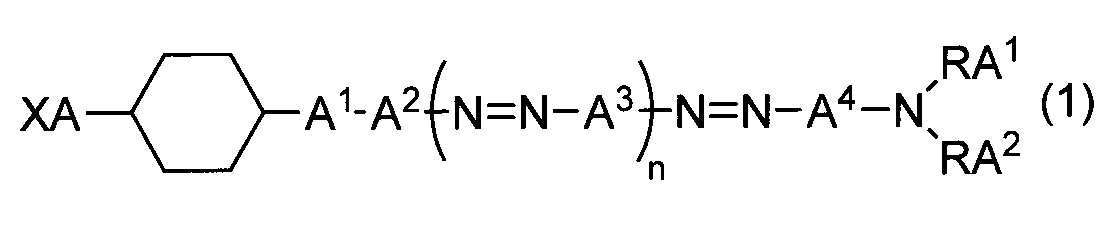
-XAは1価の有機基を表す。
-RA1及び-RA2は、それぞれ独立に、置換基を有していてもよいアルキル基を表す。-RA1及び-RA2は一体となって環を形成してもよいが、-RA1及び-RA2が形成する環の-RA1及び-RA2部分は炭化水素鎖のみで形成される。
-A1-、-A2-、-A3-及び-A4-は、それぞれ独立に、置換基を有していてもよい1,4-フェニレン基を表す。
nは0、1、又は2を表す。
nが2の場合、複数の-A3-は互いに同一でも異なっていてもよい。)
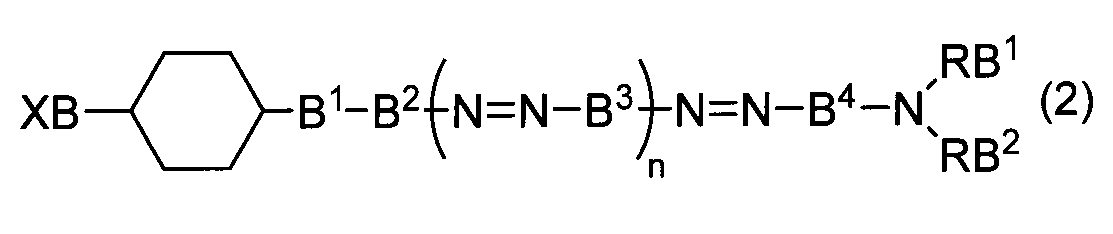
-XBは1価の有機基を表す。
-RB1及び-RB2は、それぞれ独立に、置換基を有していてもよいアルキル基を表す。-RB1及び-RB2は一体となって環を形成してもよい。
-B1-及び-B2-は、それぞれ独立に、置換基を有していてもよい1,4-フェニレン基を表す。
-B3-及び-B4-は、それぞれ独立に、置換基を有していてもよい芳香族炭素水素環の2価基を表す。
nは0、1、又は2を表す。
nが2の場合、複数の-B3-は互いに同一でも異なっていてもよい。)
本発明の第2の発明は、以下の態様を有する。
前記色素の極大吸収波長が次の関係式(11)を満たす組成物。
λmax2-λmax1<0 (11)
(式(11)中、λmax1は溶媒中の前記色素の極大吸収波長、λmax2は前記組成物を用いて形成された色素膜中の前記色素の極大吸収波長を表す。)
X20(-A21)m1(-N=N-A22)n1-N=N-A23-Y20 (12)
(式(12)中、
-A21-、-A22-、-A23-は、それぞれ独立に、置換基を有していてもよい芳香族炭化水素環、又は置換基を有していてもよい芳香族複素環の2価基を表し、
-X20、-Y20は、それぞれ独立に、1価の任意の置換基を表し、
m1は1又は2を表し、
n1は0、1、2、又は3を表す。
m1が2の場合、-A21-は互いに同一でも異なっていてもよい。
n1が2又は3の場合、-A22-は互いに同一でも異なっていてもよい。)
-N-(Ry)-Rx (12a)
(式(12a)中、-Rx、-Ryは、それぞれ独立に、分岐を有していてもよいアルキル基又はアリール基を表し、該アルキル基又はアリール基は置換基を有していてもよい。-Rx及び-Ryは、一体となってNと共に炭素数2~15の環を形成していてもよく、該環は置換基を有していてもよい。)
以下において、「第1の発明」と「第2の発明」を「本発明」と総称する。
吸収、屈折等の光学的異方性を有する膜としては、たとえば、直線偏光膜、円偏光膜等の偏光膜、位相差膜、導電異方性色素膜が挙げられる。本発明の化合物及び本発明の組成物を用いた異方性色素膜は、偏光膜、又は導電異方性色素膜として用いられることが好ましく、偏光膜に用いられることがより好ましい。
本発明に用いることができる色素としては、二色性色素が挙げられる。なお、二色性色素とは、分子の長軸方向における吸光度と、短軸方向における吸光度とが異なる性質を有する色素を言う。また、色素は、液晶性を有する色素であってもよいし、液晶性を有さなくてもよい。なお、液晶性を有するとは、任意の温度で液晶相を発現することを言う。
第1の発明の化合物は、下記式(1)で示される化合物(以下、「化合物(1)」と称す場合がある。)である。

-XAは1価の有機基を表す。
-RA1及び-RA2は、それぞれ独立に、置換基を有していてもよいアルキル基を表す。-RA1及び-RA2は一体となって環を形成してもよいが、-RA1及び-RA2が形成する環の-RA1及び-RA2部分は炭化水素鎖のみで形成される。
-A1-、-A2-、-A3-及び-A4-は、それぞれ独立に、置換基を有していてもよい1,4-フェニレン基を表す。
nは0、1、又は2を表す。
nが2の場合、複数の-A3-は互いに同一でも異なっていてもよい。)
化合物(1)により第1の発明の効果が奏されるメカニズムの詳細については明らかではないが、以下の通り推測される。
式(1)で表される特定の構造を有する上記化合物(1)を色素として含むことにより、異方性色素膜中での色素会合状態が最適化され、偏光子として用いる際の二色比等の光学性能が良好かつ、高い耐光性を有する異方性色素膜が得られる。
-XAは、一価の有機基を表す。
また、分岐を有していてもよい炭素数1~15のアルキル基、環を構成する原子の数が5~14のシクロアルキル基、又は-Ra及び-Rbが一体となって形成した環に含まれる一つ又はそれ以上のメチレン基は、-O-、-S-、-NH-、-N(Rz)-、-C(=O)-、-C(=O)-O-、-C(=O)-NH-、-CHF-、-CF2-、-CHCl-、-CCl2-によって置き換えられた(displace)構造であってもよく、アクリロイルオキシ基、メタクリロイルオキシ基、グリシジルオキシ基の重合性基に置き換えられた構造であってもよい。ここで、Rzは、炭素数1~6の直鎖状又は分枝状のアルキル基を表す。
前記炭素数1~15の直鎖状もしくは分枝状のアルキル基に含まれる一つ又はそれ以上のメチレン基は、-O-、-S-、-NH-、-N(Rh)-、-C(=O)-、-C(=O)-O-、-C(=O)-NH-、-CHF-、-CF2-、-CHCl-、-CCl2-によって置き換えられた(displace)構造であってもよく、アクリロイルオキシ基、メタクリロイルオキシ基、グリシジルオキシ基の重合性基に置き換えられた構造であってもよい。なお、Rhは、炭素数1~6の直鎖状又は分枝状のアルキル基を表す。
これらのうち、-Ra及び-Rbにおける分岐を有していてもよい炭素数1~15のアルキル基に許容される置換基としては、-O-Rfが好ましく、たとえば、メトキシ、エトキシ、n-プロポキシ、n-ブトキシ、n-ペントキシ、n-ヘキソキシ、n-ヘプトキシ、n-オクトキシ、アクリロイルオキシ、メタクリロイルオキシ、グリシジルオキシ等が挙げられる。
該芳香族炭化水素環の1価基の芳香族炭化水素環としては、ベンゼン環、ナフタレン環、アントラセン環、フェナントレン環、ペリレン環、テトラセン環、ピレン環、ベンズピレン環、クリセン環、トリフェニレン環、アセナフテン環、フルオランテン環、フルオレン環等が挙げられる。
-RA1及び-RA2は、それぞれ独立に、置換基を有していてもよいアルキル基を表す。-RA1及び-RA2は一体となって環を形成してもよいが、-RA1及び-RA2が形成する環の-RA1及び-RA2部分は炭化水素鎖のみで形成される。
-RA1及び-RA2のアルキル基或いは-RA1及び-RA2が一体となって形成する環が有する置換基としては、-Ra及び-Rbが有する置換基として例示したものが挙げられる。
-RA1及び-RA2としては、分子配向性の観点から、置換基を有していてもよい、炭素原子数1~10のアルキル基であることが好ましく、炭素原子数1~6のアルキル基であることがより好ましく、炭素原子数1~4のアルキル基であることがさらに好ましい。
上記であることで化合物(1)の分子配向性が良好となる傾向にある。
-A1-、-A2-、-A3-及び-A4-は、それぞれ独立に、置換基を有していてもよい1,4-フェニレン基を表す。
nは0、1、又は2を表す。
nは0又は1であることが好ましく、1であることがより好ましい。上記であることで化合物(1)の分子配向が良好となる傾向にある。
nが2である場合、それぞれの-A3-は、同一であっても異なっていてもよい。
式(1)中の-N=N-は、トランス型であることが化合物(1)の直線性を高める観点で好ましい。
化合物(1)の分子量は、300以上が好ましく、350以上がより好ましく、380以上がさらに好ましく、1500以下が好ましく、1200以下がより好ましく、1000以下がさらに好ましい。具体的には、化合物(1)の分子量は、300~1500が好ましく、350~1200がより好ましく、380~1000がさらに好ましい。上記範囲であることで適切な分子長、嵩高さとなるため、色素としての分子配向が良好になる傾向にある。
化合物(1)の具体例としては、以下の化合物が挙げられるが、これらに限定されるものではない。
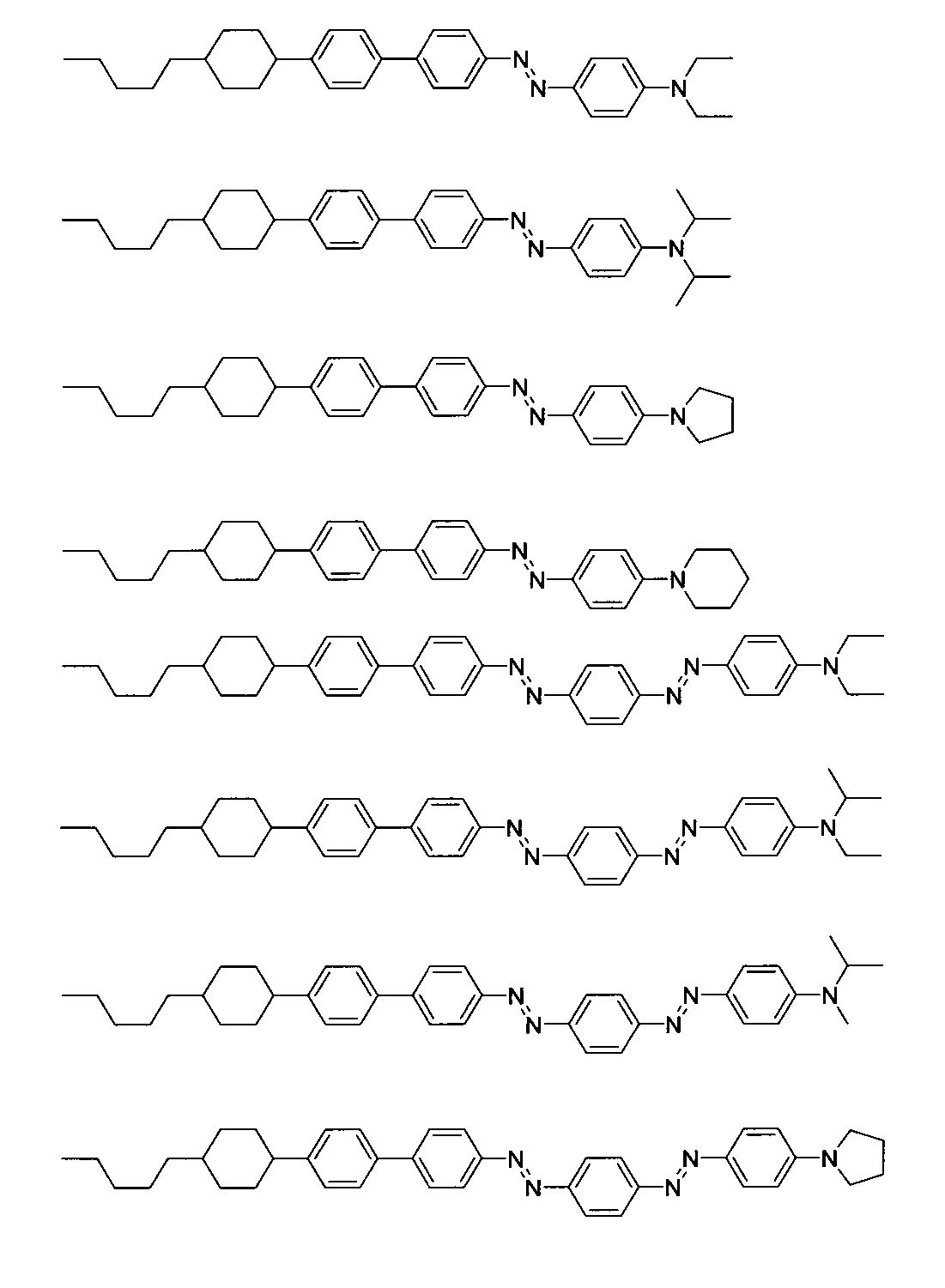
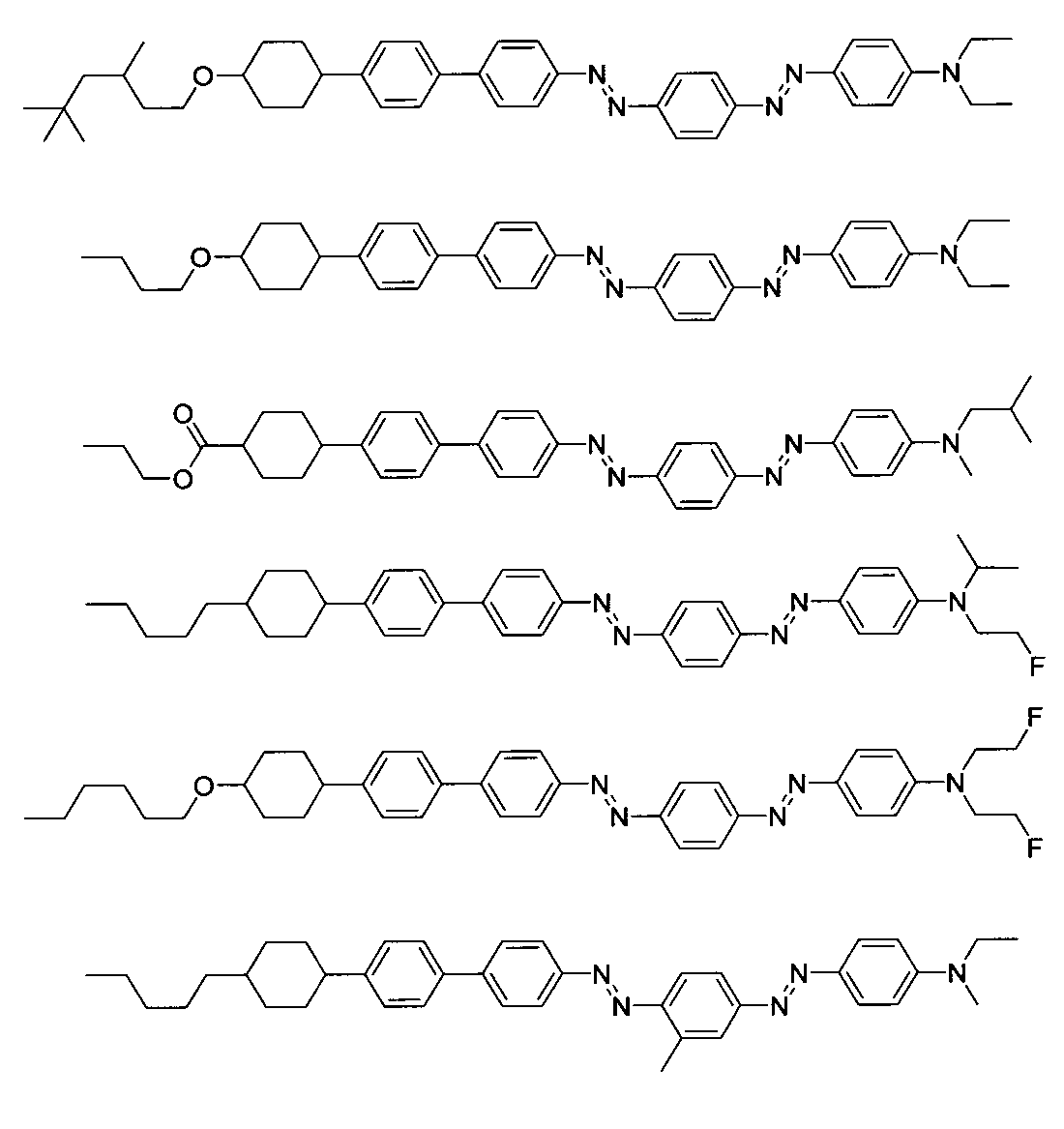
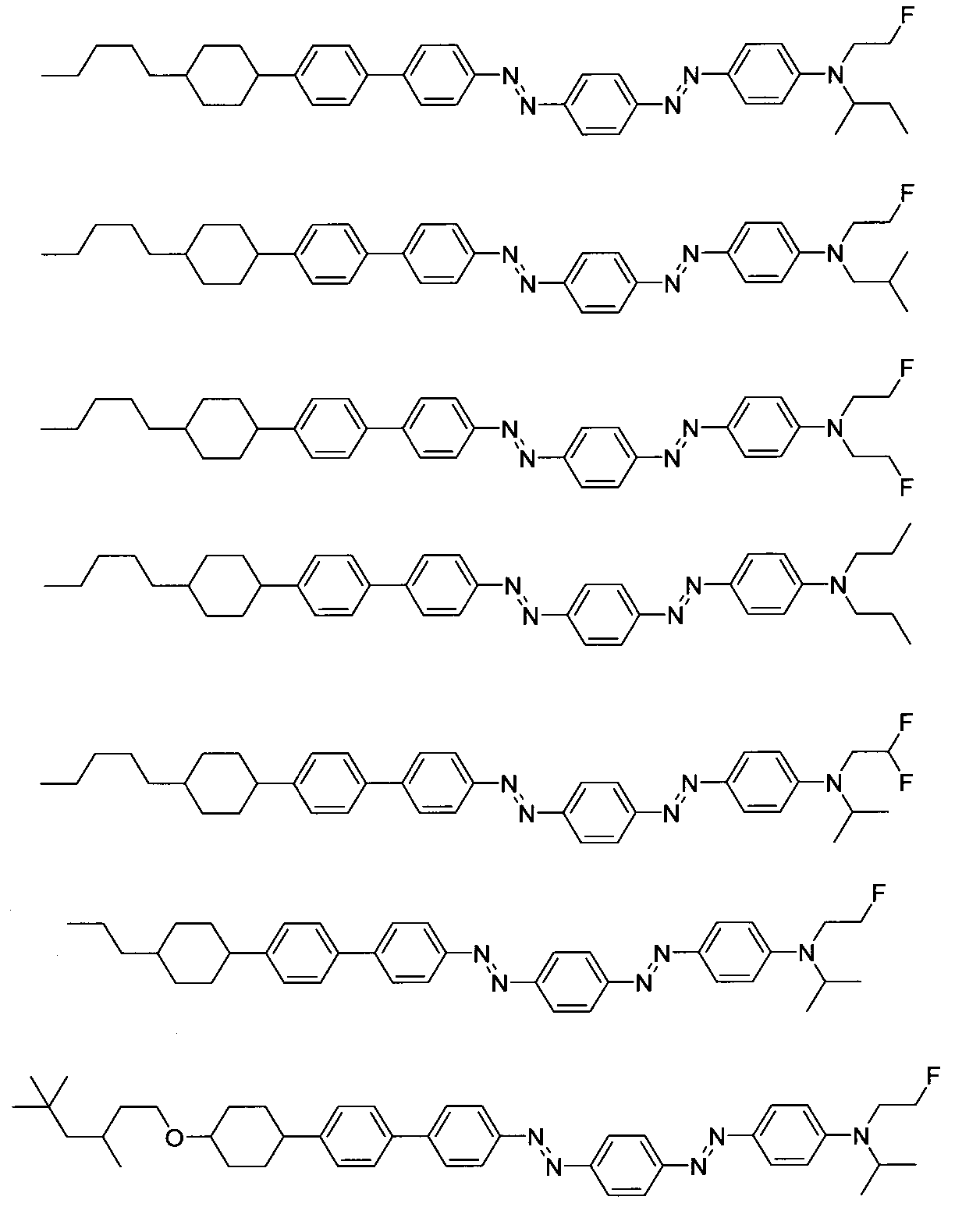
化合物(1)は、アルキル化反応、エステル化反応、アミド化反応、エーテル化反応、イプソ置換反応、ジアゾカップリング反応、金属触媒を用いたカップリング反応等の公知の化学反応を組み合わせることにより製造することができる。
第1の発明の組成物は、下記式(2)で示される化合物(以下、「化合物(2)」と称す場合がある。)と重合性液晶化合物とを含む組成物である。
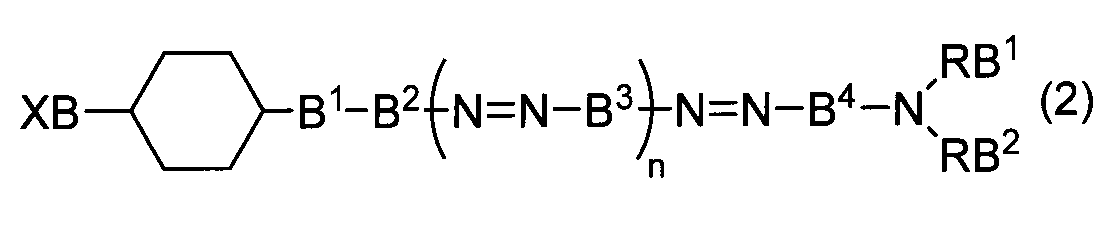
-XBは1価の有機基を表す。
-RB1及び-RB2は、それぞれ独立に、置換基を有していてもよいアルキル基を表す。-RB1及び-RB2は一体となって環を形成してもよい。
-B1-及び-B2-は、それぞれ独立に、置換基を有していてもよい1,4-フェニレン基を表す。
-B3-及び-B4-は、それぞれ独立に、置換基を有していてもよい芳香族炭素水素環の2価基を表す。
nは0、1、又は2を表す。
nが2の場合、複数の-B3-は互いに同一でも異なっていてもよい。)
第1の発明の組成物は、化合物(2)を色素として含むものであり、上記式(2)で表される特定の構造を有する化合物(2)を色素として含むことにより、異方性色素膜中での色素会合状態が最適化され、偏光子として用いる際の二色比等の光学性能が良好かつ、高い耐光性を有する異方性色素膜が得られると推測される。
-XBは1価の有機基を表し、-XBとしては、前述の式(1)における-XAと同様のものが挙げられ、好ましいものも同様である。
-RB1及び-RB2は、それぞれ独立に、置換基を有していてもよいアルキル基を表し、-RB1及び-RB2は一体となって環を形成していてもよい。
-RB1及び-RB2としては、前述の式(1)における-RA1及び-RA2と同様のものが挙げられ、好ましいものも同様である。
-B1-及び-B2-は、それぞれ独立に、置換基を有していてもよい1,4-フェニレン基を表し、該1,4-フェニレン基が有していてもよい置換基としては、式(1)における-A1-、-A2-、-A3-及び-A4-の1,4-フェニレン基が有していてもよい置換基として例示したものが挙げられ、好ましいものも同様である。
化合物(1)におけると同様の理由から、-B1-及び-B2-としては置換基を有さない1,4-フェニレン基が好ましい。
-B3-及び-B4-は、それぞれ独立に、置換基を有していてもよい芳香族炭素水素環の2価基を表す。
nは0、1、又は2を表す。
nは0又は1であることが好ましく、1であることがより好ましい。上記であることで化合物(2)の分子配向が良好となる傾向にある。
nが2である場合、それぞれの-B3-は、同一であっても異なっていてもよい。
式(2)中の-N=N-は、トランス型であることが化合物(2)の直線性を高める観点で好ましい。
化合物(2)の好適例としては、前述の化合物(1)が挙げられる。
化合物(2)の具体例としては、前述の化合物(1)の具体例の他、以下の化合物が挙げられるが、これらに限定されるものではない。
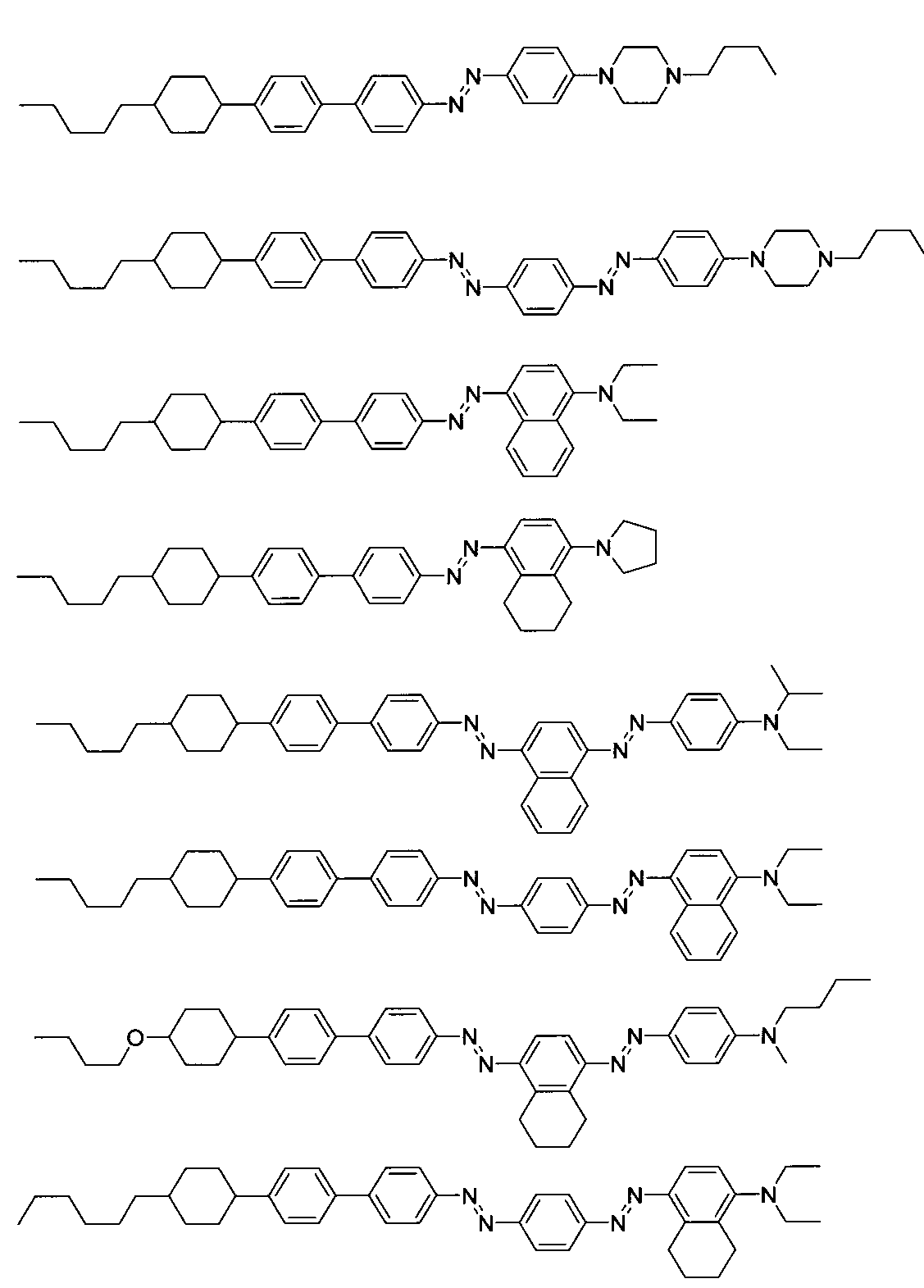
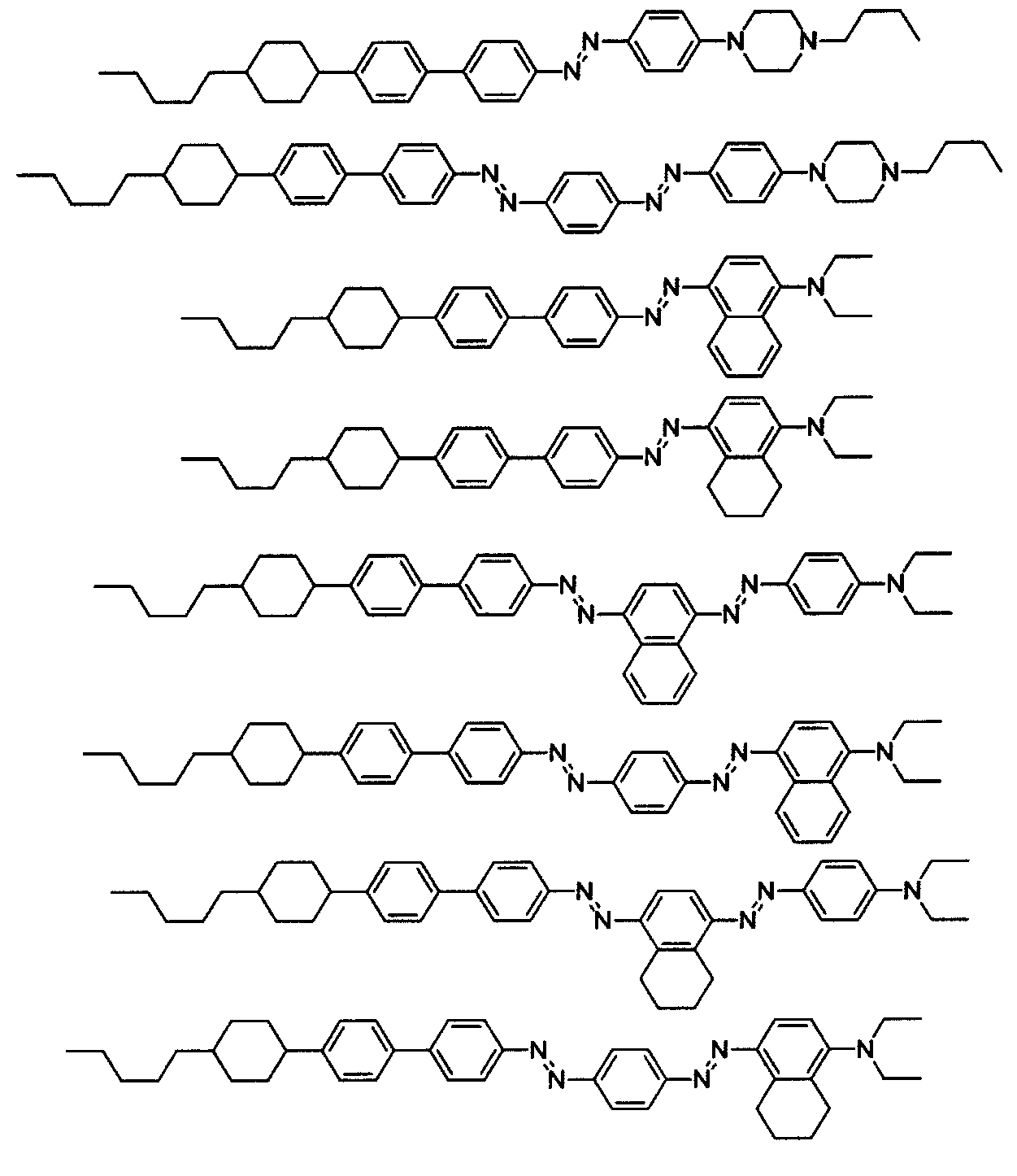
第2の発明の組成物は、極大吸収波長が次の関係式(11)を満たす色素(以下、「第2の発明の色素」と称す場合がある。)と重合性液晶化合物とを含む。
第2の発明の組成物は、第2の発明の色素の1種のみを含むものであってもよく、2種以上を含むものであってもよい。
λmax2-λmax1<0 (11)
(式(11)中、λmax1は溶媒中の前記色素の極大吸収波長、λmax2は前記組成物を用いて形成された色素膜中の前記色素の極大吸収波長を表す。)
第2の発明の組成物が、前記関係式(11)を満たす色素を含むことにより、即ち、溶媒中の色素の極大吸収波長λmax1と、第2の発明の組成物を用いて形成された色素膜中の色素の極大吸収波長λmax2とが、λmax2-λmax1<0を満たすような色素を含むことにより、得られる異方性色素膜中での色素会合状態が最適化され、偏光子として用いる際の二色比等の光学性能が良好かつ、高い耐光性を有する異方性色素膜が得られると推測される。
また、二色比等の光学性能がより良好な傾向であることから、λmax1とλmax2は、下記関係式(11B)を満たすことがより好ましく、下記関係式(11C)を満たすことがさらに好ましい。
λmax2-λmax1≦-1 (11A)
λmax2-λmax1≦-10 (11B)
λmax2-λmax1≦-20 (11C)
色素膜中の色素の極大吸収波長λmax2とは、色素膜中の色素の直交位吸光度が極大となる波長λmax2である。
また、第2の発明の色素の極大吸収波長λmax2は、350~800nmの範囲にあることが好ましく、380~750nmの範囲にあることがより好ましく、400~700nmの範囲の範囲にあることが更に好ましい。
第2の発明の色素は、上記関係式(11)、好ましくは上記関係式(11A)、より好ましくは上記関係式(11B)、さらに好ましくは上記関係式(11C)を満たすものであればよく、特に制限はないが、二色比等の光学性能の観点からアゾ系色素であることが好ましい。アゾ系色素の中でも下記式(12)で表される化合物(以下、「化合物(12)」と称す場合がある。)が二色比等の光学性能がより良好な傾向であり、好ましい。
X20(-A21)m1(-N=N-A22)n1-N=N-A23-Y20 (12)
(式(12)中、
-A21-、-A22-、-A23-は、それぞれ独立に、置換基を有していてもよい芳香族炭化水素環、又は置換基を有していてもよい芳香族複素環の2価基を表し、
-X20、-Y20は、それぞれ独立に、1価の任意の置換基を表し、
m1は、1又は2を表し、
n1は0、1、2、又は3を表す。
m1が2の場合、-A21-は互いに同一でも異なっていてもよい。
n1が2又は3の場合、-A22-は互いに同一でも異なっていてもよい。)
-A21-、-A22-、-A23-は、それぞれ独立に、置換基を有していてもよい芳香族炭化水素環、又は置換基を有していてもよい芳香族複素環の2価基を表す。
置換基を有していてもよい芳香族炭化水素環の2価基の芳香族炭化水素環としては、ベンゼン環、ナフタレン環、アントラセン環、フェナントレン環、ペリレン環、テトラセン環、ピレン環、ベンズピレン環、クリセン環、トリフェニレン環、アセナフテン環、フルオランテン環、フルオレン環等が挙げられる。
置換基を有していてもよい芳香族複素環の2価基の芳香族複素環としては、フラン環、ベンゾフラン環、チオフェン環、ベンゾチオフェン環、ピロール環、ピラゾール環、イミダゾール環、チアゾール環、イソチアゾール環、オキサジアゾール環、チアジアゾール環、トリアゾール環、インドール環、カルバゾール環、ピロロイミダゾール環、ピロロピラゾール環、ピロロピロール環、チエノピロール環、チエノチオフェン環、フロピロール環、フロフラン環、フロチアゾール環、チエノフラン環、チエノチアゾール環、ベンゾイソオキサゾール環、ベンゾイソチアゾール環、ベンゾイミダゾール環、ピリジン環、ピラジン環、ピリダジン環、ピリミジン環、トリアジン環、キノリン環、イソキノリン環、シノリン環、キノキサリン環、フェナントリジン環、キナゾリン環、アズレン環等が挙げられる。
-A21-、-A22-、-A23-のうち、-A21-、-A23-は、二色比等の光学性能および最適な色素会合状態の観点から、それぞれ独立に、置換基を有していてもよい芳香族炭化水素環の2価基であることが好ましく、それぞれ独立に、置換基を有していてもよいフェニレン基であることがより好ましく、特に置換基を有していてもよい、1,4-フェニレン基であることが好ましく、とりわけ置換基を有さない1,4-フェニレン基が好ましい。
-X20、-Y20は、それぞれ独立に、1価の任意の置換基を表す。
-X20、-Y20における1価の置換基としては、例えば、ヒドロキシ基、アミノ基、シアノ基、カルバモイル基、ニトロ基、ハロゲン原子、-Rx、-O-Rx、-NH-Rx、-N(-Ry)-Rx、-C(=O)-Rx、-C(=O)-O-Rx、-C(=O)-NH-Rx、-C(=O)-N(-Ry)-Rx、-O-C(=O)-Rx、-NH-C(=O)-Rx、-N(-Ry)-C(=O)-Rxが挙げられる。-Rxおよび-Ryは、それぞれ独立に、分岐を有していてもよいアルキル基、シクロアルキル基又はアリ-ル基を表し、これらは置換基を有していてもよい。該アルキル基の炭素数は1~15であることが好ましく、該シクロアルキル基の環を構成する原子数は5~14が好ましく、該アリール基の環を構成する原子数は5~14が好ましい。
-Rxおよび-Ryは、一体となって、好ましくは炭素数2~15、より好ましくは2~10の環を形成していてもよい。
前記炭素数1~15の直鎖状もしくは分枝状のアルキル基に含まれる一つ又はそれ以上のメチレン基は、-O-、-S-、-NH-、-N(Rh)-、-C(=O)-、-C(=O)-O-、-C(=O)-NH-、-CHF-、-CF2-、-CHCl-、-CCl2-によって置き換えられた(displace)構造であってもよく、アクリロイルオキシ基、メタクリロイルオキシ基、グリシジルオキシ基の重合性基に置き換えられた構造であってもよい。なお、Rhは、炭素数1~6の直鎖状又は分枝状のアルキル基を表す。
これらのうち、-Rxおよび-Ryにおける分岐を有していてもよい炭素数1~15のアルキル基に許容される置換基としては、-O-Rfが好ましく、たとえば、メトキシ、エトキシ、n-プロポキシ、n-ブトキシ、n-ペントキシ、n-ヘキソキシ、n-ヘプトキシ、n-オクトキシ、アクリロイルオキシ、メタクリロイルオキシ、グリシジルオキシ等が挙げられる。
また、-Y20としては、-Rx、-O-Rx、-O-C(=O)-Rx、-C(=O)-O-Rx、-N(-Ry)-Rxが好ましく、-O-Rx、-O-C(=O)-Rx、-N(-Ry)-Rxがより好ましく、-O-Rx、-N(-Ry)-Rx、-NH-Rxがさらに好ましく、特に下記式(12a)で表される基であることが特に好ましい。
-N-(Ry)-Rx (12a)
(式(12a)中、-Rx、-Ryは、それぞれ独立に、分岐を有していてもよいアルキル基又はアリール基を表し、該アルキル基又はアリール基は置換基を有していてもよい。-Rx及び-Ryは、一体となってNと共に炭素数2~15の環を形成していてもよく、該環は置換基を有していてもよい。)
上記であることで化合物(12)の吸収の遷移モーメントが化合物の長軸方向に一致するため二色性が良好となる傾向にある。
式(12a)における-Rx、-Ryは、色素の吸収波長を調整する必要がある場合には、置換基を有していることが好ましく、置換基として-OH、-O-Rf、-O-C(=O)-Rf、-C(=O)-Rf、-C(=O)-O-Rf、ハロゲン原子を有することがより好ましく、フッ素原子を有することがさらに好ましい。ここで-Rfは、炭素数1~15、好ましくは1~10の直鎖状もしくは分枝状のアルキル基を表す。
m1は1又は2を表す。
m1は2であることが好ましい。上記であることで色素会合状態が最適となる傾向にある。
m1が2である場合、それぞれの-A21-は、同一であっても異なっていてもよいが、最適な色素会合状態となる傾向にあることから同一であることが好ましい。
n1は0、1、2、又は3を表す。
n1は1又は2であることが最適な色素会合状態となる傾向にあることから好ましく、1であることがさらに化合物(12)の分子配向が良好となる傾向にあることから、より好ましい。
n1が2又は3である場合、それぞれの-A22-は、同一であっても異なっていてもよいが、最適な色素会合状態となる傾向にあることから同一であることが好ましい。
式(12)中の-N=N-は、トランス型であることが化合物(12)の直線性を高める観点で好ましい。
化合物(12)の具体例としては、以下の化合物が挙げられるが、これらに限定されるものではない。
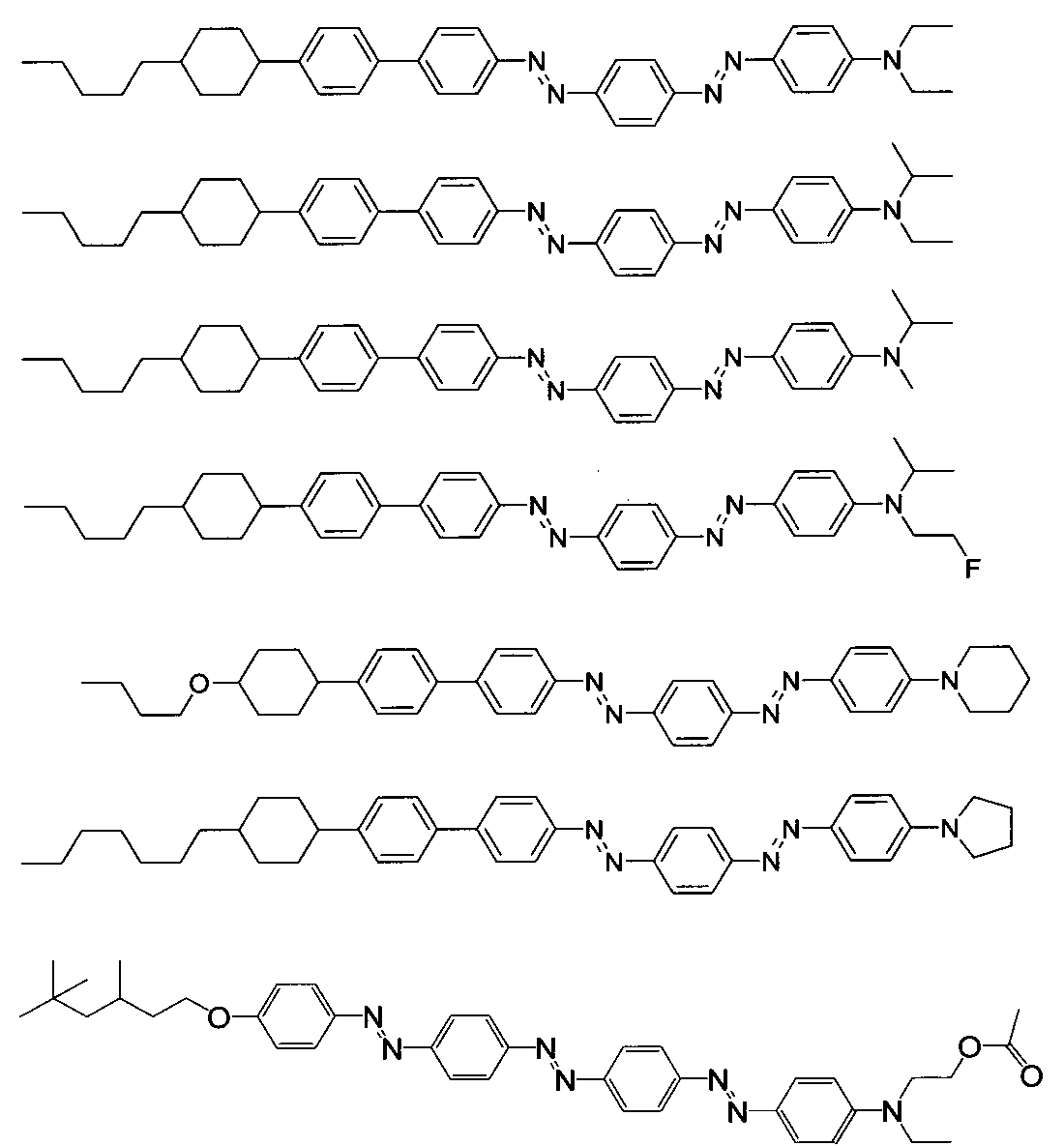
第1の発明の組成物は、化合物(2)を含む。第1の発明の組成物は、化合物(2)以外の色素を含んでいてもよい。第1の発明の組成物に含まれる化合物(2)以外の色素としては、化合物(2)以外のアゾ系色素、キノン系色素(ナフトキノン系色素、アントラキノン系色素等を含む。)、スチルベン系色素、シアニン系色素、フタロシアニン系色素、インジゴ系色素、縮合多環系色素(ペリレン系色素、オキサジン系色素、アクリジン系色素等を含む。)等が挙げられる。
第1の発明の組成物には、化合物(2)以外の色素の1種のみが単独で含まれていてもよく、2種以上が任意の組み合わせおよび比率で含まれていてもよい。
本発明の組成物に含まれる色素の分子量(2種以上の色素を併用する場合には、それぞれの分子量)は、300以上が好ましく、350以上がより好ましく、380以上がさらに好ましく、1500以下が好ましく、1200以下がより好ましく、1000以下がさらに好ましい。具体的には、本発明の組成物に含まれる色素の分子量は、300~1500が好ましく、350~1200がより好ましく、380~1000がさらに好ましい。上記範囲であることで適切な分子長、嵩高さとなるため、色素の分子配向が良好になる傾向にある。色素の分子量は、色素分子に含まれる原子量の総和である。
本発明の組成物における色素が占める含有量(2種以上の色素を併用する場合は、それぞれの含有量の総和)は、例えば、組成物の固形分(100質量部)に対して、0.01質量部以上が好ましく、0.05質量部以上がより好ましく、30質量部以下が好ましく、10質量部以下がより好ましい。具体的には、組成物における色素が占める含有量は、例えば、組成物の固形分(100質量部)に対して、好ましくは0.01~30質量部であり、より好ましくは0.05~10質量部である。
本発明の組成物がその他の色素を含有する場合、化合物(2)又は第2の発明の色素を用いることによる本発明の効果をより有効に得る観点から、本発明の組成物中の色素の総量100質量%中の化合物(2)又は第2の発明の色素の割合は、5質量%以上であることが好ましく、10質量%以上であることがより好ましく、特に15~100質量%であることが好ましい。
本発明の組成物に含有される化合物(2)、第2の発明の色素等の色素は、アルキル化反応、エステル化反応、アミド化反応、エーテル化反応、イプソ置換反応、ジアゾカップリング反応、金属触媒を用いたカップリング反応等の公知の化学反応を組み合わせることにより製造することができる。
本発明において、液晶化合物とは、液晶状態を示す物質を指し、具体的には、「液晶便覧」(丸善株式会社、平成12年10月30日発行)の1~28ページに記載されているように、結晶から液体には直接転移せず、結晶と液体の両方の性質を示す中間の状態を経て液体になる化合物をいう。
重合性液晶化合物において、重合性基は液晶化合物分子内に1つ以上存在することができる。重合性基が2つ以上存在する場合は、液晶化合物分子の両末端にそれぞれ存在していることが重合しやすさの観点から好ましい。
-Q1は、水素原子又は重合性基を表し、
-Q2は、重合性基を表し、
-R1-及び-R2-は、それぞれ独立に、鎖状有機基を表し、
-A11-及び-A13-は、それぞれ独立に、下記式(4)で表される部分構造、2価有機基、又は単結合を表し、
-A12-は、下記式(4)で表される部分構造又は2価有機基を表し、
-Y1-及び-Y2-は、それぞれ独立に、単結合、-C(=O)O-、-OC(=O)-、-C(=S)O-、-OC(=S)-、-C(=O)S-、-SC(=O)-、-CH2CH2-、-CH=CH-、-C≡C-、-C(=O)NH-、-NHC(=O)-、-CH2O-、-OCH2-、-CH2S-、又は-SCH2-を表し、
-A11-及び-A13-の一方は、下記式(4)で表される部分構造又は2価有機基であり;
kは1又は2である。
kが2の場合、2つの-Y2-A13-は互いに同一でも異なっていてもよい。)
(式(4)中、
-Cy-は、炭化水素環基又は複素環基を表し、
-X1-は、-C(=O)O-、-OC(=O)-、-C(=S)O-、-OC(=S)-、-C(=O)S-、-SC(=O)-、-CH2CH2-、-CH=CH-、-C(=O)NH-、-NHC(=O)-、-CH2O-、-OCH2-、-CH2S-、又は-SCH2-を表し、
-X2-は、単結合、-C(=O)O-、-OC(=O)-、-C(=S)O-、-OC(=S)-、-C(=O)S-、-SC(=O)-、-CH2CH2-、-CH=CH-、-C(=O)NH-、-NHC(=O)-、-CH2O-、-OCH2-、-CH2S-、又は-SCH2-を表す。)
Q1-R1-Cy-X2-C≡C-X1-Y1-A12-(Y2-A13)k-R2-Q2 (3A)
Q1-R1-X1-C≡C-X2-Cy-Y1-A12-(Y2-A13)k-R2-Q2 (3B)
Q1-R1-A11-Y1-Cy-X2-C≡C-X1-(Y2-A13)k-R2-Q2 (3C)
Q1-R1-A11-Y1-X1-C≡C-X2-Cy-(Y2-A13)k-R2-Q2 (3D)
Q1-R1-A11-Y1-A12-(Y2-Cy-X2-C≡C-X1)k-R2-Q2 (3E)
Q1-R1-A11-Y1-A12-(Y2-X1-C≡C-X2-Cy)k-R2-Q2 (3F)
-Cy-における炭化水素環基は、芳香族炭化水素環基と非芳香族炭化水素環基とを含む。
芳香族炭化水素環基は、非連結芳香族炭化水素環基と連結芳香族炭化水素環基とを含む。
これらのうち、芳香族炭化水素環基としては、ベンゼン環の2価基、ナフタレン環の2価基が好ましく、ベンゼン環の2価基(フェニレン基)がより好ましい。フェニレン基としては、1,4-フェニレン基が好ましい。-Cy-がこれらの基であることで液晶分子の直線性が高まり、分子配向性向上の効果が得られる傾向にある。
単環もしくは縮合環の炭素数は適切なコアの大きさにより分子配向性が良好となる理由で3~20であることが好ましい。
-X1-は、-C(=O)O-、-OC(=O)-、-C(=S)O-、-OC(=S)-、-C(=O)S-、-SC(=O)-、-CH2CH2-、-CH=CH-、-C(=O)NH-、-NHC(=O)-、-CH2O-、-OCH2-、-CH2S-又は-SCH2-を表す。このうち、重合性液晶化合物(3)の直線性や分子短軸周りの回転運動がしやすい傾向にあることから、-X1-としては、π結合性の小さい、-C(=O)O-、-OC(=O)-、-C(=S)O-、-OC(=S)-、-C(=O)S-、-SC(=O)-、-CH2CH2-、-CH2O-、-OCH2-、-CH2S-、-SCH2-等が好ましいものとして挙げられる。これらの中でもより好ましくは、-C(=O)O-、-OC(=O)-、-CH2CH2-、-CH2O-、-OCH2-であり、さらに好ましくは、-X1-は、-C(=O)O-又は-OC(=O)-である。別の態様として、-X1-は、-CH2CH2-、-CH2O-、又は-OCH2-であることが好ましい。
-X2-は、単結合、-C(=O)O-、-OC(=O)-、-C(=S)O-、-OC(=S)-、-C(=O)S-、-SC(=O)-、-CH2CH2-、-CH=CH-、-C(=O)NH-、-NHC(=O)-、-CH2O-、-OCH2-、-CH2S-、又は-SCH2-を表す。
-Q1及び-Q2における重合性基は、光、熱、および/又は放射線によって重合することが可能な部分構造を有する基であり、重合の機能を担保するために必要な官能基ないし原子団である。該重合性基は、光重合性基であることが異方性色素膜の製造の観点から好ましい。
-R1-及び-R2-における鎖状有機基は、前述の芳香族炭化水素環、非芳香族炭化水素環、芳香族複素環、非芳香族複素環等の環状構造を含まない2価の有機基である。
このような鎖状有機基としては、-(アルキレン基)-、-O-(アルキレン基)-、-S-(アルキレン基)-、-NH-(アルキレン基)-、-N(アルキル基)-(アルキレン基)-、-OC(=O)-(アルキレン基)-、-C(=O)O-(アルキレン基)-が挙げられる。
-A11-、-A12-及び-A13-における2価有機基は、下記式(5)で表される基であることが好ましい。
(式(6)中、Q3は、炭化水素環基又は複素環基を表す。)
芳香族炭化水素環基は、非連結芳香族炭化水素環基と連結芳香族炭化水素環基とを含む。
これらのうち、芳香族炭化水素環基としては、ベンゼン環の2価基、ナフタレン環の2価基が好ましく、ベンゼン環の2価基(フェニレン基)がより好ましい。フェニレン基としては、1,4-フェニレン基が好ましい。-Q3-がこれらの基であることで液晶分子の直線性が高まり、分子配向性向上の効果が得られる傾向にある。
単環もしくは縮合環の炭素数は適切なコアの大きさにより分子配向性が良好となる理由で3~20であることが好ましい。
-Y1-及び-Y2-は、それぞれ独立に、単結合、-C(=O)O-、-OC(=O)-、-C(=S)O-、-OC(=S)-、-C(=O)S-、-SC(=O)-、-CH2CH2-、-CH=CH-、-C≡C-、-C(=O)NH-、-NHC(=O)-、-CH2O-、-OCH2-、-CH2S-、又は-SCH2-を表す。重合性液晶化合物(3)の直線性や分子短軸周りの回転運動がしやすい傾向にあることから、-Y1-及び-Y2-としては、それぞれ独立に、π結合性の小さい、単結合、-C(=O)O-、-OC(=O)-、-C(=S)O-、-OC(=S)-、-C(=O)S-、-SC(=O)-、-CH2CH2-、-CH=CH-、-C(=O)NH-、-NHC(=O)-、-CH2O-、-OCH2-、-CH2S-、又は-SCH2-が好ましく、単結合、-C(=O)O-、-OC(=O)-、-CH2CH2-、-CH2O-、-OCH2-がより好ましい。
kは1又は2である。ある態様としては、kは1であることが好ましい。別の態様としては、kは2であることが好ましい。
kが2である場合、それぞれの-Y2-は互いに同一でも異なっていてもよく、それぞれの-A13-は互いに同一でも異なっていてもよい。
重合性液晶化合物(3)としては、前記式(3A)、(3B)、(3E)又は(3F)で表される化合物であることが液晶化合物の間に働く分子間相互作用を最適とし、かつ適切なコアの大きさとなり分子配向性が良好となる理由で好ましい。
本発明の組成物に含まれる重合性液晶化合物として、具体的には、以下に記載の重合性液晶化合物が挙げられるが、これらに限定されるものではない。以下の例示式中、C6H13は、n-ヘキシル基を、C5H11は、n-ペンチル基を意味する。
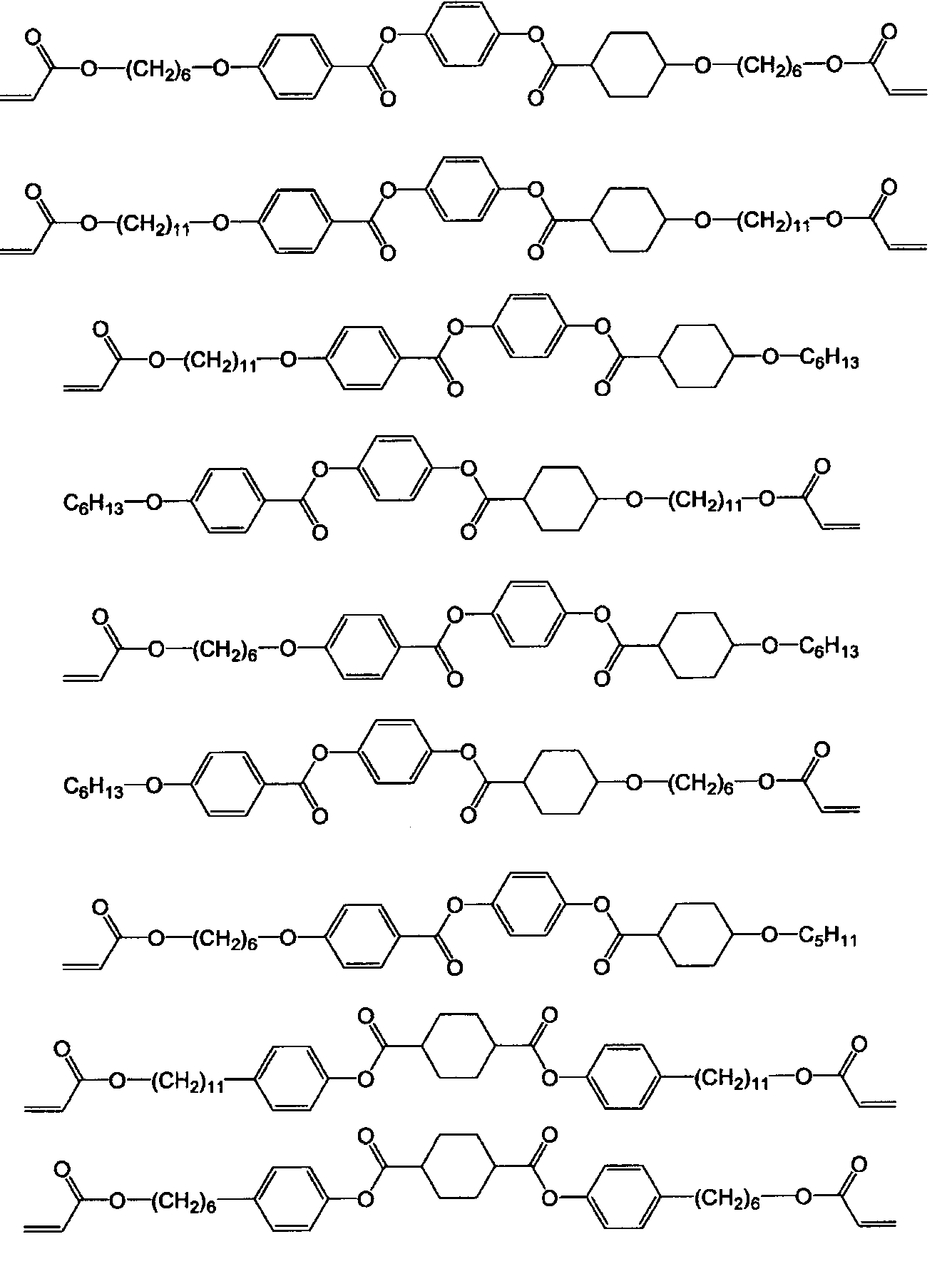
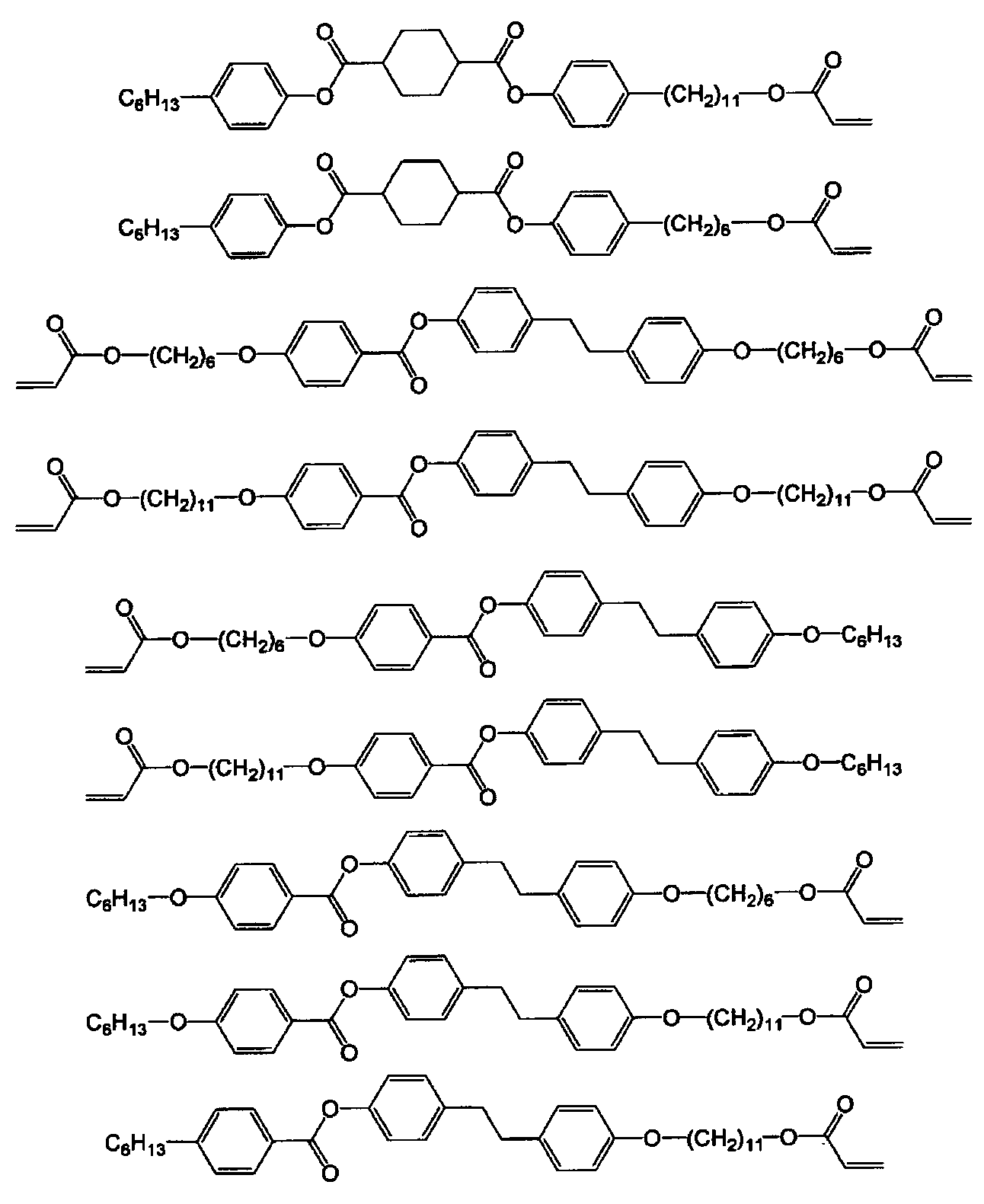
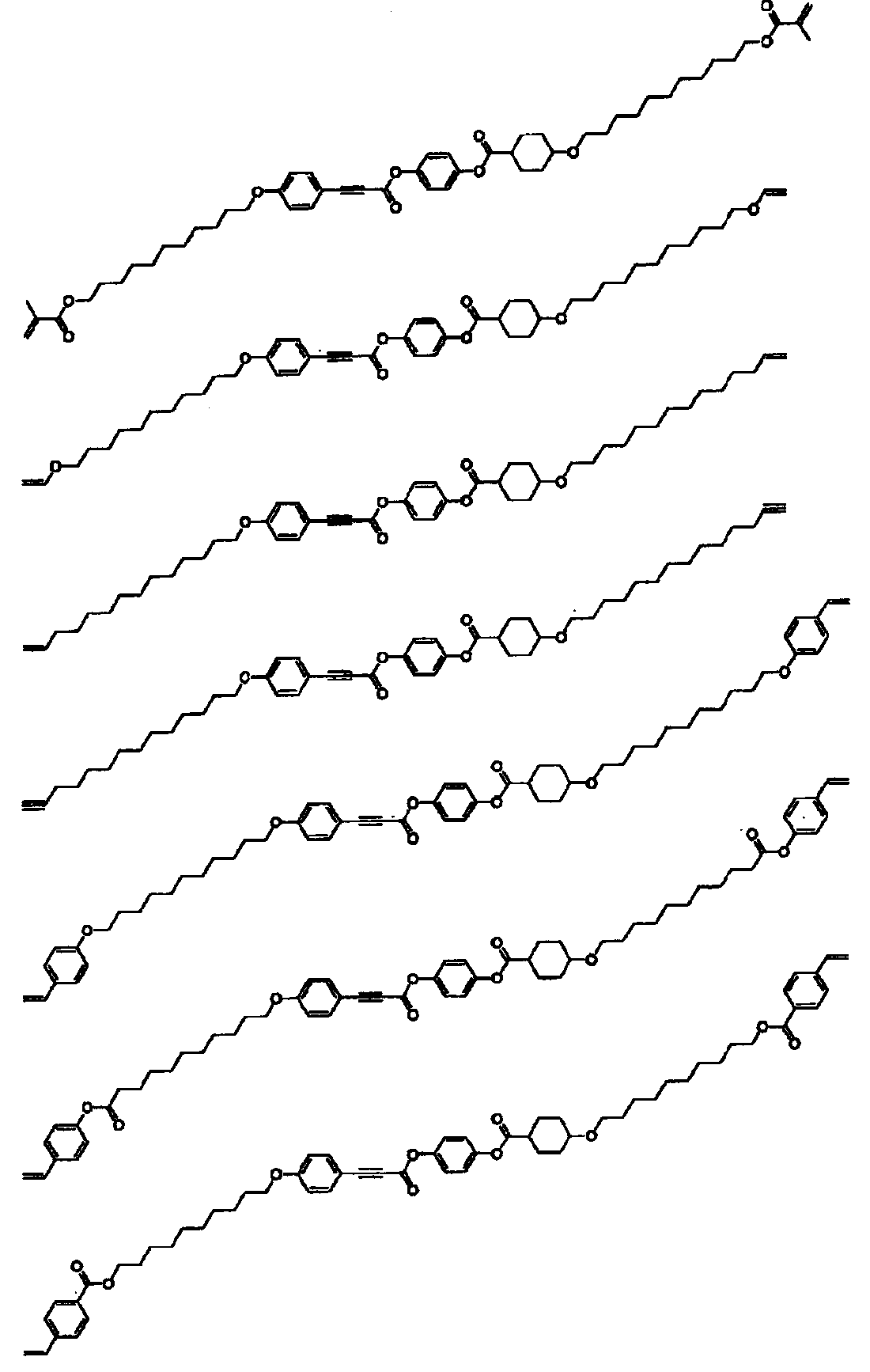
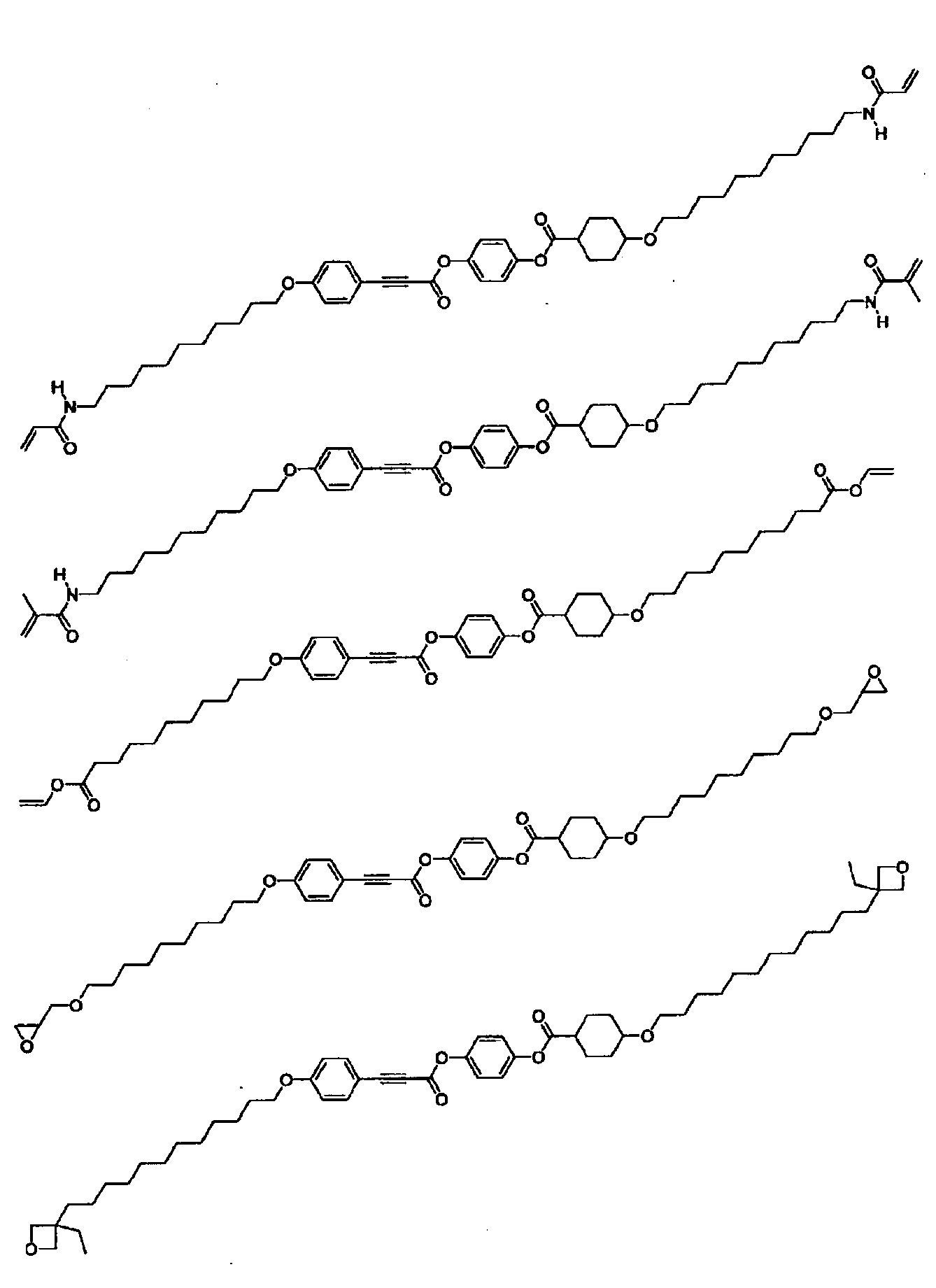

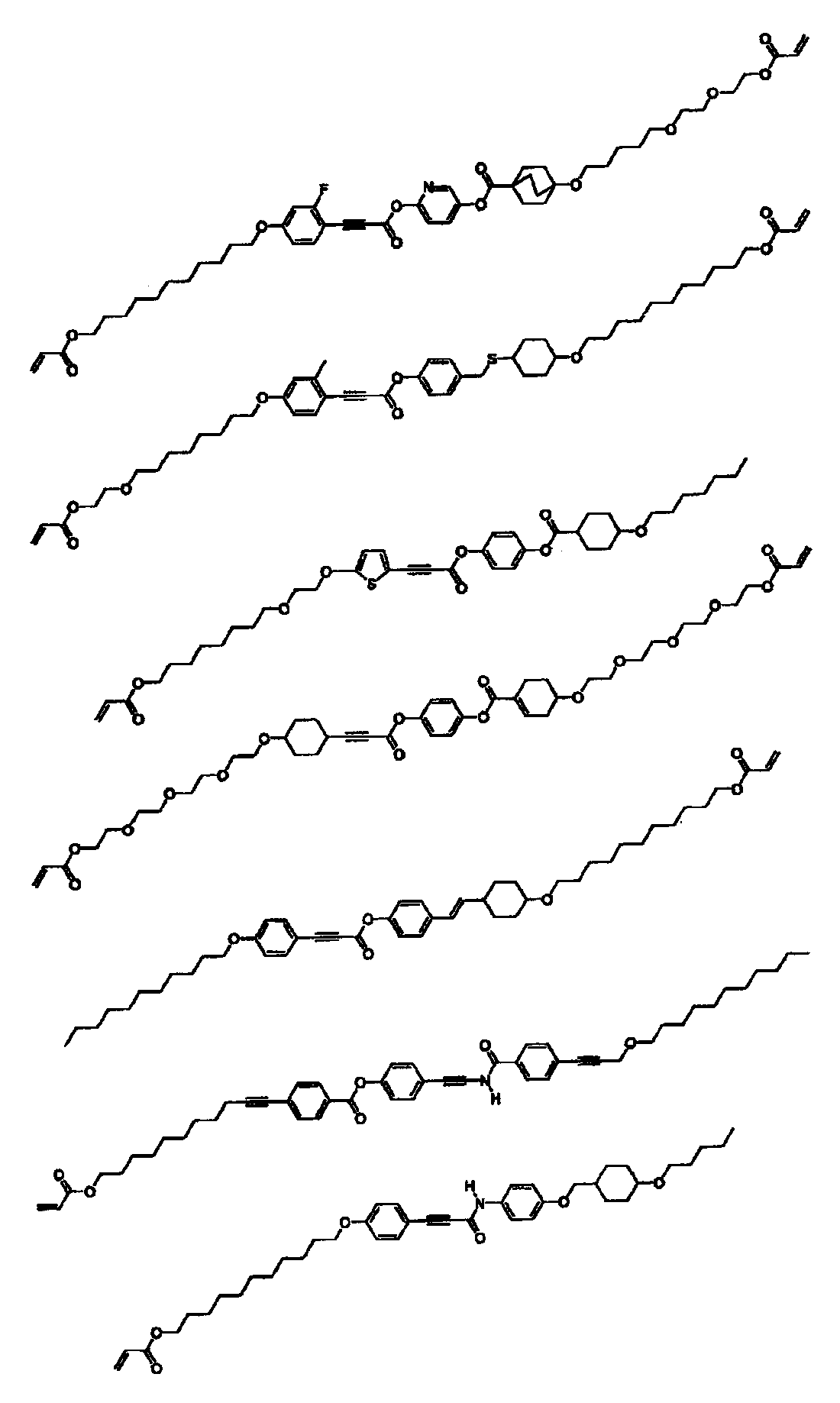

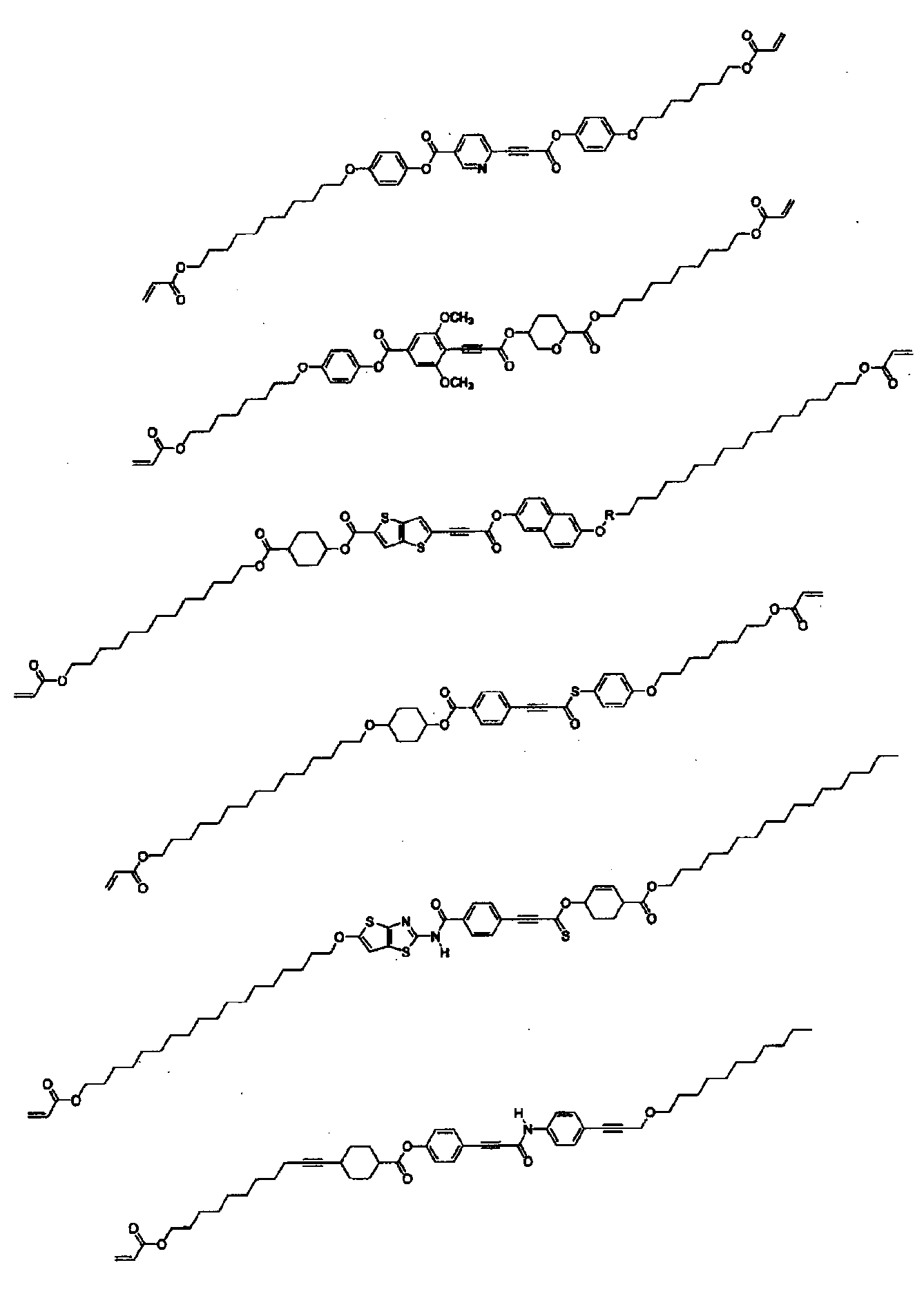
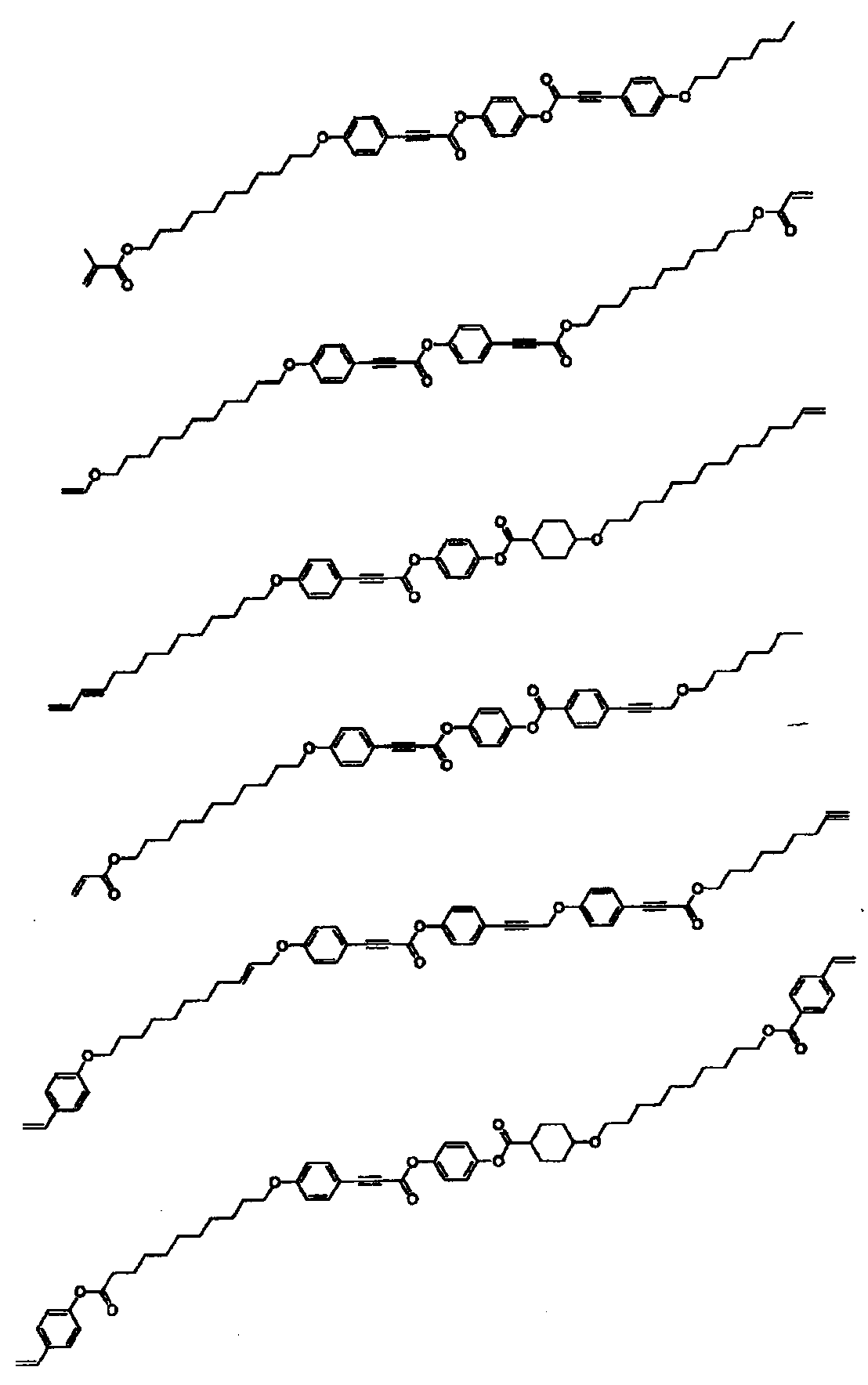
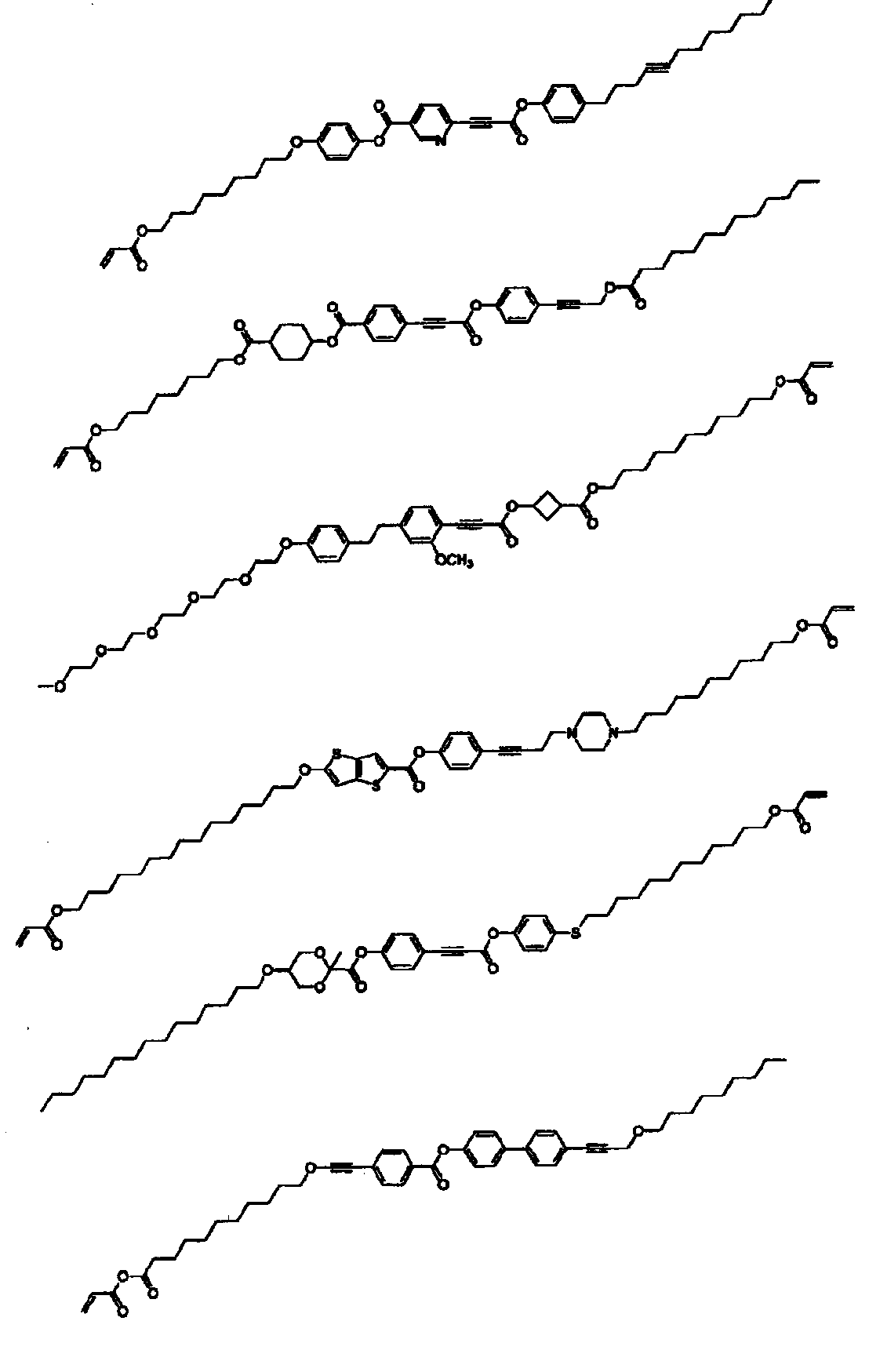
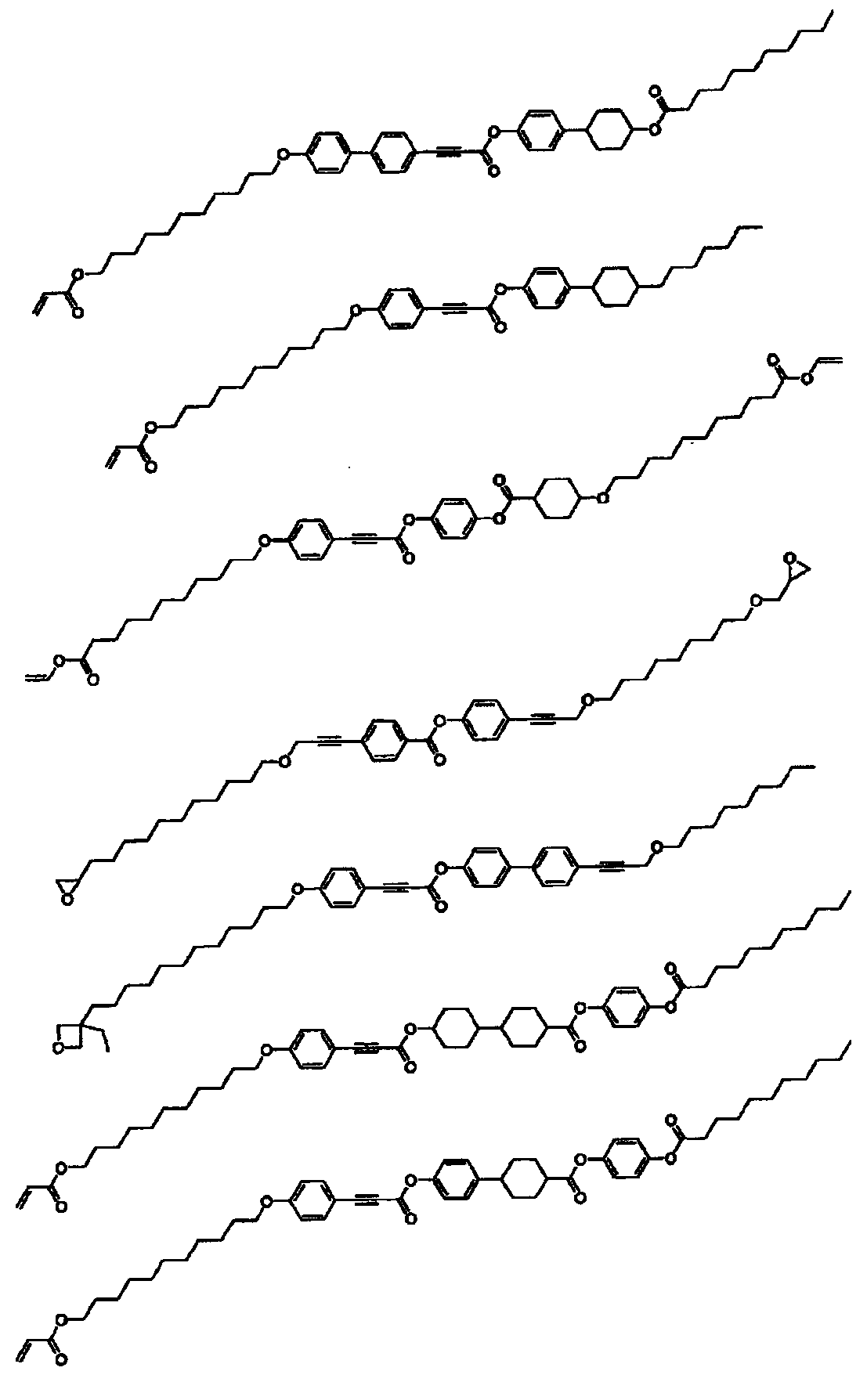
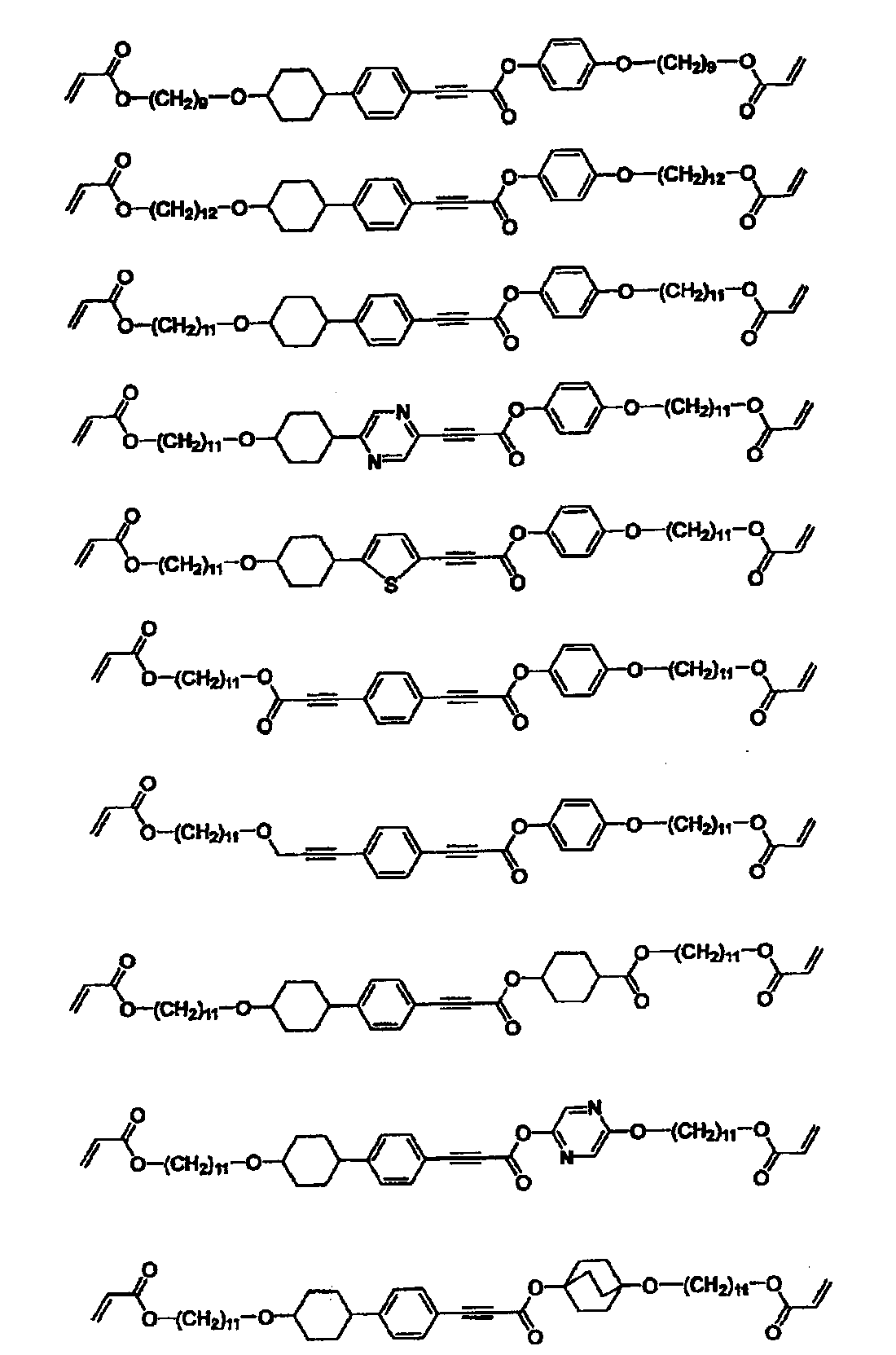

本発明の組成物に含有される液晶化合物は、重合性液晶化合物(3)からなることが好ましい。本発明の組成物には、重合性液晶化合物の1種のみが単独で含まれていてもよく、2種以上が任意の組み合わせおよび比率で含まれていてもよい。
本発明の組成物に含有される重合性液晶化合物は、プロセスの観点から、その等方相出現温度が、160℃以下であることが好ましく、140℃以下がより好ましく、115℃以下がさらに好ましく、110℃以下がよりさらに好ましく、105℃以下が特に好ましい。
ここで等方相出現温度とは、液晶から液体への相転移温度および液体から液晶への相転移温度を意味する。本発明においては、これらの相転移温度の少なくとも一方が上記上限以下であることが好ましく、これらの相転移温度の両方が上記上限以下であることがより好ましい。
本発明の組成物に含有される重合性液晶化合物は、アルキル化反応、エステル化反応、アミド化反応、エーテル化反応、イプソ置換反応、金属触媒を用いたカップリング反応等の公知の化学反応を組み合わせることにより製造することができる。
たとえば、本発明の組成物に含有される重合性液晶化合物は、後掲の実施例に記載の方法や、「液晶便覧」(丸善株式会社、平成12年10月30日発行)の449~468ページに記載の方法にしたがって合成することができる。
本発明の組成物を用いて形成される異方性色素膜の配向性を向上させやすいとの観点で、本発明の組成物においては、重合性液晶化合物の分子長と色素の分子長との差が小さいほうが液晶分子と色素分子の分子間相互作用が強く、色素分子が液晶分子同士の会合を阻害し難いため好ましい。
なお、2つ以上の環が縮合する縮合環は、環構造としては1つとして数える。
なお、N(-RB1)RB2がピロリジニル基やピペリジニル基のような環状の官能基であっても、N(-RB1)RB2に含まれる環構造は式(2)で表される化合物(2)が有する環構造の数(rn2)には含めない。
なお、-Y20がピロリジニル基やピペリジニル基のような環状の官能基であっても、-Y20に含まれる環構造は式(12)で表される化合物(12)が有する環構造の数(rn2)には含めない。
本発明の組成物は、必要に応じて、重合開始剤を含んでもよい。
市販品としては、例えば、IRGACURE(登録商標。以下同様。) 250、IRGACURE 651、IRGACURE 184、DAROCURE 1173、IRGACURE 2959、IRGACURE 127、IRGACURE 907、IRGACURE 369、IRGACURE 379EG、LUCIRIN TPO、IRGACURE 819、IRGACURE 784、OXE-01、OXE-02(いずれも、BASF社製);セイクオ-ル(登録商標)BZ、Z、およびBEE(精工化学株式会社製);カヤキュア-(kayacure)(登録商標)BP100、およびUVI-6992(ダウ・ケミカル株式会社製);アデカオプトマ-SP-152、およびSP-170(株式会社ADEKA製);TAZ-A、およびTAZ-PP(日本シイベルヘグナ-株式会社製);並びに、TAZ-104(株式会社三和ケミカル製);TRONLYTR-PBG-304、TRONLYTR-PBG-309、TRONLYTR-PBG-305、TRONLYTR-PBG-314(常州強力電子新材料有限公司社(CHANGZHOU TRONLY NEW ELECTRONIC MATERIALS CO.,LTD)製)が挙げられる。
重合加速剤もまた、1種を単独で用いてもよく、2種以上を併用してもよい。
増感色素もまた、1種を単独で用いてもよく、2種以上を併用してもよい。
本発明の組成物は、必要に応じて、溶剤を含有してもよい。
これら溶剤は、一種類のみを用いてもよく、二種類以上を組み合わせて用いてもよい。
本発明の組成物における固形分含有量が前記上限値以下であれば、本発明の組成物の粘度が高くなりすぎず、得られる偏光膜の厚みが均一になり、偏光膜にムラが生じにくくなる傾向がある。
本発明の組成物は、さらに必要に応じて、色素および重合性液晶化合物以外の成分として、前述の重合開始剤等の他に、重合禁止剤、重合助剤、重合性非液晶化合物、界面活性剤、レベリング剤、カップリング剤、pH調整剤、分散剤、酸化防止剤、有機・無機フィラー、有機・無機ナノシート、有機・無機ナノファイバー、金属酸化物等のその他の添加剤を含有してもよい。
これらの添加剤を含有することにより、本発明の組成物の塗布性や安定性等を向上させたり、本発明の組成物から形成される異方性色素膜の安定性を向上させたりし得る場合がある。
本発明の組成物を製造する方法は特に限定されない。たとえば、化合物(2)又は第2の発明の色素を含む色素、重合性液晶化合物、必要に応じて溶剤、その他の添加剤等を混合し、0~80℃で撹拌、振盪して色素を溶解させる。これらが難溶性の場合は、ホモジナイザー、ビーズミル分散機等を用いてもよい。
本発明の異方性色素膜は、本発明の組成物を用いて形成される。
したがって、第1の発明の異方性色素膜は、色素と、重合性液晶化合物および重合性液晶化合物に基づく単位を有する重合物の一方又は両方とを含み、色素は、化合物(2)を含む。
また、第2の発明の異方性色素膜は、色素と、重合性液晶化合物および重合性液晶化合物に基づく単位を有する重合物の一方又は両方とを含み、色素は、第2の発明の色素を含む。
以下、「第1の発明の異方性色素膜」と「第2の発明の異方性色素膜」を「本発明の異方性色素膜」と総称する。
また、本発明の異方性色素膜を形成するための本発明の組成物を「異方性色素膜形成用組成物」と称す場合がある。
二色比は8以上あれば偏光素子として機能するが、第1の発明において、二色比は23以上が好ましく、25以上がより好ましく、30以上がさらに好ましく、40以上が特に好ましい。
また、第2の発明において、二色比は13以上が好ましく、20以上がより好ましい。
異方性色素膜の二色比は高いほど好ましい。
二色比が前記下限値以上であることで、後述する光学素子、特に偏光素子として有用である。
D=Az/Ay
ここで、Azは異方性色素膜に入射した光の偏光方向が異方性色素の配向方向に平行な場合に観測される吸光度である。Ayは異方性色素膜に入射した光の偏光方向が垂直な場合に観測される吸光度である。
本発明の異方性色素膜は、本発明の組成物を用いて、湿式成膜法により作製することが好ましい。
具体的には、膜の重合やオーバーコートなどが、後工程の容易さ、異方性色素膜の耐久性等の点から好ましい。
活性エネルギー線の露光量は、10~10,000J/m2が好ましい。
本発明の光学素子は、本発明の異方性色素膜を含む。
本発明の光学素子は、基板上に塗布等により異方性色素膜を形成することで偏光素子を得ることができるという点から、フレキシブルディスプレイ等の用途にも好適に使用することができる。
本発明の異方性色素膜を用いて偏光素子(以下、「本発明の偏光素子」と称す場合がある。)を製造することができる。
以下の記載において、「部」は「質量部」を意味する。
得られた組成物の液晶性は、示差走査熱量測定(セイコーインスツルメンツ社「DSC220CU」)、X線構造解析(リガク社「NANO-Viewer」)、ホットステージ(東陽テクニカ社「HCS302-LN190」)が付属する偏光顕微鏡(ニコンインステック社「ECLIPSE LV100N POL」)にて観察し、「液晶便覧」(丸善株式会社、平成12年10月30日発行)の9~50ページ、117~176ページ等に記載の方法にしたがって、液晶であることの同定を行った。
得られた異方性色素膜の吸収軸/偏光軸方向の偏光に対する透過率は、グラントムソン偏光子を備える分光光度計(大塚電子社製、製品名「RETS-100」)を用いて測定した。
異方性色素膜に直線偏光の測定光を入射し、異方性色素膜の吸収軸方向の偏光に対する透過率及び異方性色素膜の偏光軸方向の偏光に対する透過率を測定し、次式により二色比(D)を算出した。
D=Az/Ay
(式中、
Ay=-log(Ty)であり;
Az=-log(Tz)であり;
Tzは、異方性色素膜の吸収軸方向の偏光に対する透過率であり;
Tyは、異方性色素膜の偏光軸方向の偏光に対する透過率である。)
第2の発明において、上記測定した異方性色素膜の二色比としては、13以上が好ましく、20以上がより好ましい。
以下のようにして測定されるAzから、異方性色素膜の0時間(耐光性試験前)における最大Azを基準とした最大Az維持率(耐光性試験後の最大Az/耐光性試験前の最大Az×100)より耐光性を評価した。
なお、Az、Tzについては、前述の通りである。
○: 最大Az維持率が80%以上
×: 最大Az維持率が80%未満
<重合性液晶化合物(I-1)>
下記構造式で表される重合性液晶化合物(I-1)を特開2020-042305号公報の記載に従い合成した。式中、C11H22はメチレン鎖が直鎖状に11個結合していることを意味する。

この重合性液晶化合物(I-1)の液晶から液体への相転移温度は111.0℃、液体から液晶への相転移温度は109.4℃であった。
なお、この温度が等方相出現温度であることは、偏光顕微鏡観察及びX線構造解析により確認した。
<色素(II-1)>
下記に記載の合成法に従い、色素(II-1)を合成した。化合物(II-1-a)は特開2010-155924号公報に記載の方法で合成した。

1H-NMR(CDCl3,400MHz)δ0.93(t,3H,J=7.1Hz),δ1.10-1.18(m,2H),δ1.22-1.38(m,15H),δ1.46-1.56(m,2H),δ1.87-2.02(m,4H),δ2.50-2.60(m,1H),δ3.50(q,4H,J=6.6Hz),δ6.77(d,2H,J=8.7Hz)δ7.33(d,2H,J=8.7Hz),δ7.61(d,2H,J=8.4Hz),δ7.71(d,2H,J=8.4Hz),δ7.87-7.97(m,4H)
下記に記載の合成法に従い、色素(II-2)を合成した。
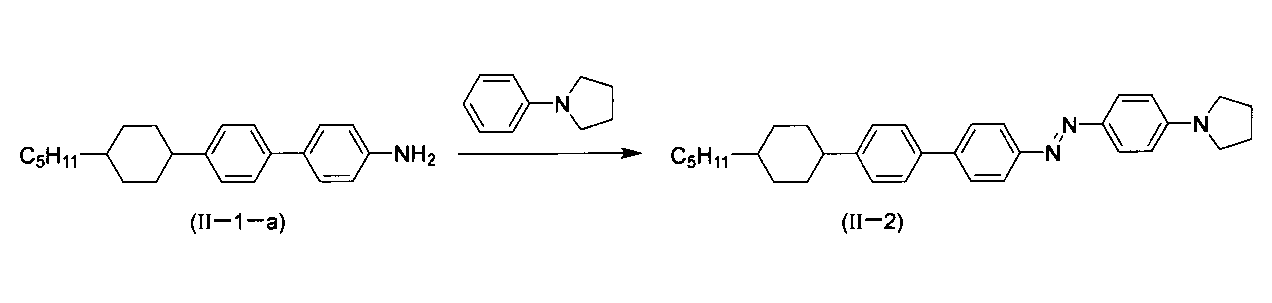
下記に記載の合成法に従い、色素(II-3)を合成した。

下記に記載の合成法に従い、色素(II-4)を合成した。
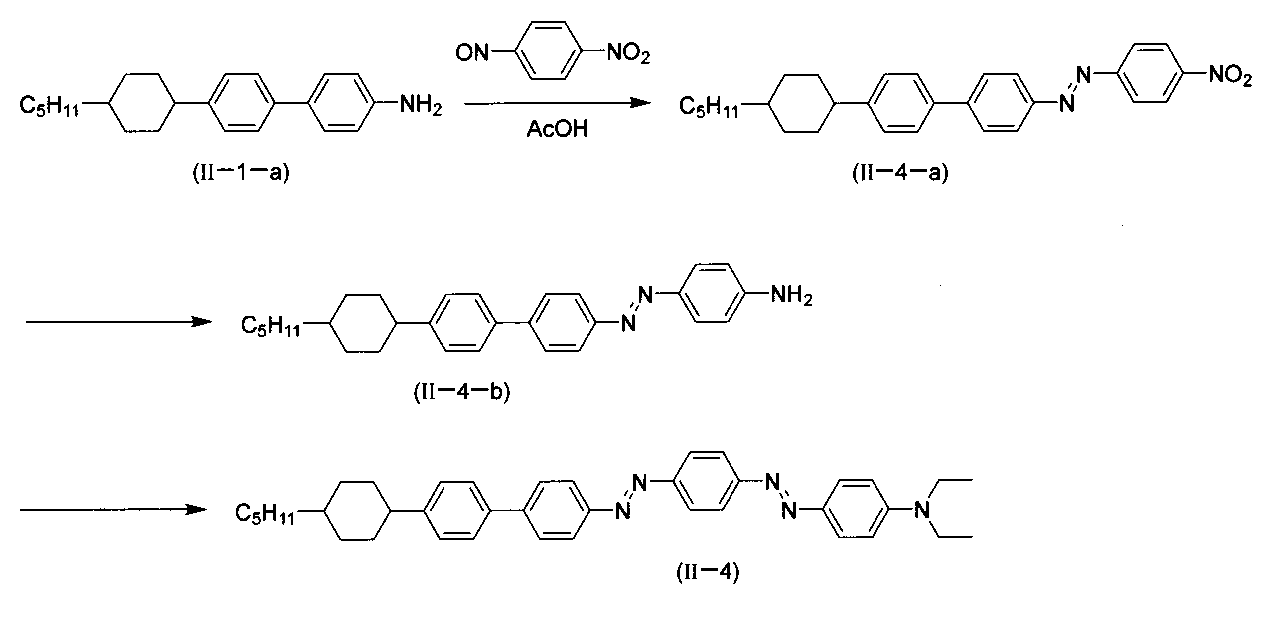
窒素気流下室温にて、化合物(II-1-a)(15.0g,0.0467mol)に酢酸(500mL)を加え、35℃で撹拌溶解し、1-ニトロソ-4-ニトロベンゼン(7.8g,1.1eq.)を分割投入し、室温にて一夜撹拌継続した。反応液を精製水200mLに注ぎ、暫く室温撹拌した後、吸引濾取し、精製水(200mL)、メタノール(200mL)でリンスし、化合物(II-4-a)を15.9g得た。
窒素気流下室温にて、化合物(II-4-a)(15.9g,0.0348mol)、エタノール400mLを加え、撹拌溶解した。NaS・H2O(11.1g,1.9eq.)を投入し、78℃で2時間攪拌した。反応液を精製水(110mL)に注ぎ、暫く室温撹拌した後、吸引濾取し、精製水(150mL)、メタノール(200mL)でリンスし、化合物(II-4-b)を13.8g得た。
反応器に、室温にて、化合物(II-4-b)(2.0g,4.70mmol)をN-メチルピロリドン(50mL)に溶解させた後、濃塩酸(1.37mL,3.8eq.)を加えて内温5℃に冷却した。亜硝酸ナトリウム(0.356g,1.1eq.)を少量の水に溶かして滴下し、内温0~5℃にて1時間撹拌してジアゾニウム塩溶液を得た。別の反応器に、窒素雰囲気下室温にて、ジエチルアニリン(1.05g,1.5eq.)、スルファミン酸(0.138g,1.4mmol)をメタノール(50mL)に溶解させた後、内温5℃に冷却した。ここに先のジアゾニウム塩溶液を内温0~5℃以内で添加し、内温0~5℃以内で4時間、室温へ戻しながら1時間撹拌継続した。酢酸ナトリウム(0.85g,14mmol)を加え室温で1時間、攪拌した。精製水(100mL)を滴下し沈殿を吸引濾取し、精製水(100mL)で掛け洗いし、褐色湿固体を得た。この粗体をシリカゲルカラムクロマトグラフィー(ヘキサン/ジクロロメタン)にて分離精製し、色素(II-4)を0.55g得た。
1H-NMR(CDCl3,400MHz)δ0.91(t,3H, J=6.9Hz),δ1.01-1.16(m,2H),δ1.24-1.35(m,14H),δ1.44-1.51(m,2H),δ1.89-1.96(m,4H),δ2.50-2.60(m,1H),δ3.45-3.52(m,4H),δ6.73-6.75(m,2H),δ7.33(d,2H,J=8.2Hz),δ7.61(d,2H,J=8.2Hz),δ7.77(d,2H,J=8.8Hz),δ7.90(d,2H,J=8.8Hz),δ7.90-8.10(m,6H)
下記に記載の合成法に従い、色素(II-5)を合成した。
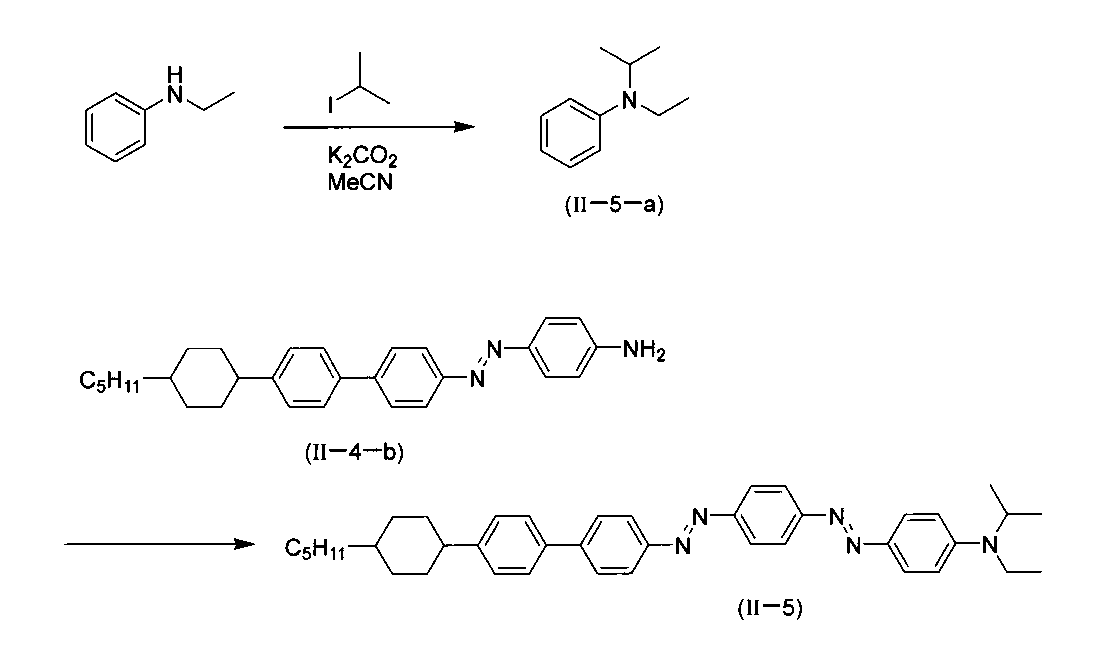
N-エチルアニリン(130.0g,1073mmol)、2-ヨードプロパン(200g,1080mmol)、炭酸カリウム(297g,2146mmol)、アセトニトリル(520mL)を混合し、還流状態で16時間加熱撹拌した。25℃まで冷却した後、反応液を濾過し、ろ液を濃縮した。得られた黄色油状の粗体をシリカゲルクロマトグラフィー(ヘキサン/ジクロロメタン)で精製し、化合物(II-5-a)を100g得た。
反応器に、窒素雰囲気下室温にて、化合物(II-4-b)(1.1g,2.58mmol)をN-メチルピロリドン(20mL)に溶解させた後、濃塩酸(0.75g,3.5eq.)を加えて内温5℃に冷却した。亜硝酸ナトリウム(0.20mg,1.1eq.)を滴下し、内温0~5℃にて1時間撹拌してジアゾニウム塩溶液を得た。別の反応器に、窒素雰囲気下室温にて、化合物(II-5-a)(0.842g,2.0eq.)、スルファミン酸(1.0g,10.5mmol)をメタノール(12mL)、テトラヒドロフラン(2mL)に溶解させた後、内温0℃に冷却した。ここに先のジアゾニウム塩溶液を内温0~5℃以内で20分間かけて添加し、内温0~5℃以内で4時間、室温へ戻しながら1時間撹拌継続した。酢酸ナトリウム(0.85g,14mmol)を加え室温で1時間、攪拌した。精製水(20mL)を滴下し沈殿を吸引濾取し、精製水(20mL)で掛け洗いし、褐色湿固体を得た。この粗体をシリカゲルカラムクロマトグラフィー(ヘキサン/ジクロロメタン)にて分離精製し、色素(II-5)を0.30g得た。
1H-NMR(CDCl3,400MHz)δ0.90-0.96(m,3H),δ1.02-1.17(m,2H),δ1.18-1.42(m,17H),δ1.46-1.59(m,1H),δ1.88-2.02(m,4H),δ2.52-2.59(m,1H),δ3.40-3.45(m,2H),δ4.21-4.35(m,1H),δ6.83-6.86(m,2H),δ7.35(d,2H,J=8.2Hz),δ7.64(d,2H,J=8.2Hz),δ7.77(d,2H,J=8.8Hz),δ7.90-8.10(m,8H)
下記に記載の合成法に従い、色素(II-6)を合成した。

反応器に、窒素雰囲気下室温にて、N-メチルアニリン(50g,0.47mol)をアセトニトリル(200mL)に溶解させた後、2-ヨードプロパン(87g,1.1eq)、炭酸カリウム(129g,2.0eq)を加え、外温80℃、加熱還流下14時間撹拌した。25℃まで冷却した後、反応液を濾過し、ろ液を濃縮した。得られた黄色油状の粗体をシリカゲルクロマトグラフィー(ヘキサン/ジクロロメタン)で精製し、化合物(II-6-a)を39g得た。
反応器に、窒素雰囲気下室温にて、化合物(II-4-b)(433mg,2mmol)をN-メチルピロリドン(8mL)に溶解させた後、濃塩酸(319mg,3.0eq.)を加えて内温5℃に冷却した。亜硝酸ナトリウム水溶液(20質量%,397mg,1.2eq.)を滴下し、内温0~5℃にて1時間撹拌してジアゾニウム塩溶液を得た。別の反応器に、窒素雰囲気下室温にて、化合物(II-6-a)(314mg,2.0eq.)をメタノール(8mL)、テトラヒドロフラン(1mL)に溶解させた後、内温0℃に冷却した。ここに先のジアゾニウム塩溶液を内温0~5℃以内で20分間かけて添加し、内温0~5℃以内で4時間、室温へ戻しながら1時間撹拌継続した。精製水(5mL)を滴下し沈殿を吸引濾取し、精製水(5mL)で掛け洗いし、褐色湿固体を得た。この粗体をシリカゲルカラムクロマトグラフィー(ヘキサン/ジクロロメタン)にて分離精製し、色素(II-6)を101mg得た。
色素(II-6)について、NMRスペクトル測定による構造確認を行った。結果を以下に示す。
1H-NMR(CDCl3,400MHz)δ0.93(t,3H,J=6.9Hz),δ1.02-1.17(m,2H),δ1.18-1.42(m,16H),δ1.46-1.59(m,1H),δ1.88-2.02(m,4H),δ2.50-2.60(m,1H),δ2.92(s,3H),δ4.21-4.35(m,1H),δ6.83-6.95(m,2H),δ7.35(d,2H,J=8.2Hz),δ7.64(d,2H,J=8.2Hz),δ7.77(d,2H,J=8.8Hz),δ7.90-8.10(m,8H)
下記に記載の合成法に従い、色素(II-7)を合成した。
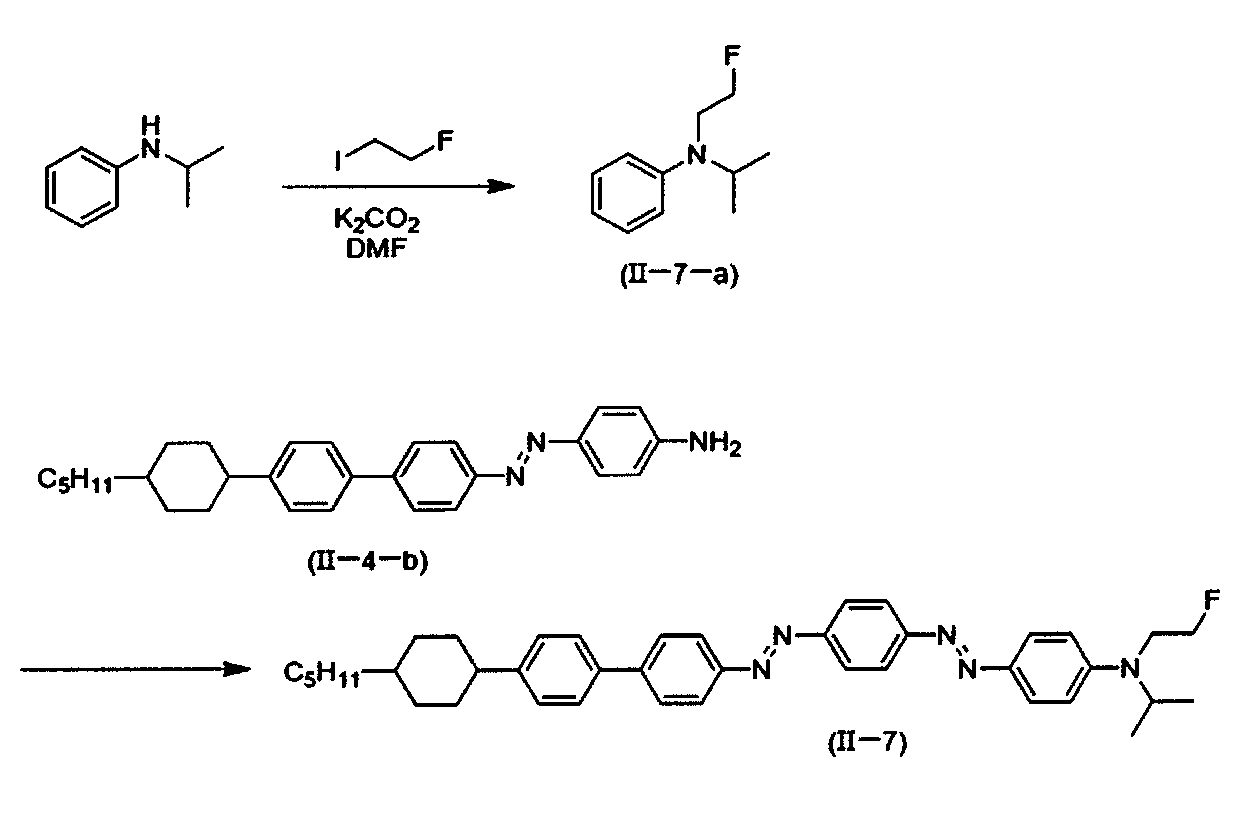
反応器に、窒素雰囲気下室温にて、N-イソプロピルアニリン(19.0g,0.140mol)をN,N-ジメチルホルムアミド(76mL)に溶解させた後、1-フルオロ-2-ヨードエタン(24.4g,1.1eq)、炭酸カリウム(38.8g,2.0eq)を加え、外温95℃、加熱還流下15時間撹拌した。25℃まで冷却した後、反応液を濾過し、ろ液を濃縮した。得られた黄色油状の粗体をシリカゲルクロマトグラフィー(ヘキサン/ジクロロメタン)で精製し、化合物(II-7-a)を7.91g得た。
反応器に、窒素雰囲気下室温にて、化合物(II-4-b)(1.74mg,2.35mmol)をN-メチルピロリドン(100mL)に溶解させた後、濃塩酸(1.18mL,3.5eq.)を加えて内温5℃に冷却した。亜硝酸ナトリウム(0.31g,1.1eq.)を少量の水に溶かした後、滴下し、内温0~5℃にて1時間撹拌してジアゾニウム塩溶液を得た。別の反応器に、窒素雰囲気下室温にて、化合物(II-7-a)(1.48g,2.0eq.)をメタノール(17mL)に溶解させた後、内温0℃に冷却した。ここに先のジアゾニウム塩溶液を内温0~5℃以内で添加し、内温0~5℃以内で1時間攪拌した後、酢酸ナトリウム(0.75g)加えて、室温へ戻しながら1時間撹拌継続した。精製水(20mL)を滴下し沈殿を吸引濾取し、精製水(50mL)、メタノール(200mL)で掛け洗いし、褐色湿固体を得た。この粗体をシリカゲルカラムクロマトグラフィー(ヘキサン/ジクロロメタン)にて分離精製し、色素(II-7)を0.274g得た。
色素(II-7)について、NMRスペクトル測定による構造確認を行った。結果を以下に示す。
1H-NMR(CDCl3,400MHz)δ0.90-0.95(m,3H),δ1.02-1.17(m,2H),δ1.18-1.42(m,14H),δ1.46-1.59(m,1H),δ1.88-2.02(m,4H),δ2.52-2.59(m,1H),δ3.65-3.75(m,2H),δ4.21-4.30(m,1H),δ6.54-6.60(m,1H),δ6.66-6.70(m,1H),δ7.35(d,2H,J=8.2Hz),δ7.64(d,2H,J=8.2Hz),δ7.77(d,2H,J=8.8Hz),δ7.90-8.10(m,8H)
下記に記載の合成法に従い、色素(II-8)を合成した。
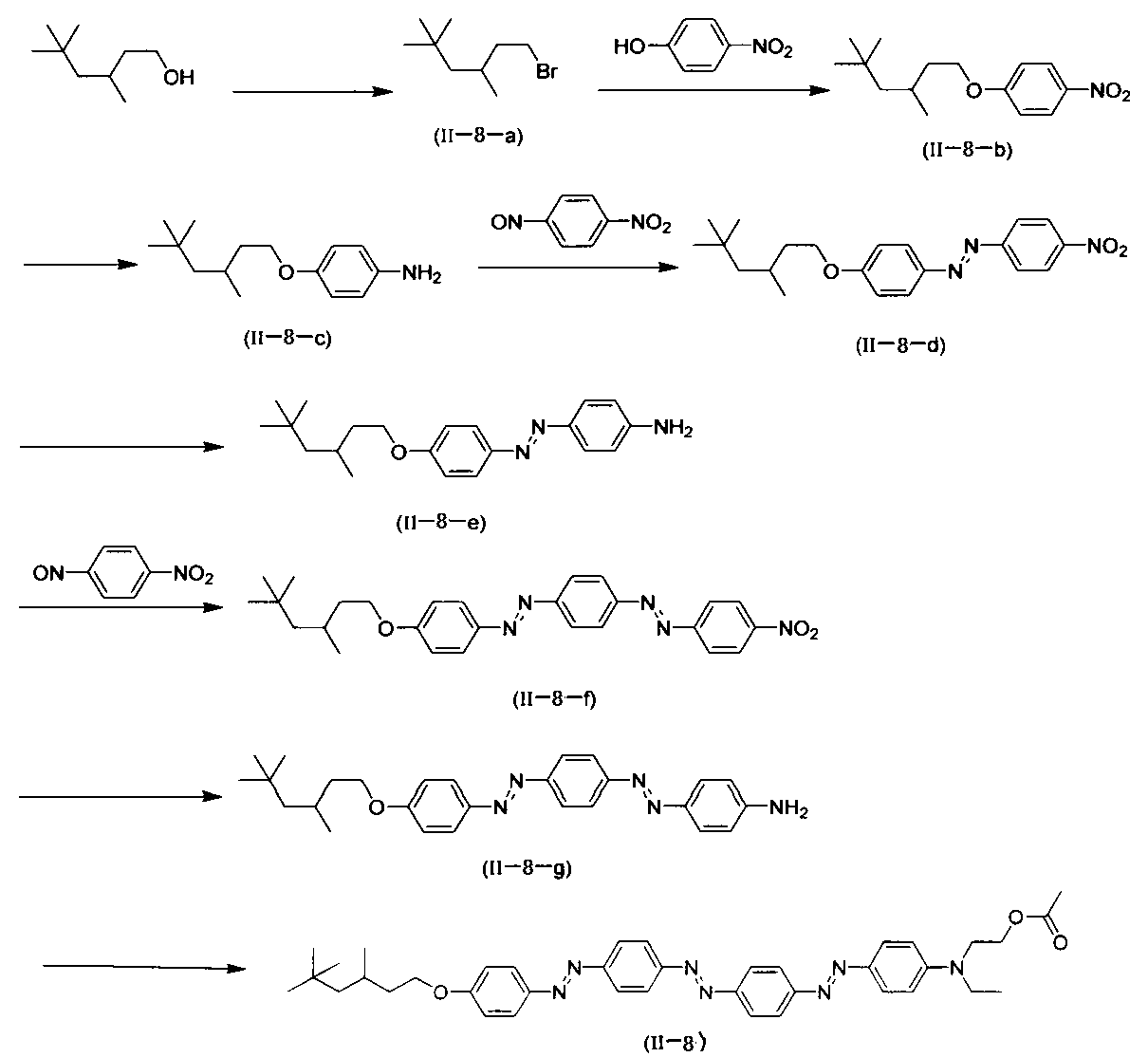
3,5,5-トリエチル-1-ヘキサノール(76.8g,532mmol)、47%臭化水素(HBr)水溶液(100.8g,586mmol)、濃硫酸(16.6g,185mmol)を混合し、120℃で5時間撹拌した。25℃まで冷却した後、ヘキサン(1200mL)へ添加し、精製水(2400mL×3回)で洗浄した。有機層を濃縮した後、シリカゲルクロマトグラフィー(ヘキサン)で精製し、化合物(II-8-a)を71.0g得た。
窒素気流下、4-ニトロフェノール(65.0g,467mmol)、化合物(II-8-a)(116.2g,560mmol)、ジメチルホルムアミド(520mL)、炭酸カリウム(129.1g,934mmol)を混合し、90℃で6時間撹拌した。ここへ精製水(1000mL)を添加し、酢酸エチル/ヘキサン=1/4混合液で抽出し、油層を濃縮した。シリカゲルクロマトグラフィー(酢酸エチル/ヘキサン)で精製し、化合物(II-8-b)を113.5g得た。
アルゴン気流下、化合物(II-8-b)(113.5g,427.7mmol)、酢酸エチル(1100mL)を混合した後、パラジウム炭素(5%Pd/C,含水量55質量%,11.4g)を添加し、水素雰囲気下25℃で60時間撹拌した。容器内をアルゴン置換した後、触媒を濾別した。触媒をジクロロメタンで抽出し、有機層を合わせて濃縮した後、シリカゲルクロマトグラフィー(ジクロロメタン)で精製し、化合物(II-8-c)を99.5g得た。
窒素気流下室温にて、化合物(II-8-c)(43.3g,0.184mol)、酢酸(1.3L)を加え、撹拌溶解し、1-ニトロソ-4-ニトロベンゼン(28.0g,1.0eq.)を分割投入した。4時間撹拌後、1-ニトロソ-4-ニトロベンゼン(8.4g,0.3eq.)を追加添加し、室温にて一夜撹拌継続した。ジクロロメタン(3.9L)、精製水(1.3L)を注ぎ、暫く撹拌後油水分離した。水層をジクロロメタン(1.3L)で抽出した後、元の有機層と合わせ、精製水(1.3L)、飽和重曹水(1.3L)、飽和食塩水(500mL)で順次洗浄後、無水硫酸マグネシウム乾燥、濾過、濾液を濃縮し赤茶色固体を得た。この粗体をシリカゲルカラムクロマトグラフィー(ヘキサン/ジクロロメタン=3/1)で精製し、化合物(II-8-d)を52.08g得た。
化合物(II-8-d)(52.0g,0.141mol)とエタノール(520mL)、精製水(52mL)と硫化ナトリウム五水和物(Na2S・5H2O)(47.4g,2.0eq.)を加え外温80℃で6時間撹拌した。室温まで放冷後、反応液を精製水(500mL)に注ぎ暫く撹拌後、吸引濾取し、精製水(250mL)でリンスした。得られた固体をシリカゲルカラムクロマトグラフィー(ジクロロメタン)で精製し、化合物(II-8-e)を34.40g得た。
窒素気流下室温にて、化合物(II-8-e)(34.4g,0.101mol)、酢酸(1.0L)を加え、撹拌溶解し、1-ニトロソ-4-ニトロベンゼン(20.0g,1.3eq.)を分割投入し、室温にて一夜撹拌継続した。反応液を精製水に注ぎ、暫く室温撹拌した後、吸引濾取し、精製水でリンスした。この固体をシリカゲルカラムクロマトグラフィー(クロロホルム)で精製し、化合物(II-8-f)を38.6g得た。
窒素雰囲気下室温にて、化合物(II-8-f)(38.6g,81.5mmol)とエタノール(386mL)、精製水(39mL)とNa2S・5H2O(27.4g,2.0eq.)を加え外温80℃で6時間撹拌した。室温まで放冷後、反応液を精製水(400mL)に注ぎ暫く撹拌後、吸引濾取し、精製水(200mL)でリンスした。得られた固体をシリカゲルカラムクロマトグラフィー(ヘキサン/ジクロロメタン=1/1)で精製し、化合物(II-8-g)を30.20g得た。
化合物(II-8-g)(1.5g,3.38mmol)、HCl(1.4mL)をN-メチル-2-ピロリドン(NMP)(20mL)に溶解させ、内温0℃に冷却した。硝酸ナトリウム(0.256g,3.718mmol)を5mLの精製水に溶解させ、先の溶液に内温0~3℃以内で滴下し、内温0~2℃にて1時間撹拌した。別の反応器に、窒素雰囲気下室温にて、2-[エチル(フェニル)アミノ]酢酸(1.05g,1.5eq.)をメタノール(10mL)に溶解させた後、酢酸ナトリウム(1.44g)を加え、内温0℃に冷却した。ここに先のジアゾニウム塩溶液を内温0~5℃以内で30分間掛けて添加し、内温0~5℃で1時間、室温へ戻しながら2時間撹拌した。精製水を添加し、メタノールにて濾過、洗浄を行い、得た粗体について、シリカゲルカラムクロマトグラフィー(トルエン/ジクロロメタン=1/3)にてカラム精製し、色素(II-8)を0.24g得た。
また、NMRスペクトル測定による構造確認を行った。結果を以下に示す。
1H-NMR(CDCl3,400MHz)δ0.92(s,9H),δ1.02(d,3H,J=6.8Hz),δ1.12-1.34(m,5H),δ1.66-1.85(m,3H),δ3.54(q,2H,J=6.8Hz),δ3.698(q,2H,J=8.8Hz),δ4.09(t,2H,J=6.8Hz),δ4.31(t,2H,J=6.8Hz),δ6.83(d,2H,J=9.2Hz),δ7.03(d,2H,J=9.2Hz),δ7.92-8.10(m,12H)
下記に記載の合成法に従い、色素(III-1)を合成した。

4-ヨードアニリン(10mmol,2.2g)の2N HCl水溶液(15mL)とエタノール(30mL)の混合溶液を0℃に冷やした後、亜硝酸ナトリウム(11mmol,0.76g)の水溶液(10mL)を少しずつ滴下し、0℃で10分撹拌した。その後反応溶液にアミド硫酸(0.2mmol)を加えてさらに0℃で10分撹拌しジアゾニウム塩溶液を得た。一方、N,N-ジエチルアニリン(10mmol,1,49g)と酢酸ナトリウム(20mmol,1.7g)の入ったエタノール(200mL)と水(100mL)の混合溶液を0℃に冷やし、先のジアゾニウム塩溶液を少しずつ加え、室温まで昇温しながら撹拌した。得られた反応溶液にNaOHを加えてpH10~12に調整した。粗生成物をろ過、水洗したのち乾燥し、メタノールで再結晶を行うことにより、化合物(III-1-a)を2.78g得た。
窒素雰囲気下、化合物(III-1-a)(2mmol,758mg)とCuI(0.3mmol,57mg)のテトラヒドロフラン(30mL)溶液にトリエチルアミン(30mL)、4-ブチルフェニルアセチレン(2.5mmol,332mg)、PdCl2(PPh3)2(0.1mmol,70mg)を加えた後、6時間加熱還流した。沈殿物をろ過した後、減圧下濃縮した。得られた粗生成物をメタノールで懸洗した後、シリカゲルクロマトグラフィー(展開液(ヘキサン:酢酸エチル=9:1(体積比))により精製することにより色素(III-1)を836mg得た。
この色素(III-2)の10ppmクロロホルム溶液での極大吸収波長(λmax1)は454nmであった。
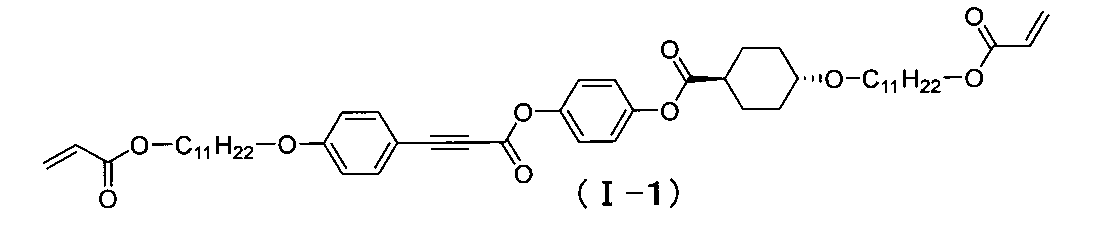
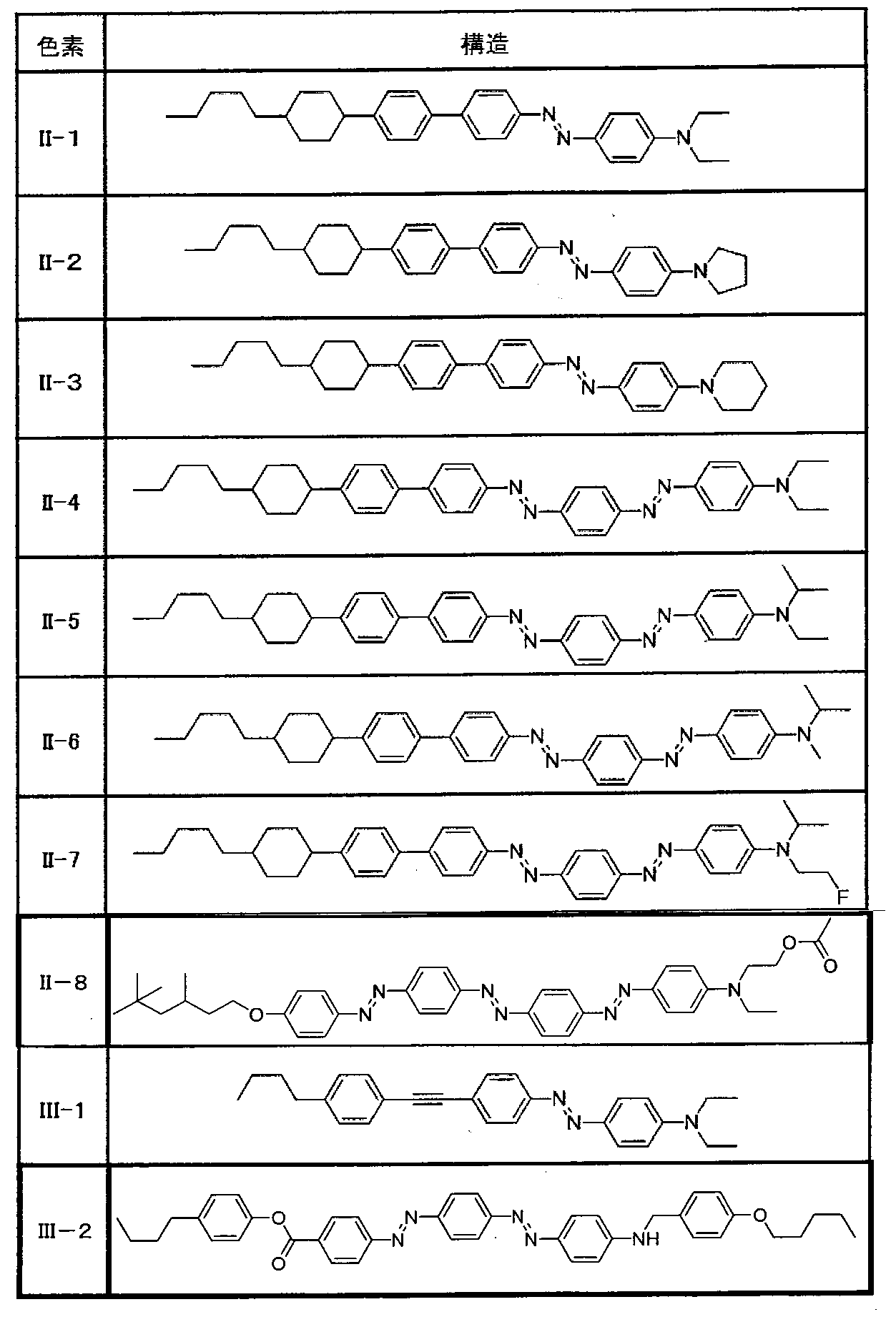
[実施例1]
クロロホルム4016.05部に、重合性液晶化合物(I-1)の20.05部、色素(II-1)の0.40部を加え、撹拌して相溶させた後、溶剤を除去することにより、組成物1Aを得た。組成物1Aのrn1/rn2は、0.75である。
組成物1Aが液晶性を示すことは、ホットステージが付属する偏光顕微鏡にて、40℃で複屈折が観察されたことで確認した。
得られた組成物1Aを用いて、上述の方法で二色比を決定するため、セルギャップ8.0μmのサンドウィッチセルを使用して異方性色素膜1Aを作製し、異方性色素膜1Aの二色比を決定した。
また、クロロホルム6013.38部に、重合性液晶化合物(I-1)の24.15部、色素(II-1)の0.48部、重合開始剤(IGM Resins B.V.社製Irgacure 369)0.48部、界面活性剤(BYK社製BYK-361N)0.36部を加え、撹拌して相溶させた後、溶剤を除去することにより、組成物1Bを得た。
得られた組成物1Bを用いて、上述の方法で耐光性を決定するため、セルギャップ8.0μmのサンドウィッチセルを使用して異方性色素膜1Bを作製し、異方性色素膜1Bの耐光性を決定した。
二色比と耐光性の評価結果を表1に示す。
色素(II-1)0.40部に代えて、色素(II-2)0.39部を加えた以外は実施例1の組成物1A及び異方性色素膜1Aと同様にして、組成物2A及び異方性色素膜2Aを得た。組成物2Aのrn1/rn2は、0.75である。
組成物2Aが液晶性を示すことは、ホットステージが付属する偏光顕微鏡にて、40℃で複屈折が観察されたことで確認した。
また、異方性色素膜2Aの二色比を決定した。
色素(II-1)0.48部に代えて、色素(II-2)0.48部を加えた以外は実施例1の組成物1B及び異方性色素膜1Bと同様にして、組成物2B及び異方性色素膜2Bを得た。
また、異方性色素膜2Bの耐光性を決定した。
二色比と耐光性の評価結果を表1に示す。
色素(II-1)0.40部に代えて、色素(II-3)0.50部を加えた以外は実施例1の組成物1A及び異方性色素膜1Aと同様にして、組成物3A及び異方性色素膜3Aを得た。組成物3Aのrn1/rn2は、0.75である。
組成物3Aが液晶性を示すことは、ホットステージが付属する偏光顕微鏡にて、40℃で複屈折が観察されたことで確認した。
また、異方性色素膜3Aの二色比を決定した。
色素(II-1)0.48部に代えて、色素(II-3)0.61部を加えた以外は実施例1の組成物1B及び異方性色素膜1Bと同様にして、組成物3B及び異方性色素膜3Bを得た。
実施例1と同様の方法で、異方性色素膜3Bの耐光性を決定した。
二色比と耐光性の評価結果を表1に示す。
色素(II-1)0.40部に代えて、色素(II-4)0.39部を加えた以外は実施例1の組成物1A及び異方性色素膜1Aと同様にして、組成物4及び異方性色素膜4Aを得た。組成物4Aのrn1/rn2は、0.6である。
組成物4Aが液晶性を示すことは、ホットステージが付属する偏光顕微鏡にて、40℃で複屈折が観察されたことで確認した。
また、異方性色素膜4Aの二色比を決定した。
色素(II-1)0.48部に代えて、色素(II-4)0.47部を加え、ほかは実施例1の組成物1B及び異方性色素膜1Bと同様にして、組成物4B及び異方性色素膜4Bを得た。
また、異方性色素膜4Bの耐光性を決定した。
二色比と耐光性の評価結果を表1に示す。
色素(II-1)0.40部に代えて、色素(II-5)0.39部を加えた以外は実施例1の組成物1A及び異方性色素膜1Aと同様にして、組成物5A及び異方性色素膜5Aを得た。組成物5Aのrn1/rn2は、0.6である。
組成物5Aが液晶性を示すことは、ホットステージが付属する偏光顕微鏡にて、40℃で複屈折が観察されたことで確認した。
また、異方性色素膜5Aの二色比を決定した。
色素(II-1)0.48部に代えて、色素(II-5)0.48部を加えた以外は実施例1の組成物1B及び異方性色素膜1Bと同様にして、組成物5B及び異方性色素膜5Bを得た。
また、異方性色素膜5Bの耐光性を決定した。
二色比と耐光性の評価結果を表1に示す。
色素(II-1)0.40部に代えて、色素(II-6)0.40部を加えた以外は実施例1の組成物1A及び異方性色素膜1Aと同様にして、組成物6A及び異方性色素膜6Aを得た。組成物6Aのrn1/rn2は、0.6である。
組成物6Aが液晶性を示すことは、ホットステージが付属する偏光顕微鏡にて、40℃で複屈折が観察されたことで確認した。
また、異方性色素膜6Aの二色比を決定した。
色素(II-1)0.48部に代えて、色素(II-6)0.48部を加えた以外は実施例1の組成物1B及び異方性色素膜1Bと同様にして、組成物6B及び異方性色素膜6Bを得た。
また、異方性色素膜6Bの耐光性を決定した。
二色比と耐光性の評価結果を表1に示す。
色素(II-1)0.40部に代えて、色素(II-7)0.42部を加えた以外は実施例1の組成物1A及び異方性色素膜1Aと同様にして、組成物7A及び異方性色素膜7Aを得た。組成物7Aのrn1/rn2は、0.6である。
組成物7Aが液晶性を示すことは、ホットステージが付属する偏光顕微鏡にて、40℃で複屈折が観察されたことで確認した。
また、異方性色素膜7Aの二色比を決定した。
色素(II-1)0.48部に代えて、色素(II-7)0.52部を加えた以外は実施例1の組成物1B及び異方性色素膜1Bと同様にして、組成物7B及び異方性色素膜7Bを得た。
また、異方性色素膜7Bの耐光性を決定した。
二色比と耐光性の評価結果を表1に示す。
色素(II-1)0.40部に代えて、色素(III-1)0.35部を用いた以外は実施例1の組成物1A及び異方性色素膜1Aと同様にして、組成物8A及び異方性色素膜8Aを得た。組成物8Aのrn1/rn2は、1である。
組成物8Aが液晶性を示すことは、ホットステージが付属する偏光顕微鏡にて、40℃で複屈折が観察されたことで確認した。
また、異方性色素膜8Aの二色比を決定した。
色素(II-1)0.48部に代えて、色素(III-1)0.42部を加えた以外は実施例1の組成物1B及び異方性色素膜1Bと同様にして、組成物8B及び異方性色素膜8Bを得た。
また、異方性色素膜8Bの耐光性を決定した。
二色比と耐光性の評価結果を表1に示す。

一方、比較例1では、二色比および耐光性が実施例に比較して低いことが示された。
[実施例8]
クロロホルム4016.05部に、重合性液晶化合物(I-1)の20.05部、色素(II-4)の0.39部を加え、撹拌して相溶させた後、溶剤を除去することにより、組成物9Aを得た。組成物9Aのrn1/rn2は0.6である。
組成物9Aが液晶性を示すことは、ホットステージが付属する偏光顕微鏡にて、40℃で複屈折が観察されたことで確認した。
得られた組成物9Aを用いて、上述の方法で二色比を決定するため、セルギャップ8.0μmのサンドウィッチセルを使用して異方性色素膜9Aを作製し、異方性色素膜8Aの二色比および直交位吸光度が極大となる波長(λmax2)を決定した。
また、クロロホルム6013.38部に、重合性液晶化合物(I-1)の24.15部、色素(II-4)の0.47部、重合開始剤(IGM Resins B.V.社製Irgacure 369)0.48部、界面活性剤(BYK社製BYK-361N)0.36部を加え、撹拌して相溶させた後、溶剤を除去することにより、組成物9Bを得た。
得られた組成物9Bを用いて、上述の方法で耐光性を決定するため、セルギャップ8.0μmのサンドウィッチセルを使用して異方性色素膜9Bを作製し、異方性色素膜9Bの耐光性を決定した。
二色比と耐光性の評価結果を、色素(II-4)のλmax1、λmax2及びλmax2-λmax1の値と共に、表3に示す。
色素(II-4)0.39部に代えて、色素(II-5)0.39部を加えた以外は実施例8の組成物9A及び異方性色素膜9Aと同様にして、組成物10A及び異方性色素膜10Aを得た。組成物10Aのrn1/rn2は0.6である。
組成物10Aが液晶性を示すことは、ホットステージが付属する偏光顕微鏡にて、40℃で複屈折が観察されたことで確認した。
また、異方性色素膜10Aの二色比および直交位吸光度が極大となる波長(λmax2)を決定した。
色素(II-4)0.48部に代えて、色素(II-5)0.48部を加えた以外は実施例8の組成物9B及び異方性色素膜9Bと同様にして、組成物10B及び異方性色素膜10Bを得、異方性色素膜10Bの耐光性を決定した。
二色比と耐光性の評価結果を、色素(II-5)のλmax1、λmax2及びλmax2-λmax1の値と共に、表3に示す。
色素(II-4)0.39部に代えて、色素(II-6)0.40部を加えた以外は実施例8の組成物9A及び異方性色素膜9Aと同様にして、組成物11A及び異方性色素膜11Aを得た。組成物11Aのrn1/rn2は0.6である。
組成物11Aが液晶性を示すことは、ホットステージが付属する偏光顕微鏡にて、40℃で複屈折が観察されたことで確認した。
また、異方性色素膜11Aの二色比および直交位吸光度が極大となる波長(λmax2)を決定した。
色素(II-4)0.48部に代えて、色素(II-6)0.48部を加え、ほかは実施例8の組成物9B及び異方性色素膜9Bと同様にして、組成物11B及び異方性色素膜11Bを得、異方性色素膜11Bの耐光性を決定した。
二色比と耐光性の評価結果を、色素(II-6)のλmax1、λmax2及びλmax2-λmax1の値と共に、表3に示す。
色素(II-4)0.39部に代えて、色素(II-7)0.42部を加えた以外は実施例8の組成物9A及び異方性色素膜9Aと同様にして、組成物12A及び異方性色素膜12Aを得た。組成物12Aのrn1/rn2は0.6である。
組成物12Aが液晶性を示すことは、ホットステージが付属する偏光顕微鏡にて、40℃で複屈折が観察されたことで確認した。
また、異方性色素膜12Aの二色比および直交位吸光度が極大となる波長(λmax2)を決定した。
色素(II-4)0.48部に代えて、色素(II-7)0.52部を加え、ほかは実施例8の組成物9B及び異方性色素膜9Bと同様にして、組成物12B及び異方性色素膜12Bを得、異方性色素膜12Bの耐光性を決定した。
二色比と耐光性の評価結果を、色素(II-7)のλmax1、λmax2及びλmax2-λmax1の値と共に、表3に示す。
色素(II-4)0.39部に代えて、色素(II-8)0.27部を加えたほかは実施例8の組成物9A及び異方性色素膜9Aと同様にして、組成物13A及び異方性色素膜13Aを得た。組成物13Aのrn1/rn2は0.75である。
組成物13Aが液晶性を示すことは、ホットステージが付属する偏光顕微鏡にて、40℃で複屈折が観察されたことで確認した。
また、異方性色素膜13Aおよび直交位吸光度が極大となる波長(λmax2)の二色比を決定した。
色素(II-4)0.48部に代えて、色素(II-8)0.39部を加えた以外は実施例8の組成物9B及び異方性色素膜9Bと同様にして、組成物13B及び異方性色素膜13Bを得、異方性色素膜13Bの耐光性を決定した。
二色比と耐光性の評価結果を、色素(II-8)のλmax1、λmax2及びλmax2-λmax1の値と共に、表3に示す。
色素(II-4)0.39部に代えて、色素(III-2)0.55部を用いた以外は実施例8の組成物9A及び異方性色素膜9Aと同様にして、組成物14A及び異方性色素膜14Aを得た。組成物14Aのrn1/rn2は0.6である。
組成物14Aが液晶性を示すことは、ホットステージが付属する偏光顕微鏡にて、40℃で複屈折が観察されたことで確認した。
また、異方性色素膜14Aの二色比および直交位吸光度が極大となる波長(λmax2)を決定した。
色素(II-4)0.48部に代えて、色素(III-2)0.66部を加えた以外は実施例8の組成物9B及び異方性色素膜9Bと同様にして、組成物14B及び異方性色素膜14Bを得、異方性色素膜14Bの耐光性を決定した。
二色比と耐光性の評価結果を、色素(III-2)のλmax1、λmax2及びλmax2-λmax1の値と共に、表3に示す。

本出願は、2022年10月4日付で出願された日本特許出願2022-160390及び日本特許出願2022-160391に基づいており、その全体が引用により援用される。
Claims (19)
- 下記式(1)で示される化合物。

-XAは1価の有機基を表す。
-RA1及び-RA2は、それぞれ独立に、置換基を有していてもよいアルキル基を表す。-RA1及び-RA2は一体となって環を形成してもよいが、-RA1及び-RA2が形成する環の-RA1及び-RA2部分は炭化水素鎖のみで形成される。
-A1-、-A2-、-A3-及び-A4-は、それぞれ独立に、置換基を有していてもよい1,4-フェニレン基を表す。
nは0、1、又は2を表す。
nが2の場合、複数の-A3-は互いに同一でも異なっていてもよい。) - 前記式(1)における-XAが、水素原子、-Ra、-O-Ra、-NH-Ra、-C(=O)-Ra、-C(=O)-O-Ra、-C(=O)-NH-Ra、-C(=O)-N(-Rb)-Ra、-O-C(=O)-Ra、-NH-C(=O)-Ra、-N(-Rb)-C(=O)-Ra、又は-S-Ra(-Ra及び-Rbは、それぞれ独立に、分岐を有していてもよい炭素数1~15のアルキル基、環を構成する原子の数が5~14のシクロアルキル基、又は環を構成する原子の数が5~14のアリール基を表し、前記アルキル基、シクロアルキル基及びアリール基は、それぞれ置換基を有していてもよい。また、-Ra及び-Rbは、一体となって炭素数2~15の環を形成していてもよく、該環は置換基を有していてもよい。)である、請求項1に記載の化合物。
- 前記式(1)における-RA1及び-RA2が、それぞれ独立に、置換基を有していてもよい、炭素数が1~10のアルキル基である、請求項1又は2に記載の化合物。
- 下記式(2)で示される化合物と重合性液晶化合物とを含む組成物。

-XBは1価の有機基を表す。
-RB1及び-RB2は、それぞれ独立に、置換基を有していてもよいアルキル基を表す。-RB1及び-RB2は一体となって環を形成してもよい。
-B1-及び-B2-は、それぞれ独立に、置換基を有していてもよい1,4-フェニレン基を表す。
-B3-及び-B4-は、それぞれ独立に、置換基を有していてもよい芳香族炭素水素環の2価基を表す。
nは0、1、又は2を表す。
nが2の場合、複数の-B3-は互いに同一でも異なっていてもよい。) - 前記式(2)における-B4-が、置換基を有していてもよい1,4-フェニレン基である、請求項4に記載の組成物。
- 前記式(2)における-B3-が、置換基を有していてもよい1,4-フェニレン基である、請求項4に記載の組成物。
- 前記式(2)における-XBが、水素原子、-Ra、-O-Ra、-NH-Ra、-C(=O)-Ra、-C(=O)-O-Ra、-C(=O)-NH-Ra、-C(=O)-N(-Rb)-Ra、-O-C(=O)-Ra、-NH-C(=O)-Ra、-N(-Rb)-C(=O)-Ra、又は-S-Ra(-Ra及び-Rbは、それぞれ独立に、分岐を有していてもよい炭素数1~15のアルキル基、環を構成する原子の数が5~14のシクロアルキル基、又は環を構成する原子の数が5~14のアリール基を表し、前記アルキル基、シクロアルキル基及びアリール基は、それぞれ置換基を有していてもよい。また、-Ra及び-Rbは、一体となって炭素数2~15の環を形成していてもよく、該環は置換基を有していてもよい。)である、請求項4に記載の組成物。
- 前記式(2)における-RB1及び-RB2が、それぞれ独立に、置換基を有していてもよい、炭素数が1~10のアルキル基である、請求項4に記載の組成物。
- 請求項4~8のいずれか一項に記載の組成物を用いて形成された異方性色素膜。
- 請求項9に記載の異方性色素膜を有する光学素子。
- 重合性液晶化合物と色素とを含む組成物であって、
前記色素の極大吸収波長が次の関係式(11)を満たす組成物。
λmax2-λmax1<0 (11)
(式(11)中、λmax1は溶媒中の前記色素の極大吸収波長、λmax2は前記組成物を用いて形成された色素膜中の前記色素の極大吸収波長を表す。) - 前記色素がアゾ系色素である、請求項11に記載の組成物。
- 前記色素が下記式(12)で表される化合物である、請求項12に記載の組成物。
X20(-A21)m1(-N=N-A22)n1-N=N-A23-Y20 (12)
(式(12)中、
-A21-、-A22-、-A23-は、それぞれ独立に、置換基を有していてもよい芳香族炭化水素環、又は置換基を有していてもよい芳香族複素環の2価基を表し、
-X20、-Y20は、それぞれ独立に、1価の任意の置換基を表し、
m1は1又は2を表し、
n1は0、1、2、又は3を表す。
m1が2の場合、-A21-は互いに同一でも異なっていてもよい。
n1が2又は3の場合、-A22-は互いに同一でも異なっていてもよい。) - 前記式(12)において-A21-、-A23-がそれぞれ独立に、置換基を有していてもよい芳香族炭化水素環の2価基である、請求項13に記載の組成物。
- 前記式(12)において-A22-が置換基を有していてもよい芳香族炭化水素環の2価基である、請求項13に記載の組成物。
- 前記式(12)において-Y20が下記式(12a)で表される、請求項13に記載の組成物。
-N-(Ry)-Rx (12a)
(式(12a)中、-Rx、-Ryは、それぞれ独立に、分岐を有していてもよいアルキル基又はアリール基を表し、該アルキル基又はアリール基は置換基を有していてもよい。-Rx及び-Ryは、一体となってNと共に炭素数2~15の環を形成していてもよく、該環は置換基を有していてもよい。) - 前記重合性液晶化合物が共重合構造を有さない低分子重合性液晶化合物である、請求項11に記載の組成物。
- 請求項11~17いずれか一項に記載の組成物を用いて形成された異方性色素膜。
- 請求項18に記載の異方性色素膜を有する光学素子。
Priority Applications (3)
| Application Number | Priority Date | Filing Date | Title |
|---|---|---|---|
| CN202380068859.3A CN119948114A (zh) | 2022-10-04 | 2023-10-04 | 化合物、组合物、各向异性色素膜和光学元件 |
| KR1020257009449A KR20250084120A (ko) | 2022-10-04 | 2023-10-04 | 화합물, 조성물, 이방성 색소막 및 광학 소자 |
| JP2024555826A JPWO2024075762A1 (ja) | 2022-10-04 | 2023-10-04 |
Applications Claiming Priority (4)
| Application Number | Priority Date | Filing Date | Title |
|---|---|---|---|
| JP2022160390 | 2022-10-04 | ||
| JP2022160391 | 2022-10-04 | ||
| JP2022-160390 | 2022-10-04 | ||
| JP2022-160391 | 2022-10-04 |
Publications (1)
| Publication Number | Publication Date |
|---|---|
| WO2024075762A1 true WO2024075762A1 (ja) | 2024-04-11 |
Family
ID=90608066
Family Applications (1)
| Application Number | Title | Priority Date | Filing Date |
|---|---|---|---|
| PCT/JP2023/036161 Ceased WO2024075762A1 (ja) | 2022-10-04 | 2023-10-04 | 化合物、組成物、異方性色素膜及び光学素子 |
Country Status (4)
| Country | Link |
|---|---|
| JP (1) | JPWO2024075762A1 (ja) |
| KR (1) | KR20250084120A (ja) |
| CN (1) | CN119948114A (ja) |
| WO (1) | WO2024075762A1 (ja) |
Citations (4)
| Publication number | Priority date | Publication date | Assignee | Title |
|---|---|---|---|---|
| JPS5857488A (ja) * | 1981-10-02 | 1983-04-05 | Mitsubishi Chem Ind Ltd | ゲスト−ホスト型液晶組成物 |
| JPS59182877A (ja) * | 1983-04-01 | 1984-10-17 | Hitachi Ltd | ゲスト−ホスト型液晶組成物 |
| JP2003096453A (ja) * | 2001-09-25 | 2003-04-03 | Fuji Photo Film Co Ltd | 液晶組成物およびそれを用いた液晶素子 |
| JP2003129055A (ja) * | 2001-10-24 | 2003-05-08 | Fuji Photo Film Co Ltd | 液晶組成物および液晶素子 |
Family Cites Families (2)
| Publication number | Priority date | Publication date | Assignee | Title |
|---|---|---|---|---|
| JP2001105204A (ja) | 1999-10-08 | 2001-04-17 | Mitsubishi Materials Corp | 切削工具 |
| KR102129135B1 (ko) | 2012-02-28 | 2020-07-01 | 스미또모 가가꾸 가부시키가이샤 | 편광막, 원편광판 및 이들의 제조 방법 |
-
2023
- 2023-10-04 KR KR1020257009449A patent/KR20250084120A/ko active Pending
- 2023-10-04 WO PCT/JP2023/036161 patent/WO2024075762A1/ja not_active Ceased
- 2023-10-04 JP JP2024555826A patent/JPWO2024075762A1/ja active Pending
- 2023-10-04 CN CN202380068859.3A patent/CN119948114A/zh active Pending
Patent Citations (4)
| Publication number | Priority date | Publication date | Assignee | Title |
|---|---|---|---|---|
| JPS5857488A (ja) * | 1981-10-02 | 1983-04-05 | Mitsubishi Chem Ind Ltd | ゲスト−ホスト型液晶組成物 |
| JPS59182877A (ja) * | 1983-04-01 | 1984-10-17 | Hitachi Ltd | ゲスト−ホスト型液晶組成物 |
| JP2003096453A (ja) * | 2001-09-25 | 2003-04-03 | Fuji Photo Film Co Ltd | 液晶組成物およびそれを用いた液晶素子 |
| JP2003129055A (ja) * | 2001-10-24 | 2003-05-08 | Fuji Photo Film Co Ltd | 液晶組成物および液晶素子 |
Also Published As
| Publication number | Publication date |
|---|---|
| KR20250084120A (ko) | 2025-06-10 |
| JPWO2024075762A1 (ja) | 2024-04-11 |
| CN119948114A (zh) | 2025-05-06 |
Similar Documents
| Publication | Publication Date | Title |
|---|---|---|
| KR102735933B1 (ko) | 편광막, 원편광판 및 이들의 제조 방법 | |
| JP5391682B2 (ja) | 化合物、光学フィルム及び光学フィルムの製造方法 | |
| JP5613992B2 (ja) | 組成物、フィルム及びフィルムの製造方法 | |
| CN101501142A (zh) | 用于偏光膜的二色性染料、用于偏光膜的包含该二色性染料的组合物、形成偏光板的方法和由此制备的偏光板 | |
| US12049583B2 (en) | Compound, composition for anisotropic dye films including the compound, anisotropic dye film, and optical element | |
| KR102710150B1 (ko) | 이방성 색소막 형성용 조성물, 이방성 색소막, 및 광학 소자 | |
| JP2010001284A (ja) | 化合物及び光学フィルム | |
| WO2023063249A1 (ja) | 化合物、該化合物を含む異方性色素膜用組成物、異方性色素膜および光学素子 | |
| JP7272022B2 (ja) | 異方性色素膜形成用組成物、異方性色素膜、および光学素子 | |
| JP7363887B2 (ja) | 異方性色素膜形成用組成物、異方性色素膜、および光学素子 | |
| JP7467850B2 (ja) | 異方性色素膜形成用組成物、異方性色素膜、および光学素子 | |
| JP7272021B2 (ja) | 異方性色素膜形成用組成物、異方性色素膜、および光学素子 | |
| KR20250084120A (ko) | 화합물, 조성물, 이방성 색소막 및 광학 소자 | |
| JP2022028423A (ja) | 異方性色素膜形成用組成物、異方性色素膜、および光学素子 | |
| JP7467851B2 (ja) | 異方性色素膜形成用組成物、異方性色素膜、および光学素子 | |
| WO2023181907A1 (ja) | 化合物、異方性色素膜形成用組成物、異方性色素膜及び光学素子 | |
| WO2024071162A1 (ja) | 光学異方性積層体および光学素子 | |
| JP2009249586A (ja) | 重合性化合物および光学フィルム | |
| JP2025156116A (ja) | 光学積層体 | |
| JP2025156117A (ja) | 活性エネルギー線硬化型接着剤組成物および光学積層体 | |
| CN118732132A (zh) | 层叠体及显示装置 | |
| WO2025143020A1 (ja) | 液晶組成物、光吸収異方性膜、積層体及び画像表示装置 |
Legal Events
| Date | Code | Title | Description |
|---|---|---|---|
| 121 | Ep: the epo has been informed by wipo that ep was designated in this application |
Ref document number: 23874888 Country of ref document: EP Kind code of ref document: A1 |
|
| WWE | Wipo information: entry into national phase |
Ref document number: 2024555826 Country of ref document: JP |
|
| WWE | Wipo information: entry into national phase |
Ref document number: 202380068859.3 Country of ref document: CN |
|
| NENP | Non-entry into the national phase |
Ref country code: DE |
|
| WWP | Wipo information: published in national office |
Ref document number: 202380068859.3 Country of ref document: CN |
|
| WWP | Wipo information: published in national office |
Ref document number: 1020257009449 Country of ref document: KR |
|
| 122 | Ep: pct application non-entry in european phase |
Ref document number: 23874888 Country of ref document: EP Kind code of ref document: A1 |