WO2024070737A1 - 放射線検出素子、放射線検出器及び放射線検出装置 - Google Patents
放射線検出素子、放射線検出器及び放射線検出装置 Download PDFInfo
- Publication number
- WO2024070737A1 WO2024070737A1 PCT/JP2023/033568 JP2023033568W WO2024070737A1 WO 2024070737 A1 WO2024070737 A1 WO 2024070737A1 JP 2023033568 W JP2023033568 W JP 2023033568W WO 2024070737 A1 WO2024070737 A1 WO 2024070737A1
- Authority
- WO
- WIPO (PCT)
- Prior art keywords
- electrode
- radiation
- electrodes
- radiation detection
- detection element
- Prior art date
- Legal status (The legal status is an assumption and is not a legal conclusion. Google has not performed a legal analysis and makes no representation as to the accuracy of the status listed.)
- Ceased
Links
Images




Classifications
-
- G—PHYSICS
- G01—MEASURING; TESTING
- G01T—MEASUREMENT OF NUCLEAR OR X-RADIATION
- G01T1/00—Measuring X-radiation, gamma radiation, corpuscular radiation, or cosmic radiation
- G01T1/16—Measuring radiation intensity
- G01T1/24—Measuring radiation intensity with semiconductor detectors
- G01T1/244—Auxiliary details, e.g. casings, cooling, damping or insulation against damage by, e.g. heat, pressure or the like
-
- G—PHYSICS
- G01—MEASURING; TESTING
- G01T—MEASUREMENT OF NUCLEAR OR X-RADIATION
- G01T1/00—Measuring X-radiation, gamma radiation, corpuscular radiation, or cosmic radiation
- G01T1/16—Measuring radiation intensity
- G01T1/24—Measuring radiation intensity with semiconductor detectors
- G01T1/241—Electrode arrangements, e.g. continuous or parallel strips or the like
Definitions
- the present invention relates to a radiation detection element, a radiation detector, and a radiation detection device.
- Some radiation detectors that detect radiation such as X-rays include a radiation detection element that uses a semiconductor.
- a radiation detection element that uses a semiconductor includes a flat semiconductor portion.
- a signal output electrode for outputting a signal is provided on one side of the semiconductor portion, and an electrode for applying a voltage is provided on the other side.
- an electric field is generated inside the semiconductor portion.
- charge is generated inside the semiconductor portion, the charge moves according to the electric field, and collects at the signal output electrode, and a signal according to the amount of collected charge is output from the signal output electrode. Radiation is counted according to the signal output.
- Some conventional radiation detection elements include multiple signal output electrodes. For example, a radiation detection element in which multiple signal output electrodes are arranged two-dimensionally on one side of a plate-shaped semiconductor is used.
- Patent Document 1 discloses an example of a radiation detection element.
- the electric field is weaker in the portion of the semiconductor section far from the signal output electrode, and if radiation is incident on this portion, charge is less likely to collect on the signal output electrode, resulting in a deterioration in the accuracy of radiation detection.
- the electric field is weaker on the periphery of the radiation detection element or in the portion located between multiple signal output electrodes.
- a barrier electrode is provided on the outside of the electrode for applying voltage, and a potential difference is generated between the electrode and the barrier electrode, making it easier to collect charge on the signal output electrode.
- the electrode and the barrier electrode are insulated from each other, if the potential difference between the electrode and the barrier electrode is increased, the potential difference becomes unstable.
- a collimator is used to cover the portion where the generated charge is less likely to collect on the signal output electrode.
- the collimator prevents radiation from being incident on the portion where the electric field is weak.
- the part of the radiation detection element that is not covered by the collimator is the sensitive area where radiation can be detected. In order to improve the efficiency of radiation detection, it is necessary to enlarge the sensitive area.
- the present invention was made in consideration of these circumstances, and its purpose is to provide a radiation detection element, a radiation detector, and a radiation detection device that can enlarge the sensitive area.
- a radiation detection element comprises a semiconductor part having an incident surface on which radiation is incident, a first electrode provided on the surface behind the incident surface and into which charge generated in the semiconductor part by the incidence of radiation flows, and a second electrode provided on the incident surface, located behind the first electrode, and to which a voltage required for the charge to flow into the first electrode is applied, the radiation detection element further comprises a third electrode provided on the incident surface and positioned to surround the second electrode, the third electrode is electrically connected to the second electrode, and a voltage is applied to the second electrode and the third electrode such that the potential changes from the third electrode to the second electrode.
- the radiation detection element includes a first electrode into which charge generated by the incidence of radiation flows, and a second electrode located behind the first electrode and to which a voltage for charge transfer is applied.
- a third electrode is disposed in a position surrounding the second electrode, and a voltage is applied to the second electrode and the third electrode so that the potential changes from the third electrode to the second electrode.
- An electric field in which the potential changes from the third electrode to the second electrode is generated near the incidence surface, and the charge generated by the incidence of radiation moves to the center of the second electrode by the electric field and flows into the first electrode.
- charge generated near the periphery of the second electrode is more likely to collect at the first electrode.
- the generated electrons can easily collect at the first electrode even in a position where electrons generated by radiation have difficulty collecting at the first electrode in the past.
- the radiation detection element is characterized in that the third electrode is provided in a plurality of parts, the plurality of third electrodes are at different distances from the second electrode and are electrically connected to each other, and a voltage is applied to the second electrode and the plurality of third electrodes such that the potential changes monotonically from the third electrode located at the outermost position among the plurality of third electrodes toward the second electrode.
- the radiation detection element includes multiple third electrodes, and a voltage is applied to the second electrode and the third electrode such that the potential changes monotonically from the outermost third electrode to the second electrode.
- An electric field is generated in which the potential changes from the outer third electrode to the second electrode.
- the radiation detection element according to one embodiment of the present invention is characterized in that it includes multiple pairs of the second electrodes and the third electrodes, and the multiple pairs of the second electrodes and the third electrodes are arranged two-dimensionally.
- the radiation detection element includes multiple pairs of second electrodes and third electrodes. By detecting radiation using multiple pairs of second electrodes and third electrodes, radiation can be detected at a high count rate.
- the radiation detection element further comprises a plurality of fourth electrodes disposed on the rear surface of the incident surface, arranged in positions surrounding the first electrode, and at different distances from the first electrode, and is characterized in that a voltage is applied to the plurality of fourth electrodes such that the potential increases monotonically from the outermost fourth electrode to the innermost fourth electrode, and a voltage is applied to the second electrode and the third electrode such that the potential of the second electrode and the third electrode is higher than the potential of the outermost fourth electrode and lower than the potential of the innermost fourth electrode.
- a plurality of fourth electrodes are disposed at positions surrounding the first electrode, and a voltage is applied to the plurality of fourth electrodes such that the potential increases monotonically from the outermost fourth electrode to the innermost fourth electrode.
- the potentials of the second electrode and the third electrode are higher than the potential of the outermost fourth electrode and lower than the potential of the innermost fourth electrode. Electrons generated in response to the incidence of radiation are more likely to move within the semiconductor portion toward the first electrode due to the generated electric field, making it easier for the electrons to flow into the first electrode.
- a radiation detector comprises a radiation detection element according to one embodiment of the present invention and a collimator that blocks radiation, and is characterized in that the collimator is arranged so as to cover a third electrode of the radiation detection element and not to cover at least a portion of a second electrode of the radiation detection element.
- the radiation detector includes a collimator that covers the third electrode. Since the third electrode is far from the first electrode, when radiation is incident near the third electrode, the generated electric charge is unlikely to collect on the first electrode.
- the collimator prevents radiation from being incident near the third electrode, and prevents electric charge from being unlikely to collect on the first electrode.
- a radiation detection device is characterized by comprising an irradiation unit that irradiates a sample with radiation, a radiation detector according to one embodiment of the present invention, a spectrum generation unit that generates a spectrum of the radiation detected by the radiation detector, and a display unit that displays the spectrum generated by the spectrum generation unit.
- the radiation detection device irradiates a sample with radiation, generates a spectrum of the radiation generated from the sample, and displays the generated spectrum on a display unit. The user can check the spectrum of the radiation generated from the sample.
- the present invention it is possible to use as a sensitive area parts that could not be used as sensitive areas in the past. Therefore, the present invention has an excellent effect of making it possible to enlarge the sensitive area.
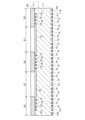
- FIG. 1 is a schematic cross-sectional view illustrating an example of a radiation detection element according to a first embodiment.
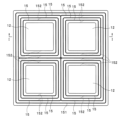
- 2 is a schematic plan view of the radiation detection element according to the first embodiment as viewed from the incident surface side.
- FIG. 2 is a schematic plan view of the radiation detection element according to the first embodiment as viewed from the electrode surface side.
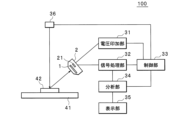
- FIG. 1 is a block diagram showing an example of a functional configuration of a radiation detection device using a radiation detection element.
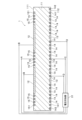
- 3 is a schematic diagram showing a connection between the radiation detection element and a voltage application unit according to the first embodiment.
- 1 is a schematic cross-sectional view showing an example of the configuration of a radiation detector according to a first embodiment
- 1 is a schematic cross-sectional view illustrating an example of a radiation detection element and a collimator according to a first embodiment
- 10A to 10C are schematic cross-sectional views showing examples of a radiation detection element and a collimator according to a second embodiment, and a connection between the radiation detection element and a voltage application unit.
- the present invention will now be described in detail with reference to the drawings showing embodiments thereof.
- ⁇ Embodiment 1> 1 is a schematic cross-sectional view showing an example of a radiation detection element 1 according to a first embodiment.
- the radiation detection element 1 is a silicon drift type radiation detection element.
- the radiation detection element 1 is generally flat.
- the radiation detection element 1 includes a disk-shaped semiconductor portion 11 made of Si (silicon).
- the semiconductor portion 11 is composed of n-type Si.
- the radiation detection element 1 has an incident surface 111 located on the incident side where radiation to be detected is incident, and an electrode surface 112 located on the back side of the incident surface 111.
- FIG. 2 is a schematic plan view of the radiation detection element 1 according to embodiment 1 as viewed from the incident surface 111 side.
- FIG. 3 is a schematic plan view of the radiation detection element 1 according to embodiment 1 as viewed from the electrode surface 112 side.
- FIG. 1 shows a cross-sectional view of the radiation detection element 1 taken along line I-I in FIGS. 2 and 3.
- the electrode surface 112 is provided with a plurality of signal output electrodes 13, which are electrodes that output a signal when radiation is detected.
- the signal output electrodes 13 correspond to the first electrodes.
- the component of the signal output electrodes 13 is the same type of Si as the semiconductor portion 11.
- the component of the signal output electrode 13 is n+Si, in which a specific dopant such as phosphorus is doped into Si.
- Figure 3 shows an example in which four signal output electrodes 13 are provided.
- the multiple signal output electrodes 13 are spaced apart from one another and arranged two-dimensionally.
- the electrode surface 112 is provided with a plurality of curved electrodes 14 in a multiple ring shape at positions surrounding each of the signal output electrodes 13.
- the curved electrodes 14 correspond to the fourth electrode.
- the component of the curved electrode 14 is a semiconductor of a different type from that of the semiconductor portion 11, and is p-type Si in which a specific dopant such as boron is doped into the Si.
- the component of the curved electrode 14 is p+Si.
- the signal output electrode 13 is located approximately in the center of the multiple curved electrodes 14 in a multiple ring shape. The distance between the signal output electrode 13 and each of the curved electrodes 14 surrounding the signal output electrode 13 is different.
- the shape of the curved electrode 14 may be a shape in which part of the ring is missing.
- the electrode surface 112 is provided with a plurality of pairs of a signal output electrode 13 and a plurality of curved electrodes 14 surrounding the signal output electrode 13.
- the plurality of pairs of the signal output electrode 13 and the plurality of curved electrodes 14 are arranged two-dimensionally.
- the outermost curved electrode 14 i.e., the curved electrode 14 that is the greatest distance from each signal output electrode 13
- the curved electrodes 14 shares a portion with the outermost curved electrode 14 among the plurality of curved electrodes 14 included in the other pairs.
- the curved electrodes 14 do not need to have a shared portion.
- each pair includes six curved electrodes 14 is shown in FIG. 1 and FIG. 3, the number of the plurality of curved electrodes 14 included in each pair may be more than six or less than six.
- the electrode surface 112 is provided with a ring-shaped protective electrode 141 and a ring-shaped ground electrode 142.
- the protective electrode 141 is disposed in a position surrounding the multiple sets of the signal output electrode 13 and the multiple curved electrodes 14.
- the ground electrode 142 is disposed outside the protective electrode 141.
- the ground electrode 142 is connected to a ground potential.
- the potential of the protective electrode 141 is a floating potential.
- the protective electrode 141 prevents dielectric breakdown between the curved electrode 14 and the ground electrode 142.
- a single protective electrode 141 is shown in FIG. 1 and FIG. 3, multiple protective electrodes 141 are provided in multiple ring shapes in reality.
- the signal output electrode 13, the curved electrode 14, the protective electrode 141, and the ground electrode 142 are formed by doping a part of the semiconductor portion 11 with a dopant.
- the incident surface 111 is provided with a plurality of counter electrodes 12, which are electrodes to which a voltage is applied.
- the counter electrodes 12 correspond to the second electrodes.
- the counter electrodes 12 are doped with a dopant that makes Si a semiconductor of a different type from the components of the semiconductor portion 11.
- the components of the counter electrodes 12 are p-type Si doped with a specific dopant such as boron, for example, p+Si.
- Each counter electrode 12 is disposed at a position on the back side of each signal output electrode 13. That is, the same number of counter electrodes 12 as the number of signal output electrodes 13 are provided.
- the multiple counter electrodes 12 are spaced apart from each other and disposed two-dimensionally.
- the area of the counter electrodes 12 along the incident surface 111 is larger than the area of the signal output electrodes 13 along the electrode surface 112.
- the counter electrodes 12 are provided in most of the area of the incident surface 111.
- a plurality of drift electrodes 15 in multiple ring shapes are provided on the incident surface 111 at positions surrounding each counter electrode 12.
- the drift electrodes 15 correspond to the third electrode.
- the drift electrodes 15 are made of the same type of semiconductor as the counter electrodes 12. The distances between the counter electrodes 12 and the drift electrodes 15 surrounding the counter electrodes 12 are different.
- the incident surface 111 is provided with a plurality of pairs of a counter electrode 12 and a plurality of drift electrodes 15 surrounding the counter electrode 12.
- the plurality of pairs of the counter electrode 12 and the plurality of drift electrodes 15 are arranged two-dimensionally.
- the outermost drift electrode 15 (i.e., the drift electrode 15 farthest from each counter electrode 12) among the plurality of drift electrodes 15 surrounding each counter electrode 12 shares a portion with the outermost drift electrode 15 among the plurality of drift electrodes 15 included in the other pairs.
- the drift electrode 15 does not need to have a shared portion.
- each pair includes three drift electrodes 15 is shown in FIG. 1 and FIG. 2, the number of the plurality of drift electrodes 15 included in each pair may be less than two or more than three.
- a ring-shaped guard electrode 151 is provided on the incident surface 111.
- the guard electrode 151 is arranged in a position that surrounds multiple pairs of counter electrodes 12 and multiple drift electrodes 15.
- the potential of the guard electrode 151 is a floating potential. Although a single guard electrode 151 is shown in Figures 1 and 2, multiple ring-shaped guard electrodes 151 are actually provided.
- the guard electrode 151 prevents dielectric breakdown between the edge of the semiconductor portion 11 and the drift electrode 15.
- the counter electrode 12, the drift electrode 15, and the guard electrode 151 are formed by doping a part of the semiconductor portion 11 with a dopant.
- the radiation detection element 1 may have a configuration in which the ground electrode 142 is not provided on the electrode surface 112 side, but is provided on the incident surface 111 side. That is, the ground electrode 142 may not be provided, and the ground electrode may be provided outside the protective electrode 151. In this configuration, the protective electrode 151 prevents dielectric breakdown between the drift electrode 15 and the ground electrode.
- the radiation detection element 1 may have a configuration in which the ground electrodes are provided on both the incident surface 111 and the electrode surface 112.
- Radiation such as X-rays, photons in general (including UV and visible light), electron beams, or other charged particle beams is incident on the radiation detection element 1.
- the radiation is absorbed in the semiconductor portion 11, and an amount of charge corresponding to the energy of the absorbed radiation is generated in the semiconductor portion 11.
- the generated charges are electrons and holes.
- the generated charges move due to the electric field inside the semiconductor portion 11, and one type of charge is concentrated and flows into the signal output electrode 13.
- electrons generated by the incidence of radiation move and flow into the signal output electrode 13.
- the signal output electrode 13 outputs a current signal corresponding to the flowing charge, i.e., a current signal corresponding to the energy of the radiation.
- FIG. 4 is a block diagram showing an example of the functional configuration of a radiation detection device 100 that uses a radiation detection element 1.
- the radiation detection device 100 is, for example, an X-ray fluorescence analysis device.
- the radiation detection device 100 includes an irradiation unit 36 that irradiates a sample 42 with radiation such as an electron beam or X-rays, a sample stage 41 on which the sample 42 is placed, and a radiation detector 2.
- the radiation detection device 100 may be configured to hold the sample 42 in a manner other than placing it on the sample stage 41.
- the radiation detector 2 includes a radiation detection element 1 and a preamplifier 21.
- the signal output electrode 13 of the radiation detection element 1 is connected to a preamplifier 21.
- Multiple signal output electrodes 13 may be connected to one preamplifier 21.
- the radiation detector 2 may include multiple preamplifiers 21, and the signal output electrodes 13 and preamplifiers 21 may be connected one-to-one.
- the preamplifier 21 outputs a signal with an intensity according to the energy of the radiation. Note that a portion of the preamplifier 21 may be included inside the radiation detector 2, and the other portion may be located outside the radiation detector 2.
- Radiation is irradiated from the irradiation unit 36 to the sample 42, which generates radiation such as fluorescent X-rays, and the radiation detector 2 detects the radiation generated from the sample 42.
- the radiation is indicated by arrows in FIG. 4.
- the radiation is input to the radiation detection element 1, and the signal output electrode 13 outputs a current signal corresponding to the energy of the radiation.
- the signal output by the signal output electrode 13 is input to the preamplifier 21.
- the preamplifier 21 converts the current signal into a voltage signal and outputs a voltage signal proportional to the energy of the radiation. In this way, the radiation detector 2 outputs a signal with an intensity corresponding to the energy of the detected radiation.
- a voltage application unit 31 is connected to the radiation detector 2.
- the voltage application unit 31 is connected to the radiation detection element 1.
- FIG. 5 is a schematic diagram showing the connection between the radiation detection element 1 and the voltage application unit 31 according to the first embodiment. More specifically, the voltage application unit 31 is connected to the counter electrode 12 and the outermost drift electrode 15 among the multiple drift electrodes 15 surrounding the counter electrode 12.
- the voltage application unit 31 is also connected to the innermost curved electrode 14 (i.e., the curved electrode 14 that is the shortest distance from the signal output electrode 13) and the outermost curved electrode 14 among the multiple curved electrodes 14 surrounding the signal output electrode 13.
- the voltage application unit 31 applies a voltage to the innermost curved electrode 14 and the outermost curved electrode 14 so that the innermost curved electrode 14 has a high potential and the outermost curved electrode 14 has the lowest potential.
- the radiation detection element 1 is also configured so that a predetermined electrical resistance is generated between adjacent curved electrodes 14 that are at different distances from the signal output electrode 13. For example, an electrical resistance channel that connects two curved electrodes 14 is formed by adjusting the components of the portion located between adjacent curved electrodes 14. In other words, the multiple curved electrodes 14 are connected in a daisy chain via electrical resistance.
- each curved electrode 14 When a voltage is applied, each curved electrode 14 has a potential that monotonically increases from the outer curved electrode 14 to the inner curved electrode 14. That is, the potential of the curved electrodes 14 increases from the outermost curved electrode 14 to the innermost curved electrode 14.
- the multiple curved electrodes 14 may include a pair of adjacent curved electrodes 14 with the same potential. The potential of the multiple curved electrodes 14 generates an electric field (potential gradient) in the semiconductor portion 11 such that the potential is higher the closer to the signal output electrode 13 and the potential is lower the farther from the signal output electrode 13.
- the voltage application unit 31 applies a voltage to the counter electrode 12 and the outermost drift electrode 15 so that the potential of the counter electrode 12 is high and the potential of the outermost drift electrode 15 is low. That is, the potential of point B shown in FIG. 5 is higher than the potential of point A. For example, the potential difference between points A and B is 6V to 20V.
- the radiation detection element 1 is configured so that a predetermined electrical resistance occurs between the counter electrode 12 and the innermost drift electrode 15 and between adjacent drift electrodes 15. That is, the multiple drift electrodes 15 and the counter electrode 12 are electrically connected via electrical resistance.
- an electrical resistance channel 152 connecting between the counter electrode 12 and the innermost drift electrode 15, and an electrical resistance channel 152 connecting between adjacent drift electrodes 15 are formed in the semiconductor portion 11. In FIG. 2, the electrical resistance channel 152 is indicated by a dashed line.
- the multiple drift electrodes 15 may include a pair of adjacent drift electrodes 15 with the same potential.
- the potentials of the counter electrode 12 and the multiple drift electrodes 15 generate an electric field near the incident surface 111 in the semiconductor portion 11 such that the potential is higher the closer to the counter electrode 12 and the potential is lower the farther from the counter electrode 12.
- the voltage application unit 31 applies a voltage so that the potential of the drift electrode 15 is higher than the potential of the outermost curved electrode 14.
- the voltage application unit 31 also applies a voltage so that the potential of the counter electrode 12 is lower than the potential of the innermost curved electrode 14. That is, the potential of point A shown in FIG. 5 is higher than the potential of point C, the potential of point B is higher than the potential of point A, and the potential of point D is higher than the potential of point B.
- an electric field is generated inside the semiconductor part 11, the potential of which increases as it approaches the signal output electrode 13. The electric field makes it easier for electrons generated in response to the incidence of radiation to move inside the semiconductor part 11 toward the signal output electrode 13.
- the counter electrode 12 and the drift electrode 15 are connected, and a voltage is applied between the counter electrode 12 and the drift electrode 15, so that a potential difference occurs between the counter electrode 12 and the drift electrode 15, and the potential difference is unlikely to become unstable even if the potential difference is increased. Therefore, a large potential difference can be generated stably, making it easier to collect charges in the signal output electrode 13.
- having multiple drift electrodes 15 makes it possible to apply a higher voltage, increase the potential difference, and make it easier to collect charge.
- the radiation detector 2 is further connected to a signal processing unit 32 that processes the output signal.
- the signal processing unit 32 is connected to the preamplifier 21. When the preamplifier 21 outputs a signal, the radiation detector 2 outputs a signal with an intensity corresponding to the energy of the radiation.
- the signal processing unit 32 is connected to the analysis unit 34.
- the analysis unit 34 is configured to include a calculation unit that performs calculations and a memory that stores data.
- the voltage application unit 31, the signal processing unit 32, the analysis unit 34, and the irradiation unit 36 are connected to the control unit 33.
- the control unit 33 controls the operations of the voltage application unit 31, the signal processing unit 32, the analysis unit 34, and the irradiation unit 36.
- the signal processing unit 32 receives the signal output by the radiation detector 2 and detects the intensity of the signal to detect a signal value corresponding to the energy of the radiation detected by the radiation detector 2.
- the signal processing unit 32 counts the signal for each signal value and outputs data indicating the relationship between the signal value and the count number to the analysis unit 34.
- the analysis unit 34 receives the data indicating the relationship between the signal value and the count number output by the signal processing unit 32.
- the analysis unit 34 performs processing to generate the relationship between the radiation energy and the count number, i.e., the radiation spectrum, based on the data from the signal processing unit 32.
- the analysis unit 34 stores spectral data representing the radiation spectrum.
- the signal processing unit 32 may generate the radiation spectrum.
- the signal processing unit 32 and the analysis unit 34 correspond to a spectrum generation unit.
- the analysis unit 34 performs qualitative or quantitative analysis of the elements contained in the sample 42 based on the spectrum of the radiation.
- a display unit 35 such as a liquid crystal display is connected to the analysis unit 34.
- the display unit 35 displays the spectrum generated by the analysis unit 34 and the analysis results by the analysis unit 34.
- the user can check the spectrum of the radiation generated from the sample 42.
- the control unit 33 may be configured to receive operations from the user and control each part of the radiation detection device 100 in response to the received operations.
- the control unit 33 and the analysis unit 34 may also be configured as a single computer.
- the radiation detection device 100 may be configured to detect radiation that has passed through the sample 42 or radiation that has been reflected by the sample 42.
- the radiation detection device 100 may be configured to scan the sample with radiation by changing the direction of the radiation.
- the radiation detection device 100 may be configured not to include the irradiation unit 36, the analysis unit 34, or the display unit 35.
- FIG. 6 is a schematic cross-sectional view showing an example of the configuration of the radiation detector 2 according to the first embodiment.
- the radiation detector 2 is an SDD (Silicon Drift Detector).
- the radiation detector 2 has a housing 25 in the shape of a cylinder with a truncated cone connected to one end.
- the housing 25 is configured with a plate-shaped bottom plate covered with a cap-shaped cover.
- a window 26 made of a window material that transmits radiation is provided at the tip of the housing 25.
- the radiation detection element 1, the collimator 22, the substrate 23, the cooling unit 28, and the cold finger 24 are arranged inside the housing 25.
- the housing 25 accommodates the radiation detection element 1, the collimator 22, the substrate 23, and the cooling unit 28.
- the cooling unit 28 is, for example, a Peltier element.
- the radiation detection element 1 is mounted on the surface of the substrate 23 and is disposed in a position facing the window 26.
- the radiation detection element 1 is disposed so that the electrode surface 112 faces the substrate 23 and the incident surface 111 faces the window 26.
- the collimator 22 is made of a material that blocks radiation.
- the collimator 22 is disposed between the radiation detection element 1 and the window 26. One end of the collimator 22 faces the window 26, and the other end faces the surface of the radiation detection element 1.
- Radiation mainly passes through the window 26 and enters the inside of the housing 25, and the collimator 22 blocks part of the radiation.
- the radiation detection element 1 detects radiation that enters without being blocked by the collimator 22.
- Wiring is formed on the substrate 23, and the preamplifier 21 is mounted on it.
- the preamplifier 21 is omitted in FIG. 6.
- the substrate 23 is in thermal contact with the heat absorption portion of the cooling portion 28 directly or through an intervening object.
- the heat dissipation portion of the cooling portion 28 is in thermal contact with the cold finger 24.
- the cold finger 24 has a flat portion with which the heat dissipation portion of the cooling portion 28 is in thermal contact, and a portion that penetrates the bottom plate portion of the housing 25.
- the heat of the radiation detection element 1 is absorbed by the cooling portion 28 through the substrate 23, transferred from the cooling portion 28 to the cold finger 24, and dissipated to the outside of the radiation detector 2 through the cold finger 24.
- the radiation detector 2 has a number of lead pins 27 that penetrate the bottom plate of the housing 25.
- the lead pins 27 are connected to the substrate 23 by a method such as wire bonding.
- the application of voltage to the radiation detection element 1 by the voltage application unit 31 and the output of a signal from the preamplifier 21 are performed through the lead pins 27.
- the radiation detector 2 may not include a cold finger 24, and the heat dissipation portion of the cooling unit 28 may be in thermal contact with the bottom plate portion of the housing 25.
- the radiation detector 2 may be in a form that does not include a cooling unit 28.
- the radiation detector 2 may be in a form that does not include a window 26 made of a window material, and the portion of the housing 25 that corresponds to the window 26 is open.
- the radiation detector 2 may be in a form that does not include a housing 25.
- the radiation detector 2 may further include other components.
- FIG. 7 is a schematic cross-sectional view showing an example of the radiation detection element 1 and collimator 22 according to the first embodiment.
- the incident surface 111 of the radiation detection element 1 is divided into a sensitive region 51 capable of detecting radiation, a boundary region 52 located between the multiple sensitive regions 51, and a peripheral region 53.
- the incident surface 111 includes multiple sensitive regions 51.
- the multiple sensitive regions 51 are spaced apart from one another.
- the sensitive regions 51 correspond one-to-one to the counter electrodes 12.
- the sensitive region 51 includes the center of the counter electrode 12 and includes most of the counter electrode 12 except for the peripheral portion of the counter electrode 12.
- the portion of the incident surface 111 other than the counter electrode 12 is not included in the sensitive region 51.
- the boundary region 52 includes a portion located between the multiple counter electrodes 12 in the incident surface 111. That is, the boundary region 52 includes multiple drift electrodes 15 located between the multiple counter electrodes 12. The boundary region 52 also includes a portion of the peripheral portion of the counter electrodes 12.
- the generated electrons When radiation is incident on the sensitive region 51, the generated electrons are gathered at the nearest signal output electrode 13, and the radiation is detected.
- the generated electrons When radiation is incident near a drift electrode 15 included in the boundary region 52, the generated electrons tend to remain between the multiple drift electrodes 15, and the electrons are less likely to gather at the signal output electrode 13. For example, it takes longer for the electrons to gather at the signal output electrode 13, and the time required for signal processing increases. For example, some of the generated electrons do not gather at the signal output electrode 13, and the energy of the detected radiation becomes inaccurate. In this way, when radiation is incident on the boundary region 52, the accuracy of radiation detection deteriorates.
- the peripheral region 53 is located on the peripheral portion of the incident surface 111, and includes a portion located between the counter electrode 12 and the edge of the radiation detection element 1 within the incident surface 111. That is, the peripheral region 53 includes the protective electrode 151, and includes a plurality of drift electrodes 15 located between the counter electrode 12 and the edge of the radiation detection element 1. The peripheral region 53 also includes a portion of the peripheral portion of the counter electrode 12. Even when radiation is incident on the peripheral region 53, electrons are less likely to gather at the signal output electrode 13, just as when radiation is incident on the boundary region 52. This reduces the accuracy of radiation detection.
- the collimator 22 is configured to cover the boundary region 52 and the peripheral region 53 but not the sensitive region 51. That is, the protective electrode 151 and the drift electrode 15 are covered by the collimator 22.
- the collimator 22 also covers the portion of the incident surface 111 where no electrodes are provided.
- the collimator 22 blocks radiation and prevents it from entering the boundary region 52 and the peripheral region 53. Radiation that is not blocked by the collimator 22 enters the sensitive region 51.
- the collimator 22 prevents radiation from entering the boundary region 52 and the peripheral region 53, so that electrons generated by radiation do not become less likely to gather at the signal output electrode 13, and deterioration of the radiation detection accuracy is prevented.
- radiation that is non-perpendicular to the incident surface 111 may enter a portion of the semiconductor part 11 that is located below the boundary region 52 and the peripheral region 53 and near the periphery of the counter electrode 12. Electrons generated by radiation in this portion are gathered by the electric field to the signal output electrode 13.
- an electric field is generated near the incident surface 111 in the semiconductor part 11, in which the potential increases from the outer drift electrode 15 toward the counter electrode 12. Electrons generated near the periphery of the counter electrode 12 due to the incidence of radiation are moved to the center of the counter electrode 12 by the generated electric field. The electrons that have moved to the center of the counter electrode 12 flow into the signal output electrode 13 by the electric field in the semiconductor part 11. Therefore, compared to a conventional radiation detection element in which the drift electrode 15 is not provided, electrons generated near the periphery of the counter electrode 12 are more likely to gather at the signal output electrode 13. In the present embodiment, even in a position where electrons generated by radiation were difficult to gather at the signal output electrode 13 in the past, the generated electrons can easily gather at the signal output electrode 13. By using multiple drift electrodes 15, the potential difference between the outer drift electrode 15 and the counter electrode 12 can be increased. Therefore, electrons are more likely to move to the center of the counter electrode 12 and more likely to flow into the signal output electrode 13.
- the sensitive region 51 can be made larger than before.
- the sensitive region 51 extends to a position closer to the edge of the counter electrode 12 than before.
- the boundary region 52 and the peripheral region 53 become smaller.
- the size of the portion of the collimator 22 that covers the boundary region 52 and the peripheral region 53 can be reduced.
- the sensitive area 51 of the radiation detection element 1 is larger than in the conventional case.
- the proportion of radiation that can be detected using the radiation detection element 1 increases.
- the efficiency of radiation detection using the radiation detection element 1 is improved.
- the radiation detection device 100 can detect radiation with higher accuracy than in the conventional case.
- the radiation detection element 1 has four sets of a counter electrode 12, a plurality of drift electrodes 15, a signal output electrode 13, and a plurality of curved electrodes 14, but the number of sets in the radiation detection element 1 may be any number other than four.
- the radiation detection element 1 By having the radiation detection element 1 have multiple sets of a counter electrode 12, a plurality of drift electrodes 15, a signal output electrode 13, and a plurality of curved electrodes 14, the radiation detection device 100 can detect radiation at a high counting rate.
- the multiple sets of the counter electrode 12, a plurality of drift electrodes 15, a signal output electrode 13, and a plurality of curved electrodes 14 may be arranged in a shape other than two dimensions, such as a straight line.
- ⁇ Embodiment 2> 8 is a schematic cross-sectional view showing an example of the radiation detection element 1 and collimator 22 according to the second embodiment, and a connection state between the radiation detection element 1 and a voltage application unit 31.
- the configuration of the radiation detection device 100 other than the radiation detection element 1 and the collimator 22 is the same as that of the first embodiment.
- a single signal output electrode 13 and a plurality of curved electrodes 14 surrounding the signal output electrode 13 are provided on the electrode surface 112.
- the signal output electrode 13 is disposed in the center of the electrode surface 112.
- a protective electrode 141 and a ground electrode 142 are provided at positions surrounding the plurality of curved electrodes 14.
- the incident surface 111 is provided with a single counter electrode 12 and multiple drift electrodes 15 surrounding the counter electrode 12.
- the counter electrode 12 is disposed at a position behind the signal output electrode 13.
- the counter electrode 12 is disposed at a position including the center of the incident surface 111.
- a protective electrode 151 is disposed at a position surrounding the multiple drift electrodes 15.
- the incident surface 111 does not include the boundary region 52.
- the collimator 22 is configured to cover the peripheral region 53 but not the sensitive region 51.
- the voltage application unit 31 applies a voltage to the curved electrodes 14 so that the innermost curved electrode 14 has a high potential and the outermost curved electrode 14 has a low potential.
- the voltage application unit 31 also applies a voltage to the counter electrode 12 and the drift electrode 15 so that the counter electrode 12 has a high potential and the outermost drift electrode 15 has a low potential.
- an electric field is generated near the incident surface 111 in the semiconductor portion 11, in which the potential increases from the outer drift electrode 15 toward the counter electrode 12.
- the sensitive area 51 can be made larger than in the past. The larger sensitive area 51 improves the efficiency of radiation detection.
- the radiation detection device 100 can detect radiation with higher accuracy than in the past.
- the semiconductor constituting the radiation detection element 1 is Si, but the radiation detection element 1 may be made of a semiconductor other than Si.
- the semiconductor portion 11 is made of an n-type semiconductor, and the counter electrode 12 and the curved electrode 14 are made of a p-type semiconductor, but the radiation detection element 1 may be made of a p-type semiconductor, and the counter electrode 12 and the curved electrode 14 are made of an n-type semiconductor.
- the potential is reversed from that in the first and second embodiments, and holes generated by the incidence of radiation flow into the signal output electrode 13, and radiation is detected.
- the radiation detection element 1 is a silicon drift type radiation detection element, but the radiation detection element 1 may be an element made of a semiconductor other than a silicon drift type radiation detection element. Therefore, the radiation detector 2 may be a radiation detector other than an SDD.
- Radiation detection device 1 Radiation detection element 11 Semiconductor part 111 Incident surface 12 Counter electrode (second electrode) 13 signal output electrode (first electrode) 14 Curved electrode (fourth electrode) 15 Drift electrode (third electrode) 2 Radiation detector 22 Collimator 32 Signal processing unit (spectrum generating unit) 34 Analysis unit (spectrum generation unit) 35 Display unit 36 Irradiation unit 42 Sample
Landscapes
- Physics & Mathematics (AREA)
- Health & Medical Sciences (AREA)
- Life Sciences & Earth Sciences (AREA)
- General Physics & Mathematics (AREA)
- High Energy & Nuclear Physics (AREA)
- Molecular Biology (AREA)
- Spectroscopy & Molecular Physics (AREA)
- Measurement Of Radiation (AREA)
Priority Applications (3)
| Application Number | Priority Date | Filing Date | Title |
|---|---|---|---|
| US19/103,874 US20260086251A1 (en) | 2022-09-29 | 2023-09-14 | Radiation detection element, radiation detector, and radiation detection apparatus |
| JP2024550075A JPWO2024070737A1 (https=) | 2022-09-29 | 2023-09-14 | |
| EP23871970.2A EP4597171A1 (en) | 2022-09-29 | 2023-09-14 | Radiation detection element, radiation detector, and radiation detection device |
Applications Claiming Priority (2)
| Application Number | Priority Date | Filing Date | Title |
|---|---|---|---|
| JP2022-156683 | 2022-09-29 | ||
| JP2022156683 | 2022-09-29 |
Publications (1)
| Publication Number | Publication Date |
|---|---|
| WO2024070737A1 true WO2024070737A1 (ja) | 2024-04-04 |
Family
ID=90477624
Family Applications (1)
| Application Number | Title | Priority Date | Filing Date |
|---|---|---|---|
| PCT/JP2023/033568 Ceased WO2024070737A1 (ja) | 2022-09-29 | 2023-09-14 | 放射線検出素子、放射線検出器及び放射線検出装置 |
Country Status (4)
| Country | Link |
|---|---|
| US (1) | US20260086251A1 (https=) |
| EP (1) | EP4597171A1 (https=) |
| JP (1) | JPWO2024070737A1 (https=) |
| WO (1) | WO2024070737A1 (https=) |
Cited By (1)
| Publication number | Priority date | Publication date | Assignee | Title |
|---|---|---|---|---|
| WO2026048679A1 (ja) * | 2024-08-29 | 2026-03-05 | 株式会社堀場製作所 | 放射線検出素子、放射線検出器及び放射線検出装置 |
Citations (3)
| Publication number | Priority date | Publication date | Assignee | Title |
|---|---|---|---|---|
| US7105827B2 (en) | 2002-12-20 | 2006-09-12 | Max-Planck-Gesellschaft Zur Foerderung Der Wissenschaften E.V. | Semiconductor detector with optimised radiation entry window |
| JP2011187501A (ja) * | 2010-03-04 | 2011-09-22 | Seiko Instruments Inc | シリコン検出器およびシリコン検出器の製造方法 |
| CN111354747A (zh) * | 2020-03-23 | 2020-06-30 | 湘潭大学 | 基于分压电阻和漂浮电极的硅漂移探测器及其设计方法 |
-
2023
- 2023-09-14 US US19/103,874 patent/US20260086251A1/en active Pending
- 2023-09-14 JP JP2024550075A patent/JPWO2024070737A1/ja active Pending
- 2023-09-14 WO PCT/JP2023/033568 patent/WO2024070737A1/ja not_active Ceased
- 2023-09-14 EP EP23871970.2A patent/EP4597171A1/en active Pending
Patent Citations (3)
| Publication number | Priority date | Publication date | Assignee | Title |
|---|---|---|---|---|
| US7105827B2 (en) | 2002-12-20 | 2006-09-12 | Max-Planck-Gesellschaft Zur Foerderung Der Wissenschaften E.V. | Semiconductor detector with optimised radiation entry window |
| JP2011187501A (ja) * | 2010-03-04 | 2011-09-22 | Seiko Instruments Inc | シリコン検出器およびシリコン検出器の製造方法 |
| CN111354747A (zh) * | 2020-03-23 | 2020-06-30 | 湘潭大学 | 基于分压电阻和漂浮电极的硅漂移探测器及其设计方法 |
Cited By (1)
| Publication number | Priority date | Publication date | Assignee | Title |
|---|---|---|---|---|
| WO2026048679A1 (ja) * | 2024-08-29 | 2026-03-05 | 株式会社堀場製作所 | 放射線検出素子、放射線検出器及び放射線検出装置 |
Also Published As
| Publication number | Publication date |
|---|---|
| US20260086251A1 (en) | 2026-03-26 |
| JPWO2024070737A1 (https=) | 2024-04-04 |
| EP4597171A1 (en) | 2025-08-06 |
Similar Documents
| Publication | Publication Date | Title |
|---|---|---|
| US12183844B2 (en) | Radiation detection element, radiation detector and radiation detection device | |
| EP3425428B1 (en) | Radiation detection element, radiation detector and radiation detection apparatus | |
| CN102507623B (zh) | 一种非扫描式波长色散型x射线荧光光谱仪 | |
| US20240337765A1 (en) | Silicon drift detection element, silicon drift detector, and radiation detection device | |
| JP6905825B2 (ja) | 半導体検出器、放射線検出器及び放射線検出装置 | |
| CN105830232B (zh) | 光检测器 | |
| CN111373287B (zh) | 放射线检测器和放射线检测装置 | |
| WO2024070737A1 (ja) | 放射線検出素子、放射線検出器及び放射線検出装置 | |
| JPH07122776A (ja) | 光・放射線電気変換半導体装置およびその応用 | |
| JP6846923B2 (ja) | 半導体検出器、放射線検出器及び放射線検出装置 | |
| JP7624899B2 (ja) | 信号処理方法、放射線検出装置及びコンピュータプログラム | |
| JP2023019637A (ja) | 放射線検出素子の製造方法 | |
| JP7710511B2 (ja) | 放射線検出素子、放射線検出器及び放射線検出装置 | |
| WO2026048679A1 (ja) | 放射線検出素子、放射線検出器及び放射線検出装置 | |
| JPWO2024070737A5 (https=) | ||
| JP7045371B2 (ja) | 放射線検出器及び放射線検出装置 | |
| JP2025186855A (ja) | 放射線検出器、放射線検出装置及び放射線検出方法 | |
| CN113419269A (zh) | 一种具有高能量分辨特征的环形伽马射线探测器 | |
| WO2025079486A1 (ja) | 放射線検出素子の製造方法、放射線検出素子及び放射線検出器 | |
| US20250224526A1 (en) | Radiation detection element, radiation detector, radiation detection device, and method for manufacturing radiation detection element | |
| JP2015021843A (ja) | 放射線検出器、放射線検出装置及び放射線分析装置 |
Legal Events
| Date | Code | Title | Description |
|---|---|---|---|
| 121 | Ep: the epo has been informed by wipo that ep was designated in this application |
Ref document number: 23871970 Country of ref document: EP Kind code of ref document: A1 |
|
| WWE | Wipo information: entry into national phase |
Ref document number: 2024550075 Country of ref document: JP |
|
| WWE | Wipo information: entry into national phase |
Ref document number: 2023871970 Country of ref document: EP |
|
| NENP | Non-entry into the national phase |
Ref country code: DE |
|
| ENP | Entry into the national phase |
Ref document number: 2023871970 Country of ref document: EP Effective date: 20250429 |
|
| WWP | Wipo information: published in national office |
Ref document number: 2023871970 Country of ref document: EP |