WO2024070046A1 - キッチンペーパーロール - Google Patents
キッチンペーパーロール Download PDFInfo
- Publication number
- WO2024070046A1 WO2024070046A1 PCT/JP2023/019281 JP2023019281W WO2024070046A1 WO 2024070046 A1 WO2024070046 A1 WO 2024070046A1 JP 2023019281 W JP2023019281 W JP 2023019281W WO 2024070046 A1 WO2024070046 A1 WO 2024070046A1
- Authority
- WO
- WIPO (PCT)
- Prior art keywords
- sheet
- roll
- sheets
- convex
- kitchen paper
- Prior art date
- Legal status (The legal status is an assumption and is not a legal conclusion. Google has not performed a legal analysis and makes no representation as to the accuracy of the status listed.)
- Ceased
Links
Images




Classifications
-
- A—HUMAN NECESSITIES
- A47—FURNITURE; DOMESTIC ARTICLES OR APPLIANCES; COFFEE MILLS; SPICE MILLS; SUCTION CLEANERS IN GENERAL
- A47L—DOMESTIC WASHING OR CLEANING; SUCTION CLEANERS IN GENERAL
- A47L13/00—Implements for cleaning floors, carpets, furniture, walls, or wall coverings
- A47L13/10—Scrubbing; Scouring; Cleaning; Polishing
- A47L13/16—Cloths; Pads; Sponges
-
- B—PERFORMING OPERATIONS; TRANSPORTING
- B31—MAKING ARTICLES OF PAPER, CARDBOARD OR MATERIAL WORKED IN A MANNER ANALOGOUS TO PAPER; WORKING PAPER, CARDBOARD OR MATERIAL WORKED IN A MANNER ANALOGOUS TO PAPER
- B31F—MECHANICAL WORKING OR DEFORMATION OF PAPER, CARDBOARD OR MATERIAL WORKED IN A MANNER ANALOGOUS TO PAPER
- B31F1/00—Mechanical deformation without removing material, e.g. in combination with laminating
- B31F1/07—Embossing, i.e. producing impressions formed by locally deep-drawing, e.g. using rolls provided with complementary profiles
-
- D—TEXTILES; PAPER
- D21—PAPER-MAKING; PRODUCTION OF CELLULOSE
- D21H—PULP COMPOSITIONS; PREPARATION THEREOF NOT COVERED BY SUBCLASSES D21C OR D21D; IMPREGNATING OR COATING OF PAPER; TREATMENT OF FINISHED PAPER NOT COVERED BY CLASS B31 OR SUBCLASS D21G; PAPER NOT OTHERWISE PROVIDED FOR
- D21H27/00—Special paper not otherwise provided for, e.g. made by multi-step processes
Definitions
- the present invention relates to a kitchen paper roll.
- the roll diameter can be increased, but this increases portability and space required for storage and sale, so it is desirable to increase the length while keeping the roll diameter at the same level as conventional products.
- Some kitchen paper has a textured surface created by embossing to improve design and liquid absorption. If the roll is tightly wound, the texture and gaps between the sheets can get crushed, and the desired design, absorbency, and other qualities cannot be achieved.
- the main objective of the present invention is to provide a kitchen paper roll that has sufficient quality in terms of design and liquid absorption, prevents the roll from becoming too large when extended, and has unevenness due to embossing.
- the first means for solving the above problem is: A sheet having a basis weight of 15.0 to 23.0 g/m2 is laminated to two plies.
- the tops of the convex portions of the sheets embossed are laminated facing each other, and a convex portion is formed on the outer laminated surface side of the inner winding sheet at a portion of the sheet on the inner winding side that corresponds to the convex portion of the sheet on the unwinding side that is embossed.
- This is a kitchen paper roll characterized by the above.
- the second method is A convex edge portion that is convex in a frame shape is formed on the outer layer side along the edge of a portion that corresponds to the top of the convex portion when embossing the sheet on the inner side of the winding.
- This is a kitchen paper roll relating to the first aspect above.
- the third method is The kitchen paper roll according to the first aspect of the present invention has a depth of the recesses in the unwinding surface sheet (D surface) of 0.060 to 0.765 mm.
- the fourth measure is This is the kitchen paper roll according to the first aspect of the present invention, in which the height (H back) of the portion of the inner winding sheet that is convex toward the outer laminate surface is 0.060 ⁇ m to 0.250 ⁇ m.
- the present invention makes it possible to provide a kitchen paper roll that has sufficient quality in terms of design and liquid absorption, prevents the roll from becoming too large in diameter due to length, and has unevenness due to embossing.
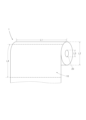
- FIG. 1 is a schematic explanatory diagram of a kitchen paper roll.
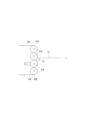
- FIG. 2 is a cross-sectional view of the sheets immediately after lamination.
- FIG. 2 is a diagram showing an example of a cross-sectional view of kitchen paper.
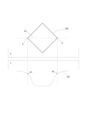
- FIG. 1 is a diagram for explaining an example of embossing of kitchen paper. 1 is a plan view of an example of a sheet on the unwinding side. 13 is a diagram for explaining a method for measuring the depth of a recess in a sheet on the unwinding surface side.
- FIG. 11 is a diagram for explaining a method for measuring the height of the convex portion on the outer layer of the sheet on the inner winding side.
- a kitchen paper roll 1 is formed by winding two plies of belt-shaped kitchen paper 10 around a paper tube (also called a tube core) 20 in a roll shape.
- the winding length is 20 to 32 m, preferably 25 to 28 m.
- the winding diameter L2 is preferably 105 to 125 mm, and more preferably 110 to 120 mm.
- the kitchen paper roll 1 of the present invention has a fairly long roll length of 22 to 32 m and a preferred roll diameter L2 of 105 to 125 mm, making it easy to carry after purchase and convenient in terms of storage space.
- the winding length of a kitchen paper roll is a value calculated by multiplying the cutting pitch by the number of cuts.
- the kitchen paper roll 1 has perforations 12 formed so that it can be easily cut at predetermined intervals for easy use like sheets.
- the distance L4 between these perforations 12 is the cutting pitch.
- the cutting pitch is approximately 18 to 25 cm.
- the kitchen paper roll of this embodiment also falls within this range.
- the number of cuts is the number of kitchen paper sheets obtained by cutting along the perforations 12, and corresponds to the number of sheets.
- a conventional kitchen paper roll 1 has about 50 to 70 cuts.
- the desired number of cuts is 90 to 180 cuts, and more preferably 100 to 140 cuts. Increasing the number of cuts makes the roll longer.
- the winding diameter L2 is calculated by measuring the circumference of the roll at three points in the width direction using a diameter rule (Muratec KDS Co., Ltd.) and taking the average of the three measurements.
- the roll width L1 is not limited, but can be 200 to 230 mm, which is similar to commercially available products.
- the roll width is calculated by measuring the axial length of the outer peripheral surface of the roll at three points around the roll using a JIS Class 1 metal ruler and averaging the measured values.
- the paper tube diameter L3 is not necessarily limited, but is set to 35 to 45 mm.
- the paper tube diameter is a factor in adjusting the winding density, which will be described later.
- the paper tube diameter is calculated by measuring the circumference of the paper tube at three points in the width direction using a diameter rule (Muratec KDS Co., Ltd.) and taking the average value of the three points.
- the kitchen paper 10 is made up of two plies of crepe paper sheets 10A and 10B laminated together, and the sheets 10A and 10B have unevenness caused by embossing.
- Steel-rubber embossing is a suitable method for this embossing.
- the sheets 10A and 10B are laminated so that the tops of the convex parts formed during embossing face each other.
- the tops of the convex parts 11A of the sheet 10A which is the first crepe paper constituting one side of the kitchen paper 10
- the tops of the convex parts 11B of the sheet 10B which is the second crepe paper constituting the other side, in a tip-to-tip configuration.
- the adhesive glue 10C can be a known adhesive glue used in kitchen paper having a laminated structure.
- the adhesive glue 10C can be a known adhesive glue used in kitchen paper having a laminated structure.
- Another known embossed form is the nested form, in which the tops of the convex parts of the first crepe paper that constitutes one side of the kitchen paper face the non-convex parts of the second crepe paper that constitutes the other side.
- This kitchen paper roll 1 employs a tip-to-tip embossed form, which tends to make the kitchen paper 10 bulky and difficult to lengthen, and has an embossed uneven shape and winding that is designed to prevent the roll from becoming larger in diameter due to lengthening while still maintaining sufficient quality in terms of design and liquid absorption. That is, in the general tip-to-tip embossing form, the tops of the convex parts 11A, 11B of the sheets 10A, 10B face each other as shown in FIG. 2, and only the concave parts 13A, 13B are present on the surface of each sheet. However, in the kitchen paper roll 1 of this embodiment, as shown in FIG. 3 and FIG.
- the sheets 10A, 10B are stacked with the tops of the convex parts 11A, 11B of the sheets 10A, 10B stacked with each other facing each other, but the sheet 10B on the inner side of the roll that is located on the paper tube side in the rolled state has the convex parts 13b, 13c formed on the outer surface of the stack of the sheet 10B on the inner side of the roll that corresponds to the convex part 11A of the sheet 10A on the unrolled side due to the embossing.
- the outer surface of the stack is the surface side on which the sheets do not face each other.
- the convex portion 11A may be pushed from the sheet 10A on the outer winding surface side to push the convex portion 11B of the sheet 10B on the inner winding surface side toward the outer laminated surface side. For example, as shown in FIG.
- the sheets 10A and 10B are embossed with embossing rolls 61A and 61B and elastic rolls 62A and 62A to form the unevenness, and then the sheets 10A and 10B are laminated on the embossing roll 61A of the sheet 10A on the unwinding surface side, and an elastic marriage roll is applied to the embossing roll 61A to laminate the two sheets with an appropriate nip pressure.
- embossing may be performed to form recesses of different depths in each sheet, for example, by using metal embossing rolls with different engravings (mainly the height of the convex portion).
- the nip width (nip pressure) during embossing of each sheet may be made different.
- the methods are not limited to these examples.
- the characteristic uneven shape described above ensures the clarity of the embossing without crushing the embossing on the crepe paper on the unwinding surface, which has a significant impact on the design due to the tight winding caused by the long length. Furthermore, by forming convex portions 13b, 13c that protrude slightly toward the inner layer side of the laminate at positions on the sheet 10B on the inner winding surface that correspond to the concave (convex) portions created by the embossing of the sheet 10A on the unwinding surface, the reduction in oil absorption is reduced.
- the concave portion 13A on the unwinding surface is particularly deep, and the convex portions 13b, 13c are formed on the sheet 10B on the inner winding surface, it is thought that this creates a tension difference and deformation between the front and back of the sheets 10A, 10B when wound, making it easier to wind them into a roll.
- a convex frame-shaped convex edge portion 13c is formed on the outer surface of the laminate along the edge of the portion corresponding to the convex top when embossing the sheet 10B on the inner surface of the winding.
- the convex edge portion 13c does not necessarily have to be formed. It may also be formed on only a part of the edge of the portion corresponding to the convex top. This convex edge portion 13c improves wiping properties.
- the edge of the portion corresponding to the convex top corresponds to a portion where the sheets are not in contact with each other when embossing, so the convex edge portion 13c is not in contact with the sheets or there is a gap between the sheets. Therefore, it is presumed that the convex edge portion 13c reduces the decrease in oil absorption. It is presumed that this convex edge portion 13c is formed when the edge of the convex top of the sheet on the unwinding surface presses the convex top on the inner surface of the winding, causing the edge of the convex top to distort.
- the embossing depth (D surface) of the recesses 13A of the sheet 10A on the unwrapping surface side is preferably 0.060 to 0.765 mm, more preferably 0.102 to 0.493 mm, and particularly preferably 0.120 to 0.255 mm. Within this range, it is easy to ensure design and oil absorption.
- the depth of the embossed recesses is determined by image analysis using a one-shot 3D measuring macroscope VR-3200 or an equivalent device manufactured by Keyence Corporation and image analysis software "VR-H1A" or an equivalent software.
- the measurement conditions for the embossed portion image are a magnification of 12 times and a field area of 24 mm x 18 mm. However, the magnification and field area can be appropriately changed depending on the size of the protrusions.
- the emboss depth is obtained by measuring the line roughness. A specific measurement procedure will be described with reference to FIG. 6.
- an "emboss depth (measurement curve) profile Q2" is obtained for a line segment Q1 that crosses the longest part of the periphery of one recess 13A in an image portion (part X in the figure) shown from a plan view point. From the “emboss depth (measurement curve) profile Q2" of the image portion (part Y in the figure) shown from this view point, two recess edge points P1 and P2 that are upwardly convex and have the strongest curvature are extracted, and the minimum value of the depth of the portion sandwiched between the recess edge points P1 and P2 is obtained and set as the minimum depth value Min.
- the average value of the depth values of the recess edge points P1 and P2 is set as the maximum depth value Max. Then, the emboss depth is calculated as the maximum value Max - minimum value Min.
- the "emboss depth (measurement curve) profile Q2" is set as a profile curve after correction of the inclination to "automatic correction” in consideration of the waviness of the sheet.
- the depth of the recess is the average value of 10 points at 30% from the outermost end at the beginning of use.
- the two recess edge points P1 and P2 that are convex upward and have the strongest curve are selected by visual inspection. The selection may be made with reference to the outline E in the plan view image of the recess 13A being measured.
- the height (H back) of the portion 13b which corresponds in particular to the top of the portion of the sheet 10B on the inner winding side that is convex toward the outer laminate surface, is preferably 0.060 ⁇ m to 0.200 ⁇ m. More preferably, it is 0.070 ⁇ m to 0.200 ⁇ m.
- the height of this convex portion 13b is also determined by image analysis using a one-shot 3D measuring macroscope VR-3200 or equivalent manufactured by Keyence Corporation and image analysis software "VR-H1A” or equivalent software.
- the height of the convex portion 13b is also determined by line roughness measurement. The specific measurement procedure will be explained with reference to Figure 7. Using the above software, five linearly adjacent convex portions are extracted from the image portion (Figure 7(A)) shown in a planar perspective. Next, as shown in Figure 7(B), a "height difference curve Q4" is obtained for line segment Q3 that crosses these five convex portions.
- This "height difference curve Q4" is a corrected profile curve in which the inclination correction is set to "automatic correction" in consideration of the waviness of the sheet.
- the center positions P1 to P5 of the five convex portions (concave portions at the time of embossing) are visually identified from the image portion shown in the plan view of FIG. 7(A) and the "height difference curve Q4" shown in FIG. 7(B), and the depth (height) of those P1 to P5 are extracted as the reference height.
- the center positions D1 to D4 of the four non-embossed portions between the two points P1 to P5 are visually identified from the image portion shown in the plan view of FIG. 7(A) and the "height difference curve Q4" shown in FIG.
- the embossing pattern in plan view is not necessarily limited.
- the embossing can be any suitable embossing pattern.
- a plan view of the sheet on the outer surface side of the roll a pattern having a substantially rectangular embossed section 40 in which a plurality of recesses are arranged and a non-embossed section 50 located therebetween can be exemplified.
- the shape of the embossed section may be a square, a rectangle, a rhombus, a circle, or the like.
- the area of one embossed section 40 is not necessarily limited, but can be exemplified as 3 to 16 cm 2.
- the number of recesses 13A, 13B in the embossed section can be exemplified as about 10 to 100.
- the non-embossed section 50 is a portion between the embossed sections 40 with no recesses and a width L8 of 3.0 to 10.0 mm.
- the kitchen paper 10 has a basis weight of 15.0 to 23.0 g/ m2 per ply. Preferably, it is 16 to 21 g/ m2 .
- the basis weight is based on JIS P 8124 (1998). However, the basis weight value is determined by measuring the basis weight of the kitchen paper 10 and dividing it by the number of layers, i.e., two sheets. This basis weight range is low for kitchen paper. If the basis weight is too thick, the roll length must be shortened, and conversely, if the basis weight is too low, the strength is reduced and the thinness of the paper is easily felt during use.
- the unevenness of the sheet due to the characteristic embossing process described above is configured, so that even if the basis weight is low, the design and oil absorption are sufficient.
- the kitchen paper 10 has a paper thickness of 1.5 mm/5 sheets to 2.2 mm/5 sheets. This paper thickness is measured by stacking the next 5 cuts, excluding the first cut from the end of the roll.
- the paper thickness when 5 sheets are stacked (10 plies) is less affected by the crushing of unevenness caused by the embossing process when measuring.
- the roll length must be shortened, and conversely, if it is too thin, it will result in a decrease in strength and the thinness of the paper will be felt when using it.
- the paper thickness is measured by sufficiently conditioning the humidity of the test piece under the conditions of JIS P 8111 (1998), and then measuring under the same conditions using a dial thickness gauge (thickness measuring device) "PEACOCK G type" (manufactured by Ozaki Manufacturing Co., Ltd.). The paper thickness is measured without peeling off each ply.
- the specific measurement procedure is to make sure that there is no dirt or dust between the plunger and the measuring table, lower the plunger onto the measuring table, move the scale of the dial thickness gauge to set the zero point, then raise the plunger and place the sample on the test table, slowly lower the plunger and read the gauge at that time. At this time, just place the plunger on the table.
- the plunger terminal is made of metal and the circular flat surface with a diameter of 10 mm is made to contact the paper surface perpendicularly, and the load when measuring this thickness is about 70 gf at 120 ⁇ m.
- the thickness is the average value obtained by performing 10 measurements.
- the value in the calculation of the roll density is the value obtained by dividing the value of 5 sheets by 5.
- the kitchen paper 10 achieves a high oil absorption value (oil absorption performance value) of 33.0 to 43.0 according to the following formula (1):
- Oil absorption performance value (oil absorption performance value)] oil absorption amount [g/ m2 ] ⁇ [roll density] / 1 ply per U.S. basis weight (g/ m2 ).
- Roll density is calculated as follows: (paper thickness of 2 plies ⁇ roll length) / ((radius of roll diameter) 2 ⁇ - (radius of paper tube diameter) 2 ⁇ ).
- the roll density is high, the roll will be tightly wound, and the unevenness caused by the embossing will be easily crushed, resulting in a decrease in oil absorption.
- the roll density is improved by reducing the paper thickness by decreasing the basis weight, the oil absorption will also decrease due to the lower basis weight. Therefore, taking these points into consideration, if the value of the oil absorption performance (oil absorption performance value) is within the above range, it can be said that the oil absorption performance of the kitchen paper roll as a whole is high. A comparison with commercially available and conventional products will be made later.
- the roll density of the kitchen paper roll 1 of this embodiment is not limited, but is preferably 1.20 or less, and more preferably 0.95 to 1.19. If the roll density is too high, the embossing is likely to be crushed, as mentioned above. This is particularly true in the case of double embossing.
- the oil absorption amount in the embodiment is measured as follows (1) to (5).
- test piece is spread out on a rigid flat net (e.g., 120 mm x 120 mm, mesh size 30 mm) that is larger than the test piece, and then lowered into the tray containing the salad oil so that the test piece is immersed in the oil so that it comes into contact with the oil surface.
- a rigid flat net e.g., 120 mm x 120 mm, mesh size 30 mm
- the salad oil has soaked into the surface of the test piece, raise the flat net directly above the oil surface, leave it there for 26 to 27 seconds, then pick up a corner of the test piece with tweezers and transfer the test piece to a pre-weighed measurement container. At this time, do not allow more than 30 seconds from when the flat net is raised above the oil surface and left at rest until it is transferred to the measurement container.
- the tensile strength of the kitchen paper 10 of the embodiment is not necessarily limited, but the tensile strength in the longitudinal direction is preferably 650 to 1350 cN/25 mm, more preferably 780 to 1220 cN/25 mm, and the tensile strength in the transverse direction is preferably 250 to 550 cN/25 mm, more preferably 320 to 480 cN/25 mm.
- the tensile strength refers to the tensile strength when dry (dry tensile strength). If the tensile strength is within this range, it can be said that the strength is necessary when in use.
- the tensile strength is measured in accordance with JIS P 8113:2006 using a test piece having a paper width of 25 mm.
- the fiber material of the sheets 10A and 10B in the embodiment is pulp fiber, and the pulp composition can be a known composition for kitchen paper 10. It is preferable that the composition contains 90 to 100% by mass of virgin pulp.
- a pulp composition that exhibits the unique effects of the present invention is one in which softwood pulp such as NBKP (softwood kraft pulp) or NUKP (softwood unbleached pulp) is mixed with hardwood pulp such as LBKP (hardwood kraft pulp) or LUKP (hardwood unbleached pulp) in an appropriate ratio. It is preferable that the pulp composition contains more softwood pulp than hardwood pulp. In particular, it is preferable that the ratio of softwood pulp to hardwood pulp is 50:50 to 80:20.
- softwood pulp Since softwood pulp has longer fibers than hardwood pulp, liquids tend to spread along the long softwood pulp fibers in pulp compositions that contain a large amount of softwood pulp, making the effects of the present invention particularly likely to be realized.
- the paper tends to develop a firm stiffness, making it particularly suitable for use in kitchen paper used for wiping off and absorbing liquids.
- the toilet paper in each example was pulled out from kitchen paper.
- the physical properties and composition of each example are shown in Table 1.
- the column for the height of the convex portion is the height of the portion that is convex on the outer surface of the laminate on the inner surface of the winding for the examples, and for the comparative examples, it is the value of the depth of the concave portion measured in the same manner as the depth of the concave portion on the unwinding surface.
- Example 2 Furthermore, a sensory evaluation test was conducted to compare Example 2 and Comparative Example 4 with regard to the clarity of the embossing on the sheet on the unwound surface.
- the test was conducted by 17 people, and the average of the scores of the 15 people excluding the highest and lowest scores was used as the evaluation score.
- the evaluation was conducted by using Comparative Example 4 as the standard and evaluating Example 2. In other words, scores were assigned as follows: 4 points for the same as Comparative Example 4, 5 points for slightly good, 6 points for good, 7 points for very good, 3 points for slightly poor, 2 points for poor, and 1 point for very poor, and the average was calculated to make a judgment.
- the Examples tend to have a higher oil absorption than the nested Comparative Examples 1, 2, 5, and 6, which have higher basis weights.
- the winding length is about 21 m
- Comparative Example 1 which has deep embossed recesses
- the winding length is about the same as in Example 1, which is over 26 m.
- it tends to be difficult to achieve a sufficient length and oil absorption.
- the embossed recesses on the unwinding surface side are deep and protruding portions are formed on the winding inner surface side, but the oil absorption is higher than that of the comparative examples with long winding lengths except for Comparative Example 3.
- Comparative Example 3 It is about the same as Comparative Example 3 with a low roll density and short length. Looking at the oil absorption performance values, Comparative Example 2 has a high basis weight and a long winding length, but is nested, so the oil absorption performance is low when viewed as a whole roll. Comparative Example 3 has a high basis weight and is tip-to-tip, but is short in winding length, so the oil absorption performance is low when viewed as a whole roll. In addition, comparing the working example with Comparative Example 4, Comparative Example 4 has a lower oil absorption. Even in the case of tip-to-tip, it is considered that the oil absorption decreases when the winding length is increased simply by reducing the basis weight. In addition, the oil absorption performance of the entire roll is not sufficiently improved.
- the configuration of the present invention can provide a kitchen paper roll that has sufficient quality in terms of design and liquid absorption, is prevented from becoming larger in diameter due to lengthening, and has unevenness due to embossing.
- the kitchen paper roll of the present invention can be used for home use as well as commercial use (for example, airport cafeterias and hospitals used by an unspecified number of people).
Landscapes
- Engineering & Computer Science (AREA)
- Mechanical Engineering (AREA)
- Paper (AREA)
- Cleaning Implements For Floors, Carpets, Furniture, Walls, And The Like (AREA)
- Machines For Manufacturing Corrugated Board In Mechanical Paper-Making Processes (AREA)
- Sanitary Thin Papers (AREA)
Applications Claiming Priority (2)
| Application Number | Priority Date | Filing Date | Title |
|---|---|---|---|
| JP2022158588A JP2024052109A (ja) | 2022-09-30 | 2022-09-30 | キッチンペーパーロール |
| JP2022-158588 | 2022-09-30 |
Publications (1)
| Publication Number | Publication Date |
|---|---|
| WO2024070046A1 true WO2024070046A1 (ja) | 2024-04-04 |
Family
ID=90476826
Family Applications (1)
| Application Number | Title | Priority Date | Filing Date |
|---|---|---|---|
| PCT/JP2023/019281 Ceased WO2024070046A1 (ja) | 2022-09-30 | 2023-05-24 | キッチンペーパーロール |
Country Status (3)
| Country | Link |
|---|---|
| JP (1) | JP2024052109A (https=) |
| TW (1) | TW202421047A (https=) |
| WO (1) | WO2024070046A1 (https=) |
Families Citing this family (1)
| Publication number | Priority date | Publication date | Assignee | Title |
|---|---|---|---|---|
| WO2026083779A1 (ja) * | 2024-10-18 | 2026-04-23 | 大王製紙株式会社 | キッチンペーパー及びキッチンペーパーロール |
Citations (4)
| Publication number | Priority date | Publication date | Assignee | Title |
|---|---|---|---|---|
| JP2013208298A (ja) * | 2012-03-30 | 2013-10-10 | Daio Paper Corp | キッチンペーパーロール及びその製造方法 |
| JP2018053384A (ja) * | 2016-09-28 | 2018-04-05 | 大王製紙株式会社 | キッチンペーパー |
| JP2019208854A (ja) * | 2018-06-04 | 2019-12-12 | 大王製紙株式会社 | キッチンペーパーロール及びキッチンペーパー |
| JP2020116046A (ja) * | 2019-01-22 | 2020-08-06 | 王子ホールディングス株式会社 | トイレットロール |
-
2022
- 2022-09-30 JP JP2022158588A patent/JP2024052109A/ja active Pending
-
2023
- 2023-05-17 TW TW112118296A patent/TW202421047A/zh unknown
- 2023-05-24 WO PCT/JP2023/019281 patent/WO2024070046A1/ja not_active Ceased
Patent Citations (4)
| Publication number | Priority date | Publication date | Assignee | Title |
|---|---|---|---|---|
| JP2013208298A (ja) * | 2012-03-30 | 2013-10-10 | Daio Paper Corp | キッチンペーパーロール及びその製造方法 |
| JP2018053384A (ja) * | 2016-09-28 | 2018-04-05 | 大王製紙株式会社 | キッチンペーパー |
| JP2019208854A (ja) * | 2018-06-04 | 2019-12-12 | 大王製紙株式会社 | キッチンペーパーロール及びキッチンペーパー |
| JP2020116046A (ja) * | 2019-01-22 | 2020-08-06 | 王子ホールディングス株式会社 | トイレットロール |
Also Published As
| Publication number | Publication date |
|---|---|
| TW202421047A (zh) | 2024-06-01 |
| JP2024052109A (ja) | 2024-04-11 |
Similar Documents
| Publication | Publication Date | Title |
|---|---|---|
| TW424120B (en) | Calendered and embossed tissue products | |
| JP7255978B2 (ja) | キッチンペーパーロール及びキッチンペーパー | |
| US11192325B2 (en) | Hygienic thin-leaf paper | |
| JP2024073437A (ja) | キッチンタオルロール製品 | |
| JP2025185123A (ja) | トイレットロール | |
| WO2024070046A1 (ja) | キッチンペーパーロール | |
| JP7033529B2 (ja) | トイレットロール | |
| JP2024052109A5 (https=) | ||
| WO2023188498A1 (ja) | キッチンペーパーロール | |
| JP2023146593A5 (https=) | ||
| JP7820271B2 (ja) | キッチンペーパーロール | |
| JP2024052108A5 (https=) | ||
| JP2025131231A (ja) | キッチンタオルロール包装体 | |
| JP7730304B2 (ja) | ロール状ペーパータオル | |
| JP7672884B2 (ja) | キッチンタオルロール | |
| WO2024117150A1 (ja) | キッチンタオルロール | |
| JP2024142077A (ja) | トイレットロール | |
| JP2026005145A (ja) | キッチンタオルロール包装体 | |
| WO2025069546A1 (ja) | トイレットロール | |
| JP2025176457A (ja) | キッチンタオルロール | |
| WO2026083779A1 (ja) | キッチンペーパー及びキッチンペーパーロール | |
| JP2025060297A (ja) | トイレットロール | |
| JP2025109130A (ja) | キッチンタオルロール及びキッチンタオルロールの製造方法 | |
| JP2025060300A (ja) | トイレットロール | |
| JP2026073748A (ja) | キッチンペーパー及びキッチンペーパーロール |
Legal Events
| Date | Code | Title | Description |
|---|---|---|---|
| 121 | Ep: the epo has been informed by wipo that ep was designated in this application |
Ref document number: 23871292 Country of ref document: EP Kind code of ref document: A1 |
|
| NENP | Non-entry into the national phase |
Ref country code: DE |
|
| 122 | Ep: pct application non-entry in european phase |
Ref document number: 23871292 Country of ref document: EP Kind code of ref document: A1 |