WO2024062837A1 - 設計支援装置、設計支援方法、プログラム及び情報処理システム - Google Patents
設計支援装置、設計支援方法、プログラム及び情報処理システム Download PDFInfo
- Publication number
- WO2024062837A1 WO2024062837A1 PCT/JP2023/030551 JP2023030551W WO2024062837A1 WO 2024062837 A1 WO2024062837 A1 WO 2024062837A1 JP 2023030551 W JP2023030551 W JP 2023030551W WO 2024062837 A1 WO2024062837 A1 WO 2024062837A1
- Authority
- WO
- WIPO (PCT)
- Prior art keywords
- information
- raw material
- design
- storage unit
- input
- Prior art date
- Legal status (The legal status is an assumption and is not a legal conclusion. Google has not performed a legal analysis and makes no representation as to the accuracy of the status listed.)
- Ceased
Links
Images







Classifications
-
- G—PHYSICS
- G16—INFORMATION AND COMMUNICATION TECHNOLOGY [ICT] SPECIALLY ADAPTED FOR SPECIFIC APPLICATION FIELDS
- G16C—COMPUTATIONAL CHEMISTRY; CHEMOINFORMATICS; COMPUTATIONAL MATERIALS SCIENCE
- G16C60/00—Computational materials science, i.e. ICT specially adapted for investigating the physical or chemical properties of materials or phenomena associated with their design, synthesis, processing, characterisation or utilisation
-
- G—PHYSICS
- G16—INFORMATION AND COMMUNICATION TECHNOLOGY [ICT] SPECIALLY ADAPTED FOR SPECIFIC APPLICATION FIELDS
- G16C—COMPUTATIONAL CHEMISTRY; CHEMOINFORMATICS; COMPUTATIONAL MATERIALS SCIENCE
- G16C20/00—Chemoinformatics, i.e. ICT specially adapted for the handling of physicochemical or structural data of chemical particles, elements, compounds or mixtures
- G16C20/30—Prediction of properties of chemical compounds, compositions or mixtures
-
- G—PHYSICS
- G16—INFORMATION AND COMMUNICATION TECHNOLOGY [ICT] SPECIALLY ADAPTED FOR SPECIFIC APPLICATION FIELDS
- G16C—COMPUTATIONAL CHEMISTRY; CHEMOINFORMATICS; COMPUTATIONAL MATERIALS SCIENCE
- G16C20/00—Chemoinformatics, i.e. ICT specially adapted for the handling of physicochemical or structural data of chemical particles, elements, compounds or mixtures
- G16C20/70—Machine learning, data mining or chemometrics
Definitions
- the present disclosure relates to a design support device, a design support method, a program, and an information processing system.
- a material design support device that predicts the properties of a material that includes a plurality of raw materials included in a learning data set.
- Patent Document 1 describes a material property prediction system for predicting material properties by processing case data including a plurality of records consisting of material composition, experimental conditions, and material properties.
- Patent Document 1 does not describe such content.
- the present disclosure provides a design support device, a design support method, a program, and an information processing system that support material design by predicting the characteristics of a material that is blended with raw materials that were not included in a learning data set. With the goal.
- This disclosure has the following configuration:
- a design support device that supports the design of materials that mix multiple raw materials using a machine learning model that has learned the correspondence between design condition information of materials that mix multiple raw materials and property information of the materials.
- a raw material information storage unit configured to store name and attribute information of a plurality of registered raw materials
- a registration reception unit configured to accept input of information on the name and attributes of a raw material to be newly registered, and to store the information in the raw material information storage unit
- a feature quantity configured to generate a feature quantity of the raw material that can be input to the machine learning model from information on attributes of a plurality of raw materials selected as the design condition information and stored in the raw material information storage unit
- a generation section A design support device equipped with.
- the information on the attributes of the raw material includes information on the use of the raw material, The design according to [1], wherein the registration reception unit is configured to prohibit new registration of a raw material that matches the molecular structure information of the raw material and the use of the raw material stored in the raw material information storage unit. Support equipment.
- the registration reception unit is configured to receive input of information on the molecular structure of the raw material in one of SMILES notation, SMARTS notation, or InChI notation as information on the attributes of the raw material to be newly registered.
- the design support device according to any one of [1] to [4].
- the registration reception unit is configured to accept input of information on the molecular structure of the raw material in MOL format, SDF format, PDB format, or CIF format as information on the attributes of the raw material to be newly registered.
- the design support device according to any one of [1] to [4] configured.
- the feature amount generation unit is configured to generate the feature amount of the raw material by calculating physical property values of molecules from the molecular structure of the raw material. Design support equipment as described in Section.
- a design condition input reception unit configured to receive input of the design condition information including information on a plurality of raw materials stored in the raw material information storage unit; a material property prediction unit configured to predict the properties of the material using the machine learning model based on the input design condition information;
- a required property input receiving unit configured to receive input of required property information of the material
- a range information input reception unit configured to receive input of range information of the design condition information including information on a plurality of raw materials stored in the raw material information storage unit
- the method is configured to propose candidates for the design condition information that satisfy the required characteristic information based on the result of predicting the characteristics of the material using the machine learning model based on the design condition information within the scope of the range information.
- a design condition proposal department The design support device according to any one of [1] to [9], further comprising:
- a display control unit configured to display the predicted material properties or the proposed candidates of the design condition information.
- the design support device according to [10] or [11], further comprising:
- a computer supports the design of a material that mixes multiple raw materials using a machine learning model that has learned the correspondence between design condition information of a material that mixes multiple raw materials and property information of the material.
- a design support method comprising: a registration reception step of accepting input of name and attribute information of a newly registered raw material and registering the name and attribute information of a plurality of registered raw materials in a raw material information storage unit; a feature value generation step of generating a feature value of the raw material that can be input to the machine learning model from information on attributes of a plurality of raw materials selected as the design condition information and stored in the raw material information storage unit;
- a design support method comprising:
- a computer that supports the design of a material that mixes multiple raw materials by using a machine learning model that has learned the correspondence between design condition information of a material that mixes multiple raw materials and property information of the material, a registration reception procedure for accepting input of name and attribute information of a newly registered raw material and registering the name and attribute information of a plurality of registered raw materials in a raw material information storage unit; a feature amount generation procedure for generating feature amounts of the raw material that can be input to the machine learning model from information on attributes of a plurality of raw materials selected as the design condition information and stored in the raw material information storage unit; A program to run.
- An information processing system that supports a raw material information storage unit configured to store name and attribute information of a plurality of registered raw materials; a registration reception unit configured to accept input of information on the name and attributes of a raw material to be newly registered, and to store the information in the raw material information storage unit; a feature quantity configured to generate a feature quantity of the raw material that can be input to the machine learning model from information on attributes of a plurality of raw materials selected as the design condition information and stored in the raw material information storage unit; A generation section, An information processing system equipped with.
- a design support device a design support method, a program, and an information processing system are provided that support material design by predicting the characteristics of a material that is blended with raw materials that were not included in a learning data set. can.
- FIG. 1 is a configuration diagram of an example of an information processing system according to an embodiment.
- FIG. 1 is a hardware configuration diagram of an example of a computer according to the present embodiment.
- FIG. 1 is a functional configuration diagram of an example of an information processing system according to the present embodiment. It is an image diagram of an example of a new raw material registration screen concerning this embodiment. It is an image diagram of an example of a new raw material registration screen concerning this embodiment.
- FIG. 13 is an image diagram of an example of a registered raw material list screen.
- 12 is a flowchart illustrating an example of a process for prohibiting registration of a new raw material with an equivalent molecular structure.
- 12 is a flowchart illustrating an example of a process for prohibiting registration of a new raw material with an equivalent molecular structure.
- FIG. 12 is a flowchart illustrating an example of a process for prohibiting registration of a new raw material with an equivalent molecular structure. 12 is a flowchart illustrating an example of support processing using forward problem analysis of material design.
- FIG. 3 is a configuration diagram of an example of material design condition information.
- FIG. 2 is a configuration diagram of an example of material property prediction information.
- FIG. 2 is an explanatory diagram of an example of a process for generating feature amounts of raw materials to be mixed into materials.
- 1 is a flowchart showing an example of a process for supporting material design by inverse problem analysis.
- FIG. 2 is a configuration diagram of an example of required characteristic information of a material.
- FIG. 3 is a configuration diagram of an example of range information of material design condition information.
- FIG. 2 is a configuration diagram of an example of information on proposed materials.
- FIG. 3 is a configuration diagram of an example of information on proposed materials.
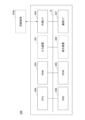
- Fig. 1 is a configuration diagram of an example of an information processing system according to this embodiment.
- the information processing system 1 in Fig. 1 includes a design support device 10 and a user terminal 12.
- the design support device 10 and the user terminal 12 are connected to each other so as to be able to communicate data with each other via a communication network 18 such as a local area network (LAN) or the Internet.
- LAN local area network
- the user terminal 12 is an information processing terminal operated by a worker, such as a PC, a tablet terminal, or a smartphone.
- the user terminal 12 displays a screen on the display device that accepts information input from the worker, and receives information input from the worker. Further, the user terminal 12 transmits information input from the operator to the design support device 10, and causes the design support device 10 to execute a process to support the design of a material that combines a plurality of raw materials.
- the user terminal 12 receives information on the execution results of the processing by the design support apparatus 10, and displays the information on the display device for confirmation by the operator.
- the design support device 10 is an information processing device such as a PC that supports the design of a material that combines a plurality of raw materials as described below.
- the design support device 10 performs an inverse problem analysis process that proposes candidates for material design condition information that satisfy required property information, and a forward problem analysis process that predicts material properties based on the design condition information. .
- the design support device 10 supports the design of a material that combines a plurality of raw materials by executing inverse problem analysis processing and forward problem analysis processing.
- the design support device 10 can utilize a mathematical model such as a machine learning model (a trained machine learning model) that has learned the correspondence between the design condition information of a material used to mix a plurality of raw materials and the material property information.
- machine learning methods include linear, generalized linear (lasso, ridge, elastic net, logistic), partial least squares, kernel ridge, Gaussian process, k-nearest neighbor method, decision tree, random forest, AdaBoost, bagging, Supervised learning techniques such as gradient boosting, support vector machines, or neural networks may be used.
- inverse problem analysis required characteristic information and range information of design condition information are input, and exhaustive search points are generated at random or at a predetermined step size in the design condition information within the range.
- the inverse problem analysis process uses a trained machine learning model to predict the material properties corresponding to each exhaustive search point, and extracts exhaustive search points with characteristics that satisfy the required property information. Candidates for design condition information that satisfy the required characteristic information can be obtained.
- the composition ratio or blending amount of each raw material blended into the material is input.
- the design support device 10 creates feature quantities (explanatory variables) of the raw material to be input to the trained machine learning model based on information quantifying the molecular structure of the raw material and the composition ratio and blending amount of the raw material.
- the blending amounts of raw materials will be explained as an example.
- ECFP Extended Circular Finger Prints
- SMILES Simplified Molecular Input Line Entry System
- SMARTS SMARTS notation
- InChI notation ECFP can quantify the molecular structure of a raw material by inputting raw material information expressed in SMILES notation into an existing library, for example.
- Another example of a method for quantifying the molecular structure of raw materials is to extract physical property values (molecular weight, number of radical charges, number of valence electrons, etc.) that can be calculated from the molecular structure of raw materials, and extract vectors (columns: types).
- physical property values molecular weight, number of radical charges, number of valence electrons, etc.
- vectors vectors: types.
- Physical property values can be extracted, for example, by inputting raw material information expressed in SMILES notation into an existing library.
- the design support device 10 receives information input by a worker into the user terminal 12, and executes processing to support material design.
- the design support apparatus 10 transmits processing result information to the user terminal 12 and causes the user terminal 12 to display the processing result information.
- the information processing system 1 in FIG. 1 can be realized by a design support device 10 having a Web server function and a user terminal 12 that executes a Web application using a Web browser function. Further, the information processing system 1 in FIG. 1 may be realized by an application installed on the user terminal 12 performing processing in cooperation with a program installed on the design support apparatus 10.
- the design support device 10 may be realized by a plurality of computers, or may be realized as a cloud computing service. Further, the information processing system 1 in FIG. 1 may be realized by a stand-alone computer.
- the design support apparatus 10 and user terminal 12 in FIG. 1 are realized, for example, by a computer 500 having the hardware configuration shown in FIG. 2.
- FIG. 2 is a hardware configuration diagram of an example of a computer according to this embodiment.
- the computer 500 in FIG. 2 includes an input device 501, a display device 502, an external I/F 503, a RAM 504, a ROM 505, a CPU 506, a communication I/F 507, an HDD 508, and the like, each of which is interconnected via a bus B.
- the input device 501 and the display device 502 may be used in a connected manner.
- the input device 501 is a touch panel, operation keys, buttons, keyboard, mouse, etc. used by the user to input various signals.
- the display device 502 includes a display such as a liquid crystal or organic EL that displays a screen, a speaker that outputs sound data such as voice and sound, and the like.
- Communication I/F 507 is an interface through which computer 500 performs data communication.
- the HDD 508 is an example of a nonvolatile storage device that stores programs and data.
- the stored programs and data include an OS, which is basic software that controls the entire computer 500, and applications that provide various functions on the OS.
- the computer 500 may use a drive device (for example, a solid state drive: SSD) that uses a flash memory as a storage medium.
- SSD solid state drive
- the external I/F 503 is an interface with an external device.
- the external device includes a recording medium 503a and the like.
- the computer 500 can read and/or write to the recording medium 503a via the external I/F 503.
- the recording medium 503a includes a flexible disk, CD, DVD, SD memory card, USB memory, and the like.
- the ROM 505 is an example of a nonvolatile semiconductor memory (storage device) that can retain programs and data even when the power is turned off.
- the ROM 505 stores programs and data such as the BIOS, OS settings, and network settings that are executed when the computer 500 is started.
- the RAM 504 is an example of a volatile semiconductor memory (storage device) that temporarily holds programs and data.
- the CPU 506 is an arithmetic device that realizes control and functions of the entire computer 500 by reading programs and data from a storage device such as the ROM 505 and the HDD 508 onto the RAM 504 and executing processing.
- the computer 500 according to this embodiment can implement various functions of the design support apparatus 10 and the user terminal 12, which will be described later, by executing programs.
- FIG. 3 is a functional configuration diagram of an example of the information processing system according to this embodiment. Note that, in the configuration diagram of FIG. 3, parts unnecessary for explaining the present embodiment are omitted as appropriate.
- the user terminal 12 also includes an information display section 50, an operation reception section 52, a request transmission section 54, and a response reception section 56.
- the information display unit 50 displays on the display device 502 a screen for accepting information input from a worker and information on the execution results of the processing of the design support device 10.
- the operation accepting unit 52 accepts operator operations such as inputting information.
- the request transmitting unit 54 transmits a processing request to the design support apparatus 10 in accordance with information input from the operator. Further, the response receiving unit 56 receives a response to the processing request transmitted by the request transmitting unit 54 from the design support apparatus 10.
- the request receiving unit 20 receives a processing request from the user terminal 12.
- the response transmitter 22 responds with the execution results of the process in response to the process request.
- the registration reception unit 24 receives input of information on the name and attribute of a raw material to be newly registered, and stores the information in the raw material information storage unit 42 .
- the raw material information storage unit 42 stores information on names and attributes of a plurality of registered raw materials.
- the design condition input reception unit 26 receives input of design condition information including information on a plurality of raw materials stored in the raw material information storage unit 42 from the operator.
- the required characteristic input receiving unit 28 receives input of required characteristic information of a material to be mixed with a plurality of raw materials from an operator.
- the range information input reception unit 30 receives input of range information of design condition information including information on a plurality of raw materials stored in the raw material information storage unit 42.
- the feature amount generation unit 34 generates feature amounts of the raw material that can be input to the learned machine learning model from information on the attributes of the raw material.
- the exhaustive search point generation unit 36 generates a predetermined number (for example, 1000) of exhaustive search points at random or at a predetermined step size within the range information of the design condition information.
- the exhaustive search point is a combination of composition ratios or blending amounts of a plurality of raw materials that are blended into the material.
- the blending amount of each raw material is selected, for example, from within the range indicated by the lower limit and upper limit of the blending amount.
- the material property prediction unit 38 predicts material properties using a learned machine learning model based on the input design condition information.
- the design condition proposal unit 40 proposes candidates for design condition information that satisfy the input required characteristic information using a trained machine learning model.
- the design condition proposal unit 40 predicts the material properties corresponding to each exhaustive search point using the trained machine learning model, and extracts exhaustive search points with characteristics that satisfy the required characteristic information, thereby achieving the desired requirements. Obtain candidates for design condition information that satisfy the characteristic information.
- the machine learning model storage unit 44 stores a machine learning model that has learned the correspondence between material design condition information and material characteristic information.
- the material design condition information includes information such as the type and blending amount of raw materials, and process conditions.
- the process conditions include, for example, a treatment temperature such as heat treatment, a treatment time, and the like.
- the characteristic information of the material includes viscosity, glass transition point, molecular weight, acid value, and the like.
- the control unit 32 includes a request reception unit 20, a response transmission unit 22, a registration reception unit 24, a design condition input reception unit 26, a required characteristic input reception unit 28, a range information input reception unit 30, a feature value generation unit 34, and an exhaustive search point It controls the generation section 36, material property prediction section 38, design condition proposal section 40, and display control section 46.
- the display control unit 46 controls so that the material properties predicted by the material property prediction unit 38 or the design condition information candidates proposed by the design condition proposal unit 40 are displayed on the user terminal 12.
- the configuration diagram in FIG. 3 is an example.
- the configuration of the information processing system 1 according to this embodiment can be realized by various configurations.
- the raw material information storage unit 42 and the machine learning model storage unit 44 may be included in a storage device, a computer, a cloud storage, or the like that can communicate data with the design support device 10.
- the information processing system 1 causes the user terminal 12 to display a new raw material registration screen 1000 as shown in FIGS. 4 and 5, for example, when the operator selects a menu for registering a new raw material.
- a new raw material registration screen 1000 in FIG. 4 is an example of a screen for inputting the purpose of a newly registered raw material, the name of the raw material to be added, and the SMILES of the raw material.
- the raw material name to be added is the name of a newly registered raw material, and is an example of information for the operator to identify the raw material.
- the usage of the raw material and the SMILES of the raw material are examples of information on the attributes of the raw material.
- the usage of the raw material is an example of information indicating the usage of the raw material, such as monomer (main chain), monomer (side chain), polymerization initiator, solvent, or catalyst, as shown in FIG. 5, for example.
- a new raw material registration screen 1000 in FIG. 5 shows an example in which an operator selects one raw material use from a plurality of raw material uses.
- the SMILES of a raw material is an example of information on the molecular structure of a raw material to be newly registered.
- the new raw material registration screen 1000 in Figures 4 and 5 shows an example of inputting information on the molecular structure of a raw material to be newly registered in SMILES notation, but it may also be input in SMARTS notation or InChI notation. Furthermore, the new raw material registration screen 1000 in Figures 4 and 5 may input information on the molecular structure of a raw material to be newly registered in any of the file formats MOL, SDF, PDB, or CIF format for expressing molecular structures. Furthermore, the new raw material registration screen 1000 in Figures 4 and 5 can accept input of information on the raw material to be added by uploading a list of the use of the raw material to be added, the raw material name to be added, and the SMILES of the raw material.
- FIG. 6 is an image diagram of an example of the registered raw material list screen.
- the registered raw material list screen 1100 in FIG. 6 displays the addition date, use, name, and SMILES of the raw material newly registered from the new raw material registration screen 1000 as shown in FIGS. 4 and 5 and stored in the raw material information storage unit 42. This is an example of a screen displaying a list.
- FIG. 7 is a flowchart illustrating an example of a process for prohibiting registration of a new raw material with an equivalent molecular structure.
- the registration reception unit 24 of the design support apparatus 10 receives input of new raw material information from the new raw material registration screen 1000 shown in FIGS. 4 and 5.
- step S12 the registration reception unit 24 converts the information on the molecular structure included in the input information on the new raw material into canonical SMILES of the new raw material.
- step S14 the registration reception unit 24 compares the canonical smile of the new raw material with the canonical smile of the raw material registered in the raw material information storage unit 42. Note that the verification using Canonical Smiles is just one example, and any information that can verify the uniqueness of the raw material may be used.
- step S16 the registration reception unit 24 determines whether there is a registered raw material in the raw material information storage unit 42 whose canonical smile matches the new raw material. If there is no raw material registered in the raw material information storage unit 42 whose Canonical Smile matches the new raw material, the registration reception unit 24 determines that the new raw material does not have an equivalent molecular structure to the raw material stored in the raw material information storage unit 42. , the new raw material is registered in the raw material information storage section 42 in step S18.
- step S20 the registration reception unit 24 rejects registration of the new raw material in the raw material information storage unit 42 in order to prohibit double registration of a new raw material that has a molecular structure equivalent to that of the raw material already stored in the raw material information storage unit 42. do.
- FIG. 8 is a flowchart illustrating an example of a process for prohibiting registration of a new raw material with an equivalent molecular structure.
- the registration reception unit 24 of the design support apparatus 10 receives input of new raw material information from the new raw material registration screen 1000 shown in FIGS. 4 and 5.
- step S32 the registration reception unit 24 converts the molecular structure information included in the received input information on the new raw material into a canonical smile of the new raw material.
- step S34 the registration reception unit 24 compares the canonical smile of the new raw material with the canonical smile of the raw material registered in the raw material information storage unit 42 whose use is the same as the new raw material. Note that the verification using Canonical Smiles is just one example, and any information that can verify the uniqueness of the raw material may be used.
- step S36 the registration reception unit 24 determines whether there is a raw material registered in the raw material information storage unit 42 that has the same use as the new raw material and a canonical smile that matches the new raw material.
- the registration reception unit 24 transfers the new raw material to the raw material information storage unit 42 in step S38. Register.
- the registration reception unit 24 registers the new raw material in the raw material information storage unit 42. It is determined that the molecular structure is equivalent to the stored raw material for the same purpose, and the process of step S40 is performed. In step S40, the registration reception unit 24 prohibits double registration of a new raw material that has a molecular structure equivalent to a raw material for the same use that has already been stored in the raw material information storage unit 42. Refuse registration.
- FIG. 9 is a flowchart illustrating an example of a process for prohibiting registration of a new raw material with an equivalent molecular structure.
- the registration reception unit 24 of the design support apparatus 10 receives input of new raw material information from the new raw material registration screen 1000 shown in FIGS. 4 and 5.
- step S52 the registration reception unit 24 converts the molecular structure information included in the received input information on the new raw material into a canonical smile of the new raw material.
- step S54 the registration reception unit 24 compares the canonical smile of the new raw material with the canonical smile of the raw material registered in the raw material information storage unit 42 whose use is the same as the new raw material. Note that the verification using Canonical Smiles is just one example, and any information that can verify the uniqueness of the raw material may be used.
- step S56 the registration reception unit 24 determines whether there is a raw material registered in the raw material information storage unit 42 that has the same use as the new raw material and has a canonical smile that matches the new raw material.
- step S58 the registration reception unit 24 compares the name of the new raw material with the name of the raw material already registered in the raw material information storage unit 42.
- the registration reception unit 24 registers the new raw material in the raw material information storage unit 42 in step S60.
- step S56 if there is a raw material registered in the raw material information storage unit 42 whose use is the same as the new raw material and whose canonical smile matches the new raw material, the registration reception unit 24 executes the process of step S62. conduct.
- step S58 if there is a registered raw material in the raw material information storage unit 42 that matches the name of the new raw material, the registration reception unit 24 performs the process of step S62.
- step S62 the registration reception unit 24 confirms that the new raw material has a molecular structure equivalent to a raw material for the same purpose stored in the raw material information storage unit 42, or that the new raw material is the same as a raw material stored in the raw material information storage unit 42. It is determined that the name is the name , and the process of step S62 is performed.
- step S62 the registration reception unit 24 stores raw material information of the new raw material in order to prohibit double registration of a new raw material that has an equivalent molecular structure or the same name as a raw material for the same use that is already stored in the raw material information storage unit 42. Registration with Section 42 is refused.
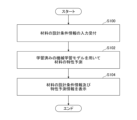
- FIG. 10 is a flowchart showing an example of support processing by forward problem analysis of material design.
- FIG. 11A is a configuration diagram of an example of material design condition information.
- FIG. 11B is a configuration diagram of an example of material property prediction information.
- the design condition input reception unit 26 of the design support apparatus 10 acquires material design condition information input by the operator at the user terminal 12, for example as shown in FIG. 11A.
- the material design condition information includes the type and blending amount of the raw material stored in the raw material information storage unit 42 as information.
- the ID "polymer 1" in FIG. 11A is an example of information that identifies the material.
- the raw material category is an example of information indicating the use of the raw material.
- the raw material name is an example of information indicating the name of the raw material.
- the blending amount is an example of information indicating the amount of raw materials used for material synthesis.
- the raw material with the raw material name "New Monomer C" in FIG. 11A is an example of a raw material registered in the raw material information storage unit 42 through new raw material registration.
- Raw materials other than the raw material name "New Monomer C" in FIG. 11A are included as raw materials in the design condition information of the learning dataset used for learning the machine learning model stored in the machine learning model storage unit 44. .
- step S102 the control unit 32 uses the trained machine learning model stored in the machine learning model storage unit 44 to predict the material properties acquired by the design condition input reception unit 26 in step S100 as follows. conduct.
- the control unit 32 reads out the types and amounts of raw materials to be mixed into the material from the design condition information of the material acquired by the design condition input reception unit 26 in step S100, and provides this to the feature generation unit 34 to request the generation of feature amounts of the raw materials.
- the feature generation unit 34 generates feature amounts of the raw materials to be mixed into the material, for example, as shown in FIG. 12.
- FIG. 12 is an explanatory diagram of an example of a process for generating characteristic amounts of raw materials to be mixed into materials.
- the feature generation unit 34 reads out from the raw material information storage unit 42 information on the molecular structure of the raw materials expressed in SMILES notation, which is an example of information on the molecular structures of the “raw materials A” and “raw materials B” blended into the materials.
- the feature generation unit 34 converts information on the molecular structure of the raw material into numerical information using a method such as ECFP that digitizes the molecular structure of the raw material.
- ECFP a method such as ECFP that digitizes the molecular structure of the raw material.
- FIG. 12 information on the molecular structures of "raw material A” and “raw material B” added to the material is converted into 1024-dimensional numerical information using ECFP.
- the feature generation unit 34 generates 1024-dimensional numerical information obtained by converting information on the molecular structure of "raw material A” and “raw material B” mixed into the material using ECFP, and the amount of the raw material mixed into the material. By integrating, the feature amount of the raw material to be input to the trained model is generated.
- the main chain information and the side chain information are integrated separately. This is because the same raw material may be used as an initiator or as a monomer, and if the raw materials are integrated without considering the usage, accurate results will not be obtained. If it is composed of raw materials for which there is no need to consider the reaction order, the calculation may be performed by integrating all the materials.
- the control unit 32 provides the material property prediction unit 38 with the feature quantities of the raw materials to be mixed into the material generated by the feature quantity generation unit 34, and requests the material property prediction unit 38 to predict the properties of the material.
- the material property prediction unit 38 inputs the characteristic amounts of raw materials to be mixed into the material into a trained machine learning model, and predicts the properties of the material.
- the material property prediction unit 38 obtains material property prediction information as shown in FIG. 11B, for example, by predicting material properties using a learned machine learning model.
- the material property prediction information shown in FIG. 11B shows the viscosity, glass transition point, molecular weight, and acid value of the material as examples of the material properties.
- step S104 the display control unit 46 of the design support device 10 uses the design condition information of the material, for example, shown in FIG. 11A, input by the operator in step S100, and the property prediction of the material, for example, shown in FIG. 11B, obtained in step S102. The information is displayed on the user terminal 12.
- the characteristics of a material containing raw materials that are not included in the learning data set used for learning the machine learning model can be predicted by forward problem analysis, thereby supporting material design.
- the information processing system 1 performs support processing using inverse problem analysis of material design, as shown in FIG. 13, for example, when the operator selects a menu for support using inverse problem analysis of material design.
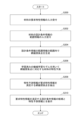
- FIG. 13 is a flowchart illustrating an example of support processing using inverse problem analysis for material design.
- FIG. 14 is a configuration diagram of an example of required material characteristic information.
- FIG. 15 is a configuration diagram of an example of range information of material design condition information.
- FIGS. 16A and 16B are configuration diagrams of an example of information on proposed materials.
- step S200 the required characteristic input receiving unit 28 of the design support apparatus 10 acquires the required characteristic information of the material shown in FIG. 14, for example, inputted by the operator at the user terminal 12.
- the material required characteristic information in FIG. 14 is an example in which the required characteristics of the material are expressed by a lower limit value and an upper limit value.
- FIG. 14 shows the lower and upper limits of viscosity, glass transition point, molecular weight, and acid value as an example of required properties of the material.
- the range information input reception unit 30 acquires the range information of the material design condition information shown in FIG. 15, for example, which is input by the operator at the user terminal 12.
- the range information of the material design condition information in FIG. 15 includes as information a raw material category, a raw material name, a lower limit value of the blending amount, and an upper limit value of the blending amount.
- the raw material category and raw material name indicate the type of raw material.
- the lower limit of the amount to be blended and the upper limit of the amount to be blended indicate the range of the amount to be blended for each raw material.
- the range information of the material design condition information shown in FIG. 15 is an example in which the operator can select raw materials that are always added to the material. By checking the item "Must include", the worker can select the raw materials that are always included in the material.
- FIG. 15 is an example in which "monomer A” and “monomer B” are selected as raw materials to be necessarily blended.
- the raw material with the raw material name "New Monomer C" in FIG. 15 is an example of a raw material registered in the raw material information storage unit 42 through new raw material registration.
- step S204 the control unit 32 provides the range information of the material design condition information acquired in step S202 to the comprehensive search point generation unit 36 to generate comprehensive search points within the range information of the material design condition information. request.
- the exhaustive search point generation unit 36 generates a predetermined number (for example, 1000) of exhaustive search points within the range information of the provided material design condition information.
- the range information of the design condition information of the material shown in FIG. This is a combination of the amounts of "polymerization initiator D".
- the blending amount of each raw material is selected from within the range indicated by the items "lower limit of blending amount” and "upper limit of blending amount”.
- step S206 the design condition proposal unit 40 uses the trained machine learning model stored in the machine learning model storage unit 44 to predict the properties of the material based on the plurality of exhaustive search points generated in step S204. , obtain material property prediction information corresponding to a plurality of exhaustive search points.
- step S208 the design condition proposal unit 40 extracts exhaustive search points where the material property prediction information obtained in step S206 satisfies the required material property information as shown in FIG. 14, for example.
- the process of step S208 is a process of extracting exhaustive search points that can satisfy the required characteristic information of the material as shown in FIG. 14 from among the exhaustive search points generated randomly or at a predetermined step size within the range of design conditions. be.
- step S210 the display control unit 46 of the design support apparatus 10 displays candidates of design condition information and property prediction information of materials to be synthesized based on the exhaustive search points extracted in step S208, for example, as shown in FIGS. 16A and 16B.
- the user terminal 12 is controlled to display information on suggested materials.
- FIG. 16A shows property prediction information of a material to be synthesized based on the exhaustive search points extracted in step S208, as information on the proposed material.
- FIG. 16B shows, as proposed material information, design condition information of a material to be synthesized based on the exhaustive search points extracted in step S208.
- the information on the proposed material shown in FIGS. 16A and 16B is an example.
- the property prediction information of the proposed material shown in FIG. 16A and the design condition information of the proposed material shown in FIG. 16B may be combined using the ID as a key. may be displayed in one line.
- the material designed by the design support device 10 is produced by, for example, supplying material design condition information to a manufacturing device that blends a plurality of raw materials to produce the material, and blends the plurality of raw materials.
- the material may be generated by a manufacturing device.
- the information processing system 1 provides a design support device, a design support method, a program, and an information processing system that predict the characteristics of a material blended with a plurality of raw materials and support the design of the material. Can be provided.
Landscapes
- Engineering & Computer Science (AREA)
- Theoretical Computer Science (AREA)
- Computing Systems (AREA)
- Bioinformatics & Computational Biology (AREA)
- Bioinformatics & Cheminformatics (AREA)
- Life Sciences & Earth Sciences (AREA)
- Chemical & Material Sciences (AREA)
- Crystallography & Structural Chemistry (AREA)
- Data Mining & Analysis (AREA)
- Software Systems (AREA)
- Medical Informatics (AREA)
- General Health & Medical Sciences (AREA)
- Evolutionary Computation (AREA)
- Databases & Information Systems (AREA)
- Health & Medical Sciences (AREA)
- Computer Vision & Pattern Recognition (AREA)
- Artificial Intelligence (AREA)
- Management, Administration, Business Operations System, And Electronic Commerce (AREA)
- Information Retrieval, Db Structures And Fs Structures Therefor (AREA)
Priority Applications (4)
| Application Number | Priority Date | Filing Date | Title |
|---|---|---|---|
| EP23867961.7A EP4593020A1 (en) | 2022-09-20 | 2023-08-24 | Design assistance device, design assistance method, program, and information processing system |
| CN202380053184.5A CN119547145A (zh) | 2022-09-20 | 2023-08-24 | 设计辅助装置、设计辅助方法、程序及信息处理系统 |
| US18/992,329 US20260004893A1 (en) | 2022-09-20 | 2023-08-24 | Design assistance device, design assistance method, program, and information processing system |
| JP2024548150A JPWO2024062837A1 (https=) | 2022-09-20 | 2023-08-24 |
Applications Claiming Priority (2)
| Application Number | Priority Date | Filing Date | Title |
|---|---|---|---|
| JP2022149308 | 2022-09-20 | ||
| JP2022-149308 | 2022-09-20 |
Publications (1)
| Publication Number | Publication Date |
|---|---|
| WO2024062837A1 true WO2024062837A1 (ja) | 2024-03-28 |
Family
ID=90454104
Family Applications (1)
| Application Number | Title | Priority Date | Filing Date |
|---|---|---|---|
| PCT/JP2023/030551 Ceased WO2024062837A1 (ja) | 2022-09-20 | 2023-08-24 | 設計支援装置、設計支援方法、プログラム及び情報処理システム |
Country Status (5)
| Country | Link |
|---|---|
| US (1) | US20260004893A1 (https=) |
| EP (1) | EP4593020A1 (https=) |
| JP (1) | JPWO2024062837A1 (https=) |
| CN (1) | CN119547145A (https=) |
| WO (1) | WO2024062837A1 (https=) |
Cited By (1)
| Publication number | Priority date | Publication date | Assignee | Title |
|---|---|---|---|---|
| JP7715267B1 (ja) * | 2024-11-18 | 2025-07-30 | Dic株式会社 | 生成方法、情報処理装置、および生成プログラム |
Citations (5)
| Publication number | Priority date | Publication date | Assignee | Title |
|---|---|---|---|---|
| US20020062307A1 (en) * | 2000-11-17 | 2002-05-23 | Amedis Pharmaceuticals Ltd | Method for generating a database of molecular fragments |
| WO2021045058A1 (ja) * | 2019-09-06 | 2021-03-11 | 昭和電工株式会社 | 材料設計装置、材料設計方法、及び材料設計プログラム |
| JP2021047627A (ja) | 2019-09-18 | 2021-03-25 | 株式会社日立製作所 | 材料特性予測システムおよび材料特性予測方法 |
| WO2021095722A1 (ja) * | 2019-11-11 | 2021-05-20 | 昭和電工マテリアルズ株式会社 | 情報処理システム、情報処理方法、および情報処理プログラム |
| JP2022149308A (ja) | 2021-03-25 | 2022-10-06 | 株式会社カネカ | 医療用具の製造方法 |
-
2023
- 2023-08-24 US US18/992,329 patent/US20260004893A1/en active Pending
- 2023-08-24 EP EP23867961.7A patent/EP4593020A1/en active Pending
- 2023-08-24 CN CN202380053184.5A patent/CN119547145A/zh active Pending
- 2023-08-24 JP JP2024548150A patent/JPWO2024062837A1/ja active Pending
- 2023-08-24 WO PCT/JP2023/030551 patent/WO2024062837A1/ja not_active Ceased
Patent Citations (5)
| Publication number | Priority date | Publication date | Assignee | Title |
|---|---|---|---|---|
| US20020062307A1 (en) * | 2000-11-17 | 2002-05-23 | Amedis Pharmaceuticals Ltd | Method for generating a database of molecular fragments |
| WO2021045058A1 (ja) * | 2019-09-06 | 2021-03-11 | 昭和電工株式会社 | 材料設計装置、材料設計方法、及び材料設計プログラム |
| JP2021047627A (ja) | 2019-09-18 | 2021-03-25 | 株式会社日立製作所 | 材料特性予測システムおよび材料特性予測方法 |
| WO2021095722A1 (ja) * | 2019-11-11 | 2021-05-20 | 昭和電工マテリアルズ株式会社 | 情報処理システム、情報処理方法、および情報処理プログラム |
| JP2022149308A (ja) | 2021-03-25 | 2022-10-06 | 株式会社カネカ | 医療用具の製造方法 |
Cited By (1)
| Publication number | Priority date | Publication date | Assignee | Title |
|---|---|---|---|---|
| JP7715267B1 (ja) * | 2024-11-18 | 2025-07-30 | Dic株式会社 | 生成方法、情報処理装置、および生成プログラム |
Also Published As
| Publication number | Publication date |
|---|---|
| CN119547145A (zh) | 2025-02-28 |
| JPWO2024062837A1 (https=) | 2024-03-28 |
| EP4593020A1 (en) | 2025-07-30 |
| US20260004893A1 (en) | 2026-01-01 |
Similar Documents
| Publication | Publication Date | Title |
|---|---|---|
| EP4398257A1 (en) | Property prediction device, property prediction method, and program | |
| WO2024173125A1 (en) | Automated machine learning using large language models | |
| JP7414194B1 (ja) | 情報処理装置、情報処理システム、プログラム、及びイジングモデル作成支援方法 | |
| EP3910506A1 (en) | System and method for providing service, and carrier means | |
| CN110968311B (zh) | 前端页面构建方法、装置及电子设备 | |
| WO2024062837A1 (ja) | 設計支援装置、設計支援方法、プログラム及び情報処理システム | |
| JP7601279B2 (ja) | 情報処理装置、情報処理システム、プログラム、及び材料組成探索方法 | |
| CN114072787A (zh) | 用于促进文档审核的快速数据输入的系统和方法 | |
| US20250046403A1 (en) | Design support device, design support method, and program | |
| WO2025053155A1 (ja) | 設計支援装置、設計支援方法、プログラム及び設計支援システム | |
| EP4362031A1 (en) | Physical property prediction device, physical property prediction method, and program | |
| CN111919199B (zh) | 用于应用导航的神经网络系统和方法 | |
| CN109462576B (zh) | 权限策略配置方法、装置及计算机可读存储介质 | |
| JP2024046304A (ja) | 候補モノマー提案装置、候補モノマー提案方法、及び候補モノマー提案プログラム | |
| CN119948516A (zh) | 文件制作辅助装置和程序 | |
| JP6869082B2 (ja) | テストケースを選択する計算機及びテストケースの選択方法 | |
| JP2024006420A (ja) | 情報処理装置、情報処理システム、情報処理方法、及びプログラム | |
| CN118673208A (zh) | 信息处理装置、存储介质及信息处理方法 | |
| JP2015072615A (ja) | サーバー装置、画面定義システム、画面定義方法、及びプログラム | |
| JP7512759B2 (ja) | 情報処理装置、文書管理システムおよびプログラム | |
| EP4418092A1 (en) | Information processing device, program, and input assistance method | |
| CN118673209A (zh) | 信息处理装置、存储介质及信息处理方法 | |
| JP2025073302A (ja) | 業務支援装置、業務支援システム及び業務支援プログラム | |
| WO2024122290A1 (ja) | データ表示装置、解析システム、データ表示方法及びプログラム | |
| WO2025258250A1 (ja) | 生成装置、生成方法、および生成プログラム |
Legal Events
| Date | Code | Title | Description |
|---|---|---|---|
| 121 | Ep: the epo has been informed by wipo that ep was designated in this application |
Ref document number: 23867961 Country of ref document: EP Kind code of ref document: A1 |
|
| WWE | Wipo information: entry into national phase |
Ref document number: 2024548150 Country of ref document: JP |
|
| WWE | Wipo information: entry into national phase |
Ref document number: 18992329 Country of ref document: US |
|
| WWE | Wipo information: entry into national phase |
Ref document number: 202380053184.5 Country of ref document: CN |
|
| WWP | Wipo information: published in national office |
Ref document number: 202380053184.5 Country of ref document: CN |
|
| WWE | Wipo information: entry into national phase |
Ref document number: 2023867961 Country of ref document: EP |
|
| NENP | Non-entry into the national phase |
Ref country code: DE |
|
| ENP | Entry into the national phase |
Ref document number: 2023867961 Country of ref document: EP Effective date: 20250422 |
|
| WWP | Wipo information: published in national office |
Ref document number: 2023867961 Country of ref document: EP |
|
| WWP | Wipo information: published in national office |
Ref document number: 18992329 Country of ref document: US |