WO2024047682A1 - 演算プログラム、演算方法、および情報処理装置 - Google Patents
演算プログラム、演算方法、および情報処理装置 Download PDFInfo
- Publication number
- WO2024047682A1 WO2024047682A1 PCT/JP2022/032329 JP2022032329W WO2024047682A1 WO 2024047682 A1 WO2024047682 A1 WO 2024047682A1 JP 2022032329 W JP2022032329 W JP 2022032329W WO 2024047682 A1 WO2024047682 A1 WO 2024047682A1
- Authority
- WO
- WIPO (PCT)
- Prior art keywords
- objective
- optimization
- direction intersecting
- information processing
- solution
- Prior art date
- Legal status (The legal status is an assumption and is not a legal conclusion. Google has not performed a legal analysis and makes no representation as to the accuracy of the status listed.)
- Ceased
Links
Images








Classifications
-
- G—PHYSICS
- G06—COMPUTING OR CALCULATING; COUNTING
- G06F—ELECTRIC DIGITAL DATA PROCESSING
- G06F17/00—Digital computing or data processing equipment or methods, specially adapted for specific functions
- G06F17/10—Complex mathematical operations
- G06F17/11—Complex mathematical operations for solving equations, e.g. nonlinear equations, general mathematical optimization problems
-
- G—PHYSICS
- G06—COMPUTING OR CALCULATING; COUNTING
- G06F—ELECTRIC DIGITAL DATA PROCESSING
- G06F30/00—Computer-aided design [CAD]
- G06F30/20—Design optimisation, verification or simulation
-
- G—PHYSICS
- G06—COMPUTING OR CALCULATING; COUNTING
- G06Q—INFORMATION AND COMMUNICATION TECHNOLOGY [ICT] SPECIALLY ADAPTED FOR ADMINISTRATIVE, COMMERCIAL, FINANCIAL, MANAGERIAL OR SUPERVISORY PURPOSES; SYSTEMS OR METHODS SPECIALLY ADAPTED FOR ADMINISTRATIVE, COMMERCIAL, FINANCIAL, MANAGERIAL OR SUPERVISORY PURPOSES, NOT OTHERWISE PROVIDED FOR
- G06Q10/00—Administration; Management
- G06Q10/04—Forecasting or optimisation specially adapted for administrative or management purposes, e.g. linear programming or "cutting stock problem"
-
- G—PHYSICS
- G06—COMPUTING OR CALCULATING; COUNTING
- G06Q—INFORMATION AND COMMUNICATION TECHNOLOGY [ICT] SPECIALLY ADAPTED FOR ADMINISTRATIVE, COMMERCIAL, FINANCIAL, MANAGERIAL OR SUPERVISORY PURPOSES; SYSTEMS OR METHODS SPECIALLY ADAPTED FOR ADMINISTRATIVE, COMMERCIAL, FINANCIAL, MANAGERIAL OR SUPERVISORY PURPOSES, NOT OTHERWISE PROVIDED FOR
- G06Q10/00—Administration; Management
- G06Q10/06—Resources, workflows, human or project management; Enterprise or organisation planning; Enterprise or organisation modelling
- G06Q10/063—Operations research, analysis or management
- G06Q10/0639—Performance analysis of employees; Performance analysis of enterprise or organisation operations
-
- G—PHYSICS
- G16—INFORMATION AND COMMUNICATION TECHNOLOGY [ICT] SPECIALLY ADAPTED FOR SPECIFIC APPLICATION FIELDS
- G16Z—INFORMATION AND COMMUNICATION TECHNOLOGY [ICT] SPECIALLY ADAPTED FOR SPECIFIC APPLICATION FIELDS, NOT OTHERWISE PROVIDED FOR
- G16Z99/00—Subject matter not provided for in other main groups of this subclass
Definitions
- This case relates to an arithmetic program, an arithmetic method, and an information processing device.
- the present invention aims to provide an information processing device, a calculation method, and a calculation program that can reduce calculation time.
- the calculation program performs single-objective optimization on the initial solution using each of a plurality of objective functions as a first evaluation function, thereby obtaining a single-objective optimal solution that has a better value than the initial solution. and calculating the second evaluation function using the single-objective optimal solution as a starting point, using a linear weighted sum obtained by weighting each of the plurality of objective functions according to the single-objective optimal solution as a second evaluation function.
- An arithmetic program characterized by executing a process of performing multi-objective optimization on a computer.
- FIG. 3 is a diagram illustrating a Pareto solution.
- FIG. 2 is a diagram illustrating a case where a genetic algorithm is used as a multi-objective optimization engine.
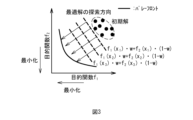
- FIG. 3 is a diagram illustrating a linear weighted sum method.
- (a) is a functional block diagram showing the overall configuration of the information processing device according to the first embodiment, and (b) is a hardware configuration diagram of the information processing device.
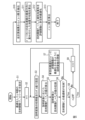
- 3 is a diagram illustrating a flowchart of Example 1.
- FIG. (a) and (b) are explanatory diagrams of Example 1.
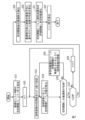
- FIG. 7 is a diagram illustrating a flowchart of Example 2;
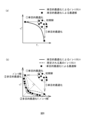
- (a) and (b) are explanatory diagrams of Example 2. It is a figure showing a calculation result. It is a figure showing a calculation result.
- FIG. 2 is a diagram for explaining a hypervolume.
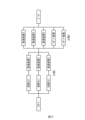
- FIG. 2 is a diagram illustrating a production line model.
- (a) to (c) are diagrams illustrating product information. It is a figure showing a calculation result. It is a figure showing a calculation result.
- optimization problems exist in various industries, including the manufacturing and distribution industries. For example, in the problem of optimizing a production plan at a manufacturing site, there is a problem in which there is a trade-off between the manufacturing time required for a certain production plan and the cost that occurs in proportion to the operating time of equipment. For example, there is a trade-off problem in that reducing the manufacturing time increases the operating time of legacy equipment with high operating costs, increasing costs.
- a multi-objective optimization problem in which multiple objective functions having a trade-off relationship are simultaneously optimized is generally a problem for finding a Pareto solution.
- the manufacturing time required for a certain production plan and the cost generated in proportion to the operating time of the device are each objective functions.
- the explanatory variable is a production plan, such as the order in which each product is introduced into the production process.
- a Pareto solution is a solution that has at least one objective function that is better than any other solution.
- FIG. 2 is a diagram illustrating a case where a genetic algorithm is used as an example of the multi-objective optimization engine.
- Genetic algorithm is a method that incorporates genetic elements to find solutions such that each objective function is minimized from a group of initial solutions.
- the search direction corresponds to a direction moving leftward and downward from the initial solution.
- FIG. 3 is a diagram illustrating the linear weighted sum method in this case.
- the objective function f 1 (x 1 ) ⁇ w+objective function f 2 (x 1 ) ⁇ (1 ⁇ w) is obtained from the initial solution group, and the objective function f 1 (x 2 ) ⁇ w+objective function is obtained from the solution.
- f 2 (x 2 ) ⁇ (1 ⁇ w) is obtained, and further the objective function f 1 (x 3 ) ⁇ w+objective function f 2 (x 3 ) ⁇ (1 ⁇ w) is obtained.
- w corresponds to weight, and has a value of 0 ⁇ w ⁇ 1.
- FIG. 4(a) is a functional block diagram showing the overall configuration of the information processing device 100 according to the first embodiment.
- the information processing device 100 is a server for optimization processing or the like. As illustrated in FIG. 4A, the information processing device 100 functions as an objective function setting unit 10, an optimization execution unit 20, an intermediate progress recording unit 30, a result output unit 40, and the like.
- FIG. 4(b) is a hardware configuration diagram of the information processing device 100.
- the information processing device 100 includes a CPU 101, a RAM 102, a storage device 103, an input device 104, a display device 105, and the like.
- a CPU (Central Processing Unit) 101 is a central processing unit.
- CPU 101 includes one or more cores.
- a RAM (Random Access Memory) 102 is a volatile memory that temporarily stores programs executed by the CPU 101, data processed by the CPU 101, and the like.
- the storage device 103 is a nonvolatile storage device.
- a ROM Read Only Memory
- SSD solid state drive
- the storage device 103 stores calculation programs.
- the input device 104 is a device for the user to input necessary information, and may be a keyboard, a mouse, or the like.
- the display device 105 is a device that displays the results output by the result output unit 40 on a screen.
- Each part of the information processing device 100 is realized by the CPU 101 executing the calculation program. Note that hardware such as a dedicated circuit may be used as each part of the information processing device 100.
- the objective function setting unit 10 sets a plurality of objective functions.
- the objective function setting unit 10 may set two objective functions, or may set three or more objective functions.
- the objective function setting unit 10 sets N objective functions f 1 to f N.
- the optimization execution unit 20 executes optimization so that the objective functions f 1 to f N are optimized.
- the intermediate progress recording unit 30 records the results of the optimization execution unit 20 performing optimization.
- the result output unit 40 outputs the results of the optimization performed by the optimization execution unit 20.
- FIGS. 6(a) and 6(b) are explanatory diagrams regarding the two objective functions f 1 and f 2 .
- Each objective function is, for example, a production completion time in a production process, a cost related to production, etc. The shorter the production completion time, the better, and the lower the cost.
- the optimization execution unit 20 sets n to 1 (step S2). Accordingly, first, attention is paid to the objective function f1 .
- the optimization execution unit 20 sets the initial value of each explanatory variable to a random value (step S3).
- the initial value may be one or more.
- the initial value may be input by the user using the input device 104.
- step S4 calculates the values of the objective functions f 1 to f N according to the explanatory variables (step S4).
- step S4 is executed for the first time, the values of the objective functions f 1 to f N are calculated from the initial values of the explanatory variables.
- an initial solution group as illustrated in FIG. 6(a) is generated.
- the intermediate progress recording unit 30 records the explanatory variables used in step S4 and the values of the objective functions f 1 to f N calculated in step S4 (step S5). Therefore, the intermediate progress recording unit 30 records the initial solution group.
- the optimization execution unit 20 determines whether the optimal solution of the objective function f n has converged (step S6). Here, it is determined whether the objective function f n has the best value. Note that it may be determined whether a better solution than the initial value has been obtained.
- step S6 determines whether the determination in step S6 is "No" or the optimization execution unit 20 updates the explanatory variables so that the evaluation function is optimized by the single-objective optimization engine (step S7). Thereafter, the process is executed again from step S4.
- step S6 the optimization execution unit 20 determines whether n is greater than or equal to N (step S8). By executing step S8, it is possible to determine whether single-objective optimization has been completed for all objective functions.
- step S8 If the determination in step S8 is "No", the optimization execution unit 20 adds 1 to n to set it to n+1 (step S9). Thereafter, the process is executed again from step S3.
- step S8 the optimization execution unit 20 extracts a Pareto solution from all calculation results (step S10). Thereby, as illustrated in FIG. 6(a), a Pareto solution obtained by single-objective optimization of each objective function can be extracted. Note that the extracted Pareto solution is recorded by the intermediate progress recording section 30.
- the optimization execution unit 20 calculates a linear weighted sum that is weighted according to the arrangement of the Pareto solutions extracted in step S10 (step S11). For example, weighting is performed in the vertical direction on an approximate plane that approximates the arrangement of Pareto solutions. If there are two objective functions, the approximate straight line of the Pareto solution is used instead of the above approximate plane. In FIG. 6(a), an approximate straight line that approximates the Pareto solution is obtained.
- the approximation method is not particularly limited, but may be, for example, the least squares method.
- FIG. 6(b) an approximate straight line and a direction intersecting the approximate straight line (for example, a perpendicular direction) are drawn. This direction corresponds to the solution search direction.
- the optimization execution unit 20 executes multi-objective optimization using the objective functions f 1 to f N and the linear weighted sum as an evaluation function (step S12).
- the initial value of the explanatory variable in this case is an explanatory variable corresponding to the Pareto solution extracted in step S10.
- the optimization execution unit 20 calculates a Pareto solution using the execution result of step S12 (step S13).
- the Pareto solution is depicted in FIG. 6(b).
- the result output unit 40 outputs the calculation result in step S13.
- a linear weighted sum obtained by weighting each objective function in the direction perpendicular to the Pareto front is set as the evaluation function, and a multi-objective optimization calculation is executed to solve the Pareto solution.
- the search direction for the optimal solution is set using a linearly weighted sum to solve the true Pareto front.
- single-objective optimization is performed for each objective function before multi-objective optimization. Since multi-objective optimization is performed starting from the optimal solution obtained by single-objective optimization, the calculation time required to reach the true Pareto front is shortened. Note that the computational load of single-objective optimization is significantly smaller than that of multi-objective optimization, so compared to performing multi-objective optimization without single-objective optimization, the computational load is reduced and the calculation time is reduced. can be shortened.
- Example 1 the results of the optimal calculation process were used in single-objective optimization, but the present invention is not limited thereto.
- the results of the optimal calculation process are not used in single-objective optimization.
- FIGS. 8(a) and 8(b) are explanatory diagrams regarding two objective functions f 1 and f 2 .
- Each objective function is, for example, a production completion time in a production process, a cost related to production, etc. The shorter the production completion time, the better, and the lower the cost.
- the optimization execution unit 20 sets n to 1 (step S22). Accordingly, first, attention is paid to the objective function f1 .
- the optimization execution unit 20 sets the initial value of the explanatory variable to a random value (step S23).
- the initial value may be one or more.
- the initial value may be input by the user using the input device 104.
- step S24 the optimization execution unit 20 calculates the values of the objective functions f 1 to f N according to the explanatory variables (step S24).
- step S24 is executed for the first time, the values of the objective functions f 1 to f N are calculated from the initial values of the explanatory variables.
- an initial solution group as illustrated in FIG. 6(a) is generated.
- the optimization execution unit 20 determines whether the optimal solution of the objective function f n has converged (step S25). Here, it is determined whether the objective function f n has the best value. Note that it may be determined whether a better solution than the initial value has been obtained.
- step S25 If the determination in step S25 is "No", the optimization execution unit 20 updates the explanatory variables so that the evaluation function is optimized by the single-objective optimization engine (step S26). Thereafter, the process is executed again from step S24.
- step S26 the optimization execution unit 20 determines whether n is greater than or equal to N (step S27). By executing step S27, it can be determined whether single-objective optimization has been completed for all objective functions.
- step S27 If the determination in step S27 is "No", the optimization execution unit 20 adds 1 to n to set it to n+1 (step S28). Thereafter, the process is executed again from step S23.
- step S27 the optimization execution unit 20 extracts an optimal solution for each objective function (step S29). As illustrated in FIG. 8A, the solution with the lowest value of f 1 and the solution with the lowest value of f 2 are extracted as the optimal solution. Note that each extracted optimal solution is recorded by the intermediate progress recording section 30.
- the optimization execution unit 20 calculates a linear sum weighted according to the arrangement of the optimal solutions extracted in step S29 (step S30). For example, weighting is performed perpendicularly to the plane connecting the optimal solutions. If there are two objective functions, a straight line connecting the optimal solutions is used. In FIG. 8(a), a straight line connecting the optimal solutions is obtained. In FIG. 8(b), a line connecting the optimal solutions and a direction (for example, a perpendicular direction) intersecting the line are drawn. This direction corresponds to the solution search direction.
- the optimization execution unit 20 executes multi-objective optimization using the objective functions f 1 to f N and the linear weighted sum as an evaluation function (step S31).
- the initial value of the explanatory variable in this case is the explanatory variable corresponding to the optimal solution extracted in step S29.
- the optimization execution unit 20 calculates a Pareto solution using the execution result of step S31 (step S32).
- the Pareto solution is depicted in FIG. 8(b).
- the result output unit 40 outputs the calculation result in step S32.
- a multi-objective optimization calculation is performed by setting each objective function f n and a linearly weighted sum in which each objective function is weighted in the direction perpendicular to the Pareto front as an evaluation function. Find the Pareto solution. While minimizing each objective function, the search direction for the optimal solution is set using a linearly weighted sum to solve the true Pareto front.
- single-objective optimization is performed for each objective function before multi-objective optimization. Since multi-objective optimization is performed starting from the optimal solution obtained by single-objective optimization, the calculation time required to reach the true Pareto front is shortened. Note that the computational load of single-objective optimization is significantly smaller than that of multi-objective optimization, so compared to performing multi-objective optimization without single-objective optimization, the computational load is reduced and the calculation time is reduced. can be shortened.
- Example 1 Simulation results of Example 1
- f 1 and f 2 are used as objective functions.
- Multi-objective optimization was performed to minimize these objective functions.
- the following standard problem was used. This standard problem is disclosed in "Eckart Zitzler, Kalyanmoy Ded, and Lothar Thiele, Comparison of Multiobjective Evolutionary Algorithms: Empirical Results, Evolutionary Computation, vol. 8, Issue 2, pp. 173?195 (2000).” .
- g(x 2 , . . . , x m ) can be expressed as in the following formula.
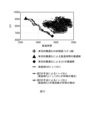
- FIG. 9 is a diagram showing the calculation results. As shown in the results of FIG. 9, in the single-objective optimization, the values were concentrated in the region where the value of f 1 (x) was small and the region where the value of f 2 (x) was small.
- FIG. 11 is a diagram for explaining hypervolume.
- Hypervolume is a performance measure of the Pareto solution.
- a hypervolume represents the area or volume of a region formed by a certain reference point and a solution set obtained by an algorithm on an objective function space.
- the reference point can be set to (0, 0), and each objective function can be standardized.
- the area shown in FIG. 11 is the hypervolume. The larger the hypervolume, the wider the solution, so it can be determined that good results are being obtained.
- Example 2 Simulation results of Example 2 Next, simulation results of Example 2 will be explained.
- the objective function was set using a specific layout of a manufacturing site.
- FIG. 12 is a diagram illustrating a production line model. As illustrated in FIG. 12, the production line model has branching and merging, and multiple products are introduced one by one. A plurality of operations are sequentially performed for each of the plurality of products. At least some of the operations for the plurality of products are different.
- the production line model in FIG. 12 is a production line model composed of process 1 and process 2.
- the products repeat branching and merging as they pass through process 1 and process 2 according to the order in which the products are introduced, and finally go through inspection and packaging processes before being shipped.
- process 1 three manufacturing apparatuses 1 having the same specifications are arranged. Before each manufacturing apparatus 1 performs work, a stage change (work of changing the settings of the processing machine's jig and equipment according to the type of product to be produced) is performed.
- Step 2 does not require stage changes.
- process 2 three manufacturing devices 2 and two legacy devices with different specifications from the manufacturing devices 2 are arranged.
- Legacy devices are devices that are costly and time consuming.
- stage change can be performed simultaneously and in parallel using a maximum of two devices.
- the cost of each device increases in proportion to the operating time of the device.
- FIGS. 13(a) to 13(c) are diagrams illustrating product information.
- FIG. 13(a) is a diagram illustrating master information of the production master.
- FIG. 13(b) is a diagram illustrating the operating cost of the production master.
- FIG. 13(c) is a diagram illustrating the takt time for stage change in the production master.
- a device operating cost coefficient is associated with each manufacturing device. The operating cost is calculated by multiplying the machining takt time by this coefficient.
- a changeover takt time is associated with the combination of subsequent product/previous product.
- the previous product for a certain device is the type of product for which the manufacturing process was previously performed by the device.
- the subsequent product is the type of product that will undergo the next manufacturing process using the device.
- Each product combination is linked to the "subsequent product/previous product" number.
- optimization algorithm was used as the optimization algorithm, but the optimization algorithm is not limited to this. Other optimization algorithms such as evolutionary algorithms may also be used.
- the optimization execution unit 20 performs single-objective optimization on the initial solution using each of the plurality of objective functions as the first evaluation function, so that the optimization execution unit 20 performs single-objective optimization on the initial solution to obtain a better value than the initial solution.
- An objective optimal solution is calculated, and a linear weighted sum obtained by weighting each of the plurality of objective functions according to the single objective optimal solution is used as a second evaluation function, and the second evaluation function is calculated using the single objective optimal solution as a starting point.
Landscapes
- Engineering & Computer Science (AREA)
- Physics & Mathematics (AREA)
- General Physics & Mathematics (AREA)
- Theoretical Computer Science (AREA)
- Business, Economics & Management (AREA)
- Mathematical Physics (AREA)
- Human Resources & Organizations (AREA)
- Mathematical Analysis (AREA)
- Mathematical Optimization (AREA)
- Computational Mathematics (AREA)
- Data Mining & Analysis (AREA)
- Pure & Applied Mathematics (AREA)
- Operations Research (AREA)
- Economics (AREA)
- Strategic Management (AREA)
- General Engineering & Computer Science (AREA)
- Development Economics (AREA)
- Entrepreneurship & Innovation (AREA)
- Software Systems (AREA)
- Algebra (AREA)
- Databases & Information Systems (AREA)
- Tourism & Hospitality (AREA)
- General Business, Economics & Management (AREA)
- Quality & Reliability (AREA)
- Marketing (AREA)
- Game Theory and Decision Science (AREA)
- Educational Administration (AREA)
- Evolutionary Computation (AREA)
- Computer Hardware Design (AREA)
- Geometry (AREA)
- Management, Administration, Business Operations System, And Electronic Commerce (AREA)
Priority Applications (4)
| Application Number | Priority Date | Filing Date | Title |
|---|---|---|---|
| JP2024543601A JP7839431B2 (ja) | 2022-08-29 | 2022-08-29 | 演算プログラム、演算方法、および情報処理装置 |
| PCT/JP2022/032329 WO2024047682A1 (ja) | 2022-08-29 | 2022-08-29 | 演算プログラム、演算方法、および情報処理装置 |
| EP22957288.8A EP4583025A4 (en) | 2022-08-29 | 2022-08-29 | CALCULATION PROGRAM, CALCULATION METHOD AND INFORMATION PROCESSING DEVICE |
| US19/039,792 US20250173390A1 (en) | 2022-08-29 | 2025-01-29 | Computer-readable recording medium storing arithmetic program, arithmetic method, and information processing device |
Applications Claiming Priority (1)
| Application Number | Priority Date | Filing Date | Title |
|---|---|---|---|
| PCT/JP2022/032329 WO2024047682A1 (ja) | 2022-08-29 | 2022-08-29 | 演算プログラム、演算方法、および情報処理装置 |
Related Child Applications (1)
| Application Number | Title | Priority Date | Filing Date |
|---|---|---|---|
| US19/039,792 Continuation US20250173390A1 (en) | 2022-08-29 | 2025-01-29 | Computer-readable recording medium storing arithmetic program, arithmetic method, and information processing device |
Publications (1)
| Publication Number | Publication Date |
|---|---|
| WO2024047682A1 true WO2024047682A1 (ja) | 2024-03-07 |
Family
ID=90099107
Family Applications (1)
| Application Number | Title | Priority Date | Filing Date |
|---|---|---|---|
| PCT/JP2022/032329 Ceased WO2024047682A1 (ja) | 2022-08-29 | 2022-08-29 | 演算プログラム、演算方法、および情報処理装置 |
Country Status (4)
| Country | Link |
|---|---|
| US (1) | US20250173390A1 (https=) |
| EP (1) | EP4583025A4 (https=) |
| JP (1) | JP7839431B2 (https=) |
| WO (1) | WO2024047682A1 (https=) |
Cited By (1)
| Publication number | Priority date | Publication date | Assignee | Title |
|---|---|---|---|---|
| WO2026058462A1 (ja) * | 2024-09-12 | 2026-03-19 | 三菱電機株式会社 | 良好解特定装置及び良好解特定方法 |
Citations (6)
| Publication number | Priority date | Publication date | Assignee | Title |
|---|---|---|---|---|
| JP2002366587A (ja) | 2001-06-07 | 2002-12-20 | Hitachi Ltd | 最適化方法 |
| JP2009169557A (ja) * | 2008-01-14 | 2009-07-30 | Fujitsu Ltd | 多目的最適化設計支援装置、方法、及びプログラム |
| US20150019173A1 (en) | 2013-07-09 | 2015-01-15 | International Business Machines Corporation | Multiobjective optimization through user interactive navigation in a design space |
| US20160306899A1 (en) | 2012-11-12 | 2016-10-20 | International Business Machines Corporation | Multi objective design selection |
| WO2021186551A1 (ja) * | 2020-03-17 | 2021-09-23 | 富士通株式会社 | 情報処理装置、作業計画決定方法、および作業計画決定プログラム |
| JP2022083200A (ja) | 2020-11-24 | 2022-06-03 | 日鉄テックスエンジ株式会社 | 処理装置、処理方法、およびプログラム |
Family Cites Families (1)
| Publication number | Priority date | Publication date | Assignee | Title |
|---|---|---|---|---|
| JP5282493B2 (ja) * | 2008-09-04 | 2013-09-04 | 富士通株式会社 | 最適解関係表示装置、方法、及びプログラム |
-
2022
- 2022-08-29 WO PCT/JP2022/032329 patent/WO2024047682A1/ja not_active Ceased
- 2022-08-29 EP EP22957288.8A patent/EP4583025A4/en active Pending
- 2022-08-29 JP JP2024543601A patent/JP7839431B2/ja active Active
-
2025
- 2025-01-29 US US19/039,792 patent/US20250173390A1/en active Pending
Patent Citations (6)
| Publication number | Priority date | Publication date | Assignee | Title |
|---|---|---|---|---|
| JP2002366587A (ja) | 2001-06-07 | 2002-12-20 | Hitachi Ltd | 最適化方法 |
| JP2009169557A (ja) * | 2008-01-14 | 2009-07-30 | Fujitsu Ltd | 多目的最適化設計支援装置、方法、及びプログラム |
| US20160306899A1 (en) | 2012-11-12 | 2016-10-20 | International Business Machines Corporation | Multi objective design selection |
| US20150019173A1 (en) | 2013-07-09 | 2015-01-15 | International Business Machines Corporation | Multiobjective optimization through user interactive navigation in a design space |
| WO2021186551A1 (ja) * | 2020-03-17 | 2021-09-23 | 富士通株式会社 | 情報処理装置、作業計画決定方法、および作業計画決定プログラム |
| JP2022083200A (ja) | 2020-11-24 | 2022-06-03 | 日鉄テックスエンジ株式会社 | 処理装置、処理方法、およびプログラム |
Non-Patent Citations (3)
| Title |
|---|
| ECKART ZITZLERKALYANMOY DEDLOTHAR THIELE: "Comparison of Multiobjective Evolutionary Algorithms: Empirical Results", EVOLUTIONARY COMPUTATION, vol. 8 |
| See also references of EP4583025A4 |
| WATANABE SHINYA, KAZUTOSHI SAKAKIBARA: "Multiobjective Approaches in Single Objective Optimization Environment.", INFORMATION PROCESSING SOCIETY OF JAPAN JOURNAL, vol. 46, no. SIG 17(TOM 13), 19 December 2005 (2005-12-19), pages 70 - 79, XP093144905 * |
Cited By (1)
| Publication number | Priority date | Publication date | Assignee | Title |
|---|---|---|---|---|
| WO2026058462A1 (ja) * | 2024-09-12 | 2026-03-19 | 三菱電機株式会社 | 良好解特定装置及び良好解特定方法 |
Also Published As
| Publication number | Publication date |
|---|---|
| JP7839431B2 (ja) | 2026-04-02 |
| JPWO2024047682A1 (https=) | 2024-03-07 |
| EP4583025A4 (en) | 2025-10-22 |
| EP4583025A1 (en) | 2025-07-09 |
| US20250173390A1 (en) | 2025-05-29 |
Similar Documents
| Publication | Publication Date | Title |
|---|---|---|
| US11237544B2 (en) | Information processing device, program, process treatment executing device, and information processing system | |
| US7788070B2 (en) | Product design optimization method and system | |
| CN113010954A (zh) | 桥梁结构损伤识别方法、装置及终端设备 | |
| CN117236278A (zh) | 一种基于数字孪生技术的芯片生产仿真方法及系统 | |
| Li et al. | Improved LSTM-based prediction method for highly variable workload and resources in clouds | |
| WO2024047682A1 (ja) | 演算プログラム、演算方法、および情報処理装置 | |
| JP2008518359A (ja) | 最適化問題の解決方法及びそのシステム | |
| US11762562B2 (en) | Performance analysis apparatus and performance analysis method | |
| WO2021161503A1 (ja) | 設計プログラムおよび設計方法 | |
| JP2009213328A (ja) | 電力系統シミュレータにおける負荷曲線モデルの生成方法 | |
| JP7452247B2 (ja) | 変換プログラム、変換方法および情報処理装置 | |
| CN114491703A (zh) | 获取物料清单bom信息的方法、装置、电子设备及介质 | |
| JP4971074B2 (ja) | 工業製品の生産支援プログラム | |
| JP7184155B2 (ja) | テンソル分解処理システム、方法およびプログラム | |
| JP7711560B2 (ja) | 設計支援装置、設計支援方法及び設計支援プログラム | |
| JP7062923B2 (ja) | 可視化方法、可視化装置及び可視化プログラム | |
| JP2004110470A (ja) | 最適設計計算装置及びそのプログラム記憶媒体 | |
| JP6973493B2 (ja) | 情報分析装置、情報分析方法および情報分析プログラム | |
| JP2022107518A (ja) | 情報処理システム、情報処理方法及び情報処理装置 | |
| JPWO2024047682A5 (https=) | ||
| JP3428813B2 (ja) | 電力系統シミュレータ | |
| JP7700624B2 (ja) | 予測モデルの作成方法、操業プロセスの条件設定方法 | |
| US20240386286A1 (en) | Arithmetic method, computer-readable recording medium storing arithmetic program, and information processing device | |
| CN105068971B (zh) | 一种向量点积的OpenCL自动化实现方法 | |
| JP2008070956A (ja) | 評価装置、評価方法、及び評価プログラム |
Legal Events
| Date | Code | Title | Description |
|---|---|---|---|
| 121 | Ep: the epo has been informed by wipo that ep was designated in this application |
Ref document number: 22957288 Country of ref document: EP Kind code of ref document: A1 |
|
| WWE | Wipo information: entry into national phase |
Ref document number: 2024543601 Country of ref document: JP |
|
| WWE | Wipo information: entry into national phase |
Ref document number: 2022957288 Country of ref document: EP |
|
| NENP | Non-entry into the national phase |
Ref country code: DE |
|
| ENP | Entry into the national phase |
Ref document number: 2022957288 Country of ref document: EP Effective date: 20250331 |
|
| WWP | Wipo information: published in national office |
Ref document number: 2022957288 Country of ref document: EP |